w w w . i a j p s . c o m
Page 3765
CODEN (USA): IAJPBB ISSN: 2349-7750
I
INNDDOO AAMMEERRIICCAANN JJOOUURRNNAALLOOFF
P
P
H
H
A
A
R
R
M
M
A
A
C
C
E
E
U
U
T
T
I
I
C
C
A
A
L
L
S
S
C
C
I
I
E
E
N
N
C
C
E
E
S
S
http://doi.org/10.5281/zenodo.1039135Available online at: http://www.iajps.com
Research Article
CHALLENGES OF IMPLEMENTING ACCREDITATION
PROGRAM IN IRAN: A QUALITATIVE STUDY
Saiedeh Sharifi
1, Farzad Faraji Khiavi
2, Mansour Zahiri
3*1 M.S of Health Services Management, Department of Health Services Management, Health
School, Ahvaz University of Medical Sciences, Ahvaz, Iran
2 Ph.D, Associate Professor, Department of health services administration, School of Health,
Ahvaz Jundishapur University of Medical Sciences, Ahvaz, Iran
3 PhD, Assistant Professor,
Department of Health Services Administration, School of Health,
Ahvaz Jundishapur University of Medical Sciences, Ahvaz, Iran
Abstract:
Accreditation is one of the methods of evaluation in healthcare organizations, especially hospitals that in Iran is one of the complicated priorities of the Ministry of Health. This study aimed to analyze the internal and external accreditation status of implementation of the accreditation program in educational hospitals in Ahvaz. This qualitative study which was performed through thematic analysis aimed to assess the views of managers, head nurses and officials of the accreditation department of educational hospitals and experts of treatment affair affiliated with Ahvaz University of Medical Sciences about accreditation challenges. Data were collected by using semi-structured interviews in 2016. Purposive sampling method was used for sampling. Data was analyzed using content analysis and through SWOT (Strengths, Weaknesses, Opportunities, Threats). According to internal analysis, the strengths of the implementation of accreditation programs categorized in three main themes: structural-cultural, systemic-management and human resource, weaknesses had three themes too: program by nature of the accreditation program, cultural, structural and human resources was determined. Looking for external analysis of opportunities in the form of five main themes were the resources, education and culture, the private sector, other government programs and initiatives and evaluate programs, opportunities in five themes including financial resources, competitive advantage, standards international, communications and other government projects and programs was classified and analyzed. Identifying serious challenges affecting implementation of accreditation program in this study will help to achieve noble objectives accreditation model in hospitals by reducing the weaknesses and considering threats and also by relying on strengths and appropriate use of opportunities.
Keywords: Accreditation, Hospital, Qualitative Study.
Corresponding author:
Mansour Zahiri, PhD,
Assistant Professor,
Department of health services administration,
School of Health, Ahvaz Jundishapur University of Medical Sciences,
Ahvaz, Iran.
Please cite this article in press as Mansour Zahiri et al
,
Challenges of Implementing Accreditation Program in Iran: A Qualitative Study , Indo Am. J. P. Sci, 2017; 4(10).IAJPS 2017, 4(10), 3765-3772 Mansour Zahiri
et al
ISSN 2349-7750
w w w . i a j p s . c o m
Page 3766
INTRODUCTION:
Paying attention to healthcare delivery is one of the objectives of Iran health system. The special attention given to the country's health development programs in the healthcare sector can be noted in this regard [1]. Treatment and the health system development on increasing productivity and workforce and production, adequate resource allocation and optimal use of resources have great importance in this sector considering the extraordinary impact of investing in health [2]. The pressure today is on health systems for greater effectiveness and services performance improvement [3]. Hospital centers are the pillars of the health system in any country and health system reform would not be possible without addressing these centers and improving and promoting their performance [4]. Evaluation has great importance in the field of health care services in terms of importance and sensitivity of the treatment and health of the community [5]. Healthcare services accreditation programs is an important mechanism for monitoring and controlling quality improvement programs by the government [6]. The Hospital accreditation is a self-assessment and an external quality review mechanisms that determines the amount of compliance with the specified standards as well as a tool for patient safety and quality improvement [7]. Accreditation is an effective tool that can be used to continuous quality improvement programs or create new leadership for continuous quality improvement plans [8]. An apparent willingness is seen towards accreditation in recent decades that is a warranted measuring to improve the quality of care and patient safety [9]. Many countries are currently working on increasing the use of accreditation programs [10]. Accreditation is carried out on a voluntary basis and for top hospitals in some of countries [8], but Iran accreditation system is mandatory and public in contrast to other countries [11], which its host is Ministry of Health in cooperation with medical sciences universities, therefore executing and controlling it, especially in educational hospitals that affiliated with the university have heavy costs. It was decided since 2011 that accreditation model be used to evaluate hospitals [4] and implementation phases of hospital accreditation were done during 2012-13. Hospital accreditation results released in 2014 and the ranking and tariff hospital services were carried out according to that and health reform program carried out by the Ministry of Health in the same year. Accreditation programs such as all healthcare interventions and programs need comprehensive and scientific evaluation and analysis. Of course, accreditation
program execution has limitations and shortcomings with all the benefits and strengths that must be discover and look for their solution during extensive studies [12]. The introduction of decision-making and planning is analysis of control factors to enhance the quality of accreditation program [13]. A thorough understanding of the control system, strengths, weaknesses, opportunities and threats reform can be achieved and provide its reform situation by analyzing internal and external factors. Process of implementing the accreditation program in recent years were studied in this study to assist the relevant policy and decision makers in health system towards provide practical and scientific solutions to promoting the program by recognizing challenges of program execution and the achievement to complete information in this regard. This study was conducted accordingly with the aim of a comprehensive internal and external analysis of implementation status of the accreditation program in Ahvaz city educational hospitals.
MATERIALS AND METHODS:
w w w . i a j p s . c o m
Page 3767
taking notes by the researcher to be set down onpaper more accurately with the permission of the interviewee. Implementing data was began at the same time with collecting it. The content analysis was used to analyze the interviews. Data transcript of each interview was studied several times and the meaning units of each was recorded. Then the semantic units obtained from interviews were coded and categorized according SWOT analysis approach. SWOT is a method to assess the strengths and weaknesses of the organization, in fact this approach is an analysis of the resources and capabilities of the organization, and the opportunities and threats. That reflects the organization's environmental factors [14]. Themes and sub-themes related to shape of the graph were summarized and reported after the data analysis.
FINDING:
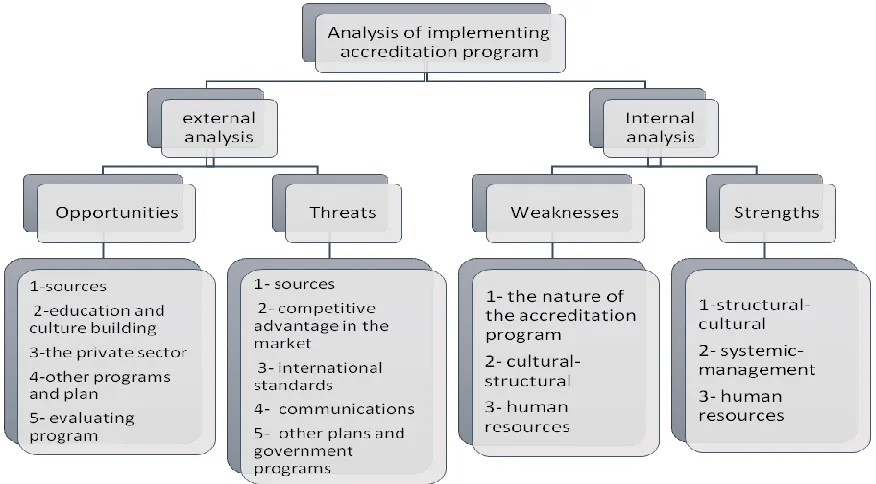
Data saturation is reached after interviewing 28 people who were involved managers, supervisors, accreditation and quality improving administrators of Ahvaz University of medical sciences educational hospitals. Demographic characteristics are shown in table1. Internal and external analysis of accreditation program execution was done by the opinion of participants in the educational hospitals of Ahvaz in this qualitative study. 16 main themes were achieved in implementing accreditation program divided into 3 strengths, 3 weaknesses and by external analyzing of 5 threats and 5
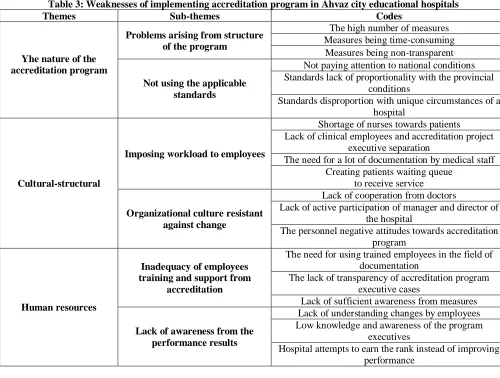
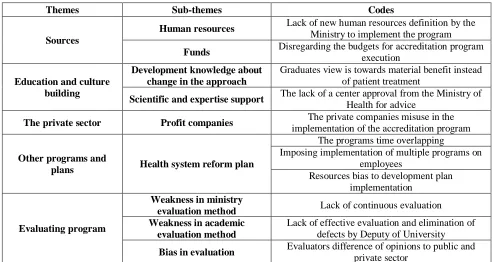
opportunities according to the results of interview in internal analysis. Figure 1 is showing results of this study as summary and simple. The strengths of implementing accreditation in Ahvaz city educational hospitals were reported with three main themes included: structural-cultural, systemic-management and human resources and 10 sub-themes obtained from 26 codes expressed by the participants that are shown in Table 2. Accreditation program weaknesses is divided into three main themes including: the nature of the accreditation program, cultural-structural, and human resources that were obtained with 6 sub-themes 19 code expressed by participants is shown in Table 3. External analysis of accreditation program execution is expressed in two areas of threats and opportunities. Opportunities of accreditation program execution are expressed in five main themes: sources, competitive advantage in the market, international standards, communications, and other plans and government programs that have been obtained from 7 sub-themes and 10 codes expressed by the participants. Details of this topic are shown in Table 4. Threats of accreditation program including five main themes: sources, education and culture building, the private sector, other programs and plans, and evaluating program. These themes are obtained from the 9 sub-themes and 11 codes expressed by the participants that are expressed as summary in Table 5.
Table 1: Demographic characteristics of involver in Ahvaz University of medical sciences educational hospitals in 2015(n=28)
Percent Frequency
Groups Variable
14.28 85.72 4
24
woman man gender
7.14 14.28 35.71 14.28 28.75 2
4 10
4 8
20-30 31-35 36-40 41-45 Up to 46 Age(year)
10.71 17.85 71.44 3
5 20
PHD Master bachelor Licence’s Degree
7.14 17.85 46.42 28.75 2
5 13
8
5< 5-10 11-20
20
IAJPS 2017, 4(10), 3765-3772 Mansour Zahiri
et al
ISSN 2349-7750
w w w . i a j p s . c o m
Page 3768
Fig 1: Internal and external analysis of implementing accreditation program in Ahvaz city educational hospitals.
Table 2: Strengths of implementing accreditation program in Ahvaz city educational hospitals
Themes Sub-themes Codes
structural-cultural
Improve the organizational structure
Regulatory functions from the hospital on providing services Determine the organizational roles and limitation of duties in the hospital
Service providers be accountable against their activities
Improving organizational culture
The personnel and hospital integration of goals Dynamize hospital environment in order to learn and improve
performance Empowering employees Motivate the personnel to learn more
systemic-management
Improving leadership and engagement with employees
Hospital committees on a regular basis
The presence of management in various committees within the hospital Formation of workgroups in deputy of treatment
Emphasizing the importance higher levels of accreditation standards
Promoting science and technology in organization
Greater use of technology The use of expert groups The use of updated standards
Improving safety
Holding training courses for the personnel Promote the processes
Improving the personnel knowledge and skills in the field of patient safety
Improving patient satisfaction
Improvement on complaints handling process Providing safer services for patients
Increasing the amount of information given to patients and their attendants
human resources
Improving the technical quality of care
Registering sectors processes in the form of policy Planning in the field of care management
Individual characteristics Increasing knowledge and awareness of personnel
Improving self-efficiency
Perceived benefits Understanding the importance of documentation in legal cases
w w w . i a j p s . c o m
Page 3769
Themes Sub-themes Codes
Yhe nature of the accreditation program
Problems arising from structure of the program
The high number of measures Measures being time-consuming
Measures being non-transparent
Not using the applicable standards
Not paying attention to national conditions Standards lack of proportionality with the provincial
conditions
Standards disproportion with unique circumstances of a hospital
Cultural-structural
Imposing workload to employees
Shortage of nurses towards patients Lack of clinical employees and accreditation project
executive separation
The need for a lot of documentation by medical staff Creating patients waiting queue
to receive service
Organizational culture resistant against change
Lack of cooperation from doctors
Lack of active participation of manager and director of the hospital
The personnel negative attitudes towards accreditation program
Human resources
Inadequacy of employees training and support from
accreditation
The need for using trained employees in the field of documentation
The lack of transparency of accreditation program executive cases
Lack of sufficient awareness from measures
Lack of awareness from the performance results
Lack of understanding changes by employees Low knowledge and awareness of the program
executives
Hospital attempts to earn the rank instead of improving performance
Table 4: Opportunities of implementing accreditation program in Ahvaz city educational hospitals
Themes Sub-themes Codes
sources Revenue Hospital financing based on rating obtained in
accreditation
competitive advantage in the market
Establishing inter-provincial competition
Establishing competition in a city or state hospitals
Establishing outer-provincial competition
Establishing competition between medical sciences universities
international standards
Creating and developing national
accreditation standards Entering international standards to the country
Promoting health tourism Preparing hospitals for providing health tourism
services
communications Increasing communication within
and outside the district
Experience of performing in other universities in the country
Sharing of information between hospitals Informal communication between universities in
the country(the main program executives)
other plans and
government programs Health system reform plan
Program development plan getting in line with helping hospitals to achieve measures and
IAJPS 2017, 4(10), 3765-3772 Mansour Zahiri
et al
ISSN 2349-7750
w w w . i a j p s . c o m
Page 3770
Table 5: Threats of implementing accreditation program in Ahvaz city educational hospitals
Themes Sub-themes Codes
Sources
Human resources Lack of new human resources definition by the
Ministry to implement the program
Funds Disregarding the budgets for accreditation program
execution
Education and culture building
Development knowledge about change in the approach
Graduates view is towards material benefit instead of patient treatment
Scientific and expertise support The lack of a center approval from the Ministry of
Health for advice
The private sector Profit companies The private companies misuse in the
implementation of the accreditation program
Other programs and
plans Health system reform plan
The programs time overlapping
Imposing implementation of multiple programs on employees
Resources bias to development plan implementation
Evaluating program
Weakness in ministry
evaluation method Lack of continuous evaluation
Weakness in academic evaluation method
Lack of effective evaluation and elimination of defects by Deputy of University
Bias in evaluation Evaluators difference of opinions to public and
private sector
DISCUSSION:
Results of the study showed that accreditation program execution in hospitals strengthens cultural and structural factors, systemic-management, and human resources. Participants believed that accreditation promotes cultural and structural factors in the hospital through improving organizational structure. Previous studies in Iran are also shown that accreditation is a good way to improve the quality of services by having comprehensive programs, monitoring and more controlling [15], and organizations that have been accredited commit themselves to improve the efficiency and better accountability [16] and have demonstrated the positive impact of the implementation of accreditation on organizational culture. Several studies have shown that hospital accreditation processes has a positive impact in the areas of leadership and management, in terms of improving the system-management [17, 18]. Statement of 2009 states that accreditation should focus on risk management and safety [19] Results of this study show that accreditation has improved safety levels which Hosford and battles and their colleagues researches also emphasized that [20-22]. Participants believed that accreditation improves human resources status. The results of Montagu and colleagues study also underscores this findings [23]. Some studies have shown that quality of care was improved as a result of accreditation that is in line with the present study [24-26], but Sack and colleagues study is
w w w . i a j p s . c o m
Page 3771
participants have low awareness and knowledgeabout the objectives, principles and concepts of the accreditation implementation that is in line with the present study [30]. On the other hand, awareness of the results of the accreditation motivates personnel. Shaw and Pomy studies showed lack of trust in the medical staff to the accreditation program and they consider fatigue of everyday work as a weaknesses of accreditation program [27, 18], that it is also mentioned in the present study. Therefore, it is necessary to take steps to remove them with recognizing the weaknesses of the accreditation program execution in achieving the goals of the accreditation that indeed is helping to improve quality and patient safety. The annual budget of hospitals from the Ministry of Health, that is devoted considering the degree accreditation earned by the hospital, can encourage hospitals to earn more points [12], and the result could compete hospitals. Participants have also noted hospitals competition for better implementation of accreditation program in the present study. Ghanbari and colleagues consider positive competition one of the best mechanisms to improve the employees’ motivation to provide services with high efficiency and effectiveness [31]. Participants have noted the impact of other government plans and programs coincided with the implementation of accreditation program. One of the most important and implementing plans of the Ministry of Health now is health system reform plan. Health system reform plan had a positive impact on accreditation program execution in hospitals with an appropriate budget, especially in hoteling. Some researchers consider success of accreditation program affected by manpower on the other hand in the quantity and quality of manpower [32]. Lack of scientific support and lack of development of science related to accreditation by the government is another factor that threatens accreditation program execution. Some of the previous studies also consider the government's lack of support as a negative factor on the implementation of accreditation [33, 34]. It is necessary to identify supportive shortcomings and take action in order to fix them. The Ministry of Health is better to train volunteers firms in the field of consulting implementation of accreditation program to hospitals and introduced them formally to the hospitals with a commitment to enforcement of laws to prevent this problem. Period of assessment, evaluations inefficient feedback and lack of uniformity in assessment views to private and public sector were from factors that participants pointed out. For the certificate of accreditation, the indicators are consistent with organizational strategy at the international level and is a requirement for firms that want to be in excellent accreditation, monitoring and
controlling program results is carried out considering predetermined goals [35].
CONCLUSION:
The accreditation program that began with the aim of promoting the quality of services and patient safety in hospitals, involves shortcomings and administrative weaknesses that became apparent during the implementation besides its benefits and prosperities. The main condition to achieve the noble objectives of accreditation is minimizing the factors that affect the proper implementing of the action as weaknesses and threats. Therefore, it is recommended to managers of the hospital to help to optimize implementing of accreditation models in hospitals by promoting internal factors influencing the implementation of the program including structural factors, cultural, management, systemic and human resources and higher authorities with insufficient attention to
external factors including resources,
communications, evaluation and training, and other government plans and programs in order to achieve good quality in providing health services through accreditation mandatory.
ACKNOWLEDGEMENTS
This paper was part of a Master of Science thesis in health management (grant no: U-94165). This study was financially supported by the Ahvaz Jundishapur University of Medical Sciences. The authors would like to thanks the managers, head nurses and officials of the accreditation department of educational hospitals and experts of treatment affair affiliated with Ahvaz University of Medical Sciences.
Conflict of Interests: The authors declare that there
is no conflict of interest.
REFERENCES:
1. Azar A, Valipuor Khatir M, Moghbel baerz A, Hasas yeganeh Y. Evaluation of Hospital Efficiency by Data Envelopment Analysis: Tehran University of Medical Sciences: 2009-2011. Journal of Health Administration. 2013; 16(53):36-46.
2. Alam tabriz A, Imanipour M. Measuring the Relative Efficiency of Health Care Offered in Hospitals bu Using Data Envelopment Analysis (DEA) Technique. Management perspective Journal of shahid baheshti university, 2011; 8(3):615-25.
3. Dehnavieh R,Ebrahimipour H, Jafari Zadeh M, Dianat M, Noori Hekmat S, Mehrolhassani M. Clinical Governance: The Challenges of Implementation in Iran. International Journal of Hospital Research. 2013; 2(1):1-10.
IAJPS 2017, 4(10), 3765-3772 Mansour Zahiri
et al
ISSN 2349-7750
w w w . i a j p s . c o m
Page 3772
5.Masouri N, Sadeghi F, Khayyamdar E. The Role of Medical Records in the Implementation of the EFQM Model in Hospital. Payavard. 2011; 5(3):49-58.
6.Mumford V, Greenfield D, Hogden A, Forde K, Westbrook J, Braithwaite J. Counting the costs of accreditation in acute care: an activity-based costing approach. BMJ Open. 2015; 5(2):e008850.
7. Halasa YA,Zeng W,Chappy E,Shepard DS. Value and impact of international hospital accreditation: a case study from Jordan. Eastern Mediterranean Health Journal. 2015; 21(2):90-8.
8. Almasabi M, Yang H, Thomas SH. A Systematic Review of the Association between Healthcare Accreditation and Patient Satisfaction. World Applied Sciences Journal. 2014; 31(9):1618-23.
9. Sack C, Scherag A, Lütkes P, Günther W, Jöckel K, Holtmann G. Is there an association between hospital accreditation and patient satisfaction with hospital care? A survey of 37 000 patients treated by 73 hospitals. International Journal for Quality in Health Care. 2011; 23(3):278-83.
10. Huang C,Wung C,Yang C. Developing 21st century
accreditation standards for teaching hospitals: the Taiwan experience. BMC Health Serv Res, 2009; 9(1):232-41.
11. Fortes M, Mattos R, Baptista T. Accreditation or accreditations? A comparative study about accreditation in France, United Kingdom and Cataluña. Revista da Associação Médica Brasileira. 2011; 57(2):239-46. 12.Yarmohammadian M, Shokri A, Bahmanziari N, Kordi A. Blind spots Accreditation Program. Journal of Health System Research. 2014; 9(11):1158-66.
13.Abolhasani F. Managing health program, ebook. 14. Gloria KB, Gilberto KK, Janice M, Benjamin J. Factors affecting implementation of accreditation programmes and the impact of the accreditation process on quality improvement in hospitals: a SWOT analysis. Hong Kong Med J. 2013; 19(5):434-46.
15. Esmaeelian M, NasrEsfahani M,Brahimi S. The Quality of Patients’ Files Documentation in Emergency Department; a Cross Sectional Study.Iranian J of Emergency Medicine. 2014; 1(1):16-21.
16. Nicklen W. The Value and Impact of Health care Accreditation: A Litarature Review. Accreditation Canada, 2012.
17. Braithwaite J, Greenfield D, Westbrook J, Pawsey M, Westbrook M, Gibberd R, Naylor J, Nathan S, Robinson M, Runciman B, Jackson M. Health service accreditation as a predictor of clinical and organisational performance: a blinded, random, stratified study. Quality and Safety in Health Care. 2010; 19(1):14-21. 18. Shaw C. The external assessment of health services. World Hospitals and Health Services. 2004; 40(1):24-7. 19. Ulin PR, Robinson ET & Tolley EE. Qualitative methods in public health: a field guide for applied research. USA: Wiley, 2004.
20. Battles J & Lilford R. Organizing patient safety research to identify risks and hazards. Quality and Safety in Health Care. 2003; 12(2):22-7.
21. Hosford SB. Hospital progress in reducing error: the impact of external interventions. Hospital topics. 2008; 86(1):9-20.
22. Sunol R, Vallejo P, Thompson A, Lombarts MJ, Shaw CD, Klazinga N. Impact of quality strategies on hospital outputs. Qual Saf Health Care. 2009; 18 (Suppl-1):62-8.
23. Montagu D. Accreditation and other external quality
assessment systems for healthcare: Review of
experience and lessons learned, 2003.
24. Chen J, Rathore S, Radford M, Krumholz H. JCAHO accreditation and quality of care for acute myocardial infarction. JCAHO accreditation and quality of care for acute myocardial infarction. Health Aff (Millwood). 2003; 22(2):243-54.
25. El-Jardali F, Jamal D, Dimassi H, Ammar W, Tchaghchaghian V. The impact of hospital accreditation on quality of care: perception of Lebanese nurses. Int J Qual Health Care. 2008; 20(5):363-71.
26. Sutherland K & Leatherman S. Regulation and quality improvement: a review of the evidence. Quest for Quality and Improved Performance, 2006.
27. Pomey M, Contandriopoulos A, François P, Bertrand D. Accreditation: a tool for organizational change in hospitals? Int J Health Care Qual Assur Inc Leadersh Health Serv. 2004; 17(2-3):113-24.
28. Shaw C, Bruneau C, Kutryba B, De Jongh G, Sunol R. Towards hospital standardization in Europe. International Journal for Quality in Health Care. 2010; 22(4):244-49.
29. Meadows G. Streamlining regulatory compliance through clinical systems. Nurs Econ 2003; 21(4):196-98.
30. Azami S, Tabrizi JS, Abdollahi L, Yari Fard K, Kabiri N, Valizadeh S, Daemi A, Abhari AA, Nadimi B. Knowledge and Attitude of Top Managers toward Accreditation in Tabriz and Ardabil Teaching Hospitals. Journal of Health. 2012; 3(2):7-15.
31. Ghanbari R, Karimi I, Mahmoudi M. Designing a model of competition in providing services for Iranian Public Hospitals.J of healthcare management. 2010; 1(3):57-68.
32. Yarmohammadian MH, Shokri A, Bahmanziari N, Kordi A. The blind spots on Accreditation program. J Health Syst Res. 2013; 9(11):1158-66.