Cryptanalysis and Improvement on Robust Three-Factor Remote User
Authentication Scheme with Key Agreement for Multimedia System
Younsung Choi and Dongho Won*
Affiliation College of Information and Communication Engineering, Sungkyunkwan University, Suwon-si, Gyeonggi-do, Republic of Korea
{yschoi, dhwon}@security.re.kr
ABSTRACT
A three-factor authentication combines biometrics information with user password and smart card to provide security-enhanced user authentication. An proposed user authentication scheme improved Das’s scheme. But An’s scheme is not secure against denial of service attack in login phase, forgery attack. Li et al. pointed out them and proposed three-factor remote user authentication scheme with key agreement. However, Li et al’s scheme still has some security problem. In this paper, we present a cryptanalysis and improvement of Li et al.’s remote user authentication scheme.
KEYWORDS
Three-factor authentication, Key agreement scheme, Cryptanalysis, Smart card, Biometrics information
1 INTRODUCTION
Recently, internet technology is growing up. The system providing various multimedia service consists of many different servers around the world. Since various servers providing access for the user are usually greater than one, authentication schemes for multiple server environments are required for the high level of security. And the protection of digital data becomes a significant issue in network-based remote application systems [1, 2].
Lamport [3] firstly proposed a password-based authentication scheme for communication via insecure channels but the server has to store a password table. Lamport’s scheme has critical vulnerability on stolen-verifier attack. So, some researchers proposed the security enhanced
various security problems. So we analyze the Li et al.’s scheme and point out the vulnerability of this scheme.
The remainder of this paper is organized as follows. Section 2 provides some related work for understanding this paper. And section 3 describes the Li et al.’s authentication scheme. In section 4, we performs cryptanalysis on Li et al.’s authentication scheme. And section 5 proposes the requirement for enhancing the security of authentication scheme. Section 6 concludes the paper.
2 RELATED WORKS
In this section, we introduce the related works to understand this paper.
2.1 Three-factor authentication
The three classes of human authentication factors are as follows, something you know (as secret password), something you have (as a secure device with a secret key, smartcard), and something you are (as a biometric). Two-factor authentication scheme requires the combination of two authentication factors (as password and smartcard). But it has various vulnerability like offline password attack and stolen smart card attack. To enhance security of authentication scheme, the three-factor authentication is introduced. In client-server system, it uses three –factor as user password, smartcard, and biometrics. Biometrics information are difficult to forge or distribute. And it cannot be lost or forgotten. Recently, various researchers study the efficiency and security of three-factor authentication schemes [16, 17].
2.2 Fuzzy extraction
Fuzzy extractor converts biometric information into random strings. So it makes it possible to apply cryptographic techniques for biometric security. It consist of a pair of efficient randomized procedures, Gen and Rep. They mean “generate” and “reproduce”. In Li et al’s
scheme, Gen(B) = (R, P) and R = Rep(B’, P) are used. Fuzzy extractor Gen generates R and P
using user’s biometric in registration phase. R is uniform and random string. P is helper string, so R can be same under the assistance of auxiliary information P even if inputted the biometric information is changed, so long as it maintain reasonably similar status with original biometric information. So fuzzy extraction is error-tolerant. Fuzzy extractor Rep reproduces the R using new inputted biometric information
B’ and P in login phase. To reproduce the same
R, the metric space distances between B and B’ have to meet the verification threshold [18, 19].
2.3 Elliptic curve cryptography
ECC is one of public-key cryptography and based on the algebraic structure of elliptic curves over finite fields. Also, elliptic curves are used in several integer factorization algorithms. The important benefit of ECC is a smaller key size, So ECC can maintains the same degree of security with the smaller key size than other public-key cryptography such as RSA, DH and DSA. Therefore, ECC is especially useful for wireless devices which are typically limited in terms of their CPU, power and network connectivity. Table 1 shows NIST guidelines on choosing the computationally equivalent symmetric and public key size [20].
Table 1 Equivalent symmetric and public key size
Symmetric ECC RSA/DH/DSA
80 160 1024
112 224 2048
128 256 3072
192 384 7680
256 512 15360
There is no polynomial time algorithm to solve the ECDDHP, ECCDHP and ECDDLP with non-negligible probability. ECDLP means that given a point element Q in G, find an integer x, such that Q = xP, where xP indicates that the point P is added to itself for x times by the elliptic curves operation. ECCDHP means that given two point elements aP, bP in G, compute
abP in G. ECDDLP means given three point elements aP, bP and cP in G, decide whether
cP = abP.
2.4 An’s authentication scheme
An’s authentication scheme improved Das’s scheme using security analysis. Das’s scheme is not secure against user impersonation attack, sever masquerading attack, password guessing attack, and insider attack. Also it does not provide mutual authentication between the user and the server. So An proposed the security enhanced effective biometric-based remote user authentication scheme. But Li et al point out the security problems of An’s authentication scheme. An’s scheme is not secure against denial of service attack in login phase, forgery attack. And in An’s scheme, wrong password cannot be quickly detected and it does not support session key agreement.
3. Review of Li et al.’s authentication scheme
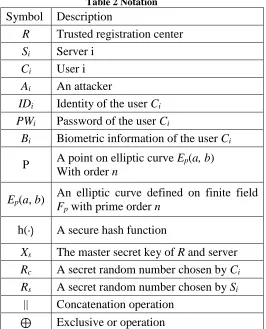
To solve the security problems of An’s scheme, Li et al proposes robust three-factor remote user authentication scheme with key agreement using ECC. It uses the fuzzy extractor method for biometric authentication in order to solve the hash function problem of An’s scheme. Table 2 shows the notations used throughout this paper.
3.1 Registration phase
Before the legitimacy user (Ci) starts login and
authentication phase, Ci and R should perform
the registration phase as follows. Fig 1 describes the detailed steps of registration phase.
Table 2 Notation
Symbol Description
R Trusted registration center
Si Server i
Ci User i
Ai An attacker
IDi Identity of the user Ci
PWi Password of the user Ci
Bi Biometric information of the user Ci
P A point on elliptic curve Ep(a, b) With order n
Ep(a, b) An elliptic curve defined on finite field
Fpwith prime order n
h(·) A secure hash function
Xs The master secret key of R and server
Rc A secret random number chosen by Ci
Rs A secret random number chosen by Si
|| Concatenation operation ⊕ Exclusive or operation
(1) Ci chooses user’s IDi, PWi and generates
random number K. Then, Ci inputs the user’s
personal biometric information Bi to the fuzzy
extractor. Ci sends the user’s IDi, Bi, and RPWi
= h(PWi||K) to registration center R through
secure communication channel.
(2) R computes Gen(Bi), fi, ei, and ri using
user’s message and secret key X.
Gen(Bi) = (Ri, Pi)
fi = h(IDi||Ri)
ei = h(IDi||Xs) ⊕ h(fi ||RPWi)
ri = h(IDi||RPWi)
(3) R stores < ei, fi, ri, Pi, h(·) > on smart card
and send it to Cithrough secure communication
channel.
(4) Ci inputs K to the smart card
3.2 Login phase
Before Ci performs the authentication phase
with Si, Ci need to execute the following steps
to generate a legitimacy login request message. Fig 2 shows the detail steps of login phase.
(1) Ci inserts Ci’s smart card into reader and
inputs IDi and PWi. And then, Ci imprints Bi at
specific device with fuzzy extractor and computes Ri = Rep(Bi’, Pi).
(2) Next, the smart card computes fi’ = h(IDi||R)
and compare it with fi which is stored in Ci’s
smart card. If they are same, Ci passes the
biometric verification. And then, smart card executes next steps. If not, login phase is terminated.
Fig. 2 Login phase of Li et al.’s scheme
(3) The smart card calculates RPWi = h(PWi||K),
ri’ = h(IDi||RPWi) and verifies whether ri’ is
same to r which is stored in smart card. If they are same, Ci passes the IDi and PWi checking
steps. And then, smart card executes the next steps. If not, the session is stopped.
(4) The smart card calculates M1 = ei ⊕
h(fi’||RPWi) and generates a random number a
∈ Zn*. Also, the smart card computes M2 = aP,
M3 = h(M1||M2). Next, Ci sends login request
message < IDi, M2, M3 > to Si.
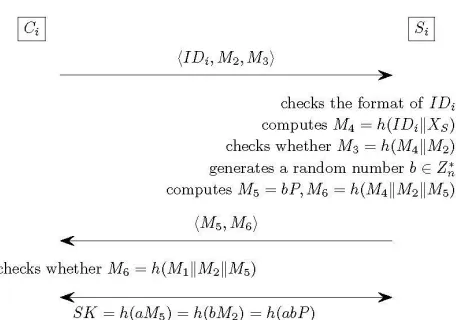
3.3 Authentication phase
Si receives the Ci’s request message and then, Si
and Ci start to perform the steps to authenticate
each other and establish session key using key agreement step. Fig 3 describes the detail steps of authentication phase.
(1) Si checks and verifies the format of IDi.
(2) If the IDi is correct, Si computes M4 =
h(IDi||Xs) and verifies whether M3 = h(M4||M2).
If they are same, Si accepts the Ci’s login
message and confirms the validity of Ci. If not,
the session is terminated.
(3) Si generates a random number b ∈ Zn* and
calculates M5 = bP, M6 = h(M4||M2||M5). And
then, Si submits the message < M5, M6 > to Ci
for mutual authentication.
(4) When Ci receives the reply message < M5,
M6 >, Ci verifies whether M6 = h(M1||M2||M5). If
they are same, Si is authenticated by Ci. Si and
Ci are authenticated with each other. So this
scheme provides the mutual authentication. Otherwise, this session is terminated.
(5) Ci and Si can compute the session key using
shared information and message.
SK = h(aM5) = h(bM2) = h(abP)
This session key is used for the future confidentiality communication
3.4 Password change phase
When Ci wants to change user’s IDi and PWi
with a new password PWinew, the user can easily
change user’s password. And also, Ci can be
finished the password change phase without assistance of registration center R. So Ci can
update the password freely.
(1) Ci inserts Ci’s smart card into a card reader
and inputs IDi and PWi. And then, user requests
to change user’s password. Ci imprints user’s
biometric information Bi at specific device. Ci
computes Ri = Rep(Bi’, Pi) using fuzzy
extractor. Ci calculates fi’ = h(IDi||Ri) and
compares fi stored in the smart card. If fi and fi’
are equal, Ci passes the biometric verification.
The smart card calculates RPWi = h(PWi||K), ri’
= h(IDi||RPWi) and then, checks whether ri’ and
ri are same. If they are no same, password
change phase is terminated. Otherwise, the user can input a new password PWinew.
(2) The smart card computes RPWi’, ei’ and ri’.
RPWi’ = h(PWinew||K)
ei’ = ei ⊕ h(fi||RPWi’) ⊕ h(fi ||RPWi’ )
ri’ = h(IDi ||RPWi’ )
(3) The smart card replaces ei and ri by using ei’
and ri’. And then, password change phase is
completed.
4 Cryptanalysis of Li et al’s scheme
This section presents the cryptanalysis about offline password attack, authentication without biometrics, denial-of-service and Insider attack
4.1 Offline password attack
Various studies pointed out that the confidential information stored in all existing smart cards could be extracted by physically monitoring its power consumption. Therefore, if the user lost his smart card, all information in the smart card could be revealed by attacker [21-23]. In Li et al.’s scheme, attacker can figure out the user’s password using revealed information. Fig 4 describes the detailed steps of off-line password attack on Li et al.’s scheme.
Fig. 4 Offline password attack
In Li et al.’ scheme, the smart card includes various information for the login and authentication between Ci and Si. Firstly, the
attacker monitors the communication between
Ci and Si. And then, attacker obtains the user
IDi and steal the user’s smart card. The smart
card for Ci stores ei, fi, ri, P, h(·), and K. The
attacker can obtain them using attacks such as simple power analysis (SPA), differential power analysis (DPA). After the attacker combines these information (especially ri, h(·),
IDi, K), the attacker can make the following
ri = h(IDi||h(PWi||K))
In this formula, attack don’t know only user’s password PWi. So attacker can executes off-line
password attack using dictionary attack, brute-force attack, rainbow table etc. If PWi is not
long enough, the attacker can figure out PWi. It
is possible for the attacker to abuse the PWi in a
variety of ways because the user generally set up the similar password.
4.2 Authentication without biometrics
In Li et al’s authentication scheme, legitimacy user needs to know user’s IDi and password and
to have the user’s biometric information and
Fig. 5 Authentication without biometrics
smart card. Therefore, when all of three-factor (IDi/PWi, Bi, smart card) are confirmed, user
can authenticated with server. But Li et al’s scheme has vulnerability. If an attacker get or steal user’s smart card, the attacker can be authenticated to server without the user’s biometrics information. Fig 5 describes the detailed steps of authentication without the biometrics on Li et al.’s scheme.
An attacker can get user IDi in the public
communication between Ci and Si. And as we
discussed in section 4.1, the attacker can figure out user password PWi if the attacker get the
user’s smart card. The attacker can perform the login and authentication phase using only IDi
necessary to make the message for login and authentication between Ci and Si. The attacker
can compute RPWi using PWi and K. K, ei, fi
and P are stored information in smartcard.
RPWi = h(PWi||K)
Using RPWi, ei and fi, the attacker can MA1,
MA1 = ei ⊕ h(fi||RPWi)
And then, the attacker generates a random number aA and computes MA2 using aA and P,
MA2 = aAP
Using MA1 and MA2, the attacker computes MA3
= h(MA1||MA2) and send IDi, MA1 and MA3 to Si
Si checks and verify the message whether it is
correct or not. Si cannot find out that the
message is made by the attacker. So the attacker is authenticated by Si. And then,
computes M5 and M6. Next, Si send M5 and M6
to the attacker. The attacker make session key
SK using this message.
SK = h(aAM5)
Finally, the attacker is authenticated with Si and
can communicate with Si using SK.
4.3 Denial-of-service
In Li et al.’s protocol, Si only checks user IDi
and M3. When Si verifies the message M3, Si
uses only IDi, Xs and M2. So, Si cannot check
whether <IDi, M2, M3> is previous message or
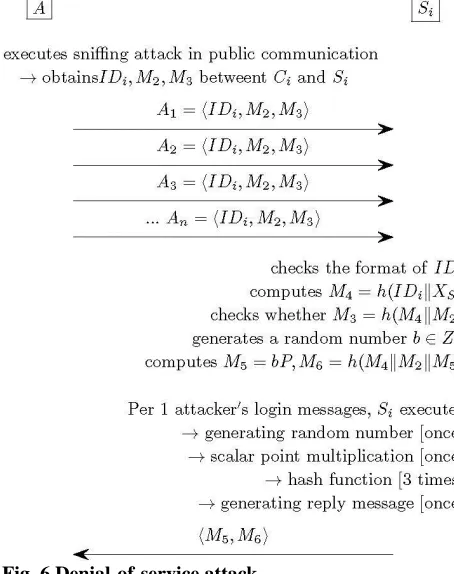
not. Thus, after the attacker monitors sniffing attack and obtains IDi, M2, and M3, the attacker
can make a lots of same message and send them to Si. It makes server Si denial-of-service. Fig 6
describes the detailed steps of denial-of-service on Li et al.’s scheme. When Si receives A1, A2,
A3… and An, Si perform various action per each
message. Si performs generating the random
number once and the scalar multiplication once.
Fig. 6 Denial-of-service attack
And Si executes a one-way hash function 3
times and generates reply message once. The one-way hash function is less important for Si,
but generating a random number and executing the scalar multiplication requires to consume a lot of computational cost of the server.
4.4 Insider attack
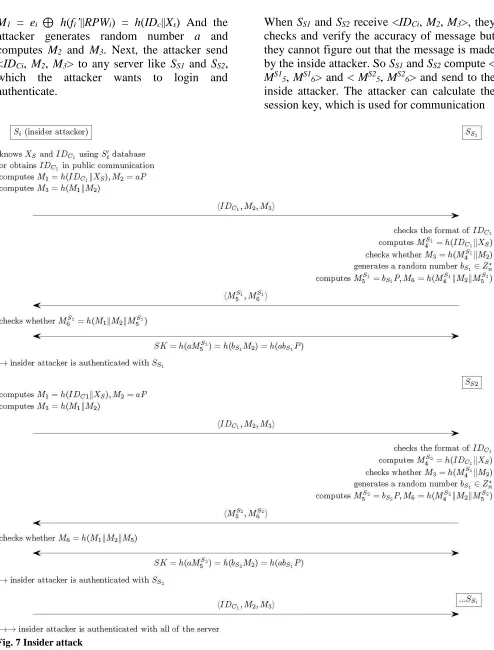
In Li et al, an insider attacker of the server Si
can know secret information Xs and IDi using
Si’s database and obtain IDi in public
communication between Ci and Si. Using these
information, the attacker can authenticated with all of server, which associated with registration center R. Fig 7 describes the detailed steps of insider attack on Li et al.’s scheme An inside attack can make login message < IDci, M2, M3 >
using IDci, Xs, P, h(·), and random number a
generated by attacker. IDci means one of
legitimacy user’s ID. The inside attacker can compute M1 = ei ⊕ h(fi’||RPWi) using IDc and
M1 = ei ⊕ h(fi’||RPWi) = h(IDc||Xs) And the
attacker generates random number a and computes M2 and M3. Next, the attacker send
<IDCi, M2, M3> to any server like SS1 and SS2,
which the attacker wants to login and authenticate.
Fig. 7 Insider attack
When SS1 and SS2 receive <IDCi, M2, M3>, they
checks and verify the accuracy of message but they cannot figure out that the message is made by the inside attacker. So SS1 and SS2 compute <
MS15, MS16> and < MS25, MS26> and send to the
with the servers. The session key between the attacker and SS1 is as follows,
SK = h(aMS1
5P) = h(bS1M2P) = h(abS1P)
The session key between the attacker and SS2 is
as follows,
SK = h(aMS25P) = h(bS2M2P) = h(abS2P)
Thus, inside attacker can login and authenticate with any server including S1 and S2.
4.5 Absence of anonymity
To provide secure communication between Ci and Si, anonymity is a desirable security feature in addition to providing secure user identification and key agreement during a user’s login and authentication procedure.
5 Requirement for enhancing security
Li et al’s proposes efficient remote user authentication scheme using ECC and hash function. But it has various vulnerability, so it is necessary to enhance the security of scheme. To resist off-line password attack, all formulas related with PWi needs to be protected by Bi.
Otherwise, PWi and Bi need to be used together
as follows,
ri = h(IDi||h(PWi||Bi||K))
To solve authentication without biometric problem, it is necessary to use Bi for making the
message of login and authentication between Ci
and Si. Otherwise, it is needed that M2, M3 and
SK are made by not only user IDi and PWi but
also Bi like as follows. To resist
denial-of-service, Si has to check the freshness of user’s
messages. Thus, it is necessary to add current timestamp to the login and authentication message of the users. To solve insider attack, it is necessary to add the secret information the only legitimate user can know or compute. Otherwise, user Ci has to know the secret
information, which cannot be known or computed by server Si.
6 Proposed scheme
In this section, to solve Li et al’s security problem, we propose security enhanced robust three-factor remote user authentication scheme with key agreement for multimedia system.
6.1 Registration phase
The registration procedure of proposed scheme is described in Fig. 8
Fig. 8 Proposed Registration phase
6.2 Login phase
The Login procedure of proposed scheme is described in Fig. 9
6.3 Authentication phase
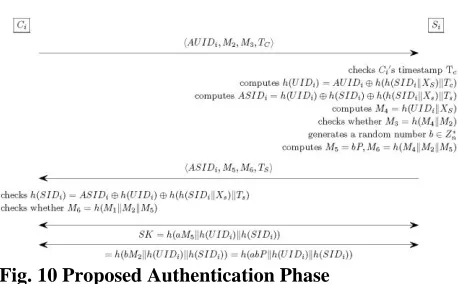
The Authentication procedure of proposed scheme is described in Fig. 10
Fig. 10 Proposed Authentication Phase
6.4 Password change phase
The password change procedure of proposed scheme is described in Fig. 10
7 Conclusion
To improve An’s authentication scheme, Li et al. proposed robust three-factor remote user authentication scheme with key agreement for multimedia system using ECC, but it has various problem. In this paper, we analyze the authentication scheme of Li et al. and executes cryptanalysis of security vulnerability. Last, we introduce requirement of authentication scheme
for enhancing security and proposed security enhanced robust three-factor remote user authentication scheme with key agreement and anonymity
‘
7 REFERENCES
[1] Li, Xiong, et al. "Robust three‐factor remote user authentication scheme with key agreement for multimedia systems." Security and Communication Networks (2014).
[2] Liao, Yi-Pin, and Shuenn-Shyang Wang. "A secure dynamic ID based remote user authentication scheme for multi-server environment." Computer Standards & Interfaces 31.1 (2009): 24-29.
[3] Lamport, Leslie. "Password authentication with insecure communication." Communications of the ACM 24.11 (1981): 770-772.
[4] Chang, Chin-Chen, and Jung-San Lee. "An efficient and secure multi-server password authentication scheme using smart cards." Cyberworlds, 2004 International Conference on. IEEE, 2004.
[5] Khan, Muhammad Khurram, and Jiashu Zhang. "An efficient and practical fingerprint-based remote user authentication scheme with smart cards." Information Security Practice and Experience. Springer Berlin Heidelberg, 2006. 260-268.
[6] Hwang, Min-Shiang, and Li-Hua Li. "A new remote user authentication scheme using smart cards." IEEE Transactions on Consumer Electronics 46.1 (2000): 28-30.
[7] Kim, Hyun-Sung, Sung-Woon Lee, and Kee-Young Yoo. "ID-based password authentication scheme using smart cards and fingerprints." ACM SIGOPS Operating Systems Review 37.4 (2003): 32-41.
[8] Lin, Chu-Hsing, and Yi-Yi Lai. "A fingerprint-based user authentication scheme for multimedia systems." Multimedia and Expo, 2004. ICME'04. 2004 IEEE International Conference on. Vol. 2. IEEE, 2004.
[9] Yang, Dexin, and Bo Yang. "A biometric password-based multi-server authentication scheme with smart card." Computer Design and Applications (ICCDA), 2010 International Conference on. Vol. 5. IEEE, 2010.
[10] Yoon, Eun-Jun, and Kee-Young Yoo. "Robust biometrics-based multi-server authentication with key agreement scheme for smart cards on elliptic curve cryptosystem." The Journal of Supercomputing (2010): 1-21.
[12] Chuang, Ming-Chin, and Meng Chang Chen. "An anonymous multi-server authenticated key agreement scheme based on trust computing using smart cards and biometrics." Expert Systems with Applications 41.4 (2014): 1411-1418.
[13] Li, Xiong, et al. "Cryptanalysis and improvement of a biometrics-based remote user authentication scheme using smart cards." Journal of Network and Computer Applications 34.1 (2011): 73-79.
[14] Das, Ashok Kumar. "Analysis and improvement on an efficient biometric-based remote user authentication scheme using smart cards." Information Security, IET 5.3 (2011): 145-151.
[15] An, Younghwa. "Security analysis and enhancements of an effective biometric-based remote user authentication scheme using smart cards." BioMed Research International 2012 (2012).
[16] Pointcheval, David, and Sébastien Zimmer. "Multi-factor authenticated key exchange." Applied Cryptography and Network Security. Springer Berlin Heidelberg, 2008.
[17] Abu-Nimeh, Saeed. "Three-Factor Authentication." Encyclopedia of Cryptography and Security. Springer US, 2011. 1287-1288.
[18] Dodis, Yevgeniy, Leonid Reyzin, and Adam Smith. "Fuzzy extractors: How to generate strong keys from biometrics and other noisy data." Advances in cryptology-Eurocrypt 2004. Springer Berlin Heidelberg, 2004.
[19] Boyen, Xavier. "Reusable cryptographic fuzzy extractors." Proceedings of the 11th ACM conference on Computer and communications security. ACM, 2004.
[20] Muthukuru, Jayabhaskar, and Bachala Sathyanarayana. "A Survey of Elliptic Curve Cryptography Implementation Approaches for Efficient Smart Card Processing." Global Journal of Computer Science and Technology 12.1 (2012).
[21] Kocher, P.; Jaffe, J.; Jun, B. Differential power analysis. the 19th Annual International Cryptology Conference on Advances in Cryptology, 388-397
[22] Messerges, T. S.; Dabbish, E. A.; Sloan, R. H. Examining smart-card security under the threat of power analysis attacks. Computers. IEEE Transactions on Computers, 2002, 51(5), 541-552