Clinical Audit
Dovepress
O r i g i n A L r e s e A r C h
open access to scientific and medical research
Open Access Full Text Article
Practice of urinary catheterization and knowledge
in junior staff: a quality control study
Muhammad r Cheema Fr shuaib
JA Barrett
Wirral University Teaching hospital, Wirral, UK
Correspondence: Muhammad raza Cheema
Flat 25-C riverview, 174 Arrowe Park road, Woodchurch, Wirral, Merseyside, UK
Tel +44 75 7244 1537
email [email protected]
Abstract: Our study was conducted in the inpatient setting of Department of Elderly Medicine. A high percentage of indwelling catheters at discharge had been observed. Our study aimed to ascertain whether these catheters were being placed for appropriate indications. Catheter placement is performed by junior doctors and nurses in the ward, therefore their knowledge of guidelines regarding indications, procedure, and documentation for catheterization and its complications was deemed to be a vital factor in determining the incidence of long-term catheter placement. A questionnaire was administered to carry out a cross-sectional survey of normal practice and opinion regarding long-term catheter placement.
Keywords: catheter, catheterization, indications
Our study revealed that 89.6% of total catheterizations (short term and long term) over the two-week study period were performed with complete documentation and for appropriate indications as per the Infectious Diseases Society of America (IDSA) guidelines. Indication for catheterization was not documented in 10.4% of cases.
Objectives
• To ascertain whether catheters were being placed for appropriate indications as per IDSA guidelines.1
• To appraise the knowledge of working staff regarding indications, complications and procedural documentation of catheterization.
Background
Indwelling catheters have become a familiar feature in the elderly population; their placement is aimed to relieve obstructive urinary symptoms when other interventions are not feasible. Despite their symptomatic benefit they are often implicated in caus-ing recurrent urinary tract infections, discomfort and retention resultcaus-ing from catheter blockage, and are associated with an increased frequency of readmission. Their ben-efit versus morbidity ratio has to be balanced very carefully depending upon clinical opinion and individual patient scenarios. Recurrent urinary tract infections result in the need for antibiotic administration, which ultimately facilitates the emergence of drug-resistant bacteria. Long-term catheter-associated urinary tract infections (UTIs) substantially account for global disease burden.1
According to recent data, catheter-associated (CA) bacteriuria has been found to be the number one health-care-associated infection worldwide.1 This is a direct
Clinical Audit downloaded from https://www.dovepress.com/ by 118.70.13.36 on 20-Aug-2020
For personal use only.
Number of times this article has been viewed
This article was published in the following Dove Press journal: Clinical Audit
Dovepress Cheema et al
consequence of the prevalent use of urinary catheterization in inpatient settings in hospitals as well as long-term care facilities (LTCFs). Some of these catheter placements are indiscriminate and add to the cost and personnel resources expended by the hospital.
Ensuring that guidelines for catheter placement are comprehensive, clear, and precisely followed would result in a decrease in the overall number of long-term catheter placements and consequently a decrease in the associated morbidity burden.
Our quality control study was conducted in the Depart-ment of Elderly Medicine (DME) setting. This setting was chosen after the observation that a large number of patients were being discharged with long-term urinary catheters. We decided to assess if long-term catheter placement was for the right indication. Junior doctors and nurses in the ward usually carry out catheterization so we also performed a cross- sectional survey of their knowledge regarding indica-tions and complicaindica-tions of urinary catheterization. It was anticipated that in some cases ambiguous documentation as to why the catheter was placed and a lack of follow-up instructions may have the consequence of the catheter staying in the patient for a prolonged period.
Methods
Data were collected over a period of two weeks from the DME. Approval to conduct this study was obtained from the local Risk Management and Governance department. All patients aged over 70 years with catheters were included in this study.
Medical notes were used to identify the indications for catheterization and to assess proper documentation pertain-ing to procedure of catheterization. This documentation comprised date, time, indication of catheterization, personnel name, catheter size, volume and color of urine drained, use of aseptic technique and antibiotic prophylaxis given.
A questionnaire survey was carried out to evaluate the knowledge among the staff regarding catheterization indica-tions, complicaindica-tions, and documentation. The questionnaire was administered to the junior doctors during the weekly teaching sessions on an optional basis. Ward managers dis-tributed questionnaires to nursing staff who were trained in urinary catheterization. Out of a total of 80 potential staff members, the questionnaire was administered to 40 with a 100% response rate.
A sample of the data collection sheet is presented in Appendix 1, and the questionnaire survey in Appendix 2.
Results
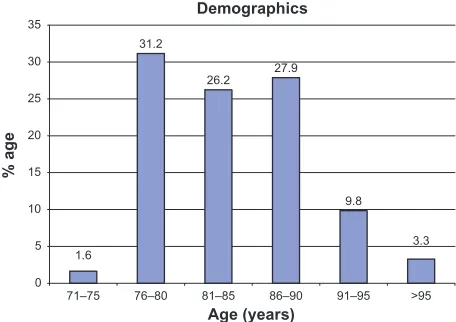
The majority (85.3%) of the patient cohort were aged 76–90 years (Figure 1). Forty completed questionnaires were collected from nurses and junior trainee doctors (foundation year 1 and 2) to appraise their knowledge of indications, complications, and procedural documentation of catheterization. The results are as follows:
• Documentation of the date of procedure, personnel doing the procedure, the indication for catheterization use of aseptic technique: 100% agreed (Figure 2).
• Document if prophylactic antibiotics were given and if a sample was sent for analysis: 77% agreed.
• Document the volume of urine drained: 97.4% agreed. 89.7% agreed they would document a description of the urine drained and 87% acknowledged they would docu-ment if it was a difficult procedure.
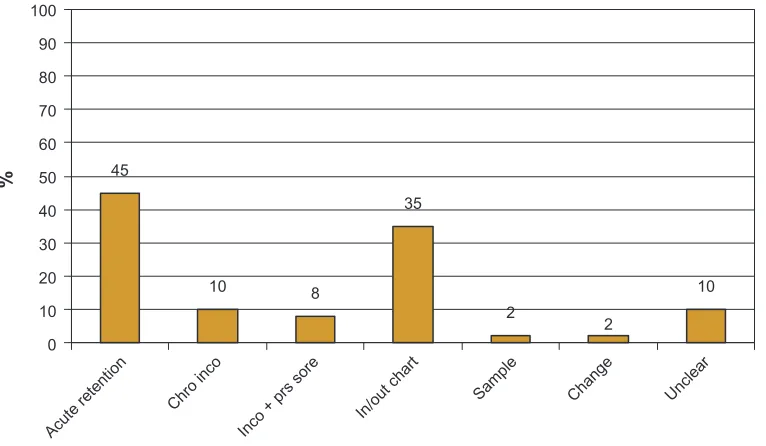
A total of 61 patients had indwelling catheters during the 2 weeks of data collection. A catheter was in place at admission in 21.4% of these patients. The remaining had catheters placed during the hospital study. Indications for catheterization (Figure 3) were as follows: retention of urine, 36.1%; chronic incontinence, 8.2%; incontinence with pressure sores, 27.9%; strict fluid balance charting, 6.5%; to obtain a sample of urine, 1.6%; indication for catheterization not clear from documentation, 10.4%. Indications according to IDSA guidelines were observed in 89.6% of the patients who had catheters placed during the hospital study.
Table 1 shows the demographics and common comorbidi-ties of the cohort. Table 2 shows the results in tabulated form comparing the practice observed and awareness of proper documentation of catheterization procedure.
Demographics 1.6 3.3 31.2 26.2 27.9 9.8 0 5 10 15 20 25 30 35 71–75 Age (years) % age >95 91–95 86–90 81–85 76–80
Figure 1 The age range of patients included in the study; 85.3% of the patients were aged between 76–90 years.
Clinical Audit downloaded from https://www.dovepress.com/ by 118.70.13.36 on 20-Aug-2020
Dovepress Urinary catheterization and knowledge in junior staff
0% 20% 40% 60% 80% 100%
Date
Catheter detailsAseptic technique
Difficult procedureVolume of urineDescription of urineSample for analysis Indication
Antibiotic use
View (yes) View (no) Practice
Figure 2 The views of junior doctors and nursing staff regarding appropriate documentation compared with the current practice of documentation after a urinary catheter has been inserted.
Notes: Yes, should be documented; no, should not be documented; Practice, currently being practiced/documented in notes.
45
10 8
35
2
2
10
0 10 20 30 40 50 60 70 80 90 100
Acute retentio n
Chro inco
Inco + prs sor e
In/out char t
Sampl e
Change Unclear
%
Figure 3 The percentages of patients catheterized for the following indications: chronic incontinence (Chro inco), incontinence with pressure sores (inco + prs sore), urinary output monitoring (in/out chart), catheterization to obtain urine sample (sample), new catheters inserted for long-term catheter patients (Change), or indication unclear/ not documented (Unclear).
Table 1 Demographics of the group, including the number of patients that were admitted with long-term catheter and common comorbidities
Variable Male (N = 33) Female (N = 28)
Mean (sD) age 78 (5) 82 (6)
Long-term catheter 11 (33%) 2 (7%)
ihD 14 (42%) 9 (32%)
hypertension 12 (36%) 10 (36%)
CVA 5 (15%) 9 (32%)
COPD 7 (21%) 2 (7%)
Dementia 7 (21%) 3 (11%)
Abbreviations: CVA, cerebrovascular accident; COPD, chronic obstructive pulmonary disease; ihD, ischemic heart disease; sD, standard deviation.
Table 2 Differences between observed practice versus awareness and knowledge among junior staff members regarding documentation of the catheterization procedure
Documented parameter Observed practice (%)
Awareness (%)
Date of catheterization 78.6 100
Time of catheterization 1.6 97.4
sample sent 1.6 77
Volume drained 39.3 97.4
Urine description 1.6 89.7
indication 79 100
Aseptic technique 3.3 100
Antibiotic prophylaxis 40 77
Clinical Audit downloaded from https://www.dovepress.com/ by 118.70.13.36 on 20-Aug-2020
Dovepress Cheema et al
Conclusion
Catheters were placed for indications according to the IDSA guidelines in 89.6% of patients.1 Catheters were placed, but
undocumented in 10.4% of patients. Long-term catheters were in situ preadmission in 21.3% patients admitted for various medical problems. Doctor and nurse knowledge regarding complications of catheterization was well above average. Responses to the questionnaire demonstrated good awareness of what needed to be documented among staff. However, the practice of documentation did not reflect the
awareness demonstrated in the questionnaire and had room for improvement in some aspects.
Disclosure
The authors report no conflicts of interest in this work.
References
1. Hooton TM, Bradley SF, Cardenas DD, et al. Infectious Diseases Society of America. Diagnosis, prevention and treatment of catheter-associated urinary tract infection in adults: 2009 International Clinical Practice Guidelines from the Infectious Diseases Society of America. Clin Infect Dis. 2010;50(5):625–663.
Clinical Audit downloaded from https://www.dovepress.com/ by 118.70.13.36 on 20-Aug-2020
Dovepress Urinary catheterization and knowledge in junior staff
Appendix 1
Data collection sheet
Age 75–80 81–85 86–90 91–95 Over 95
Sex Male Female
Hospital Number : ____________ Ward : ____________
Primary Diagnosis: _____________________________________________________
Comorbidity
IHD
HTN
DM – Type 1 DM – Type 2
COPD
CVA
Others _______________________________________________
Indication for Catheterization
1. Retention Acute
a. UTI
b. Neuropathic
c. BPH
d. Others
2. Chronic Incontinence
3. Input/Output Chart
Cause ______________________________________________________________________ 4. Incontinence with Pressure Sore
5. To Obtain Urine Sample
6. Indication for Catheterization Not Clear
7. Admitted with Catheter in Place
Where the Patient was Catheterized
MAU
A&E
Ward
Other _______________________________________________
Documentation
Documented Not Documented
Pathway in Notes
Date
Time
Person who Catheterized
Catheter Size
Volume of Urine Drained
Color of Urine Drained
Specimen to Lab
Antibiotic Given
Aseptic Technique
Indication for Catheterization
Clinical Audit downloaded from https://www.dovepress.com/ by 118.70.13.36 on 20-Aug-2020
Clinical Audit
Publish your work in this journal
Submit your manuscript here: http://www.dovepress.com/clinical-audit-journal
Clinical Audit is an international, peer-reviewed, open access journal focusing on the processes and outcomes of clinical audit in any area of healthcare. All aspects of patient care are addressed within the journal and practitioners from all disciplines are invited to submit their work. Areas covered include: Publication of audits; How an audit has changed practice;
Practical tips on how to do audits and to avoid pitfalls; How audits have changed patient care; Calls and justifications for new audits. The manuscript management system is completely online and includes a very quick and fair peer-review system, which is all easy to use. Visit http://www.dovepress. com/testimonials.php to read real quotes from published authors.
Dovepress
Dovepress
Cheema et al
Appendix 2
Questionnaire survey
Have you worked in a DME ward? Yes No
Dr:
Grade: Foundation year 1 Foundation year 2
Nurse:
Trained in catheterization: Yes No
1. What are the indications for catheterization? (Please tick all that apply)
Yes No a. Acute retention of urine
b. Urinary incontinence (with no comorbidity)
c. Monitoring urine output in ill patients
d. Patient requests
e. To obtain clear urine sample for investigations
f. Incontinent patient with sacral/buttock pressure sore
g. Patient confined to bed and too weak to mobilize to toilet unassisted
2. Documentation: What information would you document following catheterization? (Please tick all that apply)
Yes No
Date
Time
Samples sent for lab analysis
Volume of urine drained
Description of urine drained
Indication for catheterization
Aseptic technique on catheterization
Difficult catheterization
Antibiotic prophylaxis
3. Name three complications of catheterization
1. __________________ 2. __________________ 3. __________________
Clinical Audit downloaded from https://www.dovepress.com/ by 118.70.13.36 on 20-Aug-2020