Correlation Linear Cryptanalysis
⋆Bing Sun1,3, Zhiqiang Liu2,3,, Vincent Rijmen3, Ruilin Li4, Lei Cheng1, Qingju Wang2,3, Hoda Alkhzaimi5, Chao Li1
1
College of Science, National University of Defense Technology, Changsha, Hunan, P. R. China, 410073 2
Dept. Computer Science and Engineering, Shanghai Jiao Tong University, China 3
Dept. Electrical Engineering (ESAT), KU Leuven and iMinds, Belgium 4
College of Electronic Science and Engineering, National University of Defense Technology, Changsha, Hunan, P. R. China, 410073
5
Technical University of Denmark, DK-2800 Kgs. Lyngby, Denmark
happy [email protected],ilu [email protected]
Abstract. As two important cryptanalytic methods, impossible differential cryptanalysis and integral cryptanalysis have attracted much attention in recent years. Although relations among other important cryptanalytic approaches have been investigated, the link between these two methods has been missing. The motivation in this paper is to fix this gap and establish links between impossible differential cryptanalysis and integral cryptanalysis.
Firstly, by introducing the concept of structure and dual structure, we prove that a → bis an impossible differential of a structure E if and only if it is a zero correlation linear hull of the dual
structure E⊥. More specifically, constructing a zero correlation linear hull of a Feistel structure with
SP-type round function wherePis invertible, is equivalent to constructing an impossible differential of the same structure withPT
instead ofP. Constructing a zero correlation linear hull of an SPN structure is equivalent to constructing an impossible differential of the same structure with (P−1
)T
instead ofP. Meanwhile, our proof shows that the automatic search tool presented by Wu and Wang could find all impossible differentials of both Feistel structures with SP-type round functions and SPN structures, which is useful in provable security of block ciphers against impossible differential cryptanalysis.
Secondly, by establishing some boolean equations, we show that a zero correlation linear hull always indicates the existence of an integral distinguisher while a special integral implies the existence of a zero correlation linear hull. With this observation we improve the integral distinguishers of Feistel structures by 1 round, build a 24-round integral distinguisher of CAST-256 based on which we propose the best known key recovery attack on reduced round CAST-256 in the non-weak key model, present a 12-round integral distinguisher of SMS4 and an 8-round integral distinguisher of Camellia without F L/F L−1
. Moreover, this result provides a novel way for establishing integral distinguishers and converting known plaintext attacks to chosen plaintext attacks.
Finally, we conclude that anr-round impossible differential ofE always leads to anr-round integral
distinguisher of the dual structureE⊥. In the case thatE and E⊥are linearly equivalent, we derive a direct link between impossible differentials and integral distinguishers ofE. Specifically, we obtain that
an r-round impossible differential of an SPN structure, which adopts a bit permutation as its linear layer, always indicates the existence of anr-round integral distinguisher. Based on this newly established link, we deduce that impossible differentials of SNAKE(2), PRESENT, PRINCE and ARIA, which are independent of the choices of the S-boxes, always imply the existence of integral distinguishers.
Our results could help to classify different cryptanalytic tools. Furthermore, when designing a block cipher, the designers need to demonstrate that the cipher has sufficient security margins against impor-tant cryptanalytic approaches, which is a very tough task since there have been so many cryptanalytic tools up to now. Our results certainly facilitate this security evaluation process.
Keywords: Impossible Differential, Integral, Zero Correlation Linear, Feistel, SPN, Camellia, CAST-256, SMS4, SNAKE(2), PRESENT, PRINCE, ARIA
⋆
1
Introduction
Block ciphers are considered vital elements in constructing many symmetric cryptographic schemes such as encryption algorithms, hash functions, authentication schemes and pseudo-random number generators. The core security of these schemes depends on the resistance of the underlying block ciphers to known cryptanalytic techniques. So far a variety of cryptanalytic techniques have been proposed such as impossible differential cryptanalysis [1, 2], integral cryptanalysis [3], zero correlation linear cryptanalysis [4], etc.
Impossible differential cryptanalysis was independently proposed by Knudsen [1] and Biham [2]. One of the most popular impossible differentials is called a truncated impossible differential. It is independent of the choices of the S-boxes. Several approaches have been proposed to derive truncated impossible differentials of a block cipher/structure effectively such as the U-method [5], UID-method [6] and the extended tool of the former two methods generalized by Wu and Wang in Indocrypt 2012 [7]. Integral cryptanalysis [3], also known as square attack[8], saturation attack [9], multi-set attack [10], higher-order differential attack [11, 12], was first proposed by Knudsen and Wagner. With some special inputs, we check whether the sum of the corresponding ciphertexts is zero or not. Usually, we do not need to investigate the details of the
S-boxes and only view the S-boxes as some bijective transformations over finite fields. Zero correlation linear cryptanalysis, proposed by Bogdanov and Rijmen in [4], tries to construct some linear hulls with correlation exactly zero. In most cases, as in impossible differential and integral cryptanalysis, we do not need to investigate the details of theS-boxes. Generally, though there has been lots of work concentrating on the design and cryptanalysis ofS-boxes [13], most cryptanalytic results by using impossible differential, integral and zero correlation linear cryptanalysis are independent of the choices of theS-boxes. If we choose some otherS-boxes in a cipher, the corresponding cryptanalytic results will remain almost the same.
Along with the growing of the list of cryptanalytic tools, the question whether there are direct links or any connections among different tools has drawn much attention of the cryptographic research community, since such relations can be used to compare the effectiveness of different tools as well as to improve cryptanalytic results on block ciphers.
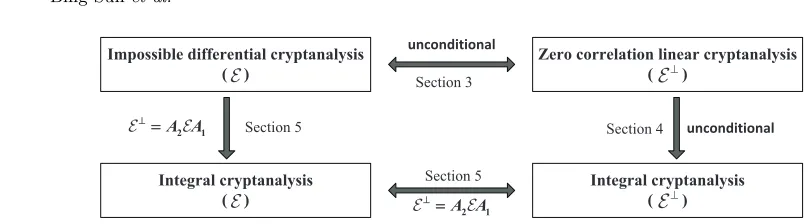
Contributions. Although there have been intriguing results with respect to the relations among some im-portant cryptanalytic approaches, the link between impossible differential cryptanalysis and integral crypt-analysis is still missing. In this paper, we aim to explore the link between these two cryptanalytic methods. Since the fundamental step in statistical cryptanalysis of block ciphers is to construct effective distinguishers, we focus on building the links among impossible differential, zero correlation linear and integral cryptanalysis from the aspect of distinguishers. Our main contributions are as follows (see Fig.1).
1. To characterize what “being independent of the choices ofS-boxes” means, we propose the definition of
structureE, which is a set containing some ciphers that are “similar” to each other. Then, by introducing the dual structureE⊥, we prove thata→ b is an impossible differential of E if and only if it is a zero
correlation linear hull of E⊥. More specifically, letPT and P−1 denote the transpose and inverse ofP respectively. Then for a Feistel structure with SP-type round functions where P is invertible, denoted as FSP, constructing anr-round zero correlation linear hull is equivalent to constructing an impossible differential ofFSPT, which is the same structure asFSP withPT instead ofP; For an SPN structureESP, constructing an r-round zero correlation linear hull of ESP is equivalent to constructing an impossible differential of ES(P−1)T, which is the same structure as ESP with (P−1)T instead of P. Based on this result, we find 8-round zero correlation linear hulls of Camellia without F L/F L−1 layer and 4-round zero correlation linear hulls of ARIA.
2. We show that the automatic search tool, presented by Wu and Wang in Indocrypt 2012, could find all impossible differentials of a cipher that are independent of the choices of the S-boxes. This can be used in provable security of block ciphers against impossible differential cryptanalysis.
3. We find that a zero correlation linear hull always implies the existence of an integral distinguisher, which means the conditions used for deriving integral distinguisher from zero correlation linear hull in [17] can be removed. This observation also provides a novel way for constructing integral distinguisher and converting known plaintext attacks to chosen plaintext attacks. Meanwhile, we observe that the statement “integral unconditionally implies zero correlation linear hull” in [17] is correct only under the definition that integral property is a balanced vectorial boolean function, while it does not hold for the general case. For example, up to date we cannot use the integral distinguisher for 4-round AES (with extra MixColumns) [4, 8] to construct a zero correlation linear hull.
4. Following the results given above, we build the link between impossible differential cryptanalysis and integral cryptanalysis, i.e., anr-round impossible differential of a structureEalways implies the existence of an r-round integral distinguisher ofE⊥
. Moreover, in the case that E⊥
=A2EA1 where A1 and A2 are linear transformations, we could get direct links between impossible differential cryptanalysis and integral cryptanalysis ofE. Specifically, anr-round impossible differential of SPN structure which adopts bit permutation as the linear layer, always leads to anr-round integral distinguisher.
5. We improve the integral distinguishers of Feistel structures by 1 round, build a 24-round integral dis-tinguisher of CAST-256, and present a 12-round integral disdis-tinguisher of SMS4 which is 2-round longer than previously best known ones and an 8-round integral distinguisher of Camellia without F L/F L−1 layser which is 2-round longer than the best known ones which are independent with the choices of theS-box. These distinguishers could not be obtained by the known methods for constructing integral distinguishers or by using the link given in [17]. As an example, the best known key recovery attack on reduced round CAST-256 in non-weak key model is given to show the effectiveness of the newly constructed distinguishers.
Integral cryptanalysis ( ) Impossible differential cryptanalysis
( )
Zero correlation linear cryptanalysis ( )
2 A1 A !
Integral cryptanalysis ( )
unconditional
unconditional
2 A1 A !
Section 3
Section 4 Section 5
Section 5
Fig. 1.Links among Impossible Differential, Integral and Zero Correlation Linear Cryptanalysis, whereEis a structure andE⊥is the dual structure ofE,A
1andA2are linear transformations applied before the input and after the output
ofE.
Organization. The remainder of this paper is organized as follows. Sec. 2 introduces the notations and concepts that will be used throughout the paper. In Sec. 3, we establish the new links between impossible differential cryptanalysis and zero correlation linear cryptanalysis. Sec. 4 shows the refined link between integral cryptanalysis and zero correlation linear cryptanalysis. The link between impossible differential cryptanalysis and integral cryptanalysis is presented in Sec. 5. Then in Sec. 6, we give some examples to show the effectiveness of the newly established links in constructing new distinguishers of block ciphers. Finally, Sec. 7 concludes this paper.
2
Preliminaries
2.1 Boolean Functions
This section recalls the notations and concepts [22] which will be used throughout this paper. Let F2 denote the finite field with two elements, and Fn2 be the vector space over F2 with dimension n. Let
a= (a1, . . . , an), b= (b1, . . . , bn)∈Fn2. Then
a·b,a1b1⊕ · · · ⊕anbn
denotes the inner productof aand b. Note that the inner product ofa andb can be written as abT where
bT stands for thetransposeofband the multiplication is defined as matrix multiplication. Given a function
G:Fn
2 →F2, thecorrelation ofGis defined by
c(G(x)),#{x∈F
n
2|G(x) = 0} −#{x∈Fn2|G(x) = 1}
2n =
1 2n
X
x∈Fn 2
(−1)G(x).
Given a vectorial functionH :Fn
2 →Fk2, thecorrelation of the linear approximation for ak-bit output mask
band ann-bit input maskais defined by
c(a·x⊕b·H(x)), 1
2n X
x∈Fn 2
(−1)a·x⊕b·H(x).
Ifc(a·x⊕b·H(x)) = 0, then a→b is called azero correlation linear hull ofH[4]. This definition can be extended as follows: LetA⊆Fn2,B⊆Fk2. If for alla∈A,b∈B,c(a·x⊕b·H(x)) = 0, thenA→Bis called azero correlation linear hullofH. In the case thatH is a permutation onFn2, for anyb6= 0,c(b·H(x)) = 0 and for any a6= 0, c(a·x) = 0. We call 0 →b anda →0 trivial zero correlation linear hulls of H where
a6= 0 andb6= 0. LetA⊆Fn
2. If the size of the set
is independent ofy∈Fk2, we sayH isbalanced onA. Specifically, ifA=Fn2, we sayH is abalanced function. If the sum of all images ofH is 0, i.e.
X
x∈Fn 2
H(x) = 0,
we sayH has anintegral-balanced (zero-sum)property[3]. Letδ∈Fn
2 and∆∈Fk2. The differential probability ofδ→∆is defined as
p(δ→∆),#{x∈F
n
2|H(x)⊕H(x⊕δ) =∆}
2n .
Ifp(δ→∆) = 0, then δ→∆ is called an impossible differential ofH[1, 2]. Let A⊆Fn
2, B ⊆Fk2. If for all
a∈Aandb∈B,p(a→b) = 0, A→B is called animpossible differentialofH. We recall the following property of balanced boolean functions: a function G: Fn
2 → F2 is balanced if and only ifc(G(x)) = 0.
2.2 Block Ciphers
Feistel Ciphers. An r-round Feistel cipherEis defined as follows:
Let (L0, R0)∈F22n be the input ofE. Iterate the following transformationrtimes: (
Li+1=Fi(Li)⊕Ri
Ri+1=Li
0≤i≤r−1,
whereLi, Ri∈Fn2. The output of ther-th iteration is defined as the output ofE. In this paper, we will focus on the case thatFi’s are SP-type functions which will be defined in the following.
SPN Ciphers. The SPN structure is widely used in constructing cryptographic primitives. It iterates some SP-type round functions to achieve confusion and diffusion. Specifically, the SP-type functionf :Fs2×t→Fs
×t 2 used in this paper is defined as follows:
Assume the inputxis divided intotpiecesx= (x0, . . . , xt−1), and each of thexi’s is ans-bit word. Then apply the nonlinear transformation Si to xi and let y = (S0(x0), . . . , St−1(xt−1))∈ Fs
×t
2 . At last, apply a linear transformationP toy, andP y is the output off.
The following strategies are popular in designing the diffusion layerP of a cipher:
(1) P is a bit-wise permutation ofFs2×t as in PRESENT [23]. PRESENT is an SPN block cipher with block length 64-bit. It is a lightweight block cipher primarily designed for hardware constrained environments such as RFID tags and sensor networks. PRESENT adopts bit permutation as the diffusion layerP, which can be defined as a permutation matrixP = (Pi,j)64×64:
Pi,j=
(
1 ifj= 16imod 63
0 otherwise .
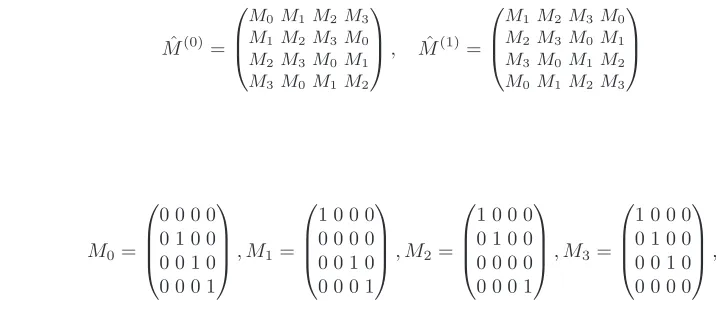
(2) Each bit ofP yis a sum of some bits ofyas in PRINCE [24]. PRINCE is a lightweight block cipher with block size 64-bit. The core component of PRINCE is PRINCEcorewhich adopts a 12-round SPN structure. Firstly, we will defineSRandM′ as follows:
SR behaves like the ShiftRows in AES and permutes the 16 nibbles of PRINCE in the following way.
(0,1,2,3,4,5,6,7,8,9,10,11,12,13,14,15)→(0,5,10,15,4,9,14,3,8,13,2,7,12,1,6,11)
Fig. 2.Round-function of PRESENT
To constructM′
, we first define
ˆ
M(0)=
M0M1M2 M3
M1M2M3 M0
M2M3M0 M1
M3M0M1 M2
,
ˆ
M(1)=
M1M2M3 M0
M2M3M0 M1
M3M0M1 M2
M0M1M2 M3
where
M0=
0 0 0 0 0 1 0 0 0 0 1 0 0 0 0 1
, M1=
1 0 0 0 0 0 0 0 0 0 1 0 0 0 0 1
, M2=
1 0 0 0 0 1 0 0 0 0 0 0 0 0 0 1
, M3=
1 0 0 0 0 1 0 0 0 0 1 0 0 0 0 0
,
and then we defineM′= diag( ˆM(0),Mˆ(1),Mˆ(1),Mˆ(0)), which is a 64×64 block diagonal matrix.
M′
is used as the linear transformation of the middle round. The transformationsM = SR◦M′
and
M−1are used before and after the middle round, respectively.
(3) Each word of P y is a sum of some words ofy as in Camellia [25] and ARIA [26]. The block cipher Camellia was recommended in the NESSIE block cipher portfolio in 2003 and selected as a new international standard by ISO/IEC in 2005. It adopts the Feistel structure with invertible SP-type round functions if not taking into account theF L/F L−1layer. The linear transformationP could be written as follows:
P =
E 0 E E 0 E E E E E 0 E E 0 E E E E E 0 E E 0 E
0 E E E E E E 0
E E 0 0 0 E E E
0 E E 0 E 0 E E
0 0 E E E E 0 E E 0 0 E E E E 0
ARIA is a 128-bit block cipher established as a Korean Standard by the Ministry of Commerce, Industry and Energy in 2004. The diffusion layer of ARIA can be written as:
P =
0 0 0 E E 0 E 0 E E 0 0 0 E E 0 0 0 E 0 0 E 0 E E E 0 0 E 0 0 E
0 E 0 0 E 0 E 0 0 0 E E E 0 0 E E 0 0 0 0 E 0 E 0 0 E E 0 E E 0
E 0 E 0 0 E 0 0 E 0 0 E 0 0 E E
0 E 0 E E 0 0 0 0 E E 0 0 0 E E E 0 E 0 0 0 0 E 0 E E 0 E E 0 0 0 E 0 E 0 0 E 0 E 0 0 E E E 0 0
E E 0 0 E 0 0 E 0 0 E 0 0 E 0 E E E 0 0 0 E E 0 0 0 0 E E 0 E 0 0 0 E E 0 E E 0 E 0 0 0 0 E 0 E
0 0 E E E 0 0 E 0 E 0 0 E 0 E 0 0 E E 0 0 0 E E 0 E 0 E E 0 0 0
E 0 0 E 0 0 E E E 0 E 0 0 E 0 0
E 0 0 E E E 0 0 0 E 0 E 0 0 E 0 0 E E 0 E E 0 0 E 0 E 0 0 0 0 E
.
whereE and 0 are the 8×8 identity and zero matrices, respectively.
(4) Each word of P y, seen as an element of some extension fields ofF2, is a linear combination of some other words of y as in the AES. In the following, we will use the matrix expression of finite fields to show how to write the linear layer of AES as a 128×128 binary matrix:
Since ShiftRows is a permutation on 16 bytes, it is also a permutation on 128 bits. Therefore, as in the discussion above, we can represent ShiftRows as a permutation matrix MSR in F128
×128
2 . Let F28 =
F2[x]/ < f(x) >where F2[x] is the polynomial ring overF2, f(x) = x8+x4+x3+x+ 1 ∈F2[x] is the
defining polynomial of F28. Then 1 = (00000001) ∈ F28 can be written as the 8×8 identity matrix E, 2 = (00000010)∈F28 can be written as the following 8×8 matrix:
M2=
0 0 0 0 0 0 0 1 1 0 0 0 0 0 0 1 0 1 0 0 0 0 0 0 0 0 1 0 0 0 0 1 0 0 0 1 0 0 0 1 0 0 0 0 1 0 0 0 0 0 0 0 0 1 0 0 0 0 0 0 0 0 1 0
and the matrix representation of 3 = (00000011) isM3=E⊕M2. If we substitute 1, 2 and 3 in MixColumns byE,M2 andM3, respectively, we get a 128×128 binary matrixMM C and the linear layer of AES can be written asMM CMSR which is a 128×128 matrix overF2.
Generally, no matter which linear transformation a cipher adopts, it is always linear overF2. Therefore,
P can always be written as a multiplication by a matrix which leads to the following definition:
Definition 1. Let P be a linear transformation overFm
2 for some positive integerm. The matrix
represen-tation ofP overF2 is called theprimitive representation ofP.
2.3 Structure and Dual Structure
Definition 2. Let E:Fn2 →Fn2 be a block cipher with bijectiveS-boxes as the basic non-linear components.
(1) A structureEE on Fn
2 is defined as a set of block ciphers E′ which is exactly the same asE except that
the S-boxes can take all possible bijective transformations on the corresponding domains.
(2) Let a, b∈Fn
2. If for any E′∈ EE,a→bis an impossible differential (zero correlation linear hull) ofE′,
a→bis called an impossible differential (zero correlation linear hull) ofEE.
Note. In the definition of EE, if E uses bijective S-boxes, then the S-boxes in EE should be bijective. However, if S-boxes used in E are not necessarily bijective, then EE could be defined as a set of block ciphersE′
which is exactly the same asE except that theS-boxes can take all possible transformations on the corresponding domains. As discussed above, the truncated impossible differentials and zero correlation linear hulls of AES and Camellia found so far are actually the impossible differentials and zero correlation linear hulls ofEAESandECamellia.
Definition 3. Let FSP be a Feistel structure with SP-type round function, and let the primitive
represen-tation of the linear transformation beP. Letσbe the operation that exchanges the left and right halves of a state. Then thedual structure F⊥
SP ofFSP is defined as σFPTSσ.
Let ESP be an SPN structurewith primitive representation of the linear transformation being P. Then
the dual structure E⊥
SP ofESP is defined as ES(P−1 )T.
3
Links between Impossible Differential and Zero Correlation Linear
Cryptanalysis
In this section, we will show the equivalence between impossible differentials and zero correlation linear hulls of a structure, which will be used to establish the link between impossible differential and integral cryptanalysis in Sec.5.
Theorem 1. a→bis anr-round impossible differential ofFSP if and only if it is anr-round zero correlation
linear hull ofF⊥
SP.
Proof. The proof can be divided into the following two parts (See Fig.3):
Part (I) In this part, we prove that for (δ0, δ1)→(δr, δr+1), if one can find E∈ FSP⊥ such thatc((δ0, δ1)·
x⊕(δr, δr+1)·E(x))6= 0, then one can find E′∈ FSP such thatp((δ1, δ0)→(δr+1, δr))>0.
i i
i i
i i
i i
Differential(SP) Linear (PTS) P
i i i
P
iP
i iPT Si,1
,1 i
, i t
,1 i
, i t
,1 i
, i t
,1 i
, i t Si,2
Si,t
Si,1
Si,2
Si,t
Assume that (δ0, δ1)→ (δr, δr+1) is a linear hull with non-zero correlation for someE ∈ FSP⊥ , and the input to the round function could be divided intotpieces, each of which is ans-bit word. Then there exists a linear characteristic with non-zero correlation:
(δ0, δ1)→ · · ·(δi−1, δi)→ · · · →(δr, δr+1),
where δi ∈(Fs2)t. In this characteristic, let the output mask ofSi= (Si,1, . . . , Si,t) be δi = (δi,1, . . . , δi,t)∈ (Fs
2)t, and let the input mask ofSi beβi= (βi,1, . . . , βi,t)∈(Fs2)t. Since forγ6=βiP,c(γ·x⊕βi·(xPT)) = 0,
δi+1=δi−1⊕βiP.
In the following, for any (xL, xR) = (xL,1, . . . , xL,t, xR,1, . . . , xR,t)∈(Fs2)t×(Fs2)t, we will construct an
r-round cipherEr∈ FSP, such thatEr(xL, xR)⊕Er(xL⊕δ1, xR⊕δ0) = (δr+1, δr).
Ifr = 1, forj ∈ {1, . . . , t}: if δ1,j = 0, we can define S1,j as any possible transformation on Fs2, and if
δ1,j6= 0, we can define
S1,j(xL,j) =xL,j, S1,j(xL,j⊕δ1,j) =xL,j⊕β1,j,
then forE1∈ FSP which adopts suchS-boxes,
E1(xL, xR)⊕E1(xL⊕δ1, xR⊕δ0) = (δ0⊕β1P, δ1) = (δ2, δ1).
Suppose that we have constructedEr−1 such that Er−1(xL, xR)⊕Er−1(xL⊕δ1, xR⊕δ0) = (δr, δr−1).
Denote by (yL, yR) = (yL,1, . . . , yL,t, yR,1, . . . , yR,t) the output ofEr−1(xL, xR). Then in ther-th round, if
δr,j= 0, we can defineSr,j as any possible transformation onFs2, otherwise, defineSr,jas follows:
Sr,j(yL,j) =yL,j, Sr,j(yL,j⊕δr,j) =yL,j⊕βr,j.
ThereforeEr(xL, xR)⊕Er(xL⊕δ1, xR⊕δ0) = (δr−1⊕βrP, δr) = (δr+1, δr).
Part (II) In this part, we prove that for (δ1, δ0) → (δr+1, δr), if one can find some E ∈ FSP such that
p((δ1, δ0)→(δr+1, δr))>0, one can find someE′∈ FSP⊥ such thatc((δ0, δ1)·x⊕(δr, δr+1)·E′(x))6= 0. Assume that (δ1, δ0)→(δr+1, δr) is a differential ofE∈ FSP. Then there exists a differential characteristic with positive probability:
(δ1, δ0)→ · · ·(δi+1, δi)→ · · · →(δr+1, δr),
where δi ∈ (Fs2)t. In this characteristic, the input difference of Si = (Si,1, . . . , Si,t) is δi = (δi,1, . . . , δi,t)∈ (Fs
2)t, and let the output difference ofSi be βi= (βi,1, . . . , βi,t)∈(Fs2)t, thenδi+1=δi−1⊕(βiP).
Taking the following fact into consideration: for (δi,j, βi,j), where δi,j 6= 0, there always exists an s×s binary matrixMi,j such thatβi,j=δi,jMi,jT, then forSi,j(x) =xMi,j, c(βi,j·x⊕δi,j·Si,j(x)) = 1.
Now we construct anr-round cipherEr∈ FSP⊥ such thatc((δ0, δ1)·x⊕(δr, δr+1)·Er(x))6= 0. Ifr= 1, let
S1,j(x) =xM1,jforδ1,j6= 0 and any linear transformation onFs2otherwise. Then all operations inE1∈ FSP⊥ are linear overF2, which implies that there exists a 2st×2stbinary matrixM1such thatE1(x) =xM1, and
c((δ0, δ1)·x⊕(δ1, δ2)·E1(x)) = 1.
Assume that we have constructedEr−1(x) = xMr−1 with Mr−1 being a 2st×2st binary matrix such that
c((δ0, δ1)·x⊕(δr−1, δr)·Er−1(x)) = 1,
and we can defineSr,j(x) in ther-th round similarly, then Er(x) = xMr for some 2st×2st binary matrix
Mr, and
c((δ0, δ1)·x⊕(δr, δr+1)·Er(x)) = 1,
which ends our proof.
Theorem 2. a→bis anr-round impossible differential ofESP if and only if it is anr-round zero correlation
linear hull ofE⊥
SP.
Definition 2 implies that the “impossibility” of an impossible differential of a structure can be caused only by a differentialδ1 →δ2 where eitherδ1= 0 or δ2 = 0 (but not both) over an invertible S-box, or by a differential 0 →δ2 over a non-invertible S-box. Otherwise, according to the proof of Theorem 1, we can always find an S-box such thatδ1→δ2is a possible differential. Therefore, we have the following corollary:
Corollary 1. The method presented in [7] finds all impossible differentials of FSP andESP.
As a matter of fact, this Corollary can be used in the provable security of block ciphers against impossible differential cryptanalysis, since with the help of this Corollary, the longest impossible differentials of a given structure could be given.
In case P is invertible, according to the definition of equivalent structures given in [30], we have
FPT
S = (PT)
−1,(PT)−1
FSPT PT, PT, (1) which indicates:
Corollary 2. Let FSP be a Feistel structure with SP-type round function, and let the primitive
represen-tation of the linear transformation be P. If P is invertible, finding zero correlation linear hulls of FSP is
equivalent to finding impossible differentials ofFSPT.
Example 1. (8-Round Zero Correlation Linear Hull of Camellia Without F L/F L−1) Let Camellia*
denote the cipher which is exactly the same as Camellia without F L/F L−1 layer except that PT is used instead ofP. Then we find that, for example:
((0,0,0,0,0,0,0,0),(0,0,0,0, a,0,0,0))→((0,0,0,0,0,0,0, h),(0,0,0,0,0,0,0,0))
is an 8-round impossible differential of Camellia*, whereaandhdenote any non-zero values. Therefore, we could derive an 8-round zero correlation linear distinguisher of Camellia withoutF L/F L−1 layer as shown below:
((a, a,0,0, a,0, a, a),(0,0,0,0,0,0,0,0))→((0,0,0,0,0,0,0,0),(h,0,0, h,0, h, h, h)).
Furthermore, if FSP =FSPT andESP =ES(P−1)T, the following corollary holds:
Corollary 3. For a Feistel structure FSP with SP-type round function, if P is invertible and P = PT,
there is a one-to-one correspondence between impossible differentials and zero correlation linear hulls. For an SPN structuresESP, ifPTP =E,a→b is an impossible differential if and only if it is a zero
correlation linear hull.
Example 2. (4-Round Zero Correlation Linear Hull of ARIA) Since the linear layer P of ARIA
satisfies PTP = E, any impossible differential of EARIA is automatically a zero correlation linear hull of
EARIA. Therefore, the impossible differentials of 4-round ARIA shown in [28] are also zero correlation linear hulls of 4-round ARIA.
Notes.
1. In the proof of Theorem 1, theS-boxes we constructed are not necessarily bijective. If we add the bijective condition, Theorem 1 still holds. Since for a bijectiveS-box, if the correlation is non-zero,δ1,j6= 0 implies
β1,j6= 0. Therefore, in Part(I) of the proof, we can further defineS1,j as
S1,j(x) =
xL,j⊕δ1,j x=xL,j⊕β1,j,
xL,j⊕β1,j x=xL,j⊕δ1,j,
and a similar definition can also be given to Sr,j. In this case, theS-boxes are invertible. Moreover, for a bijective S-box, if the differential probability is positive,δi,j6= 0 implies βi,j6= 0, thus in Part (II) of the proof, we can always find a non-singular binary matrixMi,j such thatβi,j=δi,jMi,jT.
2. Theorem 1 and 2 show some links between impossible differentials and zero correlation linear hulls of a structure E and the corresponding dual structure E⊥. However, it doesn’t mean that, for example,
an impossible differential of a cipher E ∈ E indicates a zero correlation linear hull of another cipher
E′ ∈ E⊥. This follows from the difference between the definitions of an impossible differential and a zero
correlation linear hull of a cipher and a structure, respectively.
4
Links between Integral and Zero Correlation Linear Cryptanalysis
Firstly, we will give two foundational statements that give links between integral cryptanalysis and zero correlation linear cryptanalysis:
Lemma 1. LetAbe a subspace ofFn
2,A⊥={x∈Fn2|a·x= 0, a∈A}be the dual space ofAandF :Fn2 →Fn2
be a function on Fn
2. For anyλ∈Fn2,Tλ:A⊥→Fn2 is defined asTλ(x) =F(x⊕λ), then for any b∈Fn2, X
a∈A
(−1)a·λc(a·x⊕b·F(x)) =c(b·T λ(x)).
Proof.
X
a∈A
(−1)a·λc(a·x⊕b·F(x)) = X a∈A
(−1)a·λ 1 2n
X
x∈Fn 2
(−1)a·x⊕b·F(x)
= 1 2n
X
x∈Fn 2
(−1)b·F(x)X a∈A
(−1)a·(λ⊕x)= 1 2n
X
x∈Fn 2
(−1)b·F(x)|A|δ
A⊥(λ⊕x)
= 1
|A⊥|
X
y∈A⊥
(−1)b·Tλ(y)
=c(b·Tλ(x)),
whereδA⊥(x) =
(
1 x∈A⊥
0 x /∈A⊥ .
The second statement is as follows:
Lemma 2. Let Abe a subspace of Fn
2,F :Fn2 →Fn2, and let Tλ:A⊥ →Fn2 be defined asTλ(x) =F(x⊕λ)
whereλ∈Fn
2. Then for any b∈Fn2, 1
2n X
λ∈Fn 2
(−1)b·F(λ)c(b·T λ(x)) =
X
a∈A
c2(a·x⊕b·F(x)).
Proof.
X
a∈A
c2(a·x⊕b·F(x)) = X
a∈A 1 2n
X
x∈Fn 2
(−1)a·x⊕b·F(x) 1 2n
X
λ∈Fn 2
(−1)a·λ⊕b·F(λ)
= 1
22n X
x∈Fn 2
X
λ∈Fn 2
(−1)b·F(x)⊕b·F(λ)X a∈A
(−1)a·x⊕a·λ
= 1
22n X
x∈Fn 2
X
λ∈Fn 2
(−1)b·F(x)⊕b·F(λ)|A|δ
Letθ=x⊕λ. Since|A| × |A⊥
|= 2n, we have 1
22n X
x∈Fn 2
X
λ∈Fn 2
(−1)b·F(x)⊕b·F(λ)|A|δ
A⊥(x⊕λ)
= |A| 22n
X
θ⊕λ∈Fn 2
X
λ∈Fn 2
(−1)b·F(θ⊕λ)⊕b·F(λ)δ
A⊥(θ) =
1 2n|A⊥|
X
λ∈Fn 2
(−1)b·F(λ) X θ⊕λ∈Fn
2
(−1)b·F(θ⊕λ)δ A⊥(θ)
= 1 2n
X
λ∈Fn 2
(−1)b·F(λ) 1
|A⊥|
X
θ∈A⊥
(−1)b·F(θ⊕λ)= 1 2n
X
λ∈Fn 2
(−1)b·F(λ)c(b·T λ(x)).
The authors of [17] concluded that an integral distinguisher implies a zero correlation linear hull. However, for general integral distinguishers, c(b·Tλ(x)) may not necessarily be 0, hence the conclusion that integral unconditionally implies zero correlation linear hull in [17] is correct only under their definition of integral while it may not hold for general ones.
From Lemma 1, we can deduce the following:
Corollary 4. LetF :Fn
2 →Fn2 be a function onFn2, and letAbe a subspace ofFn2 andb∈Fn2\ {0}. Suppose
that A→b is a zero correlation linear hull ofF, then for any λ∈Fn2,b·F(x⊕λ)is balanced onA⊥. This Corollary states that if the input masks of a zero correlation linear hull form a subspace, then a zero correlation linear hull implies an integral distinguisher. Furthermore, the condition that input masks form a subspace could be removed, which leads to the following result:
Theorem 3. A nontrivial zero correlation linear hull of a block cipher always implies the existence of an
integral distinguisher.
Proof. Assume thatA → B is a non-trivial zero correlation linear hull of a block cipher E. Then we can
choose 06=a∈A,06=b∈B, such that{0, a} →b is also a zero correlation linear hull ofE.
Since V ={0, a} forms a subspace on F2, according to Corollary 4, b·E(x) is balanced on V⊥
. This
implies an integral distinguisher ofE.
Moreover, in the proof of Theorem 3, we can always assume that 0∈A. Then
1. IfA forms a subspace, an integral distinguisher can be constructed fromA→b;
2. If A does not form a subspace, we can choose some A1 ⊂A such that A1 forms a subspace, then an integral distinguisher can be constructed fromA1→b.
It was stated in [17] that a zero correlation linear hull indicates the existence of an integral distinguisher under certain conditions, while Theorem 3 shows that these conditions can be removed. This results in a more applicable link between zero correlation linear cryptanalysis and integral cryptanalysis.
It can be seen that Theorem 3 also gives us a new approach to find integral distinguishers of block ciphers. More specifically, anr-round zero correlation linear hull can be used to construct anr-round integral distinguisher. Interestingly, Theorem 3 can also be used to convert known plaintext attacks to chosen plaintext attacks.
5
Links between Impossible Differential and Integral Cryptanalysis
According to the links given in the previous sections, we establish a link between impossible differential cryptanalysis and integral cryptanalysis:
Theorem 4. Let E ∈ {FSP,ESP}. Then impossible differential of E always implies the existence of an
integral of E⊥
In caseE⊥
=A2EA1whereA1andA2are linear transformations, we get the direct links between impossible differential and integral cryptanalysis:
Corollary 5. Let FSP be a Feistel structure with SP-type round function, and let the primitive
represen-tation of the linear transformation be P. IfP is invertible and there exists a permutation π on t elements such that for any(x0, . . . , xt−1)∈Fs
×t 2 ,
P(x0, . . . , xt−1) =π−1PTπ(x0, . . . , xt−1),
then forFSP, an impossible differential always implies the existence of an integral distinguisher.
Proof. Letπbe a permutation on (x0, . . . , xt−1)∈Fs
×t 2 . Since
Si◦π(x0, . . . , xt−1) =π◦Si(x0, . . . , xt−1),
in the case thatP is invertible, we have
FPTS = (πPT)
−1,(πPT)−1
FS(π−1PTπ) πPT, πPT
.
Therefore, the impossible differential ofFSP implies a zero correlation linear hull of FPTS, which implies a zero correlation linear hull ofFS(π−1PTπ)=FSP, which in turn an integral distinguisher ofFSP.
Example 3. SNAKE(2) is a Feistel cipher proposed by Lee and Cha at JW-ISC’97, please refer to [31, 32] for
details. According to [30], the round function of SNAKE(2) can be seen as an SP-type one with the primitive presentation of the matrix being defined as
P=
E E E E
E 0 E E
E 0 0 E
E 0 0 0
,
whereE and 0 are the identity and zero matrices ofF82×8, respectively. Let
π=
1 0 0 0 0 0 0 1 0 0 1 0 0 1 0 0
.
Then we haveP =π−1PTπ, therefore, an impossible differential of SNAKE(2), which is independent of the details of theS-boxes, always implies the existence of an integral distinguisher of SNAKE(2). Denote byCr the output of r-round SNAKE(2), and leta→b be an impossible differential ofr-round SNAKE(2). Then
(πPT)−1,(πPT−1
)b·Cr is balanced when the input takes all values in ((πPT, πPT)a)⊥.
Corollary 6. Let ESP be an SPN structure with the primitive representation of the linear transformation
beingP. IfPTP =diag(Q
1, . . . , Qt), whereQi∈Fs
×s
2 , then forESP, an impossible differential always implies
the existence of an integral distinguisher.
Proof. Firstly, according to Theorem 4, if PTP =E, an impossible differential of E
SP always implies the existence of an integral.
Secondly, for the S-layer of ESP, if we substitute S by applying Qi to the i-th S-box, according to definition 2, the structure stays identical. Since
P◦(diag(Q1, . . . , Qt)◦S) = (P◦diag(Q1, . . . , Qt))◦S, an SPN structureESP is equivalent to an SPN structureES(P◦diag(Q1,...,Qt)).
To show applications of these links, we recall that, ann×nmatrixP is calledorthogonalif and only if
PTP =E, whereE is then×nidentity matrix.
Example 4. We can check that,SR andM′
used in PRINCE are orthogonal matrices, therefore
MTM = (SR◦M′)T(SR◦M′) =E,
where E is the 64×64 identity matrix. So all the linear layers used in different rounds of PRINCE are orthogonal based on which we could conclude that anyr-round impossible differential of PRINCE which is independent of the choices of the S-boxes implies the existence of anr-round integral distinguisher.
Example 5. Since the linear layerP of ARIA is both symmetric and involutional, e.g.P =P−1=PT, any
impossible differential of ARIA which is independent of the choices ofS-boxes implies the existence of an integral distinguisher.
Example 6. We can check that P used in PRESENT satisfies P = (P−1)T, therefore, an impossible
dif-ferential, which is independent of the details of the S-boxes, always leads to the existence of an integral distinguisher. In fact, since a permutation matrixP is always orthogonal, we have the following Corollary:
Corollary 7. For an SPN structure which adopts bit permutation as the diffusion layer, anr-round
impos-sible differential always implies the existence of an r-round integral distinguisher.
6
New Integral Distinguishers of Block Ciphers/Structures
6.1 New Integral Distinguishers for Feistel Structures
Equivalence between r-Round Impossible Differential and Zero Correlation Linear Hull of
Feistel Structures. LetErbe anr-round Feistel structureFSP. In the case thatP is the identity transfor-mation, we getE⊥
r =σErσ, from which we can conclude that, (aL, aR)→(bL, bR) is an impossible differential ofEr if and only if (aR, aL)→(bR, bL) is a zero correlation linear hull ofEr. If the round functions are not necessarily bijective, we obtain equivalence between the following two statements:
1. For anya6= 0,b6=a, (0, a)→(b,0) is an impossible differential ofE3;
2. For anya6= 0,b6=a, (a,0)→(0, b) is a zero correlation linear hull ofE3;
If the round functions are bijective, we obtain equivalence between 5-round impossible differentials and zero correlation linear hulls of Feistel structures:
(1) For anya6= 0, (0, a)→(a,0) is an impossible differential ofE5;
(2) For anya6= 0, (a,0)→(0, a) is a zero correlation linear hull ofE5.
New Integral Distinguishers of Feistel Structures. So far the longest integral distinguisher known for a Feistel structure with bijective round functions counts 4 rounds, and the longest integral distinguisher for a Feistel structure with general round functions counts 2 rounds. We improve these distinguishers by 1 round using Theorem 3.
Proposition 1. Let Er be an r-round Feistel structure defined onF22n. Then
1. If the Fi’s are bijective, then for anyc∈Fn2,c6= 0,c·R5 is balanced on{(0,0),(c,0)}⊥ with respect to
E5.
2. If the Fi’s are not necessarily bijective, then let {α0, . . . , αn−1} be a base ofFn2 overF2. Then αn−1·R3
is balanced on {(0,Pn−2
As a matter of fact, for anyc ∈ Fn2, c = 0, (6 c,0) → (0, c) is a zero correlation linear hull of E5. Thus according to Theorem 3, we can construct an integral distinguisher ofE5, i.e., let (L0, R0) take all values in
{(0,0),(c,0)}⊥
, thenc·R5 is balanced.
Specifically, letc= (1,1, . . . ,1)∈Fn2. Then we have
{(0,0),(c,0)}⊥={((x1, . . . , xn),(xn+1, . . . , x2n))|xi ∈F2,
n X
t=
xt= 0}.
LetR5= (R5,1, . . . , R5,n). Then we can derive thatPni=1R5,iis balanced on{(0,0),(c,0)}⊥.
6.2 24-Round Integral Distinguisher of CAST-256
The block cipher CAST-256 [33] was proposed as a first-round AES candidate, and we refer to [33] for details. Firstly, we recall the following zero correlation linear property given in [17].
Property 1. (0,0,0, L1)→(0,0,0, L2) is a zero correlation linear hull of the 24-round CAST-256 (from the
13-th round to the 36-th round of CAST-256), whereL16= 0,L26= 0 andL16=L2. LetL∗
1={(l1, l2, . . . , l31,0)|li∈F2} andL2= (0, . . . ,0,1). Then we obtain a zero correlation linear hull
(0,0,0, L∗
1) →(0,0,0, L2) for the 24-round CAST-256. According to Theorem 3, we can get the following result:
Proposition 2. Let V ={(x1, x2, x3,031y)|xi∈F322 , y∈F2}. If the input takes all values inV, and let the
output of the24-round be(C0, C1, C2, C3)∈F232×4(from the13-th round to36-th round). Then(0, . . . ,0,1)·C3
is balanced.
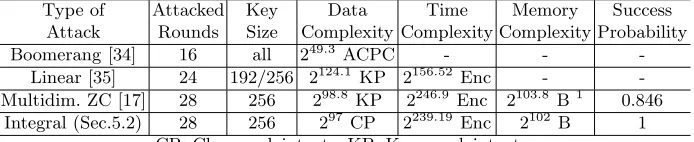
Based on this integral distinguisher, we present a key recovery attack on 28-round CAST-256 which is the best known attack on CAST-256 in the non-weak key model. The details of the attack are listed in Appendix A. Table 1 gives the summary of attacks on CAST-256 in the non-weak key model.
Table 1.Summary of Attacks on CAST-256 in the Non-Weak Key Model
Type of Attacked Key Data Time Memory Success
Attack Rounds Size Complexity Complexity Complexity Probability
Boomerang [34] 16 all 249.3
ACPC - -
-Linear [35] 24 192/256 2124.1
KP 2156.52
Enc -
-Multidim. ZC [17] 28 256 298.8
KP 2246.9
Enc 2103.8
B1
0.846
Integral (Sec.5.2) 28 256 297
CP 2239.19
Enc 2102
B 1
CP: Chosen plaintexts, KP: Known plaintexts, ACPC: Adaptive chosen plaintexts and ciphertexts, Enc: Encryptions, B: Bytes, -: Not given in the related paper.
6.3 12-Round Integral Distinguisher of SMS4
The SMS4 block cipher is designed by the Chinese government as part of their WAPI standard for wireless networks [36]. Up to date, the longest known integral distinguisher of SMS4 covers 10 rounds [37]. The details of SMS4 and the proof of the following Propositions are listed in Appendix B.
Proposition 3. Let V ={v∈(F82)4|HW(LTv) = 1}, where HW(x1, x2, x3, x4) = #{xi 6= 0, i= 1,2,3,4}.
Proposition 4. Let V = {v ∈ (F82)4|HW(LTv) = 1}, Vd = {w ∈ (F322 )4|(0,0,0, d)·w = 0}, and let (c0, c1, c2, c3) be the output of12-round SMS4. Then for anyd∈V, when the input takes all possible values
inVd, we have
#{d·c0= 0}= #{d·c0= 1}.
Note that most of the known integral distinguishers are independent of the choices of theS-boxes. However, the integral distinguisher presented above is highly related with theS-boxes, since for different S-boxes, we would find different zero correlation linear hulls which lead to different integral distinguishers of SMS4.
6.4 8-Round Integral Distinguisher of Camellia without F L/F L−1 Layer
In [39], by using the division property, the author proposed a 6-round integral distinguisher of Camellia withoutF L/F L−1layers as the best known integral distinguisher which could be built without knowing the details of the S-box. Based on the 8-round zero correlation linear hull presented in Example 1, the integral distinguisher which is independent with the choices ofS-box could be improved from 6-round to 8-round:
Proposition 5. Let V be defined as
V ={((x1, . . . , x8),(x9, . . . , x16))|x1⊕x2⊕x5⊕x7⊕x8= 0, xi∈F82}.
For anyh∈F82,h6= 0,(h,0,0, h,0, h, h, h)·Ri+8 is balanced onV with respect to 8-round Camellia without
F L/F L−1 layer.
7
Conclusion
In this paper, we have investigated the link between impossible differential and integral cryptanalysis. To do this, we have introduced the concept ofstructure E and dual structure E⊥ and established the link in the
following steps:
– We derived the relation between impossible differential ofEand zero correlation linear hull ofE⊥. We have
shown that for a Feistel structureFSP withSP-type round functions whereP is invertible, constructing a zero correlation linear hull of FSP is equivalent to constructing an impossible differential of FSPT, which is the same structure as FSP withPT instead of P. For an SPN structure ESP, constructing a zero correlation linear hull of ESP is equivalent to constructing an impossible differential of ES(P−1)T, which is the same structure as ESP with (P−1)T instead ofP.
– We presented the relation between zero correlation linear hull and integral distinguisher of block ciphers. As proven in Sec.4, a zero correlation linear hull always implies the existence of an integral distinguisher, while such statement only holds under certain conditions in [17]. Meanwhile, we have observed that the statement “integral unconditionally implies zero correlation linear hull” in [17] is correct only under the definition that integral property is a balanced vectorial boolean function, while it does not hold for the general case (i.e., integral defined in [3] is a zero-sum property).
– We built the link between impossible differential ofE and integral distinguisher of E⊥. We have
demon-strated that anr-round impossible differential ofE always leads to anr-round integral distinguisher of
E⊥. In the case thatEandE⊥ are linearly equivalent, we obtained some direct links between impossible
differential and integral distinguisher of E. Specifically, an r-round impossible differential of an SPN structure, which adopts bit permutation as the linear layer, always indicates the existence of anr-round integral distinguisher.
The results and links presented in this paper not only allow to achieve a better understanding and classi-fying of impossible differential cryptanalysis, integral cryptanalysis and zero correlation linear cryptanalysis, but also provide some new insights with respect to these cryptanalytic approaches as shown below:
1
The original memory complexity of the attack in [17] (268
bytes) was underestimated since it did not take into account the memory requirement for storing the 298.8
– The automatic search tool presented by Wu and Wang in Indocrypt 2012 finds all impossible differentials of both Feistel structures withSP-type round functions and SPN structures, which is useful in provable security of block ciphers against impossible differential cryptanalysis.
– Our statement “zero correlation linear hull always implies the existence of an integral distinguisher” pro-vides a novel way for constructing integral distinguisher of block ciphers and converting known plaintext attacks to chosen plaintext attacks. With this observation, we have improved the integral distinguishers of Feistel structures by 1 round, built a 24-round integral distinguisher of CAST-256, and proposed a 12-round integral distinguisher of SMS4 which is 2-round longer than previously best known ones and an 8-round integral distinguisher of Camellia withoutF L/F L−1layser which is 2-round longer than the best known ones which are independent with the choices of theS-box. These distinguishers could not be obtained by the previously known methods for constructing integral distinguishers or by using the link given in [17]. Moreover, we have presented the best known key recovery attack on CAST-256 in non-weak key model to show that the new links can also be used to improve cryptanalytic results of some concrete ciphers.
By using the matrix representation given in [38], the concept of dual structure can be extended to gener-alized Feistel structures, and we can get similar results for these structures. Furthermore, we have focused on the links among the distinguishers used in impossible differential, integral and zero correlation linear cryptanalysis since distinguishers are the essential points in the evaluation of security margins of a block cipher against various cryptanalytic tools, and our results can be helpful in designing a block cipher from this point of view.
References
1. L.R. Knudsen. DEAL — A 128-bit Block Cipher. Department of Informatics, University of Bergen, Norway. Technical report, 1998.
2. E. Biham, A. Biryukov, A. Shamir. Cryptanalysis of Skipjack Reduced to 31 Rounds Using Impossible Differen-tials. EUROCRYPT 1999, LNCS 1592, pp. 12–23, Springer-Verlag, 1999.
3. L.R. Knudsen, D. Wagner. Integral Cryptanalysis. FSE 2002, LNCS 2365, pp. 112–127, Springer–Verlag, 2002. 4. A. Bogdanov, V. Rijmen. Linear Hulls with Correlation Zero and Linear Cryptanalysis of Block Ciphers. Designs,
Codes and Cryptography, 70(3), pp. 369–383, 2014.
5. J. Kim, S. Hong, J. Sung, S. Lee, J. Lim. Impossible Differential Cryptanalysis for Block Cipher Structures. Indocrypt 2003, LNCS 2904, pp. 82–96, 2003.
6. Y. Luo, X. Lai, Z. Wu, G. Gong. A Unified Method for Finding Impossible Differentials of Block Cipher Structures. Information Sciences, Volume 263, 1 April 2014, Pages 211–220.
7. S. Wu, M. Wang. Automatic Search of Truncated Impossible Differentials for Word-Oriented Block Ciphers. Indocrypt 2012, LNCS 7668, pp. 283–302, 2012.
8. J. Daemen, L. R. Knudsen, V. Rijmen. The Block Cipher Square. Fast Software Encryption 1997, LNCS 1267, pp. 149–165, Springer–Verlag, 1997.
9. S. Lucks. The Saturation Attack — A Bait for Twofish. Fast Software Encryption 2001, LNCS 2355, pp. 1–15, Springer–Verlag, 2002.
10. A. Biryukov, A. Shamir. Structural Cryptanalysis of SASAS. EUROCRYPT 2001, LNCS 2045, pp. 394–405, Springer–Verlag, 2001.
11. X. Lai. Higher Order Derivatives and Differential Cryptanalysis. Communications and Cryptography: Two Sides of One Tapestry, 227 (1994)
12. L.R. Knudsen. Truncated and Higher Order Differentials. Fast Software Encryption 1994, LNCS 1008, pp. 196– 211. Springer, Heidelberg (1995)
13. S. Picek, L. Batina, D. Jakobovi´c, B. Ege, M. Golub. S-box, SET, Match: A Toolbox for S-box Analysis. WISTP 2014, LNCS 8501, pp. 140–149, 2014.
14. F. Chabaud, S. Vaudenay. Links Between Differential and Linear Cryptoanalysis. EUROCRYPT 1994, LNCS 950, pp. 356–365, Springer-Verlag, 1995.
16. G. Leander. On Linear Hulls, Statistical Saturation Attacks, PRESENT and a Cryptanalysis of PUFFIN. EU-ROCRYPT 2011, LNCS 6632, pp. 303–322, Springer-Verlag, 2011.
17. A. Bogdanov, G. Leander, K. Nyberg and M. Wang. Integral and Multidimensional Linear Distinguishers with Correlation Zero. ASIACRYPT 2012, LNCS 7658, pp. 244–261, Springer–Verlag, 2012.
18. C. Blondeau and K. Nyberg. New Links Between Differential and Linear Cryptanalysis. EUROCRYPT 2013, LNCS 7881, pp. 388–404, Springer–Verlag, 2013.
19. C. Blondeau, G. Leander, K. Nyberg. Differential-Linear Cryptanalysis Revisited. FSE 2014, to appear. 20. C. Blondeau, A. Bogdanov, M. Wang. On the (In)Equivalence of Impossible Differential and zero correlation
Distinguishers for Feistel- and Skipjack-type Ciphers. ACNS 2014, LNCS 8479, pp. 271–288, 2014.
21. C. Blondeau, K. Nyberg. Links Between Truncated Differential and Multidimensional Linear Properties of Block Ciphers and Underlying Attack Complexities. EUROCRYPT 2014, LNCS 8441, pp. 165–182, 2014.
22. C. Carlet. Boolean Functions for Cryptography and Error Correcting Codes. Cambridge University Press, 2006. 23. A. Bogdanov, L. R. Knudsen, G. Leander, C. Paar, A. Poschmann, M. J. B. Robshaw, Y. Seurin, C. Vikkelsoe:
PRESENT: An Ultra-Lightweight Block Cipher. CHES 2007, LNCS 4727, pp 450–466, 2007.
24. J. Borghoff, A. Canteaut, T. G¨uneysu, E. B. Kavun, M. Knezevic, L. R. Knudsen, G. Leander, V. Nikov, C. Paar, C. Rechberger, P. Rombouts, S. Thomsen, T. Yal¸cın. PRINCE — A Low-Latency Block Cipher for Pervasive Computing Applications - Extended Abstract. ASIACRYPT 2012. LNCS 7658, pp. 208–225, 2012.
25. K. Aoki, T. Ichikawa, M. Kanda, M. Matsui, S. Moriai, J. Nakajima and T. Tokita. Camellia: A 128–Bit Block Cipher Suitable for Multiple Platforms - Design and Analysis. SAC 2000, LNCS 2012, pp. 39–56, Springer–Verlag, 2000.
26. D. Kwon, J. Kim, S. Park, S.H. Sung etc. New Block Cipher: ARIA. ICISC 2003, LNCS 2971, pp.432–445, Springer-Verlag 2004.
27. H. Mala, M. Dakhilalian, V. Rijmen, M. Modarres-Hashemi. Improved Impossible Differential Cryptanalysis of 7-Round AES-128. INDOCRYPT 2010, LNCS 6498, pp. 282–291, Springer–Verlag, 2010.
28. W. Wu, W. Zhang, D. Feng. Impossible Differential Cryptanalysis of Round-Reduced ARIA and Camellia. Journal of Computer Science and Technology, 22(3), pp. 449–456, 2007.
29. A. Bogdanov, H. Geng, M. Wang, L. Wen, B. Collard. Zero Correlation Linear Cryptanalysis with FFT and Improved Attacks on ISO Standards Camellia and CLEFIA. SAC 2013, LNCS 8282, pp. 306–323.
30. L. Duo, C. Li, K. Feng. New Observation on Camellia. SAC 2005, LNCS 3897, pp. 51–64, Springer–Verlag, 2006. 31. C. Lee, Y. Cha. The Block Cipher: SNAKE with Provable Resistance against DC and LC Attacks. In Proceedings
of 1997 Korea-Japan Joint Workshop on Information Security and Cryptology (JW–ISC’97), pp. 3–17, 1997. 32. S. Moriai, T. Shimoyama, T. Kaneko. Interpolation Attacks of the Block Cipher: SNAKE. FSE 1999, LNCS 1636,
pp. 275–289, 1999.
33. First AES Candidate Conference. http://csrc.nist.gov/archive/aes/round1/conf1/aes1conf.htm. 34. D. Wagner. The Boomerang Attack. FSE 1999, LNCS 1636, pp. 156–170, Springer–Verlag, 1999.
35. M. Wang, X. Wang and C. Hu. New Linear Cryptanalytic Results of Reduced-Round of 128 and CAST-256. SAC 2008, LNCS 5381, pp. 429–441. Springer–Verlag, 2009.
36. Specification of SMS4, Block Cipher for WLAN Products C SMS4 (in Chinese), http://www.oscca.gov.cn/UpFile/200621016423197990.pdf
37. W. Zhang, B. Su, W. Wu, D. Feng. C. Wu. Extending Higher-Order Integral: An Efficient Unified Algorithm of Constructing Integral Distinguishers for Block Ciphers. ACNS 2012, LNCS 7341, pp. 117–134, Springer-Verlag, 2012.
38. T.P. Berger, M. Minier, G. Thomas. Extended Generalized Feistel Networks Using Matrix Representation. SAC 2013, LNCS 8282, pp. 289–305, 2014.
39. Yosuke Todo. Structural Evaluation by Generalized Integral Property. To appear in EUROCRYPT 2015. http://eprint.iacr.org/2015/090
Appendix A
The block cipher CAST-256 [33] was proposed as a first-round AES candidate. It is a 128-bit block cipher which adopts a generalized Feistel structure. CAST-256 supports variable key sizes, i.e., 128, 192 or 256-bit key size, and the number of rounds for all variants is 48.
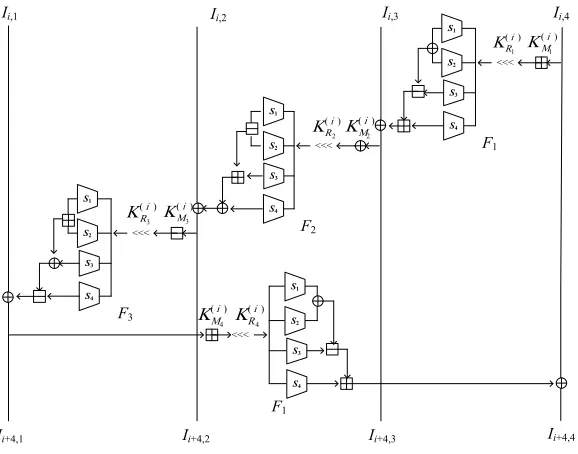
(mod 4) andIi,j∈F322 , 1≤j≤4. Then the forward quad-roundQ(Ii) is defined as consecutive application of 4 rounds as follows (See Fig.4):
Ii+4,3=Ii,3⊕F1(Ii,4, KR(i1), K
(i)
M1), Ii+4,2=Ii,2⊕F2(Ii+4,3, K (i) R2, K
(i) M2),
Ii+4,1=Ii,1⊕F3(Ii+4,2, KR(i)3, K
(i)
M3), Ii+4,4=Ii,4⊕F1(Ii+4,1, K (i) R2, K
(i) M2). Similarly, the reverse quad-round ¯Q(Ii) is defined as:
F1
<<<
F1
<<<
Ii,3 Ii,4
) ( 1 i M K ) ( 1 i R K
Ii,2 Ii,3
F2 <<< ) ( 2 i M K ) ( 2 i R K F3 <<< S1 S3 S4 S2 ) ( 3 i M K ) ( 3 i R K Ii,1 ) ( 4 i M K ( )
4
i R K
Ii+4,1 Ii+4,2 Ii+4,3 Ii+4,4
S1 S3 S4 S2 S1 S3 S4 S2 S1 S3 S4 S2
Fig. 4.Forward quad-round of CAST-256
Ii+4,4=Ii,4⊕F1(Ii,1, KR(i)4, K
(i)
M4), Ii+4,1=Ii,1⊕F3(Ii,2, K (i) R3, K
(i) M3),
Ii+4,2=Ii,2⊕F2(Ii,3, KR(i)2, K
(i)
M2), Ii+4,3=Ii,3⊕F1(Ii,4, K (i) R1, K
(i) M1). whereKR(i)={KR(i1), K
(i) R2, K
(i) R3, K
(i) R4} ∈(F
5
2)4is the set of rotation keys for the i-th quad-round, andK (i) M =
{KM(i)1, K (i) M2, K
(i) M3, K
(i) M4} ∈(F
32
2 )4 is the set of masking keys for thei-th quad-round.
The encryption procedure for CAST-256 consists of 6 forward rounds followed by 6 reverse quad-rounds, counting 48 rounds in total. Please refer to [33] for the details.
Attacking 28-round CAST-256
With the help of the integral distinguisher presented in Proposition 2, we can mount an attack on the 28 rounds of CAST-256 (from the 13-th round to the 40-th round of CAST-256 and denoted asE) and recover the 148 subkey bits used in the last 4 rounds ofE. The attack works as below.
Step 1.Collect a structure of plaintexts with the form (x1, x2, x3,031y), wherexi∈F322 , y∈F2can take all possible values. Thus this structure consists of 297 plaintexts. Ask for the encryption of this structure so as to get the corresponding ciphertexts.
– For each of the 297 ciphertexts obtained above, do the partial decryption to derive the value ofI 37,4.
– Calculate the parity (0, . . . ,0,1)·I37,4. If the parity is 0, increaseT by 1, and decreaseT by 1 otherwise.
– Check whether T is equal to 0 or not. If yes, keep the guessed value as the correct subkey information, and discard it otherwise.
For a wrong key guess, the probability that it can pass the test in Step 2 is aboutC296 297/22
97
. Since there are 2148possible values of the 148 subkey bits used in the last 4 rounds ofEand 2148×C296
297/22 97
<2−256, it
can be expected that only the correct subkey information will be kept after Step 2, and the success probability of this attack is approximately 1.
The data complexity of this attack is 297chosen plaintexts. The time complexity of this attack is mainly dominated by the partial decryptions in Step 2, thus it can be measured as 297×2148×4/28≈2239.19 28-round CAST-256 encryptions. Moreover, the memory complexity of this attack is primarily owing to keeping 297plaintext-ciphertext pairs, accordingly, it can be estimated as 297×256/8 = 2102bytes.
Appendix B
SMS4 takes a 128-bit plaintext P = (P0, P1, P2, P3)∈ (F322 )4 as input, and 128-bit secret key K which is used to derive the roundkeys used in different round.
LetXi= (Xi,0, Xi,1, Xi,2, Xi,3)∈(F322 )4, and setX0=P, then, see Fig.5, for i= 1,2, . . . ,32,
Xi,0=Xi−1,1
Xi,1=Xi−1,2
Xi,2=Xi−1,3
Xi,3=Xi−1,0⊕F(Xi−1,1⊕Xi−1,2⊕Xi−1,3⊕ki)
whereki is the roundkey andF :F322 →F322 is defined as following:
AssumeM = (M0, M1, M2, M3)∈(F82)4,S be an 8×8 bijective S-box andM ≪i be left rotation ofM byibits. Let
S(M) = (S(M0), S(M1), S(M2), S(M3)),
and
L(M) =M ⊕(M ≪2)⊕(M ≪10)⊕(M ≪18)⊕(M ≪24)
ThenF(M) =L ◦ S(M).
To make the decryption identical to the encryption, there is a permutation after we getX32, however, since it does not influence the properties introduced in this paper, details are omitted.
In the following, as shown in Fig.5, we will first construct a 12-round zero correlation linear hull of SMS4 which will be used to construct integral distinguishers.
Let the input mask of SMS4 be (0,0,0, d),d6= 0. Then to construct a characteristic with non-zero corre-lation, the output masks of the first, second and third round should be (0,0, d,0), (0, d,0,0) and (d,0,0,0), respectively. For any 06=α∈F322 , let
V(α) ={β∈F322 |c(β·x⊕α·F(x))6= 0},
then the output mask of the forth and fifth rounds are (u1, u1, u1, d),u1∈ V(d) and (u1⊕v1, u1⊕v1, d⊕v1, u1),
v1∈ V(u1), respectively. Therefore, the output mask of the sixth round is
F
0 0 0 d
0 0 d 0
0 d 0 0
d 0 0 0
1
u u1 u1 d
1 1
u v u1 v1 d v1 u1
1 1 1
u v w d v1 w1 u1 w1 u1 v1 2 2
u v u2 w2 d v2 w2u2 v2 w2
2
u d v2 u2 v2 u2 v2
d u2 u2 u2
0 0 0 d
0 0 d 0
0 d 0 0
d 0 0 0
Encryption Direction Decryption Direction
F
F
F
F
F
F
F
F
F
F
F
Fig. 5.12-Round Zero Correlation Linear Hull of SMS4
Let the output mask of the twelfth round be (d,0,0,0). Then to construct a characteristic with non-zero correlation, the output masks of the eleventh, tenth and ninth round are (0, d,0,0), (0,0, d,0) and (0,0,0, d), respectively. The output mask of the eighth and seventh round are (d, u2, u2, u2), u2 ∈ V(d), (u2, d⊕v2, u2⊕v2, u2⊕v2),v2∈ V(u2), respectively. Finally, we get the output mask of the sixth round
wherew2∈ V(u2⊕v2). Therefore, we have
u1⊕v1⊕w1=u2⊕v2
d⊕v1⊕w1=u2⊕w2
u1⊕w1=d⊕v2⊕w2
u1⊕v1=u2⊕v2⊕w2
which impliesw1=w2= 0. Takingw1∈ V(u1⊕v1) andw2∈ V(u2⊕v2) into consideration, we haveu1=v1,
u2=v2 andu1⊕v2=u2⊕v1=d. Therefore, for 06=d∈F322 , if we could not findu1, such thatu1∈ V(d),
u1⊕d∈ V(d), u1 ∈ V(u1) and u1⊕d∈ V(u1⊕d), then (0,0,0, d)→(d,0,0,0) is a zero correlation linear hull of12-round SMS4.