Cryptanalysis of the Round-Reduced Kupyna
Hash Function
Jian Zou1,2, Le Dong3
1
Mathematics and Computer Science of Fuzhou University, Fuzhou, China, 350108
2Key Lab of Information Security of Network Systems (Fuzhou University),
Fuzhou, China, China, 350108
3
College of Mathematics and Information Science, Henan Normal University, Xinxiang, China, 453007
[email protected], [email protected]
Abstract. The Kupyna hash function was selected as the new Ukrainian standard DSTU 7564:2014 in 2015. It is designed to replace the old In-dependent States (CIS) standard GOST 34.311-95. The Kupyna hash function is an AES-based primitive, which uses Merkle-Damg˚ard com-pression function based on Even-Mansour design. In this paper, we show the first cryptanalytic attacks on the round-reduced Kupyna hash func-tion. Using the rebound attack, we present a collision attack on 5-round of the Kupyna-256 hash function. The complexity of this collision at-tack is (2120,264) (in time and memory). Furthermore, we use
guess-and-determine MitM attack to construct pseudo-preimage attacks on 6-round Kupyna-256 and Kupyna-512 hash function, respectively. The complex-ity of these preimage attacks are (2250.33,2250.33) and (2498.33,2498.33) (in
time and memory), respectively.
Key words: Kupyna, preimage attack, collision attack, rebound attack, meet-in-the-middle, guess-and-determine
1
Introduction
GOST R 34.11-94 that no longer fits performance and security requirements. The Kupyna hash function was approved in 2015, which is widely used in Ukraine. Note that for the remainder of this article, we refer to the Kupyna hash function simply as Kupyna.
Kupyna is an iterated hash function based on the wide-pipe Merkle-Damg˚ard design. It uses Davies-Meyer compression function based on Even-Mansour block cipher construction. The compression function of Kupyna employs an SPN struc-ture following the AES design strategy. Kupyna supports output length from 8 bits to 512 bits. The recommended modes are Kupyna-256, Kupyna-384 and Kupyna-512.
With respect to the collision attack, the rebound attack proposed by Mendel et al.[14] is very effective with the differential attack against AES based struc-ture. From then on, many techniques are proposed to improve the original re-bound attack such as start-from-the-middle technique [11], linearized match-in-the-middle technique [11], Super-Sbox analysis [7, 5], and multiple-inbound technique [10]. At FES 2014, Mendel et al.[15] constructed a 5-round collision attack on Grøstl-256.
At FSE 2008, Leurent [8] proposed the preimage attack on the full MD4 hash function. From then on, many techniques are proposed to improve the preimage attacks. One of them is the meet-in-the-middle (MitM) preimage attack with the splice-and-cut technique. This method is first proposed by Aoki and Sasaki to attack MD4 [2]. The MitM attack preimage attacks have been applied to many hash function such as HAVAL-3/4 [20], MD4 [8, 2], MD5 [21], Tiger [6], RIPEMD [25], SHA-0/1 [3], and SHA-2 [1, 6]. In CRYPTO 2009, Aoki and Sasaki [3] combined the MitM attack with the guessing of carry bits technique to improve their preimage attack on SHA-0 and SHA-1. In FSE 2012, Wuet al. [29] improved its complexity and proposed the first pseudo preimage attack on Grøstl. Using the combination of the guess-and-determin and the MitM attack, Sasaki et al. [22] improved the preimage attacks on Whirlpool in AsiaCrypt 2012. In addition, Zou et al. [30] combined the guess-and-determin with the MitM attack to propose an improved pseudo-preimage attack on Grøstl.
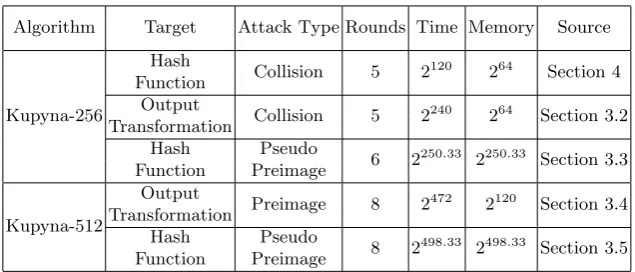
In this paper, we combine the guess-and-determine technique with the MitM to propose a pseudo-preimage attack on 6-round Kupyna-256 and an 8-round pseudo-preimage attack on Kupyna-512. Then we construct a 5-round collision attack on Kupyna-256. Our cryptanalytic results of Kupyna are summarized in Table 1. We will explain these results in Section 3 and 4.
Outline of the paper The rest of the paper is organized as follows. We give
Table 1.Summary of Attack Results
Algorithm Target Attack Type Rounds Time Memory Source
Kupyna-256
Hash
Collision 5 2120 264 Section 4
Function Output
Collision 5 2240 264 Section 3.2
Transformation
Hash Pseudo
6 2250.33 2250.33 Section 3.3
Function Preimage
Kupyna-512
Output
Preimage 8 2472 2120 Section 3.4
Transformation
Hash Pseudo
8 2498.33 2498.33 Section 3.5
Function Preimage
2
Description of Kupyna
Kupyna is an iterated hash function with an SPN structure following the AES design strategy. Kupyna supports output length from 8 bits to 512 bits. The recommended modes are Kupyna-256, Kupyna-384 and Kupyna-512. Assume a message is padded and divided into message blocks M0, M1, . . . , Mk−1 of l-bit length, which is defined as
l=
{
512, if 8≤n≤256, 1024, if 256< n≤512.
We can process as follows to generate a hash valueh:
CV0←IV
CVi+1←CF(CVi, Mi) fori= 0,1, . . . , k−1 h=T runc(Tl⊕(CVk)⊕CVk)
Here theIV is the initial value(Ifl = 512,IV=1≪510, else IV=1≪1024.), and CF(CVi, Mi) is the compression function of Kupyna. Tl⊕(CVk) is a per-mutation that is a component of the compression function and will be defined later.
Before applying the compression function, the input messageM is processed to be a multiple of l bits by the padding procedure. According to the padding procedure, a single bit ‘1’ and len0 ‘0’s are put at the end of the message M. Herelen0satisfies the following equationlenM+ 1 +len0≡96 mod 512 (lenM andlen0are short for the length ofM and the number of ‘0’ respectively). After the above step, we put another 96 bits including the length of the message at the end of the padding. Then the padded message M∗ is divided into l bits blocks Mi (i= 0,1, . . . , k−1).
The compression function uses two permutationsTl⊕ andTl+, and computes as follows(see also Fig.1):
l
CVi-1 CVi
Mi-1
Truncated
T+
l
T
CVk Tl
10 40 16 15 14 13 12 11 23 22 21 20 19 18 17 39 38 37 36 35 34 33 32 31 30 29 28 27 26 25 24 48 47 46 45 44 43 42 41 57 56 55 54 53 52 51 50 49 2 1 0 63 62 61 60 59 58 7 6 5 4 3 9 8
Fig. 1.Compression function, output transformation of Kupyna, and the byte positions for Kupyna-256.
Here, CVi is the chaining value and Mi is a message block. Note that, the compression function CFl has only two forms CF512 (for 8 ≤ n ≤ 256) and CF1024 (for 256 < n ≤ 512). In the following, we only present Kupyna-256 and Kupyna-512 for simplicity. Tl⊕() and Tl+() are AES-like permutation with 8×8 and 8×16 sized state for Kupyna-256 and Kupyna-512 respectively. As shown in Fig. 1, byte positions in a stateS for Kupyna-256/512 are denoted by G= (gi,j),gi,j∈GF(28), wherei= 0,1, ...,7,j= 0,1, ..., c−1 (ifl= 512, c= 8; ifl= 1024, c= 16). Kupyna-256 adopts 10-roundT512⊕ () andT512+ (). Kupyna-512 uses 14-roundT1024⊕ () andT1024+ (). The round function of the two permutations consist of the following four operations:
– AddConstant: The AddConstant operation adds a round-dependent
con-stant to the state.
– SubBytes: The SubBytes transformation applies an S-box to each cell of
the state.
– ShiftRows:The ShiftRows transformation cyclically rotates the cells of the i-th row leftwards by shift vector (define later).
– MixColumns:In the MixColumns operation, each column of the matrix is
multiplied by an MDS matrix.
We useAC, SB, SRandM Cto denote these transformations for short. TheSB function transforms each cellgi,jof the state matrixG= (gi,j) bySBi mod4(gi,j), whereSBs:GF(28)→GF(28), s∈0,1,2,3). We omitted the detail of the SB, since its not important in our attack. The shift vectors used inTl⊕() and Tl+() are different.T512⊕ () andT512+ () in Kupyna-256 uses (0,1,2,3,4,5,6,7), whileT1024⊕ () andT1024+ () in Kupyna-512 uses (0,1,2,3,4,5,6,11). For a detailed explanation, we refer to the original paper [17]. Since the design of Kupyna is similar to Grøstl, we can apply some attacks on Grøstl to Kupyna.
3
Preimage Attack on Kupyna
In this section, we will show how to construct a preimage attack on the Kupyna hash function. Firstly, we present the previous preimage attacks on Grøstl. Sec-ondly, we show how to construct the preimage attacks on Kupyna. Note that, if we makeCVi′ =CVi⊕Mi, then compression function can be rewritten as
CF(CVi, Mi) =Tl⊕(CV ′ i)⊕CV
′ i ⊕T
+
l (Mi)⊕Mi.
3.1 Previous Works
In FSE 2012, Wuet al.[29] proposed the first pseudo preimage attack on Grøstl hash function. In [30], Zou et al. found out the attack of Wu et al. could be divided into two-phase MitM attacks, then they could use the subspace preimage to improve the complexity. Subspace preimage attack can be defined by a linear subspace (with a linear functionL(·)). In subspace preimage attack process, the attacker should store the L(A) in the lookup table LSub, and check if there exists an entry in LSub that L(A) is equal to L(B). If they find one,L(A⊕B) is equal to 0, that meansA⊕B is in the linear subspace. Compared with b-bit partial preimage, the subspace preimage could achieve some balance between the two-phase MitM attacks, and then reduce the overall complexity.
The idea of Zouet al.can be summarized as below. Suppose the hash output isn-bit and the state size is 2n-bit. To find a pseudo preimage (H, M) of Grøstl, it is desirable to invert the output transformation of Grøstl. LetX=CF(H, M), thenX is the preimage of the output transformation. WithH′ =H⊕M, they get
(P(H′)⊕H′)⊕(Q(M)⊕M)⊕X = 0.
If enough candidates for P(H′)⊕H′,Q(M)⊕M, andX have been collected, the pseudo preimage attack turns into a three-sum problem. The attack process is similar to the generalized birthday attack[24]. Using four parametersx1, x2, x3 andb, the attack process can be described as follow:
1. Find 2x1 preimages X of the output transformation and store them in a
lookup tableL1.
2. Find 2x3 subspace preimages of P(H′)⊕H′. Then store P(H′)⊕H′ in a
lookup tableL2.
3. Find 2x2 random M with the correct padding and calculate Q(M)⊕M.
Check if there exists an entry in L1 that Q(M)⊕M ⊕X is in the same subspace ofP(H′)⊕H′. Then 2x1+x2−b partial matchesQ(M)⊕M⊕X are
expected to remain (Here the dimension of the linear equationL(x) =t0 is n−b).
4. For each of the 2x1+x2−bQ(M)⊕M⊕X remained in step 3, check whether
there exists an entry inL2 that matches the remaining (2n−b) bits. Once a full match is found, a pseudo preimage of Grøstl hash function is found.
Suppose for Grøstl with 2n-bit state, it needs 2C1(2n,n)computations to find a
fixed position n-bit partial preimage ofXand it needs 2C2(2n,b)computations to
find a subspace preimage ofP(X)⊕X. Then the overall complexity to compute the pseudo preimage of Grøstl is:
2x1+C1(2n,n)+ 2x3+C2(2n,b)+ 2x2−1+ 2x1+x2−b·C
T L, (1)
with memory requirement of 2x1+ 2x3. HereC
3.2 Preimage Attack on 6-round Kupyna-256 Output Transformation
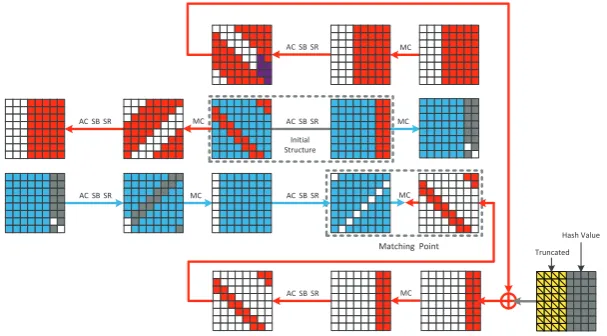
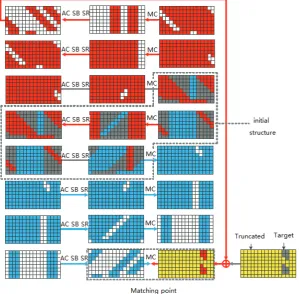
Using the combination of the guess-and-determine technique and the MitM at-tack, we can construct 6-round preimage attacks on the compression function of Kupyna-256. The 6-round chunk separation of the state update transformation is illustrated in Fig. 2. By guessing some unknown bytes, all the possible values of the guessed bytes are used as extra freedom degrees in the MitM preimage attack. As a result, more matching points can be obtained. Note that the guessed bytes are extra constraints. After a partial match is found, we should check if the guessed value produces a valid preimage. More details about the guessing technique will be shown in the following attack algorithm.
Parameters for the Guess-and-Determine MitM Attack As shown in
Fig. 2, we use the purple bytes as the guessed bytes. The red/blue color means neutral message. They are independent from each other. The white color stands for the bytes whose values are affected by red bytes and blue bytes both, and we can’t determine their values until a partial match is found. The gray bytes are constants that come from the hash value or the initial structure. In order to evaluate the complexity for the attack, we should define these parameters: freedom degrees in red and blue bytes (dr, db), the guessing red and blue bytes (Dgr, Dgb), the bits of the matching pointbm.
SR SB AC MC
SR SB AC
SR SB
AC MC
SR SB
AC MC ACSBSR MC
MC Initial
Structure
Matching Point
SR SB
AC MC
Hash Value
Truncated
Fig. 2.Preimage attack on the Output Transformation of Kupyna-256
The Attack Algorithm and Complexity The guess-and-determine MitM
1. Set random values to constants in the initial structure.
2. For all possible values 2dr of the red bytes and 2Dgr of the guessing red
bytes, compute backward from the initial structure and obtain the value at the matching point. Store the values in a lookup tableLcomp.
3. For all possible values 2db of the blue bytes and 2Dgb of the guessing blue
bytes, compute forward from the initial structure and obtain the value at the matching point. Check if there exists an entry inLcomp that matches the result at the matching point. Expected number of the partial matches is 2dr+db+Dgr+Dgb−bm.
4. Once a partial match is found, compute and check if the guessed value is right. The probability of the validity is 2−Dgr−Dgb. There are 2dr+db−bm valid
partial matches left. Then we continue the computation and check the full match. The probability that a partial match is a full match is 2−(n−bm).
5. The success probability for the above steps is 2dr+db+Dgr+Dgb−bm·2−(Dgb+Dgr)·
2−(n−bm)= 2dr+db−n. Then repeat the above steps for 2n−db−dr to find one
full match.
The complexity for each step can be calculated as follows:
1. In Step 2, building the the lookup tableLcomp takes 2dr+Dgr computations and memory.
2. In Step 3, it takes 2db+Dgb computations to find the partial matches.
Ex-pected number of the partial matches is 2db+Dgb+dr+Dgr−bm.
3. In Step 4, testing all the partial matches in step 3 needs 2db+Dgb+dr+Dgr−bm
computations. The probability of the validity is 2−Dgb−Dgr, and there are
2db+dr−bm valid partial matches left.
4. In Step 5, repeat the above four step for 2n−db−dr times.
Then the complexity of the above attack algorithm is:
2n−db−dr·(2dr+Dgr+ 2db+Dgb+ 2db+Dgb+dr+Dgr−bm)
= 2n·(2Dgr−db+ 2Dgb−dr+ 2Dgb+Dgr−bm).
(2)
As shown in Fig. 2, the parameters for the attack on the 6-round compression function of Kupyna-256 are as follow: dr = 16, db = 64, Dgr = 48, Dgb = 0, bm = 64 and n = 256. According to equation (1), the overall complexity is 2256·(248−64+ 20−16+ 248−64)≈2240 compression function calls. Only Step 2 requires 216+48= 264 memory.
3.3 Subspace Preimage Attack on T512⊕ (H
′
)⊕H′
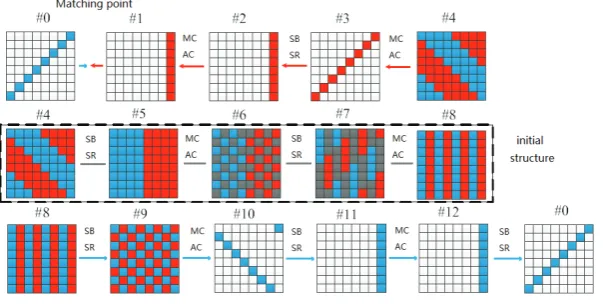
1. Randomly set the State value #6[1,3,5,7,8,10,12,14,17,19,21,23,24,26,28,30](gray). 2. Set the value of the State #4[0,5,6,7,8,9,14,15,16,17,18,23,24,25,26,27] (blue)
so that the chosen 4 bytes at State #3[7,14,21,28] (red) can be achieved through the Inverse-MixColumns operation.
3. For each value of the State #4[0,5,6,7,8,9,14,15,16,17,18,23,24,25,26,27] (blue), we can calculate through the SubBytes and ShiftRows operations and get the corresponding values of the State #5[0,1,2,3,8,9,10,15,16,17,22,23,24,29,30,31] (blue).
4. With the known values of State #5 (blue) and State #6 (gray), we calculate the rest blue bytes of State #5 and State #6 through the MixColumns operation.
5. With the calculated bytes #5[4,5,6,7,11,12,13,14,18,19,20,21,25,26,27,28], we compute the values of #4[33,34,35,36,42,43,44,45,51,52,53,54,60,61,62,63] through the Inverse-ShiftRows and Inverse-SubBytes operations. We check whether the values of the State #4[33,34,35,36,42,43,44,45,51,52,53,54,60,61,62,63] satisfy the linear relationship so that the chosen 4 bytes at #3[35,42,49,56] can be achieved through the Inverse-Mix-Columns operation
For Kupyna-256 compression function, we suppose that it needs 2Cr
compu-tations to find a suitable initial structure for the forward direction (from #6 to #8) and it needs 2Cb computations to find a suitable initial structure for the
backward direction (from #6 to #4). Then the complexity to find a suitable initial structure can be written as follows:
2n−db−dr·(2dr+Cr+ 2db+Cb+ 2db+dr−m)
= 2n·(2Cr−db+ 2Cb−dr+ 2−m). (3)
As shown in Fig. 3, the parameters for this attack are as follows:Cr=Cb = 32 bits, dr=db = 40 bits,m= 8 bits. Then 28(= 240+40−32−32/28) 8-bit subspace preimages can be found with a complexity of 28. It means that an 8-bit subspace preimage can be found with a complexity of 20(= 28/28) and the complexity 2C2(512,8)= 20. According to Eq. (1) and 2C1(512,256)= 2240, 2C2(512,8)= 20.
The Complexity of Pseudo Preimage Attack on 6-round Kupyna-256 Hash Function The overall complexity can be expressed as 2x1+240+ 2x3+
2x2−1+ 2x1+x2−8·C
T L. Whenx1= 10.33, x2 = 251.33, x3 = 250.33, b= 8, the minimum complexity is 2250.33and the memory requirement is 2250.33.
3.4 Preimage Attack on 8-round Kupyna-512 Output
Transformation
Fig. 3.Chunk separation of subspace preimage attack on 6-round Kupyna-256
In Fig. 4, the parameters for the attack on the output transformation of 8-round Kupyna-512 are as follows:dr=db = 80 bits,Dgr=Dgb = 40 bits,m= 144 bits and n = 512 bits. According to Eq. (2), the complexity of our attack can be calculated as 2C1(1024,512)= 2512·(240−80+ 240−80+ 240+40−144)≈2472
compression function calls. The memory requirement is 240+80= 2120.
3.5 Subspace Preimage Attack on T1024⊕ (H′)⊕H′
We show the chunk separation of subspace preimage attack onT1024⊕ (H′)⊕H′ in Fig. 5. Here we also do not adopt the guess-and-determine technique here, because we cannot find a good guess-and-determine way to make the complexity better than the simple MitM attack.
The parameters for the MitM attack: the freedom degreesdr = 16 bits, db = 16 bits. The size of matching pointbmaxis 32 bits. We setdr=db=bbest = 16 bits, and then we can find 216(= 216+16/216) 16-bit subspace preimages with the complexity of 216. It means that a 16-bit subspace preimage is found with the complexity of 20(= 216/216). The complexity is 2C2(1024,16)≈20.
The Complexity of Pseudo Preimage Attack on 8-round Kupyna-512 Hash Function The overall complexity can be expressed as 2x1+472+ 2x3+
2x2−1+ 2x1+x2−16·C
T L. Whenx1= 26.33, x2= 499.33, x3= 498.33, b= 16, the minimum complexity is 2498.33and the memory requirement is 2498.33.
4
Collision Attack on 5-round Kupyna-256
AC SB SR
AC SB SR
AC SB SR
MC
MC
MC
MC
MC
MC AC SB SR
AC SB SR
AC SB SR AC SB SR
AC SB SR
MC
Matching point
MC
Initial structure
Target
by setting on differences inTl+(). Based on these attacks, we then present the collision attacks on the hash function of Kupyna-256.
4.1 Details of the Attack
In order to simplify the attack process, we use the alternative description of Kupyna in the following way. LetTl⊕′() andTl+′() denote the permutationTl⊕() and Tl+() without the last application of M C. Then, we can get an equivalent description of Kupyna, by setting:
h0←M C−1(IV) hi←T⊕
′
l (hi−1⊕mi−1)⊕T+ ′
l (mi−1)⊕h′i−1 f or i= 1, . . . , k h=T runc(M C(h′k))
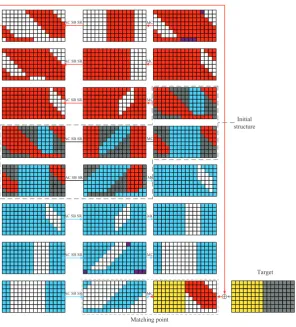
We show the collision attacks on the hash function of Kupyna-256 by us-ing the Super-Sbox technique. The Super-Sbox rebound technique was indepen-dently proposed by Lambergeret al.at Asiacrypto 2009 [7] and by Gilbert and Peyrin [5] at FSE 2010. The Super-Sbox consists of 8 parallel S-boxesS, followed by one MixBytes operationLand another 8 parallel S-boxesS:S-L-S.
If the differences in the message words are the same as in the output of the state update transformation, the differences cancel each other through the feed-forward. By using the freedom of the message blocks to cancel the differences of the chaining values successively, we can construct the collision attack on the Kupyna-256 hash function. Our differential path using the Super-Sbox rebound technique is shown in Fig. 6. The 5-round collision trail:
64→64→8→1→8→8. (4)
SB MC AC SB
SR MC
AC SB SR MC
AC SB SR MC
AC SB SR AC
SR
Inbound phase: average 1 Outbound phase: probability 2-56
Fig. 6.Supersbox technique used in the 5-round truncated differential trail
The inbound phase is shown by dashed arrows and the outbound phase is shown by solid arrows. Note that, we should cancel the differences in 8 bytes in each iteration. The probability of this is 2−64, so that we should generate 264 pairs following the differential trail for a given difference. As shown in Fig. 7, the 5-round collision attack proceeds as follows:
2. Use a right pair of message blocks m1, m∗1 for the trail of (4) to cancel 8 bytes of the difference inh1.
3. Use a right pair of message blocks m2,m∗2 for the trail of to cancel 8 bytes of the difference inh2.
4. Repeat steps 3-4 in 8 times until we have found a collision inh9.
MC m0 AC SB SR MC AC SB SR MC AC SB SR MC
T+(m0)
AC SB SR MC AC SB SR h1 h0 MC m1 AC SB SR MC AC SB SR MC AC SB SR MC
T+(m1)
AC SB SR MC AC SB SR h2 h1 MC m2 AC SB SR MC AC SB SR MC AC SB SR MC
T+(m2)
AC SB SR MC AC SB SR
h2 h3
MC m3 AC SB SR MC AC SB SR MC AC SB SR MC
T+(m3)
AC SB SR MC AC SB SR h4 h3 MC m4 AC SB SR MC AC SB SR MC AC SB SR MC
T+(m4)
AC SB SR MC AC SB SR h4 MC m5 AC SB SR MC AC SB SR MC AC SB SR MC
T+(m5)
AC SB SR MC AC SB SR MC m6 AC SB SR MC AC SB SR MC AC SB SR MC
T+(m6)
AC SB SR MC AC SB SR MC m7 AC SB SR MC AC SB SR MC AC SB SR MC
T+(m7)
AC SB SR MC AC SB SR MC m8 AC SB SR MC AC SB SR MC AC SB SR MC
T+(m8)
AC SB SR MC AC SB SR h9 h5
h5 h6
h6 h7
h7 h8
h8
Fig. 7.Truncated differential trail used in the attack on 5 rounds
inbound phase are propagated outwards probabilistically. The transition from 8 active bytes to one active byte through the Mixcolumn transformation M C has a probability of 2−56. As a result, there are only 28 pairs exist for this truncated differential trail. The freedom in finding right pairs for the 5-round trail is limited, more message blocks should be needed for the collision attack. As pointed in , this problem can be solved by using more message blocks in each step of the attack. The differences have to be canceled iteratively 8 times fromh2 toh9. Then complexity of the attack is 8·264+56= 2123, and we need the length of colliding message 8·256= 259. The memory requirement are 264. As noted in , we can use the tree-based approach to reduce the length of the colliding message pair to 65 message blocks. By using denser characteristics, the complexity of the 5-round collision attack can be slightly reduced to 2120. Furthermore, we can construct collisions in the chosen-prefix setting with the same complexity due to the generic nature of our attack.
5
Conclusion
In this article, we propose the collision attacks and the preimage attacks on the Kupyna hash function. The design of Kupyna is similar to Grøstl, but some round constants are added with a modular addition. This design approach makes many known attacks harder to apply. The original MitM attack [2] is not suit to solve a pseudo-preimage of the Kupyna hash function due to the wide-pipe design. In addition, we can not construct the collision attack on the Kupyna hash function only by the original rebound attack. Our solution is the combination of some known attacks such as the guess-and-determine technique and the MitM preimage attack. To sum up, we present the first public security analysis of the Kupyna hash function. Firstly, we propose a pseudo-preimage attack on 6-round hash function of Kupyna-256 and a pseudo-preimage attack on 8-6-round hash function of Kupyna-512 by combining the guess-and-determine technique with the MitM attack. Secondly, we construct a collision attack on the 5-round Kupyna-256 hash function. However, our attacks do not threat any security claims of Kupyna.
References
1. Kazumaro Aoki, Jian Guo, Krystian Matusiewicz, Yu Sasaki, and Lei Wang. Preim-ages for Step-Reduced SHA-2. In Matsui [9], pPreim-ages 578–597.
2. Kazumaro Aoki and Yu Sasaki. Preimage Attacks on One-Block MD4, 63-Step MD5 and More. In Roberto Maria Avanzi, Liam Keliher, and Francesco Sica, editors, Selected Areas in Cryptography, volume 5381 of LNCS, pages 103–119. Springer, 2008.
3. Kazumaro Aoki and Yu Sasaki. Meet-in-the-Middle Preimage Attacks Against Reduced SHA-0 and SHA-1. In Shai Halevi, editor, CRYPTO, volume 5677 of
4. Praveen Gauravaram, Lars R. Knudsen, Krystian Matusiewicz, Florian Mendel, Christian Rechberger, Martin Schl¨affer, and Søren S. Thomsen. Grøstl – a SHA-3 candidate. Submission to NIST (Round 3), 2011.
5. Henri Gilbert and Thomas Peyrin. Super-sbox cryptanalysis: Improved attacks for aes-like permutations. In Seokhie Hong and Tetsu Iwata, editors,FSE, volume 6147 ofLecture Notes in Computer Science, pages 365–383. Springer, 2010. 6. Jian Guo, San Ling, Christian Rechberger, and Huaxiong Wang. Advanced
Meet-in-the-Middle Preimage Attacks: First Results on Full Tiger, and Improved Results
on MD4 and SHA-2. In Masayuki Abe, editor, ASIACRYPT, volume 6477 of
LNCS, pages 56–75. Springer, 2010.
7. Mario Lamberger, Florian Mendel, Christian Rechberger, Vincent Rijmen, and Martin Schl¨affer. Rebound distinguishers: Results on the full whirlpool compression function. In Matsui [9], pages 126–143.
8. Ga¨etan Leurent. MD4 is Not One-Way. In Nyberg [16], pages 412–428.
9. Mitsuru Matsui, editor. Advances in Cryptology - ASIACRYPT 2009, 15th Inter-national Conference on the Theory and Application of Cryptology and Information Security, Tokyo, Japan, December 6-10, 2009. Proceedings, volume 5912 ofLecture Notes in Computer Science. Springer, 2009.
10. Krystian Matusiewicz, Mar´ıa Naya-Plasencia, Ivica Nikolic, Yu Sasaki, and Martin Schl¨affer. Rebound attack on the full lane compression function. In Matsui [9], pages 106–125.
11. Florian Mendel, Thomas Peyrin, Christian Rechberger, and Martin Schl¨affer. Im-proved cryptanalysis of the reduced grøstl compression function, echo permutation and aes block cipher. In Michael J. Jacobson Jr., Vincent Rijmen, and Reihaneh Safavi-Naini, editors,Selected Areas in Cryptography, volume 5867 ofLecture Notes in Computer Science, pages 16–35. Springer, 2009.
12. Florian Mendel, Norbert Pramstaller, and Christian Rechberger. A (second) preim-age attack on the gost hash function. In Nyberg [16], ppreim-ages 224–234.
13. Florian Mendel, Norbert Pramstaller, Christian Rechberger, Marcin Kontak, and Janusz Szmidt. Cryptanalysis of the gost hash function. In David Wagner, editor,
CRYPTO, volume 5157 of Lecture Notes in Computer Science, pages 162–178. Springer, 2008.
14. Florian Mendel, Christian Rechberger, Martin Schl¨affer, and Søren S. Thomsen. The rebound attack: Cryptanalysis of reduced whirlpool and grøstl. In Orr Dunkel-man, editor,FSE, volume 5665 ofLecture Notes in Computer Science, pages 260– 276. Springer, 2009.
15. Florian Mendel, Vincent Rijmen, and Martin Schl¨affer. Collision attack on 5 rounds of grøstl. InFast Software Encryption - 21st International Workshop, FSE 2014, London, UK, March 3-5, 2014. Revised Selected Papers, pages 509–521, 2014. 16. Kaisa Nyberg, editor. Fast Software Encryption, 15th International Workshop,
FSE 2008, Lausanne, Switzerland, February 10-13, 2008, Revised Selected Papers, volume 5086 ofLecture Notes in Computer Science. Springer, 2008.
17. Gorbenko I. Kazymyrov O. Ruzhentsev V. Kuznetsov O. Gorbenko Y. Boiko A. Dyrda O. Dolgov V. Pushkaryov A. Oliynykov, R. A new standard of ukraine: The kupyna hash function. Cryptology ePrint Archive, Report 2015/885, 2015. 18. Information Protection and Special Communications of the Federal Security
19. Information Protection and Special Communications of the Federal Security Ser-vice of the Russian Federation. Gost r 34.11.94 information technology crypto-graphic date security hash-functions (in russian).
20. Yu Sasaki and Kazumaro Aoki. Preimage Attacks on 3, 4, and 5-Pass HAVAL. In Josef Pieprzyk, editor, ASIACRYPT, volume 5350 of LNCS, pages 253–271. Springer, 2008.
21. Yu Sasaki and Kazumaro Aoki. Finding Preimages in Full MD5 Faster Than
Exhaustive Search. In Antoine Joux, editor,EUROCRYPT, volume 5479 ofLNCS, pages 134–152. Springer, 2009.
22. Yu Sasaki, Lei Wang, Shuang Wu, and Wenling Wu. Investigating fundamental security requirements on whirlpool: Improved preimage and collision attacks. In Xiaoyun Wang and Kazue Sako, editors, ASIACRYPT, volume 7658 of Lecture Notes in Computer Science, pages 562–579. Springer, 2012.
23. Victor Shoup, editor.Advances in Cryptology - CRYPTO 2005: 25th Annual Inter-national Cryptology Conference, Santa Barbara, California, USA, August 14-18, 2005, Proceedings, volume 3621 ofLecture Notes in Computer Science. Springer, 2005.
24. David Wagner. A Generalized Birthday Problem. In Moti Yung, editor,CRYPTO, volume 2442 ofLNCS, pages 288–303. Springer, 2002.
25. Lei Wang, Yu Sasaki, Wataru Komatsubara, Kazuo Ohta, and Kazuo Sakiyama. (Second) Preimage Attacks on Step-Reduced RIPEMD/RIPEMD-128 with a New Local-Collision Approach. In Aggelos Kiayias, editor, CT-RSA, volume 6558 of
LNCS, pages 197–212. Springer, 2011.
26. Xiaoyun Wang, Yiqun Lisa Yin, and Hongbo Yu. Finding collisions in the full sha-1. In Shoup [23], pages 17–36.
27. Xiaoyun Wang and Hongbo Yu. How to break md5 and other hash functions. In Ronald Cramer, editor,EUROCRYPT, volume 3494 ofLecture Notes in Computer Science, pages 19–35. Springer, 2005.
28. Xiaoyun Wang, Hongbo Yu, and Yiqun Lisa Yin. Efficient collision search attacks on sha-0. In Shoup [23], pages 1–16.
29. Shuang Wu, Dengguo Feng, Wenling Wu, Jian Guo, Le Dong, and Jian Zou. (pseudo) preimage attack on round-reduced grøstl hash function and others. In Anne Canteaut, editor,FSE, volume 7549 ofLecture Notes in Computer Science, pages 127–145. Springer, 2012.