
Recent results from CMS
ÉmilienChapon1,, on behalf of the CMS Collaboration
1Experimental Physics Department, CERN, CH-1211 Geneva 23, Switzerland
Abstract.Recent results from the CMS Collaboration are reported, covering the wide
variety of probes accessible to the experiment.
The strongly interacting matter created in nuclear collisions at the LHC, in pPb and PbPb collisions but also high multiplicity pp collisions, can be studied with the means of a large variety of probes, from identified hadrons to jets, from light flavours and strangeness to heavy flavours, charm and beauty. The CMS collaboration [1] uses many different observables in these studies, starting with the production cross section. Nuclear modification factors (RAA) can also be built, from the ratio
of the cross section in heavy ions collisions (HIC), pPb or PbPb, to that in pp collisions. In this way, one can clearly see if the production of a given probe is suppressed or enhanced in HIC: for instance, in the case of charmonia, colour charge Debye screening in the quark-gluon plasma (QGP) induces a suppression in the production in PbPb collisions, while recombination can also play a role and enhance the yields at low transverse momentum (pT). Much information can also be gained
by focusing on collective properties of each event, such as N-particle correlations, or event-by-event fluctuations of such quantities. In particular, the Fourier coefficients of the azimuthal correlations (v2,v3, etc.) provide information on the anisotropic flow in the event (resp. elliptic, triangular, etc).
A collective behaviour is observed not only in PbPb collisions, but also in small systems: pPb and even pp collisions. In dijet production, the imbalance of the two jets can be measured and compared between different systems, pp and PbPb. Heavy flavour jets, such as b jets, then allow to probe the flavour dependence of parton energy loss.
1 Charmonia
The different charmonium states (J/ψ, ψ(2S)) can be reconstructed through their decay to a pair
of oppositely charged muons. The invariant mass distributionmµµ of these pairs is then fitted to
extract the observed yields. However, further work is needed to disentangle the different sources of charmonium production. Some fraction of it, called nonprompt, originates from the decay of B mesons, which can be resolved using the pseudo-proper decay lengthJ/ψ, reconstructed using the
distance between the primary and dimuon vertices. In the case of the J/ψmeson, a two-dimensional fit allows to simultaneously extract the prompt and nonprompt production, while in the case of theψ(2S) meson, a cut-based method was used to remove the nonprompt contribution. The prompt component of J/ψmeson production receives also a contribution from the feed-down from excited charmonium states,χcandψ(2S) mesons. This cannot be separated from direct J/ψmeson production in the results reported here.
part N
0 50 100 150 200 250 300 350 400
AA
R
0 0.2 0.4 0.6 0.8 1 1.2 1.4
(Eur.Phys.J. C77 (2017) no.4, 252)
= 2.76 TeV
NN
s
= 5.02 TeV
NN
s |y| < 2.4
< 50 GeV/c T 6.5 < p
ψ
Prompt J/
(5.02 TeV)
-1
, pp 28.0 pb
-1
b µ PbPb 368 (<30%) / 464 (>30%)
CMS Preliminary
(GeV/c) T p
0 5 10 15 20 25 30
2
v
0 0.1 0.2 0.3 0.4 0.5
0.6CMS PbPb sNN = 2.76 TeV
Cent. 10-60%
ψ Hidden charm: prompt J/ 1.6 < |y| < 2.4 |y| < 2.4 Charged hadron
| < 0.8 η |
Open charm: prompt D (ALICE) |y| < 0.8, Cent. 30-50%
CM y
-3 -2 -1 0 1 2 3
pPb
R
0 0.2 0.4 0.6 0.8 1 1.2 1.4 1.6
< 10 GeV/c
T
6.5 < p
(HIN-14-009) ψ Prompt J/
(2S) ψ Prompt
= 5.02 TeV
NN
s
-1
, pp 28.0 pb
-1
pPb 34.6 nb
CMS Preliminary
Figure 1.Left:RAAof prompt J/ψmesons as a function of the number of participants to the collision, at√sNN=
2.76 [2] and 5.02 TeV [3]. Center:v2of prompt J/ψmesons as a function ofpT, at √sNN=2.76 TeV, compared
to that of other hadrons. Right:RpPbof promptψ(2S) [4] and prompt J/ψ[5] mesons at √sNN=5.02 TeV, as a
function of rapidity in the centre-of-mass frame.
The nuclear modification factor of prompt J/ψmesons has been measured in pPb collisions at
√s
NN=5.02 TeV [5], as well as in PbPb collisions at √sNN=2.76 TeV [2] and 5.02 TeV [3], always
compared to pp measurements at the same collision energy. In pPb collisions, nuclear modifications of the parton distribution functions are expected to impact the prompt J/ψmeson production. The CMS measurement of theRpPbas a function of the rapidity of the J/ψmeson is consistent with this
expectation, but other effects could also contribute, such as energy loss in cold nuclear matter. In PbPb collisions and at highpT(pT >6.5 GeV), the creation of a QGP further suppresses J/ψmeson
production, because of parton energy loss, especially at very highpT, and melting induced by Debye
colour charge screening in the deconfined medium. This suppression is even more pronounced in central collisions, where the QGP is hotter and longer lived, as can be seen in Fig. 1. The elliptic flowv2of prompt J/ψmesons has also been measured and is found to be non-zero, even at relatively
highpT (up to 10 GeV, see Fig. 1)), possibly pointing to a path length dependence of parton energy
loss. On the other hand, thev2measurement is found to be compatible at highpTwith that of charged
hadrons, dominated by light hadrons, which could be pointing to a flavour independence of this path length dependence.
Additional information can be gained by comparing the behaviour of the ground and excited char-monium states, the J/ψandψ(2S) mesons. A higher suppression of theψ(2S) meson, compared to the J/ψmeson, is observed both in pPb [4] and PbPb [6] collisions at √sNN =5.02 TeV. This difference
seems to be more pronounced at backward rapidity in pPb collisions, as shown in Fig. 1, and it is ob-served at allpTbetween 3 and 30 GeV in PbPb collisions. This points to the importance of final state
effects, which have a different impact on the ground and excited states. Understanding such different behaviours of the J/ψandψ(2S) mesons is challenging to understand theoretically, especially in pPb
where final state effects should be of lesser importance.
Bottomonia are measured in the CMS experiment, inclusively from pT =0 GeV. In addition, as
opposed to J/ψandψ(2S) meson production,Υ(nS) meson production is free from any nonprompt contribution, because they are heavier than B mesons. Feed-down fromP-wave and heavierS-wave states is however also present in the Υ(1S) and Υ(2S) meson measurements. The comparison of the RAA of the different Υ(nS) states [7] shows a clear ordering, with the heavier, weaker bound
part N
0 50 100 150 200 250 300 350 400
AA R 0 0.2 0.4 0.6 0.8 1 1.2 1.4
(Eur.Phys.J. C77 (2017) no.4, 252)
= 2.76 TeV
NN
s
= 5.02 TeV
NN
s |y| < 2.4
< 50 GeV/c T 6.5 < p
ψ
Prompt J/
(5.02 TeV)
-1
, pp 28.0 pb
-1
b µ PbPb 368 (<30%) / 464 (>30%)
CMS Preliminary
(GeV/c) T p
0 5 10 15 20 25 30
2 v 0 0.1 0.2 0.3 0.4 0.5
0.6CMS PbPb sNN = 2.76 TeV
Cent. 10-60%
ψ Hidden charm: prompt J/ 1.6 < |y| < 2.4 |y| < 2.4 Charged hadron
| < 0.8 η |
Open charm: prompt D (ALICE) |y| < 0.8, Cent. 30-50%
CM y
-3 -2 -1 0 1 2 3
pPb R 0 0.2 0.4 0.6 0.8 1 1.2 1.4 1.6
< 10 GeV/c
T
6.5 < p
(HIN-14-009) ψ Prompt J/ (2S) ψ Prompt
= 5.02 TeV
NN
s
-1
, pp 28.0 pb
-1
pPb 34.6 nb
CMS Preliminary
Figure 1.Left:RAAof prompt J/ψmesons as a function of the number of participants to the collision, at √sNN=
2.76 [2] and 5.02 TeV [3]. Center:v2of prompt J/ψmesons as a function ofpT, at√sNN=2.76 TeV, compared
to that of other hadrons. Right:RpPbof promptψ(2S) [4] and prompt J/ψ[5] mesons at √sNN=5.02 TeV, as a
function of rapidity in the centre-of-mass frame.
The nuclear modification factor of prompt J/ψmesons has been measured in pPb collisions at
√s
NN=5.02 TeV [5], as well as in PbPb collisions at √sNN=2.76 TeV [2] and 5.02 TeV [3], always
compared to pp measurements at the same collision energy. In pPb collisions, nuclear modifications of the parton distribution functions are expected to impact the prompt J/ψmeson production. The CMS measurement of theRpPb as a function of the rapidity of the J/ψmeson is consistent with this
expectation, but other effects could also contribute, such as energy loss in cold nuclear matter. In PbPb collisions and at high pT(pT >6.5 GeV), the creation of a QGP further suppresses J/ψmeson
production, because of parton energy loss, especially at very high pT, and melting induced by Debye
colour charge screening in the deconfined medium. This suppression is even more pronounced in central collisions, where the QGP is hotter and longer lived, as can be seen in Fig. 1. The elliptic flowv2of prompt J/ψmesons has also been measured and is found to be non-zero, even at relatively
highpT(up to 10 GeV, see Fig. 1)), possibly pointing to a path length dependence of parton energy
loss. On the other hand, thev2measurement is found to be compatible at highpTwith that of charged
hadrons, dominated by light hadrons, which could be pointing to a flavour independence of this path length dependence.
Additional information can be gained by comparing the behaviour of the ground and excited char-monium states, the J/ψandψ(2S) mesons. A higher suppression of theψ(2S) meson, compared to the J/ψmeson, is observed both in pPb [4] and PbPb [6] collisions at √sNN =5.02 TeV. This difference
seems to be more pronounced at backward rapidity in pPb collisions, as shown in Fig. 1, and it is ob-served at allpTbetween 3 and 30 GeV in PbPb collisions. This points to the importance of final state
effects, which have a different impact on the ground and excited states. Understanding such different behaviours of the J/ψandψ(2S) mesons is challenging to understand theoretically, especially in pPb
where final state effects should be of lesser importance.
Bottomonia are measured in the CMS experiment, inclusively frompT =0 GeV. In addition, as
opposed to J/ψandψ(2S) meson production,Υ(nS) meson production is free from any nonprompt contribution, because they are heavier than B mesons. Feed-down fromP-wave and heavierS-wave states is however also present in the Υ(1S) andΥ(2S) meson measurements. The comparison of the RAA of the differentΥ(nS) states [7] shows a clear ordering, with the heavier, weaker bound
excited states being more suppressed, as expected from sequential suppression because of the lower
(GeV/c)
T
c jet p
0 100 200 300 400
GeV/c nb T dp pp σ d , T dp pPb dN pA T 1 3 − 10 2 − 10 1 − 10 1 10 2 10
| < 1.5
CM
η
pPb data, | | < 1.5
η
pp data, | CMS pp (5.02 TeV)
-1 pPb, 27.4 pb -1 35 nb
(GeV/c)
T
c jet p
0 100 200 300 400
pA
R 1 2
pPb Lumi. Uncert. pp Lumi. Uncert.
-weighted) coll (N 〉 part N 〈
0 50 100 150 200 250 300 350 400 〉J x 〈 0.56 0.58 0.6 0.62 0.64 0.66 0.68 0.7 0.72 0.74 pp 30-100% 10-30% 0-10% (5.02 TeV PbPb)
-1
b µ (5.02 TeV pp) + 404
-1 25.8 pb CMS Preliminary Inclusive dijets Data pp-based reference -weighted) coll (N 〉 part N 〈
0 50 100 150 200 250 300 350 400 〉J x 〈 0.56 0.58 0.6 0.62 0.64 0.66 0.68 0.7 0.72 0.74 pp 30-100% 10-30% 0-10% (5.02 TeV PbPb)
-1
b µ (5.02 TeV pp) + 404
-1 25.8 pb CMS Preliminary b dijets Data pp-based reference
Figure 2.Left: differential cross section for c-jet production in pp and pPb collisions at √sNN=5.02 TeV, as a
function ofpT[9]. TheRpPbis also shown in the bottom panel. Center: dijet momentum imbalance of inclusive
dijets in pp and PbPb collisions at√sNN=5.02 TeV, as a function of the number of participants weighted by the
number of binary collisions [10]. Right: same as center, for b dijets.
dissociation temperature of the Υ(2S) andΥ(3S) mesons with respect to theΥ(1S) meson. This suppression is also higher in central than in peripheral events. TheΥ(3S) meson is not observed in the PbPb dataset at √sNN=5.02 TeV, even in the most peripheral events [8].
2 Heavy flavour jets
Tagged jets provide another probe in the study of heavy flavour production in HIC. Tagging relies on several properties of the jet, such as the secondary vertex mass, which allow to discriminate jets originating from a charm or bottom quark from those initiated by a light parton. The contribution from these different categories of jets is then extracted thanks to templates of this discriminating variable. Heavy flavour jets allow to probe charm and bottom production at highpT, above 55 GeV, and include
contributions from all hadron species. The comparison with light jets can provide information on the importance of the quark mass in energy loss mechanisms and other phenomena.
The production of both charm [9] and bottom [11] jets has been measured in both pp and pPb collisions at √sNN =5.02 TeV. In the case of c jets, the first measurement of this kind in pp and pPb
collisions, the spectra have been found to be compatible between the two systems (see Fig. 2). The b jet measurement is also the first in pPb collisions, and is compared to expectations from PYTHIA: again no significant differences are found between the data and the pp model.
The measurement of jet pair production, and of the momentum imbalance between the two jets,
xJ=pT,1/pT,2, is another tool in the understanding of heavy quark energy loss in HIC. In the case
of light jets, a smallerxJis found in PbPb than in pp collisions at √sNN =5.02 TeV [10], possibly
more pronounced in the most central collisions. A similar behaviour is observed when comparing the
xJof b jets in PbPb and pp collisions (see Fig. 2). Several processes give a significant contribution
to b jet production, from gluon splitting to flavour creation, but the former is suppressed by selecting back-to-back b dijets.
3 Open heavy flavour
(GeV/c) T p
1 10 102
AA
R
0 0.2 0.4 0.6 0.8 1 1.2 1.4 1.6
(5.02 TeV PbPb)
-1
b µ (5.02 TeV pp) + 530
-1
27.4 pb
CMS
|y| < 1 Cent. 0-10%
0 D + 0 D charged hadrons
and lumi.
AA
T uncertainty
) 2 (GeV/c inv m
1.7 1.75 1.8 1.85 1.9 1.95 2
)
2
Entries / (5 MeV/c
1000 2000 3000 4000 5000 6000 7000 8000
9000 Data
Fit Signal
0
D swapped π K-Combinatorial
CMS PbPb sNN = 5.02 TeV |y| < 1.0
Cent. 10-30% < 5.0 GeV/c
T
4.0 < p
) 2 (GeV/c inv m
1.7 1.75 1.8 1.85 1.9 1.95 2 S+B 2v
0.1 0.15 0.2 0.25
0.3 S = 0.156 ± 0.008
2
v
part N
0 50 100 150 200 250 300 350 400
AA
R
0 0.2 0.4 0.6 0.8 1 1.2 1.4
(Eur.Phys.J. C77 (2017) no.4, 252)
= 2.76 TeV
NN
s
= 5.02 TeV
NN
s
|y| < 2.4 < 50 GeV/c
T
6.5 < p ψ
Nonprompt J/
(5.02 TeV)
-1
, pp 28.0 pb
-1
b µ PbPb 368 (<30%) / 464 (>30%)
CMS Preliminary
Figure 3.Left:RAAof prompt D0mesons and charged hadrons in pp and PbPb collisions at √sNN=5.02 TeV,
as a function ofpT[12]. Center: example of simultaneous fit of the invariant mass spectrum and thev2, for the
extraction of thev2of promptD0mesons in PbPb collisions at√sNN=5.02 TeV [13]. Right:RAAof nonprompt
J/ψmesons as a function of the number of participants to the collision, at√sNN=2.76 [2] and 5.02 TeV [3].
The decay channels used are D0 →Kπand B± → J/ψK. Similarly to J/ψ, they also include a
non-prompt component from the decay of B mesons, which can be separated from the non-prompt component using the impact parameter of the D0meson decay vertex with respect to the primary vertex.
When comparing the nuclear modification factor of D0mesons [12] to that of charged hadrons,
as shown in Fig. 3, a similar suppression is observed, especially at high pT. Within the larger
un-certainties, theRAA of B±mesons [14] is also comparable. Such a comparison of the behaviour of
the suppression of different flavours of hadrons in PbPb collisions at √sNN = 5.02 TeV, compared
to pp at the same collision energy, provides information on the flavour dependence of parton energy loss. Thev2of prompt D0mesons [13] has also been measured in PbPb as a function ofpT, in several
centrality intervals. At lowpT, up to about 7 GeV, thev2of D0mesons is smaller than that of charged
hadrons, hinting to a mass ordering in the flow of hadrons. At highpT, on the other hand, the charmed
mesons feature a similarv2 as the light hadrons, consistent with a flavour independence of the path
length dependence of energy loss.
Coming back to J/ψmeasurements, their nonprompt component provides another way to study B meson (open beauty) production, up to 30 GeV. In pPb collisions [5], no large modification is observed, in any rapidity or pT bin. On the other hand, a strong suppression is observed in PbPb
collisions, both at √sNN=2.76 TeV [2] and 5.02 TeV [3], even stronger in central events, which can
be seen in Fig. 3. The elliptic flow of nonprompt J/ψin PbPb collisions at √sNN=2.76 TeV [2] has
also been measured, but still suffers from large uncertainties at the moment, preventing from drawing firm conclusions about the collective behaviour of the bottom quark.
4 Collectivity
Detailed studies of the collective behaviour of particle production in HIC help better understand the properties of the medium and the fluctuations in the initial state. Thus, the event-by-event fluctu-ations in the v2 have been quantified with the measurement of the probability distribution of this
quantity [15], in several centrality classes in PbPb data at √sNN=5.02 TeV. These distributions are
(GeV/c) T p
1 10 102
AA
R
0 0.2 0.4 0.6 0.8 1 1.2 1.4 1.6
(5.02 TeV PbPb)
-1
b µ (5.02 TeV pp) + 530
-1
27.4 pb
CMS
|y| < 1 Cent. 0-10%
0 D + 0 D charged hadrons
and lumi.
AA
T uncertainty
) 2 (GeV/c inv m
1.7 1.75 1.8 1.85 1.9 1.95 2
)
2
Entries / (5 MeV/c
1000 2000 3000 4000 5000 6000 7000 8000
9000 Data
Fit Signal
0
D swapped π K-Combinatorial
CMS PbPb sNN = 5.02 TeV |y| < 1.0
Cent. 10-30% < 5.0 GeV/c
T
4.0 < p
) 2 (GeV/c inv m
1.7 1.75 1.8 1.85 1.9 1.95 2 S+B 2v
0.1 0.15 0.2 0.25
0.3 S = 0.156 ± 0.008
2
v
part N
0 50 100 150 200 250 300 350 400
AA
R
0 0.2 0.4 0.6 0.8 1 1.2 1.4
(Eur.Phys.J. C77 (2017) no.4, 252)
= 2.76 TeV
NN
s
= 5.02 TeV
NN
s
|y| < 2.4 < 50 GeV/c
T
6.5 < p ψ
Nonprompt J/
(5.02 TeV)
-1
, pp 28.0 pb
-1
b µ PbPb 368 (<30%) / 464 (>30%)
CMS Preliminary
Figure 3.Left:RAAof prompt D0mesons and charged hadrons in pp and PbPb collisions at √sNN=5.02 TeV,
as a function ofpT [12]. Center: example of simultaneous fit of the invariant mass spectrum and thev2, for the
extraction of thev2of promptD0mesons in PbPb collisions at√sNN=5.02 TeV [13]. Right:RAAof nonprompt
J/ψmesons as a function of the number of participants to the collision, at√sNN=2.76 [2] and 5.02 TeV [3].
The decay channels used are D0 → Kπand B± → J/ψK. Similarly to J/ψ, they also include a
non-prompt component from the decay of B mesons, which can be separated from the non-prompt component using the impact parameter of the D0meson decay vertex with respect to the primary vertex.
When comparing the nuclear modification factor of D0mesons [12] to that of charged hadrons,
as shown in Fig. 3, a similar suppression is observed, especially at high pT. Within the larger
un-certainties, theRAAof B±mesons [14] is also comparable. Such a comparison of the behaviour of
the suppression of different flavours of hadrons in PbPb collisions at √sNN = 5.02 TeV, compared
to pp at the same collision energy, provides information on the flavour dependence of parton energy loss. Thev2of prompt D0mesons [13] has also been measured in PbPb as a function ofpT, in several
centrality intervals. At lowpT, up to about 7 GeV, thev2of D0mesons is smaller than that of charged
hadrons, hinting to a mass ordering in the flow of hadrons. At highpT, on the other hand, the charmed
mesons feature a similarv2 as the light hadrons, consistent with a flavour independence of the path
length dependence of energy loss.
Coming back to J/ψmeasurements, their nonprompt component provides another way to study B meson (open beauty) production, up to 30 GeV. In pPb collisions [5], no large modification is observed, in any rapidity or pT bin. On the other hand, a strong suppression is observed in PbPb
collisions, both at √sNN=2.76 TeV [2] and 5.02 TeV [3], even stronger in central events, which can
be seen in Fig. 3. The elliptic flow of nonprompt J/ψin PbPb collisions at √sNN=2.76 TeV [2] has
also been measured, but still suffers from large uncertainties at the moment, preventing from drawing firm conclusions about the collective behaviour of the bottom quark.
4 Collectivity
Detailed studies of the collective behaviour of particle production in HIC help better understand the properties of the medium and the fluctuations in the initial state. Thus, the event-by-event fluctu-ations in the v2 have been quantified with the measurement of the probability distribution of this
quantity [15], in several centrality classes in PbPb data at √sNN=5.02 TeV. These distributions are
fitted with two analytic functions, and the data is found to be better described by an elliptic power than
Centrality %
0 10 20 30 40 50 60
expγ 1
1.0
−
0.8
−
0.6
−
0.4
−
0.2
−
0.0 0.2 0.4
exp 1 γ
2.76 TeV Hydro
Preliminary
CMS PbPb 5.02 TeV
< 3.0 GeV/c
T
0.3 < p | < 1.0
η
|
Figure 4.Left: the estimated skewness for the unfoldedp(v2) in PbPb data at√sNN=5.02 TeV, as a function of
centrality [15]. Center: correlations between the hyperon and a charged hadron in high multiplicity pp collisions at √s=13 TeV, as a function of∆ηand∆φ[16]. Right: normalised symmetric cumulant between the second and third harmonics, as a function of the number of offline tracks, in pp, pPb and PbPb collisions [17].
by a Bessel-Gaussian function. The skewness of the fluctuations,γexp1 , is also extracted and found to be in good agreement with predictions from an hydrodynamic model, as can be seen in Fig. 4. Such observations suggest non-Gaussian fluctuations of the eccentricity of the collisions.
Evidence for a collective behaviour is also found in particle production in smaller systems, in pp and pPb collisions. One striking feature is the observation of long-range correlations, the so-called ridge effect, even in high multiplicity pp collisions [16]. A correlation (the “ridge”) is found at ∆φ=0, even at large∆|η|, in pairs of charged hadrons, but also with strange particles, such as short kaons K0
Sor hyperonsΛ(see Fig. 4). Thev2of charged particles has also been measured as a function
of track multiplicity, in pp, pPb and PbPb collisions, using different methods. In all three systems, the v2 computed from two-particle correlations is found to be larger than that obtained with other
correlators, but four-, six- and eight-particle correlations, as well as the Lee-Yang zeroes method, all yield to similarv2values, as expected from a collective origin for the correlations.
Another useful observable in the study of collectivity is the event-by-event correlation between Fourier harmonics of different orders,vn andvm. The CMS Collaboration has measured these
nor-malised symmetric cumulants in pp, pPb and PbPb collisions, as a function of track multiplicity [17]. Similar observations are made in all three systems. In the case of SC(2,3), which gauges the
correla-tion betweenv2andv3, an anti-correlation is found at high track multiplicity, as shown in Fig. 4. On
the contrary, SC(2,4)>0: thev2andv4values are positively correlated event-by-event. Similar trends
are observed in pPb and PbPb collisions, and high multiplicity pp collisions, regarding the trend of these observables as a function of track multiplicity.
Characteristics of strangeness production have been compared between pp, pPb and PbPb colli-sions. A higher average kinematic energyKEThas been found at higher multiplicities, for all three
systems, and for K0
S,ΛandΞ− particles alike [18]. In addition, the increase ofKET is faster in
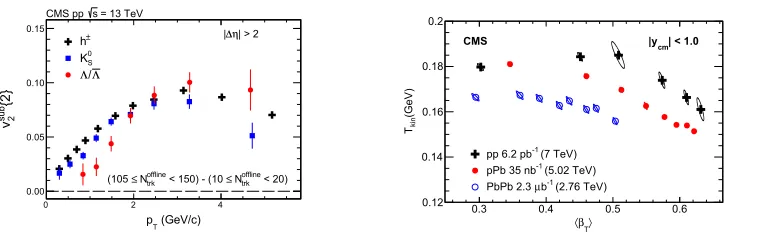
smaller systems, and for heavier particles. A similar mass ordering is also seen in pp collisions [16], when comparing the v2 of charged hadrons and of K0S andΛparticles as a function of pT at high
multiplicity, after correcting for back-to-back jet correlations estimated from low-multiplicity data, as shown in Fig. 5. Blast-wave fits have also been performed to thepTspectra of strange particles [18],
in several multiplicity bins (see Fig. 5). The interpretation of the parameters of these fits, Tkin and
〉
T
β 〈
0.3 0.4 0.5 0.6
(GeV)
kin
T
0.12 0.14 0.16 0.18 0.2
(7 TeV)
-1
pp 6.2 pb (5.02 TeV)
-1
pPb 35 nb
(2.76 TeV)
-1
b
µ
PbPb 2.3
CMS |ycm| < 1.0
Figure 5. Left: thev2results of inclusive charged particles,KS0andΛ/Λ¯ particles as a function ofpTfor high
multiplicity in pp collisions, after correcting for back-to-back jet correlations estimated from low-multiplicity data [16]. Right: the extracted kinetic freeze-out temperature,Tkin, versus the average radial-flow velocity,βT,
from a simultaneous blast-wave fit to theK0
SandΛparticlespTspectra for different multiplicity intervals in pp ,
pPb , and PbPb collisions [18].
multiplicity in the event, while Tkintends to decrease. In addition, a larger radial flow velocity (large
βT) is found in smaller systems.
References
[1] CMS Collaboration, JINST3, S08004 (2008) [2] CMS Collaboration, Eur. Phys. J. C77, 252 (2017)
[3] CMS Collaboration, CMS-PAS-HIN-16-025 (2017), https://cds.cern.ch/record/
2274286
[4] CMS Collaboration, CMS-PAS-HIN-16-015 (2017), https://cds.cern.ch/record/
2244643
[5] CMS Collaboration, Eur. Phys. J. C77, 269 (2017) [6] CMS Collaboration, Phys. Rev. Lett.118, 162301 (2017)
[7] CMS Collaboration, CMS-PAS-HIN-16-023 (2017), https://cds.cern.ch/record/
2244680
[8] CMS Collaboration (2017),arXiv:1706.05984
[9] CMS Collaboration, Phys. Lett. B772, 306 (2017)
[10] CMS Collaboration, CMS-PAS-HIN-16-005 (2016), https://cds.cern.ch/record/
2202805
[11] CMS Collaboration, Phys. Lett. B754, 59 (2016)
[12] CMS Collaboration (2017),arXiv:1708.04962
[13] CMS Collaboration (2017),arXiv:1708.03497
[14] CMS Collaboration, Phys. Rev. Lett.119, 152301 (2017)
[15] CMS Collaboration, CMS-PAS-HIN-16-019 (2017), https://cds.cern.ch/record/
2244666
[16] CMS Collaboration, Phys. Lett. B765, 193 (2017)
[17] CMS Collaboration (2017),arXiv:1709.09189
![Figure 1. [5] mesons at √to that of other hadrons. Right:/ψ RpPb of prompt ψ(2S ) [4] and prompt J/ψNN =2 Left: RAA of prompt J mesons as a function of the number of participants to the collision, at √ √s.76 [2] and 5.02 TeV [3]](https://thumb-us.123doks.com/thumbv2/123dok_us/8061907.1343718/2.512.56.457.93.222/figure-mesons-hadrons-right-prompt-function-participants-collision.webp)
![Figure 1. Left: RAA of prompt J/ψ mesons as a function of the number of participants to the collision, at √sNN =2.76 [2] and 5.02 TeV [3]](https://thumb-us.123doks.com/thumbv2/123dok_us/8061907.1343718/3.512.59.443.98.225/figure-left-prompt-mesons-function-number-participants-collision.webp)
![Figure 3.AA √J Left: R of prompt D0 mesons and charged hadrons in pp and PbPb collisions at √sNN = 5.02 TeV,as a function of pT [12]](https://thumb-us.123doks.com/thumbv2/123dok_us/8061907.1343718/4.512.58.455.91.242/figure-prompt-mesons-charged-hadrons-pbpb-collisions-function.webp)
![Figure 3. Left: RAA of prompt D0 mesons and charged hadrons in pp and PbPb collisions at √sNN = 5.02 TeV,as a function of pT [12]](https://thumb-us.123doks.com/thumbv2/123dok_us/8061907.1343718/5.512.58.461.93.224/figure-left-prompt-mesons-charged-hadrons-collisions-function.webp)
![The European Council [Rome Summit 1990], Rome, 27-28 October 1990](data:image/gif;base64,R0lGODlhAQABAIAAAP///wAAACH5BAEAAAAALAAAAAABAAEAAAICRAEAOw==)