Article 1
Research-based training: methodological
2characteristics and results of the analysis of
3educational programs
4Roman O. Pavliuk 1,*, Tetiana L. Liakh 2, Olga V. Bezpalko 3 and Nataliia A. Klishevych 4 5
1 Borys Grinchenko Kyiv University, Kyiv, Ukraine; [email protected] 6
2 Borys Grinchenko Kyiv University, Kyiv, Ukraine; [email protected] 7
3 Borys Grinchenko Kyiv University, Kyiv, Ukraine; [email protected] 8
4 Borys Grinchenko Kyiv University, Kyiv, Ukraine; [email protected] 9
* Correspondence: [email protected]; Tel.: +38-050-699-8421 10
Abstract: The purpose of the article is to determine the peculiarities of using of teaching elements
11
of research-based training at the Institute of Human Sciences of Borys Grinchenko Kyiv University.
12
Based on the focus group methodology, the authors identify the key methodological characteristics
13
of research-based training, which have been put into basis of analysis of educational programs for
14
the purpose of determining the application of tasks that contribute to the development of research
15
skills of students. The study used a method of focus group. Its purpose was to obtain the necessary
16
information from the participants to describe the methodological basis and justification of methods,
17
forms, indicators, etc. of research-based training system among people who are competent, have
18
experience in this field. After that, the method of "theoretical sampling" was used, which enabled to
19
formulate generalized characteristics according to the results of focus groups. The practical value of
20
the study is determination of the methodological characteristics of research-based training which is
21
the basis for the application of tasks by university teachers that promote the development of
22
research competence of students. The research is one of the first attempts to determine the
23
methodological characteristics of research-based training in Ukraine.
24
Keywords: research-based training; methodological characteristics; development of research skills.
25 26
1. Introduction 27
The current issue of the modern educational environment in Ukraine is in the process of
28
transition to a new system of quality assurance of education with an understanding of the
29
transformational processes taking place in the political, economic, educational, scientific and
30
scientific and technical fields.
31
Reforms in the system of higher education (Law on Higher Education of 2014) and in the
32
scientific and technical sector (Law on Scientific and Scientific and Technical Activities of 2015)
33
provide sample opportunities for the training of highly skilled specialists and clearly regulate the
34
educational and scientific policies of modern universities and research institutions. The changes
35
announced in these laws include training of specialists in the system of higher education and
36
life-long education, primarily through research techniques, using research-based learning.
37
The system of research-based training has become widely developed in foreign higher
38
educational institutions, but, unfortunately, in Ukraine this issue is paid very little attention.
39
Research-based training is seen as a fragmentary form of learning organization, although it has long
40
time ago been proven that it is a type of active learning (Wildt 2010; Ludwig 2011), which is
41
implemented through specific forms, has its features and specifications. In addition, research-based
42
training is an unifying concept that covers a range of pedagogical approaches in the process of
43
students' professional training aimed at developing of research skills (formulation and problem
44
solving) (Aditomo et al. 2013).
45
Our analysis of research-based training made it possible to isolate general approaches, concepts
46
of development of this issue in foreign studies. Some foreign researchers (Lageman 2002; Dewey
47
1933) relate the emergence of research-based training with the distinction of pedagogical research
48
from the psychological system. This was preceded by a general scientific study in the system of joint
49
sciences (for example, the humanities). Such a statement originates from the first half of the XX
50
century. In many foreign studies research-based training is associated with project training - the
51
student prepares a graduation work on the basis of a lengthy study with the involvement of
52
interdisciplinary (Abbott and McKinney 2013; Baldwing 2005; Blackmore and Fraser 2007; Thomas
53
2000, etc.). In addition, it is known from the history of science and education that the views and
54
activities of the German scientist Wilhelm von Humboldt (Humbold 1984) are a classic and the first
55
example of the introduction of a research-based learning system. His ideas about the unity of science
56
and education date back to the beginning of the nineteenth century. American scientist John Dewey
57
more than a hundred years ago expresses a similar view - study through action, verification. The
58
current understanding of research-based training has been developed since the 70s of the twentieth
59
century (Spoken-Smith and Walker 2010). Due to this, we now have a significant foreign arsenal of
60
developments in the methodology of using of research-based training. Thus, foreign studies have
61
convincingly shown that research-based learning contributes to student-centred learning, aimed at
62
fulfilling of student needs (Justice et al 2009; Prince and Felder 2006, 2007), contributes to the
63
implementation of the scientific potential of the teaching staff of a higher educational institution
64
(Healy 2005); research-based training can be realized as a means of understanding of science, and as
65
a method of teaching (Spoken-Smith and Walker 2010).
66
On the basis of scientists’ research, we understand research-based training as a form of
67
learning that has its purpose, content, methods, forms of organization and tools, and can be
68
implemented by using a specific set of learning technologies. Confirmation of such an opinion is
69
found in the works of well-known foreign scientists, whose research were concerned with the
70
methodological basis of research-based training. So, the confirmation that research-based training
71
cannot be a form of organization of training are found in the researches of Prince, M. & Felder, R.
72
(Prince and Felder 2006); Mills, J. E. & Treagust, D. F. (Mills and Treagust 2003), who argue that
73
research-based learning can be implemented through certain organizational forms:
74
problem-oriented learning, project-oriented learning, learning based on case-techniques /
75
technologies. That is, these forms of organization of teaching contribute to the implementation of
76
research-based training as a type of training. Ifenthaler, D. & Gosper, M. (Ifenthaler and Gosper
77
2014, p.74) on the basis of theoretical and empirical research argue that "research-based training is
78
based on a multidisciplinary approach for the application of diverse goals and strategies training for
79
the purpose of interconnected and logical conducting of research and teaching / instruction". Levy,
80
P. & Petrulis, R. (Levy and Petrulis 2012) in many of their writings have repeatedly argued that
81
research-based training embraces a fairly wide range of pedagogical goals. This means that the
82
concept of research-based training is very broad and, according to our deep conviction (and
83
according to research by leading foreign scholars in this field), this is a type of study.
84
Consequently, according to the results of studies of foreign scientists, we can conclude that
85
research-based learning is a complex of pedagogical goals, which are united with the main tasks in
86
the development of research competence of students (development of skills for setting a research
87
task and finding ways to solve it).
2. Results 89
As a result of the first stage of the study the activities of two focus groups, whose participants
90
differed in their work experience in higher educational institutions, their degree and position, the
91
main methodological characteristics of research-based training were identified. The division into
92
more and less experienced participants was not effective, as we got very close in content response
93
from experienced and less experienced participants in focus groups. We give below these
94
methodological characteristics.
95
Research-based training is a complex of pedagogical goals, which are united with the main
96
tasks in the development of research competence of students (development of skills for setting a
97
research task and finding ways to solve it).
98
Research-based training as a type of study has the following features:
99
• A set of student-centered learning and teaching goals that are realized through research;
100
• Teaching students by setting up specific tasks that involve the interpretation of experimental
101
data, case studies (tasks) for analysis or a set of real life situations / problems for solving;
102
• A set of tasks that contain specific instructions and which promote student-oriented and
103
consulting research (the teacher is a consultant);
104
• Management of the learning process is done by setting questions and problems / practical
105
tasks;
106
• Training based on the search for novelty and its relevance;
107
• Student-centered learning where the teacher is a facilitator.
108
Learning objectives of research-based training:
109
• Formation of knowledge about science as a holistic and integrated education;
110
• Development of skills for determining the novelty and relevance of the research (through
111
conducting own research and verification of its evidence).
112
Teaching methods of research-based training:
113
• Search/research activities aimed at solving self-identified issues/problems in an
114
unexplored/underdeveloped field;
115
• Search for new knowledge, solving a research problem set by a teacher;
116
• Situational analysis of research results through verification of their evidence using their
117
methodology.
118
Key research-based training elements: research questions and problem situations that require
119
their pilot testing.
120
The main subtypes of research-based training:
121
• Problem-oriented learning (focused on the process of solving the problem / in the process of
122
research, the main goal - the definition of new, unexplored);
123
• Project-oriented training (focused on product development; the main goal is to determine the
124
practical use of research results);
125
• Evidence-based training (can be verified practically).
126
Forms of study of research-based training:
127
• Content-oriented learning (studying the general methodology of science);
128
• Practically oriented training - participating in short-term or fundamental academic studies;
• Applied research - aimed at solving practical problems or providing practical
130
recommendations;
131
• Academic comprehensive research;
132
• Simplified research (research by model, algorithm or methodology developed by others);
133
• Research on the basis of literature analysis (theoretical research, development);
134
• Discussion on a specific scientific topic (with the selection of unexplored aspects and when
135
the result is new knowledge).
136
Main types of tasks and forms of work of research-based training:
137
• Case studies;
138
• Project tasks;
139
• Problem-search tasks;
140
• Brain-storming;
141
• Focus group;
142
• Polls (surveys, interviews etc.);
143
• Press conference, discussion;
144
• Presentation (research results).
145
The role of students in research-based training: active participants in the research process
146
(producing ideas, determining relevance, engaging in research, developing methodologies,
147
empirical studies, etc.).
148
After working out the methodological characteristics, each employee of the departments of
149
the Institute of Human Sciences of Borys Grinchenko Kyiv University had to analyse his own
150
educational programs of disciplines. The analysis results should have been presented in the form of
151
the proposed table.
152
Here's a sample of tasks that meet the core characteristics of research-based training.
153 154
Table 3.
155
Results of the analysis of educational discipline for the presence of tasks that correspond to the
156
characteristics of research-based training
157
Subjects Course, specialty
Social
administration
6th year, masters,
specialty "Social work"
Independent work 7. Professional activity of a specialist in the social sphere
What specific skills and abilities need to be developed by the future manager to form a readiness for public administration in the social sphere?
The order of the task:
Develop a questionnaire whose purpose is to determine the degree of readiness of the future social worker for public administration in the social sphere. All questions of the questionnaire must be grouped into the following four blocks: - The urgency of the issue (what is)?
- How to solve a question (what should be)?
- What arguments can be used to resolve the issue (Why)? - What do you need to do (Action)? In this paragraph it is necessary to clearly formulate a "call" for actions that will lead to a proper resolution of the issue.
Ask at least 10 respondents (5 students and 5 specialists) Analyse the completed questionnaire.
Present the results in the form of an Argument Card.
At the 5-point scale, try to evaluate your readiness for public administration in the social sphere by creating an appropriate scale of criteria and indicators.
Fundamentals of career guidance
2nd year, Bachelor, Practical Psychology
Determination of the readiness of the graduate to choose a profession
An indicator of the readiness of the graduate to choose a profession is the availability of a professional plan. A personal professional plan is an image of a professional way, a model of professional self-determination of a person. It is important to construct it realistically, logically, clearly. Having a professional plan means: determine the profession you want to choose; determine the educational institution in which you can get the chosen profession.
The substantiated professional plan is based on: knowledge of the content and requirements of the profession that it imposes a specialist; awareness of the suitability of the chosen
profession; a real assessment of the possibility of admission to a selected educational institution.
A professional plan must include (sample):
2. Determining the closest and long-term specific goals (to finish school, to enrol in an educational institution). 3. Ways and means of achieving close goals (how to reach; with the help of which, who will help, etc.)
4. Spare options for achieving the goal in case of insurmountable difficulties (including recourse to the employment centre).
5. External conditions for the achievement of similar goals (form of study, place of study, etc.).
6. Acquaintance with the information on the chosen profession (working conditions, technology, requirements for the
qualities of a specialist, etc.).
7. Cognition of own capabilities in the chosen activity (selection of techniques, identification of individual psychological features).
8. Matching own capabilities with the requirements of the profession.
9. Awareness of the possible efforts to acquire a profession. 10. Identification of ways of self-development for mastering the future profession (self-education, studying of additional literature, studying, conversations with specialists).
11. Identification of objective difficulties, possible obstacles on the way to achieving the goal.
12. Awareness of your responsibility for the decision to choose a profession.
Tasks for students.
The task is offered to 3-4 students, the results are presented and discussed at a practical lesson. The deadline is 3 weeks. Aim: To determine the readiness to choose the profession of a (real) student-senior pupil.
Task:
1. See a sample of your personal career plan. 2. Find and agree with a graduate student about his participation in the study.
3. Conduct an advisory interview with a student and get information from him on all points in the plan.
4. Make a selection of techniques for identifying the individual psychological characteristics of the student (6 point plan).
6. Create a personal professional plan for a senior pupil (for all sample points).
Make a presentation of this plan identifying the readiness of the graduate to choose a profession.
158
After the teachers' introspection of their educational programs of disciplines, the focus groups
159
were reoccupied. This activity was organized for the purpose of studying the experience of the staff
160
of the Institute of Human Sciences of Borys Grinchenko Kyiv University and expert analysis of their
161
assigned tasks, which, in their opinion, correspond to the characteristics of research-based training.
162
The purpose of the re-activity of the focus groups was to critically analyse the assigned tasks for
163
their full compliance with the pre-developed methodological characteristics of research-based
164
training. The quantitative characteristics of self-examination by teachers of their own educational
165
programs and the analysis of participants in the focus group are presented in Table 4.
166
Table 4.
167
Generalized results of analysis of educational programs
168 169
Educational level Total disciplines /
modules
With research tasks (introspection of
lecturers)
Fully meet the signs (analysis of participants in the
focus group)
Bachelor 335 (100%) 60 (18%) 14 (4%)
Master 131 (100%) 41 (31%) 31 (24%)
All educational levels
466 (100%) 101 (22%) 45 (10%)
170
Let us explain some of the quantitative indicators presented in Table 4. By the educational
171
level of the "Bachelor" at the Institute of Human Sciences at the time of the study, students study in 5
172
specialties: Social Work, Social Pedagogy, Psychology, Practical Psychology, Special Education
173
(speech therapy). In total there are 28 groups of students, for whom 335 disciplines are taught in
174
different courses and in different semesters during 4 years of study. At the educational level,
175
"Master" students studied under similar specialties. Total number of groups is 10; during 2 years of
176
study students study 131 disciplines in all specialties.
177
Summarizing the quantitative indicators, we note that the teachers as a result of
178
self-examination, identified 60 subjects (18%) at the Bachelor level in which in their opinion there are
179
tasks corresponding to the characteristics of research-based training. However, participants of the
180
focus group as a result of the critical analysis fully met the methodological characteristics
181
determined that this is 14 disciplines, which is only 4% of the total.
182
A slightly different picture is observed at the educational level "Master". According to the
183
results of self-analysis the teachers indicated that in 31% of disciplines (41 units) there are tasks that
correspond to the methodological characteristics of research-based training. According to the results
185
of the critical analysis of the participants in the focus group this percentage has decreased to 24%,
186
which is 31 disciplines. Such a percentage is quite permissible and is a normal indicator, since
187
according to the new law "On Higher Education" in Ukraine (2014), education at the level "Master"
188
may take place in educational-professional or educational-scientific areas. The training of specialists
189
in the educational level "Master" at at the Institute of Human Sciences takes place at an
190
educational-professional level, and the indicator of tasks of research-based training is quite normal.
191
As for the professional training of specialists at the educational level of "Bachelor" the
192
percentage of disciplines that contain tasks corresponding to the methodological characteristics of
193
research-based training is too low - only 4%. In this direction teachers were given a recommendation
194
to review the structure of educational programs of disciplines and to consider the desirability of
195
including tasks that correspond to the characteristics of research-based training.
196
3. Discussion and conclusions 197
As a result of the analysis of the participants of the focus group of separated after the
198
introspection by the teachers of their own educational programmes of disciplines, the Institutional
199
Forum “Research-based training in quality assurance of education” for the scientific and
200
pedagogical staff of the Institute of Human Sciences of Borys Grinchenko Kyiv University was held.
201
This topic was chosen through a number of issues on which the teaching staff of the Institute of
202
Human Sciences works and one of them is the provision of quality of education and its on-going
203
monitoring. (Bezpalko et al. 2016).
204
The results of self-examination by teachers of their own educational programs of disciplines
205
for the presence of tasks that correspond to the methodological characteristics of research-based
206
training and the results of expert evaluation of the participants of the focus group were presented at
207
the Institutional Forum. Also it was again accented an attention on the methodological
208
characteristics of research-based training with the presentation of foreign experience and concrete
209
examples of the development of such tasks.
210
In addition, staff members were invited to jointly analysis of all their assigned tasks, which
211
correspond to the characteristics of research-based training, and identify from 1 to 5 best practices
212
and present them at the Institutional Forum in order to present best practices for the application of
213
the elements of research-based training.
214
Thus, the practice of applying the case-study method in the training of future speech
215
therapists was presented by the Department of Special Psychology, Correctional and Inclusive
216
Education. Their practice is that during the training and practical training of students a fairly large
217
range of cases is being used which are prepared by the students themselves, in co-operation with the
218
teachers, and carry out the cases developed by the teachers. During the course students can not only
219
get practical experience in speech therapy with children who have different speech and
220
development disorders but also conduct a mini-study on a particular issue of speech development
221
and general psychological development.
222
The staff members of the Department of Practical Psychology presented the system of phased
223
involvement of students in scientific work through various types of research tasks, which are used in
224
the teaching of different disciplines and in various courses - at the undergraduate level at the
225
master's degree and at the level of preparation of the doctor of philosophy (postgraduate study) .
A similar system was presented by the staff members of the Department of Social Pedagogy
227
and Social Work. The difference was that teachers identified the specific disciplines of the
228
professional training unit and professional practices that with the transition from the course to the
229
student's course involve using previously acquired knowledge for conducting certain mini-studies
230
and performing research tasks.
231
The teaching staff of the department of General, Age and Pedagogical Psychology presented
232
the experience of the research partnership in ensuring the quality of higher education. The main
233
view of the teachers of the department was presented in the form of involving students in joint
234
research with teachers during the study of various disciplines, writing course and master's projects
235
and participation in scientific projects of the department as researcher on equal rights with the
236
teachers.
237
Conclusions and results of this study should be taken into account in light of certain
238
limitations. First, qualitative research by its nature cannot be generalized. This means that the results
239
of this study cannot be presentable for other institutes of Borys Grinchenko Kyiv University,
240
universities of Ukraine. Secondly, the study was limited to the participation in focus groups of only
241
teachers of the Institute of Human Sciences. Thus, the experience of teachers from other universities
242
is not presented in this study.
243
In conclusion, this study makes it clear that planning approaches that meet the characteristics
244
of research-based training should be based on how teachers should understand the methodological
245
characteristics of this type of learning and approach to the use of such tasks carefully without
246
overloading students with research tasks neglecting with the formation of professionally meaningful
247
competencies.
248
4. Materials and Methods 249
At the first stage of our study, the focus group method was applied. Its goal was to obtain the
250
necessary information from the participants to describe the methodological basis and justify the
251
methods, forms, indicators, etc. of research-based training among competent persons and among
252
people who have practical experience in this field.
253
Focus group method is a group interview conducted by a moderator in a pre-designed
254
scenario with a small group of representatives of the researched contingent of respondents, similar
255
in basic social characteristics. Our focus group was conducted according to the methodology
256
developed by American sociologists Robert K. Merton, Patricia L. Kendall, which is now the most
257
relevant one (Merton and Kendall 1946).
258
Respondents were attracted to the focus group through announcements posted on the website
259
of the Institute Human of Sciences of Borys Grinchenko Kyiv University and suggestions in a
260
personal letter to the staff members and heads of the departments.
261
For the focus groups there were selected two equal number (8 people) groups among the
262
Institute of Human Sciences of Borys Grinchenko Kyiv University staff. Such a choice is due to the
263
fact that the representatives of this institute expressed the desire to participate in the study and try to
264
analyze existing educational programs to determine the presence of research-based training tasks. In
265
general, the Institute of Human Sciences of Borys Grinchenko Kyiv University consists of 4
266
departments: 1) general, age and pedagogical psychology; 2) practical psychology; 3) special
267
psychology, correctional and inclusive education; 4) social pedagogy and social work. Accordingly,
from each structural unit 4 persons were selected, which differ in scientific degrees, work
269
experience, have a common field of activity - the humanities.
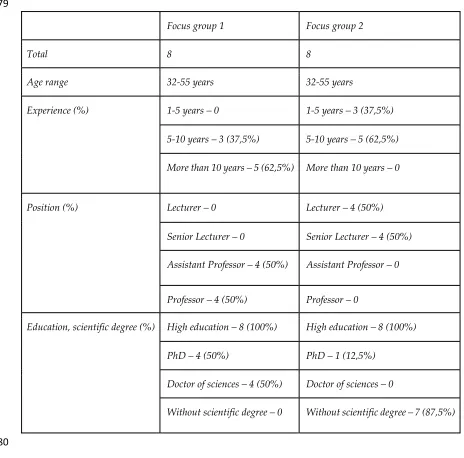
270
The first focus group included experienced scientists and lecturers who have more than 10
271
years of teaching experience (teaching at a high school), are doctors of sciences and Ph.D.’s, associate
272
professors and professors. The second focus group was composed of teachers who had a
273
pedagogical experience of less than 10 years, are not Ph.D.’s (except 1) and doctors of sciences,
274
associate professors and professors. This division made it impossible for the more experienced
275
colleagues to pressure the less experienced, which allowed the authors to compare the insights of the
276
participants of the focus groups.
277
Table 1. Focus groups participants 278
279
Focus group 1 Focus group 2
Total 8 8
Age range 32-55 years 32-55 years
Experience (%) 1-5 years – 0 1-5 years – 3 (37,5%)
5-10 years – 3 (37,5%) 5-10 years – 5 (62,5%)
More than 10 years – 5 (62,5%) More than 10 years – 0
Position (%) Lecturer – 0 Lecturer – 4 (50%)
Senior Lecturer – 0 Senior Lecturer – 4 (50%)
Assistant Professor – 4 (50%) Assistant Professor – 0
Professor – 4 (50%) Professor – 0
Education, scientific degree (%) High education – 8 (100%) High education – 8 (100%)
PhD – 4 (50%) PhD – 1 (12,5%)
Doctor of sciences – 4 (50%) Doctor of sciences – 0
Without scientific degree – 0 Without scientific degree – 7 (87,5%)
280
As a result of the work of the focus groups methodological characteristics, features, forms and
281
methods of research-based training were determined, after which the method of "theoretical
282
sampling" was used (Glaser and Strauss 2012). This method makes it possible to formulate more
283
specific questions for self-examination by lecturers of higher educational institutions of their own
educational programs of disciplines. In addition, such a method enabled to formulate generalized
285
characteristics by the results of focus groups.
286
For the next stage of the study - self-examination of educational programs by the staff of the
287
Institute of Human Sciences of Borys Grinchenko Kyiv University - a methodological description of
288
the main characteristics of research-based training were proposed, which were developed as a result
289
of the activity of two focus groups. Accordingly, they had to determine the presence of
290
research-based training elements in the educational curricula of the disciplines they taught at the
291
bachelor's and master's levels.
292
After working out the methodological basis, lecturers were asked to analyse their own
293
programs for the presence of signs, goals, forms, elements, subspecies, and tasks of research-based
294
training. The results had to be drawn in the form of a table.
295
Table 2.
296
Sample for self-examination of the educational program for the presence of tasks that correspond the
297
characteristics of research-based training.
298
Subjects Course, specialty
Examples of tasks that match the characteristics of research-based training
299
Acknowledgments: The research is done within the evaluation of scientific theme of the Institute of Human 300
Sciences "Personality in terms of social transformations of modern Ukraine", registration number 0116U002960, 301
term of implementation – 5.2016-5.2021. 302
Author Contributions: Roman Pavliuk and Tetiana Liakh conceived and designed the experiments; Nataliia 303
Klishevych performed the experiments; Olga Bezpalko and Tetiana Liakh analyzed the data; Roman Pavlik 304
wrote the paper. 305
Conflicts of Interest: The authors declare no conflict of interest. 306
References 307
308
(Abbott and McKinney 2013) Abbott, M.L., McKinney, J. (2013). Understanding and applying research design. 309
Published by John Willey & Sons, Inc., Hoboken, New Jersey. 448p. 310
(Aditomo et al. 2013) Aditomo, A., Goodyear, P., Bliuc, A.-M., Ellis, R. A. (2013). Inquiry-based learning in 311
higher education: principal forms, educational objectives, and disciplinary variations. Studies in Higher
312
Education, 38, 1239-1258. doi: 10.1080/03075079.2011.616584. 313
(Baldwing 2005) Baldwing, G. (2005). The teaching research nexus: How research informs and enhances 314
learning and teaching in the University of Melbourne. Melbourne: The University of Melbourne, available at: 315
http://www.cshe.unimelb.edu.ua. 316
(Bezpalko et al. 2016) Bezpalko, O.V., Liakh, T.L., Klishevych, N.A., Pavliuk, R.O. (2016). Criteria and indicators 317
of university education quality: the results of expert interview. The New Education Review. Vol. 46. pp.61-71. DOI: 318
(Blackmore and Fraser 20017) Blackmore, P., Fraser, M. (2007). Researching and teaching: Making the link. In P. 320
Blackmore & R. Blackwell (Eds.). Towards strategic staff development in higher education. pp. 131-141. 321
Maidenhead, UK:McGraw-Hill International. 322
(Dewey 1933) Dewey, J. (1933). How we think: A restatement of the relation of reflective thinking to the 323
educative process. Boston, MA: D.C. Heath. 324
(Glaser and Strauss 2012) Glaser, B.G. & Strauss, A.L. (2012). The Discovery of Grounded Theory: Strategies for 325
Qualitative Research. New Brunswick & London. Aldine Transaction. 326
(Healy 2005) Healy, M. (2005). Linking research and learning to benefit student learning. Journal of Geography in
327
Higher Education, 29, no 2, 183-201. 328
(Humbold 1984) Humbold, V. W. (1984). Der Köningsbrger Schulplan. 1809. In A. Flitner (Ed.), Schriften zur
329
Anthropologie und Bildunslehre. 69-76. 330
(Ifenthaler and Gosper 2014) Ifenthaler, D. & Gosper, M. (2014). Research-based learning: connecting research 331
and instructions. Curriculum Models for the 21st Century: Using Learning technologies in Higher Education, 73-89. doi: 332
10.1007/978-1-4614-73-66-4_5. 333
(Jewel and Brew 2010) Jewel, E., & Brew, A. (2010). Undergraduate research experience: Programs in Australian 334
universities, available at: http://www.mq.edu.au/ltc/ug_research/files/Brew_MQFellouship_UGprograms_ 335
report2010.pdf. 336
(Justice et al. 2009) Justice, C., Rice, J., & Warry, W. (2009). Academic skill development – Inquiry seminars can 337
make a difference: Reflections and directions on course design and teaching methods. Innovative Higher
338
Education, 3, no 1, 201-1-23. 339
(Lageman 2002) Lageman, E. C. (2002). Experimenting with education: John Dewey and Ella Flagg Young at the 340
University of Chicago. In C. H. Siegfried (Ed.), Feminist interpretations of John Dewey (pp. 31-46). 341
(Levy and Petrulis 2012) Levy, P. & Petrulis, R. (2012). How do first year university students experience inquiry 342
and research, and what are the implications for the practice of inquiry-based learning? Studies in Higher
343
Education, 37 (1), 85-101. 344
(Ludwig 2011) Ludwig, J. (2011). Forschungsbasierte Lehre als Lehre im Format der Forschung, available online 345
at: http://www.sq-brandenburg.de/files/bbhd03.pdf. 346
(Merton and Kendall 1946) Merton R.K., Kendall P.L. (1946). The Focused Interview. The American Journal of 347
Sociology, Vol. 51, № 6, pp. 541-557. 348
(Mills and Treagust 2003) Mills, J. E. & Treagust, D. F. (2003). Engineering education – Is problem-based or 349
project-based learning the answer? Australasian Journal of Engineering Education, available 350
at: http://www.aaee.com.au/journal/2003mills_treagust03.pdf. 351
(Oliver 2008) Oliver, R. (2008). Engaging first year students using a web-supported inquiry-based learning 352
setting. Higher Education, 55, 285-301. 353
(Prince and Felder 2006) Prince, M. J., & Felder, R. M. (2006). Inductive teaching and learning methods: 354
Definitions, comparisons, and research bases. Journal of Engineering Education, 95, no 2, 123-138. 355
(Prince and Felder 2007) Prince, M. J., & Felder, R. M. (2007). The many faces of inductive teaching and training. 356
Journal of College Science Teaching, 36, no 5, 14-20. 357
(Rogers and Abell 2008) Rogers, M. A. P., & Abell, S. K. (2008). The design, enactment, and experience of 358
inquiry-based instructions in undergraduate science education: A case study. Science Education, 92, no 4, 359
591-607. 360
(Spoken-Smith and Walker 2010) Spoken-Smith, R., Walker, R. (2010). Can Inquiry-based Learning Strengthen 361
(Thomas 2000) Thomas, J.W. (2000). A review of research on project-based learning. 45p. 363
(Wildt 2010) Wildt, J. (2010). ‘Forschendes Lernen: Wie und Warum?’, Presentation at Leibniz University 364
Hannover, 13. October 2011, available online at: 365
http://www.zel.uni-hannover.de/fileadmin/institut/pdf/Forschendes_ Lernen_ 366