© 2014, IJCSMC All Rights Reserved 932
Available Online atwww.ijcsmc.com
International Journal of Computer Science and Mobile Computing
A Monthly Journal of Computer Science and Information Technology
ISSN 2320–088X
IJCSMC, Vol. 3, Issue. 3, March 2014, pg.932 – 940
RESEARCH ARTICLE
Implementation of Multibiometric System
Using Iris and Thumb Recognition
Ashish Naghate
1, Mayur Sahu
2, Pranju Bhange
3, Swati Lonkar
4,
Pallavi Wankhede
5, Yamini Bute
6¹ Dr. Babasaheb Ambedkar College of Engineering and Research, RTMNU, India
² Dr. Babasaheb Ambedkar College of Engineering and Research, RTMNU, India
³Dr. Babasaheb Ambedkar College of Engineering and Research, RTMNU, India 4
Dr. Babasaheb Ambedkar College of Engineering and Research, RTMNU, India 5
Dr. Babasaheb Ambedkar College of Engineering and Research, RTMNU, India 6
Assistant Professor, Dr. Babasaheb Ambedkar College of Engineering and Research, RTMNU, India
1
[email protected]; 2 [email protected]; 3 [email protected]; 4 [email protected];
5
[email protected]; 6 [email protected]
Abstract— A Multibiometric system relies on the evidence presented by multiple sources of biometric information. Most biometric systems that are presently in use, typically use a single biometric trait to establish identity (i.e., they are unibiometric systems). Multibiometric systems address the issue of non-universality (i.e., limited population coverage) encountered by unibiometric systems. There are various basic criteria for Multibiometric security system: gait recognition, voice recognition, palm recognition, face recognition, iris recognition, fingerprint recognition, vein recognition. From these two main approaches are used in this: Fingerprint and Eye Iris. These two unibiometric systems results in multibiometric system giving more security to the users.
Keywords — Multibiometric; fusion; minutiae; template; feature extraction; Hough transform.
I. INTRODUCTION
Verifying the identity of a user is critical for many security applications such as e-commerce, access control and observation. Current authentication systems are password based, making them at risk to problems such as forgetting the password and passwords being stolen. One way to overcome these problems is to employ biometrics (e.g., fingerprints, face, iris, voice, etc.) for authentication. Multibiometric systems are biometric systems that consolidate multiple sources of biometric evidences. The integration of evidences is known as fusion. In biometrics, various levels of fusion can be categorized into two broad categories: pre classification (fusion before matching) and post classification (fusion after matching).
© 2014, IJCSMC All Rights Reserved 933
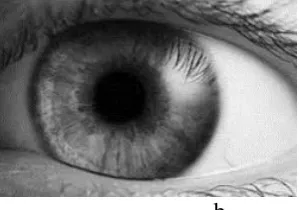
systems, multi-algorithm systems, multi-instance systems, multi-sample systems, multimodal systems and hybrid systems. There are various biometric systems are available such as gait, voice, palm, face, iris, fingerprint, vein, etc. But we have used only two biometric traits: Fingerprint and Eye Iris. The detailed view of iris and thumb is shown in figure 1.
Fingerprint is strong authentication that each fingerprint gives individuality. Fingerprint is related with termination and bifurcation. Fingerprints are permanently registered on a card that record is further used for comparison for criminal agencies like FBI. Fingerprint recognition methods employ feature-based matching on the basis of minutiae (i.e., ridge ending and ridge bifurcation) [4]. Iris recognition is the new technique coming into existence. Its existence rises as it provides results in accuracy, robustness. The patterns of eye are unique it establishes individuality of person, for identification patterns of eye. The iris contains important unique features, such as stripes, freckles, coronas, etc. These features are collectively referred to as the texture of the iris. [5]
a b
Fig. 1: (a) Image of the eye, (b) Image of thumb
II. LITERATURE REVIEW
Rashmi Singhal and Payal Jain[1] proposed that by combing multiple sources of information system address, most of the problems encountered in mono-biometric systems. Depending upon the nature of application there is a need to choose an suitable multibiometric system out of available ones. Further, the performance of the system improves if two or more physically uncorrelated traits are used. Efficiency of multibiometric system is highly dependent on the fusion technique employed.
Minatue based technique was introduced by Jain et.al[11] presented among current fingerprint matching algorithms like minatue based matching, correlation filters based matching, transform feature based matching, graph based matching & generic algorithm based matching; minatue based fingerprint matching is dominant. V. Larrumbe Hidalgo, L.Martin García and M.Taboada Lorenzo [3] proposed biometric system using iris recognition. A biometric identification system is developed and a man’s iris processed through computer to perform the processing of the pictures. The application is developed by using Java and the image processing library JAVAVis. Ms. Mary Praveena.S, Ms.A.K.Kavitha and Dr.IlaVennila [4] proposed multimodal biometric system has a number of unique qualities, starting from utilizing principal component analysis and fisher’s linear discriminant methods for individual matchers authentication and the novel rank level fusion method is used in order to consolidate the results obtained from different biometric matchers. The ranks of the individual matchers are combined using highest rank, borda count, and logistic regression method. From the results it can be concluded that the overall performances of the multi biometric systems are very good even in the presence of poor quality of data.
Gupta et al. tested on iris images of CASIA database. Iris localization using Hough transform performs better as compared to other localization techniques in case of occlusion due to eyelids and eyelashes. [10]
III.PROPOSED WORK
© 2014, IJCSMC All Rights Reserved 934
The iris is extracted from the eye image i.e. disturbing features like eyelids & eyelashes are eliminated to the maximum possible extent and then process of normalization is carried out. Feature extraction is a key process where the two dimensional image is converted to a set of mathematical parameters. The iris contains important unique features, such as stripes, freckles, coronas, etc. These features are collectively referred to as the texture of the iris. These features are extracted using various algorithms. Once the features are extracted using Hough transforms, an iris image is transformed into a unique representation within the feature space. In order to make the decision of acceptance or refusal, a distance is calculated to measure the closeness of match. [9]
There are various steps involved in thumb recognition system. We introduce the principle of phase-based image matching using the Phase-Only Correlation (POC) function (which is sometimes called the “phase-correlation function”). In order to reduce the computation time and to improve the recognition performance, we introduce the rule-based fingerprint classification method. In Hong algorithm, we classify the thumb into various categories: “Arch”, “Left Loop”, “Right Loop”, “Left Loop or Right Loop”, “Arch or Left Loop”, “Arch or Right Loop”. In case of thumb, the major concern is on ridge and minutiae extraction. In this approach ridge ending bifurcations are created. [7]
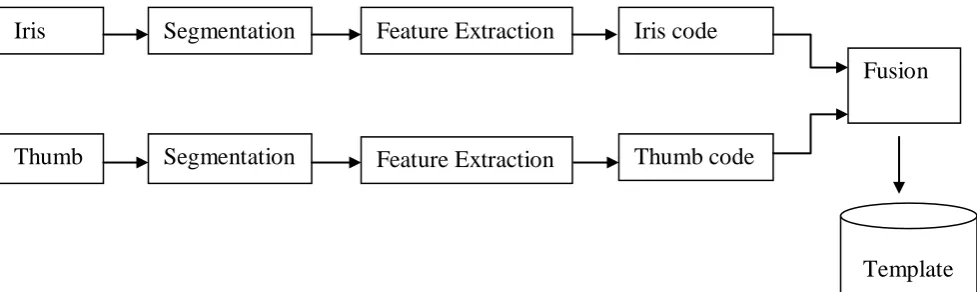
In Feature fusion stage, feature sets extracted using multiple individual sensors are combined together to form a joint feature vector which is then passed to matching stage. Information integrated at this stage provide better recognition results and is expected to be more effective as the feature set contains maximum information about the input biometric data. In matching stage, the combined feature set vector is matched with the user’s inputted biometric data. If the provided biometric data is correct then the login is provided to that user else the user is treated as wrong user.
Fig. 2: Proposed Multibiometric System
IV.IMPLEMENTATION
A. Enrolment Module
In enrolment process, a subject presents his/her biometric characteristics to the sensor along with his/her non-biometric information. Non-biometric information related to subjects could be name, social security number, driver license’s number, etc. Biometric features extracted from the captured sample and the non-biometric information is enrolled in the database.
Iris Segmentation Feature Extraction Iris code
Thumb Segmentation Feature Extraction Thumb code
Fusion
© 2014, IJCSMC All Rights Reserved 935
B. Feature Extraction Module
In this module the raw data acquired during the enrolment process is processed to get unique features. Like in our system the unique features of iris and thumb are extracted. For thumb, Thumb minutiae are extracted and obtain the binary string representation from the minutiae set and for iris, the binary iris code features are extracted. In order to reduce the dimensionality of the iris code and to remove redundancy present in the code, Haar Wavelet Transformation is applied. All extracted features of thumb and iris sample are getting collected into a template.
1) Iris feature extraction:
Iris recognition is the new technique coming into existence. Its existence rises as it provides results in accuracy, robustness. The patterns of eye are unique it establishes individuality of person, for identification patterns of eye. Image pre-processing technique is used for extracting iris code pattern which is obtained by converting it into digital format which is helpful in embedding into the biometric template. After generating the template it will store in the database. Generation of template needs to perform mathematical operation which converts the original image into the iris code. The following are the steps involved in extraction of iris image. [2]
a) Graying:
In this coloured image is converted in gray-pattern. Method of converting an image in gray colour is by selecting two appropriate numbers that are indicated to two upper and lower thresholds (L, U). For K=1 iteration number do as follows: 1. See the intensity of each pixel, if it is lower than the smaller L + K , convert is to 0 and if it is bigger than U − K , covert it to 255.
2. Otherwise filter the intensity to the lower one by a scaling factor. The processed image is converted to a logical image that means a Black and White type image will be obtained.
a b
Fig. 3: (a) Original image, (b) Grey image.
b) Segmentation:
© 2014, IJCSMC All Rights Reserved 936
a b c
d
Fig. 4: (a) Inner edge, (b) Exact outer edge, c) Encircled of the exact edge, (d) The inner and outer detected boundaries.
An edge in the original image would correspond to a higher value in the gradient image. A gradient image is used for the Hough transform which decreases computation time significantly, since only points that correspond to actual edges are used in the computation. The Sobel operator is often used to compute the gradient image as well. It has distinct advantages, although it is slightly more complex. It is less sensitive to isolated high intensity point variations because it averages points over a larger area. There are two kernels which are convolved with the image: one for each direction. The kernels are applied separately to compute the gradient in each direction (Gx and Gy) and then combined to produce an absolute value [4].
The absolute magnitude is defined as: _______
|G| = √Gx2
+Gy (1.1)
c) Edge Detection and Thresholding:
For edge detection we will use sobel operator in which gradient is calculated. The gradient is simply the derivative of the local image values. The edge and the image we have a mixture of black, gray and white values. In order to maintain the feasibility we will consider one threshold value. All the values above that threshold will be considered while and all those below as black. Thus a pure black and white image is obtained.
a b
© 2014, IJCSMC All Rights Reserved 937
2) Fingerprint feature extraction :
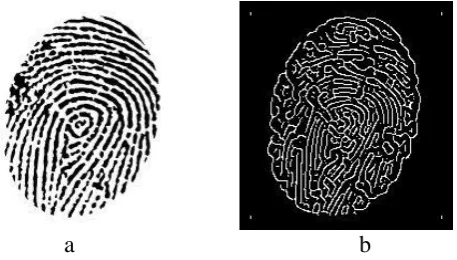
In the proposed work fingerprint features based on ridge and minutiae are extracted. The overall fingerprint feature extraction is divided into pre-processing stage. The various stages of feature extraction are shown in Figure 8. During the pre-processing stage the input foreground fingerprint image is separated from the background image. This process is called as segmentation. The key objective of any segmentation algorithm is to discard the background from the foreground of the input image as the fingerprint are striated patterns and cannot be efficiently isolated from the background. In the proposed method Harris corner detection scheme is used for segmentation. Harris corner uses Gaussian function to reduce noisy response due to binary window function instead of shifted patches. The average intensity changes in direction, is expressed in bilinear form and describes a point in terms of Eigenvalues. In it invariant to rotation but non-invariant to scaling. The ridge orientation and ridge frequency are estimated from the segmentation image as shown in Figure 8. Once this process is completed the Gabor filter is used to obtain the skeletonized image. The skeletonized image is a 1 pixel wide digital skeleton of ridges. From the skeletonized image the proposed method extracts the ridge and minutiae features.
a b
Fig 6(a) Original image, (b) Edge detected threshold image
a) Graying:
In this coloured image is converted in gray-pattern. Method of converting an image in gray colour is by selecting two appropriate numbers that are indicated to two upper and lower thresholds (L, U). For K=1 iteration number do as follows:
1. See the intensity of each pixel, if it is lower than the smaller L + K , convert is to 0 and if it is bigger than U − K , covert it to 255.
2. Otherwise filter the intensity to the lower one by a scaling factor. The processed image is converted to a logical image that means a Black and White type image will be obtained.
b) Edge Detection and Thresholding:
© 2014, IJCSMC All Rights Reserved 938
3) Iris and thumb Feature fusion:
Fusion scheme is decided depending on the type of information available. Choosing the fusion scheme is important for any multibiometric system as it has significant impact over the performance of the multibiometric system. Various levels of fusion can be categorized into two broad categories as Pre-classification or fusion before matching and post-classification or fusion after matching.[8]
Pre-classification fusion schemes typically require the development of new matching techniques (since the matchers used by the individual sources may no longer be relevant) thereby introducing additional challenges. Pre-classification schemes are sensor level and feature level. Post-classification schemes include fusion at match score level, rank level and decision level. Feature level fusion is combining the feature extracted from various biometric sources. The source of information can be from multiple traits, multiple sensors, and multiple instances. The extracted features can be homogeneous where the same trait can be multiple times and the weighted average for the feature set can be calculated. The feature set which are non-homogeneous i.e., from multiple traits as in the proposed work (fingerprint and iris); the features can be concatenated as a single template. Feature level fusion is difficult due to certain reasons such as :(i)incompatibility between failure set,(ii)concatenation may direct to higher feature set;(iii) feature space to be known prior. Some of the works associated to feature level fusion are present in related work. In the proposed method the feature level fusion is done through fusing the feature vector sets acquired from the fingerprint and iris image
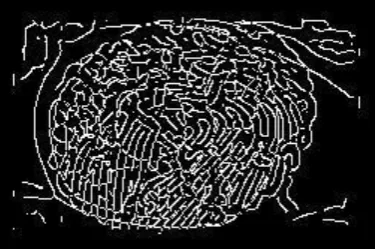
The iris code is acquired from the iris image. The concatenated feature set for the fingerprint and iris is stored as single template in the database. The above process is done for enrolment stage. During the verification stage the query image undergoes the same process of segmentation, feature extraction and feature fusion. A query template is generated and compared with the template in the database using hamming distance. The hamming distance gives a measure of how many bits are same between the two bit patterns. Using the Hamming distance of two bit patterns, a decision can be made as to whether the two patterns were generated from different templates or from the same template. In comparing the bit pattern say and Y the Hamming Distance (HD) is defined as the sum of disagreeing bits (sum of the exclusive-OR between X and Y) over N, the total number of bits in the bit pattern. IF two bit patterns are completely independent, the Hamming distance between the two patterns should equal 0.5.This occurs because independence implies the two bit patterns will be totally random, so there is 0.5 chance of setting any bit to 1, and vice versa. If two patterns are derived from the same template then the Hamming distance between them will be close to 0.0, since they are highly correlated and the bits should agree between the two template iris codes. The fused image is shown below in figure 7.
© 2014, IJCSMC All Rights Reserved 939
C) Matching Module
During this process, a match template is compared against an enrolment template to determine the degree of correlation. The matching process results in a score that is compared against a threshold. If the score exceeds the threshold, the result is a match; otherwise it is considered a mismatch.
D) Decision Module
Based on the comparison score(s) and decision policy, a decision subsystem determines if the captured biometric sample and enrolled template are derived from the same subject. In case of verification process, decision made based on a comparison score is either the acceptance or rejection of the subject. In case of identification, a ranking is enrolled.
V. CONCLUSION
Multimodal biometrics system gives accuracy in providing results as compared to unimodal system. The unique features of iris and thumb are extracted. For both the thumb and iris, first the original image is converted into grey image and then into binarised image which is obtained by applying canny edge detector and threshold algorithm. The comparison between two users is based on the fused template created. The fusion of two templates, thumb and iris is done by using XOR operation. Since, it is embedded with the GUI interface; the system can be used for commercial purpose too.
VI.FUTURE WORK
In future work we can work on the large database of subjects. We can also use the encryption technique to wrap the biometric template which is tricky to reform the same template for providing security to the Multibiometric system. Successful pursuit of these biometric challenges will generate significant advances to improve safety and security in future missions. The future work also include the fusion algorithm, the best features from the above two traits are taken into account. The minutia extraction can be done on thumb and the Hough transform can be applied on the iris. With minimum possible features the fusion of the both the traits is carried out. The fused image is then generated; it is formed in such a way that it is completely invertible to get back the original image back. As when we have used images for storing it takes lots of space for storage, so we will use the selective encryption that is used for compressing and decompressing of data.
REFERENCES
[1] Rashmi Singhal and Payal Jain, “multi-biometric systems: secure security systems”in IJREAS Volume 2, Issue 2 (February 2012), ISSN: 2249-3905.
[2] Mininath Raosaheb Bendre, Sandip Ashok Shivarkar, “An Improved Approach for IRIS Authentication System by Using Daugman’s Rubber Sheet Model, Segmentation, Normalization and RSA Security Algorithm” in IJCTEE, Volume 1, Issue 3, ISSN 2249-6343.
[3] V.Larrumbe Hidalgo, L.Martin García and M.Taboada Lorenzo, “Iris recognition using the JAVAVis Library” in IJIMAI, Vol. 1, Nº 1, ISSN 1989-1660.
[4] Ms. Mary Praveena.S, Ms.A.K.Kavitha and Dr.IlaVennila, “Multimodal Image Fusion Biometric System”, IJERD, Volume 2, Issue 5 (July 2012), PP. 13-19.
[5] Minakshi r. Rajput and L. M. Waghmare, “ Iris feature extraction and recognition based ondifferent transforms ” in IJASET, ISSN: 2321-9009 Volume- 1, Issue- 1, July-2013
[6] Poonguzali N. and Ezhilarasan, “Feature Level Fusion and Iris Multibiometrics System”, ICSIP 2013, pp. 136-145., Elsevier Publications.
© 2014, IJCSMC All Rights Reserved 940
[8] Arun Ross and Anil K. Jain, “Fusion Techniques in Multibiometric Systems”.
[9] C.M.Patil and Sudarshan Patilkulkarani, “ Iris Feature Extraction for Personal Identification using Lifting Wavelet Transform ”, 2010 International Journal of Computer Applications (0975 – 8887) Volume 1 – No. 14
[10] Polash Paul, Md. Maruf Monwar, “Human Iris Recognition for Biometric Identification”, Ahsanullah University of Science and Technology, Dhaka, Bangladesh.,29 December, 2007