Electronic Thesis and Dissertation Repository
12-5-2011 12:00 AM
Flexibility in Parent-Child Interactions: The Application of Dynamic
Flexibility in Parent-Child Interactions: The Application of Dynamic
Systems Methodology to Dyadic Processes in Children with
Systems Methodology to Dyadic Processes in Children with
Behaviour Problems
Behaviour Problems
Vivien Lee
The University of Western Ontario Supervisor
Peter N.S. Hoaken
The University of Western Ontario Graduate Program in Psychology
A thesis submitted in partial fulfillment of the requirements for the degree in Doctor of Philosophy
© Vivien Lee 2011
Follow this and additional works at: https://ir.lib.uwo.ca/etd
Part of the Child Psychology Commons, Clinical Psychology Commons, and the Developmental Psychology Commons
Recommended Citation Recommended Citation
Lee, Vivien, "Flexibility in Parent-Child Interactions: The Application of Dynamic Systems Methodology to Dyadic Processes in Children with Behaviour Problems" (2011). Electronic Thesis and Dissertation Repository. 352.
https://ir.lib.uwo.ca/etd/352
This Dissertation/Thesis is brought to you for free and open access by Scholarship@Western. It has been accepted for inclusion in Electronic Thesis and Dissertation Repository by an authorized administrator of
Methodology to Dyadic Processes in Children with Behaviour Problems
(Spine Title: Parent-Child Flexibility: Applying Dynamic Systems Theory) (Thesis format: Monograph)
by Vivien Lee
Graduate Program in Psychology
A thesis submitted in partial fulfillment of the requirements for the degree of
Doctor of Philosophy
The School of Graduate and Postdoctoral Studies The University of Western Ontario
London, Ontario, Canada
ii
THE UNIVERSITY OF WESTERN ONTARIO School of Graduate and Postdoctoral Studies
CERTIFICATE OF EXAMINATION
Supervisor
______________________________ Dr. Peter N.S. Hoaken
Supervisory Committee
______________________________ Dr. Greg Moran
______________________________ Dr. Rod Martin
Examiners
______________________________ Dr. Lorne Campbell
______________________________ Dr. Richard W. Neufeld
______________________________ Dr. Evelyn R. Vingilis
______________________________ Dr. Joanne Lee
The thesis by
Vivien Lee
entitled:
Flexibility in Parent-Child Interactions: The Application of Dynamic
Systems Methodology to Dyadic Processes in Children with Behaviour Problems
is accepted in partial fulfillment of the requirements for the degree of
Doctor of Philosophy
iii Abstract
Dynamic systems theory (DST) can provide a comprehensive account for how parent-child interactions evolve over time to produce stable patterns of interacting and can result in seemingly divergent trajectories. Recent methodological advances using state space grids (SSGs) have provided a graphical means to examine real-time dyadic processes, as well as measures of dyadic flexibility, or the ability to adapt emotional and behavioural responding in response to contextual demands. Higher levels of dyadic flexibility have been associated with improvements in child behaviour problems after treatment (Granic et al., 2007), while its converse, rigidity, has been associated with increases in behaviour problems over time (Hollenstein et al., 2004). The type of task (e.g., structured versus unstructured) in which the dyad is engaged may also impact the relative importance of dyadic and parental characteristics (e.g., warmth) on the interaction. The present study examined parent-child interactions involving clinically-referred children ages 3 years, 11 months, to 6 years of age with externalizing behaviour problems (n=33 dyads).
Flexibility variables as identified in previous research were examined across task types using principal components analyses and a multiple discriminant function analysis, resulting in a standardized flexibility composite. Similarly, dyadic processes identified from SSGs were replicated and examined across tasks using a repeated-measures
iv
by dyadic processes and parental characteristics tended to differ by task type, illustrating the importance of looking at the demands of the task and changing contexts. Somewhat counterintuitively, negative dyadic and parental variables were found to predict
flexibility, possibly reflecting a transitional reorganization of dyadic interaction processes in the preschool period. Synchronous parent-child interactions did not tend to predict flexibility. Dyadic flexibility and the differential impact of parental and dyadic processes across different task types appear promising as potential targets in early intervention programs for children with behaviour problems.
v
ACKNOWLEDGEMENTS
Data for this dissertation was obtained through the Supporting Early Experiences for Kids (SEEK) at the Child and Parent Resource Institute (CPRI) in London, Ontario, Canada. The author expresses her sincerest appreciation and gratitude to Dr. Shannon Stewart and Melissa Currie for allowing access to the data and guiding her through the study and it components. This dissertation is also the result of methodological
consultation with Dr. Tom Hollenstein of Queens University who was one of the developers of the GridWare program relied upon in the present study, as well as statistical consultation with Dr. Robert Gardner at the University of Western Ontario. The author would like to express her appreciation to her graduate advisor, Dr. Peter Hoaken, and Drs. Greg Moran, Lorne Campbell, Rod Martin, and Evelyn Vingilis for feedback on previous versions of this dissertation.
The author would like to especially acknowledge the extensive guidance and feedback of Dr. R.W.J. Neufeld at UWO, who provided consultation in the intermediate stages on statistical analyses and methodology and a portion of an early draft of the dissertation. Dr. Neufeld also went above and beyond in providing expertise, guidance, feedback, and support in the final stage of the dissertation.
vi
TABLE OF CONTENTS
Page
CERTIFICATE OF EXAMINATION ... ii
ABSTRACT... iii
ACKNOWLEDGEMENTS... v
LIST OF TABLES... viii
LIST OF FIGURES ... x
1. INTRODUCTION ... 1
Externalizing Behaviours... 2
Dynamic Systems Theory ... 5
Attractors ... 6
Phase Transitions ... 6
Relevance of Dynamic Systems to Developmental Psychology ... 8
Dynamic Systems Methodology... 10
Flexibility ... 11
Application of the Dynamic Systems Approach to Developmental Psychopathology... 13
Flexibility and rigidity ... 15
Differentiating clinical subgroups... 18
Dyadic Nature of Parent-Child Interactions ... 20
Types of parent-child interactions ... 23
Structured Interactions ... 23
Free Play ... 24
The Present Study ... 28
2. METHOD ... 31
Participants... 31
Measures ... 32
Videotaped interactions ... 32
Relationship Process Code (RPC) ... 33
Parental Warmth and Control Scale (PWCS) ... 38
Flexibility variables ... 43
Dyadic process variables... 49
Child psychopathology ... 49
Potential covariates ... 51
Maternal depression... 51
vii
Procedure ... 51
Analyses... 52
3. RESULTS ... 59
Construction of Flexibility variables ... 60
Bivariate correlations ... 60
Principal components analyses ... 66
Multiple discriminant function analysis... 66
Flexibility composite ... 71
Canonical correlation and redundancy index analysis... 76
Covariate analyses ... 76
Dyadic processes by task type ... 78
Repeated measures analysis of covariance ... 81
Parental characteristics and dyadic processes... 81
Prediction of flexibility... 84
Externalizing subgroups... 91
MANCOVA... 91
4. DISCUSSION ...102
Derivation of the flexibility composite ...102
Dyadic processes across tasks...108
Prediction of flexibility by parental characteristics and dyadic processes ....109
Free play...110
Clean-up...110
Teaching tasks...111
Externalizing subgroups...114
Dyadic flexibility and processes with parent-child interactions ...116
Phase transitions...117
Dyadic synchrony ...119
The application of dynamic systems theory to parent-child interactions ...120
Implications ...125
Limitations ...128
Clinical implications ...135
Future Directions ...137
5. REFERENCES ...140
6. ETHICS APPROVAL ...160
viii
LIST OF TABLES
Table Page
1. Flexibility variables identified in previous research... 14
2. Duration of tasks... 34
3. Coding for and examples of Relationship Process Code ... 36
4. Coding for Parental Warmth and Control scale... 40
5. Analyses conducted in present study ... 56
6. Descriptive statistics for flexibility variables ... 61
7. Bivariate correlations among the four flexibility variables averaged across all tasks... 62
8. Bivariate correlations among the four flexibility variables in Task 1 (Free Play) and Task 2 (Clean-Up)... 63
9. Bivariate correlations among the four flexibility variables in Task 3 (Teaching - Puzzle) and Task 4 (Teaching – Etch-a-Sketch) ... 64
10. Bivariate correlations among the four flexibility variables in Task 5 (Teaching - Lego) ... 65
11. Eigenvalues and percent of variance for principal component analyses for flexibility variables within tasks ………. 67
12. Component matrix in principal component analysis for flexibility variables within tasks... 68
13. Multiple discriminant function analysis for flexibility variables... 69
14. Structure coefficients for discriminant functions for flexibility variables... 70
15. Descriptive statistics for standardized flexibility variables and composite across all tasks... 74
16. Means and standard deviations for flexibility composite ... 75
ix
18. Descriptive statistics for dyadic region variables ... 79 19. Bivariate correlations among parental characteristics, dyadic process
variables, flexibility, and covariates across all tasks ... 82 20. Descriptive characteristics for parental characteristics... 85 21. Regression analyses for parental characteristics, dyadic variables, and
covariates on flexibility by task……….. 86 22. Regression coefficients for parental characteristics, dyadic variables,
and covariates on flexibility for free play and clean-up ... 89 23. Regression coefficients for parental characteristics, dyadic variables,
and covariates on flexibility for teaching tasks...90 24. Univariate analyses for main effect of externalizing subgroup on
parental characteristics and dyadic process variables... 92 25. Structure and standardized coefficients for discriminant functions by
Externalizing subgroups...103 26. Number of dyads not exhibiting negative dyadic processes or parental
x
LIST OF FIGURES
Figure Page
1. An example of within-dyad differences in flexibility across task types... 44
2. An example of 4 dyads engaged in the free play task... 45
3. An example of 4 dyads engaged in a teaching task (Puzzle)... 46
4. An example of 4 dyads engaged in a teaching task (Lego) ... 47
5. Dyadic regions derived from state space grids. ... 50
6. Example of number of parental Warmth events for one dyad during a Free Play task ... 53
7. Example of number of parental Sensitivity events for one dyad during a Free Play task... 54
8. Example of number of parental Hostility events for one dyad during a Free Play task ... 55
9. Structure coefficients of flexibility measures on DF1 and DF2 ... 72
10. Graph of standardized flexibility variables by task type ... 73
11. Graph of dyadic regions by task type ... 83
12. Flexibility scores for EXT and MIXED groups across tasks... 93
13. Warmth scores for EXT and MIXED groups across tasks ... 94
14. Sensitivity scores for EXT and MIXED groups across tasks ... 95
15. Hostility scores for EXT and MIXED groups across tasks ... 96
16. Mutual Positive Engagement scores for EXT and MIXED groups across tasks... 97
17. Scaffolding scores for EXT and MIXED groups across tasks... 98
18. Permissiveness scores for EXT and MIXED groups across tasks... 99
19. Mutual Negative Engagement scores for EXT and MIXED groups across tasks ...100
Flexibility in Parent-Child Interactions: The Application of Dynamic Systems Methodology to Dyadic Processes in Children with Behaviour Problems It is normative for young children to display externalizing behaviours in early childhood. When looking at two children from apparently similar circumstances, what factors contribute to one child to ‘growing out’ of such behaviours, while the other child continues along a trajectory of behaviour problems? One factor that may increase the tendency to develop and maintain maladaptive behaviours is the relationship between the child and his or her primary caregiver(s) in early childhood. Dynamic systems theory (DST) provides one framework within which to examine how individual and dyadic processes develop and emerge into stable phenomena. Until children enter school, they typically spend the vast majority of their time with their parents. Within the parent-child relationship, children learn how to negotiate increasingly complex emotions and
perceptions, as well as conflict between their own and other people’s needs and desires. One result of the numerous parent-child interactions throughout development may be that parent-child dyads come to default into specific stable patterns of interacting that come to form the template and expectations children hold for interpersonal interactions. As children increasingly interact with peers and other adults, they may bring such expectations and biases into other interpersonal interactions, further reinforcing and potentially amplifying maladaptive interpersonal processes. For example, if a child has not learned to adequately modulate strong emotional arousal, he or she may experience rejection by peers, which could lead to further distress and emotion dysregulation.
A characteristic that has been examined relatively little is the level of flexibility
contextual demands of changing situations, and adjust their emotional responding and behaviours accordingly. The expression of negative emotions may not be problematic per se as children learn how to appropriately express negative affect and negotiate conflict; what may be more problematic in an interpersonal interaction is a lack of flexibility in the interaction. Methodology derived from dynamic systems theory has been increasingly applied in recent years to the study of interpersonal interactions and provides measurements of flexibility in dyadic interactions. The present study examined which parental characteristics and dyadic processes tended to predict dyadic flexibility goals in a sample of young children with clinical behaviour problems, and whether these predictors varied according to changing contextual demands of each task type.
Externalizing Behaviours
Externalizing problems in children can have significant and long-lasting impacts on their social and emotional development. Many young children under the age of 5 years display some level of behaviour difficulties; however, those children displaying clinical-level behaviours above the norm at such a young age may be beginning on a trajectory of chronic behaviour problems. The preschool years appear to be a critical time as the aggressive behaviour problems that emerge and become stabilized in the preschool years are highly predictive of antisocial behaviours in later childhood,
adolescence, and adulthood (Bégin, 2004; Campbell, Shaw, & Gilliom, 2000; Tremblay & LeMarquand, 2001). Early aggressive tendencies in children tend to crystallize around age 8 years without intervention (Eron, 1990). The risk seems especially acute in high-risk, low-socioeconomic status (SES) populations, with rates as high as 35% for
1998). Societal costs of aggression and delinquency are significant. One study of four low-SES communities in the US found that public costs related to Conduct Disorder per child exceeded $70,000 over a seven-year period (ages 7 through 13 years) compared to youth with no diagnosis (Foster, Jones, & The Conduct Problems Prevention Research Group, 2005). The need to prevent and treat children’s externalizing behaviours early is paramount in terms of both societal costs and distress of individuals who suffer from or are victimized by aggression and delinquency.
It has long been observed that parent-child interactions can be dysfunctional in families with children with behaviour problems; however, the maladaptive processes that contribute to the maintenance of behaviour problems have been relatively understudied. Interactional problems experienced with parents will affect children’s relationships with peers and teachers when they enter school (Pepler, 2003). Empirically-supported interventions exist for the treatment of childhood behaviour problems (e.g., Triple P parenting program; Webster-Stratton et al., 2001), yet a high proportion of families with behaviourally-disordered children do not receive, participate in, or benefit from existing treatments. Less than 10% of school-aged children and fewer preschool-aged children who need intervention for aggressive behaviours receive them (Kazdin & Kendall, 1998), and less than half of those children who access such services receive
internalizing behaviour problems, but only when a stressor was introduced (Granic & Lamey, 2002).
Dynamic Systems Theory
A dynamic system is a complex, self-organizing system within which its components can affect and modify its trajectory over time. The term, dynamic, emphasizes systems that change constantly over time, yet result in the emergence of relatively stable patterns. Dynamic systems theory is based on chaos theory, or the idea that very small differences in a system’s starting conditions can result in a confluence of effects from which apparently new forms may emerge (i.e., emergent phenomena). ‘Chaos’ in DST refers to patterns that appear to be extremely disorderly and random, but in fact show a stable, underlying order (Thelen & Smith, 1994). Van Geert (2003) identified the most important feature of chaos as the ability to emerge spontaneously as certain variables that control the behaviours of simple, orderly systems cross a specific threshold value. Chaos theorists have shown that randomness and chaotic variation does not need to come from outside the system: chaos can be produced by the system itself if conditions are right (Shinbrot, Grebogi, Yorke, & Ott, 1993; van Geert, 2003). Of particular interest to dynamic systems theorists is how complex systems, including developing humans, produce patterns that evolve in time (Thelen & Smith, 1994).
A dynamic system changes because it is affected by other systems (i.e.,
it particularly relevant to the study of developmental systems. The two tenets that are most central to the present study include attractors and phase transitions.
Attractors. Although dynamic systems theoretically have the potential to exhibit
a huge number of behavioural patterns, they tend to stabilize within a small number of possibilities. Components of a system are consistently drawn into, or ‘default’ into certain patterns of interacting (i.e., attractors). Thus, a parent-child dyad which frequently argues and fails to effectively resolve conflict may come to quickly default into arguments in most instances in which potential conflict is perceived, and require a major ‘push’, or perturbation, to change such attractor patterns. Conversely, systems have patterns or states that they tend to avoid (i.e., repellors). Some attractor states are so stable that they look almost intrinsic; yet, even though they may require very large perturbations to move them from their preferred positions, they are still dynamic and malleable (Thelen & Smith, 1994). Many apparently permanent patterns in behaviour, cognition, and interactions may be considered to be “stable attractors whose stability limits may indeed be shifted under appropriate circumstances” (Thelen & Smith, 1994; p.61).
Phase transitions. Phase transitions consist of global reorganizations in the
should once again decrease (Thelen & Smith, 1994). Thus, while variability is often considered a ‘nuisance variable’ in traditional statistical analyses, DST views such variability as adding crucial information in its own right, as it may signal that the system is transitioning to new patterns (de Weerth, van Geert, & Hoijtink, 1999). Within-system variability might be a necessary precondition for adaptation and learning: without
variability, no exploration can take place and the system’s ability to create new pathways and patterns is undermined (Lichtwarck-Aschoff, Kunnen, & van Geert, 2009).
Clinically, the identification of phase transitions in child development may point to more effective periods to target intervention. If a parent-child dyad is going through a period of increased variability in how they interact with one another before renegotiating new modes of interacting, they may be more malleable to the introduction of strategies through intervention.
Thelen and Smith (1994) were one of the first researchers to apply dynamic systems principles to developmental psychology. They delineated how, through
important relationships involving developing children, coherent patterns can emerge over time that could not have been predicted on the basis of its individual components.
What started out as an aggregation of…individual parts…with no
particular or privileged relations may suddenly produce patterns in space and regularities in time…These emergent organizations are totally different from the elements that constitute the system, and the patterns cannot be predicted solely from the characteristics of the individual elements. (p. 54)
In the years since Thelen and Smith’s (1994) original publication, dynamic systems have begun to be applied to several areas of developmental psychology, including motor development (e.g., Corbetta & Thelen, 1996), cognitive development (e.g., Spencer, Simmering, Schutte, & Schöner, 2007), and socioemotional development (e.g., Lewis et al., 1999).
Relevance of Dynamic Systems to Developmental Psychopathology
early childhood, can set into motion seemingly small changes in that dyad’s trajectory that can gradually accumulate and eventually result in an outcome that differs from that of another parent-child dyad. Consequently, a parent-child dyad can be considered a complex, dynamic system.
Throughout infancy and early childhood, affective exchanges with the caregivers can help to regulate changes in the infant’s physiological and emotional states (Schore, 1994). These types of parallel and reciprocal interactions involve the adaptation of behaviours and emotions to one another, creating a dynamical system of contingent and mutual responsivity (Schore, 1994). If an infant does not have an adequate experience of being part of a dynamic system with an emotionally responsive caregiver, the infant may develop poor coping abilities to deal with the stressful chaotic dynamics that exist in many interpersonal relationships (Feldman, Greenbaum, & Yirmiya, 1999; Schore, 2000; Wright, 1991).
Three principles have been identified as being central to the dynamic systems framework, particularly as it pertains to developmental psychology (Granic, 2005; Granic et al., 2003). The hallmark principle is the discontinuous nature of change in
Lamey, 2004). The second principle is that variability represents critical data, not simply error variance, as it may indicate that the dynamic system is nearing a transition point. Measurements of variability in dynamic systems are often considered “the signal, not the noise” (e.g., Ford & Lerner, 1992; Thelen & Ulrich, 1991). The third principle relevant to the study of interpersonal processes is that DST is fundamentally concerned with the interrelations between the time scales of development, and a large focus is on
understanding the changing patterns of real-time behaviour as they are related to broader changes in developmental patterns (Granic et al., 2003). When studying development in real-time, one can observe ‘default’ socioemotional behaviour and interactions emerge in seconds, as children and parents fall into one of the habits in their repertoire. Then, over developmental time, one can see habits emerging and consolidating while others fade, as individuals and dyads self-organize with age.
Dynamic Systems Methodology
modelling, information can be represented and analyzed at a dyadic system level (Granic et al., 2003). For example, Lewis and colleagues (1999) have argued that sequential analyses may not be appropriate when studying the clustering or ‘pooling’ of behaviour or the tendency for behaviour to move from one given state to particular target states, rather than the sequential path by which some events lead to others. Another advantage over traditional statistical methods is that SSGs are designed to measure qualitative patterns of dyadic interactions (Granic et al., 2003). Not only do SSGs provide a visually intuitive way of understanding the interaction, they also can be used to categorize
interactions in order to perform more traditional statistical analyses with the data. For example, researchers have used SSGs to examine parent-child interactions by further classifying the coded behaviours into categories such as: positive, neutral, negative, hostile. By looking at the location of behaviours on a SSG, one can examine the content of emotional communication, while the pattern of movements across SSGs provides information about the dynamic processes of the interaction, such as dyadic flexibility (Hollenstein & Lewis, 2006).
Dodge, 1994; Weiss, Dodge, Bates, & Pettit, 1992) and anxiety disorders (Barrett, Rapee, Dadds, & Ryan, 1996; Shortt, Barrett, Dadds, & Fox, 2001). What may be common to these dysfunctions is a tendency to respond to environmental change in a rigid manner, a limited behavioural repertoire, an inability to adapt effectively to environmental changes, and a tendency to perseverate (Hollenstein, Granic, Stoolmiller, & Snyder, 2004). The inability to transition from one task to another and to experience a broad array of
emotional states in dyadic interactions can be problematic, even if negative emotions are not involved (Hollenstein et al., 2004). Granic (2006) has hypothesized that rigidity may be a general feature of the state space of individuals or families experiencing
psychopathology, regardless of the specific attractors, or specific emotions or behaviours. Since the content of behaviour of children without behaviour problems is often similar to that of children with clinical problems (e.g., anxiety, aggression, anger). Granic (2006) surmised that the differentiating factor may be the extent to which one can flexibly navigate in and out of negative states. For example, if parents do not respond to extended periods of high emotional arousal in their children with a range of down-regulatory responses, even if the arousal involves positive emotions, the dyad will not move through a varied number of dyadic states. This may leave children with an inability to adapt well to shifting environmental demands (Hollenstein et al., 2004). Several measures of flexibility and rigidity have been identified:
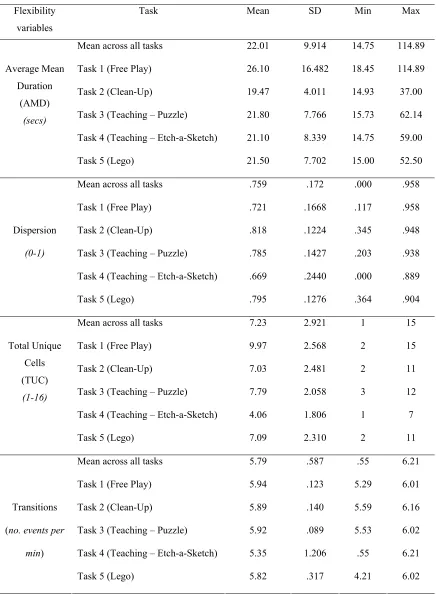
(2) Dispersion, or the sum of squared proportional durations across all cells, corrected for the number of cells and inverted. Higher values indicate greater flexibility. A lower value indicates a diminished behavioural repertoire.
(3) Average Mean Duration(AMD), or the mean duration of each behavioural ‘event’. A lower duration (of each event) indicates greater flexibility since the dyad is not getting ‘stuck’ in a behaviour. In contrast, a higher duration indicates a tendency to perseverate in any particular behaviour.
(4) Total Number of Unique Cells (TUC), or the number of cells on the SSG the dyad entered at least once during the interaction. A higher number indicates greater flexibility.
Table 1 lists the studies that have used SSGs to measure flexibility in dyadic interactions and the combination of variables that comprised each Flexibility construct. A group of developmental psychology researchers have devised a computer program, GridWare
(Lamey, Hollenstein, Lewis, & Granic, 2004), that not only generates SSGs with inputted dyadic data, but also extracts numerical values for the flexibility variables listed above.
Application of the Dynamic Systems Approach to Developmental Psychopathology
Table 1
Flexibility Variables Identified in Previous Research
Flexibility Measure
Study Other Variables
in Flexibility Construct Granic, Hollenstein, Dishion, & Patterson
(2003)
TUC
Granic, O’Hara, Pepler, & Lewis (2007) AMD; Disp Hollenstein, Granic, Stoolmiller, & Snyder
(2004)
AMD Transitions
Hollenstein & Lewis (2006) Disp Granic, O’Hara, Pepler, & Lewis (2007) Trans; Disp Average Mean
Duration Hollenstein, Granic, Stoolmiller, & Snyder (2004)
Trans
Granic, O’Hara, Pepler, & Lewis (2007) Trans; AMD Dispersion Hollenstein & Lewis (2006) Trans
Granic, Hollenstein, Dishion, & Patterson (2003)
Trans Unique Cells
Hollenstein, Granic, Stoolmiller, & Snyder (2004)
*dropped due to reducing
incorporate DST into their study of socioemotional development processes, and devised methods to examine dynamic systems and dyadic processes. Lewis and his colleagues (1999) first applied DST methodology to the study of socioemotional development in infants, theorizing that socioemotional behaviour and the underlying psychological states should self-organize in interpersonal situations, converging to one or more attractor states. The researchers constructed intra-individual SSGs for changes in infants’ facial expressions (e.g., distress) and direction of eye gaze (i.e., attention) during separation and reunion sequences with their mothers. Lewis and his colleagues found that the infants’ distress and attention (i.e., attractor states) stabilized more quickly at 26 to 28 weeks than at 10 to 12 weeks, suggesting that self-organization becomes more coherent and cohesive with development. Consistent with Thelen and Smith (1994), Lewis and colleagues concluded that increasing attractor strength is one sign of skill development. Lewis et al. were some of the first developmental psychology researchers to devise a visually intuitive method to examine a real-time process through SSGs.
Flexibility and rigidity. A major advantage of SSG methodology is the ability to
measure flexibility in individual or dyadic systems. Lewis and his colleagues have examined flexibility and rigidity in parent-child interactions in a number of different age groups, from infancy through adolescence. One longitudinal study examined behavioural rigidity in parent-child interactions at four time points: from early kindergarten to the end of the first grade in boys and girls at high-risk for developing externalizing behaviour problems (Hollenstein et al., 2004). Rigidity was associated with externalizing behaviours at all time points. Children who showed consistently high levels of
at time 1 but developed high levels of externalizing behaviours two years later had parent-child interactions with greater levels of rigidity. Conversely, children who were rated high on externalizing behaviours but whose interactions did not show high levels of rigidity at time 1 no longer exhibited externalizing difficulties at the end of the first-grade. Thus, Hollenstein and his colleagues concluded that the decreased ability of parent-child dyads to adapt to changes in the environment was associated with
chronically high externalizing and internalizing difficulties, as well as the development of later behaviour problems.
Another longitudinal study that examined changes in the structure of dyadic interactions over time followed boys in a high-risk community sample at five time points from ages 9 or 10 years through 18 years (Granic et al., 2003). Using SSGs, the
researchers found that dyadic interactions showed the greatest variability at the 13- to 14-year age range. Granic and her colleagues concluded that this increase in variability reflected a phase transition, or a reorganization of the structure of the parent-child
interaction. That is, these researchers argued that parents and their early adolescent boys in this sample underwent a phase in which their old modes of relating to one another were no longer adaptive and had to negotiate new ways of effectively interacting with each other. Granic et al. argued that this variability did not simply reflect higher levels of conflict at that age as their longitudinal analyses revealed that dyads showed the most conflict at the next time point (i.e., 15 to 16 years).
found that girls who reported more stressful life events and showed less negative emotion overall, displayed greater flexibility during conflict discussions even while expressing more negative emotions. Hollenstein and Lewis interpreted this latter finding as indicating that the expression of negative emotions during dyadic interactions is not necessarily a detriment; rather, it is the lack of flexibility in thinking and negotiating that can result in greater distress.
An advantage of examining parent-child interaction processes is the ability to target interventions, which typically may be administered in a similar fashion across families. Rather than a sole focus on interaction content (e.g., mutual negative engagement), it may be more beneficial to focus on more global processes, such as increasing flexibility in interpersonal interactions. Granic and colleagues (2007) view real-time parent-child interactions as the “proximal engines of development” (p.846), and therefore hypothesized that, if antisocial behaviours emerge out of moment-to-moment, day-to-day direct experiences, then these interactions must also be the context through which outcomes change. But they pointed out that it remains unclear which components of the interaction change when children become less aggressive. Using SSGs, Granic et al. (2007) found that improvements in behavioural problems after treatment were
displays whining, anger, or contempt). After 12 weeks of treatment, improvements in externalizing symptoms were associated with increases in parent-child emotional flexibility during problem-solving discussions as the dyads acquired the skills to repair conflicts. That is, dyads were still able to express negative emotion, but were better able after treatment to shift out of negative interactions to mutually positive patterns. Families that participated in treatment but did not improve became more rigid after intervention. The results of this study highlight one process through which intervention can
successfully reduce problem child behaviours: via increasing the flexibility of the parent-child interaction. Therefore, it would benefit intervention research to shift from a focus on pre- to post-treatment outcomes to examining the mechanisms through which change occurs.
Differentiating clinical subgroups. While few researchers have examined
relatively low-stress task, but diverged upon the introduction of a stressor. Whereas parents in both groups showed a permissive pattern during the first task, the parents of children with mixed psychopathology shifted to a mutually hostile pattern, while the externalizing-only group continued their permissive pattern. Thus, while parents in both externalizing subgroups demonstrated a pattern of responding indiscriminately to
children’s noncompliance when not stressed, when mothers of children with mixed psychopathology became stressed, they exhibited hostility. As children are often unaware of parental stress, Granic and Lamey theorized that this tendency by parents to default to hostility when stressed may be perceived by the child as unpredictable. They also argued that individual differences are best viewed under stressful conditions, and that, by increasing arousal levels, participants may rely on overlearned and automatic response patterns that have stabilized over development across similarly repeated episodes.
Foundational principles of dynamic systems theory such as attractor states, phase transitions, and self-organization (i.e., emergence of increasingly stable phenomena) appear to have particular relevance for developing humans, both intra-individually and interpersonally. It is now possible to examine real-time interactions between two individuals and visually ‘map out’ the trajectory of the dyad throughout an interaction. As children and their primary caregivers typically interact constantly and frequently throughout their daily lives, the ability to examine real-time interactions and how they shape a child’s emotional and social development delineates a process that has
interactions. The focus in the previous studies using SSGs has been primarily on dyadic interactions involving potential conflict in order to increase the number of opportunities to examine negative parent-child processes and how dyads resolve conflict. Primary caregivers play a crucial role in helping children to navigate both positive and negative emotions, and certain types of tasks are likely to give rise to different emotions. The type of task in which the dyad is engaged may be expected to impact the nature of the parent-child interaction as the demands of the task change.
Dyadic Nature of Parent-Child Interactions
Children learn to integrate complex nonverbal emotional experiences with emerging verbal communication through environmental input, such as parental
scaffolding, that fosters the appropriate integration of language and emotional processes (Cole, Armstrong, & Pemberton, 2010). One developmental task involves learning to modulate, tolerate, and endure experiences of negative affect (Kopp, 1989). Children can benefit from negative emotion experiences (Demos, 1986) because psychological
in with somewhat different skills and purposes involved that can help children to attain importance developmental skills.
Different types of situations in which a parent and child are interacting are expected to make certain characteristics more relevant than in other situations (Tamis-LeMonda, Užgiris, & Bornstein, 2002). Warmth refers to parents’ expressions of affection and respect toward their children, while sensitivity typically refers to parents’ attunement to their children’s cues, emotions, interests, and capabilities in ways that balance children’s needs for support with their needs for autonomy (Lugo-Gil & Tamis-LeMonda, 2008). Conversely, parents who exhibit low levels of these positive
characteristics often have children who exhibit a variety of psychological and school adjustment problems (McFayden-Ketchum, Bates, Dodge, & Pettit, 1996; Mize & Pettit, 1997). Children of warm parents are thought to find interpersonal interactions to be more rewarding than children with parents expressing low levels of warmth, and they should be more motivated to socialize with peers as they have come to expect social exchanges to be pleasurable (MacDonald, 1992). Warmth and sensitivity also appear to foster cooperation in children, and encourage them to consider other people’s feelings and regulate negative emotions in social interactions (Campbell, 2002; Denham et al., 2000; Eisenberg & Fabes, 1998; Olson, Sameroff, Kerr, Lopez, & Wellman, 2005; Pettit, Laird, Dodge, Bates, & Cross, 2001). Parental displays of positive regard, as well as the setting of clear limits and/or expectations, have been shown to predict lower levels of
externalizing behaviours over time, even after controlling for initial levels of
require the ability to infer their children’s needs, and to have a wide repertoire of childrearing strategies and problem-solving skills in order to discriminate between the situations in which intervention is needed and when it is not (Azar, 2002).
Davidov and Grusec (2006) have hypothesized that parental warmth would strengthen the parent-child bond, but may be somewhat less relevant than responsiveness to emotion regulation. They thought warmth might be displayed more frequently in neutral and positive interactions in which the child is not currently experiencing distress, resulting in fewer instances of modelling how to react to distress. They suggested that parental responsiveness to children’s needs, particularly their distress, may be more relevant to emotion regulation because it would help the child learn to cope with,
regulate, and appropriately express negative emotions. For example, young children who have a history of receiving empathic and sensitive responses to their distress at 14 months can communicate their own distress more clearly at 24 months (Tonyan, 2005).
Types of Parent-Child Interactions
Parents and children engage in different types of tasks which tend to make certain characteristics more relevant than in other situations (Tamis-LeMonda et al., 2002). For example, warmth may be more relevant in a free play situation in which the child is exploring and interacting positively with the parent, whereas more structured situations with an objective goal may require parental attunement to signs of distress and negative emotions in the child (Davidov & Grusec, 2006). These latter types of tasks would require more structure and may provide opportunities for frustration and failure on the part of the child. In learning tasks, it is beneficial for parents to teach problem-solving skills and help the child learn to work his or her way through challenges within his or her developmental level (i.e., scaffolding) in a supportive and accepting manner in order for the child to learn and develop mastery and self-competence. Parents can structure the environment and guide problem-solving activities for their infants and young children, who eventually come to adopt these structuring and regulatory activities themselves (Valentino, Cicchetti, Toth, & Rogosch, 2006).
Structured interactions. As children get older, they are typically expected to
take increasing responsibility for self-care, everyday tasks, and following rules and routines. The increase in responsibility and delay of gratification are important
developmental tasks, but can be distressful at times for children. Young children are also acquiring cognitive and emotional skills at a rapid pace, but require guidance and
their children’s emotion regulation. The sensitivity with which caregivers manage children’s negative emotions impacts the intensity and duration of these emotions and may influence the development of emotion self-regulation when the child learns that distress is manageable and workable (Thompson & Meyer, 2007). One study observing mothers and their toddlers found that mothers who showed higher levels of interfering behaviours had children who became more distressed during a frustration task, while mothers who offered more support, suggestions, and encouragement had children who utilized problem solving and distraction (Calkins & Johnson, 1998). Repeated
interactions with caregivers over time in emotional or stressful contexts teach children that the use of certain strategies may be more useful for the reduction of emotional arousal than other strategies (Sroufe, 1996). Nonresponsive or interfering parent behaviours may lead children to develop maladaptive emotion regulation strategies that could undermine the development of appropriate skills and abilities needed to master later developmental tasks (Cassidy, 1994). As there are more opportunities for conflict to arise in a structured, problem-solving type of task as compared to an unstructured play situation, there is likely an increased probability of witnessing how a dyad copes with negative emotions and distress and how conflict is resolved.
Free play. Play is a quintessential child activity and plays a major role in
both positive and negative overarousal in interpersonal interactions. Parents’ active participation in play has been shown to be especially important to scaffolding children to higher levels of functioning, as parents expand on play themes that are new to children and initiate themes and ways of play that extend their children’s cognitive and emotion regulation abilities (Tamis-LeMonda et al., 2002). Pretend play can help the
development of social collaboration, understanding of mental states (Hughes & Dunn, 1997), and emotional understanding (Seja & Russ, 1999). Two main types of play have been identified in childhood as being especially relevant to dyadic interactions and development (Tamis-LeMonda et al., 2002), and are detailed below.
Interpersonal play. Beginning in early infancy, caregivers engage in brief, focused episodes of social interaction with their child, responding with animation to maintain the child in a positive emotional state by mirroring the child’s positive
expressions, and ignoring or responding with surprise to negative emotions (Thompson & Meyer, 2007). These repeated, brief interactions are thought to contribute to the
emerging capacities for self-regulation as the child learns how to maintain manageable arousal in the context of supportive or insensitive responses by the caregiver (Feldman, Greenbaum, & Yirmiya, 1999; Gianino & Tronick, 1988; Roggman, 1991).
to their emotional expressions (Tamis-LeMonda et al., 2002). Through object-focused play, children can also develop a sense of mastery and self-competence if their parents support their efforts on challenging, structured tasks, are responsive to their initiatives, are accurate in assessing their need for help, and effective in helping them (Tamis-LeMonda et al., 2002).
Play and structured tasks are two of the numerous types of interactions that parent-child dyads engage in. Each task type has characteristics and objectives that are unique to that task, with one major differentiation being unstructured (e.g., play) and structured (e.g., teaching, chores). Researchers have traditionally focused on the effects of the parent’s behaviour on the child and, somewhat less frequently, the child’s
behaviour on the parent. The dyadic nature of the relationship has been examined
The parent-child relationship has been studied by a multitude of researchers over a number of years. Flexibility in parent-child interactions appears promising as both a research enterprise and has clinical applications. There is also increasing recognition that the importance of dyadic and parental characteristics may differ according to the type of interaction the dyad is engaged in. Parents can assist children to develop emotion regulation skills in interpersonal interactions by helping them to recognize and
understand emotions, learn to consider other perspectives, negotiate conflict, and help regulate overarousal. In more structured situations in which children require more guidance, more opportunities exist for frustration on the part of the child as he or she learns to delay gratification and is challenged to learn new skills. In these types of situations, parental sensitivity to signs of distress may be especially important to match his or her level of instruction or discussion to the developmental level of the child, and help him or her learn to manage frustration and other negative emotions.
physical, neurological, cognitive, and emotional development. Targeting changes in dyadic interactions during early childhood may be somewhat easier due to possible increased variability in interpersonal processes.
The Present Study
The relatively recent dynamic systems approach in developmental psychology provides accessible methodology to examine dyadic flexibility and other dyadic
were assumed to require the parents’ ability to assess and adjust to the contextual demands of changing situations.
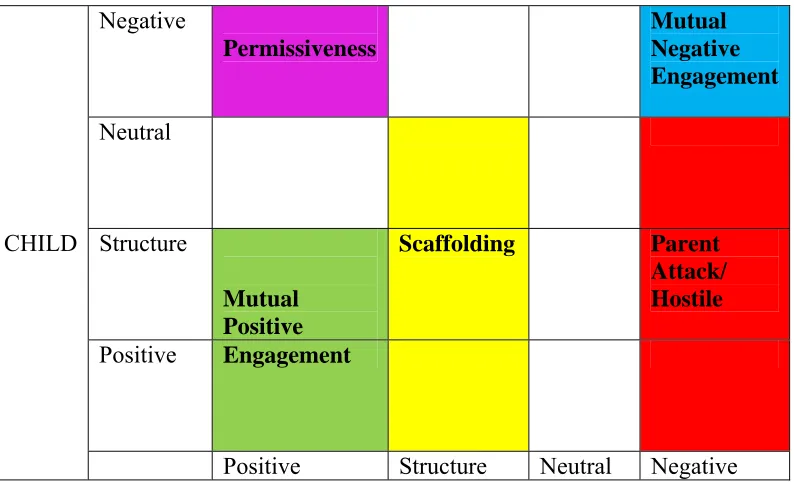
In line with previous DST methodology, dyadic processes were identified from the SSGs that provided information not solely on content (e.g., positive, negative), but also the synchrony or asynchrony of parent and child processes (e.g., mutually positive). Four of the five dyadic processes in the present study have been examined in previous research: Mutual Positive Engagement, Mutual Negative Engagement, Permissiveness (i.e., parent engages in positive behaviour while child behaves negatively), and Parent Attack (i.e., parent acts negatively while child engages in positive, neutral, or structuring behaviours). A fifth dyadic interaction area, Scaffolding was included in the present study. Thus, a second purpose of the present study was to examine how dyadic processes varied across tasks. It was expected that mutual positive engagement would be higher during the free play task, while scaffolding would be higher in the teaching tasks.
Negative dyadic processes were expected to increase during the more structured clean-up and teaching tasks.
Finally, subgroups of children with behaviour problems were examined to assess whether children with ‘externalizing-only’ behaviour and children with both
externalizing and internalizing difficulties (i.e., ‘mixed’ symptomatology) differed in levels of flexibility and dyadic processes across task types. The identification of differences between externalizing subgroups can be clinically relevant because
therapeutic interventions are often delivered to families despite a lack of knowledge on whether different underlying processes contribute to the development and/or maintenance of difficulties. An interaction between group and task types was predicted, such that the ‘mixed’ dyads would show greater parent attack and parental hostility during the more structured tasks because these goal-oriented tasks were thought to increase perceived stress on the parents, similar to Granic and Lamey’s (2002) introduction of a stressor to the parent-child interaction.
Method
Participants
large number of data was generated for analyses, potentially mitigating the size of the sample. Other studies have examined data derived from state space grids using similar sample sizes (n=24 dyads: Lewis et al., 2004; n=33 dyads: Granic & Lamey, 2002; n=38 dyads: Granic et al., 2003).
The 33 dyads included 27 boys (81.8%) and 6 girls (18.2%). The mean age of the 33 children included in the present analyses was 5.00 years (SD=.797 years), and ranged from 3.42 to 6.50 years at the time of referral. The total household income reported by caregivers was: less than $25,000 (n=9; 27.3%); $25-35,000 (n=12; 36.4%); $35-45,000 (n=2; 6.1%); $45,000 and up (n=6; 18.2%); missing (n=4; 12.1%). In terms of marital status, 14 (42.4%) children lived in a two-parent household, and 19 (57.6%) lived in single-parent households.
Measures
Videotaped interactions. Prior to beginning treatment, referred children and
their primary caregiver were asked to participate in five interactive tasks designed to last approximately 50 minutes that were videotaped in the caregiver’s home. The five tasks for children ages 3 years, 11 months, and older included:
(1) Free play (approximately 20 mins): A standard set of toys was provided to each dyad. Each dyad was asked to play together as they normally would. No other guidance was provided by the researchers. (2) Clean-up (approximately 5 mins): Caregivers were instructed to ask
their child to clean up the toys.
help the child solve the puzzle, but was asked not to touch any of the puzzle pieces.
(4) Teaching task #2: Etch-a-Sketch (approximately 3 mins): Each dyad was given an Etch-a-Sketch® toy and asked to draw a staircase. The Etch-a-Sketch involves a screen on which a picture can be drawn using two knobs. The parent and child each controlled one knob and
cooperated to draw the staircase. The parent was encouraged to verbally, but not physically assist the child.
(5) Teaching task #3: Lego (approximately 10 mins): Each dyad was given a set of large Lego® pieces and a diagram which illustrated how to construct a truck from the Lego pieces. The parent was asked to assist the child in building the model without touching any of the pieces. Table 2 lists the mean duration of each task in the present sample.
Relationship Process Code (RPC). The Relationship Process Code (RPC;
Dishion, Rivera, Verberkmoes, Jones, & Patras, 2002) codes for frequency of behaviours and verbalizations for both parent and child for every 15-second interval. Two
undergraduate-level research assistants were trained to minimum 80% agreement, with inter-rater reliability ranging from intraclass coefficient (ICC) =.81 to 1.00 for the mother ratings and from ICC=.89 to 1.00 for child ratings. The following 13 characteristics were coded for each dyad member using the RPC (Dishion et al., 2002) coding scheme:
Positive Verbal; Negative Verbal; Talk; Directive (i.e., requesting behaviour change);
Table 2
Duration of Tasks
Task n Mean (secs) SD (secs) Min (secs) Max (secs)
1. Free Play 33 1167.6 [19.45 mins] 191.15 704 1694
2. Clean-Up 33 285.5 [4.76 mins] 110.85 74 629
3. Teach – Puzzle 33 555.7 [9.26 mins] 186.66 254 1034
4. Teach – Etch 31 121.3 [2.02 mins] 66.84 29 344
expressions when other behaviour descriptions do not apply (e.g., laughter, sobbing);
Physical Contact; Positive Physical; Negative Physical; Comply, or following the other dyad member’s request within five seconds of request for behaviour change or
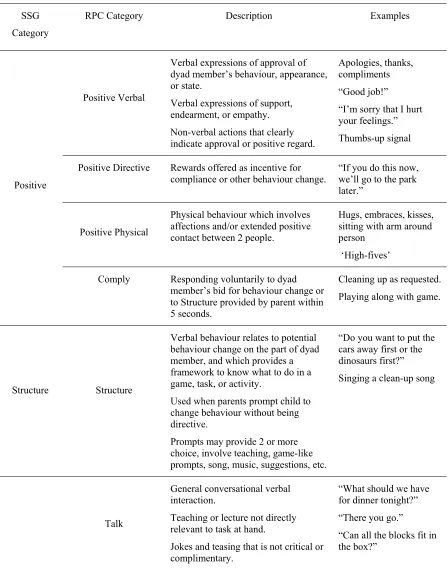
‘structure’ provided by parent; Non-Comply, or not following the other person’s request within five seconds or at all. Table 3 shows the RPC variables and examples of each category. Thus, for each 15-second interval, frequency for each of the 13 characteristics was recorded for each dyad member, resulting in 26 variables per interval, or 104
variables per minute. If two behaviours appeared to occur simultaneously, the RPC specifies priority rules to decide which code is more important. In order of precedence, the codes were: (1) Verbal, Physical (with Directives taking precedence over other verbal); (2) Compliance; (3) Vocal; and (4) Nonverbal. For example, if a mother praised her child while also hugging him or her, the behavioural event would be coded as
Positive Verbal.
All variables for each dyad member for every 15-second interval were entered into the Statistical Package for the Social Sciences (SPSS) program, and subsequently transferred in text format to Notepad in order to format it for input into GridWare. Coding categories from previous studies (e.g., Granic, Hollenstein studies) were used as the basis for the present study, with the addition of the Structure category. Each variable for each 15-second interval was grouped into one of four sub-groupings, resulting in a frequency count for each of the four new categories:
Positive: Positive Verbal; Positive Directive; Positive Physical Contact; Comply
Structure: Structure
Table 3
Coding for and Examples of Relationship Process Code (RPC; Dishion et al., 2004)
SSG Category
RPC Category Description Examples
Positive Verbal
Verbal expressions of approval of dyad member’s behaviour, appearance, or state.
Verbal expressions of support, endearment, or empathy. Non-verbal actions that clearly indicate approval or positive regard.
Apologies, thanks, compliments “Good job!”
“I’m sorry that I hurt your feelings.” Thumbs-up signal
Positive Directive Rewards offered as incentive for
compliance or other behaviour change. “If you do this now, we’ll go to the park later.”
Positive Physical
Physical behaviour which involves affections and/or extended positive contact between 2 people.
Hugs, embraces, kisses, sitting with arm around person
‘High-fives’ Positive
Comply Responding voluntarily to dyad member’s bid for behaviour change or to Structure provided by parent within 5 seconds.
Cleaning up as requested. Playing along with game.
Structure Structure
Verbal behaviour relates to potential behaviour change on the part of dyad member, and which provides a framework to know what to do in a game, task, or activity.
Used when parents prompt child to change behaviour without being directive.
Prompts may provide 2 or more choice, involve teaching, game-like prompts, song, music, suggestions, etc.
“Do you want to put the cars away first or the dinosaurs first?” Singing a clean-up song
Talk
General conversational verbal interaction.
Teaching or lecture not directly relevant to task at hand.
Jokes and teasing that is not critical or complimentary.
Directive
Commands or requests for behaviour change.
Compliance must be potentially observable.
Clear demands not to repeat a previous behaviour.
“Clean up.”
“Pick up the toys and put them in the box.” “Should we put it back in the bucket?”
Vocal
Any audible vocal expression including, but not limited to, laughter, sobbing, or neutral vocal expressions of acknowledgement.
“Uh huh”
Humming, whistling Neutral
Physical Contact
Any physical contact between 2 people which is inherently neutral or non-intrusive, or not delivered with intention to harm.
Holding child back to ensure safety.
Holding arm to assist in task or activity.
Negative Verbal
Verbal expressions of approval of dyad member’s behaviour, appearance, or state.
Complaints, cursing, insults, personal attacks, teasing that is critical. Non-verbal actions that clearly indicate disapproval or negative regard.
“You aren’t doing that right.”
“You’re not cleaning up very fast.”
Making face of contempt.
Negative Directive E.g., warnings of unpleasant
consequence, threats or implied threats (e.g., physical reprimand, loss of privilege, or withholding of favourable consequence).
Can be verbal or nonverbal.
“You just open that door and see what happens.” “If you don’t pick up the toys, we’re not going to get ice cream later.”
Negative Physical Intrusive physical contact with other person that is likely to be experienced as unpleasant and/or aversive. Low-grade physical contact with objects not part of clean-up task. Destruction of objects.
Light hitting, pinching, slapping, grabbing other’s hand, shove. Restraining child for reasons other than safety or protection.
Throwing objects away from toy box.
Negative
Non Comply Clearly ignoring, disagreeing or refusing to cooperate with dyad member’s bid for behaviour change. If no compliance observed within 5 seconds of bid for behaviour change.
Negative: Negative Verbal; Negative Directive; Negative Physical Contact; Non Comply
Separate files were created for each dyad and for each task within each dyad in order to graphically depict and obtain flexibility variables (see below) for each dyad in each task. After grouping all RPC data into one of the above four categories, all data were then transferred into the Gridware program.
Parental Warmth and Control Scale. The Parental Warmth & Control Scale
(PWCS; Rubin & McKinnon, 1994) codes for parent behaviours and verbalizations for every 20-second interval of the dyadic interaction. Research assistants coded for overall quality of the rated characteristic using a 3-point Likert scale, with the exception of Sensitivity, which was rated on a 4-point scale. Codes were derived for seven parent characteristics. Proximity & Orientation assesses the parent’s physical location with reference to the child and parental nonverbal attentiveness. Positive Affect is a measure of the positive quality of parental emotional expressiveness toward the child, such as warmth, positive feeling, pleasantness, and enjoyment toward the child. Hostile Affect
activities of the child regardless of the child’s wishes. Positive Control assesses the extent to which the parent facilitates his or her child’s behaviour. The parent actively and positively provides guidance which allows the child to direct or structure the ongoing activities, and provides well-timed supportive assistance and facilitates the child’s competent functioning. Table 4 details the PWCS coding scheme and examples. Due to the different coding intervals between the two coding schemes (i.e., 20-second intervals for PWCS; 15-second for RPC), PWCS variables were not entered into the GridWare program for each interval as coded. Rather, PWCS variables were consolidated into categorical variables before input into GridWare. For the purposes of the present study, only Positive Affect, Hostile Affect, Positive Control and Guidance, and Sensitivity were of interest. These variables were further forced into dichotomous variables for analyses with the following cut-off scores below designated for the present study. The number of events per minute for each variable (e.g., number of ‘Warm’ events) were extracted for each dyad for each task type through GridWare. For each 20-second interval, the parent was considered Warm if Positive Affect was rated as 2 or 3 (i.e., moderate or high). Similarly, the parent was rated as Hostile if she was rated as 2 or 3 on Hostile Affect. The parent was described as Sensitive if one of two conditions was met: (1) Sensitivity = 4; or (2) Sensitivity = 3 AND Positive Control and Guidance > 1. For the latter coding, the parent was rated as exhibiting a moderate level of sensitivity as well as constructively helping to guide the child’s activity. The parent was not rated as Sensitive if: (1)
Table 4
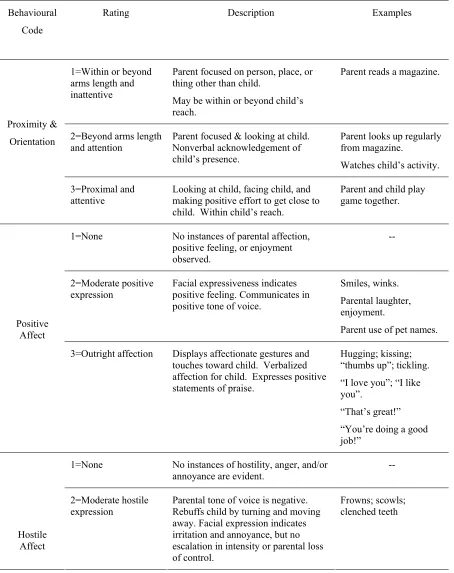
Coding for Parental Warmth and Control Scale (PWCS; Rubin & McKinnon, 1994)
Behavioural Code
Rating Description Examples
1=Within or beyond arms length and inattentive
Parent focused on person, place, or thing other than child.
May be within or beyond child’s reach.
Parent reads a magazine.
2=Beyond arms length
and attention Parent focused & looking at child. Nonverbal acknowledgement of child’s presence.
Parent looks up regularly from magazine.
Watches child’s activity. Proximity &
Orientation
3=Proximal and
attentive Looking at child, facing child, and making positive effort to get close to child. Within child’s reach.
Parent and child play game together.
1=None No instances of parental affection, positive feeling, or enjoyment observed.
--
2=Moderate positive
expression Facial expressiveness indicates positive feeling. Communicates in positive tone of voice.
Smiles, winks. Parental laughter, enjoyment.
Parent use of pet names. Positive
Affect
3=Outright affection Displays affectionate gestures and touches toward child. Verbalized affection for child. Expresses positive statements of praise.
Hugging; kissing; “thumbs up”; tickling. “I love you”; “I like you”.
“That’s great!” “You’re doing a good job!”
1=None No instances of hostility, anger, and/or
annoyance are evident. --
Hostile Affect
2=Moderate hostile
expression Parental tone of voice is negative. Rebuffs child by turning and moving away. Facial expression indicates irritation and annoyance, but no escalation in intensity or parental loss of control.
3=Outright hostility Parent insults and criticizes child. Yells or physically punishes child. Vocalized negative sarcasm.
“Don’t be stupid.” “Sometimes you’re such a klutz.”
Slaps hands; grabs arms and pulls child.
“All washed out like you, eh?”
1=None No instances of parental sadness,
anxiety, or fearfulness observed. --
2=Moderate negative
expression Parent exhibits sad expression, is unable to relax, and/or looks worried. Expresses a flat, sullen tone of voice and/or anxious tone of voice.
Parent frequently looks around and fidgets. Negative
Affect
3=Outright negative
expression Parent verbally expresses sadness, embarrassment, and/or wariness in response to child’s behaviour.
“I am unhappy with your behaviour!”
“Remember what I said at home, we do not talk like that!”
1=No sensitivity Parent missed some occasions to set limits; leads to disorganization of child.
Child’s behaviour is inappropriate and parent does not intervene.
2=Low sensitivity Parent does not respond to child’s attempts to gain attention, or to the child’s questions. Parent is unaware that child needs help, even though child’s nonverbal behaviour indicates need for attention.
Child struggles with Lego and parent does not ask child if they need assistance.
3=Moderate Parent gives non-contingent response. Parent responds to child, but does not attempt to extend the exchange.
Parent’s response is not relevant to child’s question.
4=High sensitivity Parent extends the exchange. Parent elaborates the conversation.
Parent contributes to the activity in response to child’s cues. Sensitivity
N/A Situation does not require maternal response.
1=None No instances of parental intrusiveness
2=Moderate negative
control Parent is verbally intrusive or momentarily distracts child. Parent quizzes child in interfering way.
Parent talks to child but does not allow time for child to respond. Child is busy playing with toy and parent directs his/her attention elsewhere.
Negative Control
3=Outright negative
control Parent uses unnecessary dictatorial instructions to control the child’s behaviour. Instruction leave little room for child’s autonomous functioning. Parent uses physical intrusiveness that clearly change or stop child’s behaviour.
“Don’t do that.” “Don’t play with this.” Grabs toy from child to demonstrate use of toy. Pulls child aside.
1=None No instances of parental guidance
observed. --
2=Moderate positive control and/or guidance
Parent determines/chooses activity for child, but allows child time to adjust to activity. Does not interfere with child’s play. Parent suggests a few activities for child but allow child opportunity to determine the activity; child
unoccupied at the time.
“We could play with the cars or animals. What would you like?” Positive Control & Guidance 3=Outright positive control and/or guidance
Child chooses the activity and parent provides guidance. Parental behaviour clearly unobtrusive.
Parent offers help if required.
guide the child’s activity or they were rated as showing low or no sensitivity, they were not rated as sensitive.
Flexibility variables. Based on previous research, the GridWare (Lamey et al.
2004) program was designed to display dyadic data in the form of state space grids. GridWare provides a visualization and data manipulation tool for multivariate time series of sequential data. Two major advantages of GridWare are that: (1) it can map all
possible states of a system and plot a trajectory for the dyad as their interaction changes over time; and (2) it visually depicts and provides variables for states that ‘attract’ the dyad from other states.
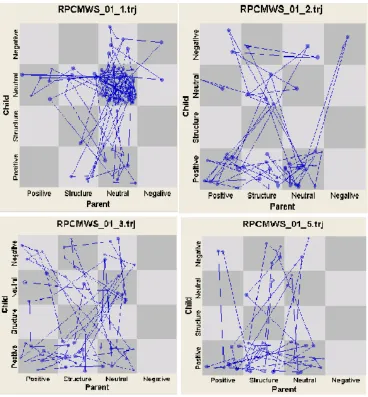
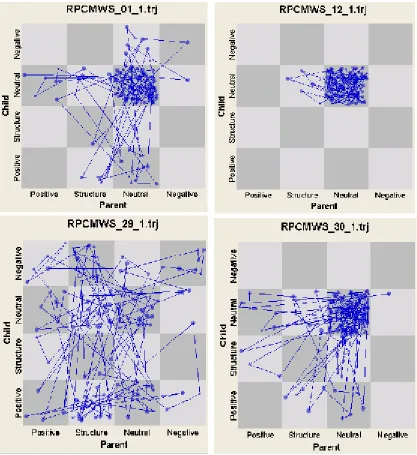
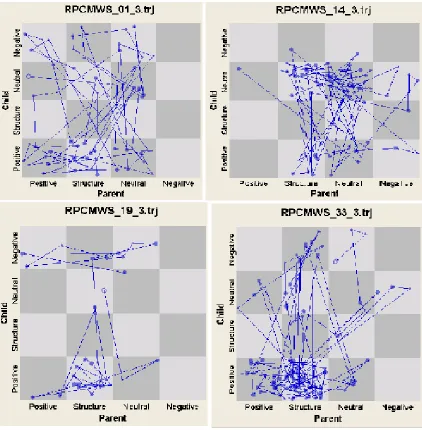
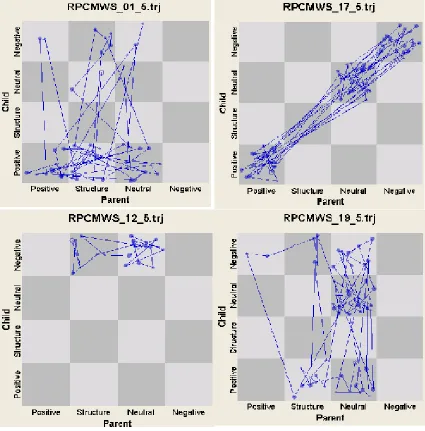
In addition to visually depicting dyadic interaction patterns, the GridWare program also provides numerical values for variables indicating degrees of flexibility in dyadic interactions (i.e., how flexible the dyad is in being able to move to different types of interactions such as negative to positive to neutral). One can examine differences in flexibility within each dyad, across different types of tasks (see Figure 1 for an example of one dyad engaging in four different task types). Patterns in flexibility within task type, can also be examined across dyads. Figures 2 through 4 show four different dyads
engaged in the same tasks (free play and two teaching tasks). In the SSGs, plot points for behavioural events were laid out within each cell using the ‘Random’ layout mode of GridWare. Thus, there is no specific pattern for location of plot points within each cell.