Non-Malleability vs. CCA-Security:
The Case of Commitments
Brandon Broadnax?, Valerie Fetzer??, J¨orn M¨uller-Quade?, and Andy Rupp?,??
Karlsruhe Institute of Technology, Karlsruhe, Germany {brandon.broadnax, valerie.fetzer, joern.mueller-quade,
andy.rupp}@kit.edu
Abstract. In this work, we settle the relations among a variety of se-curity notions related to non-malleability and CCA-sese-curity that have been proposed for commitment schemes in the literature. Interestingly, all our separations follow from two generic transformations. Given two appropriate security notionsX andY from the class of security notions we compare, these transformations take a commitment scheme that ful-fills notionX and output a commitment scheme that still fulfills notion
X but not notionY.
Using these transformations, we are able to show that some of the known relations for public-key encryption do not carry over to commitments. In particular, we show that, surprisingly, parallel non-malleability and parallel CCA-security are not equivalent for commitment schemes. This stands in contrast to the situation for public-key encryption where these two notions are equivalent as shown by Bellare et al. at CRYPTO ‘99.
1
Introduction
A commitment scheme is a two-party protocol that enables one party, called the sender, to commit himself to a value, while keeping it hidden from others and to later reveal that value to the other party, called the receiver. Commitment schemes belong to the most important building blocks of cryptography and have many applications including coin flipping protocols, signature schemes and zero-knowledge proofs.
Non-malleability (first introduced in [15]) is an important security notion for commitment schemes that is, like its counterpart for encryption schemes, concerned with defending against man-in-the-middle attacks. Informally, a com-mitment scheme is called (stand-alone) non-malleable if it is impossible for a man-in-the-middle adversary that receives a commitment to a value v to “suc-cessfully” commit to a related value ˜v.
Several variants of non-malleability have been defined in the literature. For
parallel non-malleability [16] the adversary receives multiple commitments in
?The author is supported by the German Federal Ministry of Education and Research
within the framework of the project “Sicherheit vernetzter Infrastrukturen (SVI)” in the Competence Center for Applied Security Technology (KASTEL).
parallel and commits to multiple values in parallel. For concurrent non-malle-ability [26] the adversary receives and sends multiple commitments in an arbi-trary schedule determined by the adversary.
There are many works on non-malleable commitment schemes in the litera-ture, e.g., [11, 13, 16, 18, 19, 22, 27, 31]. Non-malleable commitment schemes have numerous applications in the field of multi-party computation. For instance, parallel non-malleable commitment schemes have been used for constructing round-efficient (six round) MPC protocols [16], concurrently non-malleable com-mitment schemes have been used as a building block for black-box MPC proto-cols [31] and (stand-alone) non-malleable commitment schemes have been used for concurrently composable protocols [27].
Another security notion related to non-malleability is CCA-security [25]. A commitment scheme is called CCA-secure if it remains hiding even if the adversary has access to an oracle that “breaks” polynomially many commit-ments. There exist several relaxed variants of CCA-security. For parallel CCA-security [24] the adversary can ask the oracle a single query that consists of polynomially many commitments sent to the oracle in parallel. For one-one CCA-security [23] the adversary can ask the oracle a single query that consists of exactly one commitment.
CCA-secure commitment schemes are a central building block for concur-rently secure multi-party computation in the plain model, i.e., without trusted setup apart from authenticated channels. CCA-secure commitment schemes were introduced by [9] in the context of “angel-based security”. Angel-based security, first proposed by [30], relaxes the security notion of the universal composabil-ity framework (UC) [6] in order to circumvent the broad impossibilcomposabil-ity results of the latter. In the angel-based security framework, concurrently secure multi-party computation in the plain model can be achieved for (almost) every cryp-tographic task [9, 10, 23–25]. This stands in contrast to the UC framework where many important functionalities such as commitments or zero-knowledge cannot be realized in the plain model (see, e.g., [7, 8]). Moreover, parallel CCA-secure commitment schemes [5, 23] and one-one CCA-secure commitment schemes [23, 24] were used as building blocks for several recent round-efficient concurrently secure general multi-party computation protocols in the plain model.
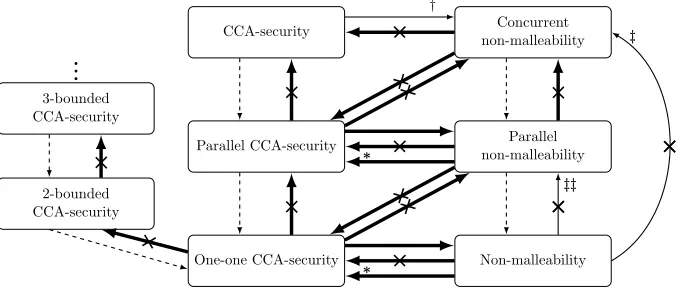
Considering this great variety of useful security notions, it is a natural ques-tion to ask how these noques-tions are related. Surprisingly, only a few relaques-tions have been analyzed so far (cf. Fig. 1). Most works focus either on security notions related to CCA-security or on security notions related to non-malleability. In this work we focus on the relationsbetweenthe two concepts and provide a more complete relation diagram. Motivated by public-key encryption, we also define and analyze the hierarchy ofq-bounded CCA-security [14], where the adversary can adaptively ask the oracle at mostqqueries for a fixed natural numberq.
no-tions of security for public-key encryption. In particular, they show that IND-CCA2-security and NM-IND-CCA2-security are equivalent. Bellare and Sahai [3] show that the indistinguishability-based definition of non-malleable encryption is equivalent to the simulation-based definition. Moreover, they show that non-malleability is equivalent to indistinguishability for public-key encryption under a “parallel chosen ciphertext attack”. Bellare et al. [2] show that standard se-curity for commitment schemes does not imply selective opening sese-curity. B¨ohl, Hofheinz and Kraschewski [4] analyze the relations between indistinguishability-based and simulation-indistinguishability-based definitions of selective opening security for public-key encryption.
For the class of security notions for commitment schemes that are considered in this work, only a few relations are resolved, however. Pandey, Pass and Vaikun-tanathan [28] show that CCA-security implies concurrent non-malleability. In [13] Ciampi et al. show that the non-malleable commitment scheme from a preliminary version of [20] is not concurrently non-malleable. Lin, Pass and Venkitasubramaniam [26] construct a commitment scheme that separates non-malleability and parallel non-non-malleability. The remaining relations are, to the best of our knowledge, unsettled.
Our Contribution. We settle the relations among a variety of security no-tions related to non-malleability and CCA-security that have been proposed for commitment schemes in the literature (see Fig. 1).1
Our results show, in particular, that some of the known results from previous works that dealt with public-key encryption do not carry over to the case of commitment schemes. In particular, the result of Bellare and Sahai [3], who showed that parallel non-malleability and parallel CCA-security are equivalent for public-key encryption schemes, does not hold for commitment schemes, in general. These two notions are only equivalent for non-interactive commitment schemes (see Appendix A).
Interestingly, we are able to obtain all of our separation results using two generic transformations. Given two appropriate security notions X andY from the class of security notions we compare in this work, these transformations take a commitment scheme that fulfills notion X and output a commitment scheme that still fulfills notion X but not notion Y. Both transformations are fully black-box and require no additional computational assumptions.
The first transformation is used for separations whereY is a CCA-related security notion. The key idea of this transformation is to expand a commitment scheme that fulfills a security notion X by a “puzzle phase” where the sender sends a specific computationally hard puzzle to the receiver. If the receiver an-swers with a correct solution, then the sender “gives up” and sends his input to the receiver who can then trivially win in the security game in this case. If
1 Note that we always use statistically binding commitment schemes in this work,
Concurrent non-malleability
Parallel non-malleability
Non-malleability CCA-security
Parallel CCA-security
One-one CCA-security 2-bounded
CCA-security 3-bounded CCA-security
†
‡‡
‡‡ ‡‡
* *
*only for non-interactive commitment schemes
Fig. 1.The relations between several security notions for commitment schemes. The dotted arrows indicate trivial implications. The thin solid arrows indicate relations proved in the literature (see [28] for†and [13] for‡) or separating commitment schemes from the literature (such as the scheme hC,˜ R˜i from [26] for ‡‡). The thick arrows indicate our results.
the puzzle is tailored appropriately, then the expanded commitment scheme still fulfills notionXbut fails to fulfill notionY. Intuitively, this separation holds be-cause an adversary in theY-security game has access to an oracle that “breaks” the puzzle but an adversary in theX-security game does not.
The second transformation is used for separations where Y is a variant of non-malleability. This transformation expands a given commitment scheme by adding a “share phase” in which the sender commits to two random shares of his input in a specific order. This is done in such a way that a man-in-the-middle adversary is able to forward these commitments to the receiver in his experiment. After the commit phase is over, these shares will be opened by the implicit oracle in the experiment and given to the distinguisher, who can then reconstruct the committed value.
On Black-Box Separations. We note that the separations proven in this work differ from black-box separations. Separating a security notion X from a security notionY by a black-box separation means that one cannot construct a scheme satisfyingX from a scheme satisfyingY in ablack-box manner.
one can construct a one-way function in a black-box way [21]. Moreover, [23] showed how to construct a CCA-secure commitment scheme from any one-way function in a black-box way. Since CCA-security implies any other notion de-scribed in this work, the statement follows. This transformation is, of course, highly redundant and inefficient and therefore only of theoretical interest.
2
Preliminaries and Definitions
For any x∈ {0,1}∗, we let
|x| denote the size of x. If S is a set, thens ←$ S
denotes the operation of picking an elementsofSuniformly at random. We use the termpptas abbreviation for probabilistic polynomial time (in the security
parameter) in the context of algorithms or machines. We writeA(x) to indicate that A is an algorithm with input x, we write AO(x) to indicate that A is an algorithm with input xand black-box access to the oracle O and we write
y← A(x) to denote the outputy ofAwith inputx.
The termnegligible is used for denoting functions that are (asymptotically) smaller than one over any polynomial. More precisely, a functionf(·) from non-negative integers to reals is callednegligible if for every constantc > 0 and all sufficiently large k, it holds that|f(k)|< k−c.
Commitment Schemes. A commitment scheme is a two-phase two-party protocol in which one party, the sender, commits himself in the first phase (the commit phase) to a value while keeping it secret from the other party, the re-ceiver. In the second phase (the reveal phase) the sender reveals the value he committed to. At the end of this phase the receiver outputs this value. In addi-tion to the requirement that both sender and receiver run in polynomial time, we require that a commitment scheme fulfills the following two properties:
– Hiding: The commit phase yields no knowledge of the value to the receiver. This also applies to cheating receivers.
– Binding: Given the transcript of the interaction in the first phase, there exists at most one value that the receiver can accept as the correct opening in the reveal phase. This also applies to cheating senders.
For a formal definition see [17]. In this work we focus on statistically bind-ing and computationally hidbind-ing (strbind-ing) commitment schemes, i.e., the bindbind-ing property holds against unbounded adversaries, while the hiding property only holds against computationally bounded (non-uniform) adversaries. This is be-cause committed values are then uniquely defined with overwhelming probability. In a tag-based commitment scheme both parties get a bit string called tag as additional input. We will denote byComtag(v) a (possibly interactive) commit-ment to the valuev∈ {0,1}k under the tagtag
∈ {0,1}k using the commitment schemeCom.2In the following, we only consider tag-based commitment schemes
2 Note that if we later use a formulation like “the sender sendsCom
tag(v) to the
ab-because the definitions of security notions considered here require tag-based commitment schemes.
CCA-Secure Commitment Schemes. Roughly speaking, a tag-based com-mitment scheme Comis said to be CCA-secure [25], if the value committed to using a tagtag remains hidden even if the receiver has access to an oracle that “breaks” polynomially many commitments using a different tag tag0 6=tag for him. In this work we consider committed value oracles (oracles that return the committed value) only, but not decommitment oracles (oracles that return the full decommitment information).
The CCA-oracleOcca forCom acts as follows in an interaction with an ad-versaryA: It participates withAin polynomially many sessions of the commit phase ofComas an honest receiver (the adversary determines the tag he wants to use at the start of each session). At the end of each session, if the session is valid, the oracle returns the unique valuevcommitted to in the interaction; oth-erwise, it returns⊥. Note that if a session has multiple valid committed values, the CCA-oracle also returns⊥. The statistical binding property guarantees that this happens with only negligible probability.
LetExpccaCom,A(k) denote the output of the following probabilistic experiment: Let Occa be the CCA-oracle for Com. The adversary has access to Occa during the entire course of the experiment. On input 1k, z, the adversary
AOcca picks a tag tag and two strings v0 and v1 with |v0| =|v1| and sends this triple to the experiment. The experiment randomly selects a bitb←− {$ 0,1}and then commits tovb using the tagtag toAOcca. Finally,AOcca sends a bitb0 to the experiment, which outputs 1 if b = b0 and 0 otherwise. The output of the experiment is replaced by ⊥ if during the execution the adversary queries the oracle on a commitment that uses the challenge tagtag.
Definition 1 (CCA-secure commitment scheme). LetCombe a tag-based commitment scheme andOcca be the CCA-oracle forCom. We say that Comis CCA-secure, if for every ppt-adversary Aand allz∈ {0,1}∗ the advantage
Advcca
Com,A(z)(k) :=Pr[Exp cca
Com,A(z)(k) = 1 ]− 1 2
is a negligible function.
Parallel CCA-Secure Commitment Schemes. Parallel CCA-secure com-mitment schemes are for example defined by Kiyoshima [23]. The parallel CCA-oracleOpccais defined like the CCA-oracle, except that the adversary is restricted to a parallel query, i.e., the adversary can only send a single query that may con-tain multiple commitments sent in parallel. Let ExppccaCom,A(k) define the output of the security game for parallel CCA-security (PCCA). The formal definition is then analogous to the definition of CCA-security.
One-One CCA-Secure Commitment Schemes. One-one CCA-secure com-mitment schemes are for example defined by Kiyoshima [23]. The one-one CCA-oracleO1ccais defined like the CCA-oracle, except that the adversary is restricted to a single query consisting of exactly one commitment. LetExp1cca
Com,A(k) define the output of the security game for one-one CCA-security (1CCA). The formal definition is then analogous to the definition of CCA-security.
q-bounded CCA-Secure Commitment Schemes. The q-bounded
CCA-oracle Oqcca is defined like the CCA-oracle, except that the adversary is re-stricted toq∈IN queries where each query consists of exactly one commitment. Let ExpqComcca,A(k) define the output of the security game for q-bounded CCA-security (qCCA). The formal definition is then analogous to the definition of CCA-security. Note that by definition 1-bounded CCA-security equals one-one CCA-security.
Non-Malleable Commitment Schemes. We now specify a definition of non-malleable commitment schemes that is essentially a game-based variant of the definition by Goyal, Pandey and Richelson [20]. It is easy to see that the two definitions are equivalent. Using a game-based variant of [20] makes it easier to compare this notion with CCA-security.
Let Expnm
Com,A,D(k) denote the output of the following probabilistic experi-ment: On input 1k, z, the adversary
A picks a tag tag and two strings v0 and v1 with|v0|=|v1|, sends this triple to the senderSand gets back the challenge commitment Comtag(vb), where b is a random bit chosen by the sender. The adversary then sends a commitmentComgtag(˜vb) to the receiverR. Iftagf =tag, ˜
vb is set to ⊥. At the end of this interaction the adversary outputs his view
viewAand the receiver outputs the value ˜vb. Note that the experiment plays the role of the sender and the receiver in the interaction. Also note that the receiver has implicit access to a super-polynomial-time oracleOthat breaks the received commitment for him and that the adversary’s view contains the randomness of the adversary and a transcript of all messages sent and received by the adversary. After the interaction has finished, the distinguisherDgetsz, the viewviewAof the adversary and the value ˜vb as input and outputs a bit b0. The experiment outputs 1 ifb=b0 and 0 otherwise.
Definition 2 (Non-malleable commitment scheme).A commitment scheme Comis non-malleableif for everypptman-in-the-middle adversaryA, for every
pptdistinguisherDand all z∈ {0,1}∗ the advantage
AdvnmCom,A(z),D(k) :=Pr[Exp nm
Com,A(z),D(k) = 1 ]− 1 2
is a negligible function.
Concurrent Non-Malleable Commitment Schemes. Tag-based concur-rent non-malleable commitment schemes are examined by Lin, Pass and Venki-tasubramaniam [26]. Here, man-in-the-middle adversaries are participating in left and right interactions in whichm=poly(k) commitments take place (where
In the concurrent setting, the adversary A is simultaneously participating in m left and right interactions. He sends a triple of sequences (tag,v0,v1) with tag = (tag1, . . . , tagm), v0 = (v10, . . . , v0m) and v1 = (v11, . . . , v1m) to the sender and receives commitments to values vb
1, . . . , vmb with tags tag1, . . . , tagm from the sender S and commits to values ˜vb
1, . . . ,v˜mb with tags tagf1, . . . ,tagfm to the receiver R. For any i such that tagfi = tagj for some j, set ˜vbi = ⊥. Let ExpcnmCom,A,D(k) define the output of the security game for concurrent non-malleability (CNM). The formal definition is then analogous to the definition of non-malleability.
Parallel Non-Malleable Commitment Schemes. A relaxed notion of con-current non-malleability is parallel non-malleability [16]. Here, like for concon-current non-malleability, the adversary receives m commitments from the sender and sendsmcommitments to the receiver. However, for parallel non-malleability the commitments are always sent in parallel. Again, any commitment in the right interaction that uses a tag that is also present in the left interaction is con-sidered invalid. Let ExppnmCom,A,D(k) define the output of the security game for parallel non-malleability (PNM). The formal definition is then analogous to the definition of non-malleability.
O-One-Way Commitment Schemes. Informally speaking, a tag-based com-mitment schemeComwith message space{0,1}k and tag space
{0,1}kis said to beO-one-way, if noppt-adversary can break a commitment to a random value,
even with access to the oracleO. The property can be formally defined with a security game. LetExpowCom,A,O(k) denote the output of the following probabilis-tic experiment: The experiment generates a random valuev and a random tag
tag, i.e., v ← {$ 0,1}k, tag $
← {0,1}k. It then sends the commitment Com tag(v) as challenge to theppt-adversary AO. On input 1k,z, the adversary now tries
to break the commitment and sends at some time his solution v0 back to the experiment which outputs 1 if v = v0 and 0 otherwise. Note that during the entire course of the game the adversary has access to the oracle O. The output of the experiment is replaced by⊥if during the execution the adversary queries the oracle on a commitment that uses the challenge tagtag.
Definition 3 (O-one-way commitment scheme). Let Com be a tag-based commitment scheme and O be a specific oracle for it. We say thatCom is O -one-way, if for every ppt-adversary Aand allz∈ {0,1}∗ the advantage
AdvowCom,A(z),O(k) :=Pr[Exp ow
Com,A(z),O(k) = 1 ]
is a negligible function.
(and its stronger variants) implies ε-one-wayness for the empty oracle ε. Note that the empty oracle just returns⊥for each query.
Extractable Commitment Schemes. Finally, we define extractable commit-ment schemes:
Definition 4 (Extractable commitment scheme). Let Com be a statisti-cally binding commitment scheme. Then, Com is extractable if there exists a
pptoracle machine E (the “extractor”) such that for any pptsender S∗, ES
∗ outputs a pair (τ, σ) such that
– τ is identically distributed to the view ofS∗ at the end of interacting with an
honest receiverRin the commit phase.
– the probability thatτ is accepting and σ6=⊥is negligible.
– ifσ6=⊥, then it is statistically impossible to decommit τ to any value other thanσ.
3
The First Transformation: Puzzle-Solution Approach
In this section, we describe the first transformation in this work. We call this approach the puzzle-solution approach because the general idea is to expand a commitment scheme by a puzzle phase that is executed at the beginning. Let
X and Y be security notions for commitment schemes for which one wants to show thatX does not implyY. For the first transformation,Y will always be a CCA-related security notion. LetOX be the oracle an adversary can use in the security game for the notionX. Let analogouslyOY be the oracle an adversary can use in the security game for the notionY (note that these oracles can be the “empty oracle”). Let Combe a (possibly interactive) commitment scheme that fulfillsX. We will sometimes callComthe base commitment scheme.
3.1 The Construction
Using Com, one can then define the separating commitment scheme, which we will denote byCom0. We defineCom0as output of a transformationPComGenthat gets a base commitment scheme, a numberl∈IN and a stringsch∈ {seq, par} as input, i.e.,Com0←PComGen(Com, l,sch).
In the commitment schemeCom0 the sender S, who wants to commit to a valuevgiven a tagtag, first sends a puzzle to the receiverRand, depending on whether Rsolves the puzzle or not, sendsv either as plaintext or commits tov
using the base commitment schemeCom. The puzzle consists oflcommitments to random messages (usingCom) that are either sent in parallel (ifsch=par) or sequentially (ifsch=seq) toR. More specifically, the sender randomly generates
ltags of lengthkandlvalues also of lengthk, i.e., (tag1
p, . . . , tagpl)
$
←− {0,1}kl, (w1, . . . , wl)
$
←− {0,1}kl.
Ifsch =par, the sender commits in parallel to (w1, . . . , wl) under the tags (tag1
p, . . . , tagpl) to the receiver. The receiver then answers with a possible so-lution to the puzzle by simply guessing, i.e., sending random (w0
sender then checks if for all i ∈ {1, . . . , l} it holds that wi = wi0. If this is the case,S sendsv as plaintext to the receiver. If it does not hold, Scommits to v
using the tagtag and the commitment schemeComtoR.
Ifsch=seq, the sendersequentially commits to (w1, . . . , wl) under the tags (tag1
p, . . . , tagpl) to the receiver. More specifically, he first commits tow1using the tagtag1
p and the commitment scheme Comand waits for the possible solution. The receiver Rthen sends a random valuew0
1 toS. If the solution is incorrect, then S commits tov using the tagtag and the base commitment schemeCom to R. Otherwise, he continues the puzzle phase by sending the second puzzle commitment, i.e., Comtag2
p(w2), toR and again waits for the possible solution. The receiver R then sends another random value w0
2 to S. If the solution is incorrect, then S commits to v using the tag tag and the commitment scheme Com. Otherwise, he continues by sending the third puzzle commitment and so forth. IfRhas correctly solved alllpuzzle commitments, Ssendsvas plaintext to the receiver.
Remark 1. When designing the separating commitment scheme,landschshould be carefully picked. The puzzle should be selected in such a way that it can be solved withOY but not withOX.
3.2 The Proof Strategy
To prove thatX does not implyY, one shows that the constructed commitment scheme Com0 still fulfillsX if the base commitment schemeComfulfillsX, but notY.
Show that Com0 is not Y-secure. For that purpose, one constructs an ad-versaryA, who breaks the Y-security ofCom0. The strategy for Ais to let OY solve the puzzle for him. He then gets the challenge value as plaintext and can thus trivially win in the security game for Y.
The probability that A wins the game is overwhelming because the only possibilities howAcan lose are: 1) the oracle solves the puzzle it gets before the query, 2) a session with the oracle has multiple valid committed values andOY thus returns ⊥, 3) during the execution the adversary queries the oracle on a commitment that uses the challenge tag (which happens if a puzzle commitment uses the challenge tag). Since one can show that each possibility occurs only with negligible probability, the overall winning probability ofAis overwhelming.
Show that Com0 is X-secure (under the assumption that Com is X-secure). LetAbe an adversary onCom0 in the security game forX, who wins the game with non-negligible advantage. Depending whether or notAsolves at least one puzzle3in the security game forX, one has to distinguish two cases. For each case one builds an adversary who breaks theX-security of the commitment schemeCom.
3 Note that for example in the concurrent non-malleability security game multiple
Case 1:A solves at least one puzzle. In this case, one constructs an adver-saryB1on theOX-one-wayness ofCom. Recall thatX-security impliesOX -one-wayness for our cases. We denote by n the number of challenge commitments Aawaits. Since each of thencorresponding puzzles containslcommitments,A expects in totalm=l·npuzzle commitments. The strategy ofB1 is then first to randomly generate m−1 puzzle values and tags and to randomly select a
j ∈ {1, . . . , m}. After B1 has received the challengeComtag(v) from the experi-ment, he starts to sendAthe puzzle(s). For all puzzle commitments except the
jthhe uses the honestly generated values and tags. Asjthpuzzle commitment he uses the challenge. After Ahas sent the solution to thejth puzzle commitment (aka the challenge), B1 terminates the simulation of A and sends A’s solution to thejth puzzle commitment as his own solution to the experiment.
IfA asks his oracle OX during the game, B1 sends random answers in the puzzle phase (to simulate the oracle) and forwards the actual oracle query to his own OX. There is a chance that B1’s experiment returns ⊥ at the end of the experiment. This happens if one ofA’s oracle queries contains a tag that equals B1’s challenge tag. This case may occur with non-negligible probability because the challenge tags of A and B1 are not necessarily identical. Fortunately, the opposite event also occurs with non-negligible probability.
The adversaryB1thus wins his game ifAsolves the puzzle commitment that is the challenge andA’s oracle queries do not involve the challenge tag.
Case 2: A solves none of the puzzles. In this case one builds an adversary B2on theX-security ofCom. The strategy ofB2 is to send random puzzle(s) to A, who fails to solve them (by assumption). After the puzzle phase,B2forwards his own challenge toA. The adversaryB2also forwardsA’s solution as his own solution to the experiment.
IfA asks his oracle OX during the game, B2 sends random answers in the puzzle phase (to simulate the oracle) and forwards the actual oracle query to his ownOX. Here, the challenge tags ofAandB2 are always identical (becauseB2 forwards it to his experiment), so the possibility ofB2’s experiment outputting ⊥is not a problem in this case.
The adversaryB2 thus wins his game ifAwins his own game and solves no puzzle.
4
A Concrete Example of the Puzzle Solution Approach:
Concurrent Non-Malleability Does Not Imply
CCA-Security
In this section, we apply the puzzle-solution approach to separate the notion of CCA-security from the notion of concurrent non-malleability.4 To this end, we
4 While the separation of CCA-security from concurrent non-malleability is not very
defineCom0asCom0←PComGen(Com,1, seq) whereComis a statistically bind-ing, concurrent non-malleable commitment scheme. The puzzle hence consists of just one commitment (thus the scheduling does not matter in this case). We follow the proof strategy described in Sec. 3.
Theorem 1 (CNM ; CCA). If Com is a statistically binding, concurrent
non-malleable commitment scheme, thenCom0 ←PComGen(Com,1, seq) is also statistically binding and concurrent non-malleable but not CCA-secure.
Proof. The statistical binding property ofCom0follows readily from the statisti-cal binding property of the underlying commitment schemeCom. In the follow-ing, we prove thatCom0 is concurrent non-malleable but not CCA-secure.5 Claim 1: Com0 is not CCA-secure. We show that we can build a CCA-adversary A, such that A wins the CCA-security game for the commitment schemeCom0 with non-negligible advantage.
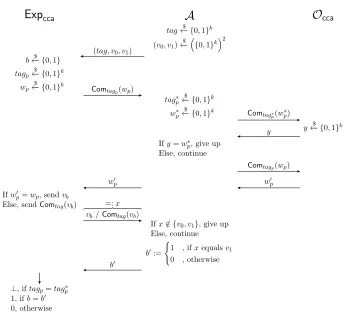
The CCA-adversaryA acts as depicted in Fig. 2. His strategy is to let the oracle solve the puzzle he got from the experiment and to hence get the challenge as plaintext. There are three possibilities howAcan lose the game:
– The oracle solves the puzzle, i.e.,y=w∗ p.
– The puzzle tag equals the challenge tag, i.e., tag =tagp (in that case the experiment returns⊥as result instead of a bit).
– The query sent to the oracle has more than one valid opening (in that case the oracle returnsw0
p=⊥).
The first possibility occurs with probability1/2kbecause the oracle uniformly se-lects a solution. The second possibility also occurs with probability1/2k because the puzzle tag is uniformly selected. The third possibility occurs with negligi-ble probability, which we denote by negl1(k), because Com is by assumption statistically binding. Thus, A’s advantage is non-negligible:
AdvccaCom0,A(k) =Pr[ExpccaCom0,A(k) = 1]−
1 2
≥1− 1 2k −
1
2k −negl1(k)− 1 2
=1 2 −
1
2k−1 −negl1(k)
Claim 2: Com0 is concurrent non-malleable. Let us assume Com0 is not concurrent non-malleable. Then we show that Comis also not concurrent non-malleable. Consider an adversary A and distinguisher DA such that A wins in the concurrent non-malleability security game for the commitment scheme Com0 with advantageAdvcnmCom0,A,D
A(k). Letm=poly(k), wherekis the security
parameter, be the number of concurrent commitment sessions initiated by the
5 For ease of notation, we omit the (non-uniform) inputz of the adversary and
Exp
ccaA
O
cca(tag, v0, v1) b←− {0$ ,1}
tagp←− {0$ ,1}k
wp←− {$ 0,1}k
Ifw0
p=wp, sendvb Else, sendComtag(vb)
⊥, iftagp=tagp∗ 1, ifb=b0
0, otherwise
tag←− {$ 0,1}k
(v0, v1)←−$
{0,1}k2
tag∗p
$
←− {0,1}k
w∗p←− {$ 0,1}k
Ify=w∗
p, give up Else, continue
Ifx /∈ {v0, v1}, give up
Else, continue
b0:=
(
1 , ifxequalsv1
0 , otherwise
y←− {0$ ,1}k
Comtagp(wp)
Comtag∗p(w∗p)
y
Comtagp(wp)
w0
p
w0
p
vb/Comtag(vb) =:x
b0
Fig. 2. Graphical depiction of the behavior of the adversaryA in the CCA-security game for the commitment schemeCom0. Note thatw0p∈ {wp,⊥}is either the unique
committed valuewpor, if the commitment has more than one valid opening,⊥.
sender in the concurrent non-malleability security game forCom0. Then we can split upA’s advantage into
AdvcnmCom0,A,D
A(k) =Pr[Exp
cnm Com0,A,D
A(k) = 1∧ ∃i:Asolves puzzlei]
+Pr[Expcnm Com0,A,D
A(k) = 1∧@i:Asolves puzzlei]−
1 2
(1)
Hence, in the following it suffices to consider that Awins and
– Case 1:Asolves at least one of thempuzzles.
– Case 2:Asolves none of thempuzzles.
Exp
owB
1A
(tag,v0,v1)v←− {$ 0,1}k
tag←− {$ 0,1}k
1, ifw0j=v
0, otherwise
b←− {$ 0,1}
j←− {$ 1, . . . , m} (tag1
p, . . . , tagpj−1, tagjp+1, . . . , tagpm)
$
←− {0,1}km−1 (w1, . . . , wj−1, wj+1, . . . , wm)←− {$ 0,1}km−1
tagjp:=tag
wj:=v
Comtag(v)
Comtagi p(wi)
w0
i
Comtagi(vbi)
w0j
Forifrom 1 tom
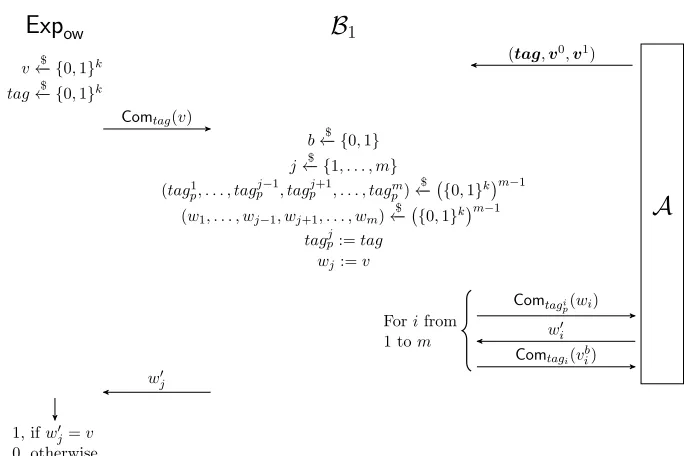
Fig. 3. Graphical depiction of the behavior of the adversary B1 in the ε-one-way security game for the commitment scheme Com. Note that tag = (tag1, . . . , tagm), v0= (v10, . . . , vm0) andv1= (v11, . . . , vm1).
A in the concurrent non-malleability security game and to replace a random puzzle commitment with the challenge he got from his own experiment. Note that depending on the behavior ofA, it may at some time happen thatAsends a puzzle to who he believes is the receiver, but is actuallyB1. IfB1receives such a puzzleCom
g
tagip( ˜wi) fromA, he acts as an honest receiver and sends a random solution ˜w0
iback. The time ofA’s interaction with the “receiver” or the contents of the puzzle do not matter in this case, therefore this interaction is omitted in Fig. 3.
By construction,B1 wins the game if v equals w0j, which happens ifA cor-rectly solves thejth puzzle. Thus, the advantage of
B1 is as follows: AdvowCom,B1,ε(k) =Pr[Exp
ow
Com,B1,ε(k) = 1]
≥Pr[Expow
Com,B1,ε(k) = 1| ∃i:Asolves puzzlei]
·Pr[∃i:Asolves puzzlei]
≥ m1 ·Pr[∃i:Asolves puzzlei]
≥ m1 ·Pr[ExpcnmCom0,A,D
A(k) = 1∧ ∃i:Asolves puzzlei]
(2)
S
B
2A
R
(tag,v0,v1)
(tag,v0,v1) b←− {$ 0,1}
(tag1 p, . . . , tagmp)
$
←− {0,1}km
(w1, . . . , wm)←− {$ 0,1}km
Ifw0
i=wi, give up
yi←− {$ 0,1}k
viewB2 (˜v1b, . . . ,v˜qb) Comtagi(v
b i)
Comtagi p(wi)
wi0
Comtagi(v
b i)
Comtagfi p( ˜wi)
yi Comtagf
i(˜v
b i) / ˜vib
viewA
Comtagf
i(˜v
b i)
Forifrom 1 tom
Forifrom 1 tom
Forifrom 1 tom
Forifrom 1 tom
DB2
b0
Description ofDB2:
•Execute the distinguisher fromA, i.e.,b0← DA(viewA,(˜vb
1, . . . ,v˜qb))
(I)
(II)
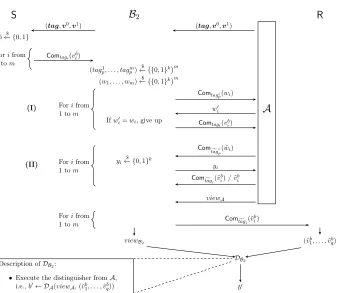
Fig. 4.Graphical depiction of the behavior of the adversaryB2in the concurrent non-malleability security game for the commitment scheme Com. At (I) A’s interaction with the “sender” is depicted and at (II)A’s interaction with the “receiver”. Note that tag = (tag1, . . . , tagm), v0 = (v10, . . . , vm0) and v1 = (v11, . . . , vm1). Note that
Com g tagi(˜v
b
i) / ˜vbi denotes that, depending on whetherB2correctly guessed the solution
yi or not, theith result value is sent as a commitment or as a plaintext value. In the (negligible) case thatB2 correctly solves a puzzle and gets a value ˜vi as plaintext, he himself commits to this value before sending the commitment to the receiver. Also note thatviewB2 containsviewA.
The advantage ofB2in this case is as follows:
Advcnm
Com,B2,DB2(k) =Pr[Exp
cnm
Com,B2,DB2(k) = 1]−
1 2 ≥Pr[Expcnm
Com,B2,DB2(k) = 1|@i:Asolves puzzle i] ·Pr[@i:Asolves puzzlei]−1
2 =Pr[ExpcnmCom0,A,D
A(k) = 1|@i:Asolves puzzlei] ·Pr[@i:Asolves puzzlei]−1
2
=Pr[Expcnm Com0,A,D
A(k) = 1∧@i:Asolves puzzlei]−
1 2
(3)
Putting things together. Putting Eq. 2 and Eq. 3 back into Eq. 1, we get the following:
Advcnm Com0,A,D
A(k) =Pr[Exp
cnm Com0,A,D
A(k) = 1∧ ∃i:Asolves puzzlei]
+Pr[ExpcnmCom0,A,D
A(k) = 1∧@i:Asolves puzzlei]−
1 2
≤m·AdvowCom,B1,ε(k) +Adv
cnm
Com,B2,DB2(k) +
1 2−
1 2 =m·Advow
Com,B1,ε(k) +Adv
cnm
Com,B2,DB2(k)
SinceComis by assumption concurrent non-malleable, it holds thatAdvow
Com,B1,ε(k)
and Advcnm
Com,B2,DB2(k) are negligible. Thus, Adv
cnm Com0,A,D
A(k) is also negligible,
which concludes the proof of the theorem. ut
5
More Instantiations of the Puzzle-Solution Approach
In this section, we show how more separation results can be obtained by ap-propriate instantiations of the puzzle-solution approach. Therefore, we illustrate how the puzzle-solution approach from Sec. 3 should be instantiated to show the respective result.
Using the same puzzle and very similar arguments as in the proof of Thm. 1, one can prove that parallel non-malleability does not imply parallel CCA-security, that non-malleability does not imply one-one CCA-security, that concurrent malleability does not imply parallel CCA-security and that parallel non-malleability does not imply one-one CCA-security.
Theorem 2 (PNM;PCCA).IfComis a statistically binding, parallel
non-malleable commitment scheme, then Com0←PComGen(Com,1, seq)is also sta-tistically binding and parallel non-malleable but not parallel CCA-secure.
Theorem 3 (NM ; 1CCA).If Comis a statistically binding, non-malleable
Theorem 4 (CNM ; PCCA). If Comis a statistically binding, concurrent
non-malleable commitment scheme, thenCom0 ←PComGen(Com,1, seq) is also statistically binding and concurrent non-malleable but not parallel CCA-secure.
Theorem 5 (PNM; 1CCA).IfComis a statistically binding, parallel
non-malleable commitment scheme, then Com0←PComGen(Com,1, seq)is also sta-tistically binding and parallel non-malleable but not one-one CCA-secure.
We can prove additional separations using other puzzles.
Theorem 6 (1CCA ; PCCA). If Com is a statistically binding, one-one
CCA-secure commitment scheme, then Com0 ← PComGen(Com,2, par) is also statistically binding and one-one CCA-secure but not parallel CCA-secure.
Proof Idea. The puzzle consists of two parallel commitments. It is thus solvable with a parallel CCA-oracle but not with a one-one CCA-oracle. The probability that in the reduction of the first case of the second claim the oracle query can be answered is at least1/2−1/2k (withkthe tag length). ut
Theorem 7 (PCCA;CCA).IfComis a statistically binding, parallel
CCA-secure commitment scheme, then Com0 ← PComGen(Com,2, seq) is also statis-tically binding and parallel CCA-secure but not CCA-secure.
Proof Idea. The puzzle consists of two sequentially sent commitments. It is thus solvable with a CCA-oracle but not with a parallel CCA-oracle. The probability that in the reduction of the first case of the second claim the oracle query can be answered is at least 1/2−m/2k (with m the number of commitments in the
oracle query andkthe tag length). ut
Theorem 8 (qCCA;(q+1)CCA).Letq≥1be a positive integer. IfComis
a statistically binding,q-bounded CCA-secure commitment scheme, thenCom0← PComGen(Com, q+1, seq)is also statistically binding andq-bounded CCA-secure but not (q+ 1)-bounded CCA-secure.
Proof Idea. The puzzle consists of q+ 1 sequentially sent commitments. It is thus solvable with a (q+ 1)-bounded CCA-oracle but not with a q-bounded CCA-oracle. The probability that in the reduction of the first case of the second claim the oracle query can be answered is at least1/q+1−1/2k (with k the tag
length). ut
6
The Second Transformation: Sharing Approach
can therefore no longer insert a puzzle into a given commitment scheme since an adversary (i.e., a man-in-the-middle) in a non-malleability-related experiment does not have a committed value oracle at his disposal that can be used to solve the puzzle.
We therefore deviate from the puzzle-solution approach in the following way: Instead of sending a puzzle, i.e., commitments to random strings, we let the sender commit toshares of the message to be committed to using two different random tags. This way, the man-in-the-middle will be able to forward the com-mitments to the shares to the receiver in his experiment. After the commit phase is over, these shares will then be opened by the implicit oracle in the experiment. The distinguisher will then be able to reconstruct the message and win in the experiment.
Using the above approach, we first show that parallel CCA-security does not imply concurrent non-malleability. To this end, consider the following scheme Com0, given a commitment schemeCom:
On input v ∈ {0,1}k, tag
∈ {0,1}k, the sender generates message shares
s0, s1∈ {0,1}ksuch thats0⊕s1=v. He then sendsComtag0(s0) andComtag1(s1)
to the receiver in a sequential order using random tags tag0, tag1 ∈ {0,1}k. Afterwards, the sender sendsComtag(v) to the receiver. The unveil phase is the same as inCom(notice that the shares are never unveiled).
First note that, in general, the above construction Com0 does not yield a separation between concurrent non-malleability and parallel CCA-security, even ifComis parallel CCA-secure. This is becauseCom0 may fulfillneither of these two security notions. For instance, assumingComisnon-interactive, an adversary against the parallel CCA-security ofCom0 can simply forward the two commit-ments to the shares to his oracle and thereby easily win in his experiment.
In order to obtain a separation, we therefore additionally assume thatComis
extractable. Note that if a statistically binding, parallel CCA-secure commitment scheme exists, then there also exists a statistically binding, parallel CCA-secure commitment scheme that is additionally extractable. This is because one-way functions can be constructed from commitment schemes [21] (in a black-box way) and [23] showed how to construct an extractable CCA-secure commitment scheme from one-way functions (in a black-box way).
For the proof of the separation between concurrent non-malleability and par-allel CCA-security, we use the following experiment as an auxiliary tool:
Definition 5 (RepeatPCCA).RepeatPCCA is like the ordinary parallel CCA-security game except that the adversary can “reset” the experiment at any given moment.
More specifically, the adversary (on input 1k, z) first chooses two strings (v0, v1)such that|v0|=|v1|and a challenge tagtagand sends(v0, v1, tag)to the experiment. The experiment then chooses a random bitb← {0,1} and commits to vb using the tag tag. The adversary can then send reset to the experiment
or a bit b0. If the adversary sends reset, then he can send new strings (v0 0, v10) and a new challenge tag to the experiment. The experiment then commits to v0
b
adversary may reset the experiment polynomially many times. If the adversary sends a bitb0, then the experiment outputs1ifb=b0and0otherwise. Throughout
the experiment, the adversary may send a single parallel query toOpcca on tags
that are different from the current challenge tag. If the adversary sends reset
but hasn’t finished his query yet, then his query is invalidated, i.e., the oracle ignores all further messages.
Denote by ExprpccaCom,A(k) the output of the above experiment. We say that a tag-based commitment scheme Com is RepeatPCCA-secure if for every ppt -adversaryAand all z∈ {0,1}∗ the advantage
AdvrpccaCom,A(z)(k) :=Pr[ExprpccaCom,A(z)(k) = 1 ]−12
is a negligible function.
We have the following lemma:
Lemma 1. If a commitment scheme is parallel CCA-secure and extractable, then it is also RepeatPCCA-secure.
Proof Idea. The proof is by reduction to parallel CCA-security. The reduction B can answer the oracle query of the adversary A against the RepeatPCCA-security in the following way: If A sends his query duringB’s challenge phase, thenBforwards the query to his own parallel CCA-oracle. IfAsends his query before or afterB’s challenge phase, thenBuses the extractability property. ut
We are now ready to prove the following theorem:
Theorem 9 (PCCA ; CNM). If there exists a statistically binding,
paral-lel CCA-secure commitment scheme, then there also exists a statistically bind-ing and parallel CCA-secure commitment scheme that is not concurrent non-malleable.
Proof. Let Com0 be as above with a statistically binding, parallel CCA-secure and extractable commitment scheme Com as its base commitment scheme (as noted above, such a Com exists if a statistically binding, parallel CCA-secure commitment scheme exists).
The statistical binding property ofCom0 follows readily from the statistical binding property of the underlying commitment scheme Com. In the following, we prove thatCom0 is parallel CCA-secure but not concurrent non-malleable.6 Claim 1: Com0 is not concurrent non-malleable. A man-in-the-middle adversary in the concurrent non-malleability game first sends (v0
1, . . . , v0m), (v1
1, . . . , v1m), (tag1, . . . , tagm)
to the sender, who randomly selects a bitb. The sender then commits for each i ∈ {1, . . . , m} to the shares sb
i0 and s
b i1 using
random tags and to vb
i using tag tagi to the adversary (with sbi0 ⊕s
b i1 = v
b i). 6 For ease of notation, we again omit the (non-uniform) inputz of the adversary and
Let h := bm
2c. For each j ∈ {1, . . . , h} the adversary forwards the commit-ments to sb
j0 and s
b
j1 to the sender (as shares for these commitments he just
uses commitments to 0k).7 If m is odd, he chooses 0k as his last message to commit to (he also uses commitments to 0k as shares). The distinguisher is then given (sb
10, s
b
11, . . . , s
b h0, s
b
h1) as input (and possibly 0
k) and can thus reconstruct (vb
1, . . . , vhb), which suffices to deduce the correctb if the challenge messages are chosen appropriately.
Claim 2: Com0 is parallel CCA-secure. Let Abe a ppt-adversary against
the parallel CCA-security ofCom0. Consider the following hybrids for the com-mitment scheme Com0: H0 is the ordinary parallel CCA-security game, H1 is like H0 except that the sender now commits to two random andindependently distributed strings s0, t(that therefore do not fulfill s0⊕t =v in general) and finally H2 that is likeH1 except that the sender commits to 0k instead of (his input)v.
Letoutibe the output of the hybrid Hi.
Sub-Claim 1: |Pr[out0= 1]−Pr[out1= 1]| ≤negl(k). Consider the following adversaryBagainstComin the RepeatPCCA game: The adversaryBsimulates the experimentH0 forA. (∗) AfterAhas sent (v0, v1, tag),Bchooses a random bit b← {0,1} and generates sharess0, s1such that s0⊕s1=vb and a random string t ∈ {0,1}k. The adversary
B then sends (s1, t, tag1), where tag1 is a random tag of lengthk, to his experiment. Afterwards, B randomly selects one of the two (sequentially ordered) commit sessions to the shares of vb in the commit phase ofCom0 and inserts his challenge C∗ into the selected session and Comtag0(s0) into the other session (for a randomly chosen tag tag0 ∈ {0,1}
k). If the adversaryA starts his (parallel) oracle queryduring the challenge phase of B (i.e., during the session in whichB has inserted his challenge C∗), then
B resets his experiment and repeats the aforementioned strategy (i.e., jumps back to (∗)).
Otherwise,B answersA’s oracle query in the following way:
Case 1: IfA starts his querybefore B’s challenge phase has begunand A’s query does not useB’s challenge tagtag1, thenBforwardsA’s query to his own parallel CCA-oracle (ifA’s query usesB’s challenge tag, then Baborts).
Case 2:IfAstarts his queryafter B’s challenge phase is over, thenBanswers the query by extractingA.8
7 Note that the receiver inCom0does not “examine” the commitments to the shares.
This would, of course, not work anyway. Since we assume that the commitment scheme Com is hiding, it is impossible for the receiver to learn the values of the shares by any efficient procedure.
8 Note that, in general, B cannot use his own oracle in case 2. This is because, in
Afterwards,B continues simulating the experimentH0forA. After the sim-ulated experiment is over, B outputs what the simulated experiment outputs. The adversaryBrepeats the experiment at mostk−1 times (and aborts if the
kth iteration leads to another reset).
Denote by BadQuerythe event that the adversary A queries the parallel CCA-oracle during the challenge phase ofBin all iterations.
Letj ∈ {1,2} be the session into whichBhas chosen to insert his challenge C∗. Since
Bchoosesj randomly in each iteration andA’s view isindependent of
j in each iteration, it holds thatPr[BadQuery]≤1/2k.
Denote byGuessTagthe event thatAqueries his parallel CCA-oraclebefore
the challengeC∗has startedusingB’s challenge tagtag
1in one of the iterations. Since the challenge tagtag1 is chosen randomly (from the set of strings of length k) and A’s view is independent of tag1 before the challenge phase C∗ begins, it holds thatPr[GuessTag]≤k·i/2k, wherei=poly(k) is the number of commitments in the parallel oracle query.
Now it holds thatconditioned onBadQueryandGuessTagboth not occur-ring, the output of B is either identically distributed to the output ofH0 (this holds if C∗ =Com
tag1(s1)) or identically distributed to the output ofH1 (this
holds if C∗=Comtag1(t)).
LetE =BadQuery∨GuessTag and let Outputb∗(B) denote the output
of B in the RepeatPCCA-experiment if the challenge bitb∗ was chosen by the RepeatPCCA-experiment. Then we have the following:
|Pr[out0= 1]−Pr[out1= 1]| ≤Pr[E] +|Pr[out0= 1|¬E]−Pr[out1= 1|¬E]| =Pr[E] +|Pr[Output0(B) = 1|¬E]
−Pr[Output1(B) = 1|¬E]|
≤ k·2ik+ 1 +negl(k) =negl0(k)
Note that |Pr[Output0(B) = 1|¬E]−Pr[Output1(B) = 1|¬E]| ≤ negl(k) holds because Comis RepeatPCCA-secure by Lemma 1 and Pr[¬E] = 1−k·i+1/2k is overwhelming ink(see Appendix B).
Sub-Claim 2: |Pr[out1 = 1]−Pr[out2 = 1]| ≤ negl(k). This follows from a standard reduction argument to the parallel CCA-security of Com. Consider an adversary B0 against the parallel CCA-security of Com. The adversary
B0 simulates the experimentH1 forA. AfterAhas sent (v0, v1, tag),B0 chooses a random bit b← {0,1} and sends (vb,0k, tag) to his experiment. Afterwards,B0 forwards his challenge C∗ to
AasA’s challenge. IfAqueries his oracle, thenB0 forwards this query to his own oracle. After the simulated experiment is over,B0 outputs what the simulated experiment outputs. It holds that the output ofB0 is identically distributed to the output ofH1 if C∗=Comtag(vb) and identically
distributed to the output of H2 if C∗ =Comtag(0k). Sub-Claim 2 now follows from the parallel CCA-security ofCom.
Sub-Claim 3: Pr[out2= 1] =1/2. This follows from the fact that the view of Ain the hybridH2 is independent of the challenge bit.
In conclusion,|Pr[out0= 1]−1/2]| ≤negl(k). Hence,Com0is parallel CCA-secure. u t
Using the transformation implied by [21, 23] described earlier and Thm. 9, we also get the following separation:
Theorem 10 (PNM ; CNM). If there exists a statistically binding,
par-allel non-malleable commitment scheme, then there also exists a statistically binding and parallel non-malleable commitment scheme that is not concurrent non-malleable.
Using similar arguments as in the proof of Thm. 9, one can also show that one-one CCA-security does not imply parallel non-malleability.
Theorem 11 (1CCA;PNM).If there exists a statistically binding, one-one
CCA-secure commitment scheme, then there also exists a statistically binding and one-one CCA-secure commitment scheme that is not parallel non-malleable.
Proof Idea. This separation follows by adapting the techniques used for the sep-aration in Thm. 9. In the commitment schemeCom0 the sender commits to the sharess0ands1in parallelinstead of sequentially. The experiment Repeat1CCA is like RepeatPCCA except that the adversary may now query O1cca instead of
Opcca. ut
Remark 2. We remark that all results, except for Thms. 3, 5 and 8, carry over to bit commitment schemes. This can be shown by similar arguments as in the proofs of Thms. 1 and 9. The main difference for the proofs using the puzzle-solution approach is that the puzzle consists ofkparallel (bit) commitments. The main difference for the proofs using the sharing approach is that the sender gen-erates 2kshares. We do not know if Thms. 3, 5 or 8 carry over to bit commitment schemes because those theorems cannot be proven using the above modification of the puzzle-solution approach. This is because the number of queries that can be sent to the oracle in these cases is bounded by a constant. Hence, the oracle cannot be used to solve a puzzle consisting ofkparallel bit commitments.
Remark 3. We note that the (known) separation between (stand-alone) non-malleability and parallel non-non-malleability can also be proven using the sharing approach. This follows from the transformation implied by [21, 23] and Thm. 11.
References
1. Bellare, M., Desai, A., Pointcheval, D., Rogaway, P.: Relations among notions of security for public-key encryption schemes. In: Advances in Cryptology – CRYPTO 1998. Proceedings. pp. 26–45. Springer (1998)
2. Bellare, M., Dowsley, R., Waters, B., Yilek, S.: Standard security does not imply security against selective-opening. In: Advances in Cryptology – EUROCRYPT 2012. Proceedings. pp. 645–662. Springer (2012)
3. Bellare, M., Sahai, A.: Non-malleable encryption: Equivalence between two notions, and an indistinguishability-based characterization. In: Advances in Cryptology – CRYPTO 1999. Proceedings. pp. 519–536. Springer (1999)
4. B¨ohl, F., Hofheinz, D., Kraschewski, D.: On definitions of selective opening security. In: Public Key Cryptography - PKC 2012. pp. 522–539 (2012)
5. Broadnax, B., D¨ottling, N., Hartung, G., M¨uller-Quade, J., Nagel, M.: Concur-rently composable security with shielded super-polynomial simulators. In: Ad-vances in Cryptology – EUROCRYPT 2017. Proceedings Part I. pp. 351–381. Springer (2017)
6. Canetti, R.: Universally composable security: A new paradigm for cryptographic protocols. In: The 42th Annual IEEE Symposium on Foundations of Computer Science, 2001. Proceedings. pp. 136–145. FOCS 2001, IEEE (2001)
7. Canetti, R., Fischlin, M.: Universally composable commitments. In: Kilian, J. (ed.) Advances in Cryptology – CRYPTO 2001: 21st Annual International Cryptology Conference, Proceedings. pp. 19–40. Springer (2001)
8. Canetti, R., Kushilevitz, E., Lindell, Y.: On the limitations of universally com-posable two-party computation without set-up assumptions. In: Biham, E. (ed.) Advances in Cryptology – EUROCRYPT 2003: 22nd Annual International Confer-ence on the Theory and Applications of Cryptographic Techniques, Proceedings. pp. 68–86. Springer (2003)
9. Canetti, R., Lin, H., Pass, R.: Adaptive hardness and composable security in the plain model from standard assumptions. In: The 51st Annual IEEE Symposium on Foundations of Computer Science, 2010. Proceedings. pp. 541–550. FOCS 2010, IEEE (2010)
10. Canetti, R., Lin, H., Pass, R.: From unprovability to environmentally friendly pro-tocols. In: The 54th Annual IEEE Symposium on Foundations of Computer Sci-ence, 2013. Proceedings. pp. 70–79. FOCS 2013, IEEE (2013)
11. Cao, Z., Visconti, I., Zhang, Z.: Constant-round concurrent non-malleable statis-tically binding commitments and decommitments. In: Public Key Cryptography – PKC 2010. pp. 193–208. Springer (2010)
12. Choi, S.G., Dachman-Soled, D., Malkin, T., Wee, H.: A black-box construction of non-malleable encryption from semantically secure encryption. Journal of Cryp-tology pp. 1–30 (2017)
13. Ciampi, M., Ostrovsky, R., Siniscalchi, L., Visconti, I.: Concurrent non-malleable commitments (and more) in 3 rounds. In: Advances in Cryptology – CRYPTO 2016. Proceedings. pp. 270–299. Springer (2016)
14. Cramer, R., Hanaoka, G., Hofheinz, D., Imai, H., Kiltz, E., Pass, R., Shelat, A., Vaikuntanathan, V.: Bounded cca2-secure encryption. In: International Conference on the Theory and Application of Cryptology and Information Security. pp. 502– 518. ASIACRYPT 2007, Springer (2007)
16. Garg, S., Mukherjee, P., Pandey, O., Polychroniadou, A.: The exact round com-plexity of secure computation. In: Advances in Cryptology – EUROCRYPT 2016. Proceedings Part II. pp. 448–476. Springer (2016)
17. Goldreich, O.: Foundations of Cryptography: Volume 1, Basic Tools. Cambridge University Press (2001)
18. Goldreich, O., Lindell, Y.: Session-key generation using human passwords only. In: Advances in Cryptology – CRYPTO 2001. Proceedings. pp. 408–432. Springer (2001)
19. Goyal, V.: Constant round non-malleable protocols using one way functions. In: Proceedings of the Forty-third Annual ACM Symposium on Theory of Computing. pp. 695–704. STOC 2011, ACM (2011)
20. Goyal, V., Pandey, O., Richelson, S.: Textbook non-malleable commitments. In: Proceedings of the 48th Annual ACM SIGACT Symposium on Theory of Com-puting. pp. 1128–1141. STOC 2016, ACM (2016)
21. Impagliazzo, R., Luby, M.: One-way functions are essential for complexity based cryptography. In: The 30th Annual Symposium on Foundations of Computer Sci-ence, 1989. Proceedings. pp. 230–235. FOCS 1989, IEEE (1989)
22. Katz, J., Ostrovsky, R., Smith, A.: Round efficiency of multi-party computation with a dishonest majority. In: Advances in Cryptology – EUROCRYPT 2003. Proceedings. pp. 578–595. Springer (2003)
23. Kiyoshima, S.: Round-efficient black-box construction of composable multi-party computation. In: Advances in Cryptology – CRYPTO 2014. Proceedings. pp. 351– 368. Springer (2014)
24. Kiyoshima, S., Manabe, Y., Okamoto, T.: Constant-round black-box construction of composable multi-party computation protocol. In: Theory of Cryptography Con-ference. pp. 343–367. TCC 2014, Springer (2014)
25. Lin, H., Pass, R.: Black-box constructions of composable protocols without set-up. In: Advances in Cryptology – CRYPTO 2012. Proceedings. pp. 461–478. Springer (2012)
26. Lin, H., Pass, R., Venkitasubramaniam, M.: Concurrent non-malleable commit-ments from any one-way function. In: Theory of Cryptography Conference. pp. 571–588. TCC 2008, Springer (2008)
27. Lin, H., Pass, R., Venkitasubramaniam, M.: A unified framework for concurrent security: Universal composability from stand-alone non-malleability. In: Proceed-ings of the 41st annual ACM symposium on Theory of computing. pp. 179–188. STOC 2009, ACM (2009)
28. Pandey, O., Pass, R., Vaikuntanathan, V.: Adaptive one-way functions and ap-plications. In: Advances in Cryptology – CRYPTO 2008. Proceedings. pp. 57–74. Springer (2008)
29. Pass, R., Shelat, A., Vaikuntanathan, V.: Construction of a non-malleable en-cryption scheme from any semantically secure one. In: Advances in Cryptology – CRYPTO 2006. Proceedings. pp. 271–289. Springer (2006)
30. Prabhakaran, M., Sahai, A.: New notions of security: Achieving universal compos-ability without trusted setup. In: Proceedings of the 36th Annual ACM Symposium on Theory of Computing. pp. 242–251. STOC 2004, ACM (2004)
A
The Implication Results
Here we prove all our implication results (cf. Fig. 1). The results in them-selves are not surprising, but are included for the sake of completeness. To this end, we adapt proof techniques from Bellare and Sahai [3]. They show that for public-key encryption schemes the notions of parallel CCA-security and parallel non-malleability are equivalent. We show that for non-interactive commitment schemes this is also the case. However, forinteractive commitment schemes the situation is different, as we have constructed in Sec. 5 a commitment scheme that separates the two notions.
Theorem 12 (PCCA ⇒ PNM).Let Combe a parallel CCA-secure commit-ment scheme. ThenCom is also parallel non-malleable.
Proof Idea. By taking the strategy from Bellare and Sahai (cf. proof of Thm. 5.3 in [3]) and adapting the proof to commitment schemes, the proof of this theorem is straightforward. The general strategy for the parallel CCA-adversary is to forward his challenge to the parallel non-malleability adversary and use his parallel CCA-oracle to decommit the messages the parallel non-malleability
adversary sends to the receiver. ut
Note that this proof holds for general commitment schemes, regardless of whether they are interactive or non-interactive. With a very similar proof one can show that one-one CCA-security implies non-malleability.
Theorem 13 (1CCA ⇒ NM). Let Com be a one-one CCA-secure commit-ment scheme. ThenCom is also non-malleable.
In contrast to public-key encryption schemes, the theorem that parallel non-malleability implies parallel CCA-security only holds for non-interactive com-mitment schemes.
Theorem 14 (PNM ===n.-i.⇒ PCCA). Let Com be a non-interactive, parallel non-malleable commitment scheme. Then Comis also parallel CCA-secure.
Proof Idea. We again adapt the strategy from Bellare and Sahai (cf. proof of Thm. 5.2 in [3]). The general strategy for the parallel non-malleability adver-sary is to forward his challenge to the parallel CCA-adveradver-sary and to forward the oracle query of the parallel CCA-adversary to the receiver. Then the dis-tinguisher gets what is effectively the oracle answer as input (via the implicit committed value oracle of the experiment) and can continue the simulation of the parallel CCA-adversary until he outputs his solution. ut
With essentially the same proof one can show that non-malleability implies one-one CCA-security for non-interactive commitment schemes .
B
A Technical Detail
The statement |Pr[Output0(B) = 1|¬E]−Pr[Output1(B) = 1|¬E]| ≤ negl(k) holds (cf. proof of Sub-Claim 1 in Thm. 9).
Proof.
|Pr[Output0(B) = 1]−Pr[Output1(B) = 1]|=
|Pr[¬E]·(Pr[Output0(B) = 1|¬E]−Pr[Output1(B) = 1|¬E]) +Pr[E]·(Pr[Output0(B) = 1|E]−Pr[Output1(B) = 1|E])|
≥Pr[¬E]· |Pr[Output0(B) = 1|¬E]−Pr[Output1(B) = 1|¬E]| −Pr[E]· |Pr[Output0(B) = 1|E]−Pr[Output1(B) = 1|E]| (because|x+y| ≥ |x| − |y|)
≥Pr[¬E]· |Pr[Output0(B) = 1|¬E]−Pr[Output1(B) = 1|¬E]| −Pr[E]·1 (because|Pr[Output0(B) = 1|E]−Pr[Output1(B) = 1|E]| ≤1)
≥ 12 · |Pr[Output0(B) = 1|¬E]−Pr[Output1(B) = 1|¬E]| −Pr[E]·1 (This holds for sufficiently large kbecausePr[¬E] is overwhelming. Note that1/2is arbitrary, any constant 0< c <1 works.)