FLEXURAL BEHAVIOR OF HYBRID FIBER
REINFORCED CONCRETE DEEP BEAM AND
EFFECT OF STEEL & POLYPROPYLENE FIBER ON
MECHANICAL PROPERTIES OF CONCRETE
Prof. Pravin B.Shinde
1, Prof. Sangita V. Pawar
2, Prof. V. P. Kulkarni
31,2
Assistant Professor, Department of Civil Engineering, Sanghavi College of Engineering,
Nashik, Maharashtra, (India)
3
Assistant Professor, Department of Civil Engineering, Amruvahini College of Engineering,
Sangamner, Ahemadnagar, Maharashtra, (India)
ABSTRACT
Concrete is most widely used construction material in the world. Fiber reinforced concrete (FRC) is a concrete
in which small and discontinuous fibers are dispersed uniformly. The fibers used in FRC may be of different
materials like steel, carbon, glass, polypropylene etc. The addition of these fibers into concrete mass can
dramatically increase the compressive strength, tensile strength, flexural strength and impact strength of
concrete. The effect of addition of mono fibers and hybrid fibers on the mechanical properties of concrete
mixture is studied in the present investigation. In this paper hybrid fibres with crimped steel and polypropylene
were used in concrete matrix to study its improvements in strength and durability properties. This paper
addresses the compressive strength, split tensile strength, flexure behavior of hybrid fibre reinforced concrete
deep beams. The shear span to depth ratio of the beams used in this investigation was maintained as 2. The
specimens incorporated steel and polypropylene fibres in the mix proportions of 00-00%, 0-100%, 25-75%,
50-50%, 75-25% and 100-00% by volume at a total volume fraction of 1.0%.
Keywords: Deep Beam, Polypropylene Fibre, Flat Crimped Steel Fiber, Split Tensile Strength,
Flexural Strength.
I. INTRODUCTION
Portland cement is a very commonly used construction material. Concrete made with this cement has certain
characteristics. It is relatively strong in compression but weak in tension and tends to be brittle. Because of the
load and environmental changes, a micro crack appears in cement products. Therefore cement based materials
have low tensile strength and cause brittle failure. Cement mortar and concrete made with Portland cement is a
kind of most commonly used construction material in the world. These materials have inherently brittle nature
and have some dramatic disadvantages such as poor deformability and weak crack resistance in the practical
usage. Also their tensile strength and flexural strength is relatively low compared to their compressive strength.
improve the mechanical properties of concrete it is good to mix cement with fibre which have good tensile
strength. Adding fibres to concrete greatly increases the toughness of the material. The use of fibres also alters
the behavior of the fibre matrix composite after it has cracked, thereby improving its toughness.
Fibre Reinforced Concrete is concrete containing fibrous material which increases its structural integrity. It
contains short discrete fibres that are uniformly distributed and randomly oriented. Fibres include steel fibres,
glass fibres, synthetic fibres and natural fibres each of which lend varying properties to the concrete. In addition,
the character of fibre reinforced concrete changes with varying concretes, fibre materials, geometries,
distribution, orientation, and densities. In a hybrid, two or more different types of fibres are rationally combined
to produce a composite that derives benefits from each of the individual fibres.
The hybrid combination of metallic and non-metallic fibres can offer potential advantages in improving concrete
properties as well as reducing the overall cost of concrete production. Basically fibers can be divided into
following two groups
(i) Fibers whose moduli are lower than the cement matrix such as cellulose, nylon, polypropylene
(ii) Fibres with higher moduli than the cement such as asbestos, glass, steel etc.
II. REVIEW OF LITERATURE
V.R.Rathi [1] presented the result of glass fiber reinforced moderate deep beam with and without stirrups. Six
tee beams of constant overall span and depth 150mm, 200mm, 250mm, 300mm with span to depth (L/D) ratios
of 4,3,2.4, & 2 and glass fibers of 12mm cut length and diameter 0.0125mm added at volume fraction of 0%,
0.25%, 0.50%, 0.75% & 1 %.The beams wear tested under two point loads at mid span. The results showed that
the addition of glass fiber significantly improved the compressive strength, split tensile strength, flexural
strength, shear stress and ductility of reinforced moderate deep beam without stirrups.
M.V. Krishna Rao [2] Presented the behavior of deep beams is different from that of shallow beams in which
the bending stress distribution is linear across the depth and the shear failure is ductile. He also addresses the
flexure and shear behaviour of polypropylene fibre reinforced fly ash concrete (PFRFAC) deep beams. The
shear span to depth ratio of the beams used in these investigations was maintained as 2.0. The variables of study
include the Characteristic strength of concrete, fck (15.0 MPa, 20.0 MPa, and 25.0 MPa) and polypropylene
fibre (Recron 3s) content (0%, 0.5% and 1%). The test results indicate that compressive strength of concrete
increases with the increasing percentage of fibre. There has been a significant increase in flexural and shear
strengths of PFRFAC, in all the mix proportions, as fibre content increased from 0% to 1.0%. However, the
ultimate failure was observed to be gradual in all the beams.
This paper addresses the flexure behavior of hybrid fibre reinforced concrete deep beam in which effective span
to depth ratio was maintained as 2. Also mechanical properties of concrete were calculated i.e compressive
strength and split tensile strength for different fibre proportions. The variables considered in this study include
fibre content.
III. EXPERIMENTAL STUDY
3.1 Selection of Ingredients and Materials
The main ingredients of concrete are as follows:
1) Cement 2) Fine aggregate 3) Coarse aggregate 4) Water 5) Steel and Polypropylene fibres
3.2.1 Cement
Among The Chemical Constituents of Cement, the Most Important Ones Are C3A (Tricalcium Aluminate), C3S
(Tricalcium Silicate) and C2S (Dicalcium Silicate). The C3A Portion Of Cement Hydrates More Rapidly,
Thereby Reducing The Workability Of Fresh Concrete. It also absorb the chemical admixtures quickly which
leads to reduction in availability of those admixtures for comparatively slower setting components of cements
viz., C2S and C3S. This Further Affect the Workability of Fresh Concrete and Also It’s Rate of Retention of
Workability.
Regarding Particle Size Distribution It May Be Noted That Final Particle Hydrate Faster than Coarser Particle
and Hence Contribute More to Early age strength concrete. However at the same time the faster the rate of
hydration may lead to quicker loss of workability. Due to rapid and large release of heat of hydration. However
with reference to standard FAC test methods for properties of cement such as standard consistency, setting time,
heat of hydration etc. After reviewing all requirements 53 grade Ultra tech ordinary Portland cement is used
throughout experiment. Cement is tested in laboratories and test results are as follows.
Table 3.1 Cement properties
Sr.No Description of Test Results
1. Fineness of cement ( residue on IS sieve No.90 micron) 3 %
2. Specific Gravity 3.15
3. standard consistency of cement 29%
4. Setting time of cement
a) Initial setting time
b) Final setting time
100 minute
293 minute
5. Soundness test of cement ( with Le-Chartelier’s mould) 1.7 mm
6. Compressive strength of cement
a) 3 days
b) 7 days
25.98 N/mm2
37.1 N/mm2
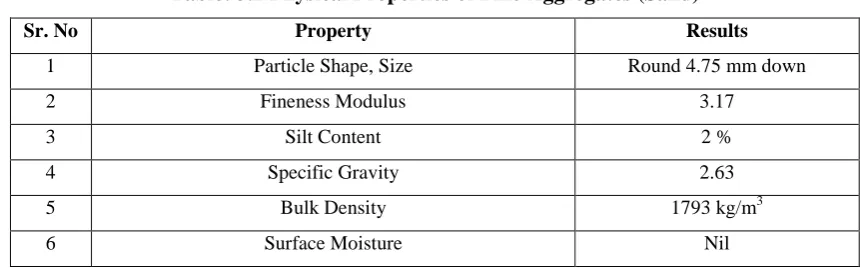
3.2.2 Fine Aggregate (Sand)
Locally available sand, from Pravara River is used as fine aggregate, it confirms to zone II of IS 383-1983 and
other necessary properties are given in table.
Table: 3.2 Physical Properties of Fine Aggregates (Sand)
Sr. No Property Results
1 Particle Shape, Size Round 4.75 mm down
2 Fineness Modulus 3.17
3 Silt Content 2 %
4 Specific Gravity 2.63
5 Bulk Density 1793 kg/m3
6 Surface Moisture Nil
3.2.3 Coarse Aggregate
Table: 3.3 Physical Properties of coarse Aggregate
Sr No Property Results
1 Particle Shape, Size Angular 20mm
2 Fineness Modulus of 20 mm
aggregates
6.8
3 Specific Gravity 2.77
4 Water Absorption 1.02%
5 Bulk density of 20mm aggregates 1603 k/mm3
6 Surface moisture Nil
3.2.4 Flat Crimped Steel Fiber
s
Material Purchase: M&J International E, Hatkesh industrial Estate, Mira Bhayander Road, Mira Road (East)
Mumbai
Length =25mm to 50mm
Aspect Ratio=40 to 90
Diameter (d) =0.55
Width=2 to 2.5 mm
Tensile strength=400 to 600Mpa
Photo 3.1: Flat Crimped Steel Fiber
3.2.5 Properties of Polypropylene Fibers
Fibrillated mesh fiber is a chemically surface treated 100% virgin high tenacity fibrillated propropylene mesh
fiber based concrete additive and is available in graded length. It provides micro reinforcement to concrete. The
material recruitment is done from “Dolphin Floats” situated at Bhosari M.I.D.C. Pune-78
It is used at 0.9 kg per m3 of concrete (minimum) shortcrete complies with ASTM C1116 and ACT committee
Photo No. 3.2: Polypropylene Fibre
Table 3.4: Physical Properties of polypropylene fibers
Sr. No. Properties Remark
1 Length 12 mm
2 Construction Fibrillated
3 Melting Point 1650 C
4 Absorption Nil
5 Elongation 15%
3.2.6 Design Mix Proportion
Table: 3.5 Quantity of materials per m
3of concrete (M30 Grade Concrete-IS 10262-2009)
Material Portion by weight Weight in kg/m3
Cement 1 413.3
F.A. 1.61 669.45
C.A 2.789 1152.83
W/C 0.45 0.45
3.3 Testing
3.3.1 Compressive Strength
Cube mould of 150mm × 150 mm ×150mm were casted for finding the compressive strength of HFRC.In
which hybrid fibre with different hybridization ratio were added in concrete and compressive strength of cube
was calculated by using compression testing machine. Total 24 No. of cube casted. Table No.3.6 shows the
result of compressive strength of concrete for different hybridization ratio.
Table 3.6 Compressive strength test on cubes at 28 Day
Sr No Hybridization Ratio
(steel-poly %)
Load
(N)
Compressive
strength ( MPa)
Average Compressive
Strength
(MPa)
1
0-0%
741×103 32.90
33.28
2 761×103 33.79
3 738×103 32.76
5
0-100%
776×103 34.45
35.32
6 809×103 35.92
7 790×103 35.11
8 806×103 35.79
9
25-75%
816×103 36.23
35.95
10 841×103 37.34
11 861×103 38.23
12 721×103 32.01
13
50-50%
876×103 38.89
37.2
14 851×103 35.48
15 825×103 37.78
16 827×103 36.725
17
75-25%
901×103 40.00
39.92
18 870×103 38.63
19 942×103 41.82
20 883×103 39.21
21
100-0%
800×103 35.52
35.48
22 781×103 34.68
23 823 ×103 36.54
24 792×103 35.16
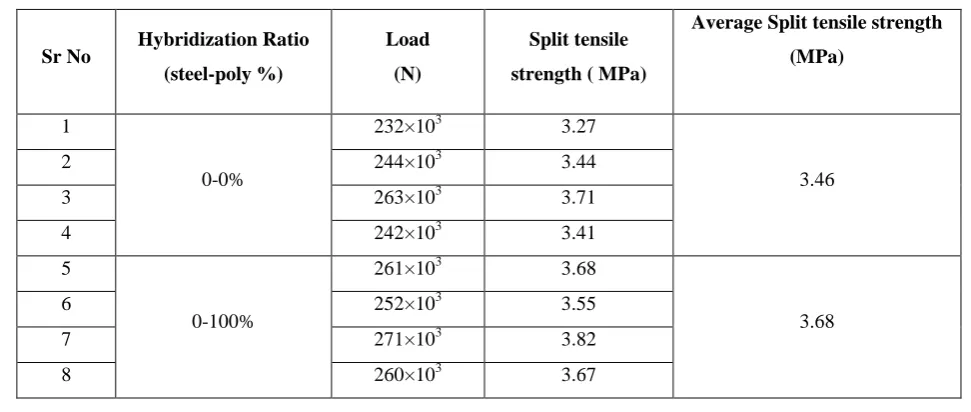
3.3.2 Split Tensile Strength
Cylindrical mould of 150 mm diameter and 300mm long are used for casting the specimen for split tesile
strength test. Total 24 No .of cylindrical mould were casted with varying hybridization ratio of steel and
polypropylene fibre.
Table No.3.7 shows the result of
Split Tensile
of concrete for different hybridization ratio.Table: 3.7 Split Tensile strength test on cubes at 28 Days
Sr No Hybridization Ratio
(steel-poly %)
Load
(N)
Split tensile
strength ( MPa)
Average Split tensile strength
(MPa)
1
0-0%
232×103 3.27
3.46
2 244×103 3.44
3 263×103 3.71
4 242×103 3.41
5
0-100%
261×103 3.68
3.68
6 252×103 3.55
7 271×103 3.82
9
25-75%
269×103 3.79
3.87
10 282×103 3.98
11 281×103 3.96
12 265×103 3.74
13
50-50%
311×103 4.39
4.38
14 322×103 4.54
15 318×103 4.48
16 293×103 4.12
17
75-25%
321×103 4.53
4.57
18 338×103 4.77
19 316×103 4.46
20 321×103 4.53
21
100-0%
361×103 5.09
4.9
22 359×103 5.06
23 339 ×103 4.78
24 331×103 4.67
3.3.3 Flexural Strength
In flexure test, the beam specimen is placed in the machine in such a manner that the load is applied to the upper
most surface as cast in the mould. All beams are tested under two-point loading in universal testing machine of
100 tone capacity Table No. 3.8 shows the result of Flexural strength of HFRC deep beam for different
hybridization ratio of steel and polypropylene fibre.
The flexural strength is calculated from the formula,
Fb=PL/bd2
Where,
P=Applied load at failure,
d=depth of specimen,
b=breadth of specimen,
L=Length of specimen.
Table: 3.8 Flexural strength tests on beams at 28 Days
Sr No Fck Hybridization Ratio
(steel-poly %) Load (N) Flexural strength ( MPa) Average Flexural Strength (MPa) 1
30 0-0%
38.21×10³ 2.26
2.29
2 39.60×10³ 2.34
3 40.32×10³ 2.38
5
30 0-100%
39.55×10³ 2.34
2.48
6 41.62×10³ 2.46
7 43.81×10³ 2.59
8 42.95×10³ 2.54
9
30 25-75%
44.68×10³ 2.65
2.70
10 43.59×10³ 2.58
11 47.85×10³ 2.83
12 46.65×10³ 2.76
13
30 50-50%
47.90×10³ 2.83
2.87
14 48.35×10³ 2.86
15 49.34×10³ 2.92
16 48.91×10³ 2.89
17
30 75-25%
54.62×10³ 3.23
3.13
18 50.35×10³ 2.98
19 53.85×10³ 3.19
20 52.81×10³ 3.13
21
30 100-0%
46.36×10³ 2.74
2.83
22 47.90×10³ 2.84
23 48.34×10³ 2.86
24 49.31×10³ 2.92
IV. RESULT AND DISCUSSION
4.1 Results for Compressive Strength Test
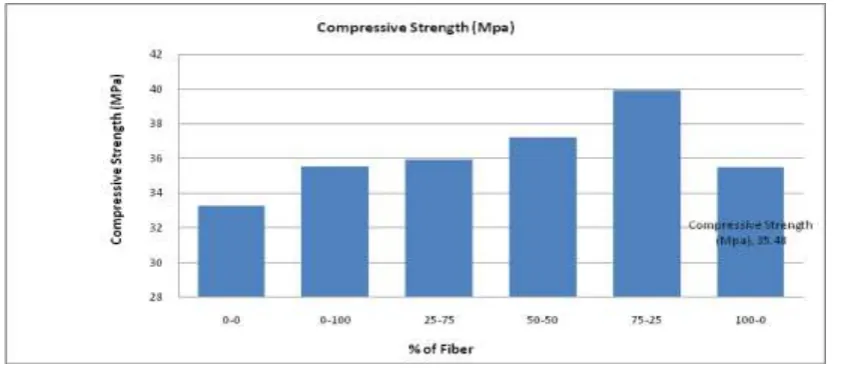
The results of compressive strength at 28 days show that the HFRC with 75-25 % (steel and polypropylene)
hybridization ratio is maximum as compared with respect to normal concrete. Due to hybridization of steel and
polypropylene (75-25%) mix provide better response to arrest micro and macro cracks hence improve the
compressive strength of concrete as compared to plain concrete and all other combination of hybridization ratio.
Fig: 4.2 Results for Compressive Strength Test on Cubes at 28 Days
4.2 Results for Split Tensile Strength Test
The increase in split tensile strength due to incorporation of steel fibre is greater than polypropylene fibre. High
modulus of elasticity of steel fibre makes the concrete more ductile. Tensile strength of ductile material is higher
than brittle materials. Therefore gradual increase in % of steel fibres for different hybridization ratio split tensile
strength of concrete also increases. Therefore split tensile strength at 100-0 % (steel – poly) shows greater than
plain concrete and other combination of hybridization ratio.
Fig.4.4 Results for Split Tensile Strength Test On Cylindrical Mould at 28 Days
4.3 Results for Flexural Strength Test
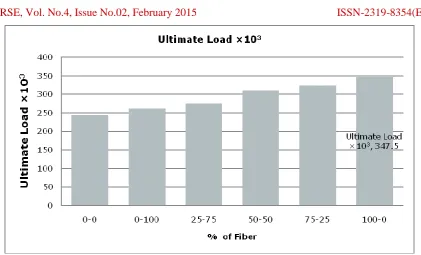
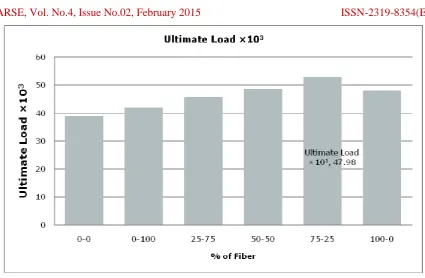
The results of flexural strength test are given in table 3.8 Fig.4.5 and Fig.4.6 shows the graphical representation
for the variation of the average flexural strength for plain concrete mix and concrete mixes containing different
hybridization ratio of steel-polypropylene fibres at volume fraction 1% by volume of concrete. Flexural strength
of concrete increases with increase in steel fibre percentage in specimen. It is also seen that the addition of
polypropylene fibre increase the flexural strength. Fig.4.5 shows that the flexural strength of beam specimen is
maximum for 75-25% (steel-poly) fibres than other combination of hybridization ratio.
Fig. 4.6 Results for Flexural Strength Test On Beams at 28 Days
V. CONCLUSION
1) Compressive strength of HyFRC after 28 days for 75-25% (steel-polypropylene) hybridization ratio is
maximum. It is increased by 19.95% with respect to normal concrete (i.e. Hybridization ratio 0-0%). At 28 days
Compressive strength of SFRC (i.e. Hybridization ratio 100-0 %) is increased by 6.61% with respect to normal
concrete & compressive strength of PPFRC ( i.e. Hybridization ratio 0-100 %) increased by 6.21% with respect
to normal concrete.
2) Split Tensile Strength of HyFRC Concrete for 28 Days Increases with Increasing Contribution of Steel Fiber
in hybridization ratio. Split tensile strength of SFRC (i.e. Hybridization ratio 100-0%) is maximum. split tensile
strength of SFRC (i.e. Hybridization ratio 100-0%) increases 41.61% & Split tensile strength of PPFRC (i.e.
Hybridization ratio 0-100%) increases 6.35% with respect to normal concrete respectively.
3) Flexural strength of HyFRC for 50-50% & SFRC i.e. 100-0% after 28 days is nearly same. Flexural strength
of HyFRC with75-25% hybridization ratio and SFRC i.e. hybridization ratio 100-0% is increases 36.68% &
23.58 % respectively than normal cement concrete. Flexural strength of PPFRC (i.e. Hybridization ratio
0-100%) increased by 8.29% with respect to normal concrete.
REFERENCES
[1] V.R.Rathi, A.V.Ghogare and S.R.Nawale, Experimental Study on Glass Fiber Reinforced Concrete
Moderate Deep Beam, International Journal of Innovative Research in Science, Engineering and
Technology, 3(3), March 2014, 10639-10645.
[2] M.V. Krishna Rao , N.R. Dakhshina Murthyband ,V. Santhosh Kumara, Behaviour of Polypropylene Fibre
Reinforced FlyAsh Concrete Deep Beams in Flexure and Shear , Asian Journal Of Civil Engineering
[3] V.P.V. Ramanaa, T. Kanta, S.E. Mortonb, P.K. Duttac, A. Mukherjeea, Y.M. Desaia , Behavior Of CFRPC
Strengthened Reinforced Concrete Beams With Varying Degrees Of Strengthening,31,2000,461-470.
[4] G. Jeenu, R. Reji, and V. Syam Prakash, Flexural Behavior of Hybrid Fibre Reinforced Self Compacting
Concrete, Proceedings of the International Conference on Our World in Concrete & Structures, Singapore,
2007.
[5] V.Vengatachalapathy, R. Ilangovan, Study on Steel Fibre Reinforced Concrete Deep Beams with and
without Openings, International Journal Of Civil And Structural Engineering, 1(3), 2010, 509-517.
[6] S.P. Singh, A.P. Singh and V. Bajaj, Strength and Flexural Toughness of Concrete Reinforced with Steel –
Polypropylene Hybrid Fibres , Asian Journal of Civil Engineering (Building and Housing),11(4),
2010,495-507.
[7] Mohammad Abdul Rashid, Behavior of Reinforced concrete deep beams under uniform loading, Journal of
civil engineering, the institution of engineering, Bangladesh, 24(2), 1996, 155-169.
[8] M. Tamil Selvi1 and Dr. T.S. Thandavamoorthy, Studies on the Properties of Steel and Polypropylene Fibre
Reinforced Concrete without any Admixture, International Journal of Engineering and Innovative
Technology (IJEIT), 3(1), 2013.
[9] Faisal Fouad Wafa, Properties and Applications of Fiber Reinforced Concrete, Journal of Engineering
Science, (2), pp. 49-6.
Authors Profile
Prof. Pravin B. Shinde Pursuing M.E.Structure in Amrutvahini College of Engineering, Sangamner,
Ahemadnagar-422605.
Currently working as an Assistant Professor in Sanghavi College of Engineering,
Nashik.
Prof. Sangita V. Pawar
Completed M.E. (WRE) from Government College of Engineering, Aurangabad.
Currently working as an Assistant Professor in Sanghavi College of Engineering,
Nashik-422202
Prof. Vishwas Kulkarni M.E. (Structure) and Currently working as an Assistant Professor in Amrutvahini