Secure Multiparty Computation with
General Interaction Patterns
Shai Halevi∗ Yuval Ishai† Abhishek Jain‡ Eyal Kushilevitz§ Tal Rabin¶ Extended abstract of this work published in ITCS 2016
Abstract
We present a unified framework for studying secure multi-party computation (MPC) with
arbitrarily restricted interaction patterns. Our study generalizes both standard MPC and recent models for MPC with specific restricted interaction patterns (such as a chain or a star), which were studied by Halevi et al. (Crypto 2011), Goldwasser et al. (Eurocrypt 2014), and Beimel et al. (Crypto 2014).
Since restricted interaction patterns cannot always yield full security for MPC, we start by formalizing the notion of “best possible security” for any interaction pattern. We then obtain the following results:
• Completeness theorem. We prove that the star interaction pattern iscompletefor the problem of MPC with general interaction patterns.
• Positive results. We present both information-theoretic and computationally secure protocols for computing arbitrary functions with general interaction patterns. We also present more efficient protocols for computing symmetric functions and for computing arbitrary functions over achain.
• Negative results. We give evidence that our information-theoretic protocols for general functions will be hard to substantially improve on.
All of our protocols rely on a correlated randomness setup, which isnecessary for computing general functions in our setting. In the computational case, we also present a generic procedure to make any correlated randomness setupreusable, in the common random string model.
Although most of our information-theoretic protocols have exponential complexity, they may be practical for functions on small domains (e.g.,{0,1}20), where they are concretely faster than
their computational counterparts.
Keywords: Secure multiparty computation, Interactions, Obfuscation.
∗
IBM Research. Email: [email protected]
†
Technion and UCLA. Email: [email protected]
‡
Johns Hopkins University. Email: [email protected]
§
Technion, Israel. Email: [email protected]
¶
Contents
1 Introduction 1
1.1 Formulating Achievable Security . . . 2
1.2 Our Results . . . 3
1.3 Technical Overview . . . 6
1.4 Related Work . . . 9
2 Preliminaries 10 2.1 Protocols with Restricted Interaction Patterns . . . 11
2.2 Security in the presence of malicious adversaries . . . 14
3 A Reduction to Star 16 3.1 The Semi-Honest Transformation . . . 17
3.2 Reduction for Malicious Security . . . 20
4 Information-Theoretic Protocols for General Functions 20 4.1 Computing Any Function on a Chain. . . 21
4.1.1 Malicious Security for General Functions on a Chain . . . 23
4.2 Protocol for General DAGs . . . 25
4.2.1 A First Attempt . . . 25
4.2.2 A Secure Solution . . . 26
4.2.3 Extending the Star Protocol to General DAGs . . . 27
4.2.4 Malicious Security for General Functions on a DAGs . . . 28
5 Information-Theoretic Protocols for Symmetric Functions 30 5.1 Security Against Semi-Honest Adversaries . . . 31
5.1.1 Proof of Security . . . 32
5.1.2 Extensions . . . 33
5.2 Security Against Malicious Adversaries . . . 34
5.2.1 The protocol . . . 35
5.2.2 Proof of Security . . . 36
6 Computational Protocols for General Functions 38 6.1 Computing General Functions with Non-Reusable Correlated Randomness . . . 39
6.2 Reusable Correlated Randomness in the CRS Model . . . 39
7 Computational Protocols for Symmetric Functions 44 7.1 Protocol for Star Pattern . . . 45
7.2 Protocol for General Interaction Patterns . . . 46
1
Introduction
Secure multiparty computation (MPC) allowsn mutually suspicious parties to evaluate a function on their joint inputs in such a manner that no information about their inputs, beyond the output of the computation, is revealed to each other. Since the first general feasibility results for MPC [52, 35, 6, 15], almost all prior work in this area has considered protocols that require full interaction
between the parties. Such protocols typically proceed in rounds, where in each round each party may send messages to all other parties, thus requiring that all parties remain online throughout the execution of the protocol.
MPC with Restricted Interaction. Full interaction between the parties is often problematic or even infeasible. For instance, physical distances between wireless devices may prevent them from directly communicating with each other, and temporal constraints may restrict their availability to send or receive messages (e.g., due to battery life). Furthermore, efficiency considerations may also motivate a leaner form of communication. Consider, for instance, the goal of computing the majority vote over the inputs of n parties. While this task can be performed using only (n−1) messages if no security is needed, typical MPC protocols with full interaction involve Ω(n2) point-to-point messages to compute the same task securely.
Such considerations have motivated the study of MPC protocols with restricted interaction between the parties. Halevi, Lindell, and Pinkas [40] were the first to study this problem: they consider an interaction pattern where each of the n parties, in an ordered fashion, sends a single message to a central server, who eventually computes the output of the function. A different interaction pattern, where each party independently (i.e., without any predetermined order) sends a single message to the server, was recently considered by Goldwasser et al. [36] and Beimel et al. [3]. In both cases, the security guarantee is necessarily weaker than the standard simulation-based security for MPC (see below for further discussion on security).
The above works constitute two specific examples of restricted interaction patterns. In general, different application scenarios may dictate different interaction patterns. For example, applications involving data aggregation typically use interaction patterns that can be represented as a directed tree. Furthermore, the topology of the communication network (used by an application) may itself limit the choices of interaction patterns: e.g., a communication network without any node with full degree is not consistent with server-centered interaction patterns. Importantly, as we discuss below, the security guarantees that we get would typically depend on the interaction pattern at hand.
Our Goal: MPC with General Interaction Patterns. Seeking to understand the fundamental role of interaction patterns in MPC, we ask the following broad question:
Given an arbitrary n-party interaction pattern I and ann-input function f, can f be securely realized by a protocol that complies with I? If so, how efficiently and under what assumptions?
Before addressing this question, we should clarify how we model interaction patterns, what we mean by “securely,” and what setup assumptions we are willing to make.
The protocols from [40, 39] can be adapted to accommodate a chain-based interaction, whereas the protocols from [36, 3] were designed for the case of a star-based interaction. More general DAG-based interaction patterns naturally arise in “self-forming sensor networks,” where multiple sensor nodes form an arbitrary communication graph and then collect and compute on data that is transmitted, using the smallest possible number of messages, to a central base station.
While DAGs are an important special case, general interaction patterns are not necessarily restricted to DAGs. Some other useful patterns include the server-centered interaction pattern from [40], atwo-way chain, where messages travel along a chain fromPntoP1 and back toPnwho computes an output, or the traditional multi-round protocols over a fully-connected point-to-point network. In Section2 we describe a unified modeling of general interaction patterns.
1.1 Formulating Achievable Security
In the traditional model of MPC, corrupted parties are restricted to learning the outputs off on just asingleinput (x1, . . . , xn). However, as observed by [40], this property cannot always be achieved in the case of restricted interaction patterns. For instance, in the server-centered interaction pattern of [40], if the server and the last few parties Pi, . . . , Pn are corrupted, there is nothing to prevent the adversary from learning the value of f on the honest inputs x1, . . . , xi−1 and every possible
choice of corrupted inputsx∗i, . . . , x∗n.
To define the “best possible security” for a fixed interaction pattern, we use the notions of free and fixed inputs and residual function from [40]. We call the inputs that the adversary can vary thefree inputs, and the other inputs are thefixed inputs. Clearly, all the honest parties’ inputs are fixed. Crucially, however, some of the inputs controlled by the adversary can be fixed as well. For example, in the protocols from [40], the only free inputs are those of corrupted parties that send messagesafter the last honest party does; the inputs of all other corrupted parties are fixed.
Extending the model from [40] to our setting of general interaction patterns, we first consider the case where only one party computes an output and call this party the evaluator. The input of a corrupted party Pi is considered fixed if the interaction pattern includes any message path that leads fromPi to the evaluator and passes through somehonest party. The input of a corruptedPi is free ifall paths from Pi to the evaluator consist only of other corrupted parties. For example, in a star pattern with a corrupted center, the inputs of all the corrupted parties are free [36, 3]. In contrast, traditional MPC requires the inputs of all corrupted parties to be fixed.
The “best possible security” is defined by the residual function, that captures everything that the adversary can learn about the honest parties’ by restricting f to the values of all the fixed inputs while allowing arbitrary choices of the free inputs. Some additional subtleties arise in the malicious-adversary model when multiple parties compute outputs; in particular, security in this case generalizes goals such as Byzantine agreement. We discuss some of these issues further in 2, but leave the issue of malicious-security with multiple output nodes to future work.
An important technical point relates to the achievable notion of simulation. Traditional ideal-vs-real definitions of security (cf. [38, 10, 34]) require efficient simulation, but it is known that efficient simulation is, in general, impossible in our setting [40, 36]. For example, protocols with efficient simulation for a star (or even chain) interaction pattern imply virtual black-box obfuscation [36], which is known to be impossible in general [2]. To get around these impossibility results, we settle for security with respect toindistinguishabilityorunbounded simulation.
model” (PSM) from [28] with general correlated randomness setup, where the parties have access to a source (r1, . . . , rn) of correlated random strings. When implementing such protocols, the correlated randomness can come from a trusted dealer or generated using an offline MPC protocol that takes place before the inputs are known and before the limitations on interaction are imposed. This clean model is popular both for a theoretical study of MPC and as a platform for practical implementations that exploit the efficiency benefits of offline preprocessing. (See [7,22,3,23] and references therein.)
The correlated randomness setup can either be reusableornon-reusable. Namely, it can either be akin to a one-time pad, allowing only a single run of the protocol (which is the case for protocols with information-theoretic security), or it can allow polynomial number of runs (which is sometimes possible in the computational setting). A key advantage of the correlated randomness setup model is that we can hope to tolerate any number of corrupted parties even in the information-theoretic setting [45,43,7].
Is “Best Possible Security” Good Enough? Though weaker than the standard notion of security for MPC protocols, our notion of “best possible security” is still meaningful in many interesting cases. First, depending on the interaction pattern and the set of corrupted parties, it could be that most corrupted parties are fixed and hence the residual function is quite degenerate (or even all inputs are fixed as in standard MPC). Second, there are functions for which access even to a “large” residual function does not compromise the secrecy of uncorrupted inputs significantly. Examples include symmetric functions (such as majority) where the size of the residual truth table is not very significant (see [3] for a discussion), as well as unlearnable functions where it is computationally hard to figure out the inputs of honest parties even when given oracle access to the residual function.
1.2 Our Results
We give a variety of answers to the main question posed above. In particular we show “low-end” protocols that offer unconditional security and are generally exponential in the input size (except for special function classes and special interaction patterns), as well as “high-end” protocols that (necessarily) use general-purpose obfuscation techniques to achieve polynomial-time solutions for general functions and interaction patterns.Finally, we also show protocols that make simple use of multilinear maps to compute symmetric functions with general interaction patterns. All of our protocols tolerate an arbitrary number of corrupted parties in the static corruption model. Below, when describing our results, we use the phrase I-compliant to denote that the interaction pattern in a protocol is consistent with I.
I. Completeness Theorem for Interaction Patterns. In Section 3 we show that the star interaction pattern iscompletefor secure computation with restricted interaction patterns. Specifi-cally, we give an efficient, unconditional reduction from the problem of realizing a functionf using a general interaction patternI to that of realizing the samef on a star. This transformation requires its own (non-reusable) correlated randomness setup, in addition to the setup for the underlying star-pattern protocol, and yields security against malicious parties essentially for free.
Theorem 1 (Informal). There exists an efficient transformation T that, for any n-party interac-tion pattern I and any star-compliant protocol Π? for computing a function f : {0,1}n → {0,1},
generates an I-compliant protocol ΠI for computing f in the non-reusable correlated randomness
setup model. If Π? is statistical/computational semi-honest secure then the resulting ΠI is
com-Correlated Randomness Online Communication
Previous work: Star [3] 2.5MB 2.5MB
Star (Lemma4.2) 128KB 128KB
Chain (Theorem11) 2.5MB 20bits
DAG (Theorem2) 128KB 1.25MB
Gen. Patterns (Theorem3) 2.5MB 25MB
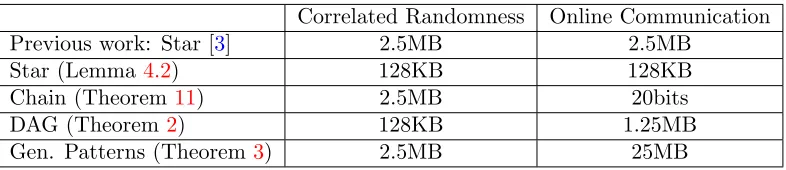
Table 1: Concrete complexity numbers (per party) forn= 20 for computing general functions with single output with information-theoretic security in the semi-honest model.
plexity) are only a factor ofO(nλ)(resp. O(n2λ)) above those of the underlying protocol Π?, where
λis a security parameter.
Note that the above theorem is stated for the case wheref operates over binary inputs. When the functionf computed by ΠI accepts larger inputs, our transformation requires Π? for a different (but related) function f0 that operates over binary inputs. We remark that although we only consider communication patternsI with a single sink, in the semi-honest case this can be trivially extended to allow for multiple sink nodes which can each have a different output.
II. Information-Theoretic Protocols for General Functions. In the information-theoretic setting, we present in Section 4 perfectly (resp., statistically) secure protocols for computing any deterministic function against semi-honest (resp., malicious) adversaries. For f :{0,1}n→ {0,1}, our semi-honest protocols give each party 2nbits of correlated randomness and require each party to communicateO(n·2n) bits. For malicious security, the correlated randomness and communication are of size O(λn·2n), with λ the security parameter. In the special case of a star pattern, our protocols improve over previous protocols from [3] by a factor of n.
Theorem 2 (Informal). For every function f : {0,1}n → {0,1} and any DAG interaction
pat-ternI, there is a semi-honest, perfectly-secure,I-compliant protocol for f, in which each party gets
2n+ 1bits of correlated randomness and sends at most n·2n−1 bits of communication. Also, there is a malicious, statistically-secure, I-compliant protocol for f, in which each party getsO(λn·2n)
bits of correlated randomness and sends at mostO(λn·2n) bits of communication.
For non-DAG patterns, we can use our protocol for star (which is a special case of the above; see Section 4.2) and then apply our reduction to obtain:
Theorem 3 (Informal). For every function f : {0,1}n → {0,1} and any interaction pattern I,
there is a semi-honest, perfectly-secure,I-compliant protocol forf, in which each party getsn+(n+ 1)·(2n+ 1) bits of correlated randomness and sends at mostn2·(2n−1+ 2) bits of communication. Also, there is a malicious, statistically-secure,I-compliant protocol for f, in which each party gets O(λn·2n) bits of correlated randomness and sends at most O(λn2·2n) bits of communication.
We stress again that for small input domains, these protocols could be quite practical, see Table 1 for some concrete numbers for computing general functions with binary inputs, a single output and semi-honest security.
Theorem 4 (Informal). For every f : {0,1}n → {0,1}, there is a semi-honest, perfectly-secure
protocol for f with a chain pattern in which each party gets at most n·2n bits of correlated
ran-domness and sends at most nbits of communication. Also, there is a malicious, statistically-secure
protocol for f with a chain pattern in which each party gets at most O(λn·2n) bits of correlated
randomness and sends at most O(n2+λn) bits of communication.
In Section 8, we give evidence that it would be hard to extend this result to more general interaction patterns: concretely, we show that even in a networkNn consisting of two chains (each of length n) that lead to a common endpoint, a similar protocol would imply a 3-server protocol for information-theoretic PIR [18] with poly-logarithmic communication, which is an unexpected result.
Theorem 5 (Informal). Assume that, for every f :{0,1}2n → {0,1}, there exists a semi-honest,
statistically -secure Nn-compliant protocol that computes f with communication complexity c(n).
Then, there exists an (interactive, statistical) 3-server PIR protocol, with communication complexity O(c(logN) + logN+ log 1/), where N is the database size.
III. Efficient Information-Theoretic Protocols for Symmetric Functions. For symmetric functions, we construct in Section5 efficient, perfectly (resp., statistically) secure protocols over a chain against semi-honest (resp., malicious) adversaries where both the offline and online phases are polynomial in the input size.
Theorem 6(Informal). For every symmetric binary functionf :{0,1}n→ {0,1}, there is a
semi-honest perfectly-secure protocol forf for the chain network in which each party gets (n+ 1)2 bits of
correlated randomness and sends at most(n+ 1)2 bits of communication. Also, there is a malicious
statistically-secure protocol for f for the chain in which each party gets O(λn2) bits of correlated
randomness and sends at most O(λn2) bits of communication, where λ is the statistical security
parameter. Moreover, both these protocols have efficient simulators.
IV. Computational Protocols for General Functions from Obfuscation. In the com-putational setting, we observe in Section 6 that the multi-input functional encryption scheme of Goldwasser et al. [36] already yields a protocol for computing general functions with a star inter-action against semi-honest adversaries, based on indistinguishability obfuscation (iO) [2,31] and one-way functions. Combining their result with Theorem 1, we obtain a malicious-secure protocol for computing general functions with general interaction patterns.
Theorem 7 (Informal). Assuming iO for general circuits and one-way functions, for every
inter-action patternI, there exists an I-compliant protocol for computing any polynomial-time function,
that achieves malicious security against any number of corruptions, in the (non-reusable) correlated randomness setup model.
Making Correlated Randomness Reusable. We also present a generic procedure to transform any non-reusable correlated randomness setup into one that isreusable. Our transformation works in the common random string (CRS) model where the size of the CRS grows linearly with the number of uses of the correlated randomness. We note, however, that since the CRS is “public” randomness, it can be easily compressed in the random oracle model.
Theorem 8 (Informal). Assuming FHE and iO for general circuits, for every interaction pattern
I, there exists an I-compliant protocol for computing any polynomial-time function that achieves
malicious security against any number of corruptions. The protocol uses a reusable correlated
randomness setup in the CRS model where the size of the CRS grows linearly with the number of uses of the protocol.
Necessity ofiO. We note that general-purposeiO is anecessaryassumption for the above results. Indeed, for the special case of a star pattern, it was already shown by [36] that a secure protocol for general functions implies general-purposeiO.
V. Computational Protocols for Symmetric Functions from Multilinear Maps. For the case of symmetric functions, we describe in Section 7 a much simpler protocol for general interaction patterns that uses multilinear maps but does not require general-purpose obfuscation. The security of that protocol reduces to a very simple variant of the Multilinear Decisional Diffie-Hellman (MDDH) assumption over multilinear maps [9, 30], which we call the bookend MDDH
assumption. Unfortunately, in light of recent attacks [16,19,17,46], this assumption (and indeed the security of our protocol) does not hold for any of the current multilinear map candidates [30, 20, 33, 21]. We hope that future multilinear map constructions will give rise to efficient implementations of our protocol. In fact, this application of multilinear maps can serve as a useful benchmark for evaluating the security and performance of future candidate constructions.
VI. Implications to standard MPC.We note that our results for MPC with general interaction patterns also have relevance tostandardMPC overfully connected networks. For instance, suppose that there is a cost ci,j associated with sending a message from Pi to Pj. Our results reduce the question of minimizing the total cost of an MPC protocol in this setting to a combinatorial optimization problem. For instance, for standard n-party MPC where onlyP1 has an output, our
results imply general protocols with only 2n−2 point-to-point messages (e.g., a chain fromP1 to
Pnand back), which can be shown to be optimal.
1.3 Technical Overview
We now give an overview of some of our main results, more details are given in technical sections.
Reduction to Star Pattern. Recall that our goal here is to transform an n-party protocol for computing general functions with a star pattern into another protocol for general interaction patterns I. For simplicity, here we focus only on computing functions with binary inputs and achieving semi-honest security see Section3for the general case. It is instructive to begin from the naive protocol where each party just sends over the paths in I to the evaluator whatever message it was supposed to send in the underlying star protocol. This protocol falls short of providing the “best possible security” for the patternI, because in the star pattern the inputs of all the corrupted parties are free while some of them should be fixed in I.
The challenge is to letPj know which of the two shares to send to the evaluator without revealing
Pi’s input. To that end, we distribute the shares ofPi’s two messages to all the parties in arandom
but consistent order. That is, either they all get first the share of m0i followed by share of m1i, or vice-versa. Furthermore, this random permutation bit is given to party Pi. During the protocol
Pi will xor that bit with its input, sending the resulting bit to the other parties to indicate which shares they should send to the evaluator and which to omit. See Section3 for more details of this protocol and its proof of security.
Information-Theoretic Protocols for General Functions. Our information-theoretic proto-cols follow a somewhat similar approach to the general reduction discussed above. Specifically, we secret-share the truth table off, giving each party a share for each of the 2n inputs, and then have the honest parties omit some of their shares during the protocol run. This is done so as to ensure that when the input of Pi is fixed, the adversary can obtain all the shares for inputs with xi = 0 or all the shares for inputs with xi = 1,but not both.
We remark that this is easy to implement in a star pattern: since the only fixed inputs are those of the honest parties, we can have each honest party send to the evaluator only the shares consistent with its own input bit. A protocol for a general pattern can be obtained using the transformation from above, but we can get a better communication complexity by instead tailoring the share-omission rules to the communication pattern. To obtain security in the malicious-adversary model, we add authentication information to the correlated randomness. See Sections 4.1 and 4.2 for details.
Efficient Information-Theoretic Protocols for Symmetric Functions. In the case of sym-metric functions, we capitalize on the fact that there is a small representation of the truth table of the function. In particular, the residual function in this representation can be obtained from the global truth table by having each party locally drop one of the rows, depending on its input.
A similar approach was considered by [40] in the computational setting. In their case, the rows of the truth table were encrypted using an additively homomorphic scheme so that partyPi+1 does
not learn what row was dropped by partyPi. In our information-theoretic setting, however, such an additively homomorphic scheme is not available so we use a different hiding mechanism. Specifically, we view messages as matrices, letting each party in the protocol multiply its received message by a random matrix (which is given to it in its correlated randomness), then dropping one column and forwarding the result to the next party. The correlated randomness of evaluator consists of the columns of the resulting product matrix, tagged by the function output and permuted randomly. In a run of the protocol, the evaluator will receive one of these columns and will use it to determine the corresponding function output.
Adding security against malicious adversary is harder here than in our other information-theoretic protocols, since parties do more than just forwarding some pre-determined messages that are given to them as part of their correlated randomness. Our solution still uses authentica-tion to force the corrupted parties to send the right messages, but we must ensure that the added authentication information does not leak information on potential messages that are not sent in a particular run of the protocol. To ensure that, we use an authentication mechanism that doubles also as a randomness extractor, namely the “extractor-MAC” construction from [24], which is based on almost-universal hashing [51]. We also need to withhold from the evaluator the columns of the product matrix, replacing them by just the authentication information needed to recognize these columns. See Section5 for details and proofs of security.
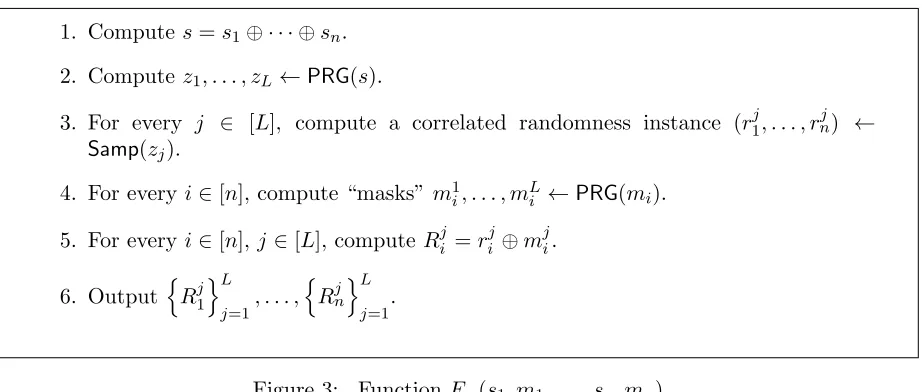
string (CRS).
Our starting idea is to use an MPC protocol Π to compute the function Fcr that takes small
randomness as input and outputs a large number L = poly(k) of independent instances of CRnr.
Note that such a function Fcr is easy to define: on input a short random seed, Fcr first expands
it into a large pseudorandom string using a PRG (of appropriate stretch) and then uses different “chunks” of the resultant string to compute L independent instances of CRnr. Now, fix an honest
execution of Π and consider viewi, the view of each party i in the execution, consisting of its random tape and the protocol messages. Note that if each |viewi| was independent of L, then we could simply set (view1, . . . ,viewn) as an instance of thereusablecorrelated randomness setupCR. This is because given viewi, party Pi can locally compute the output of Π, which consists of L instances of CRnr.
Thus, we have effectively reduced our problem of making any correlated randomness setup reusable to the problem of constructing an MPC protocol Πout-indthat computes n-party functions
with “long” outputs where the communication complexity of the protocol as well as the size of randomness of each party is independent of the function output length. A moments reflection, however, reveals that such a protocol is impossible in the standard model.1 Instead, our solution will use a long CRS.
Our starting point is a recent work of Hub´aˇcek and Wichs [41], who constructs a secure two-party computation protocol where the communication complexity of the protocol is independent of the function output length. However, the size of the randomness of each party does grow with the function output length. We extend their protocol to the multiparty setting. Let Πlong-rand denote
the resulting protocol. Our key observation then is that the long randomness of the parties in Πlong-rand can be “compressed” by using a long public CRS. In particular, we transform Πlong-rand
into a new protocol Πshort-rand using a public random string CRS = CRS1, . . . ,CRSn where each CRSi is as long as the function output length. The randomness of each partyPi in Πshort-rand is set
to be a short seedri. At the start of the protocol, Pi first locally computes a large random string
Ri =PRG(ri)⊕CRSi. It then executes the strategy of the i’th party in Πlong-rand using Ri for the rest of the protocol.
Combining the above steps, we obtain our desired MPC protocol. We stress that we are able to bypass the aforementioned impossibility result since we are working in the CRS model, where the size of the CRS grows with the function output length. (But since the CRS is “public” randomness, it can be easily compressed in the random oracle model.)
Computational Protocols for Symmetric Functions. For symmetric functions, we use multi-linear maps to construct simple protocols that achieve computational security against semi-honest adversaries. Here we focus on the star pattern; a protocol for general interaction patterns can be obtained by composing the star protocol with our general reduction to star.
Consider an n-level multilinear map where [x]i denotes an encoding of x at level i. In our star protocol, as part of the correlated randomness, each party Pi is given two level-1 encodings [ai]1,[ai×r]1 for random and independent elementsai’s and the same random r. LetA=Qni=1ai denote the product of theai’s. The evaluator is given of all then+1 (level-n) encodings [bi]n= [A×
ri], i= 0,1, . . . nin a random order, where eachbi is tagged with the function valuefi =f(1i0n−i). In the protocol, each party Pi simply sends the encoding [ai]1 or [ai ×r]1, depending upon
whether its input bit is 0 or 1, respectively. The evaluator multiplies thenencodings that it receives
1Consider an execution of Π
out-ind for evaluating a PRG with “long” stretch. The view of any party iin the
and then compares the resulting encoding against the bi’s to determine the function output. More details are found in Section 7. As mentioned above, this protocol is unfortunately insecure using current multilinear-map candidates.
1.4 Related Work
There is a very large body of recent work about minimizing interaction in cryptography (mostly concentrating on the number of rounds, rather than the number of messages): whereas classical MPC results show that every cryptographic task can be realized with sufficient interaction, popular recent research topics such as garbling schemes [53, 5, 37], fully homomorphic encryption [32], functional encryption [49,8,48], and obfuscation [2,31], are all about minimizing interaction. Our work can be seen as taking the question of “what can we do with a given type of interaction” to its ultimate level of generality. One can view the previous notions, as well as standard interactive MPC, as special cases of this general problem.
Another large body of work, originating from [25], studies the problem of securecommunication
(or message transmission) in general networks, where only certain pairs of parties can communicate with each other. This goal is trivialized when allowing a correlated randomness set-up, as we do here, and so the challenges that arise in that setting are very different from the ones we face in our work. The same is true for a recent extension of this problem to secret sharing in general networks [50], a task whose feasibility reduces to that of secure message transmission.
Another line of work, originating from earlier works in the context of distributed computing [26], studies the possibility of realizing MPC on sparse networks [29, 14]. These works use specially designed (expander-based) networks to allow MPC in graphs of a small degree. To this end, they also need to relax the traditional goal of MPC by assuming that some honest inputs are being compromised. However, in contrast to the model considered in our work, being compromised there means “known or fixed by the adversary” as opposed to being “free” in the sense considered here. In particular, general solutions for MPC in that model have no consequences for obfuscation.
Finally, Kearns et al. [44] also study secure computation in a model with restricted communica-tion. Their restriction is more liberal than our definition of interaction pattern: each message from
Pi toPj should be computed by a small neighborhood ofPi, Pj (in an undirected network graph). Their positive results provide computational security against asingle corrupted party, a limitation which they show to be inherent to their model. In contrast, our protocols provide a meaningful notion of security with respect to any number of corrupted parties.
Acknowledgments. We thank Mor Weiss for her useful comments on an earlier version of this manuscript.
2
Preliminaries
Below we formalize our model of secure computation with arbitrary restricted interaction patterns, generalizing previous definitions from [40, 36, 3] that consider specific patterns. Our definitions assume that the communication pattern is fixed a-priori and does not depend on the input of the parties or their randomness. We begin by defining the syntax for specifying a communication pat-ternI and a protocol Π that complies with it. In all the definitions below, we letP ={P1, . . . , Pn} denote a fixed set of parties who would participate in the protocol. When we want to stress the difference between a protocol message as an entity by itself (e.g., “the 3rd message of party P1”)
and the content of that message in a specific run of the protocol, we sometime refer to the former as a “message slot” and the latter as the “message content”.
To define an N-message interaction pattern for the parties in P, we assign a unique identifier to each message slot. (Without loss of generality, the identifiers are the indices 1 through N.) An interaction pattern is then defined via a set of constraints on these message slots, specifying the sender and receiver of each message, as well as the other messages that it depends on. These constraints are specified by a message dependency graph, where the vertices are the message slots and the edges specify the dependencies.
Definition 1 (Interaction pattern). An N-message interaction pattern for the set of parties P is
specified by a message dependency directed acyclic labeled graph,
I = [N], D, L:V → P ×(P ∪ {Out})
.
The vertices are the message indices [N], each vertex i∈ [N] is labeled by a sender-receiver pair L(i) = (Si, Ri), withRi=Out meaning that this message is output by party Si rather than sent to
another party.
The directed edges in D specify message dependencies, where an edge i → j means that
mes-sage j in the protocol may depend on message i. The message-dependency graph must satisfy two
requirements:
• I is acyclic. We assume without loss of generality that the message indices are given in
topological order, so i < j for every(i→j)∈D.
• If message j depends on message i, then the sender of message j is the receiver of messagei.
That is, for every (i→j)∈D, we haveSj =Ri (whereL(i) = (Si, Ri) andL(j) = (Sj, Rj)).
We assume without loss of generality that each party P ∈ P has at most one output, namely
at most one i ∈ [N] such that L(i) = (P,Out). For a message j ∈ [N], we denote its incoming
neighborhood, i.e. all the messages that it depends on, by DepOn(j)4={i: (i→j)∈D}.
An n-party, N-message interaction pattern, is an N-message pattern for P = [n]. To avoid confusion, we usually denote partyi by Pi rather than just the index i.
Note that we allow “party cycles” with one message sent from Pi toPj and a different message sent from Pj to Pi. Such cycles may have one message depends on the other (e.g., Pi waits for a message fromPj and then replies to it), or they may be independent (e.g.,Pi, Pj send independent messages to each other in the same communication round). Some examples of communication patterns with party cycles include:
• Clique. Each party sends a single message to each other party (and then computes an
all pairs (R, S) ∈ P ×(P ∪ {Out}) with R 6= S. The only dependencies are in the output, namely the message labeled by (P,Out) depends on all the messages labeled by (P0, P) (for all P, P0∈ P).
• Two-way chain. Messages travel from partyPnto partyP1 on a simple path and then back
to partyPnon the same path in the reverse direction, and partyPnis the only one computing an output. Here we have a total of N = 2n−1 messages (including the final output).
• Standard MPC:Standard MPC protocols over point-to-point channels consist ofmrounds
of interaction, where in each round every party sends a message to every other party, de-pending on messages it received in previous rounds, and parties compute their outputs at the end of the last round. The clique pattern above is a special case of this pattern with a single communication round.
DAG-based patterns. In some cases we consider special interaction patterns without such party cycles and call them “DAG-based” patterns. Two extreme types of DAGs that we consider in this work are astar, containing only one message fromPi toPn, fori= 1, . . . , n−1, and a chain, containing messages from Pi toPi+1, for i= 1, . . . , n−1. In both cases, we think of party Pn as the only party that has an output. For notational convenience, in some of our protocols for stars and chains we usen+ 1 parties, wherePn+1 is an “evaluator” party who has an output but has no
input.
2.1 Protocols with Restricted Interaction Patterns
We next define the syntax of an MPC protocol complying with a restricted fixed interaction pat-tern. Importantly, our model includes general correlated randomness set-up, making protocols with limited interaction much more powerful.
Definition 2(MPC with fixed interaction: Syntax). Let I= ([N], D, L)be ann-party N-message
interaction pattern. An n-party protocol complying with I is specified by a pair of algorithms
Π = (Gen,Msg) of the following syntax:
• Genis a randomized sampling algorithm that outputs an n-tuple of correlated random strings
(r1, . . . , rn).
• Msgis a deterministic algorithm specifying how each message is computed from the messages
on which it depends. Concretely, the input of Msgconsists of the index i∈[N]of a vertex in
the dependency graph, the randomness rSi and input xSi for the sender Si corresponding to
that vertex, and an assignment of message-content to all the messages that messageidepends
on, M :DepOn(i) → {0,1}∗. The output of Msg is an outgoing message in {0,1}∗, namely
the string that the senderSi should send to the receiver Ri.
I. Once all messages (including outputs) are computed, the parties have local outputs (y1, . . . , yn), where we use yi=⊥to indicate thatPi does not have an output.
For a setT ⊂[n] of corrupted parties, letviewT denote the entire view of T during the protocol execution. This view includes the inputsxT, correlated randomness rT, and messages received by
T. (Sent messages and outputs are determined by this information.) The view does not include messages exchanged between honest parties.
Security of a protocol with communication pattern I requires that for any subset of corrupted parties T ⊆ P, the viewviewT reveals as little about the inputsxT¯ of honest parties as is possible
with the interaction pattern I. As discussed in the introduction, we formulate this notion of “as little as possible” via the notion of fixed vs. free inputs: If partiesPi, Pj are corrupted and no path of messages fromPi toPj passes through any honest party, then the adversary can learn the output ofPj on every possible value of xi. However, if there is some honest party on some communication path from Pi to Pj, then having to send a message through that party may be used to “fix” the input of Pi that was used to generate that message, so the adversary can only learn the value of the function on that one input.
Definition 3 (Fixed vs. free inputs). For an interaction pattern I, partiesPi, Pj ∈ P (input and
output parties), and a set T ⊆ P of corrupted parties, we say that Pi has fixed input with respect
to I, T and Pj if either
(1) Pi 6∈T (the input party is honest), or
(2) there is a directed path inI starting with some message sent byPi, ending with some message
received by Pj, and containing at least one message sent by some honest party Ph 6∈T.
We say that Pi has free input(with respect to I, T, Pj) ifPi ∈T and its input is not fixed. We let Free(I, T, Pj)⊆T denote the set of parties with free inputs, andFixed(I, T, Pj) =P −Free(I, T, Pj)
is the complement set of parties with fixed input (all with respect to I, T and Pj).
To illustrate the above notion, consider the case where only Pn has output, and T is a strict subset of P with Pn ∈ T. If I is a chain, then the free inputs are all Pi ∈ T whose position in the chain is after the last honest party. In the cases of a star and a clique (or 1-round standard MPC), the entire set T is free. In the cases of a two-way chain and standard m-round MPC with
m ≥ 2, all inputs are fixed. We also note that if the output party is honest then all inputs are fixed, regardless of the interaction pattern.
Using the notion of fixed inputs, we can now capture the minimum information available to the adversary by defining a suitable restriction of the function f that the protocol needs to compute.
Definition 4(Residual function). For ann-party functionality f, interaction pattern I, corrupted set T ⊂ P, input x = (x1, . . . , xn) and output party Pj ∈ P, the residual function fI,T ,x,Pj is the
function obtained from fj by restricting the input variables indexed byF =Fixed(I, T, Pj) to their
values in x. That is, for input variables x0F¯ = (x0i)i6∈F, we define fI,T ,x,Pj(x
0
¯
F) = fj(x 0
1, . . . , x0n),
where x0i=xi for alli∈F.
Definition 5 (Perfect security with semi-honest adversaries). Let f be a deterministic n-party
functionality, I be an n-party, N-message interaction pattern, and Π = (Gen,Msg) be an n-party
protocol complying with I. We say thatΠ is aperfectly T-secure protocol forf in the semi-honest
model for a fixed setT ⊆ P of corrupted parties if the following requirements are met:
• Correctness: For every input x = (x1, . . . , xn), the outputs at the end of the protocol
execution are always equal to f(x) (namely, with probability1 over the randomness of Gen).
• Perfect security: There is an unbounded simulator Sim that for any input x is given
xT and the truth tables of the residual functions fI,T ,x,Pj for all Pj ∈ T, and its output is
distributed identically to viewT(x).
We say that Π is a secure protocol forf if it is T-secure for everyT ⊆ P.
As is typically the case for unbounded simulation, one can equivalently formulate the above definitions in terms of indistinguishability.
Definition 6 (Indistinguishability-based security). We say that a protocolΠ is aT-secure protocol forf in the sense of indistinguishabilityagainst a semi-honest adversary if it meets the correctness requirement and the following security requirement: For every pair of inputsx= (x1, . . . , xn), x0= (x01, . . . , x0n) such that xT = x0T and fI,T ,x,Pj = fI,T ,x0,Pj for all Pj ∈ T, the random variables
viewT(x) and viewT(x0) are identically distributed.
Claim 2.1(Equivalence of unbounded simulation and indistinguishability). Every protocolΠmeets
the T-security requirement of Definition 5 if and only if it meets the T-security requirement with
respect to indistinguishability of Definition 6.
Proof. Suppose that the indistinguishability requirement is met. Then a simulator Sim, on input
xT and given oracle access to the residual functions fI,T ,x,Pj for allPj ∈T, can proceed as follows: • Using a brute-force search on the input space, find an input x0 such that x0T = xT and
fI,T ,x,j =fI,T ,x0,j, for all j∈T.
• Run the protocol Π onx0 and output the view ofT.
The output of the simulator is distributed according toviewT(x0), which by the indistinguishability requirement is identical to the distribution viewT(x).
In the other direction, suppose there is an unbounded simulator Simas in Definition5, and let
xandx0 be inputs such thatxT =x0T andfI,T ,x,j =fI,T ,x0,j, for allj∈T. By the definition ofSim, both viewT(x) and viewT(x0) should be identically distributed to its output and should therefore have the same distribution, as required.
Protocol compilers. As is typically the case in the context of MPC protocols, we will be inter-ested not in a single protocol for a single instance of the problem, but rather in a general solution that can handle different functionalities, interaction patterns, and levels of security in a uniform way. Such a general solution is captured by the following notion of a protocol compiler.
Definition 7 (Protocol compiler). A protocol compiler is a polynomial-time algorithm whose
in-puts consist of the number of parties n and number of messages N, an n-party functionality f
(given by some canonical representation such as a boolean circuit or a truth-table), an n-party N
-message interaction patternI, and (for the case of statistical and computational security) a security parameter 1k.
The output of the compiler consists of a pair of boolean circuits implementing a protocol Π =
(Gen,Msg) as in Definition 2. The compiler can be either perfect, statistical, or computational. In the computational (resp., statistical) case, it is required that for every polynomial t(k) there is a negligible(k)such that the protocolΠ, output by the compiler when invoked with security parameter k, is(t(k), (k))-secure (resp., (k)-secure).
In the rest of the paper, the term “protocol” will implicitly refer to a protocol compiler as above. We will sometimes restrict protocol compilers to handle special types of functionalities (such as boolean, symmetric, or single-output functionalities), special types of representations (such as a truth-table representation) or special types of interaction patterns (such as a chain or a star).
Bounded simulation. One can similarly define a bounded simulation variant of the above defi-nition, in which the protocol compiler should also output an explicit description of a circuit imple-mentingSim. This effectively restricts the running time ofSimto be polynomial in the description size of f and the security parameter. While this variant of the definition cannot be realized for general circuits, it can be realized for special types of interaction patterns (such as ones forcing all inputs to be fixed), special functionalities (such as symmetric boolean functions) or when using a truth-table representation off that effectively allowsSimto be exponential in the bit-length of the inputs.
Reusable set-up. The above definition uses a single invocation of the set-up Gento support a single evaluation of f. Ideally, one would want to use the same set-up to support an arbitrary polynomial number of function evaluations. While this is impossible to achieve in the information-theoretic setting, some of our protocols for the computational setting have a reusable set-up.
2.2 Security in the presence of malicious adversaries
We define security against malicious adversaries via a suitable modification of the standard real-ideal paradigm for MPC. We start by highlighting some subtleties that arise in this setting.
When considering malicious adversaries, who may deviate from the protocol’s specification, one needs to consider not only the information obtained by the adversary about the inputs of honest parties, but also the adversary’s influence on the outputs of honest parties. Moreover, while in the semi-honest case the content of messages sent during the protocol execution is insensitive to the message scheduling, malicious adversaries may correlate messages they send with messages they receive, and the latter may depend on the scheduling.2 We will thus need to guarantee that our
2
notion of security hold for every (adversarially chosen) admissible message scheduling, as defined in Definition1.
Additional subtleties arise in the case where there is more than one output. While the traditional notion of MPC requires that the adversary’s inputs be chosen independently of the honest parties’ inputs, this is not always possible with general interaction patterns. For instance, in the case of the clique pattern from above, a corrupted P1 may first compute the output (on each possible choice
of its input) after receiving messages from all other parties, and then pick its input depending on the information it learned and send messages honestly according to this input. Moreover, it can potentially use a different input for each destination. This generic strategy allows P1 to correlate
its choice of inputs with the information it can obtain about inputs of honest parties. We will thus need to relax the ideal model to accommodate this type of attacks.
Our definition follows the standard framework for simulation-based security definitions of MPC (cf. [10,11]). Such definitions require that for any adversary attacking the real protocol there is a simulator attacking an ideal protocol, such that no environment can distinguish between the case it is interacting with the adversary attacking the real protocol and the case it is interacting with the simulator attacking the ideal protocol. The ideal protocol employs a special trusted party for computing the functionality, effectively restricting the simulator to picking its inputs independently of the honest parties’ inputs and learning only the outputs of corrupted parties.
One can consider both a standalone variant of these definitions [10,34], in which the environ-ment only communicates inputs in the beginning of the protocol and receives outputs (from the adversary/simulator and the honest parties) in the end of the protocol, or a universally compos-able (UC) variant [11, 12] in which the environment can interact freely with the adversary and the simulator. One can also consider both an information-theoretic variant in which the adversary can be unbounded and an information-theoretic variant in which the adversary and the simulator should be efficient. Allowing a correlated randomness setup gets around impossibility results for information-theoretic MPC and UC security.
Our definition deviates from the standard MPC framework in the following ways. We allow simulators to be computationally unbounded by default. We augment the real protocol execution by incorporating the set-up phase, which cannot be controlled by the adversary. (The random inputsri of corrupted parties are treated by the simulator as incoming messages it must simulate, similarly to a CRS in standard definitions.) The message scheduling in the real protocol is chosen by the adversary, subject to the constraint of being admissible with respect to the given interaction patternI.
The interaction of the simulator with the ideal protocol is modified as follows. We start with the simpler case of functionalities having a single output. In this case, if the evaluator (i.e., the output party) is honest then the simulator’s interaction with the functionality is as in the standard MPC definition. (This implies, in particular, that the adversary should learn nothing about the honest parties’ inputs, and its effect on the output is limited to choosing its inputs independently of honest inputs or making the evaluator output an abort symbol⊥.) If the evaluator is corrupted, then the simulator is still required to send a single input value to the functionality for each fixed
corrupted input (as defined in Definition 3), but it is also allowed to “reset” the functionality by changing an existing value of a free corrupted input. The functionality sends an updated output value to the simulator (assuming it has all ninputs) upon each such change.
Note that in the case of unbounded simulation, there is no restriction on the number of times
in which the functionality is called. Thus the simulator is effectively given a full description of the residual function defined by the honest inputs and the fixed corrupted inputs, where the latter should be produced by the simulator. (The simulator may pick these fixed inputs by running the adversary’s algorithm and extracting effective inputs from messages it sends.)
Functions with Multiple Outputs. Finally, we address the general case of a functionality with multiple outputs. As illustrated by the clique example above, in such a case we need to allow the simulator to learn the corrupted parties’ outputs before committing to the inputs that determine the honest parties’ outputs. Moreover, it may be possible for the adversary to use different inputs when determining the outputs of different honest parties.
This is captured in the following way. The interaction of the simulator with the ideal function-ality is divided into a “learning phase,” where the simulator tries to gather as much information as it can about inputs of honest parties, and an “influence phase,” where the simulator tries to influence the outputs of honest parties. During the learning phase, honest parties send their inputs to the functionality. Then, for each corrupted output j ∈T, the simulator interacts with fj as in the single-output case whenj ∈T. (Namely, it can pick a unique input value for each input that is fixed with respect toT andPj and can pick arbitrarily many input values for the free inputs; note that the set of free inputs may be different for each j.) During the influence phase, the simulator interacts with each fh,h6∈T, by picking a single input for each j∈T, and allowing fh to deliver the correct output to party h with respect to this input. The simulator can also send ⊥ to fh, making partyh output ⊥.
3
A Reduction to Star
Below we show that the star interaction pattern is complete, in that we describe a reduction from the problem of realizing a function f using an arbitrary interaction pattern I to that of realizing the same f on a star. Our transformation is information-theoretic and does not require any cryptographic assumptions, but it requires its own non-reusable correlated randomness (in addition to whatever setup is needed for the underlying star-pattern protocol). We prove that if the underlying star protocol is semi-honest secure then so is the resulting general-pattern protocol, achieving possibly even better security. Furthermore, in Section3.2 we modify the transformation so that the general-pattern protocol is malicious-secure.
The transformation below assumes that the function f depends on all its inputs, that it has only a single party with output (as this is inherent in having a secure star-protocol forf), and that the interaction pattern has at least one message path from every party to the evaluator. We note that in the semi-honest model one can easily extend a solution for the one output case to multiple outputs by just running separate protocols for the different outputs (piggybacking over the same messages ofI as needed).
We will modify the naive transformation and cause the inputs of a set of corrupted parties to be fixed. These corrupted parties will include all those who have an honest party on any of their
I-paths to the evaluator. Once we expand the set of parties whose input is fixed, we will consider this expanded set to be the set of “honest” parties in the star network. This, in return, will also restrict the residual function that we have access to, thus providing improved security.
The main observation that enables our reduction is that in the star pattern, once the correlated randomness is fixed, each party has only two messages that it can send to the evaluator, depending on its input bit. In our transformation, we share these two possible messages of party Pi using an n-out-of-nsecret sharing, giving each party in the graph one share of each message. Note that even party Pi does not know the two messages corresponding to its two possible inputs. Thus, the evaluator needs all shares of an input in order to compute the function on this input. We will further modify the construction to enable an honest Pj on a path of a corrupt Pi to send only one of the shares, de facto fixing the input ofPi.
A remaining challenge is how to let Pj know which of the two shares to send while, at the same time, hiding Pi’s input bit. For this, the shares of Pi’s two messages are given to all the Pj’s in
a random but consistent order. That is, either they all get first the share of message-0 and then
of message-1, or they all get first the share of message-1 and then of message-0. Party Pi is told whether the order is flipped or not. This enables partyPi to inform the parties on its paths to the evaluator which share to send without revealing its actual input bit. IfPj is not on any path from
Pi to the evaluator then it will not hear which of the two shares to send, and thus it will forward both shares. IfPi is corrupted, each honest party on the path fromPi to the evaluator would send just one of its two shares, so the view of the protocol would include (at most) one ofPi’s underlying messages in the star protocol, which would fix Pi’s effective input in the underlying protocol.
3.1 The Semi-Honest Transformation
Theorem 9. There exists an efficient transformation T such that for any function f :{0,1}n →
{0,1} that depends on all its inputs, anyn-party interaction pattern I with a single sink, and any star-compliant protocol Π? for f, T(Π?,I) is an I-compliant protocol ΠI for f (with non-reusable correlated randomness) with the following properties:
• If inΠ? each party gets at mostR bits of correlated randomness and sends at mostM bits of
communication, then inΠI each party gets at most R+ 2n·M bits of correlated randomness
and sends at mostn2(M+ 1) bits of communication.
• If Π? is perfect/statistical/computational semi-honest secure then so is the resulting ΠI.
Proof. Let P1, P2, . . . , Pn+1 be the parties, and assume without loss of generality that Pn+1 is the
evaluator. Let Π? = (Gen?,Msg.int?,Msg.eval?) be a protocol for computing f on the star, where Gen? generates correlated randomness, Msg.int? is the next message function of the parties, and Msg.eval? is used by the evaluator to compute the output. For any communication pattern I, we construct a protocol ΠI = (GenI,Msg.intI,Msg.evalI) for computingf onI as follows.
Setup. The randomness-generation procedureGenIbegins by runningGen?to generate correlated randomnessr1, . . . , rn+1 for the underlying star protocol, and then proceeds as follows:
2. Compute an n-out-of-n secret sharing of each message mσi. Let mσi,1, . . . , mσi,n denote the n
shares of mσi.
3. Choose random permutation bitsb1, . . . , bn, one for each party Pi, i≤n.
The correlated randomness of each party Pi includes the permutation bit bi, and all the pairs (mbj
j,i, m 1−bj
j,i ) for every j≤n. Below we denote (Mj,i0 , Mj,i1 ) = (m bj
j,i, m 1−bj
j,i ). The evaluator receives in addition alsorn+1.
Messages and Output. On inputxi, each partyPicomputes the bitci =xi⊕bi,that determines which shares of Pi’s messages should be used. Then it proceeds as follows:
1. Pi sends the bitci on every path to the evaluator in I.
2. Then, for every Pj such that some path fromPj to the evaluator goes through Pi, partyPi waits until it receives the bitcj and then sends M
cj
j,i=m xi
j,i on the path to the evaluator.
3. For everyPj such thatno path fromPj to the evaluator goes throughPi, partyPi sends both shares on someI-path to the evaluator.
4. In addition,Pi forwards every message that it receives from other parties on some I-path to the evaluator.
After receiving all the messages, the evaluator collects the set of shares {Mci
i,1, . . . , M ci
i,n}i∈[n]
and reconstructs all the messagesmxi
i from the corresponding nshares, for every i∈[n]. Finally, it runs the evaluator algorithmMsg.eval? on inputs rn+1 and {mxii}i∈[n] and returns its output.
This completes the description of ΠI. The correctness of the protocol is easy to verify.
Complexity. To achieve the communication complexity stated in Theorem 9, the parties need to send their messages only once on all paths to the evaluator and forward each message that they receive only once. Specifically eachPi needs to send the bitscj (either its own or others’) toward each Pj0 downstream only in the first opportunity that it has according to I. Similarly it needs to send shares toward the evaluator (both its own and forwarded) only in the last opportunity that it has according to I. All other I messages (if any) should be empty. Done this way, the complexity of the resulting ΠI depends only on the number of parties nand NOT on the number of messagesN in the communication pattern I.
Some further optimization is possible, in that eachPi need not forward all messages from other parties, it can drop messages that it already knows are inconsistent with thecj’s that it saw. This modification changes the (worst-case) complexity stated in Theorem9by at most a small constant factor.
parties in a run of ΠI, and partition it into fixed and free parties T =TFixed∪TFree. Denote the set of honest parties by H = [n+ 1]\T. Let T∗ =TFree be the set of corrupted parties used for simulatorSim? and H∗=TFixed∪H be the set of honest parties.
The I-simulator SimI gets the input bits xi for all i∈T and the residual function f0(xTFree) =
f(xH∗, xTFree). It runs the star-simulator Sim
?, giving it the input bitsx
i fori∈TFreeand the same residual function. Sim? returns the correlated randomness ri for i ∈ TFree and messages mi for
i∈H∗. (Recall thatmi =mxii for somexi∈ {0,1}, butSimI does not know xi.)
Next SimI computes the corrupted-party messages of the underlying star protocol as mσi ←
Msg.int?(σ, ri) fori∈TFree, σ∈ {0,1}, and also chooses random bits b1, . . . , bn. It computesn -out-of-nsecret sharing of all them’s that it knows, chooses at random shares for them’s that it does not know, and orders the shares as follows:
• For all i∈TFree,j ∈[n], the simulator sets ci := bi⊕xi and then forσ ∈ {0,1} it sets Mi,jσ
to be thej’th share of the messagemσ⊕bi
i .
• For all i ∈ H∗, j ∈ [n+ 1], the simulator sets ci := bi and then it sets Mi,jbi to be the j’th share of the messagemi, and it choosesMi,j1−bi uniformly at random.
TheI-simulatorSimI gives everyi∈T the correlated randomnessbi and shares {(Mj,i0 , Mj,i1 ) :j∈ [n]}, and if the evaluator is corrupted then SimI gives it also the correlated randomness rn+1 of
the underlying star protocol. Finally. SimI runs the actual protocol ΠI using the shares that it computed and theci bits to determine the honest parties’ messages in theI-protocol.
We observe that the simulated view is identical/statistially-close/computationally indistinguish-able to the real view, depending on the properties of the underlying simulator Sim?, Indeed, if the simulated view contains all the shares of some messagesm of the underlying protocol, then either
m was produced directly by Sim? or it was computed from the correlated randomnessri produced bySim?. All other shares in the view, as well as the permutation bitsbi, are uniformly random and independent of everything else.
Handling Functions Over a Large Domain. The transformation above can handle a function with a large range without any change, but its efficiency relies crucially on the domain being small, so that once the correlated randomness is fixed each party has only a small number of messages that it can possibly send in the star protocol, depending on its input. Applying the transformation as-is to a function f :Dn →R with a large domain D, would increase the complexity of the star protocol forf roughly by a factor of |D|.
To do better, we can always represent each input off as a binary string of length`=dlog|D|e, and apply the above transformation to a star protocol for the modified functionf0 :{0,1}n`→R, defined as:
f0(x1, . . . , xn`) =f (x1, . . . , x`), . . . ,(x(n−1)`+1, . . . , xn`)
.
3.2 Reduction for Malicious Security
Theorem 10. There exists an efficient transformationT such that for any functionf :{0,1}n→
{0,1} that depend on all its inputs, any n-party interaction pattern I with a single sink, and any star-compliant protocol Π? for f, T(Π?,I) is an I-compliant protocol ΠI for f (with non-reusable correlated randomness) with the following properties:
• If inΠ? the evaluator gets R bits of correlated randomness and the other parties send at most
M bits of communication each, then in ΠI each party gets at most R+ 2n·M ·O(λ) bits of
correlated randomness and sends at mostnR+n2M·O(λ)bits of communication, with λthe
statistical security parameter.
• If the underlying protocolΠ?is statistical/computational semi-honest secure, then the resulting
ΠI is statistical/computational malicious secure.
Proof. (sketch) The transformation for malicious security is very similar to the semi-honest
trans-formation from above, except that we also secret-share the evaluator randomness rn+1, and we
authenticate all the messages (say, using an information-theoretic two-time MAC, e.g. 3-wise inde-pendent hash functions). Specifically, the parties are given the authentication tags for the messages that they may need to send (and they attach these tags to the messages that they actually send), and the evaluator is given the keys to verify these MACs.
The complexity is easy to verify, and the security proof is quite similar to the one from above. The main difference is that before SimI learns the inputs of the fixed corrupted parties, it needs to give all the corrupted parties their correlated randomness and the messages from honest parties (other than the last one). Moreover, SimI needs to extract these inputs from messages that the fixed corrupted parties send.
To do this,SimI chooses the bitsbi and the shares uniformly at random (and the authentication keys and tags are chosen as in the protocol). When a fixed corrupted party Pi sends the bit ci towards an honest party,SimI extracts the input bit xi =ci⊕bi. Once it has all the input bits xi for the fixed corrupted parties,SimI gets the residual function and it can then run the semi-honest simulator Sim? for the underlying star protocol (choosing arbitrary inputs for the free corrupted parties). Now SimI learns from Sim? the correlated randomness ri for corrupted parties and the messages mi for the honest parties, so it can compute all the relevant mi’s and choose the shares of the last honest party to match thesemi’s (and also the randomnessrn+1 of the evaluator, if it is
corrupted). Finally SimI can compute the authentication tags using the keys that it prepared for the evaluator, so it has everything that it needs for the simulation.
Another difference from the semi-honest case is that, when the evaluator is honest, we need to use the authentication tags. Namely, if the evaluator receives a message which is not consistent with the shares that SimI generated, then the simulator aborts, since this is what would happen whp in the protocol itself.
It is not hard to see that this simulation strategy produces a distribution which is statistically close (upto authentication error) to the real-protocol distribution ifSim?is perfect or statistical, and is computationally indistinguishable from the real-protocol distribution if Sim? is computational.
4
Information-Theoretic Protocols for General Functions
on a chain which is communication efficient (but requires exponential randomness). Then, in Section 4.2, we describe a protocol for computing arbitrary deterministic functions on arbitrary DAGs with exponential communication and randomness. We also describe, in Section 4.2.1, a protocol which is insecure as per Definition 5, but has some interesting implications for garbled circuits.
We identify an n-input function f(x1, . . . , xn) with a binary decision tree for f. Each input is associated with a level in the tree and the input ordering in the tree is made to respect the topological order in the DAG. That is, if there is a path from party A toB in the DAG, then we put the input of A before the input of B in the decision tree. In particular, for a chain network, the ordering in the tree agrees completely with the linear order of nodes on the chain.
In the protocols, a party associated with level-iin the tree will be given correlated randomness associated with each edge leading from levelito leveli+ 1. During the computation of the function it will send some of the information which is associated with the edges that match its input (i.e. left edges if the input is 0 and right-edges if it is 1). This can be visualized as each party marking some of the edges in its layer of the tree. The markings create a single marked path from the root to a leaf. The value of the function will be computed by the evaluator based on the information in this leaf.
In the description below, we use the following notations: We have a height-n decision treeT, with the root at level 0 and the leaves at leveln. The left edge of every intermediate node is labeled with 0, and the right edge is labeled with 1. We name each node in the tree by the labels on the path leading to it, so the root is named, its left- and right-children are 0 and 1, respectively, their children are 00,01,10,11, etc. (In the protocols we will attach labels to nodes that may be different from their names, but it is convenient to have the names fixed.) PartyPi (who gets the i’th input bitxi) is associated with leveliin the tree,3 and a special partyE (the evaluator) associated with the leaves. The evaluator does not have an input, but it is the one who will learn the value of the function.
4.1 Computing Any Function on a Chain
We consider below only a chain network, and describecommunication-efficient protocols that still require exponential randomness.
Theorem 11. For every function f : {0,1}n → {0,1}, there is a semi-honest, perfectly-secure,
chain-compliant protocol for f in which each party gets at mostn·2nbits of correlated randomness
and sends at mostn bits of communication.
Setup and Correlated Randomness. We have partiesP0, . . . , Pn−1, Pn who are connected in a chain starting atP0, where the last partyPnis the evaluator who does not have an input. PartyPi is associated with level iin the decision treeT for f.
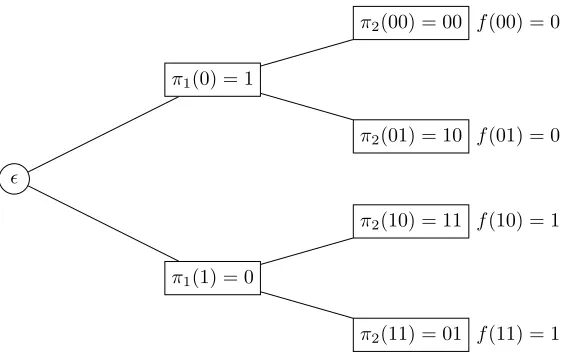
The correlated randomness in the protocol is determined by a set of random permutations, one for every level in the tree. For level i (with 2i nodes) we select a random permutation πi :
{0,1}i → {0,1}i, and assign to each node with name x ∈ {0,1}i the label a = π
i(x).4 These node-permutations induce 1-1 mappings as follows: for a node named x ∈ {0,1}i, its label a =
3
For ease of description we start the enumeration of the parties at 0 rather than 1.
4