Study of soft photon yield in pp and AA interactions at JINR
ElenaKokoulina1,2,,NurlanBarlykov1,VladimirDudin1,VladimirDunin1,AndreyKutov3, VladimirNikitin1,VasiliiRiadovikov4, andRomanShulyakovsky5
1Joint Institute for Nuclear Research 6 Joliot-Curie St 141980 Dubna, Moscow region, Russia
2Sukhoi State Technical University of Gomel Prospect Octiabria, 48, 246746 Gomel, Belarus
3Institute of Physics and Mathematics Komi SC UrD RAS Kommunisticheskaja st., 24, 167000 Syktyvkar,
Russia
4Institute of High Energy Physics Science sq. 1, 142281 Protvino, Russia
5Institute of Applied Physics Akademicheskaya str. 16, 220072 Minsk, Belarus
Abstract. Over 30 years there has been no comprehensive understanding of the
mecha-nism of soft photons (energy smaller than 50 MeV) formation. Experimental data indicate an excess of their yield in hadron and nuclear interactions in comparison with calcula-tions performed in QED. For a more thorough study of this phenomenon at the Nuclotron (a superconducting accelerator in JINR), preliminary measurements have been carried out with using an electromagnetic calorimeter based on BGO crystals. These results are consistent with the world data. In JINR, in connection with the building of a future ac-celerator complex NICA, it has become possible to carry out such studies inpp,pA and AA interactions at energies up to 25 A GeV. Our group develops the conception of an heterogeneous electromagnetic calorimeter as “spaghetti” and “shashlik” types based on gadolinium gallium garnet (GaGG) crystals with a low threshold for registration of pho-tons. The first tests of prototypes of them manufactured at JINR on the basis of the GaGG and a mixture of tungstate and copper as an absorber are reported.
1 Introduction
We call soft photons (SPh) such photons that are the direct products of high energy interactions. They are not decay products of secondary particles and their energy is smaller than 50 MeV. More than thirty years ago the excess yield of SPh has been observed [1]. The following studies of this phenomenon have confirmed the excess yield in hadron and nuclear interactions from low up to high energies [2–6]. The excess gets 4–8 fold surplus for reactions with secondary charged particles. The unexpected result has been obtained ine+e−annihilation at DELPHI setup [6]. The excess of SPh yield
depending on neutral particle multiplicity exceeds the theoretical estimation seventeen times over at 6 neutral pions. Such excess was observed only in the hadron channels. It was absent in the lepton channel:e+e−→ µ+µ−. The existing theoretical calculations based on the quantum electrodynamics
can not predict and explain this excess. Physics only offer various phenomenological models taking into account quantum chromodynamics and experimental data.
Why are we interested in SPh? First of all, up to now, the nature of SPh remains obscure. Ap-parently, they are formed in the region of non perturbative quantum chromodynamics. So physicists build phenomenological models. Among them, the model of P. Lichard and L. Van Hove [7] is the most successful. It is based on hypothesis of the cold quark-gluon plasma (QGP) formation. This model supposes formation of a quark-gluon system which consists of a few quarks, antiquarks and gluons (about 40 partons). These partons are encountering with each other and reradiate soft photons because there is not enough of their energy to produce hadrons. At that, the main reactions are Comp-ton scattering,q+g→q+γ, and annihilation,q+q→γ. This model describes well the experimental yield of SPh. There are also other phenomenological schemes explaining this yield [8, 9].
Our SVD-2 Collaboration develops the gluon dominance model (GDM) [10] in order to describe the region of high multiplicity (events with multiplicity way more than an average one). It takes into account two stages of multiparticle production (MP). In accordance to this model, at first stage, called quark-gluon cascade, a plentiful gluon splitting leads to abundance of gluons. We distinguish active and soft gluons. The active gluons have sufficiently high energy and can decay to quark-antiquark pairs. Further, these pairs form secondary hadrons by recombination mechanism. This model is evidence the main sources of secondary hadrons are active gluons. But soft gluons can not split to quark pairs. So they are caught up by new formed hadrons and scattering on their valence quarks with formation of SPh. We have estimated the fraction of such gluons. It is about 50 % of all gluons [11]. We could estimate the SPh emission region in the case of an almost equilibrium state using the black body emission spectrum in proton-proton interactions at the U-70 accelerator with 70 GeV/cproton beams. It represents a cube with side about 4–6 fm. This value exceeds the conventional region of hadronisation and raises some questions. Therefore, study of the soft gluon role will help understand deeper the mechanism of hadronisation.
Our experiment at U-70 was dedicated to study of the collective phenomena of secondary particles in events with high multiplicity. We managed to get the evidence of the Bose-Einstein condensate for-mation in this region [12]. Our Collaboration would like to answer question: Is there any connection between high multiplicity events and the excess yield of SPh.
And of course, the study of the soft gluon component will be very important for more detail description and understanding of the nucleon structure where an application of pQCD is hampered. We can not help but repeat the important words about them [13] : “Gluons are carriers of the strong force, bind quarks together inside nucleons and nuclei and generate nearly all of the visible mass in the universe. Despite their importance, fundamental questions remain about the role of gluons in nucleon and nuclei. These questions can only be answered with a powerful new electron ion collider (EIC) providing unprecedented precision and versatility.” Xiangdong Ji recalled them at the “Confinement and hadron spectrum" conference in Ireland in 2018.
2 First results of SPh study at Nuclotron
Why are we interested in SPh? First of all, up to now, the nature of SPh remains obscure. Ap-parently, they are formed in the region of non perturbative quantum chromodynamics. So physicists build phenomenological models. Among them, the model of P. Lichard and L. Van Hove [7] is the most successful. It is based on hypothesis of the cold quark-gluon plasma (QGP) formation. This model supposes formation of a quark-gluon system which consists of a few quarks, antiquarks and gluons (about 40 partons). These partons are encountering with each other and reradiate soft photons because there is not enough of their energy to produce hadrons. At that, the main reactions are Comp-ton scattering,q+g→q+γ, and annihilation,q+q→γ. This model describes well the experimental yield of SPh. There are also other phenomenological schemes explaining this yield [8, 9].
Our SVD-2 Collaboration develops the gluon dominance model (GDM) [10] in order to describe the region of high multiplicity (events with multiplicity way more than an average one). It takes into account two stages of multiparticle production (MP). In accordance to this model, at first stage, called quark-gluon cascade, a plentiful gluon splitting leads to abundance of gluons. We distinguish active and soft gluons. The active gluons have sufficiently high energy and can decay to quark-antiquark pairs. Further, these pairs form secondary hadrons by recombination mechanism. This model is evidence the main sources of secondary hadrons are active gluons. But soft gluons can not split to quark pairs. So they are caught up by new formed hadrons and scattering on their valence quarks with formation of SPh. We have estimated the fraction of such gluons. It is about 50 % of all gluons [11]. We could estimate the SPh emission region in the case of an almost equilibrium state using the black body emission spectrum in proton-proton interactions at the U-70 accelerator with 70 GeV/cproton beams. It represents a cube with side about 4–6 fm. This value exceeds the conventional region of hadronisation and raises some questions. Therefore, study of the soft gluon role will help understand deeper the mechanism of hadronisation.
Our experiment at U-70 was dedicated to study of the collective phenomena of secondary particles in events with high multiplicity. We managed to get the evidence of the Bose-Einstein condensate for-mation in this region [12]. Our Collaboration would like to answer question: Is there any connection between high multiplicity events and the excess yield of SPh.
And of course, the study of the soft gluon component will be very important for more detail description and understanding of the nucleon structure where an application of pQCD is hampered. We can not help but repeat the important words about them [13] : “Gluons are carriers of the strong force, bind quarks together inside nucleons and nuclei and generate nearly all of the visible mass in the universe. Despite their importance, fundamental questions remain about the role of gluons in nucleon and nuclei. These questions can only be answered with a powerful new electron ion collider (EIC) providing unprecedented precision and versatility.” Xiangdong Ji recalled them at the “Confinement and hadron spectrum" conference in Ireland in 2018.
2 First results of SPh study at Nuclotron
Among with theoretical estimations of the SPh yield we carry out active experimental study of them in proton and nuclear collisions at Nuclotron (the JINR’s setup) and plan extending them [14] at fu-ture accelerator center NICA [15]. This task was one of the main goals of Thermalization project that planned to solve at the U-70 accelerator. We could get down to this study at the ending of our project. Toward this end our Collaboration manufactured the electromagnetic calorimeter (ECal) on the base of BGO (bismuth ortogermanate) scintillators [16]. BGO crystals have a small radiation length X0=1.12 cm that permits reducing considerably the volume of our device. Moreover, this scin-tillator has small sensibility to neutrons. It was important at the measurement of a gamma-radiation. At manufacturing of such calorimeter, the problems of uniform distributions of activator in the crystal volume did not appear.
Deposited energy (MeV) 0 50 100 150 200 250 300 350 400 450 500
N/( 10 MeV)
0 10 20 30 40 50 60 70 80 - data - MC
PRELIMINARY
= 3.5 GeV/nucl. d
+ X. T γ → d + C
Deposited energy (MeV) 0 50 100 150 200 250 300 350 400 450 500
N/( 10 MeV)
0 20 40 60 80 100 120 140 160 180 - data - MC
PREL
IM
INAR
Y
= 3.5 GeV/nucl. Li
+ X. T γ → Li + C
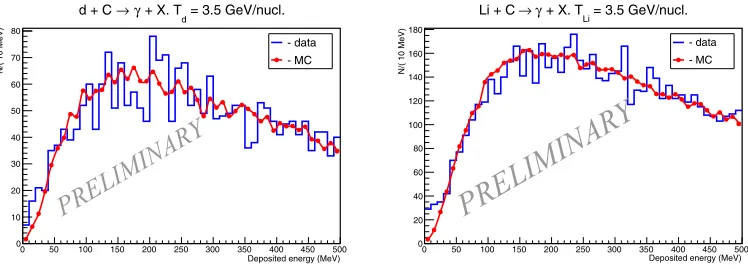
Figure 1.Energy release in BGO calorimeter with a pre-shower in d+C (the left panel) and in Li+C (the right
panel) interactions at Nuclotron. Monte Carlo simulation (the red line) and data (the blue line).
This calorimeter presents a square matrix composed of 49 (7×7) counters. The counter with a demultiplier and a preliminary amplifier are placed directly on the panel of PMT, every crystal has the parallelepiped form, 30×30×180 mm3. 180 mm correspond to 16 radiation lengths. The lateral facets of crystals are wrapped up in Tyvic (the thickness 120µm) for increasing of light gathering. The PMT 9106SB are used (ET Enterprises). They have 8 dynodes and high quantum efficiency in the green part of spectrum. PMT is glued to the crystal by the optic EPO-TEK 301 glue.
This calorimeter with counters is surrounded by the scintillator detectors of a guard veto-system. It was placed inside of the thermostat. The thermo stabilisation was realised by a cooling system Huber 006B. The temperature of liquid in the thermostat can vary from -20◦ up to+40◦ C. After a
few trials the temperature has been chosen+18◦C.
The plastic veto-detector of charged particles (23×23×1 cm3) was placed before the crystals and behind it an assembly of 4 plastics of a pre-shower (18×4.5×1 cm3) was installed. A lead 2 mm-convertor was put between the front-veto and plastics. The trigger was produced by the signal from any 2 of 4 pre-shower counters. There were two large veto-counters in front of the target to forbid a response from the beam halo. This BGO calorimeter with veto-detectors has been laid at the Nuclotron hall at the NIS-GIBS setup.
During the Nuclotron run (2015 year) this BGO calorimeter was set at an angle of 16◦relative to
the beam direction. The front plane of the crystals was away from the target at the distance 203 cm. The digitisation of plastic scintillators was realised with a CAMAC ADCs (Lecroy 2249A) and TDCs (LeCroy 2228A), the digitisation of the analog signals of calorimeter – by ADC CC-008.
Monte Carlo simulation of this calorimeter has been carried out at the conditions of the last as-sembly and the beam energy – 3.5 AGeV. Monte-Carlo simulation (uRQMD+Geant-3.21) is used. Geant-4 has shown the same result. After data processing we have obtained SPh spectra of energy release in deuterium-carbon (Fig. 1, the left panel) and lithium-carbon (Fig. 1, the right panel) inter-actions. In the region of energy below 50 MeV, a noticeable excess over Monte-Carlo simulation has been observed. It agrees well to other SPh experiments [17].
3 Simulation and testing of “spaghetti” and “shashlik” calorimeters
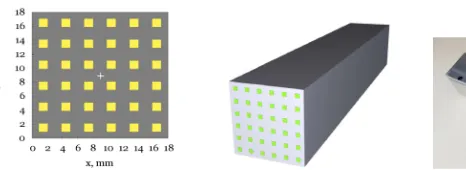
Figure 2.Scheme of the cell for “spaghetti” ECal and its assembly.
and heterogeneous, such types as “spaghetti” [19] and “shashlik” [18]. Physicists use the abridgment SpaCal saying about “spaghetti” ECal. Crystal ECals are very expensive. Their cost gets 50 $/cm3. In the second case, we lose a little with the energy resolution but we gain with a cost which gets 5÷30 $/cm3. We would like to occupy a niche between heterogeneous structures (“spaghetti” or “shashlik” type) with light yield∼3-6 ph/MeV and crystal detectors with light yield∼10,000 - 40,000 ph/MeV and tune them for the region 10–50 MeV (SPh). It is known that the threshold for shashlik types currently used starts from 100 MeV which is not suitable for our task. The main cause making an impact on such choice was using of heavy crystal in the capacity of scintillator.
We are aimed at the creation of “heavy” ECals (by analogy with heavy ions). We are going to substitute light scintillator material [20] for very dense (heavy) crystal with high specific light yield. It will allow us to build the device that is capable to keep the considerable compactness (space-saving about 30%). To produce the “spaghetti” type we have chosen a mono-crystal of gadolinium-gallium garnet, Gd3Al2Ga3O12:Ce (GaGG), as a scintillator and tungsten+copper composite by way of the absorber. We wait the decay time∼90 ns; the light yield∼45,000-55,000 ph/MeV; price about 25-35 $/cm3of volume, and good radiation resistance.
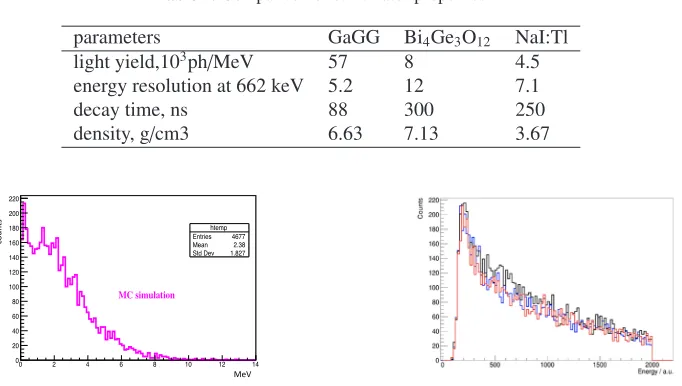
Comparison of properties of several crystals are presented in table 1. We choose crystal GaGG because it is a fast-acting scintillator, has a high light yield. The light yield in GaGG is 4 times more than in BGO. What is more, irradiation tests demonstrate good radiation resistance of GaGG. And we can acquire these crystals from the well-known domestic firm “Fomos-Materials” [21]. It has a long history, rich in scientific researches and technological developments that is competitive with the foreign analogues (and even surpass them) on an equal basis. Thanks to knowledge and professionalism of founding developers it was possible to obtain a material of high quality.
The first prototype of the detector cell SpaCal was an assembly of W+Cu composite plates and GaGG: Ce rods, with the shape of a rectangular parallelepiped: 18×18×100 mm3. It had 6×6 (1×1×100 mm3) scintillator rods surrounded by absorber. The surfaces of plates and absorber rods were coated with a 10µmpolymer dim white reflector. We tested two such assemblies. “Spaghetti” technology is a type of the sampling calorimeter with scintillation fibres running along a shower direc-tion [19]. Granularity of whole module is defined by the granularity of read-out system. The scheme of a single cell and its view in an assembly is shown in Fig. 2.
Figure 2.Scheme of the cell for “spaghetti” ECal and its assembly.
and heterogeneous, such types as “spaghetti” [19] and “shashlik” [18]. Physicists use the abridgment SpaCal saying about “spaghetti” ECal. Crystal ECals are very expensive. Their cost gets 50 $/cm3.
In the second case, we lose a little with the energy resolution but we gain with a cost which gets 5÷30 $/cm3. We would like to occupy a niche between heterogeneous structures (“spaghetti” or “shashlik”
type) with light yield∼3-6 ph/MeV and crystal detectors with light yield∼10,000 - 40,000 ph/MeV
and tune them for the region 10–50 MeV (SPh). It is known that the threshold for shashlik types currently used starts from 100 MeV which is not suitable for our task. The main cause making an impact on such choice was using of heavy crystal in the capacity of scintillator.
We are aimed at the creation of “heavy” ECals (by analogy with heavy ions). We are going to substitute light scintillator material [20] for very dense (heavy) crystal with high specific light yield. It will allow us to build the device that is capable to keep the considerable compactness (space-saving about 30%). To produce the “spaghetti” type we have chosen a mono-crystal of gadolinium-gallium garnet, Gd3Al2Ga3O12:Ce (GaGG), as a scintillator and tungsten+copper composite by way of the
absorber. We wait the decay time∼90 ns; the light yield∼45,000-55,000 ph/MeV; price about 25-35
$/cm3of volume, and good radiation resistance.
Comparison of properties of several crystals are presented in table 1. We choose crystal GaGG because it is a fast-acting scintillator, has a high light yield. The light yield in GaGG is 4 times more than in BGO. What is more, irradiation tests demonstrate good radiation resistance of GaGG. And we can acquire these crystals from the well-known domestic firm “Fomos-Materials” [21]. It has a long history, rich in scientific researches and technological developments that is competitive with the foreign analogues (and even surpass them) on an equal basis. Thanks to knowledge and professionalism of founding developers it was possible to obtain a material of high quality.
The first prototype of the detector cell SpaCal was an assembly of W+Cu composite plates
and GaGG: Ce rods, with the shape of a rectangular parallelepiped: 18×18×100 mm3. It had 6×6
(1×1×100 mm3) scintillator rods surrounded by absorber. The surfaces of plates and absorber rods
were coated with a 10µmpolymer dim white reflector. We tested two such assemblies. “Spaghetti” technology is a type of the sampling calorimeter with scintillation fibres running along a shower direc-tion [19]. Granularity of whole module is defined by the granularity of read-out system. The scheme of a single cell and its view in an assembly is shown in Fig. 2.
In spring of 2019 year the experimental tests have been carried out by ourselves in Mainz (Mainz Microtron, Germany). Two manufactured cells were irradiated by 41, 51 and 69 MeV-photons. In Fig. 3, both Monte Carlo simulation of such a cell and our experimental result demonstrate the same behaviour in the case of 51 MeV-photon beam. It is seen that in the case of an even number of rods a narrow photon beam hitting in the centre of the cell turns out in the absorber plate. We are only observing the tail of the Gauss distribution.
Table 1.Comparison of scintillator properties
parameters GaGG Bi4Ge3O12 NaI:Tl
light yield,103ph/MeV 57 8 4.5
energy resolution at 662 keV 5.2 12 7.1 decay time, ns 88 300 250 density, g/cm3 6.63 7.13 3.67
htemp Entries 4677 Mean 2.38 Std Dev 1.827
0 2 4 6 8 10 12 14 Efib 0
20 40 60 80 100 120 140 160 180 200 220
htemp Entries 4677 Mean 2.38 Std Dev 1.827
Efib {Efib>0}
51 MeV
MC simulation
MeV
co
unt
s
Figure 3. Energy release: Monte Carlo simulation and experimental data for 51 MeV-photon irradiation of SpaCal. The different colours of line correspond to a few small falling angles of a photon beam (the right panel)
To optimize the properties of ECals, modeling of both types has been carried out. We have opted for “spaghetti” simulation the following parameters: the matrix 25×25 GaGG crystal rods with 3×3 mm2cross section, the ratio between the tungsten and copper components for the absorber was chosen
5:95. The total size of such a cell was equal to 101×101×150 mm3. The gap between rods consisted
of 1 mm. For “shashlik” we constrained of sixteen GaGG plates (100×100×3 mm3) and fifteen 2-mm
absorber plates with the same ratio of W/Cu components and the same cross section of every plate
like in the SpaCal case. The total thickness of that prototype consists of 78 mm. In Fig. 4 the energy resolution of both types of ECals is presented. It is seen that at that choice of ECal parameters the “shashlik” type gives the energy resolution much better and can be used in our future experimental study.
4 Conclusions
The unique physical program of SPh study [14] can be carried out at accelerator setups of JINR or elsewhere. Simulation both “spaghetti” and “shashlik” types of heterogeneous ECals gives evidence that our program are quite reasonable and feasible. Their characteristics (the energy resolution and others) can be improved by changing of the cross-section of crystal rods, adjusting the absorber den-sity, and optimising the length of ECals for the energy field of SPh. The energy resolution will be 10 and better for photons with energy above 50 MeV with SiPM and the correct scheme for light transporting to a photo detector.
Simulation of “shashlik” type with GaGG as a scintillator and W/Cu as an absorber demonstrate
the energy resolution at low energy much better than with “spaghetti” type. Our experimental tests at photon beams are in progress. We hope to carry out these investigations in this year. We are also learning possibilities of using of Glass and Glass Ceramic Stoichiometric and Gd3+heavy loaded
Ef Entries 1813 Mean 14.29 Std Dev 2 / ndf 4.214
χ 67.45 / 46 Prob 0.02127 Constant 85.21 ± 2.68 Mean 14.44 ± 0.10 Sigma 4.117 ± 0.088
0 5 10 15 20 25 30 35 40 45 50 0
10 20 30 40 50 60 70 80
90 Ef
Entries 1813 Mean 14.29 Std Dev 2 / ndf 4.214
χ 67.45 / 46 Prob 0.02127 Constant 85.21 ± 2.68 Mean 14.44 ± 0.10 Sigma 4.117 ± 0.088
Efib>0 30 MeV
MeV 20 30 40 50
2
10 2×10² 103
, MeV
γ
E 5
10 15 20 25
Energy resolution (%)
SpaCal, 25x25 rods Shashlik, GaGG, WCu
Figure 4.The left panel: spectrum of the energy release in “shashlik” (Eγ=30 MeV). The right panel: the energy
resolution in the“spaghetti” (the red line) versus the “shashlik” (the blue line) calorimeters.
to the SVD-2 Collaboration for the fruitful work in the manufacture of SpaCal, getting and discussing the main results.
References
[1] P.V. Chliapnikov et al., Physics LettersB141, 276-280 (1984)
[2] J. Schukraft. HELIOS Collaboration, Nuclear PhysicsA498, 79-92 (1989) [3] S. Banerjee et al. SOPHIE/WA83, Physics LettersB305, 82-186 (1993) [4] A. Belogianni et al. WA91, Physics LettersB408, 487-492 (1997) [5] A. Belogianni et al. WA102, Physics LettersB548, 129-139 (2002)
[6] J. Abdallah et al., DELPHI Collaboration, Eur. Phys. JC47, 273-294 (2006) [7] P. Lichard, L. Van Hove, Physics LettersB245, 605-608 (1990)
[8] S. Barshay, Physics LettersB227, 279-284 (1989) [9] Wong Cheuk-Yin, Phys. Rev. Lett.C81, 064903 (2010) [10] E. Kokoulina, Acta Phys. Polon.B35, 295-302 (2004) [11] E.S. Kokoulina, Phys. Part. Nucl. Lett.13, 74-78 (2016)
[12] Afonin, A.G. et al. SVD Collaboration EPJ Web of Conferences37, 06002 (2013)
[13] Xiangdong Ji and Tsung-Dao Lee. Report at the XIIIth Quark Confinement and Hadron Spec-trum Aug. 3, 2018, Maynooth University, Ireland
[14] V.V. Avdeichikov et al.NICA White Paper(JINR, Dubna, 2013) p.135 http://theor.jinr.ru/twiki-cgi/view/NICA/NICAWhitePaper
[15] V. Golovatyuk, et al. Eur.Phys.J.A52, 212 (2016) [16] E.N. Ardashev et al. Instr. Exp. Tech.58, 18 (2015)
[17] J. Schukraft. HELIOS Collaboration. Nucl.Phys.A498, 79 (1989)
[18] C. Grupen and B. Shwartz.Particles detectors(Cambridge University Press, New York, 2011) 652 p.
[19] D. Acosta et al. Nucl.Instrum.Meth.A294, 193 (1990)
[20] Paul Lecoq, Alexander Gektin, and Mikhail Korzhik.Inorganic Scintillators for Detector Sys-tems(Second Edition. Springer, Berlin, 2017) 408 p.