UPCommons
Portal del coneixement obert de la UPC
http://upcommons.upc.edu/e-prints
Aquesta és una còpia de la versió
author’s final draft
d'un article
publicat a la revista
Journal of ambient intelligence and humanized
computing
.
La publicació final està disponible a Springer a través de
http://dx.doi.org/10.1007/s12652-017-0658-2
This is a copy of the author 's final draft version of an article
published in the
Journal of ambient intelligence and humanized
computing
.
The final publication is available at Springer via
http://dx.doi.org/10.1007/s12652-017-0658-2
Article publicat / Published article:
Zhang, J. [et al.] (2017)
Energy-efficient secure outsourcing
decryption of attribute based encryption for mobile device in cloud
computation. "Journal of ambient intelligence and humanized
computing". Doi: 10.1007/s12652-017-0658-2
(will be inserted by the editor)
Energy-efficient Secure Outsourcing Decryption of Attribute
Based Encryption for Mobile Device in Cloud Computation
Jindan Zhang · Baocang Wang · Fatos Xhafa · Xu An Wang · Cong Li
Received: date / Accepted: date
Abstract In this paper, we propose two new ways for efficient secure outsourcing the the decryption of key-policy attribute based encryption (KP −ABE) with energy efficiency. The first way base on an observation about the permutation property of the access structure of the attribute based encryption schemes. We propose a high efficient way for outsourcing the decryption for KP-ABE based on this observation, and it can be used for mobile devices for its high efficiency, but it can on-ly be used for the ABE schemes having tree-like access structure and the self-enclosed system. The second way
Jindan Zhang
State Key Laboratory of Integrated Service Networks, Xidi-an University, Xi’Xidi-an 710071, China; GuXidi-angxi Key Laboratory of Cryptography and Information Security, Guilin University of Electronic Technology, P. R. China; Xianyang Vocational Technique College, P. R. China
E-mail: [email protected] Baocang Wang
State Key Laboratory of Integrated Service Networks, Xidian University, Xi’an 710071, China
E-mail: [email protected] Fatos Xhafa
Department of Computer Science, Universitat Politcnica de Catalunya, Spain
E-mail: [email protected] Xu An Wang
Key Laboratory of Information and Network Security, En-gineering University of Chinese Armed Police Force, P. R. China; Guangxi Key Laboratory of Cryptography and Infor-mation Security, Guilin University of Electronic Technology, P. R. China
E-mail: [email protected] Cong Li
Key Laboratory of Information and Network Security, En-gineering University of Chinese Armed Police Force, P. R. China
base on another observation that almost all the previous work on outsourcing the decryption ofKP−ABEcares little about the ciphertext length. Almost all the previ-ous schemes have linear length ciphertext with the at-tributes or the policy. But we know that transferring so long ciphertexts via wireless network for mobile phone can easily run out the energy of the battery, which hesi-tates the adaption of these solutions in actual scenarios. Thus we propose another new scheme to outsource the decryption of ABE but with constant-size ciphertexts, which can achieve high energy efficiency. Furthermore, we propose a new very efficient way to secure outsource the decryptor’s secret key to the cloud, which cost only one modular exponentiation. We roughly evaluate the efficiency of our proposals and the results show that our proposals are practical.
1 Introduction
In these days, cloud computation is a very hot research topic for its promising properties of cheap management cost for users, any where/any time access, and very s-calable software and hard ware investigation. However, before adapting cloud computation, data owners should ensure their data shall be secure and well protected. At-tribute based encryption is a very promising technique to store data owner’s data for flexible secure access con-trolling on the ciphertexts. However, attribute based encryption is a public key primitive and use tools need-ing huge computation cost like bilinear pairneed-ings. Thus it is desired to outsource this huge cost to the cloud. In this paper, we concentrate on one scenario of outsouring for cloud computation: how to securely outsourcing the decryption of attribute based encryption to the cloud,
which has important application for mobile users. Con-sider the following scenario:
“Data owner Alice outsource her data sets to the cloud, before outsourcing her data to the cloud, she first encrypt her data by using attribute based encryp-tion such as KP-ABE and outsource the ciphertexts to the cloud. Data user Bob want to use the data item-s for which hiitem-s credential can decrypt, but he iitem-s on a vacation and can only use mobile phone. Thus if he de-crypt the downloading ciphertexts directly, his mobile phone can not implement this for the huge computation load. Thus he needs some mechanism to outsouce the decrypting to the cloud, this is called the mechanism of outsourcing decryption of attribute based encryption to the cloud. Another important issue is the length of the ciphertexts, if the length is very long outsoucing the ciphertexts to the cloud will cost lots of energy for the mobile phone, which will sharply shorten the living time of the mobile phone and this is intolerable. Thus we also care about the length of ciphertexts when out-sourcing the decryption of attribute based encryption to the cloud.”
Here we review some previous work on this topic. Green et al. [14] in 2011 proposed a very efficient way for outsourcing decryption of attribute based encryp-tion, which is a wonderful result for adapting ABE for mobile equipments. However, this work care little about the verifiability for the computation results, the cloud can cheat the data users without any noticing. There-fore, Lai et al. [15] proposed a new way to outsource decryption of ABE with verifiability, but their scheme is not very efficient. Li et al. [19] also proposed a way to outsource encryption/key generation/decryption of ABE with checkability, but their scheme need often in-teraction with the PKG. Recently, Qin et al. [22] pro-posed an very efficient way to outsource decryption of ABE with verifiability.
1.1 Our Contribution
In this paper, we propose two new ways for efficien-t secure ouefficien-tsourcing efficien-the efficien-the decrypefficien-tion of key-policy attribute based encryption (KP −ABE) with energy efficiency. The first way base on an observation about the permutation property of the access structure of the attribute based encryption schemes, that is, the se-quence of attributes are tightly associated with the ac-cess structure. If the sequence of attributes have been permutated, the access structure should be changed too. From the permutated sequence of attributes and the changed access structure, the adversary can not eas-ily deduce the original sequence of attributes and the o-riginal access structure if there are many attributes like
100 ones in the access structure. We propose a high ef-ficient way for outsourcing the decryption for KP-ABE based on this observation, and it can be used for mo-bile devices for its high efficiency, but it has its own restriction: it can only be used for the ABE schemes having tree-like access structure while not supporting LSSS structure, and also it can only be used for self-enclosed system. The second way base on another obser-vation that almost all the previous work on outsourc-ing the decryption of KP −ABE cares little about the ciphertext length. Almost all the previous schemes have linear length ciphertext with the attributes or the policy. But we know that transferring so long cipher-texts via wireless network for mobile phone can easily run out the energy of the battery, which hesitates the adaption of these solutions in actual scenarios. Thus we propose another new scheme to outsource the decryp-tion of ABE but with constant-size ciphertexts, which can achieve high energy efficiency. Furthermore, we pro-pose a new very efficient way to secure outsource the decryptor’s secret key to the cloud, which cost only one modular exponentiation. We roughly evaluate the ef-ficiency of our proposals, compared with the pervious work [14, 15, 19, 22] on outsourcing the decryption of ABE, our work can achieve high energy efficiency for the client’s mobile devices. Thus our proposals are practi-cal. This paper is based on our previous work [28] but with significant extension, concretely we add the first proposal which is not considered in our previous work, formally prove the security of the second proposal, and evaluate the performance of the second proposal etc.
1.2 Related Work
In 2005, Sahai and Waters [23] first proposed the con-cept of attribute based encryption and give a concrete such construction, which is an extension of fuzzy iden-tity based encryption they also first proposed. In 2006, according to how to embed the access control in the algorithm, Goyal et al. [13] categorized ABE as the key policy ABE and the ciphertext policy ABE, and they also gave the first concrete key policy ABE based on bi-linear pairings, this scheme can be proved selective se-cure in the standard model. Since then, many research results have been achieved. Waters in 2009 [24]first pro-posed the dual system encryption framework and lat-er [16,18,20] use this technique to design sevlat-eral fully se-cure ABE schemes. Recently, Attrapadung [1] give a in-teresting framework to transform selective ABE to fully secure ABE. Chase et al. in 2007 [5] proposed the con-cept of ABE with multi-authority and [6, 17] continues this line of research. Attrapadung et al. [2–4,25,26] pro-posed serveral variants of ABE with interesting
proper-ties such as dual-policy ABE, chosen ciphertext secure ABE, constant size ciphertext ABE, they also discussed some relationship about ABE and other primitives such as conjunctive broadcast encryption and predicate en-cryption etc. In 2012, Parno et al. [21]first consider ABE’s application in secure verifiable outsourcing com-putation. Garg et al. [10] first proposed the ABE scheme which can support any access control structure which can be expressed as circuits by using the multilinear map, this work can resist the backward-and-shift at-tack while construction on bilinear map can not. How-ever, almost all the ABE scheme for circuits [12] can only achieve selective security, which is not satisfying. Recently, Garg et al. [11] proposed the first fully secure ABE schemes for circuits and proved the construction’s full security by relying on some novel interesting tech-niques. In another line of research work, Chen et al. [7–9] try to give high efficient ABE schemes with full se-curity and there are serval notable research results have been achieved. Recently, how to efficient outsource the decryption of ABE has gained great attention and many wonderful results have been achieved [14, 15, 19, 22].
1.3 Organization
We organize our paper as the following. In section II, we give the definition and security model for outsouced attribute based encryption. In section III, we give our first proposal, roughly analysis its security and give the comparison results. In section IV, we give our second proposal and its security proof, we also give a new way for outsourcing the decryption key, finally we give the performance and comparison results. In the last sec-tion, we conclude our paper with many interesting open problems.
2 Definition and Security Model
2.1 Definition
Let S represent a set of attributes, and A an accesss tructure. For generality, we will define (Ienc, Ikey) as the
inputs to the encryption and key generation function re-spectively. In aKP−ABE scheme (Ienc, Ikey) = (S, A)
while in a CP −ABE scheme (Ienc, Ikey) = (A, S). A
CP−ABE(KP−ABE) scheme with outsourcing func-tionality consists of five algorithms:
1. Setup(λ, U).The setup algorithm takes security pa-rameter and attribute universe description as input. It outputs the public parametersP K and a master keyM K.
2. Encrypt(P K, M, Ienc).The encryption algorithm takes
as input the public parameters P K, a message M, and an access structure (resp. attribute set)I. It out-puts the ciphertextCT.
3. KeyGenout(M K, Ikey).The key generation
algorith-m takes as input the algorith-master key M K and an at-tribute set (resp. access structure)Ikey and outputs
a private keySK and a transformation keyT K. 4. Transform(T K, CT).The ciphertext transformation
algorithm takes as input a transformation keyT K forIkey and a ciphertextCT that was encrypted
un-derIenc. It outputs the partially decrypted
cipher-textCT0ifS∈Aand the error symbol⊥otherwise. 5. Decrypt(SK, CT). The decryption algorithm takes as input a private key SK for Ikey and a partially
decrypted key ciphertext CT0 that was originally encrypted under Ienc. It outputs the message M if
S∈A and the error symbol⊥otherwise.
2.2 Security Model
Definition 1 ACP−ABEorKP−ABEscheme with outsourcing is selective CPA-secure (or selective secure against chosen-plaintext attacks) if all polynomial time adversaries have at most a negligible advantage in the below game.
The formal security game consists of the following phases:
1. Init.Adeclares a set of encryption attributeSthat will be used to create the challenge ciphertext dur-ing Challenge phase, submits S to the challenger. 2. Setup.The challenger runs the Setup algorithm and
gives the pubilc parameters to the adversary A. 3. Phase 1.The challenger initializes an empty tableT,
an empty set D and an integer j = 0. Proceeding adaptively, the adversary can repeatedly make any of the following queries:
• Creat(Ikey):The challenger setsj:=j+1. It runs
the outsourced key generation algorithm onIkey
to obtain the pair (SK, T K) and stores in table T the entry (j, Ikey, SK, T K). It then returns to
the adversary the transformation keyT K. Note: Create can be repeatedly queried with the same input.
• Corrupt(i):If there exists ani−thentry in table T, then the challenger obtains the entry (i, Ikey, SK,
T K) and sets D :=D∪ {Ikey}. It then returns
to the adversary the private keySK. If no such entry exists, then it returns⊥.
4. Challenge.The adversary submits two messagesM0, M1.
that for all Ikey ∈ D, fIkey, I ∗
enc) 6= 1. The
chal-lenger flips a random coinb, and encryptsMbunder
Ienc∗ . The resulting ciphertext CT∗ is given to the adversary.
5. Phase 2. Phase 1 is repeated with the restrictions that the adversary cannot trivially obtain a private key for the challenge ciphertext. That is, it can not issue a Corrupt query that would result in a value Ikey which satisfiesf(Ikey, Ienc∗ ) = 1 being added to
D.
6. Guess.The adversary outputs a guess b0 forb. The adversarys advantage in this game is defined as|P r[b0= b]−1/2|.
3 The First Proposal
3.1 System model R etrie ve d ata Cloud Computing
Ciphertexts from attribute based encryption Sto re d ata Outsource decryption Computation result Self-enclosed system
Outsourced decryption key
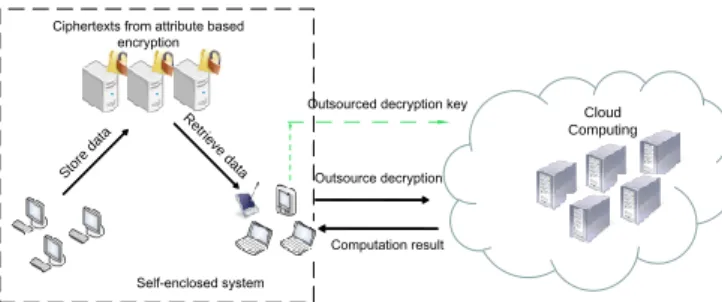
Fig. 1: Outsourced attributed based encryption for self-enclosed system
In this subsection, we describe the system model for our proposal. Our first proposal is mainly aiming at re-lieve the decryption overhead of mobile users for secure access control system using attribute based encryption in a self-enclosed setting. The self-enclosed system here refers that the cloud can not access the information flow in this system. In this self-enclosed system, there are three roles: the data owners who upload their files to the storage server using attribute based encryption, the data users can scalable access these encrypted files by using their secret keys if the attributes associated with the ciphertext satisfying the access structure tree as-sociated with their secret keys, and the storage servers for storing the uploaded ciphertexts. Outside the self-enclosed system, there exists another party named the cloud service provider. The data users maybe use mo-bile devices which shall greatly restrict their computa-tion ability, thus it need to outsource the computacomputa-tion work to the cloud, here we mainly focus on how to out-source the decryption of ciphertexts for the mobile de-vices. In this model, the cloud is a semi-trusted party,
which shall be interested to derive the private keys of the data users, note here we do not consider the ver-ifiability of the computation results, which is another issue many other papers have solved.
3.2 Review of GPSW’S Key-Policy ABE
3.2.1 Access Tree
Ciphertexts are labeled with sets of attributes and pri-vate keys are associated with access structures that con-trol which ciphertexts a user is able to decrypt.
Access treeΓ.LetΓ be a tree representing an access structure. Each non-leaf node of the tree represents a threshold gate, described by its children and a threshold value. Ifnumxis the number of children of a nodexand
kx is its threshold value, then 0 ≤k ≤ numx. When
kx = 1, the threshold gate is an OR gate and when
kx=numx, it is anAN Dgate. Each leaf nodexof the
tree is described by an attribute and a threshold value kx= 1.
To facilitate working with the access trees, we define a few functions. We denote the parent of the nodexin the tree by parent(x). The function att(x) is defined only ifxis a leaf node and denotes the attribute asso-ciated with the leaf nodexin the tree. The access tree T also defines an ordering between the children of every node, that is, the children of a node are numbered from 1 tonum. The functionindex(x) returns such a num-ber associated with the nodex. Where the index values are uniquely assigned to nodes in the access structure for a given key in an arbitrary manner.
Satisfying an access tree.LetΓbe an access tree with rootr. Denote byΓxthe subtree ofΓrooted at the node
x. Hence Γ is the same as Γr. If a set of attributesγ
satisfies the access treeΓx, we denote it asΓx(γ) = 1.
We computeΓx(γ) recursively as follows. Ifxis a
non-leaf node, evaluateΓx0(γ) for all childrenx0 of nodex.
Γx(γ) returns 1 if and only if at leastkxchildren return
1. Ifxis a leaf node, then Γx(γ) returns 1 if and only
ifatt(x)∈γ.
3.2.2 GPSW Scheme
1. Setup: Let G1 be a bilinear group of prime order
p, and let g be a generator of G1. In addition, let
e:G1×G1→G2denote the bilinear map. We also
define the Lagrange coefficient ∆i,S fori∈Zp and
a set, S, of elements inZp:∆i,S(x)=Πj∈S,j6=ixi−−jj.
Define the universe of attributes U ={1,2,· · ·, n}. 2. Key Generation(Γ):
• For each attributei∈U, choose random number ti uniformly fromZp.
• Choose random numbery uniformly inZp.
• The published public parametersP K is T1=gt1,· · · , T|U|=gt|U|, Y =gy
And the authority’s master keyM K is: (t1,· · · , t|U|, y)
• Then the authority generates a key that enables theUser to decrypt a message encrypted under a set of attributesγif and only ifΓ(γ) = 1. The algorithm proceeds as follows.
(a) Choose a polynomialqxfor each nodex
(in-cluding the leaves) in the tree T .These poly-nomials are chosen in the following way in a top-down manner, starting from the root node r. For each node x in the tree, set the degree dx of the polynomial qx to be
one less than the threshold valuekx of that
node, that is, dx = kx−1. Now, for the
root node r, set qr(0) = y and dr other
points of the polynomialqrrandomly to
de-fine it completely. For any other nodex, set qx(0) = qparent(x)(index(x)) and choose dx
other points randomly to completely define qx.
(b) Once the polynomials have been decided, for each leaf nodex, the authority give the fol-lowing secret key to the user:
Dx=g qx(0)
ti
wherei=att(x).
3. Encryption(M, γ, P K): To encrypt a message M ∈
G2 under a set of attributes γ, choose a random
valuer∈Zp and publish the ciphertext as:
E= (γ, E0 =M e(gr, Y) =M e(g, g)ry,
{Ei=Tir(i∈γ)})
4. Decryption(E, D):We specify our decryption proce-dure as a recursive algorithm.
• We first define a recursive algorithmDecryptN ode(E, D, x) that takes as input the ciphertextE, the private
keyD(we assume the access treeΓ is embedded in the private key), and a nodexin the tree. It outputs a group element ofG2or ⊥.
• Leti=att(x), if the nodexis a leaf node then:
– Ifi∈γ,
Decrypt(E, D, x) =e(Dx, Ei)
=e(gqx(0)ti , grti) =e(q, q)rqx(0)
– Otherwise, return⊥.
We now consider the recursive case whenxis a non-leaf node. The algorithmDecryptN ode(E, D, x) then proceeds as follows: For all nodeszthat are children ofx, it callsDecryptN ode(E, D, z) and stores the output asFz. Let Sx be an arbitrary
kx -sized set of child nodes z such thatFz6=⊥.
If no such set exists then the node was not sat-isfied and the function returns⊥. Otherwise, we compute Fx= Y z∈Sx Fδi,S0x(0) z = Y z∈Sx (e(g, g)rqz(0))δi,S0 x(0) = Y z∈Sx
(e(g, g)rqparent(z)(index(z)))δi,S0x(0)
= Y z∈Sx e(g, g)rqx(i)δi,S0 x(0) =e(g, g)rqx(0) =e(g, g)ry 3.3 Main Idea OR AND 1 2 3 AND OR AND 4 5 6
Fig. 2: Original Access Structure I
Our proposal is based on the following observation:
The access structure is tightly associated with the order of the leaf nodes. For example, in KP-ABE, the ciphertexts are associated with the attribute sets, and the policy is embedded in the private key of the users. But the point is that the ciphertexts shoud have some order, if we change the ciphertexts’ order, which
mean-OR AND 4 5 AND OR AND 2 1 3 6
Fig. 3: Permutated Access Structure II
OR AND 4 5 AND OR AND 3 1 6 7 OR 2
Fig. 4: Permutated Access Structure III
s the ciphertext corresponding to the attribute are no longer correct, the decryption result can no longer be correct! CP-ABE also has this feature.
A more detailed description is the following: In Fig.1, which is the original access structure I, and the leaf nodes are{1,2,· · ·,6}, and the order of them is{1−2−3−4−5−6}. In Fig.2, we permutated the access structure, which denoted as II, the leaf nodes are still{1,2,· · ·,6}, but the order of them is{6−4−5−
2−3−1}. In Fig.3, we further permutated the access structure II to get III, which has more difference. It has more leaf nodes and gates, which hide the topology of I. The leaf nodes are now{1,2,· · ·,6,7}, and the order
of them is{6−4−5−3−1−2−7}. To get the same derived boolean value, leaf node 3 should have the same boolean value with leaf node 7.
3.4 A Concrete Outsourced ABE Scheme
In this section, we give a concrete example to show how the ABE scheme with permutated access structure II works. Our scheme is based on the GPSW scheme [13] (Note GPSW scheme has a threshold access structure, but our Fig.1, 2, 3 all have the boolean formula struc-ture. We emphasis this does not matter for OR gate can be seen as 1-to-1 threshold access structure and AND gate can be seen as a 2-to-1 threshold access structure.) 1. Setup: Let G1 be a bilinear group of prime order
p, and let g be a generator of G1. In addition, let
e:G1×G1→G2denote the bilinear map. We also
define the Lagrange coefficient ∆i,S fori∈Zp and
a set, S, of elements inZp:∆i,S(x)=Πj∈S,j6=ixi−−jj.
Define the universe of attributes U ={1,2,· · ·, n}. 2. Key Generation(Γ)):
• For each attributei∈U, choose random number ti uniformly fromZp.
• Choose random numbery uniformly inZp.
• The published public parametersP K is T1=gt1,· · ·, T|U|=gt|U|, Y =gy
And the authority’s master keyM K is: (t1,· · · , t|U|, y)
• Then the authority generates a key that enables theUser to decrypt a message encrypted under a set of attributesγif and only ifΓ(γ) = 1. The algorithm proceeds as follows.
(a) Choose a polynomialqxfor each nodex
(in-cluding the leaves) in the tree T .These poly-nomials are chosen in the following way in a top-down manner, starting from the root node r. For each node x in the tree, set the degree dx of the polynomial qx to be
one less than the threshold valuekx of that
node, that is, dx = kx −1. Now, for the
root node r, set qr(0) = y and dr other
points of the polynomialqrrandomly to
de-fine it completely. For any other nodex, set qx(0) = qparent(x)(index(x)) and choose dx
other points randomly to completely define qx.
(b) Once the polynomials have been decided, for each leaf nodex, the authority generates the following keys:
Dx=g qx(0)
wherei=att(x).
Note here Γ =Access Structure I and should be keptprivateby the decryptor.
3. Outsource KeyGen (D, Γ, P, Q) The decryptor first permutes his access structure and the sequence of the attributes, that is,
P(Access Structure I) =Access Structure II Q(Order of leaf nodes in I) =Order of leaf nodes in II
HereP, Qdenote the permutation of the access struc-ture and permutation of the order of leaf nodes and is kept secret by the decryptor. Furthermore the fol-lowing condition should be satisfied:
Q(Order of leaf nodes in I) satisfying
P(Access Structure I) if and if
Order of leaf nodes in I satisfying
Access Structure I
The data user’s outsourced decryption key will be Doutsource= (Q(Dx,· · ·Dx0) =Q(g
qx(0) t1 ,· · ·, g
qx(0) tn ),
Access Structure II)
4. Encryption(M, γ, P K): To encrypt a message M ∈
G2 under a set of attributes γ, choose a random
valuer∈Zp and compute:
E= (γ,
E0 =M e(gr, Y) =M e(g, g)ry,{Ei=Tir(i∈γ)})
then the encrypter sends these ciphertexts to the data user.
5. Outsource Ciphertext(E, Q): After obtaining the ci-phertextE, the decryptor permutesEby using per-mutationQ
Eoutsource= (Q(γ), Q({Ei=Tir(i∈γ)}))
and outsource them to the cloud.
6. Decryption(E0, D0):After obtaining (E0, D0), the cloud runs the decryption algorithm as following:
• We first define a recursive algorithmDecryptN ode (E0, D0, x) that takes as input the ciphertextE0, the private keyD(we assume the access treeII is embedded in the private key), and a nodexin the tree. It outputs a group element ofG2 or⊥. • Leti=att(x), if the nodexis a leaf node then:
– Ifi∈Q(γ),
Decrypt(Eoutsource, Doutsource, x) = =e(gqx(0)ti , grti) =e(q, q)rqx(0)
– Otherwise, return⊥.
We now consider the recursive case whenxis a non-leaf node. The algorithmDecryptN ode(E0, D0, x) then proceeds as follows: For all nodeszthat are children ofx, it callsDecryptN ode(E0, D0, z) and stores the output asFz. LetSx be an
arbi-trary kx -sized set of child nodes z such that
Fz 6=⊥. If no such set exists then the node was
not satisfied and the function returns⊥. Other-wise, the cloud compute
Fx= Y z∈Sx Fδi,S0x(0) z = Y z∈Sx (e(g, g)rqz(0))δi,S0x(0) = Y z∈Sx
(e(g, g)rqparent(z)(index(z)))δi,S0
x(0) = Y z∈Sx e(g, g)rqx(i)δi,Sx0(0) =e(g, g)rqx(0) =e(g, g)ry
and returns it to the user, the user then com-putes M = E 0 e(g, g)ry = M e(gr, Y) e(g, g)ry 3.5 Security Analysis
Theorem 1 Our construction of outsourced attribute based encryption is secure if the underlying permutation of order of leaves and permutation of access structure can not be inverted (e. g. number of the attributes is very large like 100 and the access structure is complex enough).
Proof Here we roughly analysis our proposal’s security. For the malicious cloud, although it can get the permu-tated secret key,
Doutsource= (Q(Dx,· · ·Dx0) =Q(g
qx(0) t1 ,· · ·, g
qx(0) tn ),
Access Structure II)
it can not know the concrete permutation, when the attributes are large enough such as 100 ones, it need-s to try 100! = 9.33×10157 times to knowing the
concrete permutation, which shall be too large for a rational cloud service. But we also note our proposal can only be secure in the self-enclosed system, that is, the attributed based encryption ciphertexts can only
be known by the data owners and data users, and can not be accessed by the clouds. Otherwise, the malicious cloud may derive the permutation from the original se-quence of ciphertexts and the permutated sese-quence of ciphertexts. We remark here such self-enclosed system is very common in our real life, such as E-health infor-mation system in hospital, which can be accessed by Doctors and Patients, but can not be accessed by oth-ers outside the hospital like the cloud service provider-s. Although our proposal is not a perfect solution for generic construction of outsourced attribute based en-cryption, but it can find its application in many real setting. Note here the mobile data users only need to permutate his secret keys and keep the permutation as the secret key, while all previous proposals for out-sourced ABE at least require the data users to do a modular exponential operation for outsourcing the de-cryption key, thus our proposal is high efficient for the data users.
3.6 Comparison
Table 1: Comparison Result
Proposals Method Assumption Efficiency
Previous Work Cryptographic Way Computation Intractable Problem Not very high
Our Permutation Combinatorial Intractable Problem High
Here we give a roughly comparison results with pre-vious work, our work uses the permutation approach, while all previous work use the cryptographic approach, thus our proposal can be high efficient for the data user-s.
4 The Second Proposal
4.1 System model
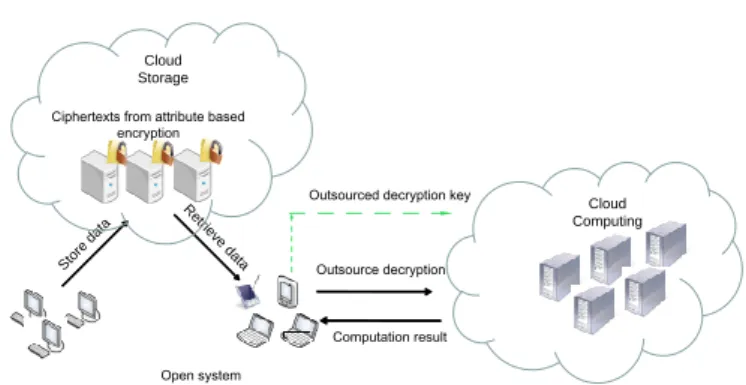
Here we describe the system model for our second pro-posal, which is mainly for reducing the decryption over-head of mobile users for secure access control system us-ing attribute based encryption. The open system here refers that the cloud can easily access the information flow (e.g. ABE ciphertexts) in this system. In this open system, there are four parties: the data owners, the da-ta users, and the cloud storage service provider, and the cloud computing service provider. The data owners first use attribute based encryption to share the datum with the data users via storage server, the data users are often mobile users and need to use the cloud comput-ing service to relieve the decryption overhead. Here the
R etrie ve d ata Cloud Computing
Ciphertexts from attribute based encryption Store dat a Outsource decryption Computation result Open system
Outsourced decryption key
Cloud Storage
Fig. 5: Outsourced attributed based encryption for open system
cloud computing service is a semi-trusted party, which is curious about deriving the secret keys of the data users or the decryption results.
4.2 Review of Generic Construction of Expressive Key-Policy Attribute-Based Encryption with Constant-Size Ciphertexts
Attrapadung et al. construct monotonic KP-ABE with short ciphertexts by showing a general transformation that automatically turns any IBBE scheme fitting a cer-tain template into a KP-ABE in the selective security model. Here we review this generic construction.
4.2.1 Linear ID-based Broadcast Encryption Template
They define a template that IBBE schemes should com-ply with in order to give rise to (selectively secure) KP-ABE schemes. They call this a linear IBBE tem-plate. Let (G, GT) be underlying bilinear groups of
or-derp. A linear IBBE scheme is determined by parame-tern1, n2∈N, a familyF of vectors of functions, and
a functionD of which the latter two are specified by
F ⊂ {f1, f2, F}|f1:Zp∗→G, f2:Zp∗→G n1, F : (Zp∗)≤n−1→G≤n2, D:Gn1+2×I×Gn2+1× I < N →GT
with requirements specified below. A linear IBBE scheme works as follows.
1. Setup(λ, n). Given a security parameterλ∈Nand a boundn∈Non the number of identities per cipher-text, the algorithm selects bilinear groups (G,GT)
of prime orderpand a generatorsg←RG. It
com-putes e(g, g)α for a random α ∈ Z∗p and
choos-es functions (f1, f2, F) ← F. The master secret
key consists of msk = gα while the public key is
2. Keygen(msk,ID). It picksr∈RZ∗p and computes
skID= (d1, d2, d3)
= (gα·f1(ID)r,gr,f2(ID)r)∈Gn1+2
3. Encrypt(mpk, M, S). It parses S asS={ID1,· · · ,IDq},
whereq≤n. To encryptM ∈GT, it chooses a
ran-dom exponents∈RZ∗pand computes the ciphertext
as
C= (C0, C1, C2)
= (M·e(g, g)αs, gs, F(ID1,· · · ,IDq)s)
4. Decrypt(mpk, skID,ID,C,S).It parsesskID= (d1, d2, d3)
andC= (C0, C1, C2) then runs
D((d1, d2, d3),ID,(C1,C2),S)→e(g,g)αs
and obtainsM = C0/e(g, g)αs. We are now ready
to state the requirements: for all (f1, f2, F)∈ F, the
following properties must hold (a) Correctness. For all α, r, s ∈ Z∗
p, ID ∈ I, S = {ID1,· · · ,IDq} ∈ I < N and ID∈S, We have D((gαf1(ID)r,gr,f2(ID)r),gr,f2(ID)r)), ID,(gs,F(ID1,· · ·,IDq)s),S) =e(g,g)αs
(b) Linearity.For allγ∈Z∗p,ID∈I,S∈(
I < N),ID∈ S, (d1, d2, d3)∈Gn1+2, and (C1, C2)∈G≤n2+1, we have D((d1, d2, d3)γ,ID,(C1, C2), S) =D((d1, d2, d3),ID,(C1, C2), S)γ
4.2.2 Generic Conversion from Linear IBBE to KP-ABE
LetΠIBBE= (Setup0, Keygen0, Encrypt0, Decrypt0) be
a linear IBBE system. They construct a KP-ABE scheme fromΠIBBE as follows:
1. Setup(λ, n):It simply outputsSetup0(λ, n)→(msk, mpk).
2. KeyGen(msk,(L, π)):The algorithm computes a pri-vate key for an access structure that is associated with LSSS scheme (L, π) as follows. Let Lbe l×k matrix. First it generates shares of 1 with the LSSS scheme (L, π) as follows. LetLbel×kmatrix. First, it generates shares of 1 with theLSSS(L, π). Name-ly, it chooses a vector β = (β1, β2,· · ·, βk)T ∈R
(Zp)k subject to the constraint β1 = 1. Then for
eachi = 1 to l, it calculates λi =< Li, β >, picks
r0∈RZp and setsDias follows:
Keygen0(msk, π(i))→(di,1, di,2, di,3) Di= (dλi,i1·f1(π(i))r 0 , dλi i,2·g r0, dλi i,3·f2(π(i))r 0 )
It then outputs the private key as sk(L,π)={Di}i=1,···,l
3. Encrypt(mpk, M, ω):It simply outputs Encrypt0(mpk, M, ω)→(C0, C1, C2)
4. Decrypt(mpk, sk(L,π),(L, π), C, ω):Assume first that
the policy (L, π) is satisfied by the attribute setω, so that decryption is possible. LetI={i|π(i)∈ω}. It calculates the reconstruction constants{(i, ui)}i∈I =
ReconL,π(ω). It parsesC as (C0, C1, C2) andskL,π
as{Di}i=1,···,l whereDi= (d0i,1, d0i,2, d0i,3). For each
i∈I, it computes
D((d0i,1, d0i,2, d0i,3), ID,(C1, C2), S)→e(g, g)α·s·λi
(1)
which we prove correctness below. It computee(g, g)αs=
Q
i∈I(e(g, g)
αsλi)uiand finally obtainsM = C0 e(g,g)αs,
where we recall that Σi∈Iλiui= 1.
Correctness. They now verify that equation (1) is correct. First from a property of keys in linear IBBE, we have that (di,1, di,2, di,3) will be in the form (gα·
f1(π(i))ri, gri, f2(π(i))ri) for someri∈RZ∗p. Therefore
we have Di= (gαλi·f1(π(i))rλ¯ i, grλ¯ i, f2(π(i)) ¯iλi) = (dλi 1 , d λi 2 , d λi 3 )
with ¯ri =ri+r0/λi and (d1, d2, d3) =skπ(i) with
ran-domness ¯ri. Hence
D((d0i,1, d0i,2, d0i,3), ID,(C1, C2), S)
=D((d1, d2, d3), ID,(C1, C2), S)λi
= (e(g, g)α·s)λi
where each equality holds from linearity and correctness ofDrespectively.
The authors also give the security theorem of the above generic construction:
Theorem 2 If the underlying IBBE scheme is selec-tively secure, then the resulting KP-ABE system is also selectively secure.
4.2.3 IBBE Instantiation with Short Ciphertexts
This subsection presents an IBBE scheme with short ciphertexts and shows how to apply the KP-ABE con-version. This specific IBBE can be seen as an instance of the functional encryption (FE) for zero inner-product, which itself is implied by spatial encryption of [10]. A FE system for zero inner- product is defined by a rela-tionRZIP :
Zp×Zp → {0,1}where RZIP(X,Y) = 1
if <X,Y >= 0. The technique of deriving an IBBE scheme from a FE scheme for zero inner-product can
be traced to [23]. A private key for an identity ID is defined by settingX = (x1,· · · , xn)T, withxi=IDi−1.
To encrypt to a set S = {ID1,· · · , IDq}, one defines
Y = (y1,· · ·, yn)T as a coefficient vector from
PS[Z] =Σ q+1 i=1yiZi−1= Y IDj∈S (Z−IDj) (2)
where, if q+ 1 ≤ n, the coordinates yq+2,· · · , yn are
set to 0. By doing so, we note thatPS[ID] =<X,Y>
evaluates to 0 iff ID ∈ S. We now describe the IBBE instantiated from the FE system of [4]. Its selective se-curity is an immediate consequence of [4], where it is proved under the DBDHE assumption.
1. Setup(λ, n): It chooses bilinear groups (G,GT) of
prime order p ≥ 2λ with g ←
R G. It randomly
chooses α, α0 ∈ Zp, α = (α1,· · · , αn)T ←R Znp.
It then sets H = (h1,· · ·, hn)T = gα. The
mas-ter secret key is msk = α, and the public key is mpk= (g, e(g, g)α, h0=gα0, H =gα).
2. KeyGen(msk,ID):The algorithm first defines a vec-tor X = {x1,· · ·, xn}T such that xi = IDi−1 for
i = 1 to n. It chooses r ∈R Zp and outputs the
private keyskID= (D1, D2, K2,· · ·, Kn) where
D1=gα·hr0, D2=gr,{Ki= (h −xi x1 1 ) r} i=2,···,n
3. Encrypt(mpk, M, S): To encrypt M to the receiv-er set S (where |S| ≤ n), the algorithm defines
Y = (y1, y2,· · ·, yn)T as the coefficient vector of
PS[Z] from equation (2). It then picks s ←R Zp
and computes the ciphertext as
C= (C0, C1, C2) = (M·e(g, g)αs, gs,(h0·hy1· · ·h
yn n )
s)
4. Decrypt(mpk, skID,ID,C,S):It defines the vectorY =
(y1,· · ·, yn)T from the polynomial PS[Z] as usual.
It then computes e(g, g)αs= e(C1, D1·K y2 2 · · ·K yn n ) e(C2, D2) and recoversM = C0 e(g,g)αs.
Correctness.If< X, Y >= 0, then decryption recov-ers M since D1· n Y i=2 Kyi i =g α(h 0·h −1 x1(<X,Y >−x1y1) 1 n Y i=2 hyi i ) r =gα(h0· n Y i=1 hyi i ) r
so thate(C1, D1·Qni=1Kiyi) =e(g, g)αs·e(h0Qni=1hyii, grs)
equals the producte(g, g)αs·e(C2, D2).
Applying the KP-ABE Conversion.The above IBBE can be considered as a linear IBBE system withn1 =
n−1, n2 = 1 and the family F is defined by
tak-ing all functions of the followtak-ing forms rangtak-ing over h0, h1,· · ·, hn ∈G: f1(ID) =h0,f2(ID) = (h−1IDh2,· · ·, h−ID n−1 1 hn), F(ID1,· · ·,IDq) =h0 q+1 Y i=1 hyi i
where the vector Y = {y1,· · · , yn)T is defined from
the polynomialPS[Z] in equation (2) as usual. In
addi-tion, the functionDis the computation in equation (3), which can be show to have linearity as required. The resulting KP-ABE has constant-size ciphertexts. This comes with the expense of longer private keys of size O(tn), wheretis the number of attributes in the access structure.
4.3 Our Proposal
Here we give a generic construction just like the above transformation: LetΠIBBE= (Setup0, Keygen0, Encrypt0,
Decrypt0) be a linear IBBE system. Then we construct an efficient outsourcing KP-ABE scheme with energy efficiency fromΠIBBE as follows:
1. Setup(λ, n):It simply outputsSetup0(λ, n)→(msk, mpk). 2. KeyGen(msk,(L, π)):The algorithm computes a
pri-vate key for an access structure that is associated with LSSS scheme (L, π) as follows. LetL bel×k matrix. First it generates shares of 1 with the LSSS scheme (L, π) as follows. LetLbel×kmatrix. First, it generates shares of 1 with theLSSS(L, π). Name-ly, it chooses a vector β = (β1, β2,· · · , βk)T ∈R
(Zp)k subject to the constraint β1 = 1. Then for
each i = 1 to l, it calculates λi =< Li, β >, picks
r0 ∈
RZpand sets Di as follows:
Keygen0(msk, π(i))→(di,1, di,2, di,3) Di= (dλi,i1·f1(π(i))r 0 , dλi i,2·g r0, dλi i,3·f2(π(i))r 0 ) It then outputs the private key assk(L,π)={Di}i=1,···,l.
3. Outsourcing KeyGen(sk(L,π), T emp):This algorithm
computes the outsourcing private key for data us-er. After input the secret keysk(L,π)and a random
T emp ∈ Z∗
p which acts as the key to mask the
re-al secret key, this re-algorithm outputs the outsourced secret key skoutsource
(L,π) for this data user
D 1 T emp i = ((d λi i,1·f1(π(i))r 0 )T emp1 , (dλi i,2·g r0) 1 T emp, (dλi i,3·f2(π(i))r 0 )T emp1 )
The data user preservesT emp for final decryption. 4. Encrypt(mpk, M, ω):It simply outputsEncrypt0(mpk,
M, ω)→(C0, C1, C2).
5. Outsourcing Decrypt(mpk, sk(L,π),(L, π), C, ω):
As-sume first that the policy (L, π) is satisfied by the at-tribute setω, so that decryption is possible. LetI=
{i|π(i) ∈ ω}. The cloud calculates the reconstruc-tion constants{(i, ui)}i∈I =ReconL,π(ω). It parses
Cas (C0, C1, C2) andskoutsourceL,π as{D 1 T emp i }i=1,···,l whereD 1 T emp i = ((d0i,1) 1 T emp,(d0 i,2) 1 T emp,(d0 i,3) 1 T emp).
For eachi∈I, it computes
D(((d0i,1)T emp1 ,(d0 i,2) 1 T emp,(d0 i,3) 1 T emp), ID, (C1, C2), S)→e(g, g) α·s·λi T emp (3)
which we prove correctness below. It compute T empDecrypt=e(g, g)T empαs
=Y
i∈I
(e(g, g)α
·s·λi
T emp)ui
where we recall thatΣi∈Iλiui= 1.
6. Decrypt(T empDecrypt,T emp):On inputsT empDecrypt andT emp, this algorithm finally obtainse(g, g)αs = T empDecryptT emp = (e(g, g)T empαs )T emp and thus
M = C0
e(g,g)αs.
Correctness.We can verify that equation (3) is cor-rect. First from a property of keys in linear IBBE, we have that (di,1, di,2, di,3) will be in the form (gα·
f1(π(i))ri, gri, f2(π(i))ri) for someri∈RZ∗p. Therefore
we have Di= (gαλi·f1(π(i))¯rλi, g¯rλi, f2(π(i)) ¯iλi) = (dλi 1 , d λi 2 , d λi 3 )
with ¯ri =ri+r0/λi and (d1, d2, d3) =skπ(i)with
ran-domness ¯ri. Hence D(((d0i,1)T emp1 ,(d0 i,2) 1 T emp,(d0 i,3) 1 T emp), ID,(C 1, C2), S) =D((d1, d2, d3), ID,(C1, C2), S) λi T emp
= (e(g, g)α·s)T empλi
where each equality holds from linearity and correct-ness ofD respectively. And the correctness of Decrypt algorithm follows easily. Our technique is same as [14]
4.4 Security Analysis
We have the following security theorem on our proposal (denoted as KP-OABE):
Theorem 3 If the underlying IBBE scheme is selec-tively secure, then so is the resulting KP-OABE sys-tem. More precisely, for any selective-set adversary A
against the KP-OABE construction, there is an IND-sID-CPA adversaryBagainst the IBBE scheme and we have:
AdvBIBBE−sID−CP A(λ)≥AdvAKP−OABE−sCP A(λ)
More concretely, our KP-ABE scheme with outsourced decryption is selectively CPA-secure assuming that the scheme of Attrapdung [4] is an selectively CPA-secure IBBE scheme.
Proof We construct a simple IND-sID-CPA adversary
Bagainst the IBBE scheme assuming that a selective-set attackerAhas non-negligible advantage against the KP-OABE system. Namely,Bplays the role ofAs chal-lenger and interacts with his own chalchal-lenger in the IBBE security game. Here, we call the challenger of IBBE as
CI.
The game begins with our KP-OABE adversary A
choosing an attribute setω∗that intends to attack. The
Attrapdung IBBE adversary B then announces S∗ =
{i∈ω∗}as her target set of receivers. The system-wide Attrapdung IBBE public key thatB receives from her challenger are relayed toAas system-wide parameters for the our KP-OABE scheme.
1. Init. KP-OABE adversary A chooses the set of at-tribute set ω∗ it wishes to be challenged upon and sends toB.
2. Setup. The challenger CI computes the public key
M P K = (g, e(g, g)α, f1, f2, F, n, n1, n2) and sends
these to the adversaryA.
3. Phase 1.In this phase the simulator Banswers the following queries byA. AndBconstructs the corre-sponding key tableQ, then it answers the adversarys queries as follows:
Amay ask for the private key of any access structure (L, π) such thatω∗ does not satisfy (L, π). To
an-swer such a query, letLω∗be the sub-matrix formed
by the rows ofLthat correspond to an attribute in ω∗. Since1= (1,0,· · ·,0)T is not in the row space of Lω∗, there must exist an efficiently computable
vector w such that Lω∗·w = 0 and <1, w >6= 0.
Lethdenote the value of<1, w >6= 0. Lethdenote the value<1, w >. To construct a private key,Bhas to define a vectoru=a·β such that .Bimplicitly setsuasu=v+ψ·w, wherev= (v1,· · · , vk)T is a
randomly chosen vector andψ= (α−v1)/h, so that
(1, w) =α. To generate triples (Di,1, Di,2, Di,3) for
each row of L,Bproceeds as follows:
(a) Let Γ1 ={j ∈ {1,· · ·, l}|π(j) ∈ ω∗}. For each
j ∈ Γ1, if Γ1T = (mj1,· · ·, mjk) denotes the
jth row of L, we have <Lj,u >=<Lj,u >=
Pk
t1=1mjt1vt1 and the share λj =< Lj,u > is
λj, rj ∈RZp∗and define (Dj =Dj,1, Dj,2, Dj,3) =
(gλj·f
1(π(j))rj, grj, f2(π(j))rj).B calls the the
IBBE key generation oracle on (L, π) to obtain the private keyskL,π. ThenBchooses a random
value T emp ∈ Z∗
p and sets the outsourced
se-cret keyskoutsource L,π asD
1/T emp
j . FinallyBstores
(skL,π, skoutsourceL,π , T emp) in tableQ.
(b) Let Γ2 = {j ∈ {1,· · ·, l}|π(j) ∈/ ω∗}. For each
j∈Γ2,Bis allowed to query its own challenger CI to extract (dj,1, dj,2, dj,3)← Y IBBE Keygen(msk, π(j)) We have<Lj,u>=<Lj,v>+ψ <Li,w >=¯ Pk t1=1mjt1 vt1+ α−v1 h ωt1 = µ1α+µ2 where the coefficientsµ1 = (P k t1=1mjt1wt1)·h −1 and µ2=h−1Pkt1=1mjt1wt1(hvt1−v1wt1) are both
computable, so thatBcan obtain a well-formed triple Dj = (Dj,1, Dj,2, Dj,3) = (dµ1 j,1g µ2f 1(π(j))r 0 j, dµ1 j,2·g r0j, dµ1 j,2·g r0j, dµ1 j,3·f(π(j)) rj0)
B calls the the IBBE key generation oracle on (L, π) to obtain the private keysk(L, π). Then,
Bchooses a random valueT emp0∈Zp∗ and set-s the outset-sourced set-secret key (set-sk0(L,π))outsource as
D 1 T emp0 j . Finally,B stores (sk(0L,π),(sk0(L,π))outsource, T emp) in tableQ.
4. Challenge.The adversaryAsubmits two equal length messages M0, M1 and attribute S to B to obtain
the challenge ciphertext CT∗. Then, B sends the M0, M1 to CI before relaying the challenge
cipher-texts back toA.
5. Phase 2. The adversary A continues to adaptively queries as in Phase 1, but with the restriction that the adversary cannot violate the constraint on the challenge attributeS.B responds the queries as in Phase 1. AndB eventually outputs the same result σ∈ {0,1} asAdoes. It is easy to see that Bnever has to query her challenger to extract the private key for an identity of the target attribute setS∗ = ω∗.
6. Guess.Eventually, Aoutputs a bit β0, then B
out-putsβ0. This ends the description of the simulation. Thus, ifAhas advantage in the selective security game against our scheme, thenBbreaks theIBBE scheme with the same probability. It comes thatB
is successful wheneverAis so, this ends our proof.
4.5 A New Way to Outsource the Decryption Key with Only One Modular Exponentiation Cost
Here we give a new way for secure efficient outsourc-ing the decryptor’s decryption key for KP-ABE, which only cost one modular exponentiation, concretely the outsourced KP-ABE scheme is the following:
1. Setup(λ, n):It simply outputs
Setup0(λ, n)→(msk, mpk)
2. KeyGen(msk,(L, π)):The algorithm computes a pri-vate key for an access structure that is associated with LSSS scheme (L, π) as follows. LetL bel×k matrix. First it generates shares of 1 with the LSSS scheme (L, π) as follows. Let L be l ×k matrix. It chooses a vector β = (β1, β2,· · ·, βk)T ∈R (Zp)k
subject to the constraintβ1= 1. Then for eachi= 1
tol, it calculatesλi=< Li, β >, picksr0 ∈RZpand
setsDi as follows: Keygen0(msk, π(i))→(di,1, di,2, di,3) Di= (dλi,i1·f1(π(i))r 0 , dλi i,2·g r0, dλi i,3·f2(π(i))r 0 ) It then outputs the private key assk(L,π)={Di}i=1,···,l.
3. Outsourcing KeyGen(sk(L,π), z):This algorithm
com-putes the outsourcing private key for data user. Af-ter input the secret keysk(L,π)and a randomz∈Z∗p
which acts as the key to mask the real secret key, this algorithm outputs the outsourced secret key skoutsource
(L,π) for this data user
Doutsourcei = ((dλi i,1·f1(π(i))r 0 )·gz,(dλi i,2·g r0) ·gz,(dλi i,3·f2(π(i))r 0 )·gz) The data user preserveszfor final decryption.
4. Encrypt(mpk, M, ω):It simply outputs Encrypt0(mpk, M, ω)→(C0, C1, C2)
5. Outsourcing Decrypt(mpk, sk(L,π),(L, π), C, ω):
As-sume first that the policy (L, π) is satisfied by the attribute set ω, so that decryption is possible. Let I = {i|π(i) ∈ ω}. The cloud calculates the recon-struction constants {(i, ui)}i∈I = ReconL,π(ω). It
parses C as (C0, C1, C2) and skoutsourceL,π as ((d0i,1)·
gz,(d0
i,2)·gz,(di,03)·gz). For eachi∈I, it computes
Xi=D(((d0i,1)·g z,(d0 i,2)·g z,(d0 i,3)·g z), ID,(C 1, C2), S) (4) Yi=D((g, g, g), ID,(C1, C2), S) (5)
which we prove correctness below. It compute T empDecrypt1= Y i∈I (e(g, g)α·s·λi(Yz i )) ui
and T empDecrypt2 = Qi∈I(Yi)ui where we recall
thatΣi∈Iλiui= 1.
6. Decrypt(T empDecrypt1,T empDecrypt2,z):On
in-puts T empDecrypt1, T empDecrypt2, z, this
algo-rithm finally obtains e(g, g)αs = T empDecrypt1 T empDecryptz 2
and thusM = C0
e(g,g)αs.
Correctness.We can verify that equation (3) is cor-rect. First from a property of keys in linear IBBE, we have that (di,1, di,2, di,3) will be in the form (gα·
f1(π(i))ri, gri, f2(π(i))ri) for someri∈RZ∗p. Therefore
we have Di= (gαλi·f1(π(i))¯rλi, g¯rλi, f2(π(i)) ¯iλi) = (dλi 1 , d λi 2 , d λi 3 )
with ¯ri =ri+r0/λi and (d1, d2, d3) =skπ(i)with
ran-domness ¯ri. Hence
D((gz, gz, gz), ID,(C1, C2), S)
=D((g, g, g), ID,(C1, C2), S)z
where each equality holds from linearity and correct-ness ofD respectively. And the correctness of Decrypt algorithm follows easily.Security.Here we roughly anal-ysis the security of this proposal. The main difference between this proposal and the above one is this: in Out-sourcing KeyGenalgorithm, the outsourced key is
Doutsourcei = ((dλi i,1·f1(π(i))r 0 )·gz,(dλi i,2·g r0)·gz,(dλi i,3·f2(π(i))r 0 )·gz) Forz is unknown to the adversary, thus the adversary can not easily derive the real decryption key.
4.6 Feature and Performance Analysis
4.6.1 Feature Comparison
Table 2: Comparison Result
Proposals Constant Ciphertext Length Verifiability Contribution
[14] No No First OD-ABE
[15] No Yes First OD-ABE-V
[19] No Yes First OD/E/K-ABE-V
[22] No Yes Efficient OD-ABE-V
Ours Yes No Efficient OD-C-ABE
In this subsection, we compare our work with the previous work, with the emphasis on the ciphertex-t lengciphertex-th. OD-ABE denociphertex-tes ouciphertex-tsourcing decrypciphertex-tion of ABE, OD-ABE-V denotes outsourcing decryption of
ABE with verifiability, OD/E/K-ABE-V denotes out-sourcing decryption/encryption/key generation of ABE with verifiability, OD-C-ABE denotes outsourcing de-cryption of ABE with constant ciphertexts. We also note our scheme can easily achieve verifiability proper-ty by adapting the technique presenting in [22], which is the most efficient one until now. From the above ta-ble, we can see our proposal is the most energy efficient scheme for mobile users when outsourcing the decryp-tion of attribute based encrypdecryp-tion to the cloud, which will has important applications for mobile users, while this is a more and more common setting in our life.
4.6.2 Performance Analysis
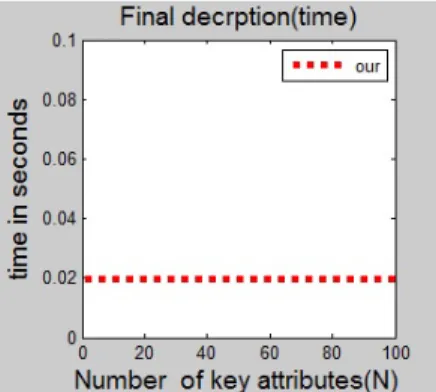
We roughly evaluate the performance of our second pro-posal. According to the benchmark of JPBC, based on the testbed3 which with the following hardware plat-forms: HTC Desire HD A9191, Android 2.2 (Java Port) [27], we give the comparison results between Green et al.’s scheme [14] and our scheme, which can be seen in Table II, III, IV and Fig. 6, 7, 8, 9. These performance evaluation results show our second proposal is practical.
Table 3: ABE Ciphertext Size (Kbytes) Scheme/Number of Attributes 20 40 60 80 100
GHW [14] 1.385 2.645 3.905 5.165 6.425 Ours 0.188 0.188 0.188 0.188 0.188
Table 4: Outsourcing KeygenTime(seconds) Scheme/Number of Attributes 20 40 60 80 100
GHW [14] 0.118 0.176 0.234 0.292 0.350 Our first way 4.3 0.089 0.089 0.089 0.089 0.089 Our another new way4.5 0.029 0.029 0.029 0.029 0.029
Table 5: Final Decryption time (seconds)
Scheme/Number of Attributes 20 40 60 80 100
Ours 0.0198 0.0198 0.0198 0.0198 0.0198
5 Conclusion
In this paper, we consider the issue of outsourcing de-cryption of ABE for mobile devices with energy effi-ciency. We give two proposals. The first one is based on a novel permutation technique for access structure and attributes, which can be used for self-enclosed sys-tem. The second one is based on ABE schemes with
Fig. 6: ABE cipertext size comparison
Fig. 7: Outsourcing keygen time comparison
Fig. 8: Final decryption time
constant ciphertexts for mobile users in the cloud set-ting. We propose a generic construction for outsourced ABE based on Attrapadung et al. generic construction of ABE. We think the ciphertext length is an impor-tant issue for outsourcing for it directly affect the bat-tery’s energy consuming, the more shorter the cipher-texts are, the more surviving time the mobile phones can support. However, we also note our result is very basic, many open problems are leaving such as prov-ing proposprov-ing outsourcprov-ing decryption of ABE candi-dates with constant ciphertexts and constant private
Fig. 9: Outsourcing keygen time comparison between GHW and our new way
keys etc, extending the idea of permutation technique to ciphertext-policy attribute based encryption etc.
Acknowledgements
The second author and third author are the correspond-ing authors. This work is supported by the Nation-al Cryptography Development Fund of China Under Grants No. MMJJ20170112, National Key Research and Development Program of China Under Grants No. 2017YF-B0802002, National Nature Science Foundation of Chi-na (Grant Nos. U1636114, 61402531, 61572521), the Nature Science Basic Research Plan in Shaanxi Province of china (Grant Nos. 2014JM8300, 2014JQ8358, 2015JQ6231, 2016JQ6037) and Guangxi Key Laboratory of Cryptog-raphy and Information Security (No. GCIS201610).
References
1. Nuttapong Attrapadung. Dual system encryption via
doubly selective security: Framework, fully secure
func-tional encryption for regular languages, and more. In
Phong Q. Nguyen and Elisabeth Oswald, editors,
EU-ROCRYPT 2014, volume 8441 ofLNCS, pages 557–577.
Springer, May 2014.
2. Nuttapong Attrapadung and Hideki Imai.
Conjunc-tive broadcast and attribute-based encryption. In
Hov-av Shacham and Brent Waters, editors,PAIRING 2009,
volume 5671 ofLNCS, pages 248–265. Springer, August
2009.
3. Nuttapong Attrapadung and Hideki Imai. Dual-policy
attribute based encryption. In Michel Abdalla, David
Pointcheval, Pierre-Alain Fouque, and Damien Vergnaud,
editors,ACNS 09, volume 5536 ofLNCS, pages 168–185.
Springer, June 2009.
4. Nuttapong Attrapadung, Benoˆıt Libert, and Elie
de Panafieu. Expressive key-policy attribute-based en-cryption with constant-size ciphertexts. In Dario Cata-lano, Nelly Fazio, Rosario Gennaro, and Antonio Nicolosi,
editors,PKC 2011, volume 6571 ofLNCS, pages 90–108.
5. Melissa Chase. Multi-authority attribute based
encryp-tion. In Salil P. Vadhan, editor,TCC 2007, volume 4392
ofLNCS, pages 515–534. Springer, February 2007.
6. Melissa Chase and Sherman S. M. Chow. Improving pri-vacy and security in multi-authority attribute-based en-cryption. In Ehab Al-Shaer, Somesh Jha, and Angelos D.
Keromytis, editors,ACM CCS 09, pages 121–130. ACM
Press, November 2009.
7. Jie Chen and Hoeteck Wee. Fully, (almost) tightly secure IBE and dual system groups. In Ran Canetti and Juan A.
Garay, editors,CRYPTO 2013, Part II, volume 8043 of
LNCS, pages 435–460. Springer, August 2013.
8. Jie Chen and Hoeteck Wee. Doubly spatial
encryp-tion from DBDH. Cryptology ePrint Archive, Report
2014/199, 2014. http://eprint.iacr.org/2014/199.
9. Jie Chen and Hoeteck Wee. Dual system groups and its
applications — compact HIBE and more. Cryptology
ePrint Archive, Report 2014/265, 2014. http://eprint.
iacr.org/2014/265.
10. Sanjam Garg, Craig Gentry, Shai Halevi, Amit Sahai, and Brent Waters. Attribute-based encryption for cir-cuits from multilinear maps. In Ran Canetti and Juan A.
Garay, editors,CRYPTO 2013, Part II, volume 8043 of
LNCS, pages 479–499. Springer, August 2013.
11. Sanjam Garg, Craig Gentry, Shai Halevi, and Mark Zhandry. Fully secure functional encryption without ob-fuscation. Cryptology ePrint Archive, Report 2014/666,
2014. http://eprint.iacr.org/2014/666.
12. Sergey Gorbunov, Vinod Vaikuntanathan, and Hoeteck
Wee. Attribute-based encryption for circuits. In Dan
Boneh, Tim Roughgarden, and Joan Feigenbaum,
edi-tors,45th ACM STOC, pages 545–554. ACM Press, June
2013.
13. Vipul Goyal, Omkant Pandey, Amit Sahai, and
Bren-t WaBren-ters. Attribute-based encryption for fine-grained
access control of encrypted data. In Ari Juels, Rebec-ca N. Wright, and Sabrina De Capitani di VimerRebec-cati,
editors,ACM CCS 06, pages 89–98. ACM Press,
Octo-ber / NovemOcto-ber 2006. Available as Cryptology ePrint Archive Report 2006/309.
14. Matthew Green, Susan Hohenberger, and Brent Water-s. Outsourcing the decryption of abe ciphertextWater-s. Proc. USENIX Security Symposim, San Francisco, CA, USA, 2013.
15. Junzuo Lai, Robert Deng, Caowen Guan, and Jian Weng. Attribute-based encryption with verifiable outsourced
de-cryption. IEEE Transaction on Information Forensics
and Security, 8(8):1343–1354, 2013.
16. Allison B. Lewko, Tatsuaki Okamoto, Amit Sahai, Kat-suyuki Takashima, and Brent Waters. Fully secure func-tional encryption: Attribute-based encryption and (hier-archical) inner product encryption. In Henri Gilbert,
ed-itor,EUROCRYPT 2010, volume 6110 of LNCS, pages
62–91. Springer, May 2010.
17. Allison B. Lewko and Brent Waters. Decentralizing
attribute-based encryption. In Kenneth G. Paterson,
ed-itor,EUROCRYPT 2011, volume 6632 of LNCS, pages
568–588. Springer, May 2011.
18. Allison B. Lewko and Brent Waters. New proof method-s for attribute-bamethod-sed encryption: Achieving full method-security through selective techniques. In Reihaneh Safavi-Naini
and Ran Canetti, editors,CRYPTO 2012, volume 7417
ofLNCS, pages 180–198. Springer, August 2012.
19. Jin Li, Xinyi Huang, Jingwei Li, Xiaofeng Chen, and
Yang Xiang. Securely utsourcing attribute-based
en-cryption with checkability. IEEE Transation on
Paral-lel and Distributed Systems, In Press, doi: 10.1109/T-PDS.2013.27, 2013.
20. Tatsuaki Okamoto and Katsuyuki Takashima. Fully se-cure functional encryption with general relations from the decisional linear assumption. In Tal Rabin, editor,
CRYPTO 2010, volume 6223 of LNCS, pages 191–208.
Springer, August 2010.
21. Bryan Parno, Mariana Raykova, and Vinod Vaikun-tanathan. How to delegate and verify in public: Verifiable computation from attribute-based encryption. In Ronald
Cramer, editor,TCC 2012, volume 7194 ofLNCS, pages
422–439. Springer, March 2012.
22. Baodong Qin, Robert H. Deng, Shengli Liu, and Siqi Ma. Attribute-based encryption with efficient verifiable
out-sourced decryption. IEEE Transaction on Information
Forensics and Security, 10(7):1384–1393, 2015.
23. Amit Sahai and Brent R. Waters. Fuzzy identity-based
encryption. In Ronald Cramer, editor,
EUROCRYP-T 2005, volume 3494 ofLNCS, pages 457–473. Springer, May 2005.
24. Brent Waters. Dual system encryption: Realizing fully secure IBE and HIBE under simple assumptions. In Shai
Halevi, editor,CRYPTO 2009, volume 5677 of LNCS,
pages 619–636. Springer, August 2009.
25. Shota Yamada, Nuttapong Attrapadung, Goichiro
Hanaoka, and Noboru Kunihiro. Generic constructions for chosen-ciphertext secure attribute based encryption. In Dario Catalano, Nelly Fazio, Rosario Gennaro, and
Antonio Nicolosi, editors,PKC 2011, volume 6571 of
L-NCS, pages 71–89. Springer, March 2011.
26. Shota Yamada, Nuttapong Attrapadung, Goichiro
Hanaoka, and Noboru Kunihiro. A framework and com-pact constructions for non-monotonic attribute-based
en-cryption. In Hugo Krawczyk, editor,PKC 2014, volume
8383 ofLNCS, pages 275–292. Springer, March 2014.
27. Angelo De Caro, Vincenz Iovino. jPBC: java pairing
based cryptography. In Proceeding of the 16th IEEE
symposium on Comuputers and Communications,
ISC-C 2011, pages 850–855. IEEE, 2011. http://gas.dia.
unisa.it/projects/jpbc/.
28. Xu An Wang, Jianfeng Ma, Fatos Xhafa. Outsourcing decryption of attribute based encryption with energy
ef-ficiency. InProceeding of the International Conference
on P2P, Parallel, Grid, Cloud and Internet Computing