Characterization of Secure Multiparty Computation
Without Broadcast
∗Ran Cohen† Iftach Haitner‡ Eran Omri§ Lior Rotem¶
August 27, 2017
Abstract
A major challenge in the study of cryptography is characterizing the necessary and sufficient assumptions required to carry out a given cryptographic task. The focus of this work is the necessity of a broadcast channel for securely computing symmetric functionalities (where all the parties receive the same output) when one third of the parties, or more, might be corrupted. Assuming all parties are connected via a point-to-point network, but no broadcast channel (nor a secure setup phase) is available, we prove the following characterization:
• A symmetricn-party functionality can be securely computed facing n/3 ≤t < n/2 cor-ruptions (i.e., honest majority), if and only if it is (n−2t)-dominated; a functionality is k-dominated, ifany k-size subset of its input variables can be set todetermineits output to some predetermined value.
• Assuming the existence of one-way functions, a symmetric n-party functionality can be securely computed facingt≥n/2 corruptions (i.e., no honest majority), if and only if it is 1-dominated and can be securely computed with broadcast.
It follows that, in case a third of the parties might be corrupted, broadcast is necessary for securely computing non-dominated functionalities (in which “small” subsets of the inputs cannot determine the output), including, as interesting special cases, the Boolean XOR and coin-flipping functionalities.
Keywords: broadcast; point-to-point communication; multiparty computation; coin flipping; fairness; impossibility result.
∗
An extended abstract of this work appeared in [11].
†
Department of Computer Science, Bar-Ilan University. E-mail: [email protected]. Work supported bythe israel science foundation(grant No. 189/11), the Ministry of Science, Technology and Space and by the National Cyber Bureau of Israel.
‡
School of Computer Science, Tel Aviv University. E-mail: [email protected]. Research supported by ERC starting grant 638121, ISF grant 1076/11, I-CORE grant 4/11, BSF grant 2010196, and Check Point Institute for Information Security.
§
Department of Computer Science and Mathematics, Ariel University. E-mail: [email protected]. Research supported by ISF grant 544/13.
¶
School of Computer Science and Engineering, Hebrew University of Jerusalem. E-mail:
Contents
1 Introduction 1
1.1 Our Result . . . 1
1.2 Our Technique . . . 3
1.3 Additional Related Work . . . 5
1.4 Open Questions . . . 6
2 Preliminaries 6 2.1 Notations . . . 6
2.2 Protocols . . . 7
2.2.1 Time and Round Complexity . . . 7
3 Attacking Consistent Protocols 8 3.1 Protocols of Strict Running-Time Guarantee . . . 8
3.2 Protocols of Expected Running-Time Guarantee . . . 11
4 Impossibility Results for Secure Computation 12 4.1 Symmetric Functionalities Secure According to the Real/Ideal Paradigm . . . 12
4.1.1 Model Definition . . . 12
4.1.2 Dominated Functionalities . . . 14
4.1.3 The Lower Bound . . . 14
4.2 Coin-Flipping Protocols . . . 15
5 Characterizing Secure Computation Without Broadcast 16 5.1 No Honest Majority . . . 16
5.2 Honest Majority . . . 16
5.2.1 Defining Two-Threshold Security . . . 17
1
Introduction
Broadcast (introduced by Lamport et al. [24] as the Byzantine Generals problem) allows any party to deliver a message of its choice to all parties, such that all honest parties will receive the same message even if the broadcasting party is corrupted. Broadcast is an important resource for imple-menting secure multiparty computation. Indeed, much can be achieved when broadcast is available (hereafter, the broadcast model). In the computational setting, assuming the existence of oblivious transfer, every efficient functionality can be securely computedwith abort,1facing an arbitrary num-ber of corruptions [29,18]. Some functionalities can be computed with full security,2 e.g., Boolean OR and three-party majority [20], or with 1/p-security,3e.g., coin-flipping protocols [25,22]. In the information-theoretic setting, considering ideally secure communication lines between the parties, every efficient functionality can be computed with full security against unbounded adversaries,4 facing any minority of corrupted parties [28].
The above drastically changes when broadcast or a secure setup phase are not available,5 specifi-cally, when considering multiparty protocols (involving more than two parties), in which the parties are connected only via a point-to-point network (hereafter, the point-to-point model) and one third of the parties, or more, might be corrupted.6 Considering authenticated channels and assuming the existence of oblivious transfer, every efficient functionality can be securely computed with abort, facing an arbitrary number of corruptions [15]. In the full-security model, some important function-alitiescannot be securely computed when a third of the parties might be corrupted (e.g., Byzantine agreement [26] and three-party majority [10]), whereas other functionalities can be securely com-puted facing an arbitrary number of corruptions (e.g.,weak Byzantine agreement [15] and Boolean OR [10]). The characterization of many other functionalities, however, was unknown. For instance, it was unknown whether the coin-flipping functionality or the Boolean XOR functionality can be computed with full securely, even when assuming an honest majority.
1.1 Our Result
A protocol is t-consistent, if in any execution of the protocol, in which at most t parties are corrupted, all honest parties output the same value. Our main technical result is the following attack on consistent protocols.
Lemma 1.1 (main lemma, informal). Let n ≥ 3, t ≥ n3, and let s = n−2t if t < n2 and
s= 1 otherwise. Let π be an n-party, t-consistent protocol in the point-to-point model with secure channels. Then, there exists an adversary that by corrupting any s-size subsetI of the parties can
1
An efficient attack in the real world is computationally indistinguishable, via a simulator, from an attack on an “ideal computation,” in which malicious parties are allowed to prematurely abort even after learning the output.
2The malicious parties in the “ideal computation” are not allowed to prematurely abort. 3
The success probability of any efficient distinguisher between the real model and an “ideal computation” without abort is bounded from above by 1/p.
4
The real and ideal models are statistically close: indistinguishable even in the eyes of an all-powerful distinguisher.
5In case a secure setup phase is available,authenticated broadcastcan be computed facingt < ncorrupted parties;
Authenticated broadcast exists in the computational setting over authenticated channels assuming one-way functions exist [13] and in the information-theoretic setting over secure channels given a correlated-randomness setup [27].
6
do the following: first, before the execution of π, output a value y∗ = y∗(I). Second, during the execution of π, force the remaining honest parties to output y∗. The running time of the adversary is proportional to executing polynomially many instances ofπ.
The lemma extends toexpectedpolynomial-time protocols, and to protocols that only guarantee consistency to hold with high probability. We prove the lemma by extending the well-known hexagon argument of Fischer et al. [14], originally used for proving the impossibility of reaching (strong and weak) Byzantine agreement in the point-to-point model.
A corollary of Lemma 1.1is the following lower bound on symmetric functionalities, where all parties receive the same output value. (To give a stronger lower bound, we state the result in the secure-channels model rather than in the authenticated-channels model, since any functionality that can be computed with authenticated channels can also be computed with secure channels.) A functionality isk-dominated, if there exists a valuey∗such thatanyk-size subset of the functionality input variables can be manipulated to make the output of the functionality bey∗ (e.g., the Boolean OR functionality is 1-dominated with value y∗ = 1).
Corollary 1.2 (Informal). Let n≥3, t≥ n3, and let s=n−2t if t < n2 and s= 1 otherwise. A symmetricn-party functionality that can be computed with full security in the point-to-point model with secure channels, facing up to t corruptions, is s-dominated.
Interestingly, the above lower bound is tight. Cohen and Lindell [10] (following Fitzi et al. [15]) showed that assuming one-way functions exist, any 1-dominated functionality (e.g., Boolean OR) that can be securely computed in the broadcast model with authenticated channels can be securely computed in the point-to-point model with authenticated channels. This shows tightness when an honest majority is not assumed. We generalize the approach of [10], using the two-threshold detectable precomputation of Fitzi et al. [16], to get the following upper bound (in all our positive results, the efficiency of the protocol is considered to be polynomial in the circuit size of the functionality).
Proposition 1.3 (Informal). Let n ≥ 3 and n3 ≤ t < n2. Assuming up to t corruptions, any symmetricn-party functionality that is(n−2t)-dominated, can be computed in the secure-channels point-to-point model with information-theoretic security.
Combining Corollary1.2, Proposition1.3and [10, Thm. 7], yields the following characterization of symmetric functionalities.
Theorem 1.4 (main theorem, informal). Let n ≥ 3, t ≥ n
3 and let f be a symmetric n-party
functionality.
1. For t < n2, f can be t-securely computed (with information-theoretic security) in the secure-channels point-to-point model if and only if f is(n−2t)-dominated.
2. For t ≥ n
2, assuming one-way functions exist, f can be t-securely computed (with
compu-tational security) in the authenticated-channels point-to-point model if and only if f is 1-dominated and can bet-securely computed (with computational security) in the authenticated-channels broadcast model.
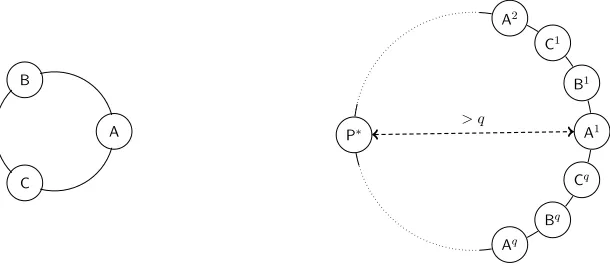
A B
C
Aq Bq
Cq A1 B1 C1 A2
P∗
> q
Figure 1: The original 3-party protocolπ= (A,B,C) is on the left. On the right is the 3q-Ring —qcopies ofπconcatenated. Communication time between parties of opposite sides is larger than 3q/2> q.
cheating parties cannot bias the outcome of the protocol by too much. We focus on protocols in which honest parties must output the same bit. Although Theorem1.4shows that fully secure coin flipping cannot be achieved facing one-third corruptions, we provide a stronger impossibility result under a weaker security requirement that only assumes n3-consistency and a non-trivial bias. In particular, we show that 1/p-secure coin flipping cannot be achieved using consistent protocols in case a third of the parties might be corrupted.
Corollary 1.5 (impossibility of multiparty coin flipping in the point-to-point model, informal). In the secure-channels point-to-point model, there exists no (n ≥ 3)-party coin-flipping protocol that guarantees a non-trivial bias (i.e., smaller than 12) against an efficient adversary controlling one third of the parties.
The above is in contrast to the broadcast model, in which coin flipping can be computed with full security if an honest majority exists [5, 8], and with 1/p-security when no honest majority is assumed [9,2,22,1,6,12].
1.2 Our Technique
We present the ideas underlying our main technical result, showing that the following holds in the point-to-point model. For any consistent protocol involving more than two parties, if one third of the parties (or more) might be corrupted, then there exists an adversary that can make the honest parties output a predetermined value. Furthermore, the adversary is efficient and its running time is proportional to executing a polynomial number of instances of the original protocol. In the following discussion we focus on three-party protocols with a single corrupted party.
Let π = (A,B,C) be a 1-consistent, three-party protocol, and let q be its round complexity on inputs of fixed lengthκ. (For the sake of clarity and by abuse of notation, we consider the joined bit-length of the deterministic inputs and random coins to be κ; see Section 3 for a formal analysis.) Consider the following 3q-party protocol R = (A1,B1,C1, . . . ,Aq,Bq,Cq), where the parties are connected in a ring network such that each two consecutive parties, as well as the first and last, are connected via a secure channel, and party Pj, for P ∈ {A,B,C}, has the code ofP (see Figure 1).
chosen whereas the random coins are uniformly distributed). A key observation is that the view of partyAj, for instance, in this execution, is avalid view of the partyAon inputwj
A in an interaction ofπ in whichBacts honestly on inputwjB. It is also a valid view ofA, on inputwAj, in an interaction ofπin whichCacts honestly on inputwj−1 (modC q). Hence, the consistency ofπ yields that any two consecutive parties inRoutput the same value, and thus all parties ofRoutput the same value.
Consider for concreteness an attack on the parties {A,B}. The adversaryDfirst selects a value
w ∈ ({0,1}κ)3q, emulates (in its head) an execution of R on w, and sets y∗ to be the output of
the party P∗ = Aq/2 in this execution. To interact with the parties {A,B} in π, the adversary
D corrupts party C and emulates an execution of R, in which all but A1,B1 have their inputs according to w (the roles of all parties but
A1,B1 are played by the corrupted C), and {A,B}
take (without knowing it) the roles ofA1,B1 .
We claim that the output of the parties {A,B} under the above attack isy∗. Observe that the emulation ofR, induced by the interaction ofDwith{A,B}, is just a valid execution ofRon some input w0 (not completely known to the adversary). Hence, by the above observation, all parties in R (including {A,B}) output the same value at the end of this emulation. Since the execution of R ends after at most q rounds, and since the number of communication links between parties
A1,B1 and the designated partyP∗ is ≈3q/2> q, the actions ofA1,B1 have no effect on the view of P∗. In particular, the output of P∗ in the attack is also y∗, and by the above this is also the output of parties{A,B}.
Extension to expected-polynomial-round protocols. The above attack works perfectly if the round complexity of π is (strictly) polynomial. For expected-polynomial-round protocols, one has to work slightly harder to come up with an attack that is (almost) as good.
Letq be the expected round complexity ofπ. That is, an honest party ofπ halts afterq rounds in expectation, regardless of what the other parties do, where the expectation is over its random coins. Consider the m-party protocol R= (A1,B1,C1, . . . ,Am,Bm,Cm), form = 2q, connected in a ring topology as before. By Markov bound, in a random execution of R, a party halts after m
rounds with probability at least 12.
The adversary Dattacking the honest parties{A,B} is defined as follows. For choosing a value fory∗, it emulates an execution ofRon arbitrary inputs and uniformly distributed random coins. If the party P∗ =Am/2 halts in at most m rounds, Dsets y∗ to be P∗’s output, and continues to
the second stage of the attack. Otherwise, it emulates R on new inputs and random coins. Note that in k attempts, D finds a good execution with probably (at least) 1−2−k. After finding y∗, the adversaryD continues as in the strict polynomial case discussed above.
The key observation here is that in the emulated execution of R, induced by the interaction of D with parties {A,B}, the party P∗ never interacts in more than m communication rounds. Therefore, again, being far from the parties {A,B}, their actions do not affect P∗ in the first m
rounds, and so do not affect it at all. Hence, P∗ outputsy∗ also in the induced execution, and so do the parties {A,B}.
Relation of our attack to the impossibility of Byzantine agreement. Our attack is based on the hexagon argument that was used to rule out three-party Byzantine agreement tolerating one corrupted party [14].7 Assuming such a protocol exists, two copies are composed into a hexagonal 7In a Byzantine agreement protocol all honest parties must output the same bit (agreement), and if all honest
system, where every pair of adjacent parties must output the same bit (by agreement) and upon starting with the same bitb, must outputb, independently of the rest of the system (by validity). The adversary, controlling one party in the three-party protocol, can force the output of the re-maining parties to be 0, even upon starting with input 1, by emulating toward both honest parties the hexagonal system where all virtual parties have input 0. This argument does not extend to arbitrary three-party consistent protocols, since the output of two adjacent parties might be influ-enced by the entire hexagonal system. We overcome this barrier by using a larger ring system, and by running the system twice: once to learn the output value and second to force the output for the honest parties in the three-party protocol.
1.3 Additional Related Work
Negative results. In their seminal work, Lamport et al. [24] defined the problem of simulating a broadcast channel in the point-to-point model in terms of the Byzantine agreement problem. They showed that a broadcast protocol exists if and only if more than two-thirds of the parties are honest. Lamport [23] defined the weak Byzantine agreement problem, and showed that even this weak variant of agreement cannot be computed, using deterministic protocols, facing one-third corruptions. Fischer et al. [14] presented simpler proofs to the above impossibility results using the so-called hexagon argument, which is also the basis of our lower bound (see Section1.2). They assumed a protocol exists for the three-party case, and composed multiple copies of this protocol into a ring system that contains an internal conflict. Since the ring system cannot exist, it follows that the three-party protocol does not exist. We remark that the result of [14] easily extends to public-coins protocols, where parties have access to a common random string, and even when new common random coins are revealed in each round, i.e., if the three-party protocol is defined in the coin-flipping hybrid model; this is achieved by simulating the same random coins to all instances of the three-party protocol in the ring system. It follows that coin flipping is not sufficient for solving Byzantine agreement, and thus the impossibility result for coin flipping stated in Corollary 1.5 is not implied by the aforementioned impossibility of Byzantine agreement.
Cohen and Lindell [10] analyzed the relation between security in the broadcast model and security in the point-to-point model, and showed that some (non 1-dominated) functionalities, e.g., three-party majority, that can be computed in the broadcast model cannot be securely computed in the point-to-point model, since they imply the existence of broadcast.
Positive results. If the model is augmented with a trusted setup phase, e.g., a public-key infras-tructure (PKI), then broadcast can be computed facing any number of corrupted parties [24]. Pfitz-mann and Waidner [27] presented an information-theoretic broadcast protocol given a correlated-randomness setup. Fitzi et al. [15] presented a probabilistic protocol that securely computes weak Byzantine agreement facing an arbitrary number of corrupted parties. Cohen and Lindell [10] showed (using the protocol from [15]) that assuming the existence of one-way functions, any 1-dominated functionality that can be securely computed in the broadcast model, can also be securely computed in the point-to-point model.
Goldwasser and Lindell [19] presented a weaker definition for MPC without agreement, in which non-unanimous abort is permitted, i.e., some of the honest parties may receive output while other honest parties might abort. Using this weaker definition, they utilized non-consistent protocols and constructed secure protocols in the point-to-point model, assuming an arbitrary number of corrupted parties.
1.4 Open Questions
Our result for the no-honest-majority case (second item of Theorem 1.4) requires the existence of one-way functions. In particular, given a protocol π for computing a 1-dominated functionality f
with full security in the broadcast model, one-way functions are used for compilingπinto a protocol for computing f with full security in the point-to-point model.8 It might be, however, that the existence of such a broadcast-model protocol (for non-trivial functionalities) implies the existence of one-way functions, and thus adding this extra assumption is not needed.
A different interesting challenge is characterizing which non-symmetric functionalities can be computed in the point-to-point model, in the spirit of current work on symmetric functionalities. For example, can a three-party coin flipping in which only two parties learn the outcome coin, be computed with full security facing a single corruption?
Paper Organization
Basic definitions can be found in Section2. Our attack is described in Section3, and its implications are given in Section4. The characterization is presented in Section5.
2
Preliminaries
2.1 Notations
We use calligraphic letters to denote sets, uppercase for random variables, lowercase for values, boldface for vectors, and sans-serif (e.g.,A) for algorithms (i.e., Turing machines). For n∈N, let [n] ={1,· · · , n}. Let poly denote the set all positive polynomials and letpptdenote a probabilistic (interactive) Turing machines that runs in strictly polynomial time. A function ν: N 7→ [0,1] is
negligible, denoted ν(κ) = neg(κ), if ν(κ) < 1/p(κ) for every p ∈ poly and large enough κ. The statistical distance between two random variablesX andY over a finite setU, denoted SD(X, Y), is defined as 12·P
u∈U|Pr [X=u]−Pr [Y =u]|.
Two distribution ensembles X ={X(a, κ)}a∈{0,1}∗,κ∈
N and Y ={Y(a, κ)}a∈{0,1}∗,κ∈N are
com-putationally indistinguishable (denoted X ≡c Y) if for every non-uniform polynomial-time distin-guisher Dthere exists a function ν(κ) = neg(κ), such that for everya∈ {0,1}∗ and everyκ,
|Pr [D(X(a, κ),1κ) = 1]−Pr [D(Y(a, κ),1κ) = 1]| ≤ν(κ).
The distribution ensembles X and Y are δ-close if for every a∈ {0,1}∗ and every κ it holds that
SD(X(a, κ), Y(a, κ)) ≤δ(κ), and statistically close (denoted X ≡s Y) is they are δ-close and δ is negligible.
8For some trivial functionalities, e.g., constant functions, there exist information-theoretically secure protocols in
2.2 Protocols
We provide the basic definitions for multiparty protocols, for further details see [17]. An n-party protocol π = (P1, . . . ,Pn) is an n-tuple of probabilistic interactive Turing machines. The term
party Pi refers to thei’th interactive Turing machine. Each party Pi starts with inputxi∈ {0,1}∗
and random coinsri ∈ {0,1}∗. Anadversary Dis another probabilistic interactive Turing machine
describing the behavior of the corrupted parties. It starts the execution with input that contains the identities of the corrupted parties and their private inputs, and an additional auxiliary input. The parties execute the protocol in a synchronous network. That is, the execution proceeds in rounds: each round consists of a send phase (where parties send their message from this round) followed by a receive phase (where they receive messages from other parties). The adversary is assumed to be rushing, which means that it can see the messages the honest parties send in a round before determining the messages that the corrupted parties send in that round (we note that the attack presented in Section 3 actually works with weaker adversaries that do not receive an auxiliary input and are not rushing).
In thepoint-to-point (communication) model, which is the one we assume by default, all parties are connected via afully connected point-to-point network. We consider two models for the commu-nication lines between the parties: In the authenticated-channels model, the communication lines are assumed to be ideally authenticated but not private (and thus the adversary cannot modify messages sent between two honest parties but can read them). In the secure-channels model, the communication lines are assumed to be ideally private (and thus the adversary cannot read or modify messages sent between two honest parties). In the broadcast model, all parties are given access to a physical broadcast channel in addition to the point-to-point network. In both models, no preprocessing phase is available.
Throughout the execution of the protocol, all the honest parties follow the instructions of the prescribed protocol, whereas the corrupted parties receive their instructions from the adversary. The adversary is considered to be malicious, meaning that it can instruct the corrupted parties to deviate from the protocol in any arbitrary way. At the conclusion of the execution, the honest parties output their prescribed output from the protocol, the corrupted parties output nothing and the adversary outputs an (arbitrary) function of its view of the computation (containing the views of the corrupted parties). The view of a party in a given execution of the protocol consists of its input, its random coins, and the messages it sees throughout this execution.
2.2.1 Time and Round Complexity
We start by defining bothstrict and expected bounds on the time complexity of interactive Turing machines (ITMs).
Definition 2.1 (time complexity of an interactive Turing machine). An ITM P has running-time
T, if for every inputx∈ {0,1}∗ and any choice of its random coins, when interacting with arbitrary (possibly unbounded) ITMs, P’s running time is at most T(|x|). If T ∈poly, then P is of (strict) polynomial time.
The machine P has an expected running timeT, if for every inputx∈ {0,1}∗, when interacting with arbitrary (possibly unbounded) ITMs, P’s expected running time, over its own random coins, is at most T(|x|). If T ∈poly, then P has expected polynomial running time.
Definition 2.2 (time complexity of a protocol). Protocol π= (P1, . . . ,Pn) is a T-time protocol, if
for everyi∈[n], party Pi has running-time T. If T ∈poly, then π is of (strict) polynomial time.
Protocolπ has an expected running timeT, if for every i∈[n], party Pi has an expected running
time T. If T ∈poly, then π has expected polynomial running time.
Definition 2.3 (round complexity). Protocol π = (P1, . . . ,Pn) is a q-round protocol, if for every
i ∈ [n], and every input xi ∈ {0,1}∗ and random coins ri ∈ {0,1}∗, the round number in which
an honest party Pi stops being active (i.e., stops sending and receiving messages) when interacting
with arbitrary (possibly unbounded) interactive Turing machines (P∗1, . . . ,P∗i−1,P∗i+1, . . . , ,P∗n) is at most q(|xi|). If q∈poly, then π has (strict) polynomial round complexity.
Protocol π has an expected round complexity q, if for every i ∈ [n], and every input xi ∈
{0,1}∗, the expected round number in which an honest party Pi stops being active, over its
ran-dom coins ri, when interacting with arbitrary (possibly unbounded) interactive Turing machines
(P∗1, . . . ,P∗i−1,P∗i+1, . . . , ,Pn∗) is at most q(|xi|). If q ∈poly, then π has expected polynomial round complexity.
Remark 2.4. Definitions 2.2 and 2.3 are fairly strong in the sense that they capture time and round complexities as local properties of every party in the protocol. Although all of our positive results readily meet these definitions, we note that weaker notions of time and round complexities can be defined, in which the running time is required to hold only when interacting with up to t
corrupted parties. Our attack (Section3) can be applied also to protocols with the weaker guarantees whenever t≥n/3.
3
Attacking Consistent Protocols
In this section, we present a lower bound for secure protocols in the secure-channels point-to-point model. Protocols in consideration are only assumed to have a very mild security property (discussing the more standard notion of security is deferred to Section 4). Specifically, we only require the protocol to be consistent – all honest parties output the same value.
Definition 3.1 (consistent protocols). A protocol π is (δ, t)-consistent against C-class (e.g., polynomial-time, expected polynomial-time) adversaries, if the following holds. Consider an ex-ecution of π with any vector of inputs of length κ for the parties, in which a C-class adversary controls at most t parties. Then with probability at least δ(κ), all honest parties output the same value, where the probability is taken over the random coins of the adversary and of the honest parties.
In Section 3.1, we present an attack on consistent protocols whose round complexity is strictly bounded, and in Section 3.2, we extend the attack to consistent protocols with a bound on their expected number of rounds.
3.1 Protocols of Strict Running-Time Guarantee
security parameter κ, D first outputs a value y∗ = y∗(I). Next, D interacts with the remaining honest parties ofπ (i.e., with[n]\ I) on arbitrary inputs of lengthκ unknown to D, and except for probability at most 32·q(κ) + 1·δ(κ), the output of every honest party in this execution is y∗.
For a polynomial-time protocol that is (1−neg, t)-consistent againstppt adversaries and as-suming an honest majority, Lemma 3.2 yields a ppt adversary that by controlling n−2t of the parties can manipulate the outputs of the honest parties (i.e., forcing them all to bey∗) with all but a negligible probability. If an honest majority is not assumed, the adversary can manipulate the outputs of the honest parties, by controlling any single party, except for a negligible probability. We remark that we would get slightly better parameters using an attack in which at least one honest party (but not necessarily all) outputs y∗.
We start by proving the lemma for three-party protocols, and later prove the multiparty case using a reduction to the party case. We actually prove a stronger statement for the three-party case, where the value y∗ is independent of the set of corrupted parties. In the following lemma, we denote by T the combined running-time of the parties. As opposed to T-time 3-party protocols, this more general measure captures asymmetry between the running time of the parties, and will turn out to be useful for proving Lemma3.2.
Lemma 3.3 (attack on three-party protocols). Let π be a 3-party, q-round protocol in the secure-channels point-to-point model, and let T be the combined running-time of all three parties. If π is (1−δ,1)-consistent against (TD = 2qT)-time adversaries, then there exists a TD-time adversary
D such that the following holds. On security parameter κ, D first outputs a value y∗. Next, given control over any non-empty set of parties, D interacts with the remaining honest parties of π on arbitrary inputs of length κ unknown to D, and except for probability at most 32 ·q(κ)·δ(κ), the output of every honest party in this execution is y∗.
Proof. We fix the input-length parameter κ and omit it from the notation when its value is clear from the context. Let π = (A,B,C) and let m = q (assume for ease of notation that m is even). Consider, without loss of generality, that a single party is corrupted (the case of two corrupted parties follows by letting the adversary simulate an honest party) and assume for concreteness that the corrupted party isC. Consider the following 3q-party protocolR= (A1,B1,C1, . . . ,Am,Bm,Cm), in which the parties are connected in a ring network such that each two consecutive parties, as well as the first and last, are connected via a secure channel, and party Pj, for P ∈ {A,B,C}, has the code of P. Let v=κ+T(κ), and consider an execution of Rwith arbitrary inputs and uniformly distributed random coins for the parties being w = (w1A, wB1, wC1, . . . , wAm, wmB, wCm) ∈ ({0,1}v)3m
(i.e., party Pi has input wPi, containing its actual input and random coins).
A key observation is that the point of view of the party Aj, for instance, in such an execution, is avalid view of the party Aon input wjA in an execution ofπ in whichB acts honestly on input
wjB. It is also a valid view ofA, on inputwjA, in an execution ofπ in whichCacts honestly on input
wj−1 (modC m). This observation yields the following consistency property ofR.
Claim 3.4. Consider an execution ofRon joint input w∈({0,1}v)3m, where the parties’ coins in w are chosen uniformly at random, and the parties’ (actual) inputs are chosen arbitrarily. Then parties of distancedinR, measured by the (minimal) number of communication links between them, as well as all d−1 parties between them, output the same value with probability at least 1−dδ.
Proof. Consider the pair of neighboring parties
Aj,Bj in the ring R (an analogous argument
interacts with{A,B} by emulating an execution ofRon w(apart from the roles of
Aj,Bj ), and let {A,B} take (without knowing that) the roles of
Aj,Bj in this execution. The joint view of
{A,B} in this emulation has the same distribution as the joint view ofAj,Bj in an execution of
R. Hence, the (1−δ)-consistency ofπ yields thatAj andBj output the same value in an execution ofRon wwith probability at least 1−δ. The proof follows by a union bound. This concludes the
proof of Claim 3.4.
The adversary D first selects a value for w ∈ ({0,1}v)3m, consisting of arbitrary input values
(e.g., zeros) and uniformly distributed random coins, and setsy∗ to be the output ofP∗=Am/2 in the execution ofRon w. To interact with{A,B}inπ, the adversary Demulates an execution ofR
in which all but
A1,B1 have their inputs according tow, and{A,B}take the roles of
A1,B1 .
The key observation is that the view of partyP∗ in the emulation induced by the above attack, is the same as its view in the execution ofR on w (regardless of the inputs of{A,B}). This is true since the execution of Rends after at mostm communication rounds. Thus, the actions of {A,B}
have no effect on the view ofP∗, and therefore the output ofP∗ isy∗ also in the emulated execution ofR. Finally, since all the parties in the emulated execution ofRhave uniformly distributed random coins, and since the distance between P∗ and {A,B} is (less than) 3m2 , Claim 3.4 yields that with probability at least 1−3m2 ·δ, the output of{A,B}under the above attack is y∗.
Note that the valuey∗ does not depend on the identity of the corrupted party, since in the first stepy∗is set independently ofC, and in the second step the attack follows without any change when the honest parties play the roles ofB1,C1 ifAis corrupted orA2,C1 ifBis corrupted.
We now proceed to prove Lemma 3.2in the multiparty case.
Proof. Let π = (P1, . . . ,Pn) be a T-time, q-round, n-party protocol that is (1−δ, t)-consistent
against 2nqT-time adversaries. We will show an adversary that by controlling any s corrupted parties, manipulates all honest parties to output a predetermined value. We separately handle the case that n3 ≤t < n2 and the case that n2 ≤t < n.
Case n3 ≤ t < n2. Let I ⊆ [n] be a subset of size s = n−2t, representing the indices of the corrupted parties inπ. Consider the three-party protocol π0 = (A0,B0,C0), defined by partitioning the set [n] into three subsets{IA0,IB0,I}, whereIA0 andIB0 are each of sizet, and letting partyA0 run the parties {Pi}i∈IA0, partyB
0 run the parties {P
i}i∈IB0 and party C
0 run the parties {P i}i∈I.
Each of the parties inπ0 waits until all the virtual parties it is running halt, arbitrarily selects one of them and outputs the virtual party’s output value.
Since the subsets IA0,IB0,I are of size at most t, the q-round, 3-party protocol π0 is (1−
δ,1)-consistent against 2nqT-adversaries (otherwise there exists a 2nqT-time adversary against the consistency ofπ, corrupting at mosttparties). In addition, since the combined time complexity of all three parties is nT, by Lemma 3.3there exists a 2nqT-time adversaryD0 that first determines a valuey∗, and later, given control over any party inπ0 (in particularC0), can force the two honest parties to outputy∗ with probability at least 1−3qδ2 .
such that Pi outputs y∗ in the execution of π with the same probability that A0 outputs y∗ in
the execution of π0, i.e., with probability at least 1−3qδ2 . From the consistency property ofπ, all honest parties output the same value with probability at least 1−δ, and using the union bound we conclude that the output of all honest parties inπ under the above attack isy∗ with probability at least 1−(3qδ2 +δ).
Case n2 ≤t < n. Leti∗ ∈[n] be the index of the corrupted party inπand consider the three-party protocol π0 = (A0,B0,C0) defined by partitioning the set [n] into three subsets {IA0,IB0,{i∗}}, for
|IA0|=n−1
2
and |IB0|=n−1
2
. As in the previous case, the size of each subsetIA0,IB0,{i∗}is at
mostt, and the proof proceeds as above.
3.2 Protocols of Expected Running-Time Guarantee
In this section, we extend the attack presented above to consistent protocols with bound on their expected number of rounds.
Lemma 3.5. Let n ≥ 3, let t ≥ n
3, let s = n −2t if t < n
2 and s = 1 otherwise, and let
z = z(κ) be an integer function. Let π be an n-party protocol of expected running time T and expected round complexity q in the secure-channels point-to-point model, that is(1−δ, t)-consistent against adversaries with expected running timeTD= 2n(z+ 1)qT. Then, there exists an adversary
D with expected running-time TD such that given control over any s-size subset I of parties, the following holds: on security parameter κ, D first outputs a value y∗ = y∗(I). Next, D interacts with the remaining honest parties ofπ on arbitrary inputs of lengthκunknown toD, and except for probability at most 2·(3·q(κ) + 1)·δ(κ) + 2−z(κ), the output ofevery honest party in this execution is y∗.
Proof. We prove the lemma for the three-party case, the proof for the general case is similar to the proof of Lemma3.2. We fix the input-length parameterκand omit it from the notation when clear from the context.
Let π = (A,B,C) and letm = 2q. Similarly to the proof of Lemma 3.3, we consider the (now double size) ringR= (A1,B1,C1, . . . ,Am,Bm,Cm). The attacker Dfollows in similar lines to those used in the proof of Lemma 3.3. The main difference is that in order to select y∗, the adversary
D iterates the following for z times. In each iteration, D emulates an execution of the ring R
on arbitrary inputs and uniformly distributed random coins,9 for m communication rounds. If during one of these iterations party P∗ =Am/2 halts, D setsy∗ to be its output in this iteration. Otherwise, in case the value y∗ was not set during all z iterations, D outputs⊥ and aborts. The attack continues as in the proof of Lemma3.3.
To analyze the above attack, we first present an upper bound on the probability thatDaborts.
Claim 3.6. Pr [Daborts ]≤2−z.
Proof. By Markov bound, the probability that in a single iteration ofDthe partyP∗ does not halt within m= 2q rounds is at most 12. Therefore, the probability that y∗ is not set in all z iterations
is at most 2−z.
9Note that now we have no a priori bound on the number of random coins used by the parties. Yet, the emulation
Since P∗ halts in the iteration that produced y∗ within m rounds, its view in the emulated execution of R induced by the attack is the same as in this selected iteration (this holds even though some parties might run for more rounds in the emulated execution). In particular, P∗
outputs y∗ also in the emulated execution. The proof continues as in the proof of Lemma 3.3, where the only additional subtlety is that it is no longer true that the random coins of the parties in the emulated execution induced by the attack are uniformly distributed. Indeed, we have selected a value forwthat causesP∗ to halt withinmrounds. Yet, since in a random execution ofR, party
P∗ halts withinmrounds with probability at least 12, the method used to samplewat most doubles the probability of inconsistency in the ring. It follows that the attacked parties {A,B} output y∗
with probability at least 1−2·3qδ times the probability that Ddoes not abort, and the proof of
the lemma follows.
4
Impossibility Results for Secure Computation
In this section, we present implications of the attack presented in Section 3 to secure multiparty computations in the channels point-to-point model (note that a lower bound in the secure-channels model is stronger than in the authenticated-secure-channels model). In Section 4.1, we show that the only symmetric functionalities that can be securely realized, according to the real/ideal paradigm, in the presence ofn/3≤t < n/2 corrupted parties (i.e., honest majority), are (n−2t )-dominated functionalities. The only symmetric functionalities that can be securely realized in the presence ofn/2≤t < ncorrupted parties (i.e., no honest majority), are 1-dominated functionalities. In Section 4.2, we show that non-trivial (n >3)-party coin-flipping protocols, in which the honest parties must output a bit, are impossible when facingt≥n/3 corrupted parties.
For concreteness, we focus on strict time protocols secure against strict polynomial-time adversaries, but all the results readily extend to the expected polynomial-polynomial-time regime.
4.1 Symmetric Functionalities Secure According to the Real/Ideal Paradigm
The model of secure computation we consider is defined in Section4.1.1, dominated functionalities are defined in Section4.1.2, and the impossibility results are stated and proved in Section4.1.3.
4.1.1 Model Definition
We provide the basic definitions for secure multiparty computation according to the real/ideal paradigm, for further details see [17]. Informally, a protocol is secure according to the real/ideal paradigm, if whatever an adversary can do in the real execution of protocol, can be done also in an ideal computation, in which an uncorrupted trusted party assists the computation. We considerfull security, meaning that the ideal-model adversary cannot prematurely abort the ideal computation.
Functionalities.
Definition 4.1 (functionalities). An n-party functionality is a random process that maps vectors of ninputs to vectors ofn outputs.10 Given an n-party functionality f: ({0,1}∗)n7→({0,1}∗)n, let
fi(x) denote its i’th output coordinate, i.e., fi(x) =f(x)i. A functionality f is symmetric, if the
output values of all parties are the same, i.e., for everyx∈({0,1}∗)n,f
1(x) =f2(x) =. . .=fn(x).
10
Real-model execution. A real-model execution of ann-party protocol proceeds as described in Section2.2.
Definition 4.2(real-model execution). Letπ = (P1, . . . ,Pn) be ann-party protocol and letI ⊆[n]
denote the set of indices of the parties corrupted by D. The joint execution of π under (D,I)in the real model, on input vector x= (x1, . . . , xn), auxiliary input z and security parameter κ, denoted
REALπ,I,D(z)(x, κ), is defined as the output vector ofP1, . . . ,Pn andD(z)resulting from the protocol
interaction, where for every i∈ I, party Pi computes its messages according to D, and for every
j /∈ I, party Pj computes its messages according to π.
Ideal-model execution. An ideal computation of an n-party functionality f on input x = (x1, . . . , xn) for parties (P1, . . . ,Pn) in the presence of an ideal-model adversary Dcontrolling the
parties indexed byI ⊆[n], proceeds via the following steps.
Sending inputs to trusted party: An honest party Pi sends its input xi to the trusted party. The
adversary may send to the trusted party arbitrary inputs for the corrupted parties. Letx0i be the value actually sent as the input of partyPi.
Trusted party answers the parties: If x0i is outside of the domain for Pi, for some index i, or if no
input was sent forPi, then the trusted party setsx0i to be some predetermined default value.
Next, the trusted party computes f(x01, . . . , x0n) = (y1, . . . , yn) and sends yi to party Pi for
everyi.
Outputs: Honest parties always output the message received from the trusted party and the cor-rupted parties output nothing. The adversary Doutputs an arbitrary function of the initial inputs{xi}i∈I, the messages received by the corrupted parties from the trusted party{yi}i∈I
and its auxiliary input.
Definition 4.3 (ideal-model execution). Let f: ({0,1}∗)n7→({0,1}∗)n be ann-party functionality
and let I ⊆ [n]. The joint execution of f under (D, I) in the ideal model, on input vector x = (x1, . . . , xn), auxiliary inputz toDand security parameterκ, denotedIDEALf,I,D(z)(x, κ), is defined
as the output vector of P1, . . . ,Pn and D(z) resulting from the above described ideal process.
Security definition. Having defined the real and ideal models, we can now define security of protocols according to the real/ideal paradigm.
Definition 4.4. Letf: ({0,1}∗)n7→({0,1}∗)nbe ann-party functionality, and letπbe a probabilis-tic polynomial-time protocol computingf. Theprotocolπ t-securely computesf (with computational security), if for every probabilistic polynomial-time real-model adversaryD, there exists a probabilis-tic polynomial-time adversary S for the ideal model, such that for every I ⊆[n] of size at most t, it holds that
n
REALπ,I,D(z)(x, κ)
o
(x,z)∈({0,1}∗)n+1,κ∈ N
c
≡nIDEALf,I,S(z)(x, κ)
o
(x,z)∈({0,1}∗)n+1,κ∈ N
.
The protocol π t-securely computes f (with information-theoretic security), if for every real-model adversary D, there exists an adversary S for the ideal model, whose running time is polynomial in the running time of D, such that for every I ⊆[n] of size at mostt,
n
REALπ,I,D(z)(x, κ)
o
(x,z)∈({0,1}∗)n+1,κ∈ N
s
≡nIDEALf,I,S(z)(x, κ)
o
(x,z)∈({0,1}∗)n+1,κ∈ N
4.1.2 Dominated Functionalities
A special class of symmetric functionalities are those with the property that every subset of a certain size can fully determine the output. For example, the multiparty Boolean AND and OR functionalities both have the property that every individual party can determine the output (for the AND functionality any party can always force the output to be 0, and for the OR functionality any party can always force the output to be 1). We distinguish between the case where there exists a single value for which every large enough subset can force the output and the case where different subsets can force the output to be different values. Looking ahead, we will focus on the first variant where a unique output value can be forced by every subset. In Section 4.1.3, we will show that every function that can be computed without broadcast is in fact k-dominated (where the value of kdepends on the maximal number of tolerable corruptions), and in Section5, we will show that dominated functions can be computed without broadcast, where the unique value (that can be forced by every large enough subset) is used as a default output value by the honest parties in case they identify some misbehaviour in the protocol.
Definition 4.5 (dominated functionalities). A symmetric n-party functionality f is weakly k -dominated, if for every k-size subset I ⊆ [n] there exists a value yI∗, for which there exist inputs
{xi}i∈I, such that f(x1, . . . , xn) =yI∗ for any complementing subset of inputs {xj}j /∈I. The
func-tionality f isk-dominated, if there exists a value y∗ such that for every k-size subset I ⊆[n]there exist inputs{xi}i∈I, for which f(x1, . . . , xn) =y∗ for any subset of inputs {xj}j /∈I.
Example 4.6. The function f(x1, x2, x3, x4) = (x1∧x2)∨(x3∧x4) is an example of a 4-party
function that is weakly2-dominated but not2-dominated. Every pair of input variables can be set to determine the output value. However, there is no single output value that can be determined by all pairs, for example, {x1, x2} can force the output to be 1 (by setting x1 =x2 = 1) whereas {x1, x3}
can force the output to be 0 (by settingx1=x3 = 0). The function
f2-of-4(x1, x2, x3, x4) = (x1∧x2)∨(x1∧x3)∨(x1∧x4)∨(x2∧x3)∨(x2∧x4)∨(x3∧x4)
is 2-dominated with valuey∗ = 1.
Claim 4.7. Let f be an n-party functionality and let m≤ n3. If f is weakly m-dominated, then it is m-dominated.
Proof. Let I1,I2 ⊆ [n] be two subsets of size m. Denote by {xi}i∈I1 (resp., {xi}i∈I2) the input values for I1 (resp., I2) that force the output to be yI∗1 (resp., y
∗
I2). In case I1 and I2 are dis-joint, fix an arbitrary complementing subset of inputs{xj}j /∈I
1∪I2. On the one hand it holds that
f(x1, . . . , xn) =yI∗1 and on the other hand it holds thatf(x1, . . . , xn) =y
∗
I2, hence y
∗ I1 =y
∗ I2. In case I1 and I2 are not disjoint, it holds that |I1∪ I2|< 2m ≤ 2n3 and since m ≤ n3, there
exists a subsetI3 ⊆[n]\(I1∪ I2) of sizem. Denote byyI∗
3 the output value that can be determined by the input variables {xi}i∈I
3 (y
∗
I3 is guaranteed to exist since f is weaklym-dominated). I3 is disjoint fromI1 and fromI2, so it follows from the argument above that yI∗1 =y
∗
I3 andy
∗ I2 =y
∗ I3, therefore y∗I
1 =y
∗
I2.
4.1.3 The Lower Bound
Lemma 4.8 (restating Corollary 1.2). Let n ≥ 3, let t ≥ n
3 and let f be a symmetric n-party
1. If n3 ≤t < n2, then f is (n−2t)-dominated.
2. If n2 ≤t < n, then f is1-dominated.
Proof. Assume that n3 ≤ t < n2 (the proof for n2 ≤ t < n is similar). Let π be a protocol that
t-securely computes f in the point-to-point model with secure channels. Sincef is symmetric, all honest parties output the same value (except for a negligible probability), hence π is (1−neg, t )-consistent; letDbe thepptadversary guaranteed from Lemma3.2and letI ⊆[n] be any subset of sizen−2t. It follows that given control over {Pi}i∈I, the adversaryDcan first fix a valueyI∗, and
later force the output of the honest parties to beyI∗ (except for a negligible probability). Sinceπ is a protocol that t-securely computesf and n−2t≤t, there exists an ideal-model adversarySthat upon corrupting{Pi}i∈I can force the output of the honest parties in the ideal-model computation
to be yI∗. All S can do is to select the input values of the corrupted parties, hence, there must exist input values{xi}i∈I that determine the output of the honest parties to bey∗I, i.e.,f is weakly
(n−2t)-dominated. Since n−2t ≤ n
3 and following Claim 4.7 we conclude that f is (n−2t
)-dominated.
4.2 Coin-Flipping Protocols
A coin-flipping protocol [4] allows the honest parties to jointly flip an unbiased coin, where even a coalition of (efficient) cheating parties cannot bias the outcome of the protocol by much. Our focus is on coin flipping, where the honest parties must output a bit. Although Lemma4.8immediately shows that coin flipping cannot be securely computed according to the real/ideal paradigm, we present a stronger impossibility result by considering weaker security requirements. For simplicity, we consider coin-flipping protocols with perfect consistency; however, our negative result readily extends to protocols where consistency is only guaranteed to hold with high probability.
Definition 4.9 (coin-flipping protocol). A polynomial-time n-party protocol π is a (γ, t)-bias coin-flipping protocol, if the following holds.
1. π is(1, t)-consistent against ppt adversaries.
2. When interacting on security parameter κ with a ppt adversary controlling at most t cor-rupted parties, the common output of the honest parties is γ(κ)-close to being a uniform bit. (In particular, the honest parties are allowed to output ⊥, or values other than {0,1}, with probability at most γ.)
The following is a straightforward application of Lemma 3.2.
Lemma 4.10 (restating Corollary1.5). In the secure-channels point-to-point model, forn≥3and
γ(κ)< 12 −2−κ, there exists no n-party, (γ,n3)-bias coin-flipping protocol.
Proof. Let π be a point-to-point n-party (γ,n3)-bias coin-flipping protocol. Let D be the ppt adversary that is guaranteed by Lemma3.2(sinceπ is (1,n
3
)-consistent againstpptadversaries). Consider some fixed set of n3corrupted parties of π and let Y(κ) denote the random variable of
D(κ)’s output in the first step of the attack. Without loss of generality, for infinitely many values of κ it holds that Pr [Y(κ) = 0] ≤ 1
2. Consider the adversary D
0 that on security parameter κ,
Dto make the honest parties of π output y∗. It is immediate that for infinitely many values ofκ, the common output of the honest parties under the above attack is 0 with probability at most 2−κ, and hence the common output of the honest parties is 12 −2−κ far from uniform. Thus, π is not a (γ,n
3
)-bias coin-flipping protocol.
5
Characterizing Secure Computation Without Broadcast
In this section, we show that the lower bounds presented in Lemma4.8are tight. We treat separately the case where an honest majority is assumed and the case where no honest majority is assumed.
5.1 No Honest Majority
Cohen and Lindell [10, Thm. 7] showed that any 1-dominated functionality that can be t-securely computed in the broadcast model, can also be t-securely computed in the point-to-point model. The idea in [10] is based on the protocols of Fitzi et al. [15, Thm. 2 and 3] that are secure with (fair) abort and compute correlated randomness to be used for authenticated Byzantine agreement protocols. Fitzi et al. [15] constructed two such protocols: the first protocol is computationally secure in the authenticated-channels model under the assumption that one-way functions exist, and the second protocol is information-theoretically secure in the secure-channels model. With the goal of constructing no-honest-majority MPC protocols, Cohen and Lindell [10] focused on the computational setting, and using the protocol in [15, Thm. 2] proved the above statement in the authenticated-channels model assuming one-way functions exist. An information-theoretic variant in the secure-channels model follows in a similar way using [15, Thm. 3].
Theorem 5.1 ([10, Thm. 7]). Let n≥3, let t < n, and let f be a 1-dominated functionality.
1. Assuming the existence of one-way functions, if f can be t-securely computed in the authenticated-channels broadcast model thenf can bet-securely computed in the authenticated-channels point-to-point model.
2. Iff can bet-securely computed in the secure-channels broadcast model thenf can bet-securely computed in the secure-channels point-to-point model.
Combining with Lemma 4.8, we establish the following result.
Theorem 5.2 (restating second part of Theorem 1.4). Let n≥3, let n2 ≤t < n, and assume that one-way functions exist. An n-party functionality can bet-securely computed in the authenticated-channels point-to-point model, if and only if it is 1-dominated and can be t-securely computed in the authenticated-channels broadcast model.
Proof. Immediately by Lemma 4.8and the first item of Theorem 5.1.
5.2 Honest Majority
To prove the matching upper bound in the honest-majority setting (Proposition 5.6below) we use the two-threshold multiparty protocol of Fitzi et al. [16, Thm. 6]. This protocol with parameters
t1, t2 runs in the point-to-point model with secure channels, and whenevert1 ≤t2 andt1+ 2t2< n,
corrupts. If |I| ≤ t1, then the protocol computes f with full security. If t1 < |I| ≤ t2, then
the protocol securely computesf with fairness (i.e., the adversary may forceall honest parties to output ⊥, provided that it learns no new information). In Section 5.2.1, we formally define the notion of two-threshold security that captures the security achieved by the protocol of Fitzi et al. [16]. In Section5.2.2, we present the fully secure protocol for (n−2t)-dominated functionalities.
5.2.1 Defining Two-Threshold Security
We present a weaker variant of the ideal model that allows for a premature (and fair) abort, in case sufficiently many parties are corrupted. Next, we define two-threshold security of protocols.
Threshold ideal-model execution. At-threshold ideal computation of ann-party functionality
f on inputx= (x1, . . . , xn) for parties (P1, . . . ,Pn), in the presence of an ideal-model adversaryD
controlling the parties indexed by I ⊆[n], proceeds via the following steps.
Sending inputs to trusted party: An honest party Pi sends its input xi to the trusted party. The
adversary may send to the trusted party arbitrary inputs for the corrupted parties. If|I|> t, then the adversary may send a special abort command to the trusted party. Let x0i be the value actually sent as the input of partyPi.
Trusted party answers the parties: If the adversary sends the special abort command (specifically,
|I|> t), then the trusted party sends ⊥ to all the parties. Otherwise, ifx0i is outside of the domain for Pi, for some indexi, or if no input is sent for Pi, then the trusted party sets x0i
to be some predetermined default value. Next, the trusted party computes f(x01, . . . , x0n) = (y1, . . . , yn) and sends yi to party Pi for everyi.
Outputs: Honest parties always output the message received from the trusted party and the cor-rupted parties output nothing. The adversary Doutputs an arbitrary function of the initial inputs{xi}i∈I, the messages received by the corrupted parties from the trusted party{yi}i∈I
and its auxiliary input.
Definition 5.3 (Threshold ideal-model computation). Let f: ({0,1}∗)n 7→ ({0,1}∗)n be an n
-party functionality and let I ⊆ [n]. The joint execution of f under (D, I) in the t-threshold ideal model, on input vector x= (x1, . . . , xn), auxiliary input z to D and security parameter κ, denoted
IDEALtf,I,D(z)(x, κ), is defined as the output vector ofP1, . . . ,Pn and D(z) resulting from the above
described ideal process.
Definition 5.4. Let f: ({0,1}∗)n 7→ ({0,1}∗)n be an n-party functionality, and let π be a prob-abilistic polynomial-time protocol computing f. The protocol π (t1, t2)-securely computes f (with information-theoretic security), if for every real-model adversary D, there exists an adversary S for the t1-threshold ideal model, whose running time is polynomial in the running time of D, such that
for everyI ⊆[n]of size at most t2
n
REALπ,I,D(z)(x, κ)
o
(x,z)∈({0,1}∗)n+1,κ∈ N
s
≡nIDEALtf,I,1 S(z)(x, κ)
o
(x,z)∈({0,1}∗)n+1,κ∈ N
.
Theorem 5.5([16, Thm. 6]). Let n≥3, let t1, t2 be parameters such thatt1 ≤t2 andt1+ 2t2 < n,
and let f be an n-party functionality. Then, f can be (t1, t2)-securely computed in the
5.2.2 Full Security with an Honest Majority
Proposition 5.6. Let n≥3, let n3 ≤t < n2, and letf be a symmetricn-party functionality. Iff is (n−2t)-dominated, then it can be t-securely computed in the secure-channels point-to-point model with information-theoretic security.
Proof. Let f be an (n−2t)-dominated functionality with default output value y∗. If n−2t= 1, then f is 1-dominated, and since t < n2, f can be t-securely computed with information-theoretic security in the secure-channels broadcast model (e.g., using Rabin and Ben-Or [28]). Hence, the proposition follows from the second item of Theorem 5.1.
For n−2t≥2, sett1 =n−2t−1 and t2 =t, and let π0 be the n-party protocol, guaranteed
to exist by Theorem5.5, that (t1, t2)-securely computesf. We defineπ to be the followingn-party
protocol for computingf in the point-to-point model with secure channels.
Protocol 5.7 (full security for (n−2t)-dominated functionalities).
1. The parties run the protocol π0. Letyi be the output of Pi at the end of the execution.
2. If yi 6=⊥, party Pi outputs yi, otherwise it outputsy∗.
. . . .
Let Dbe an adversary attacking the execution of π and let I ⊆[n] be a subset of size at most
t. It follows from Theorem 5.5 that there exists a (possibly aborting) adversary S0 for D in the
t1-threshold ideal model such that
n
REALπ0,I,D(z)(x, κ) o
(x,z)∈({0,1}∗)n+1,κ∈ N
s
≡nIDEALtf,I,1 S0(z)(x, κ) o
(x,z)∈({0,1}∗)n+1,κ∈ N
.
UsingS0, we construct the following non-aborting adversarySfor the full-security ideal model. On inputs {xi}i∈I and auxiliary input z, S starts by emulating S0 on these inputs, playing the
role of the trusted party (in the t1-threshold ideal model). If S0 sends an abort command, it is
guaranteed that |I| ≥ n−2t and since f is (n−2t)-dominated, there exist input values {x0 i}i∈I
that determine the output off to bey∗. So in this case,Ssends these{x0i}i∈I to the trusted party (in the full-security ideal model) and returns⊥toS0. Otherwise, S0 does not abort andSforwards the message fromS0 to the trusted party and the answer from the trusted party back toS0. In both casesS outputs whateverS0 outputs and halts.
A main observation is that the views of the adversaryDin an execution ofπand in an execution of π0 (with the same inputs and random coins) are identical. This holds since the only difference betweenπ andπ0 is in the second step ofπ that does not involve any interaction. It follows that in case the output of the parties in Step 1of π is not ⊥, the joint distribution of the honest parties’ output and the output of Din π is statistically close to the output of the honest parties and of S
in the full-security ideal model (since the latter is exactly the output of the honest parties and of
S0 in the t1-threshold ideal model). If the output in Step 1 of π is ⊥, then all honest parties in π
output y∗. In this case S0 sends abort(except for a negligible probability) and sinceS sends to the trusted party the input values{x0
i}i∈I that determine the output off to bey∗, the honest parties’
output isy∗ also in the ideal computation. We conclude that
n
REALπ,I,D(z)(x, κ)
o
(x,z)∈({0,1}∗)n+1,κ∈ N
s
≡nIDEALf,I,S(z)(x, κ)
o
(x,z)∈({0,1}∗)n+1,κ∈ N
.
Theorem 5.8 (restating the first part of Theorem 1.4). Let n≥3 and n3 ≤t < n2. A symmetric
n-party functionality can bet-securely computed in the secure-channels point-to-point model, if and only if it is (n−2t)-dominated.
Proof. Immediately follows by Lemma 4.8and Proposition 5.6.
References
[1] B. Alon and E. Omri. Almost-optimally fair multiparty coin-tossing with nearly three-quarters malicious. InProceedings of the 14th Theory of Cryptography Conference, TCC 2016-B, part I, pages 307–335, 2016.
[2] A. Beimel, E. Omri, and I. Orlov. Protocols for multiparty coin toss with a dishonest majority. Journal of Cryptology, 28(3):551–600, 2015.
[3] M. Ben-Or, S. Goldwasser, and A. Wigderson. Completeness theorems for non-cryptographic fault-tolerant distributed computation (extended abstract). InProceedings of the 29th Annual Symposium on Foundations of Computer Science (FOCS), pages 1–10, 1988.
[4] M. Blum. Coin flipping by telephone. InAdvances in Cryptology – CRYPTO ’81, pages 11–15, 1981.
[5] A. Z. Broder and D. Dolev. Flipping coins in many pockets (Byzantine agreement on uniformly random values). In Proceedings of the 25th Annual Symposium on Foundations of Computer Science (FOCS), pages 157–170, 1984.
[6] N. Buchbinder, I. Haitner, N. Levi, and E. Tsfadia. Fair coin flipping: Tighter analysis and the many-party case. InProceedings of the 28th Annual ACM-SIAM Symposium on Discrete Algorithms (SODA), pages 2580–2600, 2017.
[7] D. Chaum, C. Cr´epeau, and I. Damg˚ard. Multiparty unconditionally secure protocols (ex-tended abstract). InProceedings of the 10th Annual ACM Symposium on Theory of Computing (STOC), pages 11–19, 1988.
[8] B. Chor, S. Goldwasser, S. Micali, and B. Awerbuch. Verifiable secret sharing and achieving simultaneity in the presence of faults (extended abstract). InProceedings of the 26th Annual Symposium on Foundations of Computer Science (FOCS), pages 383–395, 1985.
[9] R. Cleve. Limits on the security of coin flips when half the processors are faulty. InProceedings of the 18th Annual ACM Symposium on Theory of Computing (STOC), pages 364–369, 1986.
[10] R. Cohen and Y. Lindell. Fairness versus guaranteed output delivery in secure multiparty computation. InAdvances in Cryptology – ASIACRYPT 2014, part II, pages 466–485, 2014.
[11] R. Cohen, I. Haitner, E. Omri, and L. Rotem. Characterization of secure multiparty computa-tion without broadcast. InProceedings of the 13th Theory of Cryptography Conference, TCC 2016-A, part I, pages 596–616, 2016.
[13] D. Dolev and R. Strong. Authenticated algorithms for Byzantine agreement. SIAM Journal on Computing, 12(4):656–666, 1983.
[14] M. J. Fischer, N. A. Lynch, and M. Merritt. Easy impossibility proofs for distributed consensus problems. InProceedings of the Fourth Annual ACM Symposium on Principles of Distributed Computing (PODC), pages 59–70, 1985.
[15] M. Fitzi, D. Gottesman, M. Hirt, T. Holenstein, and A. Smith. Detectable Byzantine agree-ment secure against faulty majorities. InProceedings of the 21st Annual ACM Symposium on Principles of Distributed Computing (PODC), pages 118–126, 2002.
[16] M. Fitzi, M. Hirt, T. Holenstein, and J. Wullschleger. Two-threshold broadcast and detectable multi-party computation. InAdvances in Cryptology – EUROCRYPT 2003, pages 51–67, 2003.
[17] O. Goldreich. Foundations of Cryptography – VOLUME 2: Basic Applications. Cambridge University Press, 2004.
[18] O. Goldreich, S. Micali, and A. Wigderson. How to play any mental game or a complete-ness theorem for protocols with honest majority. In Proceedings of the 19th Annual ACM Symposium on Theory of Computing (STOC), pages 218–229, 1987.
[19] S. Goldwasser and Y. Lindell. Secure multi-party computation without agreement. Journal of Cryptology, 18(3):247–287, 2005.
[20] D. Gordon and J. Katz. Complete fairness in multi-party computation without an honest majority. In Proceedings of the 6th Theory of Cryptography Conference, TCC 2009, pages 19–35, 2009.
[21] R. L. Graham and A. C. Yao. On the improbability of reaching byzantine agreements (prelim-inary version). InProceedings of the 21st Annual ACM Symposium on Theory of Computing (STOC), pages 467–478, 1989.
[22] I. Haitner and E. Tsfadia. An almost-optimally fair three-party coin-flipping protocol. In Proceedings of the 46th Annual ACM Symposium on Theory of Computing (STOC), pages 817–836, 2014.
[23] L. Lamport. The weak Byzantine generals problem. Journal of the ACM, 30(3):668–676, 1983.
[24] L. Lamport, R. E. Shostak, and M. C. Pease. The Byzantine generals problem. ACM Trans-actions on Programming Languages and Systems, 4(3):382–401, 1982.
[25] T. Moran, M. Naor, and G. Segev. An optimally fair coin toss. In Proceedings of the 6th Theory of Cryptography Conference, TCC 2009, pages 1–18, 2009.
[26] M. C. Pease, R. E. Shostak, and L. Lamport. Reaching agreement in the presence of faults. Journal of the ACM, 27(2):228–234, 1980.
[28] T. Rabin and M. Ben-Or. Verifiable secret sharing and multiparty protocols with honest majority (extended abstract). InProceedings of the 30th Annual Symposium on Foundations of Computer Science (FOCS), pages 73–85, 1989.