Algorithmic Information Theory for Obfuscation Security
Rabih Mohsen
1and Alexandre Miranda Pinto
2 1Department of Computing, Imperial College London, UK 2
Information Security Group, Royal Holloway University of London, UK and Instituto Universit´ario da Maia, Portugal [email protected], [email protected]
Keywords: Code Obfuscation, Kolmogorov Complexity, Intellectual Property Protection
Abstract: The main problem in designing effective code obfuscation is to guarantee security. State of the art obfuscation techniques rely on an unproven concept of security, and therefore are not regarded as provably secure. In this paper, we undertake a theoretical investigation of code obfuscation security based on Kolmogorov complexity and algorithmic mutual information. We introduce a new definition of code obfuscation that requires the algorithmic mutual information between a code and its obfuscated version to be minimal, allowing for controlled amount of information to be leaked to an adversary. We argue that our definition avoids the impossibility results of Barak et al. and is more advantageous then obfuscation indistinguishability definition in the sense it is more intuitive, and is algorithmic rather than probabilistic.
1
INTRODUCTION
Malicious reverse engineering represents a great risk to software confidentiality, especially for software that runs on a malicious host controlled by a software pirate intent on stealing intellectual artifacts. Thwart-ing vicious reverse engineerThwart-ing, usThwart-ing software protec-tion techniques such as code obfuscaprotec-tion, is vital to defend programs against malicious host attacks. An obfuscating transformation attempts to transform code so that it becomes unintelligible to human and auto-mated program analysis tools, while preserving their functionality. It is a low-cost technique that does not affect portability and has promise for defending mobile programs against malicious host attacks.
One of the major challenges of code obfuscation is the lack of a rigorous theoretical background. The absence of a theoretical basis makes it difficult to for-mally analyse and certify the effectiveness of these techniques against malicious host attacks. In particular, it is hard to compare different obfuscating transforma-tions with respect to their resilience to attacks. Often, obfuscation transformation techniques are proposed with no provable properties presented.
Software developers strive to produce structured and easy to comprehend code, their motivation is to simplify maintenance. Code obfuscation, on the other hand, transforms code to a less structured and intel-ligible version. It produces more complex code that looks patternless, with little regularity and is difficult
to understand. We argue that irregularities and noise makes the obfuscated code difficult to comprehend. Kolmogorov complexity (Li and Vit´anyi, 2008) is a well known theory that can measure regularities and randomness. The size of the shortest program that de-scribes a program tends to be bigger as more noise and irregularities are present in a program. Kolmogorov complexity is the basic concept of algorithmic informa-tion theory, that in many respects adapts the viewpoint of well-established Information Theory to focus on individual instances rather than random distributions. In general, algorithmic information theory replaces the notion of probability by that of intrinsic randomness of a string.
Kolmogorov complexity is uncomputable; however it can be approximated in practice by lossless compres-sion (Kieffer and Yang, 1996) (Li and Vit´anyi, 2008), which helps to intuitively understand this notion and makes this theory relevant for real world applications. Our aim in this paper is to provide a theoretical frame-work for code obfuscation in the context of algorithmic information theory: to quantitatively capture the se-curity of code obfuscation, to discuss its achievability and to investigate its limitations and resilience against an adversary.
black-box model of Barak et al., and that because of this their impossibility result does not apply. Then, we show that under reasonable conditions we can have secure obfuscation. Finally, we study the security of two main approaches to obfuscated code in software, encodingandhiding, at the subprogram level.
To the best of our knowledge, this paper is the first to propose algorithmic information theory as a theoretical basis for code obfuscation and its threat model; we believe our work is the first step to derive consistent metrics that measure the protection quality of code obfuscation. The framework can be applied to most code obfuscation techniques and is not limited to any obfuscation method or language paradigm.
Paper structure: In Section 2, we provide an
overview of related work. Section 3 provides the pre-liminaries and the required notations. In Sections 4, we discuss the intuition behind our approach, propose the formal definition of code obfuscation and present some results for security code obfuscations against passive attackers. In section 5, we study the security of two main approaches to code obfuscation at the sub-program level. Section 6 concludes with the proposed future work.
2
RELATED WORK
Collberg et al. (Collberg et al., 1997) were the first to define obfuscation in terms of a semantic-preserving transformation. Barak et al. (Barak et al., 2001) in-troduced a formal definition ofperfectobfuscation in an attempt to achieve well-defined security, which is based on the black-box paradigm. Intuitively, a pro-gram obfuscatorOis calledperfect if it transforms
any programP into a virtual black boxO(P)so that
anything that can be also efficiently computed from
O(P), can be efficiently computed given just oracle
access toP. However, they also proved that the black-box definition cannot be met by showing the existence of set of functions that are impossible to obfuscate. On the other hand, a recent study conducted by Garg et al (Garg et al., 2013) provided positive results, using indistinguishability obfuscation, for which there are no known impossibility results. However, as argued by (Goldwasser and Rothblum, 2007) there is a disad-vantage of indistinguishability obfuscation: it does not give an intuitive guarantee about the security of code obfuscation.
3
PRELIMINARIES
We use theUas the shorthand for a universal Tur-ing machine,xfor a finite-length binary string and∣x∣
for its length. We usefor a negligible value, andΛ
for an empty string. We use the notationO(1)for a
constant,p(n)for a polynomial function with input
n∈N.∥is used to denote the concatenation between
two programs or strings.
P is a set of binary programs and P′ is a set
of binary obfuscated programs, L = {λn ∶ λn ∈ {0,1}+, n ∈ N}is a set of (secret) security
parame-ters used in the obfuscation process1.
A= {An}n∈N
represents a set of adversaries (deobfuscators) where an adversaryA ⊆Auses a set of deobfuscation
tech-niques (e.g. reverse engineering); the term adversary is used interchangeably with deobfuscator.
We consider only the prefix version of Kolmogorov complexity (prefix algorithmic complexity) which is denoted byK(.). ComplexityandKolmogorov
com-plexityterms are sometimes used interchangeably; for more details on prefix algorithmic complexity and al-gorithmic information theory, we refer the reader to (Li and Vit´anyi, 2008). The necessary parts of this theory are briefly presented in the following.
Definition 1. LetU(P)denote the output ofU when
presented with a programP∈ {0,1}+.
1. The Kolmogorov complexity K(x) of a binary
stringxwith respect toUis defined as:
K(x) =min{∣P∣ ∶ U(P) =x}.
2. The Conditional Kolmogorov Complexity relative toyis defined as:
K(x∣y) =min{∣P∣ ∶ U(P, y) =x}.
Definition 2. Mutual algorithmic information of two binary programsxandyis given by
IK(x;y) =K(y) −K(y∣x).
Theorem 1(chain rule (G´acs, 1974)). For all x, y∈N
1. K(x;y) =K(x) +K(y∣x)up to an additive term
O(logK(x, y)).
2. K(x)−K(x∣y) =K(y)−K(y∣x)i.e.IK(x;y) =
IK(y;x), up to an additive termO(logK(x, y)).
Logarithmic factors like the ones needed in the previous theorem are pervasive in the theory of Kol-mogorov complexity. As commonly is done in the literature, we mostly omit them in our results, making a note in the theorem statements that they are there. This also “hides” smaller constant terms, and for this reason we regularly omit them in the derivations.
1
Definition 3. The Mutual algorithmic information of two binary stringsxand y conditioned to a binary stringzis defined as:I(x;y∣z) =K(y∣z) −K(y∣x, z)
Theorem 2((Li and Vit´anyi, 2008)). There is a con-stant c such that for allxandy
K(x) ≤ ∣x∣ +2 log∣x∣ +c and K(x∣y) ≤K(x) +c.
Theorem 3((Shen, 1982; Taveneaux, 2011)). Given a recursive computable functionf ∶ {0,1}∗→ {0,1}∗,
for allxthe algorithmic information content off(x)
is bounded by:K(f(x)) ≤K(x) +O(1).
Theorem 4((Shen et al., 2014)). Given a recursive computable functionf ∶ {0,1}∗× {0,1}∗ → {0,1}∗,
for any stringsx, ythe algorithmic information con-tent off(x, y)is bounded by:
K(f(x, y)∣y) ≤K(x∣y) +O(1).
If we are aware thatxbelongs to a subsetS of binary strings, then we can consider its complexity
K(x∣S). Also, we can measure the level of
random-ness (irregularities) using randomrandom-ness deficiency.
Definition 4. (Li and Vit´anyi, 2008) The randomness deficiency ofxwith respect to a finite setScontaining
xis defined asδ(x∣S) =log #S−K(x∣S).
Lemma 5. (Li and Vit´anyi, 2008) Let S be an enumer-able binary set of programs such thatx∈S, Then,
K(x) ≤K(S) +log #S+O(1)
4
CODE OBFUSCATION USING
KOLMOGOROV COMPLEXITY
4.1
Motivation
The main purpose of code obfuscation is to confuse an adversary, making the task of reverse engineer-ing extremely difficult. Code obfuscation introduces noise and dummy instructions that produce irregulari-ties in the targeted obfuscated code. We believe that these make the obfuscated code difficult to compre-hend. Classical complexity metrics have a limited power for measuring and quantifying irregularities in obfuscated code, because most of these metrics are designed to measure certain aspects of code attributes such as finding bugs and code maintenance. Human comprehension is a key in this case; an adversary has to understand the obfuscated code in order to recover the original. Measuring code obfuscation has to take into consideration this human factor. Although measur-ing code comprehension is very subjective, there were some successful attempts to measure human cognitive
reasoning and cognitive science based on Kolmogorov complexity (Gauvrit et al., 2011).
Code regularity (and irregularity) can be quantified, as was suggested in (Lathrop, 1997) and (Jbara and Feitelson, 2014), using Kolmogorov complexity and compression. Code regularity means a certain structure is repeated many times, and thus can be recognized. Conversely, irregularities in code can be explained as the code exhibiting different types of structure over the code’s body. Regularities in programs were intro-duced by Jbara et al. in (Jbara and Feitelson, 2014) as a potential measure for code comprehension; they experimentally showed using compression that long regular functions are less complex than the conven-tional classical metrics such as LOC (Line of Code) and McCabe (Cyclomatic complexity) could estimate. The main intuition behind our approach is based on the following argument: if an adversary fails to capture some patterns (regularities) in an obfuscated code, then the adversary will have difficulty comprehending that code: it cannot provide a valid and brief, i.e., simple description. On the other hand, if these regularities are simple to explain, then describing them becomes easier, and consequently the code will not be difficult to understand.
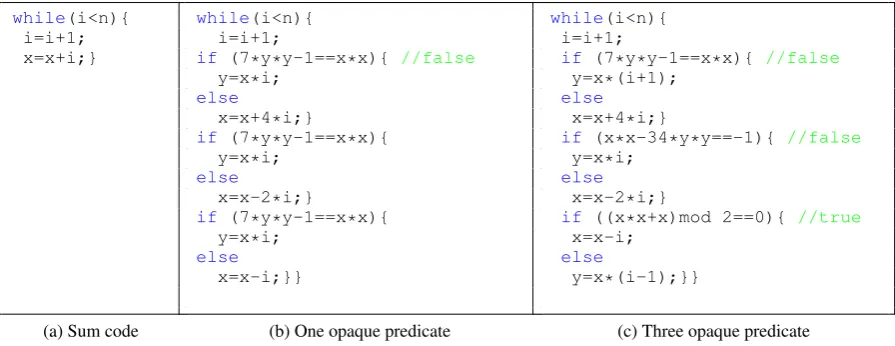
We demonstrate our motivation using the example in Fig. 1. We obfuscate the program in Fig. 1-(a) that calculates the sum of the firstnpositive integers, by adding opaque predicates2with bogus code and data encoding. If we apply Cyclomatic complexity (Mc-Cabe (Mc(Mc-Cabe, 1976)), a classical complexity mea-sure, to Fig. 1-(b) the result will be 6. Cyclomatic complexity is based on control flow graph (CFG), and is computed by:E−N+2, whereEis the number of
edges andNis the number of nodes in CFG. Fig. 1-(b) containsN =8nodes,E=13edges then the
Cyclo-matic complexity is(13−8+2) =7. We can see some
regularity here: there is one opaque predicate repeated three times. Furthermore, the variableyis repeated three times in the same place of theIf-branch. We conjecture that we can find the short description of the program in Fig. 1-(b), due to presence of regularity by using lossless compression.
We take another obfuscated version in Fig. 1-(c) (of the same program); this code is obfuscated by adding three different opaque predicates. The patterns are less in this version comparing to Fig. 1-(b); the short-est program that describes Fig. 1-(c) is likely to be very similar to the code itself, where the Cyclomatic complexity is the same 7, and it does not account for the changes that occurred in the code. Assuming the
2
while(i<n){ i=i+1; x=x+i;}
(a) Sum code
while(i<n){ i=i+1;
if (7*y*y-1==x*x){ //false
y=x*i;
else
x=x+4*i;}
if (7*y*y-1==x*x){
y=x*i;
else
x=x-2*i;}
if (7*y*y-1==x*x){
y=x*i;
else
x=x-i;}}
(b) One opaque predicate
while(i<n){ i=i+1;
if (7*y*y-1==x*x){ //false
y=x*(i+1);
else
x=x+4*i;}
if (x*x-34*y*y==-1){ //false
y=x*i;
else
x=x-2*i;}
if ((x*x+x)mod 2==0){ //true
x=x-i;
else
y=x*(i-1);}}
(c) Three opaque predicate
Figure 1: Obfuscation example: (a) is the original code for the sum ofnintegers; (b) is an obfuscated version of (a) with one opaque predicate and data encoding which has some patterns and regularities; (c) is another obfuscated version of (a) with three opaque predicate and data encoding, which has less patterns and regularities comparing to (b).
opaque predicates of Fig. 1-(c) are equally difficult to break, attacking this code requires at least twice more effort than the code in Fig. 1-(b), as we need to figure out the value of two more opaque predicates. Furthermore, Fig. 1-(b) can be compressed at higher rate than Fig. 1-(c); again, this is due to the inherent regularity in Fig. 1-(b).
We argue that an obfuscated program which is se-cure and confuses an adversary will exhibit a high level of irregularity in its source code and thus require a longer description to characterize all its features. This can be captured by the notion of Kolmogorov Complexity, which quantifies the amount of informa-tion in an object. An obfuscated program will have more non-essential information, and thus higher com-plexity, than a non-obfuscated one. Thus, we can use Kolmogorov Complexity to quantify the level of con-fusion in obfuscated programs due to the obfuscation process.
4.2
Applying Kolmogorov Complexity
to Code Obfuscation
In this section, we present a novel approach for code obfuscation based on notions from algorithmic infor-mation theory. We start with an intuitive definition that is inspired by practical uses of obfuscation. The rationale behind this definition is that an obfuscated program must be more difficult to understand than the original program. This uses the separate notion of
c-unintelligibility:
Definition 5. A program P′ is said to be c
-unintelligible with respect to another programP if it is c times more complex thanP, i.e. the added
complexity isctimes the original one, and thus more difficult to understand. Formally:
K(P′) ≥ (c+1)K(P),
for some constantc>0.
Definition 6. Ac-Obfuscator O ∶ P × L → P′is
a mapping from programs with security parameters
Lto their obfuscated versions such that∀P ∈ P, λ∈ L.O(P, λ) ≠Pand satisfies the following properties:
• Functionality:O(P, λ)andP compute the same
function.
• Polynomial Slowdown: the size and running time ofO(P, λ)are at most polynomially larger than
the size and running time ofP, i.e. for polynomial functionp.∣O(P, λ)∣ ≤p(∣P∣), and ifPhalts ink
steps on an inputi, thenO(P, λ)halts withinp(k)
steps oni.
• Unintelligibility:O(P, λ)is c-unintelligible with
respect toP.
It is interesting to ask to what extent unintelligibil-ity is related to the qualunintelligibil-ity of the obfuscation parameter
λ. Is a largeλnecessaryfor high unintelligibility? Is itsufficient?
We answer the first question in the positive by showing thatc-unintelligibility sets a lower bound on the size ofλ.
Lemma 6. Consider a programP and an obfuscated
versionP′= O(P, λ)such thatP′isc-unintelligible
with respect toP. Then,∣λ∣ ≥cK(P) −O(1).
Proof. By assumption,K(O(P, λ)) ≥ (c+1)K(P).
programOand so we can upper boundK(P′):
K(P) +K(λ∣P) +K(O) ≥K(O(P, λ))
≥ (c+1)K(P) ⇒K(λ∣P) ≥cK(P) −K(O).
Assuming the obfuscator program is simple, that is, K(O) = O(1), we have by basic properties of
Kolmogorov complexity: ∣λ∣ ≥ K(λ) ≥ K(λ∣P) ≥
cK(P) −O(1).
To answer the second question, we show a counter-example. So far, we have not addressed the nature ofOand how well it uses its obfuscation parameter.
It could well be the case thatOonly uses some bits
ofλto modifyP. In an extreme case, it can ignore
λaltogether and simply returnO(P, λ) = P. The
result satisfies the first two properties of an obfusca-tor, but can be considered unintelligible only in the degenerate case forc = 0 and surely we would not
call the resulting code obfuscated. Another extreme case is whenλ =P. Now, we would have at most
K(O(P, λ)) ≤K(P) +K(O) +O(1)which again
would lead to a very smallc. These two cases, al-though extreme, serve only to show that the quality of an obfuscator depends not only onλbut also on the obfuscation algorithm itself,O. This is addressed later
in Theorem 12.
Definition 6 is perhaps the first natural definition one can find, but it has one shortcoming. Merely re-quiring the obfuscated program to be complex overall does not mean that it is complex in all its parts, and in particular, that it hides the original program. To illustrate this point, consider the following example.
Example 1. Consider an obfuscated programP′=
O(P, λ) =P∥λ, which is a simple concatenation of
P andλ. Definen = ∣P′∣. We knowK(P ∥λ) ≃
K(P, λ) within logarithmic precision (see (Li and
Vit´anyi, 2008) page 663). Then, by applying the chain rule of Theorem 1, K(P′) = K(P ∥λ) ≃
K(P) +K(λ∣P) +O(logn). For largeλ
indepen-dent ofP, this might signify a large unintelligibility, but the original program can be extracted directly from the obfuscated version requiring onlyO(logn)to
in-dicate wherePends andλstarts.
This leads us to our second definition, where we require not that the obfuscated program be more com-plex than the original but rather, that it reveal almost no information about the original. This is captured by the notion of algorithmic mutual information and can be stated formally as:
Definition 7. Consider a program P and its
obfus-cated programP′= O(P, λ). We sayP′is aγ-secure
obfuscation ofP if the mutual information betweenP
andP′is at mostγ, that is:
IK(P;O(P, λ)) ≤γ.
We sayP′is a secure obfuscation of P if isγ -secure andγis negligible.
It is common to consider, in the literature about Kolmogorov Complexity, that logarithmic terms are negligible. Thus, if both P andP′have lengths of ordern, we might consider thatP′would be a secure obfuscation forγ=logn. This intuition, however, is
bound to fail in practice.
Programs are typically redundant, written in very well-defined and formal languages, with common structures, design patterns, and even many helpful comments. It is expected that the complexity of a non-obfuscated program be low, compared to its length. Consider then the case that for a givenPandn= ∣P∣
we haveK(P) =O(logn). Consider a scenario like
that of Example 1, where the obfuscated reveals the original program and so the mutual information be-tween both programs is maximum, i.e.,
IK(P;O(P, λ)) =K(P) −O(logn) =O(logn).
Even though this obfuscation can not be considered secure, the resulting mutual information is so small that Definition 7 would declare it secure. We have two ways out of this:
• we do not consider programs with K(P) =
O(logn), since this is the error margin of the
im-portant properties of Kolmogorov complexity, and at this level we can not achieve significant results;
• or we consider a relative definition of security, re-quiring that the mutual information be only at most a negligible fraction of the information inP.
The second option leads us to the following defini-tion:
Definition 8. Consider a program P and its
obfus-cated programP′= O(P, λ). We sayP′is a-secure
obfuscation ofP if the mutual information betweenP
andP′is at mostK(P), that is:
IK(P;O(P, λ)) ≤K(P),
for0≤≤1.
We sayP′ is a secure obfuscation of P if is -secure andis negligible in some appropriate sense.
The next proposition provides an example of how to test the security of an obfuscated code against an adversary.
Proposition 1. Consider a clear programP of length
nwithK(P) ≥n−O(logn)andAan adversary that
extracts at least m ≤ nconsecutive bits ofP from
1. K(P∣P′) ≤n−m+O(logn).
2. IK(P;P′) ≥m−O(logn)
Proof. We prove this proposition by building the fol-lowing algorithm:
Algorithm:
• BuildAof lengthO(1).
• ComputeA(P′), we obtainm≤nbits ofP.
De-note these by stringω.
• Now, build a programβsuch thatP=β(ω)which
computes two blocks of bits: those that come be-fore and those that come afterω.
To produceP,βneeds at most to produce a pair of two strings (s1, s2) with combined lengthn−m.
To describe the pair, we need at mostO(logn)bits
saying where to divides1froms2. Thus,K(β) ≤
n−m+O(logn).
By construction,K(P∣O(P, λ)) +O(1) ≤K(β) +
O(1) ≤n−m+O(logn).Using the assumption about
K(P), it is straight forward to compute
IK(P;P′) ≥m−O(logn)
On the other hand, the adversary can fully obtain
P, with only a logarithmic error, if it knows λthe security parameter, as the next theorem shows.
Theorem 7. LetP′= O(P, λ), for an adversaryA
who knowsλ:
1. K(P∣P′, λ) =O(logn).
2. IK(P, P′∣λ) =K(P∣λ) −O(logn).
wherenis the maximum length ofP, P′andλ.
Proof. Ifλcontains all the knowledge thatArequires
to obtainP givenP′, then the shortest program for a universal Turing machineU that describesPgiven
A, P′ and λ, is negligible i.e. empty string. It is
sufficient forU to describePfromA, P′andλwith
no need of any extra programs i.e.U(Λ,A(P′), λ) =
PwhereΛis an empty string.O(logn)is needed as
an overhead cost required byUto combineA, P′and
λand to locate them onU tape. The advantage ofA
givenλis obtained as follows:
IK(P;P′∣λ) =K(P∣λ) −K(P∣P′, λ) =K(P∣λ) −O(logn)
These results are not surprising. Intuitively, an adversary can easily recover the original code from the obfuscated version once the security parameter that is used for obfuscation is known.
4.3
ON THE IMPOSSIBILITY OF
OBFUSCATION
There exist other definitions of obfuscation in the lit-erature. Of particular importance to us is the work of (Barak et al., 2012), due to its famous impossibility re-sult. As the authors argue in that paper, the black-box model they propose for obfuscation is too strong to be satisfiable in practice.
The black-box model considers a program3P′ ob-fuscated if any property that can be learned fromP′
can also be obtained by a simulator with only oracle access toP′. This essentially states thatP′does not give any particular information about that property, since it is possible to learn it without having access toP′. Notice that this model does not compare an obfuscated program with an original one, but rather with its functionality.
This is different from the definitions that we have proposed so far. Our definitions can be used to capture this purpose, namely, measuring how much informa-tion a programP′gives about the function it computes, which we denote byJP′K.
It suffices to note that every functionF has a min-imal program for it, say,Q. Then, its Kolmogorov complexity is the size ofQand for every other pro-gramP′computingF we have
K(F) = ∣Q∣ ≤ ∣P′∣.
For every such program it must be that K(F) ≤
K(P′) +O(1), otherwise we could build a programR
of sizeK(P′)that producedP′and then ran in
succes-sionRandU(R).4 This composition of programs is
itself a program with complexityK(P′) +O(1)which
would be smaller than the assumed minimal program
F, i.e., a contradiction. Therefore, our definition can be changed to compare the obfuscated program not with any simpler program but withthe simplest pro-gram computing the same function.
Definition 9. Consider a programP′. We sayP′is
-securely obfuscated if
IK(JP′K;P′) ≤K(JP′K),
for0≤≤1.
We sayP′ is a secure obfuscated program if is
-secure andis negligible.
We believe our definitions of obfuscation differ from the simulation black-box model in important ways, and that because of this they avoid the impossi-bility result of (Barak et al., 2012).
3
Or rather, a circuit or a Turing machine representation thereof.
4
That is, we runRto produceP′
Our definition is a less stringent form of obfusca-tion rather than a weak form of black box obfuscaobfusca-tion. We assume the functionality of an obfuscated program is almost completely known and available to an adver-sary, and only require hiding the implementation rather than the functionality itself. This approach to obfusca-tion is very practical and pragmatic, especially for soft-ware protection obfuscation, as usually the customer likes to know exactly what a product does, although s/he might not care about how it was implemented.
Our definition for security takes a programP(clear code), which supposedly is an easy and smart imple-mentation of functionalityF, and compares it with
P′, which is a different and supposedly unintelligible implementation ofF, such that the originalPcan not be perceived or obtained fromP′. The defenders’ aim is not to prevent an adversary from understanding or findingF, but to prevent her/him from finding their own implementationsP.
This intuition best matches the idea ofbest possible obfuscationwhich was advanced by Goldwasser and Rothblum (Goldwasser and Rothblum, 2007). Accord-ing to (Goldwasser and Rothblum, 2007) an obfusca-torOis considered as best possible if it transforms a
programPso that any property that can be computed from the obfuscated programP′, can also be computed from any equivalent program of the same functionality. However, despite the close intuitive correspondence, our definition also differs from best possible obfus-cation, in the sense that it relies on some form of black-box simulation. It was proved in (Goldwasser and Rothblum, 2007) that best possible obfuscation has a strong relation withindistinguishability obfusca-tion(Barak et al., 2001) (Garg et al., 2013), ifOis an
efficient obfuscation i.e. run in polynomial time. In contrast, the black box model definition requires that all properties of a given obfuscated programP
must be hidden from any adversary that ignores its source code but has access to at most a polynomial number of points ofJPK.
1. We can see that in our case, the adversary knows more about the functionality. Since the function-ality is mostly public, this would be equivalent to giving the simulator in the black-box model access to this extra knowledge, reducing the advantage of the adversary and possibly making some functions obfuscatable.
2. On the other hand, our definition allows the leak-age of a small, but non-zero, amount of informa-tion. Compare with the black-box model where a single-bit property that is non-trivially com-puted by an adversary, renders a function un-obfuscatable. Our definition requires the adversary to be able to compute more than a few bits in order
for obfuscation to be broken.
3. Our definition considers only deterministic adver-saries, again making adversaries less powerful and reducing their advantage.
We can try to model the implications for our defini-tion of a successful black-box adversary against obfus-cation. Consider an adversaryAattacking a predicate
πby accessing an algorithmA, such thatA(P′) =1
if and onlyP′satisfiesπ. In this case,Ais able to
compute 1 bit of information aboutP′, and we want to measure how much this helpsAin describing some
simpler programPthat implements the same function
JP
′
K.
Since the adversaryAknowsA, s/he can
enumer-ate the set S of all programs that satisfyA. Then, for some programP ∈S, we would haveK(P∣A) ≤
K(S∣A) +log∣S∣.
Note that the setS may be infinite, and so enu-meration is the best that can be done: we enumerate all relevant programs and runA with each of them, noting the result. We could try to avoid this infinity problem by noticing we are only interested in pro-grams simpler than the original, and thus satisfying
K(P) ≤ K(P′) ≤ ∣P′∣. This does not give
abso-lute guarantees, since in general there are programs with∣P∣ > ∣P′∣andK(P) ≤K(P′), but our hope is
that these are few and far between as they increase in length. Thus, even if we make this assumption and disregard a whole class of possibly relevant pro-grams, we still have in the order of 2n specimens. IfAwere a deterministic algorithm, we would have
K(S∣A) =O(1), and ifShas less than a half of all
possible programs, then indeed we would find that
K(P∣A) ≤K(S∣A) +log∣S∣/2≤n−1.
However,Ais randomized, and in order to accu-rately produceS, for each programq,Amust be run with a set of random coinsrsuch thatA(q, r) ⇔q∈S.
One way to describeSfromAwould need a polyno-mial number of bits for each program inS. Now, we no longer have the comfort of a negligibleK(S∣A)
term, and we can no longer be sure that knowing this property would in any way reduce the complexity of our target program.
We can still try to go around this problem, by al-lowing our enumerator to list not only all programs but also all possible random strings, and choosing the majority vote for each program. The length, and there-fore the number, of possible random strings is bound by the running time of the program, which in turn is bound by a function of its length. Therefore, if we limit the length of our programs we limit the number of random strings to search5.
5
This would eliminate the necessity of considering the extra information due to the random coins, but on the other hand the running time would increase exponentially. Any successful adversary would be very different to the PPT adversaries of (Barak et al., 2001), and although our definition has been made, for ease of exposition, with unbounded Kolmogorov complexity (for unbounded adversaries), it is easy to change it to consider polynomially-bounded adversaries by using an alternative definition of mutual information:
IK∗(P;P′) =K(P) −Kt()(P∣P′),
wheret()is a polynomial on the length ofP′that acts
as a hard limit to the number of steps the universal machine can be run for.
This notion of information can be negative in some cases, but clearly limits the ability of any adversary trying to findP fromP′in a consistent way with the black-box model. With this definition of obfuscation, the above reasoning would lead to examples where non-obfuscatability by the black-box model does not prevent obfuscatability in the algorithmic information-theoretic model.
4.4
Security and Unintelligibility
Our first attempt to characterize obfuscation was based onunintelligibility, and then we evolved to a notion of security based onmutual information. The first notion seemed more immediately intuitive, traditional obfus-cation techniques seem to rely only on making the code as complex as possible in an attempt to hide its meaning. But precisely this notion of “hiding meaning” is nothing more than reducing the information that the obfuscated program leaks about the original one, and so we believe the second approach to be the correct one. However, we can ask the natural question: is there any relation between these two concepts? Does high unintelligibility imply high security, or vice-versa?
We give a partial answer to this question. In cer-tain situations, high unintelligibility will imply high security, as stated in the following theorem.
Theorem 8. Consider a programPof lengthmand
its obfuscated versionP′= O(P, λ)of lengthn>m
(where n is at most polynomially larger thanm), sat-isfyingc-unintelligibility forc ≥ K(nP). Assuming
that the obfuscation security parameterλ satisfies
K(P′∣P) ≥K(λ∣P) −α, then up toO(logn):
I(P;O(P, λ)) ≤α−O(1)
then we also have to enumerate an infinite number of random strings.
\\ variable that holds authentication password
string user-Input = input(); string secure-password = ...;
if secure-password == user-Input {
grant-access();
else
deny-access();}
P : simple password checker
string O@ = x0(); string $F=...;
if O@== $F{
x1();
else
x2(); }
P′
: obfuscatingP
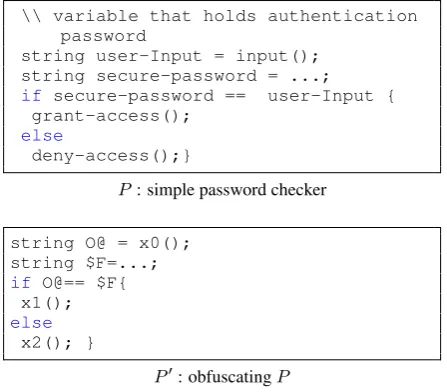
Figure 2: An example for obfuscating a program using re-naming technique.
Proof. By Theorem 3, K(P′) = K(O(P, λ)) ≤
K(P, λ) +K(O) = K(P, λ)6 and by assumption
K(P′) ≥ (c+1)K(P). Then,
K(P, λ) ≥ (c+1)K(P)
K(P, λ) −K(P) ≥cK(P)
K(λ∣P) ≥cK(P)
Now, for mutual information, we have
I(P;P′) =K(P′) −K(P′∣P)
≤K(P′) −K(λ∣P) +α(by assumption) ≤n−cK(P) +α
≤n−n+α(by assumption) =α
Intuitively, if we consider an optimal obfuscation key (it has all the information needed to produceP′
fromP, but not much more than that), we can say that ifP′is c-unintelligible for large enoughc, thenP′is a secure obfuscation ofP.
The above theorem shows when high c -unintelligibility implies security of code obfuscation. It turns out that the reverse implication does not exist, as the following theorem illustrates.
Claim 9. There are obfuscated functions O(P, λ)
that are arbtrarily secure and yet do not satisfy c -unintelligibility forc≥0.
6
Proof. Consider first the case of programP of Fig. 2, that simply checks a password for access, and its ob-fuscated versionP′, which was computed using layout obfuscation (Collberg et al., 1997): variable and func-tion renaming and comment deleting. The obfuscated variable and function names are independent of the original ones and so the information thatP′contains aboutP is limited to the unchanging structure of the code: assignment, test and if branch.
The complexity of the original code can be broken in several independent parts: the comment, the struc-ture, the variable and function names, and therefore we can writeK(P) =nc+ns+nv. The only thing thatP′
can give information about is the structure part, since all the other information was irrevocably destroyed in the process: there is no data remaining that bears any relation to the lost comment or the lost function names. Therefore,IK(P;P′) ≤ns=n ns
c+ns+nvK(P).
We can make the fraction ns
nc+ns+nv as small as
nec-essary by inserting large comments, long names and representing structure as compactly as possible, for example, keeping names in a dictionary block and indicating their use by pointers to this.
However the complexity ofP′is less than that ofP, since there is less essential information to describe: the same structure, no comments and the function names could be described by a simple algorithm. Therefore, we have that c-unintelligibility can not be satisfied for any non-negative value ofc. This shows that high
-security does not imply high unintelligibility.
The next theorem shows how we can obtain secu-rity if the obfuscated code is complex enough and the obfuscation key is independent of the original program.
Theorem 10. LetPbe a program of lengthnandλan independent and random obfuscation key, satisfying
K(λ) ≥ n−αandK(P, λ) ≥ K(P) +K(λ) −β,
whereα, β ∈ N. Suppose the obfuscation O(P, λ)
satisfiesK(O(P, λ)∣P) ≥K(λ∣P) −O(1). Then up
to a logarithmic factor:
IK(P;O(P, λ)) ≤α+β
Proof.
IK(P;O(P, λ)) =K(O(P, λ)) −K(O(P, λ)∣P) ≤K(O(P, λ)) −K(λ∣P)
Applying Theorem 1
≤K(O(P, λ)) −K(λ, P) +K(P) ≤n−K(P) −n+α+β+K(P) ≤α+β
The first two assumptions are natural: pickingλat random and independently ofP will satisfy high com-plexity and low mutual information with high prob-ability, so we can simply assume those properties at the start. The third assumption, however, is not im-mediately obvious: it describes a situation where the obfuscation key isoptimal, in the sense that it contains just the amount of information to go fromP toP′, within a small logarithmic term. The following lemma shows how λmust have a minimum complexity to allow the derivation ofPtoP′.
Lemma 11. ConsiderP′= O(P, λ)is the result of
ob-fuscating a programP. Then,K(λ∣P) ≥K(P′∣P) −
O(1)
Proof. Given the obfuscatorOand anyλ, construct
the function qλ(⋅) = O(⋅, λ). LetQλ be a program
that implements it. Then, clearly, U(Qλ, P) = P′
and so∣Qλ∣ ≥ K(P′∣P). To describeQλ, we only
need to specifyλand instructions to invokeOwith
the proper arguments, but sinceP is already known, we can use it to find a shorter description forλ. This givesK(P′∣P) ≤K(λ∣P) +O(1).
An optimal obfuscation keyλis then the one that uses as little information as possible.
Obfuscation techniques can use randomness or not. In Claim 9, we showed one case where names could be obfuscated in a deterministic way, without any random-ness. However, we could equally have used instead highly random names, with the same effect in security but increasing unintelligibility as well. We can as well consider that the set of obfuscation techniques is finite and describe each of them by a unique number. This way, we can characterize a single application of obfus-cation by a key composed of the technique’s index and the randomness needed.
We now proceed to show that it is possible to achieve obfuscation security according to our defi-nitions, but restricted to a passive adversary, that is, one that does not realize transformations over the in-tercepted code. The intuition is to use obfuscation techniques that behave as much as possible as secure encryption functions, namely, using random keys that are independent from the code and large enough that they obscure almost all original information. The cru-cial difference that enables security is that because an obfuscation technique preserves functionality, we do not need to decrypt the obfuscated code and so don’t need to hide the key.
Theorem 12. Let prepresent a program block, O
an obfuscation technique andλ∈ Lan obfuscation
key with fixed lengthn. Letp′= O(p, λ)be the
ob-fuscated block. AssumeOproduces an output with
length`≤n+γand is “nearly-injective” in the
fol-lowing sense: for everyp, any subset ofL of keys
with the same behaviour forphas cardinality at most polynomial in n. That is, for all p and λ0 ∈ L, ∣{λ∶ O(p, λ) = O(p, λ0)}∣ ≤nk, for some positive
in-tegerk.
Then, if the key is random,K(λ) ≥n−αand
inde-pendent fromp,K(λ∣p) ≥K(λ) −β, the obfuscated
codep′is(α+β+γ)-secure up to a logarithmic term.
Proof. By symmetry of information, we can write
K(p∣p′) = K(p′∣p) +K(p) −K(p′). Since p′ = O(p, λ), it’s easy to see that K(p′∣p) ≤ K(O) +
K(λ∣p) = K(λ∣p), since K(O) is a constant
in-dependent of p, λ or p′. As well, we can show the reverse inequality. To produce λ from p, we can first produce p′ from p (with a program that takes at least K(p′∣p) bits) and then build the set
Sp,p′ = {λ ∶ ∣λ∣ ≤ n,O(p, λ) = p′} of all
compati-bleλ, by a program whose length isO(1). Finally,
we just have to give the index of λin this set, and so K(λ∣p) ≤ K(p′∣p) +log #Sp,p′. Then, by as-sumptions onλ,K(p′∣p) ≥ K(λ∣p) −log #Sp,p′ ≥
n−α−β−log #Sp,p′. By assumption on the out-put ofO, K(p′) ≤ ∣O(p, λ)∣ ≤ n+γ. This gives
K(p∣p′) ≥K(p) +n−α−β−O(logn) −K(p′) ≥
K(p) −α−β−γ−O(logn).
The randomness and independence conditions for the keys are natural. The other two conditions may seem harder to justify, but they ensure thatO
effec-tively mixespwith the randomness provided byλ: the limit on the size of subsets ofLimplies a lower bound
on the number of possible obfuscations forp(the more the better); on the other hand, the limit on the length of the output ofOforces the information contained
inpto be scrambled withλ, since it can take only a few more bits than those required to describeλitself. The extreme case is similar to One-Time Pad encryp-tion7, when both the output andλhave the same size
n, andOis injective for eachp: there are2nkeys, as
well as possible obfuscations for eachp. Furthermore, because the obfuscated code has the same length ofλ, the exact same obfuscated strings are possible for each
p, maximizing security.
In general, a program is composed of several of these minimal blocks in sequence. The above proof shows when the obfuscated blockp′gives no informa-tion about its original block, sayp0. As well,p′can
7
Which is proved to be an unconditionally secure sym-metric cypher
not give any more information about any other block
p1, as there is no causal relation betweenp1andp′. At
best, there is some information inp1aboutp0, but then
the information given byp′aboutp1should be at most
that given by aboutp0. Therefore, we conclude that
if all the sub-blocks in a program are securely obfus-cated, then the whole program is. The above theorem, then, shows that secure obfuscation is possible under very reasonable assumptions.
5
INDIVIDUAL SECURITY OF
CODE OBFUSCATION
Studying the security of individual instances of obfuscated code provides more granularity. Even if the obfuscated program is considered secure according to our definition, it may have parts which can provide some information about other obfuscated parts, which reduce the security of the obfuscated code. It could be that a program is obfuscated but that some module is not: some part of the obfuscated code stays still in its original form. We can demonstrate this relation by providing some boundaries on the complexity of subprograms in the same program.
We can view (obfuscated) programs as finite, and therefore recursively enumerable, sets of subprograms (blocks or modules) such thatP′= {p′n}n∈N. Given an obfuscated programP′, it may consist of obfuscated and unobfuscated modules, that is:∃p′j, p′i∈P′, where
p′iis an obfuscated module andp′jis an unobfuscated module.
Theorem 10 demonstrates the effect of security parametersλon the whole obfuscation process. The following results show the effect of each individual security parameter on each obfuscated subprogram. Choosing a good λ(with a good source of random-ness) requires a minimum amount of information to be shared with obfuscated code and the clear code. It is important to study the relation between the secu-rity parameter and the original (clear) code. In the following theorem, we use a simple way to check the independence betweenλandP on the subprogram level.
Theorem 13. Let P′be a set of obfuscated subpro-grams andP a set of clear subprograms, such that each subprogramp′ofP′has length at mostn, and is the obfuscation of a corresponding block in P:
∃pi ∈ P, κi ∈ λ. p′ = O(pi, κi). If K(κi, pi) ≥
K(pi) +K(κi) −α, then (up to a logarithmic term):
IK(κi;pi) ≤α
O(logn), we have by assumption
K(pi) +K(κi) −α≤K(κi∣pi) +K(pi) +O(logn)
K(κi) −α≤K(κi∣pi) +O(logn)
K(κi) −K(κi∣pi) ≤α+O(logn)
IK(κi, pi) ≤α+O(logn)
The following two theorems address the secu-rity of two different forms of code obfuscation: obfuscation-as-encoding and obfuscation-as-hiding. In the obfuscation-as-encoding technique, the original program is transformed in such a way it changes the structure of original code, but preserving the func-tionality, for example Data transformation techniques such as array splitting, splitting variable, Restructure Arrays and Merge Scalar Variables (Collberg et al., 1997). The encoding process is considered as the secu-rity parameter that dictates how the obfuscation should be performed and where it should take place. Encod-ing differs from encryption, if somebody knows the encoding process, then the original code can be recov-ered. In encoding obfuscation, the clear program is not presented in the obfuscated code; what still exists, but hidden, is the encoding process. Reversing the encoded program (obfuscated) requires finding and understanding the encoding process. For instance we used a simple encoding in Fig. 1,x=x+iis encoded as x=x+4*i;x=x-2*i;x=x-i; the encoding process convertsito4*i;-2*i;-i, to figure outx=x+i, we have to find and combine4*i;-2*i;-i, which is the security parameter in this case.
The next theorem addresses the security of obfus-cation code when we apply encoding toP(as a set of subprograms ), here, the encoding process is presented as a part of security parameter.
Theorem 14(Encoding). LetP′be a collection of ob-fuscated subprogramsp′iusingκi∈λ, each of length
at mostn. Then,
IK(κi;p′i) ≤δκi−O(1),
forδκi =δ(κi∣P
′).
Proof. SinceP′is a collection of sub-programs, we can assume that it contains all the information inp′ias well as that of all other sub-programs. Then,
K(κi∣P′) =K(κi∣p′1, . . . , p′i, . . . , p′n) ≤K(κi∣p′i)
and so
IK(κi;p′i) =K(κi) −K(κi∣p′i) ≤K(κi) −K(κi∣P′)
≤K(κi) − (log #P′−δκi)by Definition 4
Because each subprogram has length at mostn,P′
can contain at most2ndistinct programs. Assuming that each appears at most a constant number of times, we have that#P′=O(2n)andlog #P′=n+O(1).
Then,
IK(κi;p′i) ≤n−n+δκi−O(1)
≤δκi−O(1)
In hiding obfuscation techniques the original sub-program still exists in the obfuscated sub-program (set of obfuscated subprograms), the security of such tech-niques depends on the degree of hiding in the set ob-fuscated subprograms. An example of such technique is the control flow obfuscations such as Insert Dead basic-blocks, Loop Unrolling, Opaque Predicate and Flatten Control Flow (Collberg et al., 1997). Normally these techniques are combined and used with encod-ing obfuscation techniques, in order to make the code more resilient to reverse engineering techniques.
For code obfuscation, an opaque predicate is used as a guard predicate that cannot statistically be com-puted without running the code; however the original code still exists too in the obfuscated code, but pro-tected by the predicate. In Fig. 1 we used opaque pred-icates with simple data encoding technique. Consider the following obfuscated code of Fig. 1-(a), where the encoding has been removed. Obviously, x=x+iis still in the code, but is hidden under the protection of opaque predicate.
while(i<n){ i=i+1
if (7*y*y-1==x*x){ //false
y=x*i;
else
x=x+i;}}
opaque predicate with no encoding
Theorem 15(Hiding). LetP′be a collection of ob-fuscated subprogramsp′i, each of length at mostn. Then,
IK(pi;p′i) ≤δpi−O(1),
forδpi =δ(pi∣P
′).
Proof. The proof is very similar to Theorem 14. The blockpiis hidden inP′but in its original form, due
to the obfuscation process. SinceP′is a collection of sub-programs, we can assume that it contains all the information inp′ias well as that of all other sub-programs. Then,
IK(pi;p′i) =K(pi) −K(pi∣p′i) ≤K(pi) −K(pi∣P′)
≤K(pi) − (log #P′−δpi)by Definition 4
Similarly to the proof of Theorem 14,#P′=O(2n)
andlog #P′=n+O(1). Then,
IK(pi;p′i) ≤n−n+δpi−O(1)
≤δpi−O(1)
6
CONCLUSION AND FUTURE
WORK
In this paper, we provide a theoretical investigation of code obfuscation. We defined code obfuscation us-ing Kolmogorov complexity and algorithmic mutual information. Our definition allows for a small amount of secret information to be revealed to an adversary, and it gives an intuitive guarantee about the security conditions that have to be met for secure obfuscation. We argued our definition is more lenient than the vir-tual black-box model of Barak et al. and that for that reason the impossibility result does not apply. In con-trast, we showed that under reasonable circumstances we can have secure obfuscation according to our defi-nition.
To the best of our knowledge, this paper is the first to propose algorithmic information theory as a theoretical basis for code obfuscation. We believe that our new definition for code obfuscation provides the first step toward establishing quantitative metrics for certifying code obfuscation techniques. Currently, we are working toward deriving new metrics based on our model, aiming to validate and apply these metrics, empirically, to real obfuscated programs using state of the art obfuscation techniques.
There are still some questions we want to address in future work. For example, it is still not clear whether the complexity of security parameter (key) has always a positive effect on the the security of obfuscated pro-grams based on algorithmic mutual information defini-tion. Furthermore, algorithmic mutual information has a parallel counterpart based on classical information theory such as Shannon mutual information, it would be interesting to explore the relation between our defi-nition and Shannon mutual information in the context of code obfuscation security. We are also planning to study and characterize the security of particular tech-niques and to analyze more carefully the scenario of active adversaries.
ACKNOWLEDGEMENTS
This research is partially funded by EPSRC-DTA (Mohsen). We would like to thank Steffen van Bakel and Emil Lupu for their comments.
REFERENCES
Barak, B., Goldreich, O., Impagliazzo, R., Rudich, S., Sa-hai, A., Vadhan, S., and Yang, K. (2012). On the (im)possibility of obfuscating programs. J. ACM, 59(2):6:1–6:48.
Barak, B., Goldreich, O., Impagliazzo, R., Rudich, S., Sa-hai, A., Vadhan, S. P., and Yang, K. (2001). On the (im)possibility of obfuscating programs.IACR Cryp-tology ePrint Archive, 2001:69.
Collberg, C., Thomborson, C., and Low, D. (1997). A Tax-onomy of Obfuscating Transformations.
G´acs, P. (1974). On the symmetry of algorithmic information. Soviet Math. Dokl, 15:1477–1480.
Garg, S., Raykova, M., Gentry, C., Sahai, A., Halevi, S., and Waters, B. (2013). Candidate indistinguishability obfuscation and functional encryption for all circuits. InIn FOCS.
Gauvrit, N., Zenil, H., and Delahaye, J. (2011). Assess-ing cognitive randomness: A kolmogorov complexity approach.CoRR, abs/1106.3059.
Goldwasser, S. and Rothblum, G. N. (2007). On best-possible obfuscation. InProceedings of the 4th con-ference on Theory of cryptography, TCC’07, pages 194–213, Berlin, Heidelberg. Springer-Verlag. Jbara, A. and Feitelson, D. G. (2014). On the effect of code
regularity on comprehension. InProceedings of the 22Nd International Conference on Program Compre-hension, ICPC 2014, pages 189–200, New York, NY, USA. ACM.
Kieffer, J. C. and Yang, E. H. (1996). Sequential codes, lossless compression of individual sequences, and Kol-mogorov complexity. IEEE Trans. on Information Theory, 42(1):29–39.
Lathrop, J. I. (1997). Compression depth and the behavior of cellular automata.Complex Systems.
Li, M. and Vit´anyi, P. M. (2008). An Introduction to Kol-mogorov Complexity and Its Applications. Springer Publishing Company, Incorporated, 3 edition. McCabe, T. J. (1976). A complexity measure. IEEE Trans.
Software Eng., 2(4):308–320.
Shen, A. (1982). Axiomatic description of the entropy notion for finite objects. VIII All-USSR Conference (Logika i metodologija nauki),Vilnjus, pages 104 – 105. The paper in Russian.
Shen, A., Uspensky, V., and Vereshchagin, N. (2014). Kol-mogorov complexity and algorithmic randomness. MC-CME Publishing house.