Active Timing-Based Correlation of Perturbed Traffic Flows with Chaff Packets
∗Pai Peng, Peng Ning, Douglas S. Reeves
Department of Computer ScienceNorth Carolina State University
Xinyuan Wang
Department of Information & Software Engineering George Mason University
Abstract
Network intruders usually launch their attacks through a chain of intermediate stepping stone hosts in order to hide their identities. Detecting such stepping stone attacks is dif-ficult because packet encryption, timing perturbations, and meaningless chaff packets can all be utilized by attackers to evade from detection. In this paper, we propose a method based on packet matching and timing-based active water-marking that can successfully correlate interactive stepping stone connections even if there are chaff packets and limited timing perturbations. We provide several algorithms that have different trade-offs among detection rate, false posi-tive rate and computation cost. Our experimental evalua-tion with both real world and synthetic data indicates that by integrating packet matching and active watermarking, our approach has overall better performance than existing schemes.
1
Introduction
Network based intrusions grow rapidly in recent years, despite the huge amount of resources that have been put into network and information security. To hide their identities, intruders have developed various countermeasures to elude from being discovered. For example, they could spoof the source IP addresses in their attacking flows to conceal the hosts where the attacks are launched. Another popular and effective method is to launch attacks through a sequence of intermediate hosts, also known as stepping stones. Intrud-ers can connect from one host to another using protocols such as Telnet or SSH, and pass the malicious instructions without disclosing the sources of attacks. Only on the last host, they will issue the attack actions toward the real vic-tims. In this scenario, even if the last host can be correctly identified, it could be very difficult to trace back to the real origin behind these stepping stones. Correlation methods
∗This work is supported by Advanced Research & Development Agency (ARDA) under contract # NBCHC030142
are needed to link the connections between stepping stones together.
Researchers have proposed many approaches to detect attacks through stepping stone connections. Early work in-cludes correlation methods based on comparing the packet contents in suspicious network flows [7] [11]. Due to the broad applications of secure protocols such as SSH and IPsec, recent approaches focus on analyzing packet tim-ing characteristics in interactive stepptim-ing stone connections [14] [12] [10] [4] [1] [9] [13].
However, existing correlation schemes are still far from being perfect. To defeat packet timing based approaches, at-tackers could intentionally insert timing perturbations sim-ply through delaying certain packets. It may severely de-stroy the timing characteristics among corresponding flows. Another countermeasure is to insert meaningless padding packets, also called chaff. Such chaff packets are very dif-ficult to be differentiated from normal packets, especially when they are transmitted through encrypted channels.
In this paper, we propose a practical solution that can correlate stepping stone connections even if both timing perturbations and chaff packets are introduced at the same time. Inspired by [9] and [13], we first actively embed timing-based watermarks into upstream flows. Then packet matching is used to find all possible corresponding pack-ets in suspicious flows. Correlation results are determined by computing the watermarks closest to the original ones from all packet combinations. We provide 4 algorithms with different trade-offs among detection rate, false posi-tive rate and computation cost. We experimentally compare our algorithms with the best existing approaches that can deal with timing perturbation or chaff. Our results indicate that by integrating the ideas in [9] and [13] we can achieve better performance.
2
Problem Statement
We useh1 ↔ h2 to represent a bi-directional network
connection between host h1 and h2, and h1 → h2 as a unidirectional flow from h1 to h2. A flow is also de-noted as f when hosts and directions are not concerned. Given a series of hosts h1, h2, . . . , hn, when a person or a program sequentially connects from hi tohi+1, the se-quence of connections h1 ↔ h2 ↔ . . . ↔ hn is called a connection chain. The intermediate hosts in a connec-tion chain are called stepping stones. Assuming j > i, we call flowhi →hi+1 an upstream flow ofhj → hj+1, andhj → hj+1 a downstream flow ofhi → hi+1. Intu-itively, information is propagated from an upstream flow to its downstream flows. We usetito represent the timestamp of packetpi. The sequence of packets in a flowf is repre-sented ashp1, p2, . . . , pni(ti≤tjfor1≤i < j≤n). We define the tracing problem of a connection chain as given an upstream flowf, to identify its downstream flows.
Solutions to the tracing problem are particularly useful to pin down attackers who launch their attacks through step-ping stones. Currently, the most promising approaches are correlation methods based on timing analysis. To evade timing analysis, attackers may introduce timing perturba-tions by delaying some or all packets to change the tim-ing characteristics of downstream flows. Another counter-measure is to insert meaningless chaff packets into a down-stream flow. For example, adding chaff packetsciinto flow hp1, p2, . . . , pnimay lead tohp1, c1, p2, c2, c3, . . . , pn, cmi. Because it is very difficult to distinguish chaff from normal packets when encryption is used, upstream and downstream flows may look very differently.
We propose to investigate tracing techniques that can deal with both timing perturbations and chaff packets. Sim-ilar to previous work [4] [9] [1] [13], we focus on inter-active connections and assume the maximum timing per-turbation attackers can introduce is bounded. Delays may also come from the networks or intermediate hosts that the connection chain passes through. It is difficult to guaran-tee the synchronization of the clocks of hosts where pack-ets are captured; this prevents us from comparing packet timestamps directly. To simplify the situation, we assume the skews between different clocks are known so that we can adjust the timestamps of packets from different hosts for comparison. The timing errors from timestamp adjust-ment, the maximum perturbations added by attackers, and delays from other sources are collectively represented by a single maximum delay∆. In summary, we have following assumptions in our solution:
1. Every packet in an upstream flow will go to its down-stream flow as a single packet.
2. The delay between a packet in an upstream flow and its
corresponding packet in a downstream flow is bounded by[0,∆]. We also call this timing constraint.
3. The order of the packets in an upstream flow is kept the same in a downstream flow. We also call this order
constraint.
3
Proposed Approaches
In our approaches, we adopt the inter-packet-delay (IPD) based watermarking scheme [9], which was originally pro-posed to defeat timing perturbations. The basic idea is to first embed a unique timing-based watermark into an up-stream flowf. If later we can detect the same watermark in another flowf0, it is very likely thatf0 is a downstream flow off. By choosing different watermark parameters, the detection rate and false positive rate are controllable. How-ever, this watermark scheme cannot be directly used when there are chaff packets. It is because watermark detection requires that we know exactly which packets inf0should be used to decode. When extra chaff packets are present, cur-rent detection mechanism fails to find the correct packets. In other words, suppose an upstream flowf = hp1, . . . , pni, andf0=hp0
1, c1, c2, . . . , p0n, cmiis the chaffed downstream flow of f, the corresponding packetshp0
1, . . . , p0ni form a
subsequence off0. Current scheme cannot dig out the cor-rect subsequence from all possible subsequences with n packets. In fact, due to the difficulty of distinguishing chaff from normal packets, it is very unlikely, if possible, to iden-tify the correct subsequence exclusively.
To defeat chaff, our idea is to find all possible subse-quences of f inf0, and decode a watermark from each of them. From all these watermarks, we choose the “best” one, which is the closest to the original watermark in terms of hamming distance. The rationale is that by using all possible subsequences, it is guaranteed that the right sub-sequence will be chosen sometime so that we can get the desired watermark. So by using the “best” watermark, if a downstream flow can be identified before chaff packets are added, we can still identify that flow afterward. Actually, it even enables us to detect certain flows missed by the ba-sic watermark scheme. On the other hand, since the “best” watermark may be obtained from another (incorrect) sub-sequence, the false positive rate may also increase. This is the trade-off between detection rate and false positive rate in our approaches.
3.1
Inter-Packet-Delay
Based
Watermark
Scheme
timing perturbations. The idea is to actively embed a water-markwinto an upstream flow by slightly delaying certain packets. Such changes of timing will then propagate to all of its downstream flows. Ifwis unique enough, we should detectwin all the downstream flows, but nowhere else, with a high probability.
Given a flow hp1, . . . , pni, to embed a single water-mark bit, we first randomly choose 2r distinct packets hpe1, . . . , pe2ri, and construct2rpacket pairs:hpei, pei+di, where1≤e1< ... < e2r≤n−d. The packets chosen to embed the watermark are called embedding packets. Here d≥1is a user-selected offset value. The IPD of packet pair hpei, pei+diis defined as:
ipdei =tei+d−tei,(i= 1, . . . ,2r). (1)
We randomly divide these2rIPDs into 2 groups,ipd1and ipd2, with each group havingrIPDs. We useipd1
i andipd2i
(i= 1, . . . , r)to denote the IPDs inipd1andipd2, respec-tively. Apparentlyipd1
i andipd2i are identically distributed. ThereforeE(ipd1
i) =E(ipd2i). The average IPD difference between the IPDs from group 1 and group 2 is defined as:
D= 1 2r
r
X
i=1
(ipd1
i −ipd2i) (2)
Then we should haveE(D) = 0. Hereris called
redun-dancy number. The biggerris, the more likelyDis equal to 0.
Now if we increase or decreaseDby a valuea >0, we can skew the distribution ofD, and the probability thatD will be positive or negative is increased. This observation gives us a way to embed a single bit of watermark proba-bilistically. To embed a watermark bit 0, we decreaseDby aso that it is more likely to haveD <0. To embed bit 1, we increaseDbyaso that it is more likely to haveD >0. The decrease ofDis achieved by decreasing everyipd1
i and increasing everyipd2
i bya; the increase ofDis achieved by increasing everyipd1
i and decreasing everyipd2i bya. The increase or decrease of a single IPD can be achieved by de-laying the second or first packet in that IPD by the amount ofa, respectively. After the watermark bit is embedded, it can be detected by checking if the adjustedDis less than 0 or not. Bit 0 (or 1, resp.) is decoded whenD≤0(or>0, resp.). There exists a slight probability that a watermark bit cannot be correctly embedded. This probability can be reduced by increasingr.
Al-bit watermarkwcan be embedded by repeating the above procedure of embedding one watermark bitltimes. Each time a different set of embedding packets should be used. All these embedding packets form a subsequence of f. In watermark detection, anotherl-bit watermarkw0is de-coded from a suspicious flow and compared withw. If the hamming distancehbetweenwandw0is less than or equal
Original flow
Matching Packets of Pi
Matching Packets of Pi+1
Suspicious flow
Pi Pi+1
Figure 1. Determining matching packets
to a pre-defined threshold, we report a stepping-stone flow is found. Because the packets used to embed the watermark are kept secret from attackers, this watermark scheme is ro-bust against random timing perturbations. However, extra chaff packets will destroy the decoding mechanism. In this paper, we use packet matching to find possible correspond-ing packets and use the “best” watermark to determine the correlation result.
3.2
Determining Matching Packets
Suppose the upstream flow is f = hp1, p2, . . . , pni, which has been embedded with watermarkw, and the suspi-cious downstream flow isf0 =hp01, p02, . . . , p0mi(m≥n). Before we can form all possible subsequences of f0, for every packet in f, we first determine which packet(s) in f0 could be its corresponding packet. According to our as-sumption that every packet in the upstream flow will go into the downstream flow, if f andf0 are actually in the same connection chain, we must be able to find the correspond-ing packets for all packets inf. Because of the difficulty to distinguish normal packets from chaff, we may only ob-tain some possible corresponding packets through cerob-tain packet matching criteria. We call these possible correspond-ing packets matchcorrespond-ing packets, or simply matches. If for any packet no matching packets can be found, we directly return thatf andf0are not in the same connection chain.
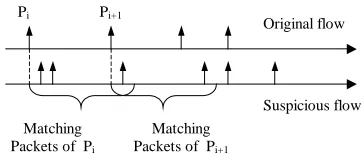
We use the timing constraint in our assumptions to de-termine the matching packets. Since the timing constraint requires that the delays between corresponding packets is bounded by [0,∆], any matching packet p0j of packet pi must satisfy: 0 ≤ t0j −ti ≤ ∆. All matching packets of piwill form a set, which is defined by:
M(pi) ={p0
j|0≤t0j−ti≤∆} (3)
We callM(pi)the matching set of packetpiin flowf0. This procedure is illustrated in figure 1.
To compute all the matching sets,f andf0only need to be scanned once. First, we scanf0 from the beginning to determine M(p1) using equation 3. Packets in a match-ing set is sorted so that the first packet has the smallest timestamp and the last one has the largest timestamp. Sup-pose inM(p1), the first and last matching packet arep0iand p0
need to re-scanf0from the beginning. Becauset1< t2, the first packet to be checked isp0i, and no packets before this packet can satisfy the timing constraint.
Based on the timestamps ofp1andp2, heuristics can be used to further reduce the number of packets to be scanned for M(p2). Suppose the first matching packet in M(p2) isp0j. To determinep0j, ift2−t1 ≤ ∆2, we should scan forward fromp0ibecause it is more likely thatp0jis close to p0
ithanp0k. Afterp0jis found, all packets fromp0jtop0kfulfill equation 3. They are directly added toM(p2). If∆2 < t2− t1 ≤ ∆, we scan backward fromp0k to determine the first half ofM(p2), then scan forward fromp0k+1to determine the second half ofM(p2). Ift2−t1>∆, we start directly fromp0k+1sinceM(p1)andM(p2)will not share common packets. Similarly, we can determine the matching sets for the rest of packets inf. Using such heuristics, each packet inf0will be checked at most twice in the worse case.
It is desirable to further reduce the size of matching sets to improve the correlation performance. Besides the timing constraint, it is possible to use packet size as a constraint in packet matching. For example, in Telnet connections, the sizes of corresponding packets are usually kept the same. Even when SSH protocol is used, block ciphers normally only pad a packet to 8-byte or 16-byte boundary. In such case, we may use quantized packet size, such as multiple of 16 bytes. However, if attackers can actively add inner-packet paddings, using inner-packet size constraint is inappro-priate because the correlation may be completely removed. Nevertheless, keeping packet size constraint as an option will at least increase the inconvenience of attackers.
3.3
Computing the “Best” Watermark
After the matching sets of all packets in flowfhave been determined, we will find the “best” watermark from all pos-sible subsequences inf0. In the following, we discuss sev-eral algorithms with different emphases on detection rate, false positive rate or computation cost. We are trying to achieve the best trade-off among these three aspects.
3.3.1 Algorithm 1: Brute Force Algorithm
The simplest algorithm is to directly form all subsequences by brute-forcely trying all combinations of matching pack-ets. Because we need to maintain the order constraint, not all combinations can form a legitimate sequence. Differ-ent matching sets are likely to share common packets, es-pecially when the maximum delay ∆ is large. We need to guarantee that chosen matching packets will not incur conflict with the order constraint. If packet p0j ∈ M(pi) and packet p0
k ∈ M(pi+1), p0j andp0k can be selected in the same subsequence only if j < k. For example, if M(p1) = {p01, p02} andM(p2) = {p01, p02, p03}, the only
Time Matching Packets
of Pi
Matching Packets of Pi+d
LargestIPD SmallestIPD
Figure 2. The largest and smallest IPDs
legitimate subsequences arehp0
1, p02i,hp01, p30i, andhp02, p03i. After all subsequences are created, we can decode every watermark then obtain the “best” one.
This Brute Force algorithm obviously suffers from its high computation cost. If the number of packets in each matching sets is represents as |M(pi)|, the computation cost of the brute force algorithm can be approximated by: cost≈Qni |M(pi)|, which is unacceptable when∆or the number of chaff packets added is large. In the following, we propose several algorithms with better computation effi-ciency.
3.3.2 Algorithm 2: Greedy Algorithm
Since only the “best” watermark is wanted, we propose a very fast Greedy algorithm that always uses the most “ap-propriate” packets to decode. This algorithm guarantees to return a watermark whose hamming distance is no bigger than that computed from the Brute Force algorithm.
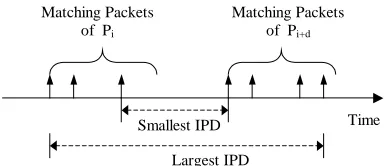
Instead of trying all possible subsequences, the Greedy algorithm only selects those matching packets that are most likely to generate the “best” watermark. In the IPD water-mark scheme, supposeipdi=ti+d−tiis used to embed the watermark. To decode watermark bit 1, it is desirable that the IPDs in the first group (ipd1) is bigger, and the IPDs in the second group (ipd2) is smaller. In this case, we want all IPDs in the first group is the largest, and all IPDs in the sec-ond group is the smallest. Similarly, to decode watermark bit 0, we want all IPDs in the first group to be the small-est, and all IPDs in the second group to be the largest. If the largest IPD is wanted, we should use the first matching packet of packetpi, and the last matching packet of packet pi+d. If the smallest IPD is wanted, we would choose the last match ofpiand the first match ofpi+dto get the small-est IPD. The largsmall-est and smallsmall-est IPDs are shown in figure 2.
(0,1,2),(0,2,1),(1,1,1), and(1,2,2), we should choose the first packets in the matching sets. For packets labeled with (0,1,1), (0,2,2), (1,1,2), and (1,2,1), we should choose the last packet.
According to these labels, the Greedy algorithm then se-lects the first or the last matching packets to form one sub-sequence, and computes the watermark. Unlike the Brute Force algorithm, the order constraint is not enforced here. The major advantage of this algorithm is its extreme low computation cost, because it only needs to form a single subsequence. This algorithm also has very good detection rate. Since the watermark it computes will not have larger hamming distance than that computed by the brute force al-gorithm, it can identify every flow that can be identified by the Brute Force algorithm. However, the false positive rate of this algorithm is high, because the packets selected may not satisfy the order constraint.
3.3.3 Algorithm 3: Greedy+Algorithm
Although the Greedy algorithm can provide very good de-tection rate and is very efficient in computation, the poten-tial high false positive rate makes it not so desirable, espe-cially when the number of chaff packets is large. However, the idea to always choose the most desired matching packets is very useful to compute the “best” watermark quickly. In this algorithm, we decrease the false positive rate by utiliz-ing the order constraint, while still keeputiliz-ing the high detec-tion rate and low computadetec-tion cost. The Greedy algorithm is revised so that not one but multiple subsequences will be created. We make sure that every subsequence satisfies the order constraint. We call this algorithm Greedy+. Unlike the Brute Force algorithm, Greedy+only forms a very small portion of all possible subsequences, so that the watermark can still be computed very efficiently. We also ensure the embedding packets that can potentially give us a better wa-termark will always be checked first. Although only a small portion of all subsequences is formed, the watermark ob-tained should be very close to the one obob-tained by the Brute Force algorithm. Compared with Greedy, Greedy+reduces the false positive rate at the cost of slightly decreased detec-tion rate.
Greedy+algorithm has five phases. First, the matching sets obtained from equation 3 is further simplified to im-prove performance. We have observed that although certain packets are included in a matching set, they may never be used in any subsequence because doing so will invalidate the order constraint. For example, ifM(p1) ={p01, p02}and M(p2) = {p10, p02, p03}, the only legitimate subsequences of hp1, p2i are {hp01, p02i, hp01, p03i, hp02, p03i}. Although p0
1∈M(p2), it cannot be selected as a matching packet of p2, becausep01is also the first match inM(p1). Similarly, suppose nowM(p1) ={p01, p02, p03}.p03cannot be used for
p1 either, because it is the last match in M(p2). We can remove all such packets to get smaller matching sets. For the above example, the matching sets will be changed to M(p1) = {p01, p02} andM(p2) = {p02, p03}. The elimina-tion of extra matching packets can be combined with the packet matching process to reduce extra overhead. To re-move duplicated first packets, instead of starting from the first matching packetp0
j ofpi, we begin withp0j+1. To re-move duplicated last packets, we only need one extra com-parison between the last packets inM(pi+1)andM(pi).
Second, we use the Greedy algorithm to compute a wa-termark wg. If the hamming distance betweenwg and the original watermarkwis larger than the threshold, we quit immediately and return that it is not in the same chain of stepping-stone connections. From wg, it is also known which watermark bits will never match no matter how we choose the matching packets. Such watermark bits will be omitted from later computation. We only focus on the wa-termark bits that match withw.
Third, we check whether the matching packets chosen by the Greedy algorithm incur any conflict with the or-der constraint. For example, if M(p1) = {p01, p02} and M(p2) = {p20, p03}, the Greedy algorithm may choosep02 as the matching packet for both p1 andp2. If a matching packet does not have conflict with other matching packets, then it is safe to stick to this selection, and we do not need to worry about this packet later. Otherwise, we will have to adjust the existing selection to satisfy the order constraint. Supposep0
k is the matching packets ofpi selected by the Greedy algorithm, andI(pi) =kis a function returning the index of matching packets. Obviously, for two consecutive embedding packets pi andpj (i < j), ifI(pi) ≥ I(pj), there will be conflict with the order constraint. Even if I(pi) < I(pj), there may still exist conflict because the non-embedding packets betweenpiandpjalso need to have exclusive matches. If there arexnon-embedding packets in between, it is required that I(pi) < I(pj)−xto ensure every non-embedding packet has at least one match.
Fourth, we form the basic subsequence by adjusting the matches selected by the Greedy algorithm to main-tain the order constraint. We make sure that when there are conflicts, we always allow a packet to choose its first match, and adjust those using their last matches. This process starts from the last embedding packet, for which we can alway stick to the current selection. If the match-ing packet of embeddmatch-ing packetpihas no conflict or is the first one in the matching set, we stick to it. Otherwise, for a embedding packet with conflict or a non-embedding packet, we choose the last match that will not incur any conflict with packets later than it. For example, suppose M(p1) = {p01, p02, p03, p04}, M(p2) = {p30, p04, p05}, and M(p3) = {p04, p50, p06}. p1andp3are embedding packets and they both choosep0
and it can select its best match p04. p2 is non-embedding packet, so it selects the last non-conflict packetp03. Thenp1 has to select the last non-conflict packetp02. From the basic subsequence, we decode a watermarkwb. If it has a ham-ming distance less than the threshold, we can immediately quit and return that this is a stepping-stone flow. Otherwise, we adjust the selections of matching packets for a better match of the watermark.
To speed up later computation, we record all the IPD dif-ferencesDwhen we computewb. Recall that watermark bit is decoded as 1 ifD >0, and 0 ifD ≤0. We divideDin two groupsD+andD−based on whether their correspond-ing watermark bits match the original watermark bit. If the ith watermark bit of wb is the same as that ofw, we put the corresponding IPD differenceDi in groupD+. Other-wise, we putDiin groupD−. We then sort allDi∈D−in the ascending order according to their absolute value|Di|1. Apparently, we can get a better watermark by choosing dif-ferent matching packets to make someDi ∈ D− fall into D+. Among allDi ∈ D−, the one with the smallest ab-solute value is most likely to be changed by using different matching packets.
In the final phase, we focus on those embedding pack-ets of Di ∈ D−, whose most desirable matching packets haven’t been chosen in the basic subsequence. For these packets, the current choice of their matching packets are not optimized. This process starts from theDwith the smallest absolute value. Suppose it isDj. To adjustDj, we begin with its last embedding packet,pk, because adjusting it will not force other embedding packets of Dj to change their selection of matching packets.
1. For packetpk, if the matching packet currently used is already the most desirable one, we stick to this selec-tion, and continue for the previous embedding packet.
2. Otherwise, we select the next matching packet ofpk, if any. Since it also affects other packets, we have to re-select their matching packets too. Then we compute the newDjto see if it moves closer to 0. We also make sure such a change will not make anyDipreviously in D+ fall into D−. If both conditions hold, it means choosing the new matching packet will improve the watermark we can get. So we make this change per-manent and updateDj. Since we have recorded all the IPD differences and labeled each packet with a triple, the computation of newDjcan be executed quickly.
3. Repeat step 2 for packetpk until 1)Dj falls intoD+, 2) there is no more matching packets, or 3) making changes will not necessarily improve the watermark. IfDjfalls intoD+, that means we have found a better
1WhetherD
iis positive or negative is not related with the group it
belongs to.
watermark. We then adjust the next smallestD∈D−. Otherwise, we will repeat this procedure for the pre-vious embedding packet ofDj. Whenever we obtain a watermark whose hamming distance is less than the threshold, we can terminate and report a stepping stone flow is found.
In the final phase, each time we determine the best option of one embedding packet without considering the possible change of other packets. In other words, we fix the selection of other packets, and check what is the best selection of the current packet. Unlike the Brute Force algorithm, there will be no backtracking. Because we use the heuristics to always adjust those packets that are most likely to generate a better result, usually we should get a watermark very close to the “best” one.
3.3.4 Algorithm 4: Greedy∗
In case a user wants to find the actual “best” watermark, and the computation cost is not much a concern, we provide an-other algorithm Greedy∗. The only difference between this algorithm and the Greedy+ algorithm is in the last phase. In Greedy∗, after we determine which embedding packets are non-optimized in the basic subsequence, we enumerate all the possible combinations of these embedding packets to find the “best” watermark. Whenever a watermark that has a hamming distance less than the threshold is obtained, this algorithm will terminate.
The last phase of Greedy∗ is similar to the Brute Force algorithm. However, after the previous several phases, usu-ally we can reduce the size of searching space significantly. For example, suppose the watermark has 24 bits, the redun-dancy numberris 4, the threshold is 5, the hamming dis-tancehgfor watermarkwgis4, and the hamming distance hbfor the watermarkwbis 7. Half of the embedding pack-ets use their first matching packpack-ets and will be omitted. So the number of embedding packets we need to check will be at most(hb−hg)×r×2 = 24. Compared with the number of packets we need to check in the Brute Force algorithm,
24×r×4 = 384, this is a huge improvement.
To bound the worst case execution time, this algorithm also allows users to set up a maximum bound of compu-tation cost. If it cannot finish within the specific cost, it returns the best watermark obtained so far.
3.4
Complexity Analysis
Table 1. Experiment Parameters
∆ 0,1,2,3,4,5,6,7,8(second) λc 0,0.5,1,1.5,2,2.5,3,3.5,4,4.5,5
Watermark 24 bits
Redundancy 4
WM threshold 7
WM delay 600ms
S-IV threshold 3 seconds
number of packets in the flow pairs, the number of chaff packets added, and the maximum delay∆.
Considering an upstream flowf and a possible down-stream flowf0. In the packet matching process, each packet inf0will be checked at most twice in the worse case. Thus, the worst case complexity isO(m), wheremis the number of packets in f0. Iff0 is actually in the same connection chain asf,mis equal to the sum of the number of packets ninf and the number of chaff packetsc. So the complexity is alsoO(n+c). The average number of matching packets in each matching set can be approximated by the product of the average packet arrival rateλf0 inf0, and the maximum
delay∆: λf0·∆. Whenf0is actually a chaffed flow off,
λf0 is equal to the average packet arrival rate off plus the
average arrival rate of chaff packets:λf0 =λf+λc.
Since the Greedy algorithm only needs to check every embedding packet once, its computation complexity is O(n). For the Greedy+ algorithm, the most time consuming part is the last phase where every match-ing packet for any non-optimized embeddmatch-ing packet will be re-scanned. Suppose the non-optimized embedding packets are pe1, . . . , pek. It requires to check at most
Pk
i=1|M(pei)|packets. Using the average number of pack-ets of matching spack-ets, it is bounded byO(n·λf0·∆). The last
phase of Greedy∗algorithm needs to checkQki=1|M(pei)| packets. However, both Greedy+ and Greedy∗ algorithm normally have much better performance than their worst case scenarios.
4
Experiments
In this section, we evaluate the performance of our al-gorithms using detection rate, false positive rate and
com-putation cost. Both real world and synthetic network flows
are used in our experiments. We compare our algorithms with the basic watermarking scheme proposed in [9] and scheme S-IV in [13], because they are the best existing ac-tive and passive schemes, respecac-tively. Only timing con-straint is used in packet matching process. We expect that false positive rate and computation cost decrease dramati-cally if quantized packet size constraint is also used.
4.1
Real World Data Set
We first evaluate our algorithms using 91 real SSH/Telnet traces derived from Bell Labs-1 Traces of NLANR [5]. All real traces have more than 1,000 packets. For each trace, we first embed a randomly generated water-mark2, then introduce 9 different kinds of timing
perturba-tions, which is uniformly distributed with a maximum delay from 0 (i.e., no perturbation) to 8 seconds. The increment of maximum delay is 1 second. For each timing perturbation, we add 11 different kinds of Poisson distributed chaff pack-ets. The arrival rate of chaff packetsλc is from 0 (i.e., no chaff) to 5, and the increment is 0.5. The maximum delay
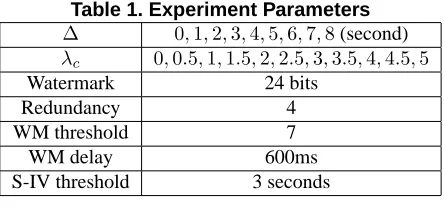
∆ in our algorithms is set the same as maximum delay of timing perturbation. For each setting of∆andλ, we com-pute the detection rate, false positive rate, and computation cost. The threshold of hamming distance in the watermark scheme is 7. Watermark length is 24, redundancy number is 4, and the delayais 600 milliseconds. The threshold for scheme S-IV is set to be 3 seconds. The parameters is shown in table 1. In Greedy∗algorithm, we also set the maximum cost to 1,000,000 to bound its execution time. The meaning of computation cost is explained in section 4.1.
Detection Rate. To evaluate the detection rate, for each
setting of parameter∆andλc, we calculate the correlation between each original flow and its perturbed and chaffed flows. For a specific∆andλc, there are 91 flow pairs to be correlated. We then compute the average detection rate for every setting of∆andλc.
Figure 3 shows the detection rate changing withλcwhen
∆ = 7 seconds for real flows. The detection rate of the
basic watermark scheme falls near 0 when chaff packets are added, which shows chaff destroys watermark detec-tion mechanism completely. The Greedy algorithm can al-ways achieve 100% detection rate. For other algorithms, the detection rates increase rapidly with the number of chaff packets. They will have around 100% detection rate when λc ≥2. If there is no chaff added, Greedy+ and Greedy∗ can detect more than 40% of stepping stone connections, while scheme S-IV can only detect less than 10%. Although theoretically Greedy∗should have better detection rate than Greedy+, under the bound of computation cost, Greedy+ outperforms Greedy∗.
Figure 4 shows the detection rate changing with∆when λc = 3. In this case, all algorithms except the basic water-mark approach have very high detection rate. However, S-IV has significant lower detection rate than our algorithms when there is no chaff, and fails to reach 100% for other cases.
Because we are trying to use the “best” watermark, the increase of chaff packets helps the detection rate. However,
2No watermark is embedded when the fast solution of scheme S-IV is
0 0.2 0.4 0.6 0.8 1
0 0.5 1 1.5 2 2.5 3 3.5 4 4.5 5
Arrival Rate of Poisson Distributed Chaff Packets
D
et
ec
ti
o
n
R
at
e Basic Watermark
Greedy Greedy+ Greedy* S-IV
Figure 3. Detection rate changing withλc,∆ = 7s
0 0.2 0.4 0.6 0.8 1
0 1 2 3 4 5 6 7 8
Maximum Delay (second)
D
et
ec
ti
on R
at
e Basic Watermark
Greedy Greedy+ Greedy* S-IV
Figure 4. Detection rate changing with∆,λc= 3
the increase of chaff will also increase the false positive rate, which is shown in the following.
False Positive Rate. To evaluate the false positive rate,
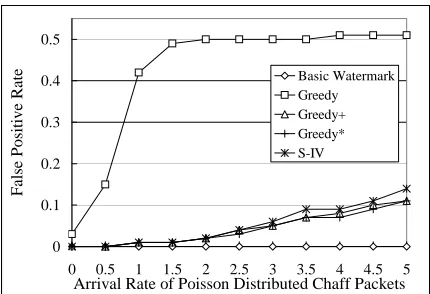
for each setting of parameter ∆ andλc, we calculate the correlation between each original flow and the perturbed and chaffed flows of other 90 flows. Totally there are 8,190 unrelated flow pairs to be correlated. We then compute the average false positive rate for each setting of∆andλc. Fig-ure 5 shows the false positive rate changing withλc when
∆ = 7 seconds. Figure 6 shows the false positive rate
changing with∆whenλc= 3.
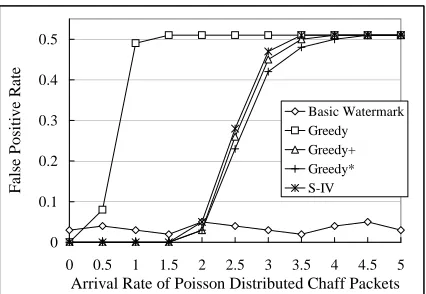
Unsurprisingly, Greedy algorithm shows the worst per-formance in terms of false positive rate. Its false positive rate reaches about 50% very quickly afterλc ≥2for both synthetic and real flows. Except for the basic watermark al-gorithm, the false positive rates of other algorithms increase withλc and∆. Both Greedy+ and Greedy∗ show better performance than scheme S-IV. The false positive rates of Greedy+and Greedy∗are up to about 40% lower than that of S-IV, as shown in figure 6.
0 0.1 0.2 0.3 0.4 0.5
0 0.5 1 1.5 2 2.5 3 3.5 4 4.5 5
Arrival Rate of Poisson Distributed Chaff Packets
F
a
ls
e
P
os
it
ive
R
a
te Basic Watermark
Greedy Greedy+ Greedy* S-IV
Figure 5. False positive rate changing withλc,
∆ = 7s
0 0.1 0.2 0.3 0.4 0.5
0 1 2 3 4 5 6 7 8
Maximum Delay (second)
F
al
se
P
o
si
ti
v
e
R
at
e
Basic Watermark Greedy Greedy+ Greedy* S-IV
Figure 6. False positive rate changing with∆,
λc= 3
Computation Costs. Now let’s compare the
computa-tion costs of these algorithms. We also include the cost of packet matching process since it is a critical and time con-suming step both in our approach and scheme S-IV. To elim-inate the bias of different implementation details, we define the computation cost as the number of packets in both flows that have to be checked to compute the “best” watermark or the smallest deviation for scheme S-IV. We distinguish the computation costs between correlated and uncorrelated flow pairs. For each algorithm, we compute the average computation cost for each setting ofλcand∆.
1.E+02 1.E+03 1.E+04 1.E+05 1.E+06
0 0.5 1 1.5 2 2.5 3 3.5 4 4.5 5
Arrival Rate of Poisson Distributed Chaff Packets
C
o
m
p
u
ta
ti
o
n
C
o
st
s
Pkt matching Greedy Greedy+ Greedy* S-IV
Figure 7. Computation Costs changing with
λc,∆ = 7s, correlated flow pairs
1.E+02 1.E+03 1.E+04 1.E+05 1.E+06
0 1 2 3 4 5 6 7 8
Maximum Delay (second)
C
o
m
p
u
ta
ti
o
n
C
o
st
s
Pkt matching Greedy Greedy+ Greedy* S-IV
Figure 8. Computation Costs changing with
∆,λc= 3, correlated flow pairs
checked increase rapidly. However, when there are enough chaff packets added, our optimization techniques can give out the results quickly so that the computation cost begin to decrease. Greedy+also shows smaller bumps in figure 7 for the same reason. There are certain cases that Greedy∗ cannot finish within its bound of computation cost, which explains why sometimes it has lower detection rate than Greedy+. Both Greedy+and Greedy∗have up to about 40 times lower costs than S-IV.
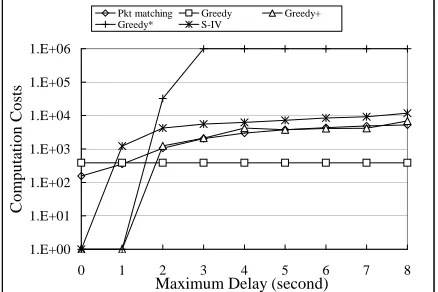
Figure 9 shows the relation between computation cost andλc for uncorrelated flows, when∆ = 7s. Figure 10 shows the relation between computation cost and∆for un-correlated flows, when λc = 3. It is worth noticing that some algorithms will have 0 cost3. It is because these
algo-rithms depends on packet matching procedure. If the match-ing process fails to find any matchmatch-ing packet, we immedi-ately have negative correlation result. The computation cost
3In order to draw the figures in logarithm scale, we change 0 to 1.
1.E+02 1.E+03 1.E+04 1.E+05 1.E+06
0 0.5 1 1.5 2 2.5 3 3.5 4 4.5 5
Arrival Rate of Poisson Distributed Chaff Packets
C
o
m
p
u
ta
ti
o
n
C
o
st
s
Pkt matching Greedy Greedy+ Greedy* S-IV
Figure 9. Computation Costs changing with
λc,∆ = 7s, uncorrelated flow pairs
1.E+00 1.E+01 1.E+02 1.E+03 1.E+04 1.E+05 1.E+06
0 1 2 3 4 5 6 7 8
Maximum Delay (second)
C
o
m
p
u
ta
ti
o
n
C
o
st
s
Pkt matching Greedy Greedy+ Greedy* S-IV
Figure 10. Computation Costs changing with
∆,λc= 3, uncorrelated flow pairs
of Greedy∗will reach its bound rapidly when chaff or delay is big. Greedy+is still up to about 2 times faster than S-IV.
4.2
Synthetic Data Set
We have also evaluated our algorithms using 100 syn-thetic tcplib traces [3]. Each synsyn-thetic trace has 800 pack-ets. We repeat the above experiments using the same water-marking parameters as in section 4.1.
The results for detection rate are shown in figures 11 and 12. They are similar to those for real flows, except that scheme S-IV has a little improvement. The results for false positive rate are shown in figures 13 and 14. Unlike the real flows, the false positive rates increase more quickly when
0 0.2 0.4 0.6 0.8 1
0 0.5 1 1.5 2 2.5 3 3.5 4 4.5 5
Arrival Rate of Poisson Distributed Chaff Packets
D
et
ec
ti
on R
at
e Basic Watermark
Greedy Greedy+ Greedy* S-IV
Figure 11. Detection rate changing with λc,
∆ = 7s
0 0.2 0.4 0.6 0.8 1
0 1 2 3 4 5 6 7 8
Maximum Delay (second)
D
e
te
c
ti
on R
a
te Basic Watermark
Greedy Greedy+ Greedy* S-IV
Figure 12. Detection rate changing with ∆,
λc= 3
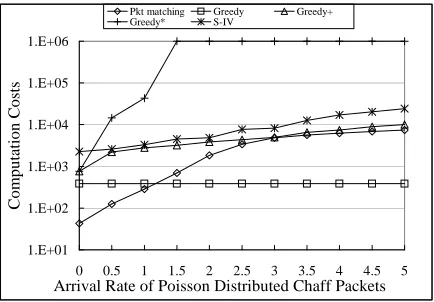
The result of computation costs for synthetic flows are shown in figures 15, 16, 17 and 18. In these figures, we can see similar trends to the results of real flows. Greedy+ has shown much better computation efficiency than both S-IV and Greedy∗.
4.3
Overall Performance
From all the experiment results, algorithm Greedy+has shown overall the best trade-off among detection rate, false positive rate and computation cost. The optimization tech-niques successfully improve the efficiency while keeping the effectiveness. Greedy∗ suffers from its high com-putation cost, especially when it cannot find correlation. Scheme S-IV only shows better detection rate in a small interval ofλcfor synthetic traffic, and has worse false pos-itive rate than both Greedy+ and Greedy∗. It also has higher computation cost than Greedy+. The packet match-ing process shows reasonable computation cost so that the entire correlation procedure can finish in a reasonable time.
0 0.1 0.2 0.3 0.4 0.5
0 0.5 1 1.5 2 2.5 3 3.5 4 4.5 5 Arrival Rate of Poisson Distributed Chaff Packets
F
a
ls
e
P
os
it
ive
R
a
te
Basic Watermark Greedy Greedy+ Greedy* S-IV
Figure 13. False positive rate changing with
λc,∆ = 7s
0 0.1 0.2 0.3 0.4 0.5
0 1 2 3 4 5 6 7 8
Maximum Delay (second)
F
al
se
P
os
it
ive
R
at
e
Basic Watermark Greedy Greedy+ Greedy* S-IV
Figure 14. False positive rate changing with
∆,λc= 3
5
Related Work
The problem of detecting interactive stepping stones was first formulated by Staniford and Heberlein [7]. They pro-posed a content-based approach by creating thumbprints from the payload of packets, and comparing them to find ex-tremely good matches. Another content-based scheme was Sleepy Watermark Tracing technique [11], which correlates stepping stone connections by injecting non-displayable contents. Such methods required the contents of pack-ets could not change significantly between different flows, which made them unusable for encrypted traffic such as SSH connections.
pro-1.E+02 1.E+03 1.E+04 1.E+05 1.E+06
0 0.5 1 1.5 2 2.5 3 3.5 4 4.5 5
Arrival Rate of Poisson Distributed Chaff Packets
C
om
put
at
ion C
os
ts
Pkt matching Greedy Greedy+ Greedy* S-IV
Figure 15. Computation Costs changing with
λc,∆ = 7s, correlated flow pairs
1.E+02 1.E+03 1.E+04 1.E+05
0 1 2 3 4 5 6 7 8
Maximum Delay (second)
C
om
put
at
ion C
os
ts
Pkt matching Greedy Greedy+ Greedy* S-IV
Figure 16. Computation Costs changing with
∆,λc= 3, correlated flow pairs
posed a deviation-based scheme to detect stepping stone connections. This scheme calculated deviation between a known attacking flow and all other flows appeared around the same time. They observed that unrelated flows would usually have deviations large enough to be distinguished from those in the same stepping stone connections. Wang et al. [10] proposed a correlation scheme based on inter-packet delays (IPDs). They showed that timing character-istic of IPDs of corresponding packet pairs were preserved across multiple stepping stones, and could be used for corre-lation. Although these schemes can be utilized to correlated encrypted connections, they are all vulnerable to timing per-turbations intentionally added by attackers.
Donoho et al. [4] investigated the theoretical limits of the attackers’ ability to disguise their traffic through timing perturbations and extra chaff packets. Using wavelet and multiscale analysis, they demonstrated that stepping stone correlation is still possible by observing long term behav-ior. However, they did not discuss the false positive rate of
1.E+01 1.E+02 1.E+03 1.E+04 1.E+05 1.E+06
0 0.5 1 1.5 2 2.5 3 3.5 4 4.5 5
Arrival Rate of Poisson Distributed Chaff Packets
C
o
m
p
u
ta
ti
o
n
C
o
st
s
Pkt matching Greedy Greedy+ Greedy* S-IV
Figure 17. Computation Costs changing with
λc,∆ = 7s, uncorrelated flow pairs
1.E+00 1.E+01 1.E+02 1.E+03 1.E+04 1.E+05 1.E+06
0 1 2 3 4 5 6 7 8
Maximum Delay (second)
C
om
put
at
ion C
os
ts
Pkt matching Greedy Greedy+ Greedy* S-IV
Figure 18. Computation Costs changing with
∆,λc= 3, uncorrelated flow pairs
their method, and provided no practical scheme to defeat chaff packets. Wang and Reeves [8] proposed an active wa-termarking scheme that was robust to random timing per-turbations. They first identified the quantitative tradeoffs between the correlation effectiveness (in term of true posi-tive & false posiposi-tive), maximum timing perturbations added by the adversary, the defining characteristics of the inter-packet timing of flows and the number of inter-packets needed. Their work is also the first one that identify provable bound on the number of packets needed to achieve desired cor-relation effectiveness. Wang et al. also proposed another watermarking scheme [9] that guaranteed even timing ad-justments and had better true positive rates.
al-gorithm which can deal with small number of chaff packets. However, they did not show any experimental evaluation of their algorithms.
Zhang et al. [13] proposed several algorithms to de-tect stepping stone connections when timing perturbation or/and chaff packets may be present. Their algorithms were also based on finding possible corresponding packets. They have shown that when deviation was chosen as the correla-tion criteria, a fast solucorrela-tion could be used to reduce com-putation time while still maintaining the same correlation results. Unlike active schemes, their passive scheme does not require traffic manipulation, thus is less noticeable to attackers. However, using active watermarking scheme, our algorithms can achieve better performance with less com-putation costs.
Researchers have also focused on building anonymous systems that can hide the identities of communication par-ticipants [2] [6]. Mixes have been used to provide anony-mous connections that are resistant to eavesdropping and traffic analysis. A Mix accepts fix-length messages from various sources, performs cryptographic transformations, and forwards them to the next destination in a random or-der. Random packet delay and traffic padding are also used to improve the privacy.
6
Conclusions
Tracing attacks through stepping stones is a difficult problem. Encryption, timing perturbation and chaff pack-ets can all be employed by intruders to hide their identities. To defeat these countermeasures, in this paper, we introduce our correlation scheme based on packet matching and active timing-based watermark scheme. We have developed a se-ries of algorithms to compute the “best” watermark. These algorithms have different emphases on detection rate, false positive rate or computation cost. Through experiments, we have demonstrated the effectiveness and efficiency of our algorithms. We have also compared our algorithms with existing best schemes, and shown that overall Greedy+ al-gorithm has better performance.
Our algorithms (and several previous approaches) re-ply on the assumption that packets should not be lost or combined together after passing through a stepping stone. However, packet loss or re-packetization are common when packets arrive too closely or system load is high. In this case, our scheme may not always return the desired result. In the future work, we will focus on correlation methods that will work under packet loss and re-packetization.
Acknowledgment. We would like to thank Dr. Yong
Guan for providing a draft of his work [13].
References
[1] A. Blum, D. Song, and S. Venkataraman. Detection of in-teractive stepping stones with maximum delay bound: algo-rithms and confidence bounds. In Proceedings of RAID’04, 2004.
[2] D. Chaum. Untraceable electronic mail, return addresses,
and digital pseudonyms. Communications of the ACM,
24(2):84–88, 1981.
[3] P. B. Danzig and S. Jamin. Tcplib: A library of TCP/IP traf-fic characteristics. USC Networking and Distributed Systems Laboratory TR CS-SYS-91-01, 1991.
[4] D. Donoho, A. Flesia, U. Shankar, V. Paxson, J. Coit, and S. Staniford. Multiscale stepping-stone detection: detecting pairs of jittered interactive streams by exploiting maximum tolerable delay. In Proceedings of RAID’02, 2002.
[5] NLANR trace archive. http://pma.nlanr.net/traces/long/. [6] Onion routing. http://www.onion-router.net.
[7] S. Staniford-Chen and L. T. Heberlein. Holding intruders accountable on the Internet. In Proceedings of IEEE S&P 95, pages 39–49, Oakland, CA, 1995.
[8] X. Wang and D. S. Reeves. Robust correlation of encrypted attack traffic through stepping stones by manipulation of inter-packet delays. In Proceedings of CCS’03, pages 20– 29, 2003.
[9] X. Wang, D. S. Reeves, P. Ning, and F. Feng. Robust
network-based attack attribution through probabilistic wa-termarking of packet flows. Technical Report TR-2005-10, Department of Computer Science, NC State University, 2005.
[10] X. Wang, D. S. Reeves, and S. F. Wu. Inter-packet delay based correlation for tracing encrypted connections through stepping stones. In D. Gollmann, G. Karjoth and M. Waid-ner, editors, 7th European Symposium on Research in Com-puter Security - ESORICS 2002, 2002.
[11] X. Wang, D. S. Reeves, S. F. Wu, and J. Yuill. Sleepy water-mark tracing: An active network-based intrusion response framework. In Proceedings of 16th International Confer-ence on Information Security (IFIP/Sec’01), 2001. [12] K. Yoda and H. Etoh. Finding a connection chain for tracing
intruders. In F. Guppens, Y. Deswarte, D. Gollmann and M. Waidners, editors, 6th European Symposium on Research in Computer Security - ESORICS 2000, 2000.
[13] L. Zhang, A. Persaud, A. Johnson, and Y. Guan. Step-ping stone attack attribution in non-cooperative IP networks. Technical Report 2005-02-1, Department of Electrical and Computer Engineering, Iowa State University, 2005. [14] Y. Zhang and V. Paxson. Detecting stepping stones. In