7
MODELING FISH AND ITS
MOVEMENT
Hisamudin Yusof, Norhaida Mohd Suaib
INTRODUCTION
Artificial life is a very interesting research area. It involves a multidisciplinary knowledge like mathematics, biology, genetics, physics, artificial intelligence and computer graphics. Modeling and animation of the artificial life has received a lot of attention from computer graphics researchers. It has been widely used in the development of computer games, animation films and smart robots, as well as in virtual reality applications. This chapter will discuss on the theory behind artificial fish and the emphasis on the computer graphics - modeling and animation of an artificial fish.
ARTIFICIAL FISH
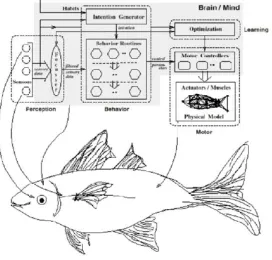
Figure 7.1 Main components, control and information flow in an artificial fish (Tu & Terzopoulos (1994);
Tu (1999))
and others. We will show the fish structure (physics-based model) and the graphics components that form a realistic artificial fish.
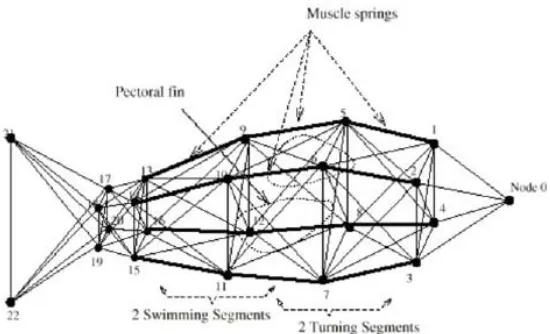
Figure 7.2 Physics-based fish model used by Tu & Terzopoulos (1994); Tu (1999)
Biomechanical Fish Model
Graphics Display
This model is a collection of geometric models that are mapped onto the main structure. Real fish image is then mapped onto Bezier surfaces that represent the left and the right side of the fish. Apart from the main body, Bezier surfaces are also used to represent the tails and fins. As the fish swims (or moves), control points will be displaced and the surface is updated accordingly.
Bezier Surface
Two sets of Bezier surfaces are modelled based on their own sets of control points. These control points will be updated as the fish moves, for example transformed points due to changes as the fish swims forward, turns left or turns right (Terzopoulos, Tu & Grzeszczuk (1994), Yu & Terzopoulos (1999), Tu (1999)).
The Cartesian Bezier blending function for the Bezier surface is given as:
¦
¦
nk jk jm kn m j u BEZ v BEZ p v u P 0 , , , 0 , (1)
where the value of pj,k determines the position of control
3D FISH MODEL
A 3D fish model that is consistent with the biomechanical model described by Tu & Terzopoulos (1994) and Tu (1999) (Figure 7.2) was used as a reference in our experiment. Since our research is focusing on the computer graphics, the following discussions will be more on the modeling and the visualization aspects of the artificial fish.
In accordance to different segments that has been implemented by Tu (1999), we described our model hierarchically. The hierarchy is illustrated as Figure 7.3.
Figure 7.3 Hierarchy of fish model
Fishmodel
Head Body– turning segment
Rightfin Leftfin
Body– swimming
segment
Figure 7.4 Algorithm to generate a Bezier surface Begin
for i = 0 to n = 0 do for j = 0 to m do
input control points, cpij
next j
next i
// u curve
for u = 0.0 to 1.0 insteps of 0.05 do
move_flag = true
for v = 0.0 to 1.0 insteps of 0.05 do
k j n
k jk jm kn m j CP u BEZ v BEZ p v u P , 0 , , , 0 ,
¦
¦
if P
u,v = starting point thenmove_to(P
u,v)move_flag = false else
draw_to(P
u,v)end ifnext v
next u
// v curve for v = 0.0 to 1.0 insteps of 0.05 do
move_flag = true
for u = 0.0 to 1.0 insteps of 0.05 do
k j n
k jk jm kn m j CP u BEZ v BEZ p v u P , 0 , , , 0 ,
¦
¦
if P
u,v = starting point thenmove_to(P
u,v)move_flag = false else
draw_to(P
u,v)end ifnext u
next v
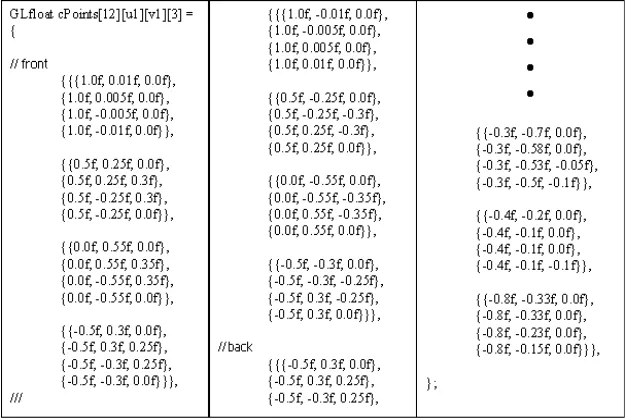
Figure 7.5 Sample codes to define the control points
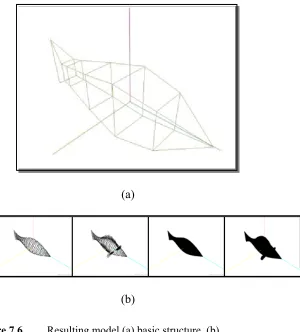
(a)
(b)
Figure 7.6 Resulting model (a) basic structure, (b) wireframe and solid models – without and with the fins
ANIMATION OF FISH MODEL
fully physics-based model was implemented. Intention generator activates certain behaviour that in turns, stimulates the motor action and causes the fish’s muscles generate movement. Referring to the biomechanical model, movement is caused by contraction and expansion of the spring. It is done harmoniously so that the tail and the swimming segments could swing back and forth. The accumulated force causes the fish to thrust. Pectorial fins (the left and the right fins) are used to stabilize the movement – by controlling the pitch and yaw.
Another option is by using a set of pre-defined path/positions. User will not be able to interact with the fish. We took a moderate approach by applying 3D transformation on the control points to simulate head, fins and tail movement as the fish swims. At the same time users are allowed to control the turning angle of the fish.
Animating the swinging motion of the fish’s tail and fins, or the turning of its head involves rotation about certain axis. This involves a series of equation a follows:
axis y y y x z x x z z ° ¿ ° ¾ ½ about the rotation ' cos sin ' sin cos ' T T T T .
Figure 7.7 Sample code to generate body movements void glMoveBody(double degree, int a, int b, int c, int d, int e, int f, int g, int h) {
int i;
theta = degree * pi / 180; //rotation degree
//rotation point
korZ = mybezier[a].anchors[b][0].z;//c_point[a][b][0][2]; korX = mybezier[a].anchors[b][0].x;//c_point[a][b][0][0]; korZ1 = mybezier[c].anchors[d][0].z;//c_point[c][d][3][2]; korX1 = mybezier[c].anchors[d][0].x;//c_point[c][d][3][0];
//rotated point for(i = 0; i < 4; i++) {
pZ[i] = mybezier[e].anchors[f][i].z;//c_point[e][f][i][2];
pX[i] = mybezier[e].anchors[f][i].x;//c_point[e][f][i][0]; pZ1[i] = mybezier[g].anchors[h][i].z;//c_point[g][h][i][2]; pX1[i] = mybezier[g].anchors[h][i].x;//c_point[g][h][i][0];
}
//rotation
for(i = 0; i < 4; i++)
{mybezier[e].anchors[f][i].z /*c_point[e][f][i][2]*/ = (korZ + (((pZ[i] - korZ) * cos(theta)) - ((pX[i] - korX) * sin(theta))));
mybezier[e].anchors[f][i].x /*c_point[e][f][i][0]*/ = (korX + (((pZ[i] - korZ) * sin(theta)) + ((pX[i] - korX) * cos(theta)))); mybezier[g].anchors[h][i].z /*c_point[g][h][i][2]*/ = (korZ1 +
(((pZ1[i] - korZ1) * cos(theta)) - ((pX1[i] - korX1) * sin(theta))));
mybezier[g].anchors[h][i].x /*c_point[g][h][i][0]*/ = (korX1 + (((pZ1[i] - korZ1) * sin(theta)) + ((pX1[i] - korX1) * cos(theta))));
Homogeneous Coordinate System could also be used for calculation. There are also OpenGL functions like
glRotatef (GLfloat angle, GLfloat x, GLfloat y, GLfloat z) and glTranslatef (GLfloat x, GLfloat y, GLfloat z) to ease the implementation.
Turning Motion
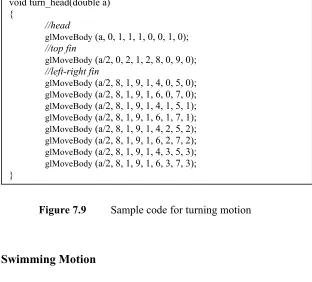
Most of the fish turns using the front muscles until a maximum level is met. Turning degree is proportional to the curvature of the fish model’s turning segment (Webb 1989). Similar to swimming motion, motor control that handles turning actions will generate appropriate parameters so that the fish could turn. An example of the turning action that we managed to produce is given as Figure 7.8 and the sample code for turning motion is given as Figure 7.9.
(a) Turn to left and right
(b) A complete body turn
Figure 7.9 Sample code for turning motion
Swimming Motion
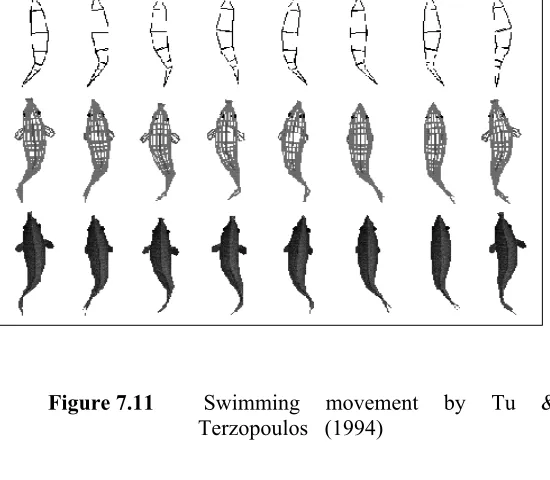
Previous researchers like Blake (1983) and Tu & Terzopoulos (1994) recorded real fish movement as it swims. These can be seen from Figure 7.10 and Figure 7.11.
void turn_head(double a) {
//head
glMoveBody (a, 0, 1, 1, 1, 0, 0, 1, 0); //top fin
glMoveBody (a/2, 0, 2, 1, 2, 8, 0, 9, 0); //left-right fin
Figure 7.10 Real fish swimming movement (Blake 1983)
Figure 7.11 Swimming movement by Tu & Terzopoulos (1994)
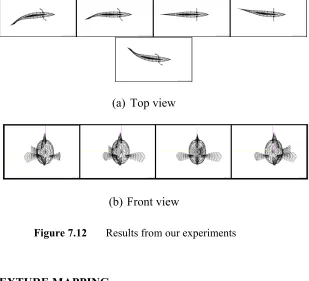
(a) Top view
(b) Front view
Figure 7.12 Results from our experiments
TEXTURE MAPPING
Texture mapping makes the fish model more realistic. In our experiment, a bitmap file from a real fish photograph was used together with OpenGL function
Figure 7.13 A texture-mapped fish
CONCLUSION
REFERENCE
D. Terzopoulos, X. Tu & R. Grzeszczuk, "Artificial fishes: Autonomous locomotion, perception, behavior, and learning in a simulated physical world,'' Journal of Artificial Life,1,4, (1994).
P.W. Webb, Form and function in fish swimming.
Scientific American, 251, pp. 58-68 (1984).
Q. Yu & D. Terzopoulos, "Synthetic motion capture: Implementing an interactive virtual marine world", The Visual Computer 15, pp. 377-394 (1999).
R. W. Blake, Fish Locomotion (Cambridge University Press, 1983).
X. Tu and D. Terzopoulos, "Artificial Fishes: Physics, Locomotion, Perception, Behavior", Computer Graphics, SIGGRAPH 94 Conference Proceedings, pp. 43-50, July, 1994
X. Tu, "Artificial Animals for Computer Animation: Biomechanics, Locomotion, Perception, and Behavior '', ACM Distinguished Ph.D Dissertation Series,