ABSTRACT
OH, YOUNG HYUN. Channel Detecting Jamming Attacks on Rendezvous Algorithms for Cognitive Radio Networks. (Under the direction of Dr. David J. Thuente.)
Traditional spread spectrum techniques such as Frequency Hopping Spread Spectrum (FHSS) and Direct Sequence Spread Spectrum (DSSS) have been used for anti-jamming solutions in wireless broad-cast communication. However, these systems generally have the fundamental limitation of a prior key sharing between a sender and receiver. If a jammer is a compromised receiver, then it uses the se-cret key to jam the entire wireless communication. To address this problem, new enhancements allow a sender and receiver to independently generate random channel hopping (CH) or frequency hopping (FH) sequences so that it is unfeasible for a jammer to compute the same sequences. These schemes can provide fast rendezvous or key exchange methods for Cognitive Radio Networks (CRNs) called blind rendezvous algorithms in which a sender and receiver have no prior knowledge of a shared key, time synchronization information, or common control channels (CCCs).
© Copyright 2014 by Young Hyun Oh
Channel Detecting Jamming Attacks on Rendezvous Algorithms for Cognitive Radio Networks
by Young Hyun Oh
A dissertation submitted to the Graduate Faculty of North Carolina State University
in partial fulfillment of the requirements for the Degree of
Doctor of Philosophy
Computer Science
Raleigh, North Carolina 2014
APPROVED BY:
Dr. Harry G. Perros Dr. Mihail L. Sichitiu
DEDICATION
BIOGRAPHY
ACKNOWLEDGEMENTS
TABLE OF CONTENTS
LIST OF TABLES . . . vii
LIST OF FIGURES . . . viii
Chapter 1 Introduction . . . 1
Chapter 2 Channel Detecting Jamming Attacks against Modular-Based Channel Hop-ping Rendezvous Algorithms for Cognitive Ratio Networks. . . 8
2.1 Introduction . . . 9
2.2 Proposed Schemes . . . 11
2.2.1 Modular Clock Algorithm . . . 11
2.2.2 The channel detecting Jamming Attacks . . . 13
2.2.3 Random Channel Hopping Rendezvous . . . 21
2.3 Simulation results . . . 22
2.4 Conclusion . . . 29
Chapter 3 Channel Detecting Jamming Attacks against Jump-Stay Based Channel Hop-ping Rendezvous Algorithms for Cognitive Radio Networks . . . 30
3.1 Introduction . . . 31
3.2 Preliminary . . . 33
3.3 Proposed Schemes . . . 34
3.3.1 The Channel Detecting Jamming Attacks . . . 35
3.3.2 Role-based Channel Rendezvous . . . 39
3.3.3 Random Channel Rendezvous . . . 41
3.4 Extensions of CDJA . . . 42
3.4.1 No Time Synchronization . . . 42
3.4.2 Listening Channel Selection . . . 44
3.4.3 CDJA for the Asymmetric JS Scheme . . . 45
3.5 Evaluation . . . 46
3.6 Conclusion . . . 53
Chapter 4 Channel Detecting Jamming Attacks on Symmetric Blind Rendezvous Algo-rithms for Cognitive Radio Networks . . . 55
4.1 Introduction . . . 56
4.2 Proposed Schemes . . . 58
4.2.1 Generated Orthogonal Sequence (GOS) . . . 58
4.2.2 CDJA on GOS scheme . . . 60
4.2.3 Random Channel Rendezvous . . . 62
4.2.4 Jamming Attacks on DRSEQ and CRSEQ . . . 63
4.3 Evaluation . . . 65
Chapter 5 Channel Detecting Jamming Attacks on Enhanced Jump Stay and
Counter-measures . . . 69
5.1 Introduction . . . 70
5.2 Preliminary . . . 71
5.3 Proposed Schemes . . . 74
5.3.1 CDJA on Symmetric EJS . . . 74
5.3.2 CDJA on Asymmetric EJS . . . 77
5.3.3 Jamming Attacks on Random CH Rendezvous . . . 82
5.4 Evaluation . . . 84
5.5 Related Work . . . 96
5.6 Conclusion . . . 97
Chapter 6 Limitations of Quorum-based Rendezvous and Key Establishment Schemes against Sophisticated Jamming Attacks. . . 99
6.1 Introduction . . . 100
6.2 Preliminary . . . 101
6.3 Proposed Schemes . . . 103
6.3.1 FQR Base Scheme (No Sequence Permutation) . . . 103
6.3.2 FQR Advanced Scheme (Sequence Permutation) . . . 106
6.3.3 Role-based Frequency Rendezvous . . . 109
6.4 Evaluation . . . 109
6.5 Related Work . . . 114
6.6 Conclusion . . . 115
Chapter 7 Enhanced Security of Random Seed DSSS Algorithms against Seed Jamming Attacks. . . 116
7.1 Introduction . . . 117
7.2 Assumptions and Context . . . 119
7.2.1 Seed Jamming Attacks . . . 119
7.2.2 Finding Random Seeds in Messages . . . 120
7.3 Proposed Schemes . . . 122
7.3.1 An Advanced Random Seed DSSS (ARS-DSSS) . . . 123
7.3.2 Security Analysis . . . 124
7.4 Experimental Evaluation . . . 127
7.5 Related Work . . . 130
7.6 Conclusion . . . 131
Chapter 8 Conclusion. . . 132
LIST OF TABLES
LIST OF FIGURES
Figure 2.1 A rendezvous example of the MC scheme . . . 12
Figure 2.2 An example of finding the forward-hop in the MC scheme . . . 15
Figure 2.3 An example of finding the initial channel . . . 17
Figure 2.4 The rendezvous probability for the MC and Random schemes with time synchroniza-tion (TS) for≤P time slots . . . 23
Figure 2.5 The rendezvous probability for the MC and Random schemes without time synchro-nization (TS) for≤P time slots . . . 24
Figure 2.6 The average time to rendezvous (TTRs) for the MC and Random without time syn-chronization (TS) (100% success rate) . . . 25
Figure 2.7 The probability of rendezvous for the MC and Random with TS under the CDJA (≤2P time slots) . . . 26
Figure 2.8 The probability of rendezvous for the MC and Random without TS under the CDJA (≤2P time slots) . . . 27
Figure 2.9 The average TTRs for the MC and Random under CDJAs (100% success rate) . . . 28
Figure 3.1 An example of the symmetric JS scheme . . . 34
Figure 3.2 An example of finding the step-length with one listening channel . . . 37
Figure 3.3 An example of finding the step-length with two listening channels . . . 39
Figure 3.4 An example of rendezvous in the RCR Symmetric scheme . . . 40
Figure 3.5 Cases for detecting the sender’s channels in the second scenario . . . 43
Figure 3.6 The average time to rendezvous (TTRs) for the JS, Random, and RCR schemes . . . 47
Figure 3.7 The expected time for finding the step-length in the JS scheme . . . 48
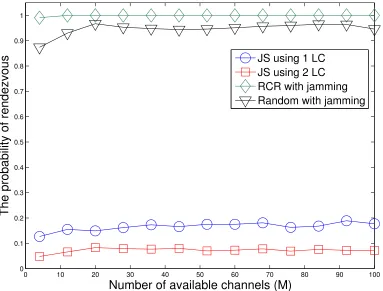
Figure 3.8 The probability of rendezvous for the JS, Random, and RCR schemes under the CD-JAs with one or two listening channels (LCs) . . . 50
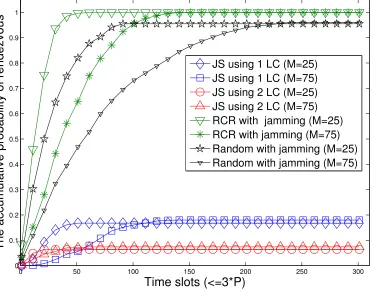
Figure 3.9 The cumulative probability of Rendezvous for the JS, Random, and RCR schemes under the CDJAs (M={25,75}) . . . 51
Figure 3.10 The probability of JS rendezvous for the second scenario under the CDJA (the jam-mer with two listening channels and no time synchronization) . . . 52
Figure 4.1 The probability rendezvous for the GOS scheme without jamming attacks and for the MC and JS schemes under CDJAs (≤3P time slots) . . . 57
Figure 4.2 An example of the GOS Rendezvous . . . 59
Figure 4.3 An example of CDJA for the GOS scheme . . . 61
Figure 4.4 A jamming example on both DRSEQ and CRSEQ . . . 64
Figure 4.5 The average time of finding the GOS sequence using two listening channels . . . . 65
Figure 4.6 The probability of rendezvous for the GOS, MC, JS, and Random schemes under jamming attacks . . . 67
Figure 5.1 An example of the symmetric EJS Rendezvous . . . 72
Figure 5.2 An example of the asymmetric EJS Rendezvous . . . 73
Figure 5.3 The CDJA example on the symmetric EJS . . . 75
Figure 5.5 The CDJA on the asymmetric EJS with replacement . . . 79
Figure 5.6 The average time to rendezvous (TTR) for the symmetric JS, EJS, and Random schemes without time synchronization . . . 85
Figure 5.7 The probability of rendezvous for the symmetric JS, EJS, and Random schemes under CDJAs . . . 86
Figure 5.8 The average time to rendezvous (TTR) for the asymmetric EJS, EJS without replace-ments, EJS with random replacement, and Random schemes for|m1|=|m2|= 20, M=40, and G = [2-20] . . . 87
Figure 5.9 The average TTR for the asymmetric EJS, EJS without Replacements, EJS with ran-dom replacement, and Ranran-dom schemes for |m1| = |m2| = 0.5M, M=[20, 30,.., 100], and G=2 . . . 89
Figure 5.10 The average TTR for the asymmetric EJS, EJS without replacements, EJS with ran-dom replacement, and Ranran-dom schemes for|m1| = |m2| = 0.5M, M=[20, 30, .., 100], and G=10 . . . 90
Figure 5.11 The probability of rendezvous for the asymmetric EJS without replacement algorithm under CDJAs for|m1|=|m2|= 20, M=40, and G = [2 20] . . . 91
Figure 5.12 The probability of rendezvous for the asymmetric EJS with replacement under CD-JAs withM = 40,|m1|=|m2|= 0.2M, and G=[1-8] . . . 92
Figure 5.13 The probability of rendezvous for the asymmetric EJS with replacement under CD-JAs withM = 40,|m1|=|m2|= 0.5M, and G=[1-20] . . . 93
Figure 5.14 The probability of rendezvous for the asymmetric EJS with replacement under CD-JAs withM = 40,|m1|=|m2|= 0.8M, and G=[24-32] . . . 94
Figure 5.15 The expected time to rendezvous for the MMC and Random schemes with G = {1,3,5,7,9} . . . 95
Figure 6.1 FQR with (7,3) difference set example . . . 102
Figure 6.2 The sophisticated jamming attack on FQR base system . . . 106
Figure 6.3 Finding the sender’s quorum set within the second frame . . . 107
Figure 6.4 TTR for both FQR and RFR without jamming attacks . . . 110
Figure 6.5 The probability of rendezvous within≤2ktime slots . . . 111
Figure 6.6 The probability of rendezvous under an average⌊k+12 ⌋jammers ink2time slots . . 113
Figure 6.7 The cumulative probability of rendezvous under an average ⌊k+12 ⌋ jammers in k2 time slots . . . 114
Figure 7.1 A seed jamming attack against DSD-DSSS SUBSET . . . 120
Figure 7.2 Finding the random seed in DSD-DSSS SUBSET . . . 122
Figure 7.3 Finding the seed in ARS-DSSS . . . 124
Figure 7.4 The seed jamming attacks in ARS-DSSS . . . 125
Figure 7.5 Implemented decoding time for the fixed message size scenario . . . 128
Chapter 1
Introduction
Recently, wireless technology has been widely used and promoted by new wireless devices such as wireless sensors and smart phones. The emergence of these newer technologies in wireless networks has generated a serious problem of spectrum availability due to the lack of the freely available spectrum resources for wireless data communication. Moreover, managing the free spectrum resources (i.e., un-licensed spectrum) is challenging due to the limited resources compared to the growing demand. For example, since many researchers have intensively studied and developed wireless applications using the 2.4GHz spectrum, the band is now saturated by industry, scientific and medical (ISM) users. Thus, it can be difficult to implement wireless applications on this spectrum band without having interference with other users.
On the other hand, the licensed spectrum is assigned by the Federal Communications Commis-sion (FCC) to the long-term licensed users (i.e., primary users) but the majority of the spectrum is under-utilized most of the time. (e.g., the occupancy of the licensed spectrum is less than6%[1]). This inefficient usage of the licensed spectrum has motivated the FCC [8] to allow the unlicensed users (i.e., secondary users) to temporarily access the unused spectrum to alleviate the problem of the limited
to dynamically and autonomously adjust their parameters to access the unused channels based on the spectrum sensing results.
In Cognitive Radio Networks (CRNs), however, a problem occurs when SUs try to exchange data and information with each other. Since the SUs are required to find a common channel from a large number of sensed open channels to establish the common control channel, the rendezvous problem occurs between SUs. The rendezvous problem occurs when two or more radios (i.e., secondary users) try to opportunistically find one another under the presence of the multiple PUs in a DSA network [6].
To solve this rendezvous problem in CRNs, many rendezvous algorithms have been proposed that can be categorized based on the presence of an assisted controller; aided rendezvous or unaided ren-dezvous [6]. Under the aided renren-dezvous, a centralized server controls the SUs’ access to set up a common transmission link [5]. The SUs can also use dedicated common control channels to establish the transmission links [9, 20, 32, 39]. The advantages of these algorithms are the simple implementation and management of establishing the transmission links for the SUs. However, these algorithms have limitations such as reliability issues due to bottlenecks and single point failure on the control channel, and low flexibility and scalability issues. Moreover, security attacks on the control channel such as jam-ming and denial of service attacks can hinder the entire wireless communication. For example, suppose that traditional spread spectrum techniques, such as Frequency Hopping Spread Spectrum (FHSS) and Direct Sequence Spread Spectrum (DSSS) [18], are used for wireless communication to decrease jam-ming attacks. Spread spectrum techniques require a shared secret key between a sender and a receiver before the communication starts. Thus, it is unfeasible for a jammer to compute the same sequences or frequencies as the sender’s without knowledge of the key. However, a compromised receiver can be a jammer in reactive jamming attacks where it uses the secret key to generate the same code sequences or frequencies to jam the wireless communication.
sender due to the randomness of channel selection. Many blind rendezvous channel hopping (CH) or frequency hopping (FH) algorithms have been proposed but we investigated the state-of-the-art for blind rendezvous schemes for CRNs [4, 6, 10, 12–14, 25, 26, 43].
Yang D. et al. proposed two rendezvous algorithms called the Deterministic Rendezvous Sequence (DRSEQ) [12] and the Channel Rendezvous Sequence (CRSEQ) [43]. In DRSEQ, each user generates the same CH sequence ofM available channels and it is guaranteed to rendezvous in at most2M + 1 time slots. This is called the maximum time to rendezvous (MTTR). When each user has the same set of M available channels, we say this is the symmetric model. When the set of available channels is not the same for each user, we say we have an asymmetric model. The DRSEQ is only applicable to a symmetric model. In CRSEQ, each user constructs the CH sequences by using the properties of triangle numbers and Chinese Remainder Theorem (CRT). The CRSEQ provides the MTTR of the symmetric case at least(P −1)(3P −1). However, both DRSEQ and CRSEQ sequences are completely deterministic and, we will see, can be easily jammed.
In [13], Luiz A. DaSilva et al. proposed a sequence-based CH rendezvous scheme in which all radios can generate the same CH sequences using the pre-defined sequence generators. The scheme supported the asynchronous systems (i.e., no time synchronization) and was referred to as Generated Orthogonal Sequence (GOS) algorithm in [6]. One fundamental limitation of GOS is that it is applicable only to the symmetric scenario.
In [6], Nick C. Theis et al. proposed the Modular-based Clock (MC) and Modified Modular-based Clock (MMC) CH rendezvous schemes to provide blind rendezvous for both symmetric and asymmetric scenarios respectively. Under the assumption that a distinct forward-hop is chosen by each user, MC and MMC can guarantee upper bounds on rendezvous time. The MC schemes do not require time synchronization between SUs. Using the MC algorithm, the sender and receiver can independently generate CH sequences among the same or different number of available channels. Then the sender and the receiver, with no time synchronization, can rendezvous in bounded time only if their forward-hops are different.
pro-vide guaranteed rendezvous for both symmetric and asymmetric scenarios. The JS rendezvous scheme solved limitations of other blind rendezvous schemes such as unbounded time for rendezvous, time synchronization requirements, not being applicable for multi-users, and working only for symmetric models. The JS schemes do not require time synchronization between the SUs. That is, in the JS sys-tem, the sender and receiver can rendezvous any time even though they independently generate the CH sequences among the same or different number of available channels and have hop sequences with dif-ferent starting times. In [26], Lin Zhiyong proposed the Enhanced JS (EJS) rendezvous algorithms [25] by redesigning the hoping sequences. The EJS can reduce the expected time to rendezvous (ETTR) for the asymmetric model from O(P3)toO(P2)whereP is the smallest prime number greater than the total number of available channels.
In addition to the above rendezvous schemes for CRNs, we also exploited the Frequency Quorum-based Rendezvous (FQR) scheme for wireless networks [17] because it provides the lowest maximum time to rendezvous compared to other schemes. Moreover, it can be applicable to CRNs without dif-ficulty [22]. In [17], Eun-Kyu Lee et al. proposed the FQR algorithm to provide fast rendezvous and secure key establishment under the various jamming attacks. The FQR scheme utilizes the non-empty property of cyclic quorum sets [19, 44]. Thus, the sender and receiver can select independent random FH sequences but they are guaranteed to rendezvous within a bounded time.
Moreover, we also investigated a general random spread spectrum technique called a delayed ran-dom seed disclosure DSSS (DSD-DSSS) scheme for broadcast wireless communications [28] because it is one of the most secure DSSS algorithms due to its unpredictable random spreading codes. The DSD-DSSS scheme removes the pre-shared key dependency of traditional DSSS techniques and allows a sender to randomly generate spread code sequences for each message using random seeds. Then the sender spreads each message using different code sequences and discloses the seeds at the end of each message. Therefore, without the knowledge of the seeds, the jammer cannot generate the same code sequences before the receiver receives the entire message.
or FH sequences by utilizing the properties of rendezvous schemes. We exploit the effectiveness of CD-JAs for representative symmetric rendezvous algorithms that are derived from Modular-based channel hopping algorithms such as Modular Clock (MC), Jump-Stay (JS), Enhanced Jump-Stay (EJS) channel hopping rendezvous algorithms [6, 25], and quorum-based frequency hopping algorithms named FQR algorithms [17], respectively. In addition, we will expand our CDJA to the remaining state-of-the-art blind rendezvous algorithms such as Generated Orthogonal Sequence (GOS) [6,13], Deterministic Ren-dezvous Sequence (DRSEQ) [12], and Channel RenRen-dezvous Sequence (CRSEQ) [43]. In our CDJAs, the channel detecting jammer can compute the channel hopping rates using one or two listening chan-nel. Using this information, the jammer can compute the sender’s entire hopping sequences within a short period and then jam the remaining channel or frequency sequences. For the asymmetric models, we focus on the asymmetric EJS scheme because many of the rendezvous algorithms are not applicable for the asymmetric models and the asymmetric EJS scheme provides a fast guaranteed rendezvous com-pared to others. Our simulation results show that the rendezvous probability of these blind rendezvous schemes for both symmetric and asymmetric models will be dramatically decreased under the CDJA.
The contributions of this thesis are as follows:
1. We introduced a novelchannel detecting jamming attacks(CDJAs) against the blind rendezvous algorithms for CRNs in which a jammer, with capabilities similar to a normal user, can find the sender’s channel hopping sequences by utilizing the properties of their rendezvous algorithms. 2. We investigated the state-of-the-art blind rendezvous algorithms [6, 13, 24–26] to demonstrate the
effectiveness of our CDJAs. The channel detecting jammer uses one or two listening channels to find the sender’s CH sequence within a short period and computes the senders’ CH sequences. Then it jams the remailing sequences so that the rendezvous probability of the state-of-the-art blind rendezvous algorithms will be significantly decreased under our CDJAs. Our simulation results demonstrate that the state-of-the-art blind rendezvous schemes are extremely vulnerable to the CDJAs.
completely defeats any predictability for the channel detecting jammer. In this thesis, we presented the theoretical expected time to rendezvous (ETTR) for the asymmetric Random system based on the number of common channelsGbetween a sender and receiver. The ETTR for the asymmetric Random is |m1|·|m2|
|G| where |m1|and |m2|is the number of available channels out of the total number of available channels M for the sender and receiver, respectively. Through simulations and theoretical analysis, we demonstrate that the symmetric and asymmetric Random schemes for CRNs can be an effective, efficient and robust rendezvous scheme against CDJAs.
4. We investigated a Frequency Quorum-based Rendezvous (FQR) algorithm [24] and then we pre-sented asophisticated jamming attackin which a jammer can find the sender’s quorum set within the second frame (i.e.,2ktime slots wherekis the number of elements from a minimal difference set) [36]. Then the jammer can completely jam the sender’s frequency hopping sequence after2k time slots. Our simulation results show that the rendezvous probability of the FQR system un-der the sophisticated jamming attack dramatically decreased as the number of available channel increases.
5. We investigated a delayed random seed disclosure DSSS (DSD-DSSS) scheme [28] and then we presented a new type of jamming attack called aseed jamming attack in which an attacker particularly focuses on jamming the random seed(s) in fixed-size messages Thus, the receiver cannot despread received messages because it cannot find the seed and hence cannot regenerate the correct spread code sequences. To mitigate this jamming attack, we propose an advanced random seed DSSS (ARS-DSSS) scheme which strengthens the previous algorithm called DSD-DSSS by using an additional location seed. Our security analysis and implementation results demonstrate how to defeat the seed jamming attacks and how to reduce the computation overhead of the DSD-DSSS scheme.
Chapter 2
Channel Detecting Jamming Attacks
against Modular-Based Channel Hopping
Rendezvous Algorithms for Cognitive
Ratio Networks
sequence and thus reduce the rendezvous success rate from around95% to around15% for the basic period. We show this is a major security problem for CRNs utilizing the MC algorithm since any sec-ondary user or even group of users can easily be denied access to the network with high probability. We also compare these results to the Random rendezvous algorithm and show it vastly outperforms the MC algorithm when there are security concerns about a channel detecting jammer.
2.1
Introduction
In cognitive radio networks (CRNs), the rendezvous problem is difficult because of the dynamically changing of available channels at any given time. To address this problem, many different rendezvous algorithms have been proposed and categorized based on the presence of the assisted controller, aided rendezvous, and unaided rendezvous [6]. Under the aided rendezvous, a centralized server can control the access from the secondary users to set up a common transmission link [5]. The secondary users can also use dedicated common control channels to establish the transmission links [9, 20, 32, 39]. The ad-vantages of these algorithms are the simple implementation and management of establishing the trans-mission links for the secondary users. However, these algorithms have limitations such as reliability issues due to bottleneck and single point of failure on the control channel, low flexibility and scalability issues, and security attacks on the control channel (e.g., jamming and denial of service attacks).
the same or different number of available channels and have hop sequences with different starting times. However, the MC systems are still vulnerable to the CDJAs where a jammer has the capability of listening on one or two channels and jamming one channel at a time (here the jammer’s capabilities are close to normal secondary users). In this chapter, we focus on the symmetric MC scheme in which two secondary users have the same number of available channels since it more clearly illustrates the charac-teristics of our jamming attack. The asymmetric MC scheme is more complicated but the techniques we develop can be effectively be used on it as well. Under the CDJA, the jammer can take advantage of the MC scheme to determine the sender’s CH sequences withinP time slots (hereP is the smallest prime number greater than or equal to the number of available channelsM) by using two listening channels. Then the jammer jams the remaining time slots after an average of⌊(P+1)2 ⌋time slots. Therefore, the rendezvous probability of the MC scheme will be decreased dramatically because the sender and re-ceiver must rendezvous within the first-half of one P period or less on average out of the MC period of 2P.
In this chapter, we present the CDJA and evaluate its effectiveness particularly on the MC schemes [6]. Moreover, we revisit the Random rendezvous scheme [6] where the sender and receiver generate their CH sequences by randomly selecting from the M available channels for each time slot. Since the sender’s CH sequences are totally random, it is unfeasible for the channel detecting jammer to esti-mate the sender’s CH sequences.
The contributions of this chapter are: first, we introduce a novel CDJA model which can detect the sender’s CH sequence within theP time slots while using two listening channels. This can dramatically decrease the rendezvous probability of the MC schemes [6]. Second, we revisit the Random CH scheme to evaluate the rendezvous probability against CDJAs. This completely defeats any predictability for the channel detecting jammer. Our simulation results demonstrate that the MC scheme is extremely vulnerable to the CDJAs. On the other hand, the Random scheme for CRNs can be an effective, efficient and robust rendezvous scheme against CDJAs.
discusses their results. Finally, Section 2.4 concludes the chapter.
2.2
Proposed Schemes
We propose a novel CDJA in which the jammer can dramatically decrease the probability of rendezvous for the MC scheme [6] by utilizing the characteristics of the modular-based CH algorithm in the MC scheme. In [6], the authors proposed both the symmetric and asymmetric scheme named Modified MC (MMC) but we only consider the symmetric model in this chapter. The expansion of the CDJA to the MMC scheme will be shown in a later chapter. In our CDJA, the jammer has capabilities close to the normal user with one transmitting channel but two listening channels. However, as we will show, the jammer can find the sender’s CH sequences withinPtime slots using two listening channels. Then it can jam the sender’s remaining CH sequences after an average⌊(P+1)2 ⌋time slots. Therefore, the probability of rendezvous for the MC scheme will be dramatically decreased under the CDJA.
We first present the MC algorithm and show how the channel detecting jammer can find the sender’s CH sequences in the MC scheme within such a short period of time. Then we analyze its effectiveness on the MC scheme in detail. We also revisit the Random CH rendezvous scheme to address jamming attacks. Finally, we compare the effectiveness of the CDJA on MC and Random schemes.
2.2.1 Modular Clock Algorithm
Theis et al. [6] proposed the MC schemes for both symmetric and asymmetric models (MMC) to provide fast rendezvous in CRNs. However, we present only the MC scheme because our jamming scheme is most clearly presented for the symmetric case.
Figure 2.1: A rendezvous example of the MC scheme
Then the channel in the MC scheme [6] is determined by
cti = (j0i +t×r0i)mod P (2.1)
wherecti is the channel of useriatt-th time slot. Furthermore, the modular clock algorithm constantly remaps the channels in [M, P) into channels [0, M). Using this MC algorithm, each user generates CH sequences for a round of2P time slots. Theis et al. [6] have shown that if two users run the CH sequences, without synchronization, from the MC scheme, the time to rendezvous (TTR) is guaranteed in2P time slots only if the two forward-hops are different.
Figure 2.1 illustrates a rendezvous example of the MC scheme where M = 6and P = 7. Since there is no time synchronization, users can start at any time slots within the2P time slots of another user but the overlap between two CH sequences is not less thanP time slots. In this example, one user (e.g.,i= 1) starts with the channel4att= 1when it randomly selects the initial channelj10 = 1and it jumps with the forward-hopr0
1 = 3. The other user (e.g.,i= 2) starts with the channel4att= 5when it randomly selects the initial channelj0
2.2.2 The channel detecting Jamming Attacks
In this subsection, we present a novel CDJA against the MC scheme. Here we consider one sender and one receiver in the CRNs trying to rendezvous under the CDJA. In the MC scheme, each secondary user uses the MC algorithm to generate its CH sequences. This guarantees that the sender and receiver can rendezvous within the maximum2P time slots when there are no jamming attacks and their forward-hops are different. However, our channel detecting jammer takes advantage of the modular-based CH properties to find the sender’s CH sequences. With two listening channels, it takes an average⌊(P+1)2 ⌋
times slots for the jammer to find the sender’s CH sequences and begins jamming in the first period. Moreover, it takes an average⌊(P+1)4 ⌋time slots for the next and all subsequent periods. Consequently, the jamming attack can dramatically decrease the rendezvous probability of the MC system.
Assumptions:We assume that the channel detecting jammer resides in the network before the be-ginning of the sender’s communication and waits for the sender’s signals with two listening channels. The sender is a secondary user who starts the communication first. Without loss of generality, we as-sume that the jammer can use spectrum sensing techniques to determine whether channels are used by other secondary users or not. Since we consider one sender and one receiver in this scenario, the jammer can observe the time when one user occupies one of the many available channels at a given time. Tra-ditionally, the spectrum sensing techniques can determine whether a spectrum is used by primary users or not [11, 15] We assume that these techniques can be extended to spectrum sensing for the secondary users by sensing the pilots or energy of the secondary users.
For ease of presentation, we also assume the channel detecting jammer can detect the beginning of the sender’s communication time. This assumption can be removed with only a very slight decrease in jamming effectiveness and no change in the first2P jamming time slots for CDJA. The essential step to removing this assumption is to determine the end of the sender’s first2P time slots. A key part of the algorithm is the fact thatji0is the last slot in the first2P slots and the base for the first slot in the second 2P slots. Using the two increments ofr0
i, which we determine below, from the first and the second2P slots allow us to determinej0
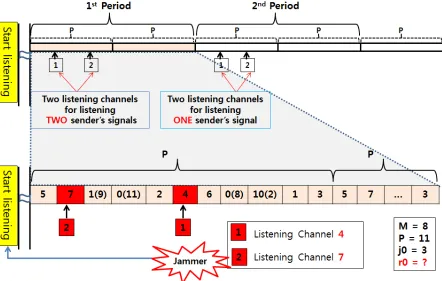
Finding the forward-hop: Now we describe the algorithm the jammer uses to find the sender’s CH sequences in the MC scheme [6]. In the CDJA, the fundamental goal for the jammer is to find the sender’s CH sequences before the sender can rendezvous. Then it is easy to jam all of the sender’s subsequent channel hops. Thus, it is critical for the jammer to find the sender’s forward-hopri0quickly, since the forward-hop is the key value to generate the CH sequences in the MC scheme. If the channel detecting jammer can find the forward-hop of the sender, then the jammer can exactly generate the subsequent CH sequences of the sender so that it can jam the remaining channels in the CH sequences with a single jammer. We first give an example of the sender and receiver rendezvousing and show how the jammer determines the sender’s CH sequences by hearing two different sender’s signals using two listening channels. Then we analyze how the channel detecting jammer uses this information to interrupt the rendezvous in the MC system.
As we described the above, in the MC scheme [6], the channelcti is determined by Equation (2.1). Using the property of the modular clock in the MC algorithm, the channel detecting jammer can find the forward-hopri0by detecting the sender’s signals from two different channels. Indeed, suppose that the jammer selects two distinct listening channels and receives the sender’s signals onct1
i at timet1and onct2
i at timet2. If the jammer is not detecting the beginning of the sender’s CH sequences, then the timet1 andt2are the jammer’s time. We see below the important part is (cti2 −ct
1
i ). In either case, the jammer can calculate the sender’s forward-hopriby:
ct1
i = (ji0+t1×r0i)mod P (2.2)
ct2
i = (ji0+t2×r0i)mod P (2.3) and then Equation (2.3)−(2.2) gives,
((t2−t1)×r0i)mod P = (cti2 −cti1). Thus, from properties of the mod function, the forward-hopri0is
ri0=⌈(P×k+ (c
t2
i −ct
1
i )) (t2−t1)
Figure 2.2: An example of finding the forward-hop in the MC scheme
whereiis the node’s identification, cti is the channel att-th time slot, ji0 is the initial channel for the nodei, r0
i is the forward-hop rate for the node i, and the kis the constant that satisfies the property of0 ≤ r0
i < P. Once the jammer computes the forward-hop ri0, then it computes the initial channel j0
i from Equation (2.2) and exactly generates the sender’s CH sequences from Equation (2.1). If the jammer does not know the beginning of the sender’s communication, it can still compute the sender’s next hop by just addingri0to the last hop and hence get every forward-hop. It is not necessary to getji0 in this case.
5,7,1(9),0(11),2,4,6,0(8),2(10),1,3
whereM = 8, r10 = 2,j10 = 3, andP = 11. The CH sequences of the first P time slots repeat for the nextP time slots. For the first period, the jammer needs to randomly selects two distinct listening channels to find the sender’s forward-hop. In Figure 2.2, the jammer randomly selects distinct channels 4and7and receives the signals on the channel 7 (ct1
1) at timet1 = 2and channel 4 (ct22) at timet2= 6 for the first and second time listening times. From the listening channels and time slot information, the jammer can compute ther01from Equation (5.4),
r10 = ⌈(P×k+ (c
t2
2 −ct
1
1)) (t2−t1)
⌉
= ⌈(11×k+ (4−7))
(6−2) ⌉=⌈
(11×k−3)
4 ⌉
0≤ ⌈(11×k−3)
4 ⌉<11, ∵0≤r 0 1 < P
then the constantkis,
3≤ ⌈11k⌉<47, 0.27.⌈k⌉.4.27.
wherect1
1 = 7att1 = 2and c2t2 = 4att2 = 6. The possible values ofkare 1, 2, 3, and 4. Now the forward-hopr10is clearly constant so only one value ofkcan be chosen. The proof of Lemma 2 in [25] actually shows that thekvalue is unique whenct1
1 andct
2
2 are not duplicate channels. We can easily see that onlyk= 1and the corresponding value ofr10= 2satisfies the CH sequences. From Equation (2.2), we easily seej10 = 3.
Figure 2.3: An example of finding the initial channel
ji0 using Equation (2.2). Therefore, the jammer can find the sender’s CH sequence within an average
⌊(P+1)4 ⌋time slots for the second and subsequent periods.
Finding the beginning of the next period:In the CDJA, the jammer has no information about the beginning of the sender’s communication. Thus, it is important for the jammer to find the beginning of the next period because the sender randomly chooses a new forward-hop for every2P period. The jammer needs to know the beginning of the next2P period to determine when to find and use the new forward-hop using channel listening. We should stop using the current sequence to jam at2P. In other words, the jammer has heard the sender’s signals from two listening channels but does not know their positions in the sender’s sequence without the knowledge of the initial channel information.
However, our channel detecting jammer can find the exact positions of the detected channels in the sender’s CH sequence when the forward-hops ri0 and ri1 change for the first 2P period and the next2P period. Figure 2.3 describes how the jammer can find the bothr0
i and ri1 using two listening channels (LCs) when the two forward-hops are different (i.e.,r0
i 6=r1i). Using this detected information, the jammer can find the initial channel j0 which is the last time slot of each period. In this example, the jammer selects two random channels LC1 = 4 and LC2 = 7 and listens to signals before the communication starts. Then the jammer receives two signals from ct1
i = 7 at timet1 and cti2 = 4at timet2 in the firstP period. Since the CH sequence repeats for the second P period, thecti1 and ct
2
will appear again at timeT1 =t1+P and time T2 =t2 +P, respectively. When the jammer detects ct2
i = 4at timet2, it can compute both the forward-hopr0i and the sender’s CH sequence for the next 2P−max{t1, t2}period. Then the jammer starts to jam the channels in the order of the sequence from the timet2. The jammer also starts to listen on the same LCs after the timeT2to find the new forward-hopri1for the next2P period. The jammer will detect two channelscT3
i = 4at timeT3 andcTi4 = 7at timeT4 in the3P period as illustrated in Figure 2.3. The time slots will reset from1to2P for every 2P + 1time slots.∆1is the gap between the timeT2 to the end of the secondP period and∆2 is the gap between the timeT2and the timeT4. Then the jammer can compute the new forward-hopri1at time T4. All those time slots in this example are the sender’s time slots. The jammer does not know their corresponding positions in the sender’s sequence before it finds the initial channelj0. But the jammer knows the gap∆2 = |T4−T2|. Also, (T2 + ∆1) is the time slot for the initial channel j0. Now the jammer knows all the information except the gap∆1. Once it computes the∆1, it can find the initial channelj0. The∆1can be computed by using the two detected channel’s informationcTi2 andcT
4
i . From Equation (2.1),cT2
i at timeT2 = 2P−∆1andcT
4
i at timeT4 = ∆2−∆1are
cT2
i = (ji0+T2×ri0)mod P = (ji0+ (t2+P)×ri0)mod P
= (ji0+ (2P−∆1)×ri0)mod P (2.5)
cT4
i = (ji0+T4×ri1)mod P
= (ji0+ (∆2−∆1)×ri1)mod P (2.6)
wherej0 is the initial channel,P is the smallest prime number greater than or equal to the number of available channelsM,ri0 is the forward-hop for the first2P period, and ri1 is the forward-hop for the next2P period, ∆1 is the gap between theT2and the last time slot of the second P period, and∆2 is the time slots between thecT2
i and thecT
4
−Equation (2.6),
cT2
i −cT
4
i = ((ji0+ (2P −∆1)×r0i)−(ji0+ (∆2−∆1)×ri1))mod P = (2P×r0i + ∆1(ri1−r0i)−∆2×ri1)mod P
∆1 = ⌈ (cT2
i −cT
4
i ) +P×k+ ∆2×r1i −2P×r0i)
r1i −ri0 ⌉, f or0≤∆1 ≤P −2 (2.7)
whereri0 6=ri1andkis the constant that satisfies the property for0≤∆1≤P−2. From the example, we can compute the∆1using Equation (2.7),
∆1 = ⌈ (cT2
i −cT
4
i ) +P ×k+ ∆2×r1i −2P×r0i
ri1−ri0 ⌉, f or0≤∆1 ≤P−2 = ⌈(4−7) + 11×k+ 9×1−2×11×2
1−2 ⌉,
0≤ ⌈38−11×k⌉ ≤9,∵ 0≤∆1 ≤9
then the constkis,
27<⌈11×k⌉<38
Thus, only the constantk= 3satisfies the property and the corresponding value of∆1 is5. Therefore, the jammer can compute the initial channelj0 = 3that is the channel ofT2+ ∆1time slot in the second Pperiod. The beginning of the next period isT2+∆1+1. However, if the forward-hopr0i andri1are the same, the jammer cannot find the initial channel from Equation (2.7). The jammer needs to repeat the same procedure for the next2P period and to wait until it finds a different forward-hop (e.g.,ri1 6=ri2) to compute the initial channelj0.
For both cases of the same forward-hop or different forward-hop, the jammer can keep jamming from the timet2. The jammer avoids jamming on the two LCs for the next2P period because it needs to compute the new forward-hopr1i. If the jammer detects thecT1
i at theT1 andT1+P time slots and cT2
of finding thej0until it finds a different forward-hop. If two forward-hops are different, the jammer can compute the initial channelj0 and then knows the beginning of the next2P period. Once the jammer knows the initial channelj0, the jammer only needs to know one channel information (i.e., eitherLC1 orLC2) to compute the new forward-hop for every2P period after the4P time slot. For example, as illustrated in Figure 2.3, the jammer heard the channelcT5
i at timeT5 which is the∆3 time slots after the time slot of thej0 in the4P period.∆3is the gap between the time slot ofj0 in the4P period and the timeT5. SincecTi5 is mapped onto only once by Equation (2.1), there exists a uniquer2i such that
c∆3
i =cT
5
i = (ji0+ ∆3×ri2)mod P. wherec∆3
i is the∆3-th time slot of the sender’s CH sequence and theri2 is in1 ≤ ri2 < P. From the above the example,
c∆3
i = 7 = (3 + 2×ri2)mod11. wherecT5
i = 7,ji0 = 3,∆3 = 2, andP = 11. Then the unique value ofri2is2in1≤ri2 < P. There are possible rendezvous on an average of⌈P2⌉time slots between the2P+ 1and4Ptime slots. But the rendezvous probability is on an average⌈P4⌉for every2Pperiod after the4Ptime slot oncej0is found.
Listening channel selection: The channel detecting jammer can randomly choose two listening channels from all the available channels. Obviously, the jammer must select distinct listening channels for the first period. It is expedient (makes the algorithm and its analysis simpler) but not necessary for the jammer to avoid selecting channels from [0, P −M) as these are duplicate channels in the MC algorithm [6] that are mapped onto by channels [M, P). If the jammer selects the channels from [0, P −M), then it is possible that the forward-hop computation allows multiple or no integer value forksince the MC algorithm maps[M, P)onto them. For example, suppose that the jammer selects 0 and 1 for listening channels of the sender (e.g.,i= 1) from the above example. Then, the jammer can detect the signals on the channelct1
forward-hopr10from Equation (5.4) is
r01 = ⌈(P ×k+ (c
t2
1 −ct
1
1)) (t2−t1)
⌉
= ⌈(11×k+ (0−1))
(4−3) ⌉=⌈11×k−1⌉ 0≤ ⌈11×k−1⌉<11, ∵0≤r01 < P
then the constantkis,
1≤ ⌈11k⌉ <12, 0.09.⌈k⌉.1.09
We can easily see that onlyk = 1and the corresponding value ofr0
1 = 10. However, ther01 does not satisfied the channel sequence in this case.
To solve this problem, the jammer computes the forward-hopr01 usingct1
1 = 9instead ofct
1
1 = 1. Then the jammer can correctly compute the forward-hopr01 = 2. However, the jammer cannot immedi-ately determine whether thect1
1 is the channel1or the channel9 (1). Thus the jammer needs to compute the forward-hop for bothct1
1 = 1and ct
1
1 = 9and generates the sender’s next CH for both forward-hops. Then the jammer listens on one channel and jams the other for one slot. This clearly determines which CH sequence is correct. To remove this ambiguity, we assume that the jammer avoids selecting duplicated channels. The number of duplicated channels is also relatively small compared toM (e.g., the maximum number of duplicated channels is7forM = 89, where 3≤M ≤100). We can, in fact, improve our channel finding algorithm by choosing one or two channels in[0, P −M)since it doubles the number of possible ”hits” and it will further degrade the MC scheme Our simulation results listen for channels not in[0, P −M).
2.2.3 Random Channel Hopping Rendezvous
rendezvous algorithms under any jamming attacks. The Random CH rendezvous algorithm is a robust CH algorithm against jamming attacks. In the Random system, a sender and receiver randomly select one channel out of theMavailable channels for each time slot. The formulaP
(1/M)(1−1/M)k−1∗k=M shows the expected TTR for the Random scheme isM time slots when there are no jamming attacks. However, it is unfeasible for any jammer to estimate when the Random sender and receiver might ren-dezvous. That is, the expected TTR for the Random scheme would be almost the same as M time slots under the CDJAs. Hence, the Random scheme for CRNs can be an effective, efficient and secure rendezvous scheme against CDJAs.
2.3
Simulation results
We implemented the CDJA on Matlab 2010b to evaluate its effectiveness against the MC scheme. We implement the natural scenario where the jammer resides in the network and is listening on two distinct channels before the communication starts. The jammer has one jamming channel for the MC scheme. We also implemented the Random rendezvous scheme to demonstrate that it is more robust against the CDJA compared to the MC scheme. The jamming attack for the Random scheme jams two random channels for the entire rendezvous time.
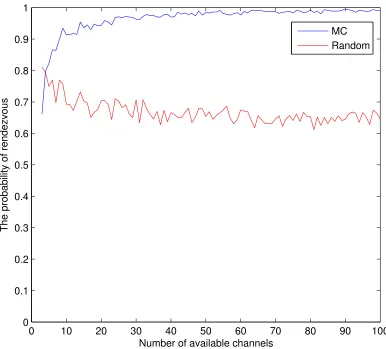
0 10 20 30 40 50 60 70 80 90 100 0
0.1 0.2 0.3 0.4 0.5 0.6 0.7 0.8 0.9 1
Number of available channels
The probability of rendezvous
MC Random
0 10 20 30 40 50 60 70 80 90 100 0
0.1 0.2 0.3 0.4 0.5 0.6 0.7 0.8 0.9 1
Number of available channels
The probability of rendezvous
MC Random
0 20 40 60 80 100 0
20 40 60 80 100 120
Number of available channels
The average TTR
MC Random
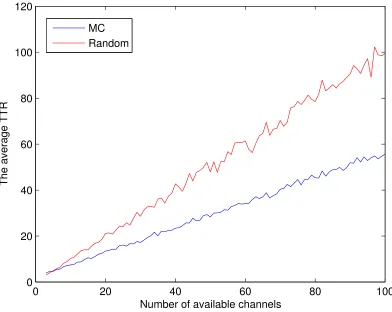
Figure 2.6: The average time to rendezvous (TTRs) for the MC and Random without time synchro-nization (TS) (100% success rate)
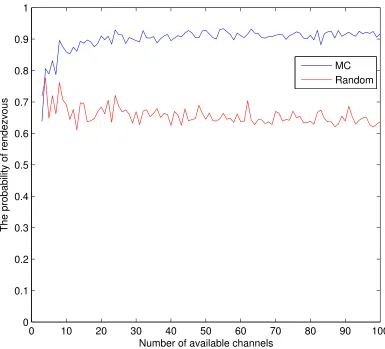
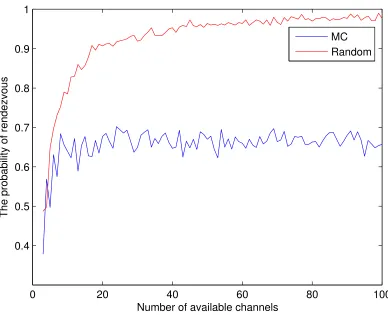
scheme decrease around5%for no start synchronization case but the probability of rendezvous for the Random scheme is essentially unchanged.
Next we compare the average TTRs for both MC and Random schemes without jamming attacks. Since both MC and Random schemes cannot guarantee the rendezvous, the sender and receiver must continue their algorithms until rendezvous occurs. Thus the rendezvous success rates is100%for both schemes. Figure 2.6 gives the average TTRs for MC and Random schemes with no TS between the sender and receiver. This figure shows that the average TTRs for both schemes increase steadily as the number of available channels increases. For the MC scheme, the maximum expected TTR is bound by
2P2
0 20 40 60 80 100 0.4
0.5 0.6 0.7 0.8 0.9 1
Number of available channels
The probability of rendezvous
MC Random
Figure 2.7: The probability of rendezvous for the MC and Random with TS under the CDJA (≤ 2P time slots)
which is an extension of but consistent with the results from [6]. The sender and receiver frequently rendezvous during the first overlap of P2 time slots. The average TTR for the Random scheme is close toM time slots.
0 20 40 60 80 100 0.1
0.2 0.3 0.4 0.5 0.6 0.7 0.8 0.9 1
Number of available channels
The probability of rendezvous
MC Random
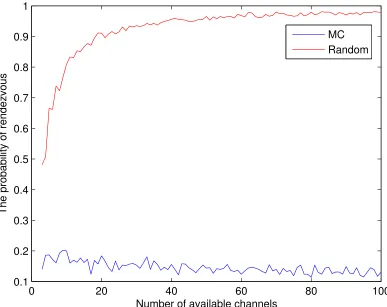
of rendezvous for the MC scheme decreases from around 95%to around 65%. Figure 2.8 shows the probability of rendezvous for both systems without sender/receiver start time synchronization (normal situation). In this case, the probability of rendezvous for the MC scheme is dramatically decreased under the CDJA. The rendezvous probability is less than15%for almost all available channels numbers. How-ever, the Random scheme rendezvous probabilities for both cases are almost the same as when there are no jamming attacks. It is over90%for mostM.
0 10 20 30 40 50 60 70 80 90 100
0 100 200 300 400 500 600 700
Number of available channels
The average TTR
MC with TS MC w/o TS Random with TS Random w/o TS
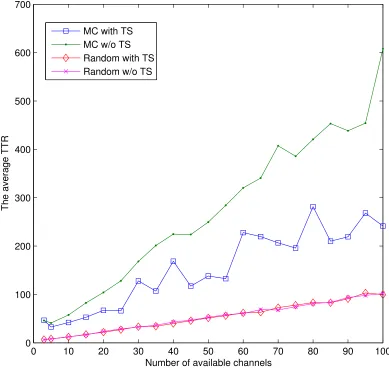
Finally, we compute the average TTRs for MC and Random schemes under the CDJAs. We calcu-lated the average TTRs by running the algorithms until rendezvous occurred (i.e., success rendezvous rates are100%for both schemes with TS and without TS cases). Figure 2.9 gives the average TTRs for MC and Random schemes. This figure shows that the average TTRs for the Random scheme are ap-proximatelyMtime slots for both TS and no TS cases which are close to the TTR for the no jamming attack case. However, for mostM, the expected TTRs for the MC scheme are close to3P time slots and 5P time slots for the TS and no TS respectively. Therefore, the CDJA with a single jammer is extremely effective for the MC scheme but is minimally so for the Random scheme. The MC algorithm itself can be very modestly improved against CDJA by selecting a new channelj0
i every2P time slots.
2.4
Conclusion
In this chapter, we presented a novel jamming attack called CDJAand demonstrated its effectiveness against the MC scheme [6]. The channel detecting jammer is able to take advantage of the MC algorithm (its method of generating its CH sequence) to find the sender’s CH sequence within the firstP time slots using two listening channels. Then the jammer can completely jam the sender after an average
Chapter 3
Channel Detecting Jamming Attacks
against Jump-Stay Based Channel
Hopping Rendezvous Algorithms for
Cognitive Radio Networks
about a channel detecting jammer. Especially, the effectiveness of CDJA is negligible for the Random and RCR schemes but their expected time to rendezvous (TTR) is close to the JS’s expected TTR.
3.1
Introduction
In the unaided rendezvous [6], the secondary users (SUs) can establish one or multiple common control channels by finding each other on one of the available channels. The SUs can alsoblind rendezvous with-out having any centralized controller or dedicated CCCs. To achieve blind rendezvous, several channel hopping (CH) algorithms [4, 6, 10, 14] have been proposed but they have the limitations such as un-bounded time for rendezvous, time synchronization requirements, not being applicable for multi-users, and working only for symmetric models. To address these limitations, the Jump-Stay (JS) based chan-nel hopping rendezvous schemes [25] have been proposed to provide guaranteed rendezvous for both symmetric and asymmetric scenarios. The JS schemes does not require time synchronization between the SUs. That is, in the JS system, the sender and receiver can rendezvous any time even though they independently generate the CH sequences among the same or different number of available channels and have hop sequences with different starting times.
However, the JS algorithms are still vulnerable to channel detecting jamming attacks (CDJAs) where a jammer has the capability of listening on one or two channels and jamming one channel at a time (e.g., the jammer’s capabilities are close to normal SUs). We first focus on the symmetric JS scheme in which two SUs have the same number of available channels because it is easier to present the CDJA in this setting. The asymmetric JS scheme is solved after the basic techniques are set. Under the CDJAs, the jammer can take advantage of the JS scheme so that it can determine the sender’s channel hopping sequences within2P time slots orP time slots (here P is the smallest prime number greater than the available channelsM) using one listening or two listening channels respectively. Then the jammer jams the remaining time slots after an averageP time slots for one listening channel and an average⌊(P+1)2 ⌋
In this chapter, we present the CDJA and evaluate its effectiveness on the JS schemes. Moreover, we revisit both the Random rendezvous scheme and the Role-based Channel Rendezvous (RCR) scheme extended from the role-based rendezvous algorithm [16]. For example, the sender and receiver in the Random scheme randomly select one of the available channels M for each time slot. However, in the RCR scheme, the sender generates its channel hopping sequences by permuting the M slots for each period and the receiver selects one random channel fromM and waits there until the end of2P slots. The main difference between the Random and RCR schemes is that the RCR scheme can guarantee the rendezvous when there are no jamming attacks but requires the roles of sender and receiver. Since the sender’s channel hopping sequences are random for both schemes, it is unfeasible for the channel detecting jammer to estimate the sender’s sequences.
The primary contribution of this chapter is that we show how to mount a debilitating jamming attack against the JS rendezvous scheme. We introduce a novel CDJA model which can detect the sender’s channel hopping sequence within the 2P time slots or P time slots while using one or two listening channels respectively. This can dramatically decrease the rendezvous probability of the JS schemes. As an alternative to the JS scheme, we revisit the Random and RCR schemes to increase the rendezvous probability against the CDJAs. They effectively decrease predictability for the jammer to find the sender’s CH sequence in CRNs. Our simulation results demonstrate that the JS scheme is extremely vulnerable to the CDJAs. On the other hand, the Random and RCR schemes for CRNs can be an effective, efficient and robust rendezvous scheme against CDJAs. In a benign environment, the expected TTR of the RCR and JS schemes are almost the same.
3.2
Preliminary
Lin Zhiyong et al. [25] proposed the JS schemes for both symmetric and asymmetric models to provide guaranteed rendezvous in CRNs [25]. We present the JS scheme for the symmetric model in this section since it clearly illustrates the characteristics of our jamming attack. Moreover, our attack is extended in Section 3.4 to the asymmetric JS scheme.
In the JS scheme, each SU runs theJSHoppingalgorithm to generate its CH sequences that consists of a jump-pattern and a stay-pattern. Each SU first performs the jump-pattern twice to jump on available channels and then performs the stay-pattern to stay on a specific channel. Let the number of available channel to beM and that is the same for all the SUs in the symmetric JS scheme. Then each SU finds the smallest prime numberP ≥M and selects random channelsi0andr0(i.e.,1≤ {i0, r0} ≤M) for the starting channel and the step-length, respectively. Using this channel information, the user generates CH sequences for a round of3P time slots that consists of two jump-patterns for2P time slots and one stay-pattern forP time slots. Then Lin Zhiyong et al. [25] have shown that if two users runs the JS CH sequences, rendezvous is guaranteed in3Ptime slots.
In this section, we briefly introduce the properties of the JS algorithm. We borrow the terminologies as defined in [25].
Lemma 1 Given a positive integer P, if r ∈ [1, P) is relatively prime toP, (i.e., the only common factor between them is 1), then for any x ∈ [0, P) the sequence S =< x%P + 1,(x+r)%P + 1,· · · ,(x+ (P −1)r)%P+ 1>is a permutation of<1,2,· · · , P >.
Lemma 2 Given a prime numberP, ifr1andr2are two different numbers in(0, P), then for anyx1 ∈ [0, P)andx2 ∈[0, P), there must be an integerk∈[0, P)such that(x1+kr1)%P = (x2+kr2)%P.
Figure 3.1: An example of the symmetric JS scheme
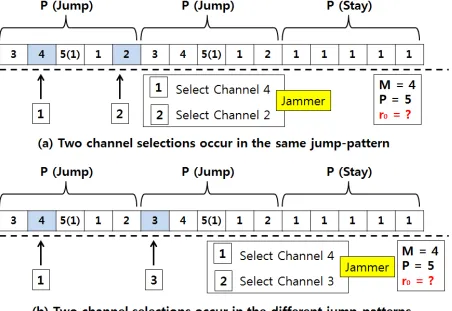
The two lemmas guarantee not only that theJSHopping algorithm visits all available the channels in any consecutiveP time slots of the jump-pattern but also two users will rendezvous if the overlap of two jump-patterns is not less than P time slots with different step-lengths. Figure 3.1 illustrates a rendezvous example of the JS scheme whereM = 4andP = 5. Since there is no time synchronization, users can start at any time slots within the3P time slots of another user but the overlap between two jump-patterns is not less thanP time slots. For example, one user starts withi1 = 2att= 1and jumps with the step-length r1 = 1. The other user starts withi2 = 3att= 5and jumps with the step-length r2 = 2. Then the two users rendezvous on channel4at time slott= 8which then satisfies the Lemmas. In the JS scheme, the authors also proved that the maximum time to rendezvous (MTTR) is at most3P time slots as described in the Theorem 1.
3.3
Proposed Schemes
at the same time but jamming one channel at a time. However, as we will show, the jammer can find the sender’s CH sequences within2P orP time slots using one or two listening channel respectively. Then it can jam the sender’s remaining CH sequences after an average P or⌊(P+1)2 ⌋ time slots for one or two listening channels. Therefore, the probability of rendezvous for the JS scheme will be dramatically decreased under the CDJAs.
We first present algorithms showing how the channel detecting jammer can find the sender’s CH sequences in the JS scheme [25] within such a short period of time. Then we analyze its effectiveness on the JS scheme. We also revisit the Random rendezvous algorithm and the RCR scheme to address jamming attacks.
3.3.1 The Channel Detecting Jamming Attacks
In this subsection, we present a CDJA. Here we consider one sender and one receiver in the CRNs trying to rendezvous under the CDJA. In the JS scheme, each SU uses the jump-stay channel hopping algorithm to generate its CH sequences described in the preliminary section. This guarantees that the sender and receiver can rendezvous within the maximum 3P time slots when there are no jamming attacks. However, our channel detecting jammer takes the advantage of the jump-stay channel hopping properties to find the sender’s CH sequences.
We consider two different scenarios for the CDJA on the JS scheme depending on whether the jammer has knowledge of the sender’s communication time or not. The first scenario is that the jammer can determine the beginning time of the sender’s communication while the second scenario assumes the jammer cannot find this beginning time. Without loss of generality, we assume in the first scenario that the jammer can use spectrum sensing techniques to determine whether channels are used by other SUs or not. Since we consider one sender and one receiver in this scenario, the jammer can observe the time when one user occupies one of the many available channels at any given time. This is not a specific channel though. The jammer keeps spectrum sensing to check whether any new channels are occupied by other SUs or not. Initially we implement the first scenario since CDJA is clearer there and we solve the second scenario in Section 3.4.
For both scenarios, the jammer’s capabilities are close to the legitimate SUs. We consider one or two listening channels. First, we describe the first scenario of the CDJA on the JS scheme when the jammer uses one listening channel. In this case, the jammer randomly selects one of the available channels and waits there until it receives signals from the sender. When the jammer receives signals, it then randomly selects another different channel and wait there until it receives the sender’s signals on that channel. Since the jammer knows the beginning of the sender’s communication, the jammer can receive two signals from different channels within the first or second jump-pattern of the JS scheme. We show the jammer can calculate the step-length of the sender’s CH sequences from two channel hits and then it can exactly generate the sender’s CH sequences. In the JS scheme, the channelcin the jump-pattern is determined by
ci= (i0+ti×r0−1) %P + 1
Figure 3.2: An example of finding the step-length with one listening channel
M remapping. Then the jammer can calculate the sender’s step-lengthr0using
c1= (i0+t1×r0−1)%P + 1 (3.1)
c2= (i0+t2×r0−1)%P + 1 (3.2)
and then equation (5.3)−(5.2) gives,
((t2−t1)×r0)%P = (c2−c1).
Thus, the step-lengthr0is
r0 =⌈
(P ×k+ (c2−c1)) (t2−t1)
where thekis the constant that satisfies the property of 1 ≤ r0 ≤ M and matches the jump-pattern. Once the jammer can compute the step-lengthr0, then the jammer computes the initial channeli0from equation (1) and exactly generates the sender’s CH sequences.
Figure 3.2 describes how the channel detecting jammer finds the sender’s step-length in the JS scheme using one listening channel. The channel detecting jammer selects the random listening channels to hear the sender’s signals whereM = 4,r0 = 1,i0 = 3, and P = 5. In this example, the complete channel hopping sequences of the sender is
3,4,5(1),1,2,3,4,5(1),1,2,1,1,1,1,1
where the total3Ptime slots consists of the first2Ptime slots for the jump-patterns and the lastP time slots for the stay-pattern. The stay-pattern is just the step size r0. To detect two sender’s signals, the jammer randomly selects channel4for the first listening channel and channel2for the second listening channel. Then the jammer receives the signals on the channel 4 (c1) at timet1 = 2and channel 2 (c2) at timet2 = 5. From the listening channels and time slot information, the jammer can compute ther0 from the equation (5.4),
r0 = ⌈
(P×k+ (c2−c1)) (t2−t1)
⌉
= ⌈(5×k+ (2−4))
(5−2) ⌉=⌈
(5×k−2)
3 ⌉
1≤ ⌈(5×k−2)
3 ⌉ ≤4, ∵1≤r0 ≤M
then the constantkis,
5≤ ⌈5k⌉ ≤14, 1≤ ⌈k⌉ ≤2.8
Figure 3.3: An example of finding the step-length with two listening channels
jump-pattern. Hence we choosek= 1and rejectk= 2. Thus, the step-lengthr0should be1fork= 1. With one listening channel, the jammer might not receive the sender’s signals within the first jump-pattern. Since the jammer uses one listening channel, the time to detect two sender’s signals depends on the order of listening channels described in Figure 3.2(a) and (b). Thus, the channel detecting jammer can detect the sender’s signals from two different channels within two jump patterns (2P) and an average ofP time slots. However, for two listening channels, the jammer can always detect the sender’s two signals within the first jump-pattern (P time slots). In Figure 3.2 (b), the jammer with one listening channel cannot detect channels4then3within the first jump-pattern (i.e.,P time slots). But Figure 3.3 shows that the jammer with two listening channels can detect both channel 3 and 4 within the first jump-pattern because there is no order of listening channels. Thus, the jammer can find the sender’s CH sequences within a maximumP time slots and an average ⌊(P+1)2 ⌋time slots. Therefore, the jammer in the first scenario can jam the remaining channels for an average2P time slots and an average2P +
⌊(P+1)2 ⌋time slots for one and two listening channels respectively. The probability of rendezvous will be dramatically decreased under the CDJA.
3.3.2 Role-based Channel Rendezvous
Figure 3.4: An example of rendezvous in the RCR Symmetric scheme
scheme [6] and extend it to the Role-based Channel Rendezvous (RCR) scheme as a countermeasure against the CDJAs. In the RCR system, a sender generates a randomized permutation of theM available channels for every frame. The receiver randomly selects one channel out ofM channels stays there until the end of two frames (i.e.,2M time slots). Thus it is unfeasible for the channel detecting jammer to estimate when the sender and receiver might rendezvous. Figure 3.4 illustrates the example of RCR scheme whereM = 5. One user generates the CH sequences by permuting{1, ..., M}for every frame. The other user randomly selects channel 4and waits on the channel until rendezvous. The two users rendezvous on the channel 4 at timet = 8. In the RCR scheme, if there is no time synchronization between users, then there must be an overlap between the two users of2M time slots to rendezvous. Thus the maximum time to rendezvous (TTR) of the RCR scheme is 2M time slots but its expected TTR is between⌊(M2+1)⌋andM time slots.
random permutation sequence. If the receiver receives the jammer’s signals before the sender’s, then the receiver will first response to the jammer to rendezvous. Therefore, the jammer can find the receiver’s random channel and jam the channel in the remaining time slots to prevent the possible rendezvous be-tween the sender and receiver. One possible solution to this attack has the receiver immediately choosing another random channel when it fails the authentication of the jammer or receives no response from it. For example, suppose that a receiver randomly selects a channel fromM available channel for every 2M time slots. The jammer sends a randomMpermutation sequence to the receiver. When the receiver and the jammer rendezvous, the receiver will respond to the jammer to exchange information or data. When the jammer receives the response, the jammer knows the receiver’s random channel so that it can jam the remaining channels of the sequence. However, it is difficult for the jammer to establish a con-nection to the receiver without passing authentication process. Thus, the receiver immediately choose a another random channel for2M time slots when it knows there is a failure. The jammer never receives more channel information.
3.3.3 Random Channel Rendezvous
We also revisit the Random CH rendezvous algorithm [6] to mitigate the CDJAs. In fact, there are no guaranteed rendezvous algorithms under any jamming attacks so that the Random CH rendezvous algorithm could be the most robust CH algorithm against jamming attacks. In the Random system, a sender and receiver randomly select one channel out of theM available channels for each time slot. The formulaP
3.4
Extensions of CDJA
In this section, we describe how to remove time synchronization restriction for the second scenario, the efficiencies in selecting listening channels, and the effectiveness of CDJAs on the asymmetric JS scheme.
3.4.1 No Time Synchronization
In the second CDJA scenario for the JS scheme, the channel detecting jammer cannot estimate the beginning of the sender’s communication by using spectrum sensing techniques. In this scenario, we assume only that the jammer resides in the network before the communication starts. Moreover, we only consider the case of a jammer with two listening channels because it simplifies the presentation and is significantly more efficient. However, this can be done with one listening channel. The cost of a second listening channel is modest.
The jammer can always hear two sender’s signals within the first pattern (i.e., P time slots) of the JS scheme. When the jammer detects two sender’s signals, the jammer can find the step-length r0 from equation (3), generate the sender’s CH sequences from the time of the second signal, and jam all remaining time slots usingcnext = (clast+r0)%P + 1.
However, the jammer cannot immediately compute the initial channel i0 because it has no knowl-edge about the beginning of the sender’s communication. The initial channel information is important for the jammer to determine the beginning of the stay-pattern and the next period so that the jammer can jam all ther0channels. For example, the first channel of the second period in the JS scheme is
ci = (i0+ti×(r
′
0)−1) %P+ 1
where the new step-length isr′0 = r0+ 1. Thus the jammer can generate the sender’s sequences for the consecutive periods from knownr0andi0information and jam all slots continuously with a single jammer.
Figure 3.5: Cases for detecting the sender’s channels in the second scenario
3.4.2 Listening Channel Selection
Jammer selection of the listening channels in CDJA can improve performance. Most of time the jammer can randomly select listening channels but the jammer should avoid selecting channels from (M, P] because the JS algorithm maps these channels back onto [1, M] channels which are then duplicated. That is, if the jammer selects the channels that are mapped onto by(M, P], then it is possible that the step-length can be ambiguous because the channels from(M, P]are duplicated with other channels in the JS algorithm.
From the above example, suppose that the jammer selects 1 and 3 for listening channels and detects signals from the following CH sequence
3,4,5(1),1,2,3,4,5(1),1,2,1,1,1,1,1.
Then the jammer can detect the signals on the channelc1= 1 (5)at timet1 = 3and the channelc2 = 3 at timet2 = 6for the first time and second time, respectively. The step-lengthr0from the equation (5.4) is
r0 = ⌈
(P×k+ (c2−c1)) (t2−t1)
⌉
= ⌈(5×k+ (3−1))
(6−3) ⌉=⌈
(5×k+ 2)
3 ⌉
1≤ ⌈(5×k+ 2)
3 ⌉ ≤4, ∵1≤r0 ≤M
then the constantkis,
1≤ ⌈5k⌉ ≤10, 0.2≤ ⌈k⌉ ≤2
Therefore, the step-lengthr0 = 2,4for the constantk= 1,2respectively. Neither of which satisfies the jump-pattern.