IMPROVING THE WORKING MEMORY OF STUDENTS WITH DOWN SYNDROME THROUGH A COGNITIVE INTERVENTION PROGRAM
SHAZNEE IRYANA BINTI YUSOFF
A thesis submitted in fulfilment of the requirements for the award of degree of Doctor of Philosophy (Educational Psychology)
Faculty of Education Universiti Teknologi Malaysia
iii
DEDICATION
iv
ACKNOWLEDGEMENT
During the preparation of this thesis, I met a lot of people, researchers, academicians and educators who have contributed towards my understanding and thoughts. First and foremost, I wish to express my earnest appreciation to my supervisor, Assoc. Prof. Dr. Yeo Kee Jiar, for her constant encouragement, guidance, advices; as well as critics and warm friendship throughout the journey of this thesis. Without her continuous support, this thesis would not be as it is presented here.
I am also indebted to all the teachers, parents and children who have shown their full commitment and support since the first until the last stage of this study. Without their assistance, such attempt would not be possible. I would also like to extend my utmost appreciation to Universiti Teknologi Malaysia (UTM) for funding my Ph.D. study. It did played a big part in helping me in completing my thesis.
Special thanks to my fellow colleagues and others who have provided suggestions, assistance and motivation during various occasions. Their insights and tips are definitely valuable.
v
ABSTRACT
vi
ABSTRAK
Individu Sindrom Down (SD) mengalami masalah perkembangan dalam kemahiran motor, sosial, personal, bahasa, pertuturan serta kognitif. Individu ini mempunyai keupayaan untuk mentafsir maklumat dengan tepat walaupun tempoh masa ingatan mereka adalah terhad dan tidak berupaya untuk memanipulasi maklumat tersebut. Masalah kemahiran berfikir dan pembelajaran ini adalah berkaitan dengan keupayaan mental. Ini menunjukkan ketidakcekapan dalam ingatan kerja mereka dan jurang ini wujud dalam kalangan pelajar SD. Tambahan pula, guru-guru pendidikan khas di Malaysia didapati tidak menekankan peranan ingatan kerja untuk meningkatkan kemahiran pembelajaran. Kajian ini mengkaji keberkesanan program intervensi kognitif yang direka sebagai kaedah pengajaran yang lebih khusus dan sistematik untuk memudahkan ingatan kerja dalam kalangan kanak-kanak dan remaja SD. Kajian ini mengguna pakai reka bentuk kajian kuasi-eksperimen dengan ujian pra dan pos. Seramai empat puluh orang kanak-kanak dan remaja SD, berusia 6-14 tahun dari tujuh buah sekolah rendah di Kuala Lumpur telah dipilih dan dibahagikan secara sama rata kepada kumpulan kajian dan kumpulan kawalan. Ujian pra dan pos yang dilaksanakan adalah berdasarkan Automated Working Memory Assessment (AWMA). Program intervensi kognitif yang dilaksanakan sepanjang 12 minggu selama 30 minit sehari, 5 kali seminggu telah dijalankan oleh guru-guru di sekolah masing-masing untuk kumpulan kajian. Selepas intervensi, skor min bagi semua komponen AWMA (Ingatan Jangka Pendek Verbal, Ingatan Jangka Pendek Visuo-Spatial, Ingatan Kerja Verbal dan Ingatan Kerja Visuo-Spatial) dalam kumpulan kajian meningkat. Namun, terdapat sedikit penurunan dalam skor min Ingatan Jangka Pendek Verbal dan Ingatan Jangka Pendek Visuo-Spatial bagi kumpulan kawalan. Ujian Wilcoxon signed-rank
vii
TABLE OF CONTENTS
CHAPTER TITLE PAGE
DECLARATION ii
DEDICATION iii
ACKNOWLEDGEMENT iv
ABSTRACT v
ABSTRAK vi
TABLE OF CONTENTS vii
LIST OF TABLES xvi
LIST OF FIGURES xix
LIST OF ABBREVIATIONS xxi
LIST OF APPENDIXES xxiii
1 INTRODUCTION 1
1.1 Introduction 1
1.2 Background of the Study 6 1.3 Statement of the Problem 14 1.4 Objectives of the Study 17 1.5 Research Questions 18
1.6 Research Hypotheses 20
1.7 Importance of the Study 21
1.7.1 Children with Down syndrome 21
viii
1.7.3 National Special Education Department 22
1.7.4 Government 22
1.8 Theoretical Framework 23
1.9 Conceptual Framework 27
1.10 Definition of Key Terms 29
1.10.1 Down syndrome 29
1.10.2 Students with Down syndrome 29
1.10.3 Special Students 29
1.10.4 Special Education Needs 30
1.10.5 Short-Term Memory 31
1.10.6 Working Memory 31
1.10.7 Cognitive Intervention Program 32
1.10.8 Narratives 32
1.10.9 Automated Working Memory Assessment(AWMA) 32 1.10.10 Children’s Memory Scale (CMS) 33
1.11 Scope of the Study 34
1.12 Research Delimitations 35
1.13 Summary 36
2 LITERATURE REVIEW 37
2.1 Introduction 37
2.2 The Genetic Basis of Down syndrome 38
2.2.1 Types of Down syndrome 39
2.2.2 Factors Contributing to Down syndrome 39 2.2.3 Down syndrome Attributes and Health
Problems 40
2.2.3.1 Physical Traits and Intellectual
Abilities 40
ix
2.3 Neuropathology in Down syndrome 46
2.4 Learning and Memory in Down syndrome 47
2.5 Working Memory 48
2.6 Working Memory in Down syndrome 52
2.6.1 Phonological Loop 53
2.6.2 Central Executive 54
2.6.3 Episodic Buffer 55
2.6.4 Visuo-Spatial Sketchpad 56
2.7 Special Education in Malaysia 57
2.7.1 Special Education for Children with
Learning Disabilities 58
2.7.2 Pedagogy in Malaysia 66
2.8 Previous Interventions on Working Memory 69
2.8.1. Narratives 69
2.8.2 Reading 69
2.8.3 Visual 70
2.8.4 Verbal 71
2.8.5 Rehearsal and Organization 72
2.8.6 Adaptive Training 73
2.8.7 Cognitive Intervention Program 74 2.9 Critical Review of Previous Intervention Program 76
2.10 Important Theories in the Study 86
2.10.1 Narratives Paradigm 86
2.10.2 Theory of Scaffolding 86
2.10.3 Operant Conditioning 87
2.10.4 The Cone of Learning 88
2.11 Instructional Design Model 89
2.11.1 ADDIE Instructional Model 89
x
2.12 Instruments to Measure Working Memory 92
2.12.1 Automated Working Memory Assessment 92
2.12.2 Children’s Memory Scale 93 2.12.3 WMI within the Wechsler Intelligence Scale for Children-4th Edition (WISC-IV) 93
2.12.4 The Working Memory Rating Scale (WMRS) 94 2.12.5 Comparison 94
2.13 Overall Synthesis of Literature Review 95 2.14 Summary 106
3 METHODOLODY 107
3.1 Introduction 107
3.2 Research Design 108
3.3 Research Stages 109
3.4 Research Instrument and Materials 112
3.4.1 Instrument for Working Memory 112
3.4.2 Research Materials 113
3.5 Data Collection Procedures 113
3.5.1 Gaining Assess 114
3.5.2 Selection of Research Subjects 114
3.5.3 Screening and Selection of Samples 115
3.5.4 Parents Informed Consent 115
3.5.5 Pre-test 115
3.5.6 Training Workshop 116
3.5.7 Implementation of Intervention 117
3.5.8 Monitoring of Intervention 120
3.5.9 Post-test 122
xi
3.7 Ethical Issues and Participants 125
3.8 Validity and Reliability of Instrument 126
3.8.1 Validity 127
3.8.1.1 Content Validity 127
3.8.1.2 Construct Validity 129
3.8.2 Reliability 130
3.8.2.1 Test-Retest Reliability 130
3.9 Pilot Study 131
3.10 Extraneous Variables 133
3.10.1 Data Analysis 134
3.11 Summary 137
4 DESIGN AND DEVELOPMENT OF INTERVENTION PROGRAM 138
4.1 Introduction 138
4.2 Phase 1: Analysis of Need 140
4.2.1 Teacher’s Self-Report on Bahasa Melayu and Mathematics 140
4.2.2 Researcher’s Self-Report on Bahasa Melayu and Mathematics 143
4.2.3 Survey on Teacher’s Theoretical and Pedagogical Knowledge in Memory 146
4.2.4 Discussion on Preliminary Studies 147
4.3 Phase 2: Design of Intervention Module 150
4.3.1 Designing Intervention Module Based on The Curriculum Conceptual Model for Special Education (1997) in Malaysia 150
4.3.2 Design of Intervention Content 152
xii
4.4 Phase 3: Development of Intervention Module 157
4.4.1 “Gagak Yang Bijak” 158
4.4.2 “Hikayat Sang Kancil dan Buaya” 159
4.4.3 “Siapa? Di mana? Apakah?” 159
4.4.4 “Ingat Gambar!” 160
4.4.5 “Mari Belajar Mengira!” 161
4.4.6 “Ingat Nombor!” 162
4.4.7 “Yang Mana Satu Mana?” 162
4.4.8 Assessment Forms 163
4.4.9 Teacher’s Guide on “Intervensi Memori” Module 164
4.5 Validation of Intervention Module and Intervention Props 164
4.5.1 Content Validation 165
4.5.2 Pilot Study 167
4.6 Phase 4: Implementation 168
4.7 Summary 170
5 DATA ANALYSIS AND RESULTS 172
5.1 Introduction 172
5.2 Basic Demographic Characteristics of Sample 173
5.3 The Level of Working Memory 174
5.3.1 The Level of Working Memory Before Intervention 174
5.3.1.1 Control Group 174
5.3.1.2 Experimental Group 175
5.3.2 The level of Working Memory After Intervention 175
xiii
5.3.2.2 Experimental Group 176 5.4 Effectiveness of the Intervention Program
On Enhancing the Working Memory 178 5.4.1 Assumptions for Wilcoxon signed-rank
Test and Mann-Whitney U 178 5.4.2 Verbal Short-Term Memory 179
5.4.2.1 Difference between Pre-tests
and Post-tests Results 179 5.4.2.2 Difference between Experimental
and Control Groups in Pre-tests
and Post-tests 180 5.4.3 Visuo-Spatial Short-Term Memory 183
5.4.3.1 Difference between Pre-tests and
Post-tests Results 183 5.4.3.2 Difference between Experimental
and Control Groups in Pre-tests
and Post-tests 184 5.4.4 Verbal Working Memory 186
5.4.4.1 Difference between Pre-tests and
Post-tests Results 187 5.4.4.2 Difference between Experimental
and Control Groups in Pre-tests
and Post-tests 189 5.4.5 Visuo-Spatial Working Memory 191
5.4.5.1 Difference between Pre-tests and
Post-tests Results 192 5.4.5.2 Difference between Experimental
and Control Groups in Pre-tests
xiv
5.5 Qualitative Supportive Findings: Perception of Students, Teachers and Parents
on the Cognitive Intervention Program 197
5.6 Summary 201
6 SUMMARY, DISCUSSION, IMPLICATION, RECOMMENDATION AND CONCLUSION 204
6.1 Introduction 204
6.2 Research Summary 204
6.3 Discussion on Research Findings 206
6.3.1 The Level of Working Memory [answering RQs 1 (a), (b), (c) & (d)] 206
6.3.1.1 Pre-Test 207
6.3.1.2 Post-Test 207
6.3.2 The Effectiveness of Working Memory Intervention 207
6.3.2.1 Difference between Pre-tests and Post-tests [answering RQs 2 (a), & (b)] 208
6.3.2.2 Difference between Experimental and Control Groups in Pre-tests and Post-tests [answering RQs 2 (c), (d), (e) & (f)] 209
6.3.3 Design and Development of Intervention Program 211
6.3.4 The Effectiveness of Working Memory Intervention as Perceived by Teachers [answering research question 3] 213
xv
6.4.1 Practical Implications 214
6.4.1.1 Children with Down Syndrome 215
6.4.1.2 Special Education Teachers (NGOs) and Parents 215
6.4.1.3 Pre-Service Special Education Teachers (Government) and In-Service Special Education Teachers 215
6.4.1.4 National Special Education Department 216
6.4.1.5 Government 216
6.5 Limitations of Study 217
6.6 Contributions of Study 217
6.7 Recommendations for Future Study 218
6.8 Conclusion 219
REFERENCES 221
xvi
LIST OF TABLES
TABLE NO. TITLE PAGE
2.1 Down Syndrome in Live Births by Single Year Maternal Age
40
2.2 2.3
Expenditure By Level, 2004-2006 Previous Intervention Program
63 77 2.4
2.5
Skinner’s Operant Conditioning Quadrants Overall Synthesis of Literature Review
88 96 3.1 3.2 3.3 3.4
Implementation Fidelity: Direct Observation List Implementation Fidelity: Overall Implementation Assessment
Content Validity Evaluation
The Correlation Coefficients for Test-Retest Reliability of the AWMA
121 122
127 130
3.5 Suggestions to Restraint Extraneous Variables 133
3.6 Research Questions and Data Analysis 135
4.1 Teacher’s Self- Report on BM 141
4.2 Teacher’s Self- Report on Mathematics 143
4.3 Researcher’s Self- Report on BM 144
4.4 Researcher’s Self- Report on Mathematics 146
4.5 Integration of CMS, AWMA and Narratives into Intervention Module
154
4.6 Incorporating Elements into Intervention Material Design
156
xvii
5.1 Descriptive statistics of samples’ gender 173
5.2 Descriptive statistics of samples’ age (years) 173 5.3 The mean score of working memory in control group
and experimental group pre-test and post-test (composite score)
177
5.4 Descriptive statistic and Wilcoxon-signed-rank Test results for Verbal Short Term Memory subtests
179
5.5 Mann-Whitney U analysis between Experimental and Control groups in Verbal Short Term Memory before intervention
181
5.6 Mann-Whitney U analysis between Experimental and Control groups in Verbal Short Term Memory after intervention
182
5.7 Descriptive statistic and Wilcoxon signed-rank Test results for Visuo-Spatial Short Term Memory subtests
183
5.8 Mann-Whitney U analysis between Experimental and Control groups in Visuo-Spatial Short Term Memory before intervention
184
5.9 Mann-Whitney U analysis between Experimental and Control groups in Visuo-Spatial Short Term Memory after intervention
185
5.10 Descriptive statistic and Wilcoxon signed-rank Test results for Verbal Working Memory subtests
187
5.11 Mann-Whitney U analysis between Experimental and Control groups in Verbal Working Memory before intervention
189
5.12 Mann-Whitney U analysis between Experimental and Control groups in Verbal Working Memory after intervention
190
5.13 Descriptive statistic and Wilcoxon signed-rank Test results for Visuo-Spatial Working Memory subtests
xviii
5.14 Mann-Whitney U analysis between Experimental and Control groups in Visuo-Spatial Working Memory before intervention
194
5.15 Mann-Whitney U analysis between Experimental and Control groups in Visuo-Spatial Working Memory after intervention
196
5.16 Themes coded for each open-ended item in memory intervention Feedback Forms and examples of responses
xix
LIST OF FIGURES
FIGURE NO. TITLE PAGE
1.1 Theoretical framework 23
1.2 Conceptual Framework 27
2.1 Trisomy 21 in individual with DS 38
2.2 Child with upward slanting eyes 41
2.3 Child with Down Syndrome 41
2.4 Difference between a normal palm crease and a Simian crease
42
2.5 Distance between the thumb and the second finger 42
2.6 Children with Down syndrome 43
2.7 Neuropathology in Working Memory 46
2.8 Baddeley’s Working Memory Model 48
2.9 Dale’s Cone of Learning 89
2.10 ADDIE Instructional Model 90
2.11 ASSURE Model 92
3.1 Pre-post non-randomized quasi experiment 109
3.2 Research Procedures and Stages 111
3.3 ‘Family Pictures’ stimulus cards 120
3.4 Sampling Process 125
4.1 “Gagak Yang Bijak” 158
4.2 “Hikayat Sang Kancil dan Buaya” 159
4.3 “Siapa? Di mana? Apakah?” 160
4.4 “Ingat Gambar!” 161
xx
4.6 “Ingat Nombor!” 162
4.7 “Yang Mana Satu Mana?” 163
4.8 Extracts from Assessment Forms 163
4.9 Cover of Teacher’s Guide on “Intervensi Memori” 164 5.1 The mean score of working memory in control group
before the intervention (composite score)
174
5.2 The mean score of working memory in experimental group before the intervention (composite score)
175
5.3 The mean score of working memory in control group after the intervention (composite score)
176
5.4 The mean score of working memory in experimental group after the intervention (composite score)
xxi
LIST OF ABBREVIATIONS
AAS - Atlantoaxial Subluxation
ADDIE - Analysis of Needs, Design, Development, Implementation and Evaluation WMI Working Memory Index
ADHD - Attention Deficit and Hyperactive Disorder and Cultural Organization
ASD - Atrial Septal Defect
ASSURE - Analyze, State, Select, Utilize, Require, Evaluate AWMA - Automated Working Memory Assessment
Bermasalah Pembelajaran’ test
BM - Bahasa Melayu
BPPDP - Bahagian Perancangan dan Penyelidikan Dasar Pendidikan. CBCL - Child Behavior Checklist
CMS - Children’s memory Scale COM - Chronic Otitis Media
CRPD - Convention on the Rights of Persons with Disabilities DOC - Direct Observation Checklist
DS - Down syndrome
DSW - The Department of Social Welfare EIP - Early Intervention Program
EPRD - Educational Policy on Research and Planning, Ministry
ES - Effect Size
FBOs - Faith-based organisations FX-O - Fragile X syndrome
xxii
IPP - Instrumen Penentuan Penempatan JKM - Jabatan Kebajikan Masyarakat
K- ABC - Kaufman Assessment Battery for Children KKBP - ‘Percubaan Alat Penilaian Kelas Khas
M - Mean
MA - Mental age
Mdn - Median
MOE - Ministry of Education MOH - Ministry of Health
MWFCD - Ministry of Women, Family and Community Development
N - Number of samples
NECIC - National Early Childhood Intervention Council NGO - Non-Govermental Organization
of Education
OT - Occupational therapy
PDA - Patent Ductus Arteriosus PDK - Pemulihan Dalam Komuniti
PSDKL - Persatuan Sindrom Down Kuala Lumpur PWD - People with Disabilities
RPI - Rancangan Pendidikan Individu
SD - Standard Deviation
SEIP - Special Education Integrated Programs SPSS - Statistical Package for the Social Sciences
TD - Typically developing
TMD - Transient Myeproliferative Disease TSS - Teacher Satisfaction Survey
UNESCO - The United Nations Educational, Scientific UNICEF - The United Nations Children’s Fund VSD - Ventricular Septal Defect
WISC-IV - The Wechsler Intelligence Scale for Children- Fourth Edition WMRS - The Working Memory Rating Scale
xxiii
LIST OF APPENDICES
APPENDIX TITLE PAGE
A1 Extract from AWMA 236
A2 Implementation Feedback Form 237
B1 Expert Validation (Module) 238
B2 Expert Validation (Module) 239
B3 Expert Validation (Instrument) 240 B4 Expert Validation (Instrument) 241 C1 Permission to Conduct Research 242 C2 Permission to Conduct Research 243
C3 Informed Consent (Teacher) 244
C4 Informed Consent (Parent) 245
C5 Informed Consent (Parent) 246
C6 Informed Consent (Parent) 247
CHAPTER 1
INTRODUCTION
1.1 Introduction
Down syndrome is a chromosomal disorder caused by an error in cell division that results in an extra 21st chromosome. There are three types of Down syndrome: trisomy 21 (nondisjunction), translocation and mosaicism. According to Reeves et al. (1995), Trisomy 21 or Down syndrome (DS) is the most common genetic cause of severe intellectual disability (ID). Down syndrome occurs in approximately 1 in 700 to 1 in 1000 live births, although it is difficult to make an accurate approximation in most countries (Wishart, 1998). With the presence of only one extra chromosome, an individual is born with an intellectual disability and specific physical traits, namely the Down syndrome.
2
children. However, this does not inhibit them from functioning like normal people. They have their own strengths and weaknesses. Individuals with DS usually have delayed development in speech, fine motor skills and often lag behind in gross motor skills which interfere with cognitive development.
The cognitive development is a reflection of an individual’s intelligence and intelligent behaviour (Buckley, 1999). It entails the development of the mental abilities of thinking, talking, remembering and reasoning. Individuals with DS have delays in cognitive development, which translates to problems in thinking and learning which are related to mental abilities. They exhibit specific deficits in speech, language and auditory short-term or working memory. Mental abilities are an important aspect in understanding and controlling daily lives. Impairment in mental abilities impedes learning for individuals with DS. In order to learn, one has to understand, retain and store the information. The ability to remember what has been learned is a key indicator of learning.
Memory is one of the core features of deficits in cognitive development in DS. Although individuals with DS have the ability to perceive information accurately, they experience delays in being able to interpret and use this information. This is due to the deficit in their executive function, an attention control system responsible for manipulating information. Individuals with DS have extreme limitations in memory span especially in processing verbal information which contributes to poor language and learning (Byrne et al., 1995). Individuals with DS have been identified as having multiple deficits in the short-term memory, the peripheral systems of articulatory rehearsal as well as central systems that direct information processing (Hulme and Mackenzie, 1992).
3
system that regulates and manipulates information. Baddeley and Hitch (1974) introduced the renown working memory model which involves a central executive which is an attention control system responsible for manipulating information, a phonological loop for maintaining and rehearsing verbal information, and a visual-spatial sketchpad for storing visual–visual-spatial information. Baddeley then revised this model to include an episodic buffer, which is thought to be a multi- modal system which integrates the memory across domains (visual, spatial, verbal, etc.) into scenes or episodes.
By improving the functioning of working memory, it leads to better learning skills in individuals with DS. The improving memory could have a positive impact on the speech, language and cognitive development of children and adults with DS. Consequently, this enables them to function better in terms of adaptive behaviour such as grooming, safety, cleaning, making friends and personal responsibility. The ability to function well in these activities require the use of memory-related tasks for the understanding, manipulation and use of information that they have learnt and put it into use.
Any strategies or intervention to assist children with DS to learn or improve their memory should take into account the difficulty experienced by children with DS in processing significant amounts of verbal language, instructions, as well as any tasks which require auditory skills. Children with DS experience difficulty in retaining words and sounds, hence their memory quickly becomes overloaded, making it difficult to store much of the information in their memory. In view of these deficits, learning tasks should be structured and broken down into small steps so as to enhance understanding and memory.
4
therefore, they should be taught the right thing right from the start. Errorless learning helps them to remember better since their mind is not loaded with mistakes and corrections. The experience of success and absence of the sense of incapacity in learning could get the children with DS to take responsibility for their learning and remember whatever they have learned.
With lower cognitive ability and difficulties in coping with multiple developmental skills, an intervention program should be implemented in order to make learning more effective. This is further supported by the Individuals with Disabilities Education Act (IDEA), 2004. It states that research-based intervention is fully supported and encouraged in order to help students with disabilities. A Free Appropriate Public Education (FAPE) program that prepares students in special education for further education, employment and independent living was elucidated by IDEA, 2005. Instructional methods and materials should be developed and tailored to cater for their unique needs.
5
This study seeks to investigate the ability of working memory in children with DS through an intervention program. The purpose of this study is to conduct a cognitive intervention involving students with DS from a few primary schools in the capital city of Malaysia that will then lead to more specific and systematic teaching tools for working memory in children and adolescents with DS. This research employed an experimental design in tackling issues regarding working memory in children with DS. Narratives and visuals are used to enhance the memory span in children with DS. It was anticipated that the result from this study would shed new insights and contribute towards more informed educational practices for children with disabilities.
This chapter begins with an overview of the context and background that frames the study. This is followed by the problem statement, the statement of purpose, objectives, and accompanying research questions. Also included in this chapter is a discussion of the research approach, the researcher’s perspectives, and the researcher’s assumptions. The chapter concludes with a discussion of the proposed rationale and significance of this research study as well as definitions of some of the key terminology used. Finally, the chapter concludes with a discussion of the scope and delimitations of this study.
The purpose of this study is to implement a cognitive intervention program that will lead to the use of more specific and systematic teaching tools for improving the working memory in children and adolescents with Down syndrome (DS). This chapter discusses the methods and procedures of the study. It provides information on the research design and instruments, sampling methods, intervention programs, pilot study, instrumentation, data collection and analysis.
6
DS using the Automated Working Memory Assessment (AWMA) developed by Tracy Packiam Alloway (2007). After the pre-test stage, children and adolescents in the experimental group were given an intervention program which was based on the Working Memory Model (Baddeley, 2000) and Children’s Memory Scales Assessment (CMS) to enhance their level of working memory. Lastly, during post-test, both children and adolescents in the experimental and control groups were assessed again with the use of AWMA.
1.2 Background of the Study
People with DS often have distinct physical characteristics, health issues, and variability in cognitive development. They experience delays in almost all areas of development, including motor skills, developmental areas in social, personal, language, speech and cognitive. Their delay in physical, social, and intellectual conditions varies among individuals. Generally, their development is slower than that of most children. They have their own profile of strengths and weakness, with some areas of their development being less affected than others. One of the more prominent and pertinent weaknesses in DS falls in the area of cognitive development particularly in information processing which affects their memory span, language development and reading development. Being the main component of cognition, memory plays an important part in cognitive development. Subdomains of memory include implicit/procedural (such as kicking a ball), explicit/declarative (consciously recalled memory), episodic, semantic (concept-based knowledge), and working memory.
7
that children who exhibit memory impairment during childhood years may have hampered academic performance, especially in arithmetic. Additionally, Alloway et al. (2009) allegedly said that it can eventually cause secondary deficits such as low self-esteem. Nevertheless, memory performance is likely to improve if interventions are performed during development resulting in improved cognitive skills.
Byrne et al. (1995) found that there are deficits in processing verbal information in people with Down syndrome which contribute towards poor language and learning outcomes. This shows that they have difficulties in understanding learning materials. Although they have the ability to perceive information accurately they have a delayed ability to interpret and manipulate the information. Weakness in their auditory short-term memory and auditory processing is found to be prevalent. They also have specific speech and language delay, with their receptive language being better than their expressive language. Some of them may also have shorter attention and concentration spans compared to their typically developing peers. The ease of distraction and difficulty in focusing on more than one task at a time are attributes which indicate a problem with processing and retaining information presented orally. Whenever there is speech and language deficiency, thinking and reasoning skills are affected. Thus, people with Down syndrome have a problem in transferring skills from one situation to another, making decisions and choices, grasping abstract concepts and problem-solving. However, they are believed to be more superior in visual processing and visual memory skills, thus making the visual teaching approach such as the use of concrete and practical materials an important aspect in teaching them. In order to reduce working memory loads, they should also be taught simple and smaller things (Gathercole and Alloway, 2008).
8
One of them is Chris Burke, an actor of the famous ‘Life Goes On', an ABC- television series. After graduating in 1981, Chris Burke, the boy scout, musician and actor became the Goodwill Ambassador of the American Down Syndrome Society (NDSS). It is a necessity for actors to remember their lines, and this goes to show that if Chris Burke can do it, so can other people with Down syndrome, provided they work hard and have a ‘can do' attitude. His mother said that integration and inclusion had to be, and were accomplished in the social aspect of his life and in the community-based programs we sought out. Another accomplished Down syndrome figure is Sujeet Desai. He is an accomplished professional musician and self- advocate with Down syndrome from New York, USA. Sujeet plays 6 musical instruments including the Bb and Bass Clarinet, Alto Saxophone, Violin, Piano and Drums and has just started to learn his 7th, the trumpet. Sujeet graduated from High School in 2001 with honours, and from the Berkshire Hills Music Academy, Massachusetts in 2003. Due to his achievements in the area of music and self- advocacy, many awards have been given to him, including the "Honour and Pride" and the "Leaders Award". Sujeet also holds a 2nd dan black belt in Tae Kwan Do, is a "Sensei" martial arts teacher, and has won a number of awards in sports including a gold and silver medal for swimming at the 1999 Special Olympics World Summer Games. As quoted by Sujeet, "I was born with Down syndrome. Therefore I learn things slowly. I have worked very hard for so many years to learn what I love to do to overcome the limitations of my disability". This shows that it is not impossible for individuals with Down syndrome to achieve things in life even though they are slow learners. He managed to remember music notes (although not all) and be who he is today. Again, like Chris Burke; he had to train over and over again in order to perform better in his musical performances. This suggests that learning depends on the memory capabilities as one has to remember and manipulate information learned before it can be retrieved.
9
trained in special education but generally have little knowledge about the specific and appropriate methods for teaching these students (MOE, 2012). Moreover, teachers also lack the knowledge as well as skills to improve cognitive development of these special students, hence requiring the input of experts on ways to improve students learning (MOE, 2012). In regards to improving working memory, it has been argued whether working memory training yields generalized cognitive enhancement. Morrision and Chein (2011) argued that knowledge of the different impacts of specific working memory procedures could afford opportunities to combine training programs and thereby alter cognition on multiple levels.
Chris Burke and Sujeet Desai are the prime examples of successful individuals with DS. Their success was attributed to their ability to remember their learning sessions. Most individuals with DS do not have this capacity. Memory retention is one of the key concerns for individuals with DS (Nadel, 1999). They are generally poor in working memory which supports activities involve grasping and manipulating information (Jarold & Baddeley, 2001). Most of them find it hard to keep important information in mind while doing other cognitive tasks such as comprehension, thinking and acting. Jarold (2001) explained that the working memory model provides a framework for describing and explaining deficits in working memory function in individuals with developmental disorders. By characterizing working memory deficits in the individuals, not only can we identify deficits within each developmental disorders group, but we can also be able to make suggestions on ways memory abilities may be improved. Since learning and memory go hand in hand, it is important for educators to target the cognitive area since it is the essential tool for one's ability to think and act corresponding to what that has been learned (Nadel & O'Keefe, 1974). The special education classes in Malaysia are inadequate in accommodating the variability of cognitive levels of students with special educational needs mainly due to the fact that special education teachers are lacking in the knowledge and skills to improve cognitive development of Special Education Needs (MOE, 2012).
10
number 28 (1) (2) (3), disabled people and children are not prohibited in taking part in the education system starting from preschool up until higher education. It also says that both government and private institutions should provide whatever is required in order to facilitate learning for disabled people. There is also The Education for All Handicapped Children Act (EHA) or Public Law 1975. It was legislated by the United States Congress in 1975. This act required all public schools accepting federal funds to provide equal access to education and one free meal a day for children with physical and mental disabilities. Four major goals of this law are; to ensure that special education services are available to children who need them, to guarantee that decisions about services to disabled students are fair and appropriate, to establish specific management and auditing requirements for special education and to provide federal funds to help the states educate disabled students. It was then revised and renamed as Individuals with Disabilities Education Act (IDEA) in 1990. IDEA 2005 clarifies that students in special education must be provided with Free Appropriate Public Education (FAPE) that prepares them for further education, employment and independent living. The use of research-based interventions is also proposed by IDEA 2004 to assist students with disabilities.
Support from global authorities is also attained. The United Nations Convention on the Rights of the Child (CRC) is a human rights treaty setting out the civil, political, economic, social, health and cultural rights of children. It defines a child as any human being under the age of eighteen unless the age of majority is attained earlier, as prescribed by a state's own domestic legislation. The Convention deals with the child-specific needs and rights. It requires that states act in the best interests of the child. The No Child Left Behind Act of 2001 (NCLB) is a United States Act of Congress that is responsible for reauthorization of the Elementary and Secondary Education Act. Free and accessible education for all children that was proposed by EHA 1975 was maintained in this act.
11
in the schooling session until they are 19 years of age. One of the acts says that there is a need for the right technique or methods of teaching for different categories within special children themselves. This is in line with the purpose of this study which targets an intervention program specifically for children with Down syndrome. Moreover, this act is in response to The Slamanca Statement of 1994 which stressed on the idea that educational planning by governments should concentrate on education for all persons, in all regions of a country and in all economic conditions, through both public and private schools. This brings the notion of inclusive schools, a reflection of genuine equalization of opportunity. Experience in many countries demonstrates that the integration of children and youth with special educational needs is best achieved within inclusive schools that serve all children within a community. The core principle of the inclusive school is that all children should learn together, wherever possible, regardless of any difficulties or differences they may have.
12
seem to interact just fine with the special needs students, it is worth noting that those special students are the high ‘functioning ones' only.
Ministry of education in Malaysia has been conducting tests to assess students' achievement in literacy and numeracy since 2006 through KIA2M (Early Intervention Class on Reading and Writing) and replaced it with LINUS in 2010 (literacy and numeracy screening tests). These aspects are related to cognitive development which necessitates attention and the use of memory systems in the process of learning. Remedial classes and intensive training were provided for students who did not pass the minimum level. For most students, they managed to achieve the minimum level after less than three years of intervention but in the case of special education students, they fall behind their peers. One could possibly argue that it is too difficult for students with DS to process, manipulate and store the language learned. Without specific working memory training, it is difficult for students with DS to acquire language where they are generally born with deficits in language and logic (Van der Lely and Howard, 1993).
13
general approach. This will eventually give the wrong verdict on one's true achievement.
Persatuan Sindrom Down Malaysia (PSDM), a non-governmental organization that supports the growth and development of Down syndrome community in Malaysia reported that the current scenario of environment for DS is much better compared to that of 20 to 30 years ago. They have also been exposed to information regarding advancements in research both locally and internationally. According to Dr. Sharifah Zainiyah (2015), currently, achievements of DS students are not at the point where much has been accomplished, instead, most of them are still being supported by their family and cannot seem to be able to live independently. However, she also stressed that DS children have the potential to be trained from infancy. They can be more independent if they were trained with the appropriate intervention. Dr. Sharifah Zainiyah believes that every child with DS has their own potential and limitation; hence a more specific approach has to be taken for each child.
14
Furthermore, even the school principal tends to think that they are incompetent and cannot contribute anything towards the school, thus making them the second priority in everything compared to those typically developing students. Funds allocation for special students is often neglected, making any chances for access to a better source of education, whether it is with regards to the facilities or the quality of education.
According to Aliza Alias and Mohd Mohktar Tahar (2007), only a handful of special education teachers has a background in learning disability. Cases like these occur mostly due to the inability of that teacher to get a decent job after finishing their studies thus this is a ‘scapegoat' option for them. Moreover, in this case, no specific training or program has been given to assist teachers who taught Down syndrome at schools. Not all special students have the same needs as other special students. The need for a specialized program for students with Down syndrome is crucial. Based on literature review, memory in Down syndrome is one of the big factors that impedes learning in them. This has triggered the researcher to look into an intervention program to overcome this problem.
1.3 Statement of the Problem
15
Nadel (1986) suggest that late developing brain structures and its functions are particularly impaired in individuals with DS. The neurobiological findings in DS showed that decrease in brain volume such as the prefrontal cortex, hippocampus and cerebellum are seen in 3-5 months of age. According to Baddeley (1986), the prefrontal cortex is responsible for directing attention, hold it and organizing a limited amount of new information so that it can be immediately be put into use, or otherwise stored in long-term memory. The prefrontal cortex also retrieves information from long-term memory so it can be briefly held and manipulated to perform some complex tasks.
Overall, the study of neuropathology suggests that there is some developmental impairment in specific brain regions of individuals with DS, namely the temporal lobe, the hippocampal formation (Wisniewski et al. 1986), the prefrontal cortex and the cerebellum. According to Frangou et al. (1997), children with DS also experience deficits in verbal working memory due to a smaller planum temporal (auditory cortex). It is important to note, however, that the relationship between the planum temporal volume deficit and cognitive-linguistic functioning in DS remains unclear (Frangou et al., 1997).
Studies suggest that the processing and recall of spoken information are improved when they are supported by relevant picture material. This information has led to educators stressing the importance of using visual supports such as pictures, signs which are printed out and used in teaching children with DS. This approach has proven to be effective as it makes full use of their stronger visual memory skills.
16
question on what intervention should be implemented. What intervention would be effective in improving their memory?
Children with DS are over learners, thus making rehearsal training a possible solution to help them remember better. This is shown in the effects of a short training in the use of rehearsal strategy by Laws, MacDonald & Buckley (1996). Findings showed a small but significant improvement in memory spans for children at schools who were trained by teachers or teaching assistants using the rehearsal strategy.
According to Hoerl (2007), the notion of narratives is trying to provide a causal understanding for remembering an event which then develops a particular kind of ‘cognitive contact' that requires knowledge and experience. This results in ‘conscious awareness' for a typically developing individual. Using narratives could be one of the possible solutions of an intervention program. Kay Raining Bird et al. (2004) said that children with DS exhibited lower gist and verbatim recall than mental–age matched controls when retelling verbally presented stories with minimal visual support. It was reported that few children with DS below 12 years of age recalled any of the stories’ content in theses verbally presented narratives, showing that the ability to recall the gist of the narrative increases substantially with age.
17
In the special education classrooms in Malaysia, teachers apply various methods to improve the language skills and other areas of development among children with DS. Much of these strategies do not emphasize the role of working memory to enhance learning. There is an inadequacy among special education teachers in knowledge and skills to enhance WM of these children.
This leads to the purpose of this study; which is to implement an intervention program for children and adolescents with DS in primary school. Hopefully, the finding of this intervention program will then lead to more specific and systematic teaching tools for children and adolescents with DS.
1.4 Objectives of the Study
This study aims to achieve the following objectives:
1.4.1 To design and develop a cognitive intervention program to enhance working memory in children with Down syndrome.
1.4.2 To determine the level of verbal short-term memory, spatial short-term memory, verbal working memory and visuo-spatial working memory in the experimental and control groups before and after the adapted and improvised cognitive intervention program.
18
1.4.4 To investigate the perception of students, teachers and parents of the adapted and improvised intervention program for improving the verbal short-term memory, visuo-spatial short-term memory, verbal working memory and visuo-spatial working memory of children with Down syndrome.
1.5 Research Questions
This study is basically conducted to answer the following research questions:
1.5.1 What is the level of verbal short-term memory, visuo-spatial short-term memory, verbal working memory and visuo-spatial working memory in experimental and control groups before and after the adapted and improvised intervention program?
(1a) What is the level of verbal short-term memory, visuo-spatial short-term memory, verbal working memory and visuo-spatial working memory in the experimental group before the intervention program?
(1b) What is the level of verbal short-term memory, visuo-spatial short-term memory, verbal working memory and visuo-spatial working memory in the experimental group after the intervention program?
(1c) What is the level of verbal short-term memory, visuo-spatial short-term memory, verbal working memory and visuo-spatial working memory in t h e control group before the intervention program?
19
visuo-spatial short-term memory, verbal working memory and visuo-spatial working memory in the control group after the intervention program? 1.5.2 Is the adapted and improvised intervention program
effective in improving the verbal short-term memory, visuo-spatial short-term memory, verbal working memory and visuo-spatial working memory of Down syndrome children?
2a) Is there any significant difference in the rankings of verbal term memory, visuo-spatial short-term memory, verbal working memory and visuo-spatial working memory in the experimental group before and after the intervention program?
2b) Is there any significant difference in the rankings of verbal term memory, visuo-spatial short-term memory, verbal working memory and visuo-spatial working memory in the control group before and after the intervention program?
2c) What is the median and mean rankings of verbal short-term memory, visuo-spatial short-term memory, verbal working memory and visuo-spatial working memory between experimental and control groups before the intervention program?
2d) Is there any significant difference in the rankings of verbal term memory, visuo-spatial short-term memory, verbal working memory and visuo-spatial working memory between experimental and control groups before the intervention program? 2e) What is the median and mean rankings of verbal
20
2f) Is there any significant difference in the rankings of verbal short-term memory, visuo-spatial short-term memory, verbal working memory and visuo-spatial working memory between t h e experimental and control groups after the intervention program?
1.5.3 What is the perception of students, teachers and parents of the adapted and improvised intervention program in improving the verbal short-term memory, visuo-spatial short-term memory, verbal working memory and visuo-spatial working memory of children with Down syndrome?
1.6 Research Hypotheses
Based on the research questions, the null hypotheses were formulated as follows:
H O1: There is no significant difference in the rankings of verbal short-term memory, visuo-spatial short-term memory, verbal working memory and visuo-spatial working memory in the experimental group before and after the intervention program.
H O2: There is no significant difference in the rankings of verbal short-term memory, visuo-spatial short-term memory, verbal working memory and visuo-spatial working memory in the control group before and after the intervention program.
21
memory between the experimental and control groups before the intervention program.
H O4: There is no significant difference in the rankings of verbal short-term memory, visuo-spatial short-term memory, verbal working memory and visuo-spatial working memory between the experimental and control groups after the intervention program.
1.7 Importance of the Study
According to Jarold (2001), some of the specific memory problems that arise from certain developmental and learning disorders can be justified by using the working memory as the baseline predictors. Thus, this will ultimately favour those who suffer from developmental and learning disorders, as they will benefit from studies that use working memory as the framework in the intervention program. Generally, sufficient intervention of working memory would definitely bring positive effects not only to those who suffer from developmental and learning disorders but also to parents and the educational practice as a whole.
1.7.1 Children with Down syndrome (DS)
22
1.7.2 Parents
Without a doubt, parents stand to benefit the most from this study’s findings. Parents will be relieved to learn that the study’s findings will provide the opportunity for their children with DS to excel in life in every possible way. This will instill confidence in the parents on their DS children’s capability to live independent lives.
1.7.3 National Special Education Department
The findings of this study will, i n t u r n , benefit the National Special Education Department as it is specific to the DS community. This is important as it will improve awareness about this community and draw attention to the need for more studies on the people with special needs in order to understand and help them live in our community.
1.7.4 Government
23
1.8 Theoretical Framework
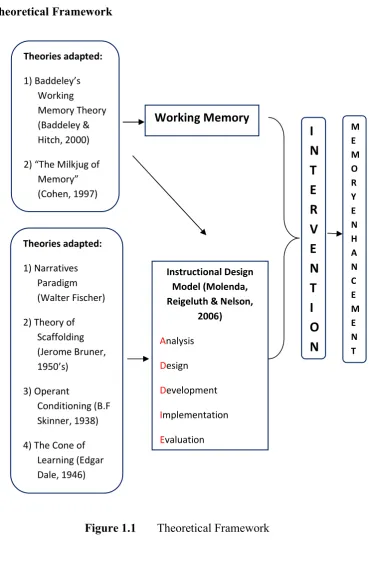
Figure 1.1 Theoretical Framework
The main theory that is being used for the cognitive intervention content is the working memory model that was introduced by Baddeley and Hitch (2000). It is best to make it the core theory in this study since this study aims at identifying the working memory in children with Down syndrome. Working memory is a cognitive system that stores and manipulates information for brief periods of time. It is different from short-term memory as it can also manipulate the information, in
Theories adapted: 1) Baddeley’s Working Memory Theory (Baddeley & Hitch, 2000)
2) “The Milkjug of Memory” (Cohen, 1997) Theories adapted: 1) Narratives Paradigm (Walter Fischer)
2) Theory of Scaffolding (Jerome Bruner, 1950’s) 3) Operant Conditioning (B.F Skinner, 1938)
4) The Cone of Learning (Edgar Dale, 1946)
I
N
T
E
R
V
E
N
T
I
O
N
M E M O R Y E N H A N C E M E N T Working Memory Instructional Design Model (Molenda, Reigeluth & Nelson,24
addition to holding it for a certain period of time. Short-term memory systems, on the other hand, are specialized purely for the purpose of temporary storage of material within particular informational domains (Baddeley, 2000; Baddeley and Hitch, 1974; Baddeley and Logie, 1999).
The working memory model consists of the central executive which is an attention control system responsible for manipulating information, a phonological loop for maintaining and rehearsing verbal information, and a visual-spatial sketchpad for storing visual–spatial information. Baddeley then revised this model by including the episodic buffer which is thought to be a multi-modal system that integrates memory across domains into scenes or episodes.
25
One of the essential elements used for the instructional approach is narratives. The researcher has adopted a social interactionist viewpoint whereby narratives provide a distinct kind of cognitive framework for remembering events (Nelson, 1996). This is in line with the episodic buffer within the working memory model that holds and integrates memory in all domains (within working memory model) into scenes or episodes.
According to Baddeley and Andrade (2000), the clarity of visual and auditory images in earlier research proved that retrieval from the buffer occurred through conscious awareness. Due to the fact that it uses verbal, visual and attention as its core, the researcher decided to improvise it with an additional feature of narratives. By adapting this assessment into an intervention, narratives are being added to assist the episodic buffer system. The theory of narrative paradigm by Walter Fisher believed that each person is a storyteller and experiences life as a chain of ongoing narratives. Individuals with DS are definitely not an exception. They still experience life just like others and can relate to it in an easier manner.
26
with narratives based on the Children’s Memory Scale assessment in order to improve working memory in children and adolescents with DS.
These theories were integrated into the ADDIE instructional design which is the framework for the procedures of this research, namely analysis, design, development, implementation and evaluation. ADDIE is the acronym of the five steps in this model. The letter ‘A’ stands for Analysis. This is the first phase that is vital to determining the direction of this study. The instructional problem is recognized, the instructional objectives are established and the current learning environment, as well as learner's existing knowledge and skills, are also identified.
The next phase is ‘D’ which stands for Design. The design phase covers the learning objectives, assessments of the instruments, subject matter content analysis, activities, lesson planning and media selection. The next ‘D’ stands for the
Development phase which encompasses the development of module and intervention props according to the design in the previous phase. The ‘I’ stands for
27
1.9 Conceptual Framework
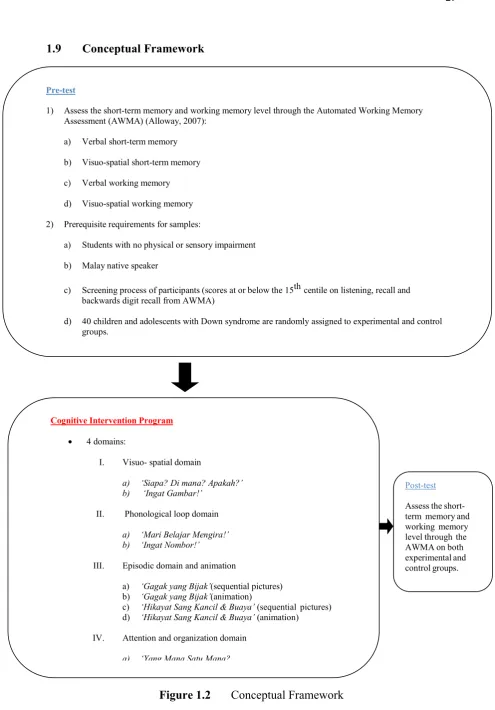
Figure 1.2 Conceptual Framework
Pre-test
1) Assess the short-term memory and working memory level through the Automated Working Memory Assessment (AWMA) (Alloway, 2007):
a) Verbal short-term memory
b) Visuo-spatial short-term memory
c) Verbal working memory
d) Visuo-spatial working memory
2) Prerequisite requirements for samples:
a) Students with no physical or sensory impairment
b) Malay native speaker
c) Screening process of participants (scores at or below the 15th centile on listening, recall and backwards digit recall from AWMA)
d) 40 children and adolescents with Down syndrome are randomly assigned to experimental and control groups.
Cognitive Intervention Program
4 domains:
I. Visuo- spatial domain
a) ‘Siapa? Di mana? Apakah?’
b) ‘Ingat Gambar!’
II. Phonological loop domain
a) ‘Mari Belajar Mengira!’ b) ‘Ingat Nombor!’
III. Episodic domain and animation
a) ‘Gagak yang Bijak’(sequential pictures) b) ‘Gagak yang Bijak’(animation)
c) ‘Hikayat Sang Kancil & Buaya’ (sequential pictures) d) ‘Hikayat Sang Kancil & Buaya’ (animation)
IV. Attention and organization domain
a) ‘Yang Mana Satu Mana?
Post-test
28
This study largely surrounds the basic pre-test and post-test experimental design with an intervention in between to allow for comparison between the two groups, namely the experimental group and the control group. The control group serves as the basis for comparison, to determine whether the performance of participants within the experimental group would be better, worse or the same as that of those who were not exposed to any experimental manipulation.
During the pre-test stage, the researcher uses the Automated Working Memory Assessment (AWMA) to assess the level of short-term memory and working memory of participants. This includes the verbal and visuo-spatial part of both short-term and working memory. Some prerequisites are also vital during this stage, namely students who participate in this study must have no sensory and physical impairments, and also the student should be a native Malay speaker. In addition, only those students who score at or below the 15th centile on listening, recall and backwards digit recall (two subtests from AWMA) (Holmes et al., 2009) can participate in this study. Lastly, a total number of 40 children and adolescents with DS aged between 6 and 14 years who meet the research requirements are assigned randomly into experimental and control groups.
29
1.10 Definition of Key Terms
Definitions are provided for key variables in this study, namely Down syndrome, students with Down syndrome, special students, special education needs, short-term memory, working memory, cognitive intervention program, narratives, Automated Working Memory Assessment and Children’s Memory Scale. The conceptual and operational definitions for all the study variables and most related key terms are provided below.
1.10.1 Down Syndrome
Down syndrome is a chromosomal disorder caused by an error in cell division that results in an extra 21st chromosome. This extra chromosome carries extra genes that can directly interrupt the normal development of individuals causing the attributes of DS, impairments and limitations in intellectual abilities and the risk of health problems associated with this condition. Christianson et al. (2006) said that there are more than 200,000 reported incidents of DS recorded each year worldwide. Down syndrome in this study refers to children with Down syndrome, individuals with Down syndrome and the Down syndrome community that suffer from a chromosomal disorder that results in an extra 21st chromosome.
1.10.2 Students with Down Syndrome
Students with Down syndrome are children who suffer from chromosomal disorder that result in an extra 21st chromosome. They are primary school students between six to twelve years of age.
1.10.3 Special Students
30
Attention Deficit and Hyperactive Disorder (ADHD), Dyslexia, Specific Language Impairments, Autistic Spectrum Disorder, Developmental Coordination Disorder and Developmental Dyscalculia, Cerebral Palsy as well as hearing and vision impairments. On another note, there are also students who are gifted and have more superior performance compared to their peers. These gifted students also need special attention and a specialized method of teaching in order to optimize their capability.
In this study, special children refer to students that are different from the normal students. They usually have difficulties resulting either from physical or/and mental impairment and need assistance from others to complete a task. They mostly comprise of children with a learning disability such as children with Down syndrome, Attention Deficit and Hyperactive Disorder (ADHD), Dyslexia, Specific Language Impairments, Autistic Spectrum Disorder and Developmental Coordination Disorder and Developmental Dyscalculia.
1.10.4 Special Education Needs
Special education needs refer to a program that has been developed mainly to accommodate various needs of special students. The teaching and learning process used is deemed to be the most appropriate technique that works for them including using the right sources and learning tools. According to Hallahan and Kauffman (2005), special education is a form of education designed to fulfil the needs of children with special needs. On the other hand, Gargiulo (2003) said that special education is a specialized teaching programme developed to assist the needs of special students, adding that it may need certain learning tools and specific teaching methods. Additionally, Friend (2006) mentioned that special education is a teaching programme intended to address the learning needs of disabled children. This type of education is conducted either in the classroom, home, hospital or other institutions.
31
competent, devoted, independent individual who is able to plan and manage their life as well as realize their potential as an individual and as part of the community; being well balanced and productive in line with the national educational philosophy. In this study, special education needs mean a program that has been developed mainly to accommodate various needs of special students. The teaching and learning process used are deemed to be the most appropriate techniques that work for them, in addition to using the right sources and learning tools.
1.10.5 Short-Term Memory
Short-term memory is the ability to hold a certain amount of information, either verbal or visual information for a short period of time.
1.10.6 Working Memory
Working memory is the ability to store information, both visually and verbally and then manipulate that information (Baddeley, 1992). It is made up of the phonological loop, visuo-spatial sketchpad, central executive and episodic buffer. The phonological loop provides brief storage and rehearsing of verbal information while the visuo-spatial sketchpad maintains and manipulates visual and spatial representations. On the other hand, the central executive is in charge of choosing relevant information and managing cognitive processes when tasks are performed. It is also responsible for administering the integration of information and coordinating slave systems (phonological loop and visuo-spatial sketchpad). Additionally, the episodic buffer is a multi-modal system that binds information and integrates memory across domains (visual, spatial, verbal, etc.) into scenes or episodes.
32
1.10.7 Cognitive Intervention Program
The cognitive intervention program is an organized program of teaching and learning that interferes with the current course of teaching and learning for a certain duration of time in order to enhance learning and memory capacity in Down syndrome.
1.10.8 Narratives
A narrative is a story (long or short; of past, present or future; factual or imagined; told for any purpose and with or without much detail) that is created in a constructive format (as a work of speech, writing, song, film, television, video games, photography or theatre) that describes a sequence of fictional or non-fictional events.
This study defines narratives as a story (short; of past, present or future; factual or imagined; told for any purpose) that is created in a constructive format (as a work of speech, writing, animation and flashcards) that portrays a sequence of fictional or non-fictional events.
1.10.9 Automated Working Memory Assessment (AWMA)
33
Verbal short-term memory momentarily holds in verbal information for a short period of time while verbal working memory briefly holds in verbal information for a short period of time and manipulates it. On the other hand, visuo-spatial short-term memory momentarily holds verbal information for a short period of time while visuo-spatial working memory briefly holds verbal information for a short period of time and manipulates it.
For the verbal short-term memory, subtests such as digit recall, word recall and nonwords recall are used. Subtests such as dot matrix and block recall are used to test the visuo-spatial short-term memory domain. On the other hand, tasks involving simultaneous storage and processing of information are used to tap into the verbal and visuo-spatial working memory. More complex tasks have been designed to measure the central executive or the attentional control aspect of working memory. It includes the counting recall whereas the participant counts the number of target items in each of a series of successive arrays and then recalls the totals for each array in the original sequence (Case, Kurland, & Goldberg, 1982). Tests such as recalling locations of images are designed to tap into the visuo-spatial working memory.
1.10.10 Children’s Memory Scale (CMS)
34
In this study, The Children's Memory Scale (CMS) is used as the reference in developing the working memory intervention program. It is one of the sources used in the development of this study's intervention program.
1.11 Scope of the Study
A total of five special education teachers and 40 children and adolescents with Down syndrome from the schools in the Keramat and Sentul region within the Kuala Lumpur district were involved in this study. This study will look into the results of an adapted and improvised intervention program based on the Working Memory Model by Baddeley and Hitch (1974) and the Children's Memory Scale (CMS) that uses the ‘The Milkjug of Memory' model in improving the phonological loop, visuo-spatial sketchpad, central executive and episodic buffer of children with Down syndrome. The samples used in the study are comprised of primary school students of 6-14 years old. Their mother tongue is the Malay Language. Special education teachers will deliver the intervention program within the school's setting and will carry out the activities in a small group.