1 MULTIPLE REGRESSION ANALYSIS USING CLIMATE VARIABLES
Nur Azilla Binti Jamainal, Assoc. Prof. Dr. Fadhilah Yusof
1.0 INTRODUCTION
Regression analysis is very useful when it comes to study the relationship between variables. Regression analysis can identify the cause and effect of one variable to another variable. Variables is the main part in regression analysis. There are dependent variable (or criterion variable) and independent variable (or predictor variable). In multiple regression, the independent variables can be added more in the model then explain the cause and effect of dependent variable in more variations. Hence, dependent variable can be predicted by building better models using multiple regression analysis.
The objective of this study comprises of (i) to determine correlation between temperature, humidity, wind, solar radiation and evaporation; and (ii) to build relationships between predictand with predictors using multiple linear regression
1.1 STUDY AREA AND DATA
This research will only focus on the Multiple Regression Analysis. Methods involve are stepwise regression, backward elimination and forward selection to find best model selection. This study will also involve lag of time that can predict an approximate interval of time hence observe the effect of rainfall on the climate variables.
There are 5 variables in this problem which are temperature, humidity, wind, solar radiation and evaporation considered as independent variables. Rainfall will act as the dependent variable. This study will be analysed based on daily and monthly observation of the independent variables. This study will use satellite data from Malaysia Meteorology Service (MMS). The data obtained was from 1985 to June 2004. SPSS 22.0 and Microsoft Excel will be used in analysing those data.
1.2 LITERATURE REVIEW
Multiple regression analysis is widely used in hypotheses generated by researchers. These hypotheses may come from formal theory, previous research, or simply scientific hunches. The following hypotheses chosen from a variety of research areas.
2 Md Mizanur Rahman et al., (2013) developed a statistical forecasting method for summer monsoon rainfall over Bangladesh using simple multiple regression. Predictors for Bangladesh summer monsoon rainfall were identified which are sea-surface temperature, surface air temperature and sea level pressure. Significant correlations exist between Bangladesh seasonal monsoon rainfall and southwest Indian Ocean sea surface temperature, sea level pressure in the central Pacific region around equator and sea air temperature over Somalia.
Marla C. et al., (2010) developed equations for estimating pollutant loads and event mean concentration (which was used to quantify the washed-off pollutant concentration from non-point sources) as a function variables. They gathered runoff quantity and quality data from a 28-month monitoring conducted on the road and parking lot sites in Korea.
Mohamed E. Yassen (2000) examined the relationship between dust particulate and selective meteorological variables such as rainfall, relative humidity, temperature and wind speed in Kuala Lumpur and Petaling Jaya, Malaysia during 1983-1997. He used correlation, simple regression and multiple regression techniques to model dust concentration as a function of meteorological conditions.
1.3 METHODOLOGY
1.3.1 Correlation
Correlation measures the strength of a linear relationship between twovariables. One numerical measure is the Pearson product moment correlation coefficient,𝑟.
𝑟 = 𝑆𝑥𝑦 √𝑆𝑥𝑥𝑆𝑦𝑦
Properties of 𝑟: 1. −1 ≤ 𝑟 ≤ 1
2. Values of 𝑟close to 1 implies there is a strong positive linear relationshipbetween 𝑥and 𝑦.
3. Values of 𝑟close to -1 implies there is a strong negative linear relationshipbetween 𝑥and 𝑦.
4. Values of 𝑟close to zero implies little or no linear relationship between𝑥and 𝑦.
The value of𝑟has no scale and range between -1 and 1 regardless of theunits of 𝑥and 𝑦.
1.3.2 Multiple Regression
Multiple regression models can be presented by the following equation:
𝑌 = 𝛽0+ 𝛽1𝑋1+ 𝛽2𝑋2+ 𝛽3𝑋3+ 𝛽4𝑋4+ 𝛽5𝑋5+ 𝜀
Where 𝑌 is the rainfall (dependent variable), 𝑋1, 𝑋2, 𝑋3, 𝑋4and 𝑋5 (independent variable) are
temperature, wind, humidity, solar radiation and evaporation respectively. 𝛽1, 𝛽2, 𝛽3, 𝛽4 and
𝛽5 are model coefficients of the five independent variables. 𝑏0 is a constant while 𝜀 is the
error.
3 graph, plot P-P, plot Q-Q, kurtosis and skewness. If the distribution of the data is not normal, transformation need to be done.
It is important to evaluate the goodness-of-fit and the statistical significance of the estimated parameters of the constructed regression models; the techniques commonly used to verify the goodness-of-fit of regression models are the hypothesis testing, R-squared and analysis of the residuals. For this purpose the F-test is used to verify the statistical significance of the overall fit and the t-test is used to evaluate the significance of the individual parameters; The latter tests the importance of the individual coefficients where the former is used to compare different models to evaluate the model that best fits the population of the sample data.
Verifying the multicollinearity is also an important stage in multiple regression modelling. Multicollinearity occurs when the predictors are highly correlated which will result in dramatic change in parameter estimates in response to small changes in the data or the model. The indicators used to identify multicollinearity among predictors are tolerance (T) and variance inflation factor (VIF):
Tolerance = 1 − 𝑅2
VIF = 1
𝑇𝑜𝑙𝑒𝑟𝑎𝑛𝑐𝑒
where 𝑅2 is the coefficient of multiple determination:
𝑅2=𝑆𝑆𝑅 𝑆𝑆𝑇 = 1 −
𝑆𝑆𝐸 𝑆𝑆𝑇
Where SST is the total sum of squares, SSR is the regression sum of squares and SSE is the error sum of squares. According to Lin (2008) a tolerance of less than 0.20 – 0.10 or a VIF greater than 5 – 10 indicates a multicollinearity problem.
To evaluate the independence of the errors of the models the Durbin-Watson test (DW) which tests the serial correlations between errors is applied. The test statistics have range of 0 – 4, according to Field (2009) values less than 1 or greater than 3 are definitely matter of concern.
1.3.3 Variable Selection Procedures
A) Forward Selection
The forward selection procedure starts with an equation containing no predictor variables, only a constant term. The first variable included in the equation is the one which has the highest simple correlation with the response variable 𝑦.
B) Backward Elimination
The backward elimination procedure starts with the full equation and successively drops one variable at a time. The variables are dropped on the basis of their contribution to the reduction of error sum of squares. This is equivalent to deleting the variable which has the smallest 𝑡-test in the equation.
4 The stepwise method is essentially a forward selection procedure but with the added requirement that at each stage the possibility of deleting a variable, as in backward elimination, is considered. In this procedure a variable that entered in the earlier stages of selection may be eliminated at later stages.
1.3.4 Distributed Lag Analysis
Distributed lag analysis is a specialized technique for examining the relationship between variables that involve some delay.
The simplest way to describe the relationship between dependent and independent variables would be in simple linear relationship:
𝑦𝑡 = ∑ 𝛽𝑖𝑥𝑡−𝑖
In this equation, the value of the dependent variable at time 𝑡 is expressed as a linear function of 𝑥 measured at times 𝑡, 𝑡 − 1, 𝑡 − 2, etc. Thus, the dependent variable is a linear function of 𝑥, and 𝑥 is lagged by 1, 2, etc. time periods. The beta weights (𝛽𝑖) can be
considered as the slope parameters in this equation. This equation recognized as a special case of the general linear regression equation. If the weights for the lagged time periods are statistically significant, 𝑦 variable is predicted (or explained) with the lag are concluded.
1.4 RESULT AND DISCUSSION
1.4.1 Data Arrangement with Lagged Effect
Lagged effect can be found if there exist relationship of some delay of time between variables involved. It allow us to investigate lag of independent variables that affects the dependent variable. Lag 1 until Lag 5 will be examined for both cases of monthly and daily data. Lag 1 represent one day before for daily data. Table 1 shows the arrangement of data based on lag of times.
Table 1 : Arrangement of data based on lag of time for daily data.
Dependent Variable Independent Variable
Lag 0 6 Jan 1985 6 Jan 1985
Lag 1 6 Jan 1985 5 Jan 1985
Lag 2 6 Jan 1985 4 Jan 1985
Lag 3 6 Jan 1985 3 Jan 1985
Lag 4 6 Jan 1985 2 Jan 1985
Lag 5 6 Jan 1985 1 Jan 1985
The same arrangement as in daily data is done on monthly data. Lag 1 will represent one month before for monthly data and lag 5 represent five months before. Table 2 shows the arrangement of data based on lag of times in month.
Table 2 : Arrangement of data based on lag of time for monthly data.
Dependent Variable Independent Variable
Lag 0 June 1985 June 1985
Lag 1 June 1985 May 1985
Lag 2 June 1985 Apr 1985
Lag 3 June 1985 Mar 1985
5
Lag 5 June 1985 Jan 1985
1.4.2 Multiple Regression Model Using Daily Data
1.4.2.1 Descriptive Statistic
Descriptive statistic basically summarize thousands data of dependent and independent variables and represent the entire data that have been collected. This study will use Yd as daily rainfall and Xdn where n= 1, 2, 3, 4, 5 as climate variables where d1, d2, d3,
d4 and d5 are daily temperature, humidity, wind, solar radiation and evaporation respectively. Table 3 shows the descriptive statistic for daily data.
Table 3 :Descriptive statistic of daily data.
Variables Mean Standard deviation Skewness Kurtosis
Yd 6.5424 15.6307 4.655 36.064
Xd1 27.5271 1.0127 -0.239 0.192
Xd2 80.8461 6.4764 -0.845 1.169
Xd3 1.7648 0.6815 1.266 2.499
Xd4 17.3844 5.1414 -1.003 1.086
Xd5 3.8061 1.3498 0.184 0.489
Histogram of the variables are normally distributed and this implies that all predictand and predictors fulfilled the need in building a model (Appendix A) There are also no multicolinearity problem as tolerance of variables are not less than 0.10-0.20 and VIF smaller than 5-10 (Appendix C). Homocedasticity means that the variance of errors are same across all levels of the independent variable. Appendix D shows that residuals are quite randomly scattered around 0 (the horizontal line) providing a relatively even distribution.
Each variables has their own summary. Yd shows that the data is skewed more to the
right compared with other variables. The probability distribution function of rainfall have long tail to the right side. In contrast, Xd2 shows the data skewed more to the left. The
probability distribution function of humidity is long tail to the left side compared to other variables. Yd also give the highest standard deviation and mean value. Yd also has the highest
value of kurtosis as the peak is sharper and has fatter tails.
1.4.2.2 Correlation
A strong relationship between dependent and independent variables are needed before building a model. Before that, the data need to be arranged according to lagged of time. In this study, Lag 1 until Lag 5 have been used for each independent variables as Lag 1 represent 1 day before and Lag 5 represent 5 days before. Then, each variables with each Lag will have different value of correlation. Using data analysis in Excel, correlation between dependent and independent variables are obtained. Table 4 are the results obtained by selecting the highest correlation between dependent and independent variables.
Table 4 : Correlation of daily lagged independent variables with rainfall
Without Lag Lag 1 Lag 2 Lag 3 Lag 4 Lag 5
Xd1 -0.2922 -0.1130 -0.0785 -0.0544 -0.0512 -0.0356
Xd2 0.3121 0.1780 0.1455 0.1247 0.1201 0.1027
Xd3 -0.0931 -0.0983 -0.1074 -0.1012 -0.0980 -0.0953
Xd4 -0.2530 -0.1054 -0.0662 -0.354 -0.0332 -0.0093
6 From Table 4, the correlation between rainfall and evaporation is the highest while the lowest is the correlation between rainfall and wind. Only rainfall and temperature have negative correlations, the rest have positive correlations.
1.4.2.3 Variable Selection
A) Backward Elimination
Backward Elimination is a method where it starts with full equation then drop the variables which has the smallest t-test. Below are the results obtained using SPSS 22.0.
Table 5 : Coefficient of daily variables in each model for backward elimination
Model Coefficient T-test Significant
1
(Constant) 40.143 4.844 0.0000
Xd1 -1.644 -7.202 0.0000
Xd2 0.274 6.921 0.0000
Xd3Lag2 0.413 1.428 0.153
Xd4 -0.050 -1.163 0.245
Xd5 -2.709 -15.800 0.000
2
(Constant) 41.049 4.975 0.000
Xd1 -1.717 -7.819 0.000
Xd2 0.279 7.099 0.000
Xd3Lag2 0.452 1.571 0.116
Xd5 -2.779 -17.299 0.000
3
(Constant) 46.205 6.102 0.000
Xd1 -1.805 -8.510 0.000
Xd2 0.254 7.065 0.000
Xd5 -2.751 -17.241 0.000
Based on Table 5, there are 3 models that can get from Backward Elimination.
Model 1:
𝑌𝑑= 40.143 − −1.644𝑋𝑑1+ 0.274𝑋𝑑2+ 0.413𝑋𝑑3𝐿𝑎𝑔2− 0.050𝑋𝑑4− 2.709𝑋𝑑5
In Model 1, all variables are entered in the equation. Based on Table 5, the smallest t-test value and most insignificant variable is the solar radiation with t-test value, 1.163 and p-value = 0.245, followed by wind with lag of 2 days, with second smallest t-test p-value, 1.428 and p-value = 0.153. Thus, variable solar radiation will be eliminated first from the equation.
Model 2:
𝑌𝑑 = 41.094 − 1.717𝑋𝑑1+ 0.279𝑋𝑑2+ 0.452𝑋𝑑3𝐿𝑎𝑔2− 2.779𝑋𝑑5
In Model 2, since variable wind has been eliminated, there are only 4 variables in the equation. Based on Table 5, wind with lag of 2 days has the smallest t-test value, 1.571 with p -value = 0.116 which is insignificant. Thus, wind will be eliminated from the equation.
Model 3:
𝑌𝑑 = 46.188 − 1.805𝑋𝑑1+ 0.254𝑋𝑑2− 2.751𝑋𝑑5
7 Table 6 : Model summary of MRA using backward elimination
Model R2 Adjusted R2
1 0.152 0.151
2 0.152 0.151
3 0.151 0.151
From the table, all models have same value of Adjusted R2. Only Model 1 and
Model 2 have changes between R2 and Adjusted R2 where Adjusted R2 became smaller
because there exist elimination of variables while there is no elimination in Model 3 because all variables in the equation are significant. Thus, based on both tables 5 and 6, Model 3 is better than Model 2 and Model 1 since Model 1 and Model 2 contain variables that are not significant.
Therefore the selected model using backward elimination method is: 𝑌𝑑 = 46.188 − 1.805𝑋𝑑1+ 0.254𝑋𝑑2− 2.751𝑋𝑑5
B) Forward Selection and Stepwise
Forward selection is a method where it start with zero independent variable in the equation then select the variables which has the highest correlation with rainfall. Stepwise is basically a combination of Backward Elimination and Forward Substitution method. Since the result of Forward Substitution and Stepwise are same, below are the result obtained using SPSS 22.0.
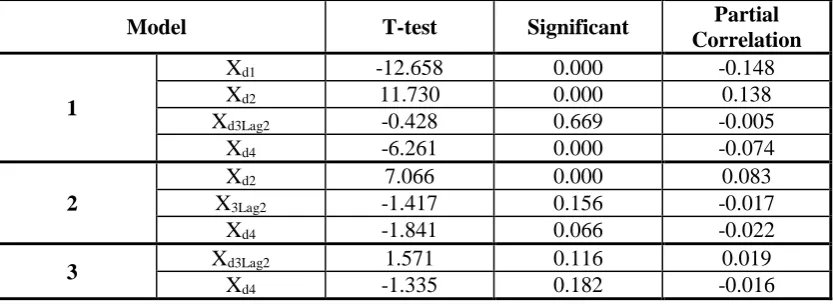
Table 7 : Excluded daily variables using forward selection and stepwise
Model T-test Significant Partial
Correlation
1
Xd1 -12.658 0.000 -0.148
Xd2 11.730 0.000 0.138
Xd3Lag2 -0.428 0.669 -0.005
Xd4 -6.261 0.000 -0.074
2
Xd2 7.066 0.000 0.083
X3Lag2 -1.417 0.156 -0.017
Xd4 -1.841 0.066 -0.022
3 Xd3Lag2 1.571 0.116 0.019
Xd4 -1.335 0.182 -0.016
Based on both Table 7, there are 3 models that can get from Forward Substitution and Stepwise.
Model 1:
𝑌𝑑= 22.201 − 4.115𝑋𝑑5
From Table 7, evaporation has the highest correlation with rainfall. Thus, variable evaporation is entered first in the equation. The variable entered also significant since it has high value of t-test based on Table 4.10.
Model 2:
𝑌𝑑= 86.069 − 2.442𝑋𝑑1− 3.234𝑋𝑑5
8 Temperature also has high value of t-test, 12.658, and also a significant variable with p-value = 0.000. Thus, variable temperature is entered in the equation.
Model 3:
𝑌𝑑 = 46.188 − 1.805𝑋𝑑1+ 0.254𝑋𝑑2− 2.751𝑋𝑑5
From Table 7, variable humidity has the highest partial correlation, 0.083, after variable temperature and variable evaporation entered the equation. Besides, humidity is the only variable that is significant with p-value = 0.000 and highest t-test value, 7.066. Thus, humidity is the last variable entered in the equation.
Table 8 : Model summary of MRA using forward selection and stepwise
Model R2 Adjusted R2
1 0.126 0.126
2 0.145 0.145
3 0.151 0.151
According to Table 8, each model has different value of R2 and Adjusted R2. The value of R2
increases each time a new variable added thus improves the models. Model 3 has the highest value of Adjusted R2 which means the model is better than Model 1 and Model 2.
Therefore the selected model using forward selection and stepwise method is: 𝑌𝑑 = 46.205 − 1.805𝑋𝑑1+ 0.254𝑋𝑑2− 2.751𝑋𝑑5
1.4.3 Multiple Regression Model Using Monthly Data
1.4.3.1 Descriptive Statistic
Since the data obtained originally in the form of daily data, subtotal of Excel is used to find the sum of each variable of each month. The study can be proceeded to find best model for monthly data. SPSS 22.0 was used in finding the descriptive statistic of the monthly data. This study will use Ym as monthly rainfall and Xmn where n= 1, 2, 3, 4, 5 as
climate variables where m1, m2, m3, m4 and m5 are monthly temperature, humidity, wind, solar radiation and evaporation respectively.
Table 9 : Descriptive statistic of monthly data
Variables Mean Standard deviation Skewness Kurtosis
Ym 199.0653 135.3564 1.160 2.254
Xm1 837.6940 29.0624 -0.212 0.155
Xm2 2460.2782 160.8352 -0.940 0.909
Xm3 53.7060 12.6717 0.940 0.364
Xm4 529.0346 72.1005 -1.878 12.738
Xm5 115.8256 21.9630 0.563 -0.195
The histogram of the variables are normally distributed (Appendix B), thus fulfil the need in building a model. There are also no multicolinearity problem as tolerance of variables are not less than 0.10-0.20 and VIF smaller than 5-10 (Appendix C). Appendix D shows that residuals are randomly scattered around 0 (the horizontal line) providing a relatively even distribution which implies that the scatter plot shows a homoscedasticity pattern.
Table 9 shows that Xm2 has the highest standard deviation and with highest mean. Ym
9 negative skewness implies that the probability distribution function of monthly solar radiation has long tail to the lefts side.
It seems that only evaporation has the negative value of kurtosis. This indicates that the distribution of monthly evaporation is too flat or even concave if the value is large enough. In addition there are 2 variables which have quite high kurtosis value, which are rainfall and solar radiation. This indicates that the distribution of both monthly variables have sharp peaks.
1.4.3.2 Correlation
The same procedures as in daily data are repeated here. Firstly, the data need to be arranged according to lagged of time. In this study, Lag 1 until Lag 5 have been used for each independent variables as Lag 1 represent 1 month before and Lag 5 represent 5 months before. Each variables with each Lag will have different value of correlation. Using data analysis in Excel, correlation between dependent and independent variables were obtained. Below are the results obtained by selecting the highest correlation between dependent and independent variables.
Table 10 : Correlation of monthly lagged independent variables with rainfall
Without Lag Lag 1 Lag 2 Lag 3 Lag 4 Lag 5
Xm1 -0.2147 -0.0429 0.1094 0.2089 0.2686 0.2592
Xm2 0.6342 0.3386 0.1570 -0.0145 -0.0793 -0.0390
Xm3 -0.5318 -0.4262 -0.2398 -0.0812 0.0089 0.0145
Xm4 -0.4600 -0.1121 -0.0056 0.0694 0.1685 0.2123
Xm5 -0.6539 -0.3142 -0.0989 0.0827 0.1425 0.1595
From Table 10, correlation between rainfall and evaporation is the highest while the lowest is the correlation between rainfall and temperature. Temperature and humidity have positive correlation towards rainfall while wind, solar radiation and evaporation have negative correlation towards rainfall.
1.4.3.3 Variables Selection
A) Backward Elimination
Below are the result obtained using SPSS 22.0.
Table 11 : Coefficient of monthly variables in each model for backward elimination.
Model Coefficient T-test Significant
1
(Constant) -513.498 -1.838 0.067
Xm1Lag4 0.322 1.386 0.167
Xm2 0.297 5.412 0.000
Xm3 -0.771 -1.069 0.286
Xm4 0.055 0.362 0.718
Xm5 -2.371 -4.419 0.000
2
(Constant) -482.763 -1.817 0.071
Xm1Lag4 0.322 1.386 0.167
Xm2 0.293 5.466 0.000
Xm3 -0.841 -1.213 0.226
Xm5 -2.256 -5.216 0.000
10
Xm1Lag4 0.313 1.347 0.179
Xm2 0.313 6.133 0.000
Xm5 -2.484 -6.371 0.000
4
(Constant) -261.466 -1.667 0.097
Xm2 0.311 6.095 0.000
Xm5 -2.627 --6.987 0.000
Based on Table 11, there are 4 models that can get from Backward Elimination method which are:
Model 1:
𝑌𝑚= −513.498 + 0.322𝑋𝑚1𝐿𝑎𝑔4+ 0.297𝑋𝑚2− 0.771𝑋𝑚3+ 0.055𝑋𝑚4− 2.371𝑋𝑚5
In Model 11, all the variables are entered in the equation. Based on Table 4.16, the smallest t-test value, 0.362, with most insignificant value, p-value = 0.718 is variable solar radiation. Variable wind also has insignificant value and second lowest t-test value which are p-value = 0.286 and 1.069.Thus variable solar radiation will be eliminated first from the equation.
Model 2:
𝑌𝑚 = −482.763 + 0.322𝑋𝑚1𝐿𝑎𝑔4+ 0.293𝑋𝑚2− 0.841𝑋𝑚3−2.256𝑋𝑚5
In Model 2, since variable solar radiation has been eliminated, there are 4 variables found in the equation. Based on Table 11, variable wind has the lowest value of t-test, 1.213, also p-value = 0.226 which is insignificant. Variable temperature with lag of 4 months also has low t-test value, 1.386 and p-value = 0.167 which is insignificant. Thus, variable wind will be eliminated.
Model 3:
𝑌𝑚 = −543.299 + 0.313𝑋𝑚1𝐿𝑎𝑔4+ 0.313𝑋𝑚2− 2.484𝑋𝑚5
Previously, variable solar radiation and variable wind have been eliminated, so the equation now contain 3 variables. From table above, temperature with lag of 4 months has the lowest t-test value and insignificant which are 1.347 and p-value = 0.179 respectively. Thus temperature is eliminated from the equation.
Model 4:
𝑌𝑚= −261.466 + 0.311𝑋𝑚2− 2.627𝑋𝑚5
In this model, there only exist 2 variables which are humidity and evaporation variables since the other variables have been eliminated previously. Based on the table above, all variable in the equation have high value of t-test value and significant with p-value = 0.000
Table 12 : Model summary of MRA using backward elimination
Model R2 Adjusted R2
1 0.516 0.505
2 0.516 0.507
3 0.512 0.506
11 According to Table 12, each model has different value of R2 and Adjusted R2. From
Model 1 until Model 4, the value of R2 decreasing since variable that is not qualified will be
dropped from the equation to achieve a best model. Model 2 has the highest value of Adjusted R2, but in Model 2 there exist variables that are not significant, thus it cannot
conclude that the model is better than Model 1, Model 2 and Model 4. Since only Model 4 contains only significant variables, therefore Model 4 is chosen.
Therefore the selected model using backward elimination method is: 𝑌𝑚 = −261.466 + 0.311𝑋𝑚2− 2.627𝑋𝑚5
B) Forward Selection and Stepwise
Same goes to daily data, the result of forward substitution and stepwise of monthly data are the same. Below are the result obtained.
Table 13 : Excluded monthly variables using forward selection and stepwise
Model T-test Significant Partial
Correlation
1
Xm1Lag4 1.134 0.258 0.075
Xm2 6.095 0.000 0.376
Xm3 -2.822 0.005 -0.184
Xm4 -0.106 0.916 -0.007
2
Xm1Lag4 1.347 0.179 0.089
Xm3 -1.168 0.244 -0.078
Xm4 0.651 0.515 0.043
Based on both Table 13, there are 2 models that can be obtained from forward substitution and stepwise method.
Model 1:
𝑌𝑚 = 671.492 − 4.079𝑋𝑚5
From the Table 10, evaporation has the highest correlation with rainfall. Thus, variable evaporation is entered first in the equation.
Model 2:
𝑌𝑚= −261.466 + 0.311𝑋𝑚2− 2.627𝑋𝑚5
From Table 13, variable humidity has the highest partial correlation with rainfall, 0.376, after variable evaporation entered the equation. Partial correlation of temperature, wind and solar radiation towards rainfall are quite low with value nearly 0. Besides, humidity has high t-test value, 6.095, and p-value = 0.000 which is significant. Thus, variable humidity is the most suitable variable entered to the equation after variable evaporation.
Table 14 : Model summary of MRA using forward selection and stepwise
Model R2 Adjusted R2
1 0.428 0.425
2 0.508 0.504
According to Table 14, each model has different value of R2 and Adjusted R2. The value of
R2 increasing along the models since new variable added thus improves the models. Model 2
has the highest value of Adjusted R2 which means the model is better than Model 1.
12 𝑌𝑚= −261.466 + 0.311𝑋𝑚2− 2.627𝑋𝑚5
1.4.4 Summary Analysis
In summary, during analysing daily and monthly data, backward elimination, forward selection and stepwise methods has managed to produce the same result. Model for case I: daily data is 𝑌𝑑 = 46.188 − 1.805𝑋𝑑1+ 0.254𝑋𝑑2− 2.751𝑋𝑑5and model for case II:
monthly data is 𝑌𝑚 = −261.466 + 0.311𝑋𝑚2− 2.627𝑋𝑚5. Both models did not have
lagged variables which implies that there are no lagged effect in the models.
R2 of daily model is 0.151 which indicates that the model explains 15.1% variability
of the response data around its mean. It also shows the data are 15.1% close to the fitted regression line. R2 of monthly model is 0.508 which implies the model explains 50.8%
variability of response data around its mean. At the same time, 50.8% of the data are close to the fitted regression line. These mean that the monthly model is better fits compared to daily model.
Generally, it is better to look at Adjusted R2 rather than R2 and to look at the standard
error of the regression rather than the standard deviation of the errors in order to strengthen the above statement. Adjusted R2 of daily model is 0.151 and monthly model is 0.504 which
indicates that monthly model contains predictors that improves the model more rather than daily model. Since monthly model has high adjusted R2 value, 0.504 compared to daily
model 0.151, monthly model is preferable than daily model.
1.5 CONCLUSION
1.5.1 Conclusion
Multiple regression analysis is usually used to determine the relationship of two or more independent variables. Correlation between rainfall and climate variables plays an important role in order to build a good model for rainfall prediction. There are 3 methods used in multiple regression analysis which are the backward elimination, forward selection and stepwise. The results of these 3 methods are compared to determine which method is the best. The data obtained from Malaysia Meteorological Servicesare analysed by using Microsoft Excel and SPSS 22.0. In this study, the data analysed were in the form of daily data and monthly data.
Generally, both daily and monthly data analysis shows that evaporation has the highest correlation towards rainfall and the lowest correlation goes to solar radiation variable. Based on daily data analysis, only wind that need to be lagged with 2 days data. However, the correlation value is not high compared to other climate variables and not added in the daily model. Unlike monthly data analysis, temperature require a lag of 4 months. However, the correlation value is not high compared to other climate variables and thus not added in the monthly model.
13 Model selected from analysing the daily data is𝑌𝑑= 46.188 − 1.805𝑋𝑑1+
0.254𝑋𝑑2− 2.751𝑋𝑑5. The model shows that daily variables of temperature, Xd1, humidity,
Xd2, and evaporation, Xd5, have the best correlation towards rainfall. These 3 variables are
significant and the model have high value of Adjusted R2 than other models, which makes
this model better for predicting rainfall pattern in the future.
For monthly data, model selected is 𝑌𝑚 = −261.466 + 0.311𝑋𝑚2− 2.627𝑋𝑚5. The
model shows that monthly variables of humidity, Xm2 and evaporation, Xm5 have the best
correlation towards rainfall. Even though this model has small value of Adjusted R2, model
that contains all significant variables is a priority so that the model would produce smaller error in predicting the rainfall in future.
In overall, from the result obtain, analysing using monthly data is better since the model has higher value of Adjusted R2 compared to model of daily data analysis. In terms of
methods used, forward selection and stepwise always give the same results thus both are the best methods because these methods will strictly picked variables that are significant for the model and produce the best model. Lag of time is also not important in this case because there is no effect of lag based on both models. The independent variables did not need to lag in order to predict the rainfall amount since the result can be obtained on same day or month.
ACKNOWLEDGEMENT
The authors wish to thank Malaysia Meteorological Services for allowing us to do analysis on the climate data.
REFERENCES
Andy,F. (2005). Discovering statistics using SPSS: (and sex, drugs and rock ‘n’ roll), London: SAGE, 2005.
Jacob Cohen, Patricia Cohen, Stephen G. West, Leona S. Aiken (2003), Applied Multiple Regression/Correlation Analysis for the Behavioural Sciences Third Edition,
Lawrence Erlbaum Associates, Inc., Mahwah, New Jersey, 2003.
John O. Rawlings, Sastry G. Pantula, David A. Dickey (1998), Applied Regression Analysis: A Research Tool, Second Edition, Springer-Verlag New York, Inc., North Carolina State University Raleigh, 1998.
Samprit Chatterjee, Ali S. Hadi (2006), Regression Analysis by Example, Fourth Edition,
John Wiley & Sons, Inc., Hobokon, New Jersey, 2006.
Timothy Z. Keith (2006), Multiple Regression and Beyond, Pearson Education, University of Texas at Austin, 2006.
14 Chattopadhyay, G., Chattopadhyay, S., Jain, P., 2010. Multivariate forecast of winter monsoon rainfall in India using SST anomaly as a predictor: neorocomputing and statistical approaches. Comptes Rendus Geoscience 342(100, 755-765.
F.Mekanik, M.A. Imtez, S. Gato-Trinidad, A. Elmahdi. (2013). The Journal of Hydrology.
Multiple regression and Artificial Neural Network for long-term rainfall forecasting using large scale climate modes, 503, 11-21.
Hartmann, H., Becker, S., King, L, 2008. International Journal of Climatology. Predicting summer rainfall in the Yangtze River basin with neural networks, 28(7) 925-936.
Intan Martina Md Ghani, Sabri Ahmad. (2010). The Journal of Procedia Social and Behavioral Sciences. Stepwise Multiple Regression Method to Forecast Fish Landing, Vol. 8, 549-554.
Lau, K., Weng, H., 2001. The Journal of Climate Coherent nodes of global SST and summer rainfall over China: an assessment of the regional impacts of the 1997-98 El Nino, 14(6) 1294-1308.
Marla C. Maniquaz, Soyoung Lee, Lee Hyung Kim (2010). The Journal of Environmental Sciences. Multiple linear regression models of urban runoff pollutant load & event mean concentration considering rainfall variables, 22(6) 946-952.
Mohamed E. Yassen (2000). The Journal of Social Sciences and Humanities. The relationship between dust particulates & meteorological parameters in Kuala Lumpur and Petaling Jaya, Malaysia. Universiti Kebangsaan Malaysia.
Shukla, R.P., Tripathi, K.C., Pandey, A.C., Das, I.M.L., 2011. Prediction of Indian summer monsoon rainfall using Niño indices: a neural network approach. Atmospheric Research 102 (1–2), 99–109.
Subana Shanmuganathan, Ajit Narayanan (2012). The Journal of Geoinformatics Research Centre and School of Computing and Mathematical Science. Modelling the climate change effects on Malaysia’s oil palm yield. IEEE Symposium on learning, E-management and E-services (IS3e).
Yufu, G., Yan, Z., Jia, W., 2002. Numerical simulation of the relationships between the 1998 Yangtze River valley floods and SST anomalies. Advances in Atmospheric Sciences 19 (3), 391–404.
StatSoft, Inc. (2013). Electronic Statistics Textbook. Tulsa, OK: StatSoft. WEB:
15 INDEX
APPENDIX A
Normality of Variables Based on Histogram Using SPSS 22.0 for Daily Data
APPENDIX B
16 APPENDIX C
SPSS 22.0 Output for Multicolinearity and Independence of Error
Backward elimination using daily data
17 Model Unstandardized Coefficients Standardized Coefficients
t Sig.
Collinearity Statistics
B Std. Error Beta Tolerance VIF
1 (Constant) 40.143 8.288 4.844 .000
TempLag0 -1.644 .228 -.107 -7.202 .000 .545 1.834 HumidLag0 .274 .040 .113 6.921 .000 .445 2.245 WindLag2 .413 .289 .018 1.428 .153 .751 1.331 SolarLag0 -.050 .043 -.016 -1.163 .245 .595 1.682 EvaporLag0 -2.709 .171 -.234 -15.800 .000 .545 1.835 2 (Constant) 41.049 8.251 4.975 .000
TempLag0 -1.717 .220 -.111 -7.819 .000 .589 1.696 HumidLag0 .279 .039 .115 7.099 .000 .451 2.216 WindLag2 .452 .287 .020 1.571 .116 .761 1.313 EvaporLag0 -2.779 .161 -.240 -17.299 .000 .621 1.611 3 (Constant) 46.188 7.576 6.097 .000
TempLag0 -1.805 .212 -.117 -8.503 .000 .631 1.585 HumidLag0 .254 .036 .105 7.066 .000 .540 1.854 EvaporLag0 -2.751 .160 -.237 -17.229 .000 .629 1.591 a. Dependent Variable: Rainfall
Forward selection and stepwise method using daily data
Coefficientsa Model Unstandardized Coefficients Standardized Coefficients
t Sig.
Collinearity Statistics
B Std. Error Beta Tolerance VIF
1 (Constant) 22.201 .519 42.819 .000
EvaporLag0 -4.115 .128 -.355 -32.034 .000 1.000 1.000 2 (Constant) 86.069 5.071 16.971 .000
EvaporLag0 -3.234 .145 -.279 -22.329 .000 .769 1.300 TempLag0 -2.442 .193 -.158 -12.658 .000 .769 1.300 3 (Constant) 46.188 7.576 6.097 .000
EvaporLag0 -2.751 .160 -.237 -17.229 .000 .629 1.591 TempLag0 -1.805 .212 -.117 -8.503 .000 .631 1.585 HumidLag0 .254 .036 .105 7.066 .000 .540 1.854 a. Dependent Variable: Rainfall
Backward elimination using monthly data
Coefficientsa Model Unstandardized Coefficients Standardized Coefficients
t Sig.
Collinearity Statistics
B Std. Error Beta Tolerance VIF
1 (Constant) -513.498 279.454 -1.838 .067
TempLag4 .322 .233 .068 1.386 .167 .891 1.123 HumidLag0 .297 .055 .350 5.412 .000 .518 1.929 WindLag0 -.771 .721 -.072 -1.069 .286 .483 2.072 SolarLag0 .055 .153 .025 .362 .718 .468 2.135 EvaporLag0 -2.371 .536 -.380 -4.419 .000 .294 3.406 2 (Constant) -482.763 265.738 -1.817 .071
18 WindLag0 -.841 .693 -.078 -1.213 .226 .520 1.922 EvaporLag0 -2.256 .433 -.362 -5.216 .000 .450 2.223 3 (Constant) -543.299 261.285 -2.079 .039
TempLag4 .313 .232 .066 1.347 .179 .892 1.121 HumidLag0 .313 .051 .369 6.133 .000 .598 1.671 EvaporLag0 -2.484 .390 -.398 -6.371 .000 .555 1.803 4 (Constant) -261.466 156.832 -1.667 .097
HumidLag0 .311 .051 .367 6.095 .000 .599 1.670 EvaporLag0 -2.627 .376 -.421 -6.987 .000 .599 1.670 a. Dependent Variable: Rainfall
Forward selection & stepwise using monthly data
Coefficientsa
Model
Unstandardized Coefficients
Standardized Coefficients
t Sig.
Collinearity Statistics
B Std. Error Beta Tolerance VIF
1 (Constant) 671.492 36.815 18.240 .000
EvaporLag0 -4.079 .313 -.654 -13.022 .000 1.000 1.000 2 (Constant) -261.466 156.832 -1.667 .097
EvaporLag0 -2.627 .376 -.421 -6.987 .000 .599 1.670 HumidLag0 .311 .051 .367 6.095 .000 .599 1.670 a. Dependent Variable: Rainfall
APPENDIX D
SPSS 22.0 Output for Heterocedasticity