AMONG POSTGRADUATE STUDENTS AT UTM KUALA LUMPUR CAMPUS
BILQIS FADHILAH
DECLARATION OF THESIS / UNDERGRADUATE PROJECT REPORT AND COPYRIGHT
Author’s full name : Bilqis Fadhilah
Date of Birth : December 5, 1987
Title : Trust Influence Towards Internet Banking Acceptance Among Postgraduate Students at UTM Kuala Lumpur Campus
Academic Session : 2013/2014
I declare that this thesis is classified as:
CONFIDENTIAL (Contains confidential information under the Official Secret Act 1972)*
RESTRICTED (Contains restricted information as specified by the organization where research was done)*
OPEN ACCESS I agree that my thesis to be published as online open access (full text)
I acknowledged that Universiti Teknologi Malaysia reserves the right as follows:
1. The thesis is the property of Universiti Teknologi Malaysia
2. The Library of Universiti Teknologi Malaysia has the right to make copies for the purpose of research only.
3. The Library has the right to make copies of the thesis for academic exchange.
Certified by:
SIGNATURE SIGNATURE OF SUPERVISOR
U933304 Madam Rokiah Bahari
(NEW IC NO/PASSPORT) NAME OF SUPERVISOR
SIGNATURE OF SUPERVISOR
Dr. Roslina Ibrahim NAME OF CO-SUPERVISOR
I hereby declare that I have read this thesis and in my opinion
this thesis is sufficient in terms of scope and quality for the award of the degree of Master of Science (IT Management)
Signature : ……….
Name of Supervisor : Madam Rokiah Bahari
Date : February 10, 2014
Signature : ……….
Name of Supervisor : Dr. Roslina Ibrahim
TRUST INFLUENCE TOWARDS INTERNET BANKING ACCEPTANCE AMONG POSTGRADUATE STUDENTS AT UTM KUALA LUMPUR CAMPUS
BILQIS FADHILAH
A dissertation submitted in fulfilment of the requirement for the award of the degree of
Master of Science (IT Management)
Advanced Informatics School Universiti Teknologi Malaysia
I declare that this thesis entitled “Trust Influence towards Internet Banking Acceptance among Postgraduate Students at UTM Kuala Lumpur Campus” is the
result of my own research except as cited in references. The thesis has not been accepted for any degree and is not concurrently submitted in candidature of any other degree.
Signature Name Date
: : :
To my favorite supporters.
ACKNOWLEDGEMENT
Praise to Allah Al-Mighty for His blessing that I can complete this thesis and finish my Master study. My deepest appreciation and gratitude goes to my supervisors, Madam Rokiah Bahari and Dr. Roslina Ibrahim for their commitment, dedication, and patience in guiding and motivating me throughout the preparation of this research. Without their encouragement and motivation, this thesis would not be the same as presented here.
To my favorite supporters, Ayah, Ibu, Mbak Nina, and Mas Intan, for their wisdom, tireless support, unconditional love and motivation. Without whom I would not be where I am today.
My deepest gratitude also goes to my examiner, lecturer, colleague, and also friend; Madam Norziha Megat Mohd Zainuddin. For her advice, feedback, and understanding during the hectic part of this thesis preparation.
To UTM AIS administration staffs, Pn. Jamaliah binti Abdullah and Pn. Noorismi binti Ismail, for their constant reminders on important dates, so that this thesis can be submitted on time. And also to Amirah Syafiqah Jamaluddin for her help in submitting the report and translating my abstract to Bahasa Melayu.
ABSTRACT
ABSTRAK
TABLE OF CONTENTS
CHAPTER TITLE PAGE
DECLARATION i
DEDICATION ii
ACKNOWLEDGEMENT iii
ABSTRACT iv
ABSTRAK v
TABLE OF CONTENTS vi
LIST OF TABLES xi
LIST OF FIGURES xiv
LIST OF ABBREVIATIONS xv
LIST OF APPENDICES xvi
1 INTRODUCTION 1
1.1 Overview 1
1.2 Background of the Problem 2
1.3 Problem Statement 3
1.4 Research Questions 3
1.5 Research Objectives 4
1.6 Research Hypothesis 4
1.7 Research Significance 5
1.8 Research Scope 5
1.9 Summary 6
2.3 Technology Acceptance Model (TAM) 9
2.4 Variables of TAM 11
2.4.1 Perceive Usefulness (PU) 11
2.4.2 Perceive Ease of Use 12
2.5 Trust Factor in Internet Banking 13
2.6 Determinants of Trust 14
2.6.1 Familiarity with E-vendor 15
2.6.2 Situational Normality 15
2.6.3 Structural Assurance 16
2.6.4 Calculative-based Trust 16
2.7 Trust Related Model 17
2.8 Summary 18
3 RESEARCH METHODOLOGY 19
3.1 Introduction 19
3.2 Justification of Proposed Model 20
3.3 Research Procedures 21
3.3.1 Problem Formulation Phase 23
3.3.2 Instrument Development Phase 23
3.3.3 Main Study Phase 25
3.3.4 Conclusion Phase 25
3.4 Proposed Model and Hypotheses 26
3.5 Instrument Development 29
3.5.1 Content Validity of Research Instrument 30 3.5.2 Pilot Testing and Reliability Test 30
3.6 Main Study 30
3.6.1.1 Defining Target Respondents 31
3.6.1.2 Sampling Technique 32
3.6.2 Data Analysis Techniques 33
3.6.2.1 Data Screening Process 33
3.6.2.2 Descriptive Analysis 33
3.6.2.3 Reliability Test 34
3.6.2.4Correlation Analysis 34
3.6.2.5 Multiple Regression Analysis 34
3.7 Summary 35
4 DATA ANALYSIS AND FINDINGS 36
4.1 Introduction 36
4.2 Preliminary Study Result 36
4.3 Questionnaire Development and Design 37
4.3.1 Experts Review 37
4.3.2 Instrument Pilot Test 41
4.4 Respondents Demographic Analysis 43
4.4.1 Data Screening 43
4.4.2 Demographic Profile 43
4.5 Descriptive Analysis 44
4.5.1 Factor Analysis 49
4.5.2 Reliability Test 52
4.6 Correlation Analysis 52
4.6.1 Correlation between Familiarity with Bank and Perceive Ease of Use
55 4.6.2 Correlation between Familiarity with Bank and
Trust
55 4.6.3 Correlation between Situational Normality and
Perceive Ease of Use
55
4.6.4 Correlation between Situational Normality and Trust
56 4.6.5 Correlation between Structural Assurance and
Trust
4.6.8 Correlation between Trust and Perceive Usefulness
57
4.6.9 Correlation between Perceive Ease Of Use and Trust
57 4.6.10 Correlation between Perceive Ease Of Use and
Behavioral Intention
58 4.6.11 Correlation between Perceive Ease Of Use and
Perceive Usefulness
58 4.6.12 Correlation between Perceive Usefulness and
Behavior Intention
58
4.7 Regression Analysis 59
4.7.1 Regression towards Trust 59
4.7.2 Regression towards Perceive Ease of Use 61 4.7.3 Regression Analysis towards Perceive
Usefulness
63 4.7.4 Regression Analysis towards Behavioral
Intention
65
4.7.5 Regression Equation 67
4.8 Findings Discussion 67
4.8.1 Familiarity with Bank 67
4.8.2 Situational Normality 69
4.8.3 Structural Assurance 70
4.8.4 Calculative-based Trust 71
4.8.5 Trust 71
4.8.6 Perceive Ease of Use 73
4.8.7 Perceive Usefulness 74
4.9 Hypotheses Testing 75
4.10 Summary 77
5 DISCUSSION AND CONCLUSION 78
5.2 Summary of Research Findings 78
5.3 Research Implication 80
5.4 Research Limitation 81
5.5 Suggestion for Future Research 81
5.6 Summary 82
REFERENCES 83
LIST OF TABLES
TABLE NO. TITLE PAGE
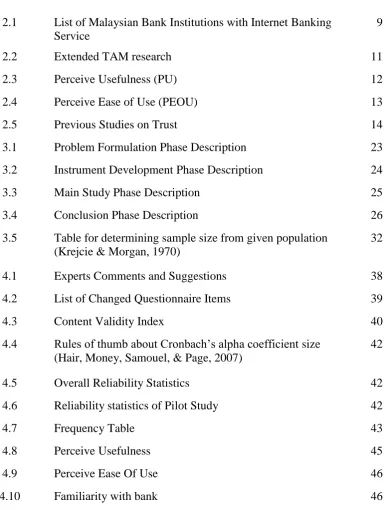
2.1 List of Malaysian Bank Institutions with Internet Banking Service
9
2.2 Extended TAM research 11
2.3 Perceive Usefulness (PU) 12
2.4 Perceive Ease of Use (PEOU) 13
2.5 Previous Studies on Trust 14
3.1 Problem Formulation Phase Description 23
3.2 Instrument Development Phase Description 24
3.3 Main Study Phase Description 25
3.4 Conclusion Phase Description 26
3.5 Table for determining sample size from given population (Krejcie & Morgan, 1970)
32
4.1 Experts Comments and Suggestions 38
4.2 List of Changed Questionnaire Items 39
4.3 Content Validity Index 40
4.4 Rules of thumb about Cronbach’s alpha coefficient size (Hair, Money, Samouel, & Page, 2007)
42
4.5 Overall Reliability Statistics 42
4.6 Reliability statistics of Pilot Study 42
4.7 Frequency Table 43
4.8 Perceive Usefulness 45
4.9 Perceive Ease Of Use 46
4.11 Structural Assurance 47
4.12 Situational Normality 47
4.13 Calculative-based Trust 48
4.14 Trust 48
4.15 Behavioral Intention 49
4.16 KMO Value Measurement (Hutcheson & Sofroniou, 1999) 50
4.17 KMO and Bartlett’s Value 50
4.18 Rotated Component Matrix 51
4.19 Reliability Test from Main Study 52
4.20 Correlation Value Strength (Cohen, 1988; Pallant, 2004) 53
4.21 Skewness and Kurtosis Value 53
4.22 Correlation Analysis Result 54
4.23 Model Summary Regression towards Trust 60
4.24 ANOVA 60
4.25 Coefficients 61
4.26 Model Summary Regression towards Perceive Ease of Use 62
4.27 ANOVA 62
4.28 Coefficients 63
4.29 Model Summary Regression Analysis towards Perceive Usefulness
64
4.30 ANOVA 64
4.31 Coefficients 64
4.32 Model Summary Regression Analysis towards Behavioral Intention
65
4.33 ANOVA 66
4.34 Coefficients 66
4.35 Regression Equation 67
4.36 Summary Result of Familiarity with Bank and Perceive Ease of Use
68 4.37 Summary Result of Familiarity with Bank and Trust 68 4.38 Summary Result of Situational Normality and Perceive
Ease of Use
4.42 Summary Result of Trust and Behavioral Intention 72 4.43 Summary Result of Trust and Perceive Usefulness 72 4.44 Summary Result of Perceive Ease of Use and Trust 73 4.45 Summary Result of Perceive Ease of Use and Behavioral
Intention
73
4.46 Summary Result of Perceive Ease of Use and Perceive Usefulness
74
4.47 Summary Result of Perceive Usefulness and Behavior Intention
75
LIST OF FIGURES
FIGURE NO. TITLE PAGE
2.1 Theory Acceptance Model (Davis, 1989) 10
2.2 Model Adapted for This Study (Gu et al, 2009) 18 3.1 Proposed Model Based on Previous Study (Gu et al,
2009)
20
3.2 Operational Framework 22
3.3 Technology Acceptance Model (TAM) 26
3.4 Proposed Model and Hypotheses 29
4.1 Regression Analysis towards Trust 59
4.2 Regression towards Perceive Ease of Use 61
4.3 Regression towards Perceive Usefulness 63
4.4 Regression towards Behavioral Intention 65
4.5 Hypothesis Result 76
LIST OF ABBREVIATIONS
IT - Information Technology PU - Perceive Usefulness PEOU - Perceive Ease of Use
FAM - Familiarity with Bank SIT - Situational Normality STR - Structural Assurance CAL - Calculative-based Trust
TRU - Trust
BI - Behavioral Intention
UTM KL - Universiti Teknologi Malaysia Kuala Lumpur campus
LIST OF APPENDICES
APPENDIX TITLE PAGE
A Preliminary Questions 88
B List of Questions 90
C Content Validity Form 92
D Instrument for Main Study 97
E Boxplot Diagram 102
F Turnitin Originality Report 103
CHAPTER 1
INTRODUCTION
1.1. Overview
Recent development in online technologies and devices, as well as the diversity of internet usage in daily life, has made internet banking as a necessity in our daily life. Online transaction has become a common practice in our society, especially in Malaysia. According to data from Internet World Stats, in 2012 the percentage of internet user in Malaysia has reach 17,723,000 internet users which is 60.7% of total population in Malaysia ("Internet Usage in Asia," 2012). In its annual financial report, Bank Negara Malaysia reported that in 2012 the transaction volume through internet banking channel in Malaysia has reached RM226.5 million (BNM, 2013).
The use of online technology opens remarkable potential to the banking industry. Internet banking has moved real banking behavior closer to neoclassical economic theories of marketing function where people will compare the service of various banks easily and able to change their banking partner much more easily than in in the physical or real bank-client relationship (Nitsure, 2003). Using internet technology banks are able to retain existing banking user by providing a convenient banking system that allow customer to have easier access into their bank accounts anytime anywhere. At the same time, banks also have the opportunity to attract internet users as their new banking customer with their services (Gu, Lee, & Suh, 2009).
1.2. Background of the Problem
As been stated previously, online transaction has becoming more popular nowadays in Malaysia than it is few years ago. However, the degree of user acceptance of internet banking does not show the same level of maturity. According to comScore ("Online Banking on the Rise in Southeast Asia," 2011), in 2011 the number of visitation to internet banking in Malaysia reached 2.7 million which is only 15.4% of internet users in Malaysia within 2011. Several previous studies reported that banking customers still hesitant to use internet as the medium for financial transaction mainly because of risk-concern, since the transaction would likely involve sensitive data exchange, and trust-related issues (M. K. Lee & Turban, 2001; Yousafzai, Pallister, & Foxall, 2003).
1.3. Problem Statement
Even though the number of internet banking users is reported to have increased since 2010 ("Online Banking on the Rise in Southeast Asia," 2011), many people still have concern about the use of internet banking services. According to initial interview with postgraduate students at UTM Kuala Lumpur campus, there is still some concerns regarding user trust toward internet banking. Some respondents still hesitate to use internet-banking services due to bad experience related to structural assurance of internet banking system. Moreover, some of them answered that they used the service due to third party request. The result from this initial study shows that the respondents was using the service because of third party suggestion instead of their own preferences. Therefore, it is important to identify the determinants that influence user intention in using internet banking. Furthermore, this study will examine the influence of trust and its determinants toward user intention in using internet banking.
1.4. Research Questions
1. What is the influence of trust and its determinants toward user intention of internet banking usage among postgraduate students at UTM Kuala Lumpur campus?
2. What model can be used to represent the relationship between trust and its determinants toward user intention to use internet banking among postgraduate students at UTM Kuala Lumpur campus?
1.5. Research Objectives
1. To identify the influence of trust and its determinants toward user intention of internet banking usage among postgraduate students at UTM Kuala Lumpur campus.
2. To propose model that can be used to represent the relationship between trust and its determinants toward user intention to use internet banking among postgraduate students at UTM Kuala Lumpur campus.
3. To validate the model proposed to represent the relationship between trust and its determinants toward user intention to use internet banking among postgraduate students at UTM Kuala Lumpur campus.
1.6. Research Hypothesis
The following are the hypothesis listed for this research:
H1: Familiarity with bank will positively affect perceive ease of use of internet banking.
H2: Familiarity with bank will positively affect trust.
H3: Situational normality will positively affect perceive ease of use of internet banking.
H4: Situational normality will positively affect trust of internet banking. H5: Structural assurance will positively affect trust of internet banking. H6: Calculative-based trust will positively affect trust of internet banking.
H7: Trust of internet banking service will positively affect behaviour intention of internet banking.
H8: Trust of internet banking service will positively affect the perceive usefulness of internet banking.
H9: Perceive ease of use will positively affect trust of internet banking service. H10: Perceive ease of use will positively affect behaviour intention of internet
banking.
1.7. Research Significance
The significance of this study is to explore and investigate the factors that influence user’s intention to use internet banking among postgraduate students at UTM Kuala Lumpur campus. Firstly, this study could help to understand which factors that influence the use of e-banking service among postgraduate students at UTM Kuala Lumpur campus. Secondly, from this study we can observe whether trust has a significant influence towards user’s acceptance of e-banking among postgraduate students at UTM Kuala Lumpur campus. Furthermore, the outcome of this study also can be useful for banks or financial institutions in considering a better online solution for their institution.
1.8. Research Scope
1.9. Summary
REFERENCES
Agarwal, R., & Karahanna, E. (2000). Time flies when you're having fun: cognitive absorption and beliefs about information technology usage 1. MIS quarterly, 24(4), 665-694.
Ahmad, R., & Buttle, F. (2002). Retaining telephone banking customers at Frontier Bank. International Journal of Bank Marketing, 20(1), 5-16.
Al-Gahtani, S. S. (2011). Modeling the electronic transactions acceptance using an extended technology acceptance model. Applied Computing and Informatics, 9(1), 47-77. doi: http://dx.doi.org/10.1016/j.aci.2009.04.001
Alsajjan, B., & Dennis, C. (2010). Internet banking acceptance model: Cross-market examination. Journal of Business Research, 63(9–10), 957-963. doi:
http://dx.doi.org/10.1016/j.jbusres.2008.12.014
Barrett, K. C., & Morgan Jr, G. A. (2005). SPSS for intermediate statistics: Use and interpretation: Psychology Press.
Bhattacherjee, A. (2001). An empirical analysis of the antecedents of electronic commerce service continuance. Decision Support Systems, 32(2), 201-214. doi:
http://dx.doi.org/10.1016/S0167-9236(01)00111-7
BNM. (2013). Financial Stability and Payment System Report 2012: Bank Negara Malaysia.
Cohen, J. (1988). Statistical Power Analysis for the Behavioral Sciences. 2nd. edit: Hillsdale, NJ: Lawrence Erlbaum Associates.
Corbitt, B. J., Thanasankit, T., & Yi, H. (2003). Trust and e-commerce: a study of consumer perceptions. Electronic Commerce Research and Applications, 2(3), 203-215.
Dabholkar, P. A. (1996). Consumer evaluations of new technology-based self-service options: an investigation of alternative models of service quality. International Journal of research in Marketing, 13(1), 29-51.
Davis, F. D. (1989). Perceived usefulness, perceived ease of use, and user acceptance of information technology. MIS quarterly, 319-340.
Davis, F. D., Bagozzi, R. P., & Warshaw, P. R. (1989). User acceptance of computer technology: a comparison of two theoretical models. Management science, 35(8), 982-1003.
Dawson, C. (2002). Practical research methods: a user-friendly guide to mastering research techniques and projects: How To Books Ltd.
DeVellis, R. F. (2003). Scale Development: Theory and Applications Second Edition (Applied Social Research Methods).
Dillon, A., & Morris, M. G. (1996). User acceptance of new information technology: theories and models.
Faqih, K. (2011). Integrating perceived risk and trust with technology acceptance model: An empirical assessment of customers' acceptance of online shopping in Jordan. Paper presented at the Research and Innovation in Information Systems (ICRIIS), 2011 International Conference on.
Friedman, B., Khan Jr, P. H., & Howe, D. C. (2000). Trust online. Communications of the ACM, 43(12), 34-40.
Gefen, D., Karahanna, E., & Straub, D. W. (2003). Trust and TAM in online shopping: an integrated model. MIS quarterly, 51-90.
Grewal, D., Iyer, G. R., & Levy, M. (2004). Internet retailing: enablers, limiters and market consequences. Journal of Business Research, 57(7), 703-713.
Gu, J.-C., Lee, S.-C., & Suh, Y.-H. (2009). Determinants of behavioral intention to mobile banking. Expert Systems with Applications, 36(9), 11605-11616. doi:
http://dx.doi.org/10.1016/j.eswa.2009.03.024
Ha, I., Yoon, Y., & Choi, M. (2007). Determinants of adoption of mobile games under mobile broadband wireless access environment. Information & Management, 44(3), 276-286. doi: http://dx.doi.org/10.1016/j.im.2007.01.001
Hair, J. F., Money, A. H., Samouel, P., & Page, M. (2007). Research methods for business: John Wiley & Sons Chichester,, England.
Hamid, M. R. A., Amin, H., Lada, S., & Ahmad, N. (2010). A comparative analysis of internet banking in Malaysia and Thailand. Journal of Internet Business, 4. Hoehle, H., Scornavacca, E., & Huff, S. (2012). Three decades of research on consumer
adoption and utilization of electronic banking channels: A literature analysis.
Decision Support Systems, 54(1), 122-132. doi:
http://dx.doi.org/10.1016/j.dss.2012.04.010
Hsu, C.-L., & Lu, H.-P. (2004). Why do people play on-line games? An extended TAM with social influences and flow experience. Information & Management, 41(7), 853-868.
Hutcheson, G. D., & Sofroniou, N. (1999). The multivariate social scientist: Introductory statistics using generalized linear models: Sage.
Ibrahim, R., Jaafar, A., & Khalil, K. (2011). Towards educational games acceptance model (EGAM): a revised Unified Theory of Acceptance and Use of Technology (UTAUT). International Journal of Research and Reviews in Computer Science, 2(3), 839+.
Internet Usage in Asia. (2012). Internet World Stats. Retrieved 20 December 2012, from http://www.internetworldstats.com/stats3.htm#asia
Kaiser, H. F. (1974). An index of factorial simplicity. Psychometrika, 39(1), 31-36. Kim, H.-Y. (2013). Statistical notes for clinical researchers: assessing normal
distribution (2) using skewness and kurtosis. Restor Dent Endod, 38(1), 52-54. Krejcie, R. V., & Morgan, D. W. (1970). Determining sample size for research
activities. Educ Psychol Meas.
Lee, M.-C. (2009). Factors influencing the adoption of internet banking: An integration of TAM and TPB with perceived risk and perceived benefit. Electronic Commerce
Research and Applications, 8(3), 130-141. doi:
http://dx.doi.org/10.1016/j.elerap.2008.11.006
Lee, M. K., & Turban, E. (2001). A Trust Model for Consumer Internet Shopping. International Journal of Electronic Commerce, 6(1), 75-91.
use mobile banking. Computers in Human Behavior, 21(6), 873-891.
Lynn, M. R. (1986). Determination and quantification of content validity. Nursing research, 35(6), 382-386.
Malhotra, N., & Peterson, M. (2006). Basic Marketing Research; a decision-making approach. New Jersey, 7458.
Mathieson, K. (1991). Predicting user intentions: comparing the technology acceptance model with the theory of planned behavior. Information systems research, 2(3), 173-191.
Mols, N. P. (2000). The Internet and services marketing–the case of Danish retail banking. Internet Research, 10(1), 7-18.
Moon, J.-W., & Kim, Y.-G. (2001). Extending the TAM for a World-Wide-Web context. Information & Management, 38(4), 217-230. doi:
http://dx.doi.org/10.1016/S0378-7206(00)00061-6
Munusamy, J. A., Sanmugam, & Chelliah, S. (2012). A Study of Users and Non-Users of Internet Banking in Malaysia. International Journal of Innovation, Management and Technology, 3(4).
Nasri, W., & Charfeddine, L. (2012). Factors affecting the adoption of Internet banking in Tunisia: An integration theory of acceptance model and theory of planned behavior. The Journal of High Technology Management Research, 23(1), 1-14. doi: http://dx.doi.org/10.1016/j.hitech.2012.03.001
Nitsure, R. R. (2003). E-banking: Challenges and Opportunities. Economic and Political Weekly, 5377-5381.
One in Four Internet Users Access Banking Sites Globally. (2012). comScore Data
Mine. Retrieved April 14, 2013, from
http://www.comscoredatamine.com/2012/06/1-in-4-internet-users-access-banking-sites-globally/
Online Banking on the Rise in Southeast Asia. (2011). comScore. Retrieved April 1,
2013, from
http://www.comscore.com/Insights/Press_Releases/2011/3/Online_Banking_on_ the_Rise_in_Southeast_Asia
Pallant, J. (2004). SPSS survival manual: version 12: Open University Press.
Parsian, N. (2009). Developing and validating a questionnaire to measure spirituality: a psychometric process. Global journal of health science, 1(1), P2.
Pavlou, P. A. (2003). Consumer acceptance of electronic commerce: integrating trust and risk with the technology acceptance model. International Journal of Electronic Commerce, 7(3), 101-134.
Rowley, J. (2006). An analysis of the e-service literature: towards a research agenda. Internet Research, 16(3), 339-359.
Sasaki, H., Ikeda, Y., Kondo, M., & Nakamura, H. (2007). An intra-task dvfs technique based on statistical analysis of hardware events. Paper presented at the Proceedings of the 4th international conference on Computing frontiers.
Suh, B., & Han, I. (2003). Effect of trust on customer acceptance of Internet banking. Electronic Commerce Research and Applications, 1(3), 247-263.
Tan, M., & Teo, T. S. (2000). Factors influencing the adoption of Internet banking. Journal of the AIS, 1(1es), 5.
Venkatesh, V. (1999). Creation of favorable user perceptions: exploring the role of intrinsic motivation. MIS quarterly, 239-260.
Venkatesh, V. (2000). Determinants of perceived ease of use: Integrating control, intrinsic motivation, and emotion into the technology acceptance model. Information systems research, 11(4), 342-365.
Venkatesh, V., & Davis, F. D. (2000). A theoretical extension of the technology acceptance model: four longitudinal field studies. Management science, 46(2), 186-204.
Wang, W., & Benbasat, I. (2005). Trust in and adoption of online recommendation agents. Journal of the Association for Information Systems, 6(3), 72-101.
West, S. G., Finch, J. F., & Curran, P. J. (1995). Structural equation models with nonnormal variables: Problems and remedies.
Wynd, C. A., Schmidt, B., & Schaefer, M. A. (2003). Two quantitative approaches for estimating content validity. Western Journal of Nursing Research, 25(5), 508-518. Yousafzai, S. Y., Pallister, J. G., & Foxall, G. R. (2003). A proposed model of e-trust
for electronic banking. Technovation, 23(11), 847-860. doi: