
Managing Continuous Uncertain Data by a Probabilistic
XML Database Management System
Theodoor Scholte
M.Sc. Thesis 28 May 2008
Graduating committee:
contains one or more databases. From a traditional perspective, databases are used to store precise values about objects in the ’real world’. However, many information is uncertain or imprecise. Consider, for example, sensor applications. Sensors produce uncertain and impre-cise data since readings of sensors are inherently impreimpre-cise and uncertain. Current database management systems are not able to store, manipulate or query continuous uncertain data unless through user-defined attributes. However, this approach delegates the responsibility of managing the uncertainty associated with the data to the end-user.
In many situations, the uncertainty associated with the data is distributed continuously, the data can be represented in terms of a continuous probability distribution. In this thesis, we present an extension to an existing probabilistic data model, resulting in a data model which is capable of storing continuous uncertain data in XML documents. We give a sound semantical foundation to this data model. The probabilistic XML data model is based on the probabilistic tree. In the probabilistic tree, elements and subtrees can be associated with probabilities. Our extension to the probabilistic XML data model extends the probabilistic XML data model in such a way that probability density functions can be associated with elements.
Instead of enumerating explicitly the data values with their associated probabilities, a probability density function represents a continuous probability distribution in terms of in-tegrals, it can represent the probability that an element attains a value on a specific interval. In order to query this data, we present a query language containing query operations that are based on probability theory. We show how querying of continuous uncertain data works using a sound semantical foundation. Next, we introduce some new query operators sup-porting the aggregation of continuous probability distributions using the same semantical foundation. An aggregation operator accepts a number of histograms representing contin-uous probability distributions, aggregates them and returns one histogram representing a continuous probability distribution.
Dankwoord
Na 7 jaren studeren rond ik mijn studie Informatica af door het doen van een onderzoek. Deze scriptie is daarvan het resultaat. Het afgelopen halfjaar heb ik onderzoek gedaan naar het beheren van continue onzekere data. En ik moet zeggen dat het leek alsof ik in deze peri-ode weer was teruggekeerd naar de peutertijd, spelend met de blokkendoos. In je peutertijd bouw je met blokken huizen en gebouwen en als het resultaat niet voldoet, dan sloop je het en begin je weer opnieuw. Zo gaat het ook met onderzoek doen, je stelt een hypothese op, je werkt naar een theorie, je ontwikkelt een model. Door middel van een prototype kan je experimenten uitvoeren waardoor je weet of je aanpak werkt. Werkt de aanpak niet, dan gooi je het weg en begin je weer opnieuw. Net als dat ik het spelen met blokken leuk vond, vind ik onderzoek doen ook hartstikke leuk. Het was een leuke afsluiting van een fantastische tijd die ik hier op de Universiteit Twente heb gehad.
Onderzoek doen heeft ook mindere kanten. Het is een nogal solitaire bezigheid waardoor het saai kan worden. Dan zijn er een aantal oplossingen. 1. Je maakt een wandeling over de prachtige campus. 2. Je gaat met je begeleiders of andere mensen op de vakgroep praten. 3. Je gaat vroeg naar huis. Regelmatig had ik een paar uur ”bedenktijd” nodig voordat ik ¨uberhaupt een eerste zin op ”papier” kon zetten. Een wandeling maken, het bekende DB-rondje, bood dan uitkomst. Maar gelukkig heb ik ook veel aan mijn begeleiders en de mensen op de vakgroep gehad om inspiratie en nieuwe idee¨en op te doen. Ook de zogenoemde DB Colloquia hebben daar zeker aan bijgedragen.
Deze scriptie was niet tot stand gekomen zonder de hulp van heel veel mensen. Allereerst wil ik mijn begeleiders, Ander de Keijzer en Maurice van Keulen, bedanken. Zij waren het die het initiatief namen om onderzoek te gaan doen naar het beheren van continue onzekere data. Ik heb niet alleen hun data model voor discrete onzekere data kunnen gebruiken, maar ze hebben me ook enorm geholpen met het uitbreiden van dit model zodat het nu ondersteuning biedt voor continue onzekere data. Hun enthousiasme gaf mij vertrouwen om door te gaan met het onderzoeksproject, ook als het even wat minder ging. Daarnaast hebben ze altijd het geduld gehad om naar mij te luisteren ook al had ik soms moeite om datgene wat ik wilde zeggen, juist te formuleren. Ook zal ik de voortgangsbesprekingen die we hadden niet snel vergeten. We hadden deze besprekingen niet vaak, maar ze mondden vaak wel uit in interessante, heftige en diepgaande discussies over de inhoud. Mijn derde begeleider, Sander Evers, heeft me enorm geholpen om het verslag leesbaarder te maken voor de buitenstaander en wist me nog op een aantal onjuistheden te wijzen. Uiteraard, ben en blijf ik, verantwoordelijk voor de overgebleven onjuistheden.
Uiteraard kan ik mijn ouders niet vergeten te bedanken want zonder hen was ik nooit zover gekomen. Inhoudelijk hebben zij natuurlijk weinig kunnen bijdragen aan deze scriptie, maar zij hebben wel mijn eindeloze verhalen over de voortgang aangehoord. Daarnaast, zijn zij het, die het ¨uberhaupt mogelijk hebben gemaakt om te studeren, zonder al te veel druk er achter te zetten. Ik heb daardoor kunnen genieten van mijn studie en alle nevenactiviteiten, zonder financi¨ele zorgen hoeven te maken, iets wat in mijn ogen erg belangrijk is.
Contents
1 Introduction 1
1.1 Motivation . . . 1
1.1.1 Sensors. . . 1
1.1.2 Science . . . 2
1.1.3 Analysis and Forecasting . . . 2
1.1.4 Online Analytical Processing . . . 3
1.1.5 Data Integration . . . 3
1.1.6 Approximate Queries . . . 3
1.2 Problem statement . . . 4
1.3 Research questions . . . 5
1.4 Scope . . . 6
1.5 Approach. . . 7
1.6 Outline . . . 7
2 Related work 9 2.1 Imprecise, uncertain, and erroneous data . . . 9
2.2 Possible world semantics. . . 10
2.3 Uncertainty in relational databases . . . 10
2.4 Uncertainty in semi-structured data . . . 12
2.5 Continuous uncertainty . . . 12
2.6 Querying uncertain data . . . 13
2.7 Lineage . . . 14
2.8 Probabilistic dependencies. . . 15
2.9 Fuzzy data . . . 16
3 Modeling Continuous Uncertain Data 17 3.1 Probabilistic XML . . . 17
3.1.1 Possible worlds . . . 17
3.1.2 Compact representation . . . 18
3.2 Expressing Continuous Uncertainty in Possible Worlds . . . 20
3.3 Representing Continuous Uncertainty . . . 22
3.4 Examples . . . 28
4.2 Querying a continuous distribution. . . 30
4.2.1 The mean function . . . 30
4.2.2 The variance function . . . 30
4.2.3 The vmin function . . . 31
4.2.4 The vmax function . . . 31
4.2.5 Predicates . . . 31
4.3 Aggregating continuous distributions . . . 32
4.3.1 Scenario . . . 36
4.3.2 A special case: the APRODUCT aggregate operation . . . 39
5 Prototype 41 5.1 Requirements . . . 41
5.2 Design . . . 43
5.2.1 Probabilistic XML (continuous representation) . . . 43
5.2.2 Continuous Uncertain XML . . . 44
5.2.3 Query processing . . . 46
5.2.4 Continuous distributions . . . 46
5.3 Architecture . . . 46
5.4 Implementation details . . . 47
5.4.1 Symbolic to histogram . . . 48
5.4.2 Histograms . . . 49
5.4.3 Simple probabilistic functions: Pr, mean, variance . . . 50
5.4.4 Aggregation operators . . . 50
5.5 Using the prototype. . . 52
6 Evaluation 55 6.1 Experiments . . . 55
6.1.1 Value-based operators . . . 56
6.1.2 Aggregate operators . . . 58
6.1.3 Test environment . . . 58
6.2 Results . . . 59
6.3 Analysis . . . 61
7 Conclusions 67 7.1 Summary . . . 67
7.2 Research questions . . . 67
7.3 Future work . . . 69
7.3.1 Support for querying multiple stochastic variables. . . 69
7.3.2 Support for lineage . . . 75
7.3.3 Query optimization . . . 75
7.3.4 Benchmarks . . . 77
7.3.5 Support for other probability distributions . . . 77
7.3.6 Support for ignorance . . . 77
7.3.7 PRODUCT aggregate operator . . . 77
Chapter 1
Introduction
Database Management Systems (DBMSs) play an important role in today’s world. Almost ev-ery information system contains one or more databases [5]. The application domain ranges from those things that we daily use (e.g. phone book on a cellular phone) to highly so-phisticated systems (e.g. container terminal management system in a main port). From a traditional perspective, databases are used to store precise values about objects in the ’real world’. Though, today, there are many applications in which data is uncertain and/or impre-cise. It is frequently the case that these applications use a conventional DBMS and process the uncertainty outside the DBMS.
1.1
Motivation
More than one decade ago, researchers addressed the importance of the problem of managing uncertain data by a Database Management System [21]. Although, considerable research ef-fort has been conducted to solve this issue, the management of uncertain data by a Database Management System is still an active research topic. The reason for this is that there is a wide variety of different models supporting the storage of uncertain data, each with its own features. Similarly, there is a broad range of applications each having its own specific require-ments. In the next few sections we will mention several application domains of uncertain data.
1.1.1 Sensors
”Ubiquitous computing names the third wave in computing, just now beginning. First were mainframes, each shared by lots of people. Now we are in the personal computing era, person and machine staring uneasily at each other across the desktop. Next comes ubiquitous computing, or the age of calm technology, when technology recedes into the background of our lives.” [24]
Another example is the adaptable room conditions in an office building. A user wears cloth-ing with an RFID-tag. When entercloth-ing the room, the temperature control system ’recognizes’ the user and its preferences. Sensors of the control system are measuring the temperature and humidity in the room at regular intervals, and transmit the data to a central processing component. The control system adjusts the temperature and humidity in the room according to the user’s preferences.
Sensors may produce unreliable data due to missed readings and/or erroneous or impre-cise values. Another problem occurring in applications with sensors and databases is that there is a gap in time between the actual value in the ’real world’ and the database value [10]. Then, queries will use the old database value instead of the accurate value in the ’real world’. One way to solve these problems, is to store imprecise data along with probabilities that indicate the confidence that an imprecise value stored in the database is the accurate value in the ’real world’.
1.1.2 Science
In experimental scientific research like earth-sciences, psychology, chemistry and biology, scientists conduct a lot of experiments that produce raw data which should be stored and processed. This data is often imprecise and subject to uncertainty and errors that cannot be modeled by traditional data management systems [25]. The causes of uncertainty and errors range from reading errors, errors in filled questionnaire forms, transmission noise to other errors in unreliable information sources or unreliable systems. Experimental data can be transformed or processed further using certain operations (like aggregation). Subsequent experiments can be carried out using the derived data resulting in new data. This data may alter the previously approximated data or it might change the confidence scores of it. The values that will be stored, might be inexact or uncertain. In many situations, it is desirable to store the data along with probabilities or with confidence values. This motivates the need for a data management system with uncertain capabilities.
1.1.3 Analysis and Forecasting
1.1.4 Online Analytical Processing
Business Intelligence is increasingly being used to support strategic decision-making. Busi-ness Intelligence applications like Online Analytical Processing are used to gain knowledge in a certain business domain resulting in competitive advantages. OLAP applications are used by managers supporting them in making decisions. OLAP queries frequently involve a significant part of the database, they are complex and updates on the data are infrequent. Data warehouses are special databases used by OLAP applications. Data warehouses are very large, have schemas which differ from schemas of ”normal” online transaction pro-cessing DBMSs (OLTP systems) and the data itself is different from what is normal in OLTP systems. In practice, warehouses contain uncertain data because data has been obtained from multiple data sources. When integrating data from different sources, each having its own schema, conflicts may occur. Moreover, the input data does not only arrive from the OLTP systems of an enterprise [5]. Think, for instance, about a customer of a company filling out a questionnaire form on a website and the customer enters a wrong city name. Typically, OLAP applications deal with problems due to space limitations of the warehouse. Sometimes, it is impossible to store all the data of the business in the warehouse. One solution then is to perform OLAP queries on smaller samples that have been extracted from the large data set. However, this simplification introduces imprecision [16]. Another example of uncertainty in OLAP applications is forecasting [15]. Data warehouses are used to maintain a history of forecasts about, for instance, sales. These forecasts are inherently uncertain.
1.1.5 Data Integration
Consider a person who has address books on his cellular phone, PDA and desktop computer. All these information sources contain information about persons. The person would like to have one information source to find an address. Data integration can assist the user because it can present the various information sources as one single source. The data in different information sources can refer to the same ’real world’ object or to multiple objects. If the data is about the same object, data can be conflicting. For instance, the phone number of the same person is different. Then there are several possibilities: a person can have two different phone numbers or only one of the phone numbers is valid. Data can be conflicting for several reasons: a miss-typed phone number, an old phone number etcetera. We can choose to use one phone number out of the different possibilities, but this may lead to incorrect results. A better approach when integrating information sources is to store for all conflicting values the possibilities with their associated probabilities [23]. The probabilities are a measure of truth that a certain possibility indeed occurs in the ’real world’. The result of the integration process is an integrated information source containing uncertain data. A probabilistic database management system is required to store the result. The main benefit of this approach is the unattended way of integration [12].
1.1.6 Approximate Queries
compute. One approach is to produce approximate answers using a small data set or statical tools. Another approach is to store the approximate values along with a degree of uncertainty; a DBMS supporting the management of uncertain data is required then.
1.2
Problem statement
The previous section illustrates some application domains in which (continuous) uncertain data is involved. Many applications in these domains make use of database management systems to maintain and manipulate data. The management of (continuous) uncertain data by traditional database management systems is hard to achieve. This is because those sys-tems assume that data is certain, precise and complete. As shown in the previous sections, information about the real world can be inherently uncertain, imprecise or incomplete. The management of continuous uncertain data by current database management systems is only possible through user-defined attributes. Then, the database management system delegates the responsibility of managing continuous uncertain data to the end-user. Moreover, there are currently no database management systems available which are capable of managing continuous uncertain data using a semi-structured data model. This leads us to the main problem which this thesis will focus on:
Designing a semi-structured probabilistic database management system which is responsible for maintaining and manipulatingcontinuous uncertain datain such way that probabilistic query operators are able to produceimprecise, but correct, answers.
To clarify the problem statement, we elaborate three terms: • Semi-structured
Data can be represented in different data models, examples are the relational and the structured data models. Discrete uncertain data can be represented in a semi-structured data model (XML) in a more natural way than in the relational model. In order to fully support the representation of uncertain data in XML, the representation of continuous uncertain data should be examined as well. We are also interested in using XML for the representation of continuous uncertain data since XML is used more and more for storing data and it is the de facto standard for data exchange between organisations.
• Continuous uncertain data
With the term ”continuous uncertain data”, we mean data that can be denoted as stochastic variables each having a univariate continuous probability distribution. • Imprecise, but correct
1.3
Research questions
In the previous section we identified the main problem this thesis will focus on. This problem can be solved by answering several research questions:
1. Which additions to existing data models are necessary in order to support the representation of continuous uncertain data in XML?
In order to integrate continuous uncertainty in a DBMS and making the system re-sponsible for maintaining and manipulating continuous uncertain data, a data model is required. The development of such model is also the main research challenge that has to be addressed in this thesis.
2. Which semantic foundation is suitable for storing continuous uncertain data?
The data model we will introduce in this thesis has to be complete and closed. The data model has to deal with data which is associated with continuous probability distribu-tion in a correct way. For these reasons, the model needs a (semantic) foundadistribu-tion. 3. How can we provide support for querying continuous uncertain data?
Besides the development of a data model supporting the representation of continuous uncertain data in XML, we need query operations that allow the end-user to retrieve information from continuous uncertain data.
How should the semantic foundation be applied in order to support querying continuous uncertain data in an intuitive way?
The query operations which we will provide should be intuitive to use. Next, the results generated by the query operations, should be intuitive to interpret (understand).
Which query operations are useful when querying continuous uncertain data?
At this moment, we have no idea which query operations are useful for the end-user. We will examine which operationscouldbe useful.
4. How can the theoretical concepts as a result from the research on the management of continuous uncertain data be practically applied?
The answers on the previous research questions may contain several new concepts. We are interested if these concepts are applicable in a feasible way. This question will be answered by developing a proof of concept.
5. What is the behavior of a probabilistic XML DBMS supporting the management of continuous uncertain data in terms of efficiency and accuracy of query answers?
1.4
Scope
The main goal of our research is to provide support for the management of continuous stochastic variables in an XML database management system. In order to meet this goal, we determine several subgoals:
• The development of a data model supporting the storage of continuous probability distributions in semi-structured data.
• Extending a query language with operations that allow users to query on semi-structured documents containing continuous stochastic variables.
• Developing a prototype in order to prove the concepts.
Besides these goals, there are also some goals or activities that are related to the topic of this thesis but are out of the scope of this thesis. We will summarize them here.
• Our work is inherently related to mathematics and especially statistics and probability theory. In this thesis, we will propose query operators that are capable of querying continuous distributions resulting in probabilistic answers. Query operators include the probability, the expected value and variance of a continuous distribution and so on. The probabilistic answers can be computed in two ways.
Exact answers
Standard continuous distributions like gaussian, gamma, beta and uniform have well-known probability density functions. One approach to compute an exact answer is based on probability theory, answers are computed by taking the integral of the proba-bility density function. Another approach is to use a distribution-specific function, with the parameters of a standard continuous distribution as input, to compute the answer. An example is a query for the expected value of a continuous uniform distribution, the expected value can be computed with the parametersaandbusing the following distribution-specific function: a+2b.
Approximations by histograms
A continuous distributions can be approximated by a histogram. Histograms are capa-ble of approximating non-standard continuous distributions. A continuous distribution is called ”non-standard” if the probability density function is not a trivial one, e.g. the probability density function is really hard to compute or it is unknown. Query opera-tors that operate on histograms will return approximated answers.
Our goal is to provide formal definitions for the data model and the query language. The query language should be based on probability theory and the operators are de-fined as if they return exact and correct answers, no approximations. However, it is not required that the proof of concept produces exact answers or formulas when these are too complex or too time-consuming to compute.
• Performance and efficiency are currently not the most important issues. We would like to focus on the concepts and proof them using a prototype. Query optimization, indexing and overall database performance are out of the scope of this thesis.
1.5
Approach
The approach taken in this research is that of the constructive research. In this thesis, we present new theoretical knowledge by means of a data model and a query language. This theoretical knowledge can be seen as a solution to the problem of managing continuous uncertain data by a semi-structured DBMS. The solution is based on many sources that contain theoretical information about uncertain data, e.g. papers and so on. In order to proof the concepts that are presented in the theoretical knowledge, we will develop a prototype and perform some tests or benchmarks on it. This proof of concept forms also an important part of the validation. The proof of concept shows us, for example, whether the data model allows the modeling of continuous uncertain data in a sufficient way; it will give us feedback on the shortcomings of the data model and the query language. The tests or benchmarks allow us to make conclusions about whether the practical use of the data model and query language is feasible in terms of the quality of query answers and query response time.
1.6
Outline
Chapter 2
Related work
In this section we will discuss related work on uncertain data management. Different data models such as the relational model, semi-structured models, probabilistic and possibility models will be discussed. Moreover, existing research projects will be mentioned. Besides explaining different data models, we will explain general concepts such as what imperfect information is and what possible world semantics is. An important point in this chapter is the discussion of related work on continuous uncertainty.
2.1
Imprecise, uncertain, and erroneous data
The title of this section mentions some terminology used in previous work on uncertain data management. Although, terms likeimprecise,uncertainanderroneousmight suggest that their meaning are all the same, this is certainly not the case. A. Motro gave a good interpretation [17] to these terms. In this section we will give a short summary.
Erroneous information is information that is different from true information. This type of imperfect information influences the integrity of information systems. One kind of erroneous information is inconsistent information. Different representations of a particular part of the real world that are conflicting can be considered as inconsistent information. An example is the birth date of the author which is stored in a database as August 4th, 1982 but which is in fact August 3th, 1983.
Another kind of imperfect information is imprecise information. Imprecise information is represented as a set of alternatives and the real value is one of those alternatives, so the real actual value is not known a-priori. Consider the temperature of a room stored in a database as a range between 18 and 20 degrees, while the real room temperature is 19 degrees. There are two extreme kinds of imprecise information: precise values and incompleteness. A precise value means that the set of possible alternatives contains exactly one single alternative. Incompleteness means that no information is available. Note that the representation then indicates that there is no information available.
2.2
Possible world semantics
The data stored in a database describes some part of the real world. In situations where available information is certain and complete, the similarity between the database and the real world is clear. However, when the database contains data that is uncertain, the database represents a collection of possible appearances of the real world. Those appearances are also called states or possible worlds. A possible world describes a set of objects in the real world. An object in the real world can have different (or multiple) interpretations. Then, different information about that object exist. Another way of describing this is to say: “there exist several possibilities oralternatives for an object in the real world”. A possible world is constructed by choosing one alternative among a collection of representations for each of the real world objects in the database. If one of the possibilities represents that the real world object does not exist, this should also be considered and treated as if it is an alternative. The possible world semantics are especially helpful for defining the mechanisms used for querying and manipulating data in uncertain databases. As we will show in one of the following chapters, evaluating a query on an uncertain database is equivalent with evaluating the query over each individual possible world and collecting the results that originate from each possible world. In this thesis we interpret information represented in the database under the Closed World Assumption stating that all the information not explicitly represented in the database is supposed to be false. This is contrary to the Open World Assumption in which negative information must be explicitly represented in the database. The possible world semantics is such a fundamental concept in research on management of uncertain data that most of the related projects are based on this theory.
2.3
Uncertainty in relational databases
Uncertain data can be encoded in conventional relational tables. The data model of most existing uncertain data management systems, MystiQ [8], Orion [10, 22], PrDB [20], Prob-View [14] and Trio [4,18], extends the relational data model. Those data models support one or more of the following concepts:
• Type-1 probabilistic relations
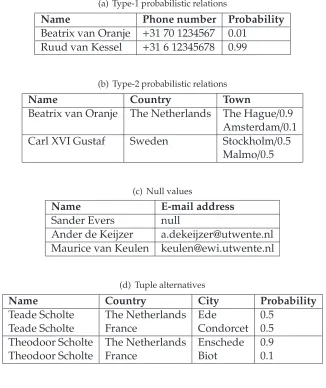
Type-1 uncertainty refers to confidence if a tuple belongs to a relation or not. Consider table 2.1(a). The table represents a part of my personal address book. It is not really likely that my address book contains the phone number of the Dutch Queen, where it is very likely that the address book contains the phone number of one of my fellow students, Ruud van Kessel.
• Type-2 probabilistic relations
Table 2.1: Examples of different concepts related to managing uncertain data. (a) Type-1 probabilistic relations
Name Phone number Probability
Beatrix van Oranje +31 70 1234567 0.01 Ruud van Kessel +31 6 12345678 0.99
(b) Type-2 probabilistic relations
Name Country Town
Beatrix van Oranje The Netherlands The Hague/0.9 Amsterdam/0.1 Carl XVI Gustaf Sweden Stockholm/0.5
Malmo/0.5
(c) Null values
Name E-mail address
Sander Evers null
Ander de Keijzer [email protected] Maurice van Keulen [email protected]
(d) Tuple alternatives
Name Country City Probability
Teade Scholte The Netherlands Ede 0.5
Teade Scholte France Condorcet 0.5
Theodoor Scholte The Netherlands Enschede 0.9
Theodoor Scholte France Biot 0.1
• Incompleteness
The value of an attribute in a relation is sometimes unknown; the information is in-complete. This can be expressed by a NULL value. A NULL value models the lack of information about a value explicitly. Table2.1(c)represents another part of my address book. The table lists the names and e-mail addresses of my supervisors. The e-mail address of supervisor ”Sander Evers” is currently not known, this has been indicated in the table with ”null”.
• Tuple alternatives
• Mutual exclusiveness
A database, supporting the modeling of mutual exclusiveness, is able to manage the relation between data items that represent propositions. These propositions cannot be true at the same time. An example is ‘Theodoor saw Ander OR Theodoor saw Maurice‘. Note that Type-2 probabilistic relations model also some kind of mutual exclusiveness. However, with Type-2 probabilistic relations, a probability is associated with each alternative.
Many uncertain data management systems are built on top of a traditional RDBMS extended with (stored) procedures, functions and data types implementing the uncertainty features. Most uncertain data management systems provide support for querying uncertain data by accepting a modified version of SQL. In general, the modified language has special constructs for querying uncertain data.
2.4
Uncertainty in semi-structured data
Semi-structured data models have also been used as a model to represent uncertain data. In [12] two strategies were identified for modeling uncertainty in semi-structured data mod-els:event basedandchoice point based. With the first one, a choice for a certain alternative in a tree is based on a pre-specified event occurring. This choice invalidates the other possible alternatives that are present in the tree. Each event has an associated probability. The choice point based strategy is more dependent on thestructureof the tree. The strategy requires that at specific points in the tree, a decision has to be made between children, each having an associated probability. The result of such approach is an entire subtree representing a path or trace of decisions made. This subtree invalidates the other possible alternatives.
Hung et al. [13] proposed the PXML data model. It is a complex data model supporting the probabilistic representation of arbitrary distributions over relationships between objects and arbitrary distributions over the object’s value. In this data model, a probabilistic instance does not have to be tree structured. A probabilistic instance has to be acyclic which means that one node can have two different parents, the only restriction is that cycles are not allowed. This data model is event based. The same holds for the Fuzzy tree model of Abiteboul and Senellart [1]. Their model allows conditional reasoning and modeling of complex dependen-cies between events. ProTDB of Nierman et al [19] and the Probabilistic XML data model proposed in [23] are both choice point based probabilistic models. Each node is not treated as an independent fact but its probability is dependent on the probabilities of its ancestors (except the root). In both models, a special type of node expresses possibilities (alternatives) and each possibility is associated with a node indicating the probability. However, the model proposed in [23] handles mutual exclusiveness in a more natural way because it does not require that mutual exclusive possibilities have to be specified explicitly.
2.5
Continuous uncertainty
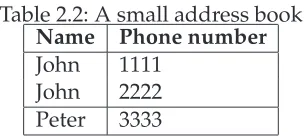
Table 2.2: A small address book
Name Phone number
John 1111 John 2222 Peter 3333
parameters. The integral over such functions on a particular interval results in the prob-ability that the value of the continuous stochastic variable lies on that particular interval. Continuous uncertainty can also be approximated by a histogram, hence the continuous distribution has to be sampled. At Purdue University, a probabilistic model was developed in the Orion project by Singh et al. [10,22]. It supports the management of discrete as well as continuous uncertain data using therelationaldata model. The model is able to represent continuous distributions very efficiently and handle them accurately by using the symbolic form of a continuous distribution. Discrete approximations (e.g. histograms) are not nec-essarily required. However, the model uses discrete approximations for the representation of non-standard distributions. Moreover, the model supports both Type-1 and Type-2 un-certainty and it can handle correlations within and across tuples. The prototype has been developed as an extension of PostgreSQL. Orion is currently the only project investigating the management of continuous uncertain data as far as we know.
2.6
Querying uncertain data
As mentioned earlier, a database supporting the management of uncertain data, represents a set of possible worlds. Following the possible world theory, querying uncertain data means that the query is evaluated in every possible world. The results from each of the worlds are collected by the database management system and the union of the results is presented to the user as an answer to the query that was posed by the user. Consider an address book as depicted in table2.2. The database contains two tuples, one tuple has two alternatives. The total number of possible worlds equals 1∗2 =2. A query for the phone number of John is evaluated in each possible world. Collecting the results from each of the worlds and applying the union operator over the results would yield the following result:{1111,2222}. As we will see later, a database which is storing continuous uncertain data, holds theoretically an infinite number of possible worlds. Querying this kind of data using the possible world semantics, means from a theoretical perspective that the query is evaluated in an infinite number of possible worlds.
Table 2.3: A part of a database containing advertisements of real estate objects.
AdId AgencyId City Type Rooms Surface Furnished Price
101 303 Amsterdam Apartment 2 ? yes 800
102 445 Amstelveen Apartment 3 ? no 650
103 303 Hilversum Apartment 2 45 ? 600
Table 2.4: Factors describing the correlations and probabilities among tuples and attributes AdID f(t.E)
101 0.2 102 0.8 103 0.6
t103Furnished f(t103.Furnished)
yes 0.5
no 0.5
City Type Rooms Surface Price f(city,type,rooms,sur f ace,price)
Amsterdam Apartment 25 2 800 0.25
Amsterdam Apartment 30 2 800 0.5
Amsterdam Apartment 35 2 800 0.25
Amstelveen Apartment 30 2 650 0.1
Amstelveen Apartment 40 2 650 0.8
Amstelveen Apartment 50 2 650 0.1
Table 2.5: An example of tuple fields having set-values.
ID Name City Phone
1 John Doe {Eindhoven, Groningen, Maastricht} {0845533228, 0622222222} 2 Peter Pan {Amsterdam, Enschede, Utrecht} {0843335599, 0611111111}
2.7
Lineage
Table 2.6: An example of world-set decomposition.
Probabilistic dependencies are related to the topic of lineage. In the probabilistic models that are based on the relational data model, one can distinguish intra-tuple and inter-tuple correlations. Inter-tuple correlations refer to dependencies between tuples. Historical de-pendencies between tuples can be used to represent the result of prior database operations on base tuples. In other probabilistic models, lineage is used for this purpose. Intra-tuple correlations capture the dependencies between attributes inside a tuple. In semi-structured probabilistic models, dependencies or correlations can be expressed in a natural way by modeling child nodes that depend on their ancestors. An interesting project to mention is PrDB. PrDB is a probabilistic data model proposed by Getoor et al. [20] that can express both Type-1 and Type-2 uncertainty. One of the remarkable features is that it supports so-called shared correlation structures. This mechanism prevents that probability functions and correlations have to be copied many times when probabilities do not change from tuple to tuple. The idea of the correlation structure is based on a parameterized factor representing uncertainty and correlations over parameterized variables which involve attributes or tuples (existence). Consider table2.3, it represents a database containing information regarding real estate objects that are for sale or for rent. Unknown attribute values are shown as question marks. The corresponding probabilistic database is depicted in table2.4. Table2.4shows the parameterized factor f(t.E), this factor describes the likelihood of each advertisement ex-isting. The table also shows the parameterized factor f(t103.Furnished), this factor describes
2.9
Fuzzy data
Chapter 3
Modeling Continuous Uncertain Data
In this chapter the data model for continuous uncertain data will be discussed. The data model supporting continuous uncertainty is based on the Probabilistic XML data model proposed in [12,23]. First, the properties of this Probabilistic XML data model are presented. Next, another topic which will be discussed is the interpretation of a continuous distribution in terms of possible worlds. One of the last sections of this chapter is dedicated to the specification of the model to be used for representing continuous uncertain data. This chapter contains several definitions. These definitions are either directly taken from [12, 23], or adapted, based on the definitions presented in [12,23].
3.1
Probabilistic XML
3.1.1 Possible worlds
The probabilistic XML data model proposed in [12, 23] is based on the possible world semantics explained in2.2. The possible world representation of the probabilistic XML data model enumerates all possible worlds and encode them in an XML document as separate subtrees. Each subtree is associated with a probability.
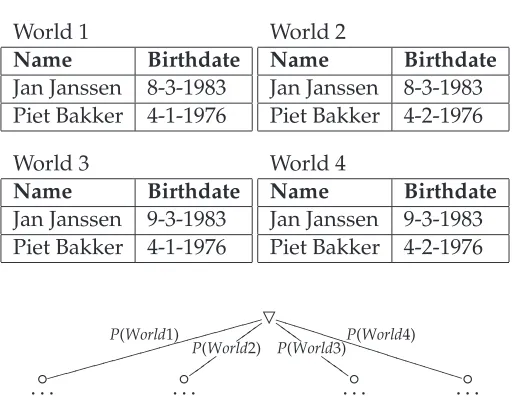
Table3.1shows a simplified version of a database used in a patient record system. The table shows the relation between name and birthdate. There is uncertainty in this relation. This uncertainty is represented in possible worlds in table3.2. Figure3.1shows the encoding of the enumeration of possible worlds in a tree.
When a database stores data using the possible world representation, a lot of redundant data will be stored in the database. As can be seen in table 3.2, there is overlap in names
Table 3.1: Part of the data in a Patient Record System
Name Birthdate
Table 3.2: Construction of Possible Worlds
Figure 3.1: Possible world representation of Patient Record Example (XML), figure has been taken from [12].
and birthdates. Each unique pair of names and birthdates is duplicated across some of the worlds. Although, thinking and reasoning in terms of possible worlds is sound, enumerating possible worlds and encoding them in an XML document is not practical. For that reason, the Compact representation was proposed in [12, 23]. This type of representation will be discussed in the next section.
3.1.2 Compact representation
The work presented in this section is based on the possible world semantics discussed earlier. The compact representation encodes discrete uncertainty in an XML document and reduces the storage of redundant data compared to the approach discussed in the previous section. In order to reduce the storage of redundant data, the compact representation distinguishes three different kinds of nodes: possibility nodes, probability nodes and regular XML nodes. Children of probability nodes are possibility nodes which represent different possibilities or alternatives, possibility nodes encodes encode probabilities. The children of possibility nodes are XML nodes. The regular XML nodes contain the base data. This approach leads to a reduction of overlapping data as we will see later.
In contrast to set theory and relational data, order is important in XML documents. In the formal definitions which will be presented in the next few section, set-based theory is used. For this reason, some notations for handling sequences will be introduced first.
Notational convention 1 Analogous to the powerset notationP, we use apower sequence nota-tionSA to denote the domain of all possible sequences built up of elements of A. We use the notation
[a1, . . . ,an]for a sequence of n elements ai ∈A(i=1..n). We use set operations for sequences, such as
The notions of a tree and subtree are abstractions from the XML document and XML fragment, respectively. A tree is modeled as a node having a sequence of subtrees as children of the node.
Definition 2 Let n={id,tag,kind,attr,value}be a node, with
• id the node identity
• tag the tag name of the name
• kind the node kind
• attr the list of attributes, which can be empty
• value the text value of the node, which can be empty
In an implementation, a node is defined in terms of their properties like in definition2. In this theoretical model, we abstract from this definition. In the following definition, the notion of a tree is defined.
Definition 3 LetN be the set ofnodes. LetTibe the set of treeswith maximum level i inductively defined as follows: In the sequel, we only work with finite trees.
Operations are frequently performed on children of a node or a subtree instead of an entire tree or a single node. For this reason, functions to obtain subtrees or children are defined. A subtree can be retrieved by performing the functionsubtreewith parametersT, indicating the tree containing the subtree, and n, indicating the rootnode of the obtained subtree. The function childaccepts the parameters T, indicating the tree containing the subtree, and n, indicating the parent of the returned nodes.
Definition 4 Letsubtree(T,n)be thesubtreewithin T=(n,ST)rooted at n.
The central notion in the compact representation is that of the probabilistic tree. In an ordinary XML document all information is certain, whereas in a probabilistic XML document each XML node has one or more possibilities or alternatives. As mentioned before, the compact representation introduces two new kinds of nodes:
2. possibility nodes depicted as◦, which have an associated probability.
In probabilistic XML, ordinary XML are depicted as •. The root of a probabilistic XML document is always a probability node. The children of a probability nodes are always possibility nodes, children of possibility nodes are always ordinary XML nodes, and children of these XML nodes are probability nodes. The result of using this layered structure is a well-structured probabilistic tree where each level of the tree only contains one kind of nodes.
For examples of probabilistic XML documents and applications of probabilistic XML, we refer to [12]. [12] contains a formal definition of a probabilistic tree, a formal definition for deriving possible worlds from a probabilistic tree and it contains an algorithm for counting the number of possible worlds encoded in a probabilistic tree. We chose not to include these definitions here as we will present adapted versions of these definitions in one of the following sections. The adapted definitions allow the encoding of continuous uncertainty in a probabilistic tree using possible world semantics. However, before we can elaborate on the representation of continuous uncertainty in a probabilistic tree, we have to agree on how continuous uncertainty can be expressed in terms of possible worlds.
3.2
Expressing Continuous Uncertainty in Possible Worlds
The Gaussian, gamma and continuous uniform distributions are all examples of absolutely continuous distributions. A probability distribution is called absolutely continuous if it has an associated probability density function. An equivalent definition of an absolutely continuous distribution is that the probability equals zero if a random variableXattains a value on any given interval.
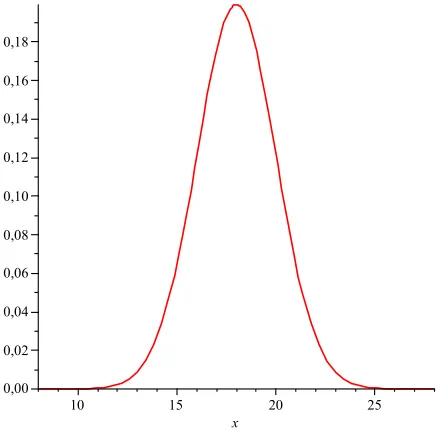
Figure 3.2 shows the probability density function of a stochastic variable that has a Gaussian distribution. The stochastic variable is, for instance, the room temperature; the distribution has parameters mean 18 and variance 2. A property of the probability density function is that the integral of a probability density function equals 1. Another property is that for all values ofx,f(x) is greater than or equal to zero.
The probability density function that is shown in figure3.2can be sampled. Sampling the probability density function on the interval [13,23], yields a histogram which approximates the continuous distribution by means of bars. The Middle Riemann Sum method is used here for the approximation of the probability density function. The width of each bar corresponds to theunitor thesegmentsize. In this example each unit has a size of 2. Figure3.3depicts this sampling. The areas of the bars correspond to approximations of the following probabilities:
P(13 ≤ X < 15),P(15 ≤ X < 17), P(17 ≤ X < 19),P(19 ≤ X < 21),P(21 ≤ X < 23). When the probability density function is sampled on the same interval with a smaller segment size, the resolution of the histogram increases. This means that the histogram consists of a larger number of segments, each segment having a smaller interval. Each bar has a smaller area and thus denotes a smaller probability. In a very fine-grained histogram, the segment size becomes close to zero, the area of each bar (column) approaches zero meaning that the probability approaches zero. Moreover, the number of segments approaches infinity. Thus, the result of sampling is histogram which approaches the curve of a probability density function.
Figure 3.2: Probability density function of a Gaussian distribution with parameters mean 18 and variance 2.
dx = 2
of sampling a continuous distribution is, in most cases, a very fine-grained histogram which is unbounded.
When a database models a particular aspect of the real world, the database holds infor-mation on real world objects. In case of an uncertain database, a database holds inforinfor-mation on possible representations of real world objects. As mentioned before, a possible represen-tation is also called a possibility. A real world object that can be described by a continuous distribution, is represented in a continuous uncertain database as an infinite sequence of possibilities. Each element in the set of possibilities has a value and an associated proba-bility approaching zero. This all follows from the sampling approach explained before, if we consider a possibility to be equivalent to a segment and the associated probability to be equivalent to the segment area under the graph of a probability density function. Con-sider again figure3.3. The probability density function is sampled, yielding seven histogram segments or seven possibilities. Each possibility has an interval, a value (the middle of the interval) and a probability (the area of the column). The equivalence between a continuous distribution and an enumeration of possibilities can be described by the following equation:
The representation in a probabilistic database of a real world object, o, that can be described by a continuous distribution, is defined as follows:
• distribution(o)↔(S=[s1, . . . ,s∞])
• ∀si ∈S∧ ∃r∈R⇒prob(si)≈0∧value(si)=r
wheredistributionsamples the continuous distribution into possibilities, si, S denotes the set of
pos-sibilities,probreturns the probability which is associated with each possibility andvaluereturns the value that corresponds with a possibility.
As mentioned before, a possible world is constructed by choosing one alternative out of a set of alternatives for each of the real world objects represented by the database (and the non-existence of an rwo is to be considered an alternative as well). When a database contains the representation of one or more real world object(s) that can be described by continuous distributions, the database holds an infinite number of possibilities. In that situation, the database also holds an infinite number of possible worlds.
As was shown in section3.1, uncertainty can be represented in XML by enumerating pos-sible worlds and encode them in separate subtrees. Following this approach when continuous uncertain data is involved, yields a tree as shown in figure3.4. This approach is theoretically very interesting, though practically not feasible. Besides the problem of duplicate information across possible worlds as discussed in the previous section, the enumeration and encoding of an infinite number of possible worlds into separate subtrees would yield a never-ending XML document. For this reason, the continuous representation will be introduced.
3.3
Representing Continuous Uncertainty
In this section the continuous representation, used to model continuous uncertain data, will be presented. The continuous representation solves some limitations of the compact repre-sentation. The representation introduced here is entirely based on the compact representation proposed in [12,23].
▽
Figure 3.4:Possible world representation of continuous uncertain data.
probabilistic tree. As discussed before, a probabilistic XML document consists of probability nodes, possibility nodes and regular XML nodes. Possibility nodes are used to model zero or more alternatives for an XML node. In the compact representation, which can be used to model discrete uncertainty, each subtree of a possibility node denotes one possibility.
The continuous representation is somewhat more complicated with respect to this. When the continuous representation is used to model continuous uncertain data, possibility nodes are associated with continuous distributions and with the probability mass, in other words: possibility nodes hold probability density functions and the probability mass. Consequently, each possibility node represents an infinite number of possibilities. The continuous represen-tation handles discrete probabilities in the same way as the compact represenrepresen-tation does. In the compact representation, each possibility node has an associated probability. The contin-uous representation also uses possibility nodes with associated probabilities when modeling discrete uncertainty. The continuous as well as the compact representation require that the total probability mass under a probability node sums up to 1. This means that the sum of the the probabilities associated with possibility nodes and the area below the graph of a probability density function have to be equal to 1.
In the continuous representation, the possibility nodes may encode probability density functions along with its parameters. We need to define which probability density functions are supported by the probabilistic model.
Definition 5 The supported probability density functions are defined by the following set:
• PDF0={gaussian(µ, σ2), gamma(k, θ), uniform(a,b), beta(α, β)}
• PDFi =PDFi−1∪Sp∈PDFi−1floor(p,F)
• PDF=S
iPDFi
is part of the whole domain. The floor operator can be used to create a new probability distribution function that is specified on that particular interval.
A probabilistic tree is defined as a tree, akindfunction that assigns node kinds to specific nodes in the tree, a prob function which attaches probabilities to possibility nodes and a
distribution function which attaches probability density functions to possibility nodes. The
root node is defined to always be a probability node. A special type of probabilistic tree is a
certain one, which means that all information in it is certain, i.e., all probability nodes have exactly one possibility node with an associated probability of 1.
Definition 6 Aprobabilistic treePT=(T,kind,prob,distribution)is defined as follows
• kind∈(N → {prob,poss,xml}) • NT
k ={n∈ N
T|kind(n)=k}.
• kind(n)=probwhere T=(n,ST)
• ∀n∈ NprobT ∀n′ ∈child(T,n)•n′ ∈ NT
poss
• ∀n∈ NpossT ∀n′ ∈child(T,n)•n′∈ NxmlT
• ∀n∈ NxmlT ∀n′∈child(T,n)•n′∈ NprobT
• prob∈ NpossT [0,1]
• distribution∈ NpossT {discrete} ∪PDF
• ∀s ∈ dom(distribution(s)) •distribution(s) ∈ PDF =⇒ s ∈ dom(prob) ∧prob(s) =
+∞
R
−∞
pdf(s)(x)dx
• ∀n∈ NprobT •((P
n′∈child(T,n)prob(n′))=1∨(∀n′∈child(T,n)•prob(n′)=⊥)). Where AB is a partial function.
A probabilistic tree PT = (T,kind,prob,distribution) iscertain iffthere is only one possibility node for each probability node and the possibility node is not associated with a continuous distribution, i.e., certain(PT) ⇔ ∀n ∈ NT
prob • |child(T,n)| = 1.To clarify definitions, we use b to denote a
probability node, s to denote a possibility node, and x to denote an XML node.
Continuous probability distributions can be characterized by probability density func-tions. A probability density function is defined as a function of a possibility node holding the kind of probability density function with its parameters, and the input variablexwhich is an element from the setR. The result is also a rational number. The attentive reader will notice
Definition 7 Letpdf(s)(x) return the value of the probability density function, which is associated with possibility node s, with as input x. Since functionpdfis a probability density function describing the probability density in terms of the input variable x, it has the following properties:
• pdf∈ NpossR→R
associated withdistribution(s)”, ifdistribution(s)∈PDF0
λx:R•
A probability density function can be used to compute probabilities. A real-world object can be described by a random variable whose probability distribution is continuous. The probability that a random variable attains a value less or equal than a given value, x, is defined by the following definition.
Definition 8 The real world object, o, can be described by the continuous random variable X. Let
Pr(s,X≤x)be the probability that the continuous random variable attains X a value less or equal x.
• Pr(s,X≤x)=
x
R
−∞
pdf(s)(x)dx
where s is a possibility node, encoding the probability density function of the continuous random variable X.
A possibility node that encodes a probability density function represents an infinite number of possibilities, the possibility node can be replaced by an infinite sequence of possibility nodes. By doing this, weexpandorslicethe possibility node that has an associated probability density function. The parent node of the resulting sequence is the probability node which can be seen as the root node of a probabilistic (sub-)tree. The children of the probability node is a sequence of possibility nodes which may contain possibility nodes that represent probabilities (discrete uncertain data) as well as an infinite number of possibility nodes which correspond to one or more continuous distributions. The possibility nodes of the latter type, have an associated probability approaching zero. This is more formally described by the following definition.
Definition 9 Letαˆs′ be the probability associated with possibility node s′after expanding the proba-bility density function encoded by possiproba-bility node s.
• αˆs′ =Pr(s,X≤x+dx)−Pr(s,X≤x)
After expanding the possibility node, each resulting possibility node has one child which is a regular XML node holding a value. A possibility node holding a continuous distribution can be transformed from the continuous representation to the compact representation using
Definition 10 Letexpand(T,n)be a probabilistic subtree of T rooted at n enumerating the infinite number of possibilities summarized by a possibility node that encodes a probability density function and is originally a child of n. Each resulting possibility is associated with a probability approaching zero, i.e.,prob(s′i)=αˆs′
A probability density function is defined on an interval. This interval is open or it is bounded. In both situations, when dx approaches zero, the associated ˆαs′ approaches zero
and the number of possibility nodes approaches infinity. Consequently, the number of XML nodes, that are children of the possibility nodes, approaches infinity. This is similar to the sampling approach which we described in section 3.2. When the size of a segment in a histogram approaches zero, the area of that segment approaches zero. In order to fill the curve of a probability density function with segments, an infinite number of segments is required.
A probabilistic tree may contain several possibility nodes, each encoding a probability density function. Applying theexpandon the parents, the probability nodes, of those pos-sibility nodes yields a new probabilistic tree. The resulting probabilistic tree is the compact representation of the set of possible worlds. In this probabilistic tree, each probability node representing continuous uncertainty, have an infinite number of possibility nodes as chil-dren. In the compact representation, a possible world can be constructed from a probabilistic tree by making a decision at each probability node for one of the possibility nodes. For this reason, a probability node can also be seen as a choice point. Each possible world can be represented by a certain probabilistic tree. Definition11assumes that all possibility nodes in
PThave already been expanded.
Definition 11 A certain probabilistic tree PT′ is apossible worldof another probabilistic tree PT, i.e.,pw(PT′,PT), withprobabilitypwprob(PT′,PT)iff
The set of all possible worlds of a probabilistic tree PT is
◦
Figure 3.5:Examples of the continuous and the compact representations.
The number of possible worlds captured by a probabilistic tree is determined by the number of probability nodes and the number of possibilities below each probability node. We also define a function leaf that returns all the leaf nodes of a tree.
Definition 12 In the continuous representation, the number of possible worlds defined by the tree PT, NPWPT(T)is equal to the number of possible worlds at node n, defined by NnPW(T)where
3.4
Examples
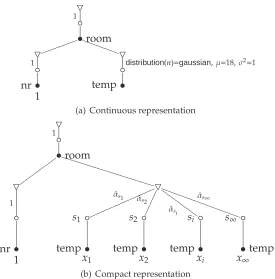
Figure3.5shows an example of how a continuous distribution can represented in a proba-bilistic database. In the example, the temperature in a room of an office building during the day can be described by a continuous distribution. The database stores the combinations of room numbers and the corresponding temperature models for the whole office building. The continuous representation shown in figure3.5(a)stores the probability density function with its parameters. Figure3.5(b)shows the corresponding expanded version of the probabilistic tree from figure3.5(a), this representation is also called the compact representation.
3.5
Conclusion
In this chapter, we introduced a probabilistic data model that supports the representation of continuous uncertain data in XML. We explained how continuous uncertain data can be ex-pressed in possible worlds. Besides that, we proposed the continuous representation which is able to represent continuous uncertain data in XML in an efficient way. The continuous repre-sentation is an extension to the compact reprerepre-sentation proposed in [12,23]. Furthermore, we showed that the continuous representation and the compact representation are equivalent since the continuous representation can be transformed to the compact representation using
theexpand(T,n) function. As a result of this, all the properties that are valid for the compact
Chapter 4
Query language
One of our goals is to provide simple, yet very powerful, constructs for querying XML documents containing continuous uncertain data. In conjunction with the XQuery language, the constructs can be used by the end-user to compose queries. In this chapter we will discuss querying techniques in terms of possible world semantics. First, we need to show how the semantics are followed when querying continuous uncertain data. Then, we will explain the working of basic operators, such as querying the probability or retrieving the mean from a distribution. We conclude this chapter with a discussion on advanced functions that are capable of aggregating one or more continuous distributions in different ways.
4.1
Possible worlds
In the previous chapter we examined two representations in detail: the compact and the con-tinuous representation. As we discussed in chapter2, most uncertain database management systems are based on the possible world semantics.
Pirotte and Zim´anyi showed in [27] how the semantics are followed when querying an uncertain database. Information residing in a database is represented by a set of possible worlds. Following the possible world semantics, querying uncertain data means that a query is evaluated in every possible world captured in a probabilistic database, the results of the individual query evaluations are collected and the union of these results are presented to the user as if it is one result.
Section3.1.1showed that a collection of possible worlds stored in a probabilistic database, contains overlapping data. Moreover, in terms of semantics, continuous uncertain data is represented by an infinite number of possible worlds. Querying redundant or overlapping data is not efficient and querying continuous uncertain data by enumerating an infinite number of possible worlds is infeasible. For these two reasons, the query operations we will propose will work directly on the continuous representation. The continuous representation should be fully compatible with possible world semantics because it only extends the compact representation in such a way that it supports the modeling of continuous uncertainty; [12,23] showed that the compact representation is consistent with possible world semantics when querying discrete uncertain data.
Figure4.1shows a commutative diagram.Dis a single database,D1...D∞denote possible
DOO
PI
q
//Rq(D)
OO
PI
D1,· · ·,D∞
q
//Rq(D
1),· · ·,Rq(D∞)
Figure 4.1:Commutative diagram, figure has been taken from [12].
The figure also shows two vertical arrows. These arrows denote the transformation between the possible worlds and the continuous representation (and vice versa).
4.2
Querying a continuous distribution
An XML document containing continuous uncertain data holds multiple continuous dis-tributions. Each possible world stored in the document, consists of one possibility (a slice) from each continuous distribution encoded in the document. Following the possible world semantics, computing a probability is an operation that works across possible worlds because a probability is associated with a possible world and is not known within a possible world. Examples of other operations that are useful and work across possible worlds, include the computation of the mean and the variance of a continuous distribution. All these value-based query operators do not conform to possible world semantics. In this section we will define several probabilistic query operations using probability theory as basis. As discussed in the previous section, we will define these operations in such way that they can be used on the continuous representation.
4.2.1 The mean function
The expected value is a way to describe the location of the distribution in the set of possible values (which is infinite in the case of a continuous distribution) in terms of the location of the probability mass. It is computed by taking the integral over the input values of the probability density function multiplied with the outcome of the probability density function for each element in the set of possible values. A more formal description is given in definition13. Definition 13 Let mean(T,s) be a function that computes the expected value of the continuous distribution encoded in possibility node, s.
• mean(T,s)= +∞
R
−∞
x∗pdf(s,x)dx
where x∈Rand T is the probabilistic tree containing the possibility node s.
4.2.2 The variance function
Definition 14 Letvariance(T,s)be a function that computes the variance of the continuous distri-bution encoded in possibility node, s.
• variance(T,s)=
+∞
R
−∞
pdf(s,x)∗(x−mean(T,s))2dx
where x∈Rand T is the probabilistic tree containing the possibility node, s.
4.2.3 The vmin function
The vmin function computes the minimum possible value of a continuous distribution. A more formal description is given below.
Definition 15 Let vmin(T,s) be a function that computes the minimum value of the continuous distribution encoded in the possibility node, s.
vmin(T,s)=
where T is the probabilistic tree containing the probability node s.
4.2.4 The vmax function
The vmaxfunction computes the maximum possible value of a continuous distribution. A more formal description is given below.
Definition 16 Let vmax(T,s) be a function that computes the maximum value of the continuous distribution encoded in the possibility node, s.
vmax(T,s)=
distribution(s)=gamma
1 ifdistribution(s)=beta
b ifdistribution(s)=uniform
(4.2)
where T is the probabilistic tree containing the possibility node s.
4.2.5 Predicates
<locations> <location>
<name>Arnhem</name> <prob>
<poss type=gaussian(920,20)> <water-level/>
</poss> </prob> </location> <location>
<name>Den Helder</name> <prob>
<poss type=gaussian(-30,5)> <water-level/>
</poss> </prob> </location> </locations>
Figure 4.2:An example of a sensor database.
Table 4.1: The value-probability pairs correspond to the segments in histograms A and B. (a) HistogramHA
Segment Value Probability
gA1 2 0.1079819330
gA2 4 0.7978845605
gA3 6 0.1079819330
(b) HistogramHB
Segment Value Probability
gB1 10 0.1079819330 gB2 12 0.7978845605 gB3 14 0.1079819330
database containing continuous uncertain data. The data is originating from sensors that measure the actual water levels on different locations in The Netherlands. The Dutch En-vironment Agency is responsible for notifying several governmental organizations when the water level reaches a certain limit. For this reason, an employee of the Dutch Environ-ment Agency wants to know the locations where the expected value of the water level is more than 100 centimeters. In order to get this knowledge, he poses the following query to the database:/location[mean(water-level)>100]/name. The answer to this query will be
<name>Arnhem</name>.
4.3
Aggregating continuous distributions
A B
Figure 4.3:The probability density functions of Gaussian distributions A and B.
A
(a) Histogram A
B
(b) Histogram B
Figure 4.4:The sampled probability density functions.
Table 4.2: Each computed probability in table B indicates the likelihood that both events occur simultaneously.
(a)min(gAi,gBj)
min 10 12 14
2 2 2 2
4 4 4 4
6 6 6 6
(b) Multiplied probabilities (gAi,gBj)
min 10 12 14



![Figure 4.1: Commutative diagram, figure has been taken from [12].](https://thumb-us.123doks.com/thumbv2/123dok_us/1028218.1127858/42.612.217.393.63.120/figure-commutative-diagram-gure-taken.webp)

