36
An Inventory Model for Deteriorating Items with Time
Dependent Demand and Partial Backlogging
Sushil Kumar* & U. S .Rajput
Department of Mathematics & Astronomy, University of Lucknow Lucknow- 226007. U.P. India.
[email protected], [email protected] Corresponding Address*
Abstract- In this paper we developed a general inventory model for deteriorating items with constant deterioration rate under the consideration of time dependent demand rate and partial backlogging. Shortages are allowed and completely back-logged. The purpose of our study is to minimize the total variable inventory cost and a numerical example is also given to demonstrate the developed model. A sensitivity analysis is also given for the developed model.
Keywords- Inventory, time dependent demand, deteriorating items, shortages and partial backlogging. 1. INTRODUCTION-
In the recent years there is a state of interest of studying time dependent demand rate. It is observed that the demand rate of newly launched products such as electronics items, mobile phones and fashionable garments increases with time and later it becomes constant. Deterioration of items cannot be avoided in business scenarios. In most of the cases the demand for items increases with time and the items that are stored for future use always loose part of their value with passage of time. In inventory this phenomenon is known as deterioration of items. The rate of deterioration is very small in some items like hardware, glassware, toys and steel. The items such as medicine, vegetables, gasoline alcohol, radioactive chemicals and food grains deteriorate rapidly over time so the effect of deterioration of physical
goods cannot be ignored in many inventory systems. The deterioration of goods is a realistic phenomenon in many inventory systems and controlling of deteriorating items becomes a measure problem in any inventory system. Due to deterioration the problem of shortages occurs in any inventory system and shortage is a fraction that is not available to satisfy the demand of the customers in a given period of time. Dye [2002] developed an inventory model with partial backlogging and stock dependent demand. Chakrabarty et al. [1998] extended the Philip’s model [1974]. Skouri and Papachristors [2003] determine an optimal time of an EOQ model for deteriorating items with time dependent partial backlogging. Manjusri Basu and Sudipta Sinha [2007] extended the Yan and Cheng
model [1998] for time dependent backlogging rate. Rau et al. [2004] considered an inventory model for determining an economic ordering policy of deteriorating items in a supply chain management
37 EOQ model under permissible delay in payments.
Aggarwal and Jaggi [1995] extended the EOQ model with constant rate of deterioration. Hwang and Shinn [1997] determined the lot size policy for the items with exponential demand and permissible delay in payment. In the presence of trade credit policy, Chung and Hung [2005] developed an EOQ model. Vinod kumar Mishra and Lal sahab singh [2010] developed an inventory model for deteriorating items with time dependent demand and partial backlogging. Further Vinod kumar Mishra [2013] developed an inventory model involving controllable deterioration rate to extend the traditional EOQ model. Mandal [2013] developed an inventory model for random deteriorating items with timedependent demand and partial backlogging. It has been observed that the unsatisfied demand is completely back-logged and during the shortage period either all the customers wait for the arrival of next order (completely backlogged) or all the customers leave the system (completely lost). The length of waiting time for the replenishment is the main factor for determining whether the backlogging is accepted or not.
In the present paper we developed an inventory model for deteriorating items with constant deterioration rate and time dependent demand and partial backlogging. Shortages are allowed and completely backlogged for the next replenishment cycle. The purpose of our study is to minimize the total variable inventory cost. A numerical example is considered to illustrate the developed model.
2. ASSUMPTIONS AND NOTATIONS
We consider the following assumptions and notations
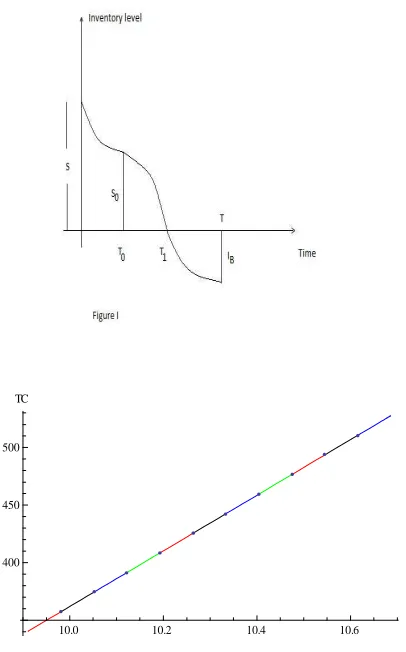
1. The time dependent demand is R(t) = (a+bt), a,b >0 where a is constant and b is the fraction of demand varying with time. 2. The replenishment rate is infinite. 3. The planning horizon is infinite. 4. The deterioration rate
θ
is constant. 5. Shortages are allowed and completelybacklogged. The backlogging rate is
defined by
)
(
1
)
(
)
(
t
T
bt
a
t
R
−
+
+
−
=
δ
where backlogging parameterδ
is a positive constant.6. I(t) is the inventory level at any time t. 7. S, is the inventory level at time t=0.
8.
S
0, is the inventory level at time
T
t
=
0. 9. A is the ordering cost per order. 10. C is the purchase cost per unit. 11. h is the holding cost per unit per cycle.12.
π
B is the backordered cost per unit
time.
13.
π
L is the lost sales cost per unit.
14. T is the cycle length. 15.
T
1 is the time at which shortages start.
16.
15. TC (
T
0 ,T
1 ,T
2) is the averagetotal inventory cost per unit time
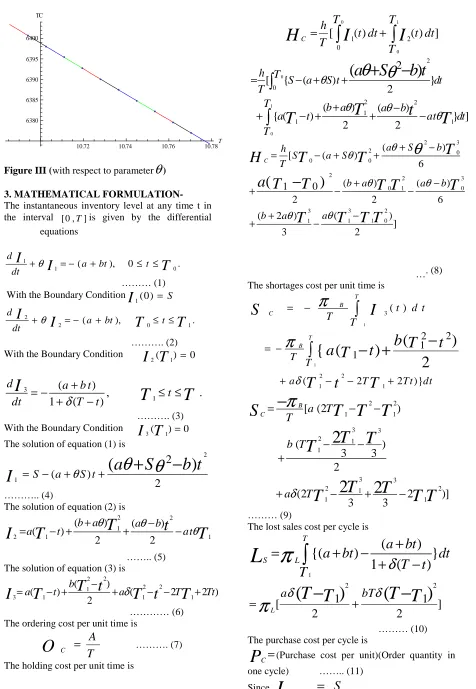
Figure II (with respect to parameter
δ
)10.0 10.2 10.4 10.6 T 400
40 )}
2 3 2
3 2 2 ( 2
) 3 3 2 (
1 {
} 2
) (
3 ) 2 (
2 1 3 3 1 2 1 2
3 1 2 1
2 2
0 1 3 1 3
1
(
)
T
T
T
T
T
T
T
T
T
T
T
T
T
T
T a T
b
a a
a b
B
− + − +
− − +
− − − − +
+
−
δ θ θ
π
)
(
{
1
)
2
2
(
a
bT
(
T
T
)
2C
S
a
T
T
1L
+
+
+
−
+
π
δ
δ
−
}]
1
2
)
(
)
(
22 2 1
T
T
T
T
a
b
−
−
−
−
δ
…….. (16)
Solving the equations (14), (15) and (16) for
T
,
T
,
T
0 1 and for which
) , ,
( 0 1 T
TC
T
T
is minimum.4. NUMERICAL EXAMPLE
Let us consider an inventory system with the given data in appropriate units as follows:
A=50, S=500,
π
L=10,π
B =5,h=0.5,δ
=
3
,001
.
0
=
θ
,a=2,b=8,C=6Table I
θ
T
0T
1 T TC 0.001 7.68152 10.8158 10.6856 6418.650.004 6.55108 10.6785 10.5629 6241.78
0.008 7.01796 10.2886 12.1451 5361.85
0.015 5.72252 10.0241 9.91096 5460.89
Table II
δ
T
0T
1 T TC3 7.68152 10.8158 10.6856 6418.65
6 7.73318 10.8115 10.7409 12784.10
9 7.75234 10.8089 10.7615 19145.40
15 7.76846 10.8086 10.7789 63756.90
Table III h
T
0T
1T TC
0.5 7.68152 10.8158 10.6856 6418.65 1.0 6.33218 10.9265 10.8855 6514.18 2.0 5.67915 10.9797 11.1128 6499.11 4.0 5.43949 10.9992 11.4601 6375.46
5. SENSITIVITY ANALYSIS
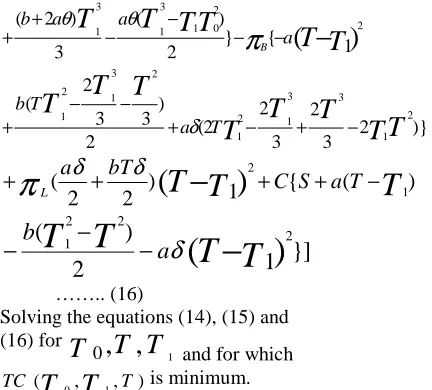
From the Table I we see that as we increase the deterioration parameter
θ
then the time periods T,T
0,T
1decreases and the total cost alsodecreases. From the Table II we see that as we increase the backlogging parameter
δ
then the time periods T,T
0 increases and the time periodT
1decreases and the total cost increases. From the Table III we see that as we increase the holding parameter h then the time periodsT
0 decreases
and the time periods T,
T
1 increases and the total cost increases. Thus the parameterδ
is more sensitive than the parametersθ
and h.6. CONCLUSION
In the present paper we developed an inventory model for deteriorating items with time dependent demand and partial back-logging under constant deterioration rate. Shortages are allowed and completely backlogged for the next replenishment cycle. From the sensitivity analysis it is observed that the parameter
δ
is more sensitive than the parameters h andθ
. We make a decision to determine the optimum cycle time for minimizing the total average inventory cost. In future study this model can be generalized by considering time dependent deterioration and holding costs and also probabilistic modelREFERENCES-
[1] Aggarwal, S.P. and Jaggi, C.K. (1995), Ordering policies of Deteriorating items under permissible delay in payments. Journal of Operational Research Society 46, 658-662.
[2] Berrotoni, J.N. (1962) Practical Applications of Weibull distribution ASQC. Tech. Conf. Trans. 303-323.
[3] Covert, R.P. and Philip, G.C. (1973) An EOQ model for deteriorating items with weibull distributions deterioration, AIIE Trans 5, 323- 332.
41 [5] Mishra, R.B. (1975) Optimum production lot-
size model for a system with deteriorating inventory, Int. J. Prod. Res. 13, 161-165. [6] Biermans, H. and Thomas, J. (1977) Inventory
decisions under inflationary conditions. Decision Sciences 8, 151-155.
[7] Bhahmbhatt, A.C. (1982) Economic order quantity under variable rate inflation and mark-up prices Productivity 23, 127-130. [8] Jesse, R.R., Mitra, A. and Cox, J.F. (1983)
EOQ formula is it valid under inflationary conditions? Decision Sciences 14(3), 370-374.
[9] Dave, U. and Patel, L.K. (1983) (T.So.) policy inventory model for deteriorating items with time proportional demand. J. Opl. Res. Soc. 20, 99-106.
[10] Goyal, S.K. (1985) Economic
order quantity under conditions of permissible delay in payments. Journal of Operational Research Society 36, 335-338. [11] Deb, M. and Chaudhuri K.S. (1986) An
EOQ model for items with finite of production and variable rate of deterioration. Opsearch 23, 175-181. [12] Chandra, J.M. and Bahner, M.L. (1988)
The effects of inflation and the value of money or some inventory systems. International Journal of Production Economics 23, (4) 723-730.
[13] Mandal, B.N. and Phaujdar, S. (1989)An inventory model for Operational Research Society 40, 483-488.
[14] Hwang, H. Shinn, S.W. (1997) Retailer’s pricing and lot sizing policy for exponentially deteriorating products under condition of permissible delay in payments. Computers and Operations research 24, 539-547.
[15] Jamal, A.M. Sarkar, B.R. and Wang, S. (1997) An ordering policy for deteriorating items with allowable shortage and permissible delay in payment. Journal of Operational Research Society 48, 826-833.
[16] Chakrabarty, T., Giri, B.C. and Chaudhuri, K.S. (1998) An EOQ model for items with weibull distribution deterioration, shortages and trended demand and an extension of Philip’s model, Computers and Operations Research 25, (7/8), 649-657.
[17] Mondal, M. and Motti, M. (1999) Inventory of damageable items with variable replenishment rate, stock dependent demand and some units in hand. Applied Mathematical Modeling 23, 799- 807.
[18] Liao, H.C., Tsai, C.H. and SU, C.T.(2000) An inventory model with deteriorating items under inflation when a delay in payment is permissible. International Journal of Production Economics 63, 207-214.
[19] Chung, K.J., Huang, Y.F. and Huang, C.K. (2002) The replenishment decision for EOQ inventory model under permissible delay in payments. Opsearch 39, 5 & 6, 327-340.
[20] Chung, K.J. and Hwang, Y.F. (2003) The optimal cycle time for EOQ inventory model under permissible delay in payments. International Journal of Production Economics 84, 307-318.
[21] Chung, K.J. and Huang, T-S. (2005) The algorithm to the EOQ model for Inventory control and trade credit. Journal of Operational Research Society 42, 16-27.
[22] Dye, C.Y. (2002) a deteriorating inventory model with stock dependent demand and partial backlogging under condition of permissible delay in payments. Opsearch 39,(3 & 4).
[23] Mishra, V.K. and Singh, L.S. (2010) Deterministic inventory model for deteriorating items with time dependent demand and partial backlogging, Applied Mathematical Sciences Vol.4, no. 72,3611-3619.
[24] Mandal, Biswarajan (2013) Inventory model for random deteriorating items with a linear trended in demand and partial backlogging. Research Journal Of Business Management and Accounting. Vol. 2(3), 48-52.
[25] Mishra V.K. (2013) Inventory model for instantaneous deteriorating items controlling deterioration rate with time dependent demand and holding cost. Journal of Industrial Engineering and Management, 6(2), 495-506.