“Who’s side are you on?”
Side-taking motives of lay third parties and the influence of
personality
Master thesis: Psychology
Faculty of Behavioural Sciences University of Twente
Enschede, The Netherlands
Date:
October 2007
Author:
Hanna Cornelia Gerarda Lange
Graduation Committee: Dr. H. Yang
Abstract
Acknowledgements
After having enjoyed an amazing time of being a student for five years, I am very pleased to present the report of my master thesis. During the first months of this final project I didn’t know much about how to set up a research and couldn’t imagine what people even attracted in doing scientific research. Now, 10 months later, I have experienced how exiting a researchers’ life can be. For me it was a challenging process of growing, ups and downs, and finally fulfilment.
A thesis is never a single persons’ piece of work, it would not have been here without the contribution of some important people.
First of all, I would like to thank my supervisor Huadong Yang who was the crucial factor in producing this thesis. He taught me how to proceed each step in the research process. He shared his bright insights and gave straightforward comments which were extremely helpful. My gratitude goes also to his patience in showing me how to formulate and structure appropriate scientific arguments which shaped my academical thinking. Thanks also to my second supervisor Ellen Giebels for her help in translating the questionnaire and the useful suggestions in all phases of the project.
Next, I would like to thank my friend Annick Kuipers for helping me with the structure and English in the first phases of this project. Thanks also to Julie Bytheway who supported with my English writing style. My gratitude also goes to Jessica de Bloom, my former study mate and work colleague, who has reviewed my work. Thanks also to the ‘conflict group’ which enlarged my understanding of conflicts and several influencing factors.
Moreover, I want to thank my colleagues of the communication department who gave me space for this project and assisted me with various aspects during the process. In addition, I am very grateful to my friends and housemates who - perhaps without knowing - supported me and gave me the confidence that I would finish successfully. Last but not least, I would like to thank my parents for their great and unconditional support during each year of my study. They were always there when I needed them and they gave me the confidence and the power to finish my study psychology successfully.
Index
The impact of personality on side-taking motives. ... 9
Personality traits... 10
Conscientiousness on legitimacy motivated side-taking... 11
Autonomy on interest motivated side-taking. ... 12
Agreeableness on relationship motivated side-taking ... 12
Extraversion; the trait description. ... 13
Appendix A Side-Taking Motive Scale (employees)... 40
Introduction
“When I am faced with an argument between two friends, and they ask me to take sides, I tend to stay out of the dispute. But when I really have to take sides, I will support the one with whom I have a better relationship, even if his/her arguments are not completely reasonable. Arguments are important, but interpersonal relationships are even more important, at least to me.” (Julia, 19 years old).
“Two of my colleagues are in a heated dispute about the future direction of our crisis centre. Tom, the founder of the centre, has a lot of experience and wants to keep everything as usual. Rebecca, the promising director of the centre who was just transferred to our department one year ago, advocates for an innovation of the centre. Neither of them would like to give in, and they both want the support of other colleagues. I side with Rebecca because she is in the right. At the same time, I feel sad to side against Tom because he is such a good supervisor, and has taught me a lot in the past.” (Seth, 31 years old).
In both examples above, Julia and Seth were faced with a conflict situation and were expected to take sides by both conflicting parties. However, they made a different choice. What motivated them to take side with one instead of the other party? And can their side-taking motives be predicted? The primary goal of this study is to investigate the motives for side-taking by third parties and to explore the factors influencing those motives.
Before going specifically into the side-taking motives and their influencing factors, first some key concepts need to be clarified. When a person is asked to take sides, he/she is often involved in a conflict dilemma between others, either actively or passively.
who became unintentionally involved in an interpersonal conflict between two individuals, without being an obvious coalition party or having professional background in, or knowledge of conflict handling (Yang, 2006). In this study, we focus on lay third parties.
When faced with a conflict, what are the options for lay third parties to react to it? They can avoid the conflict, help the disputants out, or take sides with one of the disputants (Van de Vliert, 1997). Although research has shown that in the majority of cases (52%) inaction / avoiding was adopted by third parties in conflicts, a significant percentage took sides when faced with a coalition request from both disputants (33%) (Felson & Steadman, 1983). Other studies also support that side-taking is a main reaction in conflicts (Glasl, 1980; Van de Vliert, 1981; Van de Vliert & Mastenbroek, 1998). Surprisingly, studies on side-taking by third parties have received little scientific attention in contrast to other options (Murray, 1975). Moreover, the influence of lay third parties’ side taking on a conflict is interesting because the results can directly escalate or deescalate the conflict. Once a lay third party supports a side, it may reinforce the win-loose consequences of the conflict.
Back to the example, Julia took sides with the disputant with whom she had a good social relationship. In contrast, Seth supported the disputant who came with legitimacy arguments. Apparently, Julia and Seth had different motives for side-taking. Many factors may have influenced these differences. For example, the situation in which the conflict occurs, the primary experience of Julia and Seth with side-taking, or individual differences of Julia and Seth toward side-taking. This study focuses on the influence of
personality on side-taking motives.
The research question of this study can be summarized as follows: What are the motives of lay third parties to take sides, and how do individual differences influence these side-taking motives?
By answering those questions, this paper makes three contributions to the field of conflict handling. First, findings will help our understanding of conflict dynamics which will facilitate future research and theory building about conflicts. Second, disputants can apply this information in order to persuade other parties so as to build an effective coalition with them. Third, professionals can deliberately use the results of this study for an adequate diagnosis, productive confrontation of the conflict, and self-insights.
Hypotheses Development
When lay third parties make up their minds in choosing a side, they have to collect information and form judgements from at least three perspectives. First, lay third parties may have concerns about the conflict issue. They are sensitive for judgement about whose arguments are right, reasonable, and appropriate (thus legitimacy of arguments becomes a motive for their side-taking choice). Second, lay third parties may worry about the consequences of side-taking in a conflict, such as sanction or rewards. This concerns their self-interests (interest motives). Third, lay third parties may take their relationship with disputants into account. They prefer to choose for those with whom they have a close pre-existing relationship (relationship motives).
effectively promotes societal welfare (Suchman, 1995). The second is referred as
cognitive legitimacy. It provides information about whether arguments hold by disputants mesh both with larger belief systems and with the experienced reality of daily life (DiMaggio & Powell, 1991). Because legitimacy perception is a kind of inner judgement made by individuals, there is no doubt that legitimacy side-taking motives vary from person to person.
Interest motivated side-taking. Side-taking can be stimulated by self-interest of lay third parties, which can be further distinguished in two types; sanction avoiding and reward receiving side-taking motives.
For side-taking motivated by sanction avoidance, lay third parties try to minimise their losses by supporting the disputant who may punish them if they disconfirm the disputant’s coalition request. The desire to be self-protective and avoid sanctions can be considered as underlying psychological mechanisms for this motive. The sanctions lay third parties actually expect from disputants, depends on the information collected. For example, the information about the announced sanctions, the sanctions in the past (Deutsch, 1973), and the likelihood and extend the disputant will apply punishment or penalties (Van de Vliert, 1981; Gross, 1958). Moreover, the possibilities the third party has to react to the sanctions are also taken into account.
For side-taking motivated by receiving rewards, lay third parties try to maximise their interests by supporting the side who may reward them. They react to conflict situations with a specific and limited purpose to maximise their own needs.Reward motivated side-taking leads third parties to side with the disputant who has greater potential to return in their favour in any way; such as acceptance, status, friendship, financial funds (e.g.,
Perugini & Gallucci, 2001; Clark & Jordan, 2002). The rewards lay third parties actually expect from disputants, also depends on the information collected.
personality may play an important role in influencing interest motivated side-taking.
Relationship motivated side-taking. In addition to conflict issues and self-interests, third parties also take relationships with disputants into account when processing and weighting information, and choosing conflict behaviour. Ohbuchi and his associates have argued the importance of social relationships (1999). Additionally, based on the theory of partisanship, Cooney & Philps (2004) pointed out that lay third parties’ social location is an important predictor of which side the lay third party will take; “Not only the merits of who is right or wrong determines which side the third party chooses. Even so, their location in social space predicts whose side they choose”. An important predictor for the social location is relational distance: the level of participation in one another’s lives, and
functional independence: the lay third parties’ relative ability to survive and prosper without one other (Black, 1990). All those arguments convey the idea that interpersonal relationships motivate lay third parties to give a hand to the disputants with whom they share a close relationship. Certainly there are some individual differences on the extent to which social relationships influence side-taking.
The impact of personality on side-taking motives. Before third parties determine their standpoint in the conflict, they collect information to clarify the ambiguity about the conflict issues, the causes, the process, and the effects of the conflict (e.g., Berlyne, 1960). It should be taken into account that the information collected will probably be asymmetric, because the third party has more contact or a better relationship with one party than with the other (Van de Vliert, 1981).
situations in which there are less situational constraints on behaviour than in ‘strong’ or ‘clear’ situations in which situational pressures or constraints are high (Mischel, 1977; Organ, 1994). Side-taking dilemmas often create an ambiguous rather than clear situation. Under such conditions, people get more chances to express themselves and behave according to their characteristic tendencies, predispositions, or innate traits (King et al., 2005). Third, given the fact that there is a causal link between personality and conflict handling tactics (Antonioni, 1998; King, George, & Hebl, 2005; Van der Zee & Perugini, 2006; Chanin & Schneer, 1984), one should not be surprised that personality may influence side-taking motives as well. However, the effects of personality traits on individual side-taking motives, are not yet empirically tested (Van de Vliert, 1975; Van de Vliert & Cottrell, 1979). Therefore, we attempt to build a link between personality on one hand and side-taking on the other.
Table 1: The Five-Factor Personality Descriptions and Corresponding Traits
Trait + -
Conscientiousness
Steady and firm people who are good organised and think before they act.
Fussy, tidy
Insightful and critical people, desiring to be thoughtful and reflective. the more humane aspects of humanity.
Good-natured
Outgoing and assertive people who have social skills and numerous friends.
Calm and stable people who are not prone of getting upset or anxious.
Poised
Conscientiousness on legitimacy motivated side-taking. Conscientiousness is the principal regulating factor that is primarily driven by cognitions and is not led by emotions (Van der Zee & Perugini, 2003). The trait is described in terms of alert, ambitious and firm. It is commonly associated with reliability, thoroughness and long-term plans (McCrae & Costa, 1991). Highly conscientious people maintain socially prescribed impulse control, which results in thinking before acting, and following norms and rules (John & Srivastava, 1999).
In terms of side-taking, Conscientious lay third parties tend to contemplate the content of the conflict carefully and give priority to following norms or regulations when forming a judgement of “wrong” or “right”, rather than to be led by emotions. Therefore, it is assumed that Conscientious lay third parties are motivated to take sides based on their inner judgements of right or wrong.
1997), which makes their judgements more content-related instead of depending on either social relationships or self-interests. For example, Seth took the side of his colleague Rebecca because he considered her arguments as more reasonable than those of Tom. Hence, we hypothesize:
Hypothesis 1: The more Conscientious lay third parties are, the more tendencies they have to side with the disputant who forms his/her arguments on the basis of legitimacy.
Autonomy on interest motivated side-taking. Autonomous individuals are insightful, thoughtful and reflective. The trait may also include a need for variety (Maddi & Berne, 1964), understanding (Jackson, 1984) and wide ranging intellectual interests. Autonomous individuals have rebellious tendencies, due to such adjectives as critical, plain, and mutinous. Moreover, they tend to endorse liberal political and social values because questioning authority is a natural extension of their curiosity (McCrae, 1994).
In terms of side-taking, Autonomous individuals think critically and their rebellious colourings prepares them to follow their own ideas in deciding which side to support instead of fulfilling morally or socially accepted roles as in legitimacy and relationship motivated side-taking. Lay third parties with a strong Autonomy may feel less obligated to satisfy coalition requests of disputants. They especially side against the disputant who tries to influence their decision by using threats or rewards. Taken together it is hypothesized that:
Hypotheses 2: The more Autonomous lay third parties are, the less they are motivated have to take sides based on expected sanctions (2a) or perceived rewards (2b).
trusting of others (Barrick & Mount, 1991), so that they deal with conflict cooperatively or collaboratively (Digman, 1990).
In terms of side-taking, although high Agreeable lay third parties do not have tendency to escalate the conflict, and to make enemies with disputants, when both sides want to make a coalition, they have to make a side-taking decision. Agreeable individuals put weight on social relationships and are emotional supportive and kind. Behaviour according to these characteristics arouses a feeling of pleasure and fulfilment to them. Highly Agreeable personalities are more likely to sacrifice the party with whom they have less relationship. They may choose the party with whom they have a close relationship because this will cause them less pain to break the relationship with the distant party. For example, Julia took sides with her best friend because this made her feel happy and brings fulfilment to herself. Therefore, the assumption is made:
Hypothesis 3: The more Agreeable lay third parties are, the more they are motivated to side with a disputant based on their interpersonal relationship.
Extraversion; the trait description. Extraversion reflects an ‘energetic approach’ to the social and material world. This is characterized by such traits as assertiveness, activity, enthusiasm, positive emotionality and sociability (John & Srivastava, 1999; McCrae & John, 1992). Extravert individuals are outgoing and enjoy companionship of others, they have numerous friendships and vocational interests, they are upbeat, talkative and optimistic (Hogan, Johnson, & Briggs, 1997; McCrae & Costa, 1999; Costa & McCrae, 1985). They have the social skills and the desire to work with others (McCrae & Costa, 1978). Extraverts are increasingly viewed as being ambitious, hardworking, dominant and achievement-oriented individuals (Hogan,1983; Tellegen, 1985). Extraverts are generally impulsive and risk-taking individuals. Their feelings are not kept under tight control, and they are not always reliable individuals (Eysenck & Eysenck, 1975).
trait will have much explanatory power” (Hough, 1992; Organ, 1997). Hogan, Hogan and Roberts (1996) argue that the impact of a personality trait on behaviour indeed depends on other traits. It is most likely that higher-order traits will influence other traits mostly because higher-order traits represent the broadest, most general level in the hierarchy of dispositions (Watson & Clark, 1997). For these reasons, it is insightful to consider the combined effects of traits which are theoretically expected to interact in ways to promote or inhibit side-taking motives.
Regarding motives for side-taking, it is expected that Extraversion will function as a higher order trait because it is identified in virtually every multidimensional personality inventory that has been developed during the past 50 years (Watson & Clark, 1997) and it has a general influence on human behaviour. Additionally, circumplex research suggests that Extraversion is the only ‘pure’ factor in the Big Five (Hofstee, De Raad, & Goldberg, 1992). Moreover, Witt (2002) already found that Extraversion indeed had a moderator effect on the link between personality and job performance. Based on the arguments and evidence mentioned above, it is assumed that Extraversion may serve as a higher-order personality trait to adjust the links between personality traits and side-taking motives. Specifically, the following hypotheses are proposed:
Hypothesis 4: Extraversion will moderate the link between Conscientiousness and legitimacy motivated side-taking.
Hypothesis 5: Extraversion will moderate the link between Autonomy and sanction motivated side-taking (5a) and reward motivated side-taking (5b).
Hypothesis 6: Extraversion will moderate the link between Agreeableness and relationship motivated side-taking.
measured in this study in order to explore the links between Emotional Stability and side-taking motives in an empirical way.
Method
Participants
Two samples - one student and one employee group - were recruited in order to test the theoretical assumptions. The student sample was used to empirically test the structure of side-taking motives, and initially explore the links between personality and side-taking motives. The employee sample was used to refine the structure of the side-taking questionnaire and confirm the relationship between personality traits and side-taking motives. In total, 212 respondents (111 students and 101 employees) voluntary participated in this study.
Student sample. Student respondents were recruited from the ‘Saxion Universities of Applied Sciences’, and the ‘University of Twente’. Their average age was 22, ranging from 18 to 30, and 61% were male.
Their nationality was West-European. Their studies comprised of four fields: Technical (36%), Management & Business (24%), Behavioural Sciences (23%), and Medical Studies (17%). All students had part-time work experience. We also collected information about religious orientation, and participants were free to answer, 18% reported that they were religious. The answer options were “Yes” or “No” and respondents were free to answer this question.
living together, 5% were divorced, 1% were widow / widower, and 3% other. Regarding the question about religious belief, 39% reported that they werereligious.
Procedure
All participants were approached through personal networks and snowball sampling. We created a temporal separation by introducing a week delay between the two measures to avoid common method biases on the relationship between the “Five-Factor Personality Inventory” (FFPI) and the side-taking questionnaire. In the first week, all participants filled in the paper-and-pencil based FFPI, and in the second week they were asked to fill in the side-taking questionnaire.
The order of concepts and items in the side-taking questionnaire were assumed to influence the results. Therefore, different versions of the questionnaire and the random-item questionnaire were tested in complementary analyses.
Participants were asked to fill in their e-mail address in both questionnaires so as to collate their answers. A reminder was sent in case a side-taking questionnaire was not
handed in. Each participant was provided with their scores on the FFPI as a thank-you for their participation.
Respondents were assured that their answers are treated confidentially and used for scientific research purposes only. Employees without any social or work connection to the researchers were approached as frequently as possible in order to reduce social desirability in their answers.
Measures
Personality measurement. The Five Factor Personality Inventory (FFPI) developed by Hendriks, Hofstee & De Raad (1999) was used to measure the “Big Five” personality traits as distinguished by Goldberg (1992). This scale has been tested on a large Dutch population. It has been proved to be a reliable and valid scale and is an efficient system for identifying and communicating personality traits (McCrae & John, 1992; Piedmont et al., 1991). In total the FFPI contains 100 items, each personality trait is measured with 10 items of the ‘positive’ pole (+) and 10 items of the ‘negative’ pole (-) (e.g., Extraversion
“I behave properly” (+) or “I do unexpected things” (-), for Autonomy “I decide things on my own” (+) or “I do what other’s want me to do” (-), for Agreeableness “I respect others feelings” (+) or “I see my own needs first” (-), for Extraversion “I love large parties”(+) or “I avoid company”(-), and for Emotional Stability “I keep my emotions under control”(+) or “I invent problems for myself”(-).
All items were measured on 5-point scales (1 = “not at all applicable”, 2 = “less applicable”, 3 = “moderately applicable”, 4 = “mostly applicable”, and 5 =“entirely applicable” to themselves). The original scores were computed to a person’s compatible anchored factor scores by the “FFPI scoring for Windows” programme (Hofstee & Hendriks, 1998). Compatible anchored factor scores are standardized scores anchored at the scale midpoint.
The FFPI was chosen to measure personality due to the fact that almost every item of the test has loadings on two personality traits and describes on the negative and positive poles. Another reason for using the FFPI is that the scale is based on a combination of two approaches, the Five-Factor Model and the Circumplex Model, which results in a strong and detailed instrument. The Five-Factor Model of personality, also known as “Big Five model” (Goldberg, 1992), describes dispositions at the highest level of hierarchy of personality traits, meaning that most specific and narrower personality dimensions can be understood within the framework (James & Mazerole, 2002; Goldberg, 1999). The interpersonal Circumplex Model contains the AB5C-system (Abrieved Big-Five Circumplex; Hofstee & De Raad, 1991). This system is based on the
lexicographic hypothesis which states that all traits, characteristics or behaviour that distinguish people, is expressed in language. Setting free the opportunity for identifying clusters of traits that are semantically cohesive, and therefore they permit fine-grained personality descriptions which can be used in explaining the (interaction) results of this study (e.g., low Agreeableness and high Extraversion) (Hofstee, De Raad, & Goldberg, 1992; Becker, 1999).
relevant scales (Moral-Expedient orientation scale; Gross, Mason, & McEachern, 1958; Van de Vliert & Cotrell, 1979). The final list of items was measured on 5-point Likert scales (1 = “strongly disagree”, 2 = “disagree”, 3 = “neither disagree nor agree”, 4 = “agree”, and 5 = “strongly agree”). In the second step, the questionnaire was administered to the sample of 111 students. The Cronbach alpha coefficient was .65 for the 8 items measuring legitimacy motivated side-taking, .67 for the 8 items measuring side-taking motivated by sanction avoidance, .88 for the 5 items measuring side-taking motivated by receiving rewards, and .76 for the 6 items measuring relationship motivated side-taking. In step three, based on explanatory factor analyses, the structure of the side-taking questionnaire was validated and refined by removing or improving items which had multiple or no factor loadings. In step four, the improved side-taking scale was applied to the employee sample. In the final employee sample of 101 employees, the Cronbach alpha coefficient was .77 for the 5 items measuring legitimacy motivated side-taking (e.g., “The more a colleague’s arguments are in the right, the more I am inclined to support him/her”), .58 for the 5 items measuring side-taking motivated by sanction avoidance (e.g., “I choose for the disputant who can punish me”), .85 for the 5 items measuring side-taking motivated by receiving rewards (e.g., “I care about what I can gain when choosing which side to support”) and .78 for the 6 items of relationship motivated side-taking (e.g., “When I have a close relationship with one of the colleagues, I intend to support him/her”).
The relative low alpha of .58 on sanction avoidance motivated side-taking can be explained by the questions designed to measure sanction avoidance motives. Two items had a low factor loading on the sanction-avoidance concept: “The more threats a disputant makes, the less I am willing to support him/her” (-.41) and “I would side
has caused the low reliability level of this concept. See Appendices A and B for detailed information about the side-taking questionnaire.
In step five, explanatory factor analysis was again employed to validate the side-taking concepts on the current sample of 101 employees.
Data analyses
Demographic variables such as gender, age, and years of work experience were included into the analyses as a control. Moreover, religious orientation was taken into account because we assumed that religious individuals have more tendencies for acting from their moral standards as defined in their religion.
The data were analysed through a two-stage approach. In the first stage, the structure of the side-taking questionnaire was tested. In the second stage, the influence of personality on lay third parties side-taking motives was investigated. The main statistics for data analyses were factor analyses to explore the side-taking questionnaire, and hierarchical multiple regression analyses to test the hypotheses (Aiken & West, 1991). The FFPI scores were converted into z-scores (standardized scores) prior to conducting regression analyses.
Results
Factor structure of side-taking motives
First, an explanatory factor analysis with principal component method was conducted on the student sample, to initially explore the structure of the side-taking questionnaire. Nine factors were originally extracted when ‘eigenvalue’ were set to equal or greater than 1.00. However, we detected a serious drop after four or five factors in the ‘scree plot’. Based on literature, four main factors of side-taking motives were assumed. Therefore, four side-taking factors were extracted for further analyses.
intended to measure relationship motivated side-taking explained 10% of total variance. The total, 45% of variance is explained by four factors.
Table 2 Descriptive Statistics and Correlations broken down for Student and Employee Sample
Ms SDs Me SDe 1 2 3 4 5 6 7 8 9 10 11 12
ST
1 Legit 3.78 .43 3.90 .49 - -.14 -.29** -.18† .06 .06 -.02 .02 .00 -.06 .08 .04
2 Sanct 2.49 .52 2.19 .62 -.17† - .39** .23* -.02 -.37** -.07 -.03 -.07 -.08 .09 -.23* 3 Rewar 2.65 .71 2.33 .67 -.13 .34** - .23* -.03 -.20* -.18† .13 .16 -.06 -.23* -.05 4 Relat 3.16 .57 3.11 .60 -.19† .05 .35** - -.08 -.26** .16† .12 -.03 -.13 .01 .06 Per
5 C .20 1.04 .74 1.20 -.04 -.05 -.07 -.03 - .02 .25* .18† -.16 .14 .14 .01
6 AU 1.00 .93 1.30 .95 .03 -.24* -.15 -.18† -.15 - -.14 -.00 -.04 -.13 -.21* .02 7 A 1.65 1.00 2.06 1.03 -.01 -.15 -.27** -.10 -.09 -.07 - -.33** .00 .18 -.22* -.07
8 E 1.03 .88 .85 1.14 -.02 .01 .02 .16 .08 .03 -.34** - -.14 -.18 .01 -.08
9 ES 1.04 1.01 .88 .87 -.03 .04 .21* .05 -.23* .02 -.16 -.08 - .02 -.32** .22* Co
10 Age 22.21 2.09 38.46 11.65 -.14 -.15 .05 -.11 .15 .22* .20* -.14 -.03 - -.07 .01
11 Gender NA NA NA NA .10 .08 -.14 .12 .24* -.18† .15 .22* -.26** .07 - -.21*
12 Religi NA NA NA NA -.07 .01 .04 .06 .25* .10 .10 .07 -.03 -.08 .09 -
Note.Ms and SDs refer to means and standard deviations in the student sample; Me and SDe refer to means and standard deviations in the employee sample. †p < .10 *p < .05 **p < .01
Correlations above the diagonal refer to the student sample (n = 111). Correlations below the diagonal refer to the employee sample (n = 101).
ST = Site-taking, Per = Personality trait, Co = Control variables
Legit = “legitimacy motivated side-taking”, Sanct = “sanction motivated side-taking”, Rewar = “reward motivated side-taking”, and
Relat = “relationship motivated side-taking”.
C = “Conscientiousness”, AU = “Autonomy”, A = “Agreeableness”, E = “Extraversion”, and ES = “Emotional Stability”.
Descriptive statistics
In both student and employee samples, results showed that legitimacy motivated side-taking is the most preferred side-taking motive (Mstudent = 3.78; Memployee = 3.90). Sanction avoiding motivated side-taking occurred least often (Mstudent = 2.49; Memployee = 2.33). For personality traits, in both samples, Agreeableness was mostly possessed (Mstudent = 1.65; Memployee = 2.06) and Conscientiousness was least dominant compared to other traits (Mstudent = .02; Memployee = .74).
In both the student and employee samples, a positive correlation appeared between sanction avoiding and reward receiving side-taking motives (rstudent = .39; p < .01, and remployee = .34; p < .01).
In the student and the employee sample, Autonomy appeared to be negatively correlated with sanction avoiding motivated side-taking (rstudent = -.37; p < .01; remployee = -.24; p < .05). Also, only in the student sample, a negative correlation appeared between Autonomy and reward receiving side-taking (rstudent = -.20; p < .05). The above two
findings taken together indicate that Autonomy has a negative influence on interest motivated side-taking.
In the student sample, Agreeableness correlated positively with relationship motivated side-taking (rstudent = .16; p < .10), indicating that Agreeable individuals take
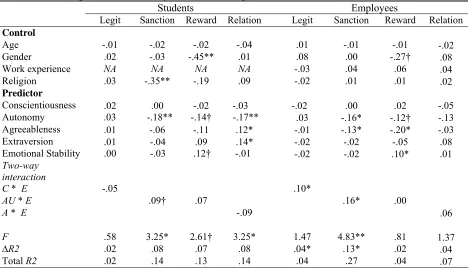
Table 3 The Impact of Personality on Side-Taking Motives
Students Employees
Legit Sanction Reward Relation Legit Sanction Reward Relation
Control
Age -.01 -.02 -.02 -.04 .01 -.01 -.01 -.02
Gender .02 -.03 -.45** .01 .08 .00 -.27† .08
Work experience NA NA NA NA -.03 .04 .06 .04
Religion .03 -.35** -.19 .09 -.02 .01 .01 .02
Predictor
Conscientiousness .02 .00 -.02 -.03 -.02 .00 .02 -.05 Autonomy .03 -.18** -.14† -.17** .03 -.16* -.12† -.13
Agreeableness .01 -.06 -.11 .12* -.01 -.13* -.20* -.03
Extraversion .01 -.04 .09 .14* -.02 -.02 -.05 .08
Emotional Stability .00 -.03 .12† -.01 -.02 -.02 .10* .01
Two-way interaction
C * E -.05 .10*
AU * E .09† .07 .16* .00
A * E -.09 .06
F .58 3.25* 2.61† 3.25* 1.47 4.83** .81 1.37
∆R2 .02 .08 .07 .08 .04* .13* .02 .04
Total R2 .02 .14 .13 .14 .04 .27 .04 .07
Note. Regression coefficients shown are unstandardized beta weights in step 2. †p < .10. *p < .05. **p < .01.
S = “Students (n = 111)”, E = “Employees (n = 101)”
C = “Conscientiousness”, AU = “Autonomy”, A = “Agreeableness”, E = “Extraversion”.
Test of the hypotheses
Legitimacy motivated side-taking. Hypothesis 1 presents a positive effect of Conscientiousness on legitimacy motivated side-taking. Hypothesis 4 posits that Extraversion will further moderate the link between Conscientiousness and Legitimacy motivated side-taking. The results in Table 3 indicated that Conscientiousness had no effect whatsoever on legitimacy motivated side-taking in both the student and the employee sample (bstudent = .02; ns; bemployee = -.02; ns) which rejects hypothesis 1. However, the interaction between Conscientiousness and Extraversion appeared to have a significant influence on legitimacy in the employee sample (bemployee = .10; p < .05), but not in the student sample (bstudent = -.05; ns). Though, note that the overall model was not significant for both student and employee sample (F = .58; ns, and F = 1.47; ns). This limits our confidence to draw the conclusion that Conscientiousness and Extraversion have a significant interaction effect on legitimacy motives.
Two reported cases from the open question section support the unpredictability of legitimacy motivated side-taking by Conscientiousness.
“When I was in the board of a student organization, I was also involved in organizing the introduction period for this organisation. Somebody asked me a favour. I didn’t know how I could combine this favour with my position in the board. So I rejected his request. He didn’t like this at all, but I had the feeling this was the only right thing to do” (Man, 25 years old.Mean personality score: C = -.52, AU = 1.37, A = 2.96, E = .98, ES = 2.22)
“There was a conflict in a group of my student organization. A very good friend and somebody who was far from friendly had a dispute. My best friend was not in the right. We talked about it and solved this businesslike” (Woman, 20 years old: Mean personality scores: C = 1.81, AU = 1.40, A = 2.10, E = .61, ES = -1.86).
Side-taking motivated by sanction avoidance. Hypothesis 2a presents a negative effect of Autonomy on side-taking motivated by sanction avoidance. Hypothesis 5a posits that Extraversion will further moderate the link between Autonomy and side-taking motivated by sanction avoidance. The results in Table 3 indicated similar results for both the student and the employee sample. Autonomy had a main negative effect on side-taking motivated by sanction avoidance (bstudent = -.21; p < .01 and bemployee = -.17; p <.05), which confirms hypothesis 5a.
A reported case from the open question section supports that individuals high in Autonomy do not let limit their freedom by proposed sanctions.
“I was working for a Belgium company who wanted to fire employees because of a complaint about the products caused by work machinery and not by personal mistakes. It affected the employees, who were not responsible for the errors and who had always worked more than necessary. I didn’t agree at all with his plans to fire some of us, so I stood up against his plans otherwise I would lose my self-respect. In the end, his plans didn’t work out, so I won. The relation between us did not improve of course”. (Man, 65 years old. Mean personality scores: C = .85, AU= 1.45, A = 1.03, E = -.75, ES = .84).
Moreover, the interaction between Autonomy and Extraversion had a significant influence on side-taking motivated by sanction avoidance (bstudent = .09; p < .10 and bemployee = .16; p < .05). This confirms hypothesis 5a about the moderating effect of Extraversion. The interaction models were significant in both student and employee samples (Fstudent = 3.25; p < .05, and Femployee = 4.83; p < .01).
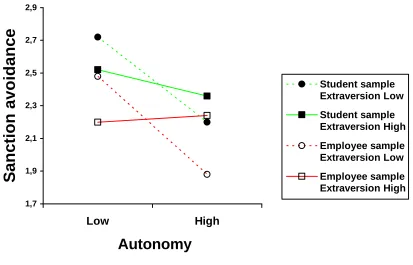
A depiction was conducted to further investigate how Autonomy and Extraversion jointly shape side-taking motivated by sanction avoidance. Figure 1 shows that when Extraversion is low, Autonomy has a negative effect on sanction avoiding motivated side-taking (bemployee = .17; p < .10). However, when Extraversion is high, the above mentioned negative relationship has disappeared (bemployee = .26; p < .10). From Figure 1, we also observe that when Autonomy and Extraversion are both low, the tendencies that lay third parties side with the disputant uses threats is maximum. When Autonomy is high
Sanction avoidance motives and Autonomy
Figure 1 Side-taking motivated by sanction avoidance regressed on Autonomy scores: low and high Extraversion groups. Student and the employee sample.
Relationship motivated side-taking. Hypothesis 3 predicts a main effect of Agreeableness on relationship motivated side-taking. Hypotheses 6 further assumes that Extraversion moderates this relationship. Table 3 showed a positive effect of Agreeableness on relationship motivated side-taking in the student sample (bstudent = .12; p < .05) which is in line with hypothesis 3. However, in the employee sample, this relationship disappeared (bemployee = -.03; ns). In addition, in both samples, the interaction effect between Agreeableness and Extraversion had no effect on relationship motivated side-taking (bstudent = -.09; ns; bemployee = .06; ns), suggesting that hypothesis 6 has to be rejected. The interaction model was significant for the student sample (Fstudent = 3.25; p < .05), but not for the employee sample (Femployee = 1.37; ns).
A reported case from the open question section supports that individuals high in Agreeableness have the tendency to side with the disputant they have a good relationship with.
“At my work there emerged a conflict between somebody from my engineering department and the other production department. I agreed with the arguments of the production, but tended to support the engineer. I supported the engineer because his arguments were okay and it felt more natural to support him, even if he was not completely right” (Man, 24 years old. Mean personality scores: C = .75, AU = 1.08, A = 2.37, E = .28, ES = 1.79).
Complementary analyses. Further analyses between Emotional Stability and side-taking motives showed that Emotional Stability had a positive main effect on reward receiving motivated side-taking in both samples (bstudent= .12; p < .10; bemployee= .10; p < .05). Which suggests that Emotional Stable individuals have the audacity to side with the disputant who benefits them most. They feel satisfied and stable about themselves, so they are not afraid of outsiders’ reactions and feel confident about their opportunistic way of side-taking.
Control variables have shown that gender should be taken into account in
samples. This was also shown in correlation analyses. Moreover, only in the student sample, and not in the employee sample, whether individuals are religious should be noted when interpreting sanction avoiding motives (bstudent= -.35; p < .01). Possibly, religious individuals perceive sanction avoidance motivated side-taking as inappropriate based on their religious norms. Non religious students have stronger tendencies for side-taking motivated by sanction-avoidance. This was also shown in the correlation analyses in Table 2.
Discussion
Side-taking is one of the main reactions by lay third parties when they are faced with two incompatible expectations from disputants with the consequence that the conflict often escalates. This study focuses on side-taking motives by lay third parties and especially explores the influence of lay third parties personality on their side-taking motives. Regarding to the findings on side-taking, three types of side-taking motives - legitimacy, interest, and relationship - are theoretically distinguished and then empirically confirmed in this study. Regarding to the impact of personality, the findings suggest that personality has an influence on side-taking. Namely, Autonomy and Agreeableness have proven to influence interest and relationship motives for side-taking, which confirms our hypotheses. We would like to highlight three points for discussion.
First, the significant negative influence of Autonomy on interest motivated side-taking deserves more attention. In both the student and the employee samples, the findings show that lay third parties who are high in Autonomy dislike to take sides based on self-interests. In other words, Autonomous lay third parties are less sensitive for extortion from disputants and do not want to let their action be limited by others. They tend not to take sides with the disputant coming with threats or rewards. This finding confirms the conclusion of Brehm (1966) that people frequently respond against pressure that limits their freedom by acting contrary to them.
The assumption that Extraversion moderates the link between Autonomy and side-taking motivated by sanction avoidance is confirmed in this study. From the interaction graph, we found two interesting findings concerning this link. First, when Extraversion is
However, when Extraversion is high, the above mentioned negative relationship disappears. The interaction graph also indicates that when Autonomy and Extraversion are low, lay third parties tendency to side with the disputant using threats is maximum. This may result from the lay third parties’ lack of perceived alternative options (low Autonomy: not insightful and not reflective) and their hesitance to reject the disputants demands placed on them (low Extraversion: not assertive, introvert). The AB5C-system of the Circumplex model enforces this results by describing individuals who are low on Autonomy and low Extraversion as conservative, slavish / servile, and narrow-minded. However, when Autonomy is high and Extraversion is low, lay third parties’ tendency to side with the disputant using threats is minimum. Third parties may take sides after contemplating the disputants’ claims and than react out their inner beliefs (high Autonomy: critical, rebellious, thoughtful) and do not value social relationships (low Extraversion: shy, not social, lonely ones); this makes them less likely to conform to a disputant’s requests. The AB5C-system of the Circumplex model enforces this results by describing individuals high in Autonomy and low in Extraversion as philosophical, complex, and thoughtful.
Third, the link between Conscientiousness and legitimacy motivated side-taking did not
appear in both samples, which disconfirms our hypothesis. This may be explained by the independent variable Conscientiousness. Conscientiousness appears to be a poor predictor for all side-taking motives. Conscientiousness appears to be the least frequent personality trait compared to the other four traits in the student sample. Conscientiousness was the most dominant trait among only 5 of the 111 students. Compared to the average score of 1.00 in the Dutch population, the students scored very low with an average score of .20. It seems that the student sample in this study is not a representative sample concerning Conscientiousness, which makes it difficult to predict legitimacy and other side-taking motives by Conscientiousness. The factor Conscientiousness in the employee sample seems normal, 19 of the 101 employees showed it as their major personality trait and the average score was .74. Mortimer, Finch, and Kumka (1982) have demonstrated that it is a normal tendency of Conscientiousness to be higher in the older employee sample because Conscientiousness normally increases with age. An explanation of the absence of Conscientiousness as a predictor of legitimacy in the employee sample is not yet clearly found in this study. A possible explanation could be that in a side-taking dilemma, Conscientious individuals may show other personality traits first because they are personally involved in a conflict which arouses emotions. The trait Conscientiousness may be not accurate enough due to the lack of taking emotional arguments into account to predict motives in complex and emotional side-taking situations.
Limitations
Three limitations should be noted when interpreting the results of this study. The first limitation concerns types of side-taking motives. In everyday life, different side-taking motives may intervene with each other and can not be distinguished as we assumed in theory. A reported case from the open-ended questions illustrates this combination of side-taking motives: “Rational arguments are most important to me in conflicts. The relationship with a colleague is less important, however, it is easier to discuss all the (counter) arguments with a friend. And of course, I have less tendency to provide the party who is not my friend with good arguments” (Man, 31 years old). This example shows the interfering of legitimacy and relationship motives which illustrates that a more fine-grained picture of side-taking motives should be investigated in further research. The second limitation concerns personality measured by the FFPI as a predictor of side-taking motives. However the FFPI measures a positive and negative pole of each trait and the Circumplex-model, possibly these five broad categories were still too general to specifically predict side-taking motives in an accurate way. A more fine-grained personality inventory could provide stronger influences on side-taking motives (e.g., Cattell's 16 Personality Factors).
The above mentioned limitations can be improved in further research. Focus groups and semi-structured interviews might be a good method to distinguish the types of side-taking motives which can improve the current side-side-taking questionnaire. Moreover, a specific personality inventory might be more suitable in predicting side-taking motives. In addition, it would be interesting for further research to investigate the combined
influence of personality and situation on side-taking motives.
Practical implications
To conclude this report, two practical applications are suggested. First, when one is in a conflict and wants to get support from outsiders, two strategies are recommended in forming an effective coalition. He/she should take the personality of the “target” (lay third party) into account. First, Autonomous “targets” it is better not persuade them by using threats or rewards; they may side opposite to you because they prefer their freedom of action. Second, concerning coalition forming with Agreeable individuals, one should influence them through social relationships. Agreeable lay third parties take social relationships seriously and are likely to side with the disputant they have a close relationship with. You have a good chance to gain their support when you are already close friends.
References
Aiken, L. S., & West, S. G. (1991). Multiple regression: Testing and Interpreting Interactions. Newbury Park, CA: Sage.
Antonioni, D. (1998). Relationship between the Big Five personality factors and conflict management styles. International Journal of Conflict Management, 9.
Barrick, M. R., & Mount, M. K. (1991). The Big Five personality dimensions and job performance: A meta-analyses. Personnel Psychology, 44, 1-26.
Berlyne, D. E. (1960) Conflict, Arousal, and Curiosity. McGraw-Hill: New York.
Bazerman, M. H., Curhan, J. R., Moore, D. A., & Valley, K. L. (2000). Negotiation.
Annual Review of Psychology, 51, 279-314.
Becker, P. (1999). Beyond the Big Five. Personality and Individual Differences, 26, 511-530.
Black, D. (1990). The Elementary Forms of Conflict Management. In New Directions in the Study of Justice, Law and Social Control 43-69. Arizona State University. New York: Plenum.
Brehm, J. W. (1966). Effect of a favor which reduces freedom. Journal of Personality and Social Psychology, 3, 420-426.
Chanin, M. N., & Schneer, J. A. (1984). A study of the relationship between Jungian personality dimensions and conflict handling behaviour. Human Relations, 37, 863-879.
Clark, M. S. & Jordan, S. D. (2002). Adherence to communal norms: What it means, when it occurs, and some thoughts on how it develops. In W. G. Graziano & B.
Costa, P. T., Jr., & McCrae, R.R. (1985). The NEO Personality Inventory manual. Odessa. FL: Psychological Assesment Resources.
De Raad, B. & Doddema-Winsemius, M. (2006). De Big 5 persoonlijkheids factoren. Amsterdam:Uitgeverij Nieuwezijds.
Deci, E.L. (1975). Intrinsic motivation.. New York: Plenum. Or: Motivation, will, and well-being. Unpublished manuscript, University of Rochester.
Deutsch, M. (1973). The Resolution of Conflict: Constructive and Destructive Processes. New Haven, CT: Yale Univ. Press.
Digman, J. M. (1990). Personality structure: Emergence of the five-factor model. Annual Review of Psychology, 41, 417- 442.
DiMaggio, P.J., & Powell, W. W. (1991). Introduction. In W. W. Powell & P.J. DiMaggio (Eds.), The new institutionalism in organizational analyses: 1-38. University of Chicago Press.
Dowling, J., & Pfeffer, J. (1975). Organizational legitimacy: Social values and organizational behavior. Pacific Sociological Review, 18, 122-136.
Eysenck, H. J., & Eysenck, S. B. G. (1975). Manual of the Eysenck Personality Questionnaire. San Diego, CA: Educational and Industrial Testing Service.
Felson, R. B. & Steadman, H. J. (1983). Situational Factors in Disputes Leading to Criminal Violence. Criminology 21, 59-74.
Glasl, F. (1980). The process of conflict escalation and roles of third parties. In G. J. Bomers & R. B. Peterson (Eds.), Conflict management and industrial relations 119-140. Hingham, MA: Kluwer Boston.
Goldberg, L. R. (1992). The development of markers for the Big-Five factor structure. Psychological Assessment, 4, 26-42.
Goldberg, L. R. (1999). A broad-bandwidth, public domain, personality inventory measuring the lower level facets of several five-factor models. In I. Mervielde, I. Deary, F. De Fruyt, & F. Ostendorf (Eds.), Personality psychology in Europe, 7, (pp 7-28). Tilburg University Press.
Graziano, W. G., Jensen-Campbell, L., & Hair, E. C. (1996). Perceiving interpersonal conflict and reacting to it: The case of agreeableness. Journal of Personality and Social Psychology, 70, 820-835.
Gross, N., W. S. Mason, & A. W. McEachern (1958). Explorations in Role Analysis: Studies of School Superintendency Role. New York: John Wiley.
Hendriks, A. A. J., Hofstee, W. K. B., & De Raad, B. (1999). The Five-Factor Personality Inventory (FFPI). Personality and Individual Differences, 27, 307-325.
Hofstee, W. K. B., & Hendriks, A. A. J. (1998). The use of scores anchored at the scale midpoint in reporting individuals’ traits. European Journal of Personality, 12, 219-228.
Hofstee, W. K. B., de Raad, B., & Goldberg, L. 1992. Integration of the big five and circumplex approaches to trait structure. Journal of Personality and Social Psychology, 65, 563-576.
Hogan, R. T. (1983). A social analytic theory of personality. In M. Page (Ed.), 1982 Nebraska Symposium on Motivation (pp. 55-89). Lincoln: University of Nebraska Press.
Hogan, R., J. Johnson, & S. Briggs (1997). Handbook of personality psychology. Academic Press, London (pp. 767-865). Second edition: San Diago: Academic Press (pp.383).
Hough, L. M. (1992). The ‘Big Five’ personality variables – construct confusion: Description versus prediction. Human Performance, 5, 139-155.
James, L. R. and Mazerolle, M. D. (2002). Personality in work organisations. Sage Publications: Thousand Oaks, CA.
Jackson, D. N. (1984). Personality Research Form manual (3rd ed.). Port Huron, MI: Research
Psychologists Press.
John, O.P. & Strivastava, S. (1999). The Big-Five Trait Taxonomy: History, Measurement and Theoretical Perspectives. In Handbook of Personality: Theory and Research (2nd
edition). New York: Guilford.
Judge, T. A., & Ilies, R. (2002). Relationship of personality to Performance Motivation: A analytic review. Journal of Applied Psychology, 87, 797-807.
King, E. B., George, J. M., & Hebl, M. R. (2005). Linking Personality to Helping Behaviours at Work: An interactional Perspective. Journal of Personality. Blackwell Publishing.
Maddi, S. R., & Berne, N. (1964). Novelty for productions and desire for novelty as active and passive forms of the need for variety. Journal of personality, 22, 270-277.
McCrae, R. R. (1994). Openness to experience: Expanding the boundaries of factor V. European Journal of Personality, 8, 251-272.
McCrae, R. R., & Costa, P. T., Jr. (1987). Validation of the Five-Factor model of
personality across instruments and observers. Journal of Personality and Social Psychology, 52, 81-90.
McCrae, R. R., & Costa, P. T., Jr. (1999). A five-factor theory of personality. In L. Pervin & O. P. John (Eds.), Handbook of personality: Theory and research (2nd ed.), 139-153. New York: Guilford.
McCrae, R. R., & John, O.P. (1992). An introduction to the five-factor model and its applications. Journal of Personality, 60, 175-215.
Mischel, W. (1977). The interaction of person and situation. In D. Magnusson & N. S. Endler (Eds.), Personality and the crossroads: Current issues and the interactional psychology (p.166-207). Hillsdale, NJ: Erlbaum.
Mortimer, J.T., Finch, M. D. & Kumka, D. (1982). Persistence and change in development: The multidimensional self-concept. In P. B. Baltes & O.G. Brim Jr. (Eds.) Life span development and behaviour, 4, (pp 264-315). New York: Academic Press.
Murray, V. V. (1975) “Some unanswered questions on organisational conflict.” Organization and Admin. Sci. 5, 35-53.
Nielsen E. H., & Rao, H. (1987). An ecology of agency arrangement: mortality of savings and loan associations. American Journal of Sociology, 82, 929-964.
Norman, W. (1963). Toward an adequate taxonomy of personality attributes: Replicated factor structure in peer nomination personality ratings. Journal of Abnormal and Social
Psychology, 66, 574-583.
Ohbuchi, K. L., Fukushima, O, & Tedeschi J. T. (1999). Cultural Values in Conflict Management Goal Orientation, Goal Attainment, and Tactical Decision. Journal of Cross-Cultural Psychology, 30, 51-71.
Perugini, M. & Gallucci, M. (2001). Individual differences and social norms: The distinction between reciprocators and prosocials. European Journal of Personality, 15, 19-35.
Philips, S. & Cooney, M. (2005). Aiding Peace, Abetting Violence: Third Parties and the Management of Conflict. American Sociological Review,70, 334-354.
Pruitt, D. G. & Carnevale, P. J. (1993). Relationships among the negation parties. Negotiations in social conflicts (pp. 130-155). Buckingham, Open University.
Rioux, S. M., & Penner, L. A. (2001). The causes of organisational citizenship behaviour: A motivational analyses. Journal of Applies Psychology, 86, 1306-1314.
Roccas, S., Sagiv, L., Schwartz, S. H., & Knafo, A. (2002). The Big Five personality factors and personal values. Personality and Social Psychology Bulletin, 28, 789-801.
Rubin, J.Z., Pruitt, D.G., & Kim, S.H. (1994). Social conflict: Escalation, stalemate, and settlement (2nded.). New York: McGraw-Hill.
Sheppard, B.H., Minton, J., Blumenfeld-Jones, K, Hyder, E., & Deeb, A. (1987). ‘Informal third party intervention: A tale of two models’. Unpublished manuscript.
Staub, E. (1980). Personality.Basic aspects and current research (pp. 236-294): Prentice Hall, Inc., Engelwood Cliffs
Suchman, M.C., (1995) Managing legitimacy: Strategic and institutional approaches. Academy Of Management Review, 20, No. 3, 571-610.
Tellegen, A. (1985). Structures of mood and personality and their relevance to assessing anxiety, with an emphasis on self-report. In A. H. Tuma & J.D. Maser (Eds), Anxiety and the anxiety disorders (pp. 681-706). Hillsdale, HJ: Erlbaum.
Van de Vliert, E. (1981). Siding and Other Reactions to a Conflict; A theory of escalation toward outsiders. Journal of conflict resolution, 25, No.3, 495-520. Sage Publications, Inc.
Van de Vliert, E. (1997). Complex interpersonal conflict behaviour: Theoretical Frontiers. Psychology Press, Hove, England.
Van de Vliert, E. & Cottrell, D. A. (1979) “The validity of the moral and expedient role interpretation test.” Journal. for theory of Social Behaviour, 109, 147-148.
Van de Vliert, E., & Mastenbroek, W. F. G. (1998). Negotiation. In P. J. D. Drenth & H. Thierry (Eds.), Handbook of work and organizational psychology (pp. 325-350). Hove: Taylor & Francis.
Van der Zee, K., & Perugini, M. (2006). Personality and Solidary Behaviour. Solidary and Prosocial Behaviour, 77-92. Springer: US.
Witt, L. A. (2002). The interactive Effects of Extraversion and Conscientiousness on Performance. Journal of Management, 835-851. University of New Orleans.
Watson, D. & Clark, L. A. (1997). Extraversion and its positive emotional core. In R. T. Hogan, J. A. Johnson, & S. R. Briggs, Handbook of personality psychology (pp. 767-793). San Diego: Academic Press.
Appendices
Appendix A Side-Taking Motive Scale (employees)
Introduction:
We highly appreciate your willingness to participate in this study. This is the second and last questionnaire of the personality and side-taking research. It will take you about 10 minutes to complete this questionnaire. All your answers will be treated confidentially. We would like to know your e-mail address in order to match this questionnaire with the data your have already provided to us.
E-mail address:______________________________________________
Instruction:
At your work place, you may sometimes be faced with a conflict, a dispute, or a disagreement between colleagues. As the disagreement progresses, especially when both sides want to gain your support, you may have to stand for one side or the other. We would like to know which factors influence your preference in side taking in work conflicts. Below you will find two examples of a conflict situation at work.
1) One of your colleagues is your friend as well. In a team project, he/she is not working fast because he/she is not motivated for the project anymore. The other team member becomes frustrated because of the attitude of your friend and wants him to quit the project.
2) An other possible situation could be about financial funds. Two colleagues are arguing about an financial investment. One colleague wants to invest in the development of new products, the other colleague advocates for investments in current products in order to optimize them.
Please note: We are interested in the general criteria over different work conflict situations which influence you in taking sides.
In the following scale, we list 22 statements concerning people’s opinions and reasons for taking sides in a conflict situation at work. There is no right or wrong answer to these statements. Please indicate to what extent you disagree or agree with each of the following statements.
If you strongly disagree, circle “1” in the scale next to the statement; if you strongly agreecircle “5” in that scale; if you neither disagree nor agree, circle “3”. Overall, please circle a number which fits your preference best by referring to the following key:
1= Strongly disagree
2= Disagree
3= Neither disagree nor agree 4= Agree
1 2 3 4 5 Strongly disagree Disagree Neither disagree nor agree Agree Strongly agree
1. I choose to stand for the side whose arguments sound
proper. 1 2 3 4 5
2. The more a colleague’s arguments are in the right, the
more I am inclined to support him/her. 1 2 3 4 5 3. I stand for legitimate principles, regardless of the rest. 1 2 3 4 5 4. I am comfortable in supporting the side whose arguments 1 2 3 4 5
are right.
5. Some people take side only based on who is right or who is wrong.
I don’t like those kind of people.
1 2 3 4 5
1. The stronger the social connection I have with a colleague,
the more I am inclined to support him/her. 1 2 3 4 5 2. I give priority to the colleague who is my friend. 1 2 3 4 5 3. When I have a close relationship with one of the
colleagues, I intend to support him/her. 1 2 3 4 5 4. In order support the colleague who is my friend, I tend to
reject any persuasion from the other party. 1 2 3 4 5 5. In deciding whom I will support, it is difficult for me to
ignore the relationships I have with both colleagues . 1 2 3 4 5 6. Some people take side with the colleague they have a close
relationship with. I don’t like these type of persons. 1 2 3 4 5 4. Whether I will get in trouble or not, will influence
my side-taking decision 1 2 3 4 5
5. The more threats a disputant makes, the less I am willing to
1 2 3 4 5 Strongly disagree Disagree Neither disagree nor agree Agree Strongly agree
1. I choose to stand for the disputant who can reward me. 1 2 3 4 5 2. The more benefit I can receive from a party, the more I
am inclined to support him/her. 1 2 3 4 5
3. I care about what I can gain when choosing which side to
support. 1 2 3 4 5
4. I tend to support the party who promises to reward me. 1 2 3 4 5 5. It is difficult for me to disregard the benefits I can gain
from taking sides. 1 2 3 4 5
In your work, did you ever experience a conflict, a dispute, or a disagreement between colleagues? Would you like to share that experience(s) with us? Please report your experience(s) in the following box and continue on the backside of this page when necessary.
……… ……… ……… ……… ……… ………
……… ……… ………
The following questions are not obligated to fill out.
Gender: □ Male □ Female
Age: _____ years old
What is your political preference?
Left Middle/Centre Right Other
This is the end of the questionnaire. Thank you very much for your contribution and cooperation to this research!
Appendix B Factor analyse
Table B Item Content of Side Taking Motivation Scale and Corresponding Loadings on the Four Factors of the Student and Employee Sample
Legitimacy L IS IR R
I stand for legitimate principles, whoever the disputants are.
**I stand for legitimate principles, regardless of the rest. .40
The more a side’s arguments are in the right, the more I am inclined to support him/her. The more a colleague’s arguments are in the right, the more I am inclined to support him/her.
.76 .84
I am comfortable in supporting the side whose arguments are right. I am comfortable in supporting the side whose arguments are right.
.68 .77
I choose to stand for the side whose arguments sound proper. I choose to stand for the side whose arguments sound proper.
.68 .79
~ I dislike people who choose sides only based on who is right or who is wrong.
** ~ Some people take side only based on who is right or who is wrong. I don’t like those kind of people.
*I give priority to the side with reasonable arguments.
Sanction L IS IR R
I choose for the disputant who can punish me. I choose for the disputant who can punish me.
.72 .74
The more damage a side can bring to me, the more I am inclined to support him/her. The more damage a side can bring to me, the more I am inclined to support him/her.
.75 .68
.40
*I give priority to the party who can threaten me. .62
My side-taking decision will be influenced by whether a disputant can make trouble for me.
**Whether I will get in trouble or not, will influence my side-taking decision. .50 .45 .61
~ The more threats a side makes, the less I am willing to support him/her.
** ~ The more threats a disputant makes, the less I am willing to support him/her. .41
-.50 -.41
~ I would side against the disputant, even when I know he/she can punish me for the consequences.
~ I would side against the colleague, even when I know he/she can punish me for the consequences. .36
-.49 -.43
* ~ When making up my mind, I care less about the negative consequences produced by the conflicting parties. -.48
Reward L IS IR R
The more benefit I can receive from a party, the more I am inclined to support him/her. The more benefit I can receive from a party, the more I am inclined to support him/her.
.83 .81
*If I can receive something in return from a side, I will most likely stand up for him/her.
.81
I care about what I can gain when choosing which side to support. I care about what I can gain when choosing which side to support.
.38 .81
.83
I choose to stand for the side who can reward me.
I choose to stand for the disputant who can reward me. .38 .76 .77
*I calculate how much I can gain from each side before I support him/her. .74
I tend to support the disputant who promises to reward me. I tend to support theparty who promises to reward me.
.71 .78
*~ I dislike people who stand up for a disputant because of self-interests. -.61
It is difficult for me to disregard the benefits I can gain from taking someone’s side. It is difficult for me to disregard the benefits I can gain from taking sides.
.56 .68
Note. L represents “legitimacy motivated side-taking”, IS represents “sanction-avoidance motivated side-taking”, IR
“reward receiving motivated side-taking”, and R represents “relationship motivated side-taking”. Factor loadings > 0.35 are shown. represents
Relationship L IS IR R
I give priority to the side who is a friend of mine. I give priority to the colleague who is my friend.
.76 -.67
In deciding whom I will support, it is difficult for me to ignore the relationships I have with both parties. In deciding whom I will support, it is difficult for me to ignore the relationships I have with both colleagues.
.70 -.65 *I choose to stand for the side with whom I have a good relationship. .70
When I have a close relationship with one of the disputants, I intend to support him/her. When I have a close relationship with one of the colleagues, I intend to support him/her.
.66 -.83
In order support my friend, I tend to reject any persuasion from the side who is a stranger to me. In order support the colleague who is my friend, I tend to reject any persuasion from the other party.
.39 -.67
* ~ I would side against a party even when I have a good relationship with him/her. .44 -.44
~ I dislike people who take the side with the disputant they have a close relationship with.
~ Some people take side with the colleague they have a close relationship with. I don’t like these type of persons.
-.39
.46
Items with ~ in front are negatively formulated items, their factor loadings are based on non-recoded. The Cronbach’s alpha’s, correlation and regression analyses were calculated on base of recoded scores.