A Comparative Study of Different Sentiment Lexica for Sentiment
Analysis of Tweets
Canberk ¨Ozdemir and Sabine Bergler
CLaC Labs, Concordia University 1455 de Maisonneuve Blvd West Montreal, Quebec, Canada, H3G 1M8
[email protected], [email protected]
Abstract
We report on interoperability of different sentiment lexica with each other and with the linguistic notionsnegationand modal-ity for sentiment analysis of tweets in a comprehensive ablation study and in com-petition results for SemEval 2015. Our ap-proach performed well at the tweet level, but excelled in the presence of figurative language.
1 Introduction
Increasing interest in social media is reflected in SemEval competitions on sentiment analysis of tweets. Sentiment analysis categorizes text into positive or negative sentiment, possibly with an additional neutral category (Pang and Lee, 2008). Tweets use more informal and non-standard lan-guage than other text forms posing additional chal-lenges. The winners of the past two years made heavy use of their specially designed NRC lex-icon (Mohammad et al., 2013; Kiritchenko et al., 2014), a large lexical resource extracted from tweets with hashtags that are unmistakably pos-itive or negative. This leads to the question we address here: is a bigger lexicon (proportionally) more useful? Is there something special about the NRC lexicon? Is a lexicon that is designed like the NRC lexicon but ten times its size more useful? And finally, can linguistic contextsnegationand modalityimprove the lexicon and the final classi-fication?
We compiled a NRC-inspired lexical resource, Gezi, of seven times the size of the NRC lexi-con. We used several lexica in various combina-tions: Gezi, NRC, Bing Liu’s lexicon (Hu and Liu, 2004), MPQA (Wilson et al., 2005), and aFinn
(Nielsen, 2011), and add negation and modality sensitive features, performing comprehensive ab-lation experiments. The system competed in Se-mEval 2015 and ranked 9/40 in Task 10B, senti-ment classification of tweets, and 1/35 in Task 11, tweets featuring figurative language.
2 Previous Work
2014, together with a simple negation feature. The attention paid to sentiment in tweets led to the development of the CMU tagger Gimpel et al. (2011), a tokenizer and a POS tagger for tweets, as well as a named-entity recognizer for tweets (Rit-ter et al., 2011).
3 SemEval Datasets
The datasets for the SemEval exercises have been annotated using Amazon’s Mechanical Turk1for
Task 10 and CrowdFlower2for Task 11. The
re-sulting annotations include, as expected, mislabel-ings and borderline judgements in the gold stan-dard, such as:
labelled as negativeI haven’t eaten chicken nuggets since I was like 6 or 7.. Who wants to get some McDonald’s with me tomorrow?
labelled as neutralClass early in the mornjng =\it’s bed-time! But do get to see my Sam tomorrow :)
Polarity Classification Dataset Tweets with at least one term of SentiWordNet (Esuli and Sebas-tiani, 2006) association score greater than 0.3 or less than -0.3 form the corpus that is then manu-ally labelled as positive, negative, or neutral.
The different test sets for 2013 (Nakov et al., 2013), 2014 (Rosenthal et al., 2014) and 2015 (Rosenthal et al., 2015) show a skewed distribu-tion: with the exception of 2014, the majority of test cases are neutral and negative tweets form the smallest class, with the distribution changing slightly from year to year, see Table 1, where ‘tw’ stands for ‘tweet’, ‘lj’ for ‘LiveJournal’ entries, and ‘sarc’ for ‘sarcastic tweets’, different sources for test data for comparison.
Dataset Positive Negative Neutral tw-train 3,662 1,466 4,600
tw-dev 575 340 739
2013-tw-test 1,572 601 1,640 2013-sms-test 492 394 1,207 2014-tw-test 982 202 669 2014-sarc-test 33 40 13 2014-lj-test 427 304 411 2015-tw-test 1,038 365 987
Table 1: Dataset composition for Task10B.
Figurative Language Dataset The training set, consisting of 8000 tweets containing 5000 sarcas-tic, 1000 ironical and 2000 metaphorical tweets, was annotated on an 11 point scale (-5, . . . , +5)
1https://www.mturk.com/mturk/ 2http://www.crowdflower.com/
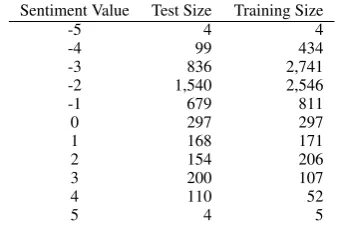
and released in two formats: tweets with integer or real-valued sentiment scores. The nature of fig-urative language tends to be negative Ghosh et al. (2015), Table 2 shows the distribution of instances for each integer sentiment score for training and test set.
Sentiment Value Test Size Training Size
-5 4 4
-4 99 434
-3 836 2,741
-2 1,540 2,546
-1 679 811
0 297 297
1 168 171
2 154 206
3 200 107
4 110 52
5 4 5
Table 2: Composition of datasets for Task 11.
4 Linguistic Notions
Following the successful use of a simple negation heuristic in (Kiritchenko et al., 2014), we further develop the use of the linguistic phenomena nega-tionandmodality. Negation and modality change the effect of the terms that occur in their scope, even though this change is not always one of total sentiment reversal for negation (a) or weakening for modality (b).
a.Just watched the whole 2nd season of AHS in less then 24 hours. I’m not even ashamed.
b. Max might have to get put down tomorrow <3 absolutely heart breaking if I have to see my puppy go. Love you Maxy
We use modality triggers would like, would love, should, ought to, must, may, might, could, will, would, can, ca, cant, cannot, able, unable; negation triggers from Rosenberg (2013); scope rules of Rosenberg et al. (2012).
could take the garbage out.) and negation in-teract (She might not have done the dishes for you.). This impacts tasks of information extrac-tion from on-line texts and while these phenom-ena have long been neglected as comparatively rare and benign in information retrieval contexts, precision-oriented information extraction has ad-dressed negation and recently modality in a series of challenge tasks (BioNLP Shared Tasks 2008-2010 (Kim et al., 2009), CoNLL 2008-2010 (Farkas et al., 2010), *Sem(Morante and Blanco, 2012), QA4MRE (Morante and Daelemans, 2012)).
Negation and modality affect sentiment (I am not happy! does not convey positive sentiment). Even simple negation heuristics are beneficial: consider the scope of the negation to span from a negation trigger to the next punctuation mark (Mo-hammad et al., 2013) or to occupy a fixed window around the negation trigger (G¨unther and Furrer, 2013). Our system uses a syntax-aware negation trigger and scope detection system developed by Rosenberg (2013).
The effect that negation is interpreted to have on the interpretation of a text varies. Kennedy and Inkpen (2005) encode negation as a simple reverser of polarity values (multiplying them by -1). However, negation does not always reverse the effects of the sentiment carriers, as the case of judgements illustrates: This isn’t awful. does not mean This is fantastic. Since negated senti-ment carriers do not default to one fixed resulting sentiment value but have to be assessed in their linguistic context, we do not resolve the negation numerically, but encode its occurrence in a sep-arate feature (negated-positive, negated-negative, negated-neutral), a technique similar to Kennedy and Inkpen (2006).When computing the associa-tion scores for our Gezi lexical resource, a nega-tion context results in multiplying sentiment as-sociation scores of sentiment carriers by -0.5, an empirically derived value.
Modality Modality indicates possibility, it dampens the asserted veridicity of a statement, often accompagnied by the reason for the hedging: second hand information, belief, hypothetical, . . . In utility texts like newspaper articles or UNIX documentation, modality is a rare phenomenon. But in journal articles in the life sciences or in tweets, it is frequent and carries important meaning aspects. The BioNLP Shared Task series (Kim et al., 2009) paid special attention to
speculative language, and QA4MRE (Morante and Daelemans, 2012) additionally addressed the interaction of negation and modality. Following Rosenberg et al. (2012), whose treatment at the QA4MRE pilot dominated the competition, we treat modality the same as we treat negation: a trigger list and scope annotation indicate the modalized material and we represent this and its interaction with negation by doubling our encoded features to include for example mod-positive, negation-mod-positive, mod-negation-positive (see Table 5).
5 Lexical Resources
A number of sentiment lexica are available and have been used in various systems. To our knowl-edge, they have not been compared critically on the same task to assess their respective contribu-tion alone or in combinacontribu-tion. We perform such a comparative ablation exercise on some of the more widely used lexica in order to assess our own new lexical resource, Gezi.
5.1 Manually Compiled Lexica
We include MPQA lexicon and Bing Lius Opin-ion Lexicon, which includes MPQA entries and thus provides a first means to compare how size impacts performance. To complete the picture, we also use the much smaller aFinn lexicon.
MPQA (Wilson et al., 2005), manually com-piled with prior polarities for over 8000 words, distinguishingpositive, negative, andneutral. The terms also have pseudo-POS tag information for disambiguation purposes.
Opinion Lexicon of Bing Liu (Hu and Liu,
2004), manually selected lexicon of around 6800 terms, onlypositiveandnegative.
aFinn (Nielsen, 2011), lexicon of words manu-ally rated for valence scores with an integer be-tween -5 and 5 together with their prior polarities, around 2500 words.
5.2 Automatically Compiled Lexica
NRC Hashtag Sentiment Lexicon
calculate PMI3based association scores (Church
and Hanks, 1990), substituting seed hashtags for emoticons in the technique championed by (Go et al., 2009). The lexicon contains 54,129 uni-grams, 316,531 bigrams and 480,010 skip bigrams extracted from their tweet collection.
Gezi ( ¨Ozdemir and Bergler, 2015) further de-velops this technique: nearly 20 million tweets are processed to calculate PMI scores for 376,863 unigrams, 922,773 bigrams and 850,074 depen-dency triples. Seed hashtags stem from 35 positive and 34 negative synonyms ofgoodandbadin the Oxford American Writers Thesaurus (Moody and Lindberg, 2012).
We remove duplicates, retweets, and modified tweets; tweets with mixed negative and posi-tive seed hashtags; tweets who consist mostly of URLs, hashtags, and usernames. Then, we label the tweets with the unique sentiment of their seed hashtag(s) after deleting URLs. Finally, we pre-process the collection and extract features. The tweet collection is tokenized using the CMU and Annie tokenizers (Gimpel et al., 2011; Cunning-ham et al., 2002), and parsed using the Stanford parser (Socher et al., 2013; de Marneffe and Man-ning, 2008). Negation and modality triggers are identified and their scope is determined (Rosen-berg et al., 2012) in order to extract the context-aware sentiment association values4with PMI for
unigrams, bigrams, and dependency triples (type-governor-dependent).
6 Validating Gezi on Subtask 10E
SemEval 2015 included a pilot task, Subtask 10E, which asked to determine association scores of given target terms with sentiment in tweets.
We tested our Gezi unigrams and bigrams to-gether with the smallest but very effective aFinn lexicon in a simple rule-based approach:
1. If a target term is covered by a Gezi bigram, only this bigram score is used, to avoid dou-ble counting the unigram sentiment carrier and negation annotation, if they exist.
2. If a carrier is in a negation scope, its prior sentiment score is multiplied with -0.5.
3pointwise mutual information
4Note that words have separate entries for different
part-of-speech.
3. Sentiment scores from aFinn and Gezi are normalized to a common scale and averaged.
4. Each prior sentiment score is scaled to [0,1]
5. If the target term cannot be assigned a score with the preceding rules, the score assigned is 0.5 (neither positive nor negative).
This approach ranked 4th among 10 submit-ted systems in both Kendall and Spearman cor-relation coefficient (Nelson, 2001) evaluations: Our Kendall rank correlation coefficient is 0.584, where other results range between 0.625 and 0.254, and our Spearman rank correlation coeffi-cient is 0.777, where others range between 0.817 and 0.373, validating Gezi unigrams and bigrams.
7 Association Ratios to Prior Polarities
Association ratios yield continuous values and re-quire thresholds to assign discrete prior polarities to lexicon entries.
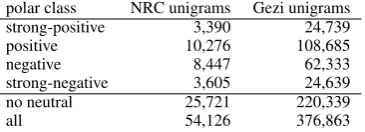
For Gezi, we partitioned the association ratios into five categories, strong positive, positive, ex-clusion, negative,andstrong negative. The mid-dle category (association score close to 0) denotes terms that occur nearly as often in tweets labelled negative as in positive ones and a clear classifica-tion is not possible. The reason may be that the term is sentiment neutral (box) or that it can take on different sentiment in different contexts ( posi-tivecarries negative sentiment in infection-related contexts). Rather than calling these termsneutral, we eliminate them entirely from Gezi.
polar class NRC unigrams Gezi unigrams strong-positive 3,390 24,739 positive 10,276 108,685
negative 8,447 62,333
strong-negative 3,605 24,639 no neutral 25,721 220,339
all 54,126 376,863
Table 3: Prior polarity class distribution.
8 Term Overlap for Different Lexica
To assess the relationship of size to unique con-tent, we paired the five corpora and determined the size of theIntersectionof the terms covered, indi-cating separately in how many cases the assigned sentiment value is the same (Agreement). Here, Ratio=IntersectionAgreement.
Lex A Lex B Intersection Agreement Ratio
aFinn NRC 989 822 0.831
aFinn Gezi 1,911 1,624 0.85 Liu NRC 1,840 1,488 0.809 Liu Gezi 4,028 3,386 0.841 MPQA NRC 1,819 1,340 0.737 MPQA Gezi 4,105 2,993 0.729 NRC Gezi 16,868 13,957 0.827 MPQA Liu 5,414 5,369 0.992 aFinn Liu 1,314 1,298 0.988 MPQA aFinn 1,246 1,202 0.965
Table 4: Intersection and agreement of lexica.
Unsurprisingly, the greatest agreement is be-tween the smaller, manually curated lexica, which are based in part on common material (like the Harvard General Inquirer and the MPQA cor-pus). As expected, MPQALiu displays the great-est degree of agreement among these lexica, since MPQA formed the seed for Liu. But the low-est agreement is between MPQA and Gezi, the biggest lexicon (explained in part by the lack of the neutral category in Gezi), while Gezi-Liu has fifth-highest agreement. These observations sug-gest that bigger is not proportionally better: while the smaller lexica encode more of a consensus set of clear sentiment carriers, the larger lexica encode increasing amounts of low-frequency terms from the sentiment fringe, which makes their out of do-main performance more volatile.
9 Experimental Setup
For the SemEval 2015 challenges, we process tweets in GATE (Cunningham et al., 2013) to ex-tract features and run supervised machine learning algorithms using Weka (Witten and Frank, 2011).
Tokenization and POS Tagging The GATE
plugin Annie tokenizer (Cunningham et al., 2002) is mature and robustly trained outside Twitter. It deals well with complex tokens, but it is not adapted to tweet-specific tokens. The CMU tok-enizer (Gimpel et al., 2011) is a new tool that has been trained on Twitter data and expressly targets non-standard tokens such as emoticons, urls, ex-clamations (!!!!!), hashtags, etc. We prioritize the CMU tagger and use its tokens and POS tags when they are Twitter-specific, otherwise we use the An-nie tokens, unless Ritter et al. (2011) suggests fus-ing multi-word entity names.
Text Normalization excludes Twitter-specific tokens that occur at the beginning and end of a sentence to improves parser performance.
Sentiment Lookup All lexical resources were transformed into gazetteer lists for each sentiment category. We use POS tag information to disam-biguate senses where necessary and exclude senti-ment carriers from the body of named entities.
Parsing by the Stanford parser and dependency module Version 3.4.1 (Socher et al., 2013; de Marneffe and Manning, 2008) forms the basis for NEGATOR (Rosenberg, 2013) to identify nega-tion and modality triggers and their scope.
Feature Creation To represent our features
compactly, we use compound primary features that encodepolarity class in linguistic contextas described above paired with thelexical resource that supplied this score. Abstracting away from actual sentiment terms to their polarity class helps to manage the feature space dimensionality. It also smoothes over the different lexical gaps of each lexicon. Primary features from a lexical resource are bundled under the name of that lexicon.
Table 5 shows the primary features created from the aFinn for Example 1. The only sentiment car-rier term from aFinn is perfect, with a positive score of3. There is also a negation trigger which scopes overperfect, the scope is underlined. The resulting feature ispositive-aFinn-negatedwith a score of -0.5*3=-1.5 in Table 5.
(1) El Classico on a Sunday Night isn’t perfectfor the Monday Morning !!
feature value positive-aFinn 0 positive-aFinn-negated 1 positive-aFinn-mod 0 positive-aFinn-mod-negated 0 negative-aFinn 0 negative-aFinn-negated 0 negative-aFinn-mod 0 negative-aFinn-mod-negated 0
aFinn-score -1.5
Table 5: aFinn subset features for Example 1.
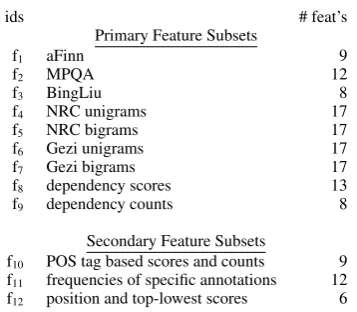
connectors and markers), frequencies and senti-ment association scores for tokens with specific POS tags, POS tags and sentiment association scores of the first and last two tokens of tweets, and the highest and lowest sentiment association scores within tweets, see Table 6.
ids # feat’s
Primary Feature Subsets
f1 aFinn 9
f2 MPQA 12
f3 BingLiu 8
f4 NRC unigrams 17
f5 NRC bigrams 17
f6 Gezi unigrams 17
f7 Gezi bigrams 17
f8 dependency scores 13
f9 dependency counts 8
Secondary Feature Subsets
f10 POS tag based scores and counts 9
f11 frequencies of specific annotations 12
f12 position and top-lowest scores 6
Table 6: Feature subset bundles with IDs.
Feature Combinations We combined the
twelve feature bundles of Table 6 in all possi-ble combinations for a comprehensive ablation study. Feature combinations are processed with libSVM (Chang and Lin, 2011) with RBF kernel and parameters of cost=5, gamma=0.001 and weights=[neutral=1; positive=2; negative=2.9] in Weka (Witten and Frank, 2011) for Subtask 10B and M5P (Wang and Witten, 1997), a decision tree regressor, to predict continuous values for Task 11. These were exhaustively combined with the technique of (Shareghi and Bergler, 2013).
10 SemEval Results and Ablation
For Task 10B, tweet polarity classification, we submitted the results of f1,2,3,6,8,9,10,11,12containing
feature subsets of aFinn, MPQA, Liu, Gezi uni-grams, dependencies and secondary feature set, 94
features in total. Our submission achieved an aver-age F-measure of positive and negative classes of 62.00, 9th among 40 submissions. Table 7 details our performance on all datasets scored. The top-performing submission achieved 64.84 f-measure. The fact that the results were this close makes it difficult to attribute them to the techniques re-ported wholesale and more comparison experi-ments need to be conducted.
dataset F1 Rank
Twitter2015 62.00 9/40 Twitter2015Sarcasm 58.55 9/40 LiveJournal2014 73.59 6/40 SMS2013 63.05 18/40 Twitter2013 70.42 7/40 Twitter2014 70.16 9/40 Twitter2014Sarcasm 51.43 10/40
Table 7: Official results for SemEval Task 10B.
For Task 11, sentiment degree association to tweets of figurative language, we submitted
f1,2,3,6,7,10,11,12 containing aFinn, MPQA, Liu,
Gezi unigrams-bigrams, and secondary feature set, totally 90 features. The challenge uses two evaluation metrics: cosine similarity and mean-squared error. According to both metrics, our sub-mission ranked first, see Table 8.
MSE
Overall Sarcasm Irony Metaphor Other 2.117 1.023 0.779 3.155 3.411 Cosine
Overall Sarcasm Irony Metaphor Other 0.758 0.892 0.904 0.655 0.584
Table 8: Official results for SemEval Task 11.
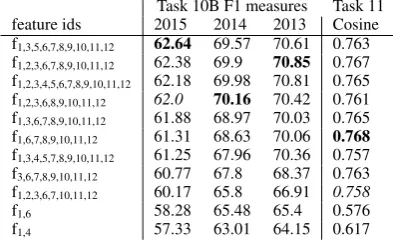
Ablation studies Table 9 compares results for different feature bundles from our ablation stud-ies. The results in italics represent official chal-lenge results, while results in bold represent the best performing bundle for given datasets.
Our choice of system for Task 10B was in-formed by good performance on both, 2013 and 2014 datasets. Our best performing feature bundle is only marginally better and leaves a 2% gap to the competition winner.
Task 10B F1 measures Task 11 feature ids 2015 2014 2013 Cosine f1,3,5,6,7,8,9,10,11,12 62.64 69.57 70.61 0.763
f1,2,3,6,7,8,9,10,11,12 62.38 69.9 70.85 0.767
f1,2,3,4,5,6,7,8,9,10,11,12 62.18 69.98 70.81 0.765
f1,2,3,6,8,9,10,11,12 62.0 70.16 70.42 0.761
f1,3,6,7,8,9,10,11,12 61.88 68.97 70.03 0.765
f1,6,7,8,9,10,11,12 61.31 68.63 70.06 0.768
f1,3,4,5,7,8,9,10,11,12 61.25 67.96 70.36 0.757
f3,6,7,8,9,10,11,12 60.77 67.8 68.37 0.763
f1,2,3,6,7,10,11,12 60.17 65.8 66.91 0.758
f1,6 58.28 65.48 65.4 0.576
f1,4 57.33 63.01 64.15 0.617
Table 9: Performance of different feature bundles.
No single feature bundle performs best on all datasets, however, since the best performers for each dataset include almost all features with small variations, we conclude that the different features are compatible and at least to a small degree en-code complementary information. However, the feature bundle that contains all features is never the top performer, indicating some interference between features. Note that among the four top performing bundles in Table 9, only NRC uni-grams is not present at all! This surprising result is probably due to Gezi being very similar but big-ger, which is supported by the comparison bun-dles that include only aFinn and NRC or aFinn and Gezi: Gezi outperforms NRC for Task 10B by a very small margin, considering its ten-fold size difference. For Task 11, however, NRC out-performs Gezi in this baseline combination.
Table 9 shows the secondary feature bundles
f10,11,12in every combination. These are corrective
measures that were frequent and obvious enough to catch our eye and are thus very effective. More surprising is the strong performance of simple de-pendency feature association scores, present in all top performing feature bundles.
Impact of Size Expectedly, performing worst are the single feature bundles, in particular each lexicon used as the sole feature for the classifi-cation task, see Table 10.The surprise: aFinn, the smallest (ca. 1% of Gezi), manually curated lexi-con not only dominates the others, but enhanced with our linguistic context annotations performs only 12% worse than the best bundle on 2015 data. We speculate that the reason is the design criterion (Nielsen, 2011) for aFinn to eliminate entries that may have conflicting sentiment labels altogether. This sends a very simple and clear message: reli-ability ranks above quantity. This of course limits
aFinn to the uncontroversial core of the fuzzy set of sentiment carriers, but below that glass ceiling, it is the one to beat. Gezi, with its 100-fold size ad-vantage trails aFinn by a mere 0.3%, which gives hope that automatically extracted lexica that in-clude the volatile fringe can, with enough training data, approximate aFinns performance (and likely surpass it in time, as it already does for the 2014 data). The NRC lexicon which is 10-fold aFinns size, trails its performance by 5%.
Task 10B F1 measures Task 11 feature ids 2015 2014 2013 Cosine f1:aFinn 54.97 60.26 62.19 0.558
f6:Gezi uni 54.65 60.81 57.86 0.554
f3:Liu 53.88 53.9 57.2 0.555
f2:MPQA 52.22 51.42 53.39 0.548
f4:NRC uni 49.83 52.39 50.9 0.609
Table 10: Task 10B’s lexical sets results. Comparing Gezi to NRC, we see that adding negation scope while enlarging the size of the tweet collection for automatically creating a re-source increases its efficiency, supported by the fact that Gezi intersects and agrees with manually created lexica to a higher degree than NRC, see Table 4. But NRC outperforms Gezi in the two-lexicon-only runs f1,6and f1,4of Table 9.
11 Conclusion
Acknowledgments
This work has been funded by a grant from Canada’s Natural Science and Engineering Re-search Council (NSERC).
References
Chih-Chung Chang and Chih-Jen Lin. 2011. LIB-SVM: A library for support vector machines. ACM Trans. Intell. Syst. Technol., 2(3):27:1–27:27. Kenneth Ward Church and Patrick Hanks. 1990. Word
association norms, mutual information, and lexicog-raphy.Computational Linguistics, 16(1).
Hamish Cunningham, Diana Maynard, Kalina Bontcheva, and Valentin Tablan. 2002. GATE: an architecture for development of robust HLT appli-cations. In Proceedings of 40th Annual Meeting of the Association for Computational Linguistics, July 2002 (ACL’02), pages 168–175, Philadelphia, Pennsylvania, USA.
Hamish Cunningham, Valentin Tablan, Angus Roberts, and Kalina Bontcheva. 2013. Getting more out of biomedical documents with GATE’s full lifecy-cle open source text analytics.PLoS Computational Biology, 9(2).
Marie-Catherine de Marneffe and Christopher D. Man-ning. 2008. The Stanford typed dependencies rep-resentation. InCOLING 2008: Proceedings of the Workshop on Cross-Framework and Cross-Domain Parser Evaluation, 18-22 August 2008, CrossParser ’08, pages 1–8, Manchester, United Kingdom. Andrea Esuli and Fabrizio Sebastiani. 2006.
Sen-tiwordnet: A publicly available lexical resource for opinion mining. InIn Proceedings of the 5th Conference on Language Resources and Evaluation (LREC’06, 24-26 May 2006, Genoa, Italy, pages 417–422.
Rich´ard Farkas, Veronika Vincze, Gy¨orgy M´ora, J´anos Csirik, and Gy¨orgy Szarvas. 2010. The CoNLL-2010 shared task: Learning to detect hedges and their scope in natural language text. In Proceed-ings of the Fourteenth Conference on Computational Natural Language Learning — Shared Task, July 15-16, 2010, CoNLL ’10: Shared Task, pages 1–12, Uppsala, Sweden.
Aniruddha Ghosh, Guofu Li, Tony Veale, Paolo Rosso, Ekaterina Shutova, John Barnden, and Antonio Reyes. 2015. SemEval-2015 Task 11: Sentiment analysis of figurative language in Twitter. In Pro-ceedings of the 9th International Workshop on Se-mantic Evaluation (SemEval 2015), 1-5 June 2015, pages 470–478, Denver, CO, USA.
Kevin Gimpel, Nathan Schneider, Brendan O’Connor, Dipanjan Das, Daniel Mills, Jacob Eisenstein, Michael Heilman, Dani Yogatama, Jeffrey Flanigan,
and Noah A. Smith. 2011. Part-of-speech tagging for Twitter: Annotation, features, and experiments. InProceedings of the 49th Annual Meeting of the Association for Computational Linguistics: Human Language Technologies: Short Papers - Volume 2, 19-24 June 2011, HLT ’11, pages 42–47, Portland, Oregon, USA.
Alec Go, Richa Bhayani, and Lei Huang. 2009. Twit-ter sentiment classification using distant supervision. CS224N Project Report, Stanford, pages 1–12. Tobias G¨unther and Lenz Furrer. 2013. GU-MLT-LT:
Sentiment analysis of short messages using linguis-tic features and stochaslinguis-tic gradient descent. In Sec-ond Joint Conference on Lexical and Computational Semantics (*SEM), Volume 2: Proceedings of the Seventh International Workshop on Semantic Eval-uation (SemEval 2013), June 2013, pages 328–332, Atlanta, Georgia, USA.
Minqing Hu and Bing Liu. 2004. Mining and sum-marizing customer reviews. InProceedings of the Tenth ACM SIGKDD International Conference on Knowledge Discovery and Data Mining, August 22-25, 2004, KDD ’04, pages 168–177, Seattle, WA, USA.
Alistair Kennedy and Diana Inkpen. 2005. Senti-ment classification of movie and product reviews us-ing contextual valence shifters. InWorkshop on the Analysis of Informal and Formal Information Ex-change during Negotiations, FINEXIN 2005, May 26-27 2005, Ottawa, Canada.
Alistair Kennedy and Diana Inkpen. 2006. Senti-ment classification of movie reviews using contex-tual valence shifters. Computational Intelligence, 22(2):110–125.
Jin-Dong Kim, Tomoko Ohta, Sampo Pyysalo, Yoshi-nobu Kano, and Jun’ichi Tsujii. 2009. Overview of BioNLP’09 shared task on event extraction. In Proceedings of the Workshop on Current Trends in Biomedical Natural Language Processing: Shared Task, June 4-5 2009, BioNLP ’09, pages 1–9, Boul-der, CO, USA.
Svetlana Kiritchenko, Xiaodan Zhu, and Saif M. Mo-hammad. 2014. Sentiment analysis of short infor-mal texts.Journal of Artificial Intelligence Research (JAIR), 50:723–762.
Saif Mohammad, Svetlana Kiritchenko, and Xiaodan Zhu. 2013. NRC-Canada: Building the state-of-the-art in sentiment analysis of tweets. InSecond Joint Conference on Lexical and Computational Se-mantics (*SEM), Volume 2: Proceedings of the Sev-enth International Workshop on Semantic Evalua-tion (SemEval 2013), June 14-15, 2013, pages 321– 327, Atlanta, Georgia, USA.
Roser Morante and Eduardo Blanco. 2012. *SEM 2012 shared task: Resolving the scope and focus of negation. InProceedings of the First Joint Conference on Lexical and Computational Semantics -Volume 1: Proceedings of the Main Conference and the Shared Task, and Volume 2: Proceedings of the Sixth International Workshop on Semantic Evalua-tion, 7-8 June 2012, SemEval ’12, pages 265–274, Montr´eal, Canada.
Roser Morante and Walter Daelemans. 2012. Anno-tating modality and negation for a machine read-ing evaluation. In Pamela Forner, Jussi Karlgren, and Christa Womser-Hacker, editors, CLEF (On-line Working Notes/Labs/Workshop), 17-20 Septem-ber 2012, Rome Italy.
Preslav Nakov, Sara Rosenthal, Zornitsa Kozareva, Veselin Stoyanov, Alan Ritter, and Theresa Wilson. 2013. SemEval-2013 Task 2: Sentiment analysis in Twitter. InSecond Joint Conference on Lexical and Computational Semantics (*SEM), Volume 2: Pro-ceedings of the Seventh International Workshop on Semantic Evaluation (SemEval 2013), June 14-15, 2013, pages 312–320, Atlanta, Georgia, USA. Roger B. Nelson. 2001. Kendall Tau metric.
Ency-clopaedia of Mathematics, 3.
Finn ˚Arup Nielsen. 2011. A new ANEW: evaluation of a word list for sentiment analysis in microblogs. In Proceedings of the ESWC2011 Workshop on ’Mak-ing Sense of Microposts’: Big th’Mak-ings come in small packages, Heraklion, Crete, Greece, May 30, 2011, pages 93–98.
Canberk ¨Ozdemir and Sabine Bergler. 2015. CLaC-SentiPipe: SemEval2015 Subtasks 10 B, E, and Task 11. In Proceedings of the 9th International Workshop on Semantic Evaluation (SemEval 2015), 1-5 June 2015, pages 479–485, Denver, CO, USA. Bo Pang and Lillian Lee. 2008. Opinion mining and
sentiment analysis. Found. Trends Inf. Retr., 2(1-2):1–135.
Bo Pang, Lillian Lee, and Shivakumar Vaithyanathan. 2002. Thumbs up?: Sentiment classification using machine learning techniques. InProceedings of the ACL-02 Conference on Empirical Methods in Nat-ural Language Processing - Volume 10, July 6-7, 2002, EMNLP ’02, pages 79–86.
Alan Ritter, Sam Clark, Mausam, and Oren Etzioni. 2011. Named entity recognition in tweets: An ex-perimental study. InProceedings of the Conference on Empirical Methods in Natural Language Pro-cessing, July 27-29, 2011, EMNLP ’11, pages 1524– 1534, Edinburgh, United Kingdom.
Sabine Rosenberg, Halil Kilicoglu, and Sabine Bergler. 2012. CLaC Labs: Processing modality and nega-tion. working notes for QA4MRE pilot task at CLEF 2012. InCLEF 2012 Evaluation Labs and Work-shop, Online Working Notes, Rome, Italy, September 17-20, 2012.
Sabine Rosenberg. 2013. Negation triggers and their scope. Master’s thesis, Department of Computer Science and Software Engineering, Concordia Uni-versity.
Sara Rosenthal, Alan Ritter, Preslav Nakov, and Veselin Stoyanov. 2014. SemEval-2014 Task 9: Sentiment analysis in Twitter. InProceedings of the 8th International Workshop on Semantic Evaluation (SemEval 2014), August 23-24, 2014, pages 73–80, Dublin, Ireland.
Sara Rosenthal, Preslav Nakov, Svetlana Kiritchenko, Saif M. Mohammad, Alan Ritter, and Veselin Stoy-anov. 2015. SemEval-2015 Task 10: Sentiment analysis in Twitter. InProceedings of the 9th In-ternational Workshop on Semantic Evaluation (Se-mEval 2015), 1-5 June 2015, pages 451–463, Den-ver, CO, USA.
Ehsan Shareghi and Sabine Bergler. 2013. Feature combination for sentence similarity. In Osmar Za-efane and Sandra Zilles, editors, Advances in Ar-tificial Intelligence: 26th Canadian Conference on Artificial Intelligence, Canadian AI 2013, Regina, Canada, May 28-31, 2013, volume 7884 of Lec-ture Notes in Computer Science, pages 150–161. Springer Berlin Heidelberg.
Richard Socher, John Bauer, Christopher D. Manning, and Andrew Y. Ng. 2013. Parsing with compo-sitional vector grammars. In Proceedings of the 51st Annual Meeting of the Association for Com-putational Linguistics, ACL 2013, 4-9 August 2013, Sofia, Bulgaria, Volume 1: Long Papers, pages 455– 465.
Philip J. Stone, Dexter C. Dunphy, and Marshall S. Smith. 1966. The General Inquirer: a Computer Approach to Content Analysis. M.I.T. studies in comparative politics. M.I.T. Press, Cambridge, MA, USA.
Yong Wang and Ian H. Witten. 1997. Induction of model trees for predicting continuous classes. In Poster in Proceedings of the 9th European Con-ference on Machine Learning, April 23-25 1997, Prague, Czech Republic. Faculty of Informatics and Statistics.
Theresa Wilson, Janyce Wiebe, and Paul Hoffmann. 2005. Recognizing contextual polarity in phrase-level sentiment analysis. InProceedings of the Con-ference on Human Language Technology and Em-pirical Methods in Natural Language Processing, October 6-8, 2005, HLT ’05, pages 347–354, Van-couver, British Columbia, Canada.