Improving Domain-specific Entity Recognition with Automatic Term
Recognition and Feature Extraction
Ziqi Zhang
a, José Iria
b, Fabio Ciravegna
aa
Department of Computer Science, University of Sheffield, UK
b
IBM Research, Zurich1
E-mail: [email protected], [email protected], [email protected]
Abstract
Domain specific entity recognition often relies on domain-specific knowledge to improve system performance. However, such knowledge often suffers from limited domain portability and is expensive to build and maintain. Therefore, obtaining it in a generic and unsupervised manner would be a desirable feature for domain-specific entity recognition systems. In this paper, we introduce an approach that exploits domain-specificity of words as a form of domain-knowledge for entity-recognition tasks. Compared to prior work in the field, our approach is generic and completely unsupervised. We empirically show an improvement in entity extraction accuracy when features derived by our unsupervised method are used, with respect to baseline methods that do not employ domain knowledge. We also compared the results against those of existing systems that use manually crafted domain knowledge, and fou nd them to be competitive.
1.
Introduction
1Entity recognition is the task of identifying and classifying atomic text elements into predefined categories. It often serves as a fundamental step for complex Natural Language Processing (NLP) applications such as information retrieval, question answering, and machine translation. Entity recognition has been applied to domain-specific corpora for recognizing domain-specific entities types such as gene and protein names, and cell types in bioinformatics (Saha et al., 2009; Nenadić et al., 2003), and archaeological artifacts, monument types in archaeology domain (Jeffery et al., 2008; Byrne, 2007). It is generally agreed that domain-specific entities in technical corpora are much harder to recognize and results have been less satisfactory. This is due to the intrinsic complexity of terms in different domains because of multiword expressions, spelling variations, acronyms, ambiguities and so on (Saha et al., 2009; Roberts et al., 2008, Collier et al., 2000).
To address this issue, studies have focused on exploiting domain-specific rules and knowledge resources, such as gazetteers and dictionaries. For example Lin et al. (2004) used domain-specific rules for refining entity boundaries detected by a supervised entity classifier; Seki and Mostafa (2003) used domain-specific rules to identify protein names; Roberts et al. (2008) used terms extracted from the biomedical knowledge resource - UMLS (Lindberg et al., 1993) as a feature in domain-specific entity recognition. Unfortunately, these approaches suffer from limited or no domain portability, since specifically designed rules are limited to the domain-in-question and domain-specific knowledge resources are often not available or cannot be exploited in the same way in different domains. Furthermore, they are often difficult to build and maintain (Kazama and Torisawa, 2008).
1
This author carried out this work while being a former member of the Department of Computer Science, University of Sheffield
In this paper, we introduce a novel approach to domain-specific entity recognition, which avoids the effort in gathering, analyzing, building and maintaining domain-specific knowledge resources and rules, and empirically show that the approach consistently improves entity recognition accuracy across corpora in different domains. To achieve this, we hypothesize an association between the domain-specific entities we want to recognize, and domain-specificity of the words in the corpus. We measure domain-specificity of words by Automatic Term Recognition techniques (ATR, Korkontzelos et al., 2008; Zhang et al., 2008), and use it as a feature in a supervised entity classifier. As in previous related work, the intuition is that domain-specific entities tend to be composed of or co-occurring with domain-specific words within a context window. For example, research on biomedical entity recognition has shown that biomedical entities are often modified by certain so-called ―trigger‖ words that are domain specific (Spasić et al., 2003; Fleischman and Hovy, 2002; Jiang et al., 2006). However, contrary to previous approaches, we use a completely unsupervised method to identify the domain-specific words. We validate the proposed approach on four different corpora in two different domains, and show improved performance over baseline systems that do not employ domain-specific features. On the three corpora for which state-of-the-art results are publicly available, we obtain competitive results to those reported by systems that make extensive use of manually-built, domain-specific knowledge resources and rules.
The rest of this paper is organized as follows: section 2 introduces our method. Section 3 compares our method with related work. Section 4 covers experiments and results. Section 5 is discussion, and we conclude our work in section 6.
2.
Methodology
domain-specific words within a context window. To exploit this insight, the simplest approach is to apply ATR to extract domain-specific terms and use them as lookup-lists or gazetteers in the context of a classification task (classifying mentions of entities in the corpus), as done by Jiang et al. (2006), Nenadić et al. (2003) and Saha et al. (2009). However, the main disadvantage of this class of approaches is that they rely on a hard decision about domain-specificity of terms to happen before the entity extraction task itself. As noted in Frantzi et al. (1998), it is often difficult to distinguish domain-specific terms from non-terms. Thus, terms incorrectly recognized and accepted into the gazetteer introduce noise when learning the entity classifiers. To avoid this, we instead apply ATR algorithms to compute a domain-specificity score for each word, and use the scores to produce a ranked list of terms. Then, we can use information derived from a term‘s rank as a feature for the learning algorithm, as explained below. This effectively merges the term extraction step with the entity extraction step, relying on the robustness of the learning algorithm to identify which terms are discriminative by taking account the training data, which is otherwise unavailable in a separate term extraction step. The ranked list of terms obtained from the output of the ATR module, if used directly, i.e., treating each rank as a binary feature, would induce a high-dimensional space, which is known to limit the generalization performance and worsen running time requirements of learning algorithms (Fodor, 2002; Saha et al., 2009). For that reason, we adopt a feature extraction method that attempts to transform the original high dimensional feature space into a lower dimensional space preserving or improving the discriminative ability of the classifier. The method can also be interpreted as a clustering method that partitions the features into several clusters. In the following, we describe the above in details.
2.1 ATR algorithms
We choose two ATR algorithms, which are term frequency tf (Dagan and Church, 1994), and term frequency versus inverse document frequency tf-idf, as used in an ATR setting (Zhang et al., 2008). We choose these two algorithms because they are easier to implement than other alternatives such as C-Value (Frantzi et al., 1998), have long been accepted as state-of-the-art ATR algorithms, and have proved sufficient in our experiments to verify the validity of our approach. Thus, our purpose is not to find the maximum performance attainable by the choice of ATR algorithms; rather, we aim to demonstrate that they can be used to improve domain-specific entity recognition. Traditionally, domain-specific ATR techniques can be applied at both document-level and corpus level. For the purposes of feature generation, we obtain statistics from each document instead of from the whole corpus.
Thus for a given word wi in a document dj, we compute tf of wi,j as the frequency of wi in dj, denoted by
tfi,j , as follows:
(1)
where the denominator is the sum of all words found in document dj. And we compute tf-idf of a word wi in document dj, denoted by tfidfi,j using:
(2)
where tfi,j is measured using equation 1 and idfi,j is computed as:
(3)
in which |D| is the total number of documents in the corpus, |{dєD : wiєd}| is the number of documents in which word wiis found.
We use each algorithm to compute a double score of domain-specificity dsw of the target word w, then rank these scores and use the rank as input to the feature extraction method described in the next section, to generate the binary features for the entity extraction classifier.
2.2 Feature extraction
To reduce the dimensionality, we apply feature extraction to transform the original n-dimensional feature space into a lower-dimensional space, where n is the number of terms output by the ATR algorithm (typically in the order of hundreds of thousands). Following Magalhães and Rüger (2007), we define a feature extraction function f to reduce the number of dimensions of a sparse space with dimensionality n into a much lower dimension k << n, formalized as:
(4)
To achieve this, we rank the list of terms outputted by the ATR module in decreasing order of the dsw score. Let
rds(w) denote the rank of term w and R denote the total number of elements in the list. For our purposes, we define the k feature extraction functions of equation 4 as:
(5)
where i=1,..,k. This can be interpreted as dividing the ranked list evenly into k partitions, and setting an indicator function for a given partition i if there is a term whose rank falls into that partition. This technique can also be viewed as a feature clustering method, such that we define number of clusters as k, and we use information derived from the domain-specificity of words and partitions of the ranking as a simple metric to compute distance between terms.
3.
Related Work
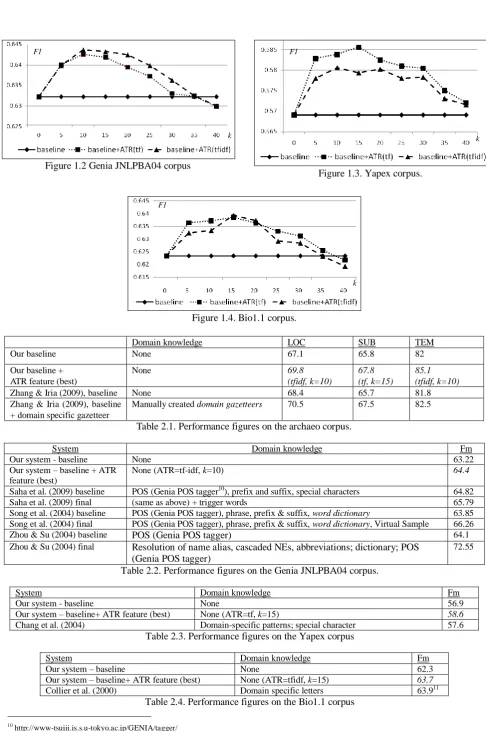
Figure 1.2 Genia JNLPBA04 corpus
Figure 1.3. Yapex corpus.
Figure 1.4. Bio1.1 corpus.
Domain knowledge LOC SUB TEM
Our baseline None 67.1 65.8 82
Our baseline + ATR feature (best)
None 69.8
(tfidf, k=10)
67.8 (tf, k=15)
85.1 (tfidf, k=10)
Zhang & Iria (2009), baseline None 68.4 65.7 81.8 Zhang & Iria (2009), baseline
+ domain specific gazetteer
Manually created domain gazetteers 70.5 67.5 82.5
Table 2.1. Performance figures on the archaeo corpus.
System Domain knowledge Fm
Our system - baseline None 63.22
Our system – baseline + ATR feature (best)
None (ATR=tf-idf, k=10) 64.4
Saha et al. (2009) baseline POS (Genia POS tagger10), prefix and suffix, special characters 64.82 Saha et al. (2009) final (same as above) + trigger words 65.79 Song et al. (2004) baseline POS (Genia POS tagger), phrase, prefix & suffix, word dictionary 63.85 Song et al. (2004) final POS (Genia POS tagger), phrase, prefix & suffix, word dictionary, Virtual Sample 66.26 Zhou & Su (2004) baseline POS (Genia POS tagger) 64.1 Zhou & Su (2004) final Resolution of name alias, cascaded NEs, abbreviations; dictionary; POS
(Genia POS tagger)
72.55
Table 2.2. Performance figures on the Genia JNLPBA04 corpus.
System Domain knowledge Fm
Our system - baseline None 56.9
Our system – baseline+ ATR feature (best) None (ATR=tf, k=15) 58.6
Chang et al. (2004) Domain-specific patterns; special character 57.6
Table 2.3. Performance figures on the Yapex corpus
System Domain knowledge Fm
Our system – baseline None 62.3
Our system – baseline+ ATR feature (best) None (ATR=tfidf, k=15) 63.7
Collier et al. (2000) Domain specific letters 63.911
Table 2.4. Performance figures on the Bio1.1 corpus
10
http://www-tsujii.is.s.u-tokyo.ac.jp/GENIA/tagger/
11 For Bio1.1, the reported average F-measure including protein, RNA, DNA and SOURCE by Collier et al (2000) is 72.8. However, since we ignore
the RNA class, thus we take the average of F-measures of protein, DNA and SOURCE as the F-measure of all entity types for this corpus.
k F1
k F1
F1
Zhang, Z., Iria, J., Brewster, C., Ciravegna, F. (2008). A comparative evaluation of term recognition algorithms. In Proceedings of LREC’08