Constructing and exploiting an
automatically annotated resource of legislative texts
Stefan H¨ofler, Kyoko Sugisaki
Institute of Computational Linguistics, University of Zurich Binzm¨uhlestrasse 14 8050 Z¨urich, Switzerland
{hoefler,sugisaki}@cl.uzh.ch
Abstract
In this paper, we report on the construction of a resource of Swiss legislative texts that is automatically annotated with structural, morphosyntactic and content-related information, and we discuss the exploitation of this resource for the purposes of legislative drafting, legal linguistics and translation and for the evaluation of legislation. Our resource is based on the classified compilation of Swiss federal legislation. All texts contained in the classified compilation exist in German, French and Italian, some of them are also available in Romansh and English. Our resource is currently being exploited (a) as a testing environment for developing methods of automated style checking for legislative drafts, (b) as the basis of a statistical multilingual word concordance, and (c) for the empirical evaluation of legislation. The paper describes the domain- and language-specific procedures that we have implemented to provide the automatic annotations needed for these applications.
Keywords:legal texts, domain-specific annotation, style checking
1.
Introduction
In this paper, we report on the construction of a resource of Swiss legislative texts that is automatically annotated with structural, morphosyntactic and content-related information, and we discuss the exploitation of this resource for the pur-poses of legislative drafting, legal linguistics and translation and for the evaluation of legislation.
We have detailed individual aspects and components of this resource in previous publications mentioned throughout the text. In this paper, we provide a synthesis, report on recent developments and introduce two novel applications of our resource.
The paper is organised as follows. We will first characterise the texts contained in the resource (section 2), then detail its automatic annotation (section 3) and finally outline its multiple areas of application (section 4).
2.
Text basis
Our resource is based on the classified compilation of Swiss federal legislation, i.e. the up-to-date collection of statutory law of the Swiss Confederation.1 It comprises the federal and all cantonal constitutions, federal acts, ordinances is-sued by the federal authorities, federal decrees and treaties between the Confederation and individual cantons or munic-ipalities.
All texts contained in the classified compilation exist in Ger-man, French and Italian. All three language versions are considered equally authentic (L¨otscher, 2009).2For this rea-son, each provision in the texts can be referenced unequivo-cally by indicating its position in the text (article, paragraph, sentence, enumeration item), independent of the language. Even in their non-annotated form, the language versions contained in the collection are thus precisely aligned down to the level of individual sentences and enumeration items.
1www.admin.ch>Federal law>Classified compilation 2Some of the texts are also available in Romansh and English;
however, these versions do not have legal force.
The collection thus amounts to an inherently aligned parallel corpus.
In total, the classified compilation consists of more than 1900 texts per language. The sizes of the individual texts range from roughly 800 words (Federal Decree on the Coat of Arms) to over 1.3 million words (Code of Obligations).3
3.
Construction
The texts contained in the classified compilation are avail-able online in HTML and PDF format. We have converted the HTML files into a simple XML representation, to which we have added our automatic annotations. These annotations provide information on (a) the boundaries of text segments (implemented for German, French, Italian and Romansh), (b) parts of speech and lemmas (implemented for German, French and Romansh), (c) morphosyntactic features and (d) content types (implemented for German only).
Whether some information has been added to the resource or not is driven by the applications for which it is used; hence the differences between the individual language versions. The German-language version has been used as a testing en-vironment for the development of an automatic style checker for legislative drafting (cf. Section 4.1.) and as a resource for gaining empirical indications on the quality of legislative texts (cf. Section 4.3.). For these applications, all levels of annotation are needed. (The annotation of the boundaries of text segments is more or less language-independent and has thus been implemented for all language versions.) The German, French and Romansh version have further been used as the input to a statistical multilingual word concor-dance (cf. Section 4.2.). This application only required the annotation of parts of speech and lemmas; only these levels of annotation have thus also been implemented for French and Romansh.
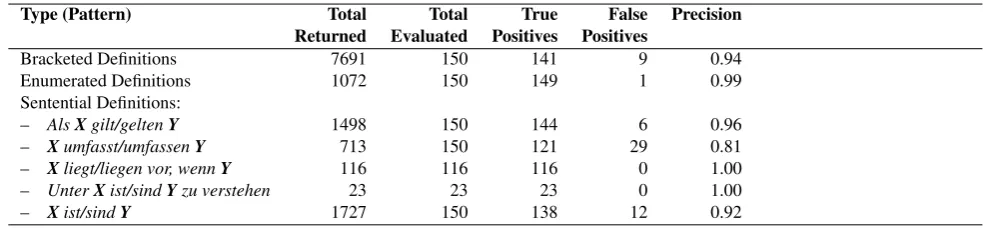
Table 1: Precisions of the individual search patterns. For each pattern, 150 randomly chosen positives were evaluated (or fewer if a smaller total number of positives were returned by the system).
Type (Pattern) Total Total True False Precision Returned Evaluated Positives Positives
Bracketed Definitions 7691 150 141 9 0.94
Enumerated Definitions 1072 150 149 1 0.99
Sentential Definitions:
– AlsXgilt/geltenY 1498 150 144 6 0.96
– Xumfasst/umfassenY 713 150 121 29 0.81
– Xliegt/liegen vor, wennY 116 116 116 0 1.00
– UnterXist/sindYzu verstehen 23 23 23 0 1.00
– Xist/sindY 1727 150 138 12 0.92
Aufgaben im Sinn von Artikel 1 aus.
‘The Federal Security Service (Service) performs the tasks according to Article 1.’
Enumerated definitions occur as a list of numbered items:
(2) In diesem Gesetz bedeuten:
a. Museum des Bundes: Museum, das
organisatorisch zur zentralen oder dezentralen Bundesverwaltung geh¨ort;
b. Sammlung des Bundes: Bestand an beweglichen Kulturg¨utern, der im Eigentum des Bundes oder einer Einheit der dezentralen Bundesverwaltung steht.
‘In this act shall mean:
a. museum of the Confederation: a museum affiliated to the central or decentralised federal administration;
b. collection of the Confederation: a stock of mobile cultural goods in the possession of the
Confederation or of a unit of the decentralised federal administration.’
Sentential definitions come in the form of a full sentence:
(3) Als Rodung gilt die dauernde oder vor¨ubergehende Zweckentfremdung von Waldboden.
‘Clearing shall be deemed to be the permanent or temporary misuse of forest soil.’
We have identified five general patterns that sentential defi-nitions typically follow:
(4) AlsXgilt/geltenY ‘Xis/are deemed to beY’
(5) Xumfasst/umfassenY ‘Xcomprises/compriseY’
(6) Xliegt/liegen vor, wennY ‘Xis/are present ifY’
(7) UnterXist/sindY1zu verstehen(,Y2) ‘Xis/are to be understood asY’
(8) Xist/sindY ‘Xis/areY’
We found that bracketed definitions, enumerated definitions and sentential definitions, with the exception of the pattern indicated in (8), can be detected by employing regular ex-pressions operating on the surface of the text alone (H¨ofler et al., 2011). For the detection of sentential definitions that follow pattern (8), it was necessary that we resorted to ad-ditional morphosyntactic information. Clauses matching pattern (8) need to be further filtered in order for the system to only return those copula clauses that constitute definitions of terms. To this aim, we have developed the following filtering rules:
(8’) a. The copula is the main verb, in indicative mood and not accompanied by a modal verb.
b. The subject or predicate of the copula clause is not an organisation and does not contain words such asZweck(‘purpose’),Ziel(‘aim’), Voraussetzung(’precondition’) orAusnahme (’exception’).
The following copula clause is, for example, filtered out by rule (8’b):
(9) Zust¨andige Beh¨orde ist das Bundesamt.
‘The responsable authority is the Federal Office.’
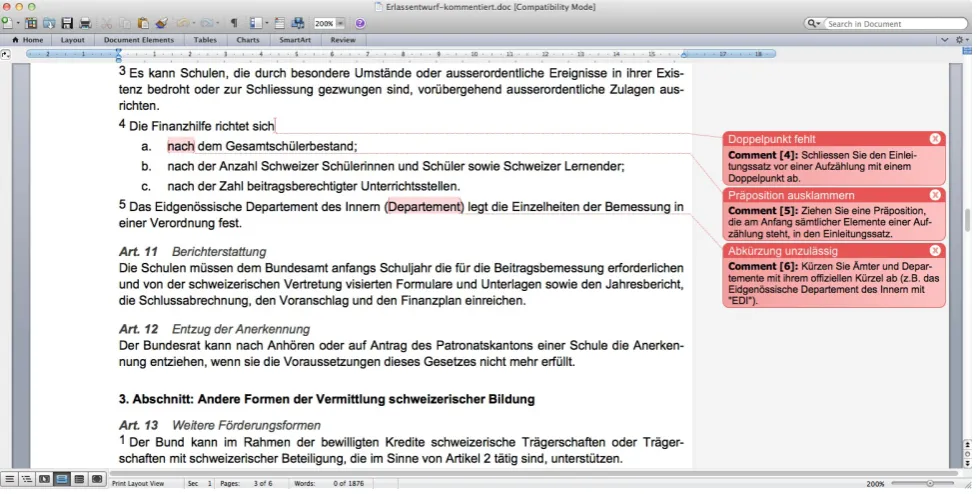
Figure 2: Sample output of the style checking tool.
in existing texts and to inspect the various translations of these terms and the contexts in which they are used. The word alignment provided by Bilingwis is based purely on statistics, which makes it more flexible than systems based on manually compiled dictionaries. Furthermore, the search results can be sorted by frequency and thus conclusions can be drawn on the way individual words are used in the domain.
The Bilingwis interface to our resource is currently available for German and French and for German and Romansh.5
4.3.
Empirical evaluation of legislation
The most recent strand of research exploiting the present resource is concerned with gaining empirical indications on the quality of legislative texts (Uhlmann, 2014). Using similar or even the same procedures that we also employ for domain-specific style checking, we calculate how the individual texts compare with regard to specific features: Which laws exhibit particularly “heavy” articles, i.e. articles consisting of more than three paragraphs? Which laws ex-hibit particularly long and complex sentences? Which laws are particularly prone to remaining at the relatively vague level of “soft” obligations expressed by the modalsollen (‘should’)? Which laws leave a lot of room for interpretation and discretionary decisions by encompassing particularly high numbers of provisions with the modal verbk¨onnen (‘can’)? The output of these evaluations serves as the input to research, carried out by law scholars, into the quality of
5
The German-French Bilingwis implementation of our re-source can be accessed athttp://kitt.cl.uzh.ch/kitt/ bilingwis\_scl/slc2(last visited on 14/10/2013); it has been set up by Roger Wechsler. The German-Romansh implemen-tation can be accessed athttp://kitt.cl.uzh.ch/kitt/ bilingwis_derm/(last visited on 11/03/2014) and has been developed by Manuela Weibel (Weibel, 2014).
particular pieces of legislation.
5.
Conclusion
The present paper introduces an automatically annotated resource of legislative texts with a particularly broad range of applications in legislative drafting, legal linguistics and the evaluation of legislation. It shows that domain- and language-specific procedures are required to provide the automatic annotations needed for these applications.
Acknowledgments
This work has been funded under SNSF grant 134701.
6.
References
Bangalore, S. and Joshi, A. K. (1999). Supertagging: An approach to almost parsing. Computational Linguistics, 25(2):237–265.
Clark, S. (2011). Supertagging for Combinatory Categorial Grammar. InProceedings of the 6th International Work-shop on Tree Adjoining Grammars and Related Frame-works (TAG+6), pages 19–24.
Foth, K., By, T., and Menzel, W. (2010). Guiding a con-straint dependency parser with supertags. In Bangalore, S. and Joshi, A. K., editors,Supertagging: Using Complex Lexical Descriptions in Natural Language Processing. MIT Press, Cambridge, Massachusetts and London, Eng-land.
Haapalainen, M. and Majorin, A. (1994). GERTWOL: ein System zur automatischen Wortformerkennung deutscher W¨orter. Technical report, Lingsoft, Inc.
Processing. MIT Press, Cambridge, Massachusetts and London, England.
H¨ofler, S. and Piotrowski, M. (2011). Building corpora for the philological study of Swiss legal texts. Journal for Language Technology and Computational Linguistics (JLCL), 26(2):77–89.
H¨ofler, S. and Sugisaki, K. (2012). From drafting guideline to error detection: Automating style checking in legisla-tive texts. InProceedings of the EACL 2012 Workshop on Computational Linguistics and Writing, pages 9–18, Avi-gnon, France. Association for Computational Linguistics. H¨ofler, S., B¨unzli, A., and Sugisaki, K. (2011). Detecting
legal definitions for automated style checking in draft laws. Technical Report CL-2011.01, University of Zurich, Institute of Computational Linguistics, Z¨urich.
Karlsson, F., Voutilainen, A., Heikkila, J., and Anttila, A. (1995).Constraint Grammar: A Language-Independent System for Parsing Unrestricted Text. Mouton de Gruyter, Berlin.
Loftsson, H. (2008). Tagging icelandic text: A linguis-tic rule-based approach. Nordic Journal of Linguistics, 31:47–72, 5.
L¨otscher, A. (2009). Multilingual law drafting in Switzer-land. In Grewendorf, G. and Rathert, M., editors,Formal Linguistics and Law, volume 12 ofTrends in Linguistics, pages 371–400. Mouton de Gruyter, Berlin, Germany. Schmid, H. (1994). Probabilistic part-of-speech tagging
using decision trees. InProceedings of the International Conference on New Methods in Language Processing, pages 44–49.
Sugisaki, K. and H¨ofler, S. (2013a). Incremental morphosyntactic disambiguation of nouns in german-language law texts. InESSLLI-13 Workshop on Extrinsic Parse Improvement (EPI).
Sugisaki, K. and H¨ofler, S. (2013b). Verbal morphosyntac-tic disambiguation through topological field recognition in german-language law texts. In Third International Workshop on Systems and Frameworks for Computational Morphology (SFCM 2013), Berlin, Germany.
Uhlmann, F. (2014). Qualit¨at der Gesetzgebung: W¨unsche an die Empirie. In Griffel, A., editor,Vom Wert einer guten Gesetzgebung, pages 171–181. St¨ampfli, Bern. U´ı Dhonnchadha, E. (2006). Part-of-speech tagging and
partial parsing for Irish using finite-state transducers and constraint grammar. Ph.D. thesis, Dublin City University. Volk, M., G¨ohring, A., Lehner, S., Rios, A., Sennrich, R., and Uibo, H. (2011). World-aligned parallel text: A new resource for contrastive language studies. In Proceed-ings of the Conference on Supporting Digital Humanities, Copenhagen, Denmark.
Voutilainen, A. (1995). A syntax-based part-of-speech anal-yser. InProceedings of the Seventh Conference of the European Chapter of the Association for Computational Linguistics (EACL ’95), pages 157–164, San Francisco, CA, USA. Morgan Kaufmann.
Weibel, M. (2014). Aufbau paralleler Korpora und Implementierung eines wortalignierten Suchsys-tems f¨ur Deutsch – Rumantsch Grischun. Master’s thesis, University of Zurich, Zurich, Switzerland.
http://www.cl.uzh.ch/studies/theses/ lic-master-theses/MLTA_Masterarbeit_ Manuela_Weibel.pdf.