Reviewing and previewing the transparency of corporate
social responsibility elements on Arab corporate websites,
2007 – 2010
Master’s thesis of Master’s thesis ofMaster’s thesis of Master’s thesis of
Sander (S.M.) Hofman
0009334
Communication Studies Communication Studies Communication Studies Communication Studies
University of Twente
Supe Supe Supe
Supervised byrvised byrvised byrvised by
Dr. Sjoerd (S.A.) de Vries
Dr. Mirjam (M.) Galetzka
FINAL FINALFINAL
FINAL VERSION VERSION VERSION VERSION
Submitted 8 September 2008
Abstract Abstract Abstract Abstract
Reviewing and previewing CSR on Arab corporate websites Reviewing and previewing CSR on Arab corporate websites Reviewing and previewing CSR on Arab corporate websites
Reviewing and previewing CSR on Arab corporate websites 222 2
C S R
Re
Re
Re
Reviewing
viewing
viewing and previewing
viewing
and previewing
and previewing the
and previewing
the transparency
the
the
transparency
transparency
transparency of
of
of
of corporate
corporate
corporate
corporate
social responsibility
social responsibility
social responsibility
social responsibility elements
elements
elements on Arab corporate websites
elements
on Arab corporate websites
on Arab corporate websites,
on Arab corporate websites
,
,
,
2007
2007
2007
2007 -
-
- 20
-
20
2010
20
10
10
10
S.M.
S.M.
S.M.
S.M. Hofman
Hofman
Hofman
Hofman
8 September 2008
Reviewing and previewing CSR on Arab corporate websites Reviewing and previewing CSR on Arab corporate websites Reviewing and previewing CSR on Arab corporate websites
Reviewing and previewing CSR on Arab corporate websites 333 3
Table of contents
Foreword ForewordForeword Foreword ... 777 7 Summary SummarySummary Summary ... 888 8 1 11 1 IntroductionIntroduction ...IntroductionIntroduction... 999 9 §1.1 Context ... 9§1.2 Research question and goal ...12
§1.3 Approach...13
§1.4 Relevance ...14
§1.5 Contents...15
2 22 2 Corporate Social Responsibility and transparencyCorporate Social Responsibility and transparency...Corporate Social Responsibility and transparencyCorporate Social Responsibility and transparency... 16...161616 §2.1 Perspectives on corporate social responsibility ...16
§2.1.1 CSR and the economic instrumental perspective...17
§2.1.2 CSR and the political perspective...17
§2.1.3 CSR and the social integration perspective...18
§2.1.4 CSR and ethics: corporate idealism ...19
§2.2 What is the core of CSR?...20
§2.2.1 People...20
§2.2.2 Planet...20
§2.2.3 Profit...21
§2.3 What drives the adoption of CSR? ...22
§2.4 Corporate social responsibility as a global trend...24
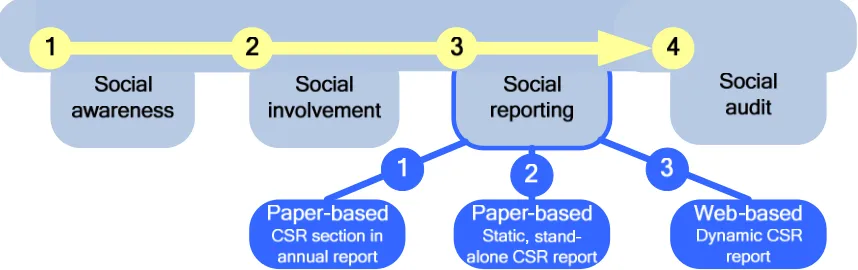
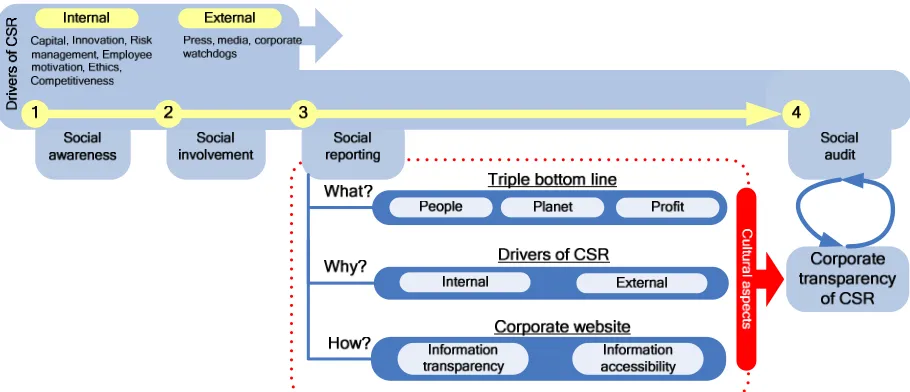
§2.4.1 From social awareness to social reporting...24
§2.4.2 A look at the leaders…...27
§2.4.3 …and a laggard...28
§2.5 Communicating social reports...30
§2.5.1 Social reports on paper...30
§2.5.2 Social reports online: transparency and accessibility...31
§2.6 Conclusion: CSR, social reporting, and corporate transparency ...32
3 33 3 Being transparent on the webBeing transparent on the web ...Being transparent on the webBeing transparent on the web... 34...343434 §3.1 Transparency of CSR information ...34
§3.1.1 United Nations’ Global Compact...35
§3.1.2 Global Sullivan Principles of Social Responsibility...35
§3.1.3 AccountAbility 1000 Series (AA1000s)...36
§3.1.4 Global Reporting Initiative (GRI)...36
§3.1.5 Comparing the frameworks...38
§3.2 Key issues of information transparency ...38
§3.3 Accessibility of CSR information ...40
Reviewing and previewing CSR on Arab corporate websites Reviewing and previewing CSR on Arab corporate websites Reviewing and previewing CSR on Arab corporate websites
Reviewing and previewing CSR on Arab corporate websites 444 4
§3.3.2 Specific accessibility of online CSR...42
§3.4 Key issues of information accessibility ...42
§3.5 From key issues to an instrument...43
Case study: information transparency and accessibility of the Novo Nordisk website...44
4 44 4 MethodologyMethodology ...MethodologyMethodology... 45...454545 §4.1 Model and validation...45
§4.1.1 Delphi...45
§4.1.2 Delphi: exploratory phase ...46
§4.1.3 Delphi: consensus phase...47
§4.1.3 Inter-rater reliability: Cohen’s kappa...50
§4.2 Comparative analysis: reviewing Arab corporate websites of 2007 ...51
§4.2.1 Selection of companies...51
§4.2.2 Implementation...52
§4.2.3 Scale...52
§4.2.4 Ranking...53
§4.3 Trend study: previewing Arab corporate websites of 2010 ...53
§4.3.1 Target group...53
§4.3.2 Implementation...53
5 55 5 AnalysisAnalysis ...AnalysisAnalysis... 55555555 §5.1 Model and validation...55
§5.1.1 Inter-rater reliability: Cohen’s kappa...55
§5.2 Comparative analysis: reviewing Arab corporate websites in 2007 ...56
§5.2.1 Top 50 companies...56
§5.2.3 What is the status of specific CSR sections on Arab corporate websites?...57
§5.2.4 What are the differences between Arab corporate websites from various market sectors?61 §5.2.5 What are the differences between Arab corporate websites from various regions?...64
§5.3 Trend study: previewing Arab corporate websites of 2010 ...69
6 66 6 ConclusionsConclusions ...ConclusionsConclusions... 71717171 §6.1 Instrument: the CSR Transparency Index ...71
§6.2 Comparative analysis: reviewing Arab corporate websites of 2007 ...71
§6.2.1 What is the status of specific CSR sections on Arab corporate websites?...71
§6.2.2 What are the differences between Arab corporate websites from various markets?...72
§6.2.3 What are the differences between Arab corporate websites from various regions?...72
§6.2.4 What are the differences between the best-performing Arab corporate websites?...73
§6.3 Trend study: previewing Arab corporate websites of 2010 ...73
§6.3.1 What is the trend on Arab corporate websites for information accessibility?...73
§6.3.2 What is the trend on Arab corporate websites for information transparency?...74
§6.4 Conclusion: online CSR in the Arab world, 2007 - 2010 ...74
7 77
Reviewing and previewing CSR on Arab corporate websites Reviewing and previewing CSR on Arab corporate websites Reviewing and previewing CSR on Arab corporate websites
Reviewing and previewing CSR on Arab corporate websites 555 5
§7.1 Limitations ...76
§7.1.2 CSR relevance...76
§7.1.2 Inter-rater reliability...76
§7.1.3 Country and regional representation...77
§7.2 Further research ...77
8 88 8 ReferencesReferences ...ReferencesReferences... 78787878 9 99 9 AppendicesAppendices ...AppendicesAppendices... 82...828282 Appendix 9.1 Complete list of the Top 50 companies and rankings by alphabet ...82
Appendix 9.2 Aspirational and ethical frameworks ...83
9.2.1 Global Compact...83
9.2.2 The Global Sullivan Principles...84
Appendix 9.3 Accountability and reporting frameworks ...85
9.3.1 AccountAbility 1000S...85
9.3.2 Global Reporting Initiative...85
Appendix 9.4 Instrument: the CSR Transparency Index...86
Reviewing and previewing CSR on Arab corporate websites Reviewing and previewing CSR on Arab corporate websites Reviewing and previewing CSR on Arab corporate websites
Reviewing and previewing CSR on Arab corporate websites 666 6
“The problem of power is how to achieve its responsible use
“The problem of power is how to achieve its responsible use
“The problem of power is how to achieve its responsible use
“The problem of power is how to achieve its responsible use –
––
– of
of
of
of
how to get men of po
how to get men of po
how to get men of po
how to get men of power to live for the public rather than off the
wer to live for the public rather than off the
wer to live for the public rather than off the
wer to live for the public rather than off the
public.”
public.”
public.”
public.”
Reviewing and previewing CSR on Arab corporate websites Reviewing and previewing CSR on Arab corporate websites Reviewing and previewing CSR on Arab corporate websites
Reviewing and previewing CSR on Arab corporate websites 777 7
Foreword
Foreword
Foreword
Foreword
Everyone close to me knows that this thesis has been a long time coming. But here I am!
I started my thesis research with the choice between staying in the relative stability of a Holland-based
assignment, or going to the Middle East and into the unknown. Thank you Koen, for kicking my
behind. Jordan was an absolutely unforgettable experience. Thank you dad, for helping me when
necessary.
When I came back, I had a hard time following through. Thank you mom and Marije, for providing me
with the chance to come back and settle my life a bit. And thank you Peter, you know why. I took up
two quick jobs, a day job at the publishing house Malmberg and a weekend job at bookstore Heinen.
I’m so glad I worked at Malmberg - I met the most wonderful woman. Thank you Marjolein, for being
around at the right time. We have our history, we’re together in the present, so let’s make the future!
Finally, I want to highlight my supervisors and the support from the faculty over the years. Thank you
Sjoerd, thank you Mirjam.
SMH
Reviewing and previewing CSR on Arab corporate websites Reviewing and previewing CSR on Arab corporate websites Reviewing and previewing CSR on Arab corporate websites
Reviewing and previewing CSR on Arab corporate websites 888 8
S
S
S
Summary
ummary
ummary
ummary
This research study revolves around the transparency of corporate social responsibility issues on the
websites of the fifty largest Arab companies by market capitalisation. The fifty websites are
comparatively analysed on information accessibility and information transparency. While this
comparative analysis reveals the current state of online corporate social responsibility in the Arab
world in 2007, a second part of the research study focuses on the future development towards 2010:
with a survey study among nine of the fifty companies, the trend in accessibility and transparency as
perceived by the companies is further analysed, allowing insight into the near future development of
corporate websites in the Arab world.
Conclusions on the current state of online transparency show the Arab companies lagging behind
global competition. More than half of the Arab companies do not have a separate section for CSR
issues, while a staggering 90% do not produce any report on their CSR activities. This in effect
translates to Arab companies labelling CSR as unimportant, which is a worrying conclusion considering
the global uptake of the corporate social responsibility trend. Market-wise, companies in the services
market out-do both financial and industrial companies and are most focused on providing CSR
information, with Arab telecommunications companies being by far the most CSR-conscious of the 50
companies. Furthermore, Arab companies that operate in the global market seem to give much more
attention to CSR on their websites than the companies operating at a national level.
Region-wise, the companies from the Levant/Egypt region and the Gulf region seem to have a similar
quality of navigation and accessibility of their corporate websites. However, the transparency of those
websites does differ significantly: the companies from the Levant/Egypt perform much better than their
peers in the GCC region. Remarkably, that leads to the conclusion that the companies from the
Levant/Egypt region, which may be regarded as underdeveloped economically in comparison to the
Gulf, is actually a region that has adopted a much stronger and higher quality online corporate
transparency and corporate social responsibility.
Looking towards the perceived trend towards 2010 in the information accessibility dimension, the
companies signal the more Web 2.0-ish features as should haves rather than will haves, meaning that
there are barriers for the companies to implement these features even though they are recognised as
being important. What the companies signal as will haves are features oriented toward offering services
and functionality to the user, such as RSS feeds and SMS services in case of website updates or
published news. In the information transparency dimension, the companies signal the importance and
likelihood of implementation of the GRI framework, while pointing out the Global Sullivan, Global
Compact and AccountAbility frameworks as won’t haves.
This explorative study clearly brings to light current efforts of the Arab world on their way to become a
globally competitive region in transparency and corporate social responsibility. Despite the current gap
in comparison to leading CSR regions, it does seem that there several highly motivated leaders among
Arab service companies, the Levant/Egypt region, and the globally active companies, who are driving
strongly at the improvement of current performance gaps to benefit from the fruits of CSR by 2010,
Reviewing and previewing CSR on Arab corporate websites Reviewing and previewing CSR on Arab corporate websites Reviewing and previewing CSR on Arab corporate websites
Reviewing and previewing CSR on Arab corporate websites 999 9
1
1
1
1
Introduction
Introduction
Introduction
Introduction
This first chapter is an introduction to the central themes of this exploratory research study. It
discusses why the choice was made to focus on the subject of online transparency and CSR, followed
by an elaboration on the research question. The scientific approach is introduced and the academic
relevance of this research is addressed. Lastly, the contents of this study are elaborated upon.
§1.1 §1.1§1.1
§1.1 ContextContextContext Context
The reputation of major companies in the United States and Europe for their ethical business conduct
and social involvement was in a negative spiral during the last decade. Enron’s tax fraud (The
Economist, 2004a), the Parmalat tax evasion, and the Brent Spar environmental scandal of Royal Dutch
Shell (The Economist, 2004b) were all unethical corporate actions that influenced the public opinion on
corporate social involvement and corporate performance immensely. As portrayed in the chart from
KPMG’s Global Sustainability Survey below (Molenkamp, 2005), public trust in various organisations
around the world varies strongly. The best trusted organisations are non governmental organisations
and the United Nations. The least trusted organisations are global corporations.
0% 20% 40% 60% 80% 100%
NGOs
UN
Governments
Press
Corporations
Much trust
Some trust
No trust
Figure 1.1 – Public trust in organisations in 2005 (Molenkamp, 2005)
During the last decade, much media attention was given to those corporate activities that were
perceived and framed as being morally wrong or unethical, etching them into the collective memory of
the Western societies: the media addressed issues like child labour, bad and unequal employee
treatment, environmental damage, unethical business conduct, and financial swindling. This gave rise
to the belief that major companies, governments and institutions needed to be accountable for an
economically, socially and environmentally responsible way of business: this three pillared concept was
eventually bundled under the term Corporate Social Responsibility, or CSR (Carroll, 1999; de Bakker,
Reviewing and previewing CSR on Arab corporate websites Reviewing and previewing CSR on Arab corporate websites Reviewing and previewing CSR on Arab corporate websites
Reviewing and previewing CSR on Arab corporate websites 10 101010
This social pressure involved with adopting a corporate strategy involving CSR, and the driving forces
of the global economy, both force major companies to focus on their responsibilities holistically. From
a CSR perspective, a company should address and communicate its responsibilities towards all their
stakeholder groups, to the environment, and to the society in which they operate.
The trend of corporate social responsibility forces them to become corporate citizens (Matten et al.,
2003), or in other words to become socially involved. This is achieved by business being done in an
economically, socially and environmentally sustainable and ethical way. But the adoption of CSR-based
business is not only a demand from society. A second issue is very much tied to the economic
dimension of CSR and involves the increasing need of stakeholders for companies to be transparent in
and accountable for their corporate performance. This need can be illustrated by the rising number of
non governmental organisations tied to corporate social responsibility reporting. These NGOs are often
labelled as corporate watchdogs: non governmental organisations that make it their goal to monitor
the performance of global corporations and to assess legislation made by governmental organizations
that aim to standardize the communication of this corporate performance. As can be seen in the chart
below, the total number of corporate watchdogs worldwide has doubled every five years. With this
exponential rise, the number of corporate watchdogs has also increased dramatically (Molenkamp,
2005). This trend constitutes a strong social control mechanism for corporate performance, forcing
companies to improve the transparency of their communication with stakeholders.
Figure 1.2 – The rising number of NGOs 1985-2005 (Molenkamp, KPMG Global Sustainability Survey, 2005)
Furthermore, governmental organizations such as the United Nations, the European Union and the
OECD have developed both legislation and voluntary guidelines to stimulate the adoption of CSR-based
strategies by the corporate world. The UN has its Millennium Development Goals and Global Compact
(see §3.1), while the European Union has headed several new initiatives in CSR, such as new legislation around European environment and the EU Accounts Modernizations Directive, which focuses on the
standardisation of financial reporting (Molenkamp, 2005). The OECD published its Guidelines for
Multinational Enterprises, which focuses on business conduct and principles (OECD, 2001). Finally,
there are a number of organizations that supply the corporate work with voluntary frameworks for
good corporate conduct, socially responsible business and transparency of corporate performance.
2500 4800
12500
20000
45000
0 5000 10000 15000 20000 25000 30000 35000 40000 45000 50000
1985 1990 1995 2000 2005
Reviewing and previewing CSR on Arab corporate websites Reviewing and previewing CSR on Arab corporate websites Reviewing and previewing CSR on Arab corporate websites
Reviewing and previewing CSR on Arab corporate websites 11 111111
Among the most important of these are the Global Reporting Initiative (2002) and AccountAbility
(2006), as will be later addressed in §3.1.
The growing attention for corporate performance greatly raises the quality standard of transparency
and accountability for major globally competitive companies and organisations. This transparency and
accountability can usually be translated to annual reports in print or press releases, which cover the
three major dimensions of the organisation in a socially networked context (SER, 1996): its financial
responsibility (the annual financial report, covering income, costs, profit, revenue, etc), its social
responsibility (the company’s effort to increase the well being of its employees and of society), and its
environmental responsibility (the company’s effort to counter any negative effects it may have on the
environment, and if it’s able to, to create positive effects). During the last five years however, the
second generation of these reports was born. A lot of European and American companies created
extensive online sections on their corporate websites to cover their CSR activities and performance
(Molenkamp, 2005). Following suit, other parts of the world have also picked up on the CSR issue. In
Asia, Japan has been a frontrunner for many years, while the economic tigers (like India, Taiwan,
Malaysia) are beginning to come up strong; in South America, Brazil and Argentina are slowly picking
up the issue. As we will see, many of these economically strong and growing regions have been
analysed for their particular integration and adoption of this global trend. However, the major reports
have failed to produce a clear picture of one region in particular. This region is the Arab world.
The Arab world is a region that has been booming economically. Countries in regional economic power
blocks such as the Gulf Cooperation Council, are aiming to become more and more of a global
economic power by integrating their respective markets (Bley & Chen, 2006), much to the model of the
European Union (EU) and the North American Free Trade Association (NAFTA). This contrast between
the regional and the global is most certainly a proven source of growth, as can be observed by the
economic prowess of the Arab region, but it can also be a source of friction (Proff, 2002). It causes
friction because trends that are becoming institutionalised on a global level might, for example, still be
non-existent trends on the regional level. However, the forces of globalisation make regional
companies go up or out, meaning regional companies both want to and have to adapt to the global
economic field (Proff, 2002). Corporate transparency of corporate social responsibility information is
one of those global trends with regional repercussions.
The wishes of major Arab economies and companies to further improve and frame themselves as
global economic powers, have indeed forced marginal adoption of the CSR and transparency trend
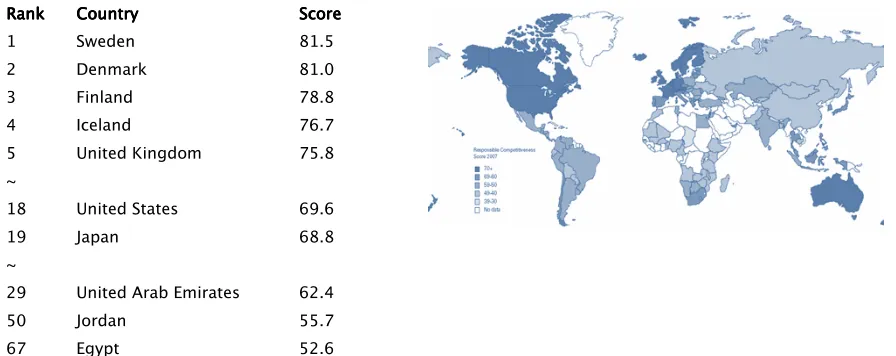
(World Economic Forum, 2007). The exhibit below shows the results of a recent survey by
AccountAbility (2007), a UK based company specializing in CSR analysis. This survey, the Responsible
Competitiveness Index, measured the CSR activity of an ambitious amount of countries (108 in total),
covering 95% of the global economy. It was broad and wholesome in range, covering key developments
in combating climate change, enhancing labour standards, closing the gender gap and reducing
corruption.
With the first 5 positions being for Western Europe (Scandinavian countries and the UK) as displayed in
the table below, the United States came in at number 18 followed closely by Japan. The first Arab
country came in at place 29: the United Arab Emirates. The only other two Arab countries in the
Reviewing and previewing CSR on Arab corporate websites Reviewing and previewing CSR on Arab corporate websites Reviewing and previewing CSR on Arab corporate websites
Reviewing and previewing CSR on Arab corporate websites 12 121212
Rank Rank Rank
Rank CountryCountryCountryCountry ScoreScoreScoreScore
1 Sweden 81.5
2 Denmark 81.0
3 Finland 78.8
4 Iceland 76.7
5 United Kingdom 75.8 ~
18 United States 69.6
19 Japan 68.8
~
29 United Arab Emirates 62.4
50 Jordan 55.7
67 Egypt 52.6
Table 1.3 – Global Responsible Competitiveness Index scores for the global leaders and the Arab region
However, as we will see in §2.3.2, the analysis of this region’s performance in the corporate social responsibility field has yet to be charted. Although such an analysis can be done through a number of
different fields of study, this research study focuses on the online dimension of corporate transparency
and corporate social responsibility, because the academic knowledge base on this particular subject is
almost non-existent. This indeed makes it a very interesting study to assess the transparency and
accessibility of the corporate social responsibility elements that are communicated through the
websites of major companies. Moreover, it will not only be interesting to see what the status of these
corporate websites is, but also how these corporate websites might change in the near future, as
perceived by the companies themselves.
§1.2 §1.2§1.2
§1.2 RRResearch questionResearch questionesearch questionesearch question and goal and goal and goal and goal
Both by analysing the corporate websites themselves and by gathering information through a survey
with a selection of company representatives, it will be possible to evaluate the current state and
perceived future development of online transparency and corporate social responsibility reporting in
the Arab world. However, transparency and corporate social responsibility are two extremely wide
issues. They stretch into various fields (social involvement, financial transparency, environmental
responsibility, corporate governance, etc), so consequently this research will have to be focused and
narrowed down to a particular field. As Chapter 2 will explain, the economic and financial transparency
dimension of corporate social responsibility is the most basic dimension in the communication of
corporate performance. Because this study is done in a developing region of the world, the Arab world,
where CSR and corporate transparency are only just beginning to be integrated in business strategy,
the research will therefore focus on this most basic dimension: the online transparency of financial and
economic corporate social responsibility performance. This study leaves other major fields of corporate
social responsibility, such as environmental and social reporting, for further follow-up studies.
Taking the introduction (§1.1) into account, we can define the main research question, and the sub
questions that will be answered in the first chapters of this thesis. The aim of this thesis will be to
answer the follow question and sub questions:
Reviewing and previewing CSR on Arab corporate websites Reviewing and previewing CSR on Arab corporate websites Reviewing and previewing CSR on Arab corporate websites
Reviewing and previewing CSR on Arab corporate websites 13 131313
What is the current What is the current What is the current
What is the current statestatestatestate and perceived future trend and perceived future trend and perceived future trend and perceived future trend of corporate social responsibility on Arab of corporate social responsibility on Arab of corporate social responsibility on Arab of corporate social responsibility on Arab
corporate we corporate wecorporate we corporate websites?bsites?bsites?bsites?
What is at the core of corporate social responsibility?
What is the status of CSR on Arab corporate websites in 2007?
• What is the status of specific CSR sections on Arab corporate websites?
• What are the differences between Arab corporate websites from various markets?
• What are the differences between Arab corporate websites from various regions?
• What are the differences between the best-performing Arab corporate websites?
What is the perceived trend of CSR on Arab corporate websites in 2010?
• What is the trend on Arab corporate websites for information accessibility?
• What is the trend on Arab corporate websites for information transparency?
As formulated in the main research question, the goal of this research is to create insight in the current
status and trend of online corporate transparency and corporate social reporting in the Arab world.
Creating this insight will be the result of a two fold research process, in which a quantitative
instrument for the evaluation of online CSR is at the core. This instrument will be able to provide
fundamental answer in 2 directions: a comparative analysis will review the current status of online
transparency and corporate social reporting in the Arab world, and a follow-up survey will cover the
perceived development of these issues in the near future. This scientific approach is further elaborated
upon in the next paragraph below, Approach (§1.3).
§1.3 §1.3§1.3
§1.3 ApproachApproachApproach Approach
To answer the main research question, initial desk research goes into the theoretical concepts behind
corporate social responsibility. As will be addressed further in paragraph 1.4 and chapter 2, theoretical
context is quite extensive, yet empirical tools are still in an embryonic state. This study therefore also
focuses on the body of more practical analyses, such as reports from consultancy firms. In the overlap
between academic theory and corporate practice, the studies of Molenkamp (2005) for KPMG were
found to be the most extensive and referred to. The result of this initial desk phase is a comprehencomprehencomprehencomprehensive sive sive sive
instrument instrumentinstrument
instrument that can reliably compare corporate websites on elements of corporate social responsibility.
With the theoretical context as a first step, the method of this research study will use a two fold
explorative approach. The research will involve a quantitative comparative analysiscomparative analysiscomparative analysiscomparative analysis of the corporate
websites of the 50 largest companies (by market capitalization over 2006) from a total of 9 Arab
countries (the GCC countries, Jordan, Egypt and Lebanon). The websites are analyzed for their
transparency on the information about economic CSR issues. This analysis results in a comprehensive
ranking of the companies that are leading the region in corporate transparency and corporate social
responsibility reporting. Furthermore, the analysis focuses on the demographics of the companies and
also compares the different regions and industries that are represented in this ranking.
Furthermore, the research will consist of a trend studytrend studytrend studytrend study. It will follow-up on the initial comparative
Reviewing and previewing CSR on Arab corporate websites Reviewing and previewing CSR on Arab corporate websites Reviewing and previewing CSR on Arab corporate websites
Reviewing and previewing CSR on Arab corporate websites 14 141414
the Arab world toward 2010. This is done through a survey among the 50 companies in the
aforementioned Arab ranking index. This survey will analyse the perceptions of the companies’ PR and
corporate communications manager, who will rate a list of CSR and transparency features on two main
dimensions: importance and likelihood of implementation. These dimensions are measured though two
simple questions for each of the items in the survey:
• Do you believe it is important for your website to have this feature?
• Do you believe it is likely your website will have this feature within 2-3 years?
The survey results will be plotted in a matrix that indicates a feature from the survey as a ‘won’t have’,
a ‘could have’, a ‘should have’ or a ‘will have’. This will enable the researchers to make trend
predictions as to what features won’t, could, should, or definitely will be implemented in the next 2-3
years on the participating corporate websites, as perceived by the PR and/or corporate communication
representatives.
§1.4 §1.4§1.4
§1.4 RelevanceRelevanceRelevance Relevance
Unfortunately, the empirical analysis of corporate social responsibility and corporate transparency is
still in a somewhat embryonic stage and critical issues regarding frameworks, measurement and
empirical methods have not been resolved. Furthermore, much like the topic of innovation, CSR is a
topic that cannot be analysed from the perspective of a single discipline. Thus, it appears that CSR is
fertile ground for interdisciplinary theory development and empirical analysis. The academic relevance
of this specific research lies in the combination of disciplines and the consequent pioneering nature of
the research: the creation of a quantitative instrument to reliably measure corporate social
responsibility information on corporate websites: Hofman’s CSR Transparency Index. This instrument
will contribute to closing the gap of knowledge as described above, and will therefore be addressed in
more detail in the final chapter of this research study. Also, for further reference on the practical use of
the instrument, please explore Appendix 9.6.
This instrument will then focus on two main issues: a comparative analysis of the information
transparency and the information accessibility of corporate websites (a snapshot of what information
exactly can be found on corporate website and how that information is presented to the readers and
users), and an analysis of the perceived development in the near future of the corporate websites
through a survey among some of the highest scoring companies.
Furthermore, as will be elaborated upon in §2.4, the status of corporate responsibility is an issue that
has been generally recognized to be relevant in the global economy, but has yet to truly be analysed
the Arab world despite the booming economies in this region. This phenomenon can be illustrated by
two recent reports, which are further elaborated upon in the next chapters. The first report was
completed by the World Economic Forum (2007). This report analyses the global competitiveness of the
booming Arab economies: the result of this analysis shows that the Arab region may be among the
fastest growing economic regions in the world, but that it does not do well in the context of global
competitiveness because of its regional focus. This friction between globalisation and regionalisation is
among other things caused by its generally very closed markets and the digital divide that many Arab
Reviewing and previewing CSR on Arab corporate websites Reviewing and previewing CSR on Arab corporate websites Reviewing and previewing CSR on Arab corporate websites
Reviewing and previewing CSR on Arab corporate websites 15 151515
AccountAbility (2007), specifically focuses on Responsibility Competitiveness and ranks countries by
evaluating CSR activities, national and regional transparency policies, and new laws concerning CSR
issues. While analysing 95% of the global economy, most of the Arab countries do not have any data
available whatsoever.
Although CSR will be a small contribution to the Arab region’s general level of competitiveness, and
CSR itself can even be characterised by many different fields of expertise, the reports above sketch the
gaps in knowledge about the Arab region: the focus of this thesis could serve as one of the first steps
towards closing these knowledge gaps.
§1.5 §1.5§1.5
§1.5 ContentsContentsContents Contents
The contents of this thesis have been structured along a path of thematic exploration. In this first
chapter, the context of the research is introduced and the main research questions are addressed. In
chapter 2, Corporate Social Responsibility and transparency, the reader is introduced to the concepts
of corporate social involvement and corporate transparency; first reviewing the different perceptions
and theories of social involvement of companies, it then focuses on the theory that is most prominent
and captures a lot of the other elements of the other theories: the triple bottom line. In chapter 3,
Taking transparency to the web, the focus turns to the corporate website as a medium for transparent
performance communication, elaborating on subjects such as the information transparency (focusing
on content like CSR issues, financial reports, governance information, ethics, etc), and information
accessibility (how the content should be presented). With these first chapters as the theoretical
context, Chapter 4 (Methodology) then discusses the research approach, followed by Analysis (Chapter
Reviewing and previewing CSR on Arab corporate websites Reviewing and previewing CSR on Arab corporate websites Reviewing and previewing CSR on Arab corporate websites
Reviewing and previewing CSR on Arab corporate websites 16 161616
2
2
2
2
Corporate Social Responsibility
Corporate Social Responsibility and transparency
Corporate Social Responsibility
Corporate Social Responsibility
and transparency
and transparency
and transparency
This chapter aims to set the context for the research study by elaborating on a crucial initial question:
What is at the core of corporate social responsibility?
To answer this question, paragraph §2.1 begins by tracing the origins of corporate social responsibility
to major contributing fields. In §2.2, these origins are synthesized to form the current core of CSR: the
People, Planet, Profit model. In §2.3, the focus turns to why CSR has become such an adopted trend.
In §2.4, corporate social responsibility is then put in a global context. Through the elaboration on a
process model of social involvement, the paragraph discusses how CSR is regarded and implemented
across various leading CSR regions in the world. How the Arab world differs from, yet tries to model
itself after the leading regions is also key issue addressed in this paragraph. Then in §2.5, the
communication of corporate social responsibility is addressed. This communication process will be
synonymous with corporate transparency.
Paragraph §2.6 synthesises all the information and answers the abovementioned question through a
visual elaboration on corporate social responsibility and corporate transparency, in the context of the
process model of social involvement.
§2.1 §2.1§2.1
§2.1 Perspectives onPerspectives onPerspectives on corporate social responsibilityPerspectives on corporate social responsibility corporate social responsibility corporate social responsibility
The concept of companies contributing to society in an economically transparent and responsible way
has been around for quite a few years. It was first addressed in academic literature in the nineteen
fifties (Bowen, 1953), after which it proliferated in the nineteen seventies and became very accepted
and common in the late nineteen nineties (Davis, 1973; Carroll, 1999; De Bakker, Groenewegen & den
Hond, 2005). However, during that time, Corporate Social Responsibility (CSR) was the subject of much
debate over its own definition. The span of CSR had already become apparent to Votaw (1972), when
he wrote
(…) corporate social responsibility means something, but not always the same thing to (…) corporate social responsibility means something, but not always the same thing to (…) corporate social responsibility means something, but not always the same thing to (…) corporate social responsibility means something, but not always the same thing to
everybody. To some it conveys the idea of legal responsibility or liability; to others, it means everybody. To some it conveys the idea of legal responsibility or liability; to others, it means everybody. To some it conveys the idea of legal responsibility or liability; to others, it means everybody. To some it conveys the idea of legal responsibility or liability; to others, it means
socially responsible behaviour in the ethical sense; socially responsible behaviour in the ethical sense;socially responsible behaviour in the ethical sense;
socially responsible behaviour in the ethical sense; to still others, the meaning transmitted is to still others, the meaning transmitted is to still others, the meaning transmitted is to still others, the meaning transmitted is
that of ‘responsible for’ in a causal mode; many simply equate it with a charitable contribution; that of ‘responsible for’ in a causal mode; many simply equate it with a charitable contribution; that of ‘responsible for’ in a causal mode; many simply equate it with a charitable contribution; that of ‘responsible for’ in a causal mode; many simply equate it with a charitable contribution;
some take it to mean socially conscious; many of those who embrace it most fervently see it as some take it to mean socially conscious; many of those who embrace it most fervently see it as some take it to mean socially conscious; many of those who embrace it most fervently see it as some take it to mean socially conscious; many of those who embrace it most fervently see it as
a mere synonym for a mere synonym fora mere synonym for
a mere synonym for legitimacy in the context of belonging or being proper of valid; a few see a legitimacy in the context of belonging or being proper of valid; a few see a legitimacy in the context of belonging or being proper of valid; a few see a legitimacy in the context of belonging or being proper of valid; a few see a
sort of fiduciary duty imposing higher standards of behaviour on businessmen than on citizens sort of fiduciary duty imposing higher standards of behaviour on businessmen than on citizens sort of fiduciary duty imposing higher standards of behaviour on businessmen than on citizens sort of fiduciary duty imposing higher standards of behaviour on businessmen than on citizens
at large. at large.at large.
at large. (1972, p. 11-12)
From this citation, the essence of some of the origins of CSR can be distilled. The following paragraphs
use different pairs of spectacles to look at the corporate social responsibility, synthesizing the array of
Reviewing and previewing CSR on Arab corporate websites Reviewing and previewing CSR on Arab corporate websites Reviewing and previewing CSR on Arab corporate websites
Reviewing and previewing CSR on Arab corporate websites 17 171717
§
§
§
§
2.1.12.1.12.1.12.1.1 CSR and CSR and CSR and the CSR and the economic instrumental the the economic instrumental economic instrumental economic instrumental perspeperspeperspectiveperspectivectivectiveIn the economic instrumental perspective of corporate social responsibility, the creation of wealth is
the most important goal of a company (Windsor, 2001). The end users of this wealth accumulation
principle are the shareholders of the company primarily, who thus should have an important say in the
decision making process; however, in another view on corporate social responsibility has the
satisfaction of all stakeholders of the company as highest priority, as the stakeholder satisfaction
contributes to the optimisation of shareholder value (Mitchell et al., 1997). Both the shareholder and
stakeholder perspectives are normative theoretical constructs of CSR, dictating what a corporation’s
role ought to be. By extension, they are also often seen as theories of proper business ethics, since
they dictate how decisions in a company are supposed to be made.
The shareholder perspective suggests that since shareholders are the ones putting capital at the
company management’s disposal, the management should only take an action that has been
authorized by the shareholders. This notion has been illustrated well by Friedman (1962):
There is one and only once social responsibility of business There is one and only once social responsibility of business There is one and only once social responsibility of business
There is one and only once social responsibility of business –––– to use its resources and engage to use its resources and engage to use its resources and engage to use its resources and engage
in activities designed to increase in activities designed to increase in activities designed to increase
in activities designed to increase itititits profits so long as it engages in open and free competition, s profits so long as it engages in open and free competition, s profits so long as it engages in open and free competition, s profits so long as it engages in open and free competition,
without deception or fraud. without deception or fraud.without deception or fraud.
without deception or fraud. (1962, p. 133)
On the other side of the spectrum is stakeholder perspective, which asserts that managers have a
twofold duty, both to their shareholders and to individuals and constituencies that contribute, either
voluntarily or involuntarily, to a company’s wealth creating capacity and activities, and who are
therefore its potential beneficiaries and/or risk bearers (Post, Preston & Sachs, 2002). Stakeholders can
be found among a wide range of groups in the social environment of the company; examples could be
employees, environmental organizations, consumers, suppliers, financial partners, and public
authorities. It should be a goal to invest in these surroundings of the company, as these stakeholders
provide the company with a wide range of vital resources, such as employees, knowledge, capital, but
also legitimacy (Deegan, 2002).
The fundamental distinction between both concepts is that the stakeholder perspective demands that
the interests of all stakeholder groups are considered in the decision making process, even if those
considerations reduce company profitability. From the shareholder perspective, the non shareholders
are viewed as the means to the end of profitability, while from the stakeholder perspective the interests
of non shareholders are also taken to be ends.
§
§
§
§
2.1.22.1.22.1.2 CSR and 2.1.2 CSR and CSR and the CSR and the political the the political political political perspectiveperspectiveperspective perspectivePolitical perspectives on CSR view the company as an integral part of society and focus on the
interactivity between the company and society, where the company has a powerful and responsible
position. A few theories have been formulated, among which are the social power equation (Davis,
1960), the iron law of responsibility (Davis, 1967), and the idea of corporate citizenship (Davis, 1973).
The social power equation
According to Davis, the social status is directly linked to the social responsibilities of managers. In
other words, a top-level manager at a key company in society has much more of a duty to guide his
Reviewing and previewing CSR on Arab corporate websites Reviewing and previewing CSR on Arab corporate websites Reviewing and previewing CSR on Arab corporate websites
Reviewing and previewing CSR on Arab corporate websites 18 181818
This theory also refers to the need-based relationship or social contract discussed in
stakeholder-shareholder theory (Deegan, 2002).
The iron law of responsibility
Another theory by Davis, this concept refers to the notion that if leading managers do not use the
social power given to them in a responsible fashion, or even not at all, they will consequently always
lose this power. Society expects certain community figures to assume responsibility for acts, and if the
figures in power cannot live up to these expectations, they will be replaced by leaders who can.
Corporate citizenship
Corporate citizenship is a term that refers to the notion of belonging to a community; the term has
seen a huge boost in popularity thanks to the continuing globalisation of business. Matten et al. (2003)
distinguish three different types of corporate citizenship, namely a limited view, a CSR view, and an
extended view. The limited view on corporate citizenship implies that society can have some
expectations of a company’s social responsibility, but that they should be mainly linked to investments
and philanthropy. The CSR view goes one further and is the most common view. This view really
stresses the interactivity between business and society on multiple levels, such as economic
transparency, environmental responsibility and social responsibility. Lastly, in the extended view on
corporate citizenship, the government’s system is questioned. Thus, the business should provide
citizens with exactly what they need, such as safety, housing, proper wages and insurance (Matten et
al., 2003)
§
§
§
§
2.1.2.1.2.1.2.1.3333 CSR and CSR and the CSR and CSR and the the the social integration social integration social integration social integration perspectiveperspectiveperspectiveperspectiveThe integrative perspective assumes that companies should integrate the demands that exist in society
into their own business. Again, as mentioned before, this is directly linked to the idea that companies
can only exist because of its direct surroundings. The surroundings legitimate the company’s existence
if this company acts responsibly and socially involved. In contrast with other theories, integrative
theories are about the achievement of social legitimacy, greater social acceptance and prestige. The
company should therefore listen to the demands of its surroundings at all times, to adjust its business
accordingly. The responsiveness to these social issues is often defined as the theory of stakeholder
engagement or issues management (Wartrick & Rude, 1986).
This concept of stakeholder engagement hinges on the discrepancy of the socially expected behaviour
of a company and the actual behaviour of that company (Ackerman, 1973). The company should be
focused to spot and analyse this discrepancy and then manage whatever issue it encompasses; this
phenomenon was named social responsiveness, and later changed to the term issues management.
This has been defined by Wartrick & Rude (1986) as
(…) the processes by which the corporation can identify, evaluate and respond to those social the processes by which the corporation can identify, evaluate and respond to those social the processes by which the corporation can identify, evaluate and respond to those social the processes by which the corporation can identify, evaluate and respond to those social
and political i and political iand political i
and political issues which may impact significantly upon it.ssues which may impact significantly upon it.ssues which may impact significantly upon it. (1986, p. 1) ssues which may impact significantly upon it.
The issues that need to be managed, however, stem from the expectancies of certain stakeholder
groups such as the customers, suppliers, financial partners, governments, etc. Cumming (2001)
suggests that the approach to address stakeholders is aligned with a shift from a trust me culture, in
Reviewing and previewing CSR on Arab corporate websites Reviewing and previewing CSR on Arab corporate websites Reviewing and previewing CSR on Arab corporate websites
Reviewing and previewing CSR on Arab corporate websites 19 191919
tell me culture, in which stakeholders want to be reassured by the companies that their actions are
morally right. Finally, the latest evolution in this process is the adoption of an ‘involve me’ culture,
where companies ask their stakeholders what they should do to act responsibly in their eyes. These
approaches in maintaining a relationship with the stakeholders are of vital importance: only when a
company is totally aware of the information needs of the stakeholder groups, can that company
disclose the right information to become a ‘truthful’ company. And likewise, stakeholders must be
willing to ask for the information from companies, and if they are not provided with this information,
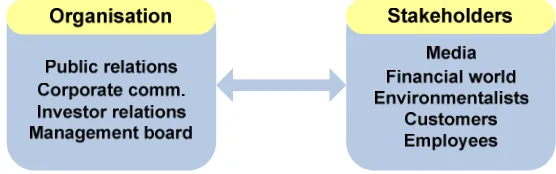
must be willing to make an issue out of this. This relationship was captured well in Shepherd’s
two-way process for effective corporate communication (2001) and has been displayed in the figure below.
On the left side of the spectrum is the organization which should be in constant dialogue with the right
side of the process, the stakeholder groups. The dialogue consists of messages, discussion, comments
and questions, all with the goal of the organization disclosing the information that the stakeholders
want to obtain and to perceive the organization as ‘trustworthy’.
Figure 2.1 – Shepherd’s two-way model for effective corporate communication (2001)
Using a stakeholder approach in corporate communication has a number of benefits (Cumming, 2001).
It allows stakeholders to judge the company’s operations, activities and strategy and compare them to
their own ideas of a morally right business. Furthermore, if companies adapt to a stakeholder approach
in their reporting, they are given the chance to constantly monitor their environment and act on this.
Thus, this gives them a crucial time advantage over competition not using a stakeholder approach.
§
§
§
§
2.1.42.1.42.1.42.1.4 CSR and ethics: CSR and ethics: CSR and ethics: CSR and ethics: corporate idealismcorporate idealismcorporate idealismcorporate idealismAnother perspective on CSR stresses the importance of an honest, trustworthy, and virtuous
relationship between a company and society: corporate idealism. A company, being part of a society,
should always contribute to the common good for that society, without being a parasite of it. It should
contribute to society in every way it can, offering wealth, skills and equality to those it employs (Melé,
2002). In other words, it should provide for sustainable development.
However, with continuing globalisation and the increased merging of markets, inequalities in business
are become more and more apparent. The term ‘sustainable development’ first appeared in a report by
World Commission on Environment and Development (1987) and was defined as quoted in paragraph
§2.1 above. This theory originally focused on environmentalist issues, but in recent years has also
adopted the idea that changes in the environment cannot be done without changes in social and
economic approaches. Critics of this theory have stated that is too much of an ideal toward which
society and business can continually strive, the way we strive is by creating value, creating outcomes
that are consistent with the ideal of sustainability along social environmental and economic dimensions
Reviewing and previewing CSR on Arab corporate websites Reviewing and previewing CSR on Arab corporate websites Reviewing and previewing CSR on Arab corporate websites
Reviewing and previewing CSR on Arab corporate websites 20 202020
ideas, like those of Stead and Stead (2000) for example who suggested corporate ecological
sustainability would be good enough. They suggested extending the traditional form of accounting
(merely showing the economic health of the company) to a sustainable form of accounting that would
include economic, social and environmental elements.
§2.2 §2.2§2.2
§2.2 WWWhat is What is hat is the core of CSR?hat is the core of CSR?the core of CSR?the core of CSR?
Taking into account all the perspectives on Corporate Social Responsibility that are listed above in this
chapter, an idea of the core of CSR can be distilled from those theories. As may be concluded from the
previous paragraphs, the main perspectives and dimensions of CSR involve the relationship between
the company’s aim at profit and its social and natural environments. This relationship was captured
well in an analysis by the Dutch organization SER (Sociaal Economische Raad – Social Economical
Council) in one of their reports (1996). The definition for Corporate Social Responsibility was titled the
triple bottom line, for the three dimensions it encompassed:
Corporate Social Responsibility means consciously fo Corporate Social Responsibility means consciously foCorporate Social Responsibility means consciously fo
Corporate Social Responsibility means consciously focusing the activities of the business on cusing the activities of the business on cusing the activities of the business on cusing the activities of the business on
long longlong
long----term value creation in three dimensions: term value creation in three dimensions: term value creation in three dimensions: people, planet, and profitterm value creation in three dimensions: people, planet, and profitpeople, planet, and profit.... people, planet, and profit
Since its inception, these three dimensions of CSR have become the most accepted theory of CSR. The
dimensions each cover an array of subjects, but basically coincide with a number of perspectives from
the previous paragraph: the peoplepeoplepeoplepeople dimension is strongly focused on corporate social involvement and
social ethical responsibility, the planetplanetplanetplanet dimension is very much focused on environmental
responsibility, while the profitprofitprofitprofit dimension mainly revolves around economic accountability, ethical
business conduct, and corporate transparency. Each dimension will be elaborated upon in detail in the
paragraphs below. The dimensional construct of the triple bottom line has been used as the foundation
for many frameworks aiming to standardise corporate social responsibility, such as the Global
Reporting Initiative (2002), and mandatory legal obligations such as the European Modernizations
Directive (Molenkamp, 2005). Over 40% of the global companies and organizations that report annually
on their corporate performance and social responsibility use the triple bottom line for the decision on
what information to communicate to their stakeholders (Molenkamp, 2005). The next sub paragraphs
elaborate briefly on each dimension.
§
§
§
§
2.2.12.2.12.2.12.2.1 PeoplePeoplePeople PeopleThis dimension of CSR has its roots in two perspectives as mentioned above, namely the political and
the social integration perspective. Therefore, it clearly has two different sides. First of all, the People
dimension can be meant to signify the internal structure of the company. A socially responsible
company provides its employees with the right benefits and salary while ensuring their safety, offers
employment opportunities to minorities and also creates scope for the combination of work and family
life. On the other side of the dimension are the external surroundings of the company. Without the
legitimacy given to it by society, the company could not exist (Deegan, 2002).
§
§
§
§
2.2.22.2.22.2.22.2.2 PlanetPlanetPlanet PlanetThis element of CSR is mostly related to the social integration and the ethical perspectives. It focuses
mainly on environmental issues and stresses the need to companies to be really proactive in securing
Reviewing and previewing CSR on Arab corporate websites Reviewing and previewing CSR on Arab corporate websites Reviewing and previewing CSR on Arab corporate websites
Reviewing and previewing CSR on Arab corporate websites 21 212121
meet human needs, contribute to the quality of life and at the same time place less and less burden of
resources and the ecosystem. This can be achieved through the external pressure from third parties
(Greenpeace, activists), through flexibility in the company to allow for changes and manoeuvring, and
the focus on gaining a competitive edge.
§
§
§
§
2.2.32.2.32.2.32.2.3 ProfitProfitProfit ProfitThe element Profit is directly related to the economic performance perspective listed above in
paragraph §2.1.2. The goal of this element is the accumulation and maximization of value for the
company, through its production processes (an internal side) but also through its interactions with the
surroundings (external side), providing jobs and sources of income. It hinges on the economic theories
as formulated by Deegan (2002). Without a long-term profitability the company cannot exist, but
another prerequisite is the approval by and legitimacy for the society in its direct surroundings. The
element Profit is regarded as the sturdy foundation of healthy economic performance upon which the
other elements of Corporate Social Responsibility can be built to last. This is suggested because the
effects of CSR activities related to the People and Planet elements are often measured through the
impacts they had on the short-term and long-term corporate financial performance (Profit). Examples
of this might be found in the organization’s relationship to its stakeholders, from which benefits might
be gained through positive relationships. Regulators may ease the permitting process for companies
that have shown a consistent focus on high sustainability performance. Also, better access to capital
might be a benefit; it is a fact that the financial community pays greater attention to the companies
performing well in social and environmental fields (Molenkamp, 2005; Epstein & Roy, 2001).
Furthermore, activities to improve sustainability might also lead more directly to cost reductions
through material innovation or substitution, changes in packaging processes, changes in energy
consumption, or reductions in handling costs. These direct impacts also have indirect benefits, such as
the customers who can benefit from reduced production costs. All these things support the concept of
Profit being the most basic and tied-in element of Corporate Social Responsibility (Epstein & Roy,
2001).
One of the most important characteristics of the triple bottom line is that it suggests interconnection
and balance of all dimensions, creating the perfect spectrum of elements necessary for a company to
do business in a socially responsible manner. Each individual dimension, represented by the three
circles below, has its own issues but also several overlapping features, connecting them to each other.
These connections are represented by the overlapping areas, where circles intersect. In the yellow
centre of the intersection, the term CSR denotes the perfect harmony of all dimensions, coming
together to share a wholesome perception of corporate social responsibility in which every dimension
has the same relevance and weight. Thus, in the triple bottom line, corporate social responsibility
Reviewing and previewing CSR on Arab corporate websites Reviewing and previewing CSR on Arab corporate websites Reviewing and previewing CSR on Arab corporate websites
Reviewing and previewing CSR on Arab corporate websites 22 222222
Figure 2.2 – Triple bottom line for corporate social responsibility (SER, 1996)
Now that the concept of corporate social responsibility has been found to exist of three main
dimensions, the question can be asked: why is this relevant? Why would a company want to adopt such
a strategy of social responsibility and involvement, environmental responsibility and economic
responsibility? In the next paragraph, the focus turns to the drivers for corporate social responsibility.
§2.3 §2.3§2.3
§2.3 What drives the adoption of CSR?What drives the adoption of CSR?What drives the adoption of CSR? What drives the adoption of CSR?
As addressed in the first chapter, increased media focus on corporate performance and increased
pressure from society to do business in an ethical and socially involved and transparent manner are
two of the most traditional motivations for companies to adopt a CSR-oriented business strategy.
These motivations are external drivers. However, there also are some important internal corporate
drivers (Molenkamp, 2005). In the chart below, the results of a survey among CEOs of global
companies are listed. Molenkamp (2005) asked them for the important reasons to adopt a corporate
social responsibility strategy.
Figure 2.3 – Percentage of CEOs indicating specific drivers for corporate social responsibility (Molenkamp, 2005)
In Molenkamp’s research, which is bundled in the KPMG Global Sustainability Survey (2005), the driver
of economic consideration is the most important, followed by ethical considerations and innovation.
Economic considerations are mostly directly linked to creating added value for shareholders, and 74% 53%
53% 47% 47% 39%
0% 10% 20% 30% 40% 50% 60% 70% 80%
Reviewing and previewing CSR on Arab corporate websites Reviewing and previewing CSR on Arab corporate websites Reviewing and previewing CSR on Arab corporate websites
Reviewing and previewing CSR on Arab corporate websites 23 232323
indirectly to the other top drivers, such as innovation, reduced risk, ventures and reputation
management. Ethical considerations and innovation are also important drivers for companies to
incorporate CSR in their business strategy. They have become linked to each other with the
development of so-called ‘green flagships’, which have become profitable over the last few years.
Green flagships are new sustainable and socially responsible products or markets that are initial niches
but grow to become mainstream product lines and markets. An example is the hybrid car industry. The
development of the Prius, Toyota’s first hybrid electric-fossil fuel powered car, took place between
1997 and 1999. The sale for the car in the first year (2000) was just 17 cars. In the second year, it was
656. And in 2005, the Prius was sold 250.000 times worldwide (Wikipedia, 2007).
Another ‘economic’ driver is access to capital. Corporate Social Responsibility is a concept that can
attract investors, because it has become a key performance indicator for the sustainability of business
(Molenkamp, 2005; Eurosif, 2006). In a European SRI (Socially Responsible Investing) study by Eurosif
(2006), it was reported that the total size of the European SRI market reached €105 billion in 2006.
This figure represents a substantial growth from 2004, even after correction for the overall average
growth of the European equity markets. Preferred European approaches for investments on portfolios
are the Best-in-class (the few companies that perform best in sustainability are invested in), Positive
screens (multiple investments in good performing sustainable business) and Ethical exclusions
(companies that have been found to act socially irresponsible are excluded from investments). The
growth and the figures in themselves allow for the conclusion that the practice of investing based on
key indicators of socially responsible business is becoming an accepted practice (Eurosif, 2006; Social
Investment Forum, 2005). Also, the creation of so-called Sustainability Indices (e.g., Dow Jones
Sustainability Index and the FTSE4good Index), for which inclusion requires companies to show
consistent high performance on CSR issues such a corporate governance, environmental protection and
labour practices, shows that companies are eager to be highly rated on responsibility performance
(Molenkamp, 2005).
Employee motivation and risk management are other drivers that stimulate the incorporation of CSR in
the corporate strategy. Through the responsible involvement of a company in society, it is possible to
attain and retain employees (Mele, 2002; de Bakker, Groenewegen & den Hond, 2005): the fact that
corporate social responsibility is an important driver for employee motivation becomes clear by these
figures as seen in the KPMG Global Sustainability Survey (2005): 75% of North American students say
that they would not apply for a job with a company that is not perceived as socially responsible. On
Reviewing and previewing CSR on Arab corporate websites Reviewing and previewing CSR on Arab corporate websites Reviewing and previewing CSR on Arab corporate websites
Revi