A2Q: an agent-based architecure for multilingual Q&A
Roberto Basili, Nicola Lorusso, Maria Teresa Pazienza, Fabio Massimo Zanzotto
Dipartimento di Informatica, Sistemi e Produzione Universit´a di Roma ”Tor Vergata”,
00133 Roma
{basili,pazienza,zanzotto}@info.uniroma2.it
Abstract
In this paper we describe the agent based architecture and extensively report the design of the shallow processing model in it. We present the general model describing the data flow and the expected activities that have to be carried out. The notion of question session will be introduced as a means to control the communication among the different agents. We then present a shallow model mainly based on an IR engine and a passage re-ranking that uses the notion of expanded query. We will report the pilot investigation on the performances of the method.
1.
Introduction
Question-answering (QA) is a field in which a number of different techniques have to work cooperatively in or-der to achieve the correct final result given the user input query. The architectural design of QA systems is then a crucial point. The requirements that QA systems have to fulfil are very diverse and eventually inconsistent. On the one hand, they have to answer to any factoid question in an open domain: this requires the adoption of very robust In-formation Retrieval oriented techniques. On the other hand, the extraction of very specific text fragment is also expected implying the use of some complex language model.
Given, for instance, a very specific, i.e. not based on ”general” knowledge, factoid question such as ”Which
company had a positive net income in the financial year 2001?” where the expected answer is rare, each bit of
rele-vant text has to be investigated. Therefore, a QA system in this case has to exploit the equivalence between this lin-guistic form and the one in the following text fragment:
”Acme Inc. reported revenues of $.9 million for the year ended in December 2001.”. Such an equivalence between
linguistic realisations of relational concepts are very rele-vant bits of semantic dictionaries and are often called
se-mantic frames. In the example, the relational concept have-revenues(AGENT:X, AMOUNT:Y, TIME:Z) can describe a
generalised level in which the two related linguistic forms
X has a positive net income of Y in Z and X reports revenues of Y for Z are equivalent.
Generally, semantic-oriented applications such as Infor-mation Extraction rely on complete semantic models con-sisting of:
• a catalogue of named entity classes (relevant concepts) as Company, Currency, and TimePeriod;
• a catalogue of (generally) coarse-grained relational concepts with their semantic restrictions, e.g.
have-revenues(AGENT:Company, AMOUNT:Currency, TIME:TimePeriod);
• a set of rules for detecting named entities realised in texts and assigning them to the correct class;
• a catalogue of one-to-many mappings between the
coarse-grained relational concepts and the correspond-ing lcorrespond-inguistic realisations.
These semantic models are often organised using logical formalisms (as in (Gaizauskas and Humphreys, 1997)). The results are very interesting artefacts conceived to rep-resent equivalences among linguistic forms in a systematic and principled manner.
In a QA system such a model has to find its place in co-operation with the bag-of-word oriented models that gives the necessary coverage for the overall system. The wide-coverage and the very specific extraction are contrasting re-quirements for different processing modules. The solution we adopt is a agent architecture (based on JADE (Bellifem-ine et al., 1999)) in which different processing techniques are spread through a pool of software components that co-operate for the final goal. Each important processing capa-bility is embedded into an agent. Cooperative work is then coordinated by a central agent that plays the role of an ”ac-tivity scheduler”. In order to keep the consistency of the cooperative processing the information is represented by a common data structure, that we call ”question session”, shared among the agents. The resulting architecture is able to host two different ways of processing the input question:
• a light processing mode, mainly embodied by a search engine and a shallow sentence processing and answer matching technique;
• a knowledge-intensive question processing model based on ontological information over a domain and making use of inference techniques for answer match-ing and interpretation
will report the pilot investigation on the performances of the method.
2.
An agent-based architecture for Q&A
An agent-based architecture seems to be the correct an-swer for meeting the very diverse and eventually inconsis-tent requirements. Very different systems may work co-operatively in order to achieve the final goal of answering input questions. However, agent-based architectures may result in places with an high entropy if not correctly gov-erned. Agents in the architecture shuold have a clear role and should communicate with a shared language. What we propose here is a master-slave approach in which each slave agent has a very specific role to play and its activation is governed by the master agent.
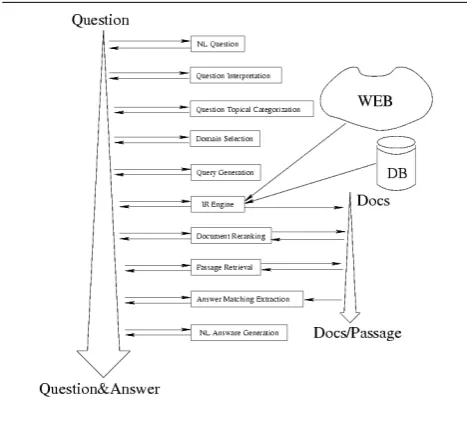
This architecture should meet the overall goal to answer input questions using knowledge stored in document col-lections or in the web. As depicted in Fig. 1, it has to host a number of ”classical” subtasks as the construction of the query for the information retrieval engine (Query
Genera-tion), the re-ranking of the documents given by the IR
en-gine with respect to considerations that are not made on the bag-of-word model (Document Reranking), the selection of the relevant passages in the selected documents (Passage
Retrieval), and the actual extraction of the answer out from
the selected passages (Answer Matching and Extraction).
Figure 1:Q&A Data Flow and Activities
Moreover, the notion of knowledge domain may be very useful both in open-domain question answering and when specific ontological domain models are available. Under this perspective, questions (and eventually documents) have to be classified according to a topical classification scheme. This requires a specific activity that should be hosted in the architecture (i.e. Question Topical Categorisation).
In an agent based architecture, each of these activities has to be performed by a specific agent and, in order to guarantee the achievement of an answer, each activity may be performed by different agents adopting different tech-nologies. Keeping the consistency in the communication
and in the cooperation among these agents is a very diffi-cult objective.
However, as depicted in Fig. 1, the information flow among the different activities embodies by agents is clear and may be interpreted along two different main axes: the state of the question processing activity (the arrow
Ques-tion to QuesQues-tion&Answer) and the state of the source of
the information (the arrow Docs to Docs/Passages). The first flow describes the changing of the information gath-ered around the question while the second takes into ac-count the documents suspected to contain the answer to the input question.
The consistency among the different agents may be kept if a clear language for these two information flows is de-fined. The model of the language, called question session, is defined in Sec. 2.1..
It is worth noticing that an agent based architecture is naturally open to the distribution of the workload on a net-work of computational resources. The JADE agent plat-form (Bellifemine et al., 1999) easily supports this facility as agents may be allocated in any machine in a specific net-work.
2.1. A unifying data model: The Question Session
The agent communication language is realised on a uni-fying data model that keeps track of the status of the anal-ysis of the input question. This data model, called question
session, gives the possibility of implementing Q&A
sys-tems ranging between the two extremes: knowledge-based approaches and IR-based approaches.
The question session contains therefore the following information:
• Question: the input question as it is
• Question-XDG: a syntactic representation of the
in-put question expressed in the eXtended Dependency Graph (XDG) formalism (Basili and Zanzotto, 2002)
• Question-QLF: a syntactic/quasi-logical repre-sentation of the input question (Gaizauskas and Humphreys, 1997) that should enable the semantic analysis whenever necessary
• Focuses: one or more focuses of the input question
intended as the phrases disambiguating the question and able to emphasise the answer
• Categories: one or more topical categories of the
in-put question that may be used to select relevant docu-ments where the answer can be found or relevant do-main knowledge bases
• Query: the query related to the input question that has
to be posed to the underlying information retrieval en-gine
• Documents: the list of documents ordered according
to the relative relevance with respect to the input ques-tion
• Passages: the list of passages of the documents in
System Test
correct answer 13%
answer in the top-10 paragraphs 39%
answer recognized in the top-10 paragraphs 33%
answer in the first paragraph 17%
answer recognized in the first paragraph 71%
Passage Re-renking + Shallow Answer Extractor Test
correct answer 38%
answer in the top-10 paragraphs 88%
answer recognized in the top-10 paragraphs 43%
answer in the first paragraph 47%
answer recognized in the first paragraph 68%
Table 1:Experimental investigation
3.3. Performance analysis
The performances of the shallow processing model have been investigated on 100 questions of the TREC-2002 on the ACQUAINT collection. Two sets of tests have been carried out in order to evaluate the accuracy of both the full light processing chain and the specific answer extraction module. The main difference between the two tests is in the use of only correct documents in the second test.
The results are shown in Tab. 1 where two different experiments are reported: the results of the overall system (called System Test) and the results of the final steps of the model (i.e. Passage Re-ranking + Shallow Answer
Extrac-tor Test) that aims to investigate the behaviour of the
pas-sage re-ranking module. In this second test only documents containing the answer have been retained. We report the measures of how many correct answers have been selected by the system as first answer. This gives the possibility of understanding the overall performances of the system. Moreover, we are interested on how the re-ranking mod-ule is working with respect to the possibility of selecting the paragraphs containing the correct answer (reported as the answer in top-10 paragraphs and answer in the first
paragraph) and on how it is able to select with the simple
heuristic the correct answer among all the possible ones (re-ported as the answer recognized in the top-10 paragraphs and answer recognized in the first paragraph).
Although non state-of-art the above results are interest-ing especially in the last line. The light system extracts correct answer (about 70%) if first paragraph is the cor-rect paragraph (i.e. it holds the corcor-rect answer). As only 17% (47%) of the first paragraphs hold the correct answer we need to improve most of the pre-processing phases, i.e. question espansion (for example, by applying word sense disambiguation before expansion), as well as document re-trieval and paragraph selection.
4.
Conclusions
Given the agent-based nature of the A2Q system, spe-cific independent measures and extension will be easily ap-plied to the corresponding software components without any of these changes affect other components. Such an al-gorithmic independence that the system architecture
imple-ments will also facilitate the embedding of specific control policies: failures in answer retrieval for the light strategies will be used to trigger deeper techniques and knowledge in-tensive processes are decided to be applied. This is a typical task for the ”activity scheduler” of the system. Finally mul-tilingual capabilites (the system is able to currently apply an English as well as an Italian robust parser to incoming questions and paragraphs) will be accessed ”on demand” by the scheduler according to the data abstraction repre-sented into the ”question session” in a transparent way for each language dependent process: the design and scalabil-ity of language specific components (e.g. the parsers) is thus make independent from the rest of the system. In a field where the assessment of techniques, systems and even general models is still very low, the advantages of the pro-posed architecture have a strong impact not only on a spe-cific system (e.g. A2Q) but on the overall advances of the Q&A area.
5.
References
Baker, Collin F., Charles J. Fillmore, and John B. Lowe, 1998. The berkeley framenet project. In Proceedings of
the COLING-ACL. Montreal, Canada.
Basili, Roberto and Fabio Massimo Zanzotto, 2002. Pars-ing engineerPars-ing and empirical robustness. Natural
Lan-guage Engineering, to appear.
Bellifemine, Fabio, Agostino Poggi, and Giovanni Ri-massa, 1999. Jade: A fipa-compliant agent framework. In Proceedings of PAAM’99. London.
Gaizauskas, Robert and Kevin Humphreys, 1997. Using a semantic network for information extraction. Natural
Language Engineering, 3, Parts 2 & 3:147–169.
MEAD - a platform for multidocument multilingual text summarization
Dragomir Radev
1, Timothy Allison
1, Sasha Blair-Goldensohn
2, John Blitzer
3, Arda C
¸ elebi
4,
Stanko Dimitrov
1, Elliott Drabek
5, Ali Hakim
1, Wai Lam
6, Danyu Liu
7, Jahna Otterbacher
1,
Hong Qi
1, Horacio Saggion
8, Simone Teufel
9, Michael Topper
1, Adam Winkel
1, Zhu Zhang
11University of Michigan,2Columbia University,3University of Pennsylvania,4USC/ISI,5Johns Hopkins University,
6Chinese University of Hong Kong,7University of Alabama,8University of Sheffield,9University of Cambridge
Abstract
This paper describes the functionality of MEAD, a comprehensive, public domain, open source, multidocument multilingual summariza-tion environment that has been thus far downloaded by more than 500 organizasummariza-tions. MEAD has been used in a variety of summarizasummariza-tion applications ranging from summarization for mobile devices to Web page summarization within a search engine and to novelty detection.
1.
Introduction
MEAD is the most elaborate publicly available platform for multi-lingual summarization and evaluation. Its source and documentation can be downloaded from http:// www.summarization.com/mead. The platform im-plements multiple summarization algorithms (at arbitrary compression rates) such as position-based, centroid-based, largest common subsequence, and keywords. The methods for evaluating the quality of the summaries are both intrin-sic (such as percent agreement, cosine similarity, and rel-ative utility) and extrinsic (document rank for information retrieval).
MEAD implements a battery of summarization algo-rithms, including baselines (lead-based and random) as well as centroid-based and query-based methods. Its flexi-ble architecture makes it possiflexi-ble to implement arbitrary al-gorithms in a standardized framework. Support is provided for trainable summarization (using Decision trees, Support Vector Machines or Maximum Entropy). Finally, MEAD has been used in numerous applications, ranging from sum-marization for mobile devices to Web page sumsum-marization within a search engine and to novelty detection.
2.
Architecture
MEAD’s architecture consists of four stages. First, documents in a cluster are converted to MEAD’s inter-nal (XML-based) format. Second, given a configuration file (.meadrc) or command-line options, a number of fea-tures are extracted for each sentence of the cluster. Third, these features are combined into a composite score for each sentence. Fourth, these scores can be further refined af-ter considering possible cross-sentence dependencies (e.g., repeated sentences, chronological ordering, source prefer-ences, etc.) In addition to a number of command-line util-ities, MEAD provides a Perl API which lets external pro-grams access its internal libraries. A sample .meadrc file is shown in Figure 1.
All data in MEAD is stored as XML. The following DTDs are part of MEAD:
• cluster: a description of all related documents that will be summarized together,
compression_basis sentences compression_absolute 1 classifier
/clair4/projects/mead307/source/mead/bin/default-classifier.pl Centroid 3.0 Position 1.0 Length 15 SimWithFirst 2.0
reranker /clair4/projects/mead307/source/mead/bin/default-reranker.pl MEAD-cosine 0.9 enidf
Figure 1: Sample .meadrc file. Using this configuration file, MEAD will produce a one-sentence summary using a linear combination of three features as the scoring function. From any sentence pair where the IDF-modified cosine similarity is higher than 0.9, one of the sentences will be dropped.
• docjudge: relevance judgements associated with the document or summary and a particular query and re-trieval method,
• docpos: a part-of-speech annotated version of the doc-ument,
• docsent: a document, split into sentences,
• document: the raw document,
• extract: alisting of all sentence that should be in the summary,
• mead-config: MEAD’s configuration parameters,
• query: a TREC-style query converted to XML,
• reranker-info: parameters for the rerankers,
• sentalign: a sentence-to-sentence alignment across languages,
• sentfeature: a list of feature values for a given docu-ment and feature names,
• sentjudge: manually annotated sentences for relevance within a cluster,
• sentrel: CST-style sentence-to-sentence relationships.
3.
Features
The following features are provided with MEAD. They are all computed on a sentence-by-sentence basis.
• Centroid: cosine overlap with the centroid vector of the cluster (Radev et al., 2004),
• SimWithFirst: cosine overlap with the first sentence in the document (or with the title, if it exists),
• Length: 1 if the length of the sentence is above a given threshold and 0 otherwise,
• RealLength: the length of the sentence in words,
• Position: the position of the sentence in the document,
• QueryOverlap: cosine overlap with a query sentence or phrase,
• KeyWordMatch: full match from a list of keywords,
• LexPageRank: eigenvector centrality of the sentence on the lexical connectivity matrix with a defined threshold.
4.
Classifiers
Four classifiers come with MEAD.
• Default: provides a linear combination of all features except for “Length” which is treated as a cutoff feature (see previous section),
• Lead-based: a baseline classifier that favors sentences that appear earlier in the cluster, as defined by the or-der of documents in the definition of the cluster,
• Random: a baseline classifier that extracts sentences at random from the cluster,
• Decision-tree: a machine learning algorithm, based on Weka (Witten and Frank, 2000) and trained on an an-notated summary corpus.
5.
Rerankers
The following rerankers are included in MEAD.
• Identity: this reranker does nothing; it preserves the scores of all sentences as computed by the classifier,
• Default: keep all scores, but skip sentences that are too similar (cosine similarity above a specific threshold) to sentence already included in the summary,
• Time-based: penalize earlier (or later, depending on the argument) sentences,
• Source-based: penalize sentences that come from par-ticular sources,
• CST-based: this reranker applies different policies as determined by the cross-document structure of the cluster (Radev, 2000; Zhang et al., 2002),
• Maximal Marginal Relevance (MMR): this reranker is based on the MMR principle as formulated in (Car-bonell and Goldstein, 1998).
6.
Evaluation methods
The MEAD evaluation toolkit (MEADEval), previously available as a separate piece of software, has been merged into MEAD as of version 3.07. This toolkit allows eval-uation of human-human, human-computer, and computer-computer agreement. MEADEval currently supports two general classes of evaluation metrics: co-selection and content-based metrics. Co-selection metrics include pre-cision, recall, Kappa, and Relative Utility, a more flexible cousin of Kappa. MEAD’s content-based metrics are co-sine (which uses TF*IDF), simple coco-sine (which doesn’t), and unigram- and bigram-overlap. An additional metric, relevance correlation, is available as an addon.
• Precision/recall: which sentences in the summary match the sentences in the human model,
• Kappa: takes into account interjudge agreement as well as the difficulty of the problem,
• Relative utility: similar to Kappa but allows for non-binary judgements in the model,
• Relevance correlation: there are two versions of this metric: Spearman (rank correlation) and Pearson (lin-ear correlation); given a query, a s(lin-earch engine, and a document collection, Relevance correlation is high if a ranked list of the full documents in the collection given the query is highly correlated with a similar rankings based on the summaries of the documents.
• Cosine: cosine similarity against a human summary (or a set of human summaries),
• Longest-common subsequence: same as Cosine, but using the longest-common subsequence similarity measure,
• Word overlap: same as Cosine, but based on the num-ber of words in common between the automatic and manual summaries,
• BLEU: based on the precision-oriented n-gram matcher developed by (Papineni et al., 2002).
7.
Corpora
• SummBank: this is a large corpus for summary eval-uation. It CD-ROM contains 40 news clusters in English and Chinese, 360 multi-document, human-written non-extractive summaries, and nearly 2 mil-lion single document and multi-document extracts cre-ated by automatic and manual methods. The collection was prepared as part of the 2001 Johns Hopkins sum-mer workshop on Text Summarization (Radev et al., 2002).
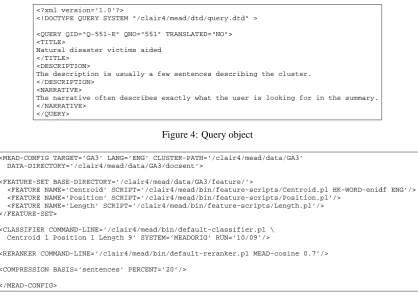
<?xml version=’1.0’?>
<!DOCTYPE QUERY SYSTEM "/clair4/mead/dtd/query.dtd" > <QUERY QID="Q-551-E" QNO="551" TRANSLATED="NO"> <TITLE>
Natural disaster victims aided </TITLE>
<DESCRIPTION>
The description is usually a few sentences describing the cluster. </DESCRIPTION>
<NARRATIVE>
The narrative often describes exactly what the user is looking for in the summary. </NARRATIVE>
</QUERY>
Figure 4: Query object
<MEAD-CONFIG TARGET=’GA3’ LANG=’ENG’ CLUSTER-PATH=’/clair4/mead/data/GA3’ DATA-DIRECTORY=’/clair4/mead/data/GA3/docsent’>
<FEATURE-SET BASE-DIRECTORY=’/clair4/mead/data/GA3/feature/’>
<FEATURE NAME=’Centroid’ SCRIPT=’/clair4/mead/bin/feature-scripts/Centroid.pl HK-WORD-enidf ENG’/> <FEATURE NAME=’Position’ SCRIPT=’/clair4/mead/bin/feature-scripts/Position.pl’/>
<FEATURE NAME=’Length’ SCRIPT=’/clair4/mead/bin/feature-scripts/Length.pl’/> </FEATURE-SET>
<CLASSIFIER COMMAND-LINE=’/clair4/mead/bin/default-classifier.pl \ Centroid 1 Position 1 Length 9’ SYSTEM=’MEADORIG’ RUN=’10/09’/>
<RERANKER COMMAND-LINE=’/clair4/mead/bin/default-reranker.pl MEAD-cosine 0.7’/> <COMPRESSION BASIS=’sentences’ PERCENT=’20’/>
</MEAD-CONFIG>
Figure 6: Mead-config object
12.
References
Carbonell, Jaime G. and Jade Goldstein, 1998. The Use of MMR, Diversity-Based Reranking for Reordering Doc-uments and Producing Summaries. In Alistair Moffat and Justin Zobel (eds.), Proceedings of the 21st Annual
International ACM SIGIR Conference on Research and Development in Information Retrieval. Melbourne,
Aus-tralia.
Otterbacher, Jahna C., Dragomir R. Radev, and Airong Luo, 2002. Revisions that improve cohesion in multi-document summaries: a preliminary study. In
Proceed-ings of the Workshop on Automatic Summarization (in-cluding DUC 2002). Philadelphia: Association for
Com-putational Linguistics.
Papineni, Kishore, Salim Roukos, Todd Ward, and Wei-Jing Zhu, 2002. Bleu: a method for automatic evaluation of machine translation. In Proceedings of the 40th
An-nual Meeting of the Association for Computational Lin-guistics (ACL).
Radev, Dragomir, 2000. A common theory of informa-tion fusion from multiple text sources, step one: Cross-document structure. In Proceedings, 1st ACL SIGDIAL
Workshop on Discourse and Dialogue. Hong Kong.
Radev, Dragomir, Sasha Blair-Goldensohn, and Zhu Zhang, 2001a. Experiments in single and multi-document summarization using MEAD. In First
Docu-ment Understanding Conference. New Orleans, LA.
Radev, Dragomir, Simone Teufel, Horacio Saggion, Wai Lam, John Blitzer, Arda C¸ elebi, Hong Qi, Elliott Drabek, and Danyu Liu, 2002. Evaluation of text summarization in a cross-lingual information retrieval framework. Tech-nical report, Center for Language and Speech
Process-ing, Johns Hopkins University, Baltimore, MD.
Radev, Dragomir R., Sasha Blair-Goldensohn, Zhu Zhang, and Revathi Sundara Raghavan, 2001b. Interactive, domain-independent identification and summarization of topically related news articles. In 5th European
Confer-ence on Research and Advanced Technology for Digital Libraries. Darmstadt, Germany.
Radev, Dragomir R., Sasha Blair-Goldensohn, Zhu Zhang, and Revathi Sundara Raghavan, 2001c. Newsinessence: A system for domain-independent, real-time news clus-tering and multi-document summarization. In Human
Language Technology Conference (Demo Session). San
Diego, CA.
Radev, Dragomir R., Weiguo Fan, and Zhu Zhang, 2001d. Webinessence: A personalized web-based multi-document summarization and recommendation system. In NAACL Workshop on Automatic Summarization. Pitts-burgh, PA.
Radev, Dragomir R., Hongyan Jing, Malgorzata Stys, and Daniel Tam, 2004. Centroid-based summarization of multiple documents. Information Processing and
Man-agement, in press.
Radev, Dragomir R., Jahna Otterbacher, Hong Qi, and Daniel Tam, 2003. Mead reducs: Michigan at duc 2003. In Proceedings of DUC 2003. Edmonton, AB, Canada. Witten, Ian H. and Eibe Frank, 2000. Data Mining:
Prac-tical machine learning tools with Java implementations.
San Francisco: Morgan Kaufmann.
NLP-enhanced Content Filtering within the POESIA Project
Mark Hepple , Neil Ireson , Paolo Allegrini
Ý, Simone Marchi
Ý,
Simonetta Montemagni
Ýand Jose Maria Gomez Hidalgo
¥University of Sheffield, Department of Computer Science, Regent Court, 211 Portobello Street, Sheffield, UK. m.hepple, [email protected]
Ý
Istituto di Linguistica Computazionale, CNR, Area della Ricerca di Pisa Via Moruzzi 1, 56124 Pisa, Italy. allegrip, simone.marchi, [email protected]
¥
Departamento de Inteligencia Artificial, Universidad Europea de Madrid, 28670, Villaviciosa de Odon, Madrid, Spain. [email protected]
Abstract
This paper introduces the POESIA internet filtering system, which is open-source, and which combines standard filtering methods, such as positive/negative URL lists, with more advanced techniques, such as image processing and NLP-enhanced text filtering. The description here focusses on components providing textual content filtering for three European languages (English, Italian and Spanish), employing NLP methods to enhance performance. We address also the acquisition of language data needed to develop these filters, and the evaluation of the system and its components.
1.
Introduction
POESIA (Public, Open-source Environment for Safer Internet Access: IAP 2117/27572) is a multisite project funded under the EU Internet Action Plan, which is devel-oping an advanced internet filtering system, intended pri-marily for use in schools and other educational establish-ments, with the aim of providing safe and educationally appropriate internet access for young people. The system is open-source, providing a basis for its development and maintenance beyond the project’s lifetime, and is freely available for download and installation.1 In this paper, we
will sketch the overall POESIA system, and then provide greater detail of the methods used for filtering on the ba-sis of textual content. Considerable quantities of web-page data are required both for the development and evaluation of the system. We will describe the approach taken for col-lecting this data, and the available early results on evalua-tion.
2.
The POESIA System
POESIA’s approach is to use multiple filters, each of which addresses some source of evidence that is of poten-tial use in identifying harmful pages. The evidence detected can then be combined by a Decision Mechanism (DM) component to produce an overall decision for each page. In this way, POESIA can best exploit whatever information is available to determine whether pages should be filtered. Work to date on the system has focussed on the filtering of pornographic content, but the same mechanisms could be reapplied to other domains.
At the heart of the POESIA architecture is a central controller, the Monitor, which interfaces with the internet caching proxy (e.g. Squid or Shweby), or other filtering
1Seehttp://www.poesia-filter.orgfor a full
list-ing of the project partners, additional information on the system, and a link to the open-source repository from which the system can be downloaded.
client, to determine the pages that must be assessed for fil-tering, and to return accept/reject decisions. The Monitor also invokes the other system components, and facilitates the traffic of data and results between filters and the DM, and caches filtering results for recently seen pages.
The POESIA filters include some that implement widely used filtering methods, e.g. positive/negative URL lists and PICS.2These methods are fairly effective for the
sites and pages explicitly addressed, but given the enor-mous size of the internet and its dynamic character, these approaches can only ever achieve partial coverage. This suggests the need for filtering based on the content of pages, and POESIA includes filters addressing both image and tex-tual content. The image filter assesses the likelihood that the images within a page are pornographic, based on the proportion of image area corresponding to skin, and on the shape and orientational characteristics of major skin areas. The multiple filters of the system should be seen as operat-ing in combination. For example, a page from a site which is not on the URL lists will be analysed for content. If the page contains a reasonable quantity of text, this alone might allow a reject decision, but if there is limited text, it might require the combination of image and text evidence for a decision to be made. The DM plays a crucial role in weigh-ing the available evidence to produce an overall decision.
The POESIA architecture readily allows for the inclu-sion of additional or substitute filters, and so the open-source character of the project allows for the continuing development and relevance of the system into the future.
3.
Filtering for Textual Content
Within POESIA, three language-specific text filters have been developed by different sites which specialise in
2
val-ALL TEXTS Light Filter Light+Heavy Filters
Language Category Pages Prec Rec Eff OvB Prec Rec Eff OvB
English Porn 5090 .969 .938 .953 93.8% 3.2% .967 .952 .960 95.2% 3.4%
Non-Porn 4840 .937 .968 .952 .951 .966 .958
Italian Porn 3500 .948 .963 .955 96.3% 4.4% .975 .953 .964 95.3% 2.0%
Non-Porn 4195 .968 .956 .962 .961 .980 .971
Spanish Porn 1000 .995 .916 .953 91.6% 1.9%
Non-Porn 4000 .999 .981 .989
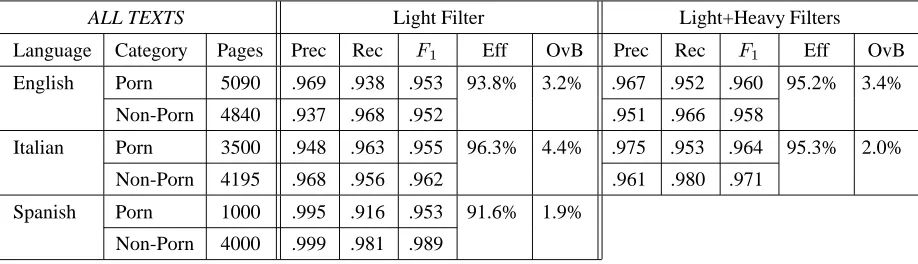
Figure 1: Performance results for text filters
sults are given as precision and recall scores for each cat-egory (i.e. porn, non-porn) together with the correspond-ing F-measure scores ( ). In addition to these familiar
metrics, percentage scores are also given for two additional metrics which are widely used in a filtering context. These are effectiveness (Eff), which is the proportion of harmful pages blocked (here corresponding to recall for the porn category), and overblocking (OvB), which is the proportion of harmless pages that are incorrectly blocked (equivalent here to one minus recall for non-porn). Results are pro-vided both for light filters alone, and for where the light and heavy filters of a language are used together.
Scores for the combined light/heavy filter for English and Italian indicate benefits for both languages of includ-ing the heavy filter, as shown by increased values. (The
corresponding scores for Spanish were not available at the time of completing the paper.) However, the key benefit ob-served differs between the two languages. For English, we see a reduction in error rate for porn of 22.6%, i.e. so that the number of harmful pages incorrectly allowed through is reduced by nearly a quarter. For Italian, the key bene-fit is a reduction in overblocking, such that the number of harmless pages that are incorrectly blocked is reduced by
55%, although this is accompanied by some reduction in
the effectiveness score.
Not surprisingly, the performance of text filters is signif-icantly affected by the quantity of text within files. To take the case of English (although similar observations could be made for the other languages), excluding files that contain
20 distinct terms produces the following results:
20 terms Light filter LightHeavy
Category Prec Rec Prec Rec
Porn .979 .959 .969 .977 .976 .977
Non-Porn .959 .979 .969 .976 .977 .976
Comparing to Figure 1, we see for light filtering that the
rises from around .953 to .969 for both porn and non-porn, and for lightheavy filtering,
rises from around .96 to
around .977. For these higher content pages, the heavy fil-ter reduces the error (misclassified pages) for porn by over 40%. Performance for the omitted low text content pages is accordingly lower (with ’s around .90). However, we
would expect pornographic pages with low text content to have high image content, and hence to be identified by the
image filter, so that the combination of image and text fil-tering can perform more effectively than either alone. Eval-uation of such combined filtering (i.e. imagetext) is at a
preliminary stage, but early results do suggest that this syn-ergy of content filters does occur.
A question that might be raised regarding the overall POESIA system is whether it will allow for filtering of other languages, given that specialist NLP techniques have been used in the filters developed for the key target lan-guages of English, Italian and Spanish. It should be noted, however, that the light filter systems developed for the three languages all employ generic text classification approaches, that can readily be reused to produce light filters for other languages, provided that a sufficient quantity of categorised training data can be acquired. This portability has been demonstrated within the project by the creation of a light filter for French using the code developed for the English light filter. In addition, the flexible architecture and open-source character of POESIA allow that heavy text filters for additional languages can be incorporated into the system should there by groups willing to develop them.
9.
References
Allegrini, P., Grigolini, P. and Palatella, L. (2004). Inter-mittency and scale-free networks: a dynamical model for human language complexity, Chaos, Solitons & Fractals, v. 20, pp. 95-105.
Carreras, X., M´arques, L. and Padr´o, L. (2002). Named Entity Extraction using AdaBoost. In Proceedings of the
Sixth Conference on Computational Natural Language Learning.
Cavnar, W.B. and Trenkle, J.M. (1994). N-gram-based text categorization. In Proceedings of SDAIR-94, 3rd Annual
Symposium on Document Analysis and Information Re-trieval, pp. 161–175.
Ratnaparkhi, A. (1998). Maximum Entropy Models for
Natural Language Ambiguity Resolution. Ph.D. thesis,
University of Pennsylvania.
Riloff, E. and Lorenzen, E. (1999). Extraction-based text categorization: Generating domain-specific role relation-ships automatically. In T. Strzalkowski, ed., Natural
Language Information Retrieval. Kluwer AP.
SESSION P24-T
Using Weighted Abduction to Align Term Variant Translations in Bilingual
Texts
Michael Carl, Ecaterina Rascu and Johann Haller
Institut f¨ur Angewandte Informationsforschung Martin-Luther-Str. 14, Saarbr¨ucken, Germany
{carl, kati, hans}@iai.uni-sb.de
Abstract
In this paper we describe a method for detecting terminological variants and their translations in bilingual texts. Our approach is based on abductive reasoning and combines various monolingual and bilingual resources. A small scale experiment shows that precision and recall increase when using more resources and when the resources interfere in a less restricted way. In order to tune our system, we develop a weighing strategy based on the precision of term translation alignments in a reference text. We feed these weights back into the linguistic resources and repeat the experiment. The results show that precision values are considerably higher when weighing term alignments.
1.
Introduction
The consistent use of terms in technical domains in-creases the comprehensibility and translatability of texts (Mitamura and Nyberg, 1995). However, terminological variation is a frequent phenomenon even in established do-mains (Daille et al., 1996; Macklovitch, 1995; Royaut´e, 1999).
Enguehardt distinguishes between term recognition sys-tems (TRS) and term extraction syssys-tems (Enguehard, 2003). While the latter identify new terms in texts, the for-mer ones detect variants of already known terms.
In this paper we investigate an abductive method to de-tect terms and their translations in bilingual texts. The pro-posed architecture combines two monolingual term recog-nition systems capable of identifying terms and their vari-ants. We infer term variation templates from language spe-cific general variation patterns by means of abduction and use them to identify term variant translations in aligned texts. Abduction as “inference to the best explanation” also requires a ranking of the hypotheses by evaluating their explanatory power (Magnani, 2001). We achieve this by weighing term variation templates according to the co-occurrence precision of variation patterns.
We first present the approach adopted for term recogni-tion. In section 3., we evaluate the system in a number of different settings.
2.
Abductive Approach to Term Recognition
To detect translations of terms and their variants in an aligned English–French text, the system requires two types of resources. The first resource is a bilingual terminol-ogy containing base terms and their authorized translations. The second resource consists of language specific general variation patterns and synonymy relations. Based on these variation patterns and the terminology, a number of term specific variation templates are generated for every term in the bilingual terminology. The variation templates are stored in a database — the so-called Abductive Terminol-ogy Database (ATDB) — together with the original terms so that each variant is linked to its authorized form. The
architecture is plotted in figure 1. The actual ATDB is in the center of figure 1 and will be discussed in section 2.2..
An ATDB consists of two symmetrical language sides, a left-hand English side and a right-hand French side1. A
bilingual sentence aligned text is fed into the system which detects term translations and marks them accordingly. The automatically annotated text is then compared with the manually annotated version of the same text. Values for precision and recall are computed for every term and tem-plate. We accumulate weights for general variation patterns based on precision values of term templates and feed these weights back into the resources. We refer to this mecha-nism as weighted abduction. In section 3. we outline this approach in more depth and show how it can be used to grade ambiguities and reduce noise.
In the following subsections we present the different re-sources of the ATDB in more detail.
2.1. General Term Variation Patterns
We distinguish three types of variations: typographical variations, morpho-syntactic variations and lexical varia-tions. In this section we give examples of these.
2.1.1. Typographical Variation
Typographical variants differ in the way hyphenation, blanks or punctuation marks are used around a term con-stituent. Examples are given in (1) and (2). We write the authorized term on the left-hand side of the arrow and the variant on the right-hand side.
(1) hand stop → handstop
(2) re-insert → reinsert
2.1.2. Morpho-syntactic Variation
Morpho-syntactic variants are derived from a base term by morphological derivation and/or by transformation of its syntactic structure. The basic mechanisms of structural transformation are omission, insertion, permutation, and coordination (Jacquemin, 1996; Daille et al., 1996). Omis-sion implies the deletion of one or more components from
1