't
<':1.'"
,
...-: r~;::!'\_.
,
.
--.;
FUNFITS: Data Analysis and Statistical Tools
for Estimating Functions
Douglas Nychka, Barbara Bailey and Stephen Ellner
Perry Haaland and Michael O'Connell
Institute of Statistics Mimeo Series #2289
(~----)
I
Mimeo Series # 2289 I
FUNFITS, Data Analysis and II Statistical Tools for Estimating
Functions .I
i
Douglas Nychka, Barbara Bailey,
1
and Stephen Ellner, Perry Haaland1
and Michael O'Connell
1
'---:::-
-=-~II
I: Kame Date f
I
: I
l
I
i
I
I
J
;;:-'"
;:,...
...
...
FUNFITS: data analysis and statistical tools for
estimating functions
Douglas Nychka, Barbara Bailey and Stephen Ellner*
North Carolina State University
Perry Haaland and Michael O'Connell
Becton Dickinson Research Center
Abstract
A module of functions has been created to simplify and extend the fitting of curves and surfaces to data. Some important applications include estimates of the mean value of a measured response over some space of interest, response surface methods for designed experiments and the modeling of nonlinear dynamic systems. The core methods that are implemented in FUNFITS include prediction, plot and summary functions that help the user interpret results and visualize the estimate. FUNFITS is written mainly in the S programming language with some support from FORTRAN subroutines. All sourceisavailable and easy to modify.
Contents
1 Introduction
2 What's so special about FUNFITS?
2.1 An example .
3 A Basic model for regression
4 Thin plate splines: tps
4.1 Determining the smoothing parameter
4.2 Approximate splines for large data sets .
4.3 Standard Errors. . . .
5 Spatial process models: krig
5.1 Specifying the Covariance Function.
5.2 Some examples of spatial process estimates.
6 Generalized ridge regression
6.1 Details oftps andkrig . . . .
6.2 Computation of the ridge regression estimator.
7 Fitting single hidden layer neural networks
7.1 Details on fitting the model .
7.2 Confidence sets for the model parameters
8 Nonlinear Autoregressive Models
8.1 Lyapunov exponents
8.2 Confidence regions
8.3 State vector form . .
9 Model components and graphics options
10 Partial listing of FUNFITS functions and datasets
10.1 Surface Fitting and Design .
10.2 Response Surface Methods and Spatial Design. 10.3 Other Regression Methods and Statistics.
10.4 Nonlinear Time Series .
10.5 Plotting Functions and Graphics . 10.6 Statistics, Summaries and Printing 10.7 Supporting Functions for Methods
10.8 Numerical functions .
10.9 Data and Object Manipulation 10.10 Help, FUNFITS and System
10.11 Data Sets .
11 Listing of the README installation file
1
Introduction
FUNFITS is a suite of functions that enhance the S_PLUS™ statistical package and
facili-tate curve and surface fitting. This software grew up as a project to augment S-'PLUS with additional nonparametric fitting strategies. Part of this effort was to focus on three areas rich in applications of function estimation and inference: spatial statistics, response surface methodology and nonlinear time series/dynamical systems. This activity has also lead to methods for spatial sampling and design of experiments when the response is expected to be a complex surface. Implementation of these methods with an object oriented approach gives a high level of integration within the FUNFITS package. This allows the models to be easily fit, summarized and checked. The main methodological contributions of FUNFITS are
• Thin plate splines
• Spatial process models
• Space filling designs
• Neural network regression
• Response surface methodology using nonparametric regression
• Nonlinear autoregressive process models and the analysis of nonlinear dynamic systems
Where possible the statistical methods are supported by generic functions that provide predicted values and derivatives, diagnostics plots and simple ways to visualize the functions using contour and surface plots. In addition there are generic functions to optimize the estimated function and to find a path of steepest ascent. Some discipline has been kept to implement the methods in the S language, however a few of the numerically intensive steps are completed using FORTRAN subroutines. All the source code is included in the distribution so it is possible to examine the algorithms when needed. The emphasis on S code and the organization of the FORTRAN objects helps to make parts of the package easy to modify.
This manual gives an overview of the FUNFITS package and provides some background to the statistical models and the computations. Besides the general treatment given herein the user is referred to help files for each of the functions that provide more detailed infor-mation. At the end of the manual are two sections that list the README file for installing the FUNFITS package and an selected of FUNFITS functions and data sets.
2
What's so special about FUNFITS?
This project was started with an interest in implementing surface and curve fitting methods that provide a global representation for the estimated functions. This form is complementary
to local methods such asloess already supported by S-PLUS. By a global method we mean
that the function has a specific (closed form) formula depending on a set of parameters. For example
M
..
where {1/Jk} are a set of basis functions and {Ck} are estimated parameters. Of course the
nonparametric flavor of this estimate means that M is similar in size to the number of data
points and the estimates of the parameters are constrained in such a way that the resulting estimate is smooth. Global methods are especially useful for smaller sample sizes, low noise situations or applications where some inferences are required.
Although the use of this package requires some knowledge of S-PLUS, many of the FUN-FITS functions are easy to use and require a minimum of S-PLUS commands. Also, there are additional functions in FUNFITS that help to round the corners of what we perceive to be rough edges in S-PLUS. Faced with the unpleasant task of learning a new program-ming/data analysis language, the reader should keep in mind that no system will make function and curve fitting a trivial exercise. The data structures can be fairly complicated and some scrutiny and interaction with the data is always required to prevent nonsensical results. Because S-PLUS already supports many statistical functions and has very flexible graphics it is a natural platform for FUNFITS. For a gradual introduction to S-PLUS the reader might take a look at S-Lab (Nychka and Boos, 1994), a series of labs teaching data analysis and some of the some of basic functions of S-PLUS incrementally. The overview by Ripley and Venables (1994) is also helpful.
2.1
An example
Another project goal is to use the object oriented features of the S language to make the functions easier to use. To illustrate these ideas here is an example of fitting a thin-plate spline surface to the summer 1987 ozone averages for 20 stations in the Chicago urban area. The data is in the S data set, ozone with the components: x a 20 x 2 matrix with
approximate Cartesian coordinates! for the station locations, a vector y with the average
ozone values for each station, and lon .lat, a matrix with the geographic locations of the
stations. The text following the S-PLUS prompt: > is what has been typed in (comments
follow the pound sign).
> ozone # print the ozone data to the screen
> plot(ozone$lon.lat) #plot locations of stations
> US(add=T) # with medium resolution US map overlaid
> ozone.tps<- tps(ozone$x, ozone$y) # thin plate spline fit to data
The results from fitting the thin plate surface to the 20 mean ozone values are now stored in the output data set ozone. tps. Since a smoothing parameter has not been specified the default is to estimate the amount of smoothness in the surface by cross validation.
The next step is to look at a summary of the fit:
Call:
tps(x = ozone$x, y = ozone$y)
Number of Observations: 20
Degree of polynomial null space ( base model): 1
Number of parameters in the null space 3
1To make this example simpler and the smoothing comparable in the north-south and east-west directions,
2, 2, 4, 1
4.5 15.5 4.047
IA
4.4594
21.17
0.3521 0.07126 -0.1868 397.7244 -0.034
L. '
Effective degrees of freedom: Residual degrees of freedom: Root Mean Square Error: Pure Error:
RMSE (PRESS):
GCV (Prediction error) Mutiple R-squared: Adjusted R-squared: Q-squared:
PRESS:
Log10(lambda): m, power, d, cost: Residuals:
min 1st Q median 3rd Q max
-6.712 -1.426 -0.4725 1.326 7.912
Method for specifying the smoothing parameter is GCV
This summary indicates some basic features of the regression. With approximately
4.5 degrees of freedom estimated for the surface one can expect that the fit is similar to a quadratic fit ( 5 parameters) but must have more structure than just fitting a linear function. To assess the quality of the fit one can look at residual plots and the GCV function:
> plot(ozone.tps)
This graphical output is given in Figure 1. Based on the two plots of fitted values and resid-uals, we see that the estimate has some problems with over-fitting ozone at the lower values. Good models tend to have small values of the cross-validation function, and we see on the lower plots that models with higher effective numbers of parameters (or equivalently smaller values of the smoothing parameter lambda) also do not predict as well. One alternative in this case is to use the variances based on the daily ozone values as a way to determine the appropriate amount of smoothness.
One can also examine the fitted surface (see Figure 2):
> surface(ozone.tps, 'Fitted ozone surface')
As expected from the summary we see that the estimated surface is similar to a quadratic function in shape. The surface has been restricted to the convex hull of the stations and so, for example, it is not extrapolated over Lake Michigan (the upper right corner of the region).
Besides a plot of the fitted surface, it is also easy to get some rough measure of uncertainty in the estimate. This involves two steps, first evaluating the standard errors at a grid of locations and then passing these evaluations to one of the surface plotting programs in S. Here is an example that gives the image plot in Figure 3.
> ozone.se <- predict. surface. se(ozone.tps)
> image(ozone.se, 'SE of fit') # or use contour or persp
> points( ozone$x) # add in the station locations
> contour( predict.surface( ozone.tps), add=T) # add contours of the
':::
..
tps(x
=
ozone$x, y
=
ozone$y)
RMSE =4.047
•
RI\2=
35.21%•
Ql\2
=
-18.68%•
•
\l) It)
•
'V
en
• •
•
Q)
•
::J
•
(ij en
>
0 as::J ••..
"C 'V
•
"C 0•
Q)
~
•
..
'en
Q)•
•
•
•
•
Q)
•
a:
•
en
•
.0 It)
0 ('I)
,
•
• •
It)
•
I
•
•
35 40 45
Predicted Values 39 40 41
Predicted values
GCV
Eft.df.=4.5 Re . df.=15.5
/
C\I 0
"
co•
"as
•
•
E 0
•
•
C) ...
•
'en
•
•
+ 0
•
-
co•
w
•
rn
«
0•
•
w It)
•
•
-
"C•
0
•
*
'V•
•
•
E
•
•
:;::::; 0 ••
en ('I)
,
w 0 C\I
>
(.) ~ o co o ... o co o It) o C\I GCV Lambda=
0.92477\
•
•
•
•
••
•
•
••
••
••
••
•
•
••
5 10 15 0.001 0.100 10.000
Effective number of parameters Lambda
...
... ... ...
...
~~WA
...
0
C"')
0
C\I
~
-
::J0 0
~
...
oJ::
~ 0
0
z
0
...
I0
C\I
I
..,
r
..
·20 -10
o
East.West
10 20 30
.-•
0('I)
0
C\I
0
•
T"""
>-0
0
T""" I
0
C\I
I
-30 -20 -10 0 10 20 30
X
•
•
Thus with a minimal amount of work it is possible to fit, check and interpret a fairly complicated nonparametric regression method. The main intent of FUN FITS is that
func-tions such as surtace or predictshould work with a variety of methods. The burden is
on the software to sort out salient differences between the objects that are passed to the
function and still produce sensible results. In this example, the ozone. tps object contains
the description of the estimated spline function but the ozone. se object consists of
stan-dard errors evaluated on a (default) grid of points. In either case a perspective or contour
plot of the function makes sense and thus the surfacefunction is designed to handle both
types of objects. An another important principle in this example is that the rich set of S-PLUS graphics functions are being leveraged to interpret the spline estimates found by a FUNFITS function. In this way the FUNFITS module is small and takes advantage of the many standard functions in S-PLUS.
3
A Basic model for regression
The suite of FUNFITS regression functions assume observations from the additive model:
Yi
=
I(:l:i)+
{i for 1~ i ~ n (1)where
Yi
is the observed response at the ith combination of design variables :l:i E ~dand
1
is the function of interest. The random components, {{i}, usually associated withthe measurement errors, are assumed be independent, zero-mean random variables with
variances, {0"2
fWd.
One efficient strategy for representing
1
is as the sum of a low order polynomial and asmooth function:
1(:1:)
=
p(:I:)+
h(:I:)In the case of thin plate splines (Wahba 1990, Silverman and Green 1994) the degree ofp
implies a specific roughness penalty on h based on integrated squared (partial) derivatives.
Under the assumption that
1
is a realization of a spatial process, p can be identified as the"spatial trend" or "drift" andh is modeled as a mean zero Gaussian process (Cressie 1991).
Spline and spatial process models are sensitive to the dimension of :I: because they
attempt to represent all possible interactions among the different variables. This feature is the well known "curse of dimensionality" and can be tied to an exponential increase in the number of interactions as the dimension of:l: increases. Neural network regression (Cheng and Titterington 1994, Ripley and Venables 1994) is less sensitive to fitting high dimensional functions. For regression problems, a useful form is a single hidden layer, feed forward network
where
M
1(:1:)
=
f30+
'Ef3k¢(J.lk+
'Yf:l:)k=l
(2)
eU ¢(u)= - - .
1
+
eUand f3, J.l and 'Yk , 1~ k ~ M are parameters to be estimated. In this form the dimension
reduction is achieved by only considering a small number of projections (M).
Another way to simplify the structure of
1
is by assuming that it is additive in the(3)
• d
f(z) =
2:
fk(Zk)k=1
In FUNFITS the full interactive model (1) can be estimated by the functions tps and
krig, the neural net model (2) is fit bynnreg and the additive model (3) by addreg. In
addition there is a fast, one dimensional cubic spline function, sreg. It should be noted
that as part of S-PLUS there exist excellent functions for fitting additive models and
one-dimensional functions using splines (gam , smooth. spline). The main advantage of the
FUNFITS version of these methods are efficiency and access to the all of the source code.
4
Thin plate splines:
tps
This section gives some back ground for the two surface fitting functions, tps and tpsreg.
Both of these fit thin plate splines the main difference beingtpsis written essentially all in
the S language and tpsreghas less options and executes a FORTRAN program outside of
S-PLUS.
Splines are usually defined implicitly as functions that solve a variational (minimization)
problem. The estimator of
f
is the minimizer of the penalized sum of squaresfor .x
>
O. The thin plate spline is a generalization of the usual cubic smoothing spline witha "roughness" penalty function Jm(f) of the form
Jm(f) =
kd
2:
a1!~.!ad! (8Xl~~.~X~d
)
2dzwith the sum in the integrand being over all non-negative integer vectors, a, such that
L:
a1+ ... +
ad=
m, and with 2m>
d. Note that for one dimension and m=
2,J2(1) =
J
(J(/I)(x)) 2dx ,giving the standard cubic smoothing spline roughness penalty.
An important feature of a spline estimate is the part of the model that is unaffected by the roughness penalty. The set of functions where the roughness penalty is zero is termed the null space, and for Jm , consists of all polynomials with degree less than or equal to
m-l.
The minimization ofS>.. results in a function that tracks the data but is also constrained
to be smooth. A more Bayesian viewpoint is to interpret S>.. as the negative of a posterior
density for
f
given the dataY. The roughness penalty then is equivalent to a priordis-tribution for
f
as a realization from a smooth (almost m differentiable) Gaussian process.This is the basis for the connection between splines and spatial process estimates.
4.1
Determining the smoothing parameter
r
•
dependent variable. Let A(>.) denote the n xn smoothing or "hat" matrix that maps the
Y vector into the spline predicted values.
Given this representation, the trace ofA(>') is interpreted as a measure of the number
of effective parameters in the spline representation. The residuals are given by(I - A(>.))Y
and thus n - trA(>.) is the degrees of freedom associated with the residuals. The estimate
of the smoothing parameter can be found by minimizing the GCV function
One variation on this criterion is to the replace the denominator by
(1- (C(trA(>') - t)
+
t)jn)2.Heretis the number of polynomial functions that span the null space ofJm andCis a cost
parameter that can give more (or less) weight to the effective number of parameters beyond
the base polynomial model (null space of the smoother). Once
X
is found, u2 is estimatedby
,2 yT(I - A(X))TW(I - A(X))Y
u
=
, .
n - tr(A(>.))
and is analogous to the classical estimate of the residual variance from linear regression.
4.2
Approximate splines for large data sets
The formal solution of the thin-plate spline has as many basis functions as unique:evectors.
Except in one-dimension, this makes computation and storage difficult when the sample size exceeds several hundred. The basic problem is that the spline computation includes a singular value decomposition of a matrix with dimensions comparable to the number of basis functions. A solution to this problem in FUNFITS is to use a reduced set of basis functions, described by a sequence of "knot" locations possibly different from the observed
:e values. Given below is a short example that goes through the steps of using a reduced
basis.
The data set flame is an experiment to relate the intensity of light from ionization of
Lithium ions to characteristics of the ionizing flame. The dependent variables are the flow rate of the fuel and oxygen supplied to the burner used to ionize the sample and data consists of 89 points. Here is the fit to these data using a spline where the base model is a cubic polynomial:
flame.full.fit<- tps( flame$x, flame$y, m=4)
To reducing the number of basis functions, one could construct a grid of knots that are different from the observed values and smaller in number. The first step is to create the new grid of knots ( a 6 x 6 grid in the example below) and then refit the spline with these
knots included in the call to tps.
> g.list <- list(Fuel=seq(3,28,,6), 02=seq(15,39,,6»
> knots.flame <- make.surface.grid(g.list)
•
--Here the grid list and the function make. surface. grid have been used to construct
the two dimensional grid. As an alternative, one could consider a random sample of the
observed X values,knots. flame<- flame$x[sample(1: 89,36),J or chose a subset based
on a coverage design,knots.flame<- cover.design( flame$x, 36). Of course in either
of these cases the number of points, 36, is flexible and is based on choosing the number large enough to accurately represent the underlying function but small enough to reduce the computational burden.
4.3
Standard Errors
Deriving valid confidence intervals for nonparametric regression estimates is still an active area of research and it appears that a comprehensive solution will involve some form of smoothing that can vary at different locations. To get some idea of the precision of the estimate, in FUNFITS, a standard error of the estimate is computed based on the as-sumption that the bias is zero. This is not correct and such confidence intervals may be misleading at points on the surface where there is fine structure such as sharp minima or maxima. However, empirical evidence suggests that such intervals provide a reasonable mea-sure of the estimate's average precision if the smoothing parameter is chosen to minimize the mean squared prediction error. The standard error can be adjusted (inflated) by the factor y'tr(A(A))/tr(A(Ap). This makes the average squared standard errors across the design points approximately equal to the average expected squared error. Some theoretical
justification for this seeminglyad hocfix is given in Nychka (1988). Operationally one would
follow the steps:
> ozone.tps<- tps(ozone$x, ozone$y)
> ozone.se <- predict.surface.se(ozone.tps)
To adjust, the $z component of the surface object is multiplied by this inflation factor.
> inflate <- sqrt(ozone.tps$trace/ozone.tps$trA2)
> ozone.se$z <- ozone.se$z*inflate
> contour( ozone.se) # now plot adjusted standard errors
In some extreme cases the actual coverage may drop from the 95% nominal level to 75%. However in most situations such intervals are useful for assessing the order of magnitude of the estimation error.
5
Spatial process models:
krig
The spatial process model used in this section assumes that h(z) is a mean zero Gaussian
process. Let
Cov(h(z), h(z'))= pk(z,z')
be a covariance function where k is a known function and p is an unknown multiplier.
Letting Kij = k(Zi, Zj) the covariance matrix assumed for Y is pK
+
(]'2W-1 and underthe assumption that p and(]'2 are known one can estimatef( z) as the best linear, unbiased
estimate for
f
based on Y (Cressie 1991, Welch et al. 1992). Recall that the basic modelassumes that the measurement errors are uncorrelated with the ith observation having a
variance given by(]'2/Wi. In spatial statistics, the variance of the errors is often referred to
also fine scale variability in the random surface in addition to the larger scale covariance structure modeled by the covariance function.
To make the connection with ridge regression explicit it is helpful to reparametrize the
parameter p as p = A(12. The estimation procedures inkrig actually determine Aand (12
directly and then these estimates are used to derive the estimate for p.
Measures of uncertainty for j(:l!) are found by evaluating
under the assumption that p and (1 are known and k is the correct covariance function.
Becausej(:l!)is a linear function of Y, it is a straight forward exercise to derive the prediction
variance in terms of matrices that have been used to estimate the function. Of course, in practice, one must estimate the parameters of the covariance function, and in FUN FITS the variance estimate is obtained by substituting these estimated values into the variance formula. The user should keep in mind that this is an approximation, underestimating the true variability in the estimate.
5.1
Specifying the Covariance Function
The strength of the krig function is in the flexibility to handle very general covariance
models The key idea is that in the call to krig one must specify an covariance function
written in S-PLUS. This function should compute the cross covariance between two sets of
points. A basic form for the arguments ismy.cov(x1,x2) where xi and x2 are matrices
giving two sets of locations and the returned result is the matrix of cross covariances.
Specifically ifxi isnl xdandx2isn2 xdthen the returned matrix will be nl xn2. where
the i,j element of this matrix is the covariance of the field between the location in the
ith row ofxi and the l h row ofx2. Here is an example using the exponential covariance
function
k(:l!, :l!') = e-II:l!-:l!'1I/9
where the default value for the range parameter, (), is set to 1.0.
> my.cov<- function(x1,x2,theta=1.0) { exp( -rdist(x1,x2)/theta) }
Hererdistis a handy function that finds the Euclidean distance between all the points
in xi with those in x2 and returns the results in matrix form. For geographic coordinates
rdist. earthgives great circle distances for locations reported in longitude and latitude.
A function that has a few more options is the FUNFITS version exp. coyand this could
be used as a template to make other covariance functions. At a more complex level is
EXP . coythat makes use of FORTRAN routines to multiply the covariance function with a vector. Although more difficult to read, these modifications decrease the amount of storage required for evaluating the kriging or thin plate spline estimate at a large number of points.
Most covariance functions also require a range parameter, ego () in the case of the
exponential. The parameters that appear in a nonlinear fashion in k are notestimated by
the krigfunction and must be specified. The parameter values can be given in two ways,
either by modifying the covariance function directly or changing the default value for a
parameter when krig is called. Suppose that one wanted to use an exponential function
with ()
=
50. One could either modifymy. coyso that the default was theta= 60or in the•
> ozone.krig <- krig(ozone$x, ozone$y, my.cov, theta=50)
In general, any extra arguments given tokrig are assumed to be parameters for the
covari-ance function. Thus, krig makes a copy of the covariance function, substitutes these new
defaults for the parameters and includes this modified function is part of the output object
in the cov. function component. For example, looking at the krig object created above,
> ozone.krig$cov.function
function(x1, x2, theta = 50)
{
exp( - rdist(x1, x2)/theta)
}
This is identical to the orignal version of the function except the default value for theta
has been changed! In this way subsequent computation based on the krig object will use the correct parameter value.
There are well established methodologies for estimating the parameters of the covari-ance function and perhaps the most straightforward is nonlinear least squares fitting of the
variogram. FUNFITS has a variogram function, vgram and many estimation methods are
based on estimating parameters from the variogram using nonlinear least squares. Because S already provides support for nonlinear least squares fitting it is not neccesary to develop specialized variogram fitting routintes within FUNFITS. The example in the next section fits a variogram in this way using the S-PLUS function nls.
In contrast to the nonlinear parameters of the covariance function, the default for krig
is to estimate the parameter A ( u2/p) based on cross-validation2• This difference is based
on the fact that the qualitative aspects of the estimated surface are usually much more
sensitive to the value of the smoothing parameter, A, than the others. Also, this parameter
appears in a linear fashion in the matrix expressions for the estimate, and so it is efficient to evaluate the estimate at different choices of this parameter. Parameters such as the range do not have a similar property, and the matrix decompositions for the estimates must be recalculated for different values of these parameters.
5.2
Some examples of spatial process estimates.
The data set ozone2 contains the daily, 8-hour average ozone measurements during the
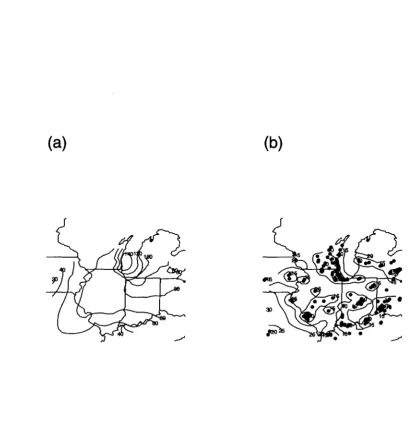
summer of 1987 for approximately 150 locations in the Midwest (Figure 4). The component
y in this dataset is a matrix of ozone values with rows indexing the different days and
columns being the different stations. The locations can be plotted by
USC xlim= range( ozone2$lon.lat[,1]), ylim= range( ozone2$lon.lat[,2]» points( ozone2$lon.lat, pch=" o")
Most of the work in this example is identifying a reasonable covariance function for these data. Here is an example of computing and plotting the variogram for day 16.
y16<- c(ozone2$y[16,]
vgram.day16<- vgram( ozone2$lon.lat, y16, lon.lat=T) plot( vgram.day16, xlim=c(0,150»
o
o
c9
o
o
0o
o
o
oo
00
~o
o
o
o
or
The variogram in this raw form is not very interpretable and one could use different smooth-ing methods such as loess or spline smoothsmooth-ing to smooth these points.
As an alternative, one could look at the correlogram to get an idea of the general distance scale for the correlations. Under the assumption that ozone over this period has a consistent
spatial covariance from day to day one can consider the different days ~ replicated points
and estimate the correlations directly. The following S code finds the pairwise correlations and plots them against distance.
> ozone.cor<- COR( ozone2$y)
> upper<- col(ozone.cor$cor»row(ozone.cor$cor)
> cgram.oz<- list( d=rdist.earth( ozone2$lon.lat) [upper] ,
+ cor= ozone.cor$cor[upper])
>plot( cgram.oz$d, cgram.oz$cor, pch=".")
Here we have use the FUNFITS function COR because it can handle missing values (in
S-PLUS NA's). This is important because the missing value patterns are irregular and reducing down to a complete data set would exclude many of the days. One disadvantage is
thatCOR is slow because it loops through all pairs of stations. Next one can fit an exponential
correlation function to these sample correlations using nonlinear least squares:
> cgram.fit<- nls( cor - alpha* exp( -d/theta),
+ cgram.oz, start= list( alpha=.96, theta=200»
> summary( cgram.fit)
Formula: cor - alpha * exp( - d/theta)
Parameters:
Value Std. Error t value
alpha 0.931247 0.00366247 264.268
theta 343.118000 2.37364000 144.664
Residual standard error: 0.120286 on 11626 degrees of freedom
Correlation of Parameter Estimates: alpha
theta -0.838
Based on this value for the range one can now remove the missing values for day 16 and
use thekrig function to fit a surface.
> good<-lis.na(y16)
> ozone.krig<- krig( ozone2$lon.lat[good,] , y16[good] ,
+ exp.earth.cov, theta=343.1183)
In this case the nugget variance and the linear parameters of the covariance are found by
GOV. Here is a summary of the results:
> summary(ozone.krig)
krig(x = ozone2$lon.lat[good, ], Y = y16[good], cov.function = exp.earth.cov, theta = 343.1183)
Number of Observations:
Degree of polynomial null space ( base model): Number of parameters in the null space
Effective degrees of freedom: Residual degrees of freedom: MLE sigma
GCV est. sigma MLE rho
Scale used for covariance (rho) Scale used for nugget (sigma~2) lambda (sigma2/rho)
Cost in GCV GCV Minimum Residuals:
min 1st Qmedian 3rd Q max -16.4 -1.697 0.0963 1.686 12.16
147 1 3 108.1 38.9 6.306 6.647 2648 2648 39.77 0.01602 1 166.8
For this particular day the ozone surface has a high degree of variability, more so than a typical day in this period, and this is reflected by the large value of the rho parameter in the summary. Alternatively one could specify sigma2 and rho explicitly in the call, and thus fix them at specific values. More is said about this below.
The next set of S calls evaluate the fitted surface and prediction standard errors on a grid of points. These evaluations are then converted to the format for surface plotting and some contour plots are drawn (see Figure 5).
set.panel(2,1)
predict.surface( ozone.krig)-> out.p
US( xlim= range( ozone2$lon.lat[,1]), ylim= range( ozone2$lon.lat[,2]» contour( out.p, add=T)
predict.surface.se( ozone.krig)-> out2.p
US( xlim= range( ozone2$lon.lat[,1]), ylim= range( ozone2$lon.lat[,2]» contour( out2.p,add=T)
points( ozone2$lon.lat)
The last part of this section illustrates how to extend this analysis to a covariance function that is not stationary. One simple departure from nonstationarity is to consider a covariance that has different marginal variances but isotropic correlations. Specifically consider
k(z, z')
=
u(z)u(z')eIlZ-Z/1l18(a)
(b)
sd.tps<- tps( ozone2$lon.lat, ozone.cor$sd, return.matrices=F)
The return.matrices switch has been set to false so that the large matrices needed to find standard errors are not included in the output object. We do not need to calculate standard errors and using this smaller object in other functions is more efficient.
The next step is to call krig with a covariance function that uses this tps object to evaluate the marginal variances. The function exp. isocor in FUNFITS has been been written to do this, and the reader is referred to the help file for the details of its arguments. The main differences between this function and the other examples that have been given is that it needs the tps object3 passed to it in order to evaluateO'(:ll)and it also has an option to return the marginal variance at a set of locations instead of the covariance. This addition is important for predict. se to work correctly. Another difference is that this covariance builds in the nugget effect.
Here is an example of using exp. isocor based on the parameters found from the nls fitting of the correlogram. In the spirit of doing something useful with the results, the modeled covariances are compared to the observed ones (Figure6). To limit the number of points on this plot only pairs of stations within 250 miles of each other are included.
> hold1<- diag(ozone.cor$sd)y'*y'(ozone.cor$cor)y'*y' diag(ozone.cor$sd)
>upper<- col(hold1» row( hold1)
> hold1<- hold1[upper] # get upper triangle
> hold2<- exp.isocor( ozone2$lon.lat, obj=sd.tps, alpha = .93, theta=343, lon.lat=T)
> hold2<-hold2[upper]
> ind<- cgram.oz$D <= 250
> plot( hold1[ind], hold2[ind], pch='.', xlab='observed COY' , ylab='fitted COY' )
> abline(O,1)
To use krig to fit the surface one has two options. The first is to keep all of the covariance parameters fixed using the values estimated from the correlogram. Here is how to specify this model.
> weights<- 1/exp.isocor(ozone2$lon.lat, obj=sd.tps, alpha=.93, theta=343,
+ marginal =T) # reciprocal marginal variances at the observed locations
> fit.fixed<- krig( ozone2$lon.lat[good,], y16[good],
+ rho=.93, sigma2= (1-.93), weights=weights[good], + cov.function=exp.isocor,obj='sd.tps', theta=343)
The values for rho, sigma and weights are set so that the covariance agrees with the nonstationary model given above. In krig the name of the tps object is passed to the covariance function as a character string to save storage.4
The second approach is to estimate the parameters p and 0'from the data. The S code
below is for finding both parameters using GCV.
30r a character string with thetpsobject's name
4The disadvantage is that subsequent computing withfit. fixedmust also have the objectsd. tpsin
o
o
LO
o
o
-0>('1) 0>0
~u
o
o
C\I
o
o
,...
o
200
observed COV
400
'
..
600
> fit.GCV<- krig( ozone2$lon.lat[good,J, y16[goodJ,
+ weights=weights[good] ,
+ cov.function=exp.isocor,obj='sd.tps', theta=343)
This gives a very different fit to the data, and possibly reflects the fact that for this given day the ozone surface has more variability than on average. To compare the effect on the estimated prediction error using these two models, one can compare the standard errors.
> set.panel(2,2)
> out1.p <- predict.surface.se(fit.fixed)
> out2.p <- predict.surface.se(fit.GCV)
> contour(out1.p)
> contour(out2.p)
> out3.p<- out2.p
> out3.p<- out2.p$z/out1.p$z #relative difference between the SE's
> contour(out3.p)
A compromise between these two models is to specify the ratio of "noise to signal",
0'2/P= A and let0'be determined by estimates based on the data at day 16. The net result
is a covariance model where the average covariances are scaled by these two parameters.
fit.lambda<- krig( ozone2$lon.lat[good,J, y16[goodJ, lambda=(1-.93)/.93,
weights=weights[goodJ,
cov.function=exp.isocor,obj='sd.tps', theta=343)
out4.p<- predict.surface.se( fit.lambda) contour( out4.p)
6
Generalized ridge regression
Both the thin plate spline and the spatial process estimators have a common form as ridge regressions. This general form is at the heart of the numerical procedures for both methods so it is appropriate to outline it in this overview. Assume the model
Y =Xw+e
and suppose that H is a nonnegative definite.
The general form of the penalized (and weighted) least squares problem is minimize
(Y - XwfW(Y - Xw)
+
AWT Hwover wE1RN
The solution is
(4)
w
=
(XTWX+
AH)-lXTWYThe details of the computation are given at the end of this section. Given this general framework, the specific applications to thin plate splines and spatial process estimates in-volve identifying the relevant parameterization to get the X matrix and the penalty matrix,
•
Consider a function estimate of the form:
t N
f(a:) =
L
c/>j(a:).Bj+
L
?Pi (a:)6ij=l i=l
where {?Pi} are a set ofN basis functions and c/> are t low order polynomial functions5 For
both thin plate splines and the spatial process estimates, the parameter vectors 6 and.Bare
found by minimizing
(Y - T.B - M6fW(Y - T.B - M6)
+
>'6Tn6Here>.
>
0,n
is a nonnegative definite matrix, Tk,j=
c/>j(a:k), Mk,i=
?Pi(a:k), and Wis a diagonal matrix proportional to the reciprocal variances of the errors. By stacking the parameter vectors and augmenting the penalty matrix with zero blocks this problem can be written in the same form as a general ridge regression. One important detail of this
correspondence is that when a basis function is defined for each unique a: (e.g n = N),
6 must satisfy the linear constraints
rT
6=
O. The discussion at the end of this sectionexplains how this constraint is enforced by reparametrizing to a reduced model.
Note that the penalty or ridge term does not apply to the parameters of the polynomial part of the model and this division corresponds to the fixed part of the spatial model or the
null space for a thin plate spline. Usually
n
is constructed so that the quadratic form6Tn6measures the roughness of the function. However, in connection with kriging estimators,
n
is the covariance matrix of the random surface.
6.1
Details of
tpsand krig
Given the ridge regression structure of the estimates, it is sufficient to describe the particular basis functions associated with each estimate and how the independent variables are scaled.
Let {a:i} for 1 ~ k ~ N denote a set of knots. In most cases the knot sequence will be
equal to the unique set ofa: values but the only real restriction is that N ~ n. Here we are
using the knot terminology loosely since these are really join points of the function only in the case of thin-plate splines in one dimension. For higher dimensions the knots specify the location of the basis functions.
Fortps let ?Pi (a:) = Emd(a: - a:i) where Emd are the radial basis functions
Emd(r)
=
amdII
r 1I(2m-d)log(1I rII)
=
amdII
r 1I(2m-d)d even
dodd
andamd is a constant.
The inclusion of the log term may seem mysterious but is necessary for even dimensions. Without this nonlinear term, the basis functions would be the norm raised to an even power and thus would add together to give a single low order polynomial. Before performing the thin-plate spline calculations, the default is to scale each dependent variable to have unit standard deviation. This operation assumes that on a standard scale the function has approximately the same smoothness in each dimension. Other scaling options are also supported. Although a more intensive approach is to estimate a separate smoothing scale for each variable by GCV (Gu 1991), this extension has not been implemented in FUNFITS because of the additional computational burden.
..
The roughness penalty matrix for thin plate splines reduces to the simple form:
Hk,j
=
tPk(Zj)=
Emd(zj - zk)and a derivation may be found in Wahba (1990). In approaching this theory the reader
should keep in mind that although a Hilbert Space development simplifies the notation and is elegant, the basic tool to justify this formula is a multidimensional integration by parts formula. One point of confusion in regard to this form of the roughness penalty is that it
is only correct if some specific linear constraints are placed on
o.
However these constraintsarise naturally in restricting the number of parameters when one takes a knot at all unique
values ofZk. In one dimension these constraints are the natural spline boundary conditions
whereby the estimate is forced to be linear beyond the boundary knots.
For the krig function let tPk(Z) = k(z,z;). Because the covariance function should
include the natural scaling of the variables as part of the range parameters, the default for
krigis notto do any scaling of the variables. The roughness penalty matrix for the spatial
process model is
Hj,k
=
tPk(Zj)=
k(zj, Zk)The estimates for ..\ , (1'2 and p can be computed using the general form of the ridge
regression problem and by default these are found using GCV and sums of squares of the residuals and predicted values. An alternative approach is to estimate these parameters by restricted maximum likelihood under the assumption of a Gaussian field (O'Connell and Wolfinger, 1996).
6.2
Computation of the ridge regression estimator
This section discusses the details of computing the ridge estimates and concludes with a discussion of the merits of this computational approach over previous work.
Recall the generic quadratic minimization problem for both the spline and spatial process
estimates in equation 4. Taking partial derivatives with respect to 0and j3 and simplifying
gives the following system of equations that characterize the minimizer.
-MTW(y - Tj3 - Mo)
+
..\00-TTW(y - Tj3 - Mo)
o
o
(5)In the case thatM
=
0 and has full rank, with some substitutions these may be simplified toWTj3
+
(..\I+
WO)O=
TT O
Wy
o
(6)This latter case is the usual form for the thin plate spline and kriging estimators and the standard way of solving this special case is discussed in Bates et al. (1987). The Bates et
al. (1987) solution is implemented in the FUNFITS functiontpsregbut the simplification
is not used for the general case when M is not equal to O. To enforce the constraint on
o
implied by the second equation, let T = FiR denote the QR decomposition of T whereF
=
[FiI
F2] is an orthogonal matrix, Fi has columns that span the column space ofTand R is upper triangular. Reparametrizing by 0= F2W2 for W2 E~n-t now enforces the
We now write the general minimization problem in ridge regression form. Let, {3
==
Wl and wT=
(Wl,W2)T. The following linear system ofn equations now describes the minimization:xTwxw +>'Hw = XTWY
where
H =
(~ Fi~F2)
and X
=
[TI
M F2] Clearly, once w is found this can be translated back into the original({3,8) parameterization.
The computational approach for solving this system is based on the need to find w
over many values of
>..
Also there is an interest keeping the numerical strategy simple sothe source code is accessible to others. Let B denote the inverse symmetric square root
ofXTWX. Currently B is constructed from the singular value decomposition ofXTWX
but a Cholesky square root is equally reasonable. Now let UDUT be the singular value
decomposition of BHB and set G
=
BU. With these decompositions and notation thesystem of ridge regression equations is
B-l(I
+
>.BHB)B-1w B-1(I+
>.UDUT)B-1w B-1U(I+
>.D)UT B-1wgiving the solution
(7)
Note that the matrix inverse is conveniently evaluated because it is diagonal.
This numerical approach is closely related to constructing a Demmler-Reinsch basis for
the smoothing problem. This basis is denoted by {gv} and is defined by the three following
properties.
1. {gv} for 1~ v ~ N spans the same subspace as {<Pi},{1/;i}
2. Lkg~(:l:k)Wkgv(:l:k)= 8~,v where 8~,v is Kronecker's delta function.
Technically this basis is orthogonal with respect to the inner products derived from weighted residual sums of squares and the roughness penalty. Let
N
1(:1:)
=
L c¥vgv(:I:)v=l
and assume that N = n (there are as many knots as unique:I: values). Then
n n
L(Yk - 1(:l:k))2Wk= L(uv - c¥v)2
--
andn Jm(f) =
L:
DvCi~v=l
where Uv = L:~=lgv(Zk)WA'yk. Based on these relationships it is easy to show that the
spline solution has the simple representation:
N
, ~ Uv
/(z) = L..J l+AD gv(z)
v=l v
Moreover, assuming the basic observational model, the random vector u has an identity
covariance matrix. Although the Demmler-Reinsch basis is not explicitly used in the tps
function is it easy to recover and the FUNFITS functionmake. drbevaluates this basis using
the output object from tps. In terms of the matrix expressions, gv(Zk)
=
(XGh,v.Based on the decompositions outlined above, there are also simple forms for A(A), the
trace of this matrix and the GCV function
Straight forward algebra verifies that aTxTWXG = UTBXTWXBU = UTU = I and
thus
There is also a simple formula for the weighted residual sums of squares. Add and subtract
A(O)
=
XGGT XTW from A(A) and one can deriveyT(I - A(A))W(I - A(A))y
yT(I - A(O))TW(I - A(O))Y
+
yT(A(O) - A(A))TW(A(O) - A(A))Y)SSpure
+ IIA(I +
AD)-luIl2N
(A
)2
SSpure
+ {;
1+
~~k
whereSSpure
=
yT(I - A(O))W(I - A(O))Y andu=
aT XTWY.Thus we see that the residual sums of squares can be evaluated in order N operations
for different values ofA provided that the decompositions u and SSpure have been found.
The residual sums of squares attributable to pure error, SSpure, is the result of the
weighted regression on the full basis without any smoothing. If N ~ n and there are no
replicated points then this is zero. However, in the presence of replicated observations this will be the usual sums squares based on (weighted) differences between group means and the replicated points.
The simple form of the solution in (7) is appealing but comes with some numerical
disadvantages. The most serious is that XTWX may not have full numerical rank and so
constructing the inverse square root is problematic. Our experience is that a large condition
number usually occurs for one-dimensional problems (try auto.paint) or when the data
points have similar dependent values
(lIz, -
ZjII
is small). A natural solution to this problem•
used in FUN FITS although the problem is that once this is done one can longer interpolate the data or fit models that have a very fine resolution. For most applications involving some measurement error this is not an issue.
Another draw back is that two intensive matrix decompositions are done instead of one.
The first is computing the inverse square root ofXTWX and the second is a singular value
decomposition of a matrix related to to the roughness penalty. In the case whenM = none
can avoid the first decomposition using the thin-plate spline algorithms of Bates et al. (1987) as implemented in the FUNFITS function tpsreg. In fact, even the second decomposition can avoided by working with tridiagonal systems (Gu 1991). In either case, one must work with a complete set of basis functions and so even with this efficiency the computation of a thin plate spline is practically limited to several hundred observations (not counting replications). By contrast, the FUNFITS tps algorithm provides approximate estimates for much larger sample sizes and is particularly efficient when one expects a moderate random component in the model. This is the case when the number of knots is much smaller than the number of observations.
7
Fitting single hidden layer neural networks
The form of the feedfoward single layer neural network is
M
f(z)
=
f30+
'Ef3k¢(J1.k+
If
z) k:lwhere ¢(u)= (etl)j(l
+
etl
) is the logistic distribution function. The parameter vectors are
f3, Pk and Ik , 1~k ~ M giving a total number of parameters equal to 1
+
M+
M+
dM =1+M(d+2).These parameters are estimated by nonlinear least squares and the complexity
of the model, i.e. the number of hidden units M, is chosen based on generalized
cross-validation: GCV(p)= RSS(p)j(l- Cpjn)2. The usual procedure is to fit a range of hidden
units, for example one to five, and choose the model with the minimum value of the GCV function. This is the default model as saved in the nnreg object. We prefer a cost value,
C= 2, to guard against the over fitting that is inherent with neural network representations.
7.1
Details on fitting the model
The parameter space has a very large number of local minima when nonlinear least squares is used to estimate the neural net parameters. Thus, a conservative computational strat-egy is to generate many parameter sets at random and use these as starting values for the minimization procedure. To make this search procedure clear, we refer to the default num-bers and argument names from the nnreg function. Minimization of the residual sums of
squares is done independently for each value ofM. A rectangular region offeasible
param-eter values (with respect to the properties of the logistic function) is divided into a series of 250 (ngrind) nested boxes about the origin. For each box, 100 (ntry) parameter sets are generated at random from a uniform distribution. The parameter set with the lowest RMSE is used as the initial point in the iterative minimization of the RMSE and we refer to
the results of these 250 (ngrind) trial fits as grinds. The best 20 (npolish) of these grinds,
based on RMSE, are then used for a more refined minimization with a much smaller
.
-
•
polished parameter set with the smallest RMSE is taken to be the least squares solution. The nnreg function also returns the other polished models for examination.
The care in searching the parameter space reflects our experience with the pathologies of the neural network sum of squares surface and is necessary for reproducible results. Because this fitting procedure may be computationally intensive, the nnreg function does most of its computation outside of S-PLUS. The nnreg function sets up some input files, executes a stand alone FORTRAN program in the UNIX shell and then reads in an output file when the program is done. This structure has the advantage that the fitting procedure can be run in the background independently of an S-PLUS session and the nnreg function has switches to set up the input file or read in the output file independently of executing the program. This may seem like a throwback to FORTRAN programming days, but for this application it seems appropriate. Along these lines the print function for the nnreg object lists the summary output file from the FORTRAN program.
Another point of possible confusion is the form of the logistic function (the squasher function) used by nnreg. The exponential form has been approximated by a rational poly-nomial. This approximate form (see nnreg. squasher) does not change the approximation properties of the neural network and is much faster to evaluate.
7.2
Confidence sets for the model parameters
The construction of confidence intervals for the neural net regression estimates is based on the identification of a joint confidence region for the model parameters using the likelihood ratio statistic. To simplify notation, it is helpful to stack the parameters in a single vector, (). In this form, the approximate confidence set is all the values of () such that
S«(})
~
S(O)[1
+
-P-F(p,n-
p,ex)]
n-p (8)
where S«(}) is the residual sum of squares,
0
is the least-squares estimate of (). For the Fdistribution, p is the total number of parameters in the model, n is the sample size and ex
is the probability level.
By default, the nnregCI function computes a set of 500 parameter vectors which satisfy
the inequality of (8) with ex
=
.05 (95% level of confidence). Some attempt is made tochoose these representative vectors to fill out the confidence region for () and the confidence set for any function of the parameters can be approximated using these representatives. Let
If'«(}) be some functional of the neural network model that is of interest. For example, If'«(})
could be the predictions of the mean function at specific x values. A more complicated
functional is to consider the Lyapunov exponent when the neural network has been used to fit an autoregressive time series model. The confidence set (or interval) is approximated
by evaluating If' at all the representative parameter vectors found by nnregCI. When If'is
univariate, a reasonable simplification of the confidence set is to report the interval given by the minimum and maximum of these values. An example of the nnregCI function will be included in the next section as an application of confidence intervals for Lyanpuov exponents.
8
Nonlinear Autoregressive Models
•
where
f
is a smooth function, {St} a sequence of covariates and {et} are mean zeroinde-pendent random variables. The obvious approach is to consider this time series model as a regression problem. Once a suitable "X" matrix has been created involving the lagged Y series and the covariates, this can be passed to the regression functions. The function nlar (and object class) is a convenient function that accomplishes these manipulations. To make these operations explicit, an example for fitting a model to a times series from the Rossler system (rossler) follows. The user should keep in mind that this example is given for exposition of the methods. The nlar function while more of a "black box" gives the same analysis with fewer steps. For the Rossler time series, the present value is modeled as
a function of the past three lags and
f
is estimated using a neural network model with 4hidden units. The plots from this example are given in Figure 7.
> rossler.xy <- make.lags(rossler.c(1.2.3»
> rossler.nnreg <- nnreg(rossler.xy$x. rossler.xy$y. 1. 4) # this takes awhile
> plot(rossler.nnreg)
> acf(rossler.nnreg$residuals) # plot autocorrelation function of the
# residuals
8.1
Lyapunov exponents
A typical analysis of a nonlinear system includes examination of the local and global Lya-punov exponents (Bailey et al. 1996). Based on a first order Taylor series, these quantities measure the effect of a small perturbation on the state of the system a specific number of
time steps into the future. The FUNFITS function llecalculates these statistics from the
partial derivatives of the estimated function,!. For the Rossler example:
> rossler.jac <- predict(rossler.nnreg. dervative=1)
> rossler.lle <- lle(rossler.jac)
> summary(rossler.lle)
estimated global exponent 0.03516533 summary of QR estimate
R mean Std.Dev. Q1 median Q3
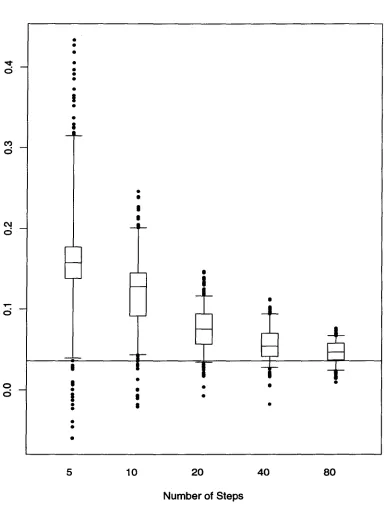
5 steps 393 0.164280 0.073891 0.138140 0.157240 0.176960 10 steps 388 0.121440 0.045294 0.091214 0.127710 0.144920 20 steps 378 0.076239 0.026980 0.066031 0.074700 0.093949 40 steps 358 0.066560 0.020770 0.040733 0.063489 0.069473 80 steps 318 0.046032 0.013269 0.036481 0.046988 0.067106
> plot(rossler.lle)
.
-nlar(Y
= rossler, lags = c(1, 2, 3), k1 = 1, k2 = 4)
.-.
-R**2 =99.84% RMSE=0.3186
•
10
•
•
--
•
••
•
•
•
Il)
..
•
•
0 c:i
--10 rn
a; 0
:::::l
>-
"0 c:i0 °Cii
CD
r-IO
•
I Il)
•
c:iI
•
•
• • •
•
••
•
•
•
-
•
10 q
•
--
I...
I
-15 -5 0 5 10 -15 -5 0 5 10
predicted values predicted values
GCVand GCV2 Root Mean Squared Error
~
##par=:•
0 ##units=
C"':i ~
...
-~
N
>
0 "!0
c:J N
w
...
"0 en
c::: ::::i:
as
a:
•
-
--
co-
>
C! c:i0
...
c:J'''It
2 c:i
•
0
•
ci
10 15 20 10 15 20
Number of Parameters Number of Parameters
'0
range of significantly positive and negative local exponents are found suggesting that in some regions of the state space the system is more sensitive to small perturbations and in other regions the system is more stable.
Finally this analysis is repeated using thenlar function:
> rossler.nlar <- nlar(rossler, lags=c(1,2,3), method="nnreg", k1=1, k2=4)
# this takes a while
> plot(rossler.nlar)
> rossler2.lle <- lle(rossler.nlar)
Note that the main job ofnlar is to keep track of the time series structure. Also the
lle function has been overloaded to use the information directly from the returned nlar object.
8.2
Confidence regions
The FUN FITS functionnnregCI will be used to calculate a 95% confidence interval for the
global Lyapunov exponent of the Rossler example. To construct a confidence interval for the global Lyapunov exponent, it is necessary to evaluate the global exponent for all 500 neural
net modelsretruend bynnregCI. The range of these values is taken to be an approximate
confidence interval for the global exponent estimate.
> rossler.Clfit <- nnregCI(rossler.nnreg) # 500 representative fits
# based on the best 4 hidden unit fit
# this takes awhile!
> hold<- rep(NA,500)
> for (i in 1:500){
# loop through all the representative parameter vectors
jac <- predict(rossler.Clfit$model[[i]],rossler.Clfit$x,derivative=1)
hold[i] <- lle(jac,nprod=NA)$glb # calculate global LE
# but not the locals
}
> rossler.le.CI <- range(hold)
The estimated global exponent is 0.035 with a 95% CI (0.017,0.036).
8.3
State vector form
Often a system is described in terms of a state vector and a map that updates this vector from the present time step into the next.
HereWt E~duniquely describes the state at timet, F :~d-+ ~dand the stochastic terms,
Et are assumed to be uncorrelated random vectors. This section ends by briefly explaining
how FUNFITS can be adapted to fit nonlinear state space models.
As an example, the usual state vector form for the Rossler system is in terms of a three
dimension vector: Wt = (Xt ,yt,Ztf. The data set rossler. state gives a realization
".
•
•
•
•
C\I
ci
•
I
•
,...
ci
o
ci
I
•
•
I
••
••
•
5
•
•
•
•
10
•
•
20
Number of Steps
•
•
40 80
-.
directly it is not difficult to fit models for each component ofF separately and combine these to estimate local Lyapunov exponents. First one needs to create the lagged set of values and fit separate (one dimensional models) for each component ofW.> out<- make.lags(rossler.state. nlags=c(1»
> tit.ross.X<- nnreg( out$x. out$y[.1]. k1=4.k2=4)
> tit.ross.Y<- nnreg( out$x. out$y[.2]. k1=4. k2=4)
> tit.ross.Z<-nnreg( out$x. out$y[.3]. k1=4. k2=4)
Here the regression methods are neural networks fixed at 4 hidden units. However, any fitting method can be used here and the methods may be different among the different components. To find the local exponents one needs to create the Jacobian matrices for F evaluated at each state vector and pass them in the correct format to lle. In this step the important point is to string each Jacobian matrix row by row into a single long row at each time point. The resulting matrix is then the object passed to 11e.
> tempx<- predict( tit.ross.X. derivative=1)
> tempy<- predict( tit.ross.Y. derivative=1)
> tempz<- predict( tit.ross.Z. derivative=1)
> ross.jacobian<- cbind( tempx. tempy. tempz)
> ross.lle.state<- lle( ross.jacobian. statevector=T)
In this example ross. jacobian will have 9 columns and the Jacobian matrix at say the
t = 25 could be constructed by
matrix(ross.jacobian[25.]. ncol=3.byrow=T)
Those familiar with state space models will also realize that the autoregressive model based on one time series also has a (trivial) state vector form. For the Rossler example presented in the beginning of this section, letWt
=
(Yi,Yi-bYi_2)T andGiven this form, one could construct the Jacobian elements explicitly and call11e with the statevector format.
> jac<-predict( rossler.nnreg. derivative=1)
> test<- matrix( O. ncol=9.nrow=nrow(jac» # till a matrix with zeroes
> test[.1:3]<-ross.jac
>test[,4]<- 1 > test[.8]<-1 > # the rest of the elements are zero!
> ross.lle<- lle( test)
9
Model components and graphics options
The nnreg, krig, and tps functions produce fitted objects having a component best . model. For the nnreg function, this is the number of the model with the minimum GCV function value for cost=2. The best.model component for tps is the value of lambda used in the fit, and, for krig the best.model component is a vector containing the value of lambda, the estimated variance of the measurement error and the scale factor for the covariance used in the fit. The plot functions for nnreg, krig, and tps by default will use the best.model component for the summary plot.
The FUNFITS plotting functions have some intelligence in controlling the layout of
the graphs. If the plotting window has already been divided up into a panel then the
FUNFITS functions will use this layout when it produces multiple plots. To signal that the function should not alter the plotting panel parameters one uses the logical argument graphics. reset. For example the following examples will produce summary plots from two tps fits on a single page.
> ozone.tps1 <- tps(ozone$x.ozone$y) # thin plate spline fit to data
> ozone.tps2 <- tps(ozone$x.ozone$y.lambda=.1) # tps fit with lambda=.1
> set.panel(3.2) # sets plotting array
> plot(ozone.tps1.graphics.reset=F.main=·tps fits')
# summary plot of first fit
> plot(ozone.tps2.graphics.reset=F.main=· .)
# summary plot of second fit
Besides changing the number of plots per panel, the graphics functions may also make other modifications to the default graphical parameters. For example the type of plotting region or the size of labels might be changed to produce a special plot. After the function is finished plotting there is the option of restoring the graphical parameters to their original val-ues or leaving them in their new states. This decision is also controlled by graphics. reset argument and has the default value of true, resetting the parameters to their old values. Although this is usually what one wants, it does not make it easy to add additional features to a graph produced by a FUNFITS function. Here is an example using graphics. reset=F to add the ozone station locations onto a contour plot of the fitted surface.
> surface(ozone.tps1.graphics.reset=F)