
Pervasive Augmented Reality Using Context
Aware Approach and Marker-Based Detection
Bhargav Athavale1, Shubham Bhosale1, Onkar Mahajan1, Rhutujit Paradkar1
B.E Student, Department of Computer Engineering, Zeal College of Engineering and Research, Pune, India1
ABSTRACT: Pervasive computing is the integration of various computing resources into our everyday applications present all around us . These computers are interconnected and always accessible. Devices such as laptops, smartphones, tablets come under pervasive computing. Augmented Reality is a new and emerging technology wherein the view of the physical world is enhanced with help of computers. These techniques are accomplished in real time and in context with the surrounding environment. The combination of pervasive computing and augmented reality opens a new and vibrant portal of innumerable interactive applications which are useful in our everyday life. In this paper we study the techniques that are currently present for imbibing this technology. We also study the classification of various devices used as well as what sensors are used. Although Augmented Reality and pervasive computing has been around for a long time but it is only in the current decade that technology has been introduced on a global and workable scale.
KEYWORDS:Pervasive Computing, Augmented Reality, Smartphones, Interactive, Mixed Reality,
Context-Awareness, 3D Modeling.
I. INTRODUCTION
Augmenting or supplementing the real world of a user with the computer generated virtual objects that are usually motion tracked is called augmented reality. Its use was started in 1962 when Cinematographer Morton Heilig created SENSORAMA. SENSORAMA was a simulator with visuals, sound, vibrations and smell.
Augmented reality is often confused with the virtual reality[1]. But the ideas on which these two realities stand are completely different from each other though they have the concept of virtual environment involved in them. Virtual Reality blocks out our world view and substitutes it with a digital world or a virtual world that distracts your senses. It is an approximation of our real world that is digital but not the actual reality. But in Augmented reality the basic idea is to enhance the real world by projecting different virtual objects into the real world rather than cutting you from it and transporting you completely to another environment.
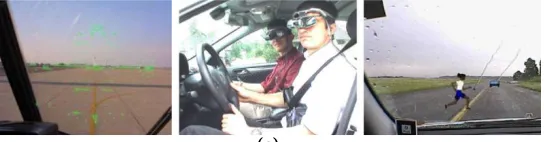
(a)
Fig 1. Augmented Reality In Driving. The driver wears glasses which will map certain virtual objects onto the screen, like in this case, a virtual pedestrian.
A prime example of applications is furniture stores that designs and sells ready-to-assemble furniture, kitchen appliances and home accessories. They can launch an AR enabled app that allows us to see actual size furniture on our screen by scanning particular image in their furniture catalogue.
(b)
Fig 2. Indoor Navigation using Augmented Reality[2].The arrow guides the user through the roads from source to destination. It also guides through turns and places.
II. RELATEDWORK
To get a highly personalized experience by sensing the user’s current context and adapting the AR system is based on the changing requirements and constraints and the surrounding environment. A classification is done based on context sources and context targets relevant for implementing such a context-aware, continuous Augmented Reality experience [1]. Based on the current survey and existing systems, future challenges are identified [1].
Indoor navigation can be performed using an application to assist people to navigate indoors. The application can be implemented on electronic devices such as a smartphone or a head-mounted device [2]. In particular, we have examined Google Glass as a wearable head-mounted device in comparison with handheld navigation aids including a smartphone and a paper map. The digital navigation aids were found to be better performing than the paper map in terms of time and lower workload [2].
1- 'Towards Pervasive Augmented Reality'
In this paper, they present the concept of Pervasive Augmented Reality, aiming to provide such an experience by sensing the user’s current context and adapting the AR system based on the changing requirements and constraints. They present a taxonomy for Pervasive Augmented Reality and context-aware Augmented Reality, which classifies context sources and context targets relevant for implementing such a context-aware, continuous Augmented Reality experience. They further summarize existing approaches that contribute towards Pervasive Augmented Reality. Based our taxonomy and survey, we identify challenges for future research directions in Pervasive Augmented Reality.
2-'AR-Based Indoor Navigation: A Comparative Analysis of Handheld Devices Versus Google Glass'
3-'Evaluation of wearable haptic systems for the fingers in Augmented Reality applications'
In this paper, evaluation of two wearable haptic interfaces for the fingers in three AR scenarios is presented. In this experiment the haptic devices provide interaction between chalk and blackboard. The haptic devices provide interaction forces due to the weight of virtual objects. This paper provides methods that allow us to interact with the virtual objects in the AR. It shows the haptic devices mounted on the fingers. Different readings have been recorded and the methods to optimize it are also mentioned.
III. EXISTINGSYSTEM
In general terms, context can be seen as being “any information used to characterize the situation of an entity". The necessary information has to be retrieved and displayed to user on 2D surfaces. These screens are not immersive and interactive in nature. They cannot be mapped onto real world objects.
The existing hardware for the Augmented Reality systems consists of sensors and displays. Electronic devices such as smartphones and tablets are used. Head Mounted Displays (HMD) are also popular.eg-Microsoft Hololens. HMD are display devices which are worn with the help of harness or strap [1] .MEMS systems such as an accelerometer, GPS and visual systems to capture the target such as the camera are also necessary. Handheld Display AR promises to be the first commercial success of AR technologies. The two main advantages of handheld AR are the portable nature of handheld devices and the ubiquitous nature of camera phones. Image Linked Map (ILM) technology is used for geo-tagging location on AR world. Pokémon GO is a recent example which used IML extensively [3]. SLAM marker-less trackers are used to navigate.
Haptic Feedback [3]
The software part has the following functionality-storing the target image, tracking the image in real time, mapping the virtual objects to these real-world objects and then displaying the various changes and interactions with the user in real time. To enable rapid development of Augmented Reality applications, various companies have introduced their SDK’s (Software Development Kits).We have AR SDK from companies such Vuforia, Wikitude, Layar, Blippar, Mobinett AR [1].
IV. PROPOSED SYSTEM USING UNITY ENGINE
1. Start with the project created in the previous post, as described in the prerequisites section. 2. Under the Project tab, find Smart Terrain.
3. Drag and drop Smart Terrain on the scene
4. Once the entire surface is traced then it sets those objects as the real world objects in virtual environment. After that the virtual object cannot pass through the traced object.
5. Select AR Camera. Change the World Center Mode to “Specific Target” and World Center to “Primary Surface”.
6. Select Image Target and find Image Target Behavior. Enable Smart Terrain. Select the Smart Terrain instance in your scene.
7. Open Vuforia Configuration and find Smart Terrain Tracker. Select Start Automatically. With this option, scanning of the environment will start automatically when the application is launched.
8. Set the scale (100 in the example). The scale determines the relative size of the virtual world and the physical world.
9. Build and run the application on your device.
A Sample Application For Unity Interface for Smart Terrain
Advantages over earlier systems
I. Computer-generated images of a structure can be superimposed into a real life local view of a property before the physical building is constructed there.
II. Augmented reality allowed video game players to experience digital game play in a real world environment. Companies and platforms like Niantic and LyteShot have emerged as major augmented reality gaming creators.
III. Computer-generated simulations of historical events, exploring and learning details of each significant area of the event site could come alive.
V. AR provided surgeons with patient monitoring data in the style of a fighter pilot's heads up display or allowed patient imaging records, including functional videos, to be accessed and overlaid. Examples include a virtual X-ray view based on prior tomography or on real time images from ultrasound and confocal microscopy probes.
VI. AR can augment the effectiveness of navigation devices. Information can be displayed on an automobile's windshield indicating destination directions and meter, weather, terrain, road conditions and traffic information as well as alerts to potential hazards in their path.
V. RESULTS(APPLICATIONSDEVELOPED)
Following are some of the AR applications we have developed in various fields. The following apps have been developed using the Unity engine and Vuforia Plug-in.
1) Wild life using AR
This is augmented reality for educating children about wild animals. It also controls the virtual animal to see its movement such as walking and running to experience it in real life.
In this application we represent commercial applications for real estate.Using a 2D plan and our application the client can visualize a 3D plan
3) Chemistry Reaction using AR
This app represents application where we can show collision between two atoms. When two virtual atoms collide in 3D space ,they represent the reacted atom. For example if oxygen and hydrogen atoms collide they form water molecule.
VI. CONCLUSION
We introduced the concept of Pervasive Augmented Reality (PAR) as a continuous, context-aware Augmented Reality experience.We gave an overview on the current state of context-aware AR as the main conceptual building blocktowards PAR. We developed and presenteda taxonomy based on three top-level domains: Model sources, Image targets, and Model controllers.
Augmented Reality has the potential to significantly change the way we interact with information and our surrounding environment. In this project we haven’t explored social or privacy considerations. We focused on technological, educational and social applications. The field of Augmented Reality is still in its infancy. However, current developments in AR hardware and Software, as well as investments from companies such as Google and Apple have been pioneering. Head-worn displays-Microsoft HoloLens with integrated computing and sensing capabilities will lead to research and implementations towards Pervasive Augmented Reality. We hope, with this project we lay some of the foundations for a systematic approach towards Pervasive Augmented Reality.
REFERENCES
[1] Jens Grubert (Member, IEEE), Tobias Langlotz (Member, IEEE), Stefanie Zollmann, and HolgerRegenbrecht (Member, IEEE) ,” Towards Pervasive Augmented Reality: Context-Awareness in Augmented Reality”, IEEE Transactions on Visualization and Computer Graphics. [2] UmairRehman and Shi Cao,”Augmented-Reality-Based Indoor Navigation: A Comparative Analysis of Handheld Devices Versus Google
Glass “,IEEE TRANSACTIONS ON HUMAN-MACHINE SYSTEMS, VOL. 47, NO. 1, FEBRUARY 2017.
[4] Mustafa Y. Arslan, Indrajeet Singh, Shailendra Singh, Harsha V. Madhyastha, KarthikeyanSundaresan, Senior Member, IEEE, and Srikanth V. Krishnamurthy, Fellow, IEEE, “CWC: A Distributed Computing Infrastructure Using Smartphones”, IEEE TRANSACTIONS ON MOBILE COMPUTING, VOL. 14, NO. 8, August 2015.
[5] S. Feiner, “Redefining the user interface: Augmented reality,” ACM SIGGRAPH 1994, Course Notes, vol. 2, pp. 1–18, 1994. [6] R. T. Azuma, “A survey of augmented reality,” Presence: Teleoperators and Virtual Environments, vol. 6, no. 4, pp. 355–385, 1997.
[7] J. Grubert, T. Langlotz, and R. Grasset, “Augmented reality browser survey,” Graz University of Technology, Graz, Tech. Rep. December, 2011. [Online]
[8] T. Langlotz, J. Grubert, and R. Grasset, “Augmented Reality Browsers: Essential Products or Only Gadgets?” Communications of the ACM, vol. 56, pp. 34–36, 2013.
[9] M. Billinghurst, R. Grasset, and J. Looser, “Designing augmented reality interfaces,” ACM Siggraph Computer Graphics, vol. 39, no. 1, pp. 17–22, 2005.
[10] http://www.openni.ru/articles/the-world-you-live-in-is-the-world-you-game-in/index.html [11] www.augmented.com.
![Fig 2. Indoor Navigation using Augmented Reality[2].The arrow guides the user through the roads from source to destination](https://thumb-us.123doks.com/thumbv2/123dok_us/1571583.1193257/2.595.178.421.274.404/indoor-navigation-using-augmented-reality-guides-source-destination.webp)
