© 2019, IRJET | Impact Factor value: 7.211 | ISO 9001:2008 Certified Journal
| Page 1704
2
Assistant professor, Dept. of Civil Engineering, Anna University Regional Campus, Tirunelveli, Tamilnadu, India
---***---
Abstract ˗
Sand plays the important role in the production of concrete. In recent years, the ban on river sand highly impacted the construction industry. Increasing demand for sand has led to excessive mining on river sand; it develops the severe ecological imbalance. Due to the sand crisis, it is a need to find some substitute to natural river sand. In this experimental study, the fine aggregate in concrete will be fully replaced by the excavated soil. Initially, Sieve analysis was carried out for excavated soil and river sand to know the grain size distribution of materials. The mix proportion of 1:1.3:2.58 was adopted for the concrete using excavated soil. Standard test specimens were cast separately for conventional concrete and excavated soil using concrete. The compressive strength test, flexural strength test and split tensile strength test was conducted for the specimens as per IS 516(1959), IS 5816(1999) to evaluate mechanical strength properties of concrete. Comparison was made between the results of conventional concrete and excavated soil concrete. Finally, the excavated soil is found suitable for concrete.Key words: Concrete, Fine aggregate, Excavated soil, Testing, Mechanical properties
1. INTRODUCTION
Concrete is the most commonly used construction material in construction industry. Concrete is used for many applications such as superstructures, sub structures, waste water and water treatment facilities, parking structures, floor construction and exterior surface. Fine aggregate is the basic component for making concrete. Mining of river sand causing many problems deepening of the river courses, loosing water retaining sand strata, disturbs the aquatic life, lowering the underground water table etc. Nowadays good sand is not readily available. It is transported from long distance due to the scarcity of river sand and no guarantee for its consistent supply. So it is a time to find some substitute to natural river sand. The alternatives for river sand are granite powder, iron powder, copper slag, wood waste, fly ash, waste foundry sand, brick waste, quarry waste, crushed concrete waste etc. The idea of the investigation is to use the excavated soil available at a construction site and unused soil as a fine aggregate in concrete because this will conserve the natural resources and protect the ecological imbalance on environment. The excavated soil is taken from the Anna University campus, Tirunelveli, Tamilnadu. Concrete of 25 Mpa with mix proportion of 1:1.3:2.58 and water cement ratio of 0.4(as per IS 456: 2000) was adopted for the excavated soil concrete. Mix design was evaluated as per IS 10262:2009. Cubes, cylinders and beams were cast for conventional concrete and excavated soil concrete. The specimens were tested after 28 days of water curing to evaluate the strength of the concrete. The compression strength test, flexural strength test and split tensile strength test was conducted for the concrete specimens. The main objective of the study is to investigate the mechanical properties of excavated soil concrete.
2. EXPERIMENTAL PROGRAMME
The investigation involves with following works. It shows how the investigation was conducted and how the strength of concrete was evaluated.
2.1 Materials
© 2019, IRJET | Impact Factor value: 7.211 | ISO 9001:2008 Certified Journal
| Page 1705
Fig 1: River sand and Excavated soil2.2 Sieve analysis
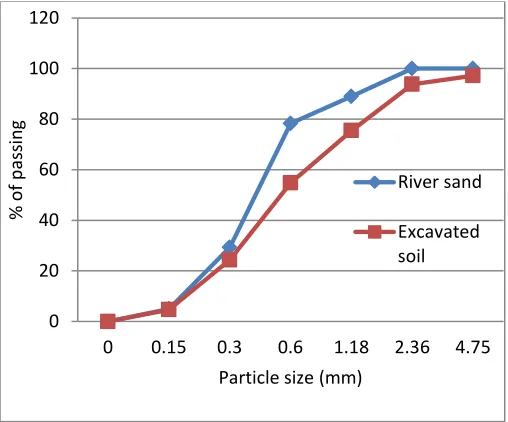
The grading and size of aggregates is important parameters in concrete mix. The sieve analysis was conducted to determine the particle size distribution of excavated soil and river sand. The sieve analysis test was conducted as per IS 383 (1970). The Chart 1 represents the gradation curve of soil and river sand. The graph shows that the gradation curve of excavated soil is similar to the curve of river sand. The fineness modulus of the excavated soil is 3.434 and classified in zone II grading.
Chart − 1: Gradation curves of soil and sand
2.3 Preparation of specimens
The conventional concrete mix and excavated soil mix was prepared. In the excavated soil mix, the river sand is fully replaced by the excavated soil. The various concrete specimens based on the test and trial basis were cast for the cube of size 150 mm ×150 mm × 150 mm, cylinder of size 150mm diameter, 300 mm long and beam size of 150mm x 150 mm x 700 mm. The samples were cured by water for 28 days. After curing the specimens were taken from the water and the surface was wiped out. The testing was conducted on the various concrete specimens.
2.4 Testing of specimens
The compressive strength test, flexural strength test and split tensile strength test was conducted for normal concrete and
excavated soil concrete specimens as per IS 516(1959), IS 5816(1999). Compressive strength was taken for the 7, 14 and 28 days cured cubes and it is done in compression testing machine (CTM). Split tensile strength test also done in CTM for 28 days cured cylinders. Flexural strength test was conducted for the 28 days cured beams in flexural testing machine.0 20 40 60 80 100 120
0 0.15 0.3 0.6 1.18 2.36 4.75
%
o
f p
ass
in
g
Particle size (mm)
River sand
© 2019, IRJET | Impact Factor value: 7.211 | ISO 9001:2008 Certified Journal
| Page 1706
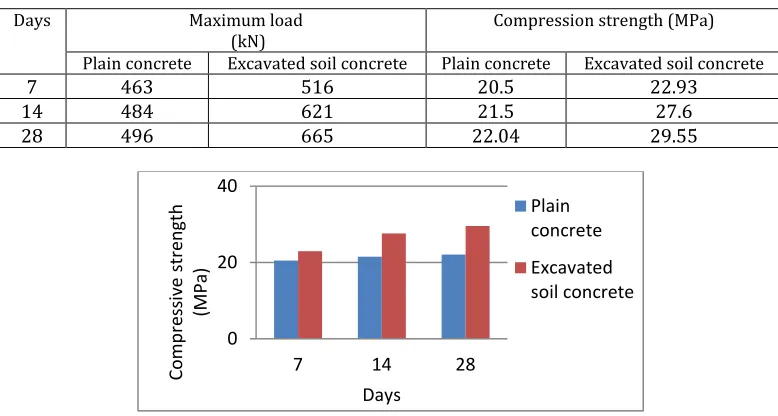
respectively. From the graph plotted in chart 2 & 3, it is clear that the compressive strength was increased in excavated soil used concrete.Table −1: Compression test result on concrete – Trial 1
Days Maximum load (kN) Compression strength (MPa)
Plain concrete Excavated soil concrete Plain concrete Excavated soil concrete
7 470 512 20.88 22.75
14 481 615 21.37 27.33
28 490.5 653 21.8 29.02
Chart − 2: Compression test results – Trial 1 Table −2: Compression test result on concrete – Trial 2
Days Maximum load
(kN) Compression strength (MPa)
Plain concrete Excavated soil concrete Plain concrete Excavated soil concrete
7 463 516 20.5 22.93
14 484 621 21.5 27.6
28 496 665 22.04 29.55
Chart − 3: Compression test results – Trial 2 0
20 40
7 14 28
Com
p
re
ss
iv
e
stren
gth
(MPa)
Days
plain concrete
excavated soil concrete
0 20 40
7 14 28
Com
p
re
ss
iv
e
stren
gth
(MPa)
Days
Plain
concrete
[image:3.612.111.500.493.701.2]© 2019, IRJET | Impact Factor value: 7.211 | ISO 9001:2008 Certified Journal
| Page 1707
Fig 2: Compression testing on cubes3.2 Flexural strength test
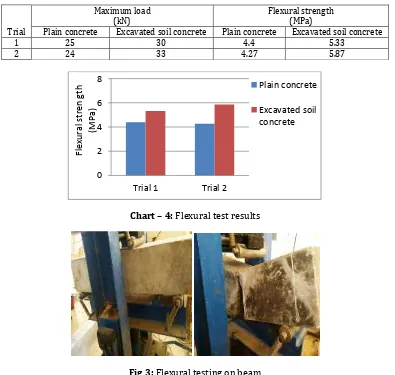
The flexural strength test was taken for the 28 days cured beams. The flexural strength results for plain and excavated soil concrete are shown in table 3. The flexural strength of excavated soil used concrete is 5.33 MPa and 5.87 MPa for trial 1 and trial 2. The chart 4 shows the comparison of results taken for the normal concrete and excavated soil concrete specimens.
Table – 3: Flexural test results on concrete
Trial
Maximum load
(kN) Flexural strength (MPa)
Plain concrete Excavated soil concrete Plain concrete Excavated soil concrete
1 25 30 4.4 5.33
2 24 33 4.27 5.87
[image:4.612.111.506.338.713.2]Chart – 4: Flexural test results
Fig 3: Flexural testing on beam 0
2 4 6 8
Trial 1 Trial 2
Fle
xu
ra
l s
tren
gt
h
(M
Pa)
Plain concrete
© 2019, IRJET | Impact Factor value: 7.211 | ISO 9001:2008 Certified Journal
| Page 1708
Trial Maximum load (kN) Split tensile strength (MPa)
Plain concrete Excavated soil concrete Plain concrete Excavated soil concrete
1 199.5 210.5 2.82 2.98
2 195 207 2.76 2.93
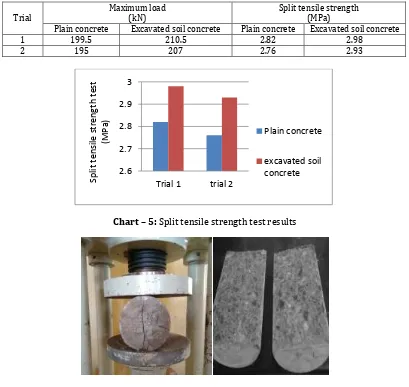
[image:5.612.102.511.183.570.2]Chart – 5: Split tensile strength test results
Fig 4: Split tensile strength testing on cylinder
4. CONCLUSIONS
Based on the results of this study, the following conclusions can be made.
1. The excavated soil concrete showed good workability similar to normal concrete mixes.
2. The compressive strength of the concrete is increased when river sand is fully replaced by the excavated soil, as a fine aggregate. The increase in compressive strength is 21% compared to strength of conventional concrete.
3. The flexural strength values of excavated soil mixed concrete is 5.33 – 5.87 MPa. Excavated soil used concrete gives good significant improvement in strength.
2.6 2.7 2.8 2.9 3
Trial 1 trial 2
Sp
lit
ten
sile
s
tren
gth
tes
t
(MPa)
Plain concrete
[image:5.612.183.433.417.559.2]© 2019, IRJET | Impact Factor value: 7.211 | ISO 9001:2008 Certified Journal
| Page 1709
4. The split tensile strength value of excavated soil used concrete is 3 MPa. The split tensile strength is increased 7.5% compared to strength of conventional concrete.5. From this investigation, the excavated soil gives good mechanical strength in concrete. Durability is important for the use of this material and will be investigated in a future study.
REFERENCES
[1] Daisy Angelin, P. and Ravi Kishore, P., 2015. Durability Studies on Concrete with Manufacturing Sand As A Partial
Replacement of Fine Aggregate In HCL Solution. International Journal of Engineering Research and Development, 7,
pp.44-50.
[2] Ghannam, S., Najm, H. and Vasconez, R., 2016. Experimental study of concrete made with granite and iron powders as
partial replacement of sand. Sustainable Materials and Technologies, 9, pp.1-9.
[3] Gupta, S., Tripathi, R.K. and Mishra, R.K., 2017. Study of Concrete having Industrial Waste as Fine Aggregate
Replacement and Generation of Model for Prediction of Compressive Strength Using Response Surface Method. Materials Today: Proceedings, 4(9), pp.9727-9731.
[4] IS 456: 2000 Plain and reinforced concrete code of practice (fourth provision)., Bureau of Indian Standards (BIS).,
New Delhi.
[5] IS 10262 : 2009 Guidelines for concrete mix design proportioning ˗ Indian standard method., Bureau of Indian
Standards (BIS)., New Delhi.
[6] Mundra, S., Sindhi, P.R., Chandwani, V., Nagar, R. and Agrawal, V., 2016. Crushed rock sand–An economical and
ecological alternative to natural sand to optimize concrete mix. Perspectives in Science, 8, pp.345-347.
[7] Omar, O.M., Elhameed, G.D.A., Sherif, M.A. and Mohamadien, H.A., 2012. Influence of limestone waste as partial
replacement material for sand and marble powder in concrete properties. HBRC Journal, 8(3), pp.193-203.
[8] Patel, H.G. and Dalal, S.P., 2017. An experimental investigation on Physical and Mechanical properties of Concrete with
the replacement of fine aggregate by Poly Vinyl Chloride and Glass waste. Procedia engineering, 173, pp.1666-1671. Gupta, S., Tripathi, R.K. and Mishra, R.K., 2017.
[9] Patro J.k., S.K. and Basarkar, S.S., 2016. Concrete using agro-waste as fine aggregate for sustainable built environment–
A review. International Journal of Sustainable Built Environment, 5(2), pp.312-333.
[10]Priyadharshini, P., Ramamurthy, K. and Robinson, R.G., 2018. Sustainable reuse of excavation soil in cementitious
composites. Journal of Cleaner Production, 176, pp.999-1011.
[11]Recent trends in replacement of natural sand with different alternatives. In Proceedings of the International
Conference on Advances in Engineering and Technology (pp. 59-66). er Production, 126, pp.74-87.
[12]Sankh, A.C., Biradar, P.M., Naghathan, S.J. and Ishwargol, M.B., 2014. Bansal, H. and Kumar, M., 2018. Experimental
study on Use of Stone Dust as a Partial Replacement of Fine Aggregates in concrete as a Rigid Pavement.
[13]Shetty M.S., 1987. Concrete Technology Theory and Practice. S.Chand & Company Limited., New Delhi.
[14]Singh, S., Nagar, R. and Agrawal, V., 2016. Feasibility as a potential substitute for natural sand: a comparative study