Analysis of Factors and Construction Project
Coordination Variables
(A Case Study of Construction Project: SDH
Lubuk Linggau)
Manlian Ronald.A. Simanjuntak1, Gusfica2
Graduate Program Master Professor of Civil Engineering majoring in Construction Management –Pelita Harapan
University - Indonesia1
Graduate Program Master Student of Civil Engineering majoring in Construction Management – Pelita Harapan
University - Indonesia2
ABSTRACT: Running the successful projects on time is one of the most important parameters for the owners and contractors. Project delays often cause various losses for both. For contractors, delays cause project costs to be suspended due to the increase in project implementation time and result in a contractor's decreased credibility for the future, whereas for the owners, the delay in the use or operation of the results of the construction project has the potential to cause disputes and claims between the owner and the contractor (Suharto, 1997). This is what happened to the SDH LubukLinggau project. Project delays are often caused by the poor coordination or misunderstandings that occur during the construction process as happened in the SDH LubukLinggau project. The poor performance of coordination in projects can interfere with the achievement of project objectives. One of the main factors that resulted in the rework of the group of managerial factors was the poor flow of communication. This study will analyze the research problem of identifying variables and coordination factors in the construction process, understanding the time performance in this study, and understanding the results of the initial analysis of coordination in the SDH LubukLinggau project. Various theories examined in this research were the theories about project coordination, construction process, planning and scheduling, the role of contractors, and various relevant research results in the last 10 years, then continued by distributing questionnaires to 5 experts to obtain the results of research from 11 factors and 44 variables to analyze the coordination of the construction process in the SDH LubukLinggau project. This research methodology startedwith the discussion of issues, identification of research problems, studies of various literature, and expert tests. From this study, it is expected that eventually important factors will be found in coordination during the construction process of the SDH LubukLinggau project so that they are able to anticipate delays in the project.
KEYWORDS: coordination, communication, construction project, project delay, communication management, information
I. INTRODUCTION
the future. As for the owners, the delay in the use or operation of the results of construction has the potential to cause disputes and claims between the owner and the contractor (Suharto, 1997). One example of a project that was not completed on time was SDH LubukLinggau. This resulted in the termination of the contract against the contractor and a large loss to the owner. Therefore, things that may cause project delays, both directly and indirectly are very important to be analyzed.
Project delays are often caused by poor communication or misunderstandings that occur during the construction process. All stakeholders in the construction process only pay attention to results and underestimate the importance of communication during the construction process. Communication in the construction process is one of the basic supporting components so that construction projects can run smoothly and effectively as expected. All construction project activities cannot be separated from communication activities. Communication between internal and external parties occurs throughout the Project Life Cycle process. Therefore communication in a good construction process is certainly one of the determining factors in the success of a project. Communication during poor construction projects can affect the success of a construction project. Therefore, it is necessary to examine the role of project communication in the failure of time management which causes the delay of the SDH LubukLinggau project.
This study aims to identify the coordination variables and factors in the construction process, to understand the time performance, and to understand the results of the initial analysis coordination in the SDH LubukLinggau project.
II. LITERATURESTUDIES Construction Process
Construction projects are related to the efforts to build an infrastructure building, which generally includes basic works in the field of civil engineering and architecture. They also involve other disciplines such as industry, machinery, electricity, geotechnics, and so on. These buildings cover a very broad aspect of the community interests in the form of housing, apartments and many-storey office buildings, factories and industrial buildings, bridges, highways including overpasses, railroads, nuclear power plants, dams and tunnels of Hydroelectric Power Plants, irrigation canals, sanitation and drainage systems, airports and aircraft hangars, seaports and offshore buildings, electricity and telecommunications networks, oil refineries and plumbing networks, etc. (Dipohusodo, 1996).
Project Coordination
According to Pearce and Robinson (Ulber Silalahi, 2006), coordination is the integration of individual and units activities into a joint venture, i.e working together towards a common goal. Whereas according to Stoner, coordination is the process of integrating goals and activities from separate units (parts or functional fields) of an organization to achieve organizational goals efficiently. While Hasibuan (2001) stated that: "Coordination is the act of directing, integrating, and coordinating the elements of management and the works of the subordinates to achieve organizational goals".
Coordination is one of the important things in administration and management to achieve the objectives of a project. Collaboration between individuals in the project, one of the requirements to run the organization, will run well with an effective coordination. Thus coordination is one of the things that determine the success of a project.
According to Westra (1983:54) in Rosyadi (2009:23), coordination, in terms of etymology, is absorbed from foreign languages consisting of the word "cum" which means different, and the word "ordinate" which means the preparation or placement of something to what they should or should be. The existence of coordination is due to the existence of work units, each of which performs tasks, functions, and responsibilities as a consequence of the application of the principle of specialization within an organization. The differences in the field of work or work require coordination to carry out existing tasks with a common goal. If a fairly complex job in an organization is carried out without coordination, then each field, unit, and task will walk in a direction that does not meet at a common goal. As a parable, the existence of coordination is like the radius of an umbrella which brings together each end of the radius of an umbrella at a similar point. Coordination is also interpreted as "the unification, integration, synchronization of the effort of group member so as to provide unity of action in the pursuit of common goals". According to the definition of this aspect, coordination can be seen as an inseparable thing because it is the core of management and will always be present and inherent in every element of management starting from planning, organizing, staffing, direction, to supervision.
As stated by Siagian (1976:111), who considers that coordination is another word or term of integration and synchronization, coordination is all project activities which have been integrated and synchronized. Synchronization according to Syafrudin (1993:78) is "Adjustment from all directions and activities with the master plan, so that time and workspace can be harmonized harmoniously, efficiently, and effectively".
Stoner and Wankel (1986: 263) stated that coordination is "the process of integrating the objectives and activities of the separate units (department of functional areas) of organization in order to achieve organizational goals efficiently". According to Alexander (1995:4), the first expert to explore coordination was Charles Lindblom who defined coordination as a systematic relationship between decisions. "Coordinated decisions, according to this view, are ones where either mutual adjustment between actors or a more deliberate interaction produced positives outcomes to the participants and avoided negative consequences". It can be interpreted that decisions to coordinate according to this view are one of the efforts to adjust each other between actors or interactions that are more flexible to produce something positive for all parties and avoid negative consequences.
Coordination is regular alignment or rearrangement of interdependent activities of individuals to achieve common goals. Coordinating is to seek balanced expenditure with financial resources, equipment, and tools with production needs and so on. In short, coordination can be said as adjusting things and the appropriate comparison actions and adjusting between the tool and the goal (Widiatmoko, 2012:18).
Ndraha (2011: 290) interpreted coordination as; "Activities carried out by various equal parties (equal in rank or order, of the same rank or order, not subordinate) to give information to one another and arrange together (agree on) certain things, so that the process of implementing the task and the success of one party does not interfere with the process of carrying out the duties and success of the other party, while on the other hand, directly or indirectly, supports the other party ".
Sugandha (1991:26) stated that theoretically coordination can be classified into several types according to the scope and direction of the lines, which are divided into:
a. According to its scope, consists of:
1) Internal coordination, i.e. coordination between officials or between units within an organization.
b. According to the direction:
1) Horizontal coordination, i.e. coordination between officials or between units with the same hierarchy in an organization and between equal organizations.
2) Vertical coordination, i.e. coordination between officials and lower-level units by their superior officials or direct top-level units, as well as branches of an organization by its parent organization.
3) Diagonal coordination, i.e. coordination between officials or units of different functions and different levels of hierarchy.
4) Functional coordination is coordination between officials, between units or between organizations based on the similarity of functions or because the coordinator has certain functions.
In order to be effective, the key to coordination, according to Stoner and Freeman (1994:503), lies in the communication. The greater the uncertainty of the task, the greater the amount of information that must be processed. Therefore, at a certain degree, coordination can also be seen as a very important information processing task. An effective coordination approach according to Stoner and Freeman (1994:503) is: the use of basic management techniques; increased coordination potential; reduction in the need for coordination.
The use of basic management techniques is an organizational command chain that specifies the relationship between its members and its units, thereby facilitating the flow of information and work among units. Increasing the potential for coordination is a condition that if the organization gets bigger, the interdependence is greater or if the function and size is wider, then greater information is needed for the organization to achieve its goals. Therefore the potential for coordination must be increased, in two ways:
1) The vertical information system is the data transmission to the up-level and down-level of the organization. Communication can occur outside or inside the existing command channel. Management Information System (MIS) for each section, such as marketing, finance, production and also a database that collects information, improve the information available for planning, coordination, and control.
2) Lateral information system. Lateral relations ignore existing command relationships, the possibility of exchanging information and decisions taken at the level where the information needed really exists. In a simple example, this relationship is a direct contact between individuals who face the same situation or problem.
According to Winardi (1990:397), if we carefully examined, coordination can also be said as the activities of individuals and groups associated with each other for the framework of achieving common goals. There is communication between organizational components which allows them to understand their activities with each other, and helps them to work well together in the general workflow. Winardi (1990:397) also revealed that in the context of coordination, there are two dimensions that must be implemented, i.e. vertical and horizontal coordination.
According to Ndraha (2011:290) there are two approaches to coordination: First, a political, normative or bureaucratic approach. This approach has been adopted by the Indonesian government until now. According to the political approach, the coordinator is determined in advance or stipulated together with other work units. This coordinator activity is called coordination. The keyword is the coordinating coordinator. Second, management or empirical approach. According to this approach, coordination is an approach to the needs of each person or institution. First coordination, then coordinator.
task refers to the coordination strategy based on the time dimension which includes anticipatory coordination and adaptive coordination (Alexander, 1995:36) and is carried out through activities including coordinating planning; coordinating implementation; and coordinating controls.
Project Scheduling
Project scheduling includes sorting and time sharing for all project activities. In scheduling, people, money, and materials are connected to specific activities and connecting each activity to one another. Scheduling is a phase that translates a plan into diagrams corresponds to the timescale. Scheduling determines when those activities are started, postponed, and completed. Project scheduling includes sorting and time sharing for all project activities. At this stage, the manager decides how long each activity requires completion time and calculates how many people are needed at each stage of production (Heizer & Render, 2006:75). One method of scheduling work for special projects is using the Gantt Charts according to the name of the inventor Henry Gantt. Gantt Chart describes the estimated time for each job in the production process (Madura, 2007: 533). The Gantt diagram shows the loading time and idle time. Gantt Chart is a planning diagram that is used for resource scheduling and time allocation. Gantt Chart is an example of a non-mathematical technique that is widely used and very popular among managers because it is simple and easy to read.
Time Performance of a Construction Project
The standard of time performance is determined by referring to all stages of project activities along with the duration and use of resources. From all the information and data obtained, a scheduling process is carried out so that there will be output in the form of full report formats on progress time. Project schedule deviations and project time performance is the process of comparing the actual schedule with the planned schedule.
III.PROPOSEDMETHODOLOGYANDDISCUSSION
3.1 Method
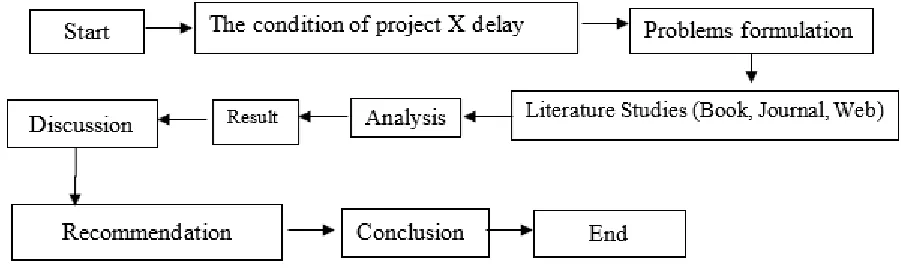
This research was started based on the condition of the X project that had been delayed. Furthermore, the problem was processed into a research topic and continued with literarurestudies.The basics of the theory were studied using literature studies obtained by relevant journals in the past 10 years.
Figure. 1. Research process flowchart
3.2 Methods
Quantitative Analysis was used to analyze data obtained from numbers. Because subsequent data processing used statistics, the data must be classified in certain categories by using certain tables to simplify the analysis using statistical data analysis programs. (Djarwanto, 1998). This quantitative analysis process was carried out in the following stages: a. Editing, i.e. taking or selecting data that is necessary and removing data that is unnecessary, so as to facilitate calculation in the hypothesis testing b. Scoring, i.e. the choice of yes or no. c. Tabulating, i.e. the data grouping of answers from the respondents that were arranged regularly and thoroughly. The data processing was processed by the statistical method used in the study and then divided into 6 parts, i.e. correlation, intercorrelation, factors, multiple linear regression, model test (F, t), and model validation. SPSS program was used for data processing.
IV.RESULTANDDISCUSSION
4.1 Results of expert interviews
After conducting interviews with 5 experts, the following interviews were obtained: Five experts said that a clear and structured chain of command affected the coordination of construction projects, good span of control, smooth delegation, good performance of centralization – decentralization, the formation of cross functional teams, clear task forces, empirical coordination, anticipatory actions and planning, good coordination planning during a construction process, good coordination implementation, good coordination control, internal communication during the construction process, communication between units (design, project, IT, and finance) during the construction process, independent communication between internal units (design, project, IT or finance) with the contractor during the process construction, the process of following the SOP (Standard Operating Procedure), comprehensive description of the project manager (PM) regarding targets, determination of project completion time targets, determination of work quality targets, preparation of project Standard Operating Procedures (SOP), determination of short-term targets (1-2 weeks) to be achieved, determination of work methods during meetings, routes and lay-out of equipment and materials, increased potential for vertical information system coordination (between leaders and teams), coordinators, the good performance of coordinator tasks, coordination of planning during the construction process, coordination of implementation during the process construction, coordination of control during the construction process, and optimal project coordination which affected the coordination process of the construction project.
Four of the five experts said that the coordination was carried out politically, normatively / bureaucratically, the existence of adaptive actions and planning, external communication during the project construction process, the process of uniforming perceptions about the schedule, quality and budget of the project among members or staff of the project, so that each unit did not run independently in carrying out its duties, the division of work tasks for each field and its members, meetings were held every time the main work begins, the respective personnel or work units were involved in carrying out their duties properly, the potential increase of information system coordination lateral (between team members), as well as a reduction in coordination needs that affected the coordination process of the construction project.
Only three of the five experts said that there was a personal liaison, internal unit communication such as between architects or fellow finance officers during the construction process, the formation of "Team Building", determination of profit targets to be achieved and the application of basic management techniques applied which affect the coordination process of the construction project.
4.2 Time Performance in the SDH LubukLinggau Construction Process
Project schedule deviation and project time performance are the processes of comparing the actual schedule with the planned schedule.
( – )
The following was the calculation of time performance for the SDH LubukLinggau project: (8-11): 8 x 100% = -37.5%
The time performance was negative (-), indicated that the implementation was slower than the schedule (behind schedule). In the SDH LubukLinggau SDH project, the time performance was negative, resulting in project delays.
4.3 Initial analysis of coordination in the SDH LubukLinggau project
Preliminary analysis of the coordination process in the SDH LubukLinggau project was not done well. The 29 main factors in coordination obtained from the above expert interviews were most likely not well implemented or not done at all, therefore the SDH LubukLinggau SDH project had experienced project delays, this was indicated by the minus result in the calculation above.
V. CONCLUSION
From the results of the literature review and expert test interviews, it can be concluded that:
1. There are 11 coordination factors that have a role to anticipate project delays including vertical coordination, horizontal coordination, approaches, time dimensions, tasks, forms, kickoff meetings, and toolbox meetings, effective communication approaches, coordinators, and tasks. Of the 11 factors, 44 factors become the basis for interviewing questions to experts. From the results of expert interviews, there were 29 factors considered to be valid because they had a score of 5 and a homogeneous answer that most affected the construction project's time performance, i.e.: a clear and structured chain of command, good span of control, smooth delegation, good performance of centralization - decentralization, the formation of cross functional teams, clear task forces, coordination is done empirically, anticipatory actions and planning, good coordination planning, good coordination implementation, good coordination control, internal communication, communication between units (design, project, IT, and finance), independent communication between internal units (design, project, IT or finance) with the contractor, the process of following the SOP (Standard Operating Procedure), comprehensive description of the project manager (PM) regarding targets, determination of project completion time targets, determination of work quality targets, preparation of project Standard Operating Procedures (SOP), determination of short-term targets (1-2 weeks) to be achieved, determination of work methods during meetings, routes and lay-out of equipment and materials, increased potential for vertical information system coordination (between leaders and teams), the presence of a coordinator, and the good performance of coordinator tasks. These 29 main factors help to make decisions in determining the most appropriate corrective action, to reduce the risk of delays to a minimum. This study will recommend an initial study that is useful to improve project coordination performance.
2. The time performance was negative (-), indicated that the implementation was slower than the schedule (behind schedule). In the SDH LubukLinggau SDH project, the time performance was negative, resulting in project delays. 3.Poor coordination and communication in contracting organizations were one of the top 10 factors that cause project
delays. This factor was included in the first delay group, i.e. Non Excusable Delays. Because it was included in Non Excusable Delays, the delay caused by poor coordination can be prevented. This preliminary study showed a link between coordination and delay in a project. Preliminary analysis of the coordination process in the SDH LubukLinggau project was not done well. The 29 main factors in coordination obtained from the above expert interviews were most likely not well implemented or not done at all, therefore the SDH LubukLinggau project had experienced project delays, this was indicated by the minus result in the calculation of the time performance.
REFERENCES
[1]. Sandyavitri, A., “Manajemen Resiko di Proyek Konstruksi” , Media Komunikasi Teknik Sipil, Tahun 17, No. 1, pp. 23 – 38,2009.
[2]. Setiawan, A., Eko Walujodjati, & Ida Farida, “Analisis Manajemen Risiko pada proyek pembangunan Jalan Tol Cisumdawu”, Jurnal Kontruksi STT Garut Vol. 11 No. 1, pp.1 – 11, 2014
[3]. Supriono, “Faktor-faktor Resiko Keterlambatan Pembangunan Proyek Infrastruktur Perdesaan Berdasarkan Waktu Perencanaan”,Extrapolasi Jurnal Teknik Sipil Untag Surabaya, pp.63 – 72, 2014.
[4]. Frenlu Sukarno, “KoordinasiDalamPengelolaanObjekWisata Taman NasionalKayanMentarang Di
[5]. Ripkianto& LilaAyuRatnaWinanda, “AnalisisPengaruhKomunikasi Antara Konsultan Dan KontraktorTerhadapKeberhasilanProyekBangunan Gedung Di Kota Malang”,KonferensiNasional Teknik Sipil 7 (KoNTekS 7), pp.73-80, 2013.
[6]. Raflis, YaniRahmawati, YuniUlfiyati dan ChristionoUtomo, “PengaruhKomunikasi Dan Tim KerjaTerhadapKeberhasilanKolaborasiDesain Pada Konsultan Teknik Di Jawa Tengah”, KonferensiNasional Teknik Sipil, 11, pp.MK 93-99, 2017.
[7]. AcengUlumudin, “PengaruhKoordinasiTerhadapManajemenProyekUntukMewujudkanEfektivitasPelaksanaanProyek Bina
MargaKabupatenGarut”, Jurnal Pembangunan dan KebijakanPublik, Vo.03, No.01, pp.1-4, 2012.
[8]. Sri Budiyani&AripurnomoKertohardjono, “Penyebab Utama KeterlambatanPelaksanaanKonstruksi Jalan BebasHambatanAksesTanjungPriok”, JurnalKonstruksia, Volume 6, No.2, pp.79-89, 2015.
[9]. Victor Michael Tyson Lempoy, “PerananKonsultanManajemenKonstruksi Pada TahapPelaksanaan (StudiKasus : Pembangunan Star Square”, JurnalSipilStatik Vol.1 No.3, pp. 215-218, 2013.