Machine Learning and IOT Driven Water Treatment
using Voting Logic
Mrs. Manasi V. Ghamande
1, Sacchidanand S. Gogawale
2Dr. Sanjeevani Gogawale
3 1,2Department of Engineering Sciences and humanities, VIT, SP Pune, University, (India)
3Management consultant, Zen International systems, (India)
ABSTRACT
This paper describes method for developing a simple, modular, cost effective, environment friendly innovative gadget for removing heavy metal ions, foul smell and color, from the effluents of industrial waste and or domestic waste groundwater by treating it, using activated carbon, by controlled combustion of orange peels, rice husk and coconut fibers.
The treatment elements are activated carbon from garden waste,- leaves, coconut fibers, and rice husk, and orange peels. Depending on contaminants involved. The three grade of cakes are used to treat water to three purity levels, depending on contaminants. For developing exact combination voting logic is used with proven profile and machine learning to validate the most effective method. The final combination and its reference profile generated is saved in software for future calibration reference, and machine learning till the source is not changed. Such profiles are stored for software based reference for expected purity and sources, contaminants, depending modules and combination of cakes . This machine learning is saved to prompt alarm, and indication and data logging for future reference, if the efficiency of absorption is reducing and cakes need replacement, or source is changed.
Keywords: AI – Artificial intelligence, data logging, machine learning
, profiling, voting logic.
I.
INTRODUCTION
II. CONCEPT
The simple cost effective solution for water treatment that can be used for day to day application, also for households, yet a SMART treatment that everyone can afford was to be developed in a group. Three sources were used for three grade, and application of contaminants. A learning logic for purifier is developed for different application using simple software profiling. With our guide we worked the details for assembly and testing. We interacted with various NABL approved laboratories to confirm the gadget we would make can be validated through them for the before and after results to prove the treatment efficiency.
III. THEORY
Activated carbon, also called activated charcoal, activated coal, carbo activates or an “AC filter”, is a form of carbon processed to have small, low-volume pores that increase the surface area available for adsorption or chemical reactions .Activated is sometimes substituted with active. Due to its high degree of micro porosity, just one gram of activated carbon has a surface area in excess of 500 m2, as determined by gas adsorption. An activation level sufficient for useful application may be attained solely from high surface area; however, further chemical treatment often enhances adsorption properties. Activated carbon is usually derived from charcoal and, increasingly, high-porosity bio char. Activated carbon is used in gas purification, decaffeination, gold purification , metal extraction, water purification, medicine, sewage treatment, air filters in gas masks and respirators, filters in compressed air, and many other applications. One major industrial application involves use of activated carbon in the metal finishing field. It is very widely employed for purification of electroplating solutions. For example, it is a main purification technique for removing organic impurities from bright nickel plating solutions. A variety of organic chemicals are added to plating solutions for improving their deposit qualities and for enhancing properties like brightness, smoothness, ductility, etc. Due to passage of direct current and electrolyticlution, their excessive build up can adversely affect the plating quality and physical properties of deposited metal. Activated carbon treatment removes such impurities and restores plating performance to the desired level. In 2007, UGent (Ghent University, Belgium) began research in water treatment after festivals.
IV. THE FACTORS AFFECTING THE ADSORPTION
4.1 Iodine NumberMany carbons preferentially adsorb small molecules. Iodine number is the most fundamental parameter used to characterize activated carbon performance. It is a measure of activity level (higher number indicates higher degree of activation), often reported in mg/g (typical range 500–1200 mg/g).
4.2 Apparent Density
4.3. Dechlorination
Some carbons are evaluated based on the dechlorination half-life length, which measures the chlorine-removal efficiency of activated carbon. The dechlorination half value length is the depth of carbon required to reduce the chlorine level of a flowing stream from 5 ppm to 3.5 ppm. A lower half-value length indicates superior performance.
4.4 Molasses:
Some carbons are more adept at adsorbing large molecules. Molasses number or molasses efficiency is a measure of the mesopore content of the activated carbon (greater than 20 Å, or larger than 2 nm) by adsorption of molasses from solution. A high molasses number indicates a high adsorption of big molecules (range 95– 600). Caramel dp (decolorizing performance) is similar to molasses number. Molasses efficiency is reported as a percentage (range 40%–185%) and parallels molasses number (600 = 185%, 425 = 85%). The European molasses number (range 525–110) is inversely related to the North American molasses number.
4.5. Hardness/abrasion number
:
It is a measure of the activated carbon’s resistance to attrition. It is an important indicator of activated carbon to maintain its physical integrity and withstand frictional forces imposed by backwashing, etc. There are large differences in the hardness of activated carbons, depending on the raw material and activity level.
4.6. Ash content
:
Ash reduces the overall activity of activated carbon and it reduces the efficiency of reactivation. The metal oxides (Fe2O3) can leach out of activated carbon resulting in discoloration.
4.7. Particle size distribution:
The finer the particle sizes of an activated carbon, the better the access to the surface area and the faster the rate of adsorption kinetics. In vapour phase systems this needs to be considered against pressure drop, which will affect energy cost. Careful consideration of particle size distribution can provide significant operating benefits.
4.8 Demineralization
:
Distillation removes all minerals from water, and the membrane methods of reverse osmosis and Nano-filtration remove most of all minerals. These results in dematerialized water which is not considered ideal drinking water The water treatment is being important day by day because of the water sources are getting contaminated, by allowing hazardous waste to be drained with our any treatment due to lack of awareness or lack of method to treat it. Water also develop foul small and different colour and due to garbage other wastage being drained, uncontrolled that may contaminate in drinking water sources.
V. DETAIL OF DESIGN
Activated carbon is carbon produced from carbonaceous source materials such as nutshells, coconut husk, peat, wood, coir, lignite, coal, and petroleum pitch. It can be produced by one of the following processes:
5.1. Physical reactivation
5.2. Chemical activation
The source material is developed into activated carbons using hot gases.Air is then introduced to burn out the gasses, creating a graded, screened and de-dusted form of activated carbon. This is generally done by using one or a combination of the following processes
Physical reactivation
A. Carbonization - pyrolyzed at temperatures in the range 600–900 °C, usually in inert atmosphere
B. Activation/Oxidation -exposed to oxidizing atmospheres (oxygen or steam) at temperatures above 250 °C, usually in the temperature range of 600–1200 °C.
Chemical activation:
With acid, strong base, or a salt, carbonized at 450–900 °C. We used activated carbon by controlled heating of Coconut shell, Husk, Orange peels, straws, dry grass, Coconut lining threads etc. in activating chamber in the range of 699-1200, using well designed burning –carbonizing chamber designed by Samuchit Environ tech. The comparative study of all types is done. The Different powder gave different results. A detailed study for the various types and factors affecting the adsorption was carried out.
5.3 Powdered activated carbon:
(R 1, PAC) are made in particulate form as powders or fine granules less than 1.0 mm in size with an average diameter between 0.15 and 0.25mm. Activated carbon (R 1)is defined as the activated carbon particles retained on a 50-mesh sieve (0.297 mm).
5.4 Granulated carbons:
Are used for water treatment, deodorization and separation of components of flow system and is also used in rapid mix basins.
5.5. Extruded activated carbon (EAC):
(PAC) with a binder, which are fused together and extruded into a cylindrical shaped activated carbon block with diameters from 0.8 to 130 mm. Bead activated carbon is made from petroleum pitch and supplied in diameters from approximately 0.35 to 0.80mm.
5.6 Polymer coated carbon:
It is used for He moper-fusion .Important properties for selection - A gram of activated carbon can have a surface area in excess of 500 m2, with 1500 m2 being readily achievable. Carbon aero gels, while more expensive, have even higher surface areas, and are used in special applications.
Tests of adsorption behaviour are usually done with nitrogen gas at 77 K under high vacuum, but in everyday terms activated carbon is perfectly capable of producing the equivalent, by adsorption from its environment, liquid water from steam at 100 °C (212 °F) and a pressure of 1/10,000 of an atmosphere.
oxygen if the carbon was first cooled to low temperatures. Physically, activated carbon binds materials by van der Waals force or London dispersion force. Activated carbon does not bind well to certain chemicals, including alcohols, diols, strong acids and bases, metals and most in organics, such as lithium, sodium, iron, lead, arsenic, fluorine, and boric acid. Activated carbon adsorbs iodine very well. The iodine capacity, mg/g, (ASTM D28 Standard Method test) may be used as an indication of total surface area.
Carbon monoxide is not well adsorbed by activated carbon. This should be of particular concern to those using the material in filters for respirators, fume hoods or other gas control systems as the gas is undetectable to the human senses, toxic to metabolism and neuro toxic. Substantial lists of the common industrial and agricultural gases adsorbed by activated carbon can be found online. Activated carbon can be used as a substrate for the application of various chemicals to improve the adsorptive capacity for some inorganic (and problematic organic) compounds such as hydrogen sulphide (H2S), ammonia (NH3), formaldehyde (HCOH), mercury (Hg) and radioactive iodine-131(131I). This property is known as chemisorptions
.
After study of all types we decided to study the effect of the carbon based filter using 1. Coconut 2. Rise husk 3. Orange peels to derived activated carbon.
Details of the material used:
The simple filter of cotton, Deposited with activated carbon, three cakes, and or combination that of with smart phone based prompt, using control and machine learning algorithm.
Two Matka (earthen pots for water cooling), or multiple of the sets depending on the profile, contaminants and machine prompt. One module has – set of two, with One of them with & one without tap, Water collection Pot, for each grade cake to decide which or combination of either to be used based on contaminant to develop learning logic for the filter,
Test equipments, SMART phone, water application, contaminated source, CrCl2, Lead,
Details of assembly: The first pot was put on second pot. The junction was separated with filter, so the water dripping from the first pot gets treated by filtering and adsorption and pure cool water is available for drinking. The carbon at lab was used effectively to get it tested a flask & titration tubes were used, however, to convert it into a gadget that can be used by all was a problem.
We brain stormed on it and realized a drop by drop arrangement is also possible if we use simple Mataka , the separation of the two with a filter would be easily done if we use the cotton filter with carbon deposit .
When a modular cost effective simple construction was done, The second problem was to identify and device a simple modular, cost effective , domestic application, or a gadget that can be easily constructed and validated. The testing for NABL approved lab and availability for Lead AS analysis was a problem. But with help of our guide and support from VSI, and Vipanan extending the support we could get our gadget validated and calibrated for different grades and different applications , to develop basic software for profiling and machine learning.
VI.FIGURES AND TABLES
6.1. Table showing the calculation of reduction after treatment, such reference are developed for various grade of treatment cakes, and contaminant to develop the machine learning using simple software program, based on daily logs.
Such analysis would also help for the municipal authority in long term to decide the control and identify the sources of contaminants to set effective water treatment.
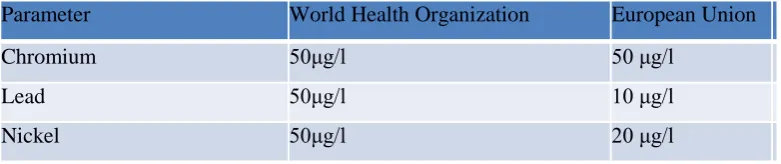
Table -The guidelines for drinking water
Parameter
World Health Organization
European Union
Chromium
50μg/l
50 μg/l
Lead
50μg/l
10 μg/l
Nickel
50μg/l
20 μg/l
Table 2 – Before and after results –
Fig. 8.1 The time response Fig.8. 2. The adsorption % display on ASM
Conc. of Lead ion In ppm
BEFORE
8.207
AFTER
3.779
DIFFERENCE
4.428
% Reduction
4.428/8.207×100 = 54%
FIG.8.
3
THE
DE
COLORIZATION
PHOTO
The photos clearly show the effective treatment done by the simple gadget.
VII. CONCLUSION
This simple devise will facilitate all specially villagers, cost effective simple treatment and also salvage the waste, which is otherwise a problem. The simple processing of waste would lead to process the waste, contaminants in water that are hazardous to health. Depending on type of contaminants the different modules and different set and combination of grades of char coal can be used for purity level required.
A combination of purifier grade and purity level required is first validated by set up method for known source and stored in machine as a learning module then by use of multiple cakes and purity profile suitable application is identified by voting logic. Such relation of grade of purifier to grade of output to number of treatment can be also linked to simple SMART phone to communicate the users, so they themselves can edit and continue the experiment till perfect treatment and grade combination is achieved first by validating.
Timely quick checks are strongly recommended to test the purity of treatment cakes, and indication of its efficiency to show replace also is given if not performing or choked up. Such device uses simple cakes, so replacement and disposal is also very simple , and user friendly, using AI prompts.
Limitation – such devise can not be used if contaminant are not known. For pure potable water, lab treatment is recommended. However where elaborate testing and treatments are not available this devise will increase the awareness and reduce the risk.
VIII. ACKNOWLEDGMENTS
We appreciate the contribution of Dr. Karve of Samuchit envirotech, and Mr. Raghvan of Vipanan for allowing us to carry out the experiments and tests that helped us to develop and validate this gadget.
REFERENCES
[3.] Polovina M., Babic B., Kaluderovic B., Dekanski A. (1997). “Surface characterization of oxidized activated carbon cloth”. Carbon 35 (8): 1047–1052. doi:10.1016/s0008-6223(97)00057-2.
[4.] TIGG Corporation. Granular activated carbon selection. Published 2012-05-8, retrieved 2012-09-21.
[5.] Petrov N., Budinova T., Razvigorova M., Ekinci E., Yardim F., Minkova V. (2000). “Preparation and characterization of carbon adsorbents from furfural”. Carbon 38 (15): 2069–2075. doi:10.1016/s0008-6223(00)00063-4.