Behaviour of Black Cotton Soil Reinforced
with Randomly Distributed Pearl Millet Waste
(A Natural Fibre)
Ajmeer Shareef. A. N 1, Dr Sitaram Nayak2, Dr B M Sunil3
M. Tech by Research, Dept. of Geotechnical Engineering, NITK Surathkal, Shrinivas Nagar, Manglore, India1
Professor, Dept. of Civil Engineering, NITK Surathkal, Shrinivas Nagar, Manglore, India2
Assistant Professor, Dept. of Civil Engineering, NITK Surathkal, Shrinivas Nagar, Manglore India3
ABSTRACT: Indian black cotton soil distribution is largely seen in Karnataka, Maharashtra, Madhya Pradesh, Malva, Sourashtra, Chhattisgarh and many other states which constitutes 20% of the area. Because of the Montmorillonite mineral it poses problems to lightly loaded structures mainly due to the variation in moisture content. The idea of reinforcing soil masses with randomly distributed natural fibre is not new, it is emerging area too because of the sustainable developments. In the past, researchers have used many natural fibers such as sisal, coir, palm leaves etc. to stabilize problematic soils. In that perspective here in this research an attempt has been made to study the effect of Pearl Millet (a natural fibre) on black cotton soil. Fibre content is varied from 0.2 to 1%, effect of the same on UCC and triaxial compression of black cotton soil is observed. From the experimental investigation it is found that shear strength of expansive soil is increased to notable extent.
KEYWORDS: Expansive soil, Pearl Millet Fibre, Fibre-reinforced soil, UCC, Triaxial Shear Strength.
I. INTRODUCTION
GENERAL:
For centuries mankind has wondered at the instability of earth materials, especially clays: one day they are dry and hard, and the next day they are wet and soft. Clays have always posed problems for lightly loaded structures like pavements, canal linings, embankments, air fields etc. by consolidating under load and by changing volumetrically along with seasonal moisture variation. The results are usually excessive deflections and differential movements resulting in damage to foundation systems, structural elements, and architectural features. In a significant number of cases the structures become unusable or uninhabitable. Even when efforts are made to improve clay soils, the lack of appropriate improvements sometimes results in volumetric changes that are responsible for billions of dollars of damage each year, as discussed by Wiggins et al. (1978). Therefore, as a profession we need to do more to develop our knowledge of proven methods to deal with expansive soils, support research for further improvement of these methods, and work toward better quality control and quality assurance for their application.
II. RELATED WORK (LITERATURE REVIEW)
form a mathematical model. Kumar et al. [5] conducted an experimental program where they used polyester fibre with varying percentage in fly ash-lime stabilized soil and studied unconfined compression strength and split tensile strength found enhancement in strength properties of expansive soil. Dasaka and Dumesh [6] carried series of triaxial and unconfined compression tests on fine grained soil by adding coir fibre 0% -2% and found remarkable increase in cohesion and friction angle values.
As the natural fibers are environmental friendly it is suitable area for sustainable development. Since the availability of natural fibers is abundant in many parts of the world, their utilization in the field of soil stabilization will be justified by more studies the performance of the fibers. In that perspective following objectives are tried to meet in present work:
1. To know the effect of randomly reinforced pearl millet fibers on unconfined compressive strength of black cotton soil.
2. To know the stress-strain behaviour of fiber reinforced black cotton soil by conducting unconsolidated undrained triaxial compression test on sample sized 38-mm diameter and 76-mm in length.
3. To know the effect of fibers on major principle stress at failure, stiffness characteristics and shear strength parameters.
III.MATERIALS AND EXPERIMENTAL PROGRAM
3.1 SOIL
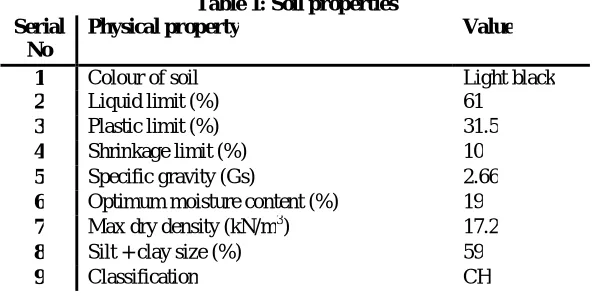
The black cotton soil sample used in the present study is collected from Badagandi Village, Bilgi Talluk Bagalkot, Karnataka state, India. Soil sample is collected from test pits of dimension 1.5m X 1.5 X 1.5m. The physical properties of the soil are determined which are listed in Table 1. All the tests are conducted according to the Indian standards (IS 2720).
Table 1: Soil properties Serial
No
Physical property Value 1 Colour of soil Light black
2 Liquid limit (%) 61
3 Plastic limit (%) 31.5
4 Shrinkage limit (%) 10
5 Specific gravity (Gs) 2.66
6 Optimum moisture content (%) 19
7 Max dry density (kN/m3) 17.2
8 Silt + clay size (%) 59
9 Classification CH
3.2 FIBER
Pearl millet fibers are obtained from Badami, Bagalkot, Karnataka state, India. The pearl millet waste used as natural fiber in this study have average diameter of 0.2 mm. The properties of fiber are listed in Table 2. And the physical appearance of the same is shown in Fig 1.
Table 2: Properties of fibers used in the study Serial
No
Physical property Value 1 Length 12-15 mm
Figure 1: Pearl millet fibers in heap, individual appearance and enlarge view 3.3 EXPERIMENTAL PROGRAM
Soil obtained from test pits in field is air dried and pulverized to desired degree. Pulverized soil is then mixed with different percentages of pearl millet waste i.e. 0.2% to 1% by weight of dry soil. Soil-fiber mixture is mixed to achieve uniform distribution of fibers. Now soil-fiber mixture is added with OMC obtained from moisture density relations and same material is packed in polythene bag and kept in humid condition for 24 hour, to get uniform distribution of moisture and also to achieve good bond between soil and fiber matrix. After 24 hours sample is compacted in proctor compaction mould to light compaction, samplers of 38 mm diameter are inserted to extract soil sample. After extracting soil sample it is trimmed to get soil sample of 38 mm diameter and 76 mm length. All the samples are ensured that they are compacted to maximum dry density and OMC.
3.3.1 UNCONFINED COMPRESSION TEST
In order to know the effect of incorporation of pearl millet waste (0.2% to 1% by weight of dry soil) on strength of black cotton soil, samples of 38 mm diameter and 76 mm length are prepared as explained in above paragraph. Samples are subjected to a unconfined compression in testing machine. Loading is done at the rate of 1.25 mm per minute until sample fails, loading is continued after failure to know the post failure behaviour of sample.
3.3.2 TRIAXIAL COMPRESSION TEST
Unconsolidated undrained triaxial compression test is carried out on samples of 38 mm diameter and 76 mm length at different confinement pressure (50kPa, 100kPa and 150kPa). Load is applied at the rate of 1.25 mm per minute till failure and it is continued after failure to know the effect of fiber after the failure. The test is carried out to know the stress strain behaviour with fiber content, modified Mohe-Coulumb failure envelope and shear strength parameters.
IV.RESULTS AND DISCUSSION
0.00 100.00 200.00 300.00 400.00 500.00
0.0 5.0 10.0 15.0 20.0
D
e
via
to
r
St
re
ss
in
k
P
a
Axial Strain in %
BC Alone
BC+0.2%F
BC+0.4%F
BC+0.6%F
BC+0.8%F
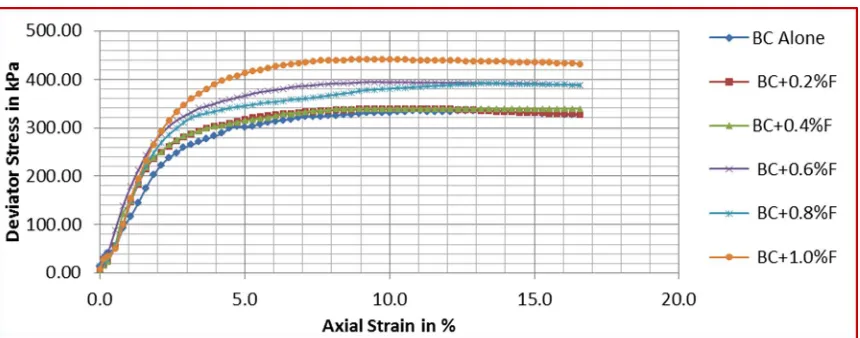
Figure 3: Stress-strain curves for different fiber content at 50kPa confining pressure
Figure 4: Stress-strain curves for different fiber content at 100kPa confining pressure
EFFECT ON UCC
Minimum of three samples were prepared for each combination that is various fiber soil combination (0.2, 0.4, 0.6, 0.8, 1.0% by weight of dry soil). Samples are prepared as per IS 2720 [12] specifications to MDD 17.2kN/m3 and OMC 20%. As seen in Figure 2. fiber inclusion enhanced the peak stress of unreinforced soil. It is to be noted that for 1.75% of fiber content the peak stress increases by 75%. It is also noticeable that wit increase in fiber content ductile behaviour will increase. Addition of fiber also changes the failure pattern in the sense that increase in fiber content showed sample more stable. Further the residual strength of soil samples increased with increase in fiber content. Failure stress increased with increase in fiber content, however beyond 1.75% of fiber content the quantity of fibers become more than that of soil due to its light weight.
TRIAXIAL COMPRESSION TEST
Unconsolidated undrained triaxial compression tests are conducted on the samples prepared as per IS 2720 Part II (1993) [11] specifications at maximum dry density and OMC on unreinforced and reinforced samples with 0.2% to 1.0% of fibers by dry soil mass. The tests were conducted at different confining pressures of 50kPa, 100kPa and 150kPa. Figures 3 – 5 shows the variations of deviator stress verses axial strain at 50kPa, 100kPa and 150kPa.
From the results (Figure 3), at 50kPa cell pressure, deviator stress at failure and strain corresponding to various fiber contents are obtained and these results shown that deviator stress is increased with increase in fiber content. In most of the cases, maximum deviator stress occurred at about 8 to 12% of strain. Failure occurred at larger strains when fiber content increased from 0.6% and more. In all the cases loading is continued beyond failure up to 17.5% of strain to know the post failure behaviour. It is observed from Figures 3 - 5 that there is still residual strength even after failure. This is because of the fibers addition and residual strength is increased with the increase in fiber contents.
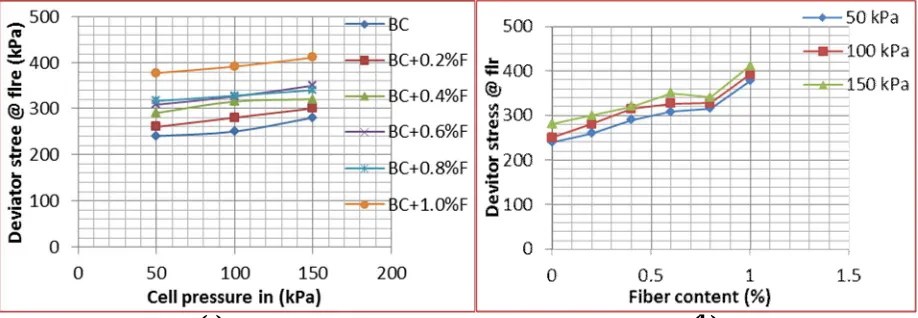
The results show that stress-strain behaviour is improved to by incorporating fiber into soil. The increment is due the resistance created by the fibers during shear. Test results at different fiber contents (fibers varying from 0.2 to 1.0% by weight of dry soil) are presented in Figure 6. From Figure 6, it can be observed that deviator stress at failure increases with fiber content. This behaviour can be seen for all the different cell pressures in triaxial cell. From the results it is seen that at 1.0% of fiber there is 1.61 times in deviator stress at failure for 150kPa confinement pressure and minimum increase of 1.2 times increase in deviator stress at failure for 50kPa confinement pressure. The effect of addition of fibers on behaviour of soil is considerably seen beyond 0.6% and it increases with increase in fiber content. It is to be noted that after 1.5 % of fiber content, it is difficult to mix fibers due to large volume of fibers. From Figure 6 (a). it is clear that with increase in fiber content, deviator stress at failure is increased. One fact to be noted that all the line look almost parallel to each other showing that there is increase in cohesion value but hardly change in frictional angle. From Figure 6 (b), clearly shows the modification in the stress at failure which increased with fiber.
(a) (b)
V. CONCLUSION
A set of UCC and triaxial compression tests were conducted to study the influence of pearl millet waste fiber (Bajra) on the strength behaviour of black cotton soil. The following conclusions can be known from the study.
Stress-strain behaviour of soil is improved with the addition of fibers, stress at failure is increased to 1.61 times compare to soil alone. Fiber addition prevents formation of cracks.
Stiffness of soil is seen increased which may reduce the immediate settlements.
Unconfined compressive strength increases with increase in percentage of fiber but beyond 1.75 % it will become difficult to mix fibers because of large volume of fibers.
Unreinforced specimens failed at small strain (1 -1.5%) when compared to reinforced specimens (beyond 3.5%).
REFERENCES
[1] Donald, H. G., and Ohashi, H."Mechanics of fiber reinforcement in sand." Journal of Geotechnical Engineering 109(3) 335-353, 1983. [2] Freitag, D. R. "Soil randomlyfReinforced with fibers." Journal of Geotechnical Engineering 112. 823-826, 1986.
[3] G. L., ShivakumarBabu, and A. K., Vasudevan. "Strength and Stiffness response of Coir fiber-reinforced tropical soil." Journal of Materials in Civil Engineering 20. 571-577, 2008.
[4] Ranjan, G., R. M., Vasan, and H. D., Charan. "Probabilistic analysis of randomly distributed fiber-reinforced soil." Journal of Geotechnical Engineering 122(6), 419-426, 1996.
[5] Arvind K., Baljit S. W., and Asheet B. "Influence of Fly Ash, Lime, and Polyester fibers on compaction and strength properties of expansive soil." Journal of Materials in Civil Engineering 19, 242-248, 2007.
[6] S. M. Dasaka and K. S. Sumesh. "Effect of coir fiber on the stress-strain behavior of a reconstituted fine-grained soil." Journal of Natural Fibers 8, 189-204, 2011.
[7] Estabragh, A. R., Bordbar, A. T., and Javadi A. A. "Mechanical behavior of a clay soil reinforced with Nylon fibers."Geotechnical and Geological Engineering 29, 899-908, 2011.
[8] Yi C. A., Bin S., Charles W.W., and Chao-sheng T. "Effect of polypropylene fibre and lime admixture on engineering properties of clayey soil." Engineering Geology 87, 230–240, 2006.
[9] Prabakara, J., and Sridharb R. S. "Effect of random inclusion of sisal fibre on strength behaviour of soil." Construction and Building Materials 16, 123–131, 2002.
[10] Ghavami, K., Romildo D., Filho, T., and Barbosac, N. P. "Behaviour of composite soil reinforced with natural fibres." Cement and Concrete Composites 21, 39-48, 1999.
[11] IS 2720 Part II (1993): "Methods of test for soils part 11 determinations of the shear strength parameters of a specimen tested in unconsolidated undrained triaxial compression without the measurement of pore water pressure"