ABSTRACT
MA, YANXUE. An Integrated Model for Shaped Knit Garment Design and Development.
(Under the direction of Dr. Traci A.M. Lamar).
Advanced knitting technologies such as integral knitting and seamless knitting expand opportunities in unique knit garment design and development, but the lack of well-defined knowledge requirements and inadequate understanding of the development process prohibit these technologies from being fully utilized in the creation of knit garments. This research investigated in detail the design and development process for shaped knit garments in three stages.
First, a reference library was established via fundamental research that investigated the influences of different shaping techniques and knit stitch structures on knitted fabric dimensions and knitted garment shapes. This reference library supported accomplishment of fully-fashioned or seamless knit garment development in each case in stages two and three of the research. Second, a preliminary model was established based on participant observation of four case studies. Third, the preliminary model was validated and refined through mapping in-depth case studies to the model in research stage three. Additionally, interviews with industry experts were conducted to verify
necessity and sufficiency of steps and components in the preliminary model. Finally, a validated and comprehensive model was developed that integrated all aspects of shaped knit garment design and development. The integrated model that delivers detailed descriptions of necessary steps and
knowledge needed is useful to designers or development teams in creating unique fully-fashioned or seamless knit garments. The archival references in the reference library and components in
An Integrated Model for Shaped Knit Garment Design and Development
by Yanxue Ma
A dissertation submitted to the Graduate Faculty of North Carolina State University
in partial fulfillment of the requirements for the degree of
Doctor of Philosophy
Textile Technology and Management
Raleigh, North Carolina 2013
APPROVED BY:
_______________________________ ______________________________
Traci A.M. Lamar
Nancy Powell
Committee Chair
DEDICATION
BIOGRAPHY
ACKNOWLEDGMENTS
I wish to acknowledge the time and support of many individuals and organizations. I could not complete this work without them. First, I would like to offer my sincere appreciation to Dr. Traci Lamar, the chair of my advisory committee, for her consistent, patient and generous guidance and encouragement throughout the duration of this research. Thanks are extended to the other committee members, Dr. Lisa Parrillo Chapman and Professor Nancy Powell for their advice, recommendations and encouragement. I also wish to thank Dr. Marcia Gumpertz for her time and assistance in
achievement of my Statistic minor.
Second, I would like to thank John Ward and Robert Lehrich in Shima Seiki for their technical support and help in the creation of knit garments in this work. I also want to acknowledge the support of College of Textiles at NCSU for providing access to the facilities to conduct my research, and thank the National Textile Center for funding the research and my graduate studies. Additionally, I own my thanks to participants in the interviews and case studies. They provided intelligent and thoughtful opinions and comments about the knit garment design and development process, and generously shared their experiences with knit garment design.
TABLE OF CONTENTS
LIST OF FIGURES ... viii
LIST OF TABLES ...x
1 Introduction ...1
1.1 Purpose of research ... 2
2 Literature review ...4
2.1 Knitting technologies supporting integrated design ... 4
2.1.1 Knitting fundamentals ... 4
2.1.2 Knit garment construction ... 6
2.1.3 Potential knitting techniques: 3D shaping for knit garments ... 8
Course shaping ... 10
2.1.3.1 Wale shaping ... 13
2.1.3.2 Stitch architecture ... 17
2.1.3.3 Changing yarn materials ... 20
2.1.3.4 Changing structural parameters ... 20
2.1.3.5 Tubular knitting ... 21
2.1.3.6 Other possible 3D shaping techniques ... 22
2.1.3.7 2.2 New product development in knitwear industry ... 24
2.2.1 Apparel development processes ... 25
2.2.2 Knitwear design models ... 26
2.2.3 Technologies supporting knitwear development ... 46
Body scanning ... 47
2.2.3.1 CAD/CAM for knit garment design ... 48
2.2.3.2 Virtual simulation ... 50
2.2.3.3 Flat/V-bed knitting technology ... 52
2.2.3.4 Other potential methods for knit garment design ... 53
2.2.3.5 2.3 Summary of Literature ... 53
3 Research objectives ... 56
4 Research methodology and results of stage one: reference library development ... 59
4.1 Yarn and machine and CAD software ... 59
4.2 Experiment I: 3D shaping technique for knit garment shaping ... 61
4.2.1 Research method in Experiment I ... 62
4.2.2 Results of Experiment I ... 66
Shaping angle ... 66
4.2.2.1 Shaping length ... 68
4.2.2.2 Loop density and shrinkage ... 69
4.3 Experiment II: effects of knitted structures on knitted garment panel size ... 72
4.3.1 Integral garments with different knitted structures: size, shape and implications for fit ... 72
4.3.2 Further analysis in Experiment II ... 79
Effects of knitted structures on ½ width of neck opening (measure A) ... 80
4.3.2.1 Effects of knitted structures on front neck drop (measure B) ... 82
4.3.2.2 Effects of knitted structures on shoulder slope (Angle α) ... 83
4.3.2.3 Effects of knitted structures on shoulder length (measure C) ... 84
4.3.2.4 Effects of knitted structures on body length (measure D) ... 85
4.3.2.5 Effects of knitted structures on ½ body width (measure E) ... 86
4.3.2.6 Effects of knitted structures on ½ upper chest width (measure F) ... 87
4.3.2.7 Effects of knitted structures on armhole depth (measure H) ... 88
4.3.2.8 4.4 Experiment III: Sample development and measurement with different stitch structures ... 89
4.5 Experiment IV: Effects of tuck stitches and miss stitches on knitted fabric dimensions ... 92
4.5.1 Research method in Experiment IV ... 93
4.5.2 Results of Experiment IV ... 96
Length of samples knitted with tuck stitches ... 98
4.5.2.1 Width of samples knitted with tuck stitches ... 99
4.5.2.2 Thickness of samples knitted with tuck stitches ... 100
4.5.2.3 Length of samples knitted with miss stitches ... 101
4.5.2.4 Width of samples knitted with miss stitches ... 102
4.5.2.5 Thickness of samples knitted with miss stitches ... 103
4.5.2.6 4.5.3 Conclusions and limitations in Experiment IV ... 106
5 Research Methodology in stages two and three ... 108
5.1 Case study selection ... 109
5.2 Data collection and analysis of case studies in stage two ... 112
5.3 Data collection and analysis on in-depth case studies in stage three ... 113
5.4 Interview instrument development ... 115
5.5 Sample selection and interview procedure ... 116
5.6 Data collection and analysis in interview ... 117
6 Results of stage two: preliminary model establishment ... 118
6.1 Case study one ... 118
6.2 Case study two ... 126
6.3 Case study three ... 129
6.4 Case study four ... 132
7.1.1 Design and development process ... 143
7.1.2 Validity of components in knowledge building ... 146
7.2 In-depth case study two: model mapping ... 148
7.2.1 Design and development process ... 150
7.2.2 Validity of components in knowledge building ... 154
7.3 In-depth case study three: model mapping ... 156
7.3.1 Design and development process ... 159
7.3.2 Validity of knowledge components ... 161
7.4 In depth case study four: model mapping ... 164
7.4.1 Design and development process ... 167
7.4.2 Validity of knowledge components ... 170
7.5 In-depth case study five: model mapping ... 172
7.5.1 Design and development process ... 174
7.5.2 Validity of knowledge components ... 176
7.6 Discussion of model mapping in in-depth case studies ... 177
7.6.1 Validity of the design and development process and evaluation ... 178
7.6.2 Validity of knowledge building ... 180
8 Results of experts interview in stage three ... 186
8.1 Expertise of participants ... 186
8.2 Comments from participant experts ... 187
8.3 Comparison of results of expert interview and in-depth case studies ... 198
9 Model refinement ... 202
10 Summary, conclusions and recommendations ... 216
10.1 Summary ... 216
10.2 Conclusions... 218
10.3 Recommendations for further research ... 220
REFERENCES ... 222
APPENDICES ... 229
Appendix A. Pilot study of yarns ... 230
Appendix B. IRB approval letter for case studies ... 231
Appendix C. IRB approval letter for interviews ... 232
LIST OF FIGURES
Figure 2.1 Two basic methods of course shaping ... 11
Figure 2.2 Comparison of pattern and knitted sample ... 12
Figure 2.3 Designed patterns with outside and inside narrowing stitches ... 14
Figure 2.4 Shapes narrowed with different numbers of transferred stitches and fashioning frequencies ... 16
Figure 2.5 Effect of arcing with two structures knitted side by side ... 17
Figure 2.6 Stitch shaping with two different structures ... 18
Figure 2.7 Combination of three knitted structures ... 19
Figure 2.8 Shaped fabric with two different loop lengths ... 21
Figure 2.9 Conventional knitwear development process ... 28
Figure 2.10 Knitwear design process with evaluation and modification ... 31
Figure 2.11 Knitwear development process with customers participation ... 33
Figure 2.12 Process model for engineering textile design properties within the shape of a product .. 35
Figure 2.13 Workflow for high-fashion knitwear production undertaken by knitwear designers using Shima Seiki’s WG® knitting system ... 38
Figure 2.14 Concepts and steps in Factory Boutique Shima ... 41
Figure 2.15 “Knit-on-Demand” process. ... 42
Figure 2.16 Design options in the “knit-on-demand” process ... 43
Figure 3.1 Research methodology structure ... 58
Figure 4.1 Stitch pattern and digital pattern. ... 60
Figure 4.2 Option line bars in Shima Seiki’s CAD software ... 60
Figure 4.3 Digital patterns of two methods for dart placement ... 63
Figure 4.4 Sample design ... 64
Figure 4.5 Measurement of shaping angles along the shaping line ... 65
Figure 4.6 Shaping angles with different number of held stitches before and after finishing ... 67
Figure 4.7 Shrinkage in the vertical direction in the shaped area ... 71
Figure 4.8 Sweater panel shape, measurements and structures ... 79
Figure 4.9 Interaction effects of front body structure and armhole edge structure on shoulder slope 83 Figure 4.10 Interaction effects of front body structure and armhole edge structure on shoulder length ... 84
Figure 4.11 Interaction effects of front body structure and armhole edge structure on body length ... 86
Figure 4.12 Interaction effect of front body structure and armhole edge structure ... 89
Figure 4.13 Comparison of sample length and width between tuck/miss stitches and single jersey .. 97
Figure 4.14 Comparison of sample thickness between tuck/miss stitches and single jersey ... 97
Figure 4.15 Interaction effects of the number of tucks, stitch design and stitch layout ... 99
Figure 4.16 Three-way interaction of number of tucks, stitch design and stitch layout ... 101
Figure 4.17 Two-way interactions of number of misses, stitch design and stitch layout ... 105
Figure 6.1 Knit dress in ivory created in case one ... 118
Figure 6.2 Initial model developed in case study one ... 120
Figure 6.3 Fully-fashioned knit dress developed in case study two ... 126
Figure 6.4 Model modified after case study two ... 128
Figure 6.5 Two dresses developed in case study three ... 129
Figure 6.9 Preliminary integrated model for shaped knit garment design and development ... 137
Figure 6.10 Supportive references for execution and evaluation steps ... 139
Figure 7.1 Seamless knit dress created in in-depth case study one ... 141
Figure 7.2 Fully-fashioned knit dress created in in-depth case study two ... 149
Figure 7.3 Seamless open structure sweater created in in-depth case study three ... 157
Figure 7.4 Illustration of 3-piece knitting ... 162
Figure 7.5 Seamless knit dress created in in-depth case study four ... 165
Figure 7.6 3-piece knitting in in-depth case study four ... 163
Figure 7.7 Seamless tank created in in-depth case study five ... 173
Figure 8.1 Comments from participant experts in interview question one ... 190
Figure 8.2 Additional knowledge components needed to support garment style generation ... 192
Figure 8.3 Additional knowledge components needed to support prototype production ... 194
Figure 9.1 Structure of the integrated model ... 205
Figure 9.2 Integrated model legend ... 205
Figure 9.3 Phase one – garment style generation ... 206
Figure 9.4 Phase two – digital design via CAD/CAM ... 207
LIST OF TABLES
Table 2.1 3D shaped knitted fabric techniques and examples ... 10
Table 2.2 Conventional computerized seamless knitwear development process ... 36
Table 2.3 Comparison of different knitwear development models ... 44
Table 4.1 Shima Seiki’s fully-fashioned knitting machine specifications ... 61
Table 4.2 Effects of number of held stitches on differences between theoretical and actual shaping angles at Apex ... 68
Table 4.3 Interaction effect on differences between theoretical and actual shaping length ... 69
Table 4.4 Effects of front body structure and armhole edge structure on ½ neck opening width ... 81
Table 4.5 Interaction effects of measurement position and body structure on 1/2 neck width ... 82
Table 4.6 Comparison of front neck drop between different levels of front body structure ... 82
Table 4.7 Interaction effects of measurement position and body structure on shoulder length ... 85
Table 4.8 Effects of front body structure on ½ body width ... 87
Table 4.9 Effects of measurement position on ½ body width ... 87
Table 4.10 Effects of front body structure and armhole edge structure on ½ upper chest width ... 88
Table 4.11 Effects of measurement position on ½ upper chest width ... 88
Table 4.12 Comparison of knitted fabrics with different stitch structures ... 91
Table 4.13 Independent variables and their treatment levels ... 94
Table 4.14 ANOVA table for sample length with tuck stitches ... 98
Table 4.15 Effects of the number of tuck stitches ... 100
Table 4.16 Effects of the number of misses, stitch design and stitch layout ... 101
Table 4.17 ANOVA table for sample width with miss stitches ... 103
Table 4.18 ANOVA table for sample thickness with miss stitches ... 103
Table 5.1 Training of CAD and CAM systems... 114
Table 7.1 Summary of in-depth case study one ... 142
Table 7.2 Summary of in-depth case study two ... 149
Table 7.3 Summary of in-depth case study three ... 158
Table 7.4 Summary of in-depth case study four ... 166
Table 7.5 Summary of in-depth case study five ... 173
1
Introduction
A well-defined product development process assists the organization to identify opportunities, create new products that meet customer demands and adopt new technology. It also improves product quality and facilitates communication among customers, designers and technicians (Ulrich &
incompletely and inaccurately. This would lead to incorrect interpretation of these knit specifications by technicians who have limited knowledge of aesthetics and garment construction (Eckert, 2001). Communication between designers and technicians is crucial, but often challenging.
These challenges in the knit garment design process can be addressed with me by integrating style development, knitted fabric design, CAD pattern making and machine operating. Integration of creative design with knitting production can facilitate collaboration of designers and technicians, and consequently improve the performance and aesthetics of knit garments. Advancements in knitting technology, such as integral and complete knitting, provide opportunities to design and produce high-fashion knit garments in an integrated system. CAD/CAM systems and 3D body scanning and other innovative computer technologies enable one person to be engaged in the entire design and
development process including aesthetic design, technical design and knit production thus improving speed and efficiency of development and providing creative designs. However, the lack of
fundamental knowledge limits the use of these innovative technologies in knit garment design. The little academic literature available in knitwear development provides inadequate understanding of the design process. An effective model for knit garment development that integrates the entire design and development process with the underlying knowledge base will facilitate a successful development process. This knit garment development model could not only have application for custom garments and mass produced garments, but assist mass customized knit garment design.
1.1
Purpose of research
fashioned and seamless knitting. Although published apparel development models exist, they emphasize development of cut and sew garments rather than shaped knit garments. A critical need exists to model the knitwear development process, expanding the understanding of shaped knit garment design.
2
Literature review
Emerging knitting technologies, such as fully-fashioned, integral and complete knitting, have altered knit garment development and production processes. Innovations in knitting machines and advances in CAD software enable the formation of shaped knitwear (Song, Wu, & Wei, 2006). They also enhance the connection of creative designers and technical designers with the garment
production. To build complete knowledge needed in fully-fashioned and seamless knitting and establish a comprehensive model, literature is reviewed in two parts: fundamental knitting
technologies supporting integrated design and existing knitwear development processes. Purposes of this literature review are to exploit the potential of knitting techniques in garment shaping, and to determine opportunities and challenges that enable or prohibit adoption of advanced knitting technologies from current knitwear development models.
2.1
Knitting technologies supporting integrated design
Advanced knitting technology such as seamless knitting and integral knitting enabled an integrated design of knitwear that incorporated aesthetic design and technical design. A review of shaped knit garment construction methods and shaping techniques revealed the potential of integrating the entire knit garment design and development process using these technologies.
2.1.1
Knitting fundamentals
Knitting is defined as “the process of forming a fabric by the intermeshing of loops of yarn (Denton & Daniels, 2002). Knitting is the most common method of interlooping and is second only to weaving as a method of manufacturing textile structures (Spencer, 2001). Compared to woven fabric, knitted fabric is more easily distorted due to lower restriction of yarn movement. In garment design, the stretch ability and flexibility are positive characteristics of knitted fabrics.
loop formation occur at each needle in succession across the needle bed during the same knitting cycle (Spencer, 2001), and loops are formed in a horizontal direction. In warp knitting, loops are formed in a vertical direction (Wilson, 2001). The two types of knitting are accomplished on two different types of knitting machines: a weft knitting machine and a warp knitting machine. According to the arrangement of needles and the configuration of the frame of the machine, weft knitting machines can be divided into straight bar, flat knitting, and circular knitting machines (Spencer, 2001). The circular knitting machine is popular to use due to high productivity, but it has less shaping capability compared to flat knitting machines (Chapman, 2008). Knitted structures that can be generated on circular knitting machines are limited to simple structures, such as jersey, rib and interlock. With the ability of combining different structures and transferring stitches, V-bed knitting machines allow for stitch variations in knitted fabrics and offer the potential of garment shaping.
neighboring or on the opposite needle beds (Brackenbury, 1992). Transferred stitches are typically produced on flat knitting machines because the needle beds must rack.
The use of different loop stitches leads to dimensional changes in knitted fabrics. Tuck stitches and miss stitches increase fabric width but reduce length (Kayacan & Kurbak, 2008a; Kayacan & Kurbak, 2008b). Combination of the two stitches enables shaping in fabric formation. Further, changes in layouts, numbers and types of loop stitches can alter the aesthetic and
performance attributes of knitted fabrics. However, existing research on knit stitches is limited to mathematical modeling, rather than aesthetics and performance. Effects of combining different loop stitches could be further explored to enhance aesthetic design of knitted fabrics.
2.1.2
Knit garment construction
Shaping is an important process in constructing knitwear, and it can be achieved after knitting or during knitted fabric formation. Main methods of making knit garments include fully cutting and sewing, cutting and sewing from tubular body width, fully-fashioned knitting and seamless knitting (Brackenbury, 1992). The evolution of knitting technologies for knit garment construction was fully reviewed in Chapman’s research (Chapman, 2008). Choi (2006) has explained adoption and
development of the three-dimensional seamless knitting. The following literature review will briefly introduce advantage and disadvantage of each construction method and identify the concepts of integral knitting and complete garment knitting. In this literature review, potential techniques that could be explored in seamless knitting will be discussed.
to produce high-fashion garments with less expensive materials because the size and shape are easy to change (Fairhurst, 2008). However, waste of raw materials and high labor costs are challenges, and the process is labor intensive (Anderson, 2008). Additionally, seams at shoulders and underarms may lead to premature product failure at seams due to the stress of wearing (Clapp et al., 1994). The lead-time from fabric knitting to finished cut and sew products is long, so it is difficult to deliver quick-response products to the rapidly changing market (Anderson, 2008).
Many challenges presented by cutting and sewing can be solved by fully-fashioned knitting and seamless knitting. In fully-fashioned knitting, shaping of garment panels occurs during knitting (Fairhurst, 2008). Compared to cutting and sewing, the fully-fashioned shaping process reduces yarn waste and cutting time, but construction of a finished garment still requires skilled workers to link or seam shaped panels.
Seamless knitting can form shaped garments with minimal or no seams. Knitwear produced by this method is referred to as an “integral garment” or “complete garment”. This technique saves material cost, labor, and making-up machinery, and shortens the production sequence compared to cutting and sewing and fully-fashioned knitting (Choi & Powell 2005; Spencer, 2001). Seamless knitting technology could provide value-added high-quality knitwear quickly and economically with individualized features and in small lots as required (Wilson, 2008). Seamless knitting, especially on a V-bed knitting machine, offers great potential for unique knitted garment design (Underwood, 2009). The disadvantages of seamless knitting include increased machine set-up costs, and complexity of seamless knitting machines, and the need for operator training (Briggs-Goode & Townsend, 2011). CAD/CAM programming is a time-consuming process and requires trained designers or technicians to accomplish.
in which the finished garments are created on the machine and require no further cutting and sewing (Spencer, 2001). On the other hand, the concept of integral knitting may be separated from the concept of complete garments. Some authors indicate that integral knitting is like fully-fashioned knitting because shaped panels are formed on the machine, but unlike fully-fashioned knitting, trims, pockets, and buttonholes can be added during the knitting process (Anderson, 2008). In this case, integral knitting requires seaming or linking to construct the final shape of the knitwear, so sewing is not eliminated in integral knitting. In complete garment knitting, the finished knitwear is directly achieved on the machine without seams. Generally, complete garment knitting is the most complex process in garment production.
No matter whether cut and sewn, fully-fashioned or seamless, garments are shaped flat fabrics that are difficult to fit to the 3D body contour, especially for larger size women (Haffenden, 2009). Although knit garments can achieve some level of fit due to inherent stretch of knitted fabrics, problems such as wrinkles and excess fabric folds still influence fit and comfort (Haffenden, 2010). To fit the body and enhance aesthetics, the shaped knit garment is not just formed in a simple tubular shape, but it can also have a 3D shape within the garment parts. Application of 3D shaping techniques in knit garment design can not only improve fit to the three-dimensional body, but also contribute to creative design with enhanced aesthetics. The following literature will introduce the concept of 3D shaping and review several methods to achieve 3D shapes within the garment parts.
2.1.3
Potential knitting techniques: 3D shaping for knit garments
machine with three-dimensional shapes that follow the body contour without additional shaping process.
To create garments of stable fabrics with 3D shapes that fit the curves of the human body, garment panels are not only sewn together to construct a finished garment, but cut and sewn panels are shaped by techniques, such as darts, pleats, tucks, seams and gathers (McKelvey & Munslow, 2003). These cut and sew shaping techniques have potential to be used in knit garment design, and adaptation of these techniques will improve knit garment fit to the body. Dart shaping is done in cut and sewn garments but darts in fully-fashioned or seamless garments would create bulk that would be undesirable. Shaping techniques with knitting technology can create similar effects to cut and sew shaping techniques.
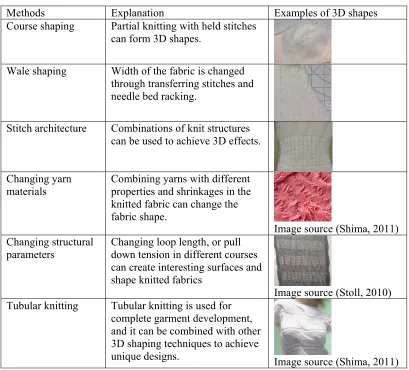
Table 2.1 3D shaped knitted fabric techniques and examples
Course shaping
2.1.3.1
In course shaping, which is also called flèchage or partial knitting, held stitches impart shape during knitting by successively increasing or decreasing the number of working needles. Knitting happens in selected areas, and the remaining stitches are suspended and do not knit. Then, all of the loops rework after a specified number of courses. This causes the wale-wise direction of knitting to change, and the knitted fabric takes on a three-dimensional shape (Ciobanu, Lonesi, & Ciobanu,
Methods Explanation Examples of 3D shapes
Course shaping Partial knitting with held stitches can form 3D shapes.
Wale shaping Width of the fabric is changed through transferring stitches and needle bed racking.
Stitch architecture Combinations of knit structures can be used to achieve 3D effects.
Changing yarn materials
Combining yarns with different properties and shrinkages in the knitted fabric can change the fabric shape.
Image source (Shima, 2011) Changing structural
parameters
Changing loop length, or pull down tension in different courses can create interesting surfaces and shape knitted fabrics
Image source (Stoll, 2010) Tubular knitting Tubular knitting is used for
complete garment development, and it can be combined with other 3D shaping techniques to achieve
(Digital patters: created on Shima Seiki’s SDS-ONE software) (Images of loops: adapted from
Brackenbury, 1992, pp.78)
on the width that is being knitted, course shaping is easy to apply, and it is frequently used to form 3D shapes.
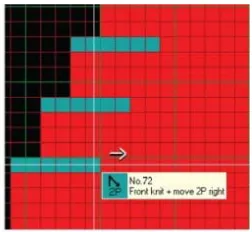
Course shaping is illustrated in Figure 2.1 along with patterns created in Shima Seiki’s CAD knitting program to illustrate each example. In Figure 2.1 (a), the number of knitted loops is reduced in every row. A smooth, unbroken fashioning line is generated and small floats may occur if more than one loop is reduced per course. The pattern in Figure 2.1 (b) shows that the number of knitted loops is reduced in every second course. No floats occur, but the fashioning lines have steps and small holes. To prevent the holes, tuck stitches can be added where steps occur (see the right image in Figure 2.1 (b)).
(a) Number of loops diminishes in every row
(b) Number of loops diminishes every two row Note: Knit stitch Tuck stitch Miss stitch
Course shaping can be used to create a shape similar to that accomplished by sewing a dart in a cut and sewn garment part. As shown in Figure 2.2 (b), the bust dart is created by course shaping with held stitches. The two solid lines in the designed pattern (see Figure 2.2 (a)) are like stitching lines in the bust dart pattern. After knitting, stitches along these two lines form a fashioning line. As discussed previously, in the cut and sew technique, dart angles and dart length define the amount of curve given to the panel. In course shaping, the structure of the shaped area is determined by the number of stitches that are held over the number of courses. The shape of the dart can be predicted theoretically before knitting based on the number of held stitches and fashioning frequencies (Lamar, Powell, & Parrillo-Chapman, 2011). The knitted front panel with a side bust dart in Figure 2.2 (b) is the result of knitting the pattern in Figure 2.2 (a).
(a) Theoretical angle (b) Actual angle
Figure 2.2 Comparison of pattern and knitted sample (Created on Shima Seiki’s software and machine)
with different fashioning lines can develop a wide range of 3D shapes without seams, including domes and curved tubes.
A significant benefit of this technique is versatility, because it can be applied to multiple knitted structures, such as rib or interlock, and it has few special machine requirements. If this technique is applied in small areas, a 3D effect on the surface of the fabric is created to enhance aesthetics of the knitted fabric (Penciuc, Blaga, & Ciobanu, 2010).
Main limitations of course shaping are takedown and knitting tension on held stitches
(Underwood, 2009). As the shaping segment is repeated and the number of held stitches increases, the stress on the held stitches grows, especially on the edge of the shaping area. The stress on stitches may result in damaged stitches or distortion of the shaping segment (Lam & Zhou, 2008). The use of stitch pressers and sinkers might help to keep more uniform physical stress on the needles and avoid the deformation of shaped fabrics (Shima, 2004a). Stitch distortion can also be avoided by using innovative knitting machines with special takedown and stitch control systems. To reduce the potential for damage to yarns and stitches, it is useful to predict the angle and shape of the shaping area before knitting. This prediction can be made based on machines, types of yarn and knitted structures that are used.
Wale shaping
2.1.3.2
Wale shaping is another way to change the number of working needles. Instead of using held stitches as in the course shaping method, the width of knitted fabric is widened or narrowed by transferring stitches left or right to adjacent needles. Prior to innovative V-bed knitting machines, the wale shaping technique was restricted to plain fabric, but now it can be accomplished with more complex structures, such as rib or interlock.
transferring may be outside transferring or inside transferring. In outside transferring, one or more stitches decreases or increases gradually on the edge, and the number of transferred stitches is the same as the number of needle bed racks (see Figure 2.3 (a)). In the case of inside transferring, the number of transferred stitches is larger than the number of needle bed racks (see Figure 2.3 (b)).
(a) 2 stitches outside narrowing (b) 2 stitches inside narrowing Note: Transfer two stitches to the right
Figure 2.3 Designed patterns with outside and inside narrowing stitches (Created on Shima Seiki’s SDS-ONE software)
armhole edge and in the knitted garment panel also influence the shape of the armhole curve (Ruan, 2011).
The angle of the shaping area can be predicted and measured before knitting, because the number of transferred stitches and the fashioning frequency determine the angle of the fashioning line. As Fig. 6 illustrates, if the same number of stitches is transferred with different frequencies, the angle of shaping will vary. The more frequently the stitch narrowing occurs, the bigger the shaping angle is. This can be observed by comparing the differences among the patterns in Figure 2.4 (a) and (b) or (c) and (d). When the fashioning frequency is kept the same, more transferred stitches in the pattern will present a larger shaping angle (see Figure 2.4 (a) and (d), or (b) and (c)). When loop transferring occurs within the width of needles, 3D forms in the fabric are created. This method applied to a tubular structure imparts shaping during knitting. On complete garment knitting machines, the width of the tube can be narrowed or widened to fit the body shape. The effect is similar to the shaping imparted by a vertical dart in the cutting and sewing method. Measurement of the angle is important to impart a proper shape to fit the body. No literature was found in the field of predicting the amount of curve given by the shaping, but commercial products provide new
(a) 3 stitches transferred in every two courses (b) 3 stitches transferred in every four courses (c) 2 stitches transferred in every four courses (d) 2 stitches transferred in every two courses Note: Transfer three stitches to the right
Transfer two stitches to the right
Figure 2.4 Shapes narrowed with different numbers of transferred stitches and fashioning frequencies (Created on Shima Seiki’s SDS-ONE software)
vary slightly depending on different yarn properties and machine limitations (Canzler & Hiemann, 1964).
Stitch architecture
2.1.3.3
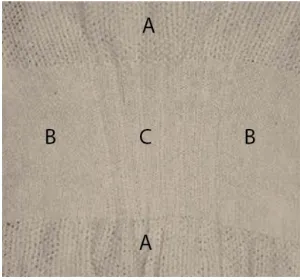
Combining different knitted structures is a simple way to impart shape during knitting. Shapes that are created by combining different structures can be horizontally, vertically, or otherwise imparted to the fabric (Brackenbury, 1992). When two different structures are knitted side by side, wales in the knitted fabric are bent and fabric arcing occurs, as the sample shown in Figure 2.5 In this case, the knitted fabric is not flat, and the degree of arcing is determined by adjoined structures, yarns used, and machine parameter settings (Tou, 2005). To extend Tou’s results, a fabric knitted with three different structures in the course direction could have a 3D shape resulting from arcing on each side. Tou did not examine the impact of juxtaposing side by side different knit structures on the 3D shaping of the knit samples she created. But, this technique could be useful for 3D shaping of garment panels.
Figure 2.5 Effect of arcing with two structures knitted side by side (Created on Shima Seiki’s 124-S flat knitting machine)
shows a fabric knitted with 2×2 cables in the waist area and interlock structures in the ground area. Because the extensibility and relaxed states of these knitted structures are different, the width of the fabric in each part is different even with the same number of stitches in each course. Therefore, combining different knitted structures vertically can build a shape that fits the human body, especially in the waist and bust areas of women’s garments.
Figure 2.6 Stitch shaping with two different structures (Created on Shima Seiki’s SES124-S V-bed knitting machine)
different structures can be applied to shaped-garment designs. If the area of each section is small, these sections may be used to create unique surface pattern designs.
Figure 2.7 Combination of three knitted structures (Created on Shima Seiki’s 124-S flat knitting machine)
Combining different knitted structures is a fast way to create 3D forms. This method is commonly used in sweater cuffs with rib structures to produce a gathered effect to the sleeve. Changing knitted structures in appropriate areas of a knit garment will create a garment shape to fit body curves (Yang & Love, 2009). However, the technique has a limited capability to form diverse shapes (Underwood, 2009), so it is often used with other shaping methods to enhance fabric textures.
The shape of knitted fabrics with combined structures is determined by shrinkage and dimensional changes of each knitted structure (Anand et al., 2002). Many studies have been
conducted to analyze geometrical models of knitted structures and loop formation (Choi & Lo, 2006; Fletcher & Roberts, 1952), and the effects of knit structures on the dimensional properties of knitted fabrics have been explored (Onal & Candan, 2003). But little literature examines dimensional
its adjacent structures, so the final shape of knitted fabrics with combined structures is difficult to measure and control. Yang and Love applied a simple mathematical approach to developing knitwear silhouettes that were directly shaped by changing knitted structures (Yang & Love, 2009). Their research provides a basis to develop new ways of combining knitted structures and helps companies to maintain and enhance their existing styles. Prediction and measurement of the shape created by combining different knitted structures should be investigated in future research.
Changing yarn materials
2.1.3.4
Yarn materials used are critical to shape and fit of knitted garments (Alexander, 2005; Ashdown, 2007). Combining yarns made of different materials leads to varied properties in knitted fabrics, which in turn affects appearance and dimension of the fabric (Ng, Lam, & Park, 2010). Including yarns that shrink with heat and adding a heat-treatment process can produce a range of shrinkage and create fabrics with 3D surfaces (Chapman, 2008). Using yarns with different degrees of shrinkage and heat-treatment is an effective way to create seamless shaped knit fabrics (Anderson, 2004).
This technique is flexible to use along with other shaping techniques, such as changing of stitch structures. Penciuc et al. (2010) created a 3D knitted fabric by knitting full cardigan and single jersey structure with acrylic and elastomeric yarns in different areas. Because cardigan and single jersey, acrylic yarn and elastomeric types of yarn have different extensibilities and degrees of shrinkage, 3D appearance is created in the fabric.
Changing structural parameters
2.1.3.5
Traditionally, changes in stitch length occur from altering the stitch cam position at particular points. Innovative flat knitting machines with electronic control systems can change the loop length in the knitting process (Black, 2002). If a fabric is knitted with two loop lengths, the width of the fabric in the area with a small loop length is less than that with a large loop length (see Figure 2.8). The resulting fabric will have a 3D effect, and changing loop length can also be used for knitted garment shaping.
Figure 2.8 Shaped fabric with two different loop lengths (Source: Stoll, 2010, Pattern No.: 0810211)
Compared to other shaping techniques, changing loop length is not as commonly used to create 3D forms. This technique requires a more complex design process, is more challenging for the machine to knit, and the 3D shape is less apparent. In addition to loop length, take down tension is another factor that affects knitted fabric properties. With higher load on the fabric, extension increases. If the take down tension was changed in different parts of one fabric, the resulting fabric would not be flat.
Tubular knitting
2.1.3.6
circular knitting machines and flat knitting machines. In circular knitting, sizes of tubes are restricted by the machine diameter, and limited structures can be knitted. On the flat knitting machine, the width of tubes can be changed, but structures are limited to simple knitted structures that only use one needle bed. The limitation exists because tubular knitting occurs on two needle beds. The front needle bed knits in one direction, and the back bed knits in the opposite direction. When tubes are knitted with more complex structures, such as ribs or interlock, knitting machines should have multiple beds or systems to control stitches (Hunter, 2004).
Because simple knitted tubes have made few contributions to three-dimensional shaping, tubular knitting is often combined with other shaping techniques, such as course shaping, wale shaping, and changing yarns or knitted structures. In particular, for complete garment design,
combining techniques is very important to producing a 3D knitted garment or creating a 3D surface in the fabric.
Other possible 3D shaping techniques
2.1.3.7
To sum up, wale or course shaping, changing of yarns and structural parameters, combining knitted structures, and tubular knitting are the commonly used and most effective methods in 3D shaped weft knitwear design. In particular, varying the number of needles in action by using held stitches and transferred stitches is an effective technique for creating three-dimensionally shaped weft knitwear. To design dramatic 3D fabrications and invent new shaping techniques, it is crucial to understand the technical constraints of each shaping method and to explore the capabilities of building 3D knitted forms.
3D shaped seamless products are available in areas of fashion, hosiery, upholstery, industrial textiles, and medical textiles (Kanakaraj & Ramachandran, 2010). 3D shaping technology with fully-fashioned and seamless knitting is expected to continue growing and have a wider range of
applications (Gupta, 2011). Therefore, to apply these unique shaping techniques to knit garments, the literature review in this section explored principles and limitations of basic 3D shaping techniques. The distinctive architecture of 3D shaped knitted fabrics can not only be used in the area of technical, industrial, composite and medical textiles, but can also be applied to knitted garment design and textile embellishment. 3D shaping within knitted garment parts that can be accomplished with fully-fashioned and seamless knitting technologies has tremendous potential for knitted garment design. Such garments are comfortable and fit to the body, and the process of shaping eliminates cutting and sewing, which reduces material and labor costs and improves quality of products. Because of these benefits, 3D shaped knit garments have increasing opportunities in the knitting industry and should continue to grow.
(Mowbray, 2004). The lack of research in fundamental knowledge of knitted structures and stitches prohibits development of unique knitwear products. Designers often do not understand the effects of knit stitch variation and knit structure combination and different machinery techniques on fabric dimensions and knit garment shapes, so that they are not able to apply these techniques in fashionable knitwear design.
2.2
New product development in knitwear industry
The development of new products is necessary to maintaining a healthy organization (Urban & Hauser, 1993). Success of new products not only brings profits and revenue to the company, but also enhances its market share and avoids declination of sales (Cooper, 2001). Many researchers have noted that new product development should be the key strategy to achieve business success
(Chapman, Bahill, & Wymore, 1992; Choi, 2006; Ulrich & Eppinger, 1995). New product
development has been widely used in various industries, but it is not consistently developed in the fashion industry, especially the knitwear industry.
In the highly competitive knitwear industry, the short fashion cycle, globalization, rapid changes in customer demands and increased labor costs have directed companies to develop new products. Changes in manufacturing methods and processes provide new possibilities to create high-fashion knitwear (Pitimaneeyakul, LaBat, & DeLong, 2004). However, limited literature has been written about the development process for knit garments. The design cycle of a knit garment is long due to lack of effective information transfer from aesthetic design to technical design (Tsigkas & Chatzopoulos, 2009).
integrated fashion knitwear design and development model. Information gathered from current knitwear design models is used as a reference to establish the integrated model.
2.2.1
Apparel development processes
New Product Development (NPD) is defined as “the set of activities beginning with the perception of market opportunity and ending in the production, sale and delivery of a product” (Ulrich & Eppinger, 1995, p.2). Product development processes have been closely examined in past twenty years. Each product development model has different steps. For example, steps in Urban and Hauser’s NPD model (1993) are defined as opportunity identification, design, testing, introduction and life cycle management. According to Crawford and Benedetto (Crawford & Benedetto, 2003), the development process consists of opportunity identification/selection, concept generation,
concept/project evaluation, development and launch. Although the product development processes as expressed in published models are varied, key functions in the development models still are
marketing, design and manufacturing (Choi, 2006).
distribution (Burns & Bryant, 1997; Lamb & Kallal, 1992; May-Plumlee & Little, 2006). These models offering an overview for textile and apparel design are useful in developing cut and sewn knitwear, but they have not provided an adequate foundation for fully-fashioned and seamless knit garment design. Knitwear design and production include textile design, fashion design and prototype production, and the three parts are collaboratively accomplished by three teams: fashion designers, technical designers and knitting machine operators (Yang & Love, 2008). Therefore, the knitwear design process differs from general apparel design processes. A fundamental understanding of the knitwear design and development process is needed.
2.2.2
Knitwear design models
A successful knitwear design not only depends on excellent garment shapes, but it also relies on unique knitted fabric design and high quality in knitting production. Typically, the knitwear development process involves a collaboration between creative designers who create styles, colors and knitwear specifications, and the knitting machine technicians who is responsible for creating detail design in a CAD system and programming the knitting machines to produce finished garments (Eckert, 1997). The interaction between creative designers and knitting technicians requires a good communication among knitwear development teams. Compared to other industry products, the knitwear industry has a relatively short fashion cycle and faces rapid changes in customer demands. Innovative knitting technologies and other computer and information technologies have also influenced the knitwear product development process.
and sewn knit garments. In order to explore potential research areas in knitwear design and establish an effective design model, current knitwear design processes are reviewed as starting points in the research.
The specific knitwear development models differ from company to company, but the typical development processes targeted to the knitwear industry follow similar steps. Eckert (2006),
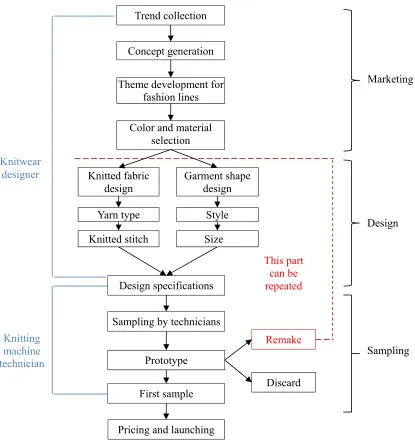
Pitimaneeyakul et al. (2004) and Yang (2010) in their research reviewed and described the typical knitwear development processes in different companies. According to their work, the conventional process is composed of three stages: marketing, design and sampling. Marketing research aims to determine customers’ needs and provide the latest information to designers. New ideas and concepts are developed by designers who gather information from marketing, as well as from new yarns and fashion trends ( Pitimaneeyakul, LaBat, & DeLong, 2004). After the concepts of yarns and structures are defined, designers will work with technicians to put the concepts into action by swatch sampling (Eckert, 2006). Technicians are primarily responsible for accessing to the CAD system and operating knitting machines (Eckert, 2001). If a prototype is knitted successfully, the design will be sent to production. If not, the design is taken back to remake and is later evaluated, or the design will be discarded. A typical knitwear design process is illustrated in Figure 2.9.
company. In others, creative design from idea generation to knitwear specification creation is separated from knitwear production. The two procedures are finished in two different companies.
Figure 2.9 Conventional knitwear development process (Adapted from Yang & Love, 2008) Trend collection
Concept generation
Theme development for fashion lines
Color and material selection
Knitted fabric design
Garment shape design
Design specifications Yarn type
Knitted stitch
Style Size
Sampling by technicians
Prototype
First sample
Remake
Discard
Pricing and launching
This part can be repeated
Knitwear designer
Knitting machine technician
Marketing
Design
In the conventional knitwear development process, aesthetic design and technical design and production are separated and undertaken by different persons. Knitwear designers are in charge of selecting color, material, shape and creating design specifications. Technicians take over pattern development in the CAD system and prototype production. However, aesthetic and technical design in knitwear cannot be completely separated because the knit garment shape and knitted fabric design interact with each other (Eckert & Demaid, 1997). In the process shown in Figure 2.9, evaluation is only completed after prototype production, where the design and production are almost defined and finished. Rework and discard in this stage not only increases yarn waste and design time, but also increase risks in the design process. For example, from the company’s perspective, failure to complete design and production results in losing customers and decreasing profits.
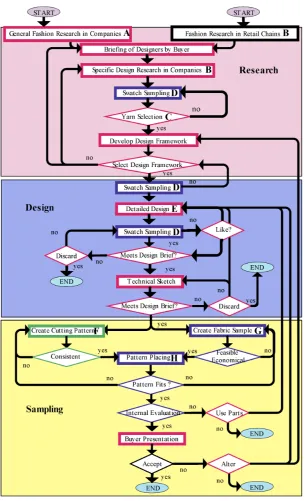
Figure 2.10 Knitwear design process with evaluation and modification (Eckert, 2006, pp.685)
was developed based on Urban and Eppinger’s New Product Development model (Urban & Eppinger, 1995). As shown in Figure 2.11, this process includes five steps from marketing research, designing if with cost estimation, presenting CAD printouts to customer, sample making to production line. Marketing research in Pitimaneeyakul et al.’s model emphasizes the importance of end user’s needs. Usually, companies collect product information from retailers or buyers at department stores and retail stores, not end users, but failure in conducting end user research results in unmarketable products that customers won’t purchase. Voice of the customer is a very important part of marketing research. Further, researchers clarified the importance of pre-costing by designers in the development process. Along with creating design sketches and making samples, designers are asked to do pre-costing to know whether the price of a design is out of range. If not, the design can not be send to next step; if the price is too high, designers can discontinue the process, saving design time and reducing waste in sampling. Additionally, Pitimaneeyakul suggested an amplified use of CAD systems and technology in knitwear design. CAD systems can easily and quickly present what
designers have in mind. Presentation of a designer’s idea helps technicians create technical design and also benefits customers in selecting preferred designs.
Configuration of the development process can be illustrated in various methods, such as linear, circular and branching. The knitwear development processes presented previously are all viewed in a linear format. However, the textile design process often includes forth and back
movements and parallel actions, not only linear stages. As Chapman (2008, p.184) stated in her PhD’s thesis “the engineered design process for textile placement reflects the definition of an engineered design in that it is an iterative process that starts with set criteria that guide the design and
manufacturing parameters from the beginning until the end of the product development cycle”, the liner model without constraints and iterative actions cannot contain all criterion and requirement needed between and within each stage of design.
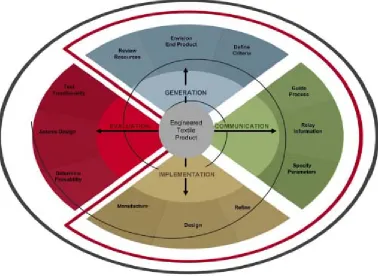
According to Boehm’s spiral model, Chapman (2008) developed a theoretical model of engineered design process for placing fabrication properties within the shape of a product. Seamless knitting as an advanced technology in shaping is supportive of engineered designing. An integration process for textile placements was defined in Chapman’s research. The model was segmented into four design phases: generation, communication, implementation, and evaluation. These phases are then divided into several activities that occur in each phase. The macro view of the integrated design process provides a comprehensive overview of the entire process and illustrates the complex
interaction among the main components in the process.
Figure 2.12 Process model for engineering textile design properties within the shape of a product (Chapman, 2008, pp.185)
Generally, the models shown previously can be used for different knitwear types, such as cut and sewn knitwear, fully-fashioned and seamless knitwear. However, because the knit garment shape is formed on the machine, the design and production processes for fully-fashioned and seamless knitwear are more complex and time-consuming than cut and sew. A specific development model for fully-fashioned and seamless knitting should be developed to enhance design efficiency and
knitwear design model based on the seamless knitwear development process in a Japanese company, Shima Seiki (see Table 2.2)
Table 2.2 Conventional computerized seamless knitwear development process (Source: Yang, 2008; Shima Seiki, 2008)
Process Sub-process
Undertaken by
knitwear designers
Identify the design concept
Investigate fashion and consumer trends Identify themes for fashion lines
Select colors
Decide fabric texture and garment shape Create stitch pattern
Create garment style Specify design details
Complete design specification sheet Undertaken
by knitting machine technicians
Make texture sample (test piece) Draw the test piece in CAD system Create data for machine operation Knit texture samples
Create garment dimensions in CAD system
Crate the garment outline in CAD system
Input stitch density and convert into number of stitches
Create garment pattern in CAD system Manually drawing or auto-drawing Create data for machine with auto-process
Carry the data to machine using portable device
Knit, check products and complete 1st
sample
Garment quality check Washing/steaming Size check
Silhouette check on the body
Production, knitting and shipping Plan production: in-house, interstate, or overseas
Production check, product confirmation & order
The presented seamless knitwear process is still undertaken by two persons: knitwear designers and knitting machine technicians. Seamless knitwear design is more complicated than apparel design with a cut fabric procedure, because knitted fabrics are designed and produed along with knitwear construction. Designers must have sufficient knowledge in knitting to create accurate and feasible design specifications for technicians. Another problem is the technician’s inappropriate interpretation of the designer’s idea. Different cultures and backgrounds underlying different roles block communication in the development process. As explained previously, the two activities in knitwear design cannot be separated. Therefore, a critical need exists for collaboration between knitwear designers and machine technicians. Yang (2008) mentioned an alternative for overcoming the communication block in high-fashion knitwear design is to incorporate the roles of aesthetic designers, knitting technicians and machine operators. In Yang’s research, she identified a workflow system for knitwear designers to take over roles of knitting machine technicians for 1st sample
production (see Figure 2.13). This is the only available model established specifically for seamless knitwear in published academic literature.The workflow enables one person to undertake roles of the designer and the technician, eliminating blocking in communicaiton. Adjustment or improvement of the design is relatively easy due to avoiding the need to explain the idea to others. In this model, procedures from marketing, to design to sampling could be done within one company, which means there is no need to employ technicians or to complete sample making and evaluation with other companies domestic or overseas. This will definitely reduce the time to market, save costs and improve efficiency.
processes to not occur only a linear format. In Yang’s model, the process is exhibited in a sequental process from one stage to the other. Connection and interaction among different stages is not illustrated. Further, this model does not show the detailed evaluation and knowledge needed in the process. Seamless knitting continues to receive attention in the knitwear industry, but lack of
knowledge building in seamless knitwear design and inadequate understanding of the design process impede seamless knit garment development.
Other knitwear development processes targeted to fully-fashioned or seamless knitting are available in mass customization. The development process of custom knitwear is different from the common knitwear development process. Companies in the knitwear industry and some researchers have explored customization in garment knitting, and they conducted different on-demand models. The design processes in these on-demand models involve the concept of allowing one person to complete the procedures from aesthetic design, pattern making in CAD systems, to prototype knitting on the machine. Review of these mass customization processes is used to explore potential methods to enhance communication and improve efficiency. Challenges relevant to the on-demand models are discussed.
In 2005, one of the leading Japanese knitting machine manufacturers, Shima Seiki, opened the first Factory Boutique Shima in Wakayama, Japan (Shima, 2005). After three years, the company added the second boutique in the same city. Shima Seiki’s boutique stores have described a business concept of “on-demand” production that combines advanced knitting technology and mass
customization on the retail level (Peterson et al., 2011).
This process presented in Factory Boutique Shima is an application of the concept of
Figure 2.14 Concepts and steps in Factory Boutique Shima (Adapted from Peterson et al., 2011)
Another shop and production concept for knit garment customization called
“Knit-on-Demand” was presented in a research project at the Swedish School of Textiles (Larsson, Mouwitz, & Peterson, 2009). This “Knit-on-Demand” model allowed customers to take an active part in the design process and to adapt available knit garment designs based on their requirements. The new concept of knitwear production enhances the ability of fashion knitwear industry to meet customer demands for fast fashion and addresses the problem of obsolete inventory, as all the knit garments are produced when orders are placed (Larsson, 2009). Similar to Shima Seiki’s Factory Boutique, the “knit-on-demand” business model offers customers a special shopping experience that they can design their knitwear with designers. The customized knit garment is based on a pre-designed base style and
Customer enters store
Customer browses through catalogues and examines merchandise
Technical design of custom garments
Order placed and purchased pre-paid
Manufacturing of customized item
Delivery of finished garment
Selection of style Choice of material Neck type and sleeve length
Size (input of body measurements)
Choice of color
Attachments
Customization completed
adjusted to personal size and design preferences (Larsson, 2009; Markwordt, 2010; Peterson & Ekwall, 2007). Figure 2.15 shows the process of Knit-on-Demand, and information regarding each step is presented in the following paragraphs (Peterson & Larsson, 2007):
Figure 2.15 “Knit-on-Demand” process (Adapted from Peterson & Larsson, 2007)
The first step in the knit-on-demand process is to select a standard base style for the garment. After taking customers' measurements, designers work with customers to adjust the selected style from standard size to personalized fit. The “knit-on-demand” model has adopted a multiple-choice system, which allows customers to choose between alternatives styles, materials, colors, structures and details. As shown in Figure 2.16, customers have six basic knitted sweater styles to choose along with 16 different colors, buttonholes, stripes and contrasting fabrics. When the customer has finalized the design decisions, the designer assists in finishing the pattern and sending the order to production. In the “knit-on-demand” model, customers can choose not to buy the garment before actual
manufacturing. After the payment is received, the order is transmitted to manufacturing. Time from order to delivery is often within two weeks.
Selet standard base style for garment
Aquire customer measurements
Design based on alternative
choices
Generate order
Produce custom
Figure 2.16 Design options in the “knit-on-demand” process (Adapted from Larsson, 2009)
As shown in Figure 2.16, customers can easily select different options and create their customized knit garments. In fact, use of a multiple-choice system is not restricted to mass customization, it will also benefit design processes of mass produced garments. In the process of mass produced knit garments, a multiple-choice system involving diverse options of garment styles, colors, yarns and knit stitch patterns allows designers to combine different choices and create new designs that can be translated into CAD patterns and machine data in a computerized system. In mass production, this will avoid misrepresenting the designer’s idea, enhancing communication between designers and technicians, and improving efficiency.
Implementation of a multiple-choice system implies that companies need to identify and develop an appropriate range of basic knitwear styles, yarns, and structure patterns. The first step is to examine their target market to learn about their customers in terms of shopping behavior and
preferences. After that, companies need to establish a database or system of choices including garment styles, yarn types and knitted samples with different structures. This process consumes a lot
Customer Base style V-neck Deep V-neck Cardigan Round neck Slipover Turtle neck Size/fit Standard size:
XS-XXL ± adjusted measures Adjustments:
Arm length Body length Width of shoulders
Color
Body: 16 colors Sleeves 16 colors Patterns: 16 colors
Details Neck plate Accessory Options with multiple choices in
of time and labor and material costs, because companies have to test different yarns and knit abundant samples to build enough knowledge to offer viable options. One potential benefit in building the multiple-choice system is that collecting preferences and requirements of the target market, and building a data base of style, yarn, and knit structure information yields results that can be used to develop mass produced items.
Table 2.3 is a comparison of various features of the knitwear development processes that were reviewed. These features include what roles were involved in the model, the level of collaboration between designers and technicians, whether or not evaluation is completed in every stage, whether or not the functions and knowledge needed in each stage were identified, and the applicability for knitwear categories.
Table 2.3 Comparison of different knitwear development models
Source and Figure number Model and characteristics Roles involved Level of collaboration
Evaluation Knowledge building Application Yang & Love, 2008 Figure 2.9 Conventional knitwear development Designer Technician Low After prototype production
No All types of
knit garments
Eckert, 2006 Figure 2.10
Systematic model for knit products
Designer Technician
Moderate Every stage Little All types of knit garments
Pitimaneey -akul et al., 2004 Figure 2.11
A knitwear development process involved end users and computer software
Customer Designer Technician
Moderate In few
stages
No All types of
knit garments
Chapman, 2008 Figure 2.12
Engineered design model for textiles
Designer Technician
High Every stage Some Engineered
knit garments Yang, 2010 Table 2.2 Conventional knitwear development Designer Technician Moderate After prototype production
Table 2.3 Continued Yang, 2010 Figure 2.13 Workflow for high-fashion knitwear development
Designer High due to undertaking by one person After prototype production
Little
Fully-fashioned and seamless knitwear Peterson et al., 2011 Figure 2.14 Factory Boutique Shima allows for knitwear in-store shopping Customer Designer Technician High between customer and designers Every step in co-design
No Custom knit
garments
Larsson et al., 2009 Figure 2.15
Knit-on-demand model with a multiple-choice system
Customer Designer
High Every step
in co-design
No Custom
fully-fashioned and seamless knitwear
Comparison of these characteristics reveals issues and problems relevant to knitwear product development. Communication between designers and technicians is the biggest challenge in current development models. Although some researchers have employed computer technology to overcome the communication bottleneck (Eckert, 2001), lack of fundamental knitting knowledge by designers and inadequate understanding of knitwear design hinder the collaboration of designers and
technicians. The integrated workflow for high-fashion knitwear established by Yang in her Ph.D. research allows one person to undertake all the roles in the design and production process, avoiding involvement of technicians. This workflow has proposed a new strategy to improve efficiency in knitwear design, but it does not show detailed functions in each stage. Without sufficient
integrated system that incorporates all aspects of knit garment design and manufacturing should be further explored.
Another issue in the knitwear development process is that little evaluation has been focused on assessing the accuracy and feasibility of every selection, such as yarn, knitted structure, stitch pattern design and garment shape selection. A formal evaluation process is only taken after prototype production in most knitwear development models. If the prototype fails to pass the evaluation, it needs to be redesigned from the beginning, resulting in long development delays and poor yields of creating successful products.
Additionally, the multiple-choice system in the on-demand development models allows for automatic generation of knit garment patterns from selected options. This multiple-choice system can be used as an effective tool in co-design of custom knitwear; it can be also applied in conventional knitwear design to improve communication between designers and technicians. Challenges in implementing the multiple-choice system are to build the database including various choices and to update it consistently with fashion trends. Cost to build and update such a system is quite large, because companies must spend a lot on market research and CAD/CAM programming. Market research aims to learn about customers’ demands. CAD/CAM programming is used to store the digitalized patterns with different choice combinations. This is an enormous project and requires the extensive involvement of many designers and programmers.