Volume 5, Issue 11, November 2016
Optimization of Wire Cut EDM Process Parameters For Surface
Roughness And Kerf Width Using Response Surface Methodology
B. Vamsidhar Reddy1, Dr. CNV Sridhar2, P. Vinay Kumar Reddy3
1 Adhoc Leturer, Department of Mechanical Engineering. JNTUACE, Pulivendula (Autonomous), 2Professor and HOD, Department of Mechanical Engineering, MREC(Autonomous), Hyderabad.
3
Mechanical Department, JNTUCEP College OF Engineering Pulivendula (Autonomous), India, 516390.
Abstract -- Machining of Composite materials like Al 7075-SiC
metal matrix composites has found its use extensively in Air craft fittings, gears, shafts, missile parts, regulating valve parts, keys and bike frames to enhance high strength, corrosion resistance and thermal resistance characteristics. And also there is a need to improve high material removal rate, better surface finish and good dimensional accuracy. Conventional machining is not able to satisfy these demands. Wire electro discharge machining plays a major role in machining of conductive materials with intricate shapes and complex geometries where a thin metallic wire of 0.1-0.3mm diameter is used as a tool electrode. Al 7075-SiC metal matrix composites are prepared by using sand casting though manual stirring.
The objective is to identify the best parametric combination of Wire EDM to minimize surface roughness and kerf width for Al 7075-10% SiC and Al 7075-15% SiC. For this experimentation Pulse on time(TON), pulse off time(TOFF), peak current(IP) and Spark gap Voltage are the most affecting input parameters to perform experiments on Wire Cut Electro Discharge Machine(ELPULSE 40A). In the present work 34 experimental runs are designed based on the Box-Behnken Design of Response Surface Methodology. ANOVA (Analysis of Variance) is used to get the effect of process parameters on process response. A second order polynomial model has been developed to correlate the process responses and the machining parameters by using
Response Surface Method (RSM).
Key words: Wire electro discharge machining, Response
Surface Method,ANOVA.
I INTRODUCTION
Wire Cut Electro Discharge Machining is an unconventional Electro Thermal machining process which is working based on the principle of repetitive sparking cycles. Due to generation of heat melting and evaporation of both wire and work piece takes place. Gap between wire and work piece is in range of 0.025-0.5mm which is maintained constant by computer controlled positioning system. The gap between wire and work piece is covered with steam of dielectric fluid which is directed to the working zone by the nozzles present at the upper and lower diamond guides. The dielectric can control sparking, cools the process and flushes away the tiny particles very faster. The wire and work piece is mounted on CNC work table. Wire is fed through work piece by a microprocessor to enable machining.
Figure1 Wire cut Electro Discharge Machine The wire EDM can cut almost all the metals including aluminium, copper, carbide, graphite, steel and titanium. Depending upon the hardness of work piece wire metal changes. With the advent of WEDM process a path provided by CNC is used to machine hard metals through inaccessible locations with the use of electrical sparks exist between tool and work piece. Al most all the areas like aerospace, semiconductor, tool and die making industries are now a days using Wire cut EDM process.
With the increase in demand for high hard, light weight and temperature resistant materials in aerospace, automobile and missile applications quality of a product has became a major concern. And also minimizing of material wastage during machining is important. Wire cut Electro Discharge Machining is the best choice to achieve all these requirements. The present study deals with identification of the best parametric combination of a Wire cut EDM process parameters to achieve minimum surface roughness and kerf width. By using ANOVA the effect of process parameters on process responses has been found.
II EXPERIMENTAL DETAILS 2.1Response Surface Methodology:
Response Surface Methodology is a collection of mathematical and statistical techniques useful for modeling and analysis of a problem in where the responses of interest is influenced by several variables and objective is to optimize this response. An optimal response can be obtained by choosing a proper choice of design and operating conditions on a set of controllable variables. Here output is influenced by the number of input factors. In this method the main goal is, to reduce the expensive analysis cost and optimize the output responses that are influenced by various input parameters. For the visualization of the
Volume 5, Issue 11, November 2016 response, contour and surface plots are used. It gives the
relation between the control factors and output responses. Contour plots are used to visualize the shape of response surface.
Suppose ‘x1' and ‘x2’ are the input parameters that are affecting the response ‘y’ can be expressed as follows: y=f(x1,x2)+Ɛ(a)
where Ɛ is the noise or error observed in response ‘y’ Let E(y) = f(x1,x2) = η (b)
The above experiment is the expected response which is known as response surface with levels of ‘x1’ and ‘x2’. RSM comprises the following steps
Prepare a set of trials for sufficient and consistent extent of the output.
Progress an empirical model of the 2nd order response surface with the suitable sets. Identify the efficient set of trial variables that
gives a maximum and minimum response values. Characterize the direct and the collaborative
effects of variables through 2D and 3D graphs. 2.2 Design of Experiments- Box Behnken Design:
Box Behnken Design is a creative approach to planned experimentation involving relatively smaller number of runs. It involves balance incomplete block design which is important alternative to Central Composite Design. In this design all the design points are equidistant from canter design point. The advantages of Box-Behnken designs includes they are all spherical designs and require factors to be run at only three levels. The designs are also rotatable or nearly rotatable. Some of these designs also provide orthogonal blocking. Thus, if there is a need to separate runs into blocks for the Box-Behnken design, then designs are available that allow blocks to be used in such a way that the estimation of the regression parameters for the factor effects are not affected by the blocks. In other words, in these designs the block effects are orthogonal to the other factor effects. Yet another advantage of these designs is that there are no runs where all factors are at either the +1 or -1 levels. This could be advantageous when the corner points represent runs that are expensive or inconvenient because they lie at the end of the range of the factor levels.
Table 1 Process parameters and their limits Process Parameters Units Level 1 Level 2 Level 3 Pulse on time (A) Micro sec 100 105 110 Pulseoff time(B) Micro sec 59 60 61 Peak Current(C) Amphere 180 190 200 Sparkgap
Voltage(D)
Volts 10 15 20
Table 2 Box-Behnken Design S.No. Pulse on time (µs) Pulse off time (µs) Peak current (Amp) Spark gap voltage (Volts) 1 105 61 200 15 2 105 59 190 10 3 110 61 190 15 4 105 59 190 20 5 105 60 200 20 6 110 60 190 20 7 105 60 200 10 8 110 60 190 10 9 105 60 180 20 10 100 61 190 15 11 105 59 180 15 12 100 59 190 15 13 100 60 200 15 14 105 60 180 10 15 100 60 190 10 16 110 60 200 15 17 105 61 190 20 18 105 60 190 15 19 105 60 190 15 20 100 60 180 15 21 110 59 190 15 22 105 60 190 15 23 105 61 180 15 24 100 60 190 20 25 105 61 190 10 26 110 60 180 15 27 105 59 200 15 2.3 Selection of Material:
Al 7075- SiC Metal Matrix Composites with varying composition of 10% and 15% Silicon Carbide are used for the experimentation. This material can be prepared by using sand casting through manual stirring. At first Al 7075 alloy is heated above melting temperature that is 650OC. And then Silicon Carbide particle of size 50 microns is added into the matrix alloy according to the proportion. This combination has to be stirred for some time and then poured into the previously prepared sand mould.
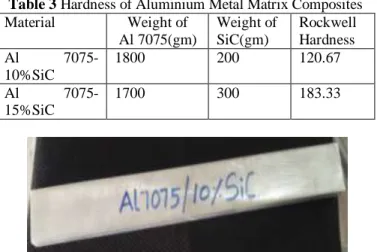
Table 3 Hardness of Aluminium Metal Matrix Composites Material Weight of Al 7075(gm) Weight of SiC(gm) Rockwell Hardness Al 7075- 10%SiC 1800 200 120.67 Al 7075- 15%SiC 1700 300 183.33
Volume 5, Issue 11, November 2016
Figure 2 Al 7075-SiC(10% and15%) after casting III EXPERIMENTAL RESULTS
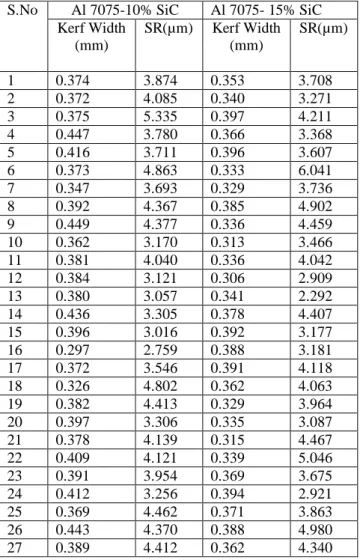
The experiments are performed based on the order of Box-Behnken Design and responses characteristics like Surface Roughness and Kerf Width have been observed by using Talysurf and Tool makers’ microscope are tabulated.
Table 4Experimental results
3.2 Analysis Of Variance And Regression Equations Table 5 ANOVA Table for Kerf Width of Al 7075-10%SiC
Source Sum of Squares df Mean Square F-Value p-value Prob > F Model 0.11 14 0.0079 19.67 <0.0001 A-A 0.0008 1 0.0080 2.00 0.173 B-B 0.0011 1 0.0011 2.88 0.106 C-C 0.0093 1 0.0093 23.14 0.001 D-D 0.0024 1 0.0024 5.98 0.024 AB 0.0012 1 0.0012 0.30 0.588 AC 0.0059 1 0.0059 14.77 0.001 AD 0.00037 1 0.0003 0.93 0.347 BC 0.0002 1 0.0002 0.50 0.489 BD 0.0014 1 0.0012 3.59 0.0734 CD 0.0010 1 0.0010 2.69 0.1174 A2 0.015 1 0.015 36.71 0.0001 B2 0.017 1 0.017 40.81 0.0001 C2 0.026 1 0.026 64.74 0.0001 D2 0.039 1 0.039 96.34 0.0001 Total 0.12 26
Regression Equation for Kerf Width:
KW=143.12942-0.21847*Ton-4.12600*Toff-0.084458*Ip+0.13222*SV+0.00095*Ton*Toff-0.00064
*Ton*Ip-0.00034*Ton*SV-0.00062*Toff*Ip-0.0036*Toff*SV+0.00028*Ip*SV+0.0013*Ton2+0.034917 *Toff2 +4.81667E-004* Ip2+2.33167E-003*SV2.
Table 6 ANOVA Table for SR of Al 7075-10%SiC
Source Sum of Squares df Mean Square F-Value p-value Prob > F Model 13.16 14 0.94 6.19 0.0002 A-A 2.01 1 2.01 13.21 0.0018 B-B 0.13 1 0.13 0.84 0.3714 C-C 0.28 1 0.28 1.87 0.1875 D-D 0.031 1 0.031 0.20 0.6592 AB 0.18 1 0.18 1.20 0.2875 AC 0.46 1 0.46 3.05 0.0967 AD 0.016 1 0.016 0.11 0.7462 BC 0.051 1 0.051 0.34 0.5688 BD 0.093 1 0.093 0.61 0.4428 CD 0.28 1 0.28 1.83 0.1922 A2 5.37 1 5.37 35.34 < 0.0001 B2 1.48 1 1.48 9.77 0.0056 C2 2.52 1 2.52 16.58 0.0007 D2 1.06 1 1.06 6.97 0.0161 Total 16.05 26
Regression Equation for Surface Roughness: SR= -2719.20818+10.89089*Ton+59.51850*Toff+ 3.62392*Ip+3.01951*SV-0.042650*Ton*Toff-0.0068*Ton* Ip+0.0025*Ton*SV-0.011300*Toff*Ip-0.030550*Toff*SV-0.0052*Ip*SV-0.033308*Ton2-0.43782 *Toff2-0.0057*Ip2-0.014798* SV2
Table 7 ANOVA Table for Kerf Width of Al 7075-15%SiC Source Sum of Squares df Mean Square F-Value p-value Prob > F Model 0.034 14 0.0024 5.56 0.0004 A-A 0.0013 1 0.0013 3.00 0.0995 B-B 0.0023 1 0.0023 5.48 0.0303 C-C 0.0000 1 0.0000 0.14 0.7125 D-D 0.0003 1 0.0000 0.085 0.7742 S.No Al 7075-10% SiC Al 7075- 15% SiC
Kerf Width (mm) SR(µm) Kerf Width (mm) SR(µm) 1 0.374 3.874 0.353 3.708 2 0.372 4.085 0.340 3.271 3 0.375 5.335 0.397 4.211 4 0.447 3.780 0.366 3.368 5 0.416 3.711 0.396 3.607 6 0.373 4.863 0.333 6.041 7 0.347 3.693 0.329 3.736 8 0.392 4.367 0.385 4.902 9 0.449 4.377 0.336 4.459 10 0.362 3.170 0.313 3.466 11 0.381 4.040 0.336 4.042 12 0.384 3.121 0.306 2.909 13 0.380 3.057 0.341 2.292 14 0.436 3.305 0.378 4.407 15 0.396 3.016 0.392 3.177 16 0.297 2.759 0.388 3.181 17 0.372 3.546 0.391 4.118 18 0.326 4.802 0.362 4.063 19 0.382 4.413 0.329 3.964 20 0.397 3.306 0.335 3.087 21 0.378 4.139 0.315 4.467 22 0.409 4.121 0.339 5.046 23 0.391 3.954 0.369 3.675 24 0.412 3.256 0.394 2.921 25 0.369 4.462 0.371 3.863 26 0.443 4.370 0.388 4.980 27 0.389 4.412 0.362 4.340
Volume 5, Issue 11, November 2016 AB 0.0014 1 0.0014 3.24 0.0878 AC 0.0000 1 0.0000 0.021 0.8870 AD 0.0000 1 0.0007 1.68 0.2105 BC 0.0008 1 0.0004 1.02 0.3262 BD 0.0000 1 0.0000 0.021 0.8870 CD 0.0029 1 0.0029 6.84 0.0170 A2 0.0050 1 0.0050 11.56 0.0030 B2 0.0022 1 0.0022 5.13 0.0354 C2 0.0062 1 0.0062 14.44 0.0012 D2 0.013 1 0.013 29.92 0.0001 Total 0.042 26
Regression Equation for Kerf Width:
KW=93.59971-0.42297* Ton-2.21067* Toff-0.049942* 0.07765* SV+0.0037* Ton * Toff-0.00003* Ton* Ip-0.0005*Ton*SV-0.001*Toff*Ip-0.0003*Toff*SV
+0.0004*Ip*SV +0.001*Ton2 +0.016958*Toff2 +2.84583E-004* Ip2+0.0016* SV2.
Table 8 ANOVA Table for SR of Al 7075-15%SiC Source Sum of Squares df Mean Square F-Value p-value Prob > F Model 25.14 14 1.80 7.69 0.0001 A-A 12.71 1 12.71 54.44 0.0001 B-B 0.036 1 0.036 0.15 0.7003 C-C 0.17 1 0.17 0.71 0.4103 D-D 0.52 1 0.52 2.22 0.1526 AB 0.17 1 0.17 0.71 0.4100 AC 0.0018 1 0.001 0.008 0.9292 AD 1.03 1 1.03 4.40 0.0496 BC 0.0030 1 0.003 0.013 0.9106 BD 0.18 1 0.18 0.77 0.3922 CD 0.19 1 0.19 0.81 0.3781 A2 1.91 1 1.91 8.20 0.0100 B2 1.00 1 1.00 4.30 0.0519 C2 4.04 1 4.04 17.29 0.0005 D2 4.08 1 4.08 17.47 0.0005 Total 29.58 26
Regression Equation for Surface Roughness:
SR= 1541.50563-1.91423*Ton-39.009*Toff-2.57093*Ip-4.66618*SV-0.0407*Ton*Toff+0.00043*Ton*SV
+0.020260*Ton*SV-0.0027*Toff*Ip+0.0423*Toff*SV-0.0043*Ip*SV+0.01988*Ton2+0.3602 Toff2+0.0072*Ip2 +0.029028*SV2
3.2. 3D SURFACE PLOTS FOR PROCESS RESPONSES Vs PROCESS VARIABLES
Figure 3 Surface graphs for interaction effect on Kerf Width for Al 7075-10% SiC
Figure 4 surface graphs for interaction effect on Surface Roughness for Al 7075-10% SiC
Figure 5 Surface graph for interaction effect on Kerf Width for Al 7075-15% SiC
Figure 6 Surface graph for interaction effect on Surface Roughness for Al 7075-15% SiC
IV CONCLUSION
The important conclusions with the machining of Al 7075 -10% SiC and Al 7075 -15% SiC on Wire cut EDM using Response Surface Methodology includes as follows:
The optimal set of process parameters are identified for achieving minimum Surface Roughness and minimum Kerf width for each material.
Second order polynomial equation have been generated for both Surface Roughness and Kerf width.
Design-Expert® Sof tware Factor Coding: Actual KW (mm)
Design points abov e predicted v alue
Design points below predicted v alue 0.449 0.297 X1 = A: Ton X2 = B: Tof f Actual Factors C: Ip = 190 D: SV = 15 59 59.5 60 60.5 61 100 102 104 106 108 110 0.25 0.3 0.35 0.4 0.45 K W ( m m )
A: Ton (micro sec) B: Toff (micro sec)
Design-Expert® Sof tware Factor Coding: Actual KW (mm)
Design points abov e predicted v alue
Design points below predicted v alue 0.449 0.297 X1 = A: Ton X2 = C: Ip Actual Factors B: Tof f = 60 D: SV = 15 180 185 190 195 200 100 102 104 106 108 110 0.25 0.3 0.35 0.4 0.45 K W ( m m )
A: Ton (micro sec) C: Ip (Amp)
Design-Expert® Software Factor Coding: Actual SR (microns)
Design points above predicted value
Design points below predicted value 4.991 2.759 X1 = A: Ton X2 = B: Toff Actual Factors C: Ip = 190 D: SV = 15 59 59.5 60 60.5 61 100 102 104 106 108 110 2.5 3 3.5 4 4.5 5 S R ( m ic ro n s )
A: Ton (micro sec) B: Toff (micro sec)
Design-Expert® Software Factor Coding: Actual SR (microns)
Design points above predicted value
Design points below predicted value 4.991 2.759 X1 = A: Ton X2 = C: Ip Actual Factors B: Toff = 60 D: SV = 15 180 185 190 195 200 100 102 104 106 108 110 2.5 3 3.5 4 4.5 5 S R ( m ic ro n s )
A: Ton (micro sec) C: Ip (Amp)
Design-Expert® Software Factor Coding: Actual KW (mm)
Design points above predicted value
Design points below predicted value 0.397 0.303 X1 = A: Ton X2 = B: Toff Actual Factors C: Ip = 190 D: SV = 15 59 59.5 60 60.5 61 100 102 104 106 108 110 0.28 0.3 0.32 0.34 0.36 0.38 0.4 K W ( m m)
A: Ton (micro sec) B: Toff (micro sec)
Design-Expert® Software Factor Coding: Actual KW (mm)
Design points above predicted value
Design points below predicted value 0.397 0.303 X1 = A: Ton X2 = C: Ip Actual Factors B: Toff = 60 D: SV = 15 180 185 190 195 200 100 102 104 106 108 110 0.28 0.3 0.32 0.34 0.36 0.38 0.4 K W ( m m)
A: Ton (micro sec) C: Ip (Amp)
Design-Expert® Software Factor Coding: Actual SR (microns)
Design points above predicted value
Design points below predicted value 6.79 3.027 X1 = A: Ton X2 = B: Ton Actual Factors C: Ip = 190 D: SV = 15 59 59.5 60 60.5 61 100 102 104 106 108 110 2 3 4 5 6 7 S R ( m ic ro n s )
A: Ton (micro sec) B: Ton (micro sec)
Design-Expert® Software Factor Coding: Actual SR (microns)
Design points above predicted value
Design points below predicted value 6.79 3.027 X1 = A: Ton X2 = C: Ip Actual Factors B: Ton = 60 D: SV = 15 180 185 190 195 200 100 102 104 106 108 110 2 3 4 5 6 7 S R ( m ic ro n s )
A: Ton (micro sec) C: Ip (Amp)
Volume 5, Issue 11, November 2016 ANOVA results to identify the effect of process
parameters on process responses and percentage contribution of each parameter on process response
Al 7075-10% SiC:
The optimal parameter setting for achieving minimum Kerf Width is obtained at 110μ sec of pulse on time and 60μ sec of pulse off time 200 Amp of peak current and 15Volts of Spark gap voltage i.e 0.297 mm.
The optimal parameter setting for achieving minimum Surface Roughness is obtained at 110μ sec of pulse on time and 60 μ sec of pulse off time 200 Amp of peak current and 15Volts of Spark gap voltage i.e 2.759 microns.
Al 7075-15% SiC:
The optimal parameter setting for achieving minimum Kerf Width is obtained at 100 μ sec of pulse on time and 59 μ sec of pulse off time 190 Amp of peak current and 15Volts of Spark gap voltage i.e 0.306mm
The optimal parameter setting for achieving minimum Surface Roughness is obtained at 100 μ sec of pulse on time and 60 μ sec of pulse off time 200 Amp of peak current and 15 Volts of Spark gap voltage i.e 2.292 microns.
V REFERENCES
1.Suresh Kumar.S, Uthayakumar.M, Thirumalai Kumaran.S, Parameswaran.P, Mohandas.E, Kempulraj.G, Ramesh Babu.B.S and Nataraan.S.A, 2015,‟ Parametric
optimization of wire electrical discharge machining on aluminium alloy based composites through gray relational analysis” Journal of Manufacturing Process, Vol.20, PP.33-39.
2.Ganesdh Dongre, Sagar Zawari, Uday Dabade and Suhas Jose.S, 2015, ‟Multi-objective optimization for Silicon
wafer slicing usig Wire- EDM Process” Journa.l of Material Science in Semiconductor processing, Vol.39, PP.793-806.
3. Amitesh Goswami and Jatinder Kumar, 2014
‟Investigation of surface integrity, material removal rate and wire wear ratio for WEDM of Nimonic 80A alloy using GRA and Taguchi method” Engineering Science and Technology, an International Journal, Vol.17 PP.173-184
4. Ravindranadh Bobbili, Madhu.V and Gogia A.K., 2015‟
Multi response optimization of wire-EDM process parameters of ballistic grade aluminium alloy” Engineering Science and Technology, an International Journal, Vol.18, PP. 720-726.
5.PujariSrinivasaRao, Koona Ramji and Beela Sathyanaranaya, 2014, ‟Experimental Investigation and
optimization of Wire EDM For Surface Roughness MRR and White layer in Machining of Aluminium alloy” International conference on advances in Manufacturing and Materials Engineering, AMME 2014, Vol.5,PP.2197-2206
6. Amrish Raj.D and Senthilvelan.T, 2015 ‟ Empirical
Modelling and Optimization of Process Parameters of machining Titanium alloy by Wire-EDM using RSM” 4th International Conference on Materials Processing and Characterization,Vol.2, PP. 1682 – 1690
7.Douglas. C Montgomery, 2006, “Design and Analysis of