Managing Risk Management
*Gordon M. Bodnar SAIS, Johns Hopkins University
Washington DC, 20036, USA
John Graham
Fuqua School of Business, Duke University Durham, NC 27708, USA
and
National Bureau of Economic Research Cambridge, MA 02912, USA
Campbell R. Harvey
Fuqua School of Business, Duke University Durham, NC 27708 USA
and
National Bureau of Economic Research Cambridge, MA 02912, USA
and Richard C. Marston
Wharton School, University of Pennsylvania Philadelphia, PA 19104 USA Draft: March 2011 Abstract:
We survey and analyze risk management goals, policies, and perceptions of risk managers in businesses and organizations around the world. With more than 1,100 responses and a global scope, we ask specific questions about risk management behavior in six risk areas: interest rate, foreign exchange, commodity, energy, credit, and geopolitical risk. We question risk managers about their firm’s exposures to these risks areas as well as their financial and operational methods used to in risk management. In addition, we pose specific questions about the interaction between risk management and the firm's investing and financing policies as well as explore the impact of recent and possible changes to derivatives market regulation on the firm's derivative usage. As some questions in the survey are drawn directly from earlier surveys we are able to assess changes in policy and practice over time. Finally, we link the personal characteristics of risk managers to their practices. For example, we are able to
determine whether a manager’s personal risk aversion is linked to the risk management policy that manager oversees. Overall the results suggest that in the post global financial crisis world, risk management is an important part of corporate activities and that best practice in risk management policy and behavior has become global.
*
The survey was carried out with support from CFO Publishing, The Global Association of Risk Professionals, the International Swap and Derivatives Association, and the Weiss Center for International Finance at the Wharton School of the University of Pennsylvania.
Managing Risk Management
Abstract:
We survey and analyze risk management goals, policies, and perceptions of risk managers in businesses and organizations around the world. With more than 1,100 responses and a global scope, we ask specific questions about risk management behavior in six risk areas: interest rate, foreign exchange, commodity, energy, credit, and geopolitical risk. We question risk managers about their firm’s exposures to these risks areas as well as their financial and operational methods used to in risk management. In addition, we pose specific questions about the interaction between risk management and the firm's investing and financing policies as well as explore the impact of recent and possible changes to derivatives market regulation on the firm's derivative usage. As some questions in the survey are drawn directly from earlier surveys we are able to assess changes in policy and practice over time. Finally, we link the personal characteristics of risk managers to their practices. For example, we are able to
determine whether a manager’s personal risk aversion is linked to the risk management policy that manager oversees. Overall the results suggest that in the post global financial crisis world, risk management is an important part of corporate activities and that best practice in risk management policy and behavior has become global.
Keywords: Corporate risk management, Global survey
JEL Classification: G32
1
1. Introduction
Unlike other areas of finance, risk management is a practice that is difficult for outsiders to observe. While disclosure about risk management activities has become more prevalent in the past decade, such disclosures tell only part of the story about firm behavior and very little about the underlying thinking of the managers making the risk management decisions within the firm. One of the few ways to understand both risk management practice as well as philosophy within the business community is to survey and interview managers.1
This study is designed to provide a benchmark of the state of business risk management in the post global financial crisis world. While part of this survey is modeled loosely on the earlier Wharton survey structures in order to allow for comparisons across similar questions to examine changes in behavior over time, (Bodnar et al, (1995, 1996 and 1998)) this survey is different from past surveys in several important ways. First, it is much more expansive in coverage, both in terms of the risk areas it covers as well as the global expanse of its sample. The survey questions managers about risk in six different areas: interest rate, foreign exchange, energy, commodity, credit and geo‐political. In terms of the breadth of the sample, we include both financial and nonfinancial firms, and geographically this survey is one of the first that is truly global in coverage rather than examining just a single country.2 This allows for an unprecedentedly large response group from which we draw representative
conclusions about current risk management practice and philosophy, both for the sample as a whole as well as for key subgroups.
Second, in comparison to many of the earlier surveys that focus only the use of derivatives for managing risk, this survey is more comprehensive, questioning managers about both financial as well as operational methods for managing risk. As we will see, this is an important expansion of investigation as for many of the risk areas examined; it will be operational methods rather than financial methods that are more commonly used by firms to manage these risks.
Third, we link the demographic characteristics of both firms and managers to risk management practices. We use psychometric methods to assess manager risk aversion and link this as well as other manager and firm
1 See Appendix 1 for a (non exhaustive) list of past surveys of derivative use and risk management practice 2 A survey of Deutche Bank customers risk management policies by Servaes et al (2009) was also global in its
specific characteristics to the firms’ risk management policy. In addition, the survey is able to determine why managers choose not to hedge—something that is impossible to observe with standard empirical methods.
The next section provides a discussion of the survey design, the sample creation and the survey
distribution. Section 3 contains the summary of sample demographics, while Section 4 summarizes the responses to the general questions about risks and the firms’ risk management programs. Section 5 discusses the responses to questions for the specific risk areas and Section 6 analyzes the link between managerial and firm characteristics and hedging policies. Some concluding remarks are offered in Section 7.
2. Survey Design, Sample and Survey Distribution
Our survey starts off with questions identifying the types of risks the respondent’s firm faces and manages. If the firm indicates that they use financial derivatives there is a second section that with detailed questions about their derivatives use and control. If firms do not use derivatives, the survey directs them to questions investigating their non‐use of derivatives. The survey follows this “branching” method for all size area of risk management.
The core of our sample is the firms that participate in the Duke Quarterly CFO survey. We also gained the assistance of a few large trade organizations, the International Swaps and Derivatives Association (ISDA)
membership and the Global Association of Risk Professionals (GARP). Our initial sample list had over 50,000 email addresses. This group included both private and public firms, non‐profit organizations and associations as well as some government owned/controlled entities. The survey is anonymous and, hence, any demographic information comes from our survey—not traditional sources like Compustat.
The survey was put on‐line and email requests were sent out the last week of February 2010. Subsequent emails were sent out in March and the survey site was closed at the end of April 2010. In all we received 1,161 responses. Although this translates into a response rate of only about 2%, a large percentage of the original email list consisted of people other than business risk management officers and so were not suitable participants. We screened respondents who accessed the survey website and turned away those who indicated that they were not involved in risk management at their firm or entity or were not at a business related entity (i.e., regulators or trade
associations). Nonetheless, with 1,161 responses, this is, to our knowledge, the largest collection of responses on risk management ever collected.
With our survey consisting of eight sections, some with as many as 10 ‐12 questions, it would be too burdensome to ask each respondent to fill out the entire survey, especially if they faced risk in each of the six areas. As a result, we designed a randomization structure for the survey participants. All survey participants filled out the general sections on risk management and derivative use or non use and the demographic section.
However, if they indicated that they managed risk in more than one of the six areas, we randomized which sections (up to two) that they would have to fill out. To address survey fatigue, we also randomized the order in which the sections were presented.3
3. Sample Characteristics
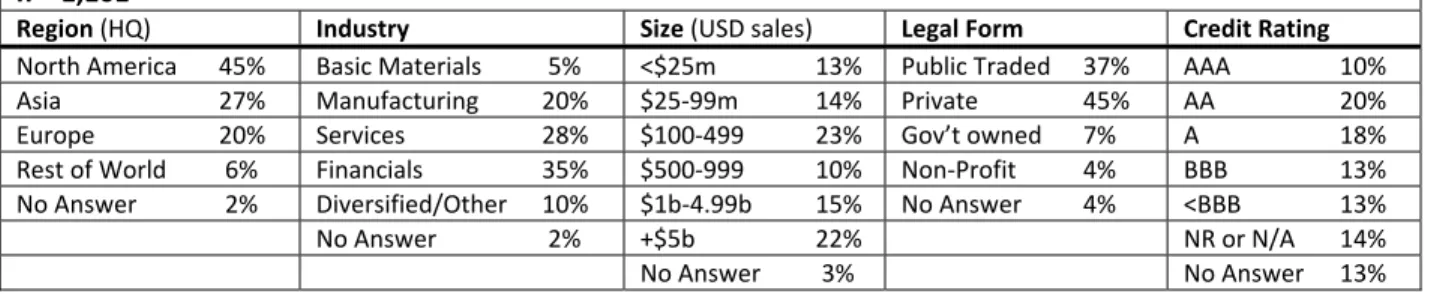
A demographic breakdown of the respondents is given in Tabl/e 1. The table shows the breakdown by region (location of headquarters), basic industry by broad sector, size in terms of annual gross sales (in USD), structure of ownership (whether publicly traded, privately owned, government owned or a non‐profit) and credit rating (self reported). The sample is very diverse in all dimensions. Casual observation suggests that the response group appears to be titled towards North American firms, financial firms, large firms, privately held firms and firms with strong credit ratings, relative to overall population. However, given our large sample size we can study various subsamples to assess any impacts on the overall results from any particular subsample of respondents. In many cases, in addition to the overall top‐line results, we will try to show interesting differences between financial and non‐financial firms as well as North American versus foreign (Rest of the World) firms.
4. Summary of Survey Responses for General Sections
4.1 Section with General Risk Management Questions
The first section was designed to identify the risks the firms face and manage as well as learn some features of a given firms’ overall risk management program. We began by asking firms about whether they face “material” risk
3
in each of the six following areas: interest rate (IR) , foreign exchange (FX) , energy (EN), commodity (CM), credit (CR) and geo‐political (GP).4 Figure 1a shows that a majority of respondents report facing material risk in three of the six areas , IR (71% of respondents), FX (63%), and CR (56%). EN, CM and GP were material risks for one‐third or less of the respondents. Figure 1B shows the results of this question for two sets of subgroups: financial versus non‐financial and North American versus foreign (Non‐ North American). Financial firms were notably more likely to indicate material risk in IR (91%), FX (85%), and CR (85%), while relatively fewer non‐financial firms indicated material risk in IR and FX (58% for each) and CR (40%). Slightly more non‐financial firms indicated material risk to EN (35%) and CM (39%) than for the full sample. Geographically, while similar percentages of North American firms and foreign firms felt material risk to interest rates (64%), the big difference is in FX where fewer North American firms reported facing material risk (43%) compared to the foreign firms (69%). North American firms reported slightly higher percentages of material risk in the other areas except for CR where more foreign firms (57%) felt material risk compared to North American firms (44%).
For the firms facing material risk in a given area, we asked them to indicate whether they actively manage this risk either through derivatives/other financial contracts or through the operational structure or decisions. Figure 2 shows the percentage of firms facing material risk in each area that actively manage the risk in each manner. Interestingly, operational risk management is used by more firms in all of the risk areas except for FX, where the use of derivatives and financial contracts is more common. While derivatives/financial contracts are used by more than half of the firms in only three risk areas, operational risk management is used by at least two‐ thirds of the firms in all of the risk areas. This suggests that risk management is more often done via operational changes than through financial contracts.
For the subgroups, financial firms reported broadly similar results with CM in addition to FX risk being more commonly managed with derivatives /financial contacts than operations (CM = 82% vs. 72%, FX = 82% vs. 64%). For non‐financial firms operational risk management is far more common than financial risk management in all areas, with IR and FX being the only risks managed with derivatives / financial contracts by more than half of the firms while 70% or more of the firms facing risks actively managed them through operations. Across the
4
board, the non‐financial firms are less likely than the financial firms to be using derivatives/financial contracts to manage their material risks. Geographically, no differential patterns emerged as operational risk management was more common than derivatives/financial contracts in all areas except FX.
Combining these two sets of responses, we determine the percentage of firms that indicate that they face a material risk but do not indicate that they actively managed this risk. The survey responses suggest that in most risk areas a relatively small percentage of firms indicate that they face a material risk do not (or did not tell us) that they actively managed that risk. For FX risk, only 9% of firms indicate facing material FX risk do not indicate any active risk management responses. This proportion trends up slowly and then balloons to 24% for GP risk. Notwithstanding, the vast majority of firms facing a material risk have some sort of active risk management strategy.
The next question measures the perception of how the level of risk in these areas is evolving. We ask the respondents to indicate their perceptions of how the level of risk in the areas that they face material risk has changed relative to 2006 (prior to the global financial crisis). Table 2 shows the responses. A majority of firms in each risk category indicate that they perceive the level of risk as of the survey time (Spring 2010) to have increased relative to 2006. Credit risk was perceived as having increased by the largest percentage of firms; not a surprise given its role in the global financial crisis. On the other end of the spectrum, IR risk stood out with more than 20% of respondents indicating that they perceived it had decreased relative to 2006. Financial firms were more likely to have perceived risk increases in IR, FX and CR, while non‐financial firms report increases in EN and CM. There was little difference in responses based on geographical breakdown.
The natural follow‐up question asks the respondents about the change in the degree or intensity of their firm’s risk management activity over the same period. Not surprisingly, the responses are very similar, as most firms responded to the perception of increased levels of risk with increases in the degree of risk management activity. Only a small percentage of firms indicate that they reduced the intensity of their risk management activity (in any of the areas) relative to 2006.
The final question on change was what impact the global financial crisis had on their firm’s overall approach to risk management. The overwhelming majority of respondents, 81%, indicate that the crisis caused
them to pay more attention to risk management issues. This percentage was slightly higher for financial firms and for foreign firms. Almost all of the rest indicated that it had no impact on their risk management activities.
In order to gauge which risk is the most important to these respondents we ask them to rank the top three risks they face in order of importance. As displayed in Table 3a, in terms of the number of most important votes, the top spot goes to CR with 26% of respondents indicating it is the most important risk they face. Interest rate risk is a close second with 25% of the top spot votes and FX is third 20% of the top votes. The other three risks all score low in top spot votes, with 15% or less of the firms ranking them as the most important risk.
This ranking of most important risk differs across the subgroups. Table 3b reveals that for financial firms only two risks rank as highly important. Not surprisingly these are CR with 46% and IR with 37% of the top spot votes; no other risk received 10% of the top spot votes from the financial firms. On the other hand, for the non‐financial firms, FX risk has the most top spot votes (26%) with CM (19%) and IR (18%) next in line. As for the geographic breakdown, more North American firms rank IR as the most important risk (29%) while foreign firms showed more concern with CR (31%) and FX (24%).
We get a very different story in terms of importance when we consider the ranking of most important risk as a percentage of just the firms indicating material risk in that area. Table 3a also shows the rankings for most important risk conditional on just the firms facing material risk in that area. For the full sample, CR still comes out on top, with 51% of firms facing credit risk indicating that CR is their most important risk, but the next highest percentage goes to CM (44%) followed by IR (38%) and EN (37%). Clearly in these risk areas which are faced by a smaller subset of firms, the firms are more likely to see that particular risks are their most important risk. This pattern continues over into the subsample analysis as displayed in Table 3b. Credit risk (57%) and IR (42%) are still most prevalent for financial firms under this measure, a majority of non‐financial firms facing CM risk (54%) considered it their most important risk, followed closely by FX (48%) and EN (44%). Credit risk is also the top concern among those facing this risk among the North American firms (56%), while for the foreign firms, nearly half with energy risk exposure (41%) rated it their most important risk. In all cases, GP risk has the lowest percentage of firms indicating it was the most important risk facing the firm. Thus although CR, IR and FX are the most prevalent risks in the sample, in terms of concern, the CM and EN risks are equally if not more concerning to the smaller set of firms that face material risk in these areas.
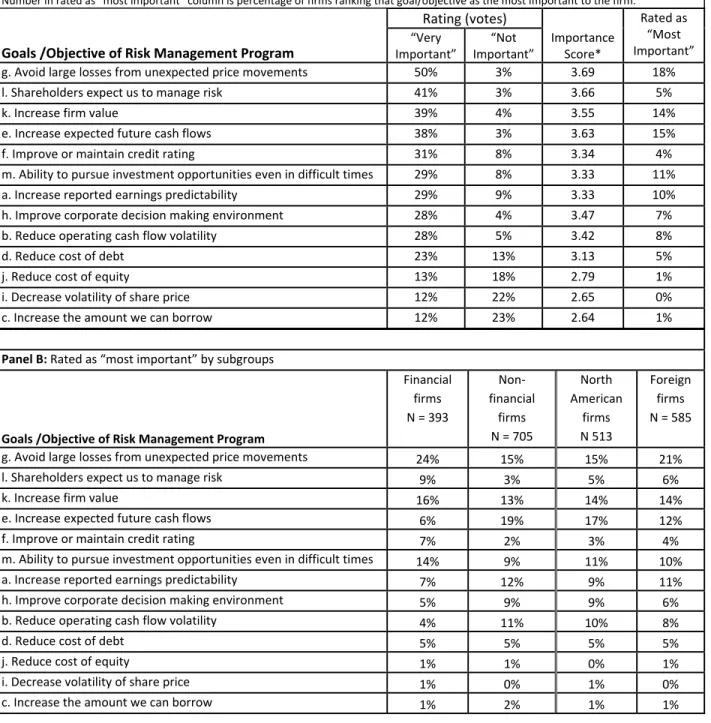
Beyond indentifying important risks, we also want to try to understand the firms’ purpose behind their risk management program. In managing risk, each firm presumably has some set of goals or identifiable benefits in mind that they are hoping to achieve through their risk management efforts. To gain some insight into what these goals are, we provide 13 possible objectives for a risk management program drawn from theoretical and practical sources, and ask the respondents to rate the importance of each goal, as well as identify the most important goal with regard to their firm’s risk management policy.5 The responses for the full sample are provided in Panel A of Table 4. The goals that frequently rate as very important are “avoid large losses from unexpected price
movements” with 50% of the respondents “increase firm value” with 41%, followed closely by “increase expected future cash flows” and “shareholders expect us to manage risk” with 39% and 38%, respectively. In terms of goals that frequently rate as “not important” are “increase the amount we can borrow” and “reduce cost of equity” with 23% and 22%, respectively, followed by “decrease the volatility of share price” and with 18%, and “reduce the cost of debt” with 13% . No other goal received more than 10% “not important” votes.
In terms of the being rated as the most important goal of the firm’s risk management policy, the largest percentage of firms, 18%, indicate that this is “avoid large loss from unexpected price movement”, essentially highlighting the primary role of risk management as an insurance function. Other goals that rate 10% or higher in the most important category are “increase expected future cash flow” (15%), “increase firm value” (14%), “ability to pursue investment opportunities even in difficult times” (11%) and “increase reported earnings predictability” (10%).
In terms of the subgroups, financial firms rank “avoid large losses from unexpected price movements” as most important (24%) while non‐financial firms go with “increase expected cash flows” as the most important goal (20%). The other interesting distinction in this breakdown is a notably higher rating as most important for “ability to pursue investments even in difficult times” by the financial firms and a greater emphasis on “reduce operating cash flow volatility” as most important by non‐financial firms. The differences are less notable in the North American and foreign firm breakdown. Foreign firms have a higher percentage rating “avoid large loss from unexpected price movement” as most important than North American firms, while the opposite is true for
5
“increase expected future cash flow” and “improve corporate decision making environment”. This suggests that North American firms are focused on the general benefits of volatility reduction more so than the insurance impact against losses from an unexpected price change. Panel B of Table 4 shows the results of the most important votes for the various goals/objectives methods by subgroups. The patterns are reasonably similar to the overall results, with the exceptions that financial firms are more keyed into “avoiding losses from unexpected price movements” while non‐financials are more into “increasing expected future cash flows”. Geographically the differences in votes are quite minor.
We move onto a set of questions about the firm’s risk management program structure. The first question is whether the firm has a formal documented risk management policy. Of the 1,110 responses, 65% of the firms indicate that they do have a formal documented risk management policy, while 35% indicate that they did not. These proportions are driven largely by financial firms of whom 87% have a formal documented policy and foreign firms of whom 73% have a formal documented risk management policy. Surprisingly, 47% of non‐financial and 44% of North American firms report not having a formal documented policy regarding their firms risk management activities. 6
Another important issue with respect to a risk management policy is how frequently results are reported to and reviewed by oversight bodies within the firm. We asked he respondents whether their firm has a regular schedule for reviewing and reporting its risk management strategy. Seventy‐two percent indicate a regular schedule, of which 90% are firms that had indicated above that they have a formal documented risk management policy. In terms of the frequency of this reporting, the most commonly reported frequency is quarterly (43%), followed by monthly (27%) and annually (13%). Results on subgroups are generally similar. Financial firms have a significantly higher percentage of firms with a regular reporting schedule and there is a slight shift towards more frequent reporting periods.
Academics have developed a variety of economic explanations for why firms should manage risk. One set of these relate to the hedging for the purpose of avoiding market imperfections in the financial markets related to
6 This contrasts with the 79% of US non‐financial firms that indicated having a formal documented policy regarding
the use of derivatives from the Wharton risk management survey done in late 1997/early 1998. (Bodnar et al, 1998).
financing investments or obtaining liquidity. To investigate the extent to which practitioners think in a similar way we ask a few specific questions about whether risk management is done with any thought towards funding investments or the access to liquidity. The first question asks whether risk management decisions are made to enhance the firm’s ability to fund attractive investment opportunities. Forty‐six percent indicated that it is and 54% indicated that it is not, suggesting that a majority of firms do not focus on any link between risk management and future financing challenges. Only for financial firms did a majority (57%) indicate that such a link was
important. In a follow up question, of the 46% of the full sample indicating that risk management did involve some thought to the firm’s ability to fund future investment opportunities, 49% indicate that risk management helped better match the availability of internal funding sources to the need for funds to make investments, while 27% indicate that risk management helped better match their access to external funding sources to the need for funds to make investments, and the remaining 24% indicate that the risk management helped reducing the cost of the external funding for investments. These proportions do not differ substantially across the subgroups.
It is well known that a good substitute for active risk mitigation is access to a large pool of liquid assets. As such we ask firms whether the size of their surplus cash holdings or access to guaranteed lines of credit influence the breadth or intensity of their risk management activities. Once again, the majority of firms (56%) said that their cash positions or access to lines of credit have no impact on their risk management policy. Interestingly, of the firms that did indicate an effect, a follow up question indicates that both greater surplus cash holdings and access to guaranteed lines of credit result in an increase in breadth or intensity of risk management activities for a larger number of firms than result in a decrease. Again, these results are quite uniform over the subgroups.
In two final academic‐driven questions on general risk management, we ask the firms for their view on the breakdown of the risk reduction from their risk management activities between idiosyncratic risk (risk which is firm specific and uncorrelated with priced risk factors), and systematic risk (risk which is common across assets and carries with it a risk premium in terms of expected return). Interestingly, the average breakdown is that the risk reduction is 58% systematic risk and 42% idiosyncratic risk. Surprisingly these averages did not vary much across the subgroups. This is interesting as with the exception of CR, most of the risks that firms are managing have exposures that are relatively firm‐ specific and do not have significant risk premium in terms of the hedging costs. The other academic question relates to the assumptions firms most commonly make about the future price
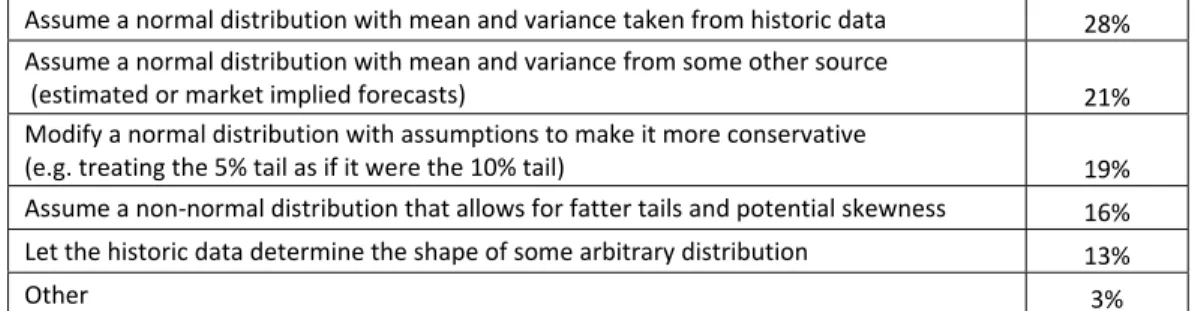
distribution when assessing future outcome risk from an exposure (e.g., as part of a Value at Risk exercise or a spreadsheet simulation). We offered a series of likely responses. The responses are displayed in Table 5. The most common response is use of a simple normal distribution with a mean and variance based upon historical data (28%). This is troubling as we know the tail issues are a critical issue in risk management. Equally worrisome is that assuming a normal distribution with the mean and variance taken from some other source was the selection of another 21% of respondents. Nineteen percent of the respondents indicate that they modify a normal distribution to worry about fat tails, while another 16% used a non‐normal distribution with fatter tails and potential skewness. Finally, 13% let the data define an arbitrary distribution and 3% do something akin to a combination of these methods. So despite what the recent financial crisis taught use about simple distributional assumptions, nearly 50% of the respondents indicate that they basically use a normal distribution when doing simulations involving future financial prices.
To end this section on general risk management activity and transition into the next section on use of financial derivatives, the survey asks firms whether they use financial derivatives (specifically forwards, futures, options, and/or swaps) in their risk management program. Panel A of Table 6 shows the results for the full sample. For the full sample, 64% of the respondents indicate that they used financial derivatives in their risk management program.
Since this is probably the most commonly asked question in risk management surveys, we consider a variety of cross tabulations of this result with our firm demographics. Panel B of Table 6 shows the cross tabulation of the responses by geographic location of headquarters and economic sector, with the non‐financial sector also broken down into primary product, manufacturing and service sectors. Financial sector firms report derivative usage as part of their risk management strategy in much higher proportions (78%) than the non‐financial firms (56%). This is not surprising given that a good portion of financial firms are likely in the business of dealing in financial derivatives both for their own risk management as well as part of their business. Geographically, foreign firms report derivative usage at a 10% higher proportion than the North American firms (68% vs. 58%). These results are consistent with findings of previous surveys. Derivative usage in European countries has typically been much higher than in the United States (see, e.g., Bodnar and Gebhardt (1999) and Bodnar, de Jong and Macrae (2003)). In the cross tabulations, prevalence of financial derivative use is highest amongst foreign financial firms at
81% and lowest amongst the North American non‐financial firms at 56%. This latter number compares closely with the findings in Bodnar et al. (1998) which reports that derivative usage amongst US non‐financial firms in the 1990’s varied between 35 – 50%. Slightly more than a decade later, the derivatives usage rate for nonfinancial – North American firms in our sample is 54%.
The pattern of usage across the non‐financial sectors is also consistent with the earlier survey findings.7 Usage is most prevalent in the primary products sector (basic materials, utilities, transportation) with 71% of firms, followed by the manufacturing sector with derivative usage by 67% of firms, and the service sector firms reporting only a minority of firms (46%) using derivatives as part of their risk management strategy. The differences in these results on a regional basis are relatively minor. The only exception is that the proportion of foreign service‐sector firms using derivatives is nearly 10% higher than the percentage of North American service‐sector firms using derivatives.
In Panel C of Table 6, the usage of financial derivatives is broken down by firm size, measured in USD sales. The results reveal a perfectly monotonic relation between the six firm size groups and the percentage of firms in each group that use financial derivatives. Amongst the smallest firms, those with sales of less than USD25M, only 35% used financial derivatives, with the percentage growing consistently as we move up the size groupings. Amongst the firms in the largest size grouping, those with sales of more than USD5B, 85% indicate that they use financial derivatives. This finding matches the common finding in previous studies in that firm size is positively related to the likelihood of using derivatives.
In the last two panels of Table 6 we show the proportion of firms indicating derivatives use by ownership form of the business (Panel D) and credit rating (Panel E). As for ownership structure, we ask respondents to classify their firms into one of four classes of ownership: publicly traded, private, government owned, or non‐ profit. The results suggest that this is an important characteristic in explaining whether the firm uses derivatives. It turns out that use of derivative use is most prevalent amongst the publicly traded firms at 78%, with government owned firms next at 70%. Privately held firms are notably less likely to use derivatives with only 53% indicating use while non‐profits report the lowest proportion of use at 43%. As for credit rating, of the 917 firms that provided
7
this information, there is an interesting relation between the derivative use and credit rating. All of the firms with ratings BB and above use derivatives in greater frequency than the sample as a whole. Interestingly the heaviest percentage users are the bottom two groups in this category, BBB and BB at 73% and 76%, respectively. Firms rated less than BB as well as those that indicate they are not rated are less likely to use derivatives at 57% and 47%, respectively.
The survey concludes the first section with a question only for those that indicated that they did not use financial derivatives in their risk management program. Non‐users are asked to rank the top three reasons they did not use financial derivatives from a pre‐selected list. Table 7 displays these results. Three of the eights choices provided garnered most of the responses for the top reason. The most important reason with 34% of the most important votes is that the “firm’s exposure to the financial price risk was not sufficient to warrant using derivatives”. This is followed with 31% of the top votes by the equally rational “exposures are more effectively managed by other means”. The other top vote getter, with 25% is the individual cost‐benefit assessment by the firms that “costs of establishing and maintaining a derivatives program exceed the expected benefits”. Among the firms that selected “other”, as the most important reason for not using derivatives, the reasons provided most commonly relates to lack of a local market for derivatives, legal restrictions against holding derivatives, or a lack of expertise with derivatives. The choices that relate to outside perception or issues with pricing, accounting or disclosure requirements appear to be much less of a deterrent to firms using derivatives in their risk management program. Results by sector and geographic area are again quite comparable.
4.2 Section with Questions on the Use of Financial Derivatives
Having identified the firms that use derivatives in their risk management program the next section of the survey asks this group specific questions about their derivatives usage and control policy. The first question we look at this section is what concerns firms have about their derivative usage. This question is based closely on a similar question asked in the Wharton surveys more than a decade ago so we can explore how the answers have evolved over time. The survey provided seven areas of concern regarding the use of derivatives and asked the firms to rate them as being either a high concern, a moderate concern, a low concern, or no concern. The responses to this question are displayed in Panel A Table 8.
The results suggest that “market risk (risk of unforeseen changes in the value of derivatives)” and “counterparty credit risk related to derivatives” are the two issues with the largest percentage of firms indicating high concern at 49% and 31 respectively. Interestingly all of the issues are rated as a moderate concern by between 30 and 40% of the respondents with monitoring and evaluating hedge results getting the highest moderate concern rating of 41%. At the low end of the concern spectrum, more firm indentified “reaction by analysts or investors”, “disclosure requirements” and “accounting treatment” as the areas of either low or no concern. The last column of Panel A shows a weighted average level of concern score for each issue related to derivative use. The score is based upon a scale of a 4 being high concern and a 1 being no concern. Clearly “market risk of derivative values” is the area of concern with the highest overall score thus being the most pressing concern related to derivatives usage for these firms. The score for “reaction by analysts or investors” is the lowest suggesting that this is the least important concern related to derivative usage for these firms.
Panel B of Table 8 shows the score for each are of concern by the two different subgroupings. While the rankings of concerns across these groups are similar to the full sample, the scores for the financial firms are notably higher than for the non‐financial firms, suggesting a higher average level of concern about these issues associated with derivative usage for financial firms than non‐financial firms. Similarly the North American firms have a lower score for each concern in comparison to the foreign firms.
Because this question is identical to one asked in the 1998 Wharton survey of US non‐financial firms, it is interesting to compare the results for similar groups. The Wharton 1998 survey showed a plot of US non‐financial firms indicating higher or low levels of concern for each of these areas related to derivative use. In Figure 3 we produce a similar plot for our sample using only the North American non‐financial firms as a comparable sample and show this plot against the plot reported in the Wharton 1998 survey report as a comparison of how levels concern about these issues associated with derivative use have changes over time. Two things jump out from Figure 3. First the percentage of firms reporting high concern about any of these areas today is lower than in 1998 and in most cases the percentage of firms reporting low concern is higher than in 1998. This suggests that the overall level of concern about derivative issues is lower today than in 1998. Second, in 1998 accounting treatment as was monitoring and evaluating hedges were big concern (with more high concern votes than low concern votes).
Another question in this section is whether the global financial crisis of 2008/09 with its underpinnings of collateralized debt obligations and credit default swaps had any impact on their firm’s use of financial derivatives. Overall the impact was quite minimal. Of 624 respondents, 27% indicated that the crisis caused them to decrease their usage, while 23% said that it caused them to increase their usage. The rest of the firms (50%) indicated that it had no effect on their use. There was little difference across sub groups: financial firms were more likely to indicate that it caused them to decrease usage (35%) relative to increase usage (28%) while non‐financials were evenly split at 20% increase and 20% decrease. Geographically a majority of foreign firms were more affected but with decreases (36%) outpacing increases (29%), while North American firms were again slightly more likely to decrease than increase (24% vs. 20%). Overall, it appears that the crisis did not have a significant impact on firm derivative usage.
We next move on to ask some questions related to the oversight and control of derivatives positions within the firm. We asked both about the frequency with which the financial derivatives contracts were valued and the source of the valuation information. In addition we asked to whom within the firm the information about derivative positions is reported. As shown in Table 9, the most common frequency for valuation of derivative positions is daily and monthly. These two horizons are driven almost completely by the industrial sector of the firm. Financial firms predominantly (63%) value their positions daily, while the most common horizon for non‐ financial firms is monthly (42%). About 11% of the firms report having no fixed schedule for valuation of financial derivatives, again with this skewed more towards non‐financial than financial firms. There is relatively less
difference in response patterns on a geographic basis, with foreign firms tending towards more frequent valuation. When asked to identify the main source of information for valuation (or re‐valuation) of their derivative positions, 38% of the firms indicated they used the original derivatives dealer, 33% indicated that they did the valuation themselves internally while 27% indicated that they used some other deal than the originating dealer. Only 2% of the firms indicated that their main source of information for re‐valuing derivative positions was some other source, and these tended to be some other outside source such as Bloomberg or some other market data provider or an outside custodian.
The other question in this set is to whom within the firm is information about the derivatives activity reported. The survey offered the choices of the senior management of the firm, the Board of Directors, or some
other group, and allowed for multiple choices if appropriate. For the full sample, of the 579 responders, 81% indicate they report activity about their financial derivatives positions to the senior management, with 50% reporting only to the senior management and 29% also reporting to the Board of Directors. While 46% indicated that they report to the Board of Directors 13% did so exclusively. Only 6% of respondents indicated reporting on financial derivative activity to some other party or parties.
The final set of questions in this section relate to the firms’ actual or potential reaction in terms of derivative usage to some regulatory rules that have occurred or are being considered in light of the recent financial crisis. Currently, both the FASB standards in the US and the IFRP standards globally mandate that the firm carry out periodic tests on the effectiveness of their derivative position as hedges of the underlying exposure. We asked the firms if such tests have results in any impact on the amount their companies use financial derivatives. For the vast majority (76%) of the 596 respondents these mandated tests have had no impact on the firms’ use of financial derivatives. However, 16% of the responding firms indicated that they had reduced their use of financial derivative contracts as a result of these hedging effective tests. When we pressed these firms who decreased derivative usage to indicate the impact on risk management, about 60 % indicated that the end result of the reduction in the use of derivatives was an overall decrease in hedging activity while 40% indicated that it results in their using more non‐financial hedging methods. The pattern of responses to the entire question is very similar across the sector and geographic subgroups. Overall these results suggest that the mandated hedging effectiveness tests had only a mildly negative impact on overall risk management with only about 10% (60% of 16%) of firms reducing their overall hedging activity as a result.
The other two questions relative to possible changes in derivative market rules that may come about as a result of regulatory changes imposed upon the derivatives market as a result of post‐financial crisis legislation. One of these possible changes is restrictions on customized over‐the‐counter derivatives and a move to all standardized, exchange‐traded contracts. As displayed in Panel A of Table 10, a majority (54%) of the 604 respondents indicated that a restriction on OTC derivatives with replacement by standardized exchange‐traded contracts would result in no change in their derivative usage. While a small percentage (10%) indicated that such a move would increase their use of derivatives, the more interesting result is that 32% of firms indicated that such a regulatory change would reduce their use of derivatives with 3% (19 firms) indicating that such a change would
cause them to discontinue use of derivatives entirely. In looking at the sub groups, financial firms showed a greater propensity to react to such a policy change with both a higher proportion indicating increased (15%) and decreased (43%) usage of derivatives in response. Non‐financial firms were more relaxed, with 66% indicating that such a policy change would not impact their derivative usage and just 24% indicating that they would decrease derivative usage. Geographically, the North American firms were less reactive than the foreign firms. There was very little variability across any of the subgroups in the percentage of firms that would discontinue their derivative use entirely in response to a restriction on OTC instruments.
Panel B of Table 10 shows the responses to the second policy question: If your firm were required to post cash collateral or to post more collateral than has traditionally been required against all over‐the‐counter
derivatives, what would be your most likely response? Firms appear to be much more sensitive to this issue in terms of its impact on their derivative use. For the full set of respondents, 52% indicated that having to post collateral on OTC instruments or post more collateral that traditionally has been required would result in a decrease in derivative usage. In addition, 7% indicated that such a move would cause them to discontinue derivative use entirely. Only 35% indicated that such a policy would have no effect on their usage. So in comparison to a policy of restricting OTC instruments in favor of exchange‐traded instruments, far more firms indicates that they would react negatively (be decreasing or quitting derivative use) to a policy of imposing or increasing cash collateral on OTC instruments.8 Interestingly, when looking at the results by subgroups, the negative reaction is more intense in the non‐financial firms (64% reacting with decrease of discontinuation of derivatives) than the financial firms (53%), and also more intense amongst North American firms (64%) than foreign firms (56%). Hopefully regulators will consider this issue carefully as imposing such a rule could reduce the degree to which firms actually manage their risks.
5. Summary of Responses for Management of Specific Risk Areas
In the remainder of the survey we asked sets of specific questions about the management of areas of risk the firm indicated they faced. For these sections, in order to reduce survey fatigue for firms that faced more than
8 As we shall see later, this may be related to the fact that a majority of firms prefer OTC instruments to exchange
two risks, respondents were randomized as to which risk section they were asked to respond, so the sample sizes for these sections are smaller than the number of firms that indicated that they faced that risk.
5.1 Interest Rate Risk Management
The first risk area whose management we investigated is interest rate risk. The firms that where eligible to respond to the questions in this section where those that had indicated that they faced material interest rate risk in the earlier section. In principle all of the firms responding to these questions faced interest rate risk. In total there were 666 firms that saw the questions in this section.
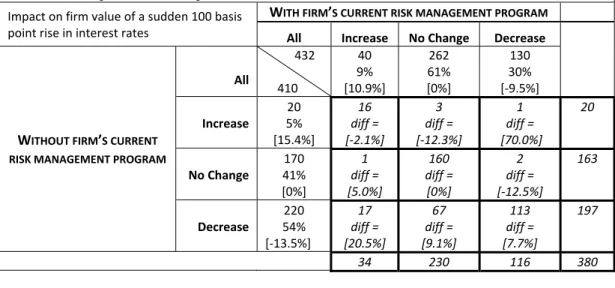
To begin we wanted to get an idea of how large firms believed their risk to interest rates to be and how effective they believed their management program to be in reducing this risk. To do this we asked a series of questions requiring the respondents to estimate the size and direction of the impact of a sudden 100 basis point rise in interest rates on their firm’s value both with and without their current interest rate risk management strategy.9 Table 11 shows the results of these questions. The first column of numbers shows the distribution of responses for the impact of the 100 basis point increase in interest rates on firm value assuming that the firms had no risk management program in place. Of the 410 responses, 54% indicated that the sudden interest rate increase would have a negative impact on firm value. The average estimate of this negative impact was ‐13.9%. In contrast, only 5% of the firms indicated that they believed the interest rate risk would increase their firm value. The average estimate of the increase was 15.4%.10 Surprisingly, 41% of the respondents indicated that the sudden rise in interest rates would have no impact on firm value, even without any risk management policy in place.
To gain some insight into the impact of the firm’s IR risk management strategy, we also asked firms to estimate the change in firm value resulting from the sudden interest rate rise given their current IR risk
management program. These results are displayed in the top row of Table 11. The first result to note is that some
9 Note the focus on the impact on firm’s value is intended as a generalization of all of the impacts of the risk (or its
elimination of the firm. This requires the respondents to estimate the impact of risks and risk management (net of cost) on firm value. It is possible that non traded firms do not think about exposure with respect to firm value and are biased towards answering no change in value to this question. Tabulations, not shown, do not support this claim as the ratio of unhedged positive, no change and negative responses to the interest rate rise are roughly similar for publicly traded firms versus non‐traded firms.
10 These are supposedly firms that are positively exposed to interest rate fluctuations as evidenced by the negative
firms hedging programs appear to be to be effective at eliminating the exposure as now 61% of the firms that respond indicate that the interest rate change would have no impact on firm value. With hedging, only 30% of the firms still indicate that they would experience a decrease in firm value, with the average decrease being ‐9.5%. With their IR risk management programs, a somewhat larger 9% of respondents indicate the interest rate rise would lead to an increase in firm value, with the average increase being 10.9%.
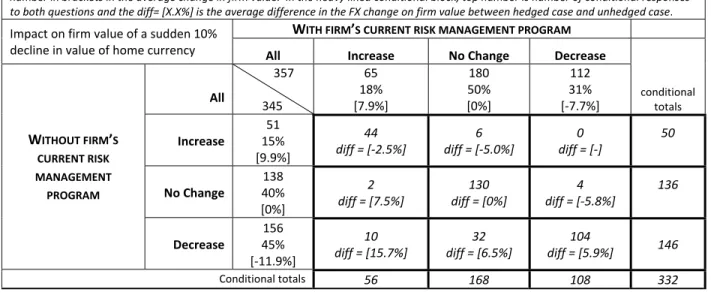
To estimate the impact of the firm’s IR risk management program, we examine the conditional responses of the firms that replied to both questions and measure the average change in the impact of the interest rate rise on firm value. These tabulations are shown in the bold box in the lower right corner of Table 11. In addition to showing the number of firms with the conditional value responses, the cells show the average of the difference in this impact of the 100 basis point rise in interest rates on firm value between the case with the firms’ risk
management program and the case where the risk is not managed at all (hedged impact minus unhedged impact). So for example, consider the center column of the bottom row which shows 67 and [9.1%]. These
numbers mean that 67 firms indicated that the interest rate rise would decrease firm value with no risk
management program and would result in no change in firm value with its risk management program. The 9.1% number means that for these 67 firms the average expected impact of the interest rate rise on firm value with hedging is 9.1% more positive (less negative) than without hedging (in this case hedging reduced the impact of the interest rate rise on firm value from an average of ‐9.1% to zero for these firms). Looking at the lower right cell in the conditional table suggests that for the firms that claim to be negatively affected by the interest rate rise without any risk management program the majority are still negatively affected with even their risk management program, though the negative impact on these 104 firms is 7.7% less than with no hedging. In addition to the 67 firms that feel that they completely hedge their underlying downside exposure to the interest rate rise, there are 17 firms that believe that their IR risk management program actually results in their firm switching to where it gains from the interest rate rise. For these firms the hedging policy changes the impact of the depreciation on firm value by over 20%. Of the 20 firms that were positively affected by the interest rate rise, even after allowing for their hedging program, 16 of these firms indicate that they would still be positively impacted, though the average impact on firm value is 2.1% smaller than without their hedging programs. Overall, the table appears to
support the view that firms’ interest rate risk management programs are reducing the impact on firm value of sudden changes in interest rates.
To investigate what kinds of exposure firms are managing with interest rate derivatives, we asked firms to indicate how frequently they used IR derivatives to accomplish certain interest rate risk management activities. We selected four common purposes for interest rate derivative transactions and asked them to indicate if they did these transactions “frequently”, “sometimes”, or “seldom/never”. Table 12 displays the sum total percentages of “frequent” and “sometimes” responses for the full set of 502 firms that responded to the questions as well as their breakdown into financial and non‐financial subgroups. The table reveals that for all respondents, entering
contracts to swap from floating to fixed interest rates was the most common IR derivative activity with 58% indicating they do so frequently or sometimes. The other activities: swap from fixed rate to floating rate, fix in advance the rate or spread on new debt, and reduce or lock in a rate based upon a market view were done frequently or sometimes by about 45% of the respondents. The breakdown of the sample into financial and non‐ financial firms shows several interesting distinctions. First of all, financial firms are much more likely to use IR derivative frequently or sometime to do almost all of these activities than non‐financial firms. Second, financial firms are most likely to swap from fixed for floating rate than non‐financial firms (68% vs. 25%), consistent with their activity of extending fixed rate loans to non‐financial customers and then deal with the interest rate risk by swapping into a floating rate.
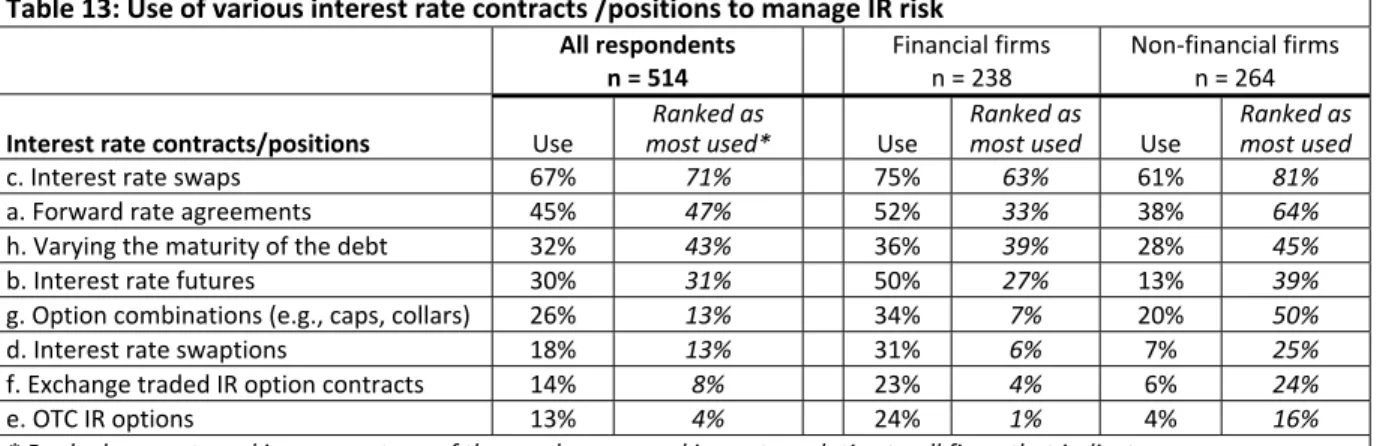
The next question was to identify which interest rate contracts/positions the firms are using to manage their interest rate risk. We provided seven different IR derivative contracts and one operational activity commonly used to mange IR risk and asked the respondents to indicate if they used any of these to manage their interest rate risk. We also asked them to indicate their most used contract or activity. Again, Table 13 shows the responses to these questions for all 514 respondents as well as the financial and non‐financial firm breakdown. Not surprisingly, the interest rate swap received the largest percentage of firms indicating usage at 67%. A distant second were forward rate agreements with 45% of firms indicating use, and then another large drop to 32% of firms varying the maturity of debt as a risk management technique and 30% indicating use of interest rate futures and 26%
indicating use of option combinations (i.e. caps and collars, etc.). Less than 20% of respondents indicated use of interest rate swaptions (18%), exchange traded IR options (14%) and OTC IR options (13%). In terms of most
common, the column displays the percentage of firms indicating use of a position/activity that voted it as their number one most commonly used method.11 The ranking of top methods is very similar to the overall usage ranking.
In looking at the distinction between financial and non‐financial firms, financial firms were much more apt to use swaps and interest rate futures than non‐financial firms. However, non‐financial firms were much more diverse in their choices for most‐used as evidenced by the higher percentages down this column as compared to the financial firms most‐used column. This pattern of top choice in conjunction with the lower percentages in the use column, suggest that non‐financial firms are more likely to have picked a particular method for managing IR risk and stick to it as their most used method.
Given the broad nature of our sample, an interesting question to ask derivative users is about their mix of over‐ the‐counter and exchange rated instruments in the firm’s derivatives portfolio. Table 14 shows responses when the respondents were asked to indicate their mix. For all 498 respondents, 35% use only OTC IR instruments with another 25% using mostly OTC instruments. A mere 12% indicated that they had a roughly equal mix between the two while only 13% indicated that they used only exchange‐traded instruments. Results for the sub groups were relatively similar, though non‐financial were much more likely to be with OTC only or exchange‐traded only while financial firms were more likely to use some combination of the two. Interestingly North American firms were more than twice as likely to use exchange‐traded only derivatives as compared to foreign firms (19% vs. 8%). With regard to the OTC interest rate instruments, we also asked whether they were generic or bespoke. Across the board, it was about an 80‐20 split: 80% of the OTC instruments were generic (i.e., plain vanilla) and about 20% of the OTC instrument were bespoke (i.e., custom made).
With regard to measuring the success of the firm’s interest rate risk management policy, we asked firms about the benchmark used for evaluating their risk management performance. We offered five possibilities, three involving a cost of funds measure and one a volatility measure along with an “other” option as well as a chance to indicate the they do not use a benchmark. The results are displayed in Table 15. The most common choice (43% of firms) was to compare their cost of funds relative to a benchmark (such as LIBOR). The next most common choice
11 To determine the percentage of total respondents that ranked a particular method as their number one choice,
(for all columns except for the financial firms) was that the firm did not use a benchmark, which leads one to wonder how the firms evaluate IR risk management. The cost of funds relative to a target portfolio (specific fixed to floating ratio) was third while the duration targeting and volatility of interest expense were least commonly used. Results were basically similar across the subgroups though foreign firms were greater users of the target (fixed/floating) portfolio while financial firms were more likely to use a duration target portfolio.
The final questions were whether the shape of the home currency’s yield curve impacts the size or amount of the firm’s interest rate hedge positions and how important the firm’s forecast/outlook for interest rate is for the extent the firm hedges IR risk. As displayed in Panel A of Table 16, 57% of the 553 respondents indicated that the shape of the yield curve does impact their interest rate hedging. These firms were predominantly financial firms or foreign firms, as less than 50% of the non‐financial and North American firms indicated that the shape of the yield curve affected their IR hedge positions. Panel B of Table 16 shows a similar story for the importance of a market view on interest rates for IR hedging decisions. Of the 4 possible responses, the table shows the
percentage of firms indicating very important and important versus the percentage of firms indicating somewhat important or not important. For the 561 firms responding, 60% indicated that their market view on interest rates was very important (18%) or important (42%) for the extent to which they hedge or manage IR risk. Looking at the breakdown across subgroups again we see that financial firms are much more likely to have their forecast of interest rates influence their IR hedging than non‐financial firms. As with the yield curve, foreign firms again showed a slightly greater tendency to take their market view into account relative to North American firms.
5.2 Foreign Currency Risk Management
This section was viewed by the set of firms that indicated that they faced material FX risk and that they managed that risk by either financial or operations means. Of this group, 540 firms responded to at least one question in this section.
We begin the FX section with the same type of question as we began the IR section. To get an idea of how large firms believe their risk to foreign currency interest rate changes to be and how effective their management program as in reducing this risk, we asked the same series of questions as before asking the firms to estimate the size and direction of the impact of 10% decline in the value of their home currency (relative to all other currencies)