Work Integrated Learning – value to non-professional degrees and
their students
CHRIS FANNING LYNN VANZO CERI MACLEOD
Flinders University, Adelaide, SA, Australia
Work Integrated Learning (WIL) has long been recognised as a powerful learning tool within the Australian higher education context, particularly within professional based disciplines. But what of those disciplines not professionally mandated, those not requiring the completion of a practical component before the graduate enters the workplace? Is there a role for WIL within these disciplines and what is the value of WIL to students studying in non-professionally mandated industries? This research considers the experiences of students that have undertaken WIL as a compulsory component of their studies in Tourism at Flinders University. Students undertake WIL despite the fact that the tourism industry does not require students to complete a WIL activity prior to working in the industry. The research examines feedback from Tourism graduates that undertook a WIL topic/s to address the following question: Is WIL recognised by the student as an important component of a student’s degree when not required by the tourism profession?
Keywords: Non-professionally mandated, tourism, students, impact, career INTRODUCTION
Much work has been undertaken within Australian universities to define Work Integrated Learning (WIL) to incorporate all of its guises and modes of implementation, from ‘traditional’ placements to on-campus ‘virtual worlds’. WIL is recognised as a key educational priority by Flinders University, which aims to provide all undergraduates with the opportunity to access a WIL activity of some form during the course of their studies. WIL is defined by Flinders University as an “organised, supervised and assessed educational activity that integrates theoretical learning with its applications in the workplace” (Flinders University, 2010).
Whilst WIL can take a variety of forms in terms of its delivery, the nature of its inclusion in a degree course can vary considerably depending on whether there is a professional requirement. WIL can be a mandatory element of a degree in order for the student to meet professional accreditation requirements, or either a mandatory or elective element by virtue of an institutionally-approved course structure (Macleod, et al., 2010). By far the most significant form of placement in terms of the numbers of students involved is in disciplines where the activity is mandated by the profession. Nursing, Midwifery, Education, Law and Social Work are just some of the many disciplines where the profession has a significant involvement in the design and delivery of placements and where students are required to complete a compulsory WIL component for their degree before they are able to enter the profession. In these cases, universities and the profession work collaboratively, often within clearly defined frameworks and agreements. In other disciplines, WIL is either still a relatively new concept and/or is delivered as an optional activity with students able to participate with varying input from the profession in terms of the nature and content of the WIL activity. A third form of WIL implementation occurs when WIL is a compulsory component of a student’s degree without it being a specific requirement of the profession. The Tourism degree at Flinders University (the Bachelor of International Tourism) falls under this category and includes WIL in a variety of guises as a compulsory component of the degree. This paper examines student feedback on the importance to them of WIL activities in the undergraduate qualification.
CONTEXT
Incorporating WIL as compulsory element by virtue of an institutionally-approved course structure without it being mandated by the profession is unusual at Flinders University. WIL placements have, however, been a compulsory component of the University’s Tourism degree since its inception in 1997. Over time, the nature, scope and delivery of these activities has changed to reflect student and industry feedback, but has remained a consistently scaffolded part of the Tourism degree program.
Designing, organising, supervising and assessing the WIL activities undertaken by students is very time-consuming and relies heavily on the development of mutually beneficial partnerships between the university and the tourism industry. In undertaking a Tourism degree at Flinders, students are required to complete a 160-hour
industry placement that is undertaken on-site with an industry provider. Postgraduate students are able to do placements as an elective. Degree students are also required to complete an industry based research project (conducted in the student’s final year) in addition to ‘tourism projects’. Tourism projects can consist of a range of opportunities for students, for example assisting with Rundle Mall Visitor Information Centre (VIC), regional VICs, a range of university events (open days, graduation dinners and conferences) and industry based projects (anything from managing an event to developing a marketing plan).
These WIL experiences are unpaid, assessable components of, and link directly back to, the requirements and outcomes of the Tourism degree and provide a wide range of learning opportunities through hands-on, real-world experiences in the tourism industry (Van Gyn, Cut, Loken & Ricks, 1997). Industry placement providers range from major event organisations, local governments, heritage organisations and smaller tourism enterprises that are based in the city of Adelaide or the South Australian regions. Placement providers are also occasionally from interstate and overseas. Students are prepared for their placement through attendance at pre-placement seminars, undertaking online preparatory modules and by preparing and submitting paperwork in accordance with the University’s WIL Policy.
The Flinders University Tourism program has long embraced the need to provide students with the opportunity to enter the tourism and events industry with relevant, appropriate knowledge and as, experienced, work-ready graduates. In providing such a wide variety of WIL opportunities, students are able to gain a true appreciation of the sector through meaningful and appropriate activities designed to reflect the nature of the industry. The changing demography of today’s university students and the increasing call from Government and industry (Cooper, Orrell & Bowden, 2010; Patrick et al., 2008) to provide work-ready graduates is a challenge that is faced by all WIL programs.
A pilot study of past students was undertaken to measure the importance that students placed on WIL as a component of their degree. The objectives of this survey were to determine:
• The value of WIL activities to students;
• Whether the inclusion of WIL activities represented a determining factor in students choosing to undertake
the Flinders University Tourism degree;
• Whether the experiences gained by students upon completion of their WIL activities helped determine their profession;
• Which aspects of their WIL activities were most beneficial to them; and
• The ways in which the students believed their WIL activity had benefitted the host organisation.
The primary aim of this research was to determine whether WIL is considered by the students as an important and valued component of their degree when it is not a professional requirement of the industry. A second consideration is to determine whether the time committed in designing and delivering these programs is justified where WIL is not a mandatory requirement of the industry?
APPROACH
The pilot study participants were Flinders University Tourism alumni who had remained in contact with the Tourism Department via social media. The study took place in early 2014 via a questionnaire and participants provided informed consent and no monetary incentive was offered. The questionnaire consisted of four closed questions requiring a yes/no response and six open ended questions that allowed participants to expand on their answers to provide opinions. Participants completed the questionnaire anonymously via Survey Monkey, an online survey tool, with only one demographic-specific question (year of graduation) required. Descriptive data from the open-ended questions were manually coded into concepts as recommended by Braun and Clarke (2006). The response rate for completion of the questionnaire was 64% (n=85). Whilst the sample size was small, each of the yes/no responses were more than 60% indicating a +/- 13.6 confidence variable (Veal, 2004).
This paper primarily considers the open questions that were asked. Respondents were asked to identify the key outcomes to them personally of the WIL activity and in a similar, but slightly varied question format, asked what aspects were most beneficial to them. Conversely respondents were asked how they believed the host organisation benefitted by the industry placement (Braunstein, Takei, Wang & Loken, 2011) 86% of respondents answered the open questions. The results of the open questions are configured under the Table heading relating to the respective question. The yes/no response questions evaluated in this paper included whether the opportunity to undertake a placement/project/research project (i.e. a WIL activity) influenced their choice of
degree or University and if the WIL activity had influenced the respondent’s choice of career. The last question asked was what year the respondent graduated, this will allow for a longitudinal study to occur to identify possible trends. The open-ended questions were coded, and patterns were identified and grouped accordingly (Miles & Huberman, 1994).
THE RESULTS
An analysis of each of the comments received for the open-ended questions generated categories of comments (response themes). Respondents’ comments were not forced to fit into a particular category and, in a number of cases, a comment was allocated to more than one category. The most cited response themes are tabled below. TABLE 1: Did the opportunity to undertake a placement/project/research project influence your choice of degree or University?
If Yes, why? Responses Selected Comments
Real world experience 9 It influenced me as I was interested to experience the “real world” application of the degree.
Positively influenced my choice of degree
3 I undertook placements, a project as well as a research project whilst completing my degree. Having these options as part of the degree was definitely a big influence for choosing the Bachelor of International Tourism.
35% of respondents were influenced by the opportunity to undertake a WIL activity when choosing their degree with the majority wanting to gain “real world experience” (Van Gyn et al., 1997; Dressler & Keeling, 2011). Of the respondents who graduated in 2014, 55% were influenced by the opportunity to undertake a WIL activity. Anecdotal evidence from the 2014 first year Tourism student cohort returned a much higher percentage (75%). TABLE 2: Did the placement or projects influence your choice of career?
If Yes, in what way?
Responses Selected Comments
Confirmed my career choice
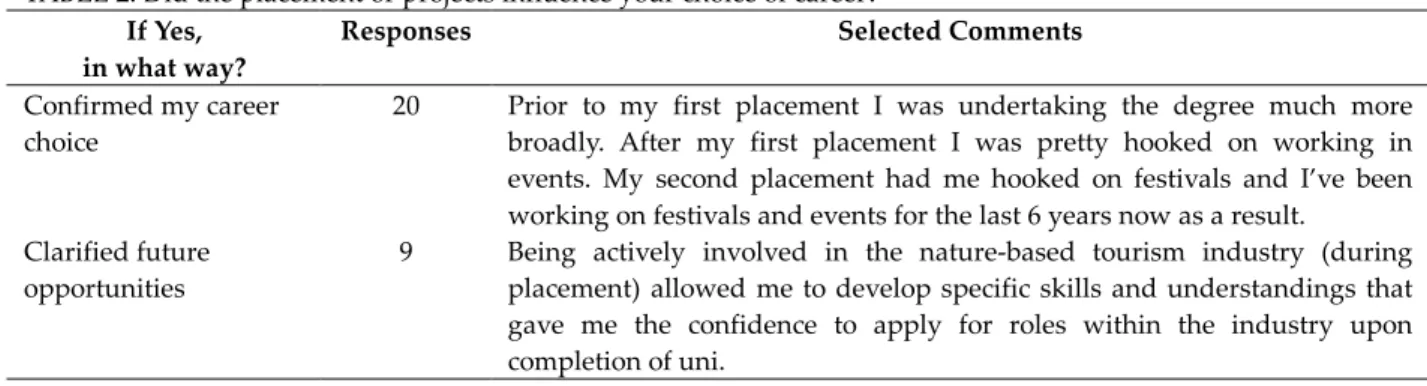
20 Prior to my first placement I was undertaking the degree much more broadly. After my first placement I was pretty hooked on working in events. My second placement had me hooked on festivals and I’ve been working on festivals and events for the last 6 years now as a result.
Clarified future opportunities
9 Being actively involved in the nature-based tourism industry (during placement) allowed me to develop specific skills and understandings that gave me the confidence to apply for roles within the industry upon completion of uni.
More than two thirds (67%) of respondents were influenced in their choice of career by their placement opportunities. (Dressler & Keeling, 2011; Chen & Shen, 2012). While their WIL experiences helped confirm career choices, the experiences also identified for students where they did not want to work (“made me realise event management wasn’t for me”).
TABLE 3: What were the key outcomes of your placement/project?
Outcomes Responses Selected Comments
Real world experience working in the tourism industry
25 From my placements I was able to learn a lot about Indigenous culture that I knew little about ... All of these placements and projects helped me to grow in many ways from communication through to working within and managing a team.
Networking opportunities
18 It also introduced me to the industry and people within it. I made a lot of contacts but also a lot of friends.
Confirmed
career/further study path
15 My placement was completely interstate so I learnt that I could live outside of my comfort zone, I also learnt that I didn’t want to be stuck in the office all day and that I needed variety in my work.
The outcomes in Table 3 identify that ‘real-world’ experiences are valued highly by respondents (43%). Alumni confirm that WIL extended them beyond their normal comfort zone and exposed them to a wider range of professions. The opportunity to network and expand their contacts was also a significant response (31%).
TABLE 4: What aspects of your placement/projects were the most beneficial to you?
Beneficial aspects Responses Selected Comments
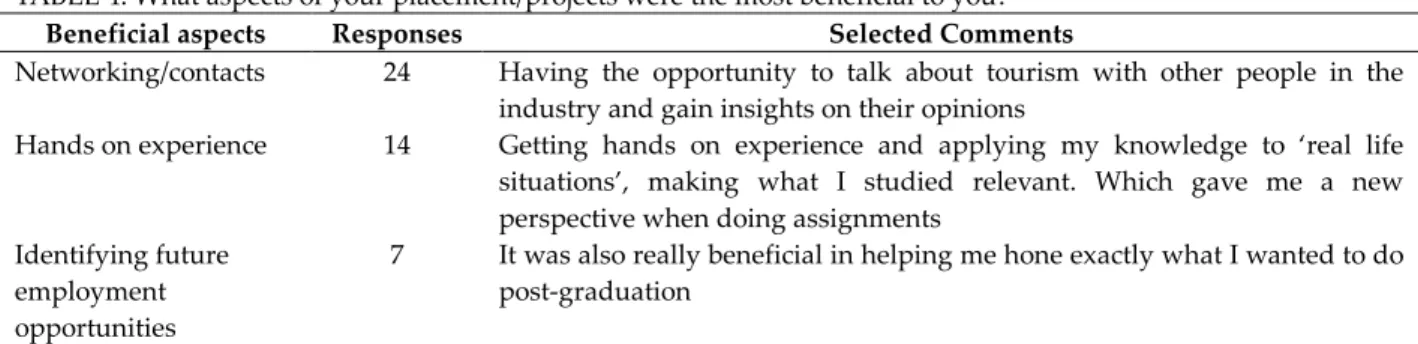
Networking/contacts 24 Having the opportunity to talk about tourism with other people in the industry and gain insights on their opinions
Hands on experience 14 Getting hands on experience and applying my knowledge to ‘real life situations’, making what I studied relevant. Which gave me a new perspective when doing assignments
Identifying future employment opportunities
7 It was also really beneficial in helping me hone exactly what I wanted to do post-graduation
Similarly to Table 3, respondents saw networking contacts and engaging with industry professionals as the predominant benefit of the WIL activity (53%). Alumni also identified employment experience and employment opportunities as a benefit but also that they had gained dispositional knowledge such as confidence in their skills and abilities (Billet, 2009).
TABLE 5: In what ways do you believe your industry placement benefitted your host organisation?
Benefits to host Responses Selected Comments
Extra assistance – ease the workload
37 My host organisations were able to get some really useful information collated and reported to them. Furthermore, I was able to create some social media pages that may not be able to afford a staff member to do this work. Fresh ideas 17 They had access to a volunteer who had knowledge and suggestions to
improve their organisation. They could learn from some of the ideas or experiences that students had been exposed to.
Vetting future employees
5 Fresh look at opportunities for the business from new recruits. One of my hosts also employed me for nearly two years after my placement with their organisation.
Respondents confirmed what other researchers have highlighted in relation to the benefits of WIL to host organisations. Having providers that value the knowledge, fresh ideas and approaches that students bring to placement is perceived by the respondents as important (see ‘Fresh ideas’ above). Students can also add value to the organisation, ease workload pressures and complete tasks that the organisation needs to do but has been unable to due to being time and resource poor (Harvey, 2001). The provision of extra assistance to host organisations is perceived as the most positive outcome (62%).
CONCLUSION
The findings of this pilot study of Tourism alumni provides insight into the benefits of work integrated learning to students and also the alumnus’ perceptions of the benefits of WIL to the industry provider or host organisation. It is clear that WIL activities are of significant benefit to students by providing them with real world activities and by extending their university education outside of the classroom and, as a consequence, are highly valued by alumni for that reason. The findings related to Tourism alumni experiences concurs with other research undertaken in this area. (Fanning, 2010; Dressler & Keeling, 2011). For the respondents of this pilot study, WIL activities also enabled students (while still studying) to confirm their career choice, which is an essential step for educators endeavouring to create work ready graduates (Daniel & Daniel, 2013). The necessity to network and meet industry professionals to establish and further a career in the industry is discussed at length in the classroom, of course, but it is difficult to teach what ‘networking’ is until students are placed in an actual business setting and can experience it for themselves. The fact that alumni recognise this as a benefit needs further exploration. Is networking something that becomes identifiable as a benefit once students have graduated or were they aware of it while they were still a student?
Primarily respondents felt that the biggest benefit they provided to host organisations was in the easing the organisation’s workload within a learning context, without feeling that they were being used as free labour. This finding is an extension of employer benefits noted by Braunstein et al. in 2011. It was important to alumni that they felt they were able to provide fresh ideas that were valued by the host organisation (Harvey, 2001). Further
research on the host organisation’s perceptions of the benefits of WIL to them would confirm whether the alumni’s perceptions are accurate.
Whether WIL activities are a determining factor in students choosing to undertake a specific degree, in this case tourism, needs further investigation beyond this pilot study. Whilst the results in this study show that WIL was not a determining factor (35%) for selecting their academic program, the results for the most recent graduates identified the opposite (55%) and anecdotally 75% of the 2014 first year tourism cohort chose their degree because they could do a placement. A longitudinal study, with cross tabulation of results would clarify if this shift identifies a new trend in perceptions and how other factors such as combined degrees, articulated pathways etc., which do not offer placements may have affected student choice of program.
Clearly WIL activities are desired by students and are seen as having a range of positive outcomes for both the student and the industry provider. More comprehensive research along the lines of this pilot study will provide more conclusive evidence that can be used by WIL coordinators, the industry and the university in maximising the benefits of WIL activities to all. WIL also has the potential to be a marketable commodity to distinguish between University programs.
REFERENCES
Braun, V. and Clarke, V. (2006) Using thematic analysis in psychology. Qualitative Research in Psychology, 3(2) pp. 77-101. ISSN 1478-0887
Braunstein, L.A, Takei, H., Wang, F. & Loken, M.K. (2011). Benefits of cooperative and work integrated education for
employers. In R.K. Coll &. Eames (Eds.), International handbook for cooperative education: An international perspective of the theory, research and practice of work-integrated learning. Boston: World Association for Cooperative Education
Billett, S. (2009). Realising the educational worth of integrating work experiences in higher education. Studies in Higher Education. 34(7) 827 – 843
Burge, L. (2012). Infinite possibilities: exploring opportunities for non-traditional students to become global citizens. Widening Participation and Lifelong Learning. 13(-1), 6-18. doi: 10.5456/wpll.13.s.6
Chen, T., Shen, C. (2012). Today’s intern, tomorrow’s practitioner? – the influence of internship programmes on student’s career development in the Hospitality industry. Journal of Hospitality, Leisure, Sport & Tourism, 11(1), 29-40.
Cooper, L., Orrell, J., & Bowden, M. (2010). Work Integrated Learning: A Guide to Effective Practice. Hoboken. New York: Hoboken Taylor & Francis.
Daniel, R. & Daniel, L. (2013). Enhancing the transition from study to work: Reflections on the value and impact of internships in the creative and performing arts. Arts and Humanities in Higher Education, 12(2-3), 138-153.
Dressler, S., & Keeling, A.E. (2011). Student benefits of cooperative education. In R.K. Coll &. Eames (Eds.), International handbook for cooperative education: An international perspective of the theory, research and practice of work-integrated learning.
Boston: World Association for Cooperative Education.
Fanning, C. (2010) Flinders Tourism Work Integrated Learning Programmes – evaluating learning outcomes. Proceedings of
ACEN National Conference – Work Integrated Learning (WIL) - Responding to Challenges, Curtin University, Australia. Flinders University. (2010). Work-Integrated Learning Policy. Retrieved from
http://www.flinders.edu.au/ppmanual/teaching-course-management/work-integrated-learning-policy.cfm
Harvey, L. (2001). Defining and Measuring Employability, Quality in Higher Education, 7(2), 97-109.
Macleod, C.A.L., Fanning, C.T., Cavaye, A.L.M., Mills, D.A., Oliphant, J. and Sweet, L.P. (2010). Learning and Leading; An innovative approach towards maximising the effectiveness of work integrated learning. In 5th ERGA conference: The Changing Face of Education. Adelaide: Education Research Group of Adelaide. 5th ERGA Conference. Adelaide. Sep 2010.
Miles, M.B. & Hubermann, A.M. (1994) Qualitative Data Analysis: An Expanded Sourcebook. London: Sage Publications. Patrick, C-j., Peach, D., Pocknee, C., Webb, F., Fletcher, M., Pretto, G. (2008, December).
The WIL [Work Integrated Learning] report: A national scoping study [Australian
Learning and Teaching Council (ALTC) Final report]. Brisbane: Queensland University of Technology. Retrieved from http://eprints.qut.edu.au/44065/1/WIL-Report-grants-project-jan09.pdf
Van Gyn, G.,Cutt, J., Loken, M. & Ricks, F. (1997). Investigating the educational benefits of cooperative education: A longitudinal study. Journal of Cooperative Education, 32(2), 70-85.
Veal, A.J. (2005). Business Research Methods- a managerial approach (2nd Ed). Sydney: Pearson.
Copyright © 2014 Chris Fanning, Lynn Vanzo & Ceri Macleod
The author(s) assign to the Australian Collaborative Education Network Limited, an educational profit institution, a non-exclusive licence to use this article for the purposes of the institution, provided that the article is used in full and this copyright statement is reproduced. The author(s) also grant a non-exclusive licence to the Australian Collaborative Education Network to publish this document on the ACEN website, and in other formats, for the Proceedings of the ACEN National Conference, Gold Coast 2014. Any other use is prohibited without the express permission of the author(s).