Technique using Linear Regression
Maryam Dialameh, Ali Hamzeh, and Hossein Rahmani
Abstract—Regularization plays a vital role in the context of deep learning by preventing deep neural networks from the danger of overfitting. This paper proposes a novel deep learning regularization method named as DL-Reg, which carefully reduces the nonlinearity of deep networks to a certain extent by explicitly enforcing the network to behave as much linear as possible. The key idea is to add a linear constraint to the objective function of the deep neural networks, which is simply the error of a linear mapping from the inputs to the outputs of the model. More precisely, the proposed DL-Reg carefully forces the network to behave in a linear manner. This linear constraint, which is further adjusted by a regularization factor, prevents the network from the risk of overfitting. The performance of DL-Reg is evaluated by training state-of-the-art deep network models on several benchmark datasets. The experimental results show that the proposed regularization method: 1) gives major improvements over the existing regularization techniques, and 2) significantly improves the performance of deep neural networks, especially in the case of small-sized training datasets.
Index Terms—Deep Networks, Regularization, Linear Regres-sion.
I. INTRODUCTION
Regularization is a popular and essential technique in the field of machine learning, reducing the complexity of learned models while allowing them to predict accurately over a set of unseen data during the test phase [23]. This technique even becomes more vital in the concept of deep learning because of their highly nonlinear behaviors, which adding even one more layer increases the nonlinearity of models to a considerable extent [15], resulting in a poor generalization performance on unseen samples.
According to a taxonomy proposed in [14], deep learning regularization techniques could be divided into five main categories. Data-based regularization is the first category, which aims to either simplify the representation of input data by applying certain transformations or creating a large number of data points using data augmentation techniques. The second category is based on modifying the network structure such as imposing restrictions on the number of nodes/layers and choosing a proper activation function. Regularization via the error function is the third type of this taxonomy trying to add certain features to the error function such as robustness to imbalanced data. The fourth category is based on modifying the optimization algorithm used to learn network. Termination
M. Dialameh is with the Department of Computer Science, Shiraz University, Shiraz, IRAN, e-mail: [email protected].
A. Hamzeh is with the Department of Computer Science, Shiraz University, Shiraz, IRAN, e-mail: [email protected].
H. Rahmani is with the School of Computing and Communications, Lancaster University, UK, e-mail: [email protected].
methods, DropOut, momentum, and weight initialization are some examples of this category. The last category is based on adding a regularization term into the network loss-function. It is assumed that there is no dependency between the regularization term and targets in this category, and they are independent of each other. Weight decay and`2−norm are two typical examples of this category.
Because of the highly nonlinear behavior of deep learning models, especially when they become deeper by adding more layers, they naturally tend to do more memorization than generalization. This problem even becomes more serious when the size of train-data is small. Moreover, although many researchers have tried to address this problem, it undoubtedly needs more work, as the danger of overfitting has remained not completely solved in the context of deep learning models. Moreover, none of the current existing regularization methods explicitly try to enforce deep networks to behave less nonlinear. That is, there is no method yet that explicitly penalizes deep networks from learning a highly nonlinear model, and this area is still open to research. Additionally, it is desirable for a regularizer to be efficient, simple, computationally inexpensive, and result in discriminative features maps. Satisfying all these characteristics together, however, is subject to more research. Considering the aforementioned points, this paper proposes a simple but efficient regularization method, named as DL-Reg (an abbreviation for Deep Learning DL-Regularization), by adding a regularization term into the network’ s loss function, enforcing the learned model to explicitly behave as much linear as possible. In other words, the proposed DL-Reg, which could be categorized into the last category outlined above, not only explicitly penalizes the network from learning a purely highly nonlinear model, but also gives enough motivation for learning as linear as possible while preserving the discrimination ability of the model. To accomplish this, we take the advantage of linear regression and propose a least-squares error-term, representing the squared error of a linear mapping from the inputs of the network to its outputs. This term simply motivates the network to behave as linearly as possible so that minimizes the least-squares errors. Additionally, the main contributions of this work can be summarized as follows:
• Regularizing deep networks using the sum of squared errors of a linear regression model which directly maps the inputs to the output of the network • Allowing supervised deep networks to be trained
using the semi-supervised learning
• Increasing the performance of deep networks on the small-sized dataset
• Conducting extensive experiments to certify the
significance of the proposed method in enhancing the performance of deep networks
The rest of this paper is structured as follows. Section II provides a brief survey of the related regularization approaches. Section III presents the proposed regularization method in depth. Section IV reports the experimental results, and section V discusses the findings and provides several possible future trends. Finally, Section VI concludes the paper.
II. RELATEDWORK
This section covers a brief background of several regulariza-tion methods used in the context of deep learning.`2−norm, which works similar to Weight Decay in the case of SGD-optimizer [28], is perhaps one of the well-known traditional regularizing methods, which is simply γ2||w||2
2, where γ is a regularization factor, and w is the weights of the network [15], [13]. In a recent work [16], however, it was shown that separating the weight decay from the gradient-based updating rule can substantially improve the generalization ability of the learning, particularly in the case of Adam optimizer.
Smoothness [2] is another regularization method, which penalizes large derivatives in the model and is defined by ||J acfw(x)||F, where J ac(.) and ||.||F denote the Jacobian of the networkf parametrized by wand the Frobenius norm, respectively. In another work,`2−normof the gradient of loss function was applied to obtain a loss-invariant backpropagation, which makes the loss invariant to the input changes [4]. Hessian Penalty [22] has been proposed as a fast approximation of`2−
norm of the Hessian of the network by penalizing Jacoobian with noisy inputs. This idea was further exploited in [18] to build a robust network against adversarial examples.
To improve the performance of recurrent neural networks (RNN), it is shown that imposing unitary or orthogonal constraints on the weight matrices prevents the network from the problem of vanishing/exploding gradients [1], [29]. In another research, matrix spectral norm [33] has been used to regularize the network by making it indifferent to the perturbations and variations of the training samples. More precisely, the parameters of the model are trained so that the spectral norm of weights is small, allowing the network to not be sensitive to the changes in the order of training data at each epoch. In the same direction, SHADE [3] has been proposed whose loss function is based on the conditional entropy trying to minimize the variation in the input representations. Inspired by [8], Louizoset al.[17] leverage the notion of weight sparsity, trying to set a certain number of the weights of the network as zeros by applying`0−norm; however, it is applicable for a certain condition, as `0−normis not generally differentiable. In the same way, group sparse regularization method [25] applies the notion of `2,1 −norm sparsity on the sets of outgoing weights from neurons.
Shake-Shake regularization [6] was proposed for only a specific type of residual network (ResNet). It follows the idea of adding gradient noise to the learning procedure where gradient noise is replaced by gradient augmentation, allowing the network to escape from local optima. More precisely, this approach multiplies the output of residual branches by a random
scaler and adds the results to both forward and backward passes. ShakeDrop regularization [30] is an extension of Shake-Shake that can be applied to other ResNet models.
The family of drop methods, initially introduced by DropOut [27], is another type of regularization method, which prevents deep learning techniques from overfitting by randomly dropping a certain number of neurons during different epochs of training. DropBlock [7], DropBand [31], DropFilter [21] are several recently proposed methods of this family. DropBlock randomly drops a certain number of continuous regions in feature maps. DropBand drops one channel of input data each time, and DropFilter randomly drops some elements of convolutional layers. Additionally, Spectral DropOut [12] is another member of this family, which prevents overfitting by firstly calculating Fourier coefficients of the network and then eliminating noisy and weak coefficients; it, however, needs additional calculations to find Fourier coefficients. Cutout [5] is a restricted type of DropOut-based regularizers that randomly masks squared regions of inputs. This masking forces the network to learn complementary features, which is helpful in case of occlusion. Overall, having a closer look at this family, one can see that such methods are different in terms of dropping layers and/or dropping nodes/weights; however, there is not much difference between them in terms of performance in practice, and they behave almost like DropOut.
Moosavi-Dezfooliet al.[20] proposed a new regularization technique by minimizing the curvature of the loss surface, which is helpful in the case of adversarial robustness. However, their optimization procedure needs to calculate the eigenvalues of a Hessian loss, which is computationally complex. Stankovic
et al. [32], took the advantage of graph Laplacian regularizer to address the problem of limited training data in deep neural networks. The proposed method is based on iteratively solving a quadratic programming problem, which adds more computation to the training phase. Apart from that, this method works only for binary classification problems.
A modification of the softmax loss function, which is called Angular softmax [34], was recently proposed as an explicit regularization technique, trying to increase the inter-class separability by distancing between class centers. Although this method, theoretically, leads to more discrimination, the empirical results over different types of datasets are far from expectations. Moreover, Angular softmax is a new/modified loss function, not a regularization method in general. Another recent work is style transfer regularization [19], which tries to regularize the network by generating new data, mostly textured image data, through combining the content of an image with the appearance of another one.
Based on the above summary, we can conclude that none of the current regularization methods have all the properties of simplicity/generality, efficiency, and dealing with small-sized training datasets at the same time. Accordingly, this paper aims to propose an efficient, but simple, method for regularizing deep neural networks, allowing the networks to extract highly discriminative features, as the experimental results certify this assertion. Moreover, the proposed method is suitable for the case of small-sized training datasets.
III. PROPOSEDMETHOD
This section describes the proposed regularization method (DL-Reg) in details. A deep neural network can be considered as a function parameterized by a set of weights that maps an n-dimensional input x ∈ Rn to a c-dimensional output
fW(x)∈Rc, i.e., fW: x→fW(x). The goal of training is
to find an optimal set of weights W∗ minimizing a certain
empirical risk function J(W): W∗= arg min
W
J(W;X, Y), (1)
where X = [x1, x2,· · · , xm]T ∈ Rm×n and Y =
[y1, y2,· · ·, ym]T ∈Rm×c is the corresponding binary label matrix. Y is defined as follows: for each training sample
xi(i= 1,· · ·, m),yi ∈ Rc is its label vector. If xi is from thekth class (k= 1,· · · , c), then only thekth entry ofyi is one and all the other entries are zero. The risk functionJ then takes the following form:
J(W;X, Y) =Pm
i=1L(fW(xi), yi) +γΩ(...), (2) whereLis a loss function, which calculates the error between the output of the network fW(xi) and the target yi, Ω is a regularization function that may consume a certain number of inputs except the targets, and γ is a regularization factor, which determines the importance of regularization in the risk function. Considering the aforementioned definitions, this work aims to propose a regularization function Ω, which improves the generalization ability of the network, particularly in case of small sample size problems. Accordingly, we propose the following regularization function, which is simply the squared norm of error between a linear mapping of the inputs and the outputs of the network:
ΩZ(X, fW(X)) =||XZ˙ −fW(X)||22, (3) whereZ ∈R(n+1)×c is a linear transformation operator (the last row of Z represents bias parameters), which mapsX˙ ∈
Rm×(n+1)(i.e.X concatenated by a column of all ones) to the c-dimensional outputXZ˙ , and||.||2denotes`2−norm. In other words,ΩZ calculates the error of a linear regression between the inputs and the outputs of the network. The parameters ofZ
are initialized randomly and then updated during the training process of the deep neural network. More precisely, whenever the parameters W of the network get updated, Z is updated as well.
Practically speaking, Eq. (3) can be applied for the case of mini-batch optimization. Therefore, it can be rewritten as follows:
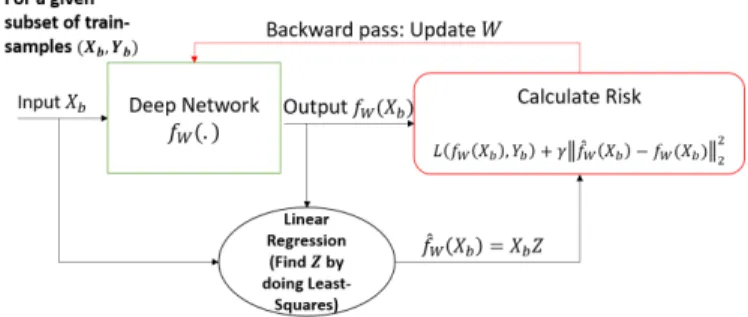
ΩZ(Xb, fW(Xb)) =||XbZ−fW(Xb)||22 (4) where Xb ∈ Rs×(n+1) represents a mini-batch subsamples of X concatenated by a column of all ones as the biases multipliers, s is the size of a batch, and fW(Xb) ∈ Rs×c. Figure 1 shows a graphical view of DL-Reg.
Minimizing Eq. (4) w.r.t.Zis a typical least-squares problem and could be solved by a closed-form solution as follows:
Z∗=XT
b(XbXbT)
−1f
W(Xb) (5)
Because the number of samples in a mini-batch,s, is often smaller than the size of the input,n,i.e.,sn,Xb is a fat matrix, and can be accounted as a full-row rank matrix. Hence, the inverse ofXbXbT exists as it forms a full rank matrix.
It is also worthwhile noting that in a case ofsn, which is almost quite rare in deep learning problems, Eq. (4) could then be solved as follows:
Z∗= (XbTXb)−1XbTfW(Xb), (6) in whichXb becomes a full-column rank,i.e., tall matrix, and consequently(XbTXb)−1 exists [9].
Eq. (3) aims to keep the network to behave as a linear mapping function and penalize the network when it behaves highly nonlinear. Hence, one concern about the proposedΩ -function might be its negative impact on the nonlinearity power of the deep networks, as the major power of deep learning methods is rooted in their abilities to produce nonlinear feature maps. This concern, however, can be rejected because the regularization factor γ adjusts the impact of linearization enforced by Ω-function, and choosing a proper value of γ
can easily resolve this concern. It is worthwhile noting that the parameter γcould be selected through a cross-validation procedure over a validation set. Additionally, the independence of Ω-function from the targets allows the network to take the advantage of unlabeled training data and makes it also suitable for the case of semi-supervised learning [24].
Fig. 1:A schematic overview of the proposed regularization method.
IV. EXPERIMENTS
This section evaluates the effectiveness of the proposed regularization method on several state-of-the-art deep network architectures, such as ResNet-152 [10], DenseNet [11], and VGG [26]. The evaluation is performed on the task of image classification using several benchmark datasets including MNIST, CIFAR-10, CIFAR-100, and ImageNet. Needless to say that the parameters used in the training phase of each architecture, such as learning rate, epochs, and batch-size are the same for both cases of using and not using our proposed regularization method.
A. CIFAR DATASETS
This subsection reports the results of our proposed regular-ization function on CIFAR-10 and CIFAR-100 and compares them to the original case of each network, i.e., the case of not
TABLE I:The comparison of test results on 10 and CIFAR-100. The improvement ratio shows the amount of improvement achieved by applying the proposed regularization method. Batch-size is set to 128.
CIFAR10 CIFAR100
Original Proposed Improvement Original Proposed Improvement
Network
DensNet-121 93.25 95.63 +%2.55 69.4 73.28 +%5.59 VGG-13 92.26 93.66 +% 1.52 67.25 71.3 +%6.02 ResNet-152 92.71 95.0 +% 2.47 75.67 77.33 +%2.2 EfficientNetB0 89.11 91.77 +% 2.99 78.61 80.05 +%1.83
TABLE II:The comparison of test results on a randomly reduced sets (20k) of CIFAR-10 and CIFAR-100. The improvement ratio shows the amount of improvement achieved by applying the proposed regularization method. Batch-size is set to 128.
CIFAR10 CIFAR100
Original Proposed Improvement Original Proposed Improvement
Network
DensNet-121 89.73 91.95 +%2.47 68.21 72.56 +%6.37 VGG-13 88.61 90.62 +%1.70 58.89 70.36 +%19.47 ResNet-152 87.02 89.31 +%2.63 62.33 75.42 +%21.0 EfficientNetB0 83.16 86.17 +%7.39 64.3 76.01 +%18.21
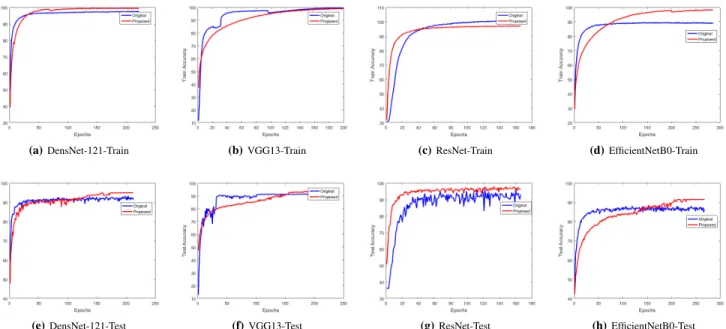
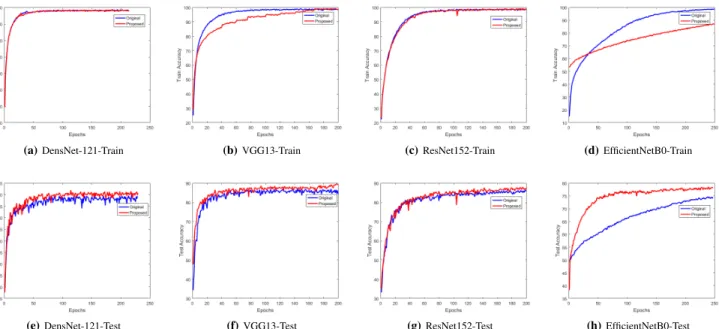
using the proposed regularization. CIFAR-10 consists of 60k 32×32 color-images divided into 10 classes. Moreover, the standard training and testing sizes are50kand 10k respectively, where the size of each training class is 5k. CIFAR-100 is the same as CIFAR-10, except that it has 100classes, where each class has 500 training images. Tables I and II report the classification accuracies of each model in each dataset, where the latter uses a subset of the original dataset as training data. Additionally, Figures 2 to 5 show the diagrams of train/test accuracies in accordance of Tables I and II, depicting the learning behaviors of the proposed method, and its ability to escape from local optima, e.g., sub-figures 2.(a,d). As the figures illustrate, in most cases the diagrams of proposed train accuracies are lower than those of original methods, certifying the less sensitivity of the proposed regularization to overfitting. Finally, training/testing diagrams of accuracies in Figures 2 and 3. As the results show, applying the proposed method results in a significant improvement for each network. More importantly, Table II demonstrates the overfitting robustness of the proposed regularization in case of small-sample-sized problems, i.e., there are small drops in accuracies.
B. ImageNet
This experiment investigates the impact of our proposed regularization term on a very large-scale set of images. ImageNet is a large image-classification dataset with more than
1 million annotated images divided into1000 classes. Table III reports the classification results on ImageNet and a reduced training set of ImageNet by randomly selecting 200 images from each category, therefore 200k in total. As the results verify, applying the proposed regularization method could significantly increase the performance of each method. More importantly, the improvement ratios on the reduced version of ImageNet are significantly higher than those of the full dataset, supporting the idea that the proposed method could be helpful in case of
TABLE III:The comparison of top-1 test results on ImageNet and a randomly reduced set of ImageNet (200k). The improvement ratio shows the amount of improvement achieved by applying the proposed regularization method.
ImageNet Reduced ImageNet
Original Proposed
Improvement
Ratio Original Proposed
Improvement Ratio Network DensNet-121 74.98 77.2 +%2.96 62.9 70.5 +% 12.08 VGG-13 74.1 76.33 +%3.0 61.25 69.05 +% 12.73 ResNet-152 78.57 79.8 +%1.56 69.7 75.4 +% 8.17 EfficientNetB0 76.3 78.15 +%2.42 65.4 69.1 +% 5.65
small-sample-size problems by reducing the chance of overfit-ting. Detailed specifications and preprocessing steps of each method are available in https://paperswithcode.com/sota/image-classification-on-imagenet.
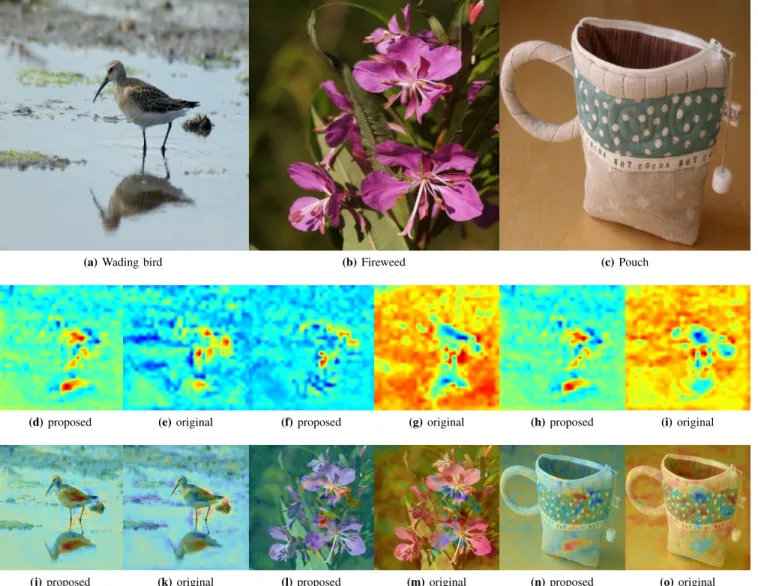
To have a deeper investigation on the effectiveness of the proposed method, we use class investigation maps (CAM), which is introduced in [35], to depict class activations of each architecture on several samples of ImageNet’s test set. To do that, we randomly select three classes of ImageNet depicted in the first row of Figure 6. Then, we calculate their CAMs using the original DensNet-121 and the one equipped with the proposed regularization (the second row shows the obtained CAMs), where both networks are trained on ImageNet. Finally and to have a better view, the third row combines the first two rows as one. From the results, it is evident that the proposed regularization forces DensNet-121 to learn discriminative features from the object of interest in each class, while the original DensNet-121 tends to memorize most areas of images. In the case of Fireweed, for instance, the equipped version of DensNet-121 with our proposed regularization uses a few number of petals to make decision, while the the original DensNet almost uses all areas of image in its decision, which eventually leads to a lower generalization.
C. Comparison with`2−norm regularizer
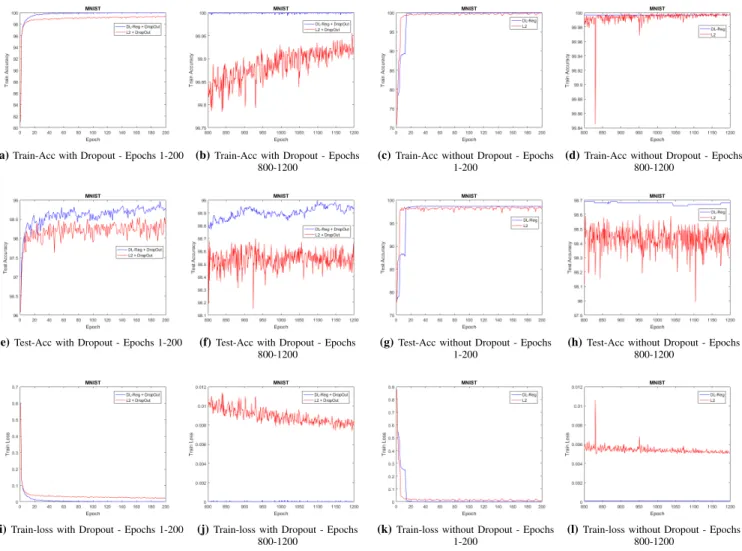
This subsection conducts several experiments on the MNIST dataset to compare the performance of the proposed regulariza-tion technique (DL-Reg) and the well-known`2−norm. The reason for selecting`2regularizer is that it belongs to the same category (see Section I) as DL-Reg; hence, the comparison is fair. In all experiments, we use the same parameter settings including randomness, train/test size, batch-size, learning rate, max-epoch, and every other setting. Table V describes a list of such parameters along with their assigned values. Moreover, we use the same network structure, consisting of three sequential hidden layers (1024, 1024, 2048) with ReLUs and with/without Dropout rates of 0.2 for the input-layer and0.5 for the other layers. Figure 7 depicts the obtained per-epoch results in terms of train and test accuracies as well as train losses. To have a better view over the results, we only depict the results of the first 200 epochs and the last 400 epochs of the learning procedure. Therefore, it becomes easier to compare the learning behaviours of models at the beginning and the end of training. Additionally, the final test accuracy of each strategy is reported in Table IV.
(a)DensNet-121-Train (b)VGG13-Train (c)ResNet-Train (d)EfficientNetB0-Train
(e)DensNet-121-Test (f)VGG13-Test (g)ResNet-Test (h)EfficientNetB0-Test
Fig. 2: CIFAR10- The classification accuracies are obtained by applying our proposed regularization method on four different networks. Rows show training/testing results obtained from each network.
(a)DensNet-121-Train (b)VGG13-Train (c)ResNet-152-Train (d)EfficientNetB0-Train
(e)DensNet-121-Test (f)VGG13-Test (g)ResNet-152-Test (h)EfficientNetB0-Test
Fig. 3: CIFAR100- The classification accuracies are obtained by applying our proposed regularization method on four different networks. Rows show training/testing results obtained from each network.
As it is depicted in Figure 7, in all cases the proposed regularization method achieves higher accuracy in both test and train phases, and a lower value of training loss. More precisely, the proposed DL-Reg shows a superior behaviour to
`2regularizer in both cases of with and without Dropout layers. The convergence speed is another significant implication of the proposed method. We can observe that DL-Reg shows even a faster rate of convergence and a more stable behavior compared to`2 regularizer. That is to say that DL-Reg can successfully reduce the nonlinearity of deep networks by implicitly forcing the neurons of the networks to behave as linear as necessary.
Another interesting observation by investigating Figure 7(c) is the fact that`2regularizer performs better at the first epochs of the training; however, after a certain number of epochs, DL-Reg reveals its generalization power and performs superior to`2 regularizer.
V. DISCUSSION ANDFUTUREWORK
There is always a trade-off between the amount of data used for training and the depth of the model on one side, and the model’s complexity in terms of memory and time on another side. The proposed regularization technique forces the
(a)DensNet-121-Train (b)VGG13-Train (c)ResNet152-Train (d)EfficientNetB0-Train
(e)DensNet-121-Test (f)VGG13-Test (g)ResNet152-Test (h)EfficientNetB0-Test
Fig. 4: Reduced-CIFAR10 -The classification accuracies are obtained by applying our proposed regularization method on four different networks while the training size of dataset is randomly reduced to 20k. Rows show training/testing results obtained from each network.
(a)DensNet-121-Train (b)VGG13-Train (c)ResNet152-Train (d)EfficientNetB0-Train
(e)DensNet-121-Test (f)VGG13-Test (g)ResNet152-Test (h)EfficientNetB0-Test
Fig. 5: Reduced-CIFAR100- The classification accuracies are obtained by applying our proposed regularization method on four different networks while the training size of dataset is randomly reduced to 20k. Rows show training/testing results obtained from each network.
TABLE IV:Comparison of`2 and the proposed DL-Reg
regulariza-tion methods on MNIST dataset.
Method Test Classification Accuracy
`2 regularizer 98.38
Dropout+`2regularizer 98.47
DL-Reg (proposed) 98.69
Dropout+DL-Reg (proposed) 98.94
network to behave as linear as possible. That is, it limits the network to learn a highly nonlinear function while preserving its prediction’s ability. This limitation enables the network to
learn discriminative features. This ability is clearly visible in the obtained results depicted in Figure 6. In the case of Wading bird, for instance, the proposed method uses the wings’ pattern of the bird for detecting this object, which obviously provides enough discrimination. It is worthy to note that the proposed method even detects the wings’ reflection on the water, which is incredible.
The parameter of regularization factor, i.e., γ, plays an essential role in the performance of DL-Reg. If γ increases, then the learning ability of the network reduces, causing the network to entirely behave like a linear regression. In
(a)Wading bird (b)Fireweed (c)Pouch
(d)proposed (e)original (f)proposed (g)original (h)proposed (i)original
(j)proposed (k)original (l)proposed (m)original (n)proposed (o)original
Fig. 6:The results of Class Activation Mapping (CAM) of DensNet-121 on several images taken from ImageNet. The first row shows original images, and the second row depicts the obtained CAMs with and without the proposed regularization. The third row combines the previous rows to have a better view of CAMs. As the results show, the CAMs of the proposed regularization highlight less but more discriminative areas of the image, e.g., the wings of the bird, which is very discriminative, are highlighted even on the water, while the CAMs of the original network tend to highlight more but less discriminative areas of the image, e.g, look at sub-figures (g,i).
TABLE V: The hyper-parameters of the fully-connected networks (784→1024→1024→2048→s10) trained on MNIST dataset, (Subsection IV-C).
Parameter Value
Learning rate (lr) 0.1
Decay rate for lr 0.96
lr-scheduler Exponential
Frequency of lr-scheduler every 30 epochs
Optimizer SGD
Momentum 0.9
Loss function Cross-Entropy
Batch size 256
Data pre-processing None
Regularization factor for DL-Reg 1e−12
Regularization factor for`2regularizer 5e−4
contrast, ifγ approaches zero, then there would be no more regularization/generalization impact in the learning procedure. Therefore, the parameterγ should be chosen carefully in every
learning problem.
Finally, the main implications of the proposed regularization method are summarized as follows:
1) DL-Reg provides a better generalization in practice and learns discriminative features
2) The convergence speed of the proposed DL-Reg is fast; however, it depends to the value of regularization factor 3) The computational cost of DL-Reg is negligible 4) the proposed regularization method is easy to implement
and can be added to any network. In other words, it is independent of the choice of loss-function.
One of the promising areas of future work could be investigating the effects of adding the linearity restriction to each layer of the network, jointly or separately.
(a)Train-Acc with Dropout - Epochs 1-200 (b)Train-Acc with Dropout - Epochs 800-1200
(c)Train-Acc without Dropout - Epochs 1-200
(d)Train-Acc without Dropout - Epochs 800-1200
(e)Test-Acc with Dropout - Epochs 1-200 (f)Test-Acc with Dropout - Epochs 800-1200
(g)Test-Acc without Dropout - Epochs 1-200
(h)Test-Acc without Dropout - Epochs 800-1200
(i)Train-loss with Dropout - Epochs 1-200 (j)Train-loss with Dropout - Epochs 800-1200
(k)Train-loss without Dropout - Epochs 1-200
(l)Train-loss without Dropout - Epochs 800-1200
Fig. 7: A comparison between the traditional`2 regularizer and the proposed DL-Reg in two scenarios including with (first two columns)
and without (last two columns) Dropout layers on the MNIST dataset. The network structure and all other common settings are the same for both methods. To better visualize the training behaviour of models, only the results of the first 200 epochs and the last 400 epochs are shown. In both scenarios, DL-Reg outperforms`2 regularizer. Moreover, DL-Reg shows faster convergence and more stable behaviours.
VI. CONCLUSION
This paper proposes a linear technique named as DL-Reg for regularizing the family of deep neural networks. As such deep networks tend to learn highly nonlinear functions, DL-Reg forces the final network to behave as linear as possible and, at the same time, as nonlinear as necessary. A series of various experiments along with a comparison with the traditional`2 regularizer is conducted, and the obtained results show great improvements in classification performances of several state-of-the-art methods. We have also shown that DL-Reg is able to extract discriminative features while avoiding unnecessary and less discriminative ones. This behavior enables the final network to avoid overfitting. Moreover, the proposed method is easy to implement and increases the learning/convergence speed.
REFERENCES
[1] Martin Arjovsky, Amar Shah, and Yoshua Bengio. Unitary evolution recurrent neural networks. InInternational Conference on Machine Learning, pages 1120–1128, 2016.
[2] Yoshua Bengio, Aaron Courville, and Pascal Vincent. Representation learning: A review and new perspectives. IEEE transactions on pattern analysis and machine intelligence, 35(8):1798–1828, 2013.
[3] Michael Blot, Thomas Robert, Nicolas Thome, and Matthieu Cord. Shade: Information-based regularization for deep learning. In2018 25th IEEE International Conference on Image Processing (ICIP), pages 813–817. IEEE, 2018.
[4] Sergey Demyanov, James Bailey, Ramamohanarao Kotagiri, and Christo-pher Leckie. Invariant backpropagation: how to train a transformation-invariant neural network. arXiv preprint arXiv:1502.04434, 2015. [5] Terrance DeVries and Graham W Taylor. Improved regularization of
con-volutional neural networks with cutout.arXiv preprint arXiv:1708.04552, 2017.
[6] Xavier Gastaldi. Shake-shake regularization. arXiv preprint arXiv:1705.07485, 2017.
[7] Golnaz Ghiasi, Tsung-Yi Lin, and Quoc V Le. Dropblock: A regu-larization method for convolutional networks. InAdvances in Neural Information Processing Systems, pages 10727–10737, 2018.
[8] Xavier Glorot, Antoine Bordes, and Yoshua Bengio. Deep sparse rectifier neural networks. InProceedings of the fourteenth international conference on artificial intelligence and statistics, pages 315–323, 2011. [9] Per Christian Hansen, Víctor Pereyra, and Godela Scherer.Least squares
data fitting with applications. JHU Press, 2013.
[10] Kaiming He, Xiangyu Zhang, Shaoqing Ren, and Jian Sun. Deep residual learning for image recognition. InProceedings of the IEEE conference on computer vision and pattern recognition, pages 770–778, 2016. [11] Gao Huang, Zhuang Liu, Laurens Van Der Maaten, and Kilian Q
of the IEEE conference on computer vision and pattern recognition, pages 4700–4708, 2017.
[12] Salman H. Khan, Munawar Hayat, and Fatih Porikli. Regularization of deep neural networks with spectral dropout.Neural Networks, 110:82 – 90, 2019.
[13] Anders Krogh and John A Hertz. A simple weight decay can improve generalization. InAdvances in neural information processing systems, pages 950–957, 1992.
[14] Jan Kukaˇcka, Vladimir Golkov, and Daniel Cremers. Regularization for deep learning: A taxonomy. arXiv preprint arXiv:1710.10686, 2017. [15] Yann LeCun, Yoshua Bengio, and Geoffrey Hinton. Deep learning.
nature, 521(7553):436–444, 2015.
[16] Ilya Loshchilov and Frank Hutter. Decoupled weight decay regularization.
arXiv preprint arXiv:1711.05101, 2017.
[17] Christos Louizos, Max Welling, and Diederik P Kingma. Learning sparse neural networks through l_0 regularization. arXiv preprint arXiv:1712.01312, 2017.
[18] Chunchuan Lyu, Kaizhu Huang, and Hai-Ning Liang. A unified gradient regularization family for adversarial examples. In2015 IEEE International Conference on Data Mining, pages 301–309. IEEE, 2015. [19] Agnieszka Mikołajczyk and Michał Grochowski. Style transfer-based image synthesis as an efficient regularization technique in deep learning. In 2019 24th International Conference on Methods and Models in Automation and Robotics (MMAR), pages 42–47. IEEE, 2019. [20] Seyed-Mohsen Moosavi-Dezfooli, Alhussein Fawzi, Jonathan Uesato,
and Pascal Frossard. Robustness via curvature regularization, and vice versa. InProceedings of the IEEE Conference on Computer Vision and Pattern Recognition, pages 9078–9086, 2019.
[21] Hengyue Pan, Xin Niu, Rongchun Li, Siqi Shen, and Yong Dou. Dropfilterr: A novel regularization method for learning convolutional neural networks.Neural Processing Letters, pages 1–14, 2019. [22] Salah Rifai, Xavier Glorot, Yoshua Bengio, and Pascal Vincent. Adding
noise to the input of a model trained with a regularized objective.arXiv preprint arXiv:1104.3250, 2011.
[23] Ryan M Rifkin and Ross A Lippert. Value regularization and fenchel duality. Journal of Machine Learning Research, 8(Mar):441–479, 2007. [24] Mehdi Sajjadi, Mehran Javanmardi, and Tolga Tasdizen. Regulariza-tion with stochastic transformaRegulariza-tions and perturbaRegulariza-tions for deep semi-supervised learning. In Advances in neural information processing systems, pages 1163–1171, 2016.
[25] Simone Scardapane, Danilo Comminiello, Amir Hussain, and Aurelio Uncini. Group sparse regularization for deep neural networks. Neuro-computing, 241:81–89, 2017.
[26] Karen Simonyan and Andrew Zisserman. Very deep convolutional net-works for large-scale image recognition. arXiv preprint arXiv:1409.1556, 2014.
[27] Nitish Srivastava, Geoffrey Hinton, Alex Krizhevsky, Ilya Sutskever, and Ruslan Salakhutdinov. Dropout: A simple way to prevent neural networks from overfitting.Journal of Machine Learning Research, 15(56):1929– 1958, 2014.
[28] Twan Van Laarhoven. L2 regularization versus batch and weight normalization. arXiv preprint arXiv:1706.05350, 2017.
[29] Scott Wisdom, Thomas Powers, John Hershey, Jonathan Le Roux, and Les Atlas. Full-capacity unitary recurrent neural networks. InAdvances in neural information processing systems, pages 4880–4888, 2016. [30] Yoshihiro Yamada, Masakazu Iwamura, Takuya Akiba, and Koichi Kise.
Shakedrop regularization for deep residual learning. arXiv preprint arXiv:1802.02375, 2018.
[31] Naisen Yang, Hong Tang, Hongquan Sun, and Xin Yang. Dropband: A simple and effective method for promoting the scene classification accuracy of convolutional neural networks for vhr remote sensing imagery.
IEEE Geoscience and Remote Sensing Letters, 15(2):257–261, 2018. [32] Minxiang Ye, Vladimir Stankovic, Lina Stankovic, and Gene Cheung.
Deep graph regularized learning for binary classification. InICASSP 2019-2019 IEEE International Conference on Acoustics, Speech and Signal Processing (ICASSP), pages 3537–3541. IEEE, 2019.
[33] Yuichi Yoshida and Takeru Miyato. Spectral norm regularization for improving the generalizability of deep learning. arXiv preprint arXiv:1705.10941, 2017.
[34] Kai Zhao, Jingyi Xu, and Ming-Ming Cheng. Regularface: Deep face recognition via exclusive regularization. InProceedings of the IEEE Conference on Computer Vision and Pattern Recognition, pages 1136– 1144, 2019.
[35] Bolei Zhou, Aditya Khosla, Agata Lapedriza, Aude Oliva, and Antonio Torralba. Learning deep features for discriminative localization. In
Proceedings of the IEEE conference on computer vision and pattern recognition, pages 2921–2929, 2016.
Maryam Dialamehreceived her A.S. degree (2009) in computer engineering from University of Applied Science and Technology of Shiraz in Iran. She then received her B.S. degree (2012) in computer engineering and her M.S. degree (2017) in artificial intelligence from Azad University and Shiraz Univer-sity in Iran respectively. Her research interests include Machine Learning, Deep Learning, and Computer Vision. She has also published several national and international papers in these areas and beyond.
Ali Hamzeh received his B.S. and M.Sc. degrees in computer engineering and artificial intelligence from Shiraz University in Iran. Then he received his Ph.D. degrees in artificial intelligence from Iran University of Science and Technology, 2007. He has been an assistant professor of artificial intelligence at Shiraz University from 2007. His research interests include evolutionary computation, machine learning and social networks. Also, he has published over 150 peer-refereed articles in these areas.
Hossein Rahmani received the B.Sc. degree in computer software engineering from the Isfahan University of Technology, Isfahan, Iran, in 2004, the M.Sc degree in software engineering from Shahid Beheshti University , Tehran, Iran, in 2010, and the Ph.D. degree from The University of Western Australia, in 2016. He has published several papers in top conferences and journals such as CVPR, ICCV, ECCV, IJCV, IEEE TIP, IEEE TPAMI. He has received several research grants from EPSRC, Innovate UK and EU with combined funding of over $2.5 million. He is currently an Associate Professor (Lecturer) with the School of Computing and Communications, Lancaster University. Before that, he was a Research Fellow at the School of Computer Science and Software Engineering, The University of Western Australia. His research interests include computer vision and machine learning.