www.rsc.org/
advances
RSC Advances
This is an
Accepted Manuscript
, which has been through the
Royal Society of Chemistry peer review process and has been
accepted for publication.
Accepted Manuscripts
are published online shortly after
acceptance, before technical editing, formatting and proof reading.
Using this free service, authors can make their results available
to the community, in citable form, before we publish the edited
article. This
Accepted Manuscript
will be replaced by the edited,
formatted and paginated article as soon as this is available.
You can find more information about
Accepted Manuscripts
in the
Information for Authors
.
Please note that technical editing may introduce minor changes
to the text and/or graphics, which may alter content. The journal’s
standard
Terms & Conditions
and the
Ethical guidelines
still
apply. In no event shall the Royal Society of Chemistry be held
responsible for any errors or omissions in this
Accepted Manuscript
or any consequences arising from the use of any information it
contains.
Cite this: DOI: 10.1039/c0xx00000x
www.rsc.org/xxxxxx
ARTICLE TYPE
Involvement of process parameters and various modes of application of
TiO
2
nano particles in heterogeneous photocatalysis of pharmaceutical
wastes – A short review
Santanu Sarkar
a, Ranjana Das
a, Heechul Choi
band Chiranjib Bhattacharjee*
, a Received (in XXX, XXX) Xth XXXXXXXXX 20XX, Accepted Xth XXXXXXXXX 20XX5
DOI: 10.1039/b000000x
In recent years, occurrence of persistent organic compounds in industrial as well as municipal effluents is becoming a serious threat to the environment. The pharmaceutical compounds present along with those organics have a detrimental effect on our environment. Among various well established wastewater treatment technologies, advanced oxidation processes (AOPs) using TiO2 nano particle have shown promising results
10
against various organic wastewater pollutants. This study represents an in-depth review on applications of TiO2 in treatment of various pharmaceutical wastes and the effect of associated process controlling
parameters. It also highlights aspects of different techniques of application of TiO2 nano particle and
involvement of reaction kinetics in photocatalytic degradation.
1 Introduction
15
Increasing human and livestock population, along with industrial developments have raised the concern for environmental protection, waste management and pollution control along with the supply of safe drinking water. It has been estimated that around 4 billion people all over the world are facing little access 20
to clean and sanitized water supply, and millions are dying from waterborne diseases annually1. These statistical figures are steadily growing, due to increase in water pollution from micro pollutants and contaminants discharged to the natural water cycle
2, 3
. Studies have shown that, pharmaceutical wastes are directly 25
entering the sewage treatment process4-6 and adversely affecting the aquatic life7-9. In the present context of safe water supply, the developments of advanced, low-cost and high efficiency wastewater treatment technologies are becoming obvious. Techniques related to removal of suspended solids, health-threat 30
coli forms and soluble refractory organic compounds from wastewater are very tedious and expensive10. In current scenario, processes like adsorption, coagulation and concentration of the pollutants using phase change methodology does not completely eliminate or destroy the pollutants11. Due to high operating cost 35
and generation of secondary pollutants, processes of sedimentation, filtration and chemical wastewater treatments are also not well accepted12-15. To overcome the limitations of conventional wastewater treatments and effective utilization of available economic resources, various advanced treatment 40
technologies have been adopted, optimized, and applied12-14. Among well adopted technologies, membrane filtration, advanced oxidation processes (AOPs), and UV irradiation have been proven beneficial in removal of a wide range of challenging contaminants.
45
Advanced oxidation processes (AOPs) are the modern trend of pharmaceutical and municipal waste water treatment. The AOPs can be categorized as: photolysis, ozonization, Fenton’s oxidation, heterogeneous photocatalysis, electrochemical
oxidation, ultra sound irradiation and wet air oxidation16. 50
According to Klavarioti et al.16 ozonization and heterogeneous photocatalysis are the most accepted water and wastewater treatment methodologies. Several researchers have observed that, ozonization is more suitable for purification of drinking water17, 18 than pharmaceutical waste water treatment because; the latter 55
requires several downstream processing steps. Hence, heterogeneous photocatalysis using nano particles has become more effective in the treatment of pharmaceutical wastewater. Nano particles offer high surface area, which pretences higher surface reaction rate and they are also commercially available and 60
photo chemically stable. Due to presence of light absorption properties, charge transport characteristics, excited-state lifetimes and favourable combination of electronic structure19 semiconductors namely TiO2, MnO2 is mostly used as photo
catalysts in the AOPs. 65
This review aims to study the application of TiO2 nano particles
in the field of heterogeneous photocatalysis for treatment of pharmaceutical waste as well as several other related parameters that controls the process efficiency. Moreover, it also covers the several ways of utilization of TiO2 nano particle so that the
70
process becomes more acceptable as well as more economic. The involvement of different reaction kinetics related to photocatalytic degradation of pharmaceutical wastes using TiO2
has also been studied here.
2 Heterogeneous photocatalysis-a new trend of
75
advanced oxidation process
Developments toward heterogeneous photocatalysis (HPC) in presence of TiO2 are gradually rising and asserted to the
maximum percentage among all AOPs16, 20, 85. The most important literatures available on photocatalytic degradation of 80
pharmaceutical components which, has evidenced the effectiveness of photocatalysis as a promising process for pharmaceutical wastewater treatment have been summarized in
RSC
Advances
Accepted
table 1.
HPC by definition is oxidation of target molecules with the help of active radicals using nano particles as catalyst under UV light illumination. As soon as the UV radiation energy becomes equal or larger than band gap energy, minimum energy is required to 5
move one electron from valance band to conduction band, electrons (e-) move from the valance band to conduction at the
photocatalytic surface and therefore, it results in generation of holes (h+). Photo hole converts the water (H2O) molecules to
hydroxyl radical (OH•) and hydrogen cation (H+). The formed
10
OH· works as highly oxidizing agent and it transforms organic
substance, mainly present in pharmaceutical wastewater into carbon dioxide, water and other often less hazardous materials than the original one.
The whole mechanism for the process can be represented using 15 equation (1) to (4). + −+ → +hγ e h particle -nano catalytic Photo (1) − −+ → 2 2 O O e (2) + • ++ → + H OH O H h 2 (3) Others O H CO waste ical Pharmaceut OH + → 2+ 2 + • (4) 20
Fig. 1 Schematic representation of photocatalysis of pharmaceutical waste on the surface of TiO2 nano particle. In heterogeneous photocatalysis two reactions occur
consecutively; first one is the reduction of oxygen and the second one is the oxidation of pharmaceutical waste by hydroxyl radical. 25
During the excitation of TiO2 nano particle electrons are
accumulated in the conduction band, and thus it causes the generation of a hole. Therefore, it is necessary to consume
electrons to increase the efficiency of HCP in presence of nano photocatalyst and here it is consumed by the dissolve oxygen. 30
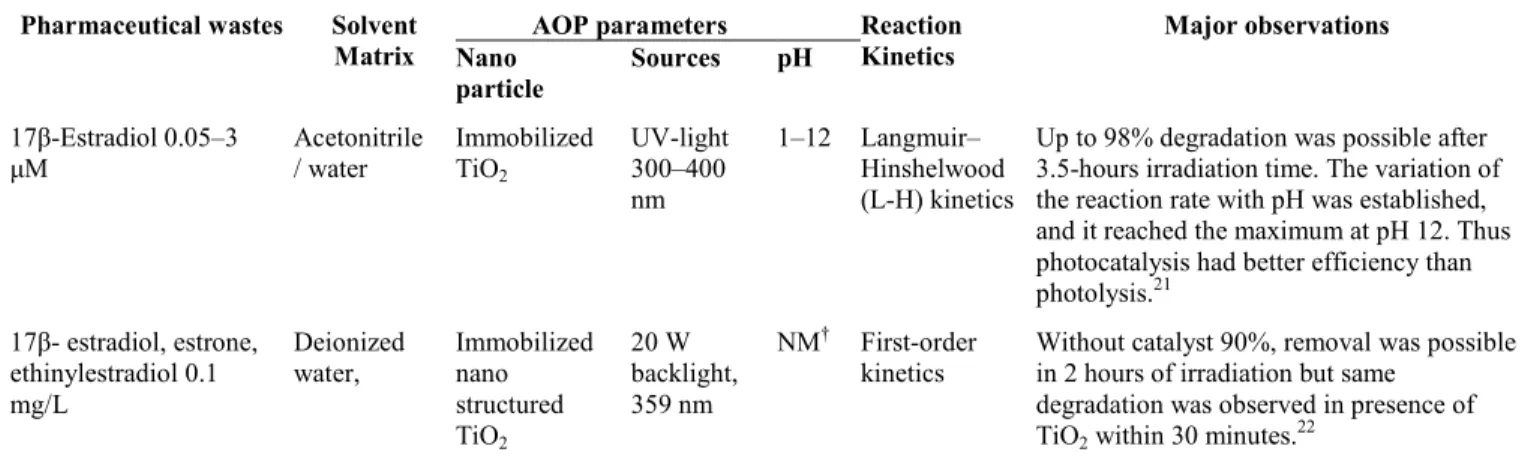
The whole reaction has been schematically represented in the figure 1. Some important parameters which influence the photocatalytic oxidation are light intensity, catalyst concentration, substrate concentration, temperature, pH of the medium, etc.21-93. Table 1 The photocatalytic degradation of pharmaceutical wastes using TiO2 nano particle
35
Pharmaceutical wastes Solvent Matrix
AOP parameters Reaction Kinetics Major observations Nano particle Sources pH 17β-Estradiol 0.05–3 µM Acetonitrile / water Immobilized TiO2 UV-light 300–400 nm 1–12 Langmuir– Hinshelwood (L-H) kinetics
Up to 98% degradation was possible after 3.5-hours irradiation time. The variation of the reaction rate with pH was established, and it reached the maximum at pH 12. Thus photocatalysis had better efficiency than photolysis.21 17β- estradiol, estrone, ethinylestradiol 0.1 mg/L Deionized water, Immobilized nano structured TiO2 20 W backlight, 359 nm NM† First-order kinetics
Without catalyst 90%, removal was possible in 2 hours of irradiation but same
degradation was observed in presence of TiO2 within 30 minutes.
22
RSC
Advances
Accepted
17β-Estradiol 1 µM Deionised water Suspended Degussa TiO2 (P25) UV-365 nm NM First-order kinetics
The total removal of 17β-Estradiol was possible, and it lost its activity. After 3 hours, the mineralization process completed and all by-products were identified.23 17β-Estradiol, estrone 250 µg/L Deionized water and industrial effluent. Immobilized TiO2 UV-black fluorescent lamp NM First-order kinetics
Rate of reaction depended on diffusion constant. As rate of diffusion of substrate molecules increased with surface area of catalyst and the temperature, the rate also increased with increase of both
parameters.24 Buspirone 15 mg/L Distilled water Suspended P25 Artificial sunlight NM First-order kinetics
Several structures of by-products were identified with different mechanisms. Maximum drug removal was possible during photocatalysis.27
Unconjugated and conjugated estrone and estradiol 1 mM Distilled water Immobilized TiO2 on glass beads UV lamp NM First-order kinetics
17-glucuronide and estrone was completely depredated within 4hrs of UV irradiation. Conjugates remain unaltered after 6.5 hours of the oxidation process.28
Clofibric acid, carbamazepine, iomeprol and iopromide
Distilled water Suspended P25 and Hombikat UV100 1000W Xe short-arc lamp < 400 nm 6.5 L-H kinetic model
P25 showed better degradation of clofibric acid and carbamazepine than Hombikat UV100 but in case of iomeprol it was reversed. As higher adsorption of iomeprol by Hombikat UV100 was observed. Possible degradation pathways were established.29 17β-Estradiol, estrone, 17α-ethylestradiol, 10 µg/L Distilled water Immobilized TiO2 High-Pressure Mercury UVA lamp NM First-order kinetics
The photocatalysis process was much faster than direct photolysis. Immobilized TiO2
inside the photo reactor helped to reuse catalyst more than single time. Thus efficiency of the process was improved.30 17α-Ethinylestradiol, 17β-estradiol, estriol 0.1–3 µM Acetonitrile/ water Immobilized P25 UVA & UVB 3 - 4 First-order degradation kinetics
Photocatalysis was more effective than photolysis. The rate of reaction increased with light intensity and initial substrate concentration. Pt and Ag were added a little amount to the system to boost the reaction and only Pt could enhance the performance of the reaction. 31 Iomeprol, clofibric acid, carbamazepine ∼2 mg/L Deionized water Suspended P25 or Hombikat TiO2 254 nm 6.8 Not mentioned
Microfiltration with backwashing enhanced the reusability of TiO2 and membrane.
Hombikat was more active in pilot plant than other type of TiO2 but batch studies
showed reverse results.32 Carbamazepine,
clofibric acid, iomeprol 0.5–5.2 mg/L Spiked lake water Suspended P25 or Hombikat TiO2 Artificial sunlight 6.5 Pseudo-first-order kinetics
P25 had more activity than other. The rate of degradation decreased and increased with an increase of substrate concentration and TiO2 loading respectively. The total
mineralization was done by photocatalysis.
33, 34 Lincomycin 10–75 µM Distilled water P25/ coupled with nanofiltration Sunlight 6.3 First-order kinetics
Membrane photo reactor helped to separate nano particles and by-products during degradation of drug. Thus, TiO2 can be used
more than one time.35 Sulfamethazine 10–70 mg/L Distilled water Suspended P25 or ZnO 350–400 nm 4.8 First-order kinetics
The result showed that ZnO was more effective than TiO2. In presence of H2O2
degradation rate increased and it also increased with catalyst loading.36
RSC
Advances
Accepted
Β-Estradiol 0.5 mg/L Distilled water
Suspended TiO2
366 nm 3-11 NM Both the adsorption and degradation increased considerably with increase of pH as OH radical of reaction mixture increased simultaneously.37 Diclofenac, 0.76–15 mg/L Distilled water Suspended P25 Artificial sunlight Ambi ent pH L-H kinetic model
Response surface methodology (RSM) was employed to optimize catalyst loading and drug concentration. Finally the toxicity was removed.38 Triclosan 15–37 µM Distilled water and surface river water Suspended P25 or anatase TiO2 300–450 nm 5 First order reaction kinetics
P25 was more active than other type TiO2.
Up to certain range, degradation rate increased with catalyst loadings. Detection of intermediates, by-products and pathways were achieved for complete removal of drug after 60 minutes of reaction. Degradation was slower in case of river water than in distilled water.39 Triclosan 9 mg/L Distilled water Suspended P25 UV- 365 nm
NM NM Up to 95% degradation of Triclosan was possible. The mineralization efficiency was increased with addition of H2O2.
By-products and degradation pathways were identified.40 Furosemide, ranitidine, ofloxacin, phenazone, etc. 5–10 mg/L Distilled water and surface river water Suspended P25 /MP UV coupled with nanofiltration 125 W medium pressure Hg lamp 2-12 First-order kinetics
The degradation rate increased with pH. Filtration separated catalyst particles for reuse. Characteristics of different type of membrane were studied in both alkali and acid medium.41 α-Methyl-phenylglycine, 500 mg/L Distilled water Suspended P25 Sunlight 2.7-2.9
NM Complete drug degradation was possible, and the chemical oxygen demand (COD) value reduced to 504 mg/L after 1500 minutes irradiation time. LCA (Life cycle assessment) measured the environmental impact of degraded by-products.43 Tetracycline 40 mg/L Deionized water Suspended P25 HPLN (>254 nm), Solarium (300-400 nm), Black light (365 nm)
NM NM Photocatalysis was more effective than photolysis. Rate of oxidation was higher under UV and solarium radiation. Partial mineralization was possible. However, the antibacterial activity of the by-products reduced completely after 1 hr irradiation.44 Sulfamethoxazole 25– 200 mg/L Distilled water Suspended P25 Artificial sunlight 2–11 First order kinetic model.
The effects of catalyst loading and pH were studied. After 6 hours of irradiation, there was some amount of aromatic compound due to presence of sulphur and nitrogen-containing aromatics. 45 Sulfamethhoxazole 5– 500 µM Deionized water with NOM and bicarbonates Suspended P25 or anatase or rutile TiO2 UV- (324–400 nm) 3–11 Pseudo-first-order reaction followed by L-H kinetic
The rate of the reaction depended on concentration of drug, TiO2, pH of the
medium. P25 showed more activity as compared to other. It intermediates, and by-products were identified and mechanism pathways were established.46
Salbutamol 15 mg/L Distilled water Suspended P25 Artificial sunlight 2.5– 9.5
L-H kinetics RSM was implemented to optimize catalyst loading and pH. The by-products and the pathway of the reaction were identified. The toxicity level was gradually decreased.
47
RSC
Advances
Accepted
17α-Ethinylestradiol, 17β-estradiol, estriol 0.8 mg/L Distilled water Immobilized P25 Artificial sunlight or UV-350 nm NM First-order kinetics.
Among all heterogeneous photocatalysis UV-irradiated photocatalysis was more effective than other. TiO2 immobilization
technique was employed to get better performance by recycling of photo catalyst .48 Gemfibrozil, tamoxifen 2.5–50 mg/L Deionized water Suspended P25 or anatase TiO2 UV-360 nm 10 Pseudo First-order kinetics followed by L-H model
The impact of photocatalysis on tamoxifen was negligible as it was degraded using photolysis, but it was opposite for gemfibrozil. P25 was more effective than other type of TiO2. The pathway of reaction
was understood and verified.49 Estrone, 17β-estradiol 0.1–1 µg/L Deionized water Suspended P25 UV-253 nm or UV-238–579 nm 2–10 First-order kinetics
Reaction at 253 nm is three times faster than at 238–579 nm. Degradation increased with catalyst loading and H2O2 addition and also
depends on pH. Humic substances facilitated degradation due to photosensitization.50 Imipramine, 15 mg/L Deionized water Suspended P25 / combined with Fenton Xenon arc lamp, 290 nm NM L-H kinetics model
The combined effects of H2O2 and Fe+2 on
photocatalytic degradation were analyzed. The application of artificial neural network (ANN) was introduced for optimization. The by-products were identified though they were as toxic as imipramine and had a resistant to photocatalysis.51 Chloramphenicol, 10– 80 mg/L Deionized water Suspended P25 or anatase TiO2 or ZnO 320–400 nm 5 L-H kinetics model
The rate of degradation was increased with substrate and catalyst concentration as well the addition of H2O2. P25 was more
effective than ZnO. The complete pathway the reaction was indentified. Within 90 minutes the target drug was completely removed.52 Diclofenac, naproxen, ibuprofen, 25–200 mg/L Deionized water Suspended P25 Artificial sunlight NM First-order kinetics model
The total organic contains (TOC) was decreased with TiO2 and O2 concentration.
Temperature affected the degradation of naproxen. By-products were identified but the post biological treatment could be done for by-products of ibuprofen.53
Paracetamol 2–10 mM Deionized water Suspended P25 UV-254 nm or UV-365 3.5– 11 Pseudo First-order kinetics
The rate of degradation was much higher under UVC irradiation than UVA. Up to certain concentration of TiO2 the value of
reaction rate constant was increased, and it also depended on the initial substrate, O2
concentration and pH of reaction medium. The by-products were identified.54
Triclosan Deionized
water
Suspended P25 in Photo Reactor
UVA lamp 6-8 Pseudo First-order followed by L–H kinetic model
The intermediates during photocatalysis were identified. The formation of toxic elements using TiO2 photocatalysis is less
compared to be other. This method could reduce the formation of dioxin with effective mineralization of triclosan. 56 Mixture of amox-icillin 10 mg/L, carbamazepine 5 mg/L, Diclofenac 2.5 mg/L Deionized water Suspended P25 Artificial UV 300-420 nm 4-5.5 Pseudo First-order followed by L–H kinetic model.
Effective mineralization, detoxification and degradation could be possible using heterogeneous photocatalysis. The intricate relationships between process parameters were identified.57, 59
RSC
Advances
Accepted
Ofloxacin and the β-blocker atenolol initial concentration of 5-20 mg/L Deionized water P25 suspension in the range 50– 1500 mg/L UVA lamp 350-400 nm 3-10 L–H kinetic model
The effects of different process parameters were studied, and addition of H2O2
enhanced the effect of photocatalytic reaction. It intermediates were more stable and less toxic compare to parent molecule.61
Diclofenac initial concentration of 5-20 mg/L Deionized water Six types TiO2 suspension UVA lamp 350–400 nm
6 NM The conversion rate for different types of TiO2 was analyzed, and effective one was
identified. H2O2 could the photocatalytic
reaction.62 Sulfachlorpyridazine, sulfapyridine and sulfisoxazole Deionized water TiO2 suspension High-pressure mercury lamp, 365 nm 3-11 Pseudo First-order followed by L-H kinetic model
Up to 90% removal of sulfa drug was possible less than 60 minutes of illumination time. pH of reaction matrix played a significant role on photocatalytic degradation. However, rate of degradation was increased with catalyst loading.63 Oxolinic acid 20 mg/L Deionized
water P25 suspension Cylindrical black light lamp as UV source 7.5-11 Pseudo First-order kinetics
The intermediates formation was confirmed. Optimization showed that 1.0 g/L TiO2
concentration at pH 7.5 is the most favourable condition for photocatalysis.64 Amoxicillin, ampicillin
and cloxacillin with concentration of 104, 105 and 103 mg/L, respectively Distilled water TiO2 suspension UVA lamp 365 nm 5-11 Pseudo-first order kinetics
The degradation of drugs was very low at 300 nm irradiation and maximum degradation was achieved at pH 11. The complete degradation was possible at pH 5 in presence of H2O2 with TiO2. Rate of
drugs constant for different degradation were calculated.65
Carbamazepine, clofibric acid and iomeprol Deionized water TiO2 suspension with activated carbon in a ratio of 1:3 UV Hg lamp, below 300 nm 7.5 Pseudo-first order kinetics
High removal efficiency was observed using TiO2 suspension. With addition of activated
carbon reduced the intermediates, although it enhanced turbidity of the current system. Lower affinity of clofibric acid towards activated carbon provided higher surface area, which led to faster degradation rate.66
sulfonamides (sulfathiazole, sulfamethoxazole and sulfadiazine) Deionized water P25, FeCl3 UV lamp, maximum irradiation 366 nm. 3-8 First and second order kinetics
Removal of sulphonamides was 15 times higher in presence of FeCl3 and HCl along
with TiO2 than TiO2 alone.67
Chloram phenicol initial concentration 6.6-23.4 mg/L Deionized water P25 suspension Mercury lamp, 365 nm
4-9 NM The optimization of parameters was made using RSM and optimized parameters were pH 6.4, TiO2 concentration 0.94 g/L and
initial substrate concentration 19.97 mg/L.
68 Indomethacin, concentration 0.1 to 1.5 mmol/L Deionized water P25 with activated carbon 125 W medium pressure mercury lamp, NM Pseudo-first order kinetics followed by L–H kinetic model
Langmuir, Freundlich, and Sips isotherm were used to describe adsorption. With the increase of TiO2 concentration, the rate of
adsorption and rate of reaction was increased, and those reached the maximum value with 10% of TiO2 concentration.69
Caffeine, diclofenac, glimepiride and ibu-profen with initial concentration of 100 µg/L and 25 µg/L for methotrexate Deionized water TiO2 modified with SiO2
Solar bath NM Zero order or Pseudo- first order kinetics
TiO2 was successfully modified with SiO2.
Both wastewater and simulated solution was used for the experimental study. Lower degradation was observed in case of real wastewater. Removal percentage of those drugs was 79-96%.70
Atenolol, metoprolol and propranolol with initial concentration of 50-200 µM Milli-Q water P25 High-pressure mercury UV lamp, 365 nm 3-11 Pseudo-first order kinetics followed by L–H kinetic model
Complete mineralization of substrates and intermediates was possible by
photocatalysis. Adsorption played the major role on photocatalytic degradation. The pathway of the reaction and intermediates
RSC
Advances
Accepted
were identified.71 Lamivudine, concentration 100 µM Distilled water P25 Mercury lamp, 365 nm 3-11 First-order model followed by L-H kinetic
Maximum degradation was possible at pH 9, TiO2 of 1g/L and with initial substrate
concentration of 100 µM. The process was optimized using RSM. A tentative reaction mechanism was established.72
Trimethoprim, initial concentration 2-50 mg/L Distilled water P25 Artificial UV lamp, 352 nm 3-8 First order kinetic
Rate of degradation was decreased with the increase of drug concentration, but it remained constant above the UV intensity 47mW/cm2 and TiO
2 concentration of
0.5gm/L. A continuous mode of degradation was successfully attempted.73
Sulfamethoxazole with initial concentration 2.5–30 mg/L Ultrapure water P25, Hombikat, Millennium PC-50/100/ 105/ 500 UVA lamp, 350– 400 nm. 5-6.7 L–H kinetic model
Effectiveness of distinct type of TiO2
catalyst was analyzed and P25 was the most effective catalyst. At the same type, the influences of different process parameters were investigated. 74 Amoxicillin and Cloxacillin Wastewater TiO2 suspension Artificial UV lamp, 365 nm
5 NM The most desirable conditions were AOP
followed by SBR process showed 57% removal efficiency, which was the limitation of the whole process. 75 Carbamazepine, Concentration of 10 mg/L Distilled water TiO2 slurry form used in MBR UVA lamp, 360 nm NM Pseudo-first order followed by L–H kinetic
Up to 95% carbamazepine removal was possible with 4:1 recycle ratio and below the concentration of 10 mg/L it cannot be biologically degradable.76
Norfluoxetine, lincomycin, etc. Initial concentration of 0.1 gm/L Ultra pure water TiO2 nanowire membrane 100 W artificial UV irradiation 6.7 Pseudo-first order kinetic
A successful attempt was made to synthesize TiO2 nanowire membrane. In
presence of UV those were more effective than normal TiO2 to degrade pharmaceutical
materials.77 Norfloxacin Deionized water C-TiO2 suspension, 0-2.0 gm/L Mercury lamp, 420 nm 2.5-11.8
L-H kinetics The most important observation from the recycling study was that degradation efficiency is nearly same for fresh and used TiO2. Addition of OH
enhanced the performance of the system.78 Amoxicillin trihydrate Deionized
water TiO2 and Sn/TiO2 nano particle suspension 15W (UVC) mercury lamp, 254nm 7 Pseudo-first-order reaction followed by L-H kinetic model
Sn doping enhanced the adsorption efficiency due to enhancement in generation of hydroxyl radicals, band gap energy, specific surface area, and decrement in the crystal size, etc. Thus the degradation efficiency of photocatalysis was increased.79 Levofloxacin, initial concentration 20 mg/L Deionized water P25, concentration of 0.05 - 0.5 g/L suspension UVC lamp, 254 nm
6.5 NM A comparative study was made between ozonization and heterogeneous photocatalysis. The intermediates were more favorable to oxidation process, and it showed higher mineralization efficiency compared to be other. It intermediates had no antibacterial property.80 Venlafaxin, atorvastatin, ibuprofen, naproxen, gemfibrozil, lincomycin, norfluoxetine, etc. Deionized water TiO2 nanowires suspension Low pressure mercury Lamp, 264 and 365 7.4 Pseudo first order reaction kinetics.
Study indicated that a degradation mechanism of waste was a simultaneous process of surface adsorption and
photocatalytic degradation. TiO2 nano wires
showed more effective mineralization compared to normal TiO2 nano particles.81
RSC
Advances
Accepted
nm Famotidine, tamsulosin and solifenacin Distilled water Tetra(4-carboxypheny l) porphyrin (TCPP)-TiO2 composite 500 W halogen lamp and sunlight
NM NM Study showed that higher degradation rate of nano composite famotidine was observed compare to unmodified P25. The recycle and reuse of photo catalyst could be possible in case of composite materials. Solar photolysis showed promising result.82
Carbamazepine Deionized water TiO2 suspension UVC 4-11 L–H kinetic model
Complete degradation of Carbamazepine was observed with help of photocatalysis with in 30 min. In addition of O2 improved
the activity of catalyst.83 Carbamazepine, initial concentration 1mg/L Deionized water N-doped TiO2 suspension Hg vapor lamp
2-8 NM The surface coating of modified N-doped TiO2 ensured multiple use of same catalyst.
The modified catalyst surface did not absorb the substrate. Less removal of
carbamazepine was observed during the presence of other organic matters. With increase of alkalinity the performance of AOP reduced. 84
Ibuprofen with initial concentration 5-60 mg/L Ultrapure water P25 suspension UV–Vis solarium lamps
3-9 NM Study showed that pH~7 is favourable for the photocatalytic reaction. The activity of catalyst could be enhanced using a proper catalyst to the substrate ratio. It
intermediates were identified, and it’s had a great impact on reaction.86
Sulfamethoxazole, diclofenac sodium, hydrochlorothiazide,4-acetamidoantipyrine, nicotine and ranitinide hydrochloride with initial concentration of 10mg/L Milli-Q water P25 suspension 150 W medium pressure mercury UV lamp, 320 nm NM First-order kinetics and for 4- acetamido-antipyrine it was zero order
After 6 hr irradiation time over 90% removal was possible. 20% of total organic carbon was removed but intermediates were not indicated here.87
Naproxen and carbamazepine with initial concentration of 60.1 and 125 mg/L respectively Deionized water P25 nanobelt suspension 100 W middle pressure mercury UV lamp, 365 nm 4-10 Pseudo first-order kinetics
TiO2 nano particle was modified to nanobelt
photo catalyst. Effect of adsorption on photocatalysis has also been studied. Addition of foreign substances to enhance the activity of nano particle also been experimented. Intermediates were not identified. 88 Diclofenac Deionized water C- and C, N-codoped TiO2 suspension Artificial UV Pseudo first-order kinetics
Up to 60% COD removed using modified nano particle. The anastase had better activity than the rutile phase. Complete mineralization was not possible using modified TiO2.89
Carbamazepine and carbamazepine epoxide, acridine, and acridone with initial
concentration of 10 µg/mL
MilliQ water TiO2 and
ZnO nano particle suspension Artificial solar illuminatio n, Xenon lamp (1500 W lamp, 300-800 nm) 3-11 Pseudo first-order kinetics
In presence of ZnO nano particle the activity of TiO2 nano particle was reduced.
Lower pH was favourable for degradation when only TiO2 was introduced but in case
of ZnO lower and higher pH (3 and 11) was favourable condition. Higher ionic strength of reaction mixture was favoured the reaction rate in presence of TiO2 only.
Intermediates were detected. 90
RSC
Advances
Accepted
5-fluorouracil, 200 µg /L and Cyclo-phosphamide (27.6 mg/L)
MilliQ water Aldrich-TiO2,
P25, and ZnO suspension
UV lamp, 8 W/254 nm
3-10 NM In the comparative study it has been observed that P25 was the best photo catalyst and completely removal of was possible within 2 hr for 5-fluorouracil and for Cyclophosph-amide it was 4hr. Catalyst loading was optimised at 20mg/L. But the effect of initial substrate concentration was unsaid. By-products were identified.91 Chlorhexidine
digluconate with initial concentration of 500 mg/L - 1500 mg/L Deionized water Aldrich-TiO2, P25 suspension UVA lamp, 10 W, 365nm
4-11 NM About 70% chlorhexidine removal was possible. The effect of all parameters had been studied so far and optimization was done using ANFIS and RSM as well. Toxicological test was performed to confirm that by-products had no detrimental effects on the environment.92, 93, 94
†NM - Not mentioned.
3 Process parameters involve in photocatalytic
degradation process
HPC is a surface phenomenon where, reaction occurs inside the active site of the catalyst in presence of UV irradiation. Like 5
every chemical reaction, several parameters like catalyst loading, substrate concentration, pH of the medium, presence for other materials etc. affect the reaction rate during the photocatalytic degradation. Several research groups have highlighted those parameters and their influences on photocatalysis. In next 10
subsequent sections, the adverse effects of process parameters on the photocatalytic degradation have been discussed.
3.1 Effect of initial substrate concentration
The initial concentration of target molecule is the primary constraint for photocatalytic reaction and the catalyst loading is 15
dependent on it. In photocatalytic reaction substrate molecule adsorbed on the active surface of the catalyst, therefore degradation rate is significantly depends on the population of target molecule on the active surface. If the substrate concentration is higher, competition between targets molecules 20
for attachment with catalyst surface become more pronounced and thus rate of degradation decreases with increase of initial substrate concentration. Many researchers studied the variation of rate with initial concentration of pharmaceutical wastes. Among them, Coleman et al.30 reported that the degradation rate of 17β-25
oestradiol was linearly dependent on its initial substrate concentration. A slightly different observation noted by Hu et al.46 that initially the rate of the reaction increased with increase of aqueous concentration of sulfonamides up to a certain value. According to them the initial increment was expected because of 30
the substrate adsorption rate at the catalyst surface was higher at initial stage and after that the reaction rate was independent of initial substrate loading. After the initial stage of reaction no such active sites on TiO2 surface available for further adsorption till
completion of earlier reaction. At that time increment in substrate 35
loading does not affect the reaction rate. Although Yang et al.54 analyzed that the degradation rate of paracetamol was decreased due to the increase of its initial concentration. They explained that at higher concentration large number of substrate molecules occupied maximum number of active sites of the catalyst and thus 40
caused decrement in available protons for oxidation process. After that Mendez-Arriaga et al.53, Rizzo et al.57, Hapeshi et al.61, Achilleos et al.62, Yanga et al.63, Yang et al.71, An et al.72, Ho et
al.73, Chen and Chu78, Mohammadi et al.79, Das et al.92 and Sarkar et al.93 reported the same as Yang et al.54 with their 45
various target materials. Xekoukoulotakis et al.74 observed that rate of degradation initially increased with increase of initial substrate concentration but up to a certain level, after that it decreased with increase of initial concentration. They gave similar type of explanation that had been already stated by Hu et 50
al.46. Therefore, initial substrate concentration plays a crucial role
in photocatalytic degradation and with increase of it the rate of degradation along with efficiency of the photocatalysis decreases.
3.2 Effect of catalyst loading
The rate of degradation of pharmaceutical wastes directly 55
depends upon the catalyst loading, as the available active surface area of catalyst increases with its concentration and thus the surface reaction also enhances. In 2006, Calza et al.38 reported that the efficiency of photocatalytic degradation was increased with TiO2 concentration up to a certain level and after that, the
60
situation was reversed due to scattering of the incident UV-irradiation occurred on TiO2 surface. Thereafter, Hu et al.
46
studied that the degradation rate is not directly proportional to the catalyst loading always, and they explained that it happened due to decrease in the number of photon or increase of scattering of 65
UV from the catalyst surface with increase of TiO2 loading.
Sakkas et al.47 indentified same observation up to 600 mg/L TiO 2
concentration but after that particular value of concentration the rate of reaction was decreased due to shrinkage of active volume of active sites. In the same year, Abellan et al.45 varied TiO2
70
concentrations in a range of 0.0 to 2.0 g/L to degrade sulfamethoxazole, and their observation was as same as Hu et al.
46
, but they explained the behaviour as a consequence of uneven competition between nano particles for light absorption at higher concentration of it. Moreover, increment of rate of degradation of 75
paracetamol with the increase of the TiO2 loading was mentioned
by Yang et al.54 up to 0.8 g/L, and it decreased beyond 5 g/L TiO2
concentration due to decrease in light penetration through the active sites and Boroski et al.58 similar type of statement was
made from their experimental observation.58. The observation of 80
Abellan et al.45 and Yang et al.54 on reaction rate behaviour and
RSC
Advances
Accepted
catalyst loading was alike as previously mentioned above for different target molecules. Though Yang et al.54 did not mention any decrement in reaction rate at higher concentration of TiO2,
but it was remained constant. Another group of researchers, Mendez-Arriaga et al.53 and Giraldo et al.64, supported the 5
statement made by Hu et al.46. Sometime screening effect of UV irradiation was responsible for the decrement in rate of photocatalysis for higher catalyst loading than threshold value of it61, 65. Though catalyst loading is expected to be directly proportional to substrate concentration, but the excess of catalyst 10
makes an obstacle for light penetration on the active surface. Thus, a proper ratio of initial substrate and catalyst concentration should be maintained62, 72. However, Yanga et al.63 and Ho et al.73 did not consider the effect of excess catalyst loading as they observed that rate of reaction was increased with increase of TiO2
15
loading. Accepting the findings of Hu et al.46, Elmolla and Chaudhuri65 explained the decrement of degradation rate at higher concentration of TiO2 was due to agglomeration and
sedimentation of TiO2. Though rate increased with catalyst
loading but Boroski et al.58, Elmolla and Chaudhuri65, 20
Xekoukoulotakis et al.74, Chen and Chu78, Mohammadi et al.79 and Nasuhoglu et al.80 reported lower UV penetration through available active sites at higher concentration of TiO2 was the vital
cause for decrement in reaction rate, which was formerly mentioned by Yang et al.54. It refers that with increase of TiO2
25
opacity of reaction solution increases and as a result UV irradiation is obstructed by the working solution and certainly some portion of UV irradiation should be absorbed by the working solution. Very recently Lin and Lin91 reported that at higher concentration of TiO2 (>20 mg/L) enhanced the scattering
30
of the light meant reduce in light penetration through the active surface of the catalyst. Therefore, catalyst loading should be optimized for every photocatalytic degradation pharmaceutical waste so that, UV can penetrate through TiO2 suspension and
active sites gets necessary energy for activation. 35
3.3 Influences of various phases of TiO2 nano particle
In the current scenario, various phases of TiO2 nano particle
are easily available such as Degussa (P25), Hombikat, anatase, rutile, etc. Many researchers have made comparative studies to identify the efficiency of various phase different types of TiO2 for
40
pharmaceutical wastewater treatment. A large number of studies
46, 33
showed that P25 was more effective than Hombikat TiO2 as
the latter contain only anatase phase and had higher adsorption capacity whereas P25 was a mixture of anatase & rutile phases and had a higher surface area. In the year of 2006, Rafqah et al.39 45
made a comparative study during the degradation of triclosan to establish higher effectiveness of P25 than PC50 and PC500. According to them, P25 was the mixture of anatase and rutile where as others were pure anatase phase. Achilleos et al.62 added new information about P25 and Hombicat UV100, according to 50
them P25 showed higher degradation rate compared to other and they explained that the first one had slower electron-hole recombination rate, and the latter had faster interfacial electron transfer rate. Therefore, availability of electron and hole on P25 helped to increase the degradation rate. Xekoukoulotakis et al.74 55
compared the activity of six different types of TiO2, among them
P25 showed the best result as the rate of recombination of hole
and electron was slower than others and that explanation had been already indicated by Achilleos et al.62. So literatures are indicating that P25 is the best choice of catalyst for the 60
photocatalytic degradation of pharmaceutical wastes and that type of TiO2 have already been used by a large number of researcher.
3.4 Effect of pH of the solution matrix
Variation of pH means alternation in concentration of H+ and OH- ions in reaction mixture. The concentration of hydroxyl 65
radical plays a vital role in photocatalytic degradation and that can be explained using equation 4 as OH• is key species for oxidation. Thus, the increase of pH means increase of OH- and it
transforms to OH• radicals as well. Therefore, the rate of oxidation improves further in presence of OH• radicals. That 70
principle is applicable, to some extent, but actual surface chemistry is more relevant to explain the effect of pH. As photocatalytic reaction is a surface phenomenon, the rate of degradation of any compound depends on the attachment rate of the substrate on the active surface of the catalyst. That attachment 75
rate totally depends on the pH of the medium and can be explained with help of point of zero charges (pzc) of TiO2 at pH
6.25. Thus, the TiO2 surface is positively charged in acidic media,
on the other hand; it is negatively charged under alkaline medium. If the substrate is negatively charged, acidic matrix is 80
favourable for absorption where as for positively charged substrate shows better absorption in alkaline medium. The above explanation can also be described with the help of logarithmic acid dissociation constant (pKa) of substrate. The acidic medium
is favourable lower pKa value, and it is opposite for higher pKa of
85
substrate. Therefore, the pH of the reaction medium is greatly influences the efficiency of photocatalysis. The chemical nature of the substrate also affects the reaction behaviour. Coleman et al.21 observed the variation of rate of reaction within pH range of 1 to 12. They explained that with the increase of pH the 90
formation of hydroxyl radical was increased and thus oxidation process was also enhanced up to pH 7, which quite was obvious. After that the rate decreased up to pH 10 due to huge formation of phenoxide ion from oestradiol made a competition with hydroxyl ion for absorption. But subsequently in the range of pH 95
10 to pH 12 the phenoxide ion was neutralized by unprotonated hydroxyl radical and formed neutral phenoxy radical which could react at TiO2 surface. Due to neutralization of phenoxide ion
reaction rate increased after pH 10. Moreover, Hu et al.46, Sakkas et al.47, Yang et al.54, Chen and Chu78 and Avisar et al.84 cited that 100
rate of photocatalytic reaction increased in the alkaline range of pH as at higher pH (> 7) the formation of OH- was also enhanced, that caused the reduction of photo holes. Sakkas et al.47 reported that at lower pH, the active surface area of photocatalyst was reduced due to agglomeration of TiO2. However, Hu et al.46
105
observed the degradation of sulfamethoxazole was not affected with variation of pH of the medium though removal of total organic content (TOC) was enhanced with the increase of pH. On the contrary, Rizzo et al.57 did not observe any improvement in degradation kinetics of triclosan with an increase of pH since pKa 110
value of substrate varied from 7.9 to 8.1 but rate decreased at acidic medium due to inhibition of hydroxyl radical. At the same time, a different observation was made by Giraldo et al.64, where they stated that degradation of oxolinic acid was favored at pH>
RSC
Advances
Accepted
7.5 but less than 11 as, at pH>11 the repulsion between oxolinic acid and catalyst surface increased. Moreover, Hapeshi et al.61 stated that pH of the solution less than pKa value of the substrates
was the favourable but medium should be alkaline in nature. Beyond the pKa value of pH caused the lower attraction between
5
substrate and catalyst surface and as a result rate of reaction decreased. Recently, Yanga et al.63, An et al.72, Xekoukoulotakis et al.74 and Chen and Chu78 generalized the influence of pH on reaction rate that medium pH depended on pKa value of substrate.
According to their suggestion, acidic medium was favourable for 10
lower pKa value of those substrates and alkaline medium was encouraging for reverse cases. During the degradation of amoxicillin, Elmolla and Chaudhuri65 mentioned that at acidic pH both the substrate and catalyst surface positively charged, and hence surface repulsion was enhanced, on the other hand, in the 15
alkaline mediums both surfaces carried negative charge and thus repulsive force was generated. Therefore, they reported that neutral pH was favourable than acidic pH but alkaline pH was accepted as the availability of OH radical was more which favoured the reaction as well as the target material was instable in 20
higher pH. Moreover, Boroski et al.58 found better degradation of pharmaceutical waste at acidic medium as negatively charged pollutants showed better absorption on TiO2 surface at that
particular condition. Therefore, acidic mediums favoured the above reaction. In general, the degradation depends on the pKa
25
value of reactants or the surface charge of the pollutants and pH of the media should be adjusted accordingly.
3.5 Effect of energy source
Like all other parameters, light intensity plays an important role on photocatalytic reaction. The band gap energy of 3.2 eV 30
for TiO2 nano particle is supplied from light energy of
UV-irradiation or sunlight. Sometime, visible light fails to provide such amount of energy for photocatalysis. At the earlier stage in the field photocatalytic degradation of pharmaceutical waste Augugliaro et al.35 achieved the degradation of lincomycin in
35
solar photoreactor in presence of TiO2 nano particle. Next year
Munõz et al.43 had tried same type of experiment and achieved successful removal of pharmaceutical wastes. Thereafter, as per available literature only another group of researcher70 had tried to
carry out photocatalysis experiment under sunlight. Though 40
earlier researches35, 43, 70 reached their target successfully using solar illumination but due to the uncertainty of solar radiation most of the researcher opted UV irradiation. In the year of 2005, Coleman et al.31 studied the dependency of reaction rate on the light intensity. They found that the rate of degradation of 17β-45
oestradiol was proportional to the square root of UV intensity. Moreover, Abellan et al.45 carried out the experiment under UV
wavelength range of 240-310 nm to differentiate the effect of photocatalysis and photolysis. They found that photolysis had an impact upon the photocatalysis process. In the next subsequent 50
year Yang et al.54 performed photolysis of paracetamol in
presence of UVC (254nm) irradiation but not UVA (365nm) as, paracetamol showed negligible absorbance above the wavelength of 350 nm and for the same reason; the rate of photocatalytic degradation was higher under UVC source. They also proposed 55
that rate was approximately proportional to the square of light intensity. In the year of 2010 Elmolla and Chaudhuri65 made a
general comment that if the substrate absorbed certain wavelength of UV irradiation, it could not be degraded at that particular wave length, but it would be degraded at a higher range 60
of UV irradiation. The effect of light intensity on the degradation process was studied by Ho et al.73, and they mentioned that rate increased with light intensity up to a certain range. Consequently, light intensity and wavelength can be varied for different substrate, and it should be chosen properly to get effective 65
degradation. Very recently, the current research group92 have also analysed the dependency of photocatalytic degradation of chlorhexidine on UV intensity and it was observed that with increasing intensity the rate also increased up to 80µW/cm2 but it decreased after that intensity. They92 reported that it was 70
happened due to the hole-electron recombination rate also increased at higher intensity therefore availability hole-electron for photo oxidation was reduced after certain range UV intensity. Therefore, the wave length and intensity of irradiation is target specific and those should be adjusted very rationally.
75
3.6 Effect of temperature variation
Heterogeneous photocatalysis in presence of TiO2 nano
particle is a combination of diffusion and reaction phenomenon. First the substrate molecules are adsorbed by means of surface diffusion on catalyst surface then it degraded inside the active 80
pores of TiO2. The change of temperature does not affect the
reaction rate; it affects the rate of diffusion of substrate molecule on catalyst surface. Very few literatures are available where the dependency of photocatalytic reaction rate on temperature has been studied. This is because heterogeneous photocatalysis is less 85
sensitive to the temperature throughout the system. Among them, Nakashima et al.24, considering the rate of the reaction was dependent of substrate diffusion constant on TiO2 surface,
showed that reaction rate constant value increased with temperature as the substrate diffusion constant increased with 90
temperature. Chatzitakis et al.52 studied the temperature effect on photocatalytic degradation of chloramphenicol in a temperature range of 3 to 57°C. They observed that degradation rate increases up to 45°C and after that it decreased. They expected that it happened because after 45°C, dissolved O2, which is one of the
95
major parameters, was disappeared from the system. However, temperature is regarded as a minor parameter for photocatalytic reaction. Liang et al.88 found that in the range of 4-600C the rate of reaction increased with increase of temperature and they tried to give their explanation with the help of activation energy 100
though, they found that in that particular range of temperature the activation energy was constant. Therefore, they88 told that with increase of temperature the rate of diffusion of substrate molecule on the catalyst surface increased and hence rate of photocatalysis. From the above discussion it may be written as ambient 105
temperature is favourable condition for photocatalysis.
3.7 Factors influencing the performance of nano particle
The presence of foreign substances may enhance the activity of nano particle. Some works have already been published where different foreign materials were added to the process to enhance 110
the performance of heterogeneous photocatalysis. In 2005, Coleman et al.31 tried to enhance the performance of TiO2 in
RSC
Advances
Accepted
presence of Pt and Ag. They reported that no such effect was observed during the degradation of the low concentrated organic pollutants in presence of Pt or Ag where as in presence of Pt, the degradation rate of high concentrated bisphenol A and resorcinol was increased, and thus they concluded that incorporation of 5
metal ion was a substrate specific. Sometime the presence of peroxide could enhance the activity of nano particle, which had been investigated by Yu et al.40. According to them, an addition of a very small amount of H2O2 enhanced the rate of degradation
of triclosan as a result less time was required for its removal. 10
They explained that this happened as H2O2 was a better electron
acceptor than O2 in the present system. Although, Calza et al.51
explained the effect of H2O2 in a manner that rate of formation of
hydroxyl ion was enhanced thereby leading to the improvement of reaction rate using the following equations.
15 H2O2+hγ→2OH• (5) - 2 2 2 2O O OH OH O H + → •+ −+ (6)
They also studied the additional effect of a small amount of ferrous (Fe2+) ion along with a lower amount H2O2. As per their
suggestion, it helped to produce hydroxyl radicals, although, the 20
excess amount of Fe2+ reduced the performance of reaction due to formation of ferret (Fe3+) ions. Chatzitakis et al.52 mentioned the influence of H2O2 is quite similar to the reason described by
Calza et al.51. They also illustrated that hydroxyl radical enhanced the formation of peroxy compound with TiO2, which enhanced
25
the reaction performance. Though increasing rate of reaction limited up to certain concentration of H2O2. Study of Hapeshi et
al.61, Achilleos et al.62, Elmolla and Chaudhuri65, 75 also supported the observation by Calza et al.51 but higher concentration of peroxide reduced mineralization rate as it absorbed oxidizing 30
agent and acted as electron and radical scavenger. Sometime KIO3 enhanced the performance of photocatalysis78 as it worked
as a recombinant between hole and electron which, resulted in higher rate of OH• generation. Very recently, Mohammadi et al.79 tested the doping effect of Sn in TiO2 matrix. They observed
35
modifications in surface area, band gap energy and crystal structure. Higher surface area, uniform particle size distribution and lower band gap energy ensured higher rate of waste degradation. Sometime, 2-propanol and KI may work as OH•
radical scavenger. As OH• radical works as main oxidising agent 40
therefore, with introduction of 2-propanol in photocatalytic system the rate of reaction increases71, 88, 91. Therefore, it may be concluded that the introduction material which enhances OH• radical concentration and Sn doping improve the performance of photocatalysis.
45
3.8 Influence of dissolved oxygen
Oxygen works as oxidizing agent, therefore, it plays a significant role in AOP. In 2007, Abellan et al.45 made a successful attempt to identify the necessity of dissolved oxygen in photocatalytic reaction. They told that a sufficient amount of 50
oxygen was required for oxidation process to produce hydroxyl radicals. In next year, Yang et al.54 tested the effect of O2
concentration, and their finding was quite similar to Abellan et al.45. They explained that H2O2 was generated during reaction
with help of O2. H2O2 played the major role in formation of
55
hydroxyl radical and subsequently reduced the effective wavelength for photocatalysis. To ensure the effectiveness of
dissolve O2, Mendez-Arriaga et al.53 observed the degradation
behaviour of ibuprofen in excess supply of O2 and ascertained a
quite high degradation rate with reduced irradiation time. 60
According to Xekoukoulotakis et al.74, Nasuhoglu et al.80 and Im et al.83 presence of O2 could reduce the possibility of
recombination between generated electrons and holes, and the excess of hole could solely degrade waste molecule, it led to formation of hydroxyl radical, which enhanced the rate of 65
degradation process. Thus, it is necessary to maintain desired O2
concentration level in the photocatalytic system.
3.9 Influence of flow rate over continuous system
The maximum researchers worked at the degradation rate of pharmaceutical wastes in batch mode. Though batch study shows 70
several disadvantages, i.e. a constant amount of liquid can be handled at a time, time consuming process, processes parameter cannot be altered during reaction, and in some cases it is not commercially viable. To alleviate that issues continuous mode can be a better alternative for downstream treatment. The flowing 75
stream can be easily handled by continuous reacting system. The most important parameter of such a type of the system is retention time; need to be optimized depending on desired conversion. The retention time is a measure of how long a reactant particle retained inside a reactor. It is directly depended 80
upon the flow rate through the system. Lower flow rate means higher retention time and higher rate of mineralization of pharmaceutical wastes. Ho et al.73 was first implemented for degradation of trimethoprim, an antibiotic in such a mode of operation and adjusted the flow rate of the stream to achieve the 85
maximum degradation of target drug for the continuous system.
4 Mode of application of nano particles
During the photocatalytic degradation, different modes of applications were observed by several groups of researchers, although it was observed that in most cases nano particle 90
suspension was used during photocatalysis for pharmaceutical wastes degradation 22, 27, 32-47, 49-57, 59-76, 78-81, 83, 84, 86-94. In
suspension mode both nano particle and pharmaceutical compound are put together into the reactor and stirring is provided to keep the suspension stable under UV irradiation. It is 95
very hard to recover nano particle from the suspension therefore TiO2 is lost after reaction and which is the major limitation of that
technique. Thus immobilization techniques have been adopted by several group of researcher to enhance the reusability of nano particle as well as to make the process more economic21, 22, 24, 28, 100
26, 30, 31, 48, 77, 82
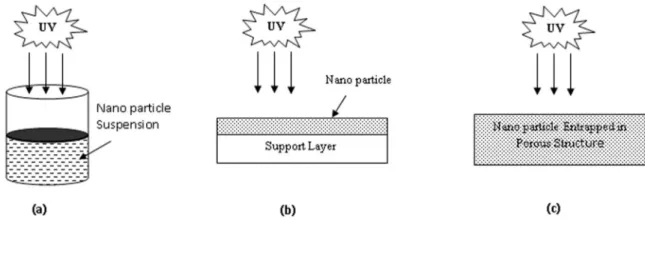
. Mainly two types of immobilization have been observed so far first one is the coating of nano particle on a substrate material and another one is entrapment of nano particle inside a porous structure. All modes of applications of nano particle have been show in the figure 2. To overcome limitations 105
of suspension mode Coleman et al.21 implemented the immobilization of TiO2 on Ti-6Al-4V alloy and they got 98%
removal of 17-β-oestradiol within 3.5 hr. In 2002, Tanizaki et al.22 implemented the concept of photo bioreactor of high sensitivity where nano particle, TiO2 was immobilized in porous
110
quartz structure to increase the available surface area. Sometime, TiO2 was used in immobilized condition inside the
RSC
Advances
Accepted
polytetrafluoroethylene mesh sheet24. Coleman et al.53 used another type of photocatalytic reactor in batch mode where TiO2
coated reactor surface was used. Doll and Frimmel32 and Ziegmann and Frimmel66 designed a pilot-scale setup of microfiltration unit to separate TiO2 from the treated solution to
5
enhance the reusability of nano particles. To fulfil the same purpose, Augugliaro et al.35 used solar membrane photo reactor.
In the next subsequent year of 2006, Molinari et al.41 induced membrane technology to separate by products and TiO2 after the
photocatalytic reaction in a batch system to make the process cost 10
effective. In 2007, Abellan et al.45 applied tubular quartz reactor to carry out photocatalytic reaction and two parabolic mirrors were used to concentrate irradiated UV towards target solution but TiO2 suspension was used during the degradation reaction.
For the same purpose, Coleman et al.48 developed ‘sol-gel spiral
15
reactor’ under both solar and UV irradiation where, immobilized as well as suspension of TiO2 was used. Though UV radiated
system showed the best performance. To enhance the performance of the system Mendez-Arriaga et al.53 incorporated
stirred tank reactor with integrated O2 supply, temperature and
20
pH indicator, thermostatic control bath, etc. All sorts of area exposed to the catalyst were covered with Teflon or made of glass to enhance the effectiveness of TiO2. To treat wastewater
from the pharmaceutical industries directly Ziemiańska et al.67 followed conditioning, microfiltration and coagulation method 25
before photocatalytic degradation to reduce the waste load from the solution matrix. Ziemiańska et al.67 and Laera et al.76
introduced membrane bioreactor (MBR) along with photocatalysis for wastewater treatment where they maintained a certain recycle ratio to achieve a sufficient amount of drug 30
removal.
In 2011, a new technology was adopted by Hu et al.77 to use nano particle for pharmaceutical wastewater treatment. They synthesized TiO2 nanowaire membrane on titanium foil. This
type of membrane showed more effective degradation than 35
normal P25 and enhanced the reusability of TiO2. The possible
explanation was made by Hu et al.77, 81 that the energy
distribution over the nano wire membrane surface was better than others. Thus it pretended effective photocatalytic effect. Murphy et al.82 compared the effectiveness of TiO2 when it was employed
40
as a suspension as well as in composite form, and they found higher degradation rate for a later case due to availability of high surface area. Moreover, composite could be reused as its activity was considerably available. Very recently, Avisar et al.84 used “sol-gel N-doped TiO2” which was deposited over microscope
45
glass slides. They found it was more advantageous than powdered TiO2 considering the fact of homogeneous mixing and scattering
of light during reaction and the present technique enhanced the reusability of nano particles as well as made that process more economic. Therefore, reuse and enhancement of active surface 50
area of TiO2 are the important area of research and developments.
Then only the photocatalysis can be implemented in wastewater treatment for commercial purpose.
Fig. 2 Different modes of application of TiO2 nano particle: (a) Suspension mode; (b) Surface immobilization; (c) Entrapped in porous structure. 55
5 Kinetics involve in photocatalytic reaction
The photocatalytic degradation process is basically classified as heterogeneous catalytic reaction. It has been already discussed in the earlier sections that reaction rate varies significantly with different process parameters such as initial substrate 60
concentration, catalyst loading, pH, dissolve oxygen, etc. The effects of those parameters on photocatalysis can be well described in terms of reaction rate constant. Therefore, it is very important to understand the reaction kinetics of photo catalytic
degradation. 65
Some group of researchers 22-24, 27, 28, 30, 31, 36, 39, 41, 45, 48, 50, 53, 67,
73, 87
described the degradation kinetics described as first- order type, which was presented as,
p photo p photo
k
C
dt
dC
r
=
=
−
(7)rphoto and kphoto represent first-order reaction rate and rate constant
70
respectively and Cp indicates the concentration of pharmaceutical
waste at any time ‘t’. TiO2 being a catalyst in the reaction
RSC
Advances
Accepted
mixture, its concentration assumed constant. Thus, rate of photocatalytic reaction can be considered as pseudo-first order reaction. That can be expressed using following rate equation 8 and equation 9. Several authors 33, 34,54, 64- 66, 70, 77, 81, 88-90 found good agreement between theoretical pseudo first order kinetic 5
model and experimental observation and had well described the degradation kinetics with help of it.
p ' photo p ' photo
k
C
dt
dC
r
=
=
−
(8)Where, r’photo , and k’photo were pseudo fist order reaction rate and
rate constant respectively. The above equation can be written as 10 t k C C ln 'phot p 0 p = (9) Initial concentration of pharmaceutical waste was represented as
C0
p. The rate constant values were calculated from the slope of the
plot of p 0 p C C
ln vs. time. However, in recent years, heterogeneous catalytic reaction kinetics has been interpreted 15
using Langmuir–Hinshelwood (L-H) kinetics55, and since photocatalysis belongs to the similar reaction category, hence in many cases, the photocatalytic degradations were described by the L-H kinetics’ model29, 38, 46, 49, 51, 52, 56, 59, 63, 69, 71, 72, 74, 78, 79, 83.
According to L-H model, the reaction took place inside the 20
catalyst pore surface where the substrate material was adsorbed through the catalyst pores. The rate represented as,
p p '' photo p '' photo kC 1 kC k dt dC r + = = − (10) where, k’’photo, r ’’
photo and k were L-H kinetic rate constant, rate of
the reaction and adsorption co-efficient respectively. Mentioned 25
researchers found that the experimental result had a good agreement with the L-H kinetic model. If the substrate concentration is very low (kCp<<1), equation 10 turned into the
pseudo first order kinetic rate law, and it could be represented through equation 11. 30 p '' photo p '' photo k kC dt dC r = = − (11)
where, k’’photo represented into pseudo first order kinetic rate
constant and that could be calculated using the plot of
p 0 p C C ln vs. time.
Therefore, three different types of kinetic model can be 35
adopted during the photocatalytic degradation of pharmaceutical wastewater under UV-irradiation depending on the experimental observation.
6 Conclusions
Considering the impacts of pharmaceutical wastes on aquatic 40
environment, it is high time to take necessary attention against the alarming threat involved in discharged pharmaceutical waste. The present study has tried to make a portrait on the importance of photocatalytic degradation process and consequences of the process variables. Some of the major observations are likely to be 45
mentioned here. Among all other treatment methodology,
heterogeneous photocatalysis has already been established as a future trend for treatment of pharmaceutical waste and by this process maximum removal of drug components can be achieved with production of no secondary pollutants. Several process 50
parameters are involved in AOP using nano particle, which are needed to be optimized. To make the process more economic as well as more acceptable to researchers and industries, recycle and reuse nano particle should be investigated. Moreover, optimization of the process parameters and kinetic study are 55
required for better understanding of the degradation process. In most of the cases, researchers have used batch process and very few literatures are available regarding the continuous oxidation process though later one can enhance the performance of the system. Therefore, the continuous process makes the process 60
more acceptable for large scale wastewater treatment.
In most of the reviewed literature, though the immense potential of the photocatalytic degradation approach is well accepted but still needs further improvements for better exploitation in pharmaceutical industries. Above all, recycle and reuse of photo 65
catalyst in a continuous wastewater treatment process is the main area which is needed to be developed in future for large scale implementation of heterogeneous photocatalysis. Moreover, the impact of photo catalyst on environment has not been studied yet according to the available literatures and that will be another area 70
of exploration. The present article has highlighted advantages as well as limitation of heterogeneous photocatalysis of pharmaceutical wastes and thus, this study may be a value addition in further development in photocatalysis. As a consequence, heterogeneous photocatalysis with some necessary 75
modification can be used as potential alternative than the traditional tedious process for municipal as well as industrial pharmaceutical wastewater treatment.
Notes and references
a Department of Chemical Engineering, Jadavpur University, Kolkata,
80
India. Fax: 9133 2414 6203; Tel: 91 98364 02118; E-mail: [email protected], [email protected] b
School of Environmental Science and Engineering, Gwangju Institute of Science and Technology, Gwangju, Korea.
1 S. Malato, P. Fernandez-Ibanez, M.I. Maldonado, J. Blanco, and W.
85
Gernjak, Catal. Today, 2009, 147, 1-59.
2 T. Wintgens, F. Salehi, R. Hochstrat, and T. Melin, Water. Sci. Technol., 2008, 57, 99-107.
3 S. Suarez, M. Carballa, F. Omil, and J.M. Lema, Rev. Environ. Sci. Biotechnol., 2008, 7, 125-138.
90
4 M. Carballa, F. Omil, J.M. Lema, M. Llompart, C. Garcia-Jares, I. Rodriguez, M. Gomez, and T. Ternes, Water R