2018
Multi-objective aerodynamic design exploration
using multi-fidelity methods and pareto set
identification techniques
Anand AmritIowa State University
Follow this and additional works at:https://lib.dr.iastate.edu/etd Part of theAerospace Engineering Commons
This Dissertation is brought to you for free and open access by the Iowa State University Capstones, Theses and Dissertations at Iowa State University Digital Repository. It has been accepted for inclusion in Graduate Theses and Dissertations by an authorized administrator of Iowa State University Digital Repository. For more information, please [email protected].
Recommended Citation
Amrit, Anand, "Multi-objective aerodynamic design exploration using multi-fidelity methods and pareto set identification techniques" (2018).Graduate Theses and Dissertations. 16782.
by
Anand Amrit
A dissertation submitted to the graduate faculty in partial fulfillment of the requirements for the degree of
DOCTOR OF PHILOSOPHY
Major: Aerospace Engineering
Program of Study Committee: Leifur Leifsson, Major Professor
Anupam Sharma Peng Wei Thomas Ward Alric P Rothmayer
The student author, whose presentation of the scholarship herein was approved by the program of study committee, is solely responsible for the content of this dissertation. The
Graduate College will ensure this dissertation is globally accessible and will not permit alterations after a degree is conferred.
Iowa State University Ames, Iowa
2018
DEDICATION
I dedicate this thesis to my Father Mr. Ajaya Kumar Nayak and my Mother Mrs. Narayani Nayak, who supported me on this adventure.
TABLE OF CONTENTS Page LIST OF FIGURES ... vi LIST OF TABLES ... x NOMENCLATURE ... xi ACKNOWLEDGMENTS ... xiii ABSTRACT ... xiv CHAPTER 1. INTRODUCTION ... 1
I. Motivation and Challenges ... 1
II. Research Goals and Questions ... 5
III. Research Contributions ... 6
A. List of Journal Articles ... 7
B. List of Conference Proceedings ... 8
C. List of Conference Talks ... 10
IV. Thesis Outline ... 11
References... 11
CHAPTER 2. FAST MULTI-OBJECTIVE AERODYNAMIC OPTIMIZATION USING SEQUENTIAL DOMAIN PATCHING AND MULTI-FIDELITY MODELS ... 17
Nomenclature ... 17
I. Introduction ... 19
II. Methodology ... 24
A. Definition of the Pareto Front... 24
B. Pareto Front Exploration Using Sequential Domain Patching ... 25
C. Multi-Fidelity, Multi-Objective Aerodynamic Sequential Domain Patching Algorithm ... 26
D. Automated Determination of Patch Sizes... 31
E. Pareto Set Refinement... 32
III. Numerical Examples ... 32
A. Analytical Problems ... 32
1. Zitzler–Deb–Thiele's function N. 1 (ZDT 1) ... 32
2. Fonseca and Fleming Function ... 34
B. Transonic Airfoil Design ... 35
1. Problem Description ... 35
2. Design Variables ... 36
3. High-Fidelity Viscous Aerodynamics Model ... 37
4. Low-Fidelity Viscous Aerodynamics Model ... 38
5. Single-Objective Optimization Results ... 38
IV. Conclusion ... 44
References... 45
CHAPTER 3. MULTI-FIDELITY AERODYNAMIC DESIGN TRADE-OFF EXPLORATION USING POINT-BY-POINT PARETO SET IDENTIFICATION ... 50
Nomenclature ... 50
I. Introduction ... 51
II. Methodology ... 57
A. Definition of the Pareto Front... 58
B. Point-by-Point Exploration of the Pareto Front ... 58
C. Multi-Fidelity, Point-by-Point Multi-Objective Optimization Algorithm ... 60
III. Numerical Examples ... 64
A. Analytical Problems ... 65
1. Zitzler-Deb-Thiele’s function N. 1 (ZDT 1) ... 65
2. Zitzler-Deb-Thiele’s function N. 2 (ZDT 2) ... 66
3. Kursawe function ... 67
B. Two-Dimensional Aerodynamic Design Problem... 68
1. Problem Description ... 68
2. Design Variables ... 69
3. High-Fidelity Viscous Aerodynamics Model ... 70
4. Low-Fidelity Viscous Aerodynamics Model ... 71
5. Single-Objective Optimization Results ... 72
6. Point-by-Point Pareto Front Exploration ... 75
C. Algorithm Scalability... 77
D. Algorithm Robustness ... 82
IV. Conclusion ... 83
References... 83
CHAPTER 4. APPLICATIONS OF SURROGATE-ASSISTED AND MULTI-FIDELITY MULTI-OBJECTIVE OPTIMIZATION ALGORITHMS TO SIMULATION-BASED AERODYNAMIC DESIGN... 92
Nomenclature ... 93
I. Introduction ... 94
II. Methods ... 98
A. Definition of the Pareto Front... 98
B. Algorithm 1: Pareto Front Exploration Using Surrogate-Assisted Multi-Fidelity Based Multi-Objective Evolutionary Algorithm ... 99
C. Algorithm 2: Pareto Front Exploration Using Sequential Domain Patching Algorithm ... 101
D. Algorithm 3: Pareto Front Exploration Using the Point-by-Point Algorithm ... 104
III. Numerical Examples ... 107
A. Analytical Problem ... 108
B. Transonic Airfoil Design ... 109
1. Problem Description ... 110
2. Design Variables ... 110
4. Low-Fidelity Viscous Aerodynamics Model ... 112
5. Single-Objective Optimization (SOO) Results ... 113
6. The Pareto Front ... 113
C. Subsonic Rectangular Wing Design ... 117
1. Problem Description ... 117
2. Design Variables ... 118
3. Computational Model ... 119
4. Single-Objective Optimization (SOO) Results ... 121
5. Pareto-Front ... 122
IV. Conclusion ... 128
References... 130
CHAPTER 5. CONCLUSION... 135
I. Main Contributions... 135
A. Multi-Fidelity Aerodynamic Modeling ... 135
B. Multi-Fidelity Aerodynamic Design Exploration Using Sequential Domain Patching ... 135
C. Multi-Fidelity Aerodynamic Design Exploration Using the Point-by-Point Method... 136
D. A Comparison of the Proposed Approaches ... 136
E. Answers to the Research Questions ... 137
LIST OF FIGURES
Page
Figure 2-1. Exploration of (a) the entire Pareto front and (b) only part of the Pareto front. ... 25 Figure 2-2. Pictorial representation of the sequential domain patching method: (a)
patches in the design space (b) refinement of the Pareto front in the
objective space... 26 Figure 2-3. Sequential domain patching based aerodynamic design exploration. ... 29 Figure 2-4. Representation of high and low-fidelity evaluation values of 5 random
designs. ... 33 Figure 2-5. Pareto front obtained for the ZDT 1 function: (a) design space (b)
feature space. ... 34 Figure 2-6. Pareto front obtained for the Fonseca and Fleming function: (a) Design
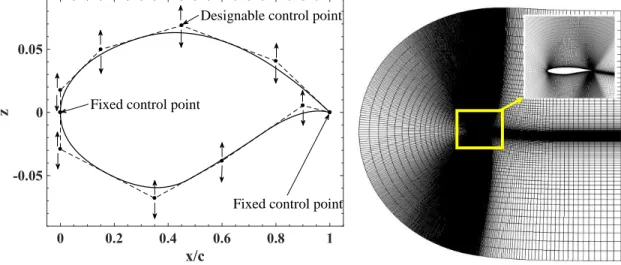
space (b) Feature space. ... 35 Figure 2-7. Airfoil computational models: (a) airfoil shape parameterization, (b)
hyperbolic C-mesh... 36 Figure 2-8. SOO results showing baseline and optimized (a) airfoil shapes, and (b)
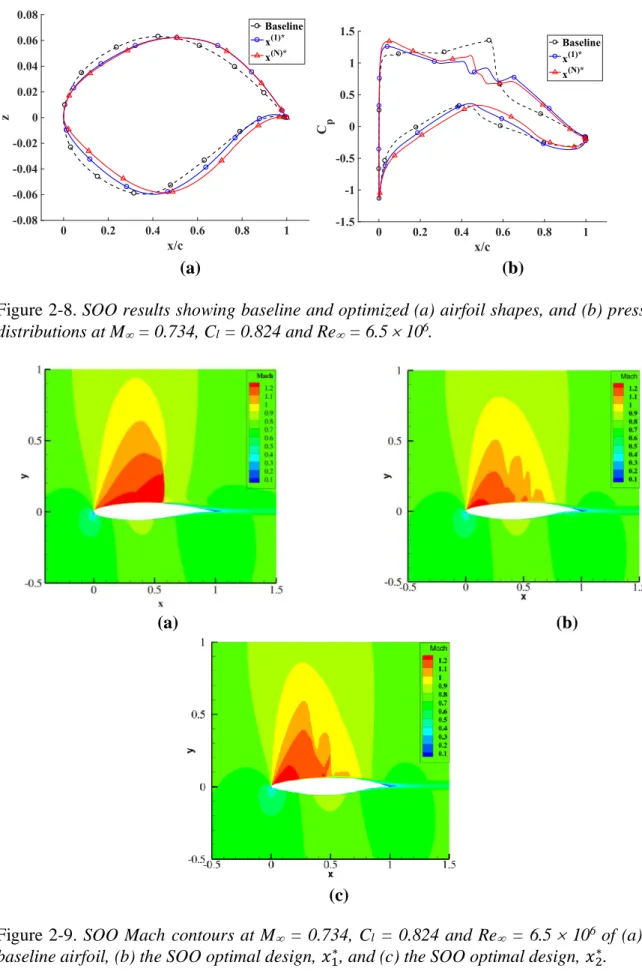
pressure distributions at M = 0.734, Cl = 0.824 and Re = 6.5 106. ... 41
Figure 2-9. SOO Mach contours at M = 0.734, Cl = 0.824 and Re = 6.5 106 of
(a) the baseline airfoil, (b) the SOO optimal design, x1 ∗, and (c) the
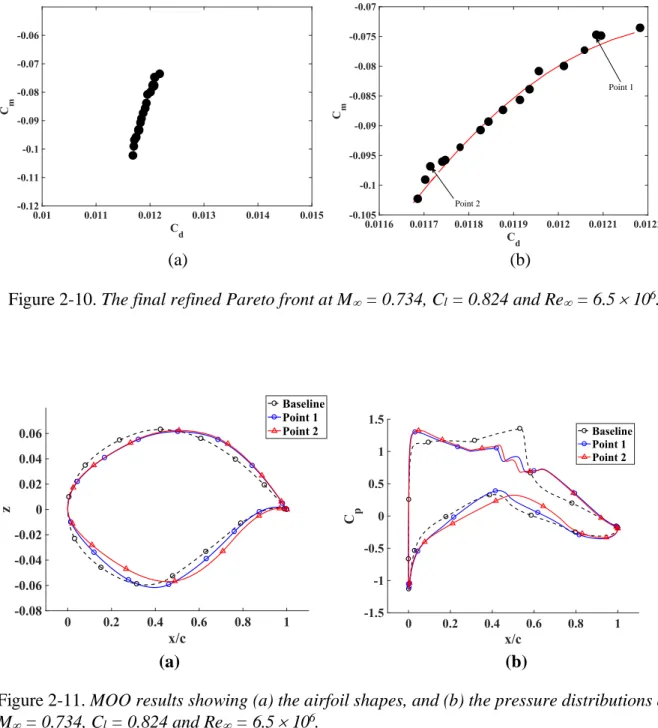
SOO optimal design, x2 ∗. ... 41 Figure 2-10. The final refined Pareto front at M = 0.734, Cl = 0.824 and Re = 6.5
106. ... 43
Figure 2-11. MOO results showing (a) the airfoil shapes, and (b) the pressure
distributions at M = 0.734, Cl = 0.824 and Re = 6.5 106... 43
Figure 2-12. Mach contours at M = 0.734, Cl = 0.824, Re = 6.5 106 of (a) point
Figure 3-1. Hypothetical representation of the point-by-point Pareto front exploration progression shown for (a) two design variables in the
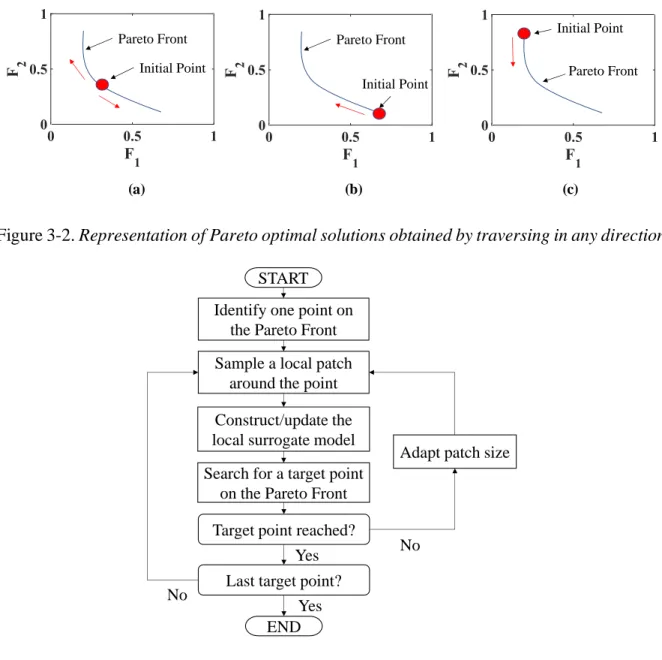
design and (b) two objectives in the feature space. ... 59 Figure 3-2. Representation of Pareto optimal solutions obtained by traversing in any
direction. ... 60 Figure 3-3. Flowchart of the point-by-point aerodynamic design exploration
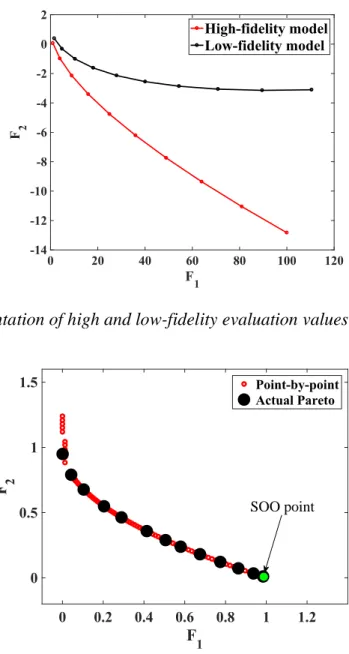
algorithm... 60 Figure 3-4. Representation of high and low-fidelity evaluation values of few random
designs. ... 66 Figure 3-5. ZDT 1 results: Comparison of Pareto obtained with the actual Pareto. ... 66 Figure 3-6. ZDT 2 results: Comparison of Pareto obtained with the actual Pareto. ... 67 Figure 3-7. Kursawe function results: comparison of Pareto obtained with the actual
Pareto. ... 68 Figure 3-8. Airfoil shape parameterization using B-spline curves. ... 69 Figure 3-9. Hyperbolic C-mesh: (a) farfield view, (b) view close to the surface. ... 71 Figure 3-10. Viscous flow simulation results for RAE 2822 at M = 0.734, Cl =
0.824 and Re = 6.5 106: (a) the evolution of the lift and drag
coefficients obtained by the low-fidelity model, (b) a comparison of the pressure distributions obtained by the high- and low-fidelity models... 72 Figure 3-11. SOO showing (a) convergence of arguments, and (b) evolution of the
objective. ... 74 Figure 3-12. SOO results showing baseline and optimized (a) airfoil shapes, and (b)
pressure distributions at M = 0.734, Cl = 0.824 and Re = 6.5 106. ... 74
Figure 3-13. SOO Mach contours at M = 0.734, Cl = 0.824 and Re = 6.5 106 106
of (a) the baseline airfoil, and (b) the SOO optimal design. ... 75 Figure 3-14. Multi-objective optimization results at M = 0.734, Cl = 0.824 and Re
= 6.5 106: (a) optimum solutions, (b) zoomed-in plot... 76
Figure 3-15. MOO results showing (a) the airfoil shapes, and (b) the pressure
distributions at M = 0.734, Cl = 0.824 and Re = 6.5 106... 77
Figure 3-17. SOO results showing the variation of (a) the drag coefficient and (b)
total optimization time as a function of the number of design variables... 79 Figure 3-18. SOO results showing (a) the airfoil shapes, and (b) the pressure
distributions at M = 0.734, Cl = 0.824 and Re = 6.5 106... 80
Figure 3-19. SOO results showing the Mach contours at M = 0.734, Cl = 0.824 and
Re = 6.5 106 of the optimal shapes for (a) 10 and (b) 12 design
variables. ... 80 Figure 3-20. Comparison of the Pareto fronts obtained using 8, 10 and 12 design
variables at M = 0.734, Cl = 0.824 and Re = 6.5 106. ... 81
Figure 3-21. Robustness of the proposed algorithms is demonstrated by obtaining comparable (within one drag count) Pareto fronts when starting from
two different initial points. ... 82 Figure 4-1. An illustration of the SDP algorithm showing (a) the design space, and
(b) the Pareto front in the feature space. ... 102 Figure 4-2. An illustration of the point-by-point Pareto front exploration progression
for (a) two design variables in the design space and (b) two objectives in the feature space. ... 106 Figure 4-3. Example high and low-fidelity evaluation values of five random designs. . 109 Figure 4-4. Pareto front obtained for Fonseca and Fleming function (a) design space,
(b) feature space. ... 109 Figure 4-5. Airfoil models: (a) shape parameterization, (b) hyperbolic C-mesh... 112 Figure 4-6. The final Pareto fronts from all three algorithms at M = 0.734, Cl =
0.824 and Re = 6.5 106 (a) final refined Pareto (b) zoomed in view of
the same Pareto front. ... 114 Figure 4-7. MOO results showing (a) the airfoil shapes, and (b) the pressure
distributions at M = 0.734, Cl = 0.824 and Re = 6.5 106 for different
points along the Pareto. ... 115 Figure 4-8. Mach contours at M = 0.734, Cl = 0.824 and Re = 6.5 106 of (a)
Point 1, (b) Point 2... 115 Figure 4-9. Baseline semi-span wing geometry with a constant section profile. ... 118
Figure 4-10. Wing shape parameterization using B-spline curves for chord length,
wing quarter-chord height and twist. ... 119 Figure 4-11. Sample mesh used for the computational fluid dynamics simulations. ... 120 Figure 4-12. Grid convergence results for the baseline design at M = 0.5 and CL =
0.2625: (a) drag coefficient versus number of mesh cells, (b) simulation run time. ... 121 Figure 4-13. Final Pareto front obtained from each algorithm: (a) optimum solutions
and (b) zoomed-in plot. ... 124 Figure 4-14. Wing shape parameter comparison for Baseline, Point 1 and Point 2
designs for (a) chord length, (b) wing quarter-chord height and (c)
twist. ... 125 Figure 4-15. Pressure contours at M = 0.5 and CL = 0.2625 (a) Point 1 (top view),
(b) Point 2 (top view), (c) Point 1 (side view) and (d) Point 2 (side
view). ... 126 Figure 4-16. MOO results showing the pressure distributions of two points on the
Pareto at M = 0.5 and CL = 0.2625 and at (a) 𝜂 = 0.02, (b) 𝜂 = 0.5, (c)
𝜂 = 0.75 and (d) 𝜂 = 1. ... 127 Figure 4-17. A comparison of the wing lift distributions for the Point 1 and Point 2
LIST OF TABLES
Page
Table 2-1. Grid convergence study for the baseline shape. ... 38
Table 2-2. Single objective optimization results... 40
Table 3-1. Grid convergence study for the baseline shape of Benchmark Case 2. ... 71
Table 3-2. Single objective optimization (SOO) results. ... 73
Table 3-3. Aerodynamic coefficients of the baseline design as a function of the number of design variables. ... 79
Table 3-4. SOO results as a function of the number of design variables... 79
Table 3-5. Comparison of the computational cost of the MOO as a function of the number of design variables. ... 81
Table 4-1. Grid convergence study for the baseline shape. ... 112
Table 4-2. Single objective optimization results for transonic airfoil design case. ... 114
Table 4-3. Cost of each multi-fidelity MOO algorithm for the transonic airfoil design case. ... 116
Table 4-4. Single-objective optimization results for the subsonic wing design. ... 121
Table 4-5. Wing shape parameter comparison for Baseline, Point 1 and Point 2 designs at multiple wing span stations. ... 125
NOMENCLATURE
A = airfoil cross-sectional area, m2
a∞ = speed of sound, m/s
b = wing span, m
Cd = airfoil section drag coefficient, d/(q∞c) CD = wing drag coefficient, D/(q∞S)
Cm = airfoil section pitching moment coefficient, M/(q∞c2) CMx = wing pitching moment coefficient, m/(q∞cS)
Cl = airfoil section lift coefficient, l/(q∞c) CL = wing lift coefficient, L/(q∞S)
c = low-fidelity model output
c = chord length, m
d = airfoil section drag force, N
D = wing drag force, N
d = trust-region radius, m
f = high-fidelity model output
H = objective function value
l = lower bound of x
l = airfoil section lift force, N
L = wing lift force, N
M = Mach number, V∞/a∞
m = pitching moment
n = number of design variables
Nc = number of coarse model evaluation
q∞ = dynamic pressure, 1/2∞V∞2
s = surrogate model output
S = wing planform area, m2
u = upper boundof x
V∞ = flow speed, m/s
V = wing volume, m3
x = design variables, m
y = coordinate along the wing span, m
zc/4 = vertical coordinates of the quarter-chord location in a wing
= wing twist, degrees
𝛼 = angle of attack, degrees
∞ = density, kg/m3
𝜂 = wing span stations, y/(b/2)
ACKNOWLEDGMENTS
I would like to thank my advisor Dr. Leifur Leifsson, and my committee members, for their guidance and support throughout the course of this research.
In addition, I would also like to thank my friends, colleagues, the department faculty and staff for making my time at Iowa State University a wonderful experience.
ABSTRACT
The research objective of this work is to accelerate the process of multi-objective aerodynamic design exploration when using computationally intensive simulation models. The design of aerodynamic surfaces is important for modern engineered systems such as unmanned aerial systems and turbomachinery. Physics-based simulations are needed for capturing the nonlinear system behavior and nonlinear interactions between disciplines. The key challenges with using high-fidelity physics-based simulations as part of aerodynamic design include (1) the high computational cost of the simulations (ranging from few hours to days or weeks on high performance computing clusters), (2) large numbers of conflicting objectives and constraints, and design variables, and (3) the repetitive evaluations during the design exploration phase. The main contributions of this thesis are the adaptation and integration of multi-fidelity methods and Pareto set identification techniques to rapidly determine the best possible trade-offs of the aerodynamic characteristics. The proposed multi-fidelity aerodynamic Pareto set identification techniques use sequential domain patching and point-by-point exploration. The algorithms are validated using analytical problems and demonstrated on aerodynamic design problems involving transonic airfoils and subsonic wings. The proposed algorithms are benchmarked against a surrogate-assisted multi-objective evolutionary algorithm. It is found that approaches produce comparable Pareto fronts. Furthermore, the proposed multi-fidelity point-by-point aerodynamic MOO algorithm is over 50% more efficient than the benchmark method. The value of the proposed algorithms is more visible in cases where designers have a limited computational budget and only a few Pareto optimal points are required in the vicinity of a target design.
CHAPTER 1. INTRODUCTION
I. Motivation and Challenges
The aerodynamic design exploration process involves determining the best-possible trade-offs between multiple non-commensurable objectives [1, 2]. This process is typically handled using multi-objective optimization (MOO) techniques. The overall goal of this research work is to investigate numerical methods that enable rapid aerodynamic MOO when using computationally intensive predictive aerodynamic simulation models. Thereby, providing engineers with the ability to utilize information from high-fidelity models in the decision making process when designing aerodynamic systems. The key challenges of aerodynamic MOO with high-fidelity models are:
(1) time-consuming model evaluations (ranging from several minutes to hours, days, or weeks on high performance computing clusters) [1],
(2) a large number of design objectives (criteria) and parameters [1], and
(3) multiple and repetitive model evaluations required by state-of-the-art design exploration techniques [1, 2].
The current state-of-the-art aerodynamic MOO relies on the weighted-sum optimization technique [3, 4]. This approach has been used widely for aerodynamic design exploration problems and involve the single-objective optimization (SOO) of an aggregate objective function. The aggregate objective function is typically constructed using a linear combination of all the objectives, with each of them multiplied by a pre-set weighting coefficient, see, for example, Refs. [5-9], casting it into a SOO problem. An improper setting of the weighting coefficients may, however, lead to the loss of important information with increasing complexity of the design problem. To avoid the issue of selecting appropriate weighting
coefficients, the epsilon-constrained method [10] can be used efficiently given that adjoint sensitivity information is available, e.g. [11, 12]. These approaches, however, only lead to one optimal solution per optimization iteration. To make a decision the designers may need multiple optimal solutions. Due to its ability to obtain several optimal solutions per algorithm run, genuine MOO, particularly non-dominated optimization [4], based on the so-called Pareto front [13] is becoming more popular in the design of complex aerodynamic problems.
Metaheuristic algorithms are one of the most widely used approaches by designers to obtain the Pareto front. Particle swarm optimization (PSO) [14], genetic algorithm (GA) [15, 16], multi-objective evolutionary algorithm (MOEA) [17, 18] are examples of metaheuristic algorithms that involve evaluations of population sizes of up to few hundreds of candidate designs and can generate the entire Pareto front in a single algorithm run. Other algorithms include the differential evolution [19], firefly algorithms [20], and cuckoo search [21]. A high computational cost is, unfortunately, a common feature of these techniques, which limits their use to aerodynamic design exploration problems of low complexity (i.e. problems with a low number of designable parameters and simulations with a low number of degrees of freedom).
Surrogate-based optimization (SBO) techniques [22-24] can alleviate the computational cost by replacing the costly simulations by their faster representations, referred to as surrogate models (or meta-models). In general, the SBO process is composed of four steps [22-24]:
(1) sampling the design space, (2) acquisition of the simulation data,
(3) construction of the surrogate models, and (4) identification of the candidate designs.
The process is continued until termination with new data samples allocated using prescribed infill criteria, followed by repetition of the steps (2) through (4). The most widely used surrogate models for aerodynamic design include response surface approximations [22], radial-based function models [23], and kriging interpolation [24]. Application of SBO in multi-objective case also known as surrogate-assisted MOO algorithms, has been of great interest in the past. For example, the Pareto-based Efficient Global Optimization [25] (ParEGO) uses the weighted-sum approach, the Pareto Set Pursuing (PSP) approach [26] utilizes global surrogate models for MOO, global surrogate-assisted MOO with constraints based on expected improvement of the objective functions is described in [23, 27], the Inexact Pre-Evaluation approach [28] is extended in [29] for MOEAs and locally constructed radial-bases function models, adaptive sampling and surrogate modeling are combined for MOGAs in [30], a global approximation-based MOO for robust design under interval uncertainty is described in [31], and, finally, surrogate-assisted MOO using global and local models is presented in [32]. Recent applications of surrogate-assisted MOO algorithms for the design of aerodynamic surfaces are following. Wang et al. [33] used response surface models and MOGA [15, 16] for aerodynamic MOO to maximize the pressure ratio and adiabatic efficiency of compressor rotors. MOO on the aerodynamic drag and lift forces of high speed train head shapes is performed by Zhang et al. [34] utilizing Kriging surrogate models [24]. Amrit et al. [15] and Leifsson et al. [35] performed MOO of transonic airfoil shapes with MOEAs [17, 18], Kriging surrogate models [27], and design space confinement strategies. All these techniques involve use of certain amount of high-fidelity model evaluations as training samples until the surrogate model accuracy is within an acceptable limit. This makes SBO cumbersome when the number of training samples increases.
Recently, there has been a growing interest in the use of multi-fidelity methods in design exploration [36, 37]. The multi-fidelity method is an approach fuse information from models of varying degree of fidelity that leverage the computational speedup provided by the models of lower fidelities, and establish the required accuracy in the design optimization task using the model of higher fidelity. Low-fidelity models and model management strategies are the two main elements of multi-fidelity methods. Few examples of low-fidelity model include simplified models (such as coarsening the numerical discretization [38-40] and simplifying the governing equations [41, 42]), projection-based methods (such as proper orthogonal decomposition [43], and reduced basis method [44]), and data-fit methods (such as radial basis functions [45], kriging [46], and support vector regression [47]). Model management strategies include adaptation, fusion, and filtering. Adaptation approaches can be categorized into global methods (e.g., efficient global optimization (EGO) using global data-fit models and infill criteria based on expected improvement to balance exploitation and exploration [48]) or multi-fidelity trust-region methods using corrected low-multi-fidelity models with the corrections classified as additive [49], multiplicative [50], comprehensive [51], or space mapping [52]) and local methods (such as SBO methods using local data-fit models [22]. Fusion approaches evaluate the low- and the high-fidelity models on a given set of samples and subsequently combine the outputs in one model. Examples of fusion methods include co-kriging [53], and Bayesian regression [54]. In filtering methods, the high-fidelity model is invoked following the evaluation of a low-fidelity filter. An example of a filtering method is the multi-fidelity stochastic collocation approach [55]. Although multi-fidelity methods are well established in the case of aerodynamic SOO, its use in multi-objective sense has not been studied extensively.
In summary, MOO of aerodynamic design problems involving computationally expensive simulations is an open area of research. Current state-of-the-art aerodynamic MOO algorithms are setup to estimate the entire Pareto front (which is cumbersome for expensive aerodynamic problems) and rely on either weighted-sum methods (which provide only one Pareto optimal solution per algorithm run) and/or evolutionary search methods (which need a large amount of model evaluations). Recent aerodynamic design exploration algorithms take advantage of global surrogate models to alleviate the computational burden [15, 17, 18, 35], but still need many model evaluations and can be impractical when dealing with the computationally intensive aerodynamic simulation models. Furthermore, in cases where there is a limited budget, a technique to obtain only a part of the Pareto is not available to obtain the best possible trade-offs at the vicinity of a target design. Multi-fidelity methods [37] are promising in reducing the computational burden, but these methods have not been utilized rigorously for multi-objective aerodynamic design exploration.
II. Research Goals and Questions
The overall research goal of this work is to fill this knowledge gap and investigate alternatives for efficient multi-fidelity multi-objective aerodynamic design exploration. To achieve this goal, the work seeks to answer the following research questions:
(1) How can multi-fidelity methods and surrogate models be used to accelerate the PDE-constrained MOO to enable fast aerodynamic design exploration? What is the magnitude of the computational acceleration? Are the estimated best possible trade-offs using the multi-fidelity methods at the level of the high-fidelity model accuracy? (2) If the designer has a budget, is it possible to obtain only a part of the Pareto, or in other
words, is it possible to obtain few optimal solutions in the vicinity of a target design which are non-commensurate using multi-fidelity methods?
(3) Is it possible to develop a strategy that can efficiently perform multi-fidelity MOO on computationally complex aerodynamic problems that have nonlinear design and feature spaces?
(4) Is it possible to develop a strategy that is robust such that the Pareto front estimated with multi-fidelity methods is always within a reasonable error margin irrespective of the number of MOO trials?
(5) Is it possible to evaluate the scalability of the multi-fidelity strategy or in other words, is it possible to measure the computational cost associated with the increase in design space dimensionality and simulation degrees of freedom?
The answers to these research questions will enable the creation and development of new and unique multi-objective aerodynamic design exploration methods. Ultimately, those methods can provide engineers with new capabilities for the design of aerodynamic systems using accurate simulation models and develop new technology.
III. Research Contributions
The research contributions of this work can be summarized as follows:
(1) Adaptation of the sequential domain patching algorithm [56] for multi-fidelity aerodynamic design exploration. Starting from two end points of the Pareto, the algorithm is utilized to obtain an initial inaccurate Pareto front cheaply using low-fidelity aerodynamic models. Further refinement of the initial Pareto yields the accurate Pareto front.
(2) Adaptation of the point-by-point Pareto set identification method [57] for multi-fidelity aerodynamic design exploration. Starting from a single point on the Pareto, the algorithm is utilized to obtain a part or entire Pareto front point-by-point using local
response surface approximation (RSA) model constructed using cheap low-fidelity aerodynamic models and few high-fidelity models for refinement.
(3) Validation of the proposed approaches using several analytical test cases.
(4) Demonstrations of the proposed approaches on two types of aerodynamic problems: a. A transonic airfoil design problem to obtain trade-offs of the characteristics. b. A subsonic wing design to obtain trade-offs of the characteristics.
(5) Evaluation and comparison of the proposed approaches using a fast surrogate-assisted multi-objective evolutionary algorithm (SA-MOEA) as a benchmark [15].
A. List of Journal Articles
The following journal articles form the contribution of this doctoral thesis:
• Amrit, A., Leifsson, L., and Koziel, S. (2018) “Multi-Fidelity Aerodynamic Design Trade-Off Exploration Using Point-by-Point Pareto Set Identification”, Aerospace Science & Technology, vol. 79, pp. 399-412.
• Amrit, A., Leifsson, L. (2018) “Fast multi-objective aerodynamic optimization using sequential domain patching and multi-fidelity models”, submitted to Aerospace Science & Technology, October 2018.
• Amrit, A. and Leifsson, L. (2018) “Applications of Multi-Fidelity Multi-Objective Optimization Algorithms to Simulation-Based Aerodynamic Design”, submitted to
Engineering Computations, October 2018.
The following is the author’s master’s thesis, and a journal article published based on it (these works are used in this work for benchmarking the proposed approaches):
• Amrit., A. (2016), “Multi-objective optimization of transonic airfoils using variable-fidelity models, co-kriging surrogates, and design space reduction”, M.Sc. Thesis, Iowa State University, Ames, Iowa.
• Amrit, A., Leifsson, L., and Koziel, S. (2017) “Design strategies for multi-objective optimization of aerodynamic surfaces”, Engineering Computations, vol. 34, no. 5, pp.
1724-1753.
B. List of Conference Proceedings
The following is a list of the conference proceedings that the author has contributed to during his doctoral work:
• Amrit, A., Leifsson, L., and Koziel, S. (2018) “Aerodynamic Design Exploration through Point-By-Point Pareto Set Identification using Local Surrogate Models”,
AIAA/ASCE/AHS/ASC Structures, Structural Dynamics, and Materials Conference. Kissimmee, Florida.
• Du, X., Leifsson, L., Amrit, A. and Koziel. S. (2018) “Efficient Inverse Design of Transonic Airfoils Using Variable-Fidelity Models and Manifold Mapping”, AIAA Aerospace Sciences Meeting, AIAA SciTech Forum, (AIAA 2018-1051).
• Amrit, A., Du, X., Leifsson, L., Thelen, A.S., and Koziel. S. (2017), and Slawomir Koziel. “Aerodynamic Design of the RAE 2822 in Transonic Viscous Flow: Single- and Multi-point Optimization Studies”, 35th AIAA Applied Aerodynamics Conference,
AIAA AVIATION Forum, (AIAA 2017-3751).
• Du, X., Amrit, A., Thelen, A.S., Leifsson, L.T., Zhang, Y., Han, Z.H., and Koziel, S. (2017), “Aerodynamic Design of a Rectangular Wing in Subsonic Inviscid Flow by
Direct and Surrogate-based Optimization”, 35th AIAA Applied Aerodynamics Conference, AIAA AVIATION Forum, (AIAA 2017-4366).
• Leifsson, L.T., Koziel, S., and Amrit, A., (2017) “Simulation-based Design Optimization by Adaptive Field Correction of Multi-fidelity Models”, 58th AIAA/ASCE/AHS/ASC Structures, Structural Dynamics, and Materials Conference,
AIAA SciTech Forum, (AIAA 2017-0358).
• Leifsson, L.T., and Koziel. S., and Amrit, A., (2017) “Adjoint-Based Nonlinear Output Space Mapping for Accelerated Aerodynamic Shape Optimization”, 55th AIAA Aerospace Sciences Meeting, AIAA SciTech Forum, (AIAA 2017-0706).
• Koziel, S., Leifsson, L.T., and Amrit, A., (2017) “Automated Selection of Low-Fidelity Models for Rapid Aerodynamic Shape Optimization Using Physics-Based Surrogates”,
58th AIAA/ASCE/AHS/ASC Structures, Structural Dynamics, and Materials Conference, AIAA SciTech Forum, (AIAA 2017-0134).
• Leifsson, L.T., Koziel, S., and Amrit, A., (2017) “Design Optimization by Manifold Mapping Response Correction and Low-Fidelity Model Preconditioning”, 55th AIAA Aerospace Sciences Meeting, AIAA SciTech Forum, (AIAA 2017-0705).
• Amrit, A., Leifsson, L.T., Koziel, S., and Tesfahunegn, Y.A., (2016) “Efficient Multi-Objective Aerodynamic Optimization by Design Space Dimension Reduction and Co-Kriging”, 17th AIAA/ISSMO Multidisciplinary Analysis and Optimization Conference,
AIAA AVIATION Forum, (AIAA 2016-3515).
• Koziel, S., Tesfahunegn, Y.A., Amrit, A., and Leifsson, L.T., (2016) “Rapid Multi-Objective Aerodynamic Design Using Co-Kriging and Space Mapping”, 57th
AIAA/ASCE/AHS/ASC Structures, Structural Dynamics, and Materials Conference,
AIAA SciTech Forum, (AIAA 2016-0418).
• Ren, J., Thelen, A.S., Amrit, A., Du, X., Leifsson, L.T., Tesfahunegn, Y.A., and Koziel, S., (2016) “Application of Multifidelity Optimization Techniques to Benchmark Aerodynamic Design Problems”, 54th AIAA Aerospace Sciences Meeting,
AIAA SciTech Forum, (AIAA 2016-1542).
C. List of Conference Talks
The following is a list of the conference talks given by the author during his doctoral work:
• Amrit, A., Leifsson, L., and Koziel, S. (2018) “Aerodynamic Design Exploration through Point-By-Point Pareto Set Identification using Local Surrogate Models”,
AIAA/ASCE/AHS/ASC Structures, Structural Dynamics, and Materials Conference. Kissimmee, Florida.
• Amrit, A., Du, X., Leifsson, L., Thelen, A.S., and Koziel. S. (2017), and Slawomir Koziel. “Aerodynamic Design of the RAE 2822 in Transonic Viscous Flow: Single- and Multi-point Optimization Studies”, 35th AIAA Applied Aerodynamics Conference,
AIAA AVIATION Forum, (AIAA 2017-3751).
• Leifsson, L.T., Koziel, S., and Amrit, A., (2017) “Design Optimization by Manifold Mapping Response Correction and Low-Fidelity Model Preconditioning”, 55th AIAA Aerospace Sciences Meeting, AIAA SciTech Forum, (AIAA 2017-0705).
• Amrit, A., Leifsson, L.T., Koziel, S., and Tesfahunegn, Y.A., (2016) “Efficient Multi-Objective Aerodynamic Optimization by Design Space Dimension Reduction and Co-Kriging”, 17th AIAA/ISSMO Multidisciplinary Analysis and Optimization Conference,
IV. Thesis Outline
The outline of this thesis is as follows. The next three chapters contain detailed descriptions of the proposed multi-fidelity aerodynamic MOO methodologies in the form of journal articles which are published or submitted. Chapter 2 is an article submitted to ‘Aerospace Science & Technology’ that describes the adaptation of sequential domain patching algorithm to solve few analytical problems and a two-dimensional transonic airfoil design. Chapter 3 is an article published in ‘Aerospace Science & Technology’ that describes the adaptation of point-by-point algorithm to solve few analytical problems and a two-dimensional transonic airfoil design. Chapter 4 is an article submitted to ‘Engineering Computations’ that compares the efficiency of sequential domain patching and the point-by-point algorithm with a multi-objective evolutionary algorithm using an analytical function, a two-dimensional transonic airfoil design and a three-dimensional subsonic wing design. The discussion in Chapter 5 summarizes the main contributions of this thesis and provides suggestions for future work.
References
[1] Slotnick, J., Khodadoust, A., Alonso, J., Darmofal, D., Gropp, W., Lurie, E., and Mavriplis, D., (2014). “CFD Vision 2030 Study: A Path to Revolutionary Computational Aerosciences,” NASA Report, CR-2014-218178.
[2] Ching-Lai Hwang; Abu Syed Md Masud, (1979). “Multiple objective decision making, methods and applications: a state-of-the-art survey”, Lecture Notes in Economics and Mathematical Systems, Springer-Verlag, Berlin Heidelberg.
[3] Mengistu, T. & Ghaly, W., (2008), “Aerodynamic Optimization of turbomachinery blades using evolutionary methods and ANN-based surrogate models” Optimization and Engineering, Vol. 9, pp. 239-255.
[4] G. Chiandussi, F. E. Varesio, M. Codegone, and S. Ferrero, (2012), “Comparison of Multi-Objective Optimization Methodologies for Engineering Applications”,
Computers & Mathematics with Applications, ISSN: 0898-1221, Vol. 63, Issue 5, Page: 912-942.
[5] Nemec, M., Zingg, D.W., and Pulliam, T.H., (2004), “Multipoint and Multi-Objective Aerodynamic Shape Optimization”, AIAA Journal, Vol. 42, No. 6, pp. 1057-1065.
[6] Mark Drela, (1998), “Pros and Cons of Airfoil Optimization”, Frontiers of CFD, pages 363–381. World Scientific.
[7] Epstein, B., and Peigin, S., (2004), “Robust Hybrid Approach to Multiobjective Constrained Optimization in Aerodynamics”, AIAA Journal, Vol. 42, No. 8, pp. 1572-1581.
[8] Liem, RP, Martins, JRRA, Kenway, GK, (2017), “Expected Drag Minimization for
Aerodynamic Design Optimization Based on Aircraft Operational Data, Aerospace Science and Technology”, Vol. 63, pp. 344-362.
[9] M. Nemec, D. W. Zingg, and T. H. Pulliam., (2004), “Multipoint and Multi-Objective Aerodynamic Shape Optimization”, AIAA Journal, 42(6):1057–1065.
[10] Zhixiang Yang, Xinye Cai, and Zhun Fan. (2014). Epsilon constrained method for constrained multiobjective optimization problems: some preliminary results. In Proceedings of the Companion Publication of the 2014 Annual Conference on Genetic and Evolutionary Computation (GECCO Comp '14). ACM, New York, NY, USA, 1181-1186
[11] Ke Zhao, Zhenghong Gao, Jiangtao Huang, Quan Li, (2016), Aerodynamic optimization of rotor airfoil based on multi-layer hierarchical constraint method,
Chinese Journal of Aeronautics, Volume 29, Issue 6, Pages 1541-1552
[12] Saul Zapotecas Martinez, Alfredo Arias Montano, and Carlos A. Coello Coello. (2014). Constrained multi-objective aerodynamic shape optimization via swarm intelligence. In Proceedings of the 2014 Annual Conference on Genetic and Evolutionary Computation (GECCO '14). ACM, New York, NY, USA, 81-88 [13] Alfonso Bueno-Orovio, Carlos Castro, Francisco Palacios, and Enrique Zuazua.,
(2012), "Continuous Adjoint Approach for the Spalart-Allmaras Model in Aerodynamic Optimization", AIAA Journal, Vol. 50, No. 3, pp. 631-646.
[14] Poli, Riccardo and Kennedy, James and Blackwell, Tim, (2007), Particle swarm optimization, Swarm Intelligence, Vol 1, pp. 1935-3820.
[15] Amrit, A., Leifsson, L., and Koziel, S. (2017) “Design strategies for multi-objective optimization of aerodynamic surfaces”, Engineering Computations, vol. 34, no. 5, pp. 1724-1753.
[16] E. Zitzler and L. Thiele, (1999), "Multiobjective evolutionary algorithms: a comparative case study and the strength Pareto approach," in IEEE Transactions on Evolutionary Computation, vol. 3, no. 4, pp. 257-271, Nov.
[17] Eiben, Agoston E. and Smith, Jim, (2015), From evolutionary computation to the evolution of things, Nature, Vol 521, pp. 476 EP.
[18] Daniel Ashlock. (2010). Evolutionary Computation for Modeling and
Optimization (1st ed.). Springer Publishing Company, Incorporated.
[19] Storn, Rainer and Price, Kenneth, (1997), Differential Evolution – A Simple and Efficient Heuristic for global Optimization over Continuous Spaces, Journal of Global Optimization, Vol 11, pp. 341-359.
[20] X.-S. Yang, (2009), Firefly algorithms for multimodal optimization, in: Stochastic Algorithms: Foundations and Applications, SAGA 2009, Lecture Notes in Computer Sciences, Vol. 5792, pp. 169-178.
[21] X. S. Yang and S. Deb, (2014), Cuckoo search: recent advances and applications,
Neural Computing and Applications, vol. 24, No. 1, pp. 169-174.
[22] Queipo, N.V., Haftka, R.T., Shyy, W., Goel, T., Vaidyanathan, R., and Tucker, P.K., (2005), “Surrogate-Based Analysis and Optimization,” Progress in Aerospace Sciences, Vol. 41, No. 1, pp. 1-28.
[23] Forrester, A.I.J., and Keane, A.J., (2009), “Recent advances in surrogate-based optimization,” Progress in Aerospace Sciences, Vol. 45, No. 1-3, pp. 50-79.
[24] Koziel, S., Echeverría-Ciaurri, D., and Leifsson, L., (2011), “Surrogate-based methods,” in S. Koziel and X.S. Yang (Eds.) Computational Optimization, Methods and Algorithms, Series: Studies in Computational Intelligence, Springer-Verlag, pp. 33-60.
[25] Knowles, J., (2006), “ParEGO: A Hybrid Algorithm with On-line Landscape Approximation for Expensive Multiobjective Optimization Problems,” IEEE Transactions on Evolutionary Computation, 10(1), pp. 50-66.
[26] Shan, S. and Wang G., (2005), “An Efficient Pareto Set Identification Approach for Multiobjective Optimization on Black-Box Functions,” Journal of Mechanical Design, 127(5), pp. 866-874.
[27] Forrester, A., Sobester, A. and Keane, A., (2008), Engineering Design via Surrogate Modelling: A Practical Guide, John Wiley & Sons, Ltd, New York.
[28] Praveen, C. and Duvigneau, R., (2009), “Low Cost PSO Using Metamodels and Inexact Pre-Evaluation: Application To Aerodynamic Shape Design,” Computer Methods in Applied Mechanics and Engineering 198(9-12), pp. 1087–1096.
[29] Karakasis, Marios K. and Giannakoglou, K. C., (2006), “On the Use Of Metamodel-Assisted, Multi-Objective Evolutionary Algorithms,” Engineering Optimization, 38(8), pp. 941-957.
[30] Li, M., Li, G. and Azarm, S., (2008), “A Kriging Metamodel Assisted Multi-Objective Genetic Algorithm for Design Optimization,” Journal of Mechanical Design, 130(3), pp. 031401-1 to 031401-10.
[31] Hu, W., Li, M., Azarm, S. and Almansoori, A., (2011), “Multi-Objective Robust Optimization under Interval Uncertainty Using Online Approximation and Constraint Cuts,” Journal of Mechanical Design, 133(6), pp. 1 to 061002-9.
[32] Hu, W.W., Saleh, K.H., Azarm, S.S. (2012) Approximation Assisted Multiobjective Optimization With Combined Global and Local Metamodeling. ASME. International Design Engineering Technical Conferences and Computers and Information in Engineering Conference, Volume 3: 38th Design Automation Conference, Parts A and B ():753-764. doi:10.1115/DETC2012-71174.
[33] Wang, W., Mo, R., and Zhang, Y. (2011), Multi-Objective Aerodynamic Optimization Design Method of Compressor Rotor Based on Isight, Procedia Engineering, 15, pp. 3699-3703.
[34] Zhang, L., Zhang, J., Li, T. et al. J. Zhejiang Univ. Sci. A (2017) 18: 841. Multiobjective aerodynamic optimization design of high-speed train head shape https://doi.org/10.1631/jzus.A1600764.
[35] L. Leifsson, S. Koziel, and Y. A. Tesfahunegn, (2016) “Multiobjective
Aerodynamic Optimization by Variable-Fidelity Models and Response Surface Surrogates,” AIAA Journal, Vol. 54, No. 2, pp. 531-541.
[36] Fernandez-Godino, M.G., Park, C., Kim, N.-H., Haftka, R.T. (2017). Review of
Multi-Fidelity Models, Under Review, Structural and Multidisciplinary
Optimization, https://arxiv.org/abs/1609.07196.
[37] Peherstorfer, B., Willcox, K., Gunzburger, M. (2017). Survey of Multifidelity Methods in Uncertainty Propagation, Inference, and Optimization, SIAM Review, accepted.
[38] Z.-H. Han, S. Gortz, and R. Zimmermann. (2013). Improving variable-fidelity surrogate modeling via gradient-enhanced kriging and a generalized hybrid bridge function, Aerospace Science and Technology, 25(1):177 -189.
[39] Koziel, S., and Leifsson, L. (2013). "Surrogate-Based Aerodynamic Shape Optimization by Variable-Resolution Models," AIAA Journal, vol. 51, no. 1, pp. 94-106.
[40] Viana, F. A., Steffen Jr, V., Butkewitsch, S., and de Freitas Leal, M. (2009). Opti-mization of aircraft structural components by using nature-inspired algorithms and multi-fidelity approximations. Journal of Global Optimization, 45(3):427-449. [41] Burgee, S., Giunta, A. A., Balabanov, V., Grossman, B., Mason, W. H., Narducci,
R., Haftka, R. T., and Watson, L. T. (1996). A coarse-grained parallel variable-complexity multidisciplinary optimization paradigm. International Journal of High Performance Computing Applications, 10(4):269–299.
[42] N. M. Alexandrov, R. M. Lewis, C. R. Gumbert, L. L. Green, and P. A. Newman. (2001). Approximation and model management in aerodynamic optimization with variable-fidelity models. Journal of Aircraft, 38(6):1093-1101.
[43] M. Rathinam and L. Petzold. (2003). A new look at proper orthogonal decomposition. SIAM Journal on Numerical Analysis, 41(5):1893-1925.
[44] G. Rozza, D. B. P. Huynh, and A. T. Patera. (2008). Reduced basis approximation and a posteriori error estimation for affinely parametrized elliptic coercive partial differential equations. Archives of Computational Methods in Engineering, 15(3):229-275.
[45] T. Akhtar and C. A. Shoemaker. (2016). Multi objective optimization of computationally expensive modal functions with RBF surrogates and multi-rule selection. Journal of Global Optimization, 64(1):17-32.
[46] J. D. Martin and T. W. Simpson. (2005). Use of Kriging models to approximate deterministic computer models. AIAA Journal, 43(4):853-863.
[47] Bernhard Scholkopf and Alexander J. Smola. (2001). Learning with Kernels: Support Vector Machines, Regularization, Optimization, and Beyond. MIT Press, Cambridge, MA, USA.
[48] D. R. Jones, M. Schonlau, and W. J. Welch. (1998). Efficient global optimization of expensive black-box functions. Journal of Global Optimization, 13(4):455-492. [49] R. T. Haftka. (1991). Combining global and local approximations. AIAA Journal,
29(9):1523-1525.
[50] Forrester, A. I. (2010). Black-box calibration for complex-system simulation.
Philosophical Transactions of the Royal Society of London A: Mathematical, Physical and Engineering Sciences, 368(1924):3567-3579.
[51] Keane, A. J. (2012). Cokriging for robust design optimization. AIAA journal, 50(11):2351-2364.
[52] Bandler, J.W., Cheng, Q.S., Dakroury, S., Mohamed, A.S., Bakr, M.H., Madsen, K., and Sondergaard, J., (2004), “Space Mapping: The State of the Art,” IEEE Transactions of Microwave Theory and Techniques, 52(1):337-361.
[53] J. Laurenceau and P. Sagaut. (2008). Building efficient response surfaces of aerodynamic functions with kriging and cokriging. AIAA Journal, 46(2):498-507. [54] Qian, P. Z. and Wu, C. J. (2008). Bayesian hierarchical modeling for integrating
low-accuracy and high-accuracy experiments. Technometrics, 50(2):192-204. [55] A. L. Teckentrup, P. Jantsch, C. G. Webster, and M. Gunzburger. (2015). A
multilevel stochastic collocation method for partial differential equations with random input data. SIAM/ASA Journal on Uncertainty Quantification, 3(1):1046– 1074.
[56] Koziel, S., and Bekasiewicz, A. (2018). Multi-objective design optimization of antenna structures using sequential domain patching with automated patch size
determination. Engineering Optimization, 50:2, 218-234, DOI:
10.1080/0305215X.2017.1311879.
[57] Koziel, S., Bekasiewicz, A., (2016), Rapid Multi-Objective Antenna Design Using Point-By-Point Pareto Set Identification, IEEE Transactions of Antennas and Propagation, vol. 64, no. 6.
CHAPTER 2. FAST MULTI-OBJECTIVE AERODYNAMIC OPTIMIZATION USING SEQUENTIAL DOMAIN PATCHING AND MULTI-FIDELITY MODELS
Adapted from Amrit, A., Leifsson, L., Koziel, S. (2018) “Fast multi-objective aerodynamic optimization using sequential domain patching and multi-fidelity models”, submitted to
Aerospace Science & Technology, October 2018.
Abstract
Exploration of design trade-offs for aerodynamic surfaces requires solving of multi-objective optimization (MOO) problems. The major bottleneck here is the time-consuming evaluations of the computational fluid dynamics (CFD) model u tilized to capture the nonlinear physics involved in designing aerodynamic surfaces. This, in conjunction with a large number of simulations necessary to yield a set of designs representing the best possible trade-offs between conflicting objectives (refer red to as a Pareto front), makes CFD-driven MOO very challenging. This paper presents a computationally efficient methodology aimed at expediting the MOO process for aerodynamic design problems. The extreme points of the Pareto front are obtained quickly using single-objective optimizations. Starting from these extreme points, identification of an initial set of Pareto-optimal designs is carried out using a sequential domain patching algorithm. Refinement of the Pareto front, originally obtained at the level of the low-fidelity CFD model, is carried out utilizing local response surface approximations (RSAs) and adaptive corrections. The proposed algorithm is validated using a few multi-objective analytical problems as well as an aerodynamic problem involving MOO of two dimensional transonic airfoil shapes where the figures of interest are the drag and pitching moment coefficients. A multi-fidelity model is constructed using computational fluid dynamics model and control points parameterizing the shape of the airfoil. The results demonstrate that an entire or a part of the Pareto front can be obtained at a low cost when considering up to eight design variables.
Nomenclature
A = cross-sectional area, m2
a∞ = speed of sound, m/s
Cm = pitching moment coefficient, M/(q∞c2) Cl = lift coefficient, l/(q∞c)
c = low-fidelity model output
c = chord length, m
d = drag force, N
d = trust-region radius, m
f = high-fidelity model output
H = objective function value
l = lower bound of x
l = lift force, N
M = Mach number, V∞/a∞
M = pitching moment
n = number of design variables
N = total Pareto optimal solutions
Nc = number of low-fidelity model evaluations
Nf = number of high-fidelity model evaluations q∞ = dynamic pressure, 1/2∞V∞2
s = surrogate model output
u = upper boundof x
V∞ = flow speed, m/s
x = design variables, m
∞ = density, kg/m3
= trust region radius
H = norm of H from last two iterations
= norm of from last two iterations
k = MOO iteration
j = SOO iteration
I. Introduction
Design of modern engineering systems often involves the use of accurate physics-based computational models. The fidelity of the simulations, e.g., in terms of discretization density of the structure at hand, increases when there is a need for higher accuracy and capturing nonlinear physics and nonlinear interactions between system disciplines, which is often required in the case of new or unconventional systems [1]. Utilization of accurate physics-based computer simulations for design purposes can pose significant challenges due to (1) their high computational cost (often ranging from a few hours to days or even weeks on high performance computing clusters), (2) a large number of design variables, constraints, and objectives (which may be conflicting), and (3) a large number of model evaluations needed by state-of-the art optimization techniques. In this paper, an efficient approach is proposed to determine the best possible trade-offs between conflicting objectives for design exploration with accurate simulations of the flow past aerodynamic surfaces, such as the wings of an aircraft or the rotor blades of helicopters and wind turbines.
Design exploration of aerodynamic surfaces with multiple conflicting objectives can be performed by (1) parametric search guided by expert knowledge, (2) minimization of the aggregate objective function using single-objective optimization (SOO) algorithms, or (3) simultaneous minimization of multiple objectives using multi-objective optimization (MOO) routines. The first usually fails to yield optimal designs, however, it is frequently used to bypass difficulties pertinent to rigorous optimization. In the SOO approach, the aggregated objective function is typically formed by a linear combination of all objectives with the weighting coefficients set to express the designer preferences, see, e.g., [2-6]. If the objective
and constraint gradients can be computed using adjoint sensitivity information [8], the SOO problem can be solved efficiently using the epsilon-constrained method [7]. The disadvantage is that only one Pareto-optimal design is found per SOO algorithm run and the location of this design with respect to the overall Pareto front is unknown. Furthermore, the method is unable to identify non-convex portions of the front.
In the MOO approach, the goal is to obtain designs representing the best possible trade-offs between conflicting objectives. It is typically found in the form of a Pareto set (a discrete representation of the Pareto front) [4]. Population-based metaheuristics are the most popular solution approaches [9-15]. The prominent examples include evolutionary algorithms (EAs) [9], such as objective genetic algorithms (MOGAs) [10] and MOEAs [11]. Other multi-objective metaheuristic approaches include particle swarm optimization [12], differential evolution [13], firefly [14] and cuckoo search [15]. Unlike the SOO approach, these population based techniques are capable of generating the entire Pareto set in a single algorithm run. Unfortunately, metaheuristics require numerous model evaluations, which limits their use to aerodynamic design exploration problems of low complexity (i.e., problems with a low number of designable parameters and simulations with a low number of degrees of freedom).
Surrogate-based optimization (SBO) [16, 17] techniques have recently become popular as a means of addressing the high computational cost of the optimization process. The main steps of the SBO procedure are: (1) sampling the design space using a design of experiments technique of choice, e.g., [18, 19], (2) acquiring the training data through high-fidelity model simulations, (3) constructing the surrogate model using the observations, and (4) updating the surrogate through allocation of additional samples. Popular surrogate modeling approaches include response surface approximations [16], radial-based function models [17], and kriging
interpolation [17]. New samples (so-called infill points) are assigned using appropriate infill criteria [17] which may involve identification of approximated optimal designs (such as Pareto-optimal solutions in case of MOO).
The SBO process plays a central role in surrogate-assisted MOO algorithms. Examples of such algorithms include Pareto-based Efficient Global Optimization [20] (ParEGO) which uses the weighted-sum approach, the Pareto Set Pursuing (PSP) approach [21] which utilizes global surrogate models for MOO, a global surrogate-assisted MOO with constraints based on expected improvement of the objective functions is described in [22], the Inexact Pre-Evaluation approach [23] is extended in [24] for MOEAs and locally constructed radial-basis function models, adaptive sampling and surrogate modeling are combined for MOGAs in [25], a global approximation-based MOO for robust design under interval uncertainty is described in [26], and, finally, surrogate-assisted MOO using global and local models is introduced in [27].
Recent applications of surrogate-assisted MOO algorithms for aerodynamic shape optimization involve various combinations of metaheuristics and surrogate modeling methods. Zhang et al. [28] utilized Kriging surrogate models [17], sampled on high-fidelity CFD models with Latin hypercube sampling [18], and the NSGA-II algorithm [10] to perform MOO on the aerodynamic forces of the high-speed train head shapes. Wang et al. [29] performed an aerodynamic MOO to maximize the pressure ratio and adiabatic efficiency of compressor rotors using response surface models and MOGA [10]. Debbie et al. [30] performed aerodynamic MOO design of helicopter blades with MOGA using Gaussian process regression techniques [17] to construct the surrogate models. Amrit et al. [11] and Leifsson et al. [31, 32] utilized MOEAs, Kriging surrogate models, and design space confinement strategies to
perform MOO of transonic airfoil shapes. Fincham et al. [33] used MOGA and radial-basis functions models [16, 17] to represent aerodynamic surfaces and performed a multi-objective aerodynamic shape optimization of camber morphing airfoil shapes.
Multi-fidelity methods [17, 34] utilize information from models of varying degree of fidelity to leverage the computational speedup of the low-fidelity models and the accuracy of the high-fidelity ones. A typical approach is to utilize the fast low-fidelity models to accelerate the design optimization process and yield initial approximations of the optimum designs, which is followed by (usually) iterative references to the high-fidelity models (through various model management strategies) aimed at refinement of the solution accuracy.
Low-fidelity modeling approaches include simplified modeling methods (e.g., simplified governing equations [35], and coarse discretization [36]), projection-based methods (e.g., proper orthogonal decomposition [37], and reduced basis method [38]), and data-fit methods (e.g., radial basis functions [16], kriging [17], and support vector regression [39]).
Model management strategies include adaptation, fusion, and filtering. Adaptation approaches can be divided into global methods (e.g., efficient global optimization (EGO) using global data-fit models and infill criteria based on expected improvement to balance exploitation and exploration [17]) or local methods (e.g., SBO methods using local data-fit models [17], and multi-fidelity trust-region methods using corrected low-fidelity models with the corrections classified as additive [40], multiplicative [41], comprehensive [42], or space mapping [43]). Fusion approaches evaluate the low- and the high-fidelity models on a given set of samples and subsequently combine the outputs in one model, (e.g., co-kriging [44], and Bayesian regression [45]). In filtering methods, the high-fidelity model is invoked following
the evaluation of a low-fidelity filter, (e.g., the multi-fidelity stochastic collocation approach [46]).
So far, multi-fidelity methods have been applied successfully to single-objective aerodynamic design problems (see, e.g., [35, 36, 41]). In this paper, an efficient multi-fidelity framework is proposed for aerodynamic design exploration in a multi-objective context. Our algorithm determines the entire Pareto, or a part of it depending upon the choice and computational budget of the designer. Two single-objective optimal designs are determined quickly using a multi-fidelity trust-region optimization algorithm with a low-fidelity model derived by a simplified modeling method [36] and adaptation using output space mapping [43]. The Pareto optimal solutions spanning between the two SOO points are obtained by relocating sequentially from one end of the front to another followed by a refinement process. For this task, the sequential domain patching technique is adopted here from the work by Koziel and Bekasiewicz [47]. In [47], the SBO is performed using a local data-fit model [16], which is constructed based on low-fidelity model evaluations that are sparsely-sampled in the vicinity of the current point on the Pareto front, and subsequently corrected using a single high-fidelity model evaluation and an additive correction [40, 43].
The distinct features of the novel aerodynamic design exploration approach presented in this paper include the following: (1) two Pareto-optimal points spanning the portion of the Pareto front to be explored are identified at low cost using multi-fidelity methods and SOO, (2) depending on the computational budget, either the entire Pareto or a part of it can be explored, (3) the proposed approach does not use metaheuristic algorithms (such as MOGAs [10] and MOEAs [11]), and (4) gradient information is not used to determine the Pareto front.
The paper is organized as follows. The next section describes the background and the proposed aerodynamic design exploration algorithm. In the following section, the proposed approach is characterized using analytical problems and the aerodynamic design exploration of transonic airfoil shapes in viscous flow. The paper ends with conclusion and remarks on future work.
II. Methodology
This section describes design exploration using sequential domain patching for Pareto set identification, and gives the details of the multi-objective optimization framework as well as multi-fidelity modeling.
A. Definition of the Pareto Front
Here, the concept of Pareto front is explained using a specific example of an aerodynamic design problem. The goal is to find a trade-off between various aerodynamic forces such as lift, drag, and pitching moment coefficients, denoted as Cl.f, Cd.f, and Cm.f,respectively. Let an
accurate high-fidelity aerodynamics simulation model be denotes as f(x) = [Cl.f(x) Cd.f(x) Cm.f(x)]T, where x is the n 1 vector of design variables.
Let Fk(x), k = 1, …, Nobj, be a kth design objective of interest. If Nobj > 1 then any two
designs x(1) and x(2) for which Fk(x(1)) < Fk(x(2)) and Fl(x(2)) < Fl(x(1)) for at least one pair kl,
are not commensurable, i.e., none is better than the other in the multi-objective sense. We define a Pareto dominance relation , saying that for the two designs x and y, we have x y
(x dominates y) if Fk(x) Fk(y) for all k = 1, …, Nobj, and Fk(x) < Fk(y) for at least one k [48].
The goal of the multi-objective optimization is to find a representation of a so-called Pareto front (of Pareto-optimal set) XP of the design space X, such that for any xXP, there is no y
B. Pareto Front Exploration Using Sequential Domain Patching
The proposed Pareto front exploration approach is based on the sequential domain patching (SDP) algorithm proposed by Koziel and Bekasiewicz [47], and is adopted and applied in this work for multi-fidelity aerodynamic design. The approach proposed in this paper is formulated in terms of two scalar design objectives, F1 and F2 and produces a sequence of designs 𝐱(𝑘)∗, k = 1, 2, …, N, where 𝐱(1)∗ and 𝐱(𝑁)∗ are the two ends of the Pareto front to be explored and
N is the total number of Pareto optimal points. In order to obtain the entire Pareto set, initially, two points representing the extreme Pareto-optimal solutions are obtained by minimizing individual objectives, one at a time, as shown in Fig. 2-1(a). If, instead of the entire front, only its part needs to be explored, then two SOOs are carried out for one of the objective functions while subjecting the second objective function into a nonlinear constraint to obtain two target points on the front, as indicated in Fig. 2-1 (b). An alternative method is a weighted-sum approach [6] that can be used to obtain two points on the Pareto front per the designer preferences encoded in the weighting factors.
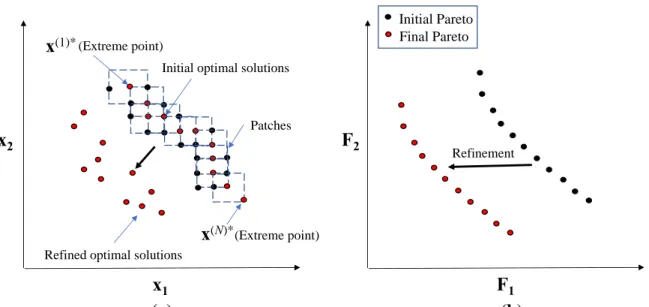
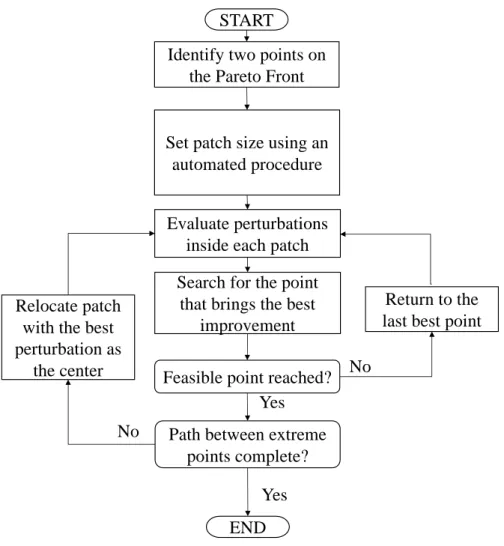
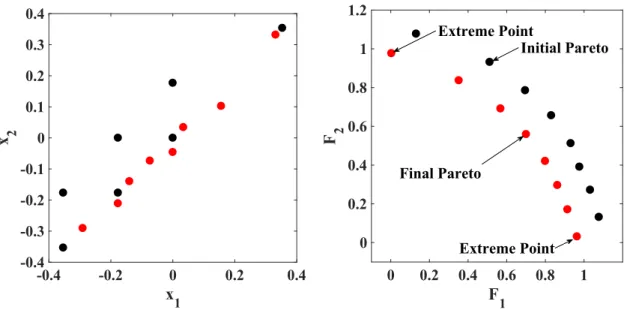
Once the extreme ends of the Pareto front to be explored are obtained, the SDP-based MOO algorithm is executed, as explained in Section II.C, to obtain an initial Pareto set (see Fig. 2-2).
(a) (b)
Figure 2-1. Exploration of (a) the entire Pareto front and (b) only part of the Pareto front.
0 0.2 0.4 0.6 0.8 1 F1 0 0.2 0.4 0.6 0.8 1 F 2 0 0.2 0.4 0.6 0.8 1 F1 0 0.2 0.4 0.6 0.8 1 F 2 x(1)* x(1)* x(N)* x(N)*
(a) (b)
Figure 2-2. Pictorial representation of the sequential domain patching method: (a) patches in the design space (b) refinement of the Pareto front in the objective space.
The optimal solutions in the initial Pareto are explored within the patches constructed in the vicinity of the starting points as shown in Fig. 2-2(a). The procedure continues until the entire distance between 𝐱(1)∗ and 𝐱(𝑁)∗ has been traversed. Due to the high cost of high-fidelity the model involved in the multi-objective aerodynamic problem, the algorithm is designed so as to obtain the initial Pareto set at the level of an auxiliary low-fidelity model. Subsequently, refinement of the initial Pareto set is performed using a limited number of high-fidelity model evaluations and response surface approximation (RSA) models to leverage the accuracy of the final Pareto set (Fig. 2-2 (a)). This process is explained in detail in Sections II.C, D and E.
C. Multi-Fidelity, Multi-Objective Aerodynamic Sequential Domain Patching Algorithm
This section describes the proposed SDP-based aerodynamic MOO algorithm in detail. The first extreme end of the Pareto front is a solution to the SOO problem of the form
𝐱(1)∗= arg min 𝐥≤𝐱≤𝐮𝐹1(𝐱), (1) subject to x1 x2 F1 F2 Initial Pareto Final Pareto x(1)* x(N)* (Extreme point) Patches (Extreme point) Refined optimal solutions
Initial optimal solutions