Ümit Ertuğrul; M. Nesibe Kesicioğlu; Funda Karaçal
Construction methods for uni-nullnorms and null-uninorms on bounded lattice
Kybernetika, Vol. 55 (2019), No. 6, 994–1015Persistent URL:http://dml.cz/dmlcz/148088
Terms of use:
© Institute of Information Theory and Automation AS CR, 2019
Institute of Mathematics of the Czech Academy of Sciences provides access to digitized documents strictly for personal use. Each copy of any part of this document must contain theseTerms of use.
This document has been digitized, optimized for electronic delivery and stamped with digital signature within the projectDML-CZ: The Czech Digital Mathematics Libraryhttp://dml.cz
CONSTRUCTION METHODS FOR UNI-NULLNORMS
AND NULL-UNINORMS ON BOUNDED LATTICE
¨
Umit Ertu˘grul, M. Nesibe Kesicio˘glu, and F. Karac¸al
In this paper, two construction methods have been proposed for uni-nullnorms on any bounded lattices. The difference between these two construction methods and the difference from the existing construction methods have been demonstrated and supported by an example. Moreover, the relationship between our construction methods and the existing construction methods for uninorms and nullnorms on bounded lattices are investigated. The charactertics of null-uninorms on bounded latticeLare given and a contruction method is presented. Keywords: uni-nullnorm, bounded lattices, uni-nullnorms, norms, uninorms,
null-norms, t-norms
Classification: 03E72, 03B52, 03G10 1. INTRODUCTION
Aggregation functions basicly are functions satisfying the monotonicity and boundary conditions. Because they have many applications (e. g., probability, statistics, artificial intelligence, operational research, economy and finance, pattern recognition and image processing, data fusion, multicriteria decision aid, automated reasoning, etc.), they are studied both in theory and in practice. Triangular norms and conorms (shortly t-norms and t-conorms, respectively), uninorms, nullnorms, uni-nullnorms and null-uninorms are special aggregation functions as well. In this respect, it is quite clear that there are many studies on these aggregation operators and that they have been working intensively([5, 6, 15, 21]).
Uninorms are special aggregation operators and they generalize t-norms and t-conorms since their neutral elements lie anywhere in the lattice. They were introduced by Yager and Rybalov [24], their structure was studied by Fodor et al. [9] and its properties and structures were investigated by many other researchers [3, 8, 11, 13].
Nullnorms, as well as uninorms, are the combination of t-norms and t-conorms. The story of these functions began with the works of Mas et al. [17] and Calvo et al. [4]. It is observed that nullnorms and t-operators are equivalent [18]. Some of their properties have been studied by researchers [7, 12, 14]
2-uninorms, which are comprised of two uninorms, are defined by Akella using the ordinal sum construction [1]. The uni-nullnorms, a special case of 2-uninorms, were
presented and studied by Sun et al. [19, 20]. In [19], Sun et al. have investigated uni-nullnorms and null-uninorms on unit real interval [0,1] and they pose the characteristics of uni-nullnorms and null-uninorms on [0,1]. In [20], they characterized uni-nullnorms with continuous Archimedean underlying t-norms and t-conorms. In [22], distributivity and conditional distributivity properties for uni-nullnorms are researched and in [23], they propose two construction methods for uni-nullnorms and a construction method for idempotent uni-nullnorms. In this study, we present two construction methods for uni-nullnorms, which we observed to be more general than the construction methods in [19], on any bounded lattices. We have demonstrated the relationship of our construc-tion methods with the existing construcconstruc-tion methods for uni-nullnorms, uninorms and nullnorms. Moreover, based on the facts V(0, a) is either 0 or a for the uni-nullnorm
F having a 2-neutral element {e,1}a on [0,1] and V(0, a) ≤ a for the uni-nullnorm V having a 2-neutral element {e,1}a on any bounded lattice L, we have proved with
an example that there may be an uni-nullnorm V having a 2-neutral element {e,1}a
on a bounded lattice L such that 0 < V(0, a) < a. The characteristic properties of null-uninorms on bounded lattices are investigated and an example is given to prove that there may be a null-uninorm F on a bounded latticeLhaving a 2-neutral element {0, e}a with a being an annihilator over [0, e] such that 1> F(1, a)> a(recall that for
null-uninorm on chain F(1, a) = a or F(1, a) = 1) The paper is organized as follows. In Section 2, we recall some basic information we need them for the construction of uni-nullnorms. In Section 3, we give two construction methods for uni-nullnorms and compare these methods with existing construction methods for uni-nullnorms, uninorms and nullnorms under some restrictions. The some concluding remarks are in Section 4.
2. NOTATIONS, DEFINITIONS AND A REVIEW OF PREVIOUS RESULTS
In this section, we recall some basic notions and results.
Definition 2.1. (Birkhoff [2]) A lattice (L,≤) is bounded lattice if L has the top element 1 and bottom element 0, that is, there exist two elements 1,0 ∈ L such that 0≤x≤1 for allx∈L.
Definition 2.2. (Birkhoff [2]) Let (L,≤,0,1) be a bounded lattice. The elementsxand
y are called comparable ifx≤y or y≤x. Otherwise,xandy are called incomparable and the notationx||y is used for such elements.
Lett∈L. The set of elements which are incomparable withtis denoted byIt∗, that
is, It∗={x∈L : x||t}.
Definition 2.3. (Birkhoff [2]) Let (L,≤,0,1) be a bounded lattice anda, b∈L with
a≤b. The sublattice [a, b] is defined as
[a, b] ={x∈L| a≤x≤b}.
Similarly, (a, b] ={x∈L| a < x≤b}, [a, b) ={x∈L| a ≤x < b} and (a, b) = {x∈L| a < x < b}can be defined.
Definition 2.4. (Klement et al. [16]) Let (L,≤,0,1) be a bounded lattice. An op-eration T (S) on a bounded latticeL is called a triangular norm (triangular conorm) if it is commutative, associative, increasing with respect to the both variables and has a neutral element 1 (0).
Definition 2.5. (Kara¸cal et al. [11]) Let (L,≤,0,1) be a bounded lattice. A binary operation U : L2 →L is called a uninorm if it has a neutral element e∈ Lsuch that U(e, x) = xfor all x ∈ L and satisfies the commutativity, associativity, monotonicity with respect to both variables.
Definition 2.6. (Ertu˘grul [7]) Let (L,≤,0,1) be a bounded lattice. A binary operation
V :L2→Lis called a nullnorm if it has a zero elementa∈Lsuch thatV(x,0) =xfor all x≤a andV(x,1) = xfor all x≥a, and satisfies the commutativity, associativity, monotonicity with respect to both variables.
Definition 2.7. (Akella [1]) Let (L,≤,0,1) be a bounded lattice ande1, a, e2∈Lwith e1≤a≤e2. LetV be a binary operator onL. Then{e1, e2}a with 0≤e1≤a≤e2≤1 is called a 2-neutral element of V ifV(e1, x) =xfor all x≤aand V(e2, x) =xfor all x≥awhere 0< a <1 ande1∈[0, a],e2∈[a,1].
Definition 2.8. (Akella [1]) Let (L,≤,0,1) be a bounded lattice and e1, a, e2∈Lwith e1 ≤ a ≤ e2. A commutative, associative, increasing binary operator on L having a 2-neutral element{e1, e2}a is called a 2-uninorm onL.
Definition 2.9. (Sun et al. [19]) Let (L,≤,0,1) be a bounded lattice ande, a∈Lwith
e≤a. A uni-nullnorm is a 2-uninorm having a 2-neutral element{e,1}a with abeing
an annihilator over [e,1].
Definition 2.10. (Sun et al. [19]) Let (L,≤,0,1) be a bounded lattice and e, a∈L
with e ≤a. A null-uninorm is a 2-uninorm having a 2-neutral element{0, e}a with a
being an annihilator over [0, e].
Definition 2.11. (Grabisch et al. [10]) LetU andV be two aggregation operators on
L. U is called smaller thanV if for any elementsx, y∈L,U(x, y)≤V(x, y).
In this sense, the smallest and greatest t-norms on a bounded lattice L are given respectively as follows: TD(x, y) = y x= 1, x y= 1, 0 otherwise andT∧(x, y) =x∧y.
Similarly, the smallest t-conormS∨ and greatest t-conormSD on a bounded latticeL,
SD(x, y) = y x= 0, x y= 0, 1 otherwise andS∨(x, y) =x∨y
are given.
We denote byIefor the set of elements which are incomparable withebut comparable
witha, in which case such an element should be smaller than the elementaand we denote byIa for the set of elements which are in comparable with abut comparable withe,in
which case such an element should be greater than the elemente,that is,Ie={x∈L : x||e and x ∦ a} and Ia = {x∈ L : x||a and x ∦ e}. By Ie,a, we denote the set of
elements which are incomparable with eand a, that is,Ie,a={x∈L : x||eandx||a}. Proposition 2.12. (Wang et al. [23]) Let (L,≤,0,1) be a bounded lattice, e, a∈L
with e≤a. F be a uni-nullnorm with 2-neutral element{e,1}a.
(i) Ifx∈Ie, thenx < a.
(ii) Ifx∈Ia, thenx > e.
The following two propositions can be obtained from Definition 2.9 directly.
Proposition 2.13. (Wang et al. [23]) Let (L,≤,0,1) be a bounded lattice, e, a∈L
with e≤a. F be a uni-nullnorm with 2-neutral element{e,1}a.
(i)U∗=F|[0,a]2 : [0, a]2→[0, a] is a uninorm on [0, a].
(ii)V∗=F|
[e,1]2 : [e,1]2→[e,1] is a nullnorm on [e,1].
(iii) T1∗=F|[0,e]2 : [0, e]2→[0, e] is a t-norm on [0, e].
(iv)S∗=F|[e,a]2 : [e, a]2→[e, a] is a t-conorm on [e, a].
(v)T2∗=F|[a,1]2 : [a,1]2→[a,1] is a t-norm on [a,1].
Proposition 2.14. (Wang et al. [23]) Lete, a∈L\ {0,1} andF be a uni-nullnorm with the neutral elementeand the zero elementaonL. Then
(i)F(x, y)≤xfor (x, y)∈[0, a]×[0, e]∪Ie×[0, e]∪[a,1]×L. (ii)F(x, y)≤y for (x, y)∈[0, e]×[0, a]∪[0, e]×Ie∪L×[a,1]. (iii) F(x, y)≥xfor (x, y)∈[0, a]×[e,1]∪[0, a]×Ia∪Ie×Ia∪Ie×[e,1]. (iv)F(x, y)≥y for (x, y)∈[e,1]×[0, a]∪[e,1]×Ie∪Ia×Ie∪Ia×[0, a]. (v) 0≤F(x, y)≤x∧y for (x, y)∈[0, e]2. (vi)x∨y≤F(x, y)≤afor (x, y)∈[e, a]2. (vii)a≤F(x, y)≤x∧yfor (x, y)∈[a,1]2. (viii)F(x, y) =afor (x, y)∈[e, a]×[a,1]∪[a,1]×[e, a]. (ix)x∧y≤F(x, y)≤x∨y for (x, y)∈[0, e)×(e, a]∪(e, a]×[0, e). (x)F(x, y)≥(x∧a)∨(y∧a) for (x, y)∈[e, a]×Ia∪Ia×[e, a]∪Ia×Ia. (xi)F(x, y)≤(x∨a)∧(y∨a) for (x, y)∈[a,1]×Ia∪Ia×[a,1]∪Ia×Ia. (xii)F(x, y)≤afor (x, y)∈[0, a]×L∪L×[0, a]∪Ie×L∪L×Ie. (xiii)F(x, y)≥afor (x, y)∈[a,1]×[e,1]∪[e,1]×[a,1]∪Ia×[a,1]∪[a,1]×Ia. In [23], the existence of uni-nullnorms on any bounded lattice is proved in the following Theorem 2.15.
Theorem 2.15. (Wang et al. [23]) Let L be a bounded lattice e, a∈L\ {0,1} such that 0≤e≤a≤1 and 0< a <1. IfT1is a t-norm on [0, e]2, S is a t-conorm on [e, a]2 andT2is a t-norm on [a,1]2, then the following functionsF∧:L2→LandF∨:L2→L
are uni-nullnorms with a 2-neutral element{e,1}a onL.
F∧(x, y) = S(x, y) (x, y)∈[e, a]2, T2(x, y) (x, y)∈[a,1]2, x∧y (x, y)∈[0, e)×[0, a)∪[e, a)×[0, e)∪[0, e)×Ie∪Ie×[0, e)∪Ie×Ie, y (x, y)∈[e, a)×Ie, x (x, y)∈Ie×[e, a), a otherwise, (1) and F∨(x, y) = T1(x, y) (x, y)∈[0, e]2, T2(x, y) (x, y)∈[a,1]2, x∨y (x, y)∈[0, a]×(e, a]∪(e, a]×[0, e]∪(e, a]×Ie∪Ie×(e, a]∪Ie×Ie, y (x, y)∈[0, e)×Ie, x (x, y)∈Ie×[0, e), a otherwise. (2)
3. CONSTRUCTION OF UNI-NULLNORMS ON BOUNDED LATTICES
In this section, we give two construction methods for uni-nullnorms on a bounded lat-tices.
Theorem 3.1. Let (L,≤,0,1) be a bounded lattice and e, a∈L\ {0,1} withe≤a. If
T1 is a t-norm on [0, e]2,S is a t-conorm on [e, a]2such thatS(x, y)< afor allx, y < a andT2is a t-norm on [a,1]2, then the following functionsFT1 :L
2→LandFS :L2→L are uni-nullnorms with a 2-neutral element{e,1}a onL.
FT1(x, y) = T1(x, y) (x, y)∈[0, e)2, S(x, y) (x, y)∈[e, a)2, T2(x, y) (x, y)∈[a,1]2, T1(x∧e, y∧e) (x, y)∈[0, e)×Ie∪Ie×[0, e)∪Ie×Ie, x∧y (x, y)∈[0, e)×[e, a)∪[e, a)×[0, e), y (x, y)∈[e, a)×Ie, x (x, y)∈Ie×[e, a), a otherwise, (3)
and FS(x, y) = T1(x, y) (x, y)∈[0, e]2, S(x, y) (x, y)∈[e, a)2, T2(x, y) (x, y)∈[a,1]2, S(x∨e, y∨e) (x, y)∈[e, a)×Ie∪Ie×[e, a)∪Ie×Ie, x∨y (x, y)∈[0, e]×(e, a)∪(e, a)×[0, e], y (x, y)∈[0, e)×Ie, x (x, y)∈Ie×[0, e), a otherwise. (4) P r o o f .
It is obvious thatFT1 satisfies the commutativity,FT1(x, e) =xfor allx∈[0, a] and
FT1(x, a) =afor allx∈[e,1]. Furthermore, FT1(x, a) =afor allx∈L.
(i)Monotonicity: Let us show that for every elements x, y∈L withx≤y, FT1(x, z)≤
FT1(y, z) for allz∈L. If the elements x, y∈Lare simultaneously elements of [0, e] or [e, a] or [a,1] or Ie or Ia or Ie,a, the proof is clear. Similarly, ifz ∈Ia or z ∈Ie,a, the inequality holds. The proof is split into all the other remain possible cases.
1. Let x∈[0, e). 1.1. y∈[e, a), 1.1.1. Ifz∈[0, e), thenFT1(x, z) =T1(x, z)≤x∧z≤y∧z=FT1(y, z). 1.1.2. Ifz∈[e, a), thenFT1(x, z) =x∧z≤z≤y∨z≤S(y, z) =FT1(y, z). 1.1.3. Ifz∈[a,1], thenFT1(x, z) =a=FT1(y, z). 1.1.4. Ifz∈Ie, thenFT1(x, z) =T1(x∧e, z∧e)≤z∧e≤z=FT1(y, z). 1.2. y∈[a,1], 1.2.1. Ifz∈[0, e), thenFT1(x, z) =T1(x, z)≤a=FT1(y, z). 1.2.2. Ifz∈[e, a), thenFT1(x, z) =x∧z≤z≤a=FT1(y, z). 1.2.3. Ifz∈[a,1], thenFT1(x, z) =a≤T2(x, y) =FT1(y, z). 1.2.4. Ifz∈Ie, thenFT1(x, z) =T1(x∧e, z∧e)≤z∧e≤a=FT1(y, z). 1.3. y∈Ie, 1.3.1. If z ∈[0, e), then FT1(x, z) =T1(x, z) =T1(x∧e, z∧e)≤T1(y∧e, z∧e) = FT1(y, z). 1.3.2. Ifz∈[e, a), thenFT1(x, z) =x∧z≤x=FT1(y, z). 1.3.3. Ifz∈[a,1], thenFT1(x, z) =a=FT1(y, z). 1.3.4. Ifz∈Ie, thenFT1(x, z) =T1(x∧e, z∧e)≤T1(y∧e, z∧e) =FT1(y, z). 1.4. y∈Ia or y∈Ie∩Ia,
In this case,FT1(y, z) =a.Therefore, it must be showed thatFT1(x, z)≤a.
1.4.1. Ifz∈[0, e), thenFT1(x, z) =T1(x, z)≤a. 1.4.2. Ifz∈[e, a), thenFT1(x, z) =x∧z≤a.
1.4.4. Ifz∈Ie, thenFT1(x, z) =T1(x∧e, z∧e)≤a. 2. Let x∈[e, a). 2.1. y∈[a,1], 2.1.1. Ifz∈[0, e), thenFT1(x, z) =x∧z≤a=FT1(y, z). 2.1.2. Ifz∈[e, a), thenFT1(x, z) =S(x, z)≤a=FT1(y, z). 2.1.3. Ifz∈[a,1], thenFT1(x, z) =a≤T2(x, y) =FT1(y, z). 2.1.4. Ifz∈Ie, thenFT1(x, z) =z≤a=FT1(y, z). 2.2. y∈Ia,
In this case,FT1(y, z) =a.Therefore, it must be showed thatFT1(x, z)≤a.
2.2.1. Ifz∈[0, e), thenFT1(x, z) =x∧z≤a. 2.2.2. Ifz∈[e, a), thenFT1(x, z) =S(x, z)≤a. 2.2.3. Ifz∈[a,1], thenFT1(x, z) =a≤a. 2.2.4. Ifz∈Ie, thenFT1(x, z) =z≤a. 3. x∈Ie, 3.1. y∈[e, a), 3.1.1. Ifz∈[0, e), thenFT1(x, z) =T1(x∧e, z∧e) =T1(x∧e, z)≤x∧z∧e=x∧z≤ y∧z=FT1(y, z). 3.1.2. Ifz∈[e, a), thenFT1(x, z) =x≤y≤S(y, z) =FT1(y, z). 3.1.3. Ifz∈[a,1], thenFT1(x, z) =a=FT1(y, z). 3.1.4. Ifz∈Ie, thenFT1(x, z) =T1(x∧e, z∧e)≤x∧z∧e≤z=FT1(y, z). 3.2. y∈[a,1], 3.2.1. Ifz∈[0, e), thenFT1(x, z) =T1(x∧e, z∧e) =T1(x∧e, z)≤x∧z∧e≤a= FT1(y, z). 3.2.2. Ifz∈[e, a), thenFT1(x, z) =x≤a=FT1(y, z). 3.2.3. Ifz∈[a,1], thenFT1(x, z) =a≤T2(y, z) =FT1(y, z). 3.2.4. Ifz∈Ie, thenFT1(x, z) =T1(x∧e, z∧e)≤x∧z∧e≤e≤a=FT1(y, z). 3.3. y∈Ia or y∈Ie∩Ia,
In this case,FT1(y, z) =a.Therefore, it must be showed thatFT1(x, z)≤a.
3.3.1. Ifz∈[0, e), thenFT1(x, z) =T1(x∧e, z∧e)≤a. 3.3.2. Ifz∈[e, a), thenFT1(x, z) =x≤a. 3.3.3. Ifz∈[a,1], thenFT1(x, z) =a. 3.3.4. Ifz∈Ie, thenFT1(x, z) =T1(x∧e, z∧e)≤a. 4. x∈Ia. 4.1. y∈(a,1], 4.1.1. Ifz∈[0, a]∪Ie, thenFT1(x, z) =a=FT1(y, z). 5. x∈Ie,a. 5.1. y∈(a,1],
5.1.1. Ifz∈[0, a]∪Ie, thenFT1(x, z) =a=FT1(y, z).
5.1.2. Ifz∈(a,1], thenFT1(x, z) =a≤T2(y, z) =FT1(y, z).
(ii)Associativity: We present thatFT1(x, FT1(y, z)) =FT1(FT1(x, y), z) for anyx, y, z∈ L. If one of the elementsx, yand z is inIa orIe,a, it is clear that the equality is always
satisfied. The proof is split into all remain possible cases by considering the situation of the elementsx, y, z. 1. Let x∈[0, e). 1.1. y∈[0, e), 1.1.1. If z ∈ [0, e), then FT1(x, FT1(y, z)) = FT1(x, T1(y, z)) = T1(x, T1(y, z)) = T1(FT1(x, y), z) =FT1(FT1(x, y), z). 1.1.2. If z ∈ [e, a), then FT1(x, FT1(y, z)) = FT1(x, y∧z) = FT1(x, y) = T1(x, y) = T1(x, y)∧z=FT1(T1(x, y), z) =FT1(FT1(x, y), z). 1.1.3. If z ∈ [a,1], then FT1(x, FT1(y, z)) = FT1(x, a) = a = FT1(T1(x, y), z) = FT1(FT1(x, y), z). 1.1.4. Ifz∈Ie, thenFT1(x, FT1(y, z)) =FT1(x, T1(y∧e, z∧e)) =FT1(x, T1(y, z∧e)) = T1(x, T1(y, z ∧e)) = T1(T1(x, y), z∧e) = T1(T1(x, y)∧e, z∧e) = FT1(T1(x, y), z) = FT1(FT1(x, y), z). 1.2. y∈[e, a), 1.2.1. If z ∈ [0, e), then FT1(x, FT1(y, z)) = FT1(x, y∧z) = FT1(x, z) = T1(x, z) = FT1(x, z) =FT1(x∧y, z) =FT1(FT1(x, y), z) 1.2.2. Ifz∈[e, a), thenFT1(x, FT1(y, z)) =FT1(x, S(y, z)) =x∧S(y, z) =x=x∧z= FT1(x, z) =FT1(x∧y, z) =FT1(FT1(x, y), z). 1.2.3. If z ∈ [a,1], then FT1(x, FT1(y, z)) = FT1(x, a) = a = FT1(x, z) = FT1(x∧ y, z) =FT1(FT1(x, y), z). 1.2.4. Ifz ∈Ie, then FT1(x, FT1(y, z)) =FT1(x, z) =T1(x∧e, z∧e) = FT1(x, z) = FT1(x∧y, z) =FT1(FT1(x, y), z). 1.3. y∈[a,1], 1.3.1. If z ∈ [0, a]∪Ie, then FT1(x, FT1(y, z)) = FT1(x, a) = a = FT1(a, z) = FT1(FT1(x, y), z). 1.3.2. If z ∈ [a,1], then FT1(x, FT1(y, z)) = FT1(x, T2(y, z)) = a = FT1(a, z) = FT1(FT1(x, y), z). 1.4. y∈Ie, 1.4.1. If z ∈ [0, e), then FT1(x, FT1(y, z)) = FT1(x, T1(y∧e, z∧e)) = T1(x, T1(y∧ e, z∧e)) = T1(T1(x, y∧e), z∧e) = FT1(T1(x, y∧e), z) = FT1(T1(x∧e, y∧e), z) = FT1(FT1(x, y), z). 1.4.2. Ifz∈[e, a), thenFT1(x, FT1(y, z)) =FT1(x, y) =T1(x∧e, y∧e) =T1(x, y∧e) = T1(x, y∧e)∧z=FT1(T1(x, y∧e), z) =FT1(T1(x∧e, y∧e), z) =FT1(FT1(x, y), z). 1.4.3. Ifz ∈ [a,1], then FT1(x, FT1(y, z)) = FT1(x, a) = a = FT1(T1(x, y∧e), z) = FT1(T1(x∧e, y∧e), z) =FT1(FT1(x, y), z).
1.4.4. If z ∈ Ie, then FT1(x, FT1(y, z)) = FT1(x, T1(y ∧e, z∧e)) = T1(x, T1(y∧ e, z∧e)) =T1(T1(x, y∧e)∧e, z∧e) =FT1(T1(x, y∧e), z) =FT1(T1(x∧e, y∧e), z) = FT1(FT1(x, y), z). 2. x∈[e, a). 2.1. y∈[0, e), 2.1.1. Ifz∈[0, e), thenFT1(x, FT1(y, z)) =FT1(x, T1(y, z)) =x∧T1(y, z) =T1(y, z) = FT1(y, z) =FT1(x∧y, z) =FT1(FT1(x, y), z). 2.1.2. Ifz∈[e, a), then FT1(x, FT1(y, z)) =FT1(x, y∧z) =FT1(x, y) =x∧y =y = y∧z=FT1(y, z) =FT1(x∧y, z) =FT1(FT1(x, y), z). 2.1.3. If z ∈ [a,1], then FT1(x, FT1(y, z)) = FT1(x, a) = a = FT1(y, z) = FT1(x∧ y, z) =FT1(FT1(x, y), z). 2.1.4. Ifz∈Ie, thenFT1(x, FT1(y, z)) =FT1(x, T1(y∧e, z∧e)) =x∧T1(y∧e, z∧e) = T1(y∧e, z∧e) =FT1(y, z) =FT1(x∧y, z) =FT1(FT1(x, y), z). 2.2. y∈[e, a), 2.2.1. If z ∈ [0, e), then FT1(x, FT1(y, z)) = FT1(x, y∧z) = FT1(x, z) = z = FT1(S(x, y), z) =FT1(FT1(x, y), z). 2.2.2. Ifz∈[e, a), thenFT1(x, FT1(y, z)) =FT1(x, S(y, z)) =S(x, S(y, z)) =S(S(x, y), z) = FT1(S(x, y), z) =FT1(FT1(x, y), z). 2.2.3. If z ∈ [a,1], then FT1(x, FT1(y, z)) = FT1(x, a) = a = FT1(S(x, y), z) = FT1(FT1(x, y), z). 2.2.4. Ifz∈Ie, thenFT1(x, FT1(y, z)) =FT1(x, z) =z=FT1(S(x, y), z) =FT1(FT1(x, y), z). 2.3. y∈[a,1], 2.3.1. If z ∈ [0, a)∪Ie, then FT1(x, FT1(y, z)) = FT1(x, a) = a = FT1(a, z) = FT1(FT1(x, y), z). 2.3.2. If z ∈ [a,1], then FT1(x, FT1(y, z)) = FT1(x, T2(y, z)) = a = FT1(a, z) = FT1(FT1(x, y), z). 2.4. y∈Ie, 2.4.1. Ifz ∈[0, e), thenFT1(x, FT1(y, z)) =FT1(x, T1(y∧e, z)) =x∧T1(y∧e, z) = T1(y∧e, z) =FT1(y, z) =FT1(FT1(x, y), z). 2.4.2. Ifz∈[e, a), thenFT1(x, FT1(y, z)) =FT1(x, y) =y=FT1(y, z) =FT1(FT1(x, y), z). 2.4.3. Ifz∈[a,1], thenFT1(x, FT1(y, z)) =a=FT1(y, z) =FT1(FT1(x, y), z). 2.4.4. Ifz ∈Ie, thenFT1(x, FT1(y, z)) =FT1(x, T1(y∧e, z∧e)) =T1(y∧e, z∧e) = FT1(y, z) =FT1(FT1(x, y), z). 3. x∈[a,1]. 3.1. y∈[0, e), 3.1.1. Ifz ∈[0, a)∪Ie, then FT1(x, FT1(y, z)) =FT1(x, T1(y, z)) =a=FT1(a, z) = FT1(FT1(x, y), z). 3.1.2. Ifz∈[a,1], thenFT1(x, FT1(y, z)) =FT1(x, a) =a=FT1(a, z) =FT1(FT1(x, y), z). 3.2. y∈[e, a),
3.2.1. If z ∈ [0, e), then FT1(x, FT1(y, z)) = FT1(x, y∧z) = FT1(x, z) = a = FT1(a, z) =FT1(FT1(x, y), z). 3.2.2. If z ∈ [e, a), then FT1(x, FT1(y, z)) = FT1(x, S(y, z)) = a = FT1(a, z) = FT1(FT1(x, y), z). 3.2.3. Ifz∈[a,1], thenFT1(x, FT1(y, z)) =FT1(x, a) =a=FT1(a, z) =FT1(FT1(x, y), z). 3.2.4. Ifz∈Ie, thenFT1(x, FT1(y, z)) =FT1(x, z) =a=FT1(a, z) =FT1(FT1(x, y), z). 3.3. y∈[a,1], 3.3.1. Ifz ∈[0, a)∪Ie, thenFT1(x, FT1(y, z)) =FT1(x, a) =a=FT1(T2(x, y), z) = FT1(FT1(x, y), z). 3.3.2. If z ∈ [a,1], then FT1(x, FT1(y, z)) = FT1(x, T2(y, z)) = T2(x, T2(y, z)) = T2(T2(x, y), z) =FT1(T2(x, y), z) =FT1(FT1(x, y), z). 3.4. y∈Ie, 3.4.1. Ifz ∈ [0, e)∪Ie, then FT1(x, FT1(y, z)) =FT1(x, T1(y, z)) =a=FT1(a, z) = FT1(FT1(x, y), z). 3.4.2. Ifz∈[e, a), thenFT1(x, FT1(y, z)) =FT1(x, y) =a=FT1(a, z) =FT1(FT1(x, y), z). 3.4.3. Ifz∈[a,1], thenFT1(x, FT1(y, z)) =FT1(x, a) =a=FT1(a, z) =FT1(FT1(x, y), z). 4. x∈Ie. 4.1. y∈[0, e), 4.1.1. Ifz∈[0, e), thenFT1(x, FT1(y, z)) =FT1(x, T1(y, z)) =T1(x∧e, T1(y, z)∧e) = T1(x∧e, T1(y, z)) =T1(T1(x∧e, y), z) =FT1(T1(x∧e, y), z) =FT1(T1(x∧e, y∧e), z) = FT1(FT1(x, y), z). 4.1.2. Ifz∈[e, a), then FT1(x, FT1(y, z)) =FT1(x, y∧z) =FT1(x, y) =T1(x∧e, y∧ e) =T1(x∧e, y) =T1(x∧e, y)∧z=FT1(T1(x∧e, y∧e), z) =FT1(FT1(x, y), z). 4.1.3. Ifz ∈ [a,1], then FT1(x, FT1(y, z)) = FT1(x, a) = a = FT1(T1(x∧e, y), z) = FT1(T1(x∧e, y∧e), z) =FT1(FT1(x, y), z). 4.1.4. Ifz∈Ie, thenFT1(x, FT1(y, z)) =FT1(x, T1(y∧e, z∧e)) =FT1(x, T1(y, z∧e)) = T1(x∧e, T1(y, z∧e)) =T1(T1(x∧e, y), z∧e) =FT1(T1(x∧e, y), z) =FT1(T1(x∧e, y∧ e), z) =FT1(FT1(x, y), z). 4.2. y∈[e, a), 4.2.1. Ifz∈[0, e)∪Ie, thenFT1(x, FT1(y, z)) =FT1(x, z) =FT1(x, z) =FT1(FT1(x, y), z). 4.2.2. If z ∈ [e, a), then FT1(x, FT1(y, z)) = FT1(x, S(y, z)) = x = FT1(x, z) = FT1(FT1(x, y), z). 4.2.3. Ifz∈[a,1], thenFT1(x, FT1(y, z)) =FT1(x, a) =a=FT1(x, z) =FT1(FT1(x, y), z). 4.3. y∈[a,1], 4.3.1. Ifz∈L, thenFT1(x, FT1(y, z)) =a=FT1(a, z) =FT1(FT1(x, y), z). 4.4. y∈Ie, 4.4.1. Ifz ∈[0, e), thenFT1(x, FT1(y, z)) =FT1(x, T1(y∧e, z∧e)) =FT1(x, T1(y∧ e, z)) = T1(x∧e, T1(y ∧e, z)) = T1(T1(x∧e, y∧e), z) = FT1(T1(x∧e, y∧e), z) = FT1(FT1(x, y), z).
4.4.2. Ifz∈[e, a), thenFT1(x, FT1(y, z)) =FT1(x, y) =T1(x∧e, y∧e)) =FT1(T1(x∧ e, y∧e), z) =FT1(FT1(x, y), z). 4.4.3. Ifz∈[a,1], thenFT1(x, FT1(y, z)) =FT1(x, a) =a=FT1(T1(x∧e, y∧e), z) = FT1(FT1(x, y), z). 4.4.4. Ifz ∈ Ie, then FT1(x, FT1(y, z)) =FT1(x, T1(y∧e, z∧e)) =T1(x∧e, T1(y∧ e, z∧e)) =FT1(T1(x∧e, y∧e), z) =FT1(FT1(x, y), z).
Therefore, we obtain thatFT1 is a uni-nullnorm onLwith the neutral elementeand
the zero element a. Similarly, we can prove that FS is a uni-nullnorm on L with the
neutral elementeand the zero elementa.
Remark 3.2. Let (L,0,1,≤) be a bounded lattice,e, a∈L\ {0,1},T1be a t-norm on [0, e], S be a t-conorm on [e, a] andT2be a t-norm on [a,1]. Consider the uni-nullnorms F∧,F∨, FT1 andFS on bounded lattice Lconsidering Theorems 2.15 and 3.1.
(i) If T1 =∧, thenF∧ =FT1. Although, the uni-nullnorm FT1 given in Theorem 3.1 is
much more general than the uni-nullnorm F∧ in Theorem 2.15 whenT16=∧in formula (3) (see Example 3.4).
(ii) If S =∨, then F∨ =FS. Although, the uni-nullnormFS given in Theorem 3.1 is
much more general than the uni-nullnorm F∨ in Theorem 2.15 when S6=∨ in formula
(3) (see Example 3.4).
(iii) If we takee= 0 in formulas (1), (2), (3) and (4), then the formula (3) is coincident to formula (1) and produce a nullnorm on bounded latticeLand formula (4) is coincided to (2) and produce a nullnorm too on bounded latticeL.
(iv) Ifa= 1, then the formula (1) is coincided to construction method given in Propo-sition 1 in [3] and the formula (2) is coincided to PropoPropo-sition 2 in [3].
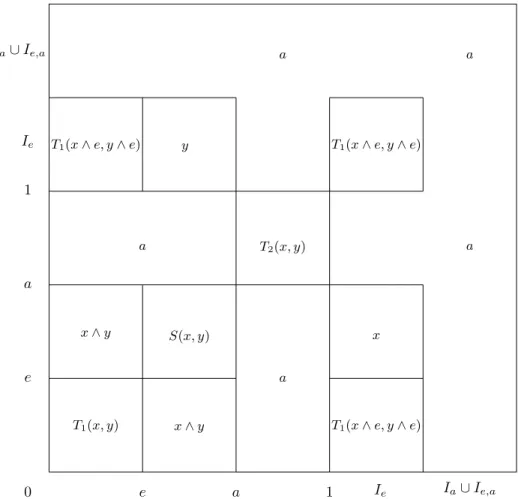
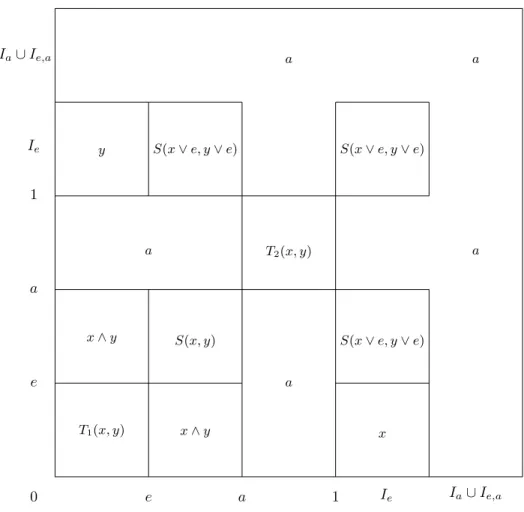
Remark 3.3. From Theorem 3.1, the structure of two construction methods of a uni-nullnorm on the bounded latticeLcan be visualized, see Figures1and2.
0 e a 1 Ie Ia∪Ie,a e a 1 Ie Ia∪Ie,a a a a a a T1(x, y) S(x, y) T2(x, y) x∧y x∧y x y T1(x∧e, y∧e) T1(x∧e, y∧e) T1(x∧e, y∧e)
Fig. 1. The representation of the uni-nullnormFT1 obtained from formula (3).
0 e a 1 Ie Ia∪Ie,a e a 1 Ie Ia∪Ie,a a a a a a T1(x, y) S(x, y) T2(x, y) x∧y x∧y S(x∨e, y∨e) S(x∨e, y∨e) x y S(x∨e, y∨e)
Fig. 2. The representation of the uni-nullnormFSontained from formula (4).
Example 3.4. Consider the latticeL whose Hasse diagram is as in Figure3.
Let us take the t-norm T2 = T∧ on [a,1], the t-norm T1 = TD on [0, e] and the
t-conormS on [e, a] as following. S e i h a e e i h a i i i a a h h a a a a a a a a
1 a i h g e f c d b 0
Fig. 3. Lattice diagram ofL
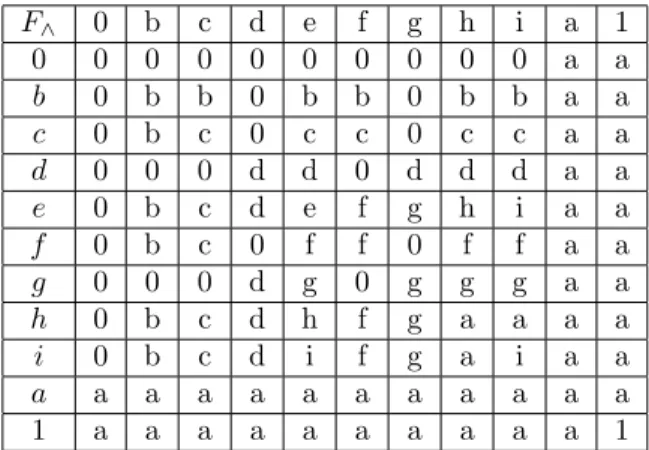
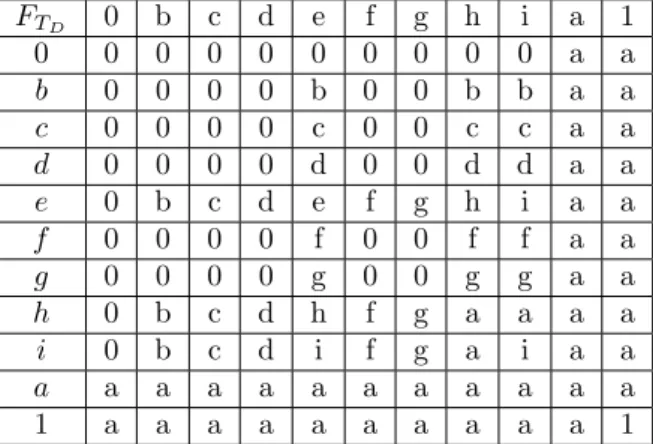
The uni-nullnorms F∧, F∨, FT1 and FS obtained from the formulas (1), (2), (3) and
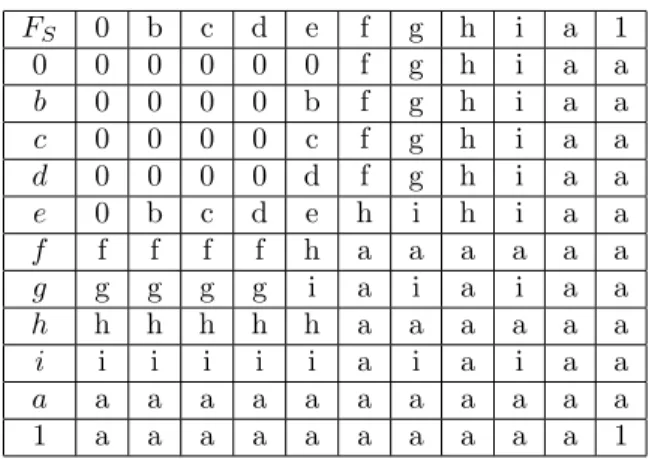
(4) are respectively as in Tables 2,3,4and5.
F∧ 0 b c d e f g h i a 1 0 0 0 0 0 0 0 0 0 0 a a b 0 b b 0 b b 0 b b a a c 0 b c 0 c c 0 c c a a d 0 0 0 d d 0 d d d a a e 0 b c d e f g h i a a f 0 b c 0 f f 0 f f a a g 0 0 0 d g 0 g g g a a h 0 b c d h f g a a a a i 0 b c d i f g a i a a a a a a a a a a a a a a 1 a a a a a a a a a a 1
Tab. 2. The uni-nullnormF∧ induced by the formula (1) in Theorem
F∨ 0 b c d e f g h i a 1 0 0 0 0 0 0 f g h i a a b 0 0 0 0 b f g h i a a c 0 0 0 0 c f g h i a a d 0 0 0 0 d f g h i a a e 0 b c d e f g h i a a f f f f f f f a a a a a g g g g g g a g a a a a h h h h h h a a h a a a i i i i i i a a a i a a a a a a a a a a a a a a 1 a a a a a a a a a a 1
Tab. 3. The uni-nullnormF∨ induced by the formula (2) in Theorem
2.15. FTD 0 b c d e f g h i a 1 0 0 0 0 0 0 0 0 0 0 a a b 0 0 0 0 b 0 0 b b a a c 0 0 0 0 c 0 0 c c a a d 0 0 0 0 d 0 0 d d a a e 0 b c d e f g h i a a f 0 0 0 0 f 0 0 f f a a g 0 0 0 0 g 0 0 g g a a h 0 b c d h f g a a a a i 0 b c d i f g a i a a a a a a a a a a a a a a 1 a a a a a a a a a a 1
Tab. 4. The uni-nullnormFT1 induced by the formula (3) in Theorem 3.1.
FS 0 b c d e f g h i a 1 0 0 0 0 0 0 f g h i a a b 0 0 0 0 b f g h i a a c 0 0 0 0 c f g h i a a d 0 0 0 0 d f g h i a a e 0 b c d e h i h i a a f f f f f h a a a a a a g g g g g i a i a i a a h h h h h h a a a a a a i i i i i i a i a i a a a a a a a a a a a a a a 1 a a a a a a a a a a 1
Tab. 5. The uni-nullnormFS induced by the formula (4) in Theorem 3.1.
By comparing Table2and Table4, one can observe that the uni-nullnorm F∧ does
not coincide with the uni-nullnormFTD (sinceTD6=∧in this lattice). Similarly, one can observe by comparing Table 3and Table 5that the uni-nullnormF∨ does not coincide
with the uni-nullnorm FS (sinceS6=∨in this lattice).
Remark 3.5. Let (L,≤,0,1) be a bounded lattice, e, a ∈ L with e ≤ a and F be a uni-nullnorm with 2-neutral element{e,1}a. We know thatF(0, a) = 0 orF(0, a) =aif
we takeL= [0,1]. In general,F(0, a)≤aon any bounded latticeL. A natural question arises: Is there a uni-nullnorm F such that F(0, a) = b for an element b satisfying 0< b < a? The following example shows that the claim may be true.
Example 3.6. Consider the latticeL whose Hasse diagram is in Figure4.
1
a
b e
0
Fig. 4. Lattice diagram ofL.
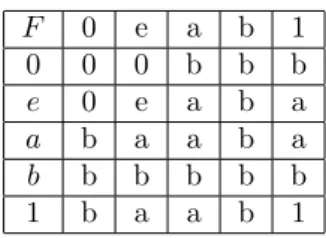
F 0 e a b 1 0 0 0 b b b e 0 e a b a a b a a b a b b b b b b 1 b a a b 1
Tab. 6. The uni-nullnormF onL.
When checking the Table6, it has seen thatF(0, a) =b < a. Therefore, this example indicates thatF(0, a) may be different from 0 orafor uni-nullnormFdefined on bounded latticeLdifferent from the real unit interval [0,1].
4. CONSTRUCTION OF NULL-UNINORM ON BOUNDED LATTICES
In this section, after giving a proposition that characterizes the general characteristics of null-uninorm on the bounded lattices, two construction methods for null-uninorm are given on the bounded lattices.
Proposition 4.1. Let (L,≤,0,1) be a bounded lattice,e, a∈Lwitha≤eandF be a null-uninorm having a 2-neutral element {0, e}a withabeing an annihilator over [0, e].
Then, (i)x≤F(x, y) for (x, y)∈[a,1]×[e,1]∪Ie×[e,1]∪[0, a]×L. (ii)y≤F(x, y) for (x, y)∈[e,1]×[a,1]∪[e,1]×Ie∪L×[0, a]. (iii) x≤F(x, y) for (x, y)∈[a,1]×[0, e]∪[a,1]×Ia∪Ie×Ia∪Ie∪[0, e]. (iv)y≤F(x, y) for (x, y)∈[0, e]×[a,1]∪[0, e]×Ie∪Ia×Ie∪Ia∪[a,1]. (v)x∨y≤F(x, y)≤1 for (x, y)∈[e,1]2. (vi)a≤F(x, y)≤x∧y for (x, y)∈[a, e]2. (vii)x∨y≤F(x, y)≤afor (x, y)∈[0, a]2. (viii)F(x, y) =afor (x, y)∈[a,1]×[0, a]∪[0, a]×[a,1]. (ix)x∧y≤F(x, y)≤x∨y for (x, y)∈(e,1]×[a, e)∪[a, e)×(e,1]. (x)F(x, y)≥(x∧a)∨(y∧a) for (x, y)∈[0, a]×Ia∪Ia×[0, a]∪Ia×Ia. (xi)F(x, y)≤(x∨a)∧(y∨a) for (x, y)∈[a, e]×Ia∪Ia×[a, e]∪Ia×Ia. (xii)F(x, y)≥afor (x, y)∈[a,1]×L∪L×[a,1]∪Ie×L∪L×Ie. (xiii)F(x, y)≤afor (x, y)∈[0, a]×[0, e]∪[0, e]×[0, a]∪Ia×[0, a]∪[0, a]×Ia.
Proposition 4.2. Let (L,≤,0,1) be a bounded lattice,e, a∈Lwitha≤eandF be a null-uninorm having a 2-neutral element {0, e}a with a being an annihilator over [0, e].
Then,
(i)V∗=F|[0,e]2 : [0, e]2→[0, e] is a nullnorm on [0, e].
(ii)U∗=F|[a,1]2: [a,1]2→[a,1] is a uninorm on [a,1].
(iii) S1∗=F|[0,a]2 : [0, a]2→[0, a] is a t-conorm on [0, a].
(iv)T∗=F|[a,e]2 : [a, e]2→[a, e] is a t-norm on [a, e].
(v)S2∗=F|[e,1]2: [e,1]2→[e,1] is a t-conorm on [e,1].
The above propositions can be obtained immediately from Definition 2.10.
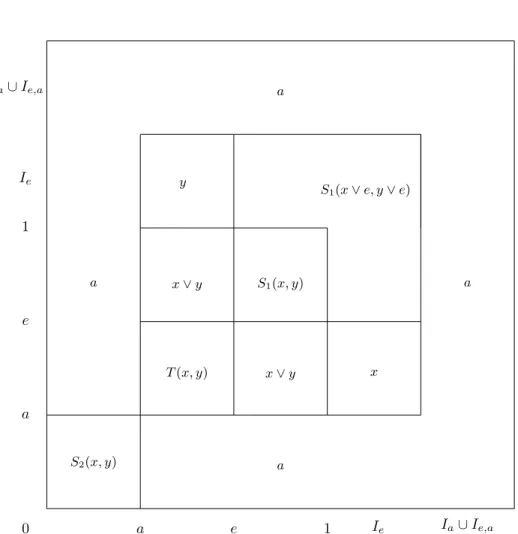
Theorem 4.3. Leta, e∈ L\ {0,1} with a≤e. If S2 is a t-conorm on [0, a]2, T is a t-norm on [a, e]2 such thatT(x, y)> afor all x, y > aandS1 is a t-conorm on [e,1]2, then the following functionFT :L2→L is null-uninorm a 2-neutral element{0, e}a on L. FT(x, y) = S2(x, y) (x, y)∈[0, a]2, T(x, y) (x, y)∈[a, e]2, S1(x, y) (x, y)∈[e,1]2, S1(x∨e, y∨e) (x, y)∈(e,1]×Ie∪Ie×(e,1]∪Ie×Ie, x∨y (x, y)∈(e,1]×(a, e]∪(a, e]×(e,1], y (x, y)∈(a, e]×Ie, x (x, y)∈Ie×(a, e], a otherwise. (5)
The proof of Theorem 4.3 is omitted since it could be done in a way similar to Theorem 3.1.
Remark 4.4. From Theorem 4.3, the structure of construction method of a null-uninorm on the bounded lattice Lcan be visualized, see Figure5.
Remark 4.5. Let (L,≤,0,1) be a bounded lattice, e, a ∈ L with a ≤ e and F be a null-uninorm with a 2-neutral element{0, e}a. We know thatF(1, a) = 1 orF(1, a) =a
if we take L = [0,1]. In general F(1, a) ≥ a on any bounded lattice L. Similarly, a natural question arises: Is there a null-uninorm F such thatF(1, a) =bfor an element
0 a e 1 Ie Ia∪Ie,a a e 1 Ie Ia∪Ie,a a a a a S2(x, y) T(x, y) S1(x∨e, y∨e) S1(x, y) x x∨y x∨y y
Fig. 5. The representation of the null-uninormFT obtained from formula (5).
Example 4.6. Consider the latticeL whose Hasse diagram is as in Figure6.
1
b e
a
0
Fig. 6. Lattice diagram ofL
Take the null-uninormF on L as in Table7
F 0 e a b 1 0 0 a a b b e a e a b 1 a a a a b b b b b b b b 1 b 1 b b 1
Tab. 7. The null-uninormF onL.
When checking the Table7, it has seen thatF(1, a) =b > a. Therefore, this example indicates that F(1, a) may be different from 1 and a for null-uninorm F defined on bounded latticeLdifferent from the real unit interval [0,1].
5. CONCLUDING REMARKS
After the definition and characteristics of the uni-nullnorms and null-uninorms on [0,1] were given by Sun et al. [19], a study was conducted by Wang et al. on the methods of constructing uni-nullnorm [23] and moreover, these functions have been studied by researchers from different perspectives [20, 22]. Uni-nullnorm functions are also stud-ied on bounded lattices such as other logical operators (t-norms, t-conorms, uninorms, nullnorms) which are defined and studied on the unit real interval at first and then studied on the bounded lattices. In this paper, two construction methods are proposed and investigated their relations with other construction methods for uni-nullnorms, null-norms and uninull-norms. Characteristic properties of nulll-uninull-norms on bounded lattice are introduced and a construction method for null-uninorm is given.
R E F E R E N C E S
[1] P. Akella: Structure of n-uninorms. Fuzzy Sets Systems 158 (2007), 1631–1651. DOI:10.1016/j.fss.2007.02.015
[2] G. Birkhoff: Lattice Theory. Third edition. Providence, 1967. DOI:10.1090/coll/025 [3] S. Bodjanova and M. Kalina: Construction of uninorms on bounded lattices. IEEE
12th International Symposium on Intelligent Systems and Informatics (SISY) Book Se-ries: International Symposium on Intelligent Systems and Informatics, 2014, pp. 61–66. DOI:10.1109/sisy.2014.6923558
[4] T. Calvo, B. De Baets,and J. Fodor: The functional equations of Frank and Alsina for uninorms and nullnorms. Fuzzy Sets Systems120 (2001), 385–394. DOI:10.1016/s0165-0114(99)00125-6
[5] G. D. C¸ aylı, ¨U. Ertu˘grul, T. K¨oro˘glu, and F. Kara¸cal: Notes on locally internal uninorm on bounded lattice. Kybernetika53(2017), 5, 911–921. DOI:10.14736/kyb-2017-5-0911 [6] G. D. C¸ aylı and F. Kara¸cal: Construction of uninorms on bounded lattices. Kybernetika
53(2017), 3, 394–417. DOI:10.14736/kyb-2017-3-0394
[7] ¨U. Ertu˘grul: Construction of nullnorms on bounded lattices and an equivalence relation on nullnorms. Fuzzy Sets Systems334(2018), 94–109. DOI:10.1016/j.fss.2017.07.020
[8] ¨U. Ertu˘grul, M. N. Kesicio˘glu, and F. Kara¸cal: Ordering based on uninorms. Inform. Sci. 330(2016), 315–327. DOI:10.1016/j.ins.2015.10.019
[9] J. Fodor, R. R. Yager, and A. Rybalov: Structure of uninorms. Int. J. Uncertain. Fuzziness Knowl.-Based Syst.5(1997), 4, 411–427. DOI:10.1142/s0218488597000312
[10] M. Grabisch, J.-L. Marichal, R. Mesiar, and E. Pap: Aggregation Functions. Cambridge University Press, 2009. DOI:10.1017/cbo9781139644150
[11] F. Kara¸cal, ¨U. Ertu˘grul, and R. Mesiar: Characterization of uninorms on bounded lattices. Fuzzy Sets Systems308(2017), 54–71. DOI:10.1016/j.fss.2016.05.014
[12] F. Kara¸cal, M. A. ˙Ince, and R. Mesiar: Nullnorms on bounded lattices. Inf. Sci.325(2015), 227–236. DOI:10.1016/j.ins.2015.06.052
[13] F. Kara¸cal and R. Mesiar: Uninorms on bounded lattices. Fuzzy Sets Systems261(2015), 33–43. DOI:10.1016/j.fss.2014.05.001
[14] M. N. Kesicio˘glu: Some notes on the partial orders induced by a uninorm and a nullnorm in a bounded lattice. Fuzzy Sets Systems346(2018), 55–71. DOI:10.1016/j.fss.2017.08.010 [15] M. N. Kesicio˘glu, ¨U. Ertu˘grul, and F. Kara¸cal: Some notes on U-partial order. Kybernetika
55(2019), 3, 518–530. DOI:10.14736/kyb-2019-3-0518
[16] E. P. Klement, R. Mesiar, and E. Pap: On Locally Internal Monotonic Operations. Kluwer Academic Publishers, Dordrecht 2000.
[17] M. Mas, G. Mayor, and J. Torrens: t-operators. Int. J. Uncertain. Fuzziness Knowl.-Based Systems7(1999), 31–50. DOI:10.1142/s0218488599000039
[18] M. Mas, G. Mayor, and J. Torrens: The distributivity condition for uninorms and t-operators. Fuzzy Sets Systems128(2002), 209—225.
[19] F. Sun, X. P. Wang, and X. B. Qu: Uni-nullnorms and null-uninorms. J. Intell. Fuzzy Systems32(2017), 1969–1981.
[20] F. Sun, X. P. Wang, and X. B. Qu: Characterizations of uni-nullnorms with continuous Archimedean underlying t-norms and t-conorms. Fuzzy Sets Systems334 (2018), 24–35. DOI:10.1016/j.fss.2017.03.001
[21] Y.-M. Wang and W.-H. Liu: On the distributivity equation for uni-nullnorms. Kybernetika 55(2019), 1, 24–43. DOI:10.14736/kyb-2019-1-0024
[22] G. Wang, F. Qin, and W.-H. Liu: Distributivity and conditional distributivity for uni-nullnorms. Fuzzy Sets Systems372(2018), 34–49. DOI:10.1016/j.fss.2018.08.008
[23] Y.-M. Wang, H. Zhan, and H.-W. Liu: Uni-nullnorms on bounded lattices. Fuzzy Sets Systems (2019).
[24] R. R. Yager and A. Rybalov: Uninorm aggregation operators. Fuzzy Sets Systems80 (1996), 1, 111–120.
¨
Umit Ertu˘grul, Department of Mathematics, Faculty of Sciences, Karadeniz Technical University, 61080 Trabzon. Turkey.
e-mail: [email protected]
M. Nesibe Kesicio˘glu, Department of Mathematics, Recep Tayyip Erdo˘gan University, 53100 Rize. Turkey
e-mail: [email protected]
Funda Kara¸cal, Department of Mathematics, Faculty of Sciences, Karadeniz Technical University, 61080 Trabzon. Turkey.