Risk Based Pricing for Unsecured Lending
Boitumelo Thoka
689586
Supervisor: Dr Blessing Mudavhanu
Masters of Management in Finance and Investments
Wits Business School
University of the Witwatersrand
Thesis submitted in fulfilment of the requirements for the degree of
Master of Management in Finance & Investment
In the
Faculty of Commerce and Law Management
Wits Business School
at the
University of the Witwatersrand
supervisor: ..
D
..
[~.~.~~
.
:
...
~~'?
.
~ ~\4.
\
Signature: ... ..
Declaration
I, Boitumelo Thoka, declare that the research work reported in this dissertation is my own, except where otherwise indicated and acknowledged. It is submitted for the degree of Master of Management in Finance and Investment at the University of the Witwatersrand, Johannesburg. This thesis has not, either in whole or in part, been submitted for a degree or diploma to any other universities.
Abstract
Risk based pricing has been a topic of discussion since the 2008 financial crisis as a result of the on-selling of packaged sub-prime assets. This paper will highlight the importance of correctly assessing risk within the framework of consumer credit provision. We will begin with a brief overview of the South African unsecured lending market, look into the definition of risk based pricing and the impact it has had in the market and conclude the paper by using a model by Robert Phillips to calculate the interest rate to be offered to a customer.
Table of Contents
1. Introduction ... 6
1.1 Problem Statement of Study ... 7
1.2 Overvie~ .... ~ ... 7
1.3 Methodology ... 13
1.4 Outline of Study ... 13
2. Risk Based Pricing ... 14
2.1 Key Attributes of Risk Based Pricing ... 19
2.2 Risk Based Pricing Models ... 20
2.3 Credit Scoring Models ... 21
2.4 FICO Scores ... 24
2.4.1 How my FICO Scores are calculated ... 25
2.4.2 What's not in my FICO Scores ... 26
2.5 Impact of Risk-Based Pricing in America ... 27
2.6 Basel Accords ... 29
3. Methodology ... 34
3.1 Pricing ... 34
4. Conclusion ... 42
5. References ... 44
List of Figures and Tables
Figure 1: Unsecured Credit Gross Debtors Book ... 6
Figure 2 : Unsecured Lending Market Share ... 12
Figure 3 : FICO Score ... 24
Figure 4 : Decrease in Credit Card Balances that Charged More than 18% ... 27
Figure 5 : Increase in Credit Card Ownership for Lower Income Households ... 28
Figure 6 : The Basel Accords ... 29
Figure 7 : Risk-Weights of Assets ... 30
Figure 8 : Basel III ... 32
Figure 9 : Risk Premiums vs. Interest Rate Offered to Client.. ... .40
Table 1 : Risks Faced by Financial Intermediaries ... 8
Table 2 : Prescriptions of the National Credit Act No.34 of 2005 ... 11
Table 3: Score-Based Pricing Systems ... 21
Table 4: Credit Scoring Models ... 22
Table 5 : Risk Premium per FICO Score Category ... 37
Table 6: Maximum Interest Rate Offered to Clients per Risk Category ... 38
1.
Introduction
Risk-based pricing has been a topic of debate since the financial crisis of 2008. Incorrect pricing of risk in mortgage loans in the United States of America put a spotlight on the lending activities of lenders, the type of risk that lenders adopt in their operations and the risk management activities thereof.
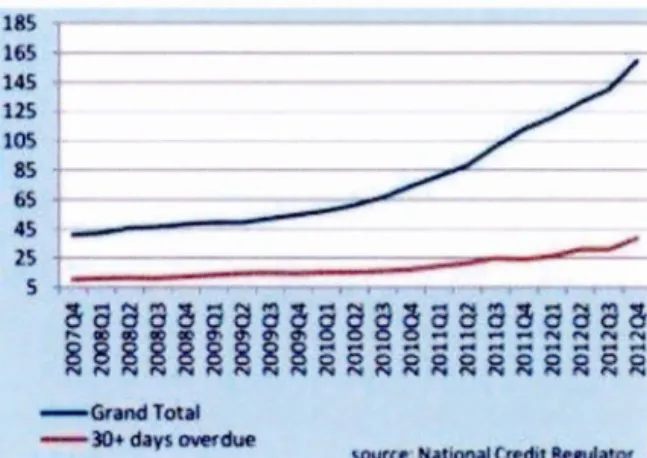
South Africa experienced a surge in unsecured loans in 2010 according to Stuart Theobald of Leriba Consulting. As the country went through an overhaul process of their unsecured loans provisions act from the Usury Act of 1968 to the National Credit Act that was instituted in 2007, opportunities were created for growth in the unsecured lending market in the form of an increase in the size of loans that the new act provided for as well as an extension in the term.
-Grand TOlil
- 30+ d<1y5 OWfdue
Figure 1: Unsecured Credit Gross Debtors Book 1
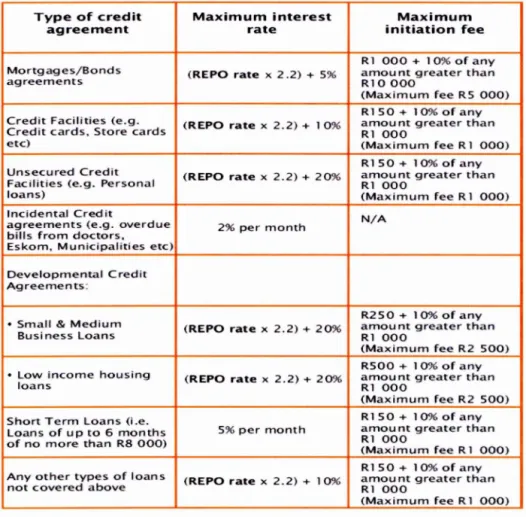
Concerns have been raised around the fairness of the interest rate that lenders are allowed to charge borrowers. The National Credit Act prescribes the maximum rates that can be charged for unsecured lending which is further broken down into credit facilities, short term credit and unsecured credit. The maximum rate for unsecured credit is prescribed at 2.2 x repo rate + 20% per annum whilst that of short term credit (defined as the nominal not exceeding R8000 and
tenor of 6 months and less) is capped at 5% per month. Credit facilities are capped at 2.2 x repo rate +10% per annum.
1.1 Problem Statement of Study
The purpose of this study is to highlight the importance of a simple loan pricing framework that is reflective of the credit risk of the potential borrower as well as other risks that the lender or bank adopts as a result of the transaction.
The study aims to address the following questions: • What is risk based pricing?
• What risks are considered when pricing loans? • What are the key attributes of risk based pricing?
This study hopes to add to the conversation regarding the prudent identification, understanding and evaluation of risks associated with lending as well as the pricing of those risks to ensure consistency with respect to the concept of risk adjusted pricing. The scope of this study falls outside of determining whether or not to lend to the customer and the affordability of the interest rate offered to the customer.
1.2 Overview
Traditional banking involves the taking in of household deposits in exchange for interest and the on-lending of these deposits at a higher interest rate (DeYoung and Rice 2004). Other forms of banking involve very little deposit taking and participation in credit instruments such as credit cards and mortgage loans and the on-selling of these assets through securitization (DeYoung Rice 2004). Institutions involved in traditional banking activities, also regarded as financial intermediaries, are privy to certain risk that are associated with their operations and it is important that these risks are identified, understood and priced correctly (Saunders and Cornett 2011). The Hong Kong Institute of Bankers (2012) stress the importance of aligning the lender's risk appetite to that of risk adopted on their balance sheets through lending activities. In the activities that caused the 2008 the financial crisis, Ackermann (2008) points out that risk assumed by the financial institutions was not in agreement with the risk absorption capacity of
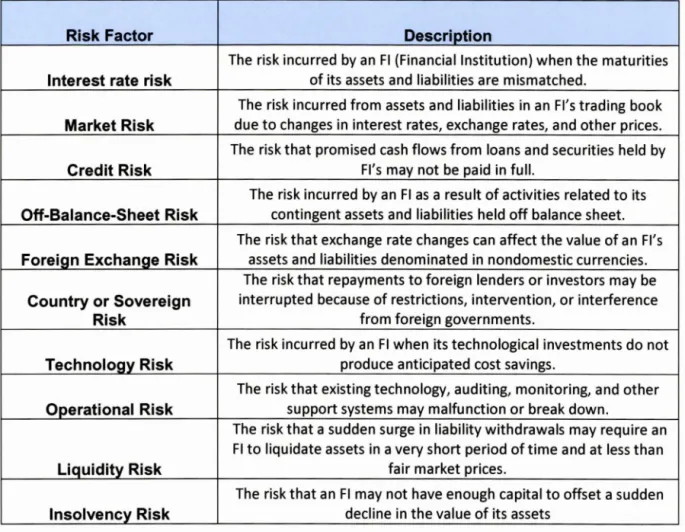
some of them. Banks bought financial products whose risk characteristics were not well understood. Below are some of the key risk factors faced by financial intermediaries.
Risk Factor Description
The risk incurred by an FI (Financial Institution) when the maturities Interest rate risk of its assets and liabilities are mismatched.
The risk incurred from assets and liabilities in an FI's trading book Market Risk due to changes in interest rates, exchange rates, and other prices. The risk that promised cash flows from loans and securities held by
Credit Risk FI's may not be paid in full.
The risk incurred by an FI as a result of activities related to its Off-Balance-Sheet Risk contingent assets and liabilities held off balance sheet.
The risk that exchange rate changes can affect the value of an FI's Foreign Exchange Risk assets and liabilities denominated in nondomestic currencies.
The risk that repayments to foreign lenders or investors may be Country or Sovereign interrupted because of restrictions, intervention, or interference
Risk from foreign governments.
The risk incurred by an FI when its technological investments do not Technology Risk produce anticipated cost savings.
The risk that existing technology, auditing, monitoring, and other Operational Risk support systems may malfunction or break down.
The risk that a sudden surge in liability withdrawals may require an FI to liquidate assets in a very short period oftime and at less than
Liquidity Risk fair market prices.
The risk that an FI may not have enough capital to offset a sudden Insolvency Risk decline in the value of its assets
Table 1 : Risks Faced by Financiallntermediaries2
Financial intermediaries are defined as financial institutions that intermediate between cash surplus entities and those short of cash. Lending activities, which make up a considerable share of operations in financial intermediaries, include secured and unsecured loans. Unsecured loans are described as loans that have a general claim to the assets of the borrower if default occurs (Saunders and Cornett 2011), which include mortgage loans. They are those loans that have a claim against specified assets (may be in the form of collateral) in the case of a borrower default. In pricing loans, financial institutions need to consider the credit risk or default risk of the individuals applying for loans, regulatory reserve requirements, loan origination fees, collateral and the costs of funding or capital sourced to fund the loans (Saunders and Cornett 2011). Default risk is described as the risk that the borrower is unable or unwilling to fulfill the terms promised under the loan contract (Saunders and Cornett 2011). Unsecured loans are high risk business due to their lack of collateral offering and thus should command pricing that is different to secured lending. This is to highlight the higher risk of default on the part of the lender and the lack of recovery given the lack of collateral that could have secured the loan.
The rate of participation in unsecured loans has been a topic of discussion in South Africa where credit provision is regulated by law thorough the National Credit Regulator (NCR). The NCR's operations are guided by the National Credit Act No.34 of 2005 (NCA) that came into law on 1 June 2007. The NCR's mandate is to regulate the credit industry of South Africa through enforcement, education, research, investigation of complaints, registration of industry participants and policy developments.
The NCA was instituted as replacement to the Usury Act No.73 of 1968, the Credit Agreement Act 75 of 1980 and the Usury Act's exemptions governed by the Integration of Usury Laws Act 57 of 1996. The Usury Act No.73 of 1968 (Appendix 1) was an act used to regulate credit, leasing and money lending transactions. The act aimed to limit the interest rate risk and other related finance charges to borrowers through credit agreements.
The exemptions to the Usury Act, which were first instituted in 1992, paved way for growth in the micro loans industry. The exemptions waived interest caps on loans up to R10 000 with a duration up to 3 years, for lenders registered with the Micro Finance Regulatory Council (MFRC).The MFRC was a instituted to regulate lenders participating in the exemptions based area. According to a 2013 paper by Stuart Theobald of Leriba Consulting, micro loans reached R15billion by 1999 as a result of the exemption.
All loans entered into before 1 June 2007 are still governed by the Usury Act. Current interest rate caps as prescribed by the act are as follows per the National Credit Regulator:
• For transactions with values not exceeding R10 000, the interest limit is determined as follows:
Repo Rate + 1/3 thereof + 11 percentage points • For transactions exceeding R10 000 the formula is as follows:
Repo Rate + 1/3 thereof + 8 percentage points
The maximum rate charged for amounts <= R 10 000.00 is 23% and 20 % for those greater than R 10 000.003.
Following the micro lending crisis that resulted in the collapse of the likes of Saambou Bank in 2002, the National Credit Act's sole purpose was to protect consumers against high and unreasonable levels of interest rate, reckless lending and unfair practices by credit providers. Following in the footsteps of its predecessor, the NCA also prescribes the maximum rate that lenders can charge and is detailed as per the table on the next page.
Type. of credit Maximum interest Maximum
agreement rate initiation fee
Rl 000 + 10% of any
Mortgages/Bonds (REPO rate x 2.2) + 5% amou nt greater than
agreements RIO 000
(Maximum fee R5 000)
Credit Facilities (e.g. (REPO rate x 2.2) + 10% Rlam50 ount greater than + 1000fany
Credit cards. Store cards RI OOO
etc) (Maximum fee R I 000)
Unsecured Credit (REPO rate x 2.2) + 20% amount greater than R I 50 + 10% of any Facilities (e.g. Personal RI OOO
loans) (Maximum fee R I 000)
Incidental Credit N/A
agreements (e.g. overdue 2% per month bills from doctors.
Eskom. Munici.palities etc)
Developmental Credit Agreements:
• Small & Medium (REPO rate x 2.2) + 20% Ramo250 unt gre+ 10% of .ater any than
Business Loans RI OOO
(Maximum fee R2 500)
• Low income housing (REPO rate x 2.2) + 20% R500 amoun+ 10% of t greater any than
loans Rl 000
(Maximum fee R2 500)
Short Term Loans (i.e. R150 + 1000fany
Loans of up to 6 months 5% per month amou nt greater than
of no more than R8 000) RI OOO
(Maximum fee R I 000)
Any other types of loans (REPO rate x 2.2) + 10% Ramou150nt g+ 100reater 0fanthan y
not covered above RI OOO
(Maximum fee R I 000)
Table 2 : Prescriptions of the National Credit Act NO.34 of 20054
The Repo rate is the rate that the South African Reserve Bank lends money to banks. The NCA only applies to lenders whose books sizes are greater than R500 000 or have more than 100 credit agreements. The lenders are also required to register with the National Credit Regulator which has replaced the MFRC.
4 Source: All you need to know about the Credit Act as a consumer (National Credit Regulator 2007)
According to a paper on unsecured lending by Bank Seta, unsecured lending in South Africa increased from 4% of total loans in 2005 to 8% by the end of 2011.As at June 2014, according to the NCR, unsecured lending which includes credit facilities, short term credit and unsecured credit makes up 23.46% of gross debtors book in South Africa. Bank Seta attributes the growing trend largely to attractive margins offered by unsecured lending as compared to those offered by secured lending, increase in urban dwellers as well as increased scope in terms of size and tenor of loans lenders are able to grant. In August of 2014, African Bank limited, a leading player in the unsecured lending space was placed under curatorship by the South African Reserve Bank (SARB), the regulator of the South African banking industry, due to losses incurred as a result of non-performing loans. This resulted in Moody's (an international ratings agency), announcing its downgrade of the bank on the 29th May 2014. The rest of the South African banking system was downgraded in response to the decision by the South African Reserve Bank not to fully guarantee the holdings of institutional bond holders.
Nedbank 12% FirstRand 14% ABSA 9% Standard Bank 16% African Bank 32% Capitec 17%
Figure 2 : Unsecured Lending Market ShareS
Over the past couple of years, unsecured lending has become a great part of South Africa's lending culture. The demise of African Bank posed questions around the business model of the bank and the risk management of the business. According to the Consumer Credit Report (June 2014), 20% of the unsecured debtor's book was in default as per the definition of Non-Performing Loans. Unsecured loans are known for their high risk qualities and high risk margins. The question around unsecured lending in South Africa given its size (in light of the scale of activities with various causes that led to the 2008 financial crisis and the impact it has had on the global economy) would be around whether or not the unsecured loans are being priced in a manner that is reflective of the risk that the lender would carry as a result of the lending transaction so as to avoid a similar 2008 financial crisis in South Africa.
1.3 Methodology
This paper will look to a formula that will take into account the credit score of the potential borrower and the risk premium that the credit score commands, the cost of funds, profit margin and cost of reserves in determining the interest rate to be charged to a potential borrower. The study will only be carried out for an unsecured loan of a period of one year. The results will be compared with the current maximum allowable interest rates as per the National Credit Act.
1.4 Outline of Study
The research work will be structured in the following:
• Chapter 2 will detail the literature review on risk based pricing, expand on Basel Frameworks and look at the impact that risk based pricing has had on the American market.
• Chapter 3 will look at the pricing of the interest rate to be charged at credit score level using a model used by Robert Phillips in one of his works
2.
Risk Based Pricing
"Any security should be regarded as a last line of defense to fall back upon in exceptional
circumstances. To lend money against a security knowing full well that one is likely to have to
realize that security is bad banking practice."-John Holden.
Thus it is crucial that banks are able to identify and quantify risks being assumed so as to correctly price products offered in a compensating manner (The Hong Kong Institute of Bankers 2012).
A paper by Edelberg (2003) suggests that risk based pricing existed as early as the 1980s. By early 90s, the credit industry had reverted to charging borrowers a "single house rate" where most high risk borrowers were rejected. This changed again in the mid 90s when data storage costs dropped and the underwriting technology improved as a result of emphasis placed by bank regulators, in the United States of America, on lending to lower income neighbourhoods, households and borrowers. Estimates of default risk were used to determine different interest rate allocations to borrowers. In 1995, The Federal National Mortgage Association (commonly known as Fannie Mae) introduced new underwriting technology and began financing high risk loans. Fannie Mae made it clear to customers looking to sell mortgage loans to them to "include a credit bureau score as part of the loan package". This practice encouraged other lenders to participate in the high risk loans market in other sectors such as credit card and car loans. Risk based pricing practices led to increased credit access to very high risk households (Edelberg 2003). 25-75% of increases in consumer debt levels in the late 90s were as a result of risk based pricing practices. More households that were previously denied credit access as a result of the "single house rate" were afforded credit.
Hand and Crowder (2005) highlight the rising levels of consumer debt across the world and the importance of customer management programs to decrease the levels of loan delinquencies in the adverse economic conditions. They mention the use of statistical models called scorecards to draw information about the credit quality of the customer including the prediction on the probability of default on the loan. Variables looked at in evaluating the financial responsibility of the client include age, income, home ownership, employment status, debt levels and any previous credit judgments. Logistic discrimination model, linear discriminant model, linear
regression, classification trees, neural networks and rule-based approaches are some of the models used in calculating the scorecards of clients.
Phillips (2013), highlights the mispricing and packaging of loans and the role these played in the financial crisis of 2008. According to statistics in the United States, 85% of mortgages and auto loans were securitized in 2010. He categorizes loans into secured and unsecured and further breaks them into collateralized, revolving or non-revolving and fixed or variable rate pricing. All these factors contribute to the pricing offered on the loan together with the nominal size, term and character of the customer. Phillips made an observation regarding the differences in rates offered to the same customer by different credit providers in the United States of America. This is believed to be a function of market competition in the form of availability of a lot of credit providers. The same observation was made in the British unsecured lending market in 2004 by Phillips. According to Phillips(2013), the decision of the credit provider on whether to loan to the customer or not is based on the probability of default of the customers based on the lender's estimates as well as the potential loss absorption in the event of a loss. The information used in determining the probability of default is based on the customer's credit history and current financial abilities. Some lenders make use of credit scores supplied by credit bureaus such as FICO (Fair Isaacs Company). These are then used to determine the creditworthiness of the customer and whether that customer will be received funds as per loan application, together with other factors. Phillips references Edelberg (2006)'s risk based pricing in consumer credit pricing where customers are classified into different risk categories in line with their risk profiles. These are then further used to determine the interest rate to be charged. Phillips used a risk based pricing model that takes into account the cost of funds, profit margin and risk premium based on the risk category of the client to determine the interest rate to be offered. Lenders generally group customers into specific risk groups and use that classification to price customers due to operational and administrative complexities as opposed to pricing each and every customer differently. Phillips (2013) stresses that objective of risk based pricing is to price a high risk customer different to a low risk customer. The interest rate offered to customers should reflect the risk profiles of the customers.
According Koh et al (2006), the growth in large databases in the financial industry, increased competition and innovation in technology have called for more use of credit scoring models. Credit scoring models assist the lender in deciding whether or not to grant credit to a customer, in an objective manner. In deciding the interest rate to be charged to the client, the score obtained in the model plays a role in the risk adjusted premium. According Koh et al (2006),
Mester defines credit scoring as a quantitative method that is used to predict the probability that a loan applicant or existing borrower will default or become delinquent. Credit scoring assists lenders in quantifying and managing the risk that is assumed in the business of credit provisioning and serves as an important tool in predicting losses. Credit scoring models allow lenders to distinguish between high risk and low risk customers (Einav et al 2013), and subsequently provide customers with risk appropriate pricing. Einav et al (2003) show in their study on the impact of credit scoring on consumer lending that profitability can increase with the correct application of credit scoring. According to Siddiqi (2005), score cards can be used in credit evaluation in conjunction with Basel II measures of potential losses from credit risk of exposure at default, loss given default and maturity.
Athavale and Edmister (2004) investigate the role that quality of information and monitoring of the information play in the pricing of sequential bank loans to existing customers. Their study found that the more information that a bank has with respect to the credit quality of the client and patterns of behavior in their existing loans, the better or worse the interest rate of sequential loans offered to the client by the bank. Ogler (1970) uses information obtained from behavior of a borrower's existing loan(s) to construct a credit scoring model for commercial loans (to circumvent the information asymmetry that exists between lender and borrower) in pricing loans. King (2007) defines risk based pricing as "an alignment of loan pricing with the expected loan risk" where the credit risk of the borrower plays an important role in the loan application decision. The high risk client profile would command a high interest rate charge and a low risk client would attract a low interest rate to compensate the lender for the risk assumed in the lending operations. In the paper "Risk-Based Pricing-Back to the Basics", King refers to credit and bankruptcy scoring as some of the risk based pricing models utilized in the lending industry as well as credit character telling variables such as debt to income, loan to value, collateral and origination channels. According to King, risk based pricing is especially important in unsecured and sub-prime lending as it allows the bank to correctly price compensation it requires for carrying such risk. He emphasizes profitability of risk as one of the key elements in the pricing strategy of any lender and not just portfolio or business growth, at the expense of risk adjusted returns. He further highlights that correct risk assessment and the pricing thereof are ways for lenders to avoid unknowingly carrying delinquent loans on their balance sheets.
Bexley et al. (2001) highlight liquidity risk, interest rate risk, credit risk and capital risk as the most important risk factors to consider in pricing financial products in light of recent bank
troubles. They encourage the use of risk based pricing as opposed to historical methods that shied away from the onerous credit risk models and focused more making money out of the customer without consideration for risk. Deans and Stewart (2012) agree with Bexley et al. in that cost of funds, credit risk and liquidity risk play an important role in the cost assigned to lending rates of banks. Saunders and Cornett (2011) refer to the credit risk and default risk, regulatory reserve requirements, loan origination fees, collateral and the costs of funding in pricing of consumer loans. Saunders and Cornett (2011) highlight risk adjusted return on capital as a widely used form of risk adjusted pricing in lending.
Edelberg (2005) focuses her study on credit provision on cars, credit cards, second mortgage and consumer loans. The default risk of each customer was used to determine the risk premium spread. A comparison is made between risk premium spreads paid by clients before and after 1995 when it is believed lenders made more use of risk based pricing models. In this, it was found that increasing levels of interest rates were charged for certain products in response to the default probabilities of the clients. This forced some clients to reduce their patterns of borrowing in an effort to curb the increasing costs.
Ruthenberg and Landskroner (2006) look into the impact of Basel II on loan pricing. Using the prescriptions as per the Basel II Accord of capital reserve as guidance, they look at the impact of the different credit risk rating approaches on the loan pricing model of an Israeli bank operating in an imperfectly competitive market. They use an internally derived loan rate equation and the probability of default of bank customers (retail and corporate) as guidance in their pricing. The decision on the interest rate to be charged is dependent upon cost of funds to the bank, risk premium that compensates the bank for the borrower's default risk, premium that shows the market power of the bank and a factor to reflect the sensitive nature of the cost of capital to bank loans advanced. They compared the impact of the internals ratings approach to that of the standardized approach and in both approaches the cost of the loan increases with the probability of default, with the internals ratings approach being slightly cheaper for low risk corporate customers. For retail customers, both high and low risk customers experienced lower interest rate charges using the internal ratings approach.
Curcio and Gianfrancesco (2010) highlight the importance of measuring and pricing credit risk. They too refer to Basel II Accords for capital requirements against credit risk, operational and market risk. The capital requirement depends on the probability of default, loss given default, exposure at default and maturity of the loan. The probability of default is depended on the
characteristics of the customer. They break credit risk into two components namely expected loss and unexpected loss. The price charged to the loan should achieve the required return on equity by shareholders. They look at changes in risk adjusted spreads using the internal ratings and standardized approaches in a multi-period pricing model looking at different payment profiles on loans. Results show that risk adjusted spreads in an internal ratings approach can be lowered by the relationship between a lower loss given default and a high spread stemming from a longer dated loan.
Subrahmanyam (2008) classifies borrowers as prime, perceived value and relationship borrowers. These borrowers are generally regarded as credit worthy borrowers. A rate encompassing default risk premium is required for creditors regarded as less credit worthy. In his paper Subrahmanyam (2008) calculates the loan rate using the present value method, prime rate method and as cost of holding the loan on the balance sheet.
The Experian's Business Information Solutions Group (2004) describes Risk based Pricing as a " tiered method of pricing that assigns interest rates and other terms of credit based on the customer's credit history JJ. Customers are charged according to the probability of their default
risk. According to their business credit paper, balancing between a bank's risk appetite and the needs of the customer is key to the sustainability of the lending business and maintaining relations with customers. Basel II's risk pricing model takes the probability of default (PO), loss given default (LOG) and exposure at default (EAO) into account.
According to a paper by Layegue of KPMG (2011), a full understanding of risks faced by financial institutions is imperative in ensuring that adequate levels of profits are achieved in order to meet business and capital management objectives. This is done by correctly pricing credit products such as loans to ensure correct risk/return rewards. Layegue (2011) refers to risk adjusted pricing as the alignment of loan pricing to its expected credit risk. A high credit risk would justify a high interest rate charged to the potential borrower.
2.1 Key Attributes of Risk Based Pricing
The benefits of risk based pricing include efficient allocation of resources to borrowers with "better prospects and associated lower risk" and "less disruptive rationing of credit during economic downturns". Layegue (2011) lists benefits of risk adjusted pricing as per below:
• Enables an institution to know early enough what kind of price will satisfy its risk/return relationship
• Improves loan and profitability
• Enhances shareholders value by ensuring that credit risk associated with the credit product is appropriately measured and priced
• Enhances achievement of credit portfolio goals and objectives
• Satisfies regulatory requirements that the risks inherent in the loan products and serves have been adequately accounted for in the pricing.
The disadvantages of risk based pricing include: • Highly dependent on credit modelling
• Credit modeling is highly dependent on data. The data needs to be relevant and accurate to provide users with usable and relevant information about the credit profile of the customer
• Credit modeling generally based on historical data which can miss relevant information that is current or can be predicted using forecasting methods
• Highly sensitive to market conditions. Updates to the credit models used in risk pricing should be frequent to capture and anticipate the impact of current and future market conditions.
• Certain variables such as race, gender and marital status used in credit scoring models can be used to discriminate against consumers
• Credit scoring models not developed correctly can produce incorrect information that is to the detriment of the customer.
2.2 Risk Based Pricing Models
Lenders consider various types of data in pricing loans. The most important of which is qualitative data. Qualitative data generally includes character, ability, margin, purpose, amount, repayment and insurance (The Hong Kong Institute of Bankers 2012).
• Character-reliability and level of honesty in applications
• Ability-Is the borrower able to make repayments based on current financial affairs and current and futures cash flows
• Margin-expected margin by bank should take into account all risks associated with the transaction
• Purpose-reason for loan application should be known to the bank
• Amount-bank should ensure that amount requested is reasonable and affordable to the borrower
• Repayment-the bank should ensure that the borrower has the means to make repayments or has access to means to make repayments. The methodology of repayments
• Insurance-the bank should consider necessity for some form of insurance. The security needs to be stable in value, measurable, easy to liquidate and must be legally enforceable.
Four types of risk based pricing models are described in the paper by The Experian's Business Information Solutions Group:
• Cost-pius -Identifies and measures costs so as to determine price to be charged to cover costs
• Competition -Uses competitors rates as benchmark or guidance in the pricing of loans • Relationship -includes other costs used by the borrower related to the provision of loans • Score-based system pricing is based on an internal or external credit scoring system
Model Description
Credit Bureau Scored Risk scores offered by credit bureaus that measure the risk of a particular business becoming delinquent based on analysis of
the entire business population
Custom scores Risk scores that are tailor-made to a specific lending institution or business based on customer data, credit policy, operations
and marketing goals
Pooled data or industry Risk scores based on data specific to an industry specific scores
Combination of above Combination of models based on type of credit decision being made
Table 3 : Score-Based Pricing Systems6
2.3 Credit Scoring Models
According to Koh et al (2006), credit scoring models assisted the development and growth of the sub-prime lending market. Sub-prime borrowers are defined as those consumers with "poor
credit records that fall short of credit acceptance and risk" .Sub-prime borrowers generally have a history of credit impairment and incomplete credit data or history and lenders have difficulty in verifying the source and pattern of income.
According to Saunders and Cornett (2011), quantitative models used in the pricing of loans include credit scoring models such as linear probability models, logit models and linear discriminant analysis. These models can be used in custom, credit bureau and pooled or industry specific scores.
6 Source: Risk-Based-Pricing-Commercial Lending and Trade Credit (Business Credit June 2004)
Model Description
Uses past qualitative data as inputs into a model to explain repayment experience on old loans. The relative importance of Linear Probability the factors used in explaining the past repayment performance then forecasts the repayment probabilities on new loans and the probability of default. Its major weakness is that probability
of default can lie outside the 0 to 1 interval. Uses past data qualitative data as inputs into a model to explain repayment experience on old loans. The relative Logit importance of the factors used in explaining the past
repayment performance then forecasts the repayment probabilities on new loans and the probability of default.
Restricts the default probabilities to between 0 and 1. Divides borrowers into high or low default risk classes. Uses past qualitative data inputs to explain repayment experiences Linear Discriminant on old loans. The relative importance of the factors used in
explaining the past repayment performance then forecasts whether the loan falls into the high or low default class.
Table 4 : Credit Scoring Models 7
Koh et al (2006) list the benefits of credit scoring that accrue to both lenders and borrowers as: • Reduces discrimination against borrowers
• Allows credit providers the ability to focus on information that relates to credit risk related matters only
• Increases speed and consistency of loan application process • Allows automation of the loan application process
• Enables the quantification of risks associated individual applications in a shorter time • Improves the allocation of resources
• Assists in determining the interest rate to be charged to the client • Better management of accounts and profitability
• Better and efficient determination of credit limits
According to the Hong Kong Institute of Bankers (2012), credit scoring involves use of research, that is operational and statistical, as well as data mining models in determining the credit risk of potential borrowers. This number is generally calculated by a credit bureau. They further state that these models reduce the cost of evaluating credit and increase the speed, consistency and accuracy of credit decisions if used correctly (Hong Kong Institute of Bankers 2012). They make decisions more impartial. They stress that wrong, inaccurate and incomplete information can distort the scoring results. Credit scoring models are based on past information of potential borrowers. Variables used in the models include past due payments, debt load relative to income and employment status which all relate to the default risk. In South Africa, companies such as TransUnion, are able to provide such credit scores. In 2010, TransUnion teamed with Fair Isaacs Corporation (FICO) in the United States of America (US) to provide South Africans with an enhanced way of measuring their credit scores using the same methodologies as used on US consumers. The FICO score is calculated as a range between 300 and 850.
Other credit risk models include term structure of derivation of credit risk, mortality rate approach, RAROC(Risk adjusted return on capital) and option models (Saunders and Cornett 2011 ).The RAROC model is a widely used approach that looks to approve loans that have a sufficiently high RAROC relative to the shareholders required return on capital or equity. The credit models can either be credit bureau calculated or custom made to suit a specific business. Bank Lending, a book by the Hong Institute of Bankers, states that banks need to ensure that the risks adopted as part of their business are reasonable and can be controlled within defined limits. The banking business is that of trust between lender and borrower. Trust that the borrower will return funds as stipulated in the contract-periodically or after an agreed period and the amount. Repayment of the loan is highly dependent on unknown future cash flows of a borrower. Overpricing of loans can result in loss of clients and under pricing in banks not being compensated enough for the level of risk adopted. Consistent under pricing will erode the earning of the bank as well as the market value.
2.4 FICO Scores
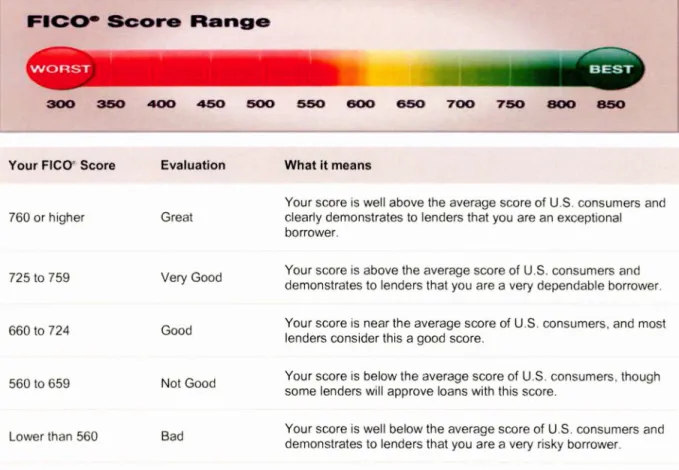
The FICO score is used by lenders to determine the risk premium to be charged as compensation for the credit risk imposed by the customer in line with the theory that the higher the credit risk the higher the interest offered. In South Africa, companies such as TransUnion provide such credit score for lenders to use in their lending decision making process. FICO
scores range from 300 - 850 and are calculated using various credit impacting variables of consumers.
FICO- Score Range
300 350 400 450 500 550 600 6SO 700 750 aoo 850
Your FICO~ Score Evaluation
760 or higher Great 725 to 759 Very Good 660 to 724 Good 560 to 659 Not Good Lower than 560 Bad What it means
Your score is well above the average score of U.S. consumers and clearly demonstrates to lenders that you are an exceptional borrower.
Your score is above the average score of U.S. consumers and demonstrates to lenders that you are a very dependable borrower.
Your score is near the average score of U.S. consumers, and most lenders consider this a good score.
Your score is below the average score of U.S. consumers, though some lenders will approve loans with this score.
Your score is well below the average score of U.S. consumers and demonstrates to lenders that you are a very risky borrower.
Figure 3 : FICO Score8
2.4.1 How my FICO Scores are calculated9
FICO" Scores are calculated from several different pieces of credit data in your credit report. This data is grouped into five categories as outlined below. The percentages in the chart reflect how important each of the categories is in
determining how your FICO Scores are calculated.
Your FICO Scores consider both positive and negative information in your credit report. Late payments will lower your FICO Scores, but establishing or re-establishing a good track record of making payments on time will raise your
score.
How a FICO Score breaks down
• Payment history
_ Amounts owed
_ Length of credit history
New credit
Types of credit used
These percentages are based on the importance of the five categories for the general population. For particular
groups-for example, people who have not been using credit long-the relative importance of these categories may be different.
The FICO score is there to provide lenders with enough information regarding the credit profile of the customer.65% of the score is made of the customer's payment history and amount of debt that the customer currently has. This information is important as it provides window into the indebtedness level of the customer as well as the customer's willingness to pay the debt, both of which are important in determining the default probability of the customer.
2.4.2 What's not in my FICO Scores 10
FICO Scores consider a wide range of information on your credit report. However, they do not consider:
• Your race, color, religion, national origin, sex and marital status.
US law prohibits credit scoring from considering these facts, as well as any receipt of public assistance,
or the exercise of any consumer right under the Consumer Credit Protection Act.
• Your age.
Other types of scores may consider your age, but FICO Scores don't.
• Your salary, occupation, title, employer, date employed or employment history.
Lenders may consider this information, however, as may other types of scores.
• Where you live.
• Any interest rate being charged on a particular credit card or other account.
• Any items reported as child/family support obligations or rental agreements.
• Certain types of inquiries (requests for your credit report).
Your scores do not count "consumer-initiated" inquiries - requests you have made for your credit report,
in order to check it. They also do not count "promotional inquiries" - requests made by lenders in order to make you a "pre-approved" credit offer - or "administrative inquiries" - requests made by lenders to review your account with them. Requests that are marked as coming from employers are not counted either.
• Any information not found in your credit report.
• Any information that is not proven to be predictive of future credit performance.
• Whether or not you are participating in a credit counseling of any kind.
The variables used in the FICO score are those that are credit related and will provide the
lender with the information required to assist in the lending decision making process.
Information related to religion, race and age which can be discriminatory are excluded in the score. Other forms of qualitative data can be used by lenders in building the risk profile of a client.
2.5 Impact of Risk-Based Pricing in America
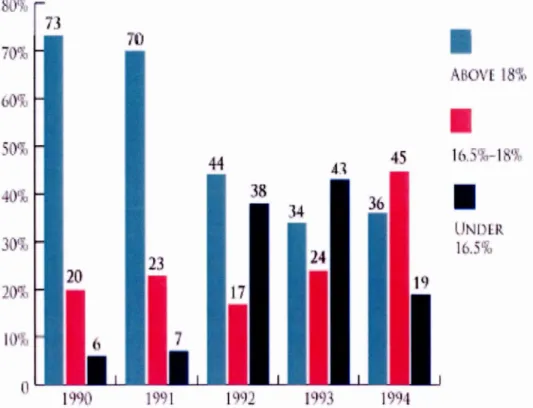
Risk based pricing has had a considerable impact on the American market since its use. As noted by Edelberg (2003), risk based pricing illuminated the concept of a single blanket interest rate for consumers and adopted a risk driven interest rate that not only decreased interest rate charged for low risk borrowers, but opened lending to high risk customers that would have otherwise been turned away for credit. Figure 4 shows the impact of risk-based pricing in the United States of America post the introduction and regular use of framework. Between 1991 and 1992, the percentage of customers charged interest rates above 18% decreased from 70% to 44% as risk adjusted pricing allowed for individual assessment of credit profile and direct consideration of the impact of the credit risk on the entire risk undertaking of the banks.
I
.
~ I-III
UNI I:R
16.-%
Figure 4 : Decrease in Credit Card Balances that Charged More than 18%11
- I.;, z ... ..u r -, 3 2
Figure 5 : Increase in Credit Card Ownership for Lower Income Households 12
Before the adoption of risk based pricing by loan providers in the United States of America, most lower income households were denied access to credit due to blanket interest rates offered that did not take into account the individual credit profile of the consumer. Since the
adoption of the methodology, more and more household have access to much needed credit
access as depicted in the above figure. Access to credit for low household incomes has increased from under 20% to just under 40% from 1983 to 2010. This again proves the methodology's ability to expand the economy through increased credit provision participation by lenders. The increased participation is notable in middle and high income households as well.
2.6 Basel Accords
In 1974, the central bankers of the Group of 10 countries (Italy, Japan, United Kingdom, United States of America, Switzerland, Germany, Spain, Sweden, France, Canada, Belgium and Netherlands) established The Basel Committee on Banking Supervision. This working group was put in a place to exchange ideas and improve on banking supervision across the globe. The recommendations out of this committee were designed to be voluntary and not compulsory or legally binding.
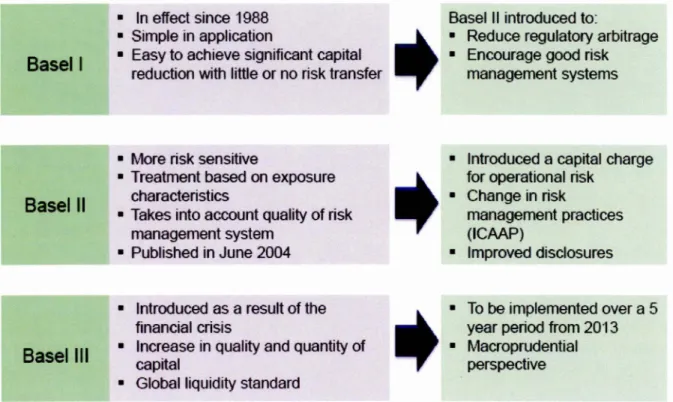
The first Basel Accord was established in the 1980's against the backdrop of increased global participation by banks. According to Balthazar (2006), the Basel I Accord of 1988 focuses on credit risk through prescription of minimum capital requirements based on risk weightings of the items on the balance sheet of the bank. The objectives of the accord were to improve and ensure the stability of the global banking system and to balance the playing field for international banks in the global economy. Basel II and Basel III have since been established as ways to improve on banking supervision.
Basel I
Basel II
Basel III
• In effect since 1988 • Simple in application
• Easy to achieve significant capital reduction with little or no risk transfer
• More risk sensitive
• Treatment based on exposure
characteristics
• Takes into account quality of risk
management system
• Published in June 2004
• Introduced as a result of the financial crisis
• Increase in quality and quantity of capital
• Global liquidity standard
Figure 6 : The Basel Accords 13
Basel II introduced to:
• Reduce regulatory arbitrage • Encourage good risk
management systems
• Introduced a capital charge for operational risk
• Change in risk
management practices
(ICAAP)
• Improved disclosures
• To be implemented over a 5 year period from 2013 • Macroprudential
perspective
Basel I required that banks hold a minimum 8% of risk weighted assets in the form of capital.
0/0 Item
o
-
Cash- Claims on OECD central governments
- Claims on other central governments if they are denominated and funded in the national currency (to avoid country transfer risk)
20 - Claims on OECD banks and multilateral development bank5 - Claims on bank5 outside OECD with residual maturity 1 year
- Claims on public sector entities (PSE) of OECD countries 50 - Mortgage loans
'I 00 - All other claims: claims on corporate, claims on bank5 outside OECD with a maturity;> 1 year, fixed assets, all other assets ...
Figure 7 : Risk-Weights of Assets 14
Critics of Basel I faulted it on its inability to differentiate between good and bad credit as well as its lack of depth on risk management principles, Instead it was accused of focusing more on ratios.
Basel II was published in 2004 in an effort 0 correct the short-comings of the Basel I Statement. The objectives of Basel II. according to Balthazar (2006). were:
• Strengthen the stability and increase the quality of the international banking platform
• Create and maintain an equal playing field for banks participating in international market
• To encourage adoption of rigorous risk management practices Basel II was broken into three areas of work named pillars:
• Pillar 1 -Minimum Capital Requirements
• Pillar 2- Supervisory Review
• Pillar 3- Market Discipline
14 Source: From Basel 1 to 3 -The Integration of State-of-the-Art Risk Modeling in Banking Regulation
Pillar 1 allows the bank to set minimum capital requirement of 8% using the Standerdised Approach or the Internal Ratings Based Approach in calculating risk weightings of assets. The standerdised approach uses credit ratings as supplied by external credit ratings agencies against risk weightings as prescribed by the statement. The risk weightings as per the statement range from 20% for AAA-credit rating to 150% for BB- and below-credit rating and 100% for unrated consumers.
The Internal Ratings Based Approach was broken into Foundation and Advanced methodologies. In the Foundation methodology, the bank uses the internally derived credit rating (which describes the probability of default), based on internal credit models, against prescribed risk parameters such as loss given default (the losses that would be incurred by the bank in the event of a default by the consumer), exposure at default (total exposure to the consumer at time of default) and maturity whereas the advanced approach relies on internal models for derivation of all risk parameters. Pillar 1 also looks at the capital provision for operational and market risk.
Pillar 2 allows for intervention by the regulatory body that supervises the activities of the market that each bank plays in and looks at the capital structure of the minimum capital requirement. This is carried out through compulsory supervision reports that allow the supervisory board to independently determine capital requirements, assess adequacy of credit risk models utilized in calculation of minimum capital requirement and determine total exposure of the bank's balance sheet. Pillar 2 also addresses levels of interest rate risk, liquidity risk and concentration risk. Pillar 3 sets out minimum risk disclosure and risk management practices, capital categorization and concentration disclosure requirements to allow insight to other market participants with exposure to the banks.
Thus, Basel II credit rating system allows banks to pass on the costs of compliance with the accords to the individual consumer in accordance with the level of risk that each consumer adds to the balance sheet of the bank. This is done through the banks' ability to identify the cost of risk of each consumer.
Again, there were critics of the Basel II Statement in that during the 2008 financial crisis it failed to provide a buffer for liquidity risk and identify and provide for the complexities of new products in the market and monitor activities and riskiness of highly leveraged financial institutions. The use of external ratings agencies was criticized at it is believed that banks failed to carry out due diligence on the quality of data they were being supplied with.
Basel III is a framework looking to correct the faults of Basel II, especially that of over reliance on external credit ratings agencies, liquidity, external shocks resilience and impact highly leverage firms. It's focus is on capital reserves of a minimum of 8% of risk weighted assets and an additional 2.5%, capital to be held against the cyclical nature of the economy as well as on and off balance sheet leverage activities of the banks, the quality of the capital held and ensuring adequate liquidity in the market in adverse events such as the 2008 financial crisis.
Capital Reform Quality ,consistency ,an
d transparency of capital base
Capturing of all risks
Controlling leverage
Buffers
Basel III
Systemic risk and i
interconnectedness
Short-term : Liquidity Capital incentives for Coverage Ratio (LCR) using CCPs for aTC
Long -term : Net Stable Funding Ration
(NSFR)
Figure 8 : Basel 11115
Higher capital for systemic derivatives Higher-capital for inter
-financial exposures Contingent capital Capital surcharge for
system ic banks
Basel III looks to enhance the liquidity of the bank using the Liquidity Coverage Ratio (LCR) and the Net Stable Fund Ratio (NSFR).LCR looks to hold high liquid assets, as prescribed by Basel, on net cash flows expected to occur in the next 30 days. The NSFR looks to maintain a minimum level of stable source of funding in response to the liquidity profile of assets on the balance sheet of the bank. The quality of the funding is equally as important as the quantity.
Basel III also highlights and requires regular simulated stress testing events, diversification of funding sources, reduction of contractual maturity mismatches and uniformity in banking supervision across the globe.
The impact of Basel Ill's liquidity reform on retail banking products is that the cost of credit facilities up to 30 days will increase dramatically as banks try to recoup the cost of holding 100% liquidity against expected net cash flows up to 30 days and discourage borrowers from participating in the one month space. The counter to this would be the decrease in rates paid to overnight and up to one month deposits in an effort to deter short dated deposits. The impact of NSFR is that as the longer dated the assets on the books of the banks, the longer dated the funding required thus increasing the cost of funds of the bank that will be passed on to the consumer as the current banking models uses short dated liabilities to fund long dated assets. Regulation has become an important feature in lending. Capital holding based on the Basel Accords creates opportunity costs to the lender, especially banks in South Africa, who are required by law through the SARB to comply with the capital reserve prescriptions. Unsecured lending in South Africa is largely dominated by banks thus unsecured lending imposes opportunity costs related to capital reserves that banks need to be compensated for.
3. Methodology
Risk based pricing involves pricing of interest rate to be charged to consumers taking into account the credit profile of the consumer and likelihood of defaulting.
Phillips (2013) describes a simplistic model of risk based pricing that is widely used. This paper will use this model to calculate the maximum interest rate to be charged to the client based on the risk categorisation of the client. Risk categorisation will be based on FICO credit scores where interest rate risk premiums will be assumed for each category. The results of this model will be compared to the maximum allowable interest rate for unsecured loans as per the NCR. The interest rate offered will be calculated for a period of 1 year only for clients wishing to borrow and have been accepted for the same nominal amount of R20, 000.
3.1 Pricing
Risk based model as per Phillips (2013)
r.
e=
T,. I+
m
+
I·
I Where:Tj is the interest rate offered to the client in a specific risk category
Tc is the cost of capital
m is the profit margin
l i is the risk premium as categorised by risk groupings.
Layegue (2011) states four categories of risk based pricing namely cost of funds, operation costs, risk costs and capital costs. This study will use a modified model that includes cost of capital reserves.
Expanded Model:
Where:
T e l l
=
r,.+
m
+ l.+
CC11 is the interest rate offered to the client in a specific risk category
Tc is the cost of capital
m is the profit margin
l i is the risk premium as categorised by risk groupings
cc is the capital reserve cost
The NCR model to be used for comparison purposes is Repo x 2.2 +20%.
Cost of capital involves the cost of cash sourced from retail, corporate and institutional parties to fund the lending activities of a lender. Traditional banking involves taking in deposits from cash surplus entities and the on-lending of the funds to cash demanding entities. In exchange for placing funds with banks, cash surplus entities expect payment in the form of interest to be paid to them for use of the funds to create assets. Different instruments are made available to attract such funds. These instruments can range from one day to 30years. To attract funds, banks issue tradable instruments such as negotiable certificate of deposits, commercial paper, bonds and floating rate notes at rates reflective of their demand, market conditions and credit risk profile as perceived by the rest of the financial fraternity. These instruments are generally traded with institutional and corporate clients and can be tradable with a tenor of up to 30 years in South Africa. Non-tradable instruments are also made available to corporate and institutional clients in the formal of fixed deposits and floating rate deposits. Banks use transactional accounts such as cheque accounts and current accounts, fixed deposits and other forms of instruments to attract funds from retail customers. The difference in these instruments is the interest rate offered by the lender to the cash surplus entity as compensation for the use of funds. The rate that the cash surplus entity is willing to accept is related to the risk profile of the lender as well as the liquidity aspect of the instrument.
Retail deposits are regarded as cheap form of funding due to the high liquidity characteristic that they offer retail clients. Funds raised from institutional and corporate customers is regarded as
expensive as liquidity of the instruments is highly dependent on market conditions as a point in time and generally more long term than retail deposits. As in risk based pricing that we are exploring, lenders sourcing funds to operate their lending business are also subject to credit risk profiling in order to compensate. Thus, cost of funds will differ for each entity. The cost of funds is representative of the price that the bank is being charged for use of surplus cash.
Profit Margin in this model looks at the margin that the lender is looking to make to stay profitable and operational. The role of any business entity is to stay profitable and continue operating. The profit margin simplistically looks at the margin that the bank is willing to earn as part of the service that it is offering as a financial intermediary. This profit margin is post the operational costs such as office space, salaries, postage and includes margin earned from its lending activities.
Risk premium looks at the risk premium that the bank would charge a customer for carrying their risk of default on their balance sheets. This is the compensation that the bank would require in exchange for the default risk imposed on the bank by the customer. Risk premium play an important role in loan pricing due to the risk that the fact that the customer may not honor their payment commitments. In this instance, the bank cannot be expected to carry that risk alone. As part of risk management, it is in the bank's best interest to insure adequate cover for such risks. In this paper, we will use assumed risk premiums based on FICO scores for the risk premium.
Example:
We take into account the variables in the expanded model at a point in time for a bank whose only business is unsecured lending:
r.
e=
T.-l l+
m
+
l
·
+
cc
Tc is 7.725% for the 1 year period
m
is static at 3.5%cc
is static at 10% which is representative of the weighted average cost of capital .The lenderallocates average costs of capital reserves to unsecured customers as Basel II prescribes that 100% capital be held against unsecured loans. The figure used is just for illustrative purposes and is not reflection of the current market opportunity cost of holding capital.
Maximum Risk Score
FICO Score Premium(basis points) Description
760 or higher 25 Great 725 to 759 100 Very Good 660 to 724 400 Good 560 to 659 900 Not Good Lower than 560 1,500 Bad
Table 5 : Risk Premium per FICO Score Category
The risk premiums as per Table 5 are representative of compensation that a lender requires for the different risk categories. Customers with a FICO Score of 760 and higher are classified as great whereas those with a score below 560 are regarded as bad. This categorisation relates to the credit history of the customer in terms of debt payment history and level of indebtedness. 65% of the FICO score is based on historical payment patterns and how much debt the customer has accumulated. It would make sense that the better the relationship or interaction between the payment history and level of indebtedness, the higher the FICO score achieved. The FICO scores also look at the length of time that a customer has had any type of credit which assists in data collection and the ability to create a credit risk profile. Clients that fall in the 760 and higher score will command a lower risk compensation rate as compared to those in the 560 and lower category classified as bad. The difference between the risk premiums in the different risk categories is assumed at a non-linear incremental rate in accordance with the higher the risk the higher the risk premium theory. Clients categorised as great will be charged a
15% in risk premium. It is the discretion of the lender to charge different risk premiums for different clients however the risk groupings provide guidance as to what to charge clients at the top end of a specific category and those at the bottom end which should be charged up to the maximum risk premium allowable.
Maximum
Maximum Risk Interest Rate
%
of Cost of FundsPremium(basis Score Offered to Client and Opportunity
FICO Score points) Description
(%)
Cost of Capital760 or higher 25 Great 21.475 82.538 725 to 759 100 Very Good 22.225 79.753 660 to 724 400 Good 25.225 70.268 560 to 659 900 Not Good 30.225 58.644 Lower than 560 1,500 Bad 36.225 48.930
Table 6 : Maximum Interest Rate Offered to Clients per Risk Category
Table 6 illustrates the maximum interest rate that can be offered to a client in each risk category. In the lower risk categories, the costs of funds and opportunity cost of regulatory capital make up a great share of the total interest offered to the client. This shows how clients with low probability of default should not be penalised on risk. The high risk client are charged on both risk and cost to the bank as their risk of default is higher and requires adequate compensation. By maintaining the profit margin at 3.5%, cost of funds at 7.725% and cost of capital reserves at 10% across the board, this model allows the default risk to be the main driver of the interest rate as specified in the literature review. Credit risk is the most important component of pricing unsecured loans.
Table 7 interpolates the risk premiums a little more between the FICO Scores. This is just to reflect the differential interest rates between the different risk premiums. The lower the FICO score the higher the interest rate offered to the client. The customer with the highest score of 850 is charged a risk premium of 10basis points due to the high credit quality of the customer. At the bottom end the customer with a score of 500 is charged the maximum risk premium of 1500basis points at a rate of 36.23%. The difference between the customer with a score of 500 and that with a score of 850 is 14.9% which is illustrative of the 15% and 0.1 % risk premiums charged to the customer.