IMPROVED OFF-LINE INTRUSION DETECTION
USING A GENETIC ALGORITHM
Pedro A. Diaz-Gomez
∗Ingenieria de Sistemas, Universidad El Bosque Bogota, Colombia
Email: [email protected]
Dean F. Hougen
Robotics, Evolution, Adaptation and Learning Laboratory (REAL Lab) School of Computer Science, University of Oklahoma
Norman, OK, USA Email: [email protected]
Keywords: Genetic Algorithms, Intrusion Detection, Off-Line Intrusion Detection, Misuse Detection.
Abstract: One of the primary approaches to the increasingly important problem of computer security is the Intrusion Detection System. Various architectures and approaches have been proposed including: Statistical, rule-based approaches; Neural Networks; Immune Systems; Genetic Algorithms; and Genetic Programming. This paper focuses on the development of an off-line Intrusion Detection System to analyze a Sun audit trail file. Off-line intrusion detection can be accomplished by searching audit trail logs of user activities for matches to patterns of events required for known attacks. Because such search is NP-complete, heuristic methods will need to be employed as databases of events and attacks grow. Genetic Algorithms can provide appropriate heuristic search methods. However, balancing the need to detect all possible attacks found in an audit trail with the need to avoid false positives (warnings of attacks that do not exist) is a challenge, given the scalar fitness values required by Genetic Algorithms. This study discusses a fitness function independent of variable parameters to overcome this problem. This fitness function allows the IDS to significantly reduce both its false positive and false negative rate. This paper also describes extending the system to account for the possibility that intrusions are either mutually exclusive or not mutually exclusive.
1
INTRODUCTION
The goal of a security system is to protect the most valuable assets of an organization: data and informa-tion. Different organizations will have very differ-ent security policies and requiremdiffer-ents depending on their missions. This is the case for a bank, an Inter-net Service Provider, a university, and a consulting firm. However, all have data in some form, and their security mechanisms are tasked with protecting the privacy, integrity, and availability of the data. Many efforts have been made to accomplish this goal: se-curity policies, firewalls, Intrusion Detection Systems (IDSs), anti-virus software, and standards to config-ure services in operating systems and networks (Bace, 2000). This paper focuses on one of those topics: In-trusion Detection Systems using the audit trail file.
The need for automated audit trail analysis was out-lined a quarter century ago (Anderson, 1980) and it is still present. Audit records are used and statistics are
∗
Conducting research at the Robotics, Evolution, Adap-tation and Learning Laboratory (REAL Lab), School of Computer Science, University of Oklahoma.
gathered and matched against profiles. Information in the matching profiles then determines what rules to apply to update the profiles, check for abnormal activ-ity, and report anomalies detected (Denning, 1986).
A key aspect of an IDS is the hypothesis that ex-ploitation of a system’s vulnerabilities is based in the abnormal use of the system (Denning, 1986). In one form or another, all IDSs take into account this as-sumption. Some, like IDES, NIDES, and EMER-ALD (Bace, 2000), use statistics, while others use a learning approach like Neural Networks (Bace, 2000), immune Systems (Forrest et al., 1994), Ge-netic Algorithms (M´e, 1998), and GeGe-netic Program-ming (Crosbie and Spafford, 1995).
This paper presents a tool to perform misuse detec-tion, using Sun audit trail files (Anonymous, 2000), and uses the guidelines of a previously proposed IDS (M´e, 1998) based on Genetic Algorithms (GAs). To understand this, we first present the basics of com-puter security (Section 2) and Genetic Algorithms (Section 3). This is followed by a brief introduction to the previous GA–based IDS (Section 4). Next, our own improved IDS is covered thoroughly (Section 5), followed by conclusions and future work (Section 6).
2
COMPUTER SECURITY
An Intrusion Detection System (IDS) is a system that monitors and detects intrusions, or abnormal ac-tivities, in a computer or computer network. The IDS reports corresponding alarms and may take immedi-ate action on the intrusions (Tjaden, 2004).
An intrusion is defined as an attempt to gain ac-cess to a system by an unauthorized user. Misuse refers to attempts to exploit weak points in the com-puter or the abuse of existing system privileges.
Ab-normal activity means significant deviations from the
normal operation of the system or use of the system by users (Tjaden, 2004).
Intrusion detection, then, is the process of monitor-ing computer networks and systems for violations of security policy. In the simplest terms, intrusion detec-tion systems consist of three funcdetec-tional components: 1. an information source that provides a stream of
event records,
2. an analysis engine that finds signs of intrusions, and 3. a response component that generates reactions based on the outcome of the analysis engine (Bace, 2000).
In order to get information for intrusion analysis, an
audit trail is often used. According with the Rainbow
Series of computer security documents, outlined by the Department of Defense (Bace, 2000), the goals of the audit mechanism are:
• to allow the review of patterns of access,
• to allow the discovery of both insider and outsider attempts to bypass protection mechanisms,
• to allow the discovery of a transaction of a user from a lower to a higher privilege level,
• to serve as a deterrent to users’ attempts to bypass system-protection mechanisms, and
• to serve as a yet another form of user assurance that attempts to bypass the protection will be recorded as discovered.
The need for automatic audit trail review to sup-port security goals has been well documented with the matrix in Table 1 suggested for classifying risks and threats to computer systems (Anderson, 1980).
This suggests a taxonomy for classifying risks and threats to computer systems that differentiates be-tween external and internal sources of problems. This articulation has been useful in structuring require-ments for audit trail content (Bace, 2000). Accord-ing to this classification, this paper focuses on internal penetration—an audit trail file of a authorized user is analyzed in order to get misuse.
A formal definition of security says that it must guaranty confidentiality, integrity, and availability.
Not authorized to Authorized to use data/program use data/program Not authorized CASE A Blank to use computer External Penetration
Authorized to CASE B CASE C use computer Internal Penetration Misfeasance
Table 1: Threat matrix. Redrawn with minor modifi-cations from Anderson, 1980.
Confidentiality refers to the fact that the information is
only known by authorized users. Integrity means that the information is protected from alteration.
Avail-ability means that the system operates as it was
de-signed; it means, for example, that users have access to it when they need it, where they need it, and in the form they need it.
Another crucial aspect of any system’s security is its security policy. A security policy is the set of practices that is explicitly stated by an organization in order to protect sensitive information (Crosbie and Spafford, 1995).
The content of most security policies is driven by a desire to address threats. A threat is defined as any event that has the potential to harm a system. This harm can be access of data by an unauthorized user, destruction or modification of data, or denial of ser-vice (Bace, 2000).
Security problems in computer systems result from vulnerabilities. Vulnerabilities are weaknesses in sys-tems that can be exploited in ways that violate secu-rity policy. Although threat and vulnerability are in-trinsically related, they are not the same. Threat is the result of exploiting one or more vulnerabilities. Intru-sion detection is designed to identify and respond to both (Bace, 2000).
IDSs can be classified as host-based, multihost-based, and network-based (Tjaden, 2004). Host-based IDSs monitor a single computer using the audit
trail of the operating system whereas network-based IDSs monitor computers on a network by scrutinizing the audit trail of multiple hosts and network traffic.
A multihost-based IDS analyzes data from multi-ple computers. Usually a module of the IDS runs on each individual computer and sends reports to a special module, sometimes called a director, running on one machine. Since the director receives informa-tion from the other computers, it can correlate this in-formation to recognize intrusions that host-based sys-tems would probably miss, such as worms. A host-based IDS may not notice that type of intrusion. A multihost-based IDS, with its data from a number of different computers, would have a much better chance of recognizing a worm as it spreads (Tjaden, 2004).
This paper deals with a host-based IDS, and an au-dit trail file generated by a Sun machine is analyzed.
3
GENETIC ALGORITHMS
Genetic Algorithms (GAs) belong to the field of
evolutionary computation and have been widely used in problems that require searching through a huge number of possibilities for solutions (Mitchell, 1998). The strength behind GAs resides in the fact that the search space is traversed in parallel by proposing so-lutions, at the beginning randomly generated, and those solutions are continuously evaluated with a
fit-ness function.
Each set of solutions proposed is called a
popula-tion, and the first set is called the initial population.
Once all members in the initial population are evalu-ated and assigned a fitness value, the selection mech-anism is applied in order to produce the next
genera-tion.
The selection mechanism is applied in order to choose parents that are going to reproduce. Often par-ents are selected proportionally to their fitness value. One common way to conceive of this is to imag-ine mapping the fitness value of each individual to a roulette wheel, where a greater fitness equates to a larger space on the wheel. Once parents are chosen,
crossover and mutation are applied to them in order
to produce offspring.
Crossover exchanges subparts of parents (typically two), while mutation changes randomly a particu-lar part of an individual. The process of selection, crossover, and mutation gives the next generation, and the process is repeated until a solution is found or un-til resources are exhausted.
4
GASSATA
One motivation for the topic of this research was the paper “GASSATA, A Genetic Algorithm as an Al-ternative Tool for Security Audit Trail Analysis” (M´e, 1998), so let us analyze the theory behind it.
GASSATA is an off-line tool that increases security
audit trail analysis efficiency. The goals of this ap-proach are the following:
• to investigate misuse detection, i.e., to determine if the events generated by a user correspond to known attacks, and
• to search in the audit trail file for the occurrence of attacks by using a heuristic method, Genetic Al-gorithms, because this search is an NP-complete problem.
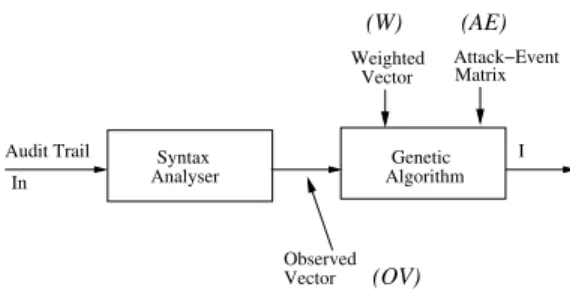
This approach is shown schematically in Figure 1. The audit subsystem recognizes various kinds of events (such as changing to a particular directory or copying a file) which are recorded in the audit trail file. The Syntax Analyzer classifies those audit events
Vector Weighted Attack−Event Audit Trail In Matrix I Syntax
Analyser AlgorithmGenetic
(OV) (W) (AE)
Observed Vector
Figure 1: Prototype of GASSATA.
and generates the Observed Vector (OV). The
Ge-netic Algorithm module finds the hypothesized
vec-tor I that maximizes the productW ·I, subject to the constraint(AE·I)i ≤ OVi profiles whereW is
a weight vector that reflects the priorities of the se-curity manager, AE is the Attacks-Event matrix that correlates sets of events with known attack profiles,
1 ≤i ≤Na, andNa is the number of known attack
profiles. The duration of the audit session was cho-sen as 30 minutes and four (4) types of user were de-fined: inexperienced, novice developer, professional, and UNIX–intensive user.
The fitness function suggested in GASSATA is:
F(I) =α+
Na
X
i=1
Wi∗Ii−β∗T2. (1)
The goal of each component of the equation is as fol-lows:
• α: To maintainF(I)>0, and therefore maintain diversity in the population.
• I: To allow for hypotheses of attacks. The system is rewarded for hypothesizing attacks, particularly those of greatest concern to the security manager. This is generated randomly in the first generation.
• β: To provide a slope for the penalty function.
• T: To count the number of times(AE·I)i> OVi.
The system is penalized for hypothesizing sets of attacks that could not have occurred, given the ob-servations.
Experimental results for simulated attacks have been reported (M´e, 1998).
5
AN IMPROVED IDS
As outlined before, intrusion detection systems consist principally of three functional components: 1. an information source that provides a stream of
event records,
3. a response component that generates reactions based on the outcome of the analysis engine (Bace, 2000).
In order to get information for intrusion analysis, an audit trail is often used. In this research we used the Sun audit trail file (Anonymous, 2000).
5.1
The Security Audit Trail
Security auditing is the formal tracking and analysis
of actions taken by computers’ users. This process is necessary in order to control current security policies and detect anomalies, abuse, or misuse of the system by users.
In order to provide individual user
accountabil-ity, the computing system identifies and authenticates
each user. Besides that, computers provide the pos-sibility to register actions taken by users. Audit data corresponds, then, to recorded actions taken by tifiable users, associated under the unique user iden-tifier (ID). All processes and activity made by users are recorded in the audit trail file. In a sense, audit data is the complete recorded history of a users’ sys-tem activity that can be gathered for an after-the-fact investigation or to determine the effectiveness of ex-isting security controls (Anonymous, 2000).
The audit trail data used in this research was down-loaded from the MIT Lincoln Laboratory (Fried and Zissman, 1998), and it has activity from various users. Since GASSATA (M´e, 1998) works its input by user, the file from was filtered by user.
The Solaris audit subsystem, called the Sun-SHIELD Basic Security Module (BSM), is the mod-ule responsible for the accountability of users’ activ-ity on the system. The file generated by the BSM has records that describe user-level and kernel events. Each record consists of tokens that identify the pro-cess that performed the event, the objects on which it was performed, and the objects’ attributes, such as the owners or modes.
5.2
The Analysis Engine
Once the audit data is recorded, it must be reviewed on a regular basis in order to maintain effective oper-ational security. Administrators who review the audit data must watch for events that may signify abnormal use of the system. Some examples include:
• trying to change sensitive information on records of files requiring higher privilege,
• killing critical processes,
• trying to access different user’s files,
• probing the system,
• installing of unauthorized, potentially damaging software, and
• exploiting a security vulnerability to gain higher or different privileges.
In order to provide system administrators with the ability to effectively audit user actions, the software developed, as suggested for GASSATA (M´e, 1998), provides the capability to read the audit trail and per-form analysis of those records based on known intru-sions. The program developed to simulate GASSATA consists of two parts: the first one, the scanner, reads the audit trail to classify and count the user’s events, and the second one, the analysis engine, is a Genetic Algorithm. In schematic form, the software devel-oped has the same architecture shown in Figure 1.
5.2.1 Data Structures
The scanner looks at all the audit trail records for a user and counts the different kind of events. The out-put of this program is an array of sizeNa called the Observed Vector (OV). Each position of this array corresponds to the number of occurrences of an event according with the classification stated before.
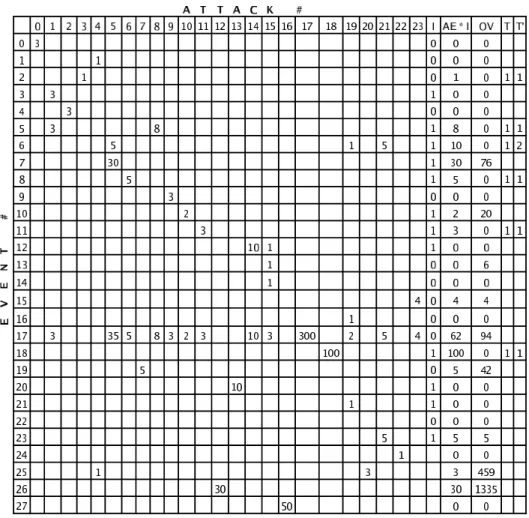
The Genetic Algorithm receives as input the Ob-served Vector and the Attack-Events matrix (AE) of known attacks (M´e, 1998). In Table 2, each row corre-sponds to an event type. Each numeric column—i.e.,
0 through 23—corresponds to a known attack; col-umnIcorresponds to a hypothesis that is being eval-uated, columnAE∗Icorresponds to the multiplica-tion of matrixAE with hypothesis vectorI, column
OV corresponds to the actual number of events that occurred—this is the output of the scanner program, and column entryiinTis set to1if(AE·I)i> OVi,
i.e., if the number of hypothesized events of typeiare greater than the actual number of events of that type registered in the audit trail file. Column T0 shows the number of of hypothesized attacks that require more events of typeithan actually occurred (see Sec-tion 5.2.3).
The Observed Vector contains the number of sys-tem events performed by a user in a session. As shown in Table 3, the first row is the type of event and the second row is the number of events of that type.
The first position of row 2 shows 1, which means that there was a 1 event of typeUser login fail, the eighth position shows 40, which means that there were 40 events of typels fail. Other event types are listed elsewhere (M´e, 1998).
5.2.2 The Genetic Algorithm
The analysis engine is a Genetic Algorithm that works as follows:
Generation of the First Population
Table 2: The Attack Events matrix AE, an example hypothesis VectorI, the resulting Multiplication VectorM V
(=AE∗I), an example Observed VectorOV, and the count of overestimates in columnsT andT0.
Selection of Parents
Reproduction with crossover and mutation
Until an acceptable Solution is found or
resources are exhausted
An individual (I) in the population is an array of 24 positions. Each position corresponds to an attack that is being hypothesized.
The First Population is generated randomly. The algorithm is guessing the possible occurrence of at-tacks. 40 individuals are generated.
Selection of Parents. Parents are selected according
to their fitness value. The fitness function guides the algorithm to find the possible intrusions.
Crossover and Mutation. Parents that are chosen
are crossed with a probability equal to60%and mu-tated with a probability of2.4%. Mitchell (1998) sug-gests values like70%for crossover and0.1%for mu-tation as commonly appropriate.
Number of generations. The number of
genera-tions for each test was variable. At the very
be-ginning of our experiments, for example, we keep track of the fitness values and stop after 500,000 generations; we found, then, the greatest fitness value of all the generations and used it with a threshold equal to STDV(M ax f itness value)/4, so the algorithm begins to run, and if the fit-ness value goes less thanM ax f itness value)/4−
STDV(M ax f itness value)/4the algorithm stops.
The Attack-Event matrix, which gives the number of events by attack, is multiplied by the individual
I that hypothesized the occurrence of attacks. The
result is the Multiplication Vector (MV) that gives the classified total number of events hypothesized (= AE∗I). This vector is evaluated using the Ob-served Vector that records the number of events that have occurred. Each position of the result vector MV is compared with the corresponding position inOV. If M Vi, the hypothesized number of events of type i, is less thanOVi (the audit trail observed number
0 1 2 3 4 5 6 7 8 9 10 11 12 13 14 15 16 17 18 19 20 21 22 23 24 25 26 27 1 12 6 0 4 9 11 40 34 9 5 45 0 0 2 7 0 29 0 0 0 0 0 0 0 0 0 0
Table 3: An example of an Observed Vector.
0 1 2 3 4 5 6 7 8 9 10 11 12 13 14 15 16 17 18 19 20 21 22 23 0 0 0 0 1 1 0 0 1 0 0 0 0 0 0 0 0 0 0 0 0 0 0 0
Table 4: An example of an Individual. Positions 4, 5, and 8 that have 1 are showing the possible occurrence of attacks 4, 5, and 8.
But if, on the contrary,M Viis greater thanOVi, that
means that the algorithm hypothesized more intru-sions than actually occurred, a situation that must be take into account using a penalty factor in the fitness function. The penalty term is then related with the number of events inM Vithat are greater than the
ob-served events inOVi.
5.2.3 An Improved Fitness Function
A genetic algorithm needs a fitness function that combines objectives and constraints into a single value (Coello, 1998). The problem is not only to find the appropriate function but also to provide accurate values to the parameters that produce the correct so-lution to the problem for as many instances as pos-sible. It appears that the fitness function proposed in GASSATA, a combination of objectives and con-straints into a single value using arithmetical opera-tions, should be correct. However, it is difficult to set the parameters so that the algorithm finds intrusions and converges.
For this problem GASSATA uses a fitness function that has principally two terms: PNa
i=1Wi∗Iithat is
rewarding, andβ∗T2that is penalizing.
As the fitness function is giving a payoff to the highest valued individual, the termPNa
i=1Wi∗Ii is
guiding the solution to have the maximum number of intrusions. However, this is good enough until the correct set of intrusions are found. Later on, i.e., if more intrusions than that are hypothesized, the prob-lem of false positives occurs. On the other hand, the term β ∗T2 is diminishing the fitness but in doing
so various intrusions can hit the same event. When this happens the counting of overestimates is wrong. These two facts were tested and false positives and false negatives were found. (Results of this testing and an analysis of the reason for it will be published elsewhere (Diaz-Gomez and Hougen, 2005). For the present work, we concentrate on improvements to the IDS).
The solution proposed has two parts: 1. remove the positive termPNa
i=1Ii, and
2. count overestimates in the correct way; this means, if two intrusions require the same event in numbers
in excess of the number of actual events then count them both, and so forth. Call thisT0.
With this in mind, the fitness function only has one term, the penalty function and the new fitness function suggested is
F(I) =Ne−T0 (2)
whereNecorresponds to the total number of
classi-fied events. For testing this value is 28. T0 corre-sponds to the number of overestimates, i.e., the num-ber of times(AE·I)i> OVi.
It must be taken into account that the role ofα cor-responds now toNeand thatβ is equal to one.
How-ever, the termPNa
i=1Iiwas suppressed, as stated
be-fore. It must be reinforced that the reason for doing that is because the termPNa
i=1Iiis giving the number
of intrusions hypothesized but those intrusions have not been evaluated yet. In doing the evaluations, that may produce an incorrect count of overestimates.
Now, the hypothesized vectorIis really evaluated inT0; the better the hypothesized vector, the smaller
T0is, and of course,F(I)→Ne, the maximum. The
fitness function is evaluating only theT0term. There is a maximum whenT = 0.
In this study we divided the set of intrusions into two subsets: mutually exclusive and not mutually
ex-clusive intrusions. We define mutually exex-clusive
in-trusions those that can not occur at the same time, de-pending of the Observed Vector in the analysis, i.e., if in considering each intrusion alone T = 0but in considering them at the same timeT 6= 0. That is the case for all intrusions that share some event type; for example, intrusions number 5, 19 and 21, in each of which event number 6 is present (see Table 2).
As our genetic algorithm runs, it creates aggre-gate solution sets of all possible compatible intrusions found. To do this, it records all the realistic solutions (those where T = 0) found in the search space and keeps track of each intrusion it finds within each real-istic solution. The algorithm then checks if the intru-sion already exists in its current solution set and, if it does not, then it checks if it is mutually exclusive or not in order to add it to the corresponding aggregate solution set. In this way, the algorithm builds up sets of all compatible solutions. This mechanism can be
seen as a replacement for the positive termPNa i=1Ii
which was misleading the genetic algorithm in
GAS-SATA.
The results found with this fitness function are shown in Table 5. The data corresponding to users
2051and2506was extracted by our scanner from au-dit data files downloaded from the Lincoln Laboratory at MIT (Fried and Zissman, 1998).
Average Count Average % User False + False - Detected False + False - Detected
2051_7 0 0 3 0 0 100 2051_11 0 0 4 0 0 100 2506_15 0 0 4 0 0 100 Zero Vector 0 0 0 0 0 100 0 0.1 0.9 0 10 90 0 0 2 0 0 100 0 0 3 0 0 100 One Intrus. Two Intrus. Three Intrus.
Table 5: Results with fitness functionF(I) =Ne−T
averaged over 10 runs.
As can be seen, with the fitness function proposed
there are no false positives and the number of false negatives decreases dramatically. This time 70 runs
were performed with different data and only one time a false negative was present.
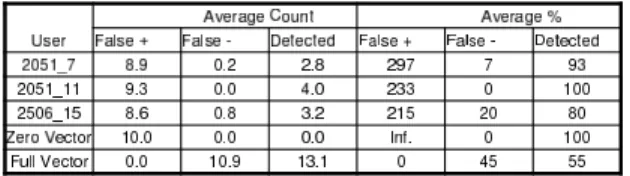
These results are significantly better than any of those found with any of the parameters we tested for the original GASSATA fitness function. For example, settingα = N2
e/2,
PNa
i=1Wi > Ne2/2, andβ = 1
resulted in the performance shown in Table 6.
Table 6: Results with Fitness Function as in Equa-tion 1 using α = N2 e/2, PNa i=1Wi > N 2 e/2, and β= 1.
5.3
Improvements
As with many heuristic tools, we have difficulties in the implementation of GASSATA. Some difficulties arise in providing accurate values for the fitness pa-rametersα,W, andβ. In doing that we found a high percentage of false positives, so this study made the following improvements in order to:
• dismiss false positives and false negatives,
• find the maximum set of intrusions and disaggre-gate them as mutually exclusive or not,
• record all events not considered in the intrusion analysis.
As was explained in Section 5.2.3 the term
PNa
i=1Wi ∗ Ii proposed for the fitness function in
Equation 1 is guiding the algorithm to give false pos-itives, so with the new fitness function proposed in this research (see Equation 2), we have discarded that term. Experimentally, as is shown in Table 5, there were no false positives with our fitness function
F(I) =Ne−T.
We also managed to all but eliminate false neg-atives by building up aggregate solution sets of all compatible intrusions found, as also explained in Sec-tion 5.2.3.
Another improvement is related with the recording of events not considered in the analysis. That is, the scanner is looking for predefined events; if there are events not defined, those are recorded, so the system administrator can check them and evaluate if there are critical events not considered and that can be included in the scanner.
6
CONCLUSIONS AND FUTURE
WORK
This paper proposes a fitness function independent of variable parameters, making the fitness function to solve this particular problem quite general and inde-pendent of the audit trail data. This approach can be generalized to similar multi-objective fitness func-tions for genetic algorithms. At the same time the system proposed improves the one suggested previ-ously (M´e, 1998) by recording all the events not con-sidered in the intrusion analysis, finding the maxi-mum set of intrusions and disaggregating them as mu-tually exclusive or not, and diminishing the false pos-itives and false negatives.
One topic that can be addressed in future work is to investigate system performance using different crossover and mutation rates.
We also consider it important for the future of intru-sion detection systems to consider the standardization of audit trail files. Such a standard has the principal benefit that it would enable logs generated by differ-ent operating systems to be reconciled. With the au-dit trail standardized, the analysis of logs by a central engine would be simpler, because that engine would deal with only one file structure.
Another improvement of the specific intrusion sys-tem developed is the use of real-time intrusion detec-tion, because such a system can catch a range of intru-sions like viruses, Trojan horses, and masquerading before these attacks have time to do extensive dam-age to a system.
This paper presented some of this new research in intrusion detection, by using a GA as an analytical engine that performs intrusion detection. However, the field of IDSs is quite diverse and other approaches such as immune systems and neural networks have been developed in order to improve this mechanism.
The field is deep and there are promising new ways to think about it. Evolutionary computation offers a chance to see intrusion detection systems with the ability to evolve—evolution that could sometimes ex-ceed human programmers. There are new paradigms to explore and we can use computers themselves as the vehicle.
REFERENCES
Anderson, J. P. (1980). Computer security threat monitoring and surveillance. Technical Report 79F296400, James P. Anderson, Co., Fort Washington, PA.
Anonymous (2000). SunSHIELD basic security mod-ule guide (Solaris 8). Technical Report 806-1789-10, Sun Microsystems, Inc., Palo Alto, CA. http://docs.sun.com/db/doc/806-1789, accessed July 2004.
Bace, R. G. (2000). Intrusion Detection. MacMillan Tech-nical Publishing, USA.
Coello, C. A. C. (1998). A comprehensive survey of evolutionary-based multiobjective optimization techniques. Knowledge and Information Systems, 1(3):269–308.
Crosbie, M. and Spafford, G. (1995). Applying genetic pro-gramming to intrusion detection. In Papers from the 1995 AAAI Fall Symposium, pages 1–8.
Denning, D. E. (1986). An intrusion-detection model. In Proceedings of the 1986 IEEE Symposium on Security and Privacy, pages 118–131.
Diaz-Gomez, P. A. and Hougen, D. F. (2005). Analysis of an off-line intrusion detection system: A case study in multi-objective genetic algorithms. In Proceedings of the Florida Artificial Intelligence Research Society Conference, to appear. AAAI Press.
Forrest, S., Perelson, A. S., Allen, L., and Cherukuri, R. (1994). Self-nonself discrimination in a computer. In Proceedings of the 1994 IEEE Symposium on Re-search in Security and Privacy, pages 202–212, Oak-land, CA. IEEE Computer Society Press.
Fried, D. and Zissman, M. (1998). Intrusion detec-tion evaluadetec-tion. Technical report, Lincoln Labora-tory, MIT. http://www.ll.mit.edu/IST/ideval/, accessed March 2004.
M´e, L. (1998). GASSATA, a genetic algorithm as an al-ternative tool for security audit trail analysis. In First International Workshop on the Recent Advances in In-trusion Detection, Belgium.
Mitchell, M. (1998). An Introduction to Genetic Algo-rithms. MIT Press.
Tjaden, B. C. (2004). Fundamentals of Secure Computer Systems. Franklin and Beedle & Associates.