measurement models of supply
chain complexity
Created in SS 2015
Masters degree programme
Supply Chain Management (SCM)
University of Applied Sciences Upper Austria - Campus Steyr
Master Thesis
Towards the academic degree of
Master of Arts in Business (MA)
Submitted by
Patrick Freinberger, BA
Submitted to: Ila Manuj, PhD
Acknowledgements
I would like to express my gratitude to my supervisor Ila Manuj, PhD for her time and effort and for her useful comments, remarks and engagements through the learning process of this master thesis. I owe a special thank to her, for helping and supporting me with her expertise, support, and encouragement.
I am also grateful to Dr. Markus Gerschberger, supply chain management professor at the University of Applied Sciences, for giving me opportunities and guided me along the way to become a better researcher and student.
I would also like to thank my family and friends for supporting me through the last two years. I am especially appreciative of my mother, Gertrude Freinberger, and my father, Franz Freinberger. With their unconditional and ongoing support it is possible to follow my dreams.
Table of Contents
ACKNOWLEDGEMENTS ... II
TABLE OF CONTENTS ... III
ABSTRACT ... VI
1 INTRODUCTION ... 7
1.1 Problem Definition ... 8
1.2 Goal of the thesis ... 10
1.3 Structure of this Thesis ... 11
2 DEVELOPMENT OF A CONCEPTUAL MODEL OF OBJECTIVE AND EFFECTIVE SUPPLY CHAIN COMPLEXITY ... 14
2.1 Definition of supply chain ... 14
2.2 Definition of supply chain management ... 15
2.3 Goals of supply chain management ... 20
2.4 System complexity ... 21
2.5 Supply chain complexity ... 23
2.5.1 Components of objective supply chain complexity ... 28
2.5.2 Relationship between objective supply chain complexity and effective supply chain complexity ... 34
2.5.3 Strategies for supply chain complexity management ... 39
2.5.4 Outcomes of supply chain complexity ... 44
2.6 Summary ... 50
3 A THEORETICAL AND MEASUREMENT MODEL OF SUPPLY CHAIN COMPLEXITY ... 52
3.1 Supply chain complexity ... 52
3.2 Methodology ... 59
3.2.1 Content and face validity ... 67
3.3 Summary ... 68
4 CONTRIBUTION, RESEARCH LIMITATIONS, AND FUTURE RESEARCH .... 69
5 LIST OF REFERENCES ... 73
6 CURRICULUM VITAE ... 84
Table of Figures
Figure 1: Thesis structure ... 12
Figure 2: Direct supply chain ... 14
Figure 3: Extended supply chain ... 15
Figure 4: Ultimate supply chain ... 15
Figure 5: Elements in the Framework of Supply Chain Management ... 20
Figure 6: Components of objective supply chain complexity ... 32
Figure 7: Strategies for managing supply chain complexity by Kaluza et al. ... 40
Figure 8: Strategy for managing supply chain complexity by Serdarasan ... 41
List of Tables
Table 1: Definitions of supply chain management ... 19
Table 2: Upstream complexity antecedents ... 29
Table 3: Types of supply chain complexity antecedents ... 33
Table 4: Definitions of supply chain complexity ... 38
Table 5: Strategies to cope with complexity ... 43
Table 6: Outcomes of supply chain complexity ... 47
Table 7: Impact of supply chain complexity on performance ... 58
Table 8: Survey items for objective supply chain complexity ... 62
Table 9: Survey items for effective supply chain complexity ... 62
Table 10: Survey items for supply chain integration ... 63
Table 11: Survey items for human cognitive abilities ... 64
Table 12: Survey items for firm performance ... 64
Table 13: Survey item for perfect order index (POI) ... 65
Table 14: Survey items for supply chain flexibility ... 65
Abstract
PurposeThe objective of this thesis is to develop a comprehensive, conceptual model of supply chain complexity, incorporating objective supply chain complexity, effective supply chain complexity, antecedents, strategies, and outcomes to get an understanding of supply chain complexity and the relationships between these constructs. Furthermore a theoreti-cal and measurement model of objective supply chain complexity, effective supply chain complexity, strategies, and outcomes are provided.
Design/methodology/approach
An extensive literature review was conducted to develop a comprehensive, conceptual model and propositions related to antecedents, strategies, and outcomes of supply chain complexity. In addition a survey comprising of measurement scales for each construct of the theoretical model was developed and content and face validity of survey items were ensured.
Findings
A clear differentiation between objective supply chain complexity and effective supply chain complexity is provided. In addition the conceptual model provides an overview of antecedents, strategies, and outcomes of supply chain complexity. Derived from the con-ceptual model a theoretical model was developed of objective supply chain complexity, effective supply chain complexity, moderators (supply chain integration and human cogni-tive abilities), and outcomes (firm performance, perfect order index, supply chain flexibil-ity). The thesis also provides hypothesis of the relationship between the constructs of the theoretical model. The thesis also provides measurement scales for each construct of the theoretical model.
Research limitations/implications
This thesis has several theoretical (comprehensive, conceptual model) and managerial contributions (measurement scales to assess potential outcomes and strategies for man-aging supply chain complexity). Research limitations are: measurement model has not been tested empirically, only two complexity moderators, and only three outcomes are incorporated.
1 Introduction
In today’s business environment successful supply chain management is a source of competitive advantage for companies. Supply chain management can be defined as the upstream and downstream flow of products and/or services, along with the related financ-es and information.123 The goal of supply chain management is the systematic and strate-gic coordination of these flows within and across companies to reduce costs, improve cus-tomer satisfaction and gain competitive advantage for the independent company and the supply chain as a whole.456
The dynamic, multi-functional, and global nature of supply chains is resulting in shorter product life cycles, higher product variety, increasing customization levels, and more de-manding customers. Additionally supply chain partners (upstream and downstream) are becoming more geographically dispersed. 78 As a result the number and variety of interac-tions among the products, processes, and relainterac-tionships increase, which consequentially leads to more complex supply chains. 9 In most simple terms, it may be argued that supply chain complexity can be determined by numerousness of elements and the interactions between these elements within a given system. 10 The elements are the structural proper-ties of the supply chain (e.g. the number of participants, faciliproper-ties, products, transportation links, information flows, etc.).11 The example below illustrates this argument:
Manufacturers seeking to exploit global markets, supply chain opportunities are hit-ting an invisible but nonetheless debilitahit-ting wall: mounhit-ting complexity across the value chain. And it is bound to get worse as manufacturers continue to globalize and accelerate new product introductions to spur growth. As a result, the task of coordinating product engineering, sourcing, manufacturing, logistics, and market-ing and sales activities that are more and more scattered around the world and supporting an increasing number of new products is growing ever more difficult.12
1
See Beamon, 1998. 2
See Lambert et al., 1998. 3 See Mentzer et al., 2001. 4 See Cooper/Ellram, 1993. 5
See Cooper et al., 1997. 6
See Mentzer et al., 2001. 7
See Manuj/Sahin, 2011. 8
See Mentzer et al., 2001. 9 See Manuj/Sahin, 2011. 10 See Choi/Krause, 2006. 11 See Manuj/Sahin, 2011. 12 See Deloitte, 2003.
Say we get an order from a European retailer to produce 10, 000 garments. It’s not a simple matter of our Korean office sourcing Korean products or our Indonesian office sourcing Indonesian products. For this customer we might decide to buy yarn from a Korean producer but have it woven and dyed in Taiwan. So we pick the yarn and ship it to Taiwan. The Japanese have the best zippers and buttons, but they manufacture them mostly in China. Okay, so we go to YKK, a big Japa-nese zipper manufacturer, and we order the right zippers from their ChiJapa-nese Li & Fung produces a truly global product by pulling apart the manufacturing value chain and optimizing each step. Today it has 35 offices in 20 countries, but its global reach is expanding rapidly. In 1997, it had revenue of approximately $1.7 billion. Then we determine that, because of quotas and labor conditions, the best place to make the garments is Thailand. So we ship everything there. And be-cause the customer needs quick delivery, we may divide the order across five fac-tories in Thailand. Effectively, we are customizing the value chain to best meet the customer’s needs.13
Cisco Systems´ growth was achieved through an outsourcing strategy that dramat-ically increased its interdependencies and the level of complexity in the supply chain.14
Apparently today´s supply chains are highly complex and it´s expected that the complexity will increase over the next decade.15
Given the higher number of elements and interconnections of elements within a supply chain system and the fact that supply chain management is seen as a competitive ad-vantage for companies, it can be conjectured that supply chain complexity was/is a key area of managerial consideration - in the past, present, and future business environment.16
1.1 Problem
Definition
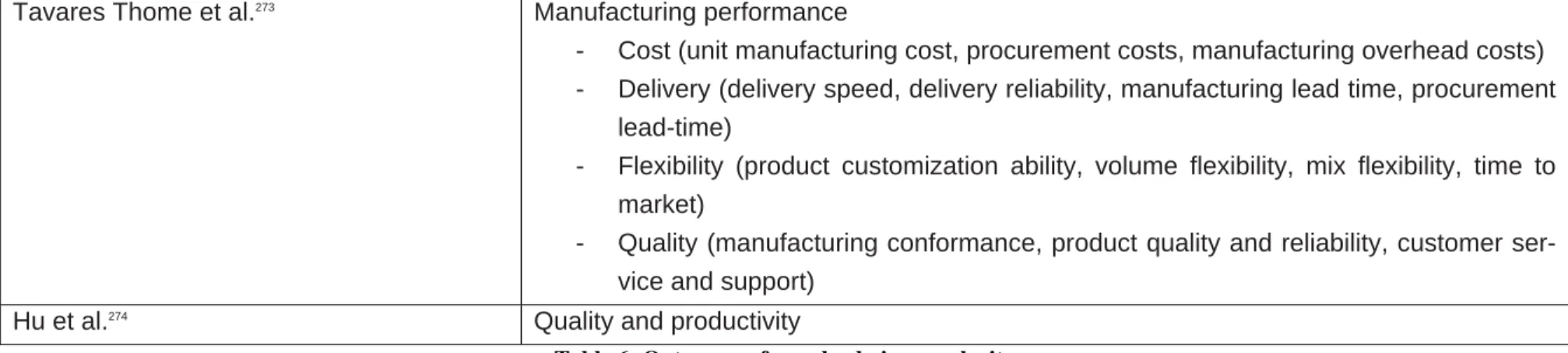
Supply chain complexity mostly implies adverse,17 unpredictable and uncertain outcomes.18 Several authors have examined the effect of supply chain complexity on certain business performance related outcomes. For example, several authors have studied the negative influence of supply chain complexity on delivery times, operational costs, transaction
13
See Magretta, 1998. 14
See Ellram et al., 2008. 15 See Capgemini, 2008. 16 See Choi/Krause, 2006. 17 See Manuj/Sahin, 2011. 18
costs, and supplier responsiveness.192021 Although it seems that higher levels of supply chain complexity automatically lead to adverse outcomes, a certain level of supply chain complexity is required for companies to stay competitive. For example, the following changes to business are critical for success but leads to increased complexity:2223
Introduction of new products on the market to generate additional revenues Increasing the number of suppliers to force competition among suppliers Increasing the number of suppliers to gain sourcing flexibility
Increasing the customer base to sell more products to generate additional reve-nues
To remain competitive it´s indispensable for companies to adequately manage the in-creasing level of supply chain complexity. 242526 A study by Deloitte found that companies that are able to manage supply chain complexity make up to 73% more in profits.27
As supply chain managers are facing rapidly changing, continuously expanding, and often increasingly uncertain business environments, they are consequently confronted with more complicated and challenging supply chain related tasks due to huge amount of data, more decision variables, and more interrelationships. These challenges may affect the robustness of, business decisions related to effectively planning, implementing, and con-trolling supply chains of companies.28
If supply chain complexity is not appropriately managed, it has negative effects on busi-ness performance of companies. 29303132 Major problems when managing supply chain com-plexity are: identifying sources of supply chain comcom-plexity, implementing adequate strate-gies to cope with supply chain complexity, and linking supply chain complexity to specific outcomes. Addressing the wrong sources of supply chain complexity and having poorly
19 See Perona/Miragliotta, 2004. 20 See Choi/Krause, 2006. 21 See Wu et al., 2007. 22
See Bozarth et al, 2009. 23 See Closs et al., 2008. 24 See Lewis/Sheinfeld, 2006. 25
See Mentzer et al., 2001. 26 See Choi/Krause, 2006. 27 See Deloitte, 2003. 28 See Manuj/Sahin, 2011. 29 See Bozarth et al., 2009. 30 See Perona/Miragliotta, 2004. 31 See Flynn/Flynn, 2009. 32 See Vachon/Klassen, 2002.
designed and executed strategies for managing supply chain complexity lead to adverse outcomes.33
The reason for managing supply chain complexity appropriately often lies in the lack of having a comprehensive and accurate understanding of supply chain complexity, and what strategies may be employed to cope with supply chain complexity.
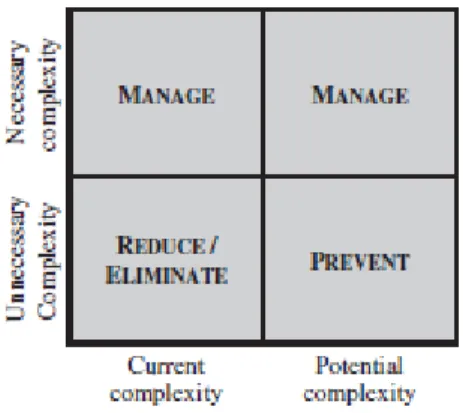
Supply chain managers have to implement specific business strategies to address supply chain complexity, as supply chain complexity may lead to adverse outcomes (e.g. higher costs and risks). Therefore it is important to know the antecedents of supply chain com-plexity to be able to design and employ the right strategies. Strategies are for example, scope and boundary management, adequate design of information systems strategy, etc.
To summarize, supply chains are becoming more complex and to remain competitive it´s essential to manage the complexity. A success factor to gain an understanding of supply chain complexity, its linkage to strategies and outcomes, is the development of a concep-tual and measurement model of the above mentioned constructs. 3435
Supply chain complexity comprises of objective supply chain complexity and effective supply chain complexity. While objective supply chain complexity is derived from the structural properties of supply chains and their interactions and effective supply chain complexity is the perceived complexity faced by supply chain managers when making a supply chain related decision.36 For example, effective supply chain complexity is affected by the uncertainty when making a supply chain related decision (e.g. requested data for decision-making is not available) and objective supply chain complexity is affected by for example, the number of suppliers, customers, etc.
Moving forward, to advance the understanding of supply chain complexity, its linkage to strategies and outcomes it is critical to develop theoretical and measurement models of supply chain complexity. To this end, the next section presents the goals and research questions of this thesis.
1.2
Goal of the thesis
The overall goal of this thesis is to extend the knowledge on supply chain complexity. First, a comprehensive conceptual model of supply chain complexity is presented. Next, from the conceptual model, theoretical and measurement models of supply chain
33 See Manuj/Sahin, 2011. 34
See de Leuuw et al, 2013. 35
See Isik, 2010. 36
plexity are derived for further investigation. The models include both, objective and effec-tive components of supply chain complexity. In addition to the components of complexity, the models investigate the moderators (strategies) and outcomes of supply chain com-plexity to get a holistic understanding of supply chain comcom-plexity.
The comprehensive conceptual model serves as the framework to arrange and link to-gether the extant knowledge on supply chain complexity from multiple disciplines. As a subset of the comprehensive model, the theoretical model serves as the foundation to derive and formulate hypothesis regarding the key constructs of the comprehensive mod-el. The measurement model includes measurement scales for each construct included in the theoretical model.
To accomplish the goal of this thesis, an attempt is made to address the following re-search questions:
Research question 1:
What is the relationship between objective supply chain complexity and effective supply chain complexity?
Research question 2:
What supply chain outcomes are affected by objective supply chain complexity and effec-tive supply chain complexity?
Research question 3:
What factors (moderators) affect the relationship between objective supply chain complex-ity and effective supply chain complexcomplex-ity?
To answer the above research questions, the objectives of this research are:
1. Defining objective supply chain complexity and effective supply chain complexity 2. Investigating moderators and outcomes of objective supply chain complexity and
effective supply chain complexity
3. Developing a conceptual and a theoretical model of supply chain complexity 4. Developing a measurement model for supply chain complexity
1.3
Structure of this Thesis
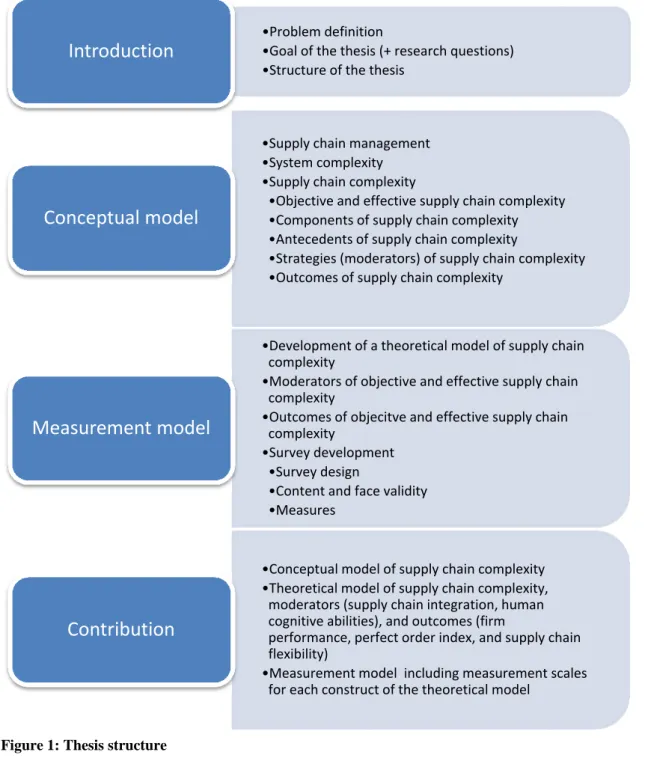
Figure 1 shows how the thesis is organized, followed by a detailed description of the chapters.
Figure 1: Thesis structure
This thesis is organized in four chapters.
The goal of chapter 1 is to present a brief introduction concerning the topic. In addition the goals of the thesis (including research questions), problem definition, and the structure of the thesis are presented.
The goal of chapter 2 is an extensive review of supply chain complexity and related litera-ture from a variety of disciplines including, e.g. systems theory, complex adaptive systems theory, etc. It provides definitions for the most relevant subjects (e.g. objective supply
•Problem definition
•Goal of the thesis (+ research questions) •Structure of the thesis
Introduction
•Supply chain management •System complexity •Supply chain complexity
•Objective and effective supply chain complexity •Components of supply chain complexity •Antecedents of supply chain complexity
•Strategies (moderators) of supply chain complexity •Outcomes of supply chain complexity
Conceptual
model
•Development of a theoretical model of supply chain
complexity
•Moderators of objective and effective supply chain
complexity
•Outcomes of objecitve and effective supply chain
complexity
•Survey development •Survey design
•Content and face validity •Measures
Measurement
model
•Conceptual model of supply chain complexity •Theoretical model of supply chain complexity,
moderators (supply chain integration, human
cognitive abilities), and outcomes (firm
performance, perfect order index, and supply chain
flexibility)
•Measurement model including measurement scales
for each construct of the theoretical model
Contribution
chain complexity and effective supply chain complexity) and gives an overview of supply chain complexity antecedents, components, strategies, and outcomes. Furthermore, grounded in actual literature, propositions are made.
The goal of chapter 3 is to develop a theoretical model of objective supply chain complexi-ty, effective supply chain complexicomplexi-ty, moderators, and outcomes. The chapter starts with the development of a theoretical model (derived from the conceptual model of Chapter 2) including relationships between the constructs. The measurement model consists of a survey consisting of measurement scales for each construct of the theoretical model.
The goal of chapter 4 is to present the contribution of this research to actual literature re-lating to the field of supply chain complexity. Additionally research limitations and future research directions are discussed.
2 Development of a conceptual model of objective and effective
supply chain complexity
The following chapter provides an overview of foundational research regarding the main concepts of this thesis. The goal is to develop a conceptual model comprising of objective supply chain complexity, effective supply chain complexity, supply chain complexity ante-cedents, supply chain complexity components, supply chain complexity moderators, and related outcomes.
2.1
Definition of supply chain
In the literature various definitions of the term “supply chain” exist. Supply chains can be seen as “a set of three or more entities (organization or individuals) directly involved in the upstream and downstream flows of products, services, finances, and/or information from a source to a customer”.37 La Londe and Masters state that supply chains are a set of com-panies that have the goal to pass materials forward (from raw material to end product) including for example raw material and component producers, product assemblers, wholesalers, retailer merchants, and transportation companies.38 According to Christopher a supply chain involves the upstream (i.e. supply) and downstream (i.e. distribution) link-ages of a focal company with the goal to produce value (in terms of products and ser-vices) to the ultimate customer.39
Derived from these definitions supply chains are classified into three categories (in terms of how to differently view the supply chain)40
“direct supply chain” (Figure 2) “extended supply chain” (Figure 3) “ultimate supply chain” (Figure 4)
Figure 2: Direct supply chain41
As illustrated in Figure 2 a direct supply chain is composed of a focal company, a supplier, and a customer embedded in the upstream and/or downstream flows of products, ser-vices, finances, and/or information.
37
See Mentzer et al., 2001. 38 See La Londe/Masters, 1994. 39
See Christopher, 1992. 40
See Mentzer et al., 2001. 41
Figure 3: Extended supply chain42
An extended supply chain goes a step further and comprises the supplier of the immedi-ate supplier and the customers of the immediimmedi-ate customers. Due to the higher number of entities and/or tiers of the supply chain, the number of upstream and downstream flows of products, services, finances, and/or information will also increase.
Figure 4: Ultimate supply chain43
All organizations involved in all upstream and downstream flows of products, services, finances, and/or information characterize an ultimate supply chain. In addtion to the enti-ties of the extended third party logistics suppliers, financial providers, and market research companies are part of the ultimate supply chain.
Given the different members of the supply chain and their relationships, the management of the entire supply chain is a very difficult and a complicated task.44 Due to the dynamic and uncertain environment (i.e. product life cycle shortens, product variety and customiza-tion levels increase, and supply chain partners become more geographically dispersed, etc.) in which supply chains are operating, supply chains can be seen as complex sys-tems.45
To address the management of complex supply chains the next section will give an over-view of the concept of supply chain management, followed by a detailed explanation of complexity, especially in the context of supply chains.
2.2
Definition of supply chain management
In the last decades the term “supply chain management” has risen to prominence, both in academia and practice.46
42
See Mentzer et al., 2001. 43 See Mentzer et al., 2001. 44
See Lambert, 1998. 45
See Bozarth et al., 2009. 46
“One of the most significant changes in the paradigm of modern business man-agement is that individual businesses no longer compete as solely autonomous entities, but rather as supply chains. Business management has entered the era of inter-network competition and the ultimate success of a single business will de-pend on management´s ability to integrate the company´s intricate network of business relationships.”474849
In academia and in practice it has been realized that real competition is not company against company, but rather supply chain against supply chain.50 As a result multiple rela-tionships across supply chains have arisen and consequently have to be managed in an efficient and effective manner, which is the goal of supply chain management.51
Multiple developments and trends are responsible for the increased popularity of the con-cept. For example:52
Global sourcing
Emphasis on time and quality-based competition Greater environmental uncertainty
Although, the importance of supply chain management has increased dramatically, litera-ture on defining the concept of supply chain management is confusing and a single defini-tion is still lacking. One reason for it lies in the fact that several definidefini-tions didn´t arise from management theory, but rather were developed solely on distinctive business practices.53 Across several authors the view on supply chain management can be classified into three categories: supply chain management can be either seen as a management philosophy, or in terms of a management process, or in operational terms including the flow of materi-als and products.54
The following Table 1 presents some definitions reflecting different views on supply chain management. 47 See Drucker, 1998. 48 See Christopher, 1998. 49 See Bowersox, 1997. 50 See Christopher, 1992. 51 See Lambert et al., 1998. 52
See Mentzer et al., 2001. 53
See Corsten/Gössinger, 2007. 54
Author, Year Definition
Jones/Riley55 "Supply chain management deals with the total flow of materials from suppliers through
end-users. The key to efficiently managing a supply chain is to plan and control the inven-tories and activities as an integrated single entity. Three elements must come together for integrating the supply chain to operate effectively:
— recognising end-user customer service level requirements;
— defining where to position inventories along the supply chain, and how much to stock at each point;
— developing the appropriate policies and procedures for managing the supply chain as a single entity."
Houlihan56 Differences between supply chain management and classical materials and manufacturing
control: “1) The supply chain is viewed as a single process. Responsibility for the various segments in the chain is not fragmented and relegated to functional areas such as manu-facturing, purchasing, distribution, and sales.
2) Supply chain management calls for, and in the end depends on, strategic decision mak-ing. “Supply” is a shared objective of practically every function in the chain and is of particu-lar strategic significance because of its impact on overall costs and market share. 3) Supply chain management calls for a different perspective on inventories which are used as a bal-ancing mechanism of last, not first, resort. 4) A new approach to systems is required— integration rather than interfacing.”
Monczka et al.57 SCM requires “traditionally separate materials functions to report to an executive
responsi-ble for coordinating the entire materials process, and also requires joint relationships with suppliers across multiple tiers. SCM is a concept, “whose primary objective is to integrate
55
See Jones/Riley, 1985.
56
See Houlihan, 1988.
and manage the sourcing, flow, and control of materials using a total systems perspective across multiple functions and multiple tiers of suppliers.”
La Londe/Masters58 Supply chain strategy includes: “... two or more firms in a supply chain entering into a
long-term agreement; ... the development of trust and commitment to the relationship; ... the integration of logistics activities involving the sharing of demand and sales data; ... the po-tential for a shift in the locus of control of the logistics process.”
Cooper et al.59 Supply chain management is the integration of key business processes from end-users
through original suppliers that provide products, services, and information and add value for customers and other stakeholders.
Mentzer60 Supply chain management is “the systemic, strategic coordination of the traditional
busi-ness functions and the tactics across these busibusi-ness functions within a particular company and across businesses within the supply chain, for the purposes of improving the long-term performance of the individual companies and the supply chain as a whole.”
Stevens61 “The objective of managing the supply chain is to synchronize the requirements of the
cus-tomer with the flow of materials from suppliers in order to effect a balance between what are often seen as conflicting goals of high customer service, low inventory management, and low unit cost.”
Ellram62 "Supply Chain Management is an integrative approach to using information to manage the
materials flow from suppliers to end-users to achieve improved customer service at re-duced overall costs. SCM represents a network of firms interacting to deliver a product or service
58
See La Londe/Masters, 1994.
59
See Cooper et al., 1997.
60
See Mentzer et al., 2001.
61
See Stevens, 1989.
to the end customer."
Fawcett et al.63 „Supply Chain Management is the collaborative effort of multiple channel members to
de-sign, implement, and manage seamless value-added processes to meet the real needs of the end customer. The development and integration of people and technological resources as well as the coordinated management of materials, information, and financial flows un-derlie successful supply chain integration.”
Table 1: Definitions of supply chain management
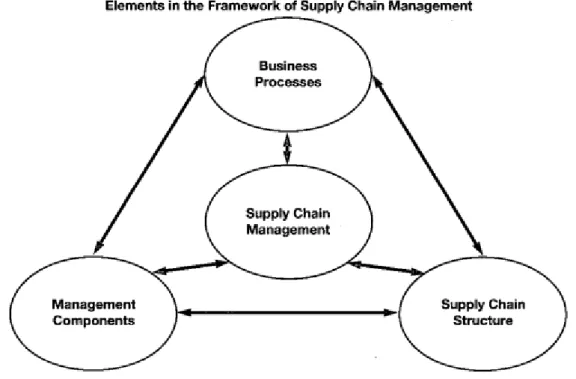
Lambert et al. introduced a supply chain management framework (see figure 5) compris-ing of supply chain network structure (the key supply chain members with whom to link processes), supply chain business processes (that processes that should be linked with each of these key supply chain members), and supply chain management components
(the level of integration and management that should be applied for each process link).64
Figure 5: Elements in the Framework of Supply Chain Management65
Although there are common approaches and similarities to define supply chain manage-ment, a single and unique definition is still lacking. As mentioned above different authors are viewing the concept of supply chain management in different ways.
For the purpose of this thesis the definition of Mentzer et al. will be used. It provides one of the most comprehensive view on supply chain management.
2.3
Goals of supply chain management
The ultimate reason why companies striving to implement successful supply chain man-agement is to increase supply chain competitive advantage.66 By installing appropriate supply chain processes companies are able to better satisfy their customer, consequently improve their competitive advantage and profitability.67 In accordance to the definition of
64 See Lambert et al., 1998. 65
See Lambert et al., 1997. 66
See Monczka et al., 1998. 67
Mentzer et al. supply chain management tries to systemic coordinate business functions within companies and between the members of the supply chain to increase the perfor-mance of an individual company and the supply chain as a whole. Through the synchroni-zation of the flow of physical goods and associated information along the whole supply chain customer value is created.68 Porter determines competitive advantage as a result of enhanced customer value that companies are creating.69 Thus, customer value and satis-faction due to successful supply chain management processes are fundamentally im-portant to gain competitive advantage.
Beside the overall goal of supply chain management to improve competitive advantage other objectives include:
Lowering costs required to provide the necessary level of customer service to a specific segment707172
Decreasing inventory costs73
Increasing customer service through increased stock availability74 Increasing customer service through reduced order cycle time75
Increasing customer service through customer-enriching supply system through the synchronization of the flow of products, services, and information to develop innovative solutions76
In summary, supply chain management has the aim to improve both, efficiency (e.g., cost reduction) and effectiveness (e.g., customer service) to obtain competitive advantage and consequently increase profitability. As stated earlier the increase of elements along the supply chain, leading to more connections and interactions, and affecting the complexity of supply chains. Therefore, the next sections discuss the concept of complexity of supply chains.
2.4 System
complexity
There is a wide range of disciplines that have examined complexity, for example: philoso-phy, physical sciences, and management.77787980 Although, there are many studies providing
68 See Mentzer et al., 2001. 69 See Porter, 1985. 70 See Houlihan, 1988. 71 See Jones/Riley, 1985. 72 See Stevens, 1989. 73 See Beamon, 1999. 74 See Cooper/Ellram, 1993. 75 See Cooper/Ellram, 1993. 76 See Ross, 1998. 77 See Simon, 1962.
insights to complexity theory, confusion remains regarding a clear and unique definition of a complex system and what constitutes a complex system.
As mentioned earlier complexity theory has been applied in the field of management. For example, a lot of research in the field of complexity has been done with regard to organi-zational theory8182 mainly with the focus on studying, predicting, and controlling chaotic systems.83 Studies regarding complexity have also been extended to the field of supply chain management.8485 The studies within the field of supply chain management will be discussed in the remainder of this chapter.
To gain an understanding of which aspects constitutes complexity in systems some defini-tions will be presented and discussed.
Simon sees a system as complex, when “the system is made up of a large number of parts that interact in a nonsimple way”.86 A similar definition of complex systems is contrib-uted by Casti, who states: “complexity refers to two major aspects of a system: (a) the mathematical structure of the irreducible component subsystems of the process and (b) the manner in which the components are connected to form the system.”87 In their defini-tions – numerousness and interacdefini-tions of parts of a system – are the underlying founda-tional aspects to determine systems complexity.
Another definition is provided by Yates, where complex systems exhibit one or more of the following attributes:88
Significant interactions
High number of component parts and interactions Nonlinearity Broken symmetry Nonholonomic constraints 78 See Casti, 1979. 79 See Holland, 1995. 80 See, Choi et al., 2001. 81
See Stacey, 1996. 82
See Stacey et al., 2000. 83
See Stewart, 2002. 84
See Choi et al., 2001. 85 See Wilding, 1998. 86 See Simon, 1962. 87 See Casti, 1979. 88 See Yates, 1978.
According to Flood and Carson the last three characteristics lead to high system com-plexity, which is explained by the assumption that they make the response of the system hard to predict.89 Nonlinearity refers to the non-proportional outcome to a given set of in-puts (which is also supported by Dubois et al.90). Asymmetry of the system means that portions of the system are not accessible from other portions of the system. And nonho-lonomic constraints arise when one or more portions are left outside the central control. A supply chain related example regarding this would be, when multiple downstream demand points placing orders independently on a centralized supply point without regard to supply constraints. In this case, the same input can have varying effects, depending on the state of the supply chain.9192 These aspects are in alignment with Waldrop, who states that sys-tems are complex when they have “a kind of dynamism that makes them qualitatively dif-ferent from static objects such as computer chips or snowflakes, which are merely compli-cated.”93
In addition to the definitions above, Senge points out that the complexity of systems is a combination of detail and dynamic complexity. The distinction between these two can be described as follows: detail complexity is the number of variables embedded in a system, whereas dynamic complexity are situations where cause and effect are subtle, and where the effects over time of interventions are not obvious.94 Later, Bozarth et al. transferred this concept to a supply chain context.95
Based on these studies, it can be summarized that complex systems are made up of a high number of parts/elements and the interaction of those. Those interactions are conse-quently leading to unpredictable outcomes to a given set of inputs and therefore generate uncertainty.
2.5
Supply chain complexity
In the literature supply chain complexity has been studied from different theoretical per-spectives such as, information theoretic perspective96, systems theoretic perspective97, and complex adaptive systems perspective98.
89 See Flood/Carson, 1988.
90 See Dubois et al., 2004. 91 See Yates, 1978. 92 See Flood/Carson, 1988. 93 See Waldrop, 1992. 94 See Senge, 1990. 95 See Bozarth et al., 2009. 96
See Sivadasan et al., 2004. 97
See Bliss et al., 2000. 98
To gain a clear understanding about what constitutes supply chain complexity, this section aims to give an overview of the current literature about supply chain complexity.
The goal of an organization is to gather information about other organizations and their environment to adapt and co-evolve with their environment. Viewing organizations as sys-tems, the behavior can be described as adaptive, complex, and emergent.99100101 Increasing the number of connections organizations have, the larger is the variety of behaviors they can exhibit. As a result higher levels of adaptability can be reached.102103104
According to Choi et al.105 and Wycisk et al.106 supply chains are complex adaptive systems and to manage them efficiently and effectively is a challenge for supply chain managers.107 The findings of Mentzer et al.108 and Choi/Krause109 strengthen this by stating that supply chain complexity is an issue confronting many supply chain managers.
Therefore, the following statement of a supply chain manager of a leading automobile producer indicates the dynamic and uncertain environment in which supply chains are operating:
A few years ago, our engineers mapped a supply chain of a small assembly by tracing it all the way back to the mine. From that exercise, we demonstrated the benefits of supply chain management, and we set out to manage the supply chain as a whole system. Frankly, we have not been able to do it. The problem was, as soon as we came up with a strategy for managing the chain, the chain changed on us – we got new suppliers and new relationship configurations. It took a lot of effort to map one supply chain, and we could not possibly map it every time something changed.110
Given the dynamic and uncertain environment (e.g. due to various companies, high num-ber and variety of relations, processes and interactions between and within the compa-nies, dynamic processes between and within compacompa-nies, etc.) in which supply chains are
99
See Brown/Eisenhardt, 1997. 100
See Kauffmann, 1995. 101 See Ashmos et al., 2000. 102 See McDaniel/Walls, 1997. 103
See Stacey, 1995. 104
See Ashmos et al., 2000. 105
See Choi et al., 2001. 106
See Wycisk et al., 2008. 107 See Ellinger et al., 2002. 108
See Mentzer et al., 2001. 109
See Choi/Krause, 2006. 110
operating, supply chains are inherently complex systems,111 embedded in networks com-prising of entities in the upstream and downstream flows of products and/or services, along with the related finances and information.112113114 Hereby, the literature refers to the term supply chain complexity, where the degree of supply chain complexity is derived from the structural properties (determined by the number and variety of elements defining a system) and the interaction between these elements, leading to an uncertain and non-linear behavior of the system.115116 Several authors found that higher degrees of supply chain complexity mostly imply adverse,117 unpredictable and uncertain performance out-comes.118
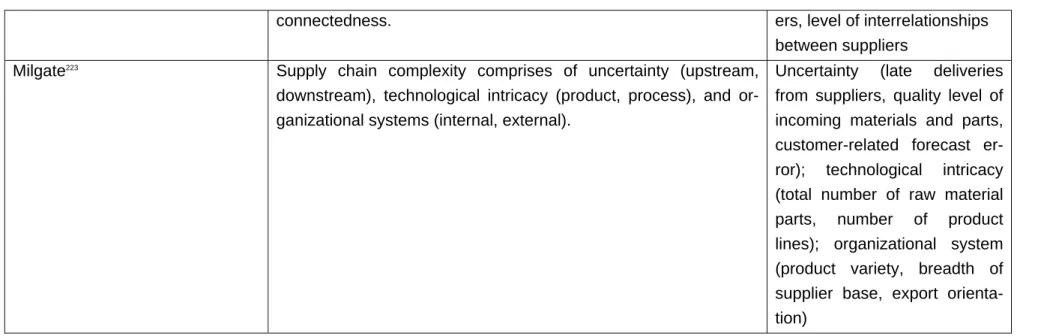
One of the first attempts to apply complexity theory in the field of supply chain manage-ment was done by Wilding. Wilding introduced the concept of a supply chain complexity triangle, composed of deterministic chaos, parallel interactions, and amplifications.119 An-other research conducted by Vachon/Klassen conceptualizes supply chain complexity as the level of complicatedness and uncertainty.120 Choi et al. presented a model of supply chain complexity, stating that supply chains are complex adaptive systems. In their work they view supply networks as complex adaptive systems and complexity arises from the numerousness of suppliers and their interconnectedness with supply chain entities,121 which was also conceptually applied to supply chain management research by Surana et al.122 and Pathak et al.123 More recently, models of supply chain complexity were developed by Bozarth et al.124, de Leeuw et al.125, Manuj and Sahin126, and Frizelle/Woodcock127. The later stating that supply chain complexity is the variety and uncertainty associated with a supply chain introducing two classifications of supply chain complexity: structural com-plexity (=variety embedded in the static system) and operational comcom-plexity (=uncertainty embedded in the dynamic system). Bozarth et al. were using survey research to empirical-ly testing the effect of suppempirical-ly chain complexity on plant manufacturing performance. In
111
See Serdarasan, 2013. 112
See Beamon, 1998.
113 See Lambert, Cooper, Pagh, 1998. 114
See Mentzer et al., 2001. 115
See Choi et al., 2001. 116
See Yates, 1978. 117
See Manuj/Sahin, 2011. 118 See Bozarth et al., 2009. 119 See Wilding, 1998. 120
See Vachon/Klassen, 2002. 121
See Choi et al., 2001. 122
See Surana et al., 2005. 123
See Pathak et al., 2007. 124 See Bozarth et al., 2009. 125
See de Leeuw et al., 2013. 126
See Manuj/Sahin, 2011. 127
their study supply chain complexity can be seen as “the level of detail complexity and dy-namic complexity exhibited by the products, processes, and relationships that make up a system”, where detail complexity is defined as “the distinct number of components or parts that make up a system” and dynamic complexity is “the unpredictability of a system´s re-sponse to a given set of inputs, driven in part by the interconnectedness of the many parts that make up the system”. De Leeuw et al. used the same definition of supply chain com-plexity, applying it to a wholesale environment. Manuj and Sahin provide a comprehensive model of supply chain complexity and supply chain decision-making complexity including antecedents, moderators, and outcomes using qualitative research.128129130 Most of the stud-ies view supply chain complexity as objective supply chain complexity, where objective supply chain complexity comprises of the structural properties of supply chains and their interactions. Consistent with the idea of Mentzer et al. (a supply chain is a set of three or more entities - organizations or individuals - directly involved in the upstream and down-stream flows of products, services, finances, and/or information from a source to a cus-tomer) objective supply chain complexity for the purpose of this thesis is defined as:
The number and variety of elements at multiple levels (manufacturing, supply, de-mand and related logistics) of the supply chain, the interactions between these el-ements, and uncertainty that results from these interactions.
Beside the structural properties of supply chain complexity and their interactions (=objective supply chain complexity), supply chain managers are facing complexity in the sense of human cognitive and organizational decision-making processes (due to vastness of data, more decisions variables, and interrelationships among variables) when it comes to make supply chain related decisions to manage supply chain complexity and arrive at sound business decisions. This includes the effort required for (related to a supply chain related problem): understanding and defining it, collecting data to solve it, using data to develop a solution, implementing a solution, controlling the implementation of the solu-tion.131 Hereby the difficulty of decision-making is resulted from the objective and subjec-tive supply chain complexity (e.g. Meijer argues that “complexity is in the eye of the be-holder” and what is complex to one, might not be complex to another reasoned in different levels of experience and knowledge132). Facing a supply chain related decision this can be seen as the effective supply chain complexity decision-maker have to deal with. Effective supply chain complexity is (in alignment with the definition of supply chain decision-making complexity from Manuj/Sahin, 2011)133:
128
See Bozarth et al., 2009. 129
See Manuj/Sahin, 2011. 130 See de Leeuw et al., 2013. 131 See Manuj/Sahin, 2011. 132 See Meijer, 2002. 133 See Manuj/Sahin, 2011.
The effort required for (related to a supply chain related problem): understanding and defining it, collecting data to solve it, using data to develop a solution, imple-menting a solution, controlling the implementation of the solution.
A study conducted by Deloitte showed companies that are able to manage supply chain complexity make up to 73% more in profits.134 Several authors examined in their studies that the management of supply chain complexity results in better supply chain perfor-mance.135136137 Therefore, supply chain complexity, which if not managed or mismanaged leads to uncertainty, risk, and consequently higher costs.138139 Combined with the findings of Capgemini, stating that supply chain complexity will increase over the next few years,140 the importance of drawing managerial and academic attention on this topic is obvious.
To understand the concept of supply chain complexity it is vital to view supply chains as one overall system, due to the nature of complex systems (the overall systems´ complexi-ty is not the sum of each parts´ complexicomplexi-ty)141. Achieving this, requires the definition and identification of various supply chain complexity antecedents. Gaining insight into supply chain complexity antecedents enables better understanding of supply chain complexity and lead to more likely addressing the right and effective strategies dealing with supply chain complexity. Consequently outcomes of supply chain complexity are positively af-fected.
Given a highly competitive business environment, supply chains need to have a certain degree of complexity to remain competitive. Furthermore many studies are focusing on specific dimensions of supply chain complexity (e.g. upstream complexity, manufacturing complexity, product complexity, etc.) without viewing the supply chain as a whole system and capturing the multi-faceted dimensions of the construct.142
Given these aspects, it is obvious that gaining insights into the management of (supply chain) complexity is an important issue for both, academia and business practice. Ad-dressing this issue the research purpose of the chapter is to provide a conceptual model of supply chain complexity components, antecedents, moderators, outcomes and related propositions, grounded in actual literature.
134 See Deloitte, 2003.
135
See Bozarth et al., 2009. 136
See Perona/Miragliotta, 2004. 137
See van der Vorst/Beulens, 2002. 138
See Christopher et al., 2011. 139 See Manuj/Mentzer, 2008. 140
See Capgemini, 2008. 141
See Choi et al, 2001. 142
2.5.1 Components of objective supply chain complexity
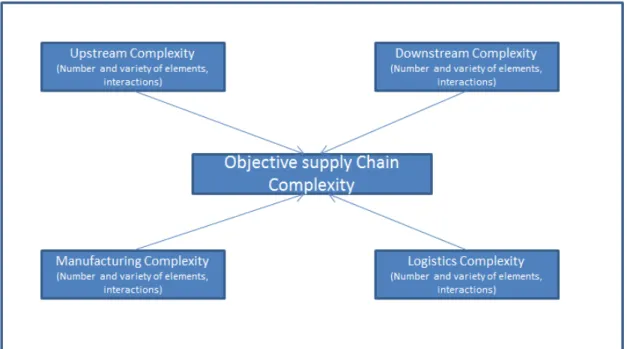
The multi-faceted and multi-functional nature of supply chains implies that objective sup-ply chain complexity arises from different parts of the supsup-ply chain. It is important to note that different complexity components have to be considered when examining the concept of objective supply chain complexity, as the overall systems´ complexity is not the sum of each parts´ complexity.143 The next section reviews the literature on different parts of the supply chain where complexity can occur. These are upstream complexity, downstream complexity, manufacturing, and logistics complexity.
Upstream/supply complexity
In the literature two terms exists, characterizing complexity related to activities and linkag-es with upstream supply chain entitilinkag-es, namely: upstream and supply complexity. In most of the times these terms are used synonymously.144 For simplification in this thesis the term upstream complexity will be used.
Upstream complexity has been identified as an important key property of objective supply chain complexity and consequently strongly influences the management of supply chain complexity145 proposing that higher levels of upstream complexity result in lower perfor-mance.146147148
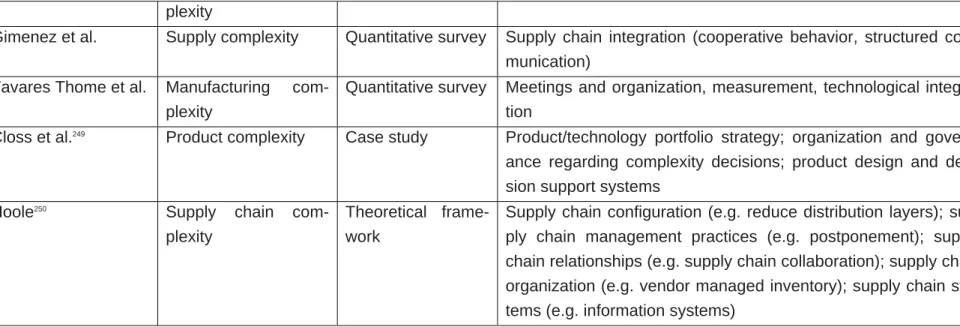
Choi/Krause provides a three-dimensional definition of upstream complexity stating that upstream complexity consists of the number of suppliers in the supply base, the degree of supplier differentiation, and the inter-relationships between suppliers.149 Another definition of upstream complexity, in the context of a supply chain of a manufacturing plant comes from Bozarth et al. They state that upstream complexity is the level of detail and dynamic complexity originated in a manufacturing facility´s supply base.150 On the level of an indi-vidual buyer-supplier relationship Gimenez et al. define upstream complexity as “the com-plexity of the process in which buyer´s orders are converted into the supplier´s manufac-turing orders, resulting in the delivery of goods according to the buyer´s expectations”.151 More recently upstream complexity was examined by Bode and Wagner. In their study structural upstream complexity (=detail complexity) was investigated in terms of vertical,
143 See Choi et al, 2001.
144
See Blome et al., 2014. 145
See Ray et al., 2005. 146
See Choi/Krause, 2006. 147
See Gimenez et al., 2012. 148 See Bozarth et al., 2009. 149
See Choi/Krause, 2006. 150
See Bozarth et al., 2009. 151
horizontal, and spatial complexity.152 Drawing from these definitions it can be stated that upstream complexity is the complexity of the upstream side of a company incorporating both complexity aspects: dynamic complexity (e.g. variability in supplier lead time) and detail complexity (e.g. number of suppliers).
Author Upstream complexity antecedents
Bozarth et al.153 - Number of immediate suppliers - Long and/or unreliable supplier lead
times
- Globalization of the supply base Choi and Krause154 - Degree of supplier differentiation
- Number of suppliers
- Level of interrelationships between suppliers
Bode/Wagner155 - Number of supplier tiers (=vertical complexity)
- Number of supplier in each tier (=horizontal complexity)
- Extent of geographic dispersion of suppliers (=spatial complexity)
Blome et al.156 - Number of direct suppliers
- High market dynamism on the sup-ply side
- Reliability of supply base
Azadegan157 - Number of suppliers
- Length of delivery lead time - Delivery reliability
- Geographic dispersion of purchases Table 2: Upstream complexity antecedents
Downstream complexity
Downstream complexity is the “level of detail and dynamic complexity originating in a manufacturing facility´s downstream markets”. Downstream complexity increases with the number of customers, heterogeneity in customer needs, shorter product life cycles, and
152
See Bode/Wagner, 2015. 153
See Bozarth et al., 2009. 154 See Choi/Krause, 2006. 155
See Bode/Wagner, 2015. 156
See Blome et al., 2014. 157
higher demand variability.158159 All those aspects have considerably effects on supply chain complexity (for further discussion see Bozarth et al.)160 In accordance to the definition of Bozarth et al., Milgate stated that downstream complexity is part of the overall concept of supply chain complexity defined by the uncertainty of the downstream side of a focal firm´s supply chain (in addition to upstream uncertainty, technological intricacy, and or-ganizational systems).161 Manuj and Sahin found out that increased customer expectations lead to higher levels of supply chain complexity.162 In general downstream complexity is characterized by the same elements as upstream complexity on the downstream side of a company, e.g. number of customers, instead of number of suppliers.
Manufacturing complexity
Downstream and upstream complexity are often driven by external factors, but there is also complexity, which arises from a company´s internal processes and activities, which refers to internal complexity. Internal complexity of a company is mainly driven by deci-sions and factors within the organization such as the product and process design.163 Transferring this to a manufacturing context Bozarth et al. examined the role of internal manufacturing complexity. Where internal manufacturing complexity is defined as the “level of detail and dynamic complexity found within the manufacturing facility´s products, processes, and planning and control systems”. This part of complexity is driven by: num-ber of products, numnum-ber of parts, one-of-a-kind/low volume batch production, and manu-facturing schedule instability, and again detail complexity (e.g. higher number of products) and dynamic complexity (e.g. unstable production schedules) are affected.
The logistical (manufacturing) complexity of a product is derived from the number of man-ufacturing steps and the number of different parts handled in a factory according to Funk.164 In the context of a scheduling problem van Donk and van Dam found these fac-tors affecting complexity: number of products, number of production lines, number of ma-chines, and labor constraints.165 Calinescu et al. divided the complexity of manufacturing systems into three categories: decision-making complexity, behavioural complexity, and structural complexity.166
158 See Bozarth et al., 2009.
159
See Azadegan et al., 2013. 160
See Bozarth et al., 2009. 161 See Milgate, 2001. 162 See Manuj/Sahin, 2011. 163 See Serdarasan, 2013. 164 See Funk, 1995. 165
See Van Donk/van Dam, 1996. 166
In general manufacturing complexity is part of the overall objective supply chain complexi-ty and higher levels of internal complexicomplexi-ty lead to higher levels objective supply chain complexity.
Logistics complexity
The above mentioned components of objective supply chain complexity have already cap-tured big parts of supply chain complexity and have been widely discussed in the litera-ture.
Other complexity generating parts are logistics functions, such as storage and transporta-tion of goods. Some factors that are highlighting the importance of logistics functransporta-tions are:167168
More decentralization Less vertically integrated
Less single-site manufacturing facilities Outsourcing of logistics function
Those trends are consequently leading to more geographically dispersed networks of re-sources and logistics processes have to be aligned to these developments.169170171 For a focal company logistics complexity is generated on the inbound and outbound side of a company. Therefore the drivers of logistics complexity are (again, on each side inbound and outbound), e.g. number of warehouses, number of transportation modes, number of transportation providers, etc.172173174175 When studying logistics complexity it is important to keep in mind that these logistics functions are very often operated by external companies (e.g. 3PLs).176 In accordance with the definition of supply chain complexity (“…number and variety of elements…and the interactions between these elements…“) it can be argued that this will increase supply chain complexity. Although the logistics complexity has been examined in some studies177178179, it falls short in considering them when investigating sup-ply chain complexity.
167
See Stock et al., 2000. 168
See Rao and Young, 1994. 169 See Greis/Kasarda, 1997. 170 See Quinn, 1999. 171 See Brunell, 1999. 172 See Manuj/Sahin, 2011. 173 See Rao/Young, 1994. 174 See de Koster, 2002. 175 See Perona/Miragliotta, 2004. 176 See Razzaque/Sheng, 1998. 177
See Stock et al., 2000. 178
In general it can be concluded that objective supply chain complexity is multi-faceted and multi-dimensional and it is important to incorporate all these aspects, as understanding the functioning of each single part of a complex system does not imply to understand the whole system.180 The following Figure summarizes the different complexity components of supply chain complexity and leads to the first proposition:
P1: Objective supply chain complexity comprises of various complexity compo-nents (upstream, downstream, manufacturing, logistics complexity.
Figure 6: Components of objective supply chain complexity
Antecedents of supply chain complexity
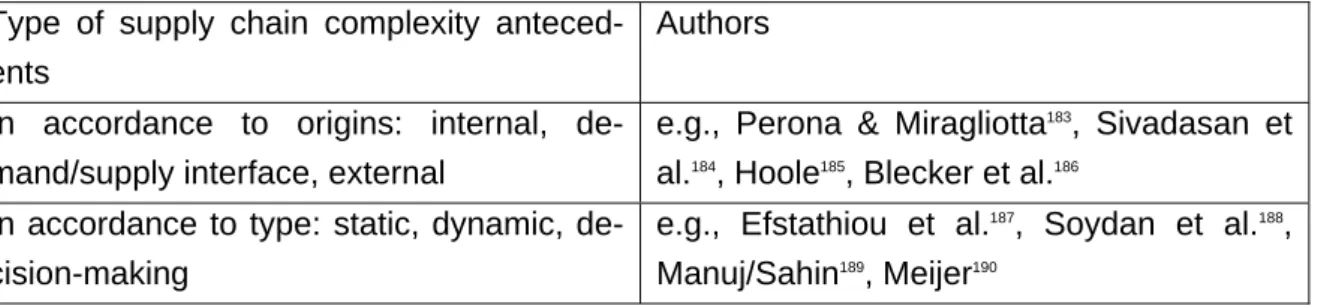
To understand the concept of supply chain complexity it is important to understand the antecedents that drive the level of complexity. Therefore, the literature refers to the term supply chain complexity antecedents (=drivers that increase supply chain complexity by increasing the structure, type and volume of interdependent activities, transactions, and processes in the supply chain or increasing the number of constraints and uncertainties under which these activities, transactions and processes take place).181 Supply chain com-plexity antecedents can be classified, as follows (for a more detailed overview see Ser-darasan182):
179 See Masson et al., 2007
180 See Forrester, 1961. 181 See Manuj/Sahin, 2011. 182 See Serdarasan, 2013.
Type of supply chain complexity anteced-ents
Authors
In accordance to origins: internal, de-mand/supply interface, external
e.g., Perona & Miragliotta183, Sivadasan et al.184, Hoole185, Blecker et al.186
In accordance to type: static, dynamic, de-cision-making
e.g., Efstathiou et al.187, Soydan et al.188, Manuj/Sahin189, Meijer190
Table 3: Types of supply chain complexity antecedents
The first group of supply chain complexity antecedents is in accordance to their origins: internal, demand/supply interface, external. Internal antecedents are generated by, for example product and process design processes (within the organization). The next group of antecedents – demand/supply interface – is associated with the material and infor-mation flow between suppliers, customers and/or service providers. Market trends, gov-ernmental regulations, etc. are external supply chain complexity antecedents.191192193194 Another way to classify antecedents is: static, dynamic, and decision-making. Hereby, the classification corresponds to the way supply chain complexity antecedents are generated: vie physical situations (e.g., number of products), operational characteristics (e.g., pro-cess uncertainties), dynamic behavior (e.g., demand amplification), and organizational characteristics (e.g., decision-making process, IT systems).195196197198
An important thing to note is that various supply chain complexity antecedents contributes in different ways to supply chain complexity (e.g., for many companies internal are easier to handle than external antecedents due to the span of control). And therefore, different strategies have to be implemented to cope with different supply chain complexity ante-cedents.199
183
See Perona & Miragliotta, 2004. 184
See Sivadasan et al., 2004. 185 See Hoole, 2005.
186
See Blecker et al., 2005. 187
See Efstathiou et al., 2002. 188
See Soydan et al., 2007. 189
See Manuj/Sahin, 2011. 190 See Meijer, 2002.
191 See Perona/Miragliotta, 2004. 192
See Sivadasan et al., 2004. 193
See Hoole, 2005. 194
See Blecker et al., 2005. 195
See Efstathiou et al., 2002. 196 See Soydan et al., 2007. 197 See Manuj/Sahin, 2011. 198 See Meijer, 2002. 199 See Serdarasan, 2013.
Table 3 gives an overview of the existing supply chain complexity antecedents in the liter-ature. Furthermore supply chain complexity antecedents affecting different complexity components are discussed in the remainder of this chapter.
It can be concluded that supply chain complexity antecedents increase the level of supply chain complexity and therefore proposition 1 for this thesis is:
P2: Supply chain complexity antecedents increase the level of objective supply chain complexity.
2.5.2 Relationship between objective supply chain complexity and effective sup-ply chain complexity
The current literature gives spatial insights into the relationship between objective supply chain complexity and effective supply chain complexity. In general, research of complexity in supply chains is quite recent and has several limitations.200201202203 While several authors are investigating the structural elements (“objective” dimensions) of supply chain complex-ity and the effects on certain outcomes204205, it falls short in explaining the relationship be-tween supply chain complexity and effective supply chain complexity (except Manuj and Sahin206 and Perona/Miragliotta207). A comprehensive model of objective supply chain com-plexity and effective supply chain comcom-plexity along with strategies to cope with it and re-lated outcomes is lacking.
It´s important to note that most of the studies view supply chain complexity on the level of “objective” complexity, where the degree of complexity is derived from the number and variety of structural properties defining a supply chain (e.g. number of products, custom-ers, supplicustom-ers, facilities, etc.) and their interactions. As complexity not only arises from those complexity elements, but also from the complexity inherent in the process of deci-sion-making, additional measures of complexity has to be considered. In the literature this can be referred to the concept of supply chain decision-making complexity.208 Hereby, the literature on cognitive and decision-making processes provides insights to the concept of supply chain making complexity. According to Wood and Campbell
200 See de Leeuw et al., 2012. 201
See Nilsson and Gammelgard, 2012. 202
See Serdarasan, 2013. 203
See Blome et al., 2014. 204
See Wycisk et al., 2008. 205 See Meyer, 2007. 206 See Manuj/Sahin, 2011. 207 See Perona/Miragliotta, 2004. 208 See Manuj/Sahin, 2011.
maker has to cope with a task´s objective (=problem attributes that can be enumerated) and perceived complexity (=unattended level of complexity leading to observed out-comes), which is related to the difficulty at arriving at a problem solution. To do so cogni-tive skills are applied to make decisions.209210 Therefore, supply chain decision-making complexity is associated with the volume and structure of information cues involved when making a supply chain related decision.211212 Addressing this to a supply chain problem, Robinson/Swink and Swink/Robinson found out that objective and perceived complexity are not always positively correlating. In their study supply chain managers were able to find better solutions for problems with high objective complexity due to the use of manage-rial tools (for example information systems) and applying cognitive skills, which resulted in a lower level of perceived complexity.213214 A survey based study regarding task complexity was conducted by Handley/Benton with the aim to show effects of objective task com-plexity on coordination and control costs in the context of outsourcing activities.215
In a supply chain “objective” complexity arises from all the elements - which can be enu-merated - embedded in the supply chain and their interactions, leading to uncertainty. Decision-makers have to deal with the generated uncertainty and are confronted with an effective supply chain complexity when managing supply chain complexity. As supply chain complexity increases, information cues also increases and decision-making is more complex for supply chain managers. Given these aspects it is proposed that:
P3: Higher levels of objective supply chain complexity will lead to higher levels of effective supply chain complexity.
209 See Wood, 1986. 210 See Campbell, 1988. 211
See Efstathiou et al., 2002. 212 See Serdarasan, 2009. 213 See Robinson/Swink, 1994. 214 See Swink/Robinson, 1997. 215 See Handley/Benton, 2013.
Author Definition Antecedents
Wilding216 Supply chain complexity is the deterministic chaos (=aperiodic,
bounded dynamics in a deterministic system with sensitivity on initial conditions, and has structure in phase space), parallel inter-actions (=interinter-actions that occur between different channels of the same tier in a supply chain network), and demand amplification (=amplifying change in demand as it passes between organiza-tions) exhibited by a supply chain.
Deterministic chaos, parallel interactions, demand amplifi-cation
Vachon/Klassen217 Supply chain complexity is the result of an information processing
dimension for complexity and a technological dimension. Note:
Information processing dimension: uncertainty (inherent noise or variations in the existing in the system) vs complicatedness (the level and type of interactions present in the system)
Technological dimension: structural (i.e. related to physical prod-uct and process) vs infrastrprod-uctural (related to management sys-tems)
Recent investments in ad-vanced manufacturing tech-nology; High value of pur-chased materials; Large num-ber of rejects of incoming ma-terial; High scrap rate; Large number of rejects at final in-spection;
Relatively large size of supply network; Considerable product variety; High frequency of changes made in scheduling; High level of make-to-order production
Bozarth et al.218 Supply chain complexity is the level of detail complexity (=distinct Number of customers,
216
See Wilding, 1998.
217
See Vachon/Klassen, 2002.
number of components or parts that make up the supply chain) and dynamic (=unpredictability of a system´s response to a given set of inputs, driven by the interconnectedness of many parts that make up the supply chain) complexity exhibited by the products, processes, and relationships that make up a supply chain (in-cludes upstream, downstream, and manufacturing complexity)
ucts, components, suppliers; Heterogeneity of customer needs; Shorter product life cycles; Considerable demand variability; One-of-a-kind/low volume manufacturing; Sched-ule instability; Long and/or unreliable supplier lead-times; Globalization of supplier base
Manuj/Sahin219 Supply chain complexity is the structure, type, and volume of
in-derdependent activities, transactions, and processes in the supply chain that also includes constraints and uncertainties under which these activities, transactions and processes take place.
Supply chain decision-making complexity is the difficulty faced by a decision-maker when managing a supply chain. It is a measure of the collective effort required for problem definition, data collec-tion, problem analysis, solution implementacollec-tion, and control.
Supply chain size and struc-ture; customer expectations; environmental conditions; globalization; organizational restructuring
de Leeuw et al.220 Supply chain complexity is the level of detail and dynamic
com-plexity of supply chains.
Uncertainty, diversity, size, variability, structure, speed, lack of information synchroni-zation, lack of cooperation Choi et al.221
Choi and Krause222
Supply network complexity is the sum of firms that collectively supply a given part or subassembly to buying firm and their
inter-Number of suppliers, degree of differentiation among
219
See Manuj/Sahin, 2011.
220
See de Leeuw et al., 2013.
connectedness. ers, level of interrelationships between suppliers
Milgate223 Supply chain complexity comprises of uncertainty (upstream,
downstream), technological intricacy (product, process), and or-ganizational systems (internal, external).
Uncertainty (late deliveries from suppliers, quality level of incoming materials and parts, customrelated forecast er-ror); technological intricacy (total number of raw material parts, number of product lines); organizational system (product variety, breadth of supplier base, export orienta-tion)
Table 4: Definitions of supply chain complexity
222
See Choi/Krause, 2006.