REDEMPTIVE CURRICULA ETHNIC STUDIES AND EMPATHY
by
RENA JOY DUNBAR
A DISSERTATION
Presented to the Department of Educational Methodology, Policy, and Leadership and the Graduate School of the University of Oregon
in partial fulfillment of the requirements for the degree of Doctor of Education. June 2020
ii
DISSERTATION APPROVAL PAGE Student: Rena Joy Dunbar
Title: Redemptive Curricula: Ethnic Studies and Empathy
This dissertation has been accepted and approved in partial fulfillment of the requirements for the Doctor of Education degree in the Department of Educational Methodology, Policy, and Leadership by:
Ilana Umansky Chairperson
Joanna Smith Core Member
Leilani Sabzalian Core Member
Sanjay Srivastava Institutional Member And
Kate Mondloch Interim Vice Provost and Dean of the Graduate School
Original approval signatures are on file with the University of Oregon Graduate School. Degree awarded June 2020
iii
© 2020 Rena Joy Dunbar
This work is licensed under a Creative Commons
iv
DISSERTATION ABSTRACT Rena Joy Dunbar
Doctor of Education
Department of Education Methodolgy, Policy, and Leadership June 2020
Title: Redemptive Curricula: Ethnic Studies and Empathy
Courses in ethnic studies challenge power dynamics in the classroom, create the conditions for multiple experiences and perspectives to be present, and examine the history and legacy of racism and how it operates. Ethnic studies courses may foster empathy across all
identity groups in ways that traditional classrooms do not. Using an explanatory sequential mixed methods study set within a critical race pedagogical framework, the author theorized that ethnic studies courses go beyond academic impacts and can foster the notion of cross-racial empathy (CRE), or empathy across all identity groups. In a pre/post, treatment/control, design, six classrooms, three ethnic studies and three treatment group US history courses, took the Scale of Ethnocultural Empathy (SEE) survey at the beginning and end of the fall semester of 2019. Contrary to the author’s hypothesis, analysis of survey results showed that students in both courses grew in CRE over time but that students in ethnic studies did not exhibit greater CRE growth than students in US history, as measured by the SEE. However, results showed that students in ethnic studies courses had higher baseline levels of empathic awareness, indicating that students who take ethnic studies courses are more likely to be aware of or concerned about institutional barriers and/or discrimination face by others in social/ethnic/racial
v
groups. Qualitative focus group responses indicated that CRE is bolstered by ethnic studies curricula particularly through intentional community-building, listening to peer’s personal experiences, and creating agents of change. This study sheds light on possible non-academic benefits of ethnic studies, specifically cross-racial empathy and
understanding, and identifies elements of ethnic studies instruction that support students’ growth in this area.
vi
CURRICULUM VITAE NAME OF AUTHOR: RENA JOY DUNBAR
GRADUATE AND UNDERGRADUATE SCHOOLS ATTENDED: University of Oregon, Eugene, OR
Pacific University, Eugene, OR DePauw University, Greencastle IN DEGREES AWARDED:
Doctor of Education, Educational Leadership, 2020, University of Oregon Master of Education, Secondary Language Arts, 1999, Pacific University Bachelor of Arts, English Literature, 1994, DePauw University
AREAS OF SPECIAL INTEREST:
Indigenous, Race, and Ethnic Studies Culturally Sustaining Teaching
Restorative and Healing Education Practices PROFESSIONAL EXPERIENCE:
ELA/Ethnic Studies Instructor 08/2009 – 09/2018
Eugene 4j School District 08/1998 – 09/2018
Instructor Ethnic Studies 101, Lane Community College 08/2016 – 12/2016 GRANTS, AWARDS, AND HONORS:
Research Assistant Education Studies Excellence Award, UO June 2020 Equity Foundations Award, Pacific University, Oct. 2019 Best Teacher/Professor, Best of Eugene Weekly Oct. 2018 Equity Leadership Fellows Program Award, UO May 2016 Nobel Laureate Teacher of the Year Award, Eugene, OR May 2019 MLK Jr. Award, South Eugene High School Feb. 2007
vii
ACKNOWLEDGMENTS
First and foremost, I want to acknowledge my sister, Leah Dunbar, for agreeing to walk this journey with me, every step, literally since before our birth, and also literally, in this doctoral program. Completion of this project marks the beginning of something even more #twinspired. And, ALL the Dunbar siblings- Karen, Lynn, Teri, Teddy- and
offspring. Your encouragement steadied us when we needed it most. A special thank you to Shadiin Garcia, Leilani Sabzalian, Tasha Katsuda, and Krystal Sundsrom: we offer our gratitude for you going before and holding the lamp so we could find our way. Deep appreciation also goes out also to the powerhouses of EMPL: Angela Burham, Joanna Smith, Ilana Umansky, and Gina Biancarosa, not only for being badass intellectuals, but more importantly, for your unwavering faith that kept the waves from completely overtaking us when we lost our anchor in the physical plane, our Source, OG heart-led educator Jean Dunbar. The Cohort of Awesomeness: y’all know what you did. Thank you to the guides who showed us, as our mom did, that a real teacher must also have the courage to be a truthslinger, making sure we would not dare be otherwise: Susan
Dwoskin, Diana Grandberry, Carmen Urbina, Anselmo Villanueva, and Misa Joo. Thank you to Oscar Loureiro for showing me that numbers can tell a story and to Alicia
DeLouise for your infinite patience, tutoring these twins in stats is an exercise in sainthood and we see you. The mind, body, and soul nourishment of the Cynthia Dance Empowered community has been crucial every step, leap, and turn. And, to our Day Ones, the Tuesday Ladies, who have been and will always be by our side in every
revolutionary endeavor and girls’ weekend, forever and ever, awoman. Last and not least, thank you to Earl Dunbar, our North Star: “because you did Twe can”.
viii
This work is dedicated to my first teachers, Jean and Earl Dunbar, my Sources; and
to my Seeds, who insist I always show up with integrity, Jonah and Lilah; to my Person, Eric, who held me up when I felt I was drowning; to all my students who have given me the courage to teach from the heart and to all abolitionist educators, activists, and visionaries past, present, and future, who have always known
ix TABLE OF CONTENTS Chapter Page CHAPTER I: INTRODUCTION ...1 Purpose ... 8 Importance ... 8 Research Questions ...11
CHAPTER II: LITERATURE REVIEW ...12
Foundations of Ethnic Studies ... 13
Definition of Ethnic Studies... 14
Common Curricular Elements of Ethnic Studies ... 16
Culturally relevant pedagogy ... 16
Critical pedagogy ... 17
Critical citizenship ... 17
Processes of colonization ... 18
Social construction of race ... 18
Multiple/collective identities ... 19
Academic Impacts of Ethnic Studies ... 20
Attitudinal Impacts of Ethnic Studies ... 21
Gaps in the research: Cross-racial Empathy ... 23
x
Chapter Page
CHAPTER III: METHODS ...27
Overview ... 28
Critical Race Mixed Methods Research Design ... 29
Setting and Participants... 30
Instrument: The Scale of Ethnocultural Empathy (SEE) ... 34
Data Collection Procedures... 36
Course selection. ... 37
Administration of the survey. ... 40
Focus groups. ... 40
Informed Consent/Assent... 43
Data ... 44
Quantitative variables. ... 44
Cross-racial empathy measures... 44
Data preparation. ... 45
Data Analysis ... 46
Research Question One. ... 46
Research Question Two. ... 47
Research Question Three. ... 48
xi
Chapter Page
Research Question One ... 51
Pre-Assessment Findings. ... 51
Pre-assessment scores of intervention and control group. ... 52
Research Question Two ... 55
Research Question Three ... 62
CHAPTER V: DISCUSSION, ANALYSIS, AND FURTHER RESEARCH ...72
Growth in CRE For All Students in Both courses with SEE ... 72
Students of Color and Female Students Show Higher CRE ... 74
Implications for Practice ... 78
Implications for Theory ... 80
Limitations ... 81
Survey limitations. ... 81
Focus group limitations... 82
Measures of student race/ethnicity and gender. ... 83
Role of Researcher ... 84
Future Research ... 84
Conclusions ... 85
APPENDIX A ...87
xii Chapter Page APPENDIX C ...91 APPENDIX D ...93 APPENDIX E ...95 APPENDIX F...95 REFERENCES CITED ...97
xiii
LIST OF TABLES
Table Page
Table 3.1. Number of participants, by Course and Identified Race/Ethnic Group ... 32 Table 3.2. Number of Participants, by Dichotomized Gender and Race/Ethnic Group ... 33 Table 3.3. Focus Group Participants, by School and Identified Race/Ethnicity ... 34 Table 4.1. Wave 1 Pre-assessment Survey t-tests ... 52 Table 4.2. Descriptive Statistics of Cross-racial Empathy by Wave, and Course ... 53 Table 4.3. Two-Way Mixed ANOVA for Effect of Wave on Factors of CRE by Course . 55 Table 4.4. Descriptive Statistics of CRE by Dichotomized Race, Wave, and Course ... 56 Table 4.5. Three-Way Mixed ANOVA for Effect of Dichotomized Race, Course, and Wave on CRE ... 58 Table 4.6. Descriptive Statistics of CRE by Dichotomized Gender, Wave, and Course .. 59 Table 4.7. Three-Way Mixed ANOVA for Effect of Dichotomized Gender, Course, and Wave on CRE ... 61
xiv
LIST OF FIGURES
Figure Page
Figure 3.1. Four Phase Explanatory Sequential Mixed Methods Study ... 37
Figure 3.2. Within Subjects and Between Subjects Model ... 47
Figure 4.1. 6 words about race ... 65
Figure 4.2. Agents of change projects ... 70
CHAPTER I: INTRODUCTION
“Dominator culture has tried to keep us all afraid, to make us choose safety instead of risk, sameness instead of diversity. Moving through that fear, finding out what
connects us, reveling in our differences; this is the process that brings us closer, that gives us a world of shared values, of meaningful community.” ~ bell hooks My twin sister and I grew up listening to the stories of my Black father and observing my White mother’s reception of those counternarratives in the backseat of the Cadillac. My father was born in 1932 and was raised in Fort Wayne, Indiana, a by-product of the Great Migration and systemized terror of the South. His childhood was spent in the “peanut gallery” of the movie theater, on chilly mornings between 9 and 12 he was allowed to swim at the pool, and the hustle of his parents and community trying to “make a dollar out of 15 cents.” He joined the Air Force at 18 and integrated the Air Force basketball team in Texas. As his team travelled through the South, my father experienced firsthand the oppression of “coloreds only”, not allowed to eat in restaurants while the rest of the team was, the back of the bus, and the bleak unfairness and constant threat of the Jim Crow South.
As a child, our family travelled from Fort Wayne, Indiana to Los Angeles, California, and back again. The stories never stopped because we never did, except for gas – our integrated family in the 1970s and on into the 80s was safer as a moving target. My father and mother understood the rules of the racial state more than our child minds could (Omi & Winant, 1994). So the stories were told, and repeated, and my twin sister and I – a truly captive audience - heard how a man with darker skin could be pulled over twice in the same day in Missouri while in his military uniform. We giggled to visualize
2
our mother in the Afro wig and dark makeup she had to wear to traverse the Southwest with my father in the late 60s. We listened to story after story, countless examples of a racial caste system so deeply embedded that our parents would lose their value as educators in Fort Wayne, Indiana; they would not only lose their jobs, but their families, and their safety for crossing the racial line with each other.
Those stories taught us how, while living in supposedly the same country, my mother and my father could experience so differently what Martin Luther King Jr. called the “two Americas” (King, 2015). We lived the story of an adoring White and Southern grandfather who would rather disown his only child than challenge that system and of a courageous White grandmother who left her husband to help her daughter with twin Black grandbabies. Those stories taught us how a person, how a couple, and how a family could grow, challenge, rage, and fall apart in a system steeped in racial hierarchy and the violence it depends upon. However, our family’s experience led us to understand on a deeper level how a critical understanding of America’s racial dynamics could open a door to empathy and just possibly the transformation and redemption that is offered by
education combined with multiple perspectives.
While my experiences at home provided an explicit forum for exploration of America’s racial dynamics, time spent in school was just the opposite. My twin sister and I, along with our classmates, encountered a wealth of ignorance and yet internalized assumptions when it came to negotiating racial positionality. While the Civil Rights Era legislated an end to “separate but equal” schooling and housing, neighborhoods,
communities, and classrooms struggled to keep up with racial progress. Our family was one of the first “Black” families in our lower-middle class neighborhood and
3
unsurprisingly provoked White flight - resulting in an integrated neighborhood and school almost equally divided between Black and White. America’s preoccupation with race and our bi-racial parentage resulted in the inevitable and relentless inquiries of “what are you” from classmates as well as strangers on the street, thus catalyzing our own racial identity exploration. However, while we socially integrated at school, our teachers
ostensibly ignored the inevitable racial dynamics that imbued their students’ interactions while reinforcing the “stereotypes, omissions, and distortions that reinforce notions of White superiority…breathed in by Black children as well as White” (Tatum, 1997, p. 134). By the time we reached middle school, lines of demarcation were more firmly drawn, with groupings inside the classroom, in the cafeteria, and in the school yard reflecting race-based identities and expectations. By high school we were firmly tracked, in ‘honors’ courses (mostly White) and vocational courses (mostly Black). There were even ‘race riots’ in which huge fights broke out between large groups of White and Black students. My sister and I moved between all of these worlds, observing much and
belonging nowhere.
Our experiences of racial inquiry and development are not ours alone, however. Research on racial identity development1 suggest that all children are socialized to
process, examine, and negotiate race in their daily lives (Cross & Cross, 2008; Tatum, 1997). However, our place on the edges of a Black and White racial identity compelled us both to be drawn to studies that could deepen our understandings of ourselves as
1What I refer to as Racial Identity Development (RID) theory, current theories are now better understood as racial-cultural-identity (REC) identity models (Tatum, 2018).
4
racialized beings within a society that reinforces and advantages “one” racial identity over others, inspiring us both to resist, challenge, and transform the place in which the most learning about self takes place - the classroom.
As an educator of color for over twenty years, I have been privy to my students’ stories of marginalization in addition to my own first-hand experience, within a system that makes invisible and negates the narratives and realities of the poor, the Brown and Black, and the Other. Hired to teach at a wealthy, predominantly White high school, my first teaching assignment was with students labeled ‘at-risk’ for drop out. I learned quickly through my treatment by staff and through my students’ eyes how a system can operate to sort, rank, and push out human beings it professes to serve. Although my job was designed to aid student ‘retention’, the very term trivializes the realities of the
students who walked into my classroom (almost) every day, placing the burden of staying in school on the student rather than the system that shapes students’ daily experiences. If I was struggling, my students had it even worse. The first year, I read the list of
characteristics and warnings that came with these students from their former 8th grade
teachers. That was the first and last time I read that list. I didn’t have the language for unconscious bias yet, but I could see that my students felt its effects.
In the eyes of many in that school community - and a common experience for new teachers - I was handed the throwaways, the hardest to teach, the poorest, the darkest hued, the ones who didn’t matter. All of us destined to fail. But what we did in the classroom – a classroom always inconveniently located in the furthest reaches of a huge school, upstairs at the end of the hall, or in an adjacent room in the lunchroom – was create a community in which students could “develop an ethnic identity that connects
5
school learning with their ethnic self” (Sleeter, 2011, p. 9) based upon authentic caring (Cabrera, Milem, Jaquette, and Marx, 2014). The students taught me what they needed, what they struggled with, and how they were brilliant. I had the most economically disadvantaged students in the school, with all the accompanying pathologies that sustain “the reproduction of class formation” (Darder, 2012, p. 69), but I could see it was the system, not the students, that was the problem.
Like many ethnic studies teachers, in my early years as an educator I was not aware that I was creating a classroom that was what is now called culturally relevant and culturally responsive (Gay, 2002; Ladson-Billings, 1995; Paris, 2012). What I was keenly aware of was the need for these students to “see themselves, their families, their
communities, and their histories in the curriculum and practices of the classroom”
(Tintiangco-Cubales, Kohli, Sacramento, Henning, Agarwal-Ragnath, & Sleeter, 2014, p. 117) in order to make sense of their educational journeys. Unfortunately, it is a systemic reality that many new teachers are given the hardest students; however, I was given free rein to create curricula so I did so with the students. Because of my own experiences with racism, sexism, and classism growing up, I could more readily and personally connect to students’ historical and “current racialized realities” (Tintiangco-Cubales et al., 2014, p. 118).
In 2008, in response to concerns regarding the oft-repeated achievement gap between Oregon’s white students and its students of color, a team of educators of color, including my twin sister, created the first Courageous Conversations classes in Evergreen school district’s four comprehensive high schools. This course was designed to “chip away at disparities, to improve difficult school relations, and to enhance student learning”
6
(Pollock, 2005, p. 9) so as to interrupt racial achievement patterns. The course was collaborative, intentional, and bore many of the markings of effective ethnic studies curricula such as a critical race and critical pedagogical philosophy. Without being
labeled so, Courageous Conversations became the foundational ethnic studies program in this school district. Based upon the precept that the failures of Brown and Black students are 1) deeply embedded within racist structural educational practices, 2) exacerbated by teacher bias or lack of preparation, and 3) reinforced by silencing of the impacts of race and racism on all students, Courageous Conversations served (and continues to serve) as a powerful intervention to address educational inequity locally (Pollock, 2004) .
At the time of its implementation, this course had district and building
administrative support and grew to include White students (inevitable in place in which students of color only make up about 30% of the school population, though a significant increase from the start of my career) and a middle school program, which I was asked to develop in 2010 in response to racist and anti-Semitic events that plagued that school community. I quickly realized that 1) even 11- & 12-year-olds hunger for conversations about race and identity that often do not happen at home, 2) creating structured listening protocols are required to foster safety in having authentic discourse about power
dynamics, 3) students need to hear their classmates’ diverse perspectives and experiences in order to expand their own cultural and racial assumptions and biases. Courageous Conversations has shown me the transformative power of authentically empowering students’ experiences and cultural knowledge. My hypothesis is that type of curricula gives all students the tools with which to scaffold a healthy understanding of their
7
racialized selves and one another, in order to deconstruct the hidden yet ubiquitous power and racial dynamics operating in our schools and country that maintain inequity.
Since 2010, I have taught Courageous Conversations courses in the 4j district at both the middle and high school levels, most recently in an alternative ‘last-chance’ school setting for students reengaging with education after failure or dropout from their comprehensive home high schools. Concurrently, my twin sister and I worked to align the curricula of Courageous Conversations with our local community college’s Ethnic
Studies 101 course in order for students to receive college credit for a course that most students do not have the opportunity to take unless they pursue higher education (Dee and Penner, 2016). In 2016 I began the doctoral program in the Department of Educational Methodology, Policy, and Leadership at the University of Oregon, and quickly decided that I wanted to focus my dissertation work on an evaluation of these courses. Currently I am a full-time student and I am not teaching in the 4j system.
This research study sought to understand the relationship of participation in one of 4j’s high school level Courageous Conversations ethnic studies classes to students' perceived sense of cross-racial empathy. The study is presented in five sections. The introduction includes the problem the study addresses: the persistence of inequity within the US education system and Oregon. The second section reviews the literature on the history of ethnic studies, its critical components, and the impacts of ethnic studies courses on student achievement and attitudes. This section also details my theoretical framework which draws on critical race (CRT) and racial-ethnic-cultural (REC) identity development theories, both of which illustrate the urgency for ethnic studies curricula in our nations’ schools for all students. The third section presents the proposed research methods, the
8
types and sources of data used, validity limitations, and my analytic plan. The fourth section includes the quantitative and qualitative results of the study. The final section includes an analysis and discussion of the study results.
Purpose
The purpose of my study was threefold. First was to challenge myself to find a place of resistance within an education system that has historically "marginalized,
silenced, and disempowered" (Solorzano & Yosso, 2002, p. 142). Specifically, it was my intention to not only use CRT and racial identity development theory as theoretical frames of reference, but to also incorporate my own experiences as a student and educator of color, and to conduct this research in ways that do not further reinforce the subjectivity (and further objectification) of marginalized students. My second purpose was to discover effects, if any, of enrollment in an ethnic studies course upon students’ perceived cross-racial empathy. The third purpose of this study was to assess what characteristics or elements of ethnic studies courses may promote cross-racial empathy.
Importance
Due to Oregon’s unique history as a ‘Whites only’ state, Oregon students (and educators) may be particularly challenged by the growing demographic shifts toward more students of color that is taking place across the country (Nokes, 2018). Oregon’s overtly racist legacy likely also exacerbates inequities and the “culture of power” (Delpit, 1988) in today’s classrooms (Vincent, Sprague, and Tobin, 2012). In 1857, exclusion laws written into Oregon’s constitution stated that, “no free Negro, or Mulatto, not residing in this state at the time of the adoption of this constitution, shall ever come, reside, or be within this state, or hold any real estate, or make any contracts, or maintain any suit
9
therein” (OR Const, art. XVIII, sec. 4). Similar laws excluded Chinese, Japanese, Latino, and Native Americans from owning property and Oregon belatedly ratified the 14th
(1973) and 15th (1959) amendments effectively discouraging people of color from living
in the state (Brooks, 2004; Nokes, 2018; Taylor, 1882). According to Darder (2016) all students are “socialized to perceive their place in society within a hierarchical structure that is informed by values that benefit the dominant culture” (p. 6). Not only are the majority of Oregon’s classrooms dominated by white students and teachers, the question must be asked how does Oregon’s hidden legacy of white supremacy perpetuate
racialized inequality in the classroom and in what ways are these values internalized by all students?
Oregon’s past continues to inform Oregon’s educational present – Black students make up a mere .06% of Oregon student population. Furthermore, Oregon students of color consistently have lower reading, science, and math scores than their White peers, higher disciplinary incidents, and higher school dropout rates. Specifically, African American, Hispanics, and Native American students had a combined average graduation rate of 66.40% within the 2013-14 school year, while White students graduated at 78% (Oregon Department of Education [ODE], 2018).
In response to data that consistently shows inequitable outcomes for Oregon students of color, and also due in part to grassroots student organizing and the rise of racially motivated hate crimes in Oregon, legislators passed House Bill 2845 in 2017, also known as the Ethnic Studies Bill. Under this bill, Oregon will adopt ethnic studies state standards, K-12, in an attempt to amend “where current statewide social studies
10
standards fail to recognize the histories, contributions and perspectives of ethnic minorities and social minorities” (HB 2845, 2017).
Growing demographic diversity and increased multi-ethnic urban school
populations indicate a need for “a specific type of culturally oriented empathy” (Albeiro and Matricardi, 2013, p. 648) in which students develop the skills to understand another’s cultural experiences, perspectives, and feelings. Ladson-Billings (2013) urges activists to “look for ways to align the interests of the dominant group with those of racially
oppressed and marginalized groups” (p.38). Ethnic studies standards and curricula may not only increase academic outcomes for Oregon’s most marginalized students, but may also challenge the stagnant racial identity development of Oregon’s most dominant group. Could, as bell hooks suggests, a pedagogy that critiques and exposes dominance and "normalization" of Whiteness, one that makes space for non-White narratives and realities, evoke deeper understandings and possibilities for all our students? (hooks, 2003). Could an ethnic studies curriculum address the "empathy gap" caused by racism for Oregon students?
This dissertation comes at a critical time when the state is committed to
developing ethnic studies standards and universalizing ethnic studies access throughout the state.This study can support this state-wide work by shedding light on possible non-academic benefits of ethnic studies, specifically cross-racial empathy and understanding, and identifying elements of ethnic studies instruction that support students’ growth in this area.
11
Research Questions
This research examines what happens when high school students are given an opportunity to engage with an ethnic studies curriculum that reorganizes “knowledge and research processes” (Sleeter, 2011, p.6) in a way that de-centers the European American experience and that critically examines race, identity, and cross-racial communication. My research questions are as follows:
1) How does cross-racial empathy change amongst high school students in an ethnic studies course as compared to a traditional U.S. history course in the same school district?
2) Do changes in cross-racial empathy between ethnic studies and U.S. history course students differ based upon student race/ethnicity and gender?
3) To what aspects of the ethnic studies course do students attribute changes in cross-racial empathy?
12
CHAPTER II: LITERATURE REVIEW
What Are Ethnic Studies Courses and How Do They Impact Students?
But race is the child of racism, not the father. And the process of naming 'the people' has never been a matter of genealogy and physiognomy so much as one of hierarchy. –
Ta-Nehisi Coates
The history of ethnic studies courses is the history of resistance to racism in education. From incorporating such content as the early writings of W.E.B Dubois (1903) and his call to examine deeply “the problem of the color line” (p. 47), to studying the 1968 walkouts of Latino students in East Los Angeles protesting blatantly racist treatment and the student strikes at San Francisco State in that same year demanding more
representation of students and faculty of color, ethnic studies courses challenge the thinking of students and their communities. Ethnic studies courses have historically been designed for, created by, and intended to include the narratives of marginalized students to “counterbalance both the inaccuracies and the predominance of Euro-American perspectives that underlie mainstream curricula (Sleeter, 2011, p. 5).
In this section, I introduce the historical foundations of ethnic studies, scholarship that indicates the academic and social impacts of ethnic studies courses upon students, as well as evidence on the mechanisms or aspects of ethnic studies that facilitate those impacts. I also present the theoretical frameworks that serve as lenses through which to understand and analyze how race operates within education.
Four main themes emerged in the literature review: (a) the demand for ethnic studies curricula is rooted in resistance to racism and white supremacy in education, (b) ethnic studies curricula and research reveals positive academic and attitudinal impacts,
13
(c) common characteristics and critical theories such as CRT and critical pedagogy are often intrinsic to ethnic studies, (d) healthy racial identity development and cross-racial empathy may be challenged in traditional curricula. These themes converge to better understand the interplay between ethnic studies in the high school classroom and its implications upon student beliefs and attitudes about each other.
Foundations of Ethnic Studies
The creation of ethnic studies as a discipline and ethnic studies classroom reflects the rich lineage of the civil rights movement and its manifestations within the classroom (Cabrera et al, 2014). Many scholars trace ethnic studies curricula to Black liberation and decolonization efforts of the early 1900s (de los Rios, Lopez, & Morrell, 2015). More recently, ethnic studies courses were borne out of educational and intellectual movements “against systemic racism and other forms of oppression” (Dee & Penner, 2017, p. 132). Inspired by the antiracist and anticolonial work of Du Bois (1903), Carter G. Woodson (2006), and Franz Fanon (1963, 2008), the Third World Liberation Front (TWLF) coalition connected scholars at University of California, Berkeley, and San Francisco State University (de los Rios, Lopez, & Morrell, 2015) in the 1960s. The first course labeled ethnic studies was taught in San Francisco State University in 1968 as a result of TWLF’s demands for “inclusion, access, democracy, representation, and new academic units buttressing multicultural and antiracist curricula” (de los Rios, Lopez, & Morrell, 2015, p. 86).
The demand for ethnic studies courses was not limited to universities. Also in 1968, students at Berkeley High School demanded African American studies curricula and students in Los Angeles mobilized the largest student protest against their US history
14
courses (de los Rios, Lopez, & Morrell, 2015). Known as “the Chicana/o Blowouts”, thousands of students challenged the ways in which school curricula was being “used as tools for colonizing Chicana/o and Latina/os” (de los Rios, 2013) by distancing them from indigenous connections to the Americas and acculturating them into Whiteness.
De los Rios, Lopez, and Morrell (2015) argue that ethnic studies curricula have always served as a counterpoint to “race-neutral” curricula by centering race and the “construction and deconstruction of racial projects” (p. 86). As opposed to the dominant notion that education and curricula are value-neutral, ethnic studies curricula is founded on the premise that what is taught in school contains hidden, yet pervasive value systems and beliefs that maintain white supremacy through dominant white narratives (Apple, 1971; Darder, 2015; de los Rios, Lopez, & Morell, 2015; Giroux, 1984; Omi and Winant, 1994; Tingtiangco-Cubales, Kohli, Sacramento, Henning, Agarwal-Rangnath, and
Sleeter, 2014). It is no wonder then, that ethnic studies, and the struggle to implement ethnic studies courses, has been at the forefront of the battle for racial equality in the classroom.
Definition of Ethnic Studies
What qualifies as ethnic studies curricula and courses is wide-ranging. According to Tingtiangco-Cubales et al., (2014) “ethnic studies defined quality education as one that is relevant and directly connected to marginalized experiences of students of color” (p. 107). Ethnic studies courses were intended to be explicitly anti-racist and multicultural in scope to more accurately reflect America’s diversity. Ethnic studies proponents called for curricula that focused specifically on “issues of race, culture, power, and identity”
15
that often support and develop cross-group communication (Sleeter, 2011). Ethnic studies courses go beyond simply adding or sprinkling diverse or multicultural narratives into traditional history, social studies, or language arts courses to examine and deconstruct institutional, structural, and social inequity. These classes directly challenge and resist reproduction of dominant power dynamics and explicitly highlight and empower the narratives and the epistemologies of people of color (Sleeter, 2011, Tingtiangco-Cubales et al., 2014). African-American, Black, Chicana/o, Latinx, Asian-American, Native-American, and gender studies can be situated under the ethnic studies umbrella if their goal is to transform and “rehumanize the world by dismantling hegemonic structures” (Sleeter, 2011, p.6).
While many agree that ethnic studies is interdisciplinary, Oregon’s 2017 Ethnic Studies bill, HB 2845, specifically targets Oregon’s state social studies curricula and goes on to define:
(a) “Ethnic minorities” means individuals who are Native American or Americans of African, Asian, Pacific Island, Chicano, Latino or Middle Eastern descent. (b) “Ethnic studies” means instruction of public school students in kindergarten through grade 12 in the histories, contributions and perspectives of ethnic minorities and social minorities.
(c) “Social minorities” means women, people with disabilities, immigrants, refugees and individuals who are lesbian, gay, bisexual or transgender. Oregon’s bill further identifies that ethnic studies fosters critical thinking and deeper analysis of “systemic social structures” (HB 2845, 2017) . Bill proponents claim
16
that ethnic studies curricula will address Oregon’s glaring “racial achievement gap” (Rep. Diego Hernandez D-Portland).
Common Curricular Elements of Ethnic Studies
Culturally relevant pedagogy. A critical element of ethnic studies courses is culturally relevant pedagogy. Culturally relevant pedagogy is defined by Gloria Ladson-Billings (1995) as a “theoretical model that not only addresses student achievement but also helps students to accept and affirm their cultural identity while developing critical perspectives that challenge inequities that schools (and other institutions) perpetuate (p. 469). Premised upon findings that for students of color, academic success privileges White middle class norms and compromises students’ sense of self and feelings of connection to their cultural and racial backgrounds (Ladson-Billings, 1995; Paris and Alim, 2017, p.10), culturally relevant teachers understand and communicate the connection between the ways in which they teach, the impacts their teaching has upon their students individually, communally, and in racialized and inequitable social
structures. Many ethnic studies teachers create protocols that promote democratic student engagement, present “collaborative, equitable, reciprocal relationships between
themselves and students” (Dee & Penner, 2017, p. 132) and provide a space in which counternarratives can exist to challenge the “delegitimizing” of the experiences of people of color (Delgado Bernal, 2002).
For example, Love’s (2014) research highlights a project entitled “Real Talk” that connected students’ culture (through hip hop) to the legacy of resistance in order to challenge stereotypes about Black youth as well as “create positive change in their community” (p. 54).
17
Critical pedagogy. Another common component of ethnic studies pedagogy is space in which to question and deconstruct coercion, domination, and power inside the classroom and without. Critical pedagogy proponents assert that by engaging historically marginalized and underserved students to learn, name, and challenge power imbalances those structural forces can be transformed. Ethnic studies courses develop “literacies of power, agency, social awareness, civic engagement, and academic achievement” (de los Rios, Lopez, & Morell, 2015, p. 84 ) so that students are seen as empowered
co-constructors of their world, in the classroom and without (de los Rios, 2013; de los Rios, Lopez, & Morrell, 2015). Centered upon Paulo Freire’s concept of conscientização, or critical consciousness, students learn to see themselves as historical and empowered beings (Freire, 1973). Perhaps most famously, Tucson’s Mexican American/Raza Studies program (MAS) was based upon Freire’s approach to develop “critical consciousness, self-reflection, and engaging in anti-oppressive, collective action” in their students (Cabrera, Milem, Jaquette, and Marx, 2012, p. 1090).
Critical citizenship. Also called community responsive education (Tintiangco-Cubales, et al., 2014), this element of ethnic studies goes beyond analysis of dominant power analyses to offer transformative, alternative, and affirming ways for students to connect with themselves and their communities (Bernal, 2002; Cabrera et al., 2014; Duncan-Andrade and Morrell, 2008). de los Rios, Lopez, and Morrell (2015) tell us that “the teaching of ethnic studies has always been tied to both academic development and civic engagement” (p. 84) and trace their high school students’ involvement in
18
undocumented immigrants to the first “college-preparatory ethnic studies courses” in their school district.
Processes of colonization. Pedagogy that includes the ways in which European American colonization continues to impact schools, racial hierarchy, and student
outcomes is also considered central to the purpose of ethnic studies (Sleeter, 2011; Tingtiangco-Cubales et al., 2014). While most US history courses continue to affirm “the centrality of the European American’s students perspective” (Epstein, 2000, p. 206) and further inhibit the ability students’ understandings of persistent inequities, ethnic studies scholars must also include curricula that connects the legacy of the “struggle against imperialist expansion that began in the seventeenth century” (Tingtiangco-Cubales et al., 2014, p. 117) to students’ lived reality in ways that encourage critical questions, thinking, and challenges to internalized and externalized colonialism. Halagao’s (2010) unique study follows the long-term effect of curricula specifically designed for Filipina
American students to think critically through the processes of U.S. colonization upon the Philippines. Students were then surveyed students several years later. According to student reports, the course, called Pinoy Teach, helped them to consider different perspectives of history, encouraged them to be empowered and active in their
communities, as well as fostered a commitment, for Filipino participants as well as non-Filipino students, to find ways “to advocate for people of color” (Halagao, 2010, p. 507).
Social construction of race. Another central component of ethnic studies discourse includesthe social construction of race, racial identity development, and the ways in which all people navigate institutional, systemic, and interpersonal racism. Some ethnic studies scholars argue that, specifically for students of color, understanding the
19
shifting definitions of race and ethnicity can serve to positively impact students’ own sense of self and racial/ethnic identity as well as academic achievement (Cabrera et. al., 2014). While others would argue that it also essential for White students to understand their radicalized selves more deeply in order to attain a more self-aware, healthy, and engaged anti-racist identity (Ambrosio, 2013; Spanierman and Hepner, 2004; Sue, Lin, Torino, Capodilupo and Rivera, 2009; Sleeter, 2011; Tatum, 1992). Spanierman & Heppner (2004)’s empirical study finds that when White students have increased
knowledge about ideological and structural racism, they demonstrate less fear and higher empathic reactions towards those who have experienced racism. It is also interesting to note that, de los Rios’ (2013) research reveals that without giving students the tools with which to understand how race is socially constructed to “serve upper and middle class interests” (Yosso, 2002, p. 96) students of color will “mimic the behaviors of their oppressors” (de los Rios, 2013, p. 67) in order to assimilate or more easily fit into racialized school environments.
Multiple/collective identities. Finally, this review of literature reveals that a common element of ethnic studies classrooms is their aim to nurture and develop students' multidimensional and intersectional historical, social, ethnic, and racialized selves. de los Rios (2013) discusses the ways in which the classroom serves as a critical space in which to analyze students' own "hybrid identities, acknowledge the complex identities of their classmates and teacher, and examine the socially constructed identities of their communities" (pp. 62-63) in transformative ways. For example, de los Rios (2013) uses a borderlands analysis to explore how for Chicanas/os and Latinas/os, these courses create space for identities that have been (re)negotiated and (re)created within the
20
context of forced migration, assimilation, segregation, patriarchy, and survival” (p.62). Ethnic studies curricula can serve as a site of resistance to one-dimensional notions of self and others that cultivates critical consciousness, healthy racial identity development and gains in empathy. (de los Rios, 2013; Sleeter, 2011; Tatum, 2004; Yosso, 2002).
Academic Impacts of Ethnic Studies
While research in this area is limited, scholarship demonstrates that ethnic studies courses can have positive impacts on student academic achievement (Cabrera, Milem, Jaquette, and Marx, 2014; Dee and Penner, 2016; de los Rios, Lopez, and Morell, 2015; Sleeter, 2011;Tintiango-Cubales, Kohli, Sacramento, Henning, Agarwal-Rangnath, Sleeter, 2014). When considering that academic success for students is linked to avoidance of the school-to-prison pipeline, continuing education, economic and health outcomes not only for the student, but the communities they come from, the role of ethnic studies curricula in challenging systemic oppression is significant (Cabrera et al., 2014).
Dee and Penner (2016) conducted a longitudinal study of five ninth grade cohorts in five ethnic studies courses across the San Francisco United School District (SFUSD). Authors analyze attendance rates, GPA, and credits earned. Using regression
discontinuity estimates results indicate that enrollment in ethnic studies led to
improvements in “ninth-grade GPA, attendance, and credits” (p. 158) as well as reduced the likelihood for dropout, particularly for male students, Lationa/o students, and Asian students, albeit to a lesser degree.
Perhaps the most well-known research involving an ethnic studies program is Cabrera et al.’s (2014) empirical study of Tucson’s Mexican American Studies.
21
analyses revealed that while most students who participated in Mexican American studies classes had lower grade point averages and state test scores prior to enrollment, after taking the class these students had higher state test scores and graduation rates than their unenrolled peers (Cabrera et al., 2014).
While not directly linked to ethnic studies courses, research also suggests that greater of issues of race and racism is also linked to improved student outcomes. For example, in Chavous, et al.’s 2003 survey conducted amongst 606 African American seniors in high school found that students who expressed the most awareness of their Blackness as well as race and racism were most likely to graduate and continue on to university (Chavous, et al., 2003).
Attitudinal Impacts of Ethnic Studies
While most ethnic studies scholarship focus upon academic outcomes such as engagement and grades, some studies explore how ethnic studies courses may impact racial attitudes about oneself and others (Cabrera et al., 2014, Sleeter, 2011).
Several studies have examined the relationship of ethnic studies-related
coursework or content exposure to attitudinal changes with regard to empathy, racial bias, and interethnic relationships. In one experimental university study, students who
participated in classes explicitly focused upon interethnic and intercultural
communication made significant gains based upon an Empathy Measurement Scale (Carrell, 1997). Another quantitative study documents the reduction of prejudicial attitudes in children who have been taught to talk about race in developmentally
appropriate ways in a pre/post test design (Sleeter, 2011). Laird, Engberg, and Hurtado’s 2005 quantitative study found that participation in a course designed “to prepare to
22
students to be effective citizens in a diverse society by encouraging interaction with diverse peers and promoting what we call democratic engagement” (p. 450) increased students’ critical thinking, understanding of oppression, interethnic/interracial
relationships, and desire to engage in “social action engagement” (p. 450). Other work has identified that ethnic studies-related exposure can change
students' engagement with their community. Rogers, Morrell, and Enydy (2007) trace the transformation of students as they become “critical researchers” (p. 419) who can effect change in their communities in a summer seminar. As students come together as a “community of practice”, they become more identified with that group; they gain their own agency, power, and knowledge within that community. Rogers et al.’s grounded study describes student shifts from high school level work to that of college level, shifts in student roles as they embraced the role of community researcher, and shifts from knowledge consumer to that of a communicator and producer of new knowledge.
While this body of work indicates that ethnic studies shows great promise with regard to non-academic student outcomes, Sue et al’s., 2009 study on microaggressions serves as a counterpoint or caution. This qualitative study identifies the ways in which discourses about race can negatively impact students of color in terms of “invalidation, insult, and denigration” (p.188) as well as reinforce confusion, racial stereotyping, and avoidance for White students and educators. This study reiterates the call for educators to possess the racial awareness, knowledge, commitment and courage necessary to explore the dimensions America’s racialized landscape (Sue et al., 2009).
23
Gaps in the research: Cross-racial Empathy
Cross-cultural empathy is defined as the ability to understand someone’s feelings and experiences who is different from one’s own group or “from the point of view of that person’s racial ethnic culture” (Wang, Davidson, Yakushiko, Savoy, Tan, and Blier, 2003, p. 222). Expanding upon understandings of general empathy, Quintana (1994)
operationalized the concept of ethnic perspective taking in which individual’s unique cultural contexts are taken into account when considering the development and growth of empathy in cross-cultural settings (Quintana, 1994; Quintana, Cantaneda-English, and Ybarra, 2000) As U.S. public schools become more diverse, the need to understand and communicate cross-ethnically and cross-racially becomes more imperative for our educators as well as for students (Wang et al., 2003).
Increased multiethnic migration and multicultural settings have positive and negative consequences, including misunderstandings, heightened intolerance, and
tensions inside and outside the classroom (Albiero and Matricardi, 2012). For those living within the United States, experiences with racism, including misinformation about race and ethnicity, is pervasive (Tatum, 1992) and thereby inevitable. CRE creates
compassion and “understanding between various racial and ethnic groups, on both
cognitive and affective levels” (Wang et al., p. 221). Having a skill set that helps students navigate spaces that fail to acknowledge pluralism is important. Traditional U.S. History courses and curricula continue to perpetuate meritocratic myths and limited historic perspectives. The result is an exacerbated gap between the proverbial American dream and students’ cultural and contemporary realities. Additionally, as Tatum (2017) warns, “unchallenged personal, cultural, and institutional racism results in the loss of human
24
potential, lowered productivity, and a rising tide of fear and violence in our society” (p. 337).
However, there is reason for hope for our students. Scholars now believe that cross-cultural or cross-racial empathy2 is a learned ability that happens over time and can
indeed be developed and measured (Wang, Davidson, Yakushhko, Savoy, Tan, & Bleier, 2001). Researchers are now aware that ”young people with stronger social, emotional, and cognitive competencies are more likely to enter and graduate from college, succeed in their careers, have positive work and family relationships, have better mental and physical health, have reduced criminal behavior, and become engaged citizens” (Berger, Berman, and Garcia, 2018).
Courses in ethnic studies challenge power dynamics in the classroom; creates the conditions for multiple experiences and perspectives to be present; and examines the history and legacy of racism and how it operates. All three of these foster empathy across all identity groups in ways that traditional classrooms do not.
Theoretical Frameworks
This research is informed by Critical Race Theory (CRT) and Racial Identity Development (RID) theory (Bell, 1979; Ladson-Billings and Tate, 1995; Tatum, 1992, 2017). These two theoretical frameworks create the conditions for power, race, and
2* What I am calling “cross racial empathy” (CRE) for the purposes of this study has been formerly referred to as cultural
empathy, empathic multicultural awareness, cultural role taking, ethnic perspective taking, or ethnocultural empathy. Wang et al., developed their construct of ethnocultural empathy based upon “theoretical discussions of general and culturally specific empathy” (Wang et al., 2003).
25
privilege to inform the research necessary that will shed light on why ethnic studies may facilitate cross-racial empathy (CRE) and wider benefits for students in school.
CRT is an analytical framework through which to understand the pervasive, persistent, and socially constructed nature of race and racism that serves to maintain societal inequality for people in the United States. Critical race theory in education is “a pedagogy, curriculum, and research agenda” (Solorzano, 1997) that challenges dominant notions such as “race-neutral”, colorblind, and meritocratic mythologies, “objective” practices such as testing, and curricular processes that continue to disproportionately marginalize students of color (Ladson-Billings & Tate, 1995; Lynn and Parker, 2006; Yosso, 2002).
RID incorporates understandings of how racial and ethnic identity development is informed by historical events, societal beliefs, and psychological needs (Tatum, 1992). According to Helms (1990), RID evolves in stages “in reaction to perceived differential racial group membership” (p.3) and unfolds differently based upon racial/ethnic group. Tatum (1992) asserts that a positive sense of one’s group identity that is “not based on any assumed superiority” (p.10) is essential for psychological health.
CRT theories imply a subjective epistemology and the ontological belief that reality is socially constructed. CRT and RID highlight an analysis of race, racism, and racial identity to transform personal, interpersonal, and structural inequities. CRT concepts of racial realism (Bell, 1992), and whiteness as property (Harris, 1993) are a lens through to understand why racism not only continues to exist within American schooling but also hinders healthy racial identity development. RID informs the CRT lens to analyze the ways the system acculturates students and their educators to resist
26
accountability for their own racial identity or for their participation in racist structures (Helms, 1990; Tatum, 1992). This analysis is crucial to understanding the power of CRE. CRE cannot be measured without a lens that takes racism into account. Finally, CRT’s framing of intersectionality and counternarratives allows an analysis CRE because it takes multiple perspectives, the permanence of racism, and racialized power dynamics into account.
The following chapter explains the methods used in this study to examine how and if changes in empathy occur for students in an ethnic studies curriculum as compared with those in a traditional U.S. history course.
27
CHAPTER III: METHODS
“Education leads to enlightenment. Enlightenment opens the way to empathy. Empathy foreshadows reform.”
~ Derrick Bell
Research supports that limited representation in school curricula of historically non-dominant student identities, such as race, ethnicity, and gender, has a profound impact on how students see themselves and each other (Dee & Penner, 2017; Sleeter, 2011; Tintiango-Cubales, et al. 2014). Furthermore, as demographics shift in classrooms, Daniel Tatum (1992) warns that curricular inclusion of the above identified variables can evoke “resistance to oppression-related content areas” (p. 2) when critical space is not created for students to examine “the systems and institutions that determine, control, and maintain their positionality in society” (Tintiango-Cubales, et al. 2014, p. 112). Research also firmly demonstrates that most secondary U.S. history textbooks continue to neglect and/or limit perspectives and contributions of previously marginalized groups, which has implications for how students understand their own and others’ racialized experiences (Brown and Brown, 2010; Epstein, 1998). Many ethnic studies scholars suggest that a critical pedagogy designed to include a diversity of narratives as well as a systemic analysis of power can indeed impact cross-racial understandings and interactions (Sleeter, 2011).
What happens when students are given an opportunity to engage with critical ethnic studies curricula in comparison to those students taking a more traditional US history course? To answer that question, I designed a study that used quantitative and
28
qualitative methods to assess and examine the role of ethnic studies curricula on student perceptions of those they consider “outside their group”.
Overview
I conducted an explanatory sequential mixed methods study set within a critical race pedagogical framework that "advances an abstract and formalized set of assumptions to guide the design and conduct of the research" (Creswell and Creswell, 2018, p. 227). The following questions were addressed:
RQ 1: How does cross-racial empathy (CRE) change amongst high school
students in an ethnic studies course as compared to a traditional U.S. history course in the same school district?
RQ 2: Do changes in cross-racial empathy (CRE) between ethnic studies and U.S. history course students differ based upon students’ race/ethnicity and gender?
RQ 3: To what aspects of the ethnic studies course do students attribute changes in cross-racial empathy (CRE)?
I hypothesized that there would be significant differences between ethnic studies students and US history students on measures of CRE over time, with CRE growing more rapidly among ethnic studies students. I also anticipated differences between identified race/ethnicity and gender for survey outcome expectations between ethnic studies students and US history course students over time. It was my hypothesis that students of color and female-identified students would also demonstrate higher empathy scores.
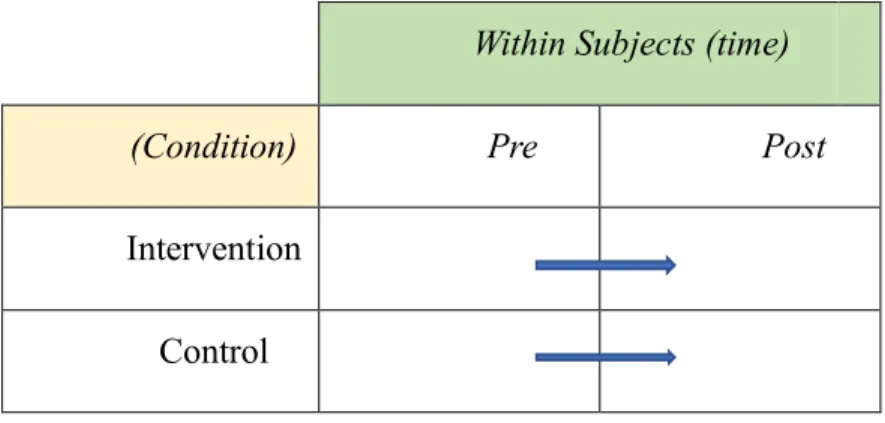
For research question one I used a two-way ANOVA to analyze changes in CRE in ethnic studies classes and control group classes, as measured using the Scale of Ethnocultural Empathy (SEE) and a pre-post design. Responses were gathered from
29
students at the beginning and end of the term in three area ethnic studies classrooms as well as from students in three “traditional” U.S. history classrooms in the same schools. For research question two, I used a three-way ANOVA to analyze the ways in which gains in CRE varied based upon students’ identified race/ethnicity and gender.
To further understand the impact of ethnic studies curricula upon student perceptions of the experiences of those outside their identified racial/ethnic group, research question three addressed students’ perceptions of the elements of ethnic studies classes that facilitated CRE growth through focus group interviews at the end of the term in the three ethnic studies courses.
Critical Race Mixed Methods Research Design
Creswell and Creswell (2018) discuss how mixed methods research design “provides a stronger understanding of the problem or question”(p. 213) than quantitative or qualitative analysis alone. Other CRT scholars assert that CRT understandings are necessary “whenever quantitative data is used in research and/or encountered in policy and practice” (Gillborn, Warmington, and Demack, 2018, p. 169). QuantCrit scholars are cognizant of the ways in which data is used in ways that maintain dominant social
hierarchies and urge researchers to keep in mind the 5 tenets of QuantCrit: (1) the centrality of racism
(2) numbers are not neutral
(3) categories are neither ‘natural’ nor given: for ‘race’ read ‘racism’ (4) voice and insight: data cannot ‘speak for itself ’
30
(Gilbourne, Warmington, and Demack, 2018, p.169). For example, the repetition of achievement gap data often serves to reinforce and further perpetuate dominant narratives regarding students of color. Therefore, in this study, I used an explanatory mixed methods design to plan, collect, and analyze data in order to allow “for the exploration of both composite and individual stories” (DeCuir-Gunby & Walker-DeVose, 2013, p. 254). Quantitative and qualitative data were analyzed in a way that kept in mind the legacy of racism within data collection and interpretation. The quantitative analyses allowed me to analyze differential changes in cross-racial empathy while the qualitative analyses allowed me to deepen interpretations from the quantitative analyses and also highlighted the importance of presenting research grounded in the voices, experiences, and
knowledge of students of color (Solórzano and Yosso, 2002).
Setting and Participants
Data was collected from three classrooms in three public high schools - School A and School B, located in the Evergreen School District3 in western Oregon, and School C
located in the Valley School District, also in western Oregon. I chose the Evergreen School District due to its proximity to where I live, and the implementation of ethnic studies courses offered at 4 of 5 area high schools. School C also recently implemented an ethnic studies course in the fall of 2019 and is located just west of the Evergreen School District.
Evergreen School District is the sixth largest urban district located in Oregon and the most diverse in its county. According to the Oregon Department of Education (2016), Evergreen School District serves 5,341 students in grades 9 through 12 in which 39%
31
identify as economically disadvantaged and 13% identify with disabilities. Twenty-five different languages are spoken at home with 5% of students identified as ever-English Language Learners. Almost 19% of Evergreen School District high school students are identified as "mobile" or transient. Due to survey completion and accuracy needs, I chose data sites within the comprehensive high schools as opposed to Evergreen’s alternative high schools. Students of color make up about 30% of the district, with the largest group identifying as Latinx (13%), the next largest group identifying as multiracial (10%); White students make up almost 70% of Evergreen.
By comparison, the Valley School District is much smaller than the adjacent Evergreen School District, ranking as the 26th largest out of 197 school districts in
Oregon. According to their district website, Valley School District serves 1,763 high school students. Out of these, 39.4% are registered for free and reduced lunch and 14.4% receive special education services. While the district website does not list the number of languages spoken in the Valley School District, Oregon Department of Education’s 2018-1019 Report Card identifies 12% of the district’s students as ever-English Language Learners and 15% as mobile students. Students of color make up almost 40% of students grade 9-12, with LatinX students making up the largest group at 16%, the next largest being students who identify as two groups or more at 6.6%; White students make up almost 60% of the Valley School District.
Table 3.1 illustrates comprehensive racial/ethnic demographics in Evergreen School District high schools, the Valley School District high school, and Oregon high schools overall (n = 214). Demographic data suggest that district and state demographics are similar, with the exception of a smaller Latinx population in Evergreen and Valley
32
compared to the state (Oregon Educator Equity Report, 2018). Besides White, Latinx students represent the largest ethnic/racial category. These comparisons indicate that findings from this study may be broadly generalizable to the state.
Table 3.1. Number of participants, by Course and Identified Race/Ethnic Group
Course Multi-racial Black/ African Am Middle Eastern/ North
African LatinX AI/LatinX Indigenous Asian White Total
ES 3 10 1 21 4 9 1 47 98
US 1 2 0 19 1 4 8 81 116
*Note. Multiracial indicates students who identified as more than three racial/ethnic categories. AI/LatinX indicates combined students who identify as both American Indian/Alaska Native and Hispanic, Latino, and Spanish origin. Indigenous category includes students who identify as either American Indian/Alaska Native, Native Hawaiian/Pacific Islander.
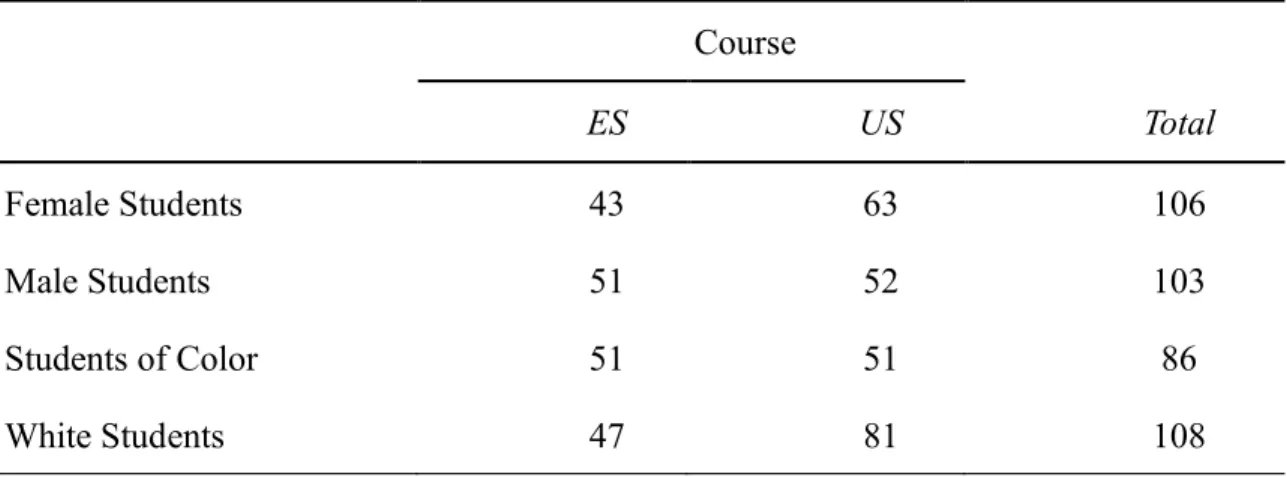
Table 3.2 displays the representation of participants in the quantitative sample for RQ 1 and 2. Both Ethnic Studies students and US History students were asked to identify their gender (n = 209) as well as ethnic/racial group (n = 214) based upon
district-established categories. Students who identify as Non-binary (n = 4) were not included due to inherent limitations in statistical analyses thus further invisibilizing the thoughts, opinions, and perspectives of those students. Similarly, in order to achieve statistical power, race was also collapsed into dichotomized categories. This researcher is aware of the historical context in which racial identification is located and thus the danger of using race as a causal or predicting variable in statistical analyses that tell “us more about statistical modeling than the ‘real’ world itself” (Covarrubias and Vélez, 2018, p. 272).
33
Table 3.2. Number of Participants, by Dichotomized Gender and Race/Ethnic Group Course ES US Total Female Students 43 63 106 Male Students 51 52 103 Students of Color 51 51 86 White Students 47 81 108
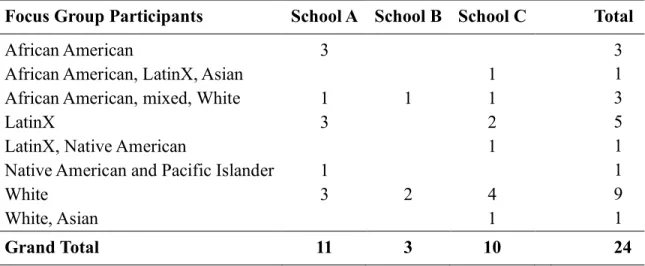
Participants for the focus group interviews for research question three were drawn from the ethnic studies courses in each school. I conducted four focus groups, two in School A based upon identified ethnic/racial group, one in school B, and one in school C. ethnic studies teachers were given a focus group narrative (included in Appendix) with which to construct groups. While there were three ethnic studies classrooms, the teacher in School A recommended two separate focus groups in that school, separated by identified race (students of color, and White students) so as to better capture differences in students’ perceptions regarding their experiences of their class as students of color clearly interact differently with oppression than their White peers (Lynn & Parker, 2006). Group size ranged from 3-10 students for a total of 24 focus group participants. Table 3.3 displays focus group participation by identified race/ethnicity.
34
Table 3.3. Focus Group Participants, by School and Identified Race/Ethnicity
Focus Group Participants School A School B School C Total
African American 3 3
African American, LatinX, Asian 1 1
African American, mixed, White 1 1 1 3
LatinX 3 2 5
LatinX, Native American 1 1
Native American and Pacific Islander 1 1
White 3 2 4 9
White, Asian 1 1
Grand Total 11 3 10 24
Instrument: The Scale of Ethnocultural Empathy (SEE)
This study used the Scale of Ethnocultural Empathy (SEE) as the measurement instrument for the outcome of interest: cross-racial empathy. The SEE is included in the appendix of this proposal (see Appendix A). The SEE was developed from theories on general and cultural empathy by a team of counseling psychology doctoral students concerned with the correlation of the lack of empathy to intergroup aggression, violence, and “social dominance orientation” (Wang, Davidson, Yakushko, Savoy, Tan, and Bleir, 2003). The SEE is a self-report instrument that measures empathy toward people whose ethnic and racial background is different from one's own. Drawing on aforementioned racial identity development theories, Wang et al., (2003) posit that ethnic perspective-taking has developmental levels or stages, is a “cognitive developmental ability” (p.222) and is multidimensional. As such, the SEE, is made up of four components based upon the hypothesis that ethnocultural empathy is “a learned ability and a personal trait, and can be assessed” (Wang et al., 2003, p. 222) and, in addition to previous constructs of cultural empathy that include cognitive, affective, and communicative domains of
35
empathy, the SEE includes “another person’s cultural framework” (Albiero & Matricardi, 2012, p. 649) as an important aspect of empathy. The SEE is presented in 6-point Likert-type scale that produces a total score as well as four subscale scores. Higher scores indicate a higher level of ethnocultural empathy.
The SEE consists of 31 items that measure four dimensions of CRE (see Appendix B) identified as:
1) Empathic feeling and expression (EFE) pertaining to discriminatory experiences and prejudicial attitudes and beliefs;
2) Empathic perspective taking (EPT) pertaining to understanding someone from another racial and/or ethnic group and their worldview;
3) Acceptance of cultural differences (ACD) pertaining to diverse traditions and customs; and
4) Empathic awareness (EA) pertaining to the discrimination or unequal treatment of someone from different racial/ethnic groups.
For example, question 25 addresses the identified factor of cross-cultural empathic awareness: "I am aware of how society differentially treats racial or ethnic groups other than my own."
The SEE creators conducted three studies in three large Midwest Universities to determine the validity and reliability of the instrument (Wang et al., 2003). SEE
developers maintain that test-retest reliability are stable over time (Wang et al., 2003). Additional studies concerned with “culturally oriented empathy” (Albiero & Matricardi, 2012, p. 648) using the SEE also illustrate internal consistency, convergent (e.g., Miville-Guzman Universality-Diversity scale; Miville et al., 1999; Interpersonal Reactivity