Embedding effect systems in Haskell
Dominic Orchard
Tomas Petricek
Computer Laboratory, University of Cambridge [email protected]
Abstract
Monads are now an everyday tool in functional programming for abstracting and delimiting effects. The link between monads and effect systems is well-known, but in their typical use, monads pro-vide a much more coarse-grained view of effects. Effect systems capture fine-grained information about the effects, but monads pro-vide only a binary view:effectfulorpure.
Recent theoretical work has unified fine-grained effect systems with monads using a monad-like structure indexed by a monoid of effect annotations (called parametric effect monads). This aligns the power of monads with the power of effect systems.
This paper leverages recent advances in Haskell’s type system (as provided by GHC) to embed this approach in Haskell, providing user-programmable effect systems. We explore a number of practi-cal examples that make Haskell even better and safer for effectful programming. Along the way, we relate the examples to other con-cepts, such as Haskell’s implicit parameters andcoeffects. Categories and Subject Descriptors D.3.2 [Programming Lan-guages]: Applicative (functional) languages; F.3.3 [Logics and Meanings of Programs]: Type Structure
Keywords effect systems; parametric effect monads; type systems
1.
Introduction
Side effects are an essential part of programming. There are many reasoning and programming techniques for working with them. Two well-known approaches in functional programming are effect systems, for analysis, and monads, for encapsulating and delimiting effects. Monads have a number of benefits. They provide a simple programming abstraction, or a design pattern, for encapsulating functionality. They also delimit the scope of effects, showing which parts of a program are pure and which parts are impure. However, compared to effect systems, monads have two limitations. 1). Granularity The information provided by monadic typing is limited. We can look at the type of an expression and see, for example, that it has state effects if it uses theSTmonad, but we no nothing more about the effects from the type; the analysis provided by standard monadic typing provides only binary information.
In contrast, effect systems annotate computations with finer-grained information. For example, stateful computations can be Permission to make digital or hard copies of all or part of this work for personal or classroom use is granted without fee provided that copies are not made or distributed for profit or commercial advantage and that copies bear this notice and the full citation on the first page. Copyrights for components of this work owned by others than the author(s) must be honored. Abstracting with credit is permitted. To copy otherwise, or republish, to post on servers or to redistribute to lists, requires prior specific permission and/or a fee. Request permissions from [email protected].
Haskell ’14, September 4–5, 2014, Gothenburg, Sweden.
Copyright is held by the owner/author(s). Publication rights licensed to ACM. ACM 978-1-4503-3041-1/14/09. . . $15.00.
http://dx.doi.org/10.1145/2633357.2633368
annotated with sets of triples of memory locations, types, and effect markersσ∈ {update,read,write}. This provides information on how state is affected, without requiring the code to be examined.
One solution for improving granularity is to define a type class for every effectful operation, with a type class constraint over a polymorphic monadic type [15]. However, this restricts an effect analysis to sets with union and ordering by subsets.
2). Compositionality. Monads do not compose well. In Haskell, we often have to refactor monadic code or add additional book-keeping (for example, insert lifting when using monad transform-ers) to compose different notions of effect. In contrast, effect sys-tems which track information about different notions of effect can be more easily composed.
The recent notion ofparametric effect monads[12] (also called in-dexed monads[19]) provides a solution togranularity, and a partial solution tocompositionality. Parametric effect monads amplify the monadic approach witheffect indices(annotations) which describe in more detail the effects of a computation. This effect informa-tion has the structure of a monoid(F,•, I), whereIis the annota-tion of pure computaannota-tions and•composes effect information. The monoidal structure adorns the standard monad structure, leading to the operations of a monad having the types:
return::a→MIa
(>>=) ::MFa→(a→MGb)→MF•Gb
The indexed data typeMFAmay be defined in terms ofF, giving a
semantic, value-level counterpart to the effect information. This ap-proach thus unifies monads with effect systems. This paper makes the following contributions:
• We encode parametric effect monads in Haskell, using them to embed effect systems (Section 2). This provides a general sys-tem for high-granularity effect information and better composi-tionality for some examples (Sections 5-6). This embedding is shallow; we do not require any macros or custom syntax. • We leverage recent additions to the Haskell type system to
make it possible (and practical) to track fine-grained informa-tion about effects in the type system, for example using type-level sets (Section 3). In particular, we usetype families[5], constraint kinds[3, 20], GADTs [22],data kinds and kind poly-morphism[25], andclosed type families[7].
• A number of practical examples are provided, including effect systems arising from reader, writer, and state monads (Sec-tions 5-6), and for analysing and verifying program proper-ties including computational complexity bounds and complete-ness of data access patterns (Section 9). We provide a Haskell-friendly explanation of recent theoretical work and show how to use it to improve programming practice.
• We discuss the dual situation ofcoeffectsand comonads (Sec-tion 8) and the connec(Sec-tion of effect and coeffect systems to
Haskell’simplicit parameters. Implicit parameters can be seen as an existing coeffect system in Haskell.
The code of this paper is available via Hackage (cabal install ixmonad) or athttp://github.com/dorchard/effect-monad.
In the rest of this section we look at two examples that demon-strate the problems with the current state-of-the-art Haskell pro-gramming. The rest of the paper shows that we can do better. Problem 1 Consider programming stream processors. We define two stateful operations,writeS for writing to an output stream (modelled as a list) andincCfor counting these writes:
writeS:: (Monad m)⇒[a]→StateT[a]m()
incC :: (Monad m,Num s)⇒StateT s m()
We have planned ahead by using the state monad transformer to allow composing states. Thus, an operation that both writes to the output stream and increments the counter can be defined using
lift:: (MonadTrans t,Monad m)⇒m a →t m a:
write:: (Monad m)⇒[a]→StateT [a] (StateT Int m) ()
write x =do{writeS x;lift$incC}
In combining the two states, an arbitrary choice is made of which one to lift (the counter state). The following example program
hellow =do{write"hello";write" ";write"world"} can be “run” by providing two initial states (in the correct order):
runStateT (runStateT hellow"") 0
evaluating to(((),"hello world"),3). The type ofhellow indi-cates in which order to supply the initial state arguments and which operations to lift in any future reuses of the state.
Consider writing another function which counts the number of times hellow is run. We reuseincC, lifting it to increment an additional state:
hellowC =do{hellow; lift$lift$incC}
Now there are twoIntstates, so the types provide less guidance on the order to apply arguments. We also see that, for every new state, we have to add more and moreliftoperations, chained together.
The parametric effect monad for state (Section 6) allows defini-tions ofincC andwriteS that have precise effect descriptions in their types, written:
incC ::State ‘["count":→Int:!RW] () writeS:: [a]→State ‘["out":→[a] :!RW] ()
meaning thatincC has a read-write effect on a variable"count"
andwriteS has a read-write effect on a variable"out". The two can then be composed, using the usualdo-notation, as:
write:: [a]→State ‘["count":→Int:!RW,
"out" :→[a] :!RW] ()
write x =do{writeS x;incC}
whose effect information is the union of the effects forwriteSand incC. Note that we didn’t need to use aliftoperation, and we now also have precise effect information at the type level.
An alternate solution to granularity is to define a type class for each effectful operation parameterised by a result monad type,e.g.,
classMonad m⇒Output a mwherewriteS:: [a]→m()
classMonad m⇒Counting m whereincC::m()
Suitable instances can be given using monad transformers. This ap-proach provides an effect system via type class constraints, but re-stricts the effect annotations to sets with union (conjunction of con-straints) and ordering of effects by subsets. In this paper, we embed a more general effect system, parameterised by a monoid of effects with a preorder, and show examples leveraging this generality.
classEffect(m::k→ ∗ → ∗)where
typeUnit m::k
typePlus m(f ::k) (g::k) ::k
typeInv m(f ::k) (g::k) ::Constraint
typeInv m f g= ()
return::a→m(Unit m)a
(>>=) ::Inv m f g⇒
m f a→(a→m g b)→m(Plus m f g)b
classSubeffect(m::k → ∗ → ∗)f g where
sub::m f a →m g a
Figure 1. Parametric effect monad and subeffecting classes
Problem 2 Consider writing a DSL for parallel programming. We want to include the ability to use state, so the underlying imple-mentation uses the state monad everywhere to capture stateful op-erations. However, we want to statically ensure that a parallel map-ping function on listsparMapis only applied to functions with, at most, read-only state effects. The standard monadic approach does not provide any guidance, so we have to resort to other encodings.
With the embedded effect system approach of this paper we can write the following definition forparMap:
parMap:: (Writes f∼‘[ ])⇒
(a→State f b)→[a]→State f [b]
parMap k[ ] =sub(return[ ])
parMap k(x:xs) =do(y,ys)←(k x) ‘par‘ (parMap k xs) return(y:ys)
The predicateWrites f∼‘[ ]on effect information constrains the computation to be free from write effects. Thepar combinator provides the parallel behaviour.
2.
Parametric effect monads
While monads are defined over parametric types of kindm::∗ → ∗, parametric effect monads are defined over types of kindm::k → ∗ → ∗with an additional parameter of some kindkof effect types. We define parametric effect monads by replacing the usualMonad type class with theEffectclass, which has the same operations, but with the effect-parameterisation described in the introduction.
Figure 1 gives the Haskell definition which uses type families, polymorphic kinds, and constraint kinds.Plus mdeclares a binary type family for composing effect annotations (of kindk) when sequentially composing computations with bind(>>=).Unit mis a nullary type family computing the ‘unit’ annotation for the trivial (or pure) effect, arising fromreturn. The idea is thatPlus mand
Unit mform a monoid which is shown by the parametric effect
monad axioms (see below).
TheInv family is aconstraint family[3, 20] (i.e., constraint-kinded type family) which can be used to restrict effect parameters in instances ofEffect. The default is the empty constraint. do-notation Haskell’sdonotation provides convenient syntac-tic sugar over the operations of a monad, resembling the imper-ative programming approach of sequencing statements. By using therebindable syntaxextension of GHC, we can reuse the stan-dard monadicdo-notation for programming with parametric effect monads in Haskell. This is why we have chosen to use the standard names for thereturnand(>>=)operations here.
Axioms The axioms, or laws, of a parametric effect monad have exactly the same syntactic shape as those of monads, but with the additional effect parameters on the monadic type constructor. These
are as follows, along with their types (where for brevity here we elide the parametermforPlusandUnitfamilies and elideInv):
(return x)>>=f ::m(Plus Unit f)a
≡ f x ::m f a
m>>=return ::m(Plus f Unit)a
≡ m ::m f a
m>>= (λx →(f x)>>=g) ::m(Plus f (Plus g h))a ≡ (m>>=f)>>=g ::m(Plus(Plus f g)h)a For these equalities to hold, the type-level operations Plus and Unitmust form a monoid, whereUnitis the identity ofPlus(for the first two laws), andPlusis associative (for the last law). Relation to monads All monads are also parametric effect mon-ads with a trivial singleton effect,i.e., if we takeUnit m = ()
andPlus m () () = (). We show the full construction to embed
monads into parametric effect monads in Section 7.
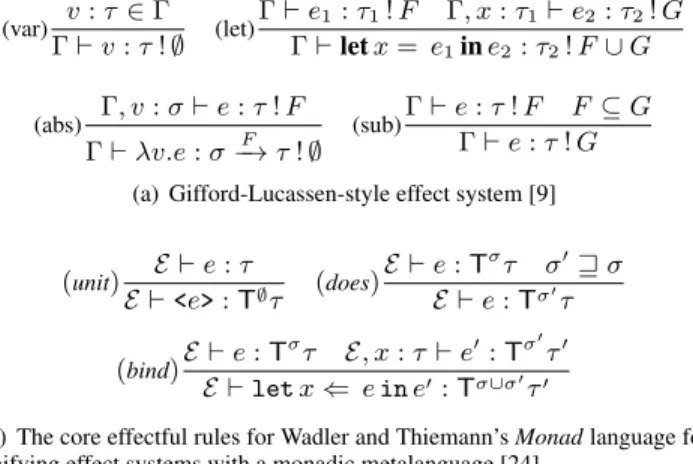
Relation to effect systems Figure 2(a) recalls the rules of a simple type-and-effect system using sets of effect annotations. The corre-spondence between type-and-effect systems (hereafter just effect systems) and monads was made clear by Wadler and Thiemann, who established a syntactic correspondence by annotating monadic type constructors with the effect sets of an effect system [24]. This is shown for comparison in Figure 2(b), showing a correspondence between (var)-(unit), (let)-(bind), and (sub)-(does).
Wadler and Thiemann established soundness results between an effect system and an operational semantics, and conjectured a “co-herent semantics” of effects and monads in a denotational style. They suggested associating to each effectFa different monadMF.
The effect-parameterised monad approach here differs: a typeMF
of the indexed family may not be a monad itself. The monadic be-haviour is “distributed” over the indexed family of types as spec-ified by the monoidal structure on effects. Figure 2(c) shows the effect system provided by our parametric effect monad encoding.
A key feature of effect systems is that the (abs) rule captures all effects of the body aslatent effectsthat happen when the function is run (this is shown by an effect annotated arrow,e.g.,−F→). This is also the case in our Haskell embedding:λx →do{...}is a pure function, returning a monadic computation.
The (sub) rule above providessubeffecting, where effects can be overapproximated. Instances of theSubeffectclass in Figure 1 provide the corresponding operation for parametric effect monads.
3.
Defining type-level sets
Early examples of effect systems often generated sets of effect information, combined via union [10], or in terms of lattices but then specialised to sets with union [9]. Sets are appropriate for effect annotations when the order of effects is irrelevant (or at least difficult to predict, for example, in a lazy language) and when effects can be treated idempotently, for example, when it is enough to know that a memory cell is read, not how many times it is read.
Later effect system descriptions separated lattices of effects into distinct algebraic structures for sequential composition, alternation, and fixed-points [17]. Our encoding of parametric effect monads is parameterised by a monoid with a preorder, but sets are an impor-tant example used throughout. In this section, we develop a type-level notion of sets (that is, sets of types, as a type) with a corre-sponding value-level representation. We define set union (for the sequential composition of effect information) and the calculation of subsets– providing the monoid and preorder structure on effects. Defining type-level sets would be easier in a dependently-typed language, but perhaps the most interesting (and practically useful) thing about this paper is that we can embed effect systems in a languagewithoutresorting to a fully dependently-typed system.
(var) v:τ∈Γ Γ`v:τ!∅ (let) Γ`e1 :τ1!F Γ, x:τ1`e2:τ2!G Γ`letx= e1ine2:τ2!F∪G (abs) Γ, v:σ`e:τ!F Γ`λv.e:σ−F→τ!∅ (sub)Γ`e:τ!F F⊆G Γ`e:τ!G (a) Gifford-Lucassen-style effect system [9]
(unit) E `e:τ E `<e>:T∅τ (does) E `e:Tστ σ0wσ E `e:Tσ0 τ (bind)E `e:T στ E, x:τ `e0 :Tσ0τ0 E `letx⇐ eine0:Tσ∪σ0 τ0
(b) The core effectful rules for Wadler and Thiemann’sMonadlanguage for unifying effect systems with a monadic metalanguage [24].
(unit) Γ`e:τ
Γ`return e:m(Unit m)τ (sub)
Γ`e:m f τ Sub f g
Γ`sube:m gτ (let) Γ`e1:m f τ1 Γ, x:τ1`e2:m gτ2
Γ`do{x← e1;e2}:m(Plus m f g)τ2
(c) The type-embedded effect system provided in this paper by the paramet-ric effect monad definition.
Figure 2. Comparison of different encodings of effect systems
Representing sets with lists We encode type-level sets using var-ious advanced type system features of GHC. The main effort is in preventing duplicate elements and enforcing the irrelevance of the storage order for elements. These properties distinguish sets from lists, which are much easier to define at the type level and will form the basis of our encoding. Type-level functions will be used to re-move duplicates and normalise the list (by sorting).
We start by inductively definingSetas a parameterised GADT:
dataSet(n:: [∗])where
Empty::Set‘[ ]
Ext ::e →Set s →Set(e‘:s)
where the parameter has thelist kind [∗] (the kind of lists of types) [25]. This definition encodes heterogeneously-typed lists, with a type-level list representation via type operators of kind:
‘[ ] :: [∗] and (‘:) ::∗ →[∗]→[∗]
These provide a compact notation for types. The data constructor namesEmptyandExt(for extension) remind us that we will treat values of this type as sets, rather than lists.
The first step in using lists to represent sets is to make the order-ing irrelevant by (perhaps ironically) fixorder-ing an arbitrary orderorder-ing on elements of the set and normalising by sorting. We use bubble sort here as it is straightforward to implement at the type level.
A single pass of the bubble sort algorithm recurses over a list and orders successive pairs of elements as follows:
type familyPass(l:: [∗]) :: [∗]where
Pass‘[ ] = ‘[ ]
Pass‘[e] = ‘[e]
Pass(e ‘:f ‘:s) =Min e f ‘: (Pass((Max e f) ‘:s))
type familyMin(a::k) (b::k) ::k
type familyMax(a::k) (b::k) ::k
Here,Min and Max are open type families which are given in-stances later for specific applications. The definition ofPasshere uses aclosed type family [7]. Closed type families define all of
there instances together,i.e., further instances cannot be defined. This allows instances to be matched against in order, contrasting with open type families where there is no ordering on the instances (which may be scattered throughout different modules and com-piled separately).Passis defined as a closed family only because we do not need it to be open, not because we require the extra power of closed families; a standard open family would suffice here.
To complete the sorting,Passis appliedn-times for a list of lengthn. The standard optimisation is to stop once the list is sorted, but for brevity we take the simple approach, deconstructing the input list to build a chain of calls toPass:
type familyBubble l l0where
Bubble l‘[ ] =l
Bubble l(x‘:xs) =Pass(Bubble l xs)
typeSort l=Bubble l l
Again, we use a closed type family here, not out of necessity but since we do not need an open definition.
This completes type-level sort. Definitions of the value-level counterparts follow exactly the same shape as their types, thus we relegate their full definition to Appendix A. The approach is to implement each type-level case as an instances of the classes:
typeSortable s=Bubbler s s
classBubbler s s0where
bubble::Set s→Set s0→Set(Bubble s s0)
classPasser swhere
pass::Set s →Set(Pass s)
classOrdH e f where
minH::e →f →Min e f
maxH::e→f →Max e f
This provides the specific behaviour of each case of the type-level definitions, with room to raise the appropriate type-class con-straints forOrdH (heterogeneously typed ordering).
The remaining idempotence property of sets requires the full power of closed type families, using equality on types. We define the following type-level functionNubto remove duplicates (named afternubfor removing duplicates from a list inData.List):
type familyNub t where
Nub‘[ ] = ‘[ ]
Nub‘[e] = ‘[e]
Nub(e‘:e‘:s) =Nub(e‘:s) Nub(e‘:f ‘:s) =e‘:Nub(f ‘:s)
As mentioned, the closed form of type families allows a number of cases to be matched against in lexical order. This allows the type equality comparison in the third case which removes a duplicate when two adjacent elements have the same type. The pattern of the fourth case overlaps the third, but is only tried if the third fails.
A corresponding value-levelnubis defined similarly tobubble andpassusing a type class with instances for each case ofNub:
classNubable twhere
nub::Set t →Set(Nub t)
instanceNubable‘[ ]where
nub Empty=Empty
instanceNubable ‘[e]where
nub(Ext x Empty) =Ext x Empty
instance(Nub(e ‘:f ‘:s)∼(e‘:Nub(f ‘:s)),
Nubable(f ‘:s))⇒Nubable(e‘:f ‘:s)where
nub(Ext e(Ext f s)) =Ext e(nub(Ext f s))
In the last case, the equality constraint is required to explain the behaviour of Nub. The type and value levels are in one-to-one
correspondence however we have deliberately omitted the case for actually removing items with the same type. This class instance will be defined later with application-specific behaviour.
Putting this all together, type- and value-level conversion of the list format to the set format is defined:
typeAsSet s=Nub(Sort s)
asSet:: (Sortable s,Nubable(Sort s))⇒
Set s →Set(AsSet s)
asSet x=nub(bsort x)
We also define a useful predicate for later definitions which asks whether a type is in the set representation format:
typeIsSet s= (s∼Nub(Sort s)) ::Constraint
This uses the constraint kinds extension [3, 20] where the kind signature explains that this “type” definition is a unary constraint.
Now that we have the representation sorted, we define opera-tions for taking the union and calculating subsets.
Union Set union is defined using our existing infrastructure and the concatenation of the underlying lists:
typeUnion s t=AsSet(Append s t)
Append concatenates the two list representations (acting like a
disjoint union of sets) andAsSetnormalises the result into the set form.Appendis defined in the usual way as a type family:
type familyAppend(s:: [∗]) (t:: [∗]) :: [∗]where
Append‘[ ]t =t
Append(x ‘:xs)ys=x ‘: (Append xs ys)
The value-level version is identical (mutatis mutandis):
append::Set s→Set t→Set(Append s t)
append Empty x =x
append(Ext e xs)ys=Ext e(append xs ys)
This twin definition, and the previous definition for Nub/nub, exposes a weakness of Haskell: we have to write both the value and type level, even though they are essentially identical. Languages that implement richer dependent-type theories tend to avoid this problem but, for the moment, this is the state of play in Haskell.
Given all of the above, union of value sets is then:
typeUnionable s t = (Sortable(Append s t),
Nubable(Sort(Append s t)))
union:: (Unionable s t)⇒Set s→Set t →Set(Union s t)
union s t=nub(bsort(append s t))
with the binary predicateUnionable hiding the underlying type class constraints associated with sorting and removing duplicates. Subsets A notion ofsubeffectingis useful for combining effect information arising from non-linear control flow (for example, to implement conditionals). We recursively define a binary predicate SubwhereSub s t means s ⊆ t. This type class has a single method that calculates the value representation of the subset:
classSubset s twhere
subset::Set t →Set s
instanceSubset ‘[ ]twhere
subset xs=Empty
instanceSubset s t ⇒Subset(x ‘:s) (x ‘:t)where
subset(Ext x xs) =Ext x(subset xs)
instanceSubset s t ⇒Subset s(x ‘:t)where
subset(Ext xs) =subset xs
Thus, in the first instance: empty sets are subsets of all sets; in the second:({x} ∪S) ⊆ ({x} ∪T)ifS ⊆T; and in the third,
S⊆({x}∪T)ifS⊆T. Note that we have used a multi-parameter type class here since the value-level behaviour depends on both the source and target types.
Set union and subset operations will be used in the next three sections, where additional set operations will appear as necessary.
4.
Writer effects
Our first example effect system will capture write effects, related to thewriter monad. The classic writer monad provides a write-only cumulative state, useful for producing a log (or trace) along with a computation. The data type is essentially that of a product. In Haskell, this monad is defined:
dataWriter w a=Writer{runWriter:: (a,w)}
instanceMonoid w⇒Monad(Writer w)where
return a=Writer(a,mempty)
(Writer(a,w))>>=k=let(b,w0) =runWriter(k a)
inWriter(b,w‘mappend‘w0) wheremempty::Monoid w ⇒wandmappend::Monoid w⇒ w → w → w are respectively the unit element and the binary operation of a monoid onw. Thus, a pure computation writes the unit element of the monoid and(>>=)composes write state using the binary operation of the monoid.
Using a parametric effect monad, we can define a more flexible version of the writer monad that allows multiple writes to be eas-ily combined and extended (without the need for tuples or monad transformers), using an effect system for write effects. This ap-proach allows us to define programs like the following:
prog::Writer ‘["x":→Int,"y":→String] () prog=doput(Var:: (Var"x")) 42
put(Var:: (Var"y"))"hello"
put(Var:: (Var"x")) 58
where"x"and"y"are type level symbols andWriteris parame-terised by a set of variable-type mappings. Running this computa-tion produces((),{(Var,100),(Var,"hello")}).
We use our level sets representation coupled with type-level symbols to provide variables, where the constructor:→ de-scribes a pair of a variable and its written type. TheWriterdata type and its accompanying parametric effect monad are defined:
dataWriter w a=Writer{runWriter:: (a,Set w)}
instanceEffect Writerwhere
typeInv Writer s t= (IsSet s,IsSet t,Unionable s t)
typeUnit Writer= ‘[ ]
typePlus Writer s t =Union s t
return x =Writer(x,Empty)
(Writer(a,w))>>=k=letWriter(b,w0) =k a
in Writer(b,w‘union‘w0) Thus,returnhas the empty set effect, and(>>=)composes writer states by taking the union, with theUnioneffect annotation. The IsSetpredicates ensure the effect indices are in the set format.
Theput operation is then defined as follows, introducing an effect with a variable-type mapping:
put::Var v→t→Writer ‘[v:→t] ()
put v x =Writer((),Ext v x Empty)
The mapping operator:→andVartype are defined:
data(v::Symbol) :→(t::∗) = (Var v) :→t
dataVar(v::Symbol) =Var
Members of the kind of symbolsSymbol are type-level strings, provided by thedata kindsextension.
Recall that we did not define thenuboperation on sets fully; the case for removing duplicates at the value level was not included in the definition of Section 3. We define this here by combining values of the same variable using themappendoperation of a monoid:
instance(Monoid a,Nubable((v:→a) ‘:s))⇒ Nubable((v:→a) ‘: (v:→a) ‘:s)where
nub(Ext( :→a) (Ext(v:→b)s)) = nub(Ext(v:→(a‘mappend‘b))s)
We finally implement the type-level ordering of mappingsv:→t by providing instances forMinandMax:
type instanceMin(v:→a) (w:→b) = (Select v w v w) :→(Select v w a b)
type instanceMax(v:→a) (w:→b) = (Select v w w v) :→(Select v w b a)
typeSelect a b p q=Choose(CmpSymbol a b)p q
type familyChoose(o::Ordering)p qwhere
Choose LT p q =p
Choose EQ p q =p
Choose GT p q =q
whereCmpSymbol::Symbol →Symbol →Orderingfrom the base library compares symbols, returning a type of kindOrdering upon whichChoose matches. The type function Select selects its third or fourth parameter based on the variables passed as its first two parameters;Select returns its third parameter if the first parameter is less than the second, otherwise it returns its fourth. The corresponding value level is a straightforward (and annoying!) transcription of the above, shown in Appendix B for reference. Examples and polymorphism The following gives a simple ex-ample (using an additive monoid onInt):
varX =Var:: (Var"x") varY =Var:: (Var "y")
test=doput varX (42 ::Int)
put varY "hello"
put varX (58 ::Int)
put varY " world"
The effects are easily inferred (shown here by querying GHCi):
*Main> :t test
test :: Writer ’["x" :-> Int, "y" :-> [Char]] ()
and the code executes as expected:
*Main> runWriter (test 1)
((),(x, 100), (y, "hello world"))
Explicit type signatures were used on assignments to"x"otherwise our implementation cannot unify the two writes to"x". If we want
"x"to be polymorphic we must use ascoped type variablewith a type signature fixing the type of eachputtox. For example:
test0(n::a) =doput varX(42 ::a) put varY "hello"
put varX(n::a)
for which Haskell can infer the expected polymorphic effect type:
*Main> :t test’
test’ :: (Monoid a, Num a) =>
a -> Writer ’["x" :-> a, "y" :-> [Char]] ()
While it is cumbersome to have to add explicit type signatures for the polymorphism here, the overhead is not vast and the type sys-tem can still infer the effect type for us. We can also be entirely polymorphic in an effect, and in a higher-order setting. For
exam-ple, the following function takes an effectful function as a parame-ter and applies it, along with some of its own write effects:
test2 :: (IsSet f,Unionable f ‘["y":→String])
⇒ (Int→Writer f t)
→ Writer(Union f ‘["y":→String]) () test2 f =do{f 3; put varY "world."}
Thus,test2 takes an effectfulf, calls it with3, and then writes to "y". The resulting effect is thus the union of f’s effects and ‘["y":→String]. To test,runWriter (test2 test0)returns the expected values((),{(x,45),(y,"hello world.")}).
While the type oftest2 can be inferred (if we give a signature on3,e.g.,3 ::Int), we include an explicit type signature here as GHC has a habit of expanding type synonym definitions, making the inferred type a bit inscrutable.
Subeffecting Since sets appear in a positive position in our
Writerdata type, subeffecting overapproximates what is written,
requiring a superset operation for writer effects. At the value level, we fill these additional writer cells with unit of the corresponding monoid (mempty), thus completing the use of monoids in this ex-ample (rather than just semigroups). We define a binary predicate
Supersetwith asupersetmethod:
classSuperset s twheresuperset::Set s →Set t
instanceSuperset‘[ ] ‘[ ]wheresuperset =Empty
instance(Monoid a,Superset ‘[ ]s)⇒ Superset‘[ ] ((v:→a) ‘:s)where
superset =Ext (Var:→mempty) (superset Empty)
instanceSuperset s t⇒
Superset((v:→a) ‘:s) ((v:→a) ‘:t)where
superset(Ext x xs) =Ext x(superset xs)
The subeffecting operation forWriteris then:
instanceSuperset s t⇒Subeffect Writer s t where
sub (Writer(a,w)) =Writer(a,(superset w) :: (Set t)) To illustrate, we applysubto our earlier example:
test3 ::Writer‘["x":→Int,"y":→String,"z":→Int] () test3 =sub(test2 test0)
which evaluates to the following showing the0value given to"z"
coming from the additive monoid forInt:
*Main> runWriter test3
((),(x, 45), (y, "hello world."), (z, 0))
Using plain lists A simpler, but less useful version of writer ef-fects uses just type-level lists, rather than sets. This provides a write-oncewriter where values can be written but with no accu-mulating behaviour. We elide this example here as it is less useful, but it can be found inControl.Effect.WriteOnceWriter. 4.1 Update effects
An alternate form of writer effect provides an updateable mem-ory cell, without any accumulating behaviour. This corresponds to the usual writer monad with the monoid overMaybe: writing a value wrapped by theJust constructor updates the cell,
writ-ingNothingleaves the cell unmodified. With a parametric effect
monad we can treat the type of the cell as an effect annotation, providing a heterogeneously-typed update monad. The standard monadic definition must have the same type throughout the com-putation. Thus, this effect system is more about generalising the power of the monad than program analysis per se.
This parametric effect monad is defined by lifting theMaybe -monoid to types. We define a GADT parameterised by Maybe promoted to a kind:
dataEff (w::Maybe ∗)where
Put::a→Eff (Just a)
NoPut::Eff Nothing
The effect-parameterised version of the update monad is then:
dataUpdate w a=U {runUpdate:: (a,Eff w)}
instanceEffect Update where
typeUnit Update=Nothing
typePlus Update s Nothing=s
typePlus Update s(Just t) =Just t
return x =U (x,NoPut)
(U (a,w))>>=k =U (update w(runUpdate$k a))
update::Eff s→(b,Eff t)→(b,Eff (Plus Update s t))
update w(b,NoPut) = (b,w)
update (b,Put w00) = (b,Put w00)
put::a→Update(Just a) ()
put x=U ((),Put x)
whereupdatecombines value- and type-levelMaybemonoid be-haviour. Note that we don’t have to use the GADT approach. We could equivalently define two data typesPut andNoPutand im-plement the type-dependent behaviour ofupdateusing a type class. The effect-parameterised writer monad therefore provides a heterogeneously-typed memory cell, where the final type of the state for a computation is that of the last write,e.g.
foo::Update(Just String) () foo=do{put42;put"hello"}
This parametric effect monad is a little baroque, but it serves to demonstrate the heterogeneous behaviour possible with parametric effect monads and gives an example effect system that is not based on sets (of which there are more examples later).
5.
Reader effects
The classicreader monadprovides a read-only value (or parame-ter) that is available throughout a computation. The data type of the reader monad is a function from the read-only state to a value:
dataReader r a=Reader{runReader::r→a}
Similarly to the previous section, we can generalise this monad to a parametric effect monad providing an effect system for read effects and allowing multiple different reader values, solving the composition problem for multiple reader monads. The generalised type and parametric effect monad instance are defined:
dataReader s a=R{runReader::Set s→a}
instanceEffect Reader where
typeInv Reader s t = (IsSet s,IsSet t,
Split s t (Union s t))
typeUnit Reader = ‘[ ]
typePlus Reader s t=Union s t
return x =R(λEmpty→x)
(R e)>>=k =R(λst →let(s,t) =split st
in(runReader$k(e s))t) A pure computation therefore reads nothing, taking the empty set as an argument. For the composition of effectful computations, we define a computation that takes in a setst::Set (Union s t)and then splits it into two partss::Set sandt::Set twhich are passed to the subcomputationse::Set s→aandk (e s) :Set t →b.
Although set union is not an injective operation (i.e., not invert-ible), thesplit operation here provides the inverse ofUnion s t
sincesandtare known, provided by the types of the two subcom-putations. We definesplitvia a type class that is parameterised by its parameter set and return sets:
classSplit s t stwheresplit::Set st →(Set s,Set t)
instanceSplit‘[ ] ‘[ ] ‘[ ]where
split Empty= (Empty,Empty)
instanceSplit s t st⇒Split (e‘:s) (e‘:t) (e ‘:st)where
split(Ext x st) =let(s,t) =split st in(Ext x s,Ext x t)
instanceSplit s t st⇒Split (x ‘:s)t(x‘:st)where
split(Ext x st) =let(s,t) =split st in(Ext x s,t)
instanceSplit s t st⇒Split s(x ‘:t) (x‘:st)where
split(Ext x st) =let(s,t) =split st in(s,Ext x t) The first instance provides the base case. The second provides the case when an element of aUnion f g appears in bothf andg. The third and fourth instances provide the cases when an element ofUnion f gis only inf or only ing.
The constraintSplit s t (Union s t)in theEffect instance enforces thatSplitis the inverse ofUnion.
Once we have the above parametric effect monad, the usualask operation takes a variable as a parameter and produces a computa-tion with a singleton effect for that variable:
ask::Var v→Reader ‘[v:→t]t
ask Var =R(λ(Ext(Var:→x)Empty)→x)
The following gives an example program, whose type and effects are easily inferred by GHC, so we do not give a type signature here:
foo=dox ←ask(Var:: (Var"x")) xs←ask(Var:: (Var"xs")) x0 ←ask(Var:: (Var"x")) return(x:x0:xs)
init1 =Ext(Var:→1) (Ext (Var:→[2,3])Empty)
runFoo=runReader foo init1
The inferred type isfoo::Reader ‘["x":→a,"xs":→[a]] [a] andrunFooevaluates to[1,1,2,3].
Note that we have not had to add a case for theNubabletype class with thenub method to removing duplicates in sets. This is becauseReader does not useunion (sets appear in a negative position, to the left of the function arrow). Instead, the idempotent behaviour is encoded by the definition ofsplit/Split.
Sub effecting Since sets appear in negative positions, we can use thesubsetfunction defined earlier for subeffecting:
instanceSubset s t⇒Subeffect Reader s twhere
sub(R e) =R(λst→lets=subset stine s)
The following overapproximates the effects of the above example: bar:: (Subset‘["x":→Int,"xs":→[Int]]t)⇒Reader t [Int]
bar=sub foo
This can be run by passing⊥into the additional slot in the incom-ing reader set with initial reader state:
init2::Set‘["x":→Int,"xs":→[Int],"z":→a] init2 =Ext(Var:→1) (Ext (Var:→[2,3])
(Ext(Var:→ ⊥)Empty))
whererunReader bar init2evaluates to[1,1,2,3]. The explicit signature oninit2 is required for the subeffecting function to be correctly resolved.
This effect system resembles theimplicit parametersextension of Haskell [14], providing most of the same functionality. However, some additional structure is need to fully replicate the implicit
parameter behaviour. This is discussed in Section 8 where we briefly discuss the dual notion of coeffect systems.
6.
State effects
The earliest effect systems were designed specifically to track side-effects relating to state, with sets of triples marking read, write, and update effects on typed locations. We combine the approaches thus far for reader and writer effects to define a parametric state effect monad with state effect system. As before, we will use sets for effects, but this time with additional type-level information for distinguishing between reads, writes, and updates (read/write), given by theEff type:
dataEff =R|W |RW
dataEffect (s::Eff) =Eff
where theEffect type usesEff as a data kind and provides a data constructor that acts as a proxy forEff. These effects markers are associated with types, describing the effect performed on a value of a particular type, with the constructor:
data(:!) (a::∗) (s::Eff) =a:! (Effect s)
Effect annotations will be sets of mappings of the form(v:→t:!f) meaning variablevhas typetand effect actionf (drawn fromEff). The parametric effect monad data typeState is analogous to usual definition of states→(a,s):
dataState s a=State
{runState::Set(Reads s)→(a,Set(Writes s))} whereReadsandWritesrefine the set of effects into the read and write effects respectively.Readis defined:
type familyReads twhere
Reads‘[ ] = ‘[ ]
Reads((v:→a:!R) ‘:s) = (v:→a:!R) ‘: (Reads s) Reads((v:→a:!RW) ‘:s) = (v:→a:!R) ‘: (Reads s)
Reads((v:→a:!W) ‘:s) =Reads s
thus read-write effectsRW are turned into read effects, and all write effects are ignored. TheWrites operation (not shown here) removesRactions and turnsRW actions intoWactions.
Previously, set union combined effect sets, but now we need some additional behaviour in the case where both sets contain ef-fects on a variablevbut with different effect actions. For example, we require the behaviour that:
Union ‘[v:→t:!R] ‘[v:→t:!W] = ‘[v:→t:!RW] i.e., if one computation readsv and the other writesv the overall effect is aread-writeeffect (possible update). We thus redefine the previousNubdefinition:
type familyNub twhere
Nub‘[ ] = ‘[ ] Nub‘[e] = ‘[e] Nub(e ‘:e‘:s) =Nub(e‘:s) Nub((v:→a:!f) ‘: (v:→a:!g) ‘:s) = Nub((v:→a:!RW) ‘:s) Nub(e ‘:f ‘:s) =e‘:Nub(f ‘:s)
Again, closed type families are used to match against types in the given order. The definition is the same as before in Section 3, apart from the third case which is new: if there are two different effects f and gon variable v then these are combined into one effect annotation with actionRW. The value level is straightforward and analogous to the type-level (seeControl.Effect.State) and is similar to the previous definition in Section 3. The union of two sets is defined as before, using sorting and the above version ofNub. To
distinguish this union from the previous (which is an actual union), we definetypeUnionS s t=Nub(Sort(Append s t)).
A final operation is required to sequentially compose write ef-fects of one computation with read efef-fects of another. This amounts to a kind of intersection of two sets, between a set of write effects and a set of readw∩rwhere at the type level this equalsr, but at the value level any reads inrthat coincide with writes inware replaced by the written values. We define this operation by first ap-pending the two sets, sorting them, then filtering withintersectR:
typeIntersectR s t= (Sortable(Append s t),
Update(Append s t)t)
intersectR:: (Writes s∼s,Reads t∼t,IntersectR s t)
⇒Set s →Set t →Set t
intersectR s t=update(bsort(append s t))
The constraints here restrict us to just read effects insand write effects int. Theupdatefunction replaces any reader values with written values (if available). This is defined by theUpdateclass:
classUpdate s twhereupdate::Set s→Set t
instanceUpdate xs‘[ ]whereupdate =Empty
instanceUpdate‘[e]‘[e]whereupdate s=s
instanceUpdate((v:→a:!R) ‘:as)as0⇒
Update((v:→a:!W) ‘: (v:→b:!R) ‘:as)as0where
update(Ext(v:→(a:! )) (Ext xs)) =
update(Ext (v:→(a:! (Eff :: (Effect R))))xs)
instanceUpdate((u:→b:!s) ‘:as)as0⇒
Update((v:→a:!W) ‘: (u:→b:!s) ‘:as)as0where
update(Ext (Ext e xs)) =update(Ext e xs)
instanceUpdate((u:→b:!s) ‘:as)as0⇒ Update((v:→a:!R) ‘: (u:→b:!s) ‘:as)
((v:→a:!R) ‘:as0)where
update(Ext e(Ext e0xs)) =Ext e(update(Ext e0xs) The first two instances provide the base cases. The third instance provides the intersection behaviour of replacing a read value with a written value. Since sorting is defined on the symbols used for vari-ables, the ordering of write effects before read effects is preserved, hence we only need consider this case of a write preceding a read. The fourth instance ignores a write that has no corresponding read. The fifth instance keeps a read that has no overwriting write effect.
Finally, we can define the full state parametric effect monad:
instanceEffect Statewhere
typeUnit State = ‘[ ]
typePlus State s t =UnionS s t
return x =State(λEmpty→(x,Empty))
(State e)>>=k=State(λst →
let(sR,tR) =split st (a,sW) =e sR
(b,tW) = (runState(k a)) (sW ‘intersectR‘tR)
in (b,sW ‘union‘tW))
Thus, a pure computation has no reads and no writes. When com-posing computations, an input statestis split into the reader states sRandtRfor the two subcomputations. The first computation is run with input statesRyielding some writessW as output state. These are then intersected withtRto give the input state to(k a) which produces output statetW. This is then unioned withsW to get the final output state.
The definition forInvis elided (seeControl.Effect.State) since it is quite long but has no surprises. As before it constrains s and t to be in the set format, and includes various type-class constraints forUnionable,SplitandIntersectR.
We can now encode the examples of the introduction. For the stream processing example, we can define the operations as:
varC =Var:: (Var "count") varS=Var:: (Var"out")
incC::State ‘["count":→Int:!RW] ()
incC =do{x ←get varC;put varC (x+ 1)}
writeS:: [a]→State ‘["out":→[a] :!RW] ()
writeS y=do{x ←get varS;put varS (x++y)}
write:: [a]→State ‘["count":→Int:!RW,
"out":→[a] :!RW] ()
write x =do{writeS x;incC}
7.
Monads as parametric effect monads
As explained in the introduction, all monads are parametric effect monads with a trivialsingleton effect. This allows us to embed existing monads into parametric effect monads with a wrapper:
import qualifiedPreludeasP
dataMonad m t a where
Wrap::P.Monad m⇒m a→Monad m()a
unWrap::Monad m t a→m a
unWrap(Wrap m) =m
instance(P.Monad m)⇒Effect (Monad m)where
typeUnit(Monad m) = ()
typePlus(Monad m)s t = ()
return x =Wrap(P.return x)
(Wrap x)>>=f =Wrap((P.>>=)x (unWrap◦f)) This provides a pathway to entirely replacing the standardMonad class of Haskell withEffect.
8.
Implicit parameters and coeffects
The parametric effect reader monad of Section 5 essentially embeds an effect system forimplicit parametersinto Haskell, an existing extension of Haskell [14]. Implicit parameters provide dynamically scoped variables. For example, the following function sums three numbers, two of which are passed implicitly (dynamically):
sum3:: (Num a,?x::a,?y::a)⇒a→a
sum3 z= ?x+ ?y+z
where implicit parameters are syntactically introduced by a pre-ceding question mark. Any implicit parameters used in an expres-sion are represented in the expresexpres-sion’s type as constraints (shown above). These implicit parameter constraints are a kind of effect analysis, similar to that of our reader effect monad. In our approach, a similar definition tosum3 is:
sum3:: (Num a)⇒a→Reader ‘["?x":→a,"?y":→a]a sum3 z=dox ←ask(Var:: (Var "?x"))
y←ask(Var:: (Var "?y"))
return(x+y+z)
This is longer than the implicit parameter approach since thedo -notation is needed to implement effect sequencing and the symbol encoding of variables is required, but the essence is the same.
However, the two approaches have a significant difference. Our effect-parameterised reader monad provides fully dynamically scoped variables, that is, they are bound only when the computa-tion is run. In contrast, implicit parameters allow a mix of dynamic and static (lexical) scoping. For example, we can write:
sum2:: (Num a,?y::a)⇒a→a
where the let binds the lexically scoped ?x inside of the λ -expression, but?y remains dynamically scoped, as shown by the type. Without entering into the internals ofReaderwe cannot (yet) implement the same behaviour with the monadic approach. This il-lustrates how the implicit parameters extension isnotan instance of an effect system or monadic semantics approach, in the traditional sense. The main difference is in the treatment ofλ-abstraction.
Recall the standard type-and-effect rule forλ-abstraction [9], which makes all effects latent. Unifying effect systems with monads via parametric effect monads gives the semantics [12]:
JΓ, x:σ`e:τ, FK=g: Γ×σ→MFτ JΓ`λx.e:σ
F
−→τ,∅K=return(uncurryg) : Γ→M∅(σ→MFτ)
where the returned function is pure (as defined byreturn). This contrasts with the abstraction rule for implicit parame-ters [14]. Lewiset al.describe implicit parameter judgments of the formC; Γ`e:τwhereCaugments the usual typing relation with a set of constraints. The rule for abstraction is then:
(abs) C; Γ, v:σ`e:τ C; Γ`λv.e:τ
If constraintsCare thought of as effect annotations, then we see that theλ-abstraction isnotpure in the sense that the constraints of the bodyeare now the constraints of theλ-abstraction (no latent effects). When combined with their rule for discharging implicit parameters, this allows lexically scoped implicit parameters.
The semantics of these implicit parameters has been described separately in terms of acomonadicsemantics for implicit parame-ters with acoeffectsystem [21].
Comonads and coeffects Comonads dualise monads, revealing a structure of the following form (taken fromControl.Comonad):
classComonad cwhere
extract::c a→a
extend:: (c a→b)→c a→c b
whereextract is the dual ofreturn andextend is the infix dual of(>>=). Comonads can be described as capturinginput impurity, input effects, orcontext-dependentnotions of computation.
Recently,coeffect systemshave been introduced as the comonadic analogues of effect systems for analysing resource usage and context-dependence in programs [4, 8, 21]. The semantics of theses systems each include a dual to parametric effect monads (in various forms), which we call hereparametric coeffect comonads(earlier calledindexed comonads[21]).
We write coeffect judgments asΓ?R ` e:τ, meaning an ex-pressionehas coeffects (orrequirements)R. The key distinguish-ing feature between (simple) coeffect systems, shown in [21], and effect systems is the abstraction rule, which has the form:
(abs)Γ, x:σ?F⊗G`e:τ Γ?F`λx.e:σ−G→τ
for some binary operation ⊗ on coeffects. Thus, in a coeffect system,λ-abstraction is not “pure”. Instead, reading the rule top-down, coeffects of the body are split between the declaration site (immediate coeffects) and the call site (latent coeffects); reading bottom up, the contexts available at the declaration site and call site are merged to give the context of the body.
In the semantics of coeffect systems, coeffect judgments are interpreted as morphisms:JΓ?F `e:τK:DFJΓK→JτKwhere
DF is a parametric coeffect comonad. The semantics of
abstrac-tion requires an addiabstrac-tional monoidal operaabstrac-tion on D of type merge:DFA×DGB→DF⊗G(A×B), giving the rule:
JΓ, x:σ?F⊗G`e:τK=g:DF⊗G(Γ×σ)→τ JΓ?F `λx.e:σ
G
−→τK=uncurry(g◦merge) :DFΓ→(DGσ→τ)
Implicit parameters as coeffects A coeffect system (with the above abstraction rule) with coeffects as sets of variable-type pairs provides the constraints behaviour of implicit parameters [21]. This allows thesum2 example for implicit parameters to be typed, with additional syntax for binding implicit parameters:
(let?)
(abs)Γ, z:a?{?x :a,?y:a} `?x+ ?y+z :a Γ ?{?x :a} `λz.?x+ ?y+z:a−−−−→{?y:a} a Γ ?∅ `let??x=ein(λz.?x+ ?y+z) :a−−−−→{?y:a} a Thus, the requirements of the function body are split, with{?x:a} becoming an immediate coeffect which is discharged by thelet? binding, and{?y:a}remaining latent.
The semantics can be given in terms of a coeffect-parameterised productcomonad onPFA = A×F, and an operationmerge:
PFA×PGB→PF∪G(A×B)taking the union of the coeffects.
Reader as a monad or comonad By (un)currying, functions of typePFA → B(e.g., denotations of the coeffect semantics) are
isomorphic to functionsA→ReaderF Bof our parametric effect reader,i.e.,curry:: ((A×F)→B)→(A→(F→B)), and vice versa byuncurry. Thus, we can structure sequential reader compu-tations using either the comonadic or monadic approach. The dif-ference is in the treatment of abstraction, as we have seen above
withmerge. However, we can recover the mixed lexical/dynamic
behaviour of the implicit parameters extension by providing the iso-morphic version ofmergefor theReadertype:
merge:: (Unionable s t)⇒(a→Reader (Union s t)b)
→Reader s(a→Reader t b)
merge k=R(λs→λa→
R(λt→runReader(k a) (union s t)))
This merges the immediate requirements/effects that occur before the function is applied and latent requirements/effects for when the function is applied, providing requirementsUnion s t. We see here the merging behaviour described above in the coeffect setting, where the union of two implicit parameter environments is taken.
Therefore,mergeallows mixed lexical/dynamic scoping of im-plicit parameters withReader. For example,sum2 (which used implicit parameters) can now be equivalently expressed as:
sum2::Num a⇒a→Reader‘["?y":→a]a
sum2 =letx = (Ext ((Var:: (Var"?x")) :→42)Empty)
inrunReader
(merge (λz→dox←ask(Var:: (Var"?x")) y←ask(Var:: (Var "?y"))
return(x+y+z)))x
Thus, we lexically scope?xvia merge with our originalsum3 definition, leaving only the requirement for?y.
We have seen here that Haskell’s implicit parameters are a kind of coeffect analysis, or an effect analysis with some addi-tional structure borrowed from the coeffect/comonadic approach. Furthermore, we can use the same approach to encode type class constraints, where dictionaries are encoded via the effect-parameterised reader monad. The mechanism for implicitly dis-charging constraints is not provided here, but our discussion shows how parametric effect monads could be used to emulate implicit parameters and type-class constraints or to give their semantics.
9.
Program analysis and specification
In our examples so far, effect indices have had value-level counter-parts. For example, the effect set for the reader monad corresponds to the set of values being read. However, we may not necessarily want, or need, to have a semantic, value-level counterpart to our
indices – they may be purely syntactic, used for analysis of pro-gramming properties and subsequent specifications for verifying program invariants. We show two examples in this section. 9.1 Data access
Stencil computationsare a common idiom for array programming, in which an array is calculated by applying a function at each pos-sible index of the array to compute a new cell value, possibly based on the neighbouring cells related to the current index. For example, convolution operations and the Game of Life are stencil compu-tations. One-dimensional stencil computations can be captured by functions of type(Array Int a,Int)→bwhich describe the local behaviour of the stencil,e.g.(ignoring boundary cases here):
localMean:: (Array Int Float,Int)→Float
localMean(x,c) = (x! (c+ 1) +x!c+x! (c−1))/3.0 Promoting this operation to work over all indices of an array is provided by theextend operation of a comonad (see the previous section) on “cursored arrays” [18]. Stencil computations can be a source of low-level errors, especially when stencils are large, performing many indexing operations (as is common). Here we use our approach to embed an effect system that tracks the indexing operations relative to the cursor index (c above). We define the following parameterised, cursored array data type CArray and
Stencilwhich captures stencil computations onCArray:
dataCArray(r:: [∗])a=A(Array Int a,Int)
dataStencil a(r:: [∗])b=S(CArray r a→b)
The parameterrhas no semantic meaning; we will use effect an-notations purely for analysis, and not for any computation.Stencil has a parametric effect monad definition with the set union monoid over indices and the standard reader definition at the value level.
instanceEffect(Stencil a)where
typePlus(Stencil a)s t=Union s t
typeUnit(Stencil a) = ‘[ ]
return a=A(\ →a)
(S f)>>=k =S (λa→let(S f0) =k (f a)inf0a) Our key effectful operation is an operation for relative indexing which induces an effect annotation containing the relative index:
ix:: (Val(IntT x)Int)⇒IntT x→Stencil a ‘[IntT x]a
ix n=S(λ(A(a,c))→a! (c+toVal n))
with lifting of the kindNatof natural numbers types to a type of integersIntTwith a sign kind overNat:
dataSign n=Pos n|Neg n
dataIntT(n::Sign Nat) =IntT
Thus, the effect system collects a set of relative indices. We can then redefinelocalMeanas:
localMean::Stencil Float
‘[IntT(Neg 1),IntT(Pos0),IntT(Pos1)]Float
localMean=doa←ix(IntT:: (IntT(Pos0)))
b←ix(IntT:: (IntT(Pos1)))
c←ix(IntT:: (IntT(Neg1)))
return$ (a+b+c)/3.0
We observe that, in practice, many stencils have a very regular shape to some fixed depth. We can therefore define type-level functions for generating stencil specifications of these shapes. For example, we define “forward” oriented stencils to depthdas:
typeForward d=AsSet((IntT(Pos0)) ‘: (Fwd d))
type familyFwd dwhere
Fwd0 = ‘[ ]
Fwd d= (IntT (Pos n)) ‘: (Fwd (d−1))
We can similarly define a backwards definition, and together form the common symmetrical stencil pattern:
typeSymm d=
AsSet((IntT (Pos0)) ‘: (Append(Fwd d) (Bwd d)))
We can then givelocalMeanthe shorter signature:
localMean::Stencil Float(Symm1)Float
Such signatures provide specifications on stencils from which the type system checks whether the stencil function is correctly imple-mented,i.e., not missing any indices. The type system will reveal to us any omissions. For example, the following buggy definition raises a type error since the negative index−1is missing:
localMean::Stencil Float(Symm1)Float
localMean=doa←ix(Pos Z)
b←ix(Pos(S Z))
return$ (a+b+b)/3.0
In this effect system, effects are ordered by the superset relation since we want to recognise when indices are omitted. For exam-ple, the effect oflocalMean is a subset of(Symm 1)as an in-dex is missing, thereforelocalMean’s effect isnota subeffect of (Symm1)hence cannot be ‘upcast’ to it. Thus, effects are overap-proximated here by the subset.
9.2 Counter
Prior to the work on effect parameterised monads, Danielsson pro-posed theThunk “annotated monad” type [6], which is parame-terised with natural numbers: 0 forreturn, and addition on the nat-ural number parameters for(>>=). We call this thecountereffect monad as it can be used for counting aspects of computation, such as time bounds in the case of Danielsson, or computation steps.
dataCounter(n::Nat)a=Counter {forget::a}
instanceEffect Counter where
typeUnit Counter= 0
typePlus Counter n m=n+m
return a=Counter a
(Counter a)>>=k=Counter.forget$k a
tick::a→Counter 1a
tick x =Counter x
Thus we can usetick to denote some increment in computation steps or time. This effect system can be used to prove complexity bounds on our programs. For example, we can prove that themap function over a sized vector is linear in its size:
dataVector(n::Nat)awhere
Nil ::Vector0a
Cons::a→Vector n a→Vector(n+ 1)a
map:: (a→Count m b)
→Vector n a→Count(n∗m) (Vector n b)
map f Nil=return Nil
map f (Cons x xs) =dox0←f x
xs0←map f xs
return(Cons x0xs0)
i.e., if we apply a function which takes m steps to a list of n elements, then this takesn∗msteps.
The above is a slight simplification of the actual implementation (which can be found inControl.Effect.Counter) since type-checking operations on type-level natural numbers are currently a little under powered: the above does not type check. Instead, if we
implement our own inductive definitions of natural numbers, and the corresponding+and∗operations, then the above type checks, and the type system gives us a kind of complexity proof. The only difference to the implementation and the above is that we do not get the compact natural number syntax in the types.
10.
Category theory definition
Previous theoretical work introduced parametric effect monads [12, 19] (where in [19] we called them indexed monads). For complete-ness we briefly show the formal definition, which shows that para-metric effect monads arise as a mapping between a monoid of ef-fects(I,•, I)and the monoid of endofunctor composition (which models sequential composition).
Parametric effect monads comprise a functorT :I → [C,C] (i.e., an indexed family of endofunctors) whereIis the category providing effect annotations. This categoryIis taken as a strict monoidal category(I,•, I),i.e., the operations on effect annota-tions are defined as a binary functor•:I × I → Iand an object I ∈ I. TheTfunctor is then a parametric effect monad when it is alax monoidal functor, mapping the strict monoidal structure onI to the strict monoid of endofunctor composition([C,C],◦, IC).
The operations of the lax monoidal structure are thus: η1:IC . − →T1 µF,G:TF◦TG . − →T(F•G) These lax monoidal operations ofTmatch the shape of the regular monad operations. Furthermore, the standard associativity and uni-tality conditions of the lax monoidal functor give coherence con-ditions toη1 andµF,Gwhich are analogous to the regular monad
laws, but with added indices,e.g.,µ1,G◦(η1)TG=idTG.
In our definition here, we have used the “extension form” in terms of(>>=), as is traditional in Haskell. This is derived from the µ(join) operation byx >>=f= (Tf◦µ)x.
Indexed monads collapse to regular monads whenIis a single-object monoidal category. Thus, indexed monads generalise mon-ads. Note that indexed monads arenotindexed families of monads. That is, for all indicesF ∈obj(I)thenTFmay not be a monad.
11.
Related notions
Parameterised monads and indexed monads Katsumata used the phraseparametric effect monads[12], which we adopted here. In previous work, we referred to such structures as indexed mon-ads[19], but we recognise this clashes with other earlier uses of the term. Most notably, Haskell already has an “indexed monad” li-brary (Control.Monad.Indexed) which provides an interface for Atkey’s notion ofparameterised monad[1] with operations:
ireturn::a→m i i a
ibind:: (a→m j k b)→m i j a→m i k b
The second and third indices onm can be read like Hoare triples (which McBride shows when embedding a similar definition to the above in Haskell [16]), wherem i j a is the triple{i}a{j},i.e., a computation starts with pre-conditioni, and computes a value of typeaproviding post-conditionj. An alternate view is thatm here is indexed by the source and target types of morphisms, where
ireturnis indexed by identities andibindexhibits composition.
We can encode the same approach with ourEffectclass. Using data kinds, we define a kind of morphismsMorph inhabited by either the identityId or a morphismM a b with sourcea and targetb. The type, together with the effect monad are defined as:
dataMorph a b=M a b|Id
newtypeT(i::Morph∗ ∗)a=T a
instanceEffect(T:: ((Morph∗ ∗)→ ∗ → ∗))where
typeUnit T =Id typePlus T(M a b) (M c d) =M a d typePlus T Id(M a b) =M a b typePlus T(M a b)Id=M a b typeInv T(M a b) (M c d) =c∼d return a=T a (T x)>>=k =letT y=k xinT y
We use theInvconstraint family to force the target type of the left morphism to match the source type of the right morphism. Thus, Hoare logic-style reasoning can be encoded in our framework, but further exploring program logics is a topic for future work. Effect handlers Algebraic effects handlersprovide a representa-tion of effects in terms of effectful operarepresenta-tions (rather than an encod-ing as with monads) and equations on these (e.g., [2, 23]). This is a change of perspective. The monadic approach tends to start with the encoding of effects, and later consider the effect-specific opera-tions. The algebraic effects approach starts with the operations and later considers the encoding as the free structure arising from the operations and their equations. This provides a flexible solution to the problems of granularity and compositionality for monads.
Recent work by Kammar, Lindley, and Oury embeds a system of effect handlers in Haskell with a DSL [11]. The aims are similar to ours, but the approach is different. Our approach can be embedded in GHC as is, without any additional macros for encoding handlers as in the approach of Kammar et al., and it provides rich type system information, showing the effects of a program. There are also some differences in power. For example, the heterogeneous typing of state provided by parametric effect monads is not possible with the current handler approach; we could not encode the update writer example from Section 4.1. However, effect handlers offer much greater compositionality, easily allowing different kinds of effect to be combined in one system.
It is our view that parametric effect monads are an intermediate approach between using monads and full algebraic effects.
As mentioned in the introduction, an alternate solution to the coarse-granularity of monads is to introduce type classes for each effectful operations where type class constraints act as effect an-notations (seee.g.[15]). A similar approach is taken by Kiselyov et al.in their library forextensible effects, which has similarities to the effect handlers approach [13]. By the type-class constraint encoding, these effect systems are based on sets with union and or-dering by subsets. Our approach allows effect systems based on dif-ferent foundations (an arbitrary monoid with a preorder),e.g., the number-indexed counter monad (Section 9.2), theMaybe-indexed update monad (Section 4.1), and the ordering of effects by super-sets for array indexing effects (Section 9.1).
12.
Epilogue
A whole menagerie of type system features were leveraged in this paper to give a shallow embedding of effect systems in Haskell types (without macros or custom syntax). The newestclosed family extension to GHC was key to embedding sets in types, which was core to some of our examples.
While there is a great deal of power in the GHC type system, a lot of boilerplate code was required. Frequently, we have made almost identical type- and value-level definitions. Languages with richer dependent types are able to combine these. Going forward, it seems likely, and prudent, that such features will become part of Haskell, although care must be taken so that they do not conflict with other aspects of the core language. We also advocate for built-in type-level sets which would significantly simplify our library.
Further work is to extend our approach to allow different kinds of effect to be combined. One possible approach may be to define
a single monad type, parameterised by a set of effect annotations whose elements each describe different notions of effect.
Acknowledgements Thanks to the anonymous reviewers for their helpful feedback, Alan Mycroft for subeffecting discussions, An-drew Rice for stencil computation discussion, Michael Gale for comments on an earlier draft of this manuscript, and participants ofFun in the Afternoon2014 (Facebook, London) for comments on a talk based on an early version. Thanks also to Andy Hopper for his support. This work was partly supported by CHESS.
References
[1] Robert Atkey. Parameterised notions of computation. InProceedings of the Workshop on Mathematically Structured Functional Program-ming. Cambridge Univ. Press, 2006.
[2] Andrej Bauer and Matija Pretnar. Programming with algebraic effects and handlers.Journal of Logical and Algebraic Methods in Program-ming, 2014.
[3] Max Bolingbroke. Constraint Kinds for GHC, 2011.http://blog. omega-prime.co.uk/?p=127(Retreived 24/06/14).
[4] Alo¨ıs Brunel, Marco Gaboardi, Damiano Mazza, and Steve Zdancewic. A core quantitative coeffect calculus. InProceedings of ESOP, volume 8410 ofLNCS, pages 351–370. Springer, 2014. [5] Manuel M. T. Chakravarty, Gabriele Keller, and Simon Peyton Jones.
Associated type synonyms. In Proceedings of 10th International Conference on Functional Programming, pages 241–253. ACM, 2005. [6] Nils Anders Danielsson. Lightweight semiformal time complexity analysis for purely functional data structures. In ACM SIGPLAN Notices, volume 43, pages 133–144. ACM, 2008.
[7] Richard A Eisenberg, Dimitrios Vytiniotis, Simon Peyton Jones, and Stephanie Weirich. Closed type families with overlapping equations. InProceedings of POPL 2014, pages 671–684, 2014.
[8] Dan R. Ghica and Alex I. Smith. Bounded linear types in a resource semiring. InProceedings of ESOP, volume 8410 ofLNCS, pages 331– 350. Springer, 2014.
[9] David K. Gifford and John M. Lucassen. Integrating functional and imperative programming. InProceedings of Conference on LISP and func. prog., LFP ’86, 1986.
[10] Pierre Jouvelot and David Gifford. Algebraic reconstruction of types and effects. InProceedings of the symposium on Principles of Pro-gramming Languages, pages 303–310. ACM, 1991.
[11] Ohad Kammar, Sam Lindley, and Nicolas Oury. Handlers in action. InProceedings of the 18th International Conference on Functional Programming, pages 145–158. ACM, 2013.
[12] Shin-ya Katsumata. Parametric effect monads and semantics of effect systems. InProceedings of symposium Principles of Programming Languages, pages 633–646. ACM, 2014.
[13] Oleg Kiselyov, Amr Sabry, and Cameron Swords. Extensible effects: an alternative to monad transformers. InProceedings of 2013 sympo-sium on Haskell, pages 59–70. ACM, 2013.
[14] J.R. Lewis, J. Launchbury, E. Meijer, and M.B. Shields. Implicit parameters: Dynamic scoping with static types. InProceedings of Principles of Programming Languages, page 118. ACM, 2000. [15] Sheng Liang, Paul Hudak, and Mark Jones. Monad transformers and
modular interpreters. InProceedings of 22nd symposium on Principles of Programming Languages, pages 333–343. ACM, 1995.
[16] Conor McBride. Functional pearl: Kleisli arrows of outrageous for-tune.Journal of Functional Programming (to appear), 2011. [17] Flemming Nielson and Hanne Nielson. Type and effect systems.
Correct System Design, pages 114–136, 1999.
[18] Dominic Orchard, Max Bolingbroke, and Alan Mycroft. Ypnos: declarative, parallel structured grid programming. InProceedings of 5th workshop on Declarative Aspects of Multicore Programming, pages 15–24. ACM, 2010.
[19] Dominic Orchard, Tomas Petricek, and Alan Mycroft. The semantic marriage of monads and effects.arXiv:1401.5391, 2014.
[20] Dominic Orchard and Tom Schrijvers. Haskell type constraints un-leashed. InFunctional and Logic Programming, volume 6009/2010, pages 56–71. Springer Berlin, 2010.
[21] Tomas Petricek, Dominic A. Orchard, and Alan Mycroft. Coeffects: Unified static analysis of context-dependence. InICALP (2), volume 7966 ofLNCS, pages 385–397. Springer, 2013.
[22] Simon Peyton Jones, Dimitrios Vytiniotis, Stephanie Weirich, and Ge-offrey Washburn. Simple unification-based type inference for GADTs. InProceedings of ICFP, pages 50–61. ACM, 2006.
[23] G. Plotkin and M. Pretnar. A logic for algebraic effects. InLogic in Computer Science, 2008. LICS’08, pages 118–129. IEEE, 2008. [24] Philip Wadler and Peter Thiemann. The marriage of effects and
monads.ACM Trans. Comput. Logic, 4:1–32, January 2003. [25] Brent A Yorgey, Stephanie Weirich, Julien Cretin, Simon
Pey-ton Jones, Dimitrios Vytiniotis, and Jos´e Pedro Magalh˜aes. Giving Haskell a promotion. InProceedings of workshop on Types in lan-guage design and implementation, pages 53–66. ACM, 2012.
A.
Typed value-level list sorting
The following gives the value-level definitions of sorting to nor-malise lists for the set representation, referenced from Section 3.
The top-levelbubblefunction is defined by a type class:
classBubbler s s0where
bubble::Set s→Set s0→Set(Bubble s s0)
instanceBubbler s ‘[ ]where
bubble s Empty=s
instance(Bubbler s t,Passer(Bubble s t))
⇒Bubbler s(e‘:t)where
bubble s(Ext t) =pass(bubble s t)
The individual bubble sort pass is defined also by a type class, so that the embedded constraints in the ‘swapping’ case are captured:
classPasser swherepass::Set s →Set(Pass s)
instancePasser ‘[ ]wherepass Empty=Empty
instancePasser ‘[e]where
pass(Ext e Empty) =Ext e Empty
instance(Passer((Max e f) ‘:s),OrdH e f)
⇒Passer(e‘:f ‘:s)where
pass(Ext e(Ext f s)) =
Ext(minH e f) (pass(Ext (maxH e f)s))
B.
Value comparison of variable-value mappings
Section 4 uses mappingsv :→t between variables and values. Here, we add the value-level comparison operation. Scoped type variables are used along with the data typeProxyused for giving a value-level proxy to a type of kindk,i.e.,Proxy::Proxy k.select::forall j k a b.(Chooser (CmpSymbol j k))⇒
Var j →Var k→a→b→Select j k a b
select x y=choose
(Proxy:: (Proxy(CmpSymbol j k)))x y
instance(Chooser(CmpSymbol u v))⇒
OrdH (u:→a) (v:→b)where
minH (u:→a) (v:→b) =Var:→(select u v a b) maxH (u:→a) (v:→b) =Var:→(select u v b a)
classChooser(o::Ordering)where
choose:: (Proxy o)→p→q →(Choose o p q)
instanceChooser LT wherechoose p q =p
instanceChooser EQ wherechoose p q=p