Programmable
Medication Wireless Alert System
(Using Bluetooth)
Sayan Guha
1, Abhik Sarkar
2, Mohona Chakraborty
3 #Information Technology,West Bengal University of Technology
BF 142, BF Block, Sector 1, Salt Lake City, Kolkata, West Bengal, 700064 1[email protected]
2[email protected] 3[email protected] RCC Institute of Information Technology Canal South Road, Beliaghata, Kolkata-700015 Abstract— With time and age, people get older and cease to
remember various things, that includes their time to take proper medicines, which is very much essential for them. The aim of this paper is to provide a technical solution for the old people to help them remember to take proper medicine at the correct time. Here, we are designing an abstract device called the Programmable Medication Wireless Alert System that not only helps the person by providing the correct time for taking the medicine with an alarm but also is a Bluetooth compatible device which can be attached to their wrist as a smart wristband, that will help them to get the alarm even at a distance of 50-100m. The main device is designed by a programmable algorithm, which will automatically open the desired medicine’s chamber and send an alert signal to the connecting devices.
Keywords—Medicine Alert System, Programmable Algorithm, Wireless alert system, Bluetooth Applications, Programmable microchip.
I. INTRODUCTION
With the advancement of Medical science average life of a man has increased, but their existence depends on taking a range of medicines every day. Roughly 56% to 60% of patients with chronic illnesses do not take their medications timely as prescribed. Any aged patient who has to take several medicines in a day has to remember a lot of things like the name of the drug, for which disease it is used, how to take it, the number of daily intakes, when to take it (before, during, or after a meal), dosage etc. This complexity results in elders taking multiple pills daily and in most cases forgetting to take their medication at the scheduled time. Also, there are many cases where they forget that whether they have already taken the scheduled medicine or not resulting in either taking extra dose or totally skipping the dose. To resolve all these problems faced by an aged patient we have designed a “Programmable Medication Wireless Alert System” that will
store different types of medicine in different boxes and alert the patient in due course of time and the system will be programmed to open those particular box/boxes simultaneously. The device also consists of a wrist band and a programmable medicine box which are connected via a wireless (Bluetooth) system. This system can be maintained by a simple algorithm which can be implemented into any modern programming languages without complexity.
II. EXISTINGAPPLICATIONS
In order to facilitate accurate use of prescribed medications, a number of medication alarm devices have been proposed, for example, in U.S. Patent Nos. 5347453,5088056, 5016230, 4970669, 4942544, 4905213, 4768176, 4419016, 4483626 etc. Many electronic companies and other researchers proposed various models regarding these. But in general, while all prior medication alarm devices are capable of reminding the patient of specific times that medication is to be taken during the day, they suffer from several significant shortcomings and drawbacks.
A. Shortcomings of the existing applications
The drawbacksof the existing systems are as follows: Most of them are not programmable. They are not
driven by any algorithm.
Those which are programmable, are designed in such a way that in order to refill the stock a person has to fill each chamber manually and carefully by matching the prescribed timing and dose. Thus the success of the system depends on appropriately refilling each box timely.
Most of these systems do not include any secondary device (like a wrist band), which will help the patient to hear the alarm while he/she is out of his/her room.
International Journal of Research in Computer and
Communication Technology, Vol 2, Issue 10, October- 2013
ISSN (Online) 2278- 5841
ISSN (Print) 2320- 5156
WWW.IJRCCT.ORG
Page 926
Existing systems needs high power consumption which can be lowered by using Bluetooth or Bluetooth LE system.
III. PROPOSED METHOD
A. The Design
Our proposed system consists of two main units. A main programmable unit
A wrist band
1) Main Programmable Unit:This is the main unit consistingof 35 boxes to store up to 35 different types of medicines. It includes various microchips, PIC Microcontrollers, a keyboard circuit, a display unit, audio units, power supply unit andan inbuilt Bluetooth device.The patient can store the respective time of the particular medicine through a keypad. Based on an RTC (Real Time Clock) interfaced to the microcontroller, the programmed time for the medicine is displayed on the LCD along with a buzzer sound to alert the patient about taking the appropriate medicine.
Wheneversystem is turned on, the display asks for the medicine name, the prescribed time to take the medicine and the box number in which user wants to store the medicine. The system will ask for confirmation if any other medicine has to be taken at the same time as it is driven by an algorithm. Now, at the specific time the alarm will beep and the concerned boxes will open. A flip-flop latch can be attached with the door of the boxes so that all boxes can be connected via a parallel connection. Also an alert signal will pass via the Bluetooth device attached with it to the wrist band which is to be worn by the patient. Actually it can be any Bluetooth enabled device the user wishes to carry. The device can be attached with a locket or even with the hearing aid of the patients. 2) The wrist band: The wrist band or any signal
receiver device consists of another Bluetooth for receiving the alert from the main device, a LED and an alarm audio device.
Fig.1 Our Proposed Device
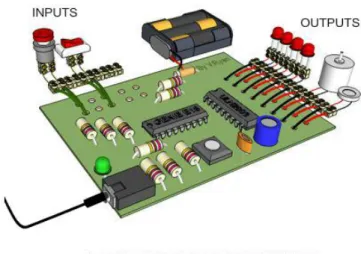
B. PIC Microcontrollers
Programmable Interface Controllers are electronic circuits that can be programmed to carry out a vast range of tasks. They can be programmed to be timers or to control a production line and much more. They are found in most electronic devices such as alarm systems, computer control systems, phones and in fact almost any electronic device. Many types of PIC microcontrollers exist, although the best are probably found in the GENIE range of programmable microcontrollers. These are programmed and simulated by circuit wizard software.
A PIC's instructions vary from about 35 instructions for the low-end PICs to over 80 instructions for the high-end PICs. The instruction set includes instructions to perform a variety of operations on registers directly, the accumulator and a literal constant or the accumulator and a register, as well as for conditional execution, and program branching.
Some operations, such as bit setting and testing, can be performed on any numbered register, but bi-operand arithmetic operations always involve W (the accumulator), writing the result back to either W or the other operand register. To load a constant, it is necessary to load it into W before it can be moved into another register. On the older cores, all register moves needed to pass through W, but this changed on the "high end" cores.
PIC cores have skip instructions which are used for conditional execution and branching. The skip instructions are 'skip if bit set' and 'skip if bit not set'. Because cores before PIC18 had only unconditional branch instructions, conditional jumps are implemented by a conditional skip (with the opposite condition) followed by an unconditional branch. Skips are also of utility for conditional execution of any immediate single following instruction. It is possible to skip instructions. For example, the instruction sequence "skip if A; skip if B; C" will execute C if A is true or if B is false.
Some of the advantages of using a PIC controller are: Small instruction set to learn
RISC architecture
Built in oscillator with selectable speeds
Easy entry level, in circuit programming plus in circuit debugging PICKit units available for less than $50
Inexpensive microcontrollers
Wide range of interfaces including I²C, SPI, USB, USART, A/D, programmable comparators, PWM, LIN, CAN, PSP, and Ethernet.
Availability of processors in DIL package makes them easy to handle for hobby use.
International Journal of Research in Computer and
Communication Technology, Vol 2, Issue 10, October- 2013
ISSN (Online) 2278- 5841
ISSN (Print) 2320- 5156
WWW.IJRCCT.ORG
Page 926
Existing systems needs high power consumption which can be lowered by using Bluetooth or Bluetooth LE system.
III. PROPOSED METHOD
A. The Design
Our proposed system consists of two main units. A main programmable unit
A wrist band
1) Main Programmable Unit:This is the main unit consistingof 35 boxes to store up to 35 different types of medicines. It includes various microchips, PIC Microcontrollers, a keyboard circuit, a display unit, audio units, power supply unit andan inbuilt Bluetooth device.The patient can store the respective time of the particular medicine through a keypad. Based on an RTC (Real Time Clock) interfaced to the microcontroller, the programmed time for the medicine is displayed on the LCD along with a buzzer sound to alert the patient about taking the appropriate medicine.
Wheneversystem is turned on, the display asks for the medicine name, the prescribed time to take the medicine and the box number in which user wants to store the medicine. The system will ask for confirmation if any other medicine has to be taken at the same time as it is driven by an algorithm. Now, at the specific time the alarm will beep and the concerned boxes will open. A flip-flop latch can be attached with the door of the boxes so that all boxes can be connected via a parallel connection. Also an alert signal will pass via the Bluetooth device attached with it to the wrist band which is to be worn by the patient. Actually it can be any Bluetooth enabled device the user wishes to carry. The device can be attached with a locket or even with the hearing aid of the patients. 2) The wrist band: The wrist band or any signal
receiver device consists of another Bluetooth for receiving the alert from the main device, a LED and an alarm audio device.
Fig.1 Our Proposed Device
B. PIC Microcontrollers
Programmable Interface Controllers are electronic circuits that can be programmed to carry out a vast range of tasks. They can be programmed to be timers or to control a production line and much more. They are found in most electronic devices such as alarm systems, computer control systems, phones and in fact almost any electronic device. Many types of PIC microcontrollers exist, although the best are probably found in the GENIE range of programmable microcontrollers. These are programmed and simulated by circuit wizard software.
A PIC's instructions vary from about 35 instructions for the low-end PICs to over 80 instructions for the high-end PICs. The instruction set includes instructions to perform a variety of operations on registers directly, the accumulator and a literal constant or the accumulator and a register, as well as for conditional execution, and program branching.
Some operations, such as bit setting and testing, can be performed on any numbered register, but bi-operand arithmetic operations always involve W (the accumulator), writing the result back to either W or the other operand register. To load a constant, it is necessary to load it into W before it can be moved into another register. On the older cores, all register moves needed to pass through W, but this changed on the "high end" cores.
PIC cores have skip instructions which are used for conditional execution and branching. The skip instructions are 'skip if bit set' and 'skip if bit not set'. Because cores before PIC18 had only unconditional branch instructions, conditional jumps are implemented by a conditional skip (with the opposite condition) followed by an unconditional branch. Skips are also of utility for conditional execution of any immediate single following instruction. It is possible to skip instructions. For example, the instruction sequence "skip if A; skip if B; C" will execute C if A is true or if B is false.
Some of the advantages of using a PIC controller are: Small instruction set to learn
RISC architecture
Built in oscillator with selectable speeds
Easy entry level, in circuit programming plus in circuit debugging PICKit units available for less than $50
Inexpensive microcontrollers
Wide range of interfaces including I²C, SPI, USB, USART, A/D, programmable comparators, PWM, LIN, CAN, PSP, and Ethernet.
Availability of processors in DIL package makes them easy to handle for hobby use.
International Journal of Research in Computer and
Communication Technology, Vol 2, Issue 10, October- 2013
ISSN (Online) 2278- 5841
ISSN (Print) 2320- 5156
WWW.IJRCCT.ORG
Page 926
Existing systems needs high power consumption which can be lowered by using Bluetooth or Bluetooth LE system.
III. PROPOSED METHOD
A. The Design
Our proposed system consists of two main units. A main programmable unit
A wrist band
1) Main Programmable Unit:This is the main unit consistingof 35 boxes to store up to 35 different types of medicines. It includes various microchips, PIC Microcontrollers, a keyboard circuit, a display unit, audio units, power supply unit andan inbuilt Bluetooth device.The patient can store the respective time of the particular medicine through a keypad. Based on an RTC (Real Time Clock) interfaced to the microcontroller, the programmed time for the medicine is displayed on the LCD along with a buzzer sound to alert the patient about taking the appropriate medicine.
Wheneversystem is turned on, the display asks for the medicine name, the prescribed time to take the medicine and the box number in which user wants to store the medicine. The system will ask for confirmation if any other medicine has to be taken at the same time as it is driven by an algorithm. Now, at the specific time the alarm will beep and the concerned boxes will open. A flip-flop latch can be attached with the door of the boxes so that all boxes can be connected via a parallel connection. Also an alert signal will pass via the Bluetooth device attached with it to the wrist band which is to be worn by the patient. Actually it can be any Bluetooth enabled device the user wishes to carry. The device can be attached with a locket or even with the hearing aid of the patients. 2) The wrist band: The wrist band or any signal
receiver device consists of another Bluetooth for receiving the alert from the main device, a LED and an alarm audio device.
Fig.1 Our Proposed Device
B. PIC Microcontrollers
Programmable Interface Controllers are electronic circuits that can be programmed to carry out a vast range of tasks. They can be programmed to be timers or to control a production line and much more. They are found in most electronic devices such as alarm systems, computer control systems, phones and in fact almost any electronic device. Many types of PIC microcontrollers exist, although the best are probably found in the GENIE range of programmable microcontrollers. These are programmed and simulated by circuit wizard software.
A PIC's instructions vary from about 35 instructions for the low-end PICs to over 80 instructions for the high-end PICs. The instruction set includes instructions to perform a variety of operations on registers directly, the accumulator and a literal constant or the accumulator and a register, as well as for conditional execution, and program branching.
Some operations, such as bit setting and testing, can be performed on any numbered register, but bi-operand arithmetic operations always involve W (the accumulator), writing the result back to either W or the other operand register. To load a constant, it is necessary to load it into W before it can be moved into another register. On the older cores, all register moves needed to pass through W, but this changed on the "high end" cores.
PIC cores have skip instructions which are used for conditional execution and branching. The skip instructions are 'skip if bit set' and 'skip if bit not set'. Because cores before PIC18 had only unconditional branch instructions, conditional jumps are implemented by a conditional skip (with the opposite condition) followed by an unconditional branch. Skips are also of utility for conditional execution of any immediate single following instruction. It is possible to skip instructions. For example, the instruction sequence "skip if A; skip if B; C" will execute C if A is true or if B is false.
Some of the advantages of using a PIC controller are: Small instruction set to learn
RISC architecture
Built in oscillator with selectable speeds
Easy entry level, in circuit programming plus in circuit debugging PICKit units available for less than $50
Inexpensive microcontrollers
Wide range of interfaces including I²C, SPI, USB, USART, A/D, programmable comparators, PWM, LIN, CAN, PSP, and Ethernet.
Availability of processors in DIL package makes them easy to handle for hobby use.
Fig. 2 A PIC Microcontroller
C. Bluetooth
Bluetooth is a wireless technology standard for exchanging data over short distances (using short wavelength radio transmission in the ISM band from 2400-2480 MHz ) from fixed and mobile devices, creating personal area networks with high levels of security. Bluetooth operates in the range of 2400-2483.5 MHz including the guard bands. This is in the globally unlicensed industrial, scientific and medical 2.4GHz short range radio frequency range. Bluetooth uses are radio technology called frequency hopping spread spectrum. Transmitted data is divided into packets and each packet is transmitted on one of the 79 designated Bluetooth channels each channel has a bandwidth of 1 MHzThe first channel starts at 2402 MHz and continues up to 2480 MHz in 1 MHz steps. It usually performs 1600 hops per second with adaptive frequency hopping enabled. Bluetooth is a packet based protocol with a master-slave structure. One master may communicate up to seven slaves in a Piconet. A master Bluetooth device can communicate with a maximum of seven devices in a Piconet (an Adhoc computer network using Bluetooth technology). The devices can switch roles i.e., the slave can become the master or the master can become the slave. The Bluetooth core specification provides for the connection of two or more Piconets to form a Scatternet, in which certain devices simultaneously play the master role in one Piconet and the slave role in another.When Bluetooth-capable devices come within range of one another, an electronic conversation takes place to determine whether they have data to share or whether one needs to control the other. The user doesn't have to press a button or give a command -- the electronic conversation happens automatically. Once
the conversation has occurred, the devices -- whether they're part of the main device system or the wrist band --form a network. Bluetooth systems create a personal-area network (PAN), or Piconet, that may fill a room or may encompass no more distance than that between the main device and the wrist band on user’s hand. Once a Piconet is established, the members randomly hop frequencies in unison so they stay in touch with one another and avoid other Piconets that may be operating in the same room.
Bluetooth low energy or Bluetooth LE (BLE) branded as Bluetooth SMART since 2011 is a wireless computer network technology which is aimed at novel applications in the healthcare, fitness, security, and home entertainment industries. Compared to "Classic" Bluetooth, BLE is intended to provide considerably reduced power consumption and lower cost, whilst maintaining a similar communication range.
Mainly Bluetooth is defined as a layer protocol architecture consisting of core protocols, cable replacement protocols, telephony control protocols, and adopted protocols. Mandatory protocols for all Bluetooth stacks are: LMP, L2CAP and SDP. In addition, devices that communicate with Bluetooth almost universally can use these protocols: HCI and RFCOMM.
D. Flip-flops
A flip-flop or latch is a circuit that has two stable states and can be used to store state information. A flip-flop is a bistable multivibrator. The circuit can be made to change state by signals applied to one or more control inputs and will have one or two outputs. It is the basic storage element in sequential logic. Flip-flops and latches are a fundamental building block ofdigital electronics systems used in computers, communications, and many other types of systems. Flip-flops and latches are used as data storage elements. Such data storage can be used for storage of state, and such a circuit is described as sequential logic. When used in a finite-state machine, the output and next state depend not only on its current input, but also on its current state (and hence, previous inputs). It can also be used for counting of pulses, and for synchronizing variably-timed input signals to some reference timing signal.
Flip-flops can be either simple (transparent or opaque) or clocked (synchronous or edge-triggered) the simple ones are commonly called latches. The word latch ismainly used for storage elements, while clocked devices are described as flip-flops.A latch is level-sensitive, whereas a flip-flop is edge-sensitive. That is, when a latch is enabled it becomes transparent, while a flip flop's output only changes on a single type (positive going or negative going) of clock edge. Various types of
flip-Fig. 2 A PIC Microcontroller
C. Bluetooth
Bluetooth is a wireless technology standard for exchanging data over short distances (using short wavelength radio transmission in the ISM band from 2400-2480 MHz ) from fixed and mobile devices, creating personal area networks with high levels of security. Bluetooth operates in the range of 2400-2483.5 MHz including the guard bands. This is in the globally unlicensed industrial, scientific and medical 2.4GHz short range radio frequency range. Bluetooth uses are radio technology called frequency hopping spread spectrum. Transmitted data is divided into packets and each packet is transmitted on one of the 79 designated Bluetooth channels each channel has a bandwidth of 1 MHzThe first channel starts at 2402 MHz and continues up to 2480 MHz in 1 MHz steps. It usually performs 1600 hops per second with adaptive frequency hopping enabled. Bluetooth is a packet based protocol with a master-slave structure. One master may communicate up to seven slaves in a Piconet. A master Bluetooth device can communicate with a maximum of seven devices in a Piconet (an Adhoc computer network using Bluetooth technology). The devices can switch roles i.e., the slave can become the master or the master can become the slave. The Bluetooth core specification provides for the connection of two or more Piconets to form a Scatternet, in which certain devices simultaneously play the master role in one Piconet and the slave role in another.When Bluetooth-capable devices come within range of one another, an electronic conversation takes place to determine whether they have data to share or whether one needs to control the other. The user doesn't have to press a button or give a command -- the electronic conversation happens automatically. Once
the conversation has occurred, the devices -- whether they're part of the main device system or the wrist band --form a network. Bluetooth systems create a personal-area network (PAN), or Piconet, that may fill a room or may encompass no more distance than that between the main device and the wrist band on user’s hand. Once a Piconet is established, the members randomly hop frequencies in unison so they stay in touch with one another and avoid other Piconets that may be operating in the same room.
Bluetooth low energy or Bluetooth LE (BLE) branded as Bluetooth SMART since 2011 is a wireless computer network technology which is aimed at novel applications in the healthcare, fitness, security, and home entertainment industries. Compared to "Classic" Bluetooth, BLE is intended to provide considerably reduced power consumption and lower cost, whilst maintaining a similar communication range.
Mainly Bluetooth is defined as a layer protocol architecture consisting of core protocols, cable replacement protocols, telephony control protocols, and adopted protocols. Mandatory protocols for all Bluetooth stacks are: LMP, L2CAP and SDP. In addition, devices that communicate with Bluetooth almost universally can use these protocols: HCI and RFCOMM.
D. Flip-flops
A flip-flop or latch is a circuit that has two stable states and can be used to store state information. A flip-flop is a bistable multivibrator. The circuit can be made to change state by signals applied to one or more control inputs and will have one or two outputs. It is the basic storage element in sequential logic. Flip-flops and latches are a fundamental building block ofdigital electronics systems used in computers, communications, and many other types of systems. Flip-flops and latches are used as data storage elements. Such data storage can be used for storage of state, and such a circuit is described as sequential logic. When used in a finite-state machine, the output and next state depend not only on its current input, but also on its current state (and hence, previous inputs). It can also be used for counting of pulses, and for synchronizing variably-timed input signals to some reference timing signal.
Flip-flops can be either simple (transparent or opaque) or clocked (synchronous or edge-triggered) the simple ones are commonly called latches. The word latch ismainly used for storage elements, while clocked devices are described as flip-flops.A latch is level-sensitive, whereas a flip-flop is edge-sensitive. That is, when a latch is enabled it becomes transparent, while a flip flop's output only changes on a single type (positive going or negative going) of clock edge. Various types of
flip-Fig. 2 A PIC Microcontroller
C. Bluetooth
Bluetooth is a wireless technology standard for exchanging data over short distances (using short wavelength radio transmission in the ISM band from 2400-2480 MHz ) from fixed and mobile devices, creating personal area networks with high levels of security. Bluetooth operates in the range of 2400-2483.5 MHz including the guard bands. This is in the globally unlicensed industrial, scientific and medical 2.4GHz short range radio frequency range. Bluetooth uses are radio technology called frequency hopping spread spectrum. Transmitted data is divided into packets and each packet is transmitted on one of the 79 designated Bluetooth channels each channel has a bandwidth of 1 MHzThe first channel starts at 2402 MHz and continues up to 2480 MHz in 1 MHz steps. It usually performs 1600 hops per second with adaptive frequency hopping enabled. Bluetooth is a packet based protocol with a master-slave structure. One master may communicate up to seven slaves in a Piconet. A master Bluetooth device can communicate with a maximum of seven devices in a Piconet (an Adhoc computer network using Bluetooth technology). The devices can switch roles i.e., the slave can become the master or the master can become the slave. The Bluetooth core specification provides for the connection of two or more Piconets to form a Scatternet, in which certain devices simultaneously play the master role in one Piconet and the slave role in another.When Bluetooth-capable devices come within range of one another, an electronic conversation takes place to determine whether they have data to share or whether one needs to control the other. The user doesn't have to press a button or give a command -- the electronic conversation happens automatically. Once
the conversation has occurred, the devices -- whether they're part of the main device system or the wrist band --form a network. Bluetooth systems create a personal-area network (PAN), or Piconet, that may fill a room or may encompass no more distance than that between the main device and the wrist band on user’s hand. Once a Piconet is established, the members randomly hop frequencies in unison so they stay in touch with one another and avoid other Piconets that may be operating in the same room.
Bluetooth low energy or Bluetooth LE (BLE) branded as Bluetooth SMART since 2011 is a wireless computer network technology which is aimed at novel applications in the healthcare, fitness, security, and home entertainment industries. Compared to "Classic" Bluetooth, BLE is intended to provide considerably reduced power consumption and lower cost, whilst maintaining a similar communication range.
Mainly Bluetooth is defined as a layer protocol architecture consisting of core protocols, cable replacement protocols, telephony control protocols, and adopted protocols. Mandatory protocols for all Bluetooth stacks are: LMP, L2CAP and SDP. In addition, devices that communicate with Bluetooth almost universally can use these protocols: HCI and RFCOMM.
D. Flip-flops
A flip-flop or latch is a circuit that has two stable states and can be used to store state information. A flip-flop is a bistable multivibrator. The circuit can be made to change state by signals applied to one or more control inputs and will have one or two outputs. It is the basic storage element in sequential logic. Flip-flops and latches are a fundamental building block ofdigital electronics systems used in computers, communications, and many other types of systems. Flip-flops and latches are used as data storage elements. Such data storage can be used for storage of state, and such a circuit is described as sequential logic. When used in a finite-state machine, the output and next state depend not only on its current input, but also on its current state (and hence, previous inputs). It can also be used for counting of pulses, and for synchronizing variably-timed input signals to some reference timing signal.
Flip-flops can be either simple (transparent or opaque) or clocked (synchronous or edge-triggered) the simple ones are commonly called latches. The word latch ismainly used for storage elements, while clocked devices are described as flip-flops.A latch is level-sensitive, whereas a flip-flop is edge-sensitive. That is, when a latch is enabled it becomes transparent, while a flip flop's output only changes on a single type (positive going or negative going) of clock edge. Various types of
flip-International Journal of Research in Computer and
Communication Technology, Vol 2, Issue 10, October- 2013
ISSN (Online) 2278- 5841
ISSN (Print) 2320- 5156
WWW.IJRCCT.ORG
Page 928
flops are present which can be implemented in our device to open the box door automatically.
.
Fig. 3 The working block diagram of a SR flip-flop
Fig. 4 The working block diagram of a data flip-flop
Fig. 3 The probable block diagram of our proposed main device
E. The Working Algorithm
The following is a probable working algorithm for the working of Programmable Medication Wireless Alert System (Using Bluetooth).
Steps:
1. START
2. Initialize Variables 3. Loop
4. Enter Time, Box_No., Medicine_Name respectively
5. Want to enter Another_Entry? Y/N
6. Return to Step 2, while Another_Entry = =’Y’ 7. End of Loop
8. Print System_Time , System_Date
9. When System_Time = = ‘Time’ and System_Date = = ‘Date’
10. Enable the PIC chip and the Bluetooth chip for wireless transmission
11. LED blinks with an alarm in the wrist band as well as in the main device.
12. Redirect Response to flip-flop
13. Open the respective box(es) door with an alarm 14. END
F. Advantages of our proposed system
Our proposed system has several advantages over the existing systems. They
are:-International Journal of Research in Computer and
Communication Technology, Vol 2, Issue 10, October- 2013
ISSN (Online) 2278- 5841
ISSN (Print) 2320- 5156
WWW.IJRCCT.ORG
Page 928
flops are present which can be implemented in our device to open the box door automatically.
.
Fig. 3 The working block diagram of a SR flip-flop
Fig. 4 The working block diagram of a data flip-flop
Fig. 3 The probable block diagram of our proposed main device
E. The Working Algorithm
The following is a probable working algorithm for the working of Programmable Medication Wireless Alert System (Using Bluetooth).
Steps:
1. START
2. Initialize Variables 3. Loop
4. Enter Time, Box_No., Medicine_Name respectively
5. Want to enter Another_Entry? Y/N
6. Return to Step 2, while Another_Entry = =’Y’ 7. End of Loop
8. Print System_Time , System_Date
9. When System_Time = = ‘Time’ and System_Date = = ‘Date’
10. Enable the PIC chip and the Bluetooth chip for wireless transmission
11. LED blinks with an alarm in the wrist band as well as in the main device.
12. Redirect Response to flip-flop
13. Open the respective box(es) door with an alarm 14. END
F. Advantages of our proposed system
Our proposed system has several advantages over the existing systems. They
are:-International Journal of Research in Computer and
Communication Technology, Vol 2, Issue 10, October- 2013
ISSN (Online) 2278- 5841
ISSN (Print) 2320- 5156
WWW.IJRCCT.ORG
Page 928
flops are present which can be implemented in our device to open the box door automatically.
.
Fig. 3 The working block diagram of a SR flip-flop
Fig. 4 The working block diagram of a data flip-flop
Fig. 3 The probable block diagram of our proposed main device
E. The Working Algorithm
The following is a probable working algorithm for the working of Programmable Medication Wireless Alert System (Using Bluetooth).
Steps:
1. START
2. Initialize Variables 3. Loop
4. Enter Time, Box_No., Medicine_Name respectively
5. Want to enter Another_Entry? Y/N
6. Return to Step 2, while Another_Entry = =’Y’ 7. End of Loop
8. Print System_Time , System_Date
9. When System_Time = = ‘Time’ and System_Date = = ‘Date’
10. Enable the PIC chip and the Bluetooth chip for wireless transmission
11. LED blinks with an alarm in the wrist band as well as in the main device.
12. Redirect Response to flip-flop
13. Open the respective box(es) door with an alarm 14. END
F. Advantages of our proposed system
Our proposed system has several advantages over the existing systems. They
are:-1) Our system is not only a programmable medication alert system but it also shows an application of Bluetooth.
2) The box is designed in such a way that more than one patient can utilize it, as there are 35 boxes for keeping 35 types of medicines.
3) The system and the algorithm is designed in such a way that there is no complexity refilling the boxes as each boxes contain only one type of medicine. So it is user friendly.
4) In case of low power consumption factor, Bluetooth Low Energy (BLE) can be used. 5) A rechargeable battery can be used as a power
supply to make the device portable .It also will help the device to work in case of power cuts. G. Future Scope regarding our application
We have designed a system which uses Bluetooth for transmitting the signal from the main device and the wrist band. Other Wireless Transmission Systems like Wi-Fi or routers can be used for sending the alert signal in a form of text messages or in a form of email to the secondary device. Thus the user (patient) can get alarm when he/she is not present in the home.This can be done by using a mobile application that will run via an internet/Wi-Fi. It can be used over a longer distance (more than 100m).
IV. CONCLUSIONS
The major problem faced by an aged person is their absence of mind, and lack of hearing. But as we know that they are very much vulnerable towards medication & proper intake of medicine. Our proposed system aims at resolving this problem. The wrist band proves to be a significant part of our proposed system. It not only reveals a new application of Bluetooth or BLE but also helps the aged person to hear the alert properly as it will be attached to his/her body. We have designed this system to help the patients and we hope this proves to be effective for taking proper medicines at the correct time which is probably the most essential for them.
.
ACKNOWLEDGMENT
The authors of this paper would like to thank their parents for their constant encouragement and support. We would also like to thank the various resources and our university for providing ample information regarding our field. The authors are also very much thankful for anonymous reviewers and editors.
REFERENCES
[1] Digital logic Available:http://www.williamson-labs.com/480_logic.htm [2] Digital circuits and logic designby Samuel C. Lee
[3] Digital Circuits and Design.by Arivazhagan S Salivahanan. [4] Mobile Communicationsby J.Schiller.
[5] The IEEE website. Available: http://www.ieee.org/ [6] http://www.google.com/patents/US5264973 [7] The PIC Microcontrollerby John Morton [8] http://electronics.howstuffworks.com/. [9] http://en.wikipedia.org/.